
SRQ02 Civility: High Impact, Bite-Sized Habits

Civility as a Ministry: Forging Habits for a Resilient World

Session SRQ02: Civility: High Impact, Bite-Sized Habits

Time: 70 Minutes, Lecture 50 minutes, videos 20 minutes.

Luke 16:10

Whoever is faithful in a very little is faithful also in much, and whoever is dishonest in a very little is dishonest also in much.

Lord, thank you for this wisdom, reminding us that faithfulness in small matters leads to faithfulness in much. As we engage in this workshop, help us to be stewards of civility in the small things—our words, listening, and tone. May our minor acts of kindness build a foundation of trust and respect in our community. Amen.


  1. The Decline of Civility and Challenges to Recovery (20 Mins)

6 Big Buckets: The Decline of Civility

  • Social media and the internet: Many Americans point to social media and the internet as primary drivers of eroding civility. The rapid spread of information, and the anonymity afforded by online interactions, can contribute to disrespectful behavior.
  • Media in general: The broader media landscape, encompassing traditional and online news sources, is also often blamed for contributing to incivility.
  • Political polarization and partisan divides: The increasing polarization of political views and the tendency to demonize opposing viewpoints can foster an environment where civility is eroded. Focusing on judgment over curiosity in discourse can be particularly harmful.
  • Public officials and political leaders: The behavior of public officials and political leaders is seen by many as influencing the overall level of civility in society. Incivility among elites can potentially trickle down and impact how citizens interact with one another.
  • Changes in societal values: Some suggest that a shift in values, emphasizing individualism and authentic self-expression over social conventions, may contribute to a decline in traditional politeness norms.
  • Weakening social norms and lack of education: A lack of emphasis on teaching and upholding civility, both within families and educational institutions, might contribute to its decline.

Analyzing the Decline

  • Social media and internet provide ways to amplify human imperfections.  Communities and individuals are developing solutions to box out some options and nudge us in positive directions.
  • The media has returned to its historical partisan stance, mixing fact and opinion, and using whatever it takes to compete for eyeballs and mindshare, appealing to our lower natures.  Combined with 24/7 access and the modern focus on individual identity, this remains a challenge to individuals and communities.
  • Political polarization has grown due to political party, candidate and advisor choices in the last 50 years.  There are practical structural solutions.  Our federal system may help us to implement and prove the value of these options at the state level.  National level adoption may require a political crisis to return power from the politicians to the people.
  • The decline in public official and political leader civility is another two-direction system.  The loss of civility in the population normalizes, accepts and affirms such behavior in leaders.  The breakdown in leader behavior does the same for the people.  This is the vicious downward cycle of civility.  We have the time and tools to reverse it.
  • Radical individualism has become a socially accepted philosophy of life.  It undermines the civility value of public-spiritedness which serves to balance community and individual needs.  In session 7, we’ll review the “paradox of tolerance”.  A society may not be able to tolerate individuals or groups who are intolerant of the core values and institutions of society.  We may need to determine how much pure individualism or lack of support for the community is tolerated in our society.
  • Civic duties, national history and civility have declined because we have not made them an educational priority.  This can be corrected.  I believe that the elevation of “tolerance” as a social value has contributed to this slide.  The rise of postmodernism as an influential philosophy in the education, entertainment and media industries promotes pure subjectivity and relativism.  The “classical liberal” philosophy of democracy also points to a limited or zero formal government support for any public morality or values.  We describe civility as being part of the “rules of the game”.  It is based on certain values.  It aspires to become a social norm that is “enforced” by society.  I believe that this kernel of values, behaviors and norms is required to support civil society.  We have not resolved this question.  As I’ll argue in Session 3, civilization is fragile.  Civility holds it together.

Optional readings:

https://tomkapostasy.com/2025/08/25/causes-of-the-decline-in-civility-2/

https://tomkapostasy.com/2025/04/21/civility-crisis-or-civilization-crisis/

https://tomkapostasy.com/2026/04/10/root-causes-of-the-decline-of-civility-2-2/

https://tomkapostasy.com/2026/03/09/civility-resources-2-causes-of-the-decline-in-civility/

https://tomkapostasy.com/2025/03/14/6-root-causes-of-our-situation/

https://tomkapostasy.com/2026/03/09/civility-resources-3-politics/

https://tomkapostasy.com/2026/04/10/reducing-political-polarization-9-3/

https://tomkapostasy.com/2025/09/19/causes-of-increased-political-polarization/

https://tomkapostasy.com/2023/07/15/one-page-why-were-polarized-klein-2020/

https://tomkapostasy.com/2023/04/10/why-were-polarized-2020/

https://tomkapostasy.com/2026/03/09/civility-resources-5-action/

Challenges to the Recovery of Civility as a Social Norm

  • From above: media, social media and internet appeal to our lesser angels.  National political polarization further infects local politics and daily life.  The decline in national leader behavior passes the “tipping point” and everyone employs uncivil tactics because “everyone else does so”.  Radical individualism is normalized and widely accepted, even by the church.  We fail to define, teach and require, incentivize, or nudge a minimum set of core civic duties.
  • Our moral, mental, emotional and tribal wiring is not designed to support all civility behaviors without significant personal and social investments (Sessions 4-7).
  • Civility is not simple or easy.  It is an aspirational moral system.  We never fully arrive or graduate.
  • The misperceptions of civility discourage its use.  Especially the idea that it is just surface level politeness, naïve good wishes and too weak to be effective.
  • Civility requires self-confidence and courage.
  • Radical individualism, in its more socially acceptable form as expressive individualism (“be all that you can be”), expands its influence with the underlying individualistic philosophy that praises ONLY individual creativity and expression, rejecting any valid role for society or God.  This is sometimes described as “the therapeutic society” or the “culture of narcissism”.

Optional readings:

https://tomkapostasy.com/2025/12/14/civility-is-not-simple-or-easy/

https://tomkapostasy.com/2026/04/10/challenges-to-adopting-civility-7-3/

https://tomkapostasy.com/2025/08/25/causes-of-the-decline-in-civility-2/

https://tomkapostasy.com/2026/07/08/charles-taylors-our-secular-age-a-short-summary/

https://tomkapostasy.com/2025/02/13/whats-the-root-cause-of-our-problems-our-secular-age/

  1. Hope: Restoring Civility (20 Mins; brief lecture, selected inspirational videos)
  • ”Western Civilization” has a constructive 500-year track record of improving in all dimensions.  Social and moral life can be improved by learning and experience.
  • Modern civility is rooted in solid research and leverages teaching methods.
  • These skills are teachable, actionable and can be learned incrementally in safe environments.
  • The skills are powerful and apply to all social environments, so they are attractive to everyone based on self-interest alone.
  • There are many motivations/inspirations for developing these skills. (Session 12)
  • The basic skills can be learned by anyone without needing permission!
  • Business, government, education and religious institutions have an incentive to invest in and reinforce civility.
  • Civility reinforces religious beliefs and practices.
  • Civility is nonpartisan, able to step above political polarization.
  • Civility reinforces our shared human dignity, agency and community.
  • Civility helps Americans to see what they have in common.
  • People now see the downside of losing civility.
  • The recovery of civility is a spontaneous, grass-roots effort.  It does not depend upon great national leadership.
  • Civility as a social norm can benefit from the self-reinforcing virtuous cycle.
  • Improved civility positively addresses the challenges of political polarization, skepticism, insecurity, radical individualism and our secular age.  This may be an even more powerful virtuous cycle than rebuilding civility per se.
  • God has a plan for mankind.  Civility fits well into “Love God, Love Neighbor, Serve God, Serve Neighbor”.

Optional readings:

https://tomkapostasy.com/2026/04/06/civility-i-will-survive/

https://tomkapostasy.com/2026/02/23/restoring-civility-overcoming-obstacles/

https://tomkapostasy.com/2025/12/14/the-power-of-civility/

https://tomkapostasy.com/2026/03/09/civility-resources-6-solutions/

https://tomkapostasy.com/2025/10/21/civility-is-for-everyone/

https://tomkapostasy.com/2026/04/10/motivation-for-civility-3-3/

https://tomkapostasy.com/2026/04/10/inspiration-for-civility-3-4/

https://tomkapostasy.com/2026/04/10/things-we-have-in-common-5-11/

https://tomkapostasy.com/2026/04/10/what-americans-have-in-common-7-1/

🤝 Political Civility & Defining Moments of Leadership

These historic moments show how national figures intentionally elevated dignity over partisanship, modeling standard-setting behavior for a broader audience.

  • John McCain Defends Barack Obama (2008 Campaign): A classic example of a leader pausing a high-stakes campaign to protect the dignity of his opponent.
  • Ronald Reagan and Tip O’Neill (The “After 6:00 PM” Relationship): Archival footage showing how the staunchly conservative President and fiercely liberal Speaker of the House separated intense policy fights from deep personal affection.
  • George W. Bush’s 2017 “Spirit of Liberty” Speech: Clips from his address praising the enduring ideals of American democracy, human dignity, and the embrace of civic responsibility.
  • Ronald Reagan’s “Shining City upon a Hill” (Farewell Address): His timeless visual metaphor for an optimistic, open, and welcoming nation built on liberty.

🏠 Hands-On Civic Leadership & Human Dignity

These clips shift the lens to physical action and the tangible, lifelong commitment to building communities from the ground up.

  • Dolly Parton’s Imagination Library (“The Book Lady”): Short clips detailing her initiative to gift millions of books to children globally to advance early literacy.
  • The Carters Supporting Habitat for Humanity: Footage spanning decades of Jimmy and Rosalynn Carter picking up hammers to build homes side-by-side with volunteers.
  • Barack Obama’s 2009 Inauguration Impact: Clips showing the profound generational and cultural emotional ripple effect across African American communities as he took the oath of office.

🍿 Cinematic Metaphors: Loyalty, Persistence, & The Individual

Using highly recognizable popular culture touchstones allows you to tap into deep emotional reservoirs, offering memorable analogies your participants can instantly grasp.

  • Sam Carries Frodo (The Lord of the Rings: The Return of the King): The iconic peak of cinematic loyalty: “I can’t carry it for you, but I can carry you!”
  • Forrest Gump “Just Started Running”: The scene where Forrest begins running across America, drawing a massive, unprompted wave of followers who find their own purpose in his simple stride.
    • Workshop Hook: “Organic Momentum. You don’t always need a perfect 10-step strategic plan to begin creating change. Sometimes, simply starting the work with authenticity creates a template for others to follow.”
    • https://www.youtube.com/shorts/kN8Zyio6pOc
    •  
  • The Star Thrower Story (The Starfish Analogy): A visual or narrated retelling of the classic story where a traveler tells a child throwing washed-up starfish back into the sea that they can’t possibly make a difference to miles of beach. The child replies, “It made a difference to that one.”
    • Workshop Hook: “Resisting Scale Despair. Overcoming the paralyzing feeling that a massive systemic problem is too big to fix by intentionally focusing on localized, individual impact.”
    • https://www.youtube.com/watch?v=Q-R5LqE3nzY
    •  
  • Gomer Pyle Sings “The Impossible Dream”: The surprising, deeply moving juxtaposition of the bumbling private stunning his harsh sergeant with a flawlessly sincere rendition of the standard.

III. The Applied Behaviors of Civility (25 Mins)

I. Video Introduction: Daniel Goleman’s Emotional Intelligence Model (6 Mins, 1.4x speed)

II. How Behaviors Fit into the Civility Model (18 Mins)

  • We’re looking at all the behaviors necessary to be highly effective at interacting with other people.  Other people have different perspectives, interests and values.  We want to both produce results and build positive relationships.
  • Today, we focus on 5 of the 7 groups of behaviors.  #6 Personal Growth, is Stephen Covey’s “Sharpen the Saw”.  #7 Problem-Solving, is comprised of skills that are typically learned in a different part of the curriculum. 
  • The remaining 5 fit together nicely, the 4 groups that Goleman addresses in his emotional intelligence model to build effective leaders; plus communications.  This is part of why Civility is misperceived as “soft”.  The skills come out of psychology, social psychology or organization behavior texts.
  • Best practices skills today combine emotional and cognitive awareness with self-control.
  • Two of the groups, self-awareness and self-management, are inward looking.  The other 3, social awareness, relationship management and communications are outward facing.
  • We’ll learn in sessions 4-7 that our default mental structures are not inherently good at building the “best practices” habits in these 5 areas.
  • We store our moral, political and religious views in our subconscious.  We are usually not aware of our specific views or managing our responses when these views are awakened.  Individuals have a variety of moral beliefs and responses that are fine-tuned and prioritized in life, again, typically without conscious thought.
  • We take shortcuts in our so-called rational thinking.
  • Emotional triggers prompt us to respond without taking advantage of the space between stimulus and response.
  • We naturally prefer people, groups and things that are familiar.  We like cognitive consistency.  We think KNOW that we are right.  We can overdo these tendencies.
  • The “best practices” skills help us to overcome these obstacles to effectiveness.
  • In this course, we’ll complete more than a dozen exercises to build skills and give you a sense of how this is done.  We’re moving at “warp speed” to illustrate a variety of areas.  Longer exercises can be used to build better skills.
  • The overlap with organizational behavior textbooks and corporate applications is intentional.  As organizations faced greater challenges in the 1970’s, they worked with social scientists to develop these insights and programs to improve the skills of managers, leaders and all workers.  As the pace of change increased, cross-functional teams became common and responsibilities were delegated to the bottom of the organization chart, companies needed to have highly effective “human resources”.
  • However, these skills are used throughout applied psychology: counseling, marriage counseling, team building, student affairs, community organizing, etc.
  • As Goleman notes, the key is that these are learned behaviors, that anyone can build at any time.
  • And, once learned, they can be applied in all walks of life.  Mastering the civility skills requires a significant investment in learning, practice and reinforcement.  But the payoff is even greater because of their universal application.
  • We’ll explain in the next session how these behaviors are infused with the civility values of human dignity, responsibility and public-spiritedness.  They are not “value free” actions.
  • I want to reinforce the chain of events in civility.  Behaviors become habits.  Habits become social norms.  Social norms are self-reinforcing.  This virtuous cycle is a critical component of maintaining civility as a shared expectation and commitment.
*
  •  

Optional readings:

https://tomkapostasy.com/2025/11/01/civility-behavioral-sciences-to-the-rescue/

https://tomkapostasy.com/2026/04/10/civility-references-0-3/

5 Groups of Civility Behaviors

Self-Awareness

Emotional Awareness – Identifying and understanding our emotions and their impact on our thoughts, behaviors, and others.
Accurate Self-assessment – Clearly understanding personal strengths and limitations without self-criticism or inflated self-perception.
Self-confidence – Firmly believing in one’s abilities, talents, and judgement.
Self-respect – Properly regarding and caring for the dignity of one’s person and character.
Authenticity – Acting in accordance with one’s true self, values and beliefs.

Self-Management

Emotional Self-control – Managing and regulating one’s emotional responses, preventing impulsive reactions.
Adaptability – Flexibly and efficiently learning and applying that knowledge across situations.
Achievement Motivation – Orientation towards success, mastery, and sense of purpose.
Initiative – Recognizing needs, taking action, and pursuing outcomes without waiting for direction.
Optimism – A mental attitude characterized by a positive outlook and expectations of favorable outcomes.
Apologizing – Acknowledging errors and guilt, expressing regret, repenting, asking for forgiveness.
Trustworthiness – Demonstrating credibility, reliability and intimacy buffered from self-interest.
Resilience – Bouncing back from adversity with flexibility & strength, maintaining wellbeing despite challenges.

Social Awareness

Empathy – Understanding what other people feel, seeing their point of view, and imagining yourself in their place.

Organizational Awareness – Interpreting a group’s emotional state, relationship dynamics and power structures.

Service Orientation – Willingly anticipating, recognizing, and meeting others’ needs, before they are articulated.

Perspective Taking – Considering others’ thoughts, feelings, intentions, and motivations in a particular situation.

Cultural Awareness – Recognizing the different beliefs, values, and customs of someone based on their origins.

Relationship Management

Influence – Capacity to affect the character, development, or behavior of another person, group, or organization.

Conflict Management – Process by which disputes are resolved, negative results are minimized and positive results are prioritized.

Teamwork and Collaboration – Combined effort of a group of people working together towards a common goal or objective.

Inspirational Leadership – Inspiring and guiding people to get the job done, to bring out their best.

Change Management – Providing approaches, tools, and techniques to achieve a desired future state.

Collaboration Tools – Offering any technology or tool that can be used to help people to better work together.

Meeting Management – Organizing and facilitating meetings to ensure productivity and alignment.

Project Management – Planning, organizing, and executing tasks to create a tangible product, service, or deliverable.

Communications

Commonality – Finding and emphasizing common interests, perspectives and experiences.

Be Patient – Encouraging others to speak, not interrupting them.

Overall Awareness – Paying attention to non-verbal cues, overall message of speakers.

Recognize/Validate Others – Listening, remembering and using names, acknowledging others’ views and emotions.

Mirror Communications – Confirming listening by restating what you heard in your own words.

Speak Kindly – Using words that are neutral or supportive, not attacking others.

Understand – Asking questions, clarifying, seeking first to understand, not to reply.

Manage Praise – Giving and receiving praise for communications, actions, intentions and results, when appropriate.

Defend Properly – Defining boundaries, expressing views in “I” statements, not overreaching.

Solve the Problem – Focusing on issues, not people.

Electronic Communications – Effective email and social media communications.

Personal Growth (#6, not covered here)

Experiential Learning – Benefiting from the experience and natural results of participating in civil processes.
Continuous Improvement – Maintaining newly developed skills and skill levels with support from civil colleagues.
Embracing Feedback – Encouraging honest feedback provides opportunities for personal growth.
New Perspectives – Gaining new approaches, viewpoints and paradigms from interacting with others.
Higher Expectations – Improving goals and behaviors in response to the expectations/norms of others.
Confidence – Using civil processes to address and resolve difficult situations builds personal and process confidence.
Broadly Applying Skills – Trying, testing and using civility skills in all domains of life.
Modelling Behaviors – Practicing civility skills helps to teach, influence and inspire others.
Developing Others – Recognizing and nurturing potential in others through encouragement and honest feedback.

Problem-Solving (#7, not covered here)

Analytical Tools – Critical thinking, decision making, game theory, finance, economics and operations management.

Creative Thinking – Thinking about a task or a problem in a new or different way, or generate new ideas.

Strategic Thinking – Intentionally and logically making organization level decisions with long-term impacts.

Organizational Design – Improving an organization’s effectiveness and performance.

Organizational Development – Structuring an organization to align with its strategic goals and objectives.

Systems Thinking – Cognitive skill and a way of understanding reality that emphasizes the whole rather than the sum of its parts.

Process Engineering – Approach to designing, analyzing, and optimizing steps to produce a consistent, repeatable outcome.

Public Administration – Coordination of government activities to ensure the effective delivery of services and the application of laws.

  1. Transition and Closing Prayer (5 Mins)

Building upon our examination of declining social norms and the behavioral skills needed for recovery, our next session will ground our workshop in the core values of human dignity, responsibility, and public-spiritedness. We will transition into an intentional look at church ministry, outlining a clear rationale for why the faith community is uniquely positioned to restore civility as a vital social norm. Together, we will examine the stark biblical and historical realities of how civilizations collapse when their relational glue dissolves, pointing us toward our ultimate goal: a flourishing civilization. Join us next week as we shift our focus from personal behavioral toolkits to the systemic, historical, and deeply spiritual calling of the Church in the public square.


Closing Prayer

“Your ancient ruins shall be rebuilt; you shall raise up the foundations of many generations; you shall be called the repairer of the breach, the restorer of streets to live in.” — Isaiah 58:12 (NRSV)


Almighty God, you are the ultimate architect of order, beauty, and human community. In a world where the glue of civility seems to be failing, we praise you for the hope that a broken society can indeed be healed. Empower us to move beyond the internal work of self-management and clear communication into the public arena of active, faithful ministry. Let our churches become vibrant sanctuaries where human dignity is fiercely protected and civility is boldly restored as a social norm. Strengthen our resolve to face historical realities honestly while actively working toward a future where all your creation may flourish together. Amen.
SRQ01 Civility: Modern Behaviors for Public Life

Civility as a Ministry: Forging Habits for a Resilient World

Church of the Palms, Sarasota, FL, 2027

Workshop Leader: Tom Kapostasy

Timing: 12 sessions of 60-75 minutes.

Workshop Summary

We live in a world where the stability of our shared civic infrastructure faces real and visible challenges, both at home and abroad. This 12-week workshop moves beyond superficial politeness and good wishes to examine civility as a practical, behavioral discipline. Our focus is on evaluating the ongoing tension between differing individual desires and community needs. By combining insights and tools from the social sciences with a Reformed theological perspective, we explore how disciplined habits and religious community can help us navigate a world of inherent human brokenness.

The first half of the course explores how our moral, mental, emotional, and tribal defaults sometimes work against the sophisticated Reason and Discernment required of us today. By identifying where our biological wiring falls short of our current social and spiritual calling, we will learn how to overcome these primitive instincts, bridge our deepest divides, and pursue human flourishing in a fractured world. In the second half, we employ practical skill-building exercises focused on self-governance, constructive dialogue, and managing conflict. We finish by applying these tools in our direct “spheres of influence”—digital, public, and family spaces—as each participant develops a civility blueprint to help us collectively build a more resilient community.

Purpose of Civility

The final purpose of civility is to establish the habits and norms that allow fractured human beings to sustain a flourishing civilization and build a resilient civic infrastructure. We live in a world of inherent human brokenness, so civility serves as a critical tool of the Church—the body of Christ—to collectively address our cognitive and moral imperfections. Practicing these disciplined behaviors, we are actively prompted to honor one another as image-bearers of God, moving beyond our imperfect instincts to fulfill our shared responsibility for the common good.

Modern Civility and Civilization (Foundations)

Session 1: Civility: Modern Behaviors for Public Life

Session 2: Civility: High Impact, Bite-Sized Habits

Session 3: Ministering to a Fragile World: The Church and the Civic Fabric

Vaulting Moral, Mental, Emotional and Tribal Hurdles (Obstacles)

Session 4: The Righteous Mind: Navigating Our Moral Foundations

Session 5: In the Same Boat: Cognitive Shortcomings and Christian Humility

Session 6: In the Arena: Forging Emotional Habits

Session 7: The Limits of Tolerance: Wrestling with Tribalism and Conviction

Weaving the Civic Mesh: Crafting Civility (Habits and Connections)

Session 8: The Art of Self-Governance: Managing Defensiveness and Boundaries

Session 9: Constructive Dialogue: Trust, Perspective, and Crucial Conversations

Session 10: Conflict Management: De-escalation and Responding to Incivility

Session 11: Sample Spheres of Influence: Digital, Public, and Family Spaces

“Head Out on the Highway” (Deployment & Action)

Session 12: The Personal Blueprint: Commissioning the “Civiliteers”

Pre-reading Assignments by Week

  1. Syllabus

https://tomkapostasy.com/2026/04/10/civility-defined-1-1/

  1. https://tomkapostasy.com/2025/12/09/civility-is-really-about-7-behaviors/
  2. Part 4A Biblical Collapses and 4C Factors, Spiral and Conclusion  https://tomkapostasy.com/2026/04/10/civility-values-3-1/ https://www.youtube.com/watch?v=W6ZDKko43p0 The Righteous Mind (4:28)
  3. None
  4. None
  5. Appendices 1, 2, and 3.
  6. Henri Tajfel and the “Minimal Group Paradigm” with Matt Williams https://www.youtube.com/watch?v=ciSx1EG4V0s&t=112s
  7. Part 3, The 3-part repair script and 10 examples of disrespect.
  8. https://tomkapostasy.com/2026/04/10/crucial-conversations-5-10/
  9. Part 1, The Art of the Pivot Guide and Toolkit
  10. Part 1, 3 scenarios.  Part 2, 8 scenarios.  Appendix 1.
  11. https://tomkapostasy.com/2026/04/10/motivation-for-civility-3-3/

https://tomkapostasy.com/2026/04/10/inspiration-for-civility-3-4/

Appendix 3.

Materials:

https://tomkapostasy.com

https://tomkapostasy.com/2026/03/09/civility-resources-0-navigating-civility/

https://tomkapostasy.com/2026/04/10/civility-references-0-3/

Books for Future Study:

Crucial Conversations Tools for Talking When Stakes Are High, Second Edition: Patterson, Kerry, Grenny, Joseph, McMillan, Ron, Switzler, Al: 8580001040288: Amazon.com: Books

The 7 Habits of Highly Effective People: 30th Anniversary Edition (The Covey Habits Series): Covey, Stephen R., Collins, Jim, Covey, Sean: 9781982137137: Amazon.com: Books

Healing the Heart of Democracy: The Courage To Create a Politics Worthy Of The Human Spirit: Palmer, Parker J.: 9781394234868: Amazon.com: Books

Choosing Civility: Forni, P. M.: 9780312302504: Amazon.com: Books

The Soul of Civility: Timeless Principles to Heal Society and Ourselves: Hudson, Alexandra: 9798982206008: Amazon.com: Books

About the Workshop Leader:

Tom Kapostasy is an educator, writer, and former corporate executive who invested four decades in mastering evolving global “best practices” and managing the tensions between the hard and soft professions, static and dynamic approaches, and central and local dimensions of large global organizations—primarily in high-technology industries. He served as CFO, COO, and global supply chain director for organizations ranging from Fortune 500 companies to the National FFA Organization, serving a million students and 15,000 teachers.

An experienced instructor, Tom has taught economics, finance, and accounting at multiple universities and led a wide array of professional content and management development workshops. He holds a BA in Economics from New College of Florida, an MBA in Finance from Case Western Reserve University, and is a graduate of Indiana University’s “Hoosier Fellows” executive leadership program.

Deeply rooted in the Reformed tradition, Tom brings a lifelong commitment to church leadership, having served as a Presbyterian elder, deacons president, treasurer, and adult education leader. He is an active member of the Sarasota community as a hunger-relief volunteer and an affiliate member of Church of the Palms. Since 2024, he has authored 100 articles on civility and supported Project Civility. Tom and his wife, Sue Maki—an elected official from the “other political party”—split their time between the vibrant communities of Carmel, Indiana, and Sarasota, Florida. Tom is an avid hiker, a frequent writer on his Good News website, and is an active community garden volunteer.

https://tomkapostasy.com

https://www.linkedin.com/in/tomkapostasy

Civility as a Ministry: Forging Habits for a Resilient World

Session SRQ01: Civility: Modern Behaviors for Public Life

Time: 70 Minutes, including a 10-minute exercise

This is the first of 3 sessions on the topic of “Modern Civility and Civilization (Foundations)”.

https://tomkapostasy.com

https://tomkapostasy.com/2026/04/10/civility-references-0-3/

https://tomkapostasy.com/2026/04/10/civility-prayers-0-5/


Genesis 1:26

Then God said, “Let us make humans in our image, according to our likeness …

Creator God, you fashioned us in your own image and likeness. As we gather, help to see that same divine image in every person, especially those with whom we disagree. Teach us to listen with compassion, speak with grace, and act with humility. May our words today reflect your image and build bridges of understanding. Amen.


Block 1: Administration, Overview, & Icebreaker/Eye-Opener

Duration: 30 Minutes

I. Administrative Check-in & Logistics (5 Mins)

  • Welcome participants and outline the physical logistics (breaks, materials, baseline guidelines).
  • Distribute the comprehensive course syllabus detailing the path from theory to application.
  • Participants are asked to read the main materials before each session and any required prereading articles.  There are also many strictly optional books and articles for now or later.
  • We have 75 minutes planned for each session.

II. Syllabus/Course Overview (15 Mins)

  • The foundational theme: Civility is an intentional, learned social system designed to protect human dignity across all sectors of life.
  • Expectation: This course moves away from surface-level etiquette toward actionable psychological tools, group leadership strategies, and behavioral constraints.  It is mostly practical and structural.
  • Define Modern Civility as “a set of behaviors that recognize differences and preserve relationships”. The behaviors are guided by a set of core values.  The behaviors become habits and then social norms.  The habits deliver both results and relationships.
  • The final purpose of civility is to “sustain a flourishing civilization and build a resilient civic infrastructure”.
  • Given our scientific understanding of human behavior, this should be easy.  It is not. Human nature is imperfectly suited for the complexities of modern life.
  • The workshop focuses on better understanding these challenges and building skills.  But this is still not enough.  Throughout the course we will emphasize the tensions inherent in actually living good lives.
  • Hence, there is a critical role for Christian ministry.  Mankind is imperfect.  Religious understanding, practices and the church community play critical roles in bridging the gap between human nature and human flourishing.
  • We move from 3 sessions on the foundations of civility and civilization through 4 sessions that describe the imperfections and challenges of practicing civility and another 4 sessions that develop skills and advice for applying civility in varied settings.  The final session translates these insights into an action plan.

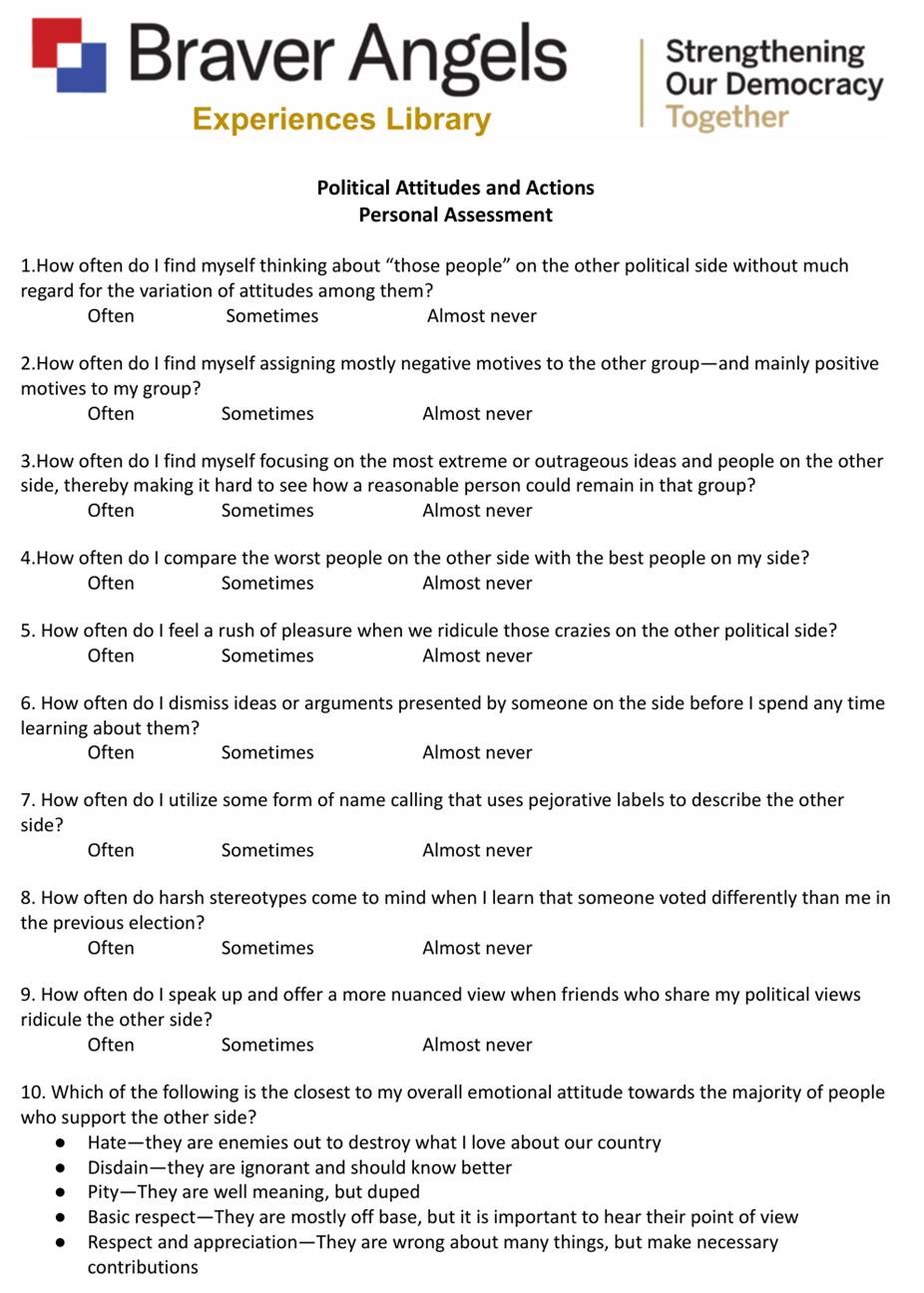
III. Icebreaker/Eye-Opener: “Political Attitudes” (10 Mins)

  • Complete Braver Angels Ex 9-2 Political Attitudes Personal Assessment
  • James 1:19–20 : “My dear brothers and sisters, take note of this: Everyone should be quick to listen, slow to speak and slow to become angry, because human anger does not produce the righteousness that God desires.”
  • https://braverangels.org/
  • https://en.wikipedia.org/wiki/Braver_Angels
  • People interested in “civility” tend to be “good government”, “center-left” or “main street”, “center-right” people.  We take a characteristic “classic liberal”, vaguely progressive and positive view of the world.  We’re accustomed to solving problems, even very difficult problems.  We sometimes implicitly think that “other people” are the issue.  I will purposely push all of us to look deeply into the possibilities for personal growth offered by the full program of modern civility.  When we see that we are all imperfect we can become better ambassadors for civility.

Block 2: Defining Civility & Correcting Misperceptions (40 minutes)

  1. Definition and Descriptions: (10 Mins)

Civility is:

  1. A set of behaviors that recognize differences and build mutual respect.
  2. A tool to deliver productive results through Civil discourse.
  3. Comprised of self-awareness, self-management, social awareness, relationship management, communications, growth and problem-solving skills and behaviors.
  4. A habit.
  5. A choice (intentional).
  6. Based on universal values of human dignity, respect, acceptance, responsibility, constructiveness, intentionality and public-spiritedness.
  7. A moral system but not a replacement for religious, philosophical or political systems.
  8. Viral; a virtuous/vicious cycle.
  9. Nonpartisan.
  10. Ecumenical.
  11. Teachable.
  12. A blend of thinking, feeling and doing.
  13. A social norm.
  14. Consistent with human nature.
  15. Actionable.
  16. An aspirational ideal, never fully achieved.
  17. A builder of trust, community, common good and institutions.
  18. A self-maintaining social system.
  19. Supported by world religions and secular humanism.
  20. Informed by modern social science.
  21. Practiced in personal, work, play, church, sports, media, union, culture, service, government and political environments.
  22. Required for democracy.
  23. Inspired by self-interest, situations, personality, identity, civic duty, patriotic duty, cultural duty, religious duty and philosophical duty.
  24. NOT too simple, complex, moderate, extreme, soft, hard, liberal or conservative.
  25. A solution to our challenges of political polarization, selfish media, radical individualism, limits of human nature, skepticism, our secular age, imperfect myths and insecurity.
    1. A Guide for Daily Life (10 Mins)

Apply the Civility Skills:

  1. Communicate effectively: active listening, seek to understand, solutions, facts versus opinions, ideas not people, engage, don’t interrupt, use “I statements”, proper tone.
  2. Practice Self-control: think twice, choose your battles, manage emotions, be patient.
  3. Apologize sincerely.
  4. Address incivility. (requires courage).
  5. Manage relationships: invest time, listening, empathy, understanding, feedback, follow-up, heads-up, no surprises, motivate, shared accountability, fair share, dirty work, spotlight, recognition, opportunities. (responsibility, respect).
  6. Be Polite.

Apply the Civility Values:

  • Be Kind. (human dignity, respect).
  • Be Responsible: own the process, fulfill commitments, respond promptly, manage shared spaces, clean up after yourself. (responsibility).
  • Be Authentic: walk the talk, follow the golden rule, say what you mean. (responsibility).
  • Value “others”: follow team rules, consider other’s perspectives, empathize, seek the common good, provide constructive feedback. (acceptance).
  • Be Inclusive: celebrate differences, welcome, encourage, open, honest, sensitive, listen, access, opportunities, voices, roles, safety, protection. (acceptance).
  • Be Respectful: others, priorities, viewpoints, ideas, solutions, politics, religion, identity, feelings, history, relations, ownership, time, timelines, commitments, while disagreeing, focus, engage, privacy, boundaries, situations. (respect).
  • Recognize: others, efforts, contributions, teams, leaders, peers, suppliers, partners, culture. (respect, constructiveness).
  • Be Positive. (constructiveness).
  1. Unpacking a Complex System: Key Insights (5 Mins)
  • The primary focus is on learnable skills and behaviors
  • With practice, the skills become habits, practiced without conscious thought.
  • When a community or society adopts these behaviors as “good” they become social norms.
  • The behaviors are NOT “value free”.  They are infused or alloyed with values.
  • The 7 civility values are broadly supported by major religions and philosophies.
  • The 3 core values are human dignity, responsibility and public spiritedness.
  • Remember human dignity, human agency and human community.
  • The values are nonpartisan.  Civility can be used to discuss or promote far-left through far-right political views.
  • Civility is the set of social norms that allow our social, moral and political systems to function in a world of personal freedom, interdependence and heartfelt differences.
  • Civility is practiced everywhere, in all interpersonal relationships and communities, large and small.

IV. Alternatives and Criticisms of Modern Civility (15 mins)

  • Civility is Politeness and Etiquette: This surface level approach does not provide real engagement that solves problems and builds relationships.  It avoids conflict and provides the appearance of civility.
  • Civility is Kindness, Niceness or a Habit of the Heart: Empathy and goodwill certainly help to promote civility.  However, they are inadequate to the task at hand.  The 5 key areas of behavior require understanding, experience, commitment and courage.  Individuals who are naturally extraverts, specific/practical, feeling, and perceiving/open ESFP in Myers-Briggs personality terms do find civility easier to practice than their opposites.  Modern civility is open to all 16 personality types.
  • Civil Discourse is enough. It focuses almost exclusively on vocabulary, rules of debate, and communication protocols. It is structurally inadequate because it fails to recognize that advanced thinking skills and deeply rooted moral values are required to sustain a community through gridlock.
  • Modern Civility is a tool for the powerful. By focusing on practical problem solving and building relationships it distracts society from power dynamics and real changes.  Civility, like any tool, can be misused.  It could also be used by any group in society to effectively promote their interests.
  • Modern Civility is an insidious secular, liberal tool. It assumes that learning and process can deliver positive results.  It hides the reality of conflicts and differing interests.  Civility tools and processes can be used to address the most contentious and difficult issues.  The system provides ways to use all possible solutions.  It takes no political or religious stances.  As we present it here, it is fully compatible with a conservative religious perspective.
  • Modern Civility is soft, weak, based on emotions alone. Modern civility focuses on skills, processes and the courage to engage in difficult situations.  It promotes ethical decision-making which includes considering all interests and perspectives.  It attends to relationships because this is an effective component of long-term success. 
  • Modern Civility is self-righteous. It overpromises results.  It is too self-confident in its theories and methods. There is a risk of elevating modern civility into a magical elixir for solving problems and healing divisions.  Throughout this workshop we will emphasize the aspirational nature of civility in bridging the gap from imperfect humans to their goals.  We will emphasize the often-unreconcilable tensions between competing principles. 

Optional reading:

https://tomkapostasy.com/2025/10/21/civility-is-for-everyone/

https://tomkapostasy.com/2025/12/14/civility-is-not-simple-or-easy/

https://tomkapostasy.com/2026/04/10/civility-misperceptions-1-2/

Transition and Closing Prayer

Looking ahead to our next session, we will expand our view from the core definition of civility to its urgent role in sustaining our threatened civilization. We will confront the mental, moral, and emotional imperfections of our shared human nature—including our deepest tribal instincts. Together, we will examine how Christian ministry offers a unique avenue for hope in the future while diving deeper into the five main categories of behavioral skills required for this work. Join us next time as we transition from foundational values to the practical, grace-filled mechanics of transforming our shared public life.

“Who is wise and understanding among you? Show by your good life that your works are done with gentleness born of wisdom.” — James 3:13

Closing Prayer:


Holy Spirit, architect of peace, we thank you for the gift of human community and the sacred call to love one another well. Guard our hearts against political bitterness and help us move beyond mere feelings into the practical skills of self-control and clear communication. Teach us to listen with social awareness and lead with a gentleness that reflects your wisdom. May our relationships bear witness to your unifying love in a divided world. Amen.

APPENDIX: Not required reading

Church and the Public Square:

A Presbyterian Guideline on Politics and Civility

Purpose of This Document

This guideline is designed for the members and leaders of our congregation to navigate the complex, often polarizing landscape of modern politics. In a community composed of diverse perspectives—our primary calling is to maintain the unity of the Spirit in the bond of peace.

This document outlines how the tools of modern civility and the rich theological heritage of the Presbyterian Church (U.S.A.) come together to guide our conversations, protect our fellowship, and honor our shared faith in Jesus Christ.


Part I: The Nature of Modern Civility

1. Civility is a Tool, not a Stance

Civility is a process and a behavioral framework; it is not a political ideology or an endorsement of any party. Its validity, authority, and power to heal divisions depend entirely upon remaining actively nonpartisan. Civility does not judge who is right or wrong in a policy debate; instead, it establishes the rules of engagement so that diverse people can coexist and collaborate with mutual dignity.

2. The Practice of Reflective Restraint

Modern civility encourages us to resist the psychological and cultural pressures toward instant, highly emotional responses to political or moral flashpoints. When confronted with divisive public questions, our first instinct should be reflective pauses rather than immediate reaction. In many cases, after careful consideration, a supporter of civility may consciously decline to respond or pass judgment, recognizing that silence or restraint can be more constructive than adding to public clamor.

3. Sharing the Vision as a Whole

Civility is a comprehensive set of values and behaviors designed to re-establish social norms. If a person, politician, or political party seeks guidance on how to bridge divides, a supporter of modern civility does not offer piecemeal policy fixes. Instead, we share the entire package of civility principles and encourage its total adoption as a lifestyle and structural commitment to human dignity, responsibility, and community.


Part II: Presbyterian Polity and Political Judgment

4. The Church Does Not Judge Individuals

Following the example and teachings of Jesus Christ, the PC(USA) does not sit in judgment of individual people. We recognize that all human beings are imperfect, stand equally in need of God’s grace, and are ultimately accountable to God alone. The church is a sanctuary for sinners seeking redemption, not a courtroom for measuring personal righteousness.

5. The Church Does Not Judge Politicians or Parties

Just as the church refrains from judging private individuals, it does not pass judgment on specific politicians or political parties. The historic Confession of 1967 explicitly warns the church against the danger of political idolatry. It reminds us that when a church identifies the sovereignty of any one nation, political program, or ideology with the cause of God, it denies the Lordship of Christ and betrays its calling. All human political structures stand under God’s judgment, and none can claim divine endorsement.

6. The Primacy of Individual Conscience and Agency

Our Presbyterian governance is anchored in the foundational truth that “God alone is Lord of the conscience.” The Confession of 1967, the Book of Order, and our historic standards consistently emphasize the primacy of individual judgment.

Mirroring the civility value of personal responsibility, our theology treats human agency as a profound, God-given gift. Every believer has full human agency to make political choices and bear their moral consequences. The relationship between the individual and the Triune God is paramount; no political party, civility program, or church body has the authority to break or supersede that connection.


Part III: How the Church Speaks to the World

7. Moral Proclamation vs. Political Endorsement

When the PC(USA) speaks out on public matters, it speaks to moral and ethical issues rather than partisan political agendas. The church’s goal is to offer prophetic witness, ground complex issues in Scripture, and help church members and citizens see the world through the lens of God’s justice and love. The church never endorses a political agenda, platform, or candidate.

8. Freedom of Conscience Takes Priority

Even when church councils (such as the General Assembly) take a strong, official moral position on an issue that some might consider political (e.g., racial justice, poverty, or care for creation), individual freedom of conscience always takes priority.

Denominational statements are intended to instruct, lead, and guide the flock—they are not legally or morally binding decrees. A faithful Presbyterian may prayerfully disagree with a statement of the church, trusting that they are ultimately answerable to God, not a church vote.

9. Our Proper Focus: Working Together

Our true calling as a local congregation is to work together, worship together, and actively respect each other’s differing political views. We refuse to let national political polarization dictate the climate of our spiritual home. By utilizing the tools of civility and leaning into our Reformed theology, we can hold our differences in tension, celebrate our shared baptism, and model to a fractured world what it looks like to find rest under the easy yoke of Jesus Christ.

Matthew 11:28-30

“Come to me, all you who are weary and burdened, and I will give you rest. Take my yoke upon you and learn from me, for I am gentle and humble in heart, and you will find rest for your souls. For my yoke is easy and my burden is light.”


SRQ00 Civility Syllabus

Civility as a Ministry: Forging Habits for a Resilient World

Church of the Palms, Sarasota, FL, 2027

Workshop Leader: Tom Kapostasy

Timing: 12 sessions of 60-75 minutes.

Workshop Summary

We live in a world where the stability of our shared civic infrastructure faces real and visible challenges, both at home and abroad. This 12-week workshop moves beyond superficial politeness and good wishes to examine civility as a practical, behavioral discipline. Our focus is on evaluating the ongoing tension between differing individual desires and community needs. By combining insights and tools from the social sciences with a Reformed theological perspective, we explore how disciplined habits and religious community can help us navigate a world of inherent human brokenness.

The first half of the course explores how our moral, mental, emotional, and tribal defaults sometimes work against the sophisticated Reason and Discernment required of us today. By identifying where our biological wiring falls short of our current social and spiritual calling, we will learn how to overcome these primitive instincts, bridge our deepest divides, and pursue human flourishing in a fractured world. In the second half, we employ practical skill-building exercises focused on self-governance, constructive dialogue, and managing conflict. We finish by applying these tools in our direct “spheres of influence”—digital, public, and family spaces—as each participant develops a civility blueprint to help us collectively build a more resilient community.

Purpose of Civility

The final purpose of civility is to establish the habits and norms that allow fractured human beings to sustain a flourishing civilization and build a resilient civic infrastructure. We live in a world of inherent human brokenness, so civility serves as a critical tool of the Church—the body of Christ—to collectively address our cognitive and moral imperfections. Practicing these disciplined behaviors, we are actively prompted to honor one another as image-bearers of God, moving beyond our imperfect instincts to fulfill our shared responsibility for the common good.

Modern Civility and Civilization (Foundations)

Session 1: Civility: Modern Behaviors for Public Life

Session 2: Civility: High Impact, Bite-Sized Habits

Session 3: Ministering to a Fragile World: The Church and the Civic Fabric

Vaulting Moral, Mental, Emotional and Tribal Hurdles (Obstacles)

Session 4: The Righteous Mind: Navigating Our Moral Foundations

Session 5: In the Same Boat: Cognitive Shortcomings and Christian Humility

Session 6: In the Arena: Forging Emotional Habits

Session 7: The Limits of Tolerance: Wrestling with Tribalism and Conviction

Weaving the Civic Mesh: Crafting Civility (Habits and Connections)

Session 8: The Art of Self-Governance: Managing Defensiveness and Boundaries

Session 9: Constructive Dialogue: Trust, Perspective, and Crucial Conversations

Session 10: Conflict Management: De-escalation and Responding to Incivility

Session 11: Sample Spheres of Influence: Digital, Public, and Family Spaces

“Head Out on the Highway” (Deployment & Action)

Session 12: The Personal Blueprint: Commissioning the “Civiliteers”

Pre-reading Assignments by Week

  1. Syllabus

https://tomkapostasy.com/2026/04/10/civility-defined-1-1/

https://tomkapostasy.com/2026/04/10/inspiration-for-civility-3-4/

Appendix 3.

Materials:

https://tomkapostasy.com

https://tomkapostasy.com/2026/03/09/civility-resources-0-navigating-civility/

https://tomkapostasy.com/2026/04/10/civility-references-0-3/

Books for Future Study:

Crucial Conversations Tools for Talking When Stakes Are High, Second Edition: Patterson, Kerry, Grenny, Joseph, McMillan, Ron, Switzler, Al: 8580001040288: Amazon.com: Books

The 7 Habits of Highly Effective People: 30th Anniversary Edition (The Covey Habits Series): Covey, Stephen R., Collins, Jim, Covey, Sean: 9781982137137: Amazon.com: Books

Healing the Heart of Democracy: The Courage To Create a Politics Worthy Of The Human Spirit: Palmer, Parker J.: 9781394234868: Amazon.com: Books

Choosing Civility: Forni, P. M.: 9780312302504: Amazon.com: Books

The Soul of Civility: Timeless Principles to Heal Society and Ourselves: Hudson, Alexandra: 9798982206008: Amazon.com: Books

About the Workshop Leader:

Tom Kapostasy is an educator, writer, and former corporate executive who invested four decades in mastering evolving global “best practices” and managing the tensions between the hard and soft professions, static and dynamic approaches, and central and local dimensions of large global organizations—primarily in high-technology industries. He served as CFO, COO, and global supply chain director for organizations ranging from Fortune 500 companies to the National FFA Organization, serving a million students and 15,000 teachers.

An experienced instructor, Tom has taught economics, finance, and accounting at multiple universities and led a wide array of professional content and management development workshops. He holds a BA in Economics from New College of Florida, an MBA in Finance from Case Western Reserve University, and is a graduate of Indiana University’s “Hoosier Fellows” executive leadership program.

Deeply rooted in the Reformed tradition, Tom brings a lifelong commitment to church leadership, having served as a Presbyterian elder, deacons president, treasurer, and adult education leader. He is an active member of the Sarasota community as a hunger-relief volunteer and an affiliate member of Church of the Palms. Since 2024, he has authored 100 articles on civility and supported Project Civility. Tom and his wife, Sue Maki—an elected official from the “other political party”—split their time between the vibrant communities of Carmel, Indiana, and Sarasota, Florida. Tom is an avid hiker, a frequent writer on his Good News website, and is an active community garden volunteer.

https://tomkapostasy.com

https://www.linkedin.com/in/tomkapostasy

Ex 6-30 Problem Solving

Ex 6-30 Problem Solving (45 Minutes)

Module: Collaborative Problem-Solving: Tools for Civil Dialogue


I. Introduction to Civil Problem-Solving (5 Minutes)

[00:00 – 00:02] Welcome and Core Shift

“Welcome back, everyone. In our program so far, we have talked a lot about the attitude of civility—listening well, showing respect, and managing our emotions. Today, we are shifting into the mechanics of civility. We are going to talk about what happens when civility meets a concrete, messy, real-world problem.  When we disagree deeply about a community issue, our natural survival instincts kick in. We treat the conversation like a courtroom or a battlefield. The goal becomes winning, proving we are right, or protecting our territory. But in a civil society, that approach leaves us fractured.

Today, our goal is to shift our objective entirely: We are moving from ‘winning the argument’ to ‘solving the shared problem.’

Civility isn’t about giving up your principles; it is a collaborative tool to find solutions that actually work for everyone involved.”

[00:02 – 00:05] The Five Pillars

“To do this, we are going to look at five behavioral pillars. You can see them on the slide behind me:

  1. Separating facts from opinions.
  2. Avoiding assumptions.
  3. Withholding judgment.
  4. Staying in dialogue.
  5. Considering diverse options.

These five pillars keep us grounded in reality and connected to each other, even when the topic is highly charged. Let’s break down how they work in practice.”


II. Grounding in Reality: Facts, Opinions, and Assumptions (15 Minutes)

[00:05 – 00:10] Separating Facts from Opinions

“Let’s start with the foundation of any problem: What is actually happening?

In a heated debate, facts and opinions get blended together into a dangerous cocktail. To solve problems civilly, we must separate them.

A fact is something verifiable and objective. It is independent of how you or I feel about it. If it rained an inch yesterday, that is a fact. We can measure it.

An opinion, on the other hand, is a belief, a value, or an emotional interpretation of those facts. Saying ‘The weather today is miserable’ is an opinion.

Where we get into trouble in community dialogues is when we treat our opinions as objective facts. For example, if someone says, ‘The downtown park is an absolute disaster and completely unsafe,’ they are speaking as if that is an undisputed fact. But if we dig deeper, the underlying facts might be: ‘Three streetlights are broken, and there was a noise complaint filed last Tuesday.’

When we argue at the level of opinion—’It’s a disaster!’ versus ‘No, it’s fine!’—we get stuck. When we pull back and look at the verifiable data—the broken streetlights—we find a concrete problem we can actually work together to fix.”

[00:10 – 00:15] The Trap of Assumptions

“But it’s not just opinions that trip us up. It’s also what our brains do with incomplete information. Humans are meaning-making machines. When we don’t have all the facts, our brains instantly fill in the blanks with assumptions.

There is a famous psychological model called the Ladder of Inference. Imagine a ladder. At the very bottom is raw reality—the actual data of what happened. But we don’t stay at the bottom. Instantly, our brains select a few pieces of that data, interpret what they mean, make an assumption, draw a conclusion, and adopt a belief. We climb from the bottom of the ladder to the very top in a fraction of a second.

Let’s look at an example. A city council member misses a public neighborhood meeting. That is the raw fact.  If we climb the ladder of assumptions, we think: ‘They missed the meeting because they don’t care about our neighborhood. They are elite and out of touch.’ Suddenly, we are furious and ready to protest.

But what if the reality was that their child was rushed to the hospital? Or they were stuck at another city meeting that ran late? When we act on unverified assumptions, we destroy trust before the dialogue even begins.”

[00:15 – 00:20] How to Avoid Assumptions

“So, how do we stay at the bottom of the ladder? We must become investigators of our own thoughts.  Before you react to someone, ask yourself: ‘What is the actual data I have, and what am I inventing?’

Then, use verification techniques. Ask clarifying, open-ended questions. Instead of accusing, try saying: ‘I noticed you weren’t at the meeting last night, and I want to make sure your perspective is included. Did something come up, or is there a better way for us to connect?’  This keeps the conversation grounded in truth rather than the stories we tell ourselves.”


III. Maintaining the Connection: Withholding Judgment and Staying in Dialogue (15 Minutes)

[00:20 – 00:27] Withholding Judgment

“Now, let’s talk about what happens internally when we listen to someone we disagree with. Our brains love efficiency. To save energy, our brains instantly categorize things: safe or unsafe, good or bad, right or wrong.  When someone voices an opinion that challenges ours, our internal judge slams down the gavel. ‘That is wrong. That is selfish. That is foolish.’

The moment you judge someone, you stop listening to them. You start preparing your rebuttal. You see them as an adversary to defeat, not a neighbor to collaborate with.

Civil problem-solving requires us to withhold judgment. This does not mean you have to agree with them. It means you pause the judge.  When you feel that surge of defensiveness or anger, take a strategic pause. Breathe. Notice the judgment and actively trade it for curiosity.  Instead of thinking, ‘How can they think that?’ ask yourself, ‘What experiences, values, or fears led them to that conclusion?’ Curiosity opens doors; judgment slams them shut.”

[00:27 – 00:35] Staying in Dialogue

“When safety vanishes from a conversation, dialogue breaks down. Author and communication experts note that dialogue generally breaks down into two directions:

Silence or Violence.

Silence looks like withdrawing, masking your true thoughts, or completely avoiding the topic. It’s when someone shuts down because they feel it’s not safe to speak.

Violence doesn’t just mean physical harm. In communication, violence looks like controlling the conversation, labeling people (‘You’re just a radical’, ‘You’re just a NIMBY’), or verbally attacking.

As a problem-solver, you must monitor the room and yourself. The moment you see silence or violence, the problem-solving has stopped. You must work to restore safety.

How do we restore safety?


First, re-establish mutual respect. Let the other person know you value them as a neighbor or colleague, even if the topic is tough.


Second, identify a shared purpose. Remind everyone why you are there. Say something like: ‘Look, we clearly disagree on the budget numbers, but I know both of us want this community center to stay open for the kids. Let’s focus on that.’
If you can align on a shared goal, you can survive the tension of the disagreement.”


IV. Moving Forward: Considering Options (10 Minutes)

[00:35 – 00:42] Expanding the Frame

“Once we have separated the facts, checked our assumptions, paused our judgments, and established a safe dialogue, we are finally ready to do the actual work of problem-solving: considering options.

Most conflicts get stuck because we treat them as a binary choice. It’s either Option A or Option B. My way or your way. If I win, you lose.  Civil problem-solving relies on expanding the frame to look for a third alternative. This requires a strict brainstorming protocol.

When you start looking for solutions, you must separate the generation of ideas from the evaluation of ideas.  If someone throws out an idea, and you immediately say, ‘No, that won’t work because of the budget,’ you have just killed the creative process. You went straight back into judgment mode.

In a civil brainstorming session, all ideas go on the board first. No criticism allowed. You stack up as many creative, wild, or standard options as possible. Only after the options are fully laid out do you collectively bring back your objective criteria—your facts, your budget, your timeline—to evaluate them together.”

[00:42 – 00:45] Transition

“When we operate this way, we stop fighting across the table from one another. Instead, we sit on the same side of the table, looking at the problem together.


Slide 1: Title Slide

  • Visual Anchor: Clean layout with a bold header.
  • Header Text: Collaborative Problem-Solving
  • Sub-header Text: Tools for Civil Dialogue
  • Footer Text: Module Duration: 60 Minutes

Slide 2: The Core Shift

  • Visual Anchor: Side-by-side or arrow graphic showing a shift in direction.
  • Bullet Points:
    • Old Goal: Win the argument, defeat the adversary, protect territory.
    • New Goal: Solve the shared problem, collaborate with neighbors.
  • Footer Quote: “Civility is a tool to find solutions that work for everyone.”

Slide 3: Five Pillars of Civil Dialogue

  • Visual Anchor: A 5-column grid or numbered list format.
  • Bullet Points:
    1. Separate facts from opinions.
    2. Avoid assumptions.
    3. Withhold judgment.
    4. Stay in dialogue.
    5. Consider options.

Slide 4: Grounding in Reality

  • Visual Anchor: Two distinct columns comparing definitions.
  • Column 1: Facts
    • Verifiable and objective data points.
    • Independent of personal feelings.
    • Example: “Three streetlights are broken on Main St.”
  • Column 2: Opinions
    • Beliefs, values, and emotional interpretations.
    • Subjective reactions.
    • Example: “The downtown park is an absolute disaster.”

Slide 5: The Ladder of Inference

  • Visual Anchor: A simple vertical ladder graphic moving from bottom to top.
  • Ladder Rungs (Top to Bottom):
    • Actions & Beliefs: Taking premature action based on assumptions.
    • Conclusions: Drawing a definitive conclusion.
    • Assumptions: Inventing a story to fill in missing information.
    • Interpretations: Assigning personal meaning to what happened.
    • Raw Data: The objective reality of what actually occurred.

Slide 6: Dismantling Assumptions

  • Visual Anchor: Focus box or callout style for the core questions.
  • Header Text: Become an Investigator of Your Own Thoughts
  • Bullet Points:
    • Internal Check: “What is the actual data I have, and what am I inventing?”
    • Verification Rule: Ask clarifying, open-ended questions.
    • Practice: Trade accusations for curiosity.

Slide 7: Pausing the Judge

  • Visual Anchor: High-contrast text box.
  • Header Text: Curiosity Over Condemnation
  • Bullet Points:
    • The Brain’s Habit: Instantly categorizing viewpoints as right or wrong.
    • The Trap: When you judge, you stop listening and start planning a rebuttal.
    • The Tool: Take a strategic pause to actively wonder: “What experiences led them to that conclusion?”

Slide 8: Recognizing Dialogue Breakdown

  • Visual Anchor: Two distinct columns detailing communication risks.
  • Column 1: Silence
    • Withdrawing from the discussion.
    • Masking true thoughts or feelings.
    • Avoiding the topic entirely.
  • Column 2: Violence
    • Controlling the conversation.
    • Labeling others (“radical”, “NIMBY”).
    • Verbally attacking opposing views.

Slide 9: Restoring Safety

  • Visual Anchor: Two clear steps with icons or bold bullet starts.
  • Bullet Points:
    • Re-establish Mutual Respect: Validate their right to hold a different perspective.
    • Identify a Shared Purpose: Anchor the room back to a common, unifying goal.
    • “We disagree on the budget, but we both want this community center open for the kids.”

Slide 10: Expanding the Frame

  • Visual Anchor: A split screen showing process separation.
  • Header Text: Moving Beyond Binary Choices (Option A vs. Option B)
  • Step 1: Generate Ideas First
    • Stack up creative alternatives without criticism.
    • Keep evaluations completely out of the brainstorming phase.
  • Step 2: Evaluate Ideas Second
    • Use objective facts, budgets, and timelines to review the choices together.

Ex 6-29 “I” Statements

Ex 6-29 “I-Statements” (25 Minutes)

The Challenge: “You-statements” focus on blaming or attacking the other person, which immediately triggers defensiveness and shuts down productive communication. “I-statements” focus instead on your own feelings, objective facts, the real-world impact, and a clear request for the future.

The Formula:

I feel [Emotion] + when [Specific, Objective Behavior] + because [Impact or Reason] + and moving forward, I need [Clear Request or Boundary].


Directions:

Act as a “Script Doctor.” Read each high-friction statement below, identify the underlying issue, and rewrite it into a civil, boundary-setting I-statement.

Group 1: Personal Space & Boundaries

  1. “You are always borrowing my things without asking and you never put them back where they belong.”
    • Your Edit:
      \
  2. “You just push your way into my conversations and completely take over the room.”
    • Your Edit:
      \
  3. “You never clean up after yourself in the shared space, and you expect everyone else to be your maid.”
    • Your Edit:
      \
  4. “You are constantly checking your phone and texting while I am trying to talk to you.”
    • Your Edit:
      \
  5. “You need to back off and give me some space because you are completely suffocating me right now.”
    • Your Edit:
      \

Group 2: Communication & Collaboration

  1. “You always cut me off in the middle of my sentences because you think your ideas are more important.”
    • Your Edit:
      \
  2. “You never listen to a single word I say; everything just goes in one ear and out the other.”
    • Your Edit:
      \
  3. “You are being completely unreasonable and stubborn about this change.”
    • Your Edit:
      \
  4. “You never communicate what is actually going on, and then you leave me to deal with the mess.”
    • Your Edit:
      \
  5. “You need to stop talking down to me like I am a child who doesn’t understand anything.”
    • Your Edit:
      \

Group 3: Time, Reliability & Commitments

  1. “You are always late to our meetings and you clearly don’t care about wasting my time.”
    • Your Edit:
      \
  2. “You just dumped this entire project on my lap at the last minute because you were too lazy to finish it.”
    • Your Edit:
      \
  3. “You completely flaked on your part of our agreement, and now I have to bail you out again.”
    • Your Edit:
      \
  4. “You never respond to my messages in a timely manner, forcing me to sit around waiting for you.”
    • Your Edit:
      \
  5. “You are micromanaging every single detail of my work because you don’t trust me at all.”
    • Your Edit:
      \

Facilitator Guide & Answer Key

  • Acknowledge the Difficulty: Remind participants that “I-statements” can feel clunky or unnatural at first. The goal is clarity and civil boundary-setting, not poetic speech.
  • Watch out for “Fake” I-Statements: Participants will often try to say, “I feel like you are being rude.” Point out that “I feel like you…” is just a hidden “You-statement.” An authentic emotion must follow “I feel…” (e.g., “I feel frustrated”).
  • Focus on Objectivity: In the “when [behavior]” section, emphasize removing loaded words like “always,” “never,” “lazy,” or “disrespectful.” Stick to video-camera facts.

Group 1: Personal Space & Boundaries

1. “You are always borrowing my things without asking and you never put them back where they belong.”

  • Core Issue: Lack of permission; misplaced property.
  • Suggested Answer: “I feel frustrated when my supplies are borrowed without prior notice and left in a different spot, because I lose time searching for them when I need to work. Moving forward, I need you to ask before taking my items and to return them to my desk when finished.”

2. “You just push your way into my conversations and completely take over the room.”

  • Core Issue: Interrupting an ongoing conversation.
  • Suggested Answer: “I feel disconnected when new voices join a conversation before we finish our current thought, because the original topic gets lost. Moving forward, I need us to complete our exchange before opening up the floor to a larger group discussion.”

3. “You never clean up after yourself in the shared space, and you expect everyone else to be your maid.”

  • Core Issue: Leftover messes in shared environments.
  • Suggested Answer: “I feel overwhelmed when dishes and papers are left on the common tables, because it restricts others from using the space comfortably. Moving forward, I need everyone to clear their personal items immediately after finishing their lunch or project.”

4. “You are constantly checking your phone and texting while I am trying to talk to you.”

  • Core Issue: Divided attention / phone distraction.
  • Suggested Answer: “I feel unheard when phones are out during our 1-on-1 check-ins, because it feels like our conversation doesn’t have your full focus. Moving forward, I need us to keep our devices away during these brief alignment sessions.”

5. “You need to back off and give me some space because you are completely suffocating me right now.”

  • Core Issue: Needing immediate emotional or physical space to process.
  • Suggested Answer: “I feel smothered and anxious when we try to resolve an issue immediately during a tense moment, because I don’t have the mental clarity to think straight. Moving forward, I need to take a 10-minute solo break before we finish discussing this problem.”

Group 2: Communication & Collaboration

6. “You always cut me off in the middle of my sentences because you think your ideas are more important.”

  • Core Issue: Verbal interruption during presentations or meetings.
  • Suggested Answer: “I feel dismissed when I am spoken over before completing my sentence, because I am unable to share my full input with the team. Moving forward, I need to finish my thought entirely before opening the floor to feedback.”

7. “You never listen to a single word I say; everything just goes in one ear and out the other.”

  • Core Issue: Lack of active listening or confirmation.
  • Suggested Answer: “I feel unsupported when instructions or feedback aren’t acknowledged, because I am left unsure if we are aligned on the task. Moving forward, I need a quick email confirmation or verbal nod to know the message was received.”

8. “You are being completely unreasonable and stubborn about this change.”

  • Core Issue: Resisting an organizational or procedural shift.
  • Suggested Answer: “I feel stuck when we choose not to explore alternative processes, because our current workflow is causing operational delays. Moving forward, I need us to look at the data for this new system with an open mind during Tuesday’s meeting.”

9. “You never communicate what is actually going on, and then you leave me to deal with the mess.”

  • Core Issue: Lack of status updates leading to reactive crisis management.
  • Suggested Answer: “I feel blindsided when project updates aren’t shared regularly, because it forces me to resolve unexpected emergencies at the final hour. Moving forward, I need a weekly 5-minute status email on Fridays regarding your milestones.”

10. “You need to stop talking down to me like I am a child who doesn’t understand anything.”

  • Core Issue: Condescending tone or simplified explanations.
  • Suggested Answer: “I feel belittled when basic explanations are delivered using a sharp or repetitive tone, because I have several years of experience in this role. Moving forward, I need us to speak as professional peers when mapping out these project guidelines.”

Group 3: Time, Reliability & Commitments

11. “You are always late to our meetings and you clearly don’t care about wasting my time.”

  • Core Issue: Tardiness impacting schedules.
  • Suggested Answer: “I feel stressed when our meetings start 15 minutes after the scheduled time, because it pushes back the rest of my daily calendar. Moving forward, I need us to arrive precisely at the start time, or receive a text notification if you are running late.”

12. “You just dumped this entire project on my lap at the last minute because you were too lazy to finish it.”

  • Core Issue: Last-minute task delegation without warning.
  • Suggested Answer: “I feel unduly pressured when large action items are handed off to me on the day they are due, because I lack the necessary time to guarantee high-quality work. Moving forward, I need at least 48 hours of advance notice before a project is transferred to my queue.”

13. “You completely flaked on your part of our agreement, and now I have to bail you out again.”

  • Core Issue: Missed collaborative deliverables.
  • Suggested Answer: “I feel frustrated when assigned sections of a group project go unsubmitted by the internal deadline, because the rest of the team must scramble to absorb the extra workload. Moving forward, I need honesty about capacity issues early so we can reallocate tasks fairly.”

14. “You never respond to my messages in a timely manner, forcing me to sit around waiting for you.”

  • Core Issue: Delayed digital communication responses.
  • Suggested Answer: “I feel blocked when messages regarding active files go unanswered for more than a business day, because I cannot proceed with the next steps of production. Moving forward, I need a brief acknowledgement or response within 4 hours for high-priority inquiries.”

15. “You are micromanaging every single detail of my work because you don’t trust me at all.”

  • Core Issue: Excessive oversight / lack of professional autonomy.
  • Suggested Answer: “I feel restricted when my daily drafts are reviewed multiple times an hour, because it breaks my concentration and slows down my workflow. Moving forward, I need us to establish a single, daily checkpoint check-in to review progress instead.”

Ex 6-28 Validating Others

Ex 6-28: Validating Others (35 Minutes)


🎤 Part 1: The 20-Minute Lecture Script

Slide 1: Title Slide (0-1)

“Welcome, everyone. Thank you for being here as part of our program on practicing civility. Today, we are focusing on one of the most powerful, yet most misunderstood tools in human communication: Validation.  In our communities, neighborhoods, and families, we often find ourselves hitting a wall when we disagree. We talk over each other, or we try to win arguments. Today, we are going to look at how validation can completely change that dynamic. Over the next 20 minutes, we’ll break down what validation is, why it works, and how to use it—even when you completely disagree with the person across from you. Then, we’ll put it straight into practice.”


Slide 2: What is Validation? (2-5)

“Let’s start with a clear definition. Validation is simply the act of recognizing and accepting another person’s thoughts, feelings, or experiences as understandable and worthy of consideration.

But here is the absolute golden rule of civility, and I want you to remember this today: Validation does not mean agreement.

Let me say that again. Validating someone does not mean you agree with their political stance, their opinion on a neighborhood policy, or their worldview. It simply means you acknowledge that their perspective exists and makes sense to them. In a polarized world, we often refuse to validate people because we think it means giving up our own beliefs. But validation isn’t about compromising your values—it’s about lowering the emotional temperature in the room so a real conversation can actually begin.”


Slide 3: The Anatomy of Validation (6-10)

“How do we do this? Validation happens in three distinct levels, moving from basic to deep.

Level 1 is Presence and Active Listening. This is physical. It means putting down your phone, turning your body toward the speaker, nodding, and making eye contact. It’s showing that you are in the room with them, not just waiting for your turn to speak.

Level 2 is Accurate Reflection. This is where you repeat back what you just heard, but without adding your own spin, judgment, or counter-arguments. You might say something like, ‘It sounds like you felt completely caught off guard by that decision.’ You are proving to them that their message successfully made it into your brain.

Level 3 is Validating the Truth in Their Experience. This is the deepest level. It’s where you acknowledge that, given their background, history, or the situation, their reaction makes logical sense. For example: ‘Given how hard you worked on that project, I completely understand why you’d feel frustrated.’ You are normalizing their human reaction.”


Slide 4: What Invalidation Looks Like (10-14)

“Now, to understand validation, we have to look at its opposite: Invalidation. Most of the time, when we invalidate people, we aren’t trying to be cruel. In fact, we usually think we’re being helpful! Watch out for these three common traps:

First, The Fixer. When someone is upset, the Fixer immediately jumps to advice. ‘Well, just don’t let it get to you next time,’ or ‘Here’s what you need to do.’ When you try to fix it immediately, the other person feels like you are brushing their emotions under the rug.

Second, The Minimizer. This person tries to spread toxic positivity. They say things like, ‘It’s not that big of a deal!’ or ‘Look on the bright side!’ While well-intentioned, this tells the speaker that their feelings are wrong or dramatic.

Third, The Debater. This is the person who weaponizes logic against an emotion. They say, ‘You shouldn’t feel mad because technically, according to the rules…’ Emotions aren’t logical, and trying to argue someone out of a feeling always backfires.”


Slide 5: Phrases for Civil Conversations (14-19)

“Let’s look at some concrete scripts you can take home with you. I’ve broken these down into two everyday scenarios.

When you are in a tough conversation and you disagree on facts or values, try phrases like:

  • ‘I see this situation differently, but I can see how that specific experience shaped your viewpoint.’
  • ‘It makes complete sense why that issue is so deeply important to you.’

Notice how neither of those phrases says ‘You are right.’ They say, ‘I see you.’

When someone is simply coming to you venting, and they are expressing frustration or hurt, use these:

  • ‘Thank you for sharing that with me. I hear how incredibly stressful this has been for you.’
  • ‘That sounds like a really challenging position to be in.’

These phrases act like an emotional safety valve. The moment a person feels heard, their defense mechanisms drop.”


Slide 6: Conclusion & Transition (19-20)

“Validation creates a powerful ripple effect. When people stop fighting just to be heard, they finally get the mental space to start listening to understand. It is the ultimate catalyst for civility.

Now, we are going to move right into our interactive session. I don’t want you to just take my word for it; I want you to feel the difference in real time. Please look around and find a partner—ideally someone in the room you don’t know very well. Go ahead and get into your pairs now.”


🏃‍♂️ Part 2: The 15-Minute Exercise Script

Slide 7: Interactive Exercise: “The Validation Shift” (20-35)

[Setup – 2 Minutes]
“Alright, now that you are in pairs, decide who is Partner A and who is Partner B. Raise your hand if you are Partner A. Great. You are the ‘Speaker’ first. Partner B, you are the ‘Responder.’

Partner A, I want you to think of a minor, relatable frustration from your past week. Maybe you were stuck in traffic on I-65, your neighbor’s dog wouldn’t stop barking, or a software update broke your phone. Keep it simple—about a 2 out of 10 on the frustration scale. Nothing deeply personal or traumatic.”

[Round 1: The Brick Wall – 4 Minutes]
“In a moment, Partner A, you will talk about this frustration for 60 seconds. Partner B, your job is to be a Brick Wall. You must actively invalidate them. Be the Fixer, the Minimizer, or the Debater. Tell them it’s not a big deal, give them unsolicited advice, or argue with their logic.

Ready? Partner A, begin venting. Partner B, start invalidating. Go!”

(Timer runs for 60 seconds. Expect noise and laughter).

“Time! Stop right there. Let’s do a quick pulse check. Partner A—the speakers—just shout out a few words. How did it feel in your body to be invalidated?”
(Wait for audience responses like: “Frustrating,” “Annoying,” “I wanted to argue.”)
“Exactly. It makes you want to double down or shut down. Partner B, how did it feel to do that?”
(Wait for responses like: “Rude,” “Unnatural,” or “Surprisingly easy!”)

[Round 2: The Validation Shift – 4 Minutes]
“Now, we are going to do The Validation Shift. Partner A, you are going to tell the exact same story again for 60 seconds. But Partner B, this time you are using your cheat sheets. Give them 100% presence. Reflect back what they say. Use a validating phrase like, ‘Wow, I can totally see why that threw off your whole morning.’

Ready? Go!”


(Timer runs for 60 seconds. The room tone will noticeably soften).

“Time! Let’s reflect again. Partner A, what changed in your body or energy just now?”
(Wait for responses like: “I relaxed,” “I felt lighter,” “I stopped trying so hard.”)
“Notice that. The story didn’t change, the problem wasn’t even solved, but the relationship shifted because you felt heard.”

[Switch Roles – 4 Minutes]
“Now, let’s flip it. Partner B, you are now the Speaker. Think of a minor frustration. Partner A, you are the Responder.  We will start with 60 seconds of absolute invalidation. Go!”
(Timer runs for 60 seconds).


“Time! And now, shift. Partner A, give Partner B pure, intentional validation for the next 60 seconds. Go!”
(Timer runs for 60 seconds).
“Time!”

[Group Wrap-up – 1 Minute]
“Let’s bring it all back to the center. Look at what just happened in a span of a few minutes. We didn’t solve anyone’s traffic problems or fix any broken phones. But by practicing intentional validation, we changed the entire atmosphere of this room.

As you go through the rest of this civility program, and as you head home to your families and neighborhoods, challenge yourself to catch your inner ‘Fixer’ or ‘Debater.’ Reclaim civility by starting with validation. Thank you all.


.

The Power of Validation in Civil Discourse

Participant Quick-Reference Guide

Core Principle: Validation is recognizing and accepting another person’s thoughts, feelings, or experiences as understandable and worthy of consideration. Validation ≠ Agreement. You can firmly disagree with someone’s conclusion while still validating the human experience that brought them there.

1. The Three Levels of Validation

  • Level 1 — Presence & Active Listening: Put away distractions, make steady eye contact, and give your full attention.
  • Level 2 — Accurate Reflection: Repeat back the core emotion or message without adding advice, spin, or judgment.
    • Example: “It sounds like you felt completely caught off guard by that decision.”
  • Level 3 — Validating the Truth: Acknowledge that given their history or situation, their reaction makes sense.
    • Example: “Given how hard you worked on that project, I understand why you’d feel frustrated.”

2. Three Common Traps to Avoid

  • The Fixer: Jumping straight to unsolicited advice before the person feels heard. (e.g., “Well, just don’t let it get to you next time.”)
  • The Minimizer: Downplaying the problem or forcing positivity. (e.g., “It’s not that big of a deal—look on the bright side!”)
  • The Debater: Using logic or facts to argue against an emotion. (e.g., “You shouldn’t feel mad because technically…”)

3. Go-To Phrases for Difficult Conversations

When you disagree on facts or values:

  • “I see this differently, but I can see how that experience shaped your viewpoint.”
  • “It makes sense why that issue is so important to you.”
  • “Help me understand more about what led you to that perspective.”

When someone is expressing hurt or frustration:

  • “Thank you for sharing that with me. I hear how stressful this has been for you.”
  • “That sounds incredibly challenging.”
  • “Given everything you’re dealing with, anyone would feel overwhelmed.”

Slide 1: The Power of Validation in Civil Discourse

  • Subtitle: Building Psychological Safety & Productive Dialogue in a Polarized World
  • Session Agenda (35 Minutes Total):
    • Part 1 (20 Mins): Interactive Lecture — Understanding & Practicing Validation
    • Part 2 (15 Mins): Paired Exercise — “The Validation Shift”

Slide 2: What Validation Is (and Isn’t)

  • Timing: Lecture Part 1 • 3 Minutes
  • Core Definition: Recognizing and accepting another person’s thoughts, feelings, or experiences as understandable and worthy of consideration.
  • The “Civil” Misconception: Validation ≠ Agreement. You can completely disagree with someone’s stance while still validating the emotions or experiences that led them there.
  • Why It Matters:
    • Lowers emotional defenses
    • Builds psychological safety
    • Opens the door to productive conversation

Slide 3: The Anatomy of Validation

  • Timing: Lecture Part 2 • 5 Minutes
  • Level 1: Presence & Active Listening
    • Action: Give your full, undivided attention by unplugging, making eye contact, and nodding.
    • Impact: Signals respect and creates immediate emotional safety.
  • Level 2: Accurate Reflection
    • Action: Repeat back what you heard without adding your own spin, advice, or judgment.
    • Example: “It sounds like you felt completely caught off guard by that decision.”
  • Level 3: Validating the Truth
    • Action: Acknowledge that based on their history or situation, their reaction makes complete sense.
    • Example: “Given how hard you worked on that project, I understand why you’d feel frustrated.”
    •  

Slide 4: What Invalidating Looks Like

  • Timing: Lecture Part 3 • 4 Minutes
  • Lead-In: Even when well-intentioned, we often invalidate others to ease our own discomfort or quickly fix a problem.
  • The Fixer:
    • Behavior: Jumps straight to unsolicited advice before letting the person feel heard.
    • Sounds Like: “Well, just don’t let it get to you next time.”
  • The Minimizer:
    • Behavior: Downplays the situation or forces premature positivity.
    • Sounds Like: “It’s not that big of a deal—look on the bright side!”
  • The Debater:
    • Behavior: Weaponizes logic and facts against a valid human emotion.
    • Sounds Like: “You shouldn’t feel mad because technically…”

Slide 5: Practical Phrases for Civil Conversations

  • Timing: Lecture Part 4 • 5 Minutes
  • When You Disagree on Facts or Values:
    • “I see this differently, but I can see how that experience shaped your viewpoint.”
    • “It makes sense why that issue is so important to you.”
    • “Help me understand more about what led you to that perspective.”
  • When Someone Expresses Hurt or Frustration:
    • “Thank you for sharing that with me. I hear how stressful this has been for you.”
    • “That sounds incredibly challenging.”
    • “Given everything you’re dealing with, anyone would feel overwhelmed.”

Slide 6: The Ripple Effect & Transition to Practice

  • Timing: Lecture Part 5 • 3 Minutes
  • Core Takeaway: “When people feel validated, they stop fighting to be heard and start listening to understand.”
  • Next Steps: Paired Practice (15 Minutes)
    • Step 1: Pair up with someone you don’t know well.
    • Step 2: Experience the contrast between invalidation and validation firsthand.
    • Step 3: Reflect on how each approach shifts energy and body language.

Slide 7: Interactive Exercise: “The Validation Shift”

  • Timing: Exercise Parts 1–3 • 10 Minutes
  • 1. Setup & Framing (2 Mins)
    • Pairs: Partner A = Speaker, Partner B = Responder.
    • Topic: Partner A picks a minor, everyday frustration from this week (e.g., traffic, tech issue).
    • Rule: Keep intensity at a 2 out of 10—nothing deeply personal or traumatic.
  • 2. Round 1: The Brick Wall (4 Mins)
    • 60s Interaction: Partner A shares; Partner B actively invalidates (Fixer, Minimizer, or Debater).
    • Group Reflection: Speaker, how did that feel in your body? Responder, how natural did that feel?
  • 3. Round 2: The Validation Shift (4 Mins)
    • 60s Interaction: Partner A shares the same frustration; Partner B uses the 3 Levels of Validation.
    • Group Reflection: What changed in the conversation’s energy? How did posture or tone shift?

Slide 8: Switch Roles & Group Wrap-Up

  • Timing: Exercise Parts 4–5 • 5 Minutes
  • 4. Switch Roles (4 Mins)
    • Swap: Partner B becomes the Speaker; Partner A becomes the Responder.
    • Cycle 1 (60s): Share a 2/10 frustration while receiving invalidation (“The Brick Wall”).
    • Cycle 2 (60s): Share the same frustration while receiving full validation (“The Shift”).
  • 5. Group Wrap-Up & Takeaway (1 Min)
    • Not “Fake Nice”: Validation does not require agreeing or pretending.
    • Conscious Civility: It is a deliberate tool that de-escalates tension and makes real dialogue possible.
    • Your Challenge: Practice one validating phrase in a difficult conversation this week.

Ex 6-27 Listen to Understand

Ex 6-27: Listen to Understand (20 Minutes)


The “Autobiographical Response” Trap

Materials Needed: One “Trap Cheat Sheet” per trio (printed index card or slide on screen), a timer/bell.


Part 1: The Setup & Briefing (4 Minutes)

[0:00 – 0:02] Hook & Context

Facilitator: We are diving into Stephen Covey’s core principle: ‘Seek first to understand, then to be understood.’ Covey points out a major flaw in how human beings naturally communicate. He says, ‘Most people do not listen with the intent to understand; they listen with the intent to reply.’

When we do this, we listen through our own ‘autobiography’—our own experiences, filters, and history. We instantly project our lives onto their story.

[0:02 – 0:04] Defining the 4 Traps

Facilitator: “According to Covey, there are four distinct traps we fall into when we respond autobiographically. Look at the screen [or your handout]. They are:

  1. Evaluating: We immediately agree or disagree. We judge them.
  2. Probing: We play detective. We ask a million questions, but they are from our frame of reference, not theirs.
  3. Advising: We give unrequested counsel. We try to ‘fix’ it.
  4. Interpreting: We try to figure them out. We play amateur psychologist and explain why they feel that way.

Today, we are going to see just how hard it is to avoid these traps.”


Part 2: The Activity & Trios (10 Minutes)

[0:04 – 0:05] Grouping and Role Assignment

Facilitator: “I need you to quickly get into groups of three.

Within your trio, assign roles for Round 1:

  • Person A is the Speaker. You will share a minor, everyday frustration. A tough coworker, a stressful driving routine, a minor neighborhood annoyance. Keep it real but light.
  • Person B is the Listener. Your goal is simply to understand. Reflect their feelings back to them. Do not fall into the four traps.
  • Person C is the Trap Spotter. Look at your cheat sheet. Your only job is to watch Person B. The moment they evaluate, probe, advise, or interpret, you will gently raise your hand and say ‘Trap!’

Go ahead and assign your roles now.” (Wait 15 seconds for sorting)

[0:05 – 0:08] Round 1 (3 Minutes)

Facilitator: “Round 1 begins now. Speaker, go ahead and start sharing. Listeners, stay out of the traps! Spotters, keep your eyes open.”
(Walk the room. Listen for the inevitable advice-giving. Ensure Trap Spotters are actually calling out the ‘traps’.)


Facilitator (At 3:00): [Ring Bell] “Stop! Time is up for Round 1.”

[0:08 – 0:11] Round 2 (3 Minutes)

Facilitator: “Let’s rotate roles.

  • Person B is now the Speaker.
  • Person C is now the Listener.
  • Person A is now the Trap Spotter.

New Speakers, begin sharing your frustration… now!”
(Monitor the room. Encourage the new listeners to try and hold back their natural urges to solve the problem.)


Facilitator (At 6:00): [Ring Bell] “Stop! Time is up for Round 2.”

[0:11 – 0:14] Round 3 (3 Minutes)

Facilitator: “Final rotation.

  • Person C is the Speaker.
  • Person A is the Listener.
  • Person B is the Trap Spotter.

Begin your final round… now!”
Facilitator (At 9:00): [Ring Bell] “And stop. Bring your attention back to the center of the room, please.”


Part 3: Group De-brief (6 Minutes)

[0:14 – 0:17] Reflecting on the Listener Experience

Facilitator: “Let’s talk about it. Raise your hand if you were the Listener and you got caught in a trap by your Spotter.” (Expect almost every hand to go up).

Facilitator: “Which of the four traps was the hardest to avoid? Why do you think our brains immediately jump to giving advice or judging?”
(Call on 1 or 2 participants for quick responses).

[0:17 – 0:20] Reflecting on the Civility Impact

Facilitator: “Now, let’s look at it from the Speaker’s perspective. When you were talking, and the Listener was forced not to fix your problem or judge you, how did that feel? Did you feel more heard?  To practice true community civility, we must stop listening to fix and start listening to understand. When a neighbor or community member comes to us with a grievance, they usually don’t want our autobiography. They want to know that their perspective has been accurately received.  For the rest of this program, challenge yourself: when someone speaks, catch your own traps before they leave your mouth.


Slide 1: Title & The Core Problem

Visual Layout: A split-screen layout. On the left side, an iconic graphic of human ears with an arrow pointing outward; on the right side, bold, clean text.

  • Header: SEEK FIRST TO UNDERSTAND
  • Sub-header: Covey’s Habit 5 in Community Civility
  • Main Quote (Large, Bold Text):

“Most people do not listen with the intent to understand; they listen with the intent to reply.”
— Stephen R. Covey

  • Footer Note: When we listen to reply, we filter everything through our own “autobiography.”

Slide 2: The 4 “Autobiographical Response” Traps

Visual Layout: A 2×2 grid. Each quadrant has a distinct color background (e.g., subtle muted tones like slate blue, sage green, terracotta, and charcoal) to serve as distinct visual anchors.

1. EVALUATING (Muted Red/Terracotta)2. PROBING (Muted Blue)
• What it is: We immediately judge, agree, or disagree.
• The Internal Thought: “I think you are right/wrong about that.”
• What it is: We play detective from our frame of reference.
• The Internal Thought: “Let me grill you with questions to satisfy my curiosity.”
3. ADVISING (Muted Teal/Green)4. INTERPRETING (Muted Charcoal/Gray)
• What it is: We give unrequested counsel or immediate fixes.
• The Internal Thought: “Here is exactly what you need to do to fix this.”
• What it is: We play amateur psychologist to explain motives.
• The Internal Thought: “The real reason you feel this way is because…”

Slide 3: Exercise Instructions & Roles

Visual Layout: Three distinct columns, each with a clear, bold header representing the three roles in the trio.

  • Main Header: Exercise: The “Autobiographical Response” Trap (20 Mins)

[ COLUMN 1 ]               [ COLUMN 2 ]       COLUMN 3 ]

🗣️ THE SPEAKER             👂 THE LISTENER     🚫 THE TRAP SPOTTER

————————   ————————  ————————

• Share a minor, real-life • Practice 100% pure      • Keep your eyes on the

daily frustration.         empathic listening.       cheat sheet grid.

• Keep it to everyday life • Do NOT use your own     • GENTLY raise your hand

(e.g., traffic, chores).   past stories or fixes.    and say “Trap!” if the

• Talk for 3 minutes.      • Goal: Reflect feeling     listener slips up.

  • Footer Instruction: We will rotate roles every 3 minutes at the sound of the bell.

Slide 4: De-brief & Reflection

Visual Layout: Centered, high-contrast typography with plenty of whitespace. Ideal for keeping on the screen while the room discusses their experiences.

  • Header: Moving From “Fixing” to “Understanding”
  • Discussion Prompts (Bullet Points):
    • Listeners: Which of the 4 traps was the hardest to resist? Why does our brain crave giving advice?
    • Speakers: How did it feel when your partner was forced not to fix your problem or share their own story?
  • Civility Takeaway:

True community civility begins when we stop listening to manage people and start listening to comprehend them.

6 localized discussion prompts – Sarasota, Florida community.

Traffic, Infrastructure & Growth

  • Prompt 1 (Seasonal Traffic): “How do you personally adapt your daily routine, shopping habits, or travel plans when ‘Season’ arrives and traffic spikes along Tamiami Trail (US-41) and the bridges to the Keys?”
  • Prompt 2 (Urban Development): “What are your thoughts on the rapid pace of luxury condominium development and high-rises reshaping the skyline of Downtown Sarasota?”

Environment & Public Spaces

  • Prompt 3 (Red Tide & Beaches): “How does the recurring threat of Red Tide outbreaks impact your ability to enjoy local natural treasures like Siesta Key Beach or Lido Beach, and how do you cope with that frustration?”
  • Prompt 4 (Park Accessibility): “Do you feel that our premier public gathering spaces, like The Bay Sarasota waterfront park or Nathan Benderson Park, are currently balancing the needs of everyday locals with the demands of major tourism events?”

Local Culture & Daily Living

  • Prompt 5 (The Arts vs. Practical Living): “Sarasota prides itself on being the ‘Cultural Coast’ with institutions like the Ringling Museum and the Sarasota Opera. Do you feel the city does enough to balance funding these arts districts with fixing everyday neighborhood issues?”
  • Prompt 6 (Cost of Living): “With skyrocketing housing prices across Sarasota County, how are you seeing the rising cost of living affect your neighborhood’s overall sense of close-knit community?”

Ex 6-26 Impatience

Ex 6-26: Impatience Lecture (20 Minutes)


Slide 1: Title Slide

  • Slide Title: The Anatomy of Impatience: Recognizing Triggers and Reclaiming Calm
  • Subtitle: Practicing Civility in an On-Demand World
  • Visual Suggestion: A clean, calming image (e.g., ripples in water or a minimalist clock) contrasted with a small icon of a loading wheel.
  • Talking Points:
    • “Welcome, everyone. Thank you for being a part of this 10-hour journey into practicing civility. Today, we are spending the next 20 minutes looking inward at one of the greatest silent killers of civil behavior: impatience.”
    • “We live in a world designed for speed, and because of that, our tolerance for delays has plummeted. Let’s look at why this happens and how we can reclaim our calm.”

Slide 2: The Modern Friction

  • Slide Title: What is Impatience?
  • Bullet Points:
    • A form of low-grade anger or irritation.
    • Occurs when our expectations of time clash with reality.
    • The Civility Connection: Impatience is the leading trigger for everyday incivility.
  • Presenter Note: Explain that when we lose patience, we lose our capacity to respect others.
  • Talking Points:
    • “Think about the last time you saw a spinning loading wheel on your phone. Did your heart rate spike just a little bit? Impatience isn’t just the act of waiting—it’s a form of low-grade anger.”
    • “It happens when our internal expectations of how fast things should go smash directly into the reality of how fast things are actually going.”
    • “This matters immensely for civility. When we let impatience take the driver’s seat, our empathy drops to zero. We stop listening, we start snapping, and we begin treating the people around us as obstacles rather than human beings.”

Slide 3: Common Triggers: In Transit

  • Slide Title: 1. The Commute
  • Bullet Points:
    • Tailgating and aggressive lane-switching.
    • Sighing or honking at slow pedestrians.
    • The Root Cause: The illusion of control and prioritizing our time over others’ safety.
  • Talking Points:
    • “Let’s look at where this shows up daily. First, on the road. We’ve all seen it or done it: tailgating a car going the speed limit, weaving aggressively through traffic, or audibly sighing because a pedestrian is taking ‘too long’ to cross the street.”
    • “What’s the root cause here? It’s an illusion of control. We trick ourselves into believing that our schedule is the only one that matters, and that by driving aggressively, we can magically bend traffic to our will.”

Slide 4: Common Triggers: In Commerce

  • Slide Title: 2. The Service Sector
  • Bullet Points:
    • Tapping feet in a slow grocery checkout line.
    • Snapping at cashiers, baristas, or customer service representatives.
    • The Root Cause: “On-demand” culture conditioning us to expect instant gratification.
  • Talking Points:
    • “Next, look at where we spend our money. We tap our feet aggressively in the grocery line, or maybe we snap at a barista because our coffee takes four minutes instead of two.”
    • “We live in an on-demand, prime-delivery culture. We have been conditioned to expect instant gratification. When a human being or a broken card reader slows that down, we treat it like a personal offense instead of a normal part of life.”

Slide 5: Common Triggers: In Communication

  • Slide Title: 3. Interpersonal Relationships
  • Bullet Points:
    • Interrupting others before they finish their thoughts.
    • Checking your phone while someone is speaking to you.
    • The Root Cause: Prioritizing the task over the human connection.
  • Talking Points:
    • “Perhaps the most damaging form of impatience is how we talk to each other. Have you ever cut someone off mid-sentence because they were speaking too slowly, or because you already ‘got the point’?”
  • “Or think about checking your phone while a friend or coworker is speaking to you. This happens because we are prioritizing the completion of a task or our need to reply over the actual value of the human connection in front of us.”

Slide 6: The True Cost

  • Slide Title: What Does Impatience Cost Us?
  • Bullet Points:
    • Relational: It erodes trust and makes others feel rushed or devalued.
    • Physical: Spikes cortisol, raises blood pressure, and triggers fight-or-flight.
    • Civility: Replaces empathy with irritation, leading to micro-aggressions.
  • Talking Points:
    • “Before we talk about fixes, let’s look at the price tag of impatience. Emotionally and relationally, it erodes trust. People feel rushed, anxious, and deeply devalued when they are around someone who is constantly impatient.”
    • “Physically, it’s toxic. It triggers your body’s fight-or-flight response, sending cortisol and blood pressure skyrocketing over a minor delay.”
    • “Ultimately, it robs us of our civility. It replaces a culture of empathy with a culture of irritation.”

Slide 7: Strategy 1 & 2: Shift Your Mindset

  • Slide Title: Reclaiming Calm: Internal Tools
  • Bullet Points:
    • The “Pause and Pivot”: Catch physical signs (tight jaw, shallow breaths) and remind yourself: “I cannot control the delay, but I can control my reaction.”
    • Radical Empathy: Give the benefit of the doubt. Assume the slow driver or cashier is having a difficult day.
  • Talking Points:
    • “So how do we fix it? It starts internally. First, try the ‘Pause and Pivot’. The moment you feel your jaw tighten or your breath get shallow in a long line, catch it. Tell yourself: ‘I cannot control this delay, but I can control my reaction.’“
    • “Second, practice Radical Empathy. When a cashier is moving slowly, our instinct is to assume incompetence. Pivot that thought. Assume they are brand new, exhausted, or dealing with a crisis at home. Give them the grace you would want on your worst day.”

Slide 8: Strategy 3 & 4: Shift Your Environment

  • Slide Title: Reclaiming Calm: Structural Tools
  • Bullet Points:
    • Buffer Your Time: Leave 10 minutes earlier. Lowering your time pressure automatically raises your patience.
    • Flip the Script on “Waiting”: Reframe delays as unexpected free time to breathe, observe, or listen to a podcast.
  • Talking Points:
    • “We can also change our habits. A lot of impatience is just bad time management. If you build a time buffer—leaving just 10 minutes earlier than you need to—you remove the pressure. You’ll find you don’t mind the red lights when you aren’t rushing.”
    • “Finally, flip the script on waiting. Stop looking at a delay as lost time. Reframe it as a gift of unexpected free time. Use those three minutes in line to practice deep breathing, look around, or just appreciate a moment of doing absolutely nothing.”

Slide 9: Conclusion & Challenge

  • Slide Title: Civility Lives in the Pause
  • Bullet Points:
    • Patience is a muscle built through intentional practice.
    • Your Challenge: Notice your top trigger today and use the “Pause and Pivot” method just once.
  • Talking Points:
    • “As we wrap up, remember this: patience is not a personality trait you are born with. It is a muscle, and just like any muscle, it only gets stronger when you pull against resistance.”
    • “True civility lives in the quiet pause between a delay and your reaction to it.”
    • “Here is my challenge to you for the remainder of this community center program: identify your absolute biggest trigger today. The next time it happens, use the Pause and Pivot. Take one breath, choose patience, and watch how it changes the room.”

The Civility Blueprint: Mastering Everyday Patience

“Civility lives in the quiet space between a delay and your reaction to it.”

Impatience is a form of low-grade anger that happens when our internal expectations of time clash with reality. When we lose our patience, we lose our empathy—making it the number one trigger for everyday incivility.  Choosing patience isn’t just about being polite; it protects your relationships, reduces stress hormones like cortisol, and preserves your peace of mind.

The Big Three Triggers

We usually lose our cool in three specific environments. Recognizing them is the first step to conquering them:

  • In Transit: Tailgating, aggressive lane-weaving, or rushing pedestrians. (Root cause: The illusion of control).
  • In Commerce: Snapping at cashiers or baristas, tapping feet, and demanding instant service. (Root cause: On-demand culture conditioning).
  • In Communication: Interrupting others, finishing sentences, or looking at your phone mid-conversation. (Root cause: Prioritizing the task over the human connection).

Your 4-Step Action Toolkit

  • 1. The “Pause and Pivot”
    • How it works: Pay attention to your body. When your jaw tightens or your breathing gets shallow, catch it.
    • The Pivot: Silently tell yourself: “I cannot control this delay, but I am entirely in control of my reaction.”
  • 2. Practice Radical Empathy
    • How it works: When someone slows you down, your default brain assumes they are incompetent.
    • The Pivot: Intentionally rewrite the narrative. Assume the slow driver or cashier is brand new, completely exhausted, or dealing with a personal emergency. Give them the grace you would want on your worst day.
  • 3. Build a Time Buffer
    • How it works: Remove the structural pressure that causes panic.
    • The Pivot: Leave 10 minutes earlier than necessary. When you remove the threat of being late, your tolerance for unexpected delays automatically skyrockets.
  • 4. Flip the Script on “Waiting”
    • How it works: Stop looking at red lights, long lines, or delays as stolen time.
    • The Pivot: Reframe delays as a gift of unexpected free time. Use those minutes to take a deep breath, observe your surroundings, or check in with yourself.

Commit to noticing your top personal trigger today. The next time it strikes, pause for exactly one breath, pivot your thinking, and choose calm.

Ex 6-23 Kindness and Positivity

Ex 6-23: The Positive Feedback Circle. (20 minutes)


🗣️ Introduction & Setup (3 Minutes)

Facilitator: For the next 20 minutes, we are shifting our focus to a superpower in civil discourse: the intentional use of positivity and validation [0:03].

Often, we view communication as just a way to trade facts or solve problems. But civility teaches us that how we make people feel during an interaction determines the future of that relationship. Positive reinforcement builds trust instantly.

To practice this, we are going to do a fast-paced ‘Positive Feedback Circle.’ I need half of the room to form a circle facing outward. Now, I need the other half of the room to form a circle around them, facing inward. You should be looking directly at a partner.

(Allow 30 seconds for positioning)

Here is how this works. You will have 2 minutes total with the person standing across from you. Your job is to offer that person a genuine, specific compliment, an expression of gratitude, or a positive observation based on what you have noticed about them during our program today. It could be about how they listened during a previous exercise, a point they made, or just their welcoming energy.

When the 2 minutes are up, I will ring this bell (or clap), and the outer circle will rotate one person to the right. We will repeat this for a few rounds. Don’t overthink it—just be genuine. Let’s begin!”


⏱️ The Activity: Rotation Rounds (12 Minutes)

(Facilitator keeps time. Every 2 minutes, give a clear cue to rotate)

  • Round 1 (2 mins): “Begin your first round of positive feedback!”
  • Round 2 (2 mins): (Ring bell) “Time! Outer circle, take one step to your right. Introduce yourself if you haven’t met, and begin your positive feedback.”
  • Round 3 (2 mins): (Ring bell) “Rotate to the right! Share what you appreciate about your new partner.”
  • Round 4 (2 mins): (Ring bell) “Rotate again! Keep that positive energy moving.”
  • Round 5 (2 mins): (Ring bell) “Next rotation. Focus on specific things they did or said today that made an impact.”
  • Round 6 (2 mins): (Ring bell) “Final round! Make this your most impactful validation yet.”

💬 Debrief & Reflection (5 Minutes)

Facilitator: “Time! Let’s pause there. Go ahead and take a seat back in our main circle.

(Allow 30 seconds to sit)

Look around the room right now. The energy, the smiles, and the volume in this room just skyrocketed in less than fifteen minutes. I want to ask the group two quick questions:

First, what felt more challenging—giving the positive feedback, or receiving it? Why do you think that is? (Pause for 2-3 brief responses from participants)

Second, how does it change the atmosphere of a room when people intentionally look for the good in each other rather than waiting for a mistake? (Pause for 2-3 responses)

Closing Thought: Civility isn’t just the absence of conflict; it is the presence of connection. When we intentionally offer kindness and recognition in our daily communications, we change the emotional temperature of our families, workplaces, and communities. Let’s carry this positive momentum into our next session. Thank you all!”


Ex 6-22 Guiding Conversations

Ex 6-22: Guiding Conversations with Initiative, Engagement, and Responsibility

Course Context

  • Program: Practicing Civility
  • Component: 20-Minute Core Lecture
  • Topic: Showing initiative, engagement, and responsibility when guiding a conversation

I. Introduction: The Leaderless Conversation (3 Minutes)

  • The Myth of the Passive Listener: Most people approach conversations as passengers rather than drivers. In a civil society, allowing conversations to drift without direction often leads to division, echo chambers, or exclusion.
  • Defining Conversation Guidance: Guiding a conversation is not about dominating or controlling others. It is the art of hosting an interaction so that all participants feel respected, heard, and purposeful.
  • Core Thesis: Civil conversations require active stewardship. By taking initiative, staying deeply engaged, and accepting responsibility for the dialogue’s direction, we transform casual talk into community building.

II. Pillar 1: Showing Initiative – Setting the Stage for Civility (5 Minutes)

  • Proactive Inclusion: Initiating contact with those who are often left out. Opening the circle physically and verbally to newcomers or quieter participants.
  • Establishing Ground Rules Implicitly: Setting a civil tone early through modeling rather than lecturing. Using a calm demeanor, polite framing, and respectful language to establish the baseline behavior for the group.
  • Constructive Interventions: Having the courage to pivot a conversation when it turns toward gossip, personal attacks, or toxic negativity.
  • Key Phrases for Pivoting:
    • “Let’s zoom out for a second and look at the bigger picture here.”
    • “I want to make sure we hear all sides of this before we jump to a conclusion.”

III. Pillar 2: Deep Engagement – Driving Connection (5 Minutes)

  • Listening Beyond the Words: True engagement means listening to understand, not listening to reply. It involves tracking emotional undertones, body language, and what is not being said.
  • The Power of the Follow-Up Question: Guiding a conversation requires asking open-ended questions that pull people deeper into meaningful sharing rather than surface-level agreement.
    • Example: Moving from “Do you agree?” to “What experiences led you to look at it that way?”
  • Validating Before Advancing: Demonstrating that you have processed a speaker’s point before introducing a new thread. This ensures participants feel valued, which lowers defensiveness and builds trust.

IV. Pillar 3: Taking Responsibility – Managing the Space (5 Minutes)

  • Owning the Climate: Acknowledging that if you are guiding the conversation, you share responsibility for its emotional safety. If someone is cut off or dismissed, it is your responsibility to bring the focus back to them.
  • Impact vs. Intent: Recognizing when a misunderstanding occurs and stepping in to clarify rather than blame.
    • Example: “It sounds like that came out differently than intended. Let’s clarify what we mean by…”
  • De-escalating Friction: Stepping into moments of tension with neutrality. Reframing hostile comments into neutral points of discussion to keep the dialogue civil and productive.

V. Conclusion (2 Minutes)

  • Summary of the Three Pillars:
    • Initiative builds the bridge.
    • Engagement crosses it together.
    • Responsibility ensures the bridge holds under pressure.
  • Call to Action: Civility is a muscle developed through intentional repetition. The community center is a laboratory to practice these skills safely.