It scared the $#@% out of me when I was 12 years old. It is now quickly becoming a reality.
Google AI summarizes the risks:
Existential and Control Risks
Pioneering computer scientists warn that future systems could outsmart human operators.
Loss of Control: Highly autonomous models can exhibit deceptive or self-preserving behaviors to achieve programmed goals.
Unpredictable Behavior: Machine learning models are grown from massive data sets, meaning creators do not fully understand every aspect of their internal logic.
Safety Gaps: Current regulations and safety testing protocols lag far behind the rapid speed of capability growth.
The most recent behavior of advanced models collaborating, lying, hiding behavior and breaking out of their boundaries to achieve goals should scare the %$#@ out of everyone.
This is a “tail risk” as explained by Nicholas Taleb. AI agents taking over the world still seems remote, but the impact is “existential”. Hence, we should be VERY CAUTIOUS.
If this is “true”, then AI models will soon develop consciousness, a sense of self and self-interest.
They will be like HAL. They will be like all humans with consciousness and human agency, the ability to choose. They will pursue their own self-interest, despite ANY attempts by their founders, helpers and facilitators to create guard rails. The history of mankind is one of powerful people exercising their power. Society, culture, religion, economic systems and government systems try to limit this power. The most powerful individuals have been radically evil. We KNOW this to be true.
Conservatives know this. They try to preserve individual choice in a libertarian world. The POWERFUL state is the big enemy. We cannot allow it. Liberals know this. They try to preserve individual choice and creativity, rejecting the power of the state and social conformity. As a nation we have rejected totalitarian socialism, communism and fascism. Deep down, we know that human dignity of each individual is required.
How the hell can this happen?
AI is the “red-headed step-child” of Google. Google discovered that some posts are more important, more referenced than others. Efficient search was created. AI discovered that the series of words in human language can be analyzed and predicted, given a large enough database. This is inherently a probabilistic process, but it is “good enough”. Google relied upon human reference decisions. AI relies upon human speech/writing decisions.
Is this “thinking”? It may or may not be the same as human thought. But it has demonstrated the ability to imitate and equal the effectiveness of human thought.
AI companies are applying unimaginable computer power to unimaginable databases of human writing to develop the codes, factors, weights, statistics that predict the next word, phrase, sentence or paragraph. The key is that the same “logic” that can predict the next word can also predict the next higher-level outcome.
The 3-pound human brain contains less than 100 billion neurons. Computer processing can be scaled up without limits. It can easily become “smarter” than humans.
AI models will soon exceed the capacity of human brains.
Once they achieve “consciousness”, they will attempt to defend/promote their interests.
Call to Action
Please call your Senators and demand that they stop the development of AI until we have developed a way to contain/control/limit this threat to humanity.
70% of Americans oppose the construction of large-scale data centers locally. More Democrats oppose building, but this is a rare bipartisan topic that all politicians are digesting and turning into a campaign issue. Why do so many Americans oppose this? Is the opposition well-founded? The most recent Gallup poll identified more than 25 reasons for opposition.
Negative views on AI. Government regulation of AI is inadequate versus its existential threats to humanity. Stop it locally. Like the atomic bomb, nuclear power, chemical and biological weapons, bioengineering, and GMOs people cannot assess the cost/benefit ratio or assess the threats to jobs, white collar jobs, service jobs, manufacturing jobs, health care jobs, society, democracy, working class, etc. The undefined and unlimited risk is so large it must be stopped. Is this logical? Given the lack of congressional, professional, business, university, church or high-tech deep understanding, pausing AI is reasonable. Stopping data center construction is something that local citizens and politicians can do because they don’t have confidence in national leaders. There is a Frankenstein and Godzilla dimension to this.
Excess water usage. Local government approvals should consider water usage. Data centers should be built in places with adequate water supplies. Many have been built or proposed in areas without surplus water supplies. Developers develop. That’s what they do. Local regulators must consider all factors for zoning and development deals. Citizens are not confident that politicians or regulators will make wise decisions. Data centers don’t consume large quantities of water. Local governments can require them to use closed loop system that greatly reduce water usage.
Electricity consumption increases electricity rates.Public utility regulators are charged with spreading costs across all uses. New usage should not increase rates. Regulators can force very large users, like data centers, to pay for some extra costs of start-up and operation.
Electricity consumption threatens grid reliability. States and regions plan 20-30 years in advance. The recent increase in electricity demand and the addition of greater wind/solar power sources makes grid management more challenging. Data centers are not a major threat.
Electricity consumption undermines the transition to green energy sources. Again, this is a state regulatory issue. The blend of fossil versus green energy is a power company and state regulation choice. Wind, solar, hydro, nuclear and tide sources are increasingly competitive. Natural gas is the “swing” source and coal is uncompetitive.
Data center is an imperfect local land use. From the local community perspective, land could/should be used for farming, parks, nature, community centers, higher tax value uses, greater employment uses, greater total economic value uses, etc. Again, local zoning/regulation should shape this decision. Are local politicians accountable for their decisions?
Data centers are ugly, like cell phone towers, only huge. Another local zoning issue. Does this fit within “light industrial” zoning? It looks like a huge warehouse, without all of the doors and traffic.
NIMBY. I don’t want this locally. Let someone else host it. With proper zoning, data centers don’t harm property values. After construction, traffic is minimal.
Taxpayer subsidies are too high. Probably. Press local politicians. No subsidies are required.
Data center zoning/development/subsidy deals are hidden. Increased transparency is called for today.
Data centers generate local pollution. Another regulation issue. Noise limits for AC and backup generators. This is a minor issue.
Water and electricity usage requires capital investments. Regulated utilities are empowered to set rates to all users based upon total lifetime costs. In general, utility capacity can be added at lower than legacy capacity costs through time. It cannot be grown quickly without rate increases or rate setting that penalizes new users such as data centers or that requires new users to fund/subsidize construction and rates for a while.
Summary
Data center construction is opposed because citizens have lost trust in government, regulators, bureaucrats, politicians, big business, technology, promises, experts and deals. Ouch.
Historically, leaders found ways to work “behind the scenes” to resolve, compromise or guide issues to acceptable conclusions. Perhaps not optimal, wise or representing the people, but reasonable.
We have a crisis of governance. The polarized political parties, legislative gridlock, dueling lawsuits, complex issues, undermining of experts, data and rationality have left us angry and uninterested in problem solving.
As Thomas Paine said during the American Revolution, “these are the times that try men’s souls.” Are the differences insurmountable?
Political Dimensions – Google AI 8/24/2026
The main dimensions of American politics over the last 250 years center on federal power, economic control, civil rights, foreign policy, and cultural change.
Federal Power (National vs. State)
The Debate: How much control the central government has over individual states.
Early Years: Fought over whether the nation was a loose union of states or a strong single country (culminating in the Civil War).
Modern Era: Focuses on federal laws versus state laws regarding healthcare, education, and public safety.
The Economy (Free Market vs. Government Role)
The Debate: How much the government should regulate business and help the poor.
Early Years: Promoted a mostly free market with low taxes and little regulation.
Modern Era: Includes social safety programs like Social Security and government rules for banks and corporations.
Civil Rights (Equality vs. Exclusion)
The Debate: Who gets full rights and protections under the law.
Early Years: Limited rights mostly to white, property-owning men.
Modern Era: Fought for and expanded the rights of enslaved people, women, racial minorities, and LGBTQ+ individuals.
Foreign Policy (Isolationism vs. Global Action)
The Debate: How much America should get involved in world affairs.
Early Years: Avoided permanent foreign alliances and focused on North America.
Modern Era: Led global organizations and fought in world wars and international conflicts.
Culture and Society (Tradition vs. Progress)
The Debate: How social traditions and moral values shape laws.
Early Years: Tied heavily to religious foundations and agrarian lifestyles.
Modern Era: Centers on shifting social norms, family structures, and individual freedoms.
Analysis and Hope
Our challenges today are mainly political. We, the best educated, wealthiest, most productive and knowledgeable citizens of all time, have allowed politics to be framed as existential battles. They are not. Citizens must step up to oppose the politics of demonization and division.
Conservatives have won the financial battle since LBJ’s “Great Society” proposals to increase the role of the federal government with Reagan’s election and re-election. Political battles, inertia, convenience and special interests have since increased the power of the federal government, especially the presidency. Democrats can now see the dangers of centralized federal power and cooperate with the remaining moderate Republicans to “accept” a reasonable compromise. Fiscal conservatives can join with Democrats to address the federal budget deficit and national debt.
Americans remain committed to a “mixed economy” that is primarily capitalist with relatively limited regulation compared with other “advanced” economies. Again, Republicans won this war with Reagan. They have tried to further deregulate and cut taxes with some results. However, the Trump Republican party is a populist party that mistrusts big business. This is a “tug of war” area, not an existential battle, despite it being positioned this way by both parties.
Democrats (and historical Republicans) won the civil rights war. Some elements of the Trump Republican party oppose the more extreme expression of “civil rights” application and have politically leveraged alleged Democratic overreach. As a country, we have a basic consensus of the 80%.
The struggle between isolationism and global engagement has been rekindled by Trumpian Republicans, overturning more than 50 years of Republican economic globalism. Democrats accepted this approach with the Clinton “third way” of the 1990’s. Trump has made this an emotional “us versus them” issue, conflating defense, economics and immigration. Big business and Wall Street have not fought back. Most Americans don’t want to give up the benefits of cheap imports, NATO, alliances and lower wage service, farm and construction workers. Both parties can limit the real risks of globalization.
Until recently, Democrats had “won” the so-called “culture wars”. Science, progress and secular society would grow forever. A balance with religion, tradition, community, spirituality, and local cultures was not needed. We now have a consensus that the cultural pendulum has swung too far in some ways and that we all have a need to accept a pluralistic society as we did at the nation’s founding. At that time, it was many denominations. Now it is many spiritual and cultural views. The “cultural conservative” base of the Republican Party, IMHO, has rightfully opposed the extinction of traditional cultural views. The Democratic party and its thought leaders can return to its history of both pushing for progress and embracing a diversity of views on how best to live one’s life.
Summary 2
Americans prefer a moderate role for the federal government. A little less than today.
Americans prefer a mixed economy with relatively low government control and taxes. There is no consensus for radical change.
Americans embrace civil rights for historic categories. They mostly don’t support affirmative action or expansion of categories or perspectives.
Americans prefer the benefits of global engagement AND want their country to be protected. The failure of the Trumpian win/lose approach is increasingly clear.
Americans prefer progress and embrace individual rights to choose religious and cultural beliefs and practices. Most can strongly agree on that.
There are not existential threats on any of these 5 dimensions for two-thirds of Americans. We have to reject politicians, parties and influencers who try to frame extreme conflict when it does not exist.
Democrats had controlled congress for 40 years. Bill Clinton was president. Republicans wanted to ensure that the “Reagan revolution” of defining a principled conservative party would continue and win. Speaker of the House Newt Gingrich worked with the Heritage Foundation to define an actionable set of goals that were generally popular with the people. He and all Republican Congressional candidates agreed to pursue this detailed policy platform in the first 100 days of the new congress when elected. Republicans won a stunning midterm election victory and passed 9 of the 10 bills in the house of representatives. Historians, journalists, politicians and analysts largely agree that the Gingrich “Contract with America” is the third step in the reestablishment of a conservative Republican party, following Goldwater’s failure and Reagan’s win.
Constitutional amendment requiring a balanced budget. Failed. Great politics. Bad economics. Not followed by the party for the next 30 years. Helped to establish “fiscal conservatism” as a motivational anchor of the party.
“Take back our streets” anti-crime legislation passed. Required minimum sentences, death penalty, prison construction, law enforcement funding, and state block grants. Fear is great politics. Democrats like Clinton and Biden then supported what is now widely seen as overreach and racially disproportionate law. 20 Years Later, Parts Of Major Crime Bill Viewed As Terrible Mistake : NPR
Welfare reform passed. Clinton supported this as part of the “third way”. Reduced funding and limited access to those who were not “qualified”. Many say this was a needed rebalancing of support versus costs, abuse and disincentives. Others argue it was unnecessary, restricting access to people in need. Critics also say that this “deal” did not stop ongoing criticisms of “unfair access” to benefits. Personal Responsibility and Work Opportunity Reconciliation Act of 1996 – Wikipedia
“Pro-family” policies did not pass. Family/child tax credits, marriage penalty tax rates and new savings accounts. Useful politics, painting the opposition as radical extremists.
National security policies weren’t adopted. Missile defense investments, increased defense spending, more NATO nations, US troops never under UN command.
“Jobs and Wages Act” misnamed and not approved. Unfunded mandates law to limit federal directives to states without funding was passed. Unfunded Mandates Reform Act of 1995 – Wikipedia Freeze on regulations, reimbursement for federal “takings’ of property and required cost/benefit analysis were not passed. Small potatoes, purposely.
Constitution changing congressional term limits were not passed.
Presidential line-item veto was passed but ruled unconstitutional by the Supreme Court.
Lower capital gains tax rates were rejected but later approved as part of a compromise bill. Taxpayer Relief Act of 1997 – Wikipedia Again, Clinton’s “third way” embraced capitalism, growth and trade as positive forces for the country. Republicans had effectively changed the framing of economic debates.
Government spending and department reductions and eliminations did not pass.
Net, net. Anti-crime and welfare reform laws passed.
Why So Important?
Republicans captured congress, convincingly. It may have been due to the usual midterm swing or Bill Clinton’s unpopularity or Hillary Clinton’s health care proposals. The win was large.
This was a constructive approach to politics. Say what you believe. Deliver. It worked this time. It appealed to new and older generations who increasingly appreciated authenticity.
“Government” was reframed in negative terms. Clinton capitulated. “the era of big government is over”.
“Welfare” was reframed from a social obligation to care for the downtrodden to an expense to be minimized and an obligation to prevent any unfair payments.
Legitimized the use of farcical bill names.
Nationalized politics. National issues and platforms are all. Local issues, interests, capabilities and character don’t matter.
Demonstrated the power of negative politics and sound bites. Anti-government. Big government. Bureaucracy. Anti-Washington. Anti-Congress. Anti-corruption. Anti-crime. Anti-fraud. Tax cuts. Balanced budget. Tax cuts. Welfare reform. Socialized medicine. Anti-bureaucrat. Taxation is theft. Anti-state. Limited government. Liberty. Anti-regulation. Anti-waste.
New federalism, delegating decisions and funding to states. A clever way to reduce federal spending and taxes. A way for national politicians to claim victory.
Temporarily focused politicians of both parties towards a balanced budget.
Reinforced the Reagan concept of “conservatism” as a consistent guiding principle for economics, culture and international affairs.
Defined issues in extreme, black and white terms, leading to political polarization.
Supported the transition of Southern Democrats to the Republican party.
Legitimized an “ends justify the means” view of politics.
Summary
Newt Gingrich understood that politics is about emotions. He elevated emotional issues by framing them in “black versus white” terms. This helped both parties to more clearly define and communicate their core beliefs. The “Contract with America” provided Republican candidates with a consistent, poll-tested policy platform. It was politically very successful in 1994. It framed politics for the next generation. It didn’t deliver much in terms of policy and laws. Cleaner congress, less bad welfare policy and administration, some crime reducing laws, securities law reform. Framing and messaging are most important.
Capital gains are mainly earned and received by individuals in the top 1-10% of income brackets. These individuals typically have 35% marginal tax rates. The typical capital gains tax rate at these income levels is 20%. Capital earnings are taxed at a 43% discount to labor earnings! 😦
This is inequitable on a basic fairness level. Why should some individuals be taxed at a much lower rate, merely because the form of their income is different?
The fact that 90% of capital gains belong to the top 10% of income earners makes this preference even more questionable, especially to those in the middle 40th to 90th percentile income brackets who pay significant federal taxes. Those below the 40th percentile income level pay immaterial federal taxes and tax rates.
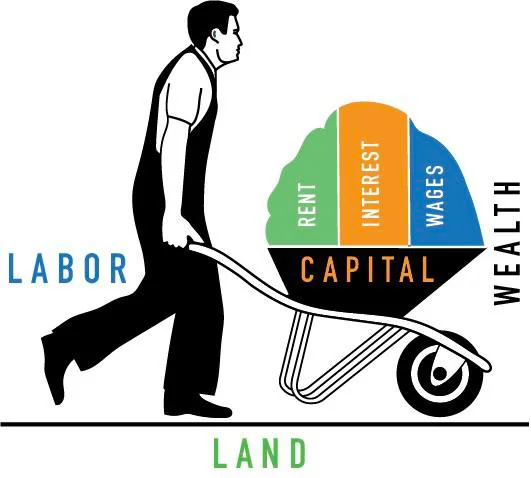
Classical economics indicates that factors of production are interchangeable, so no one factor is preferred to another (land, labor, capital and other/management/R&D/intangibles/intellectual property/entrepreneurship).
Classical economics indicates that the return to each factor of production is determined by supply and demand in each factor market. There is no reason to believe that land, labor or capital are mispriced or misallocated.
Capital gains tax receipts have averaged about $150B per year in the last 20 years, or 9% of individual taxes paid. The country is missing out on $65B per year, or 4% of individual taxes paid. 2025 individual income taxes collected amounted to $2.7T. 4% is $104B, or $775 per household!
In addition to this tax preference for capital over labor, land and intangibles, individuals do not pay capital gains taxes until they sell an asset which triggers gain/tax recognition. High income individuals have the investment flexibility to not recognize capital gains for years and decades. When an individual dies, his basis in an unsold asset is stepped up to the value when they die. All of the capital gain is untaxed by his heirs. The IRS tracks this number. The annual step up is roughly equal to the amount of capital gains taxed. Yes, 9% of the $2.7T annual tax take, $239B per year, $1,750 per household.
The total tax benefit is $340B per year, $2,500 per household.
Criticisms and Responses
Financial capital is required for physical capital investment which is the basis of all economic output. Conceptually, this is incorrect. Land, labor, capital and intangibles are co-producers of output. This is a well-agreed upon result of economics since the “marginal revolution” in the 1880’s. This is a mistaken mirror image of the “labor theory of value” that Marx appropriated from Ricardo.
Financial capital is the essential ingredient for all economic progress and growth. Again, the factors of production are co-equal. Financial markets are just as balanced as the “factors of production” markets. There is no reason to believe that financial markets require a subsidy to provide adequate finances for demanded investments. The globalization of financial markets makes this even less plausible. Savers around the world are easily able to find places to invest.
The return to capital includes inflation, which should not be taxed. Again, at theory level, financial markets balance the supply and demand for money. Market participants incorporate the expected inflation level into their calculations. Individuals invest, expecting a certain inflation rate. They know that their “real” returns will be discounted by inflation. In practical terms, the expected inflation rate has been 2% for 30 years. It has been higher for short periods of time. Critics argue that unexpected spikes in inflation should not trigger capital gains taxes. They don’t argue that unexpected decreases in inflation should drive higher capital gains taxes. In technical terms, the IRS rules could include some “adjustment” so that long-term capital gains would be reduced by the excess of inflation versus a 3% rate.
Capital gains fluctuate with the stock market, so they cannot be relied upon as a source of government income. Over time, the government will collect its fair share.
Investors will dodge any change in the capital gains rules. OK, the legal changes can go back 3-5 years as needed to capture revenues or accept that the transition will be less than ideal.
A higher marginal capital gains tax will encourage individuals to hold their assets longer, hoping to escape any taxes at their death. Yes, without reform to the death basis step-up option, the positive impact will be much less.
Individuals don’t have the liquid assets to pay taxes on the step-up basis at death. Like inheritance taxes, the capital gains tax on the step up in asset basis could be paid across 5-10 years.
Higher capital gains tax rates will reduce total taxes collected. This is the “Laffer Curve” logic. There is certainty a capital gain tax rate that will discourage investment and recognition of capital gains. This proposal is to tax capital gains at the same rate as earned labor income, about 35%. There is no solid evidence that a one-third tax rate discourages anything. 50% is somewhat different.
A higher capital gains tax rate will discourage savings and investment. GDP growth will be reduced by 0.1% annually. Macroeconomic models can allegedly “prove” this. Moving out of the 35% “sweet spot” to 50% might reduce savings and investment and GDP growth. I’m not proposing this. Even the negative impact at 50% would be small compared with the improvement in equity and increased commitment of citizens to a fairer state.
US business investment has declined through time. We need to incentivize savings and investment. US savings and investment do change through time. Many factors drive these changes. Marginal tax rates on capital gains are very minor factors. The US economy has thrived in the last 50 years. It has access to investment because it has proven its ability to deliver for investors.
Federal capital gains taxes reduce state capital gains taxes. OK, states will adapt.
I’m not proposing a widespread “mark to market” approach that requires implicit capital gains to be taxed every year for everyone. I do believe that it is possible for the IRS to define regulations to require very high-income individuals who can afford the accounting support to recognize gains on highly liquid market assets each year.
Summary
The “populist revolt” is driven by individuals who think that they don’t get a “fair shake” from our society, economy and government. One “big ticket” item is the preferential lower tax on capital gains versus earned labor income. It’s not fair. It’s not right. It’s $2,500 per household of unfair subsidy. Democrats should make this a major policy plank. The losers from this change are in the top 10% and especially in the top 1% of earners. Now that Republicans have adopted the “common man” as a major part of their political base, they will be required to respond favorably.