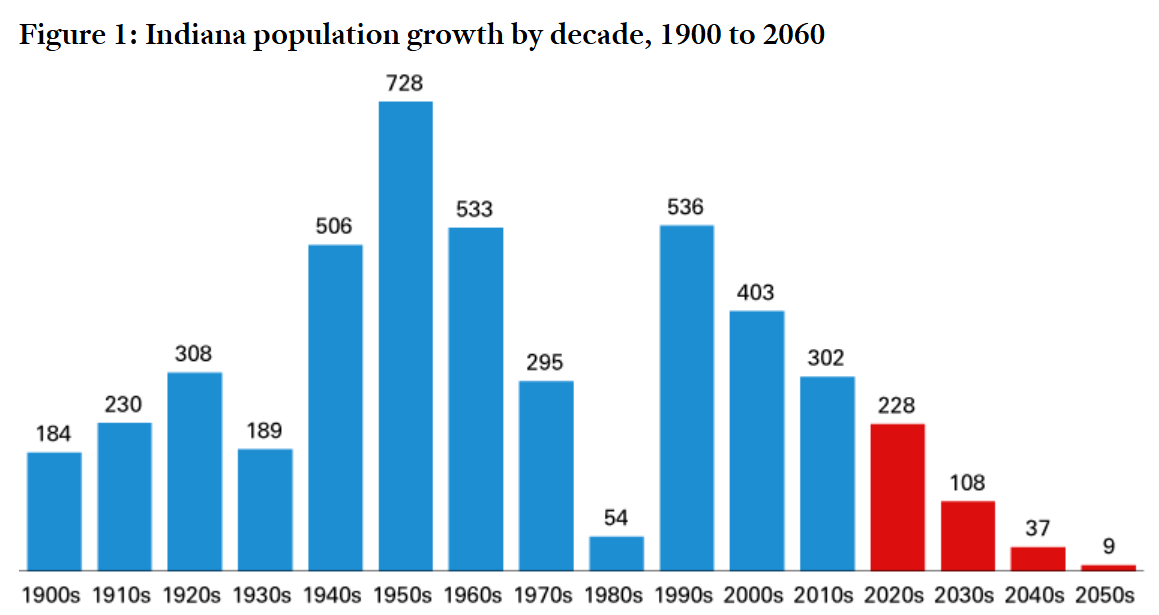
After the two dismal decades of the 1970’s and 1980’s, Indiana recovered with respectable growth for the next 30 years. Based on demographic trends, that growth will be done by the end of the current decade.
Slow-growth drives “win-lose” politics in most times and places.
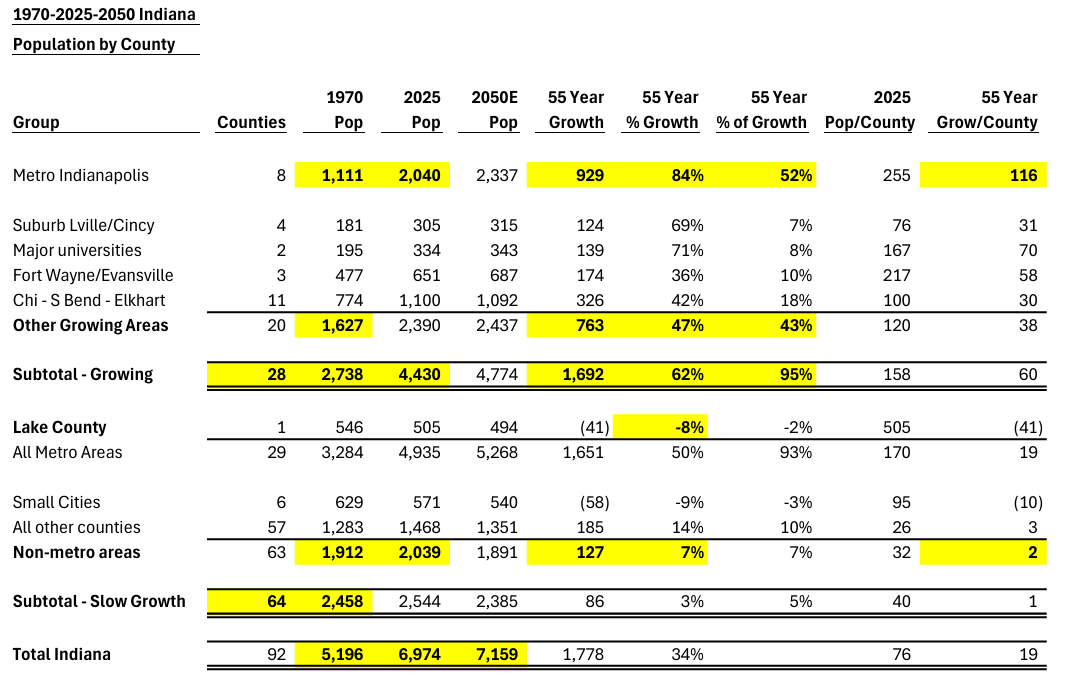
In the last 55 years, about one-third of Indiana counties registered growth and two-thirds did not. In the next 25 years, only 20 counties are forecast to grow. 16 of are part of the 28 in areas that showed growth from 1970-2025. The remaining 4 (Bartholomew, Adams, Daviess and Wells) belong to the group of 64 that saw losses or slow growth across 55 years. In general, the growing areas will show small growth, Metro Indy will grow decently and the rest will decline. Let’s look at the data in chart form.
Data
Analysis
Indiana grew by 1.8 million people between 1970 and 2025, from 5.2M to 7.0M; a gain of 34%.
The 8 counties in Metro Indianapolis accounted for slightly more than half of the total growth.
20 other counties grew, adding 763,000 people. They included Fort Wayne, Evansville, suburban Louisville, suburban Cincinnati, Monroe (IU), Tippecanoe (Purdue) and 11 counties in the Chicagoland “region”, excluding Lake County while including South Bend, Elkhart and Plymouth. Combined, these 28 counties added 1.7M people, while the other 64 counties combined added less than 100,000 people!
The growing counties added 60,000 people per county. They grew by 62%.
The non-growing counties added 1,000 people per county. They grew by 3%.
The contrast is stark and surely drives political views.
In 2025, the 8 metro Indy counties averaged 255,000 people each. The 57 rural counties averaged 26,000; just one-tenth the size.
Lake County (Gary) is set aside as a special case. Part of the Chicago region, but losing a significant 41,000 people; so, grouped with the non-growing counties.
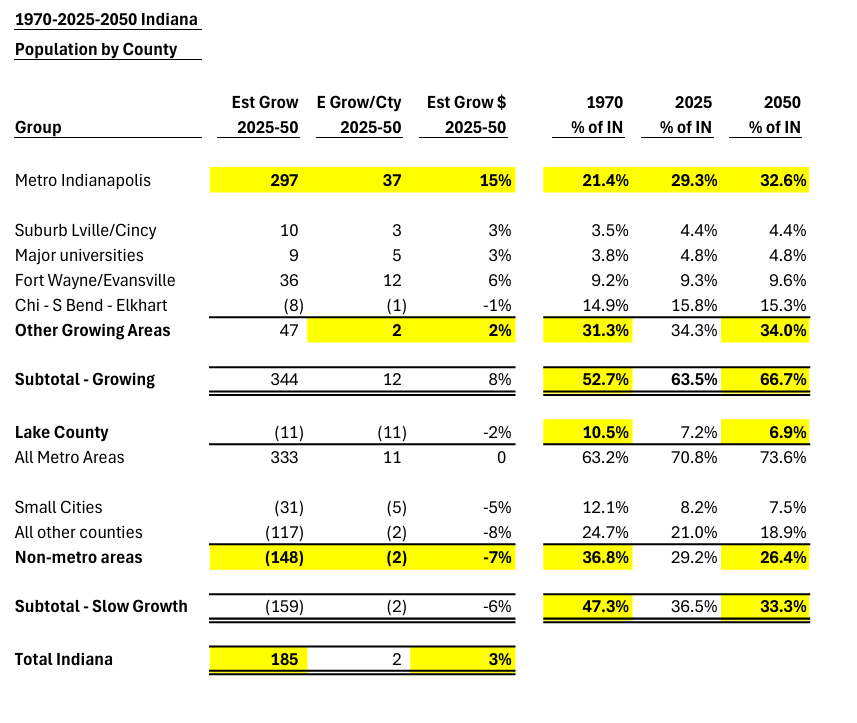
For the next 25 years, metro Indy adds 300,000 people, growing by 15% and a much slower 37,000 people per county compared with the 116,000 people per county in the prior 55 years.
The other 20 historically growing counties add 47,000 people combined by 2050, a small fraction of the 763,000 they added before 2025. The growth rate declines from 43% to 2%. Growth per county drops from 38,000 to just 2,000.
The remaining 64 counties LOSE 159,000 people; 6% of their 2025 populations, 2-3,000 people per county. Sixty (60) of the 64 counties are forecast to lose population across 25 years.
Across the full 80 years, the metro Indy area grows from 21% to 33% of the state population. The Previously growing areas edge up from 31% to 34%. The non-growing counties fall from 47% in 1970 to 37% in 2025 to 33% in 2050.
The 8 metro Indy counties will have the same population and political power as the 64 non-growing counties by 2050. Indiana’s Republican controlled house, senate and governor face a challenging future as its rural base declines further and the urban (blue, purple and red) area grows.
By 1992 politicians learned that black/white, good/bad, right/wrong framing of political issues was most effective. No more late-night sessions in a “smoke filled room”. No more compromises. No more earmarks or logrolling. Political parties must be philosophically consistent. No personal relations among congresspeople. No great existential threat, country, philosophy or doctrine to oppose together. Modern marketing and psychology provided the insights and tools to truly manipulate the public. Emotions are more powerful than logic. Hate and fear are stronger than hope. Compromise is immoral. Framing the discussion and providing the right language is most effective.
Republicans learned much faster than Democrats who held onto their historical successes, clung to rationality, facts and experts, embraced progressive trends, worshipped ideals above results, were slow to leverage modern political technologies, and truly believed they would prevail simply because they were right.
In hindsight, the path forward was obvious. Find issues that are emotionally charged. Define them as good versus evil. Manage the conceptual frames to make your position appear reasonable and the opponents extreme or radical. Use actions, political activity and the media to focus attention on the issues that are most favorable to your party at any point in time. The ends justify the means. “Winning is the only thing”. I have to respond to my opponents. Fight against evil doers. Enable victimhood. We have experienced 40 years of the downward spiral.
Situation
We are polarized. We have lost trust. We are skeptical and pessimistic. Does this make any sense? We live in the greatest country in the greatest time in history. Our parents and grandparents defeated fascism, nationalism, totalitarianism and communism. They learned to tame business cycles. They tripled international trade for mutual benefit. They established global alliances and organizations to solve problems and reduce the risks of conflicts. They quadrupled real output per person. They reduced global poverty by 80%. They extended human lifespans by two decades. I want to argue that the apparent political conflicts in the US today are a “grand illusion”. First, let’s outline the 5 main dimensions of politics.
The main dimensions of American politics over the last 250 years center on federal power, economic control, civil rights, foreign policy, and cultural change.
Federal Power (National vs. State)
The Debate: How much control the central government has over individual states.
Early Years: Fought over whether the nation was a loose union of states or a strong single country (culminating in the Civil War).
Modern Era: Focuses on federal laws versus state laws regarding healthcare, education, and public safety.
The Economy (Free Market vs. Government Role)
The Debate: How much the government should regulate business and help the poor.
Early Years: Promoted a mostly free market with low taxes and little regulation.
Modern Era: Includes social safety programs like Social Security and government rules for banks and corporations.
Civil Rights (Equality vs. Exclusion)
The Debate: Who gets full rights and protections under the law.
Early Years: Limited rights mostly to white, property-owning men.
Modern Era: Fought for and expanded the rights of enslaved people, women, racial minorities, and LGBTQ+ individuals.
Foreign Policy (Isolationism vs. Global Action)
The Debate: How much America should get involved in world affairs.
Early Years: Avoided permanent foreign alliances and focused on North America.
Modern Era: Led global organizations and fought in world wars and international conflicts.
Culture and Society (Tradition vs. Progress)
The Debate: How social traditions and moral values shape laws.
Early Years: Tied heavily to religious foundations and agrarian lifestyles.
Modern Era: Centers on shifting social norms, family structures, and individual freedoms.
Analysis and Hope
Conservatives have won the financial battle since LBJ’s “Great Society” proposals to increase the role of the federal government with Reagan’s election and re-election. Political battles, inertia, convenience and special interests have since increased the power of the federal government, especially the presidency. Democrats can now see the dangers of centralized federal power and cooperate with the remaining moderate Republicans to “accept” a reasonable compromise. Fiscal conservatives can join with Democrats to address the federal budget deficit and national debt.
Americans remain committed to a “mixed economy” that is primarily capitalist with relatively limited regulation compared with other “advanced” economies. Again, Republicans won this war with Reagan. They have tried to further deregulate and cut taxes with some results. However, the Trump Republican party is a populist party that mistrusts big business. This is a “tug of war” area, not an existential battle, despite it being positioned this way by both parties.
Democrats (and historical Republicans) won the civil rights war. Some elements of the Trump Republican party oppose the more extreme expression of “civil rights” application and have politically leveraged alleged Democratic overreach. As a country, we have a basic consensus of the 80%.
The struggle between isolationism and global engagement has been rekindled by Trumpian Republicans, overturning more than 50 years of Republican economic globalism. Democrats accepted this approach with the Clinton “third way” of the 1990’s. Trump has made this an emotional “us versus them” issue, conflating defense, economics and immigration. Big business and Wall Street have not fought back. Most Americans don’t want to give up the benefits of cheap imports, NATO, alliances and lower wage service, farm and construction workers. Both parties can limit the real risks of globalization.
Until recently, Democrats had “won” the so-called “culture wars”. Science, progress and secular society would grow forever. A balance with religion, tradition, community, spirituality, and local cultures was not needed. We now have a consensus that the cultural pendulum has swung too far in some ways and that we all have a need to accept a pluralistic society as we did at the nation’s founding. At that time, it was many denominations. Now it is many spiritual and cultural views. The “cultural conservative” base of the Republican Party, IMHO, has rightfully opposed the extinction of traditional cultural views. The Democratic party and its thought leaders can return to its history of both pushing for progress and embracing a diversity of views on how best to live one’s life.
Summary
Americans prefer a moderate role for the federal government. A little less than today. We are not a statist France. Delegate as much as possible to the states. Re-establish “checks and balances” and “the rule of law”.
Americans prefer a mixed economy with relatively low government control and taxes. There is no consensus for radical change.
Americans embrace civil rights for historic categories. They mostly don’t support affirmative action or expansion of categories or perspectives.
Americans prefer the benefits of global engagement AND want their country to be protected. The failure of the Trumpian win/lose approach is increasingly clear.
Americans prefer progress and embrace individual rights to choose religious and cultural beliefs and practices. Most can strongly agree on that.
There are not existential threats on any of these 5 dimensions for two-thirds of Americans. We have to reject politicians, parties and influencers who try to frame extreme conflict when it does not exist.