Hamilton County moved up to a tie for 14th place among the country’s 3,100 counties with 62% of its adults holding bachelor’s degrees as of 2023.
Ahead of Hamilton County are 8 Washington, DC area counties, New York County (Manhattan), 19,000 person Los Alamos County, NM, 17,000 person Pitkin, CO (Aspen), 26,000 person San Miguel County, CO (Telluride), and 329,000 person Denver suburb Boulder County.
387,000 person Hamilton County is tied with 272,000 person Williamson County, TN south of Nashville and 153,000 person Orange County, NC west of Raleigh-Durham.
People are driven by their background thoughts which they absorb from our culture. (Freud, Jung, Campbell, Kuhn, Kahneman, Haidt).
We have moved from a Christian/Western Civilization mental background to “A Secular Age” (Taylor, Smith).
It is “possible” that there is no God, no spirit, no meaning, no hope (Existentialism, Postmodernism). We have culturally concluded that this is “true” in some sense despite tremendous evidence to the contrary. (Science and Religion).
The main replacement ideology is one of “expressive individualism” (Bellah, Rieff, Lasch, Taylor, Sacks, Fukuyama). Each individual lives his best life by defining and living by his nature, talents, creative destiny to build an identity. “Be all that you can be”. “Authenticity” becomes the supreme moral value.
This is the world we live in, the one that our children and grandchildren inhabit.
In such a world, community, religion, institutions, idealism, morals, trust and character are much less important.
It is only “individual”, skeptical, insecure, purely materialist “turtles all the way up and all the way down”.
Religion must adapt to this cultural reality.
People still know there is something else, something more to life. Meaning, beauty, love, art. (Esp. James KA Smith)
Each local congregation must find ways to meet these needs.
We meet these needs by living good lives despite these challenges. We live our faith. We actively address the philosophical/theological void and confusion.
We welcome others to join us in our real-world activities, not just or primarily worship service. (be missional)
A revolution of thought, priorities and activities is required to share “the good news” with our brothers and sisters.
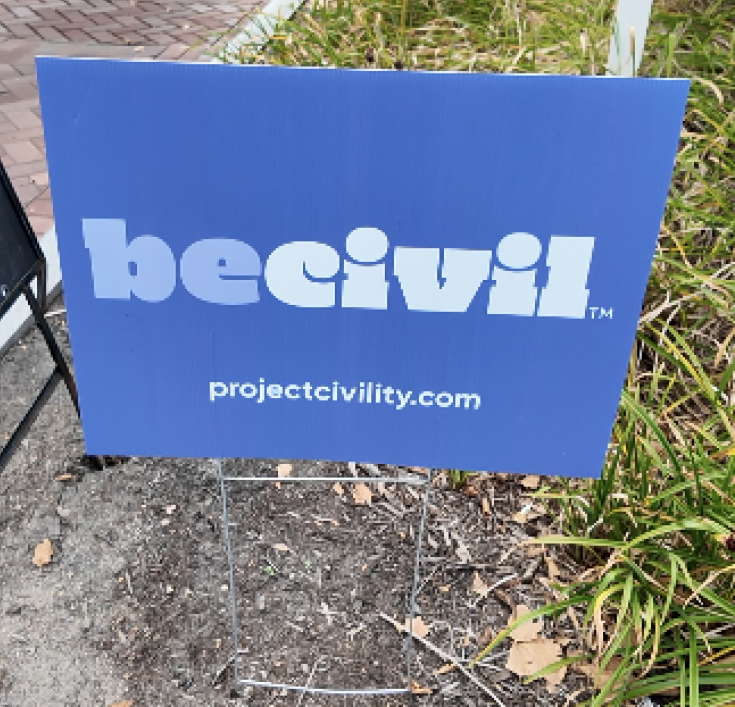
A. – Build bridges, not walls A. – Celebrate differences A. – Respect every story, welcome every voice A. – See the person, not the label B. – Be civil B. – Civility is the golden rule in action B. – Civility: pass it on C. – A house divided cannot stand C. – Different branches, common roots C. – Liberty for one, liberty for all C. – More alike than different C. – Out of many, one. C. – Stronger together. C. – There is more than enough to go around C. – We have much in common C. – We’re all in this together D. – Dialogue delivers D. – Listen to understand, speak to connect D. – One conversation at a time D. – Quick to listen, slow to speak, slow to anger D. – Speak to connect, not to correct D. – Use your inside voice E. – Look on the bright side E. – Naturally positive E. – Think win-win F. – Bold hearts, kind minds F. – Courageously engaged F. – Dare to disagree with dignity G. – Civility: pay it forward G. – Give respect. Get respect. G. – Kindness breeds kindness G. – Respect reaps respect H. – Infinite human value I. – Be kind I. – Blessed are the peacemakers I. – Kindness is our common language I. – Politeness is free J. – Be proactive J. – Begin with the end in mind J. – Choose your battles J. – Living by design K. – Democracy thrives on respect K. – I cherish my civic duties K. – Influence is power K. – Stronger arguments, kinder words L. – Be the neighbor you want to have L. – Build up each other L. – Can’t we all just get along? L. – Criticize acts, compliment people L. – Disagree better: respect is a choice L. – Every interaction matters. L. – Excuse me, did you drop your civility? L. – I’m OK. You’re OK. L. – Plays nicely with others L. – We grow together L. – What you do speaks so loudly, I can’t hear what you say. M. – A little respect goes a long way M. – I am my brother’s keeper M. – Love your enemy M. – Mutual respect M. – Respect despite disagreement. M. – Results and respect N. – Choose to be accountable N. – Do the right thing N. – I can always choose N. – My choices, my impact. N. – Take care of yourself O. – Character counts O. – Civility is always welcome O. – Cool heads, warm hearts O. – Trust is earned O. – Your reputation precedes you P. – Address incivility
In 2015, the Fishers Rotary Club created a quarter acre vegetable garden on the Fishers Christ the Savior Lutheran Church property. It’s members and the church drilled wells, installed sprinkler systems, built a shed, acquired equipment, installed access paths, established relations with local partners and food pantries to grow and distribute more than 4,000 pounds of fresh produce each year. Praise be to God!
In 2023 the Hamilton County Master Gardeners Association assumed the lead role for this community garden. The group has expanded to serving 5 local food pantries. It works with Volunteer Fishers to provide opportunities for citizens to help. The group delivers more than 3,000 pounds of produce to the food pantries. It raises $3,000 from supporters and $3,000 from HCMGA to fund expenses. It employs 2,000 volunteer hours annually. It serves the food pantries for the 6 months of May through October. The group plants 60 different crops each year in 3 planting cycles. It plants a half-dozen companion crops/flowers, rotates its 9 gardens and plants 3 cover crops each year. The group supports bee hives, hosts open houses and employs scout volunteers.
One-quarter acre is 120 18-foot long, 4-foot wide rows of 1-2-3-4 plantings.
3-4,000 pounds of fresh produce serves 8-10,000 people/servings. The retail value is roughly $15,000.
Why bother?
30 recurring volunteers have an opportunity to serve their neighbors.
20 “random” youth and community volunteers visit once, contribute and serve their community.
3-4 organizations invest $3,000 with a 5X return to serve their community.
400 local “master gardeners” have an opportunity to learn about vegetable gardening.
5 food pantries have dependable supporters for their valuable work.
Most importantly, food pantry clients have fresh, organic produce as part of their weekly visit. They greatly value fresh produce. They know that the local community invested time, talent and treasurer to make this happen. They are welcomed, truly welcomed into our community.
The history of modern Western intellectual life is not very comforting. We end up with Nietzsche’s superman which led to Nazism. We have Marx’s views which lead to totalitarian communist states. We have Freud’s view of mental repression and the impossibility of civilization. We have the next “scientific” view of psychology with Pavlov’s “stimulus and response”. We have Darwin’s principle of evolution which led to “social Darwinism” and its winner apologetics and eugenics. We have Darwin’s principle of evolution which led to scientific materialism, the rejection of any possible spiritual or non-material dimension to life. We have truly modern physics, chemistry, biology, mathematics and philosophy of science which undermine any possibility of a Newtonian certainty about science or nature, despite Einstein’s pursuit of a grand unifying theory and belief that “God doesn’t play dice with the universe”. We have existentialism which embraces the skeptics’ worst intuitions. We have professional philosophy which rejects metaphysics (fundamental nature, big picture approach) and adopts a purely analytical approach which reduces questions to precise language and logic. We have postmodernist philosophers who reject any structure other than the certainty that powerful forces will abuse their powers.
Modern History: Progress and Disintegration
Charles Taylor’s 2007 book “Our Secular Age” attempts to place all of this in perspective.
A “Secular Age” is one in which most individuals “know” that there may or may not be God, purpose, meaning or transcendence in life. A person’s life may be meaningless. The “next best” approach may only be to optimize the individual’s potential. There is “no exit”.
Doubt, skepticism and uncertainty are very powerful forces. Taylor argues that we all live based on implicit paradigms, beliefs, worldviews, assumptions, experiences, intuitions, etc. We are intuitive, social, historical beings. We absorb the beliefs of our culture. We don’t rationally evaluate and choose. About 4 million people are born in the US each year. 9,000 people earn philosophy degrees while 27,000 earn religion degrees annually. 1% of our citizens seriously pursue these questions.
In 1500, Western society was organic, with economics, politics, society and religion integrated into a well understood and accepted whole. Aristotle was “the philosopher”. St. Thomas Aquinas and the scholastics were applying logic to religious topics. History and tradition mattered. Morality and ethics were clearly defined and accepted. The spiritual dimension of nature and life was obvious. The personal Christian God was actively at work in the world. Priests and religious orders pursued perfection. Ordinary people supported the clergy and lived adequate Christian lives.
Modernity changed the Christian church. Luther elevated the role of the individual’s relationship with God, unmediated by clergy, in their local language. Each Church had to manage local politics to survive. Deism evolved as a scientific/rational form of religion.
The roles of economics, politics, society and religion were separated from each other. Social institutions evolved and learned to stand alone. Education, commerce and travel became more important.
Science became a driving force in understanding and controlling nature. It became commercially and politically important.
Individualistic philosophies developed. The “social contract” theory of politics was adopted and implemented.
Secular institutions were defined and provided services that replaced the role of the Church.
Today
We live in a world of skepticism, fear/insecurity, political polarization, subjectivity, tolerance, productivity, consumption, identity, searching, and striving.
The dominant approach of the professional class is deemed “the therapeutic society”. The individual reigns supreme. The individual is created to pursue his destiny, capabilities, potential or goal. The goal of the individual is to find/define and pursue this potential. Creativity, self-expression and authenticity are highly valued.
Taylor says that individuals seeking to pursue their capabilities still need feedback from their communities to validate their choices and results. They attempt to be radically independent but cannot do so.
There is a “tipping point” phenomenon at work. As science/technology became more insightful/effective, it became the default explanation for everything. In 1802 the mathematician Laplace replied to Napoleon’s question about the role of God in his latest book, “I have no need for that hypothesis”. The myth of the brave/heroic scientist/thinker overcoming social conventions and religious authorities was created and effectively employed. The false opposition of “science versus religion” was promoted.
The reduction in church attendance, membership and participation that occurred in Western countries along with education, urbanization and economic growth was deemed the “secularization hypothesis”: individuals automatically lost religion as civilization developed.
Our society promotes personal freedom, liberty and individual choice as the highest values. Our politicians and leaders encourage individualism. Economic production, success and consumption are elevated. The “free market” system becomes the model for social choices. Personal choices without limits are promoted. Government or social restrictions on individual choices are considered intrusions into sacred personal spaces.
Analysis and Hope
Taylor outlines the history of how our default worldview has changed. There has been continued growth and success of “instrumental logic” in science/technology and business/economics. The power of efficient causes alone in shaping and improving material well-being and possibilities is obvious. Individualism has grown to become a new God, with identity becoming all important. The possibility of “science” and “logic” explaining more and more and more has grown.
Taylor argues that we have assumed away the spiritual dimension of life. The progress of science has no bearing on important religious or philosophical questions. What is the meaning of life? Where did the world come from? Does the world have a purpose? How do scientific laws really work? How do I live a good life? How do I live in community? What is a good form of government? Why am I conscious? Why can I comprehend how the world works? What is beauty? What is religious feeling? Where does love come from?
Taylor argues that the scientific revolution lured us into believing that there are answers like Newton’s law of gravity and Euclid’s proofs of geometry that apply to all questions. We “rationalized” Christianity to make it “respectable”, creating Deism, but more importantly assuming that scientific rationality and logical proof is the only valid measure of success. Christian apologists sought to “prove” God and religious teachings. Religious leaders sought to modernize religion, stripping it of “irrational” content, deconstructing its content, evaluating it through literary and historical analysis, proving its merit through its application to social needs. Taylor says that this was a centuries long diversion.
Taylor highlights the failure of science and philosophy to be “fully rationalized”. Modern science cannot be reduced to a simplistic logical system beginning with a few assumptions and logically developing all results. Science is rational but not logically bullet-proof. It includes many features that are not “logical”. Science at very small and very large scales is strange and mysterious. Scientific disciplines use different methods and are sometimes incompatible. Emergent systems can be described but not in classic logical terms. Philosophy is used to analyze and deconstruct but it has failed to construct better answers.
Taylor and his popularizer, James K.A. Smith, emphasize that the spiritual dimension continues to “intrude” into everyday life for believers, skeptics, agnostics and atheists. Despite the progress of science, the secularization of society and the powerful influence of a “secular age” background worldview, spiritual experiences, ideas, thoughts, insights, longings, perceptions and behaviors don’t “go away”. They seem to be an intrinsic part of human life.
Like many modern Christian apologists, Taylor recommends that we reject the scientific method, logical proof, and Occam’s razor reductionist bias as the measure of religious/philosophical ideas, systems, processes, experiences and communities. He proposes that we consider “all available evidence”. What theory best matches the evidence? No theory is objectively true or fully comprehensive. Theories provide insights and answers to both common and difficult religious/philosophical questions. They are imperfect. Philosophical criticism indicates that there are trade-offs and shortcomings in all such systems. Taylor notes that it is only with the success of the scientific revolution that we have the audacity to expect to understand and explain everything about the universe including our religious/philosophical questions.
For many, Taylor’s conclusions seem like lukewarm apologetics. There is no certainty. We can’t trust science. We experience religion, so it must exist.
Taylor and his supporters argue that he is incorporating the best of human history and thought into his analysis and framework. We mistakenly believed that we could find reductionist answers to our questions. After 500 years of truly amazing scientific and economic progress we now know that this is impossible or very unlikely. We still have our religious/philosophical questions and experiences. They won’t go away. As with C.S. Lewis, he defines these explanations as myths or stories using human tools to provide insights into systems beyond our direct comprehension. The difference is that Christianity is a “true myth”.
We can choose to pursue a rational, reductionist, materialistic, non-spiritual solution. We can embrace a fully defined, literalist religious faith. Or, we can engage with a mysterious Christianity that provides essential answers that seem imperfect according to our modern conceptions of logic and rationality.
Exodus 3:14 New International Version
God said to Moses, “I am who I am. This is what you are to say to the Israelites: ‘I am has sent me to you.’”