A. – Build bridges, not walls A. – Celebrate differences A. – Respect every story, welcome every voice A. – See the person, not the label B. – Be civil B. – Civility is the golden rule in action B. – Civility: pass it on C. – A house divided cannot stand C. – Different branches, common roots C. – Liberty for one, liberty for all C. – More alike than different C. – Out of many, one. C. – Stronger together. C. – There is more than enough to go around C. – We have much in common C. – We’re all in this together D. – Dialogue delivers D. – Listen to understand, speak to connect D. – One conversation at a time D. – Quick to listen, slow to speak, slow to anger D. – Speak to connect, not to correct D. – Use your inside voice E. – Look on the bright side E. – Naturally positive E. – Think win-win F. – Bold hearts, kind minds F. – Courageously engaged F. – Dare to disagree with dignity G. – Civility: pay it forward G. – Give respect. Get respect. G. – Kindness breeds kindness G. – Respect reaps respect H. – Infinite human value I. – Be kind I. – Blessed are the peacemakers I. – Kindness is our common language I. – Politeness is free J. – Be proactive J. – Begin with the end in mind J. – Choose your battles J. – Living by design K. – Democracy thrives on respect K. – I cherish my civic duties K. – Influence is power K. – Stronger arguments, kinder words L. – Be the neighbor you want to have L. – Build up each other L. – Can’t we all just get along? L. – Criticize acts, compliment people L. – Disagree better: respect is a choice L. – Every interaction matters. L. – Excuse me, did you drop your civility? L. – I’m OK. You’re OK. L. – Plays nicely with others L. – We grow together L. – What you do speaks so loudly, I can’t hear what you say. M. – A little respect goes a long way M. – I am my brother’s keeper M. – Love your enemy M. – Mutual respect M. – Respect despite disagreement. M. – Results and respect N. – Choose to be accountable N. – Do the right thing N. – I can always choose N. – My choices, my impact. N. – Take care of yourself O. – Character counts O. – Civility is always welcome O. – Cool heads, warm hearts O. – Trust is earned O. – Your reputation precedes you P. – Address incivility
In 2015, the Fishers Rotary Club created a quarter acre vegetable garden on the Fishers Christ the Savior Lutheran Church property. It’s members and the church drilled wells, installed sprinkler systems, built a shed, acquired equipment, installed access paths, established relations with local partners and food pantries to grow and distribute more than 4,000 pounds of fresh produce each year. Praise be to God!
In 2023 the Hamilton County Master Gardeners Association assumed the lead role for this community garden. The group has expanded to serving 5 local food pantries. It works with Volunteer Fishers to provide opportunities for citizens to help. The group delivers more than 3,000 pounds of produce to the food pantries. It raises $3,000 from supporters and $3,000 from HCMGA to fund expenses. It employs 2,000 volunteer hours annually. It serves the food pantries for the 6 months of May through October. The group plants 60 different crops each year in 3 planting cycles. It plants a half-dozen companion crops/flowers, rotates its 9 gardens and plants 3 cover crops each year. The group supports bee hives, hosts open houses and employs scout volunteers.
One-quarter acre is 120 18-foot long, 4-foot wide rows of 1-2-3-4 plantings.
3-4,000 pounds of fresh produce serves 8-10,000 people/servings. The retail value is roughly $15,000.
Why bother?
30 recurring volunteers have an opportunity to serve their neighbors.
20 “random” youth and community volunteers visit once, contribute and serve their community.
3-4 organizations invest $3,000 with a 5X return to serve their community.
400 local “master gardeners” have an opportunity to learn about vegetable gardening.
5 food pantries have dependable supporters for their valuable work.
Most importantly, food pantry clients have fresh, organic produce as part of their weekly visit. They greatly value fresh produce. They know that the local community invested time, talent and treasurer to make this happen. They are welcomed, truly welcomed into our community.
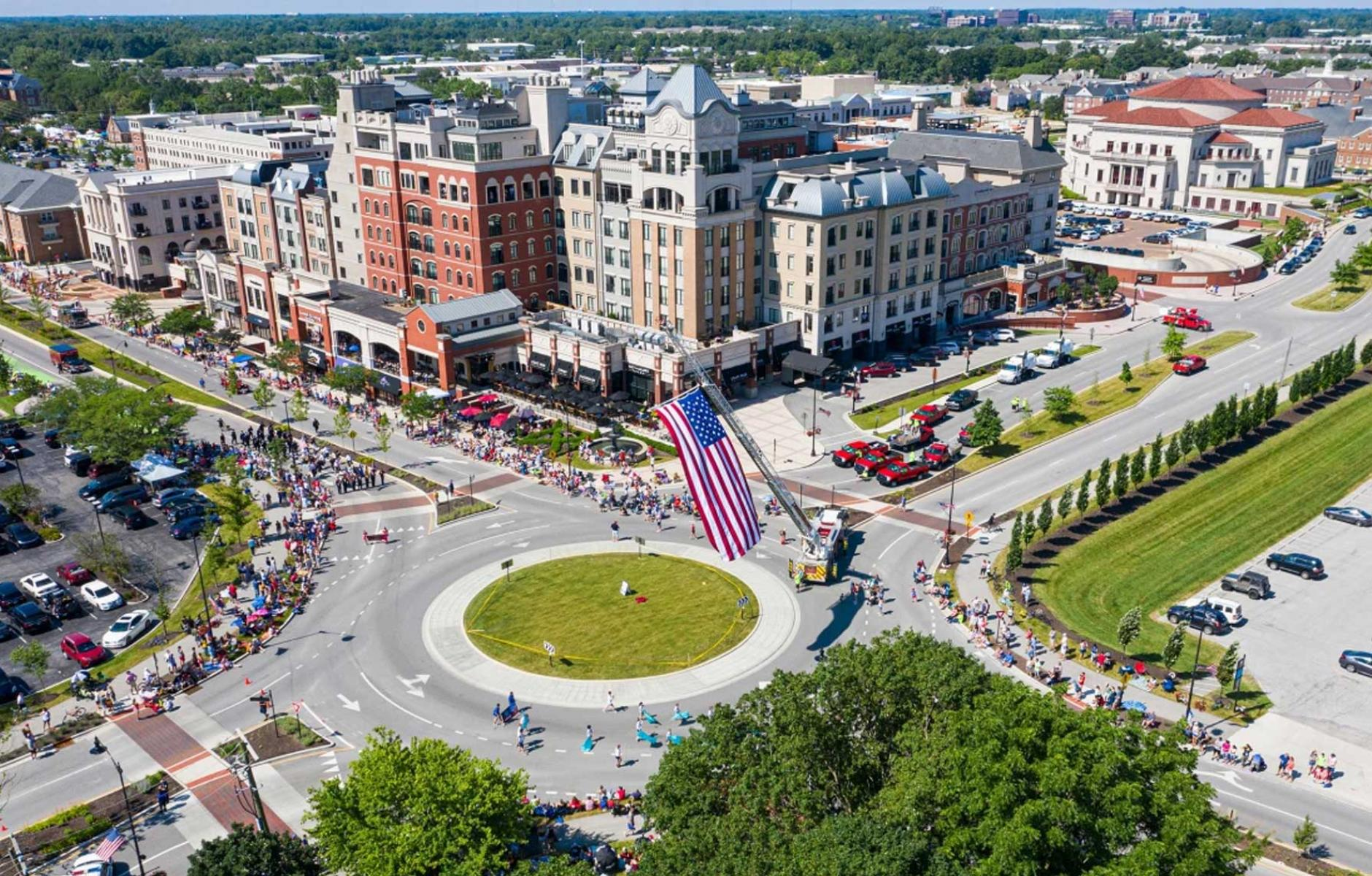
Carmel, Indiana is a 46 square mile city of 105,000 people a dozen miles north of downtown Indianapolis.
As 28-year mayor Jim Brainerd once quipped, “We don’t have mountains, valleys or an ocean, but neither does Paris”. How could an Indiana city create such a natural reputation for success?
Carmel is a suburb of Indianapolis, so it has benefitted from suburban growth since the 1950’s.
Indianapolis, like Columbus, Nashville, and Minneapolis, has been a heartland growth winner.
Indiana is a low cost of living location, benefitting from being the “Crossroads of America”.
Indiana is a low tax and low government services state, with expectations that government needs are best addressed at the lowest possible level.
Indianapolis has no natural geographical constraints to growth or limits that raise the cost of living. The Northwest Territory’s 6×6 mile townships expand in all directions.
Most metro areas have a preferred direction for wealth and growth. Indianapolis chose to develop straight north along Meridian Street across the Marion County border into Carmel by the 1950’s.
This branding and “first mover” advantage is common among America’s 50 large metro areas. Carmel benefitted from competitors in NW Zionsville limiting development to preserve the small village character, NE Geist having limited lakefront property and NNE Fishers limited main highway access.
While Indiana today is considered a deeply red state, historically it was more purple, with heavy manufacturing/worker counties balanced by rural/farming counties. Indianapolis was a local government innovator, creating county wide Unigov in 1970 to combine the city and county, preserving Republican dominance. Indianapolis has elected centrist mayors for 6 decades: Lugar, Hudnut, Goldsmith, Peterson, Ballard and Hogsett.
Jim Brainerd served as mayor from 1996-2024 as a centrist/practical Republican in the Governor Daniels mode, focusing on local economic issues and needs, without being distracted by national wedge issues.
Carmel understood the power of zoning and used this to adopt overlay zones to guide denser and higher quality development in the Meridian corridor, Range Line Road, Arts & Design District and Midtown areas. Politicians understood that Carmel was a valuable place for developers and set limits to ensure that the community would also benefit from growth.
Mayor Brainerd used the powers of the Indiana strong-mayor system to create tax increment finance (TIF) districts to capture the future property tax values of areas to allow for leveraged government investments in infrastructure.
Mayor Brainerd and the city council also allowed the city to borrow at advantageous interest rates to finance other investments to promote the city’s growth.
Like many governments, Carmel offered tax incentives to attract corporate developments.
Mayor Brainerd found that roundabouts were a local, traffic, aesthetic, environmental, safety, time, and cost winner. He prodded the city the install 150 roundabouts.
Mayor Brainerd incorporated a small investment into the arts and not-for-profits into the annual budgeting cycle. Local citizens applauded.
Mayor Brainerd chose to invest in community art, statues downtown and in the roundabouts. Again, the community applauded.
Journalistic histories emphasize the role of Mayor Brainerd in “transforming” the sleepy suburb into a new urbanist “edge city” and nationally recognized place to live. Mayor Brainerd deserves credit as a visionary and catalytic leader who delivered the goods for 3 decades. Yet the Carmel story begins before him and continues today. It relies upon political, government, community and volunteer leaders who believed that Carmel could deliver the highest possible quality of life for its residents and neighbors. I point to a few representative leaders who deserve credit.
Carmel has invested resources in making it a safe city. School safety officers requiring a separately approved levy. Formal quality standards for police and fire departments. County level emergency preparedness investments.
Carmel public schools are consistently rated among the best in Indiana. Critics say this reflects the wealthy socioeconomic status of the community. “The proof is in the pudding”.
Indiana schools are mainly funded through a statewide formula. Indiana property taxes are capped as a percentage of value. Carmel residents have chosen since 2010 to approve property tax levies to exceed the formula and the standard maximums. Recent state tax, budget and formula changes are driving new requests.
Carmel library has moved twice, expanded its main location and added a branch location. Carmel library has been nationally ranked for its activity, circulation, programs and financial investments.
Carmel aspires to be a diverse community. It has been a primary corporate transfer and health care professional destination, welcoming non-Hoosiers and preparing residents and students for national and global roles.
Carmel has more economic diversity than some expect, with many middle-class and young adult neighborhoods south of 116th Street and within the boundaries of Keystone Parkway and Meridian/US 31.
Density is good. Commercial property tax base is good. Employers are good. These 3 statements seem trivial and obvious, but many “professional class” suburbs reject them, wishing to live in an idyllic rural paradise. Carmel has always embraced manufacturing, offices, retail, and apartments.
The Meridian Corridor overlay district promoted dense development and prevented strip malls. The Range Line Road overlay district required dense and multi-use development. The early overall zoning plan encouraged economic development in the central 8 square miles of the city, within the 46 square mile footprint.
Carmel employed TIF districts and public borrowing to attract investors to its central city developments.
It employed the usual tax abatement tools to encourage major corporations to locate within Carmel.
By decade, Carmel’s population grew from 1950 to 2026 in thousands as 2, 10, 20, 33, 43, 65, 83, 99, 105. 4 decades of 10,000 population growth followed by 4 decades of 15,000 population growth. Growth may slam shut in 2030-2035. Growth provides advantages to utilities, realtors, developers, construction firms, media, and governments.
Lacking mountains or oceans, the community has developed events for every month of the year to celebrate. Many events were created, grown and managed by small groups of individuals with background support from the city government.
Carmel has leveraged its existing natural neighborhoods to develop a sense of place. Real estate developers have built traditional 50-300 home subdevelopments and filled in spaces. The city focused on the central city neighborhoods to define the “arts & design district” and midtown. The parks district has built and enhanced regional and neighborhood assets.
Carmel began with advantages as a growing suburb north of Indianapolis’s historic Meridian-Kessler neighborhood. Political leaders made wise decisions for several decades. Carmel’s measures of success have gained national recognition. However, the character of the community and quality of life is driven by the personal responsibility that citizens take for themselves and their neighbors as symbolized by the moms who built the first park and the dads who started the youth athletics programs.
Our political systems are broken. The Supreme Court’s decision to make race an unconstitutional factor in determining voting districts will probably reduce racial minority representation significantly as partisan political parties are no longer legally constrained by this limit. State level gerrymandering is proceeding towards 80% to 90% of seats being captured by the larger party whenever possible. Minority representation is greatly reduced or eliminated. Polarization increases. Citizen buy-in decreases.
It may be that the American people have had enough. Some states will adopt independent commissions to draw congressional and state districts.
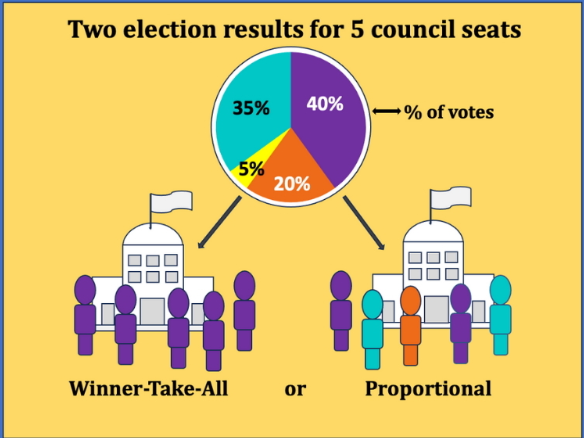
Another option is proportional representation. Define multi-member districts so that minority group, party and sub-party groups are more likely to be represented closer to their proportion of the vote.
Proportional representation requires important choices about the size of districts (typically 3-8 members is ideal) and the balance between party and candidate importance (a balanced approach is recommended).
Ranked choice voting systems can also be implemented with proportional or our existing single member districts. Ranked choice systems allow voters to express more of their preferences for candidates and parties.
A 1967 federal law requires single member congressional districts. It could be repealed by Congress to allow states to experiment with these options.
Few democracies worldwide still cling to single member/first past the post/winner take all districts. The US has historical experience with alternative member district rules.
Proportional representation is not a panacea. No voting system perfectly translates voter preferences into candidates and their subsequent votes. But proportional representation would help to reduce our polarized 2-party system, reduce the influence of money on elections and help voters to see and feel that their votes matter.
As of April, 2026 the US economy has survived 16 months of Trumpian economic malpractice.
Tariffs have cost each family $2,000 annually, acting as a huge tax increase. Suppliers and importers have absorbed less than one-fourth of the increased costs.
Tariffs and surrounding uncertainty have stopped normal business investments, R&D and new hiring.
$34 billion of green energy projects have been cancelled.
Manufacturing employment continues to decline.
Foreign born employment has been flat, after increasing by 4 million during 2022-24 to 31.8 million.
Farm bankruptcies grew by 46% due to retaliatory tariffs, labor shortages and input cost increases.
Mortgage rates have increased by 1% compared to the federal funds rate due to increased inflation, budget deficits and Fed independence concerns. In time, that is an extra $1,500 annually for every home mortgage.
Inflation was trending towards its 2% target. Trump policies have increased it to 3% and rising. This costs the median family budget $1,000 per year.
The DOGE initiatives and government shutdowns have made the federal government much less effective in performing its core functions.
Reduced IRS staffing is forecast to reduce revenue collections by $750 billion per decade.
Higher import tariffs increase input costs to American manufacturers, placing small and medium sized firms at greater risk of bankruptcy.
The US credit rating has been reduced by Moody’s due to the growing budget deficit and uncertainties, adding to the long-run cost of servicing the $39 trillion debt. At a nominal 0.25% premium that adds another $700 per year to the average household’s cost for debt service.
Frozen, reduced and politicized federal R&D threaten future economic advances.
The value of the US dollar has declined by 10%, making imports more expensive and exports more attractive.
The consumer sentiment index has declined from 70 to 50, as low as the depths of the pandemic!
Trump has required coal-fired power plants to operate beyond their planned retirement dates, costing consumers $5 billion per year.
The Iran war costs the country $50 billion.
Weaker relations with others will cost the US $1-3 billion annually in reduced foreign travelers.
Why hasn’t the economy tanked? The Iran war and tariffs may combine to tip the US economy into recession before the end of 2026, but so far it has been very resilient. How is this possible?
The long-term trends point to dynamic and creative US business and labor sectors compared with other countries.
The US economy has moved from a high fixed cost manufacturing world to a diversified service and knowledge economy, diversifying its economy and risks.
The US economy is more globally competitive and able to use international trade to manage its risks.
The AI revolution has sparked a huge data center and electricity power investment cycle. This is a classic Keynesian investment multiplier-accelerator situation, driving large investments today to support future expected demand.
The US stock market valuation has grown based upon historical growth trends, US competitiveness and the expectation of future business-friendly policies (regulation, competition, taxation, trade).
The wealth effect of the stock market has boosted the K-shaped economy with higher income/wealth families continuing to spend.
The One Big Beautiful Bill is a classic Keynesian economic stimulus from lower effective tax rates. In the short-run, the bond markets have not yet determined that the US has reached the point where it’s deficit spending is unsustainable. It may be close to that limit.
The “exorbitant privilege” of the US dollar as the world’s reserve currency and hedge for economic uncertainty remains in place. This is another “tipping point” situation where at some time China and the EU become reasonable options and US government borrowing rates spike upwards.
The federal reserve bank has cut baseline interest rates from 5.3% to 3.6%, offering borrowers a loose monetary policy, even if Trump calls for even lower rates.
Annual new home construction starts remain at 1.3 million as builders bet that higher housing prices and an 8-year building deficit will have to be filled. Historically they would have reduced their investments.
Employers remember the pain of filling open positions after the pandemic and remain slow to make major job cuts that can be rationalized away.
3% inflation is “manageable” by producers and consumers, even if it is not at the nominal 2% target.
TACO: Trump has not maintained his headline import tariff levels.
US imports are only 14% of GDP, down from 17% in 2011. Tariff changes have a smaller impact.
US strength in trade negotiations has been confirmed. Other countries have mostly chosen not to implement significant retaliatory tariffs. China is an exception.
Health care job growth has continued as the US population ages and requires greater care funded by employer insurance, Medicare and savings.
The leisure and hospitality industry has added jobs as the pandemic travel rebound continues.
The energy industry investments in wind, solar and transmission continue after a decade of limited investments, despite Trump’s lack of current support.
Trump’s pro-business tax, regulation, enforcement and competition policies provide businesses with opportunities to grow their profits.
The core age labor force participation rate remains at an historically high 84%.
Global oil prices trended down by 25% during 2023-2025. They’re up by two-thirds in the last few months.
Labor force productivity growth has been 3%+ during 2023-2025 after 3 years of no growth in 2020-2022.
The US leads the world in scientific and economic innovation by a wide margin.
Trump’s policies have cost the typical American family about $5,000 per year on a base of $100,00. They feel this and reflect it in the consumer sentiment surveys.
The US economy is far more diversified, resilient, creative, innovative, responsive than it was historically. It is able to adapt to changing regulations, immigration, regulatory enforcement, tariffs and opportunities. It is well positioned to succeed in the new US and global environment.
Civility is a social norm and a set of behaviors based upon a set of shared values. We address public morality, the 7 Civility values and their broad support from different belief systems.
Morality
Thought leaders increasingly embrace the need for some kind of commonly held public morality to replace the historical background of Christianity and Western civilization.
Respect, responsibility, honesty, compassion and fairness comprise one set of values to consider.
Rabbi Sacks provides historical context of the ideas that have led to an “I” focused culture, outlines the symptoms of a weakened “We” culture, and provides some insights as to what can be done. He combines a politically and economically moderate view with a conservative social perspective.
“We will have to rebuild families and communities and voluntary organizations. We will come to depend more on networks of kinship and friendship. And we will rapidly discover that their very existence depends on what we give as well as what we take, on our willingness to shoulder duties, responsibilities, and commitments as well as claiming freedoms and rights.”
Teddy Roosevelt: “The first duty of an American citizen, then, is that he shall work in politics; his second duty is that he shall do that work in a practical manner; and his third is that it shall be done in accord with the highest principles of honor and justice.” The citizen should be like his “man in the arena”, fully engaged in important matters.
Brooks offers 15 solutions. Live for holiness. Fight selfishness. Use your heroic capacity to struggle against external and internal challenges. Humility is the first virtue. Pride is the central vice. Struggle against sin and for virtue. Purposely build character skills, habits, experiences and preferences. Focus on the long-term, permanent attributes of life. Seek help in building character. Recognize the U-shaped pattern of falling, evaluating, feeling and accepting grace and recovering. Quiet the self enough to listen and defeat weaknesses and temptations. Aim for a practical wisdom built upon experience and history rather than a perfect ideology, theology or philosophy. Organize work around a “vocation” and do your best. Define leadership as finding “a just balance between competing values and competing goals”. Embrace the path of becoming better in your vocation and better as a person. That is the opportunity we are given.
Civility is based on values, but the practice of Civility is about behavior and habits that can be learned and improved. Inspiration connects the Civility values with the Civility behaviors. Civility is a social norm subject to the laws of virtuous and vicious cycles. The widespread re-adoption of Civility as a social norm faces many challenges.
We now understand how humans behave. We are imperfect and amazing. We have the ability to balance the individual and the other, the individual and the community, the individual and spirit/God.
Civility is based upon the human dignity of each individual. The modern “cognitive science” approach embraces this insight. It offers tools to make our lives more effective, meaningful and satisfying. Civil individuals should invest time to master these subjects.
Cultures exist because individuals need to be combined into communities. Without cultural norms, expectations, education, rewards, penalties and taboos there wouldn’t be any culture, community or civilization. This requires society – and its leaders and influencers – to clearly define select important aspirational values AND to define what is TABOO, poison, shunned, beyond the pale, unacceptable, and rejected by all.
Civility is a set of behaviors based upon a set of values. It is adopted and grown by individuals based upon their conscious and unconscious experiences. The practice of Civility tends to promote Civility in others. Unchecked incivility tends to destroy Civility.
Civility offers direct and indirect benefits to individuals. In the end, it is both a practical and a moral choice. We live in a “secular age” where the received religious views can be challenged by well-meaning people. My belief is that our “classical liberal” democracy requires the support of a Civility subset of values. I also believe that our secular society requires this same subset of values to facilitate the interactions and transactions of modern life. I believe that almost all individuals can justify Civility values, behaviors and skill development on a practical basis alone. I hope that the 15 benefits described below will help everyone to make the right choice.
The “heart” is the source of our best thoughts, feelings and actions, including acting Civilly in daily life which builds the skills, influence and expectations to require Civility in our political world.
Civility encompasses values and behaviors, a dynamic process and personal growth. It offers a process solution to our common differences and potential conflicts. It has many component parts that change through time for each person. The core components can be learned and applied by everyone. The basics are easy. Practicing and perfecting Civility values and skills is the good work of a lifetime, worthy of our human dignity.
Civility is supported by left and right in America’s political history. Modern techniques for most effective group interactions and negotiations are neutral. The values that support Civility are neutral. Civility takes no stand on modern political issues. The latest attempt to define the “righteous” bases for politics provides no dimension opposed to civility. Civility can be used as a bipartisan base for our democracy and our day-to-day interactions.
Civility is not politeness, utopian, weak, emotional, partisan, righteous or apologetic. It can be used by the most serious, radical individuals to refine their own skills, engage with others and attempt to find common ground and understanding. It seeks to find solutions and to build relations. It seeks to undermine polarization. It does not prevent leftists or rightists from highlighting systematic injustices or threats to individual rights and liberties in our economic, political and social worlds.
The populist wing of the Republican party sounds like the far-left wing of the Democratic party. Civility is a tool of the other guys, unfair, biased, inadequate, ineffective, unreliable, soft, emotional and too slow. The Civility approach doesn’t support the simple polarizing approach of modern politics. It emphasizes facts, logic, values clarification, optimal means, compromises, discovery, short and long run trade-offs, all of the tools of the modern negotiator’s kitbag. It accepts that profound differences may remain in our political, economic and social realms.
Civility is easy to caricature and dismiss. Simplistic “straw man” versions are easy to attack. It is a moderate and moderating approach, so some might call it conservative. It values interactions, feedback, process, learning and growth, so some might label it liberal.
Civility does require personal work and interactions. We have a much better understanding of the components of Civility today. It offers a scalable solution to our many problems. It can be developed one step at a time. It can be used in all arenas of life. It can be taught to everyone. We can re-establish Civility as a social norm. Like other social norms, there is a virtuous cycle/network effect that leverages our progress. Modern social science classes provide very effective tools and classes to build our skills. Civility has personal benefits, especially a sense of personal agency. It has benefits for the institutions of modern life that can invest and promote it. Civility is a personal choice that cannot be prevented by groups that oppose it. Civility is a “no brainer”. We have the opportunity to re-establish it for the benefit of all.
Rose Colored Glasses; Man Bites Dog; If it Bleeds it Leads.
Politicians, journalists and influencers of all stripes emphasize the bad, the emotional and the unusual. This burdens us and our society. Allegedly, “it’s bad now, and it was MUCH better in the past”. This eternal NOSTALGIA is a big problem for our society today, leading many people to turn to populists, idealists, authoritarians and charlatans for salvation.
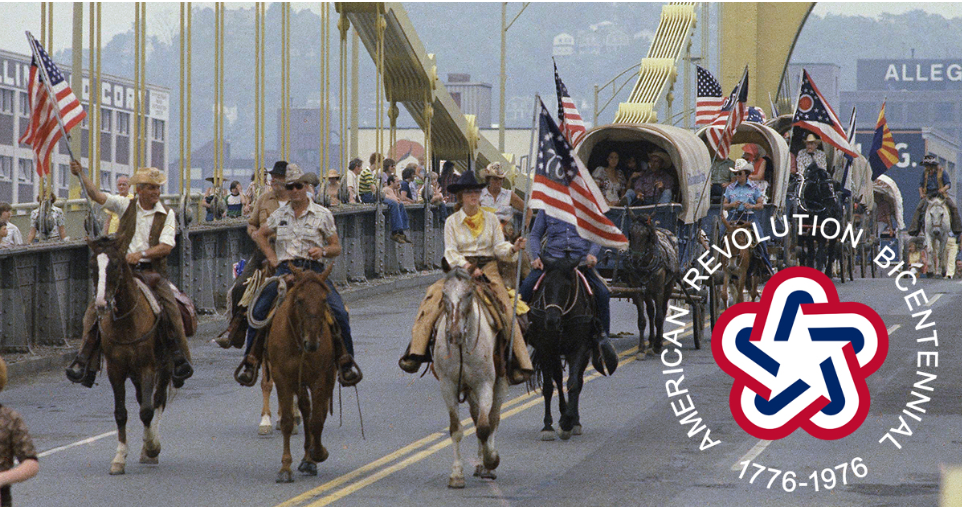
I will outline how much better the United States of America is TODAY than it was in the mid-1970’s. I graduated from high school with the class of 1974. I watched the emotionally mixed American bicentennial celebrations in 1976. I remember Jimmy Carter’s 1979 “malaise” speech in which he said that we, the people, needed to face our challenges directly, especially at a moral level. He was briefly cheered but then criticized for being too negative and pessimistic; an uninspiring leader!
Modern life in the USA is immeasurably better than it was in the 1970’s. It is certainly not perfect. The country has not achieved all that it could have or should have in the last half century. It still faces large global and moral challenges and wonders where it can possibly find the leadership, consensus and engagement to resolve them.
The sheer magnitude of changes in daily life across 50 years is difficult to describe but I hope that my outline will collectively communicate the great scale of improvements we have experienced and the resulting hope and expectation that the next 50 years will deliver the same kinds of positive growth. When we consider the last 50, 100 or 150 years of American life, we should be very optimistic.
Global Threats and Opportunities
The Cold War ended in 1989, relieving the pressure of 4 decades of imminent nuclear destruction. This was a miracle. No war. No revolution. No territories seized. No leaders executed. A quiet end to the threat. The US managed the threat of nuclear terrorism. West Germany embraced East Germany. The European Union welcomed new members. The global economy thrived.
The US established relations with China in 1979, beginning the country’s path to economic prosperity, trade and global influence. The growing trade between China and the world has acted to reduce the threat of conflicts while reducing the cost of goods for all.
The US welcomed the growth of Japan plus the “four tigers” of Hong Kong, Singapore, South Korea, Taiwan, as Asian nations embraced the “Western consensus” of mixed market capitalism, global trade and liberal democracy.
European nations also left behind histories of authoritarian governments or too much socialism to embrace the “Western consensus” and thicken ties through the European Union. Francis Fukuyama prematurely declared “the end of history” but the attractiveness of these successful choices was clear.
The US joined international efforts to reduce tariffs and increase trade leading to a doubling of imports and exports as a share of GDP.
The US adopted a less internationalist position after 9/11/2001, declaring a war on terror, defining the axis of evil, revoking treaty commitments, justifying preemptive war and invading Iraq without UN support. Even with this change, the US largely avoided major military conflicts and losses.
Total immigration to the US grew during this period from 2.3% to 2.9% of the population per decade. Many immigrant groups successfully joined American society.
The US welcomed foreign students to its universities. International tourists increased from 15 to 75 million per year.
The US attempted to resolve the Middle East conflicts with some success, avoiding large scale wars.
The US participated in talks to define and address the threat and impact of global warming. It has taken steps to reduce US carbon emissions.
Politics
Presidents Ford and Carter helped to rebuild confidence in the government after Vietnam and Watergate.
Ronald Reagan established “Conservatism” as a broad political philosophy for the Republican party.
Bill Clinton repositioned Democrats more to the center on economics with his “third way” approach.
Both parties increasingly used wedge issues and either/or choices to polarize parties and choices; although the share of independent voters has grown from 30 to 45%, with the rest evenly split between the two dominant parties.
Perot, Buchannon, Palin and Trump provided social and economic populists with a choice.
The country increasingly accepted racial minorities, women, gays, religious minorities, and immigrants; but the conflict between traditional and modern views was politicized as some could not tolerate the changes and others sought to embed the changes as universal human and legal rights accompanied by social pressures to comply with the dominant “tolerant” view.
Federal government employment was reduced from 5 to 4 million in 50 years, while the population grew by 50%. After Reagan, “government” solutions were inherently suspect. Even Bill Clinton declared “the era of big government” is over.
Total federal, state and local government activities grew a little faster than the economy, with the ratio of tax receipts to GDP inching up from 29% to 32%. The ongoing pressure to “cut spending, taxes and regulations” could not defeat the pressures to address social, political and economic issues and interests.
The top marginal income tax rate was reduced from 70% in 1982 and has remained just under 40% since 1987. Neither party has proposed widespread tax increases.
The Affordable Care Act was enacted in 2010, helping to bring the share of Americans without health insurance down from 20% in 1975 to 8% today.
The US safety net/welfare system has remained intact during this period driving the supplemental poverty rate down from 20% to 15%, while the official poverty rate has declined by just 1%. The share of the elderly (65+) in poverty has fallen from 16% to 8%.
The Economy
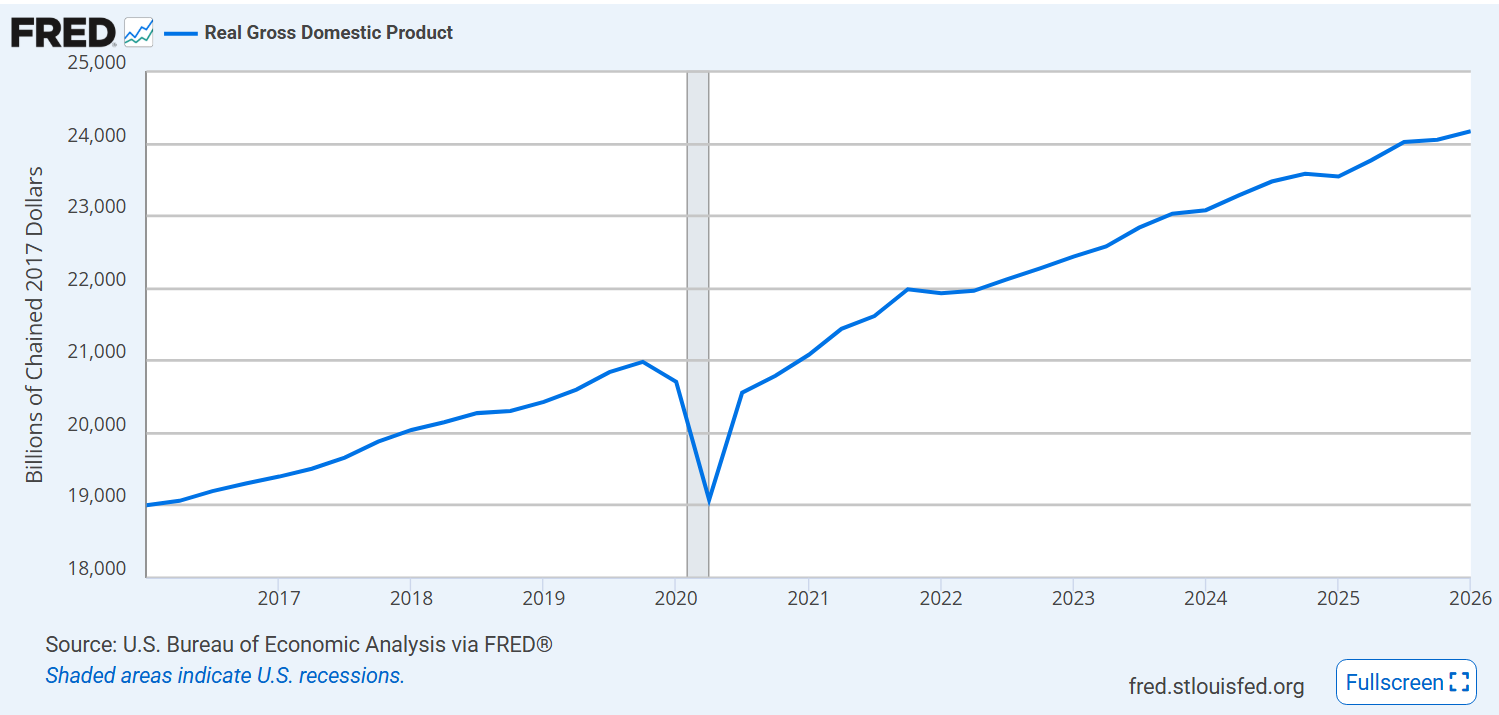
Real dollar GDP is 4 times larger at $24 trillion.
US real per capita GDP has remained the highest of all major countries for a century. Continued leadership reflects a dynamically successful economy.
Real per capita GDP has increased by 250% to $70,000.
US fiscal and monetary policy has repeatedly been effective in taming the business cycle and recovering from shocks like the housing crisis and the pandemic.
Industrial production, including energy, is up by 250%.
The number of business establishments has doubled to 8.6M, providing ownership and employment opportunities in a more specialized, globally traded world.
The number of franchise businesses has grown from 375,000 to 800,000+, employing more than 10 million people.
The rate of new business formation and success increased throughout the period, with a new boost after the pandemic.
Businesses responded to the 1970’s “Japanese invasion” and became strategically more focused, measured more effectively, focused on cost reduction, invested in R&D, and applied information technology and process improvement tools. Foreign and domestic competition led businesses to be more cost effective, improve product quality and offer products better tailored to diverse customer wants and needs.
Firms experimented with factory robots by 1975. They now use 380,000 robots, adding 10% more annually.
Auto production in the US has increased from 8 to 10 million units per year.
Farms produce twice as much using 20% less land and 40% less labor.
Businesses adapted to the world of greater international trade by growing or shrinking facilities, markets, products and product lines. They adapted to the new power of consumers and retailers and reduced power of manufacturers. They divested units and rejected the conglomerate model. They rejected vertical integration, learning to outsource all functions where they did not have a competitive advantage.
Firms embraced more effective banking, equity and bond markets to fund their activities. They tapped global sources and private equity. They learned by use financial leverage to increase net earnings and acquire other less dynamic competitors.
Firms changed organizational structures to have fewer layers, less positional power, more staff experts and the ability to use cross-functional (matrix) approaches to core operations, projects and joint ventures.
Education
Preschool/Kindergarten enrollment up from 5 to 9 million. Nearly all part-time in 1975 and mostly full-time in 2025.
High school graduation rate is up from 75% to 85%.
Intelligence test scores have increased by more than 10 points.
Share of young adults who have earned college degrees has doubled from 20% to 40%.
Share of adults with college degrees has more than tripled from 12% to 38%.
Share of young women with a college degree is up from 17% to 45%; shares for men up from 27% to 37%.
Share of degrees in STEM disciplines has grown from 11% to 19%.
Number of college students studying abroad is up by 5 times.
Law school first-year enrollment remains at 40,000, while the population has grown by 50%.
US holds 18 of top 30 global university spots.
The number of annually earned doctorates has doubled.
US accounts for 50% of Nobel prize winners, up from 40% in 1975.
Transportation
22% of new cars are electric. Self-driving cars are widely deployed.
Fuel milage has doubled from 13 to 27 miles per gallon.
New car defects have dropped by two-thirds.
Air travel miles are up by 5 times.
FedEx 2-pound overnight service was introduced in 1975 for $75. Service is widespread today at $55.
Same day and next day delivery services are available today, making Amazon.com, grocery and restaurant deliveries common. Catalog mail order lead times were 6-8 weeks in 1975.
Energy
The US faced energy crises in 1973 and 1979 that disrupted businesses, emptied filling stations and led to recessions.
The US imported 35% of its petroleum products in the 1970’s. It is a net exporter today.
Energy intensity, the ratio of energy used to GDP, has fallen by 60% since the 1970’s.
LED bulbs last 10 times longer. Lithium-ion batteries last 4 times longer.
Wind power is 10% of electricity generation. Solar is 10% of electricity generation. Solar is the lowest cost source today, accounting for two-thirds of new generating capacity added.
Coal production is the same today as in 1975, down 50% from its 2007 peak. It is declining rapidly.
Environment
Toxic air pollution measures are lower by 65-90%.
The world resolved the threat to the ozone layer.
Percentage of US homes in communities with treated wastewater has increased from 50% to 80%.
State parks acreage has doubled. Federal parks acreage has tripled. Land trust additions are equal to the state parks area.
Total US forest land area has increased from 750 to 800 million acres, while the US population has grown by 50%.
Nesting pairs of American bald eagles have grown 100-fold, from 700 to 70,000.
US (1976) and global (2014) birth rates are half of historical levels, reducing environmental demands.
US is on track to reach 50% reduction in greenhouse gas emissions by 2030.
Health
Life expectancy has increased from 73 to 78 years.
Infant mortality rate has dropped by two-thirds.
Smallpox has been eradicated. Polio remains eliminated. Other diseases close to zero.
Smoking rate is two-thirds lower, down from 37% to 12% of adults.
Death rates down: Strokes 67%. Cancer 25%. Flu/pneumonia 67%. Heart disease 50%+. Liver disease 25%.
US governments, medical industry, businesses and people responded to the Covid-19 pandemic resulting in a death rate that was half of the 1917 Spanish flu. Novel vaccine development and flexible delivery resources limited the death toll.
Abortion rates have fallen by 50% since 1980.
Medical research continues to develop new science and solutions. Cloning and human genome mapping.
In vitro fertilization births have grown from 0 to 100,000 per year.
Modern anti-depression drugs (SSRI-Prozac) are much safer and more effective than their predecessors.
Kidney dialysis extends lives for 550,000 today versus 25,000 in 1975.
Americans have 40 million MRI scans done on 13,000 machines, up from zero.
Laser eyer surgery has grown from an experimental procedure to 800,000 annually.
50,000 organs are transplanted each year, up from just a few experiments.
Safety
Property crime rate is down by more than 50%. Violent crime rate is one-third lower.
Both the workplace fatality and injury rates are down by two-thirds.
Traffic fatalities per driven mile are three-fourths lower.
Fire incidents have been cut in half while the population grew by half.
Emergency medical services have grown from 2% to 90% of counties; employing 300,000 people, 50,000 ambulances and 1,300 helicopters.
Consumer
Firms have offered consumers much wider options for products in all industries. A typical Walmart Supercenter has 125,000 different SKU’s.
We enjoy year-round availability of most fruits and vegetables today rather than shopping by season.
Clothing and durable goods prices have been cut by half.
The average automobile is 13 years old versus 6, reflecting massive quality improvements.
Car buyers can choose from 15 major manufacturers instead of just 4.
Appliances in more homes: Washing machines (70-85%), dryers (45-82%), dish washers (28-54%), microwave ovens (4-95%). Refrigerators are 25% larger, half price and 75% more energy efficient.
Median new home square footage has increased by half, from 1,500 to 2,200 square feet.
Mortgage loan rates have declined from 8-14% to 4-7%. Real rates are just 2% today.
Total debt service payments (home, car, credit card, student loan) as a percentage of disposable income have declined from 11% to 10%.
Air-conditioned homes have grown from a hot 55% to a cool 95%.
Away from home food spending has more than doubled from 28% to 59% of total food spending.
Household consumption is up from 87% to 92% of disposable income. Savings is down from 13% to 8%.
Leisure
Many television program options. Top 4 network share down from 90% to 30%. Recording and streaming options exist today.
Cable or satellite TV access has grown from 14% to 100%.
The number of feature films released each year has bloomed from 100 to 700.
Music singles are effectively free today. They cost $7.50 each in current dollars in 1975. The transistor radio has been replaced with portable, wearable devices served by playlists, suggestions and feeds.
Real consumer electronics prices have declined by 80-95%. A 21-25 inch color console was $2-3,000 in 1975 in current dollars. A 50-inch tv is available for $500 today.
A 1982 IBM PC cost $10,000 in current dollars. For $2-3,000 today you get 1,000 times the processor speed, 10,000 times the memory and 100,000 times the storage space.
Video rentals boomed in the 1980’s and 1990’s growing into a digital $100 billion industry.
The $5 billion pinball machine sector evolved into the $50 billion handheld and online gaming industry.
Virtual reality equipment is increasingly popular.
Passports are held by half of US citizens, up from 5% in 1975.
Following deregulation, the real price of air travel per mile has glided down by 40-60%.
Hotel room capacity has doubled from 2.4 to 5.3 million.
Pet food consumption has tripled.
American wine production has increased from 250 to 700 million gallons, along with quality.
American brewery count has increased from 150 to 7,000, along with quality.
Wealth
Mutual funds, index funds and 401K’s offer investing to everyone. Percentage of stockholders has grown from 12% to 60%.
The number of retirement plan participants has grown by 250%.
Real dollar retirement plan assets have grown thirty-fold, from $1.6 to $48 trillion.
Homeownership rate increased from 64% to peak of 69% before falling back to 66%.
Family wealth more than doubled for those in the 1st-25th, 26th-50th, and 51st-90th percentiles between 1989 and 2022. Summary data for 1975 to 1989 is not readily available. Real home prices increased by 20% and the real dollar S&P 500 increased by 75% during this period, overall.
Labor
Compounded labor productivity has increased by 150%, more than 2% per year!
Manufacturing, administrative and farm jobs were reduced by 20% of the total during these 50 years. They were replaced by STEM/analysis, management and health care jobs.
Prime age labor force participation increased from 74% to 84%.
Typical unemployment rate declined from 6.5% to 5%.
Share of self-employed workers increased from 9% to 11%.
According to the Gallup Organization, the share of “engaged” workers has increased greatly in the last 20 years.
Real median family income increased by 40% from 1984 to 2024.
There are dozens of expert calculations of real incomes, adjusted for taxes, government benefits, charity, fringe benefits, hours, etc. Most show that 1975-1990 was flat and that 2000-20 showed modest increases.
Society
The US continues to lead the world in charitable giving as a percentage of income, double the nearest country, Canada.
US migration and population growth in the “Sunbelt” impacted local and national economies, politics and society. Texas (13-31M), California (21-39M) and Florida (8-23M) showed the greatest growth and national influence.
Share of adults cohabiting has increased from 1% to 13%.
Teen pregnancy rate has been cut in half.
The share of married couples has declined from 83% to 67% of households.
Parents now invest 20 hours per week caring for children, up from 12 hours in 1975.
Same sex marriage was legalized by the US Supreme Court in 2015.
Female labor force participation rate has increased from 46% to 57%.
The female to male wage discount has been reduced from 35% to 10%.
The number of congresswomen increased from 19 to 155 (7X).
Women today have access to credit and credit cards in their own names.
Black unemployment declined from 15% to 7%, with the excess above whites falling from 7% to 2%.
Black poverty rate has declined from 30% to 18%.
The Black to White income ratio has improved from 60% to 67%.
The share of interracial marriages has increased from less than 1% to 10%.
Percentage of Americans moving per year has declined from 20% to 12%. Interstate moves have declined from 3% to 2%.
Robert Putnam’s “Bowling Alone” shows a 40% decrease in social participation during this time.
Awareness, tolerance and support for “differences” is higher by an order of magnitude: races, nationality, immigration status, physical or mental disability, gender identity, mental health, autism, obesity, and personality.
Hispanic Americans have increased from 6% to 20% of the population.
The percentage of non-Christians, including religiously unaffiliated, has increased from 12% to 35% of the population.
The share of 40-year-olds never married has increased from 6% to 25%.
Computers
Personal computer software and phone apps provide tools for email, calendars, word processing and spreadsheets to everyone today.
Personal computers are in 95% of homes versus 0% in 1975.
More than 90% of jobs today require computer skills.
Home internet access is 92%.
Digital cameras, music, videos, sound and storage make everything portable.
Voice controlled devices and instant language translation.
Today’s 10-day weather forecasts are as reliable as next day forecasts in 1975.
Google search and artificial intelligence provide access to all of man’s writings and promise thought, itself.
Communications
Internet structure and web browser provide access to everything and everyone.
Smartphones integrate computing and communications. 90% ownership rate. Provides photo, filming and navigating capabilities.
Mobile/cellular phone networks and wifi routers offer universal access to the internet and phones.
Social media networks combine the input of many to build and use networks.
Internet allows for open-source software and information creation.
Video conferencing and internet enabled phone/video calls are common.
Voice mail, answering machines, caller ID and 911 were invented.
Digital books have grown to 25% market share.
Annual first class mail per person increased from 240 to a peak of 360 in 2000 before falling to 130 today.
Daily newspaper subscriptions have plunged from 60 to 20 million.
Share of homes with landlines has fallen from 90% to 30%.
A 3-minute long distance call in 1975 cost $8.70 in current dollars. An international Skye call today is 77 cents.
Summary
The world is a better, richer and safer place. Politics has evolved. The economy is 4 times larger. Businesses and education are more effective. Energy is cheaper. Transportation is better. The environment is much better. Health is much better. Safety is much better. The consumer is king. Leisure options and quality can’t even be compared with 1975. Wealth is up. Incomes are up. Society is digesting many large changes. The computer and communications revolutions have delivered miracles and promise more.
We face social, political and environmental challenges. We have more resources than ever before. Based on American history we should be very confident about solving our challenges.
Civility is a set of behaviors that recognize differences and build respect. Civility is demonstrated through self-awareness, self-management, social awareness, relationship management, communications, growth and problem solving.
Civility is driven by the RICH RAP values of responsibility, intentionality, constructiveness, human dignity, respect, acceptance and public-spiritedness.
These values are essential components of the major world religions, including Christianity.
Responsibility
Responsibility for one’s choices and actions is central to Christianity.
To God: have faith, obey, repent and account for your life.
To Self: grow spiritually, resist sin, develop self-control and seek salvation.
To Others: Show love, serve, choose wisely and build relationships.
To Family: Provide for all needs.
Accountability: Be responsible for thoughts, actions and results. Listen and repent.
Action: Faith must be applied.
Stewardship: Use God-given time, talents and treasures for God’s purposes.
Reflection of Christ: Become more Christ-like through a life of holiness, love and service.
Christianity roots respect in human dignity. It is viewed as a command rather than an earned privilege, focusing on humility, love, and treating others better than oneself.
Image of God: showing respect to others honors God.
Commanded love: proper respect to everyone, including opponents, authorities, and believers.
Humility and selflessness: outdo one another in showing honor.
Value of dignity: respect is based only on intrinsic value given by God, not by social status, merit or agreement.
Reflection of Christ: Jesus showed compassion to the outcasts, the vulnerable, the weak and chose common men and women as disciples to build His church.
Christianity says that all people are created in God’s image, loved unconditionally, and invited into community regardless of background. Jesus exemplified this by engaging with marginalized groups and individuals, and Scripture emphasizes complete equality through spiritual unity.
Radical inclusion by Jesus: breaking social norms to engage outcasts, sinners and the “unclean”.
Theological equality: all are equal in Christ (Galatians 3:28).
Commandment to Love: Love your neighbor as yourself (Matthew 22:39); all of your neighbors.
Welcome the Stranger: the Old Testament repeatedly preaches that foreigners and the marginalized must be treated the same as the native born.
Community of Grace: all individuals are accepted into the community of faith and grace.
Christianity requires members to act with love, justice, and integrity in civic life. Serving the community, promoting good laws, and engaging in public discourse reflect God’s love and desire for the common good.
Love God, Love Neighbor: The great commandment requires service to society.
Identity in Christ: A child of God, redeemed by and connected with Christ, belongs to the community and as a “new” person willingly serves it.
Salt and Light: Called to be a positive influence through and for the community.
Morality: Actions are right or wrong. Individuals can/must do “right”.
Civic Engagement: Voting, holding office, debating and advocating are civic responsibilities.
Common Good: Building relations with others to work for the common good is required.
Positive Witness: Contribute so that others will see the value of “following Jesus”.
We live in a place and time where Civility has declined as a habit or social norm. It is necessary for our social, economic and political communities, IMHO. We need to rebuild Civility as a habit, norm and ideal. We can do this for practical reasons.
Or we might embrace Civility because it is a logical consequence of our religious beliefs.
Christianity is a positive force in the lives of 2 billion people. It is clearly consistent with and supports the 7 Civility values.
“Render unto Caesar the things that are Caesar’s, and to God the things that are God’s” is recorded in 3 of the gospels. Christians are warned that they must distinguish between the material and spiritual, the personal and the community, the practical and the ideal. Some have read this line to encourage Christians to withdraw from practical and civic life in favor of a private, ascetic, withdrawn spiritual life.
Most Christian theologians emphasize the duality of Christ as “fully man, fully God”. Unlike many religions, Christianity embraces the material, natural side of man as being created by God. Genesis records that God concluded his creation and man were “very good”, despite the fall and imperfections. This perspective encourages us to go “all in” as individuals, spouses, parents, stewards, fishers, builders, carpenters, teachers, servants, prophets, nurses, and participants in community.
We promote Civility as a set of behaviors, values, habits, norms and expectations; NOT as a replacement for religion, but as a secular framework for managing community in a world of 8 billion people.
I personally believe that there are common moral values that God has revealed to men in various places, ways and times.
I don’t see a groundswell of support for this view or for Christianity alone, so I promote the secular alternative of Civility as a “least common denominator” way for our “kingdom of man” to function effectively on behalf of the 8 billion children of God.