
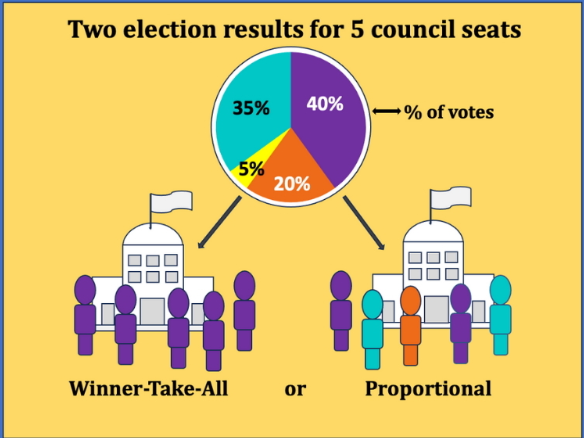
Our political systems are broken. The Supreme Court’s decision to make race an unconstitutional factor in determining voting districts will probably reduce racial minority representation significantly as partisan political parties are no longer legally constrained by this limit. State level gerrymandering is proceeding towards 80% to 90% of seats being captured by the larger party whenever possible. Minority representation is greatly reduced or eliminated. Polarization increases. Citizen buy-in decreases.
It may be that the American people have had enough. Some states will adopt independent commissions to draw congressional and state districts.
Another option is proportional representation. Define multi-member districts so that minority group, party and sub-party groups are more likely to be represented closer to their proportion of the vote.
Proportional representation requires important choices about the size of districts (typically 3-8 members is ideal) and the balance between party and candidate importance (a balanced approach is recommended).
Ranked choice voting systems can also be implemented with proportional or our existing single member districts. Ranked choice systems allow voters to express more of their preferences for candidates and parties.
A 1967 federal law requires single member congressional districts. It could be repealed by Congress to allow states to experiment with these options.
Few democracies worldwide still cling to single member/first past the post/winner take all districts. The US has historical experience with alternative member district rules.
Proportional representation is not a panacea. No voting system perfectly translates voter preferences into candidates and their subsequent votes. But proportional representation would help to reduce our polarized 2-party system, reduce the influence of money on elections and help voters to see and feel that their votes matter.
Proportional representation, explained
Video: Proportional Representation, Explained | Sightline Institute
Imagine if Congress was elected by Proportional Representation
Proportional Representation Voting Systems – FairVote
Proportional Representation – Center for Effective Government
Proportional representation – Wikipedia
Update on Proportional Representation | American Academy of Arts and Sciences
Protecting voting rights with proportional representation – FairVote
The best response to the Supreme Court’s Callais ruling: proportional representation
The Best Way to Fix the Supreme Court’s Attack on Voting Rights | The New Republic

