
Civility as a Ministry: Forging Habits for a Resilient World
Church of the Palms, Sarasota, FL, 2027
Workshop Leader: Tom Kapostasy
Timing: 12 sessions of 60-75 minutes.
Workshop Summary
We live in a world where the stability of our shared civic infrastructure faces real and visible challenges, both at home and abroad. This 12-week workshop moves beyond superficial politeness and good wishes to examine civility as a practical, behavioral discipline. Our focus is on evaluating the ongoing tension between differing individual desires and community needs. By combining insights and tools from the social sciences with a Reformed theological perspective, we explore how disciplined habits and religious community can help us navigate a world of inherent human brokenness.
The first half of the course explores how our moral, mental, emotional, and tribal defaults sometimes work against the sophisticated Reason and Discernment required of us today. By identifying where our biological wiring falls short of our current social and spiritual calling, we will learn how to overcome these primitive instincts, bridge our deepest divides, and pursue human flourishing in a fractured world. In the second half, we employ practical skill-building exercises focused on self-governance, constructive dialogue, and managing conflict. We finish by applying these tools in our direct “spheres of influence”—digital, public, and family spaces—as each participant develops a civility blueprint to help us collectively build a more resilient community.
Purpose of Civility
The final purpose of civility is to establish the habits and norms that allow fractured human beings to sustain a flourishing civilization and build a resilient civic infrastructure. We live in a world of inherent human brokenness, so civility serves as a critical tool of the Church—the body of Christ—to collectively address our cognitive and moral imperfections. Practicing these disciplined behaviors, we are actively prompted to honor one another as image-bearers of God, moving beyond our imperfect instincts to fulfill our shared responsibility for the common good.
Modern Civility and Civilization (Foundations)
Session 1: Civility: Modern Behaviors for Public Life
Session 2: Civility: High Impact, Bite-Sized Habits
Session 3: Ministering to a Fragile World: The Church and the Civic Fabric
Vaulting Moral, Mental, Emotional and Tribal Hurdles (Obstacles)
Session 4: The Righteous Mind: Navigating Our Moral Foundations
Session 5: In the Same Boat: Cognitive Shortcomings and Christian Humility
Session 6: In the Arena: Forging Emotional Habits
Session 7: The Limits of Tolerance: Wrestling with Tribalism and Conviction
Weaving the Civic Mesh: Crafting Civility (Habits and Connections)
Session 8: The Art of Self-Governance: Managing Defensiveness and Boundaries
Session 9: Constructive Dialogue: Trust, Perspective, and Crucial Conversations
Session 10: Conflict Management: De-escalation and Responding to Incivility
Session 11: Sample Spheres of Influence: Digital, Public, and Family Spaces
“Head Out on the Highway” (Deployment & Action)
Session 12: The Personal Blueprint: Commissioning the “Civiliteers”
Pre-reading Assignments by Week
- Syllabus
https://tomkapostasy.com/2026/04/10/civility-defined-1-1/
- https://tomkapostasy.com/2025/12/09/civility-is-really-about-7-behaviors/
- Part 4A Biblical Collapses and 4C Factors, Spiral and Conclusion https://tomkapostasy.com/2026/04/10/civility-values-3-1/ https://www.youtube.com/watch?v=W6ZDKko43p0 The Righteous Mind (4:28)
- None
- None
- Appendices 1, 2, and 3.
- Henri Tajfel and the “Minimal Group Paradigm” with Matt Williams https://www.youtube.com/watch?v=ciSx1EG4V0s&t=112s
- Part 3, The 3-part repair script and 10 examples of disrespect.
- https://tomkapostasy.com/2026/04/10/crucial-conversations-5-10/
- Part 1, The Art of the Pivot Guide and Toolkit
- Part 1, 3 scenarios. Part 2, 8 scenarios. Appendix 1.
- https://tomkapostasy.com/2026/04/10/motivation-for-civility-3-3/
https://tomkapostasy.com/2026/04/10/inspiration-for-civility-3-4/
Appendix 3.
Materials:
https://tomkapostasy.com/2026/03/09/civility-resources-0-navigating-civility/
https://tomkapostasy.com/2026/04/10/civility-references-0-3/
Books for Future Study:
Choosing Civility: Forni, P. M.: 9780312302504: Amazon.com: Books
About the Workshop Leader:
Tom Kapostasy is an educator, writer, and former corporate executive who invested four decades in mastering evolving global “best practices” and managing the tensions between the hard and soft professions, static and dynamic approaches, and central and local dimensions of large global organizations—primarily in high-technology industries. He served as CFO, COO, and global supply chain director for organizations ranging from Fortune 500 companies to the National FFA Organization, serving a million students and 15,000 teachers.
An experienced instructor, Tom has taught economics, finance, and accounting at multiple universities and led a wide array of professional content and management development workshops. He holds a BA in Economics from New College of Florida, an MBA in Finance from Case Western Reserve University, and is a graduate of Indiana University’s “Hoosier Fellows” executive leadership program.
Deeply rooted in the Reformed tradition, Tom brings a lifelong commitment to church leadership, having served as a Presbyterian elder, deacons president, treasurer, and adult education leader. He is an active member of the Sarasota community as a hunger-relief volunteer and an affiliate member of Church of the Palms. Since 2024, he has authored 100 articles on civility and supported Project Civility. Tom and his wife, Sue Maki—an elected official from the “other political party”—split their time between the vibrant communities of Carmel, Indiana, and Sarasota, Florida. Tom is an avid hiker, a frequent writer on his Good News website, and is an active community garden volunteer.
https://www.linkedin.com/in/tomkapostasy
Civility as a Ministry: Forging Habits for a Resilient World
Session SRQ01: Civility: Modern Behaviors for Public Life
Time: 70 Minutes, including a 10-minute exercise
This is the first of 3 sessions on the topic of “Modern Civility and Civilization (Foundations)”.
https://tomkapostasy.com/2026/04/10/civility-references-0-3/
https://tomkapostasy.com/2026/04/10/civility-prayers-0-5/
Genesis 1:26
Then God said, “Let us make humans in our image, according to our likeness …
Creator God, you fashioned us in your own image and likeness. As we gather, help to see that same divine image in every person, especially those with whom we disagree. Teach us to listen with compassion, speak with grace, and act with humility. May our words today reflect your image and build bridges of understanding. Amen.
Block 1: Administration, Overview, & Icebreaker/Eye-Opener
Duration: 30 Minutes
I. Administrative Check-in & Logistics (5 Mins)
- Welcome participants and outline the physical logistics (breaks, materials, baseline guidelines).
- Distribute the comprehensive course syllabus detailing the path from theory to application.
- Participants are asked to read the main materials before each session and any required prereading articles. There are also many strictly optional books and articles for now or later.
- We have 75 minutes planned for each session.
II. Syllabus/Course Overview (15 Mins)
- The foundational theme: Civility is an intentional, learned social system designed to protect human dignity across all sectors of life.
- Expectation: This course moves away from surface-level etiquette toward actionable psychological tools, group leadership strategies, and behavioral constraints. It is mostly practical and structural.
- Define Modern Civility as “a set of behaviors that recognize differences and preserve relationships”. The behaviors are guided by a set of core values. The behaviors become habits and then social norms. The habits deliver both results and relationships.
- The final purpose of civility is to “sustain a flourishing civilization and build a resilient civic infrastructure”.
- Given our scientific understanding of human behavior, this should be easy. It is not. Human nature is imperfectly suited for the complexities of modern life.
- The workshop focuses on better understanding these challenges and building skills. But this is still not enough. Throughout the course we will emphasize the tensions inherent in actually living good lives.
- Hence, there is a critical role for Christian ministry. Mankind is imperfect. Religious understanding, practices and the church community play critical roles in bridging the gap between human nature and human flourishing.
- We move from 3 sessions on the foundations of civility and civilization through 4 sessions that describe the imperfections and challenges of practicing civility and another 4 sessions that develop skills and advice for applying civility in varied settings. The final session translates these insights into an action plan.
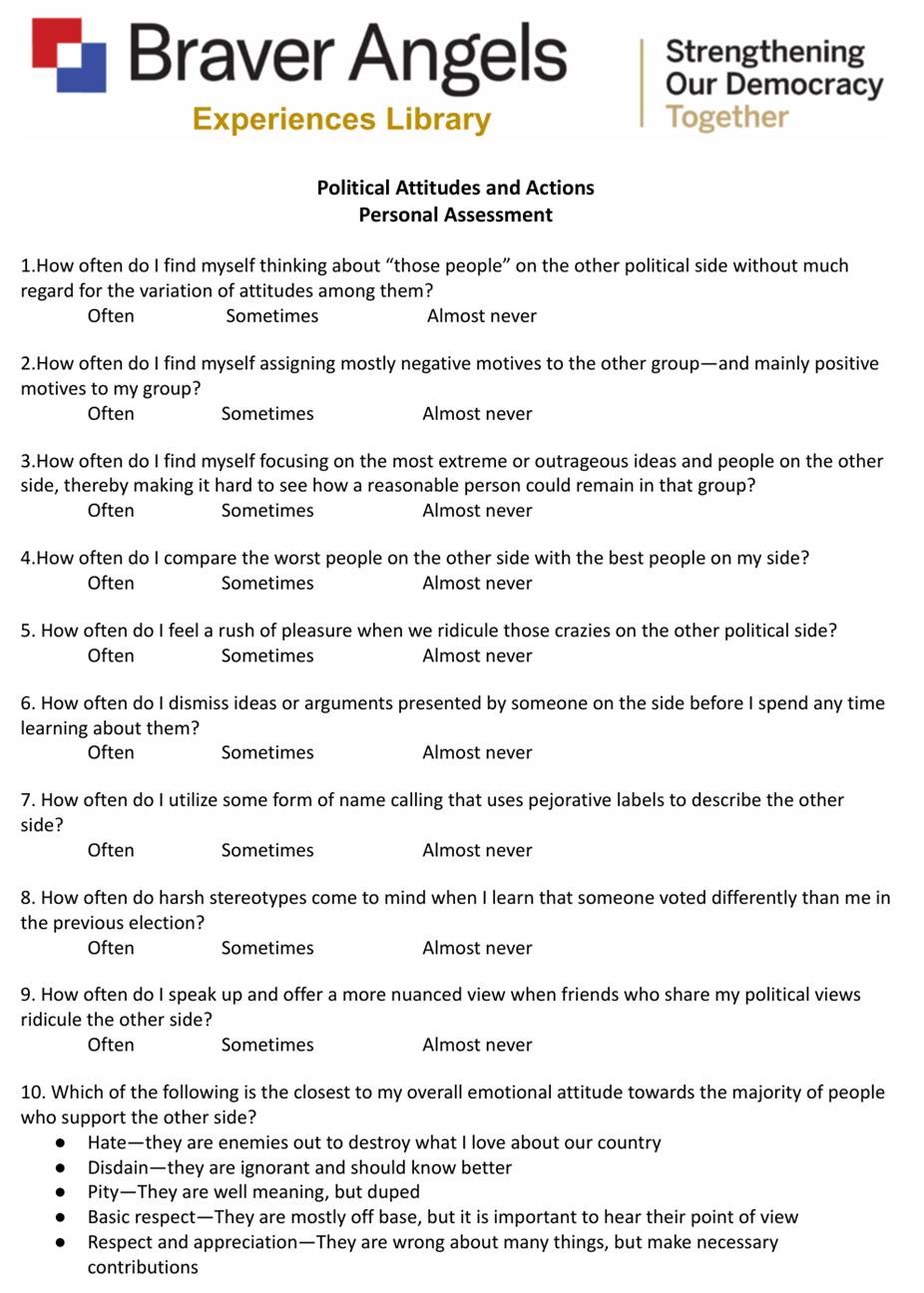
III. Icebreaker/Eye-Opener: “Political Attitudes” (10 Mins)
- Complete Braver Angels Ex 9-2 Political Attitudes Personal Assessment
- James 1:19–20 : “My dear brothers and sisters, take note of this: Everyone should be quick to listen, slow to speak and slow to become angry, because human anger does not produce the righteousness that God desires.”
- https://braverangels.org/
- https://en.wikipedia.org/wiki/Braver_Angels
- People interested in “civility” tend to be “good government”, “center-left” or “main street”, “center-right” people. We take a characteristic “classic liberal”, vaguely progressive and positive view of the world. We’re accustomed to solving problems, even very difficult problems. We sometimes implicitly think that “other people” are the issue. I will purposely push all of us to look deeply into the possibilities for personal growth offered by the full program of modern civility. When we see that we are all imperfect we can become better ambassadors for civility.
Block 2: Defining Civility & Correcting Misperceptions (40 minutes)
- Definition and Descriptions: (10 Mins)
Civility is:
- A set of behaviors that recognize differences and build mutual respect.
- A tool to deliver productive results through Civil discourse.
- Comprised of self-awareness, self-management, social awareness, relationship management, communications, growth and problem-solving skills and behaviors.
- A habit.
- A choice (intentional).
- Based on universal values of human dignity, respect, acceptance, responsibility, constructiveness, intentionality and public-spiritedness.
- A moral system but not a replacement for religious, philosophical or political systems.
- Viral; a virtuous/vicious cycle.
- Nonpartisan.
- Ecumenical.
- Teachable.
- A blend of thinking, feeling and doing.
- A social norm.
- Consistent with human nature.
- Actionable.
- An aspirational ideal, never fully achieved.
- A builder of trust, community, common good and institutions.
- A self-maintaining social system.
- Supported by world religions and secular humanism.
- Informed by modern social science.
- Practiced in personal, work, play, church, sports, media, union, culture, service, government and political environments.
- Required for democracy.
- Inspired by self-interest, situations, personality, identity, civic duty, patriotic duty, cultural duty, religious duty and philosophical duty.
- NOT too simple, complex, moderate, extreme, soft, hard, liberal or conservative.
- A solution to our challenges of political polarization, selfish media, radical individualism, limits of human nature, skepticism, our secular age, imperfect myths and insecurity.
- A Guide for Daily Life (10 Mins)
Apply the Civility Skills:
- Communicate effectively: active listening, seek to understand, solutions, facts versus opinions, ideas not people, engage, don’t interrupt, use “I statements”, proper tone.
- Practice Self-control: think twice, choose your battles, manage emotions, be patient.
- Apologize sincerely.
- Address incivility. (requires courage).
- Manage relationships: invest time, listening, empathy, understanding, feedback, follow-up, heads-up, no surprises, motivate, shared accountability, fair share, dirty work, spotlight, recognition, opportunities. (responsibility, respect).
- Be Polite.
Apply the Civility Values:
- Be Kind. (human dignity, respect).
- Be Responsible: own the process, fulfill commitments, respond promptly, manage shared spaces, clean up after yourself. (responsibility).
- Be Authentic: walk the talk, follow the golden rule, say what you mean. (responsibility).
- Value “others”: follow team rules, consider other’s perspectives, empathize, seek the common good, provide constructive feedback. (acceptance).
- Be Inclusive: celebrate differences, welcome, encourage, open, honest, sensitive, listen, access, opportunities, voices, roles, safety, protection. (acceptance).
- Be Respectful: others, priorities, viewpoints, ideas, solutions, politics, religion, identity, feelings, history, relations, ownership, time, timelines, commitments, while disagreeing, focus, engage, privacy, boundaries, situations. (respect).
- Recognize: others, efforts, contributions, teams, leaders, peers, suppliers, partners, culture. (respect, constructiveness).
- Be Positive. (constructiveness).
- Unpacking a Complex System: Key Insights (5 Mins)
- The primary focus is on learnable skills and behaviors
- With practice, the skills become habits, practiced without conscious thought.
- When a community or society adopts these behaviors as “good” they become social norms.
- The behaviors are NOT “value free”. They are infused or alloyed with values.
- The 7 civility values are broadly supported by major religions and philosophies.
- The 3 core values are human dignity, responsibility and public spiritedness.
- Remember human dignity, human agency and human community.
- The values are nonpartisan. Civility can be used to discuss or promote far-left through far-right political views.
- Civility is the set of social norms that allow our social, moral and political systems to function in a world of personal freedom, interdependence and heartfelt differences.
- Civility is practiced everywhere, in all interpersonal relationships and communities, large and small.
IV. Alternatives and Criticisms of Modern Civility (15 mins)
- Civility is Politeness and Etiquette: This surface level approach does not provide real engagement that solves problems and builds relationships. It avoids conflict and provides the appearance of civility.
- Civility is Kindness, Niceness or a Habit of the Heart: Empathy and goodwill certainly help to promote civility. However, they are inadequate to the task at hand. The 5 key areas of behavior require understanding, experience, commitment and courage. Individuals who are naturally extraverts, specific/practical, feeling, and perceiving/open ESFP in Myers-Briggs personality terms do find civility easier to practice than their opposites. Modern civility is open to all 16 personality types.
- Civil Discourse is enough. It focuses almost exclusively on vocabulary, rules of debate, and communication protocols. It is structurally inadequate because it fails to recognize that advanced thinking skills and deeply rooted moral values are required to sustain a community through gridlock.
- Modern Civility is a tool for the powerful. By focusing on practical problem solving and building relationships it distracts society from power dynamics and real changes. Civility, like any tool, can be misused. It could also be used by any group in society to effectively promote their interests.
- Modern Civility is an insidious secular, liberal tool. It assumes that learning and process can deliver positive results. It hides the reality of conflicts and differing interests. Civility tools and processes can be used to address the most contentious and difficult issues. The system provides ways to use all possible solutions. It takes no political or religious stances. As we present it here, it is fully compatible with a conservative religious perspective.
- Modern Civility is soft, weak, based on emotions alone. Modern civility focuses on skills, processes and the courage to engage in difficult situations. It promotes ethical decision-making which includes considering all interests and perspectives. It attends to relationships because this is an effective component of long-term success.
- Modern Civility is self-righteous. It overpromises results. It is too self-confident in its theories and methods. There is a risk of elevating modern civility into a magical elixir for solving problems and healing divisions. Throughout this workshop we will emphasize the aspirational nature of civility in bridging the gap from imperfect humans to their goals. We will emphasize the often-unreconcilable tensions between competing principles.
Optional reading:
https://tomkapostasy.com/2025/10/21/civility-is-for-everyone/
https://tomkapostasy.com/2025/12/14/civility-is-not-simple-or-easy/
https://tomkapostasy.com/2026/04/10/civility-misperceptions-1-2/
Transition and Closing Prayer
Looking ahead to our next session, we will expand our view from the core definition of civility to its urgent role in sustaining our threatened civilization. We will confront the mental, moral, and emotional imperfections of our shared human nature—including our deepest tribal instincts. Together, we will examine how Christian ministry offers a unique avenue for hope in the future while diving deeper into the five main categories of behavioral skills required for this work. Join us next time as we transition from foundational values to the practical, grace-filled mechanics of transforming our shared public life.
“Who is wise and understanding among you? Show by your good life that your works are done with gentleness born of wisdom.” — James 3:13
Closing Prayer:
Holy Spirit, architect of peace, we thank you for the gift of human community and the sacred call to love one another well. Guard our hearts against political bitterness and help us move beyond mere feelings into the practical skills of self-control and clear communication. Teach us to listen with social awareness and lead with a gentleness that reflects your wisdom. May our relationships bear witness to your unifying love in a divided world. Amen.
APPENDIX: Not required reading
Church and the Public Square:
A Presbyterian Guideline on Politics and Civility
Purpose of This Document
This guideline is designed for the members and leaders of our congregation to navigate the complex, often polarizing landscape of modern politics. In a community composed of diverse perspectives—our primary calling is to maintain the unity of the Spirit in the bond of peace.
This document outlines how the tools of modern civility and the rich theological heritage of the Presbyterian Church (U.S.A.) come together to guide our conversations, protect our fellowship, and honor our shared faith in Jesus Christ.
Part I: The Nature of Modern Civility
1. Civility is a Tool, not a Stance
Civility is a process and a behavioral framework; it is not a political ideology or an endorsement of any party. Its validity, authority, and power to heal divisions depend entirely upon remaining actively nonpartisan. Civility does not judge who is right or wrong in a policy debate; instead, it establishes the rules of engagement so that diverse people can coexist and collaborate with mutual dignity.
2. The Practice of Reflective Restraint
Modern civility encourages us to resist the psychological and cultural pressures toward instant, highly emotional responses to political or moral flashpoints. When confronted with divisive public questions, our first instinct should be reflective pauses rather than immediate reaction. In many cases, after careful consideration, a supporter of civility may consciously decline to respond or pass judgment, recognizing that silence or restraint can be more constructive than adding to public clamor.
3. Sharing the Vision as a Whole
Civility is a comprehensive set of values and behaviors designed to re-establish social norms. If a person, politician, or political party seeks guidance on how to bridge divides, a supporter of modern civility does not offer piecemeal policy fixes. Instead, we share the entire package of civility principles and encourage its total adoption as a lifestyle and structural commitment to human dignity, responsibility, and community.
Part II: Presbyterian Polity and Political Judgment
4. The Church Does Not Judge Individuals
Following the example and teachings of Jesus Christ, the PC(USA) does not sit in judgment of individual people. We recognize that all human beings are imperfect, stand equally in need of God’s grace, and are ultimately accountable to God alone. The church is a sanctuary for sinners seeking redemption, not a courtroom for measuring personal righteousness.
5. The Church Does Not Judge Politicians or Parties
Just as the church refrains from judging private individuals, it does not pass judgment on specific politicians or political parties. The historic Confession of 1967 explicitly warns the church against the danger of political idolatry. It reminds us that when a church identifies the sovereignty of any one nation, political program, or ideology with the cause of God, it denies the Lordship of Christ and betrays its calling. All human political structures stand under God’s judgment, and none can claim divine endorsement.
6. The Primacy of Individual Conscience and Agency
Our Presbyterian governance is anchored in the foundational truth that “God alone is Lord of the conscience.” The Confession of 1967, the Book of Order, and our historic standards consistently emphasize the primacy of individual judgment.
Mirroring the civility value of personal responsibility, our theology treats human agency as a profound, God-given gift. Every believer has full human agency to make political choices and bear their moral consequences. The relationship between the individual and the Triune God is paramount; no political party, civility program, or church body has the authority to break or supersede that connection.
Part III: How the Church Speaks to the World
7. Moral Proclamation vs. Political Endorsement
When the PC(USA) speaks out on public matters, it speaks to moral and ethical issues rather than partisan political agendas. The church’s goal is to offer prophetic witness, ground complex issues in Scripture, and help church members and citizens see the world through the lens of God’s justice and love. The church never endorses a political agenda, platform, or candidate.
8. Freedom of Conscience Takes Priority
Even when church councils (such as the General Assembly) take a strong, official moral position on an issue that some might consider political (e.g., racial justice, poverty, or care for creation), individual freedom of conscience always takes priority.
Denominational statements are intended to instruct, lead, and guide the flock—they are not legally or morally binding decrees. A faithful Presbyterian may prayerfully disagree with a statement of the church, trusting that they are ultimately answerable to God, not a church vote.
9. Our Proper Focus: Working Together
Our true calling as a local congregation is to work together, worship together, and actively respect each other’s differing political views. We refuse to let national political polarization dictate the climate of our spiritual home. By utilizing the tools of civility and leaning into our Reformed theology, we can hold our differences in tension, celebrate our shared baptism, and model to a fractured world what it looks like to find rest under the easy yoke of Jesus Christ.
Matthew 11:28-30
“Come to me, all you who are weary and burdened, and I will give you rest. Take my yoke upon you and learn from me, for I am gentle and humble in heart, and you will find rest for your souls. For my yoke is easy and my burden is light.”

