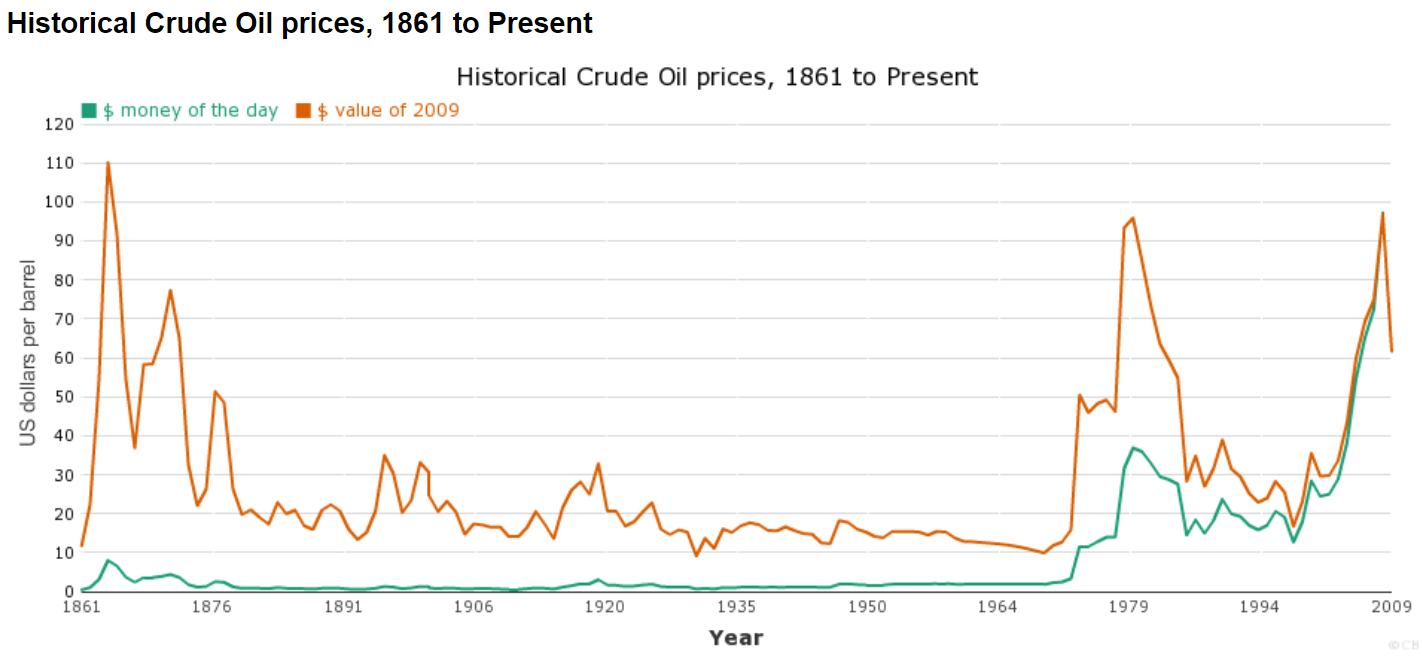
Good News: Real Gas Prices Flat for 40 Years


https://www.energypolicy.columbia.edu/research/report/oil-intensity-curiously-steady-decline-oil-gdp

https://www.energypolicy.columbia.edu/research/report/oil-intensity-curiously-steady-decline-oil-gdp


https://www.energypolicy.columbia.edu/research/report/oil-intensity-curiously-steady-decline-oil-gdp
https://www.northerntrust.com/africa/insights-research/2022/weekly-economic-commentary/oil-intensity

https://www.energypolicy.columbia.edu/research/report/oil-intensity-curiously-steady-decline-oil-gdp


https://www.energypolicy.columbia.edu/research/report/oil-intensity-curiously-steady-decline-oil-gdp

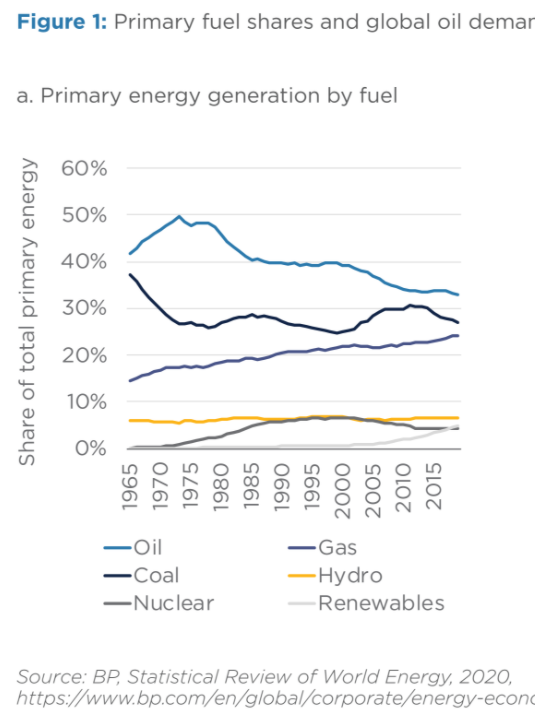
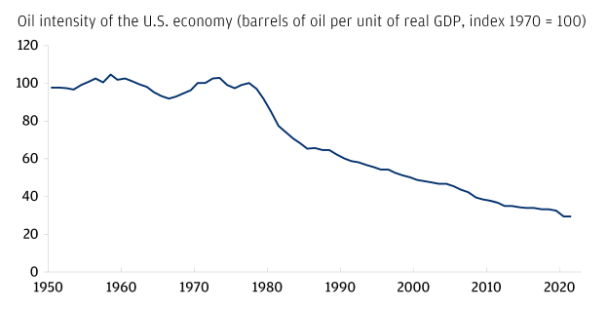
Energy intensity is down as the service economy becomes a greater share of GDP, energy efficiency improves for consumer and industrial uses, electricity power grows with its inherently higher efficiency, and renewable energy grows as a source of power.

https://www.energypolicy.columbia.edu/research/report/oil-intensity-curiously-steady-decline-oil-gdp


https://www.eia.gov/outlooks/aeo/consumption/sub-topic-03.php

https://www.eia.gov/todayinenergy/detail.php?id=42895

https://www.eia.gov/todayinenergy/detail.php?id=42895
https://www.eia.gov/outlooks/aeo/consumption/sub-topic-03.php

https://www.northerntrust.com/africa/insights-research/2022/weekly-economic-commentary/oil-intensity
US consumer price index still weights motor fuel consumption at 4%, so spikes in market prices effect consumers and politics.
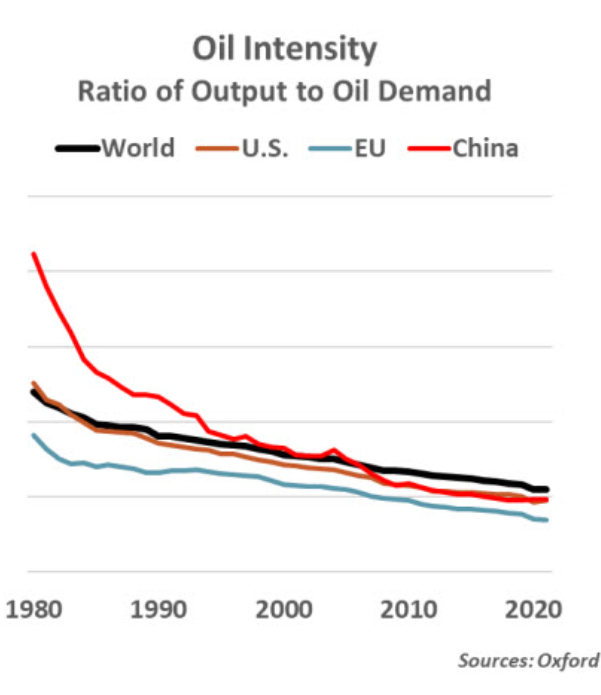
The long-term downward trend in oil required per dollar of GDP slowed after 2014.

https://www.energypolicy.columbia.edu/research/report/oil-intensity-curiously-steady-decline-oil-gdp

It’s possible that ALL energy prices may increase, especially during the transition to renewable energy sources.
Finally, individual country risks still matter: Russia, Iran, Venezuela and Saudi Arabia.
The Oil Shocks of the 1970’s were due to a drastic shift in the pricing power of the OPEC countries following 30 years of greatly accelerated global demand for oil while it was priced attractively. Demand and supply have both grown in the last 50 years. The role of oil in the global and US economies (compared with real output/GDP) has dropped by more than one-half. Increased oil prices can and will have a significant effect today, but less than one-half of that in the past. Long-run trends indicate that the role of oil as a critical resource will continue to decline, although there remain risks as the world closes coal and nuclear power plants and makes the investments required for a renewable energy world.
https://fred.stlouisfed.org/series/UNRATE
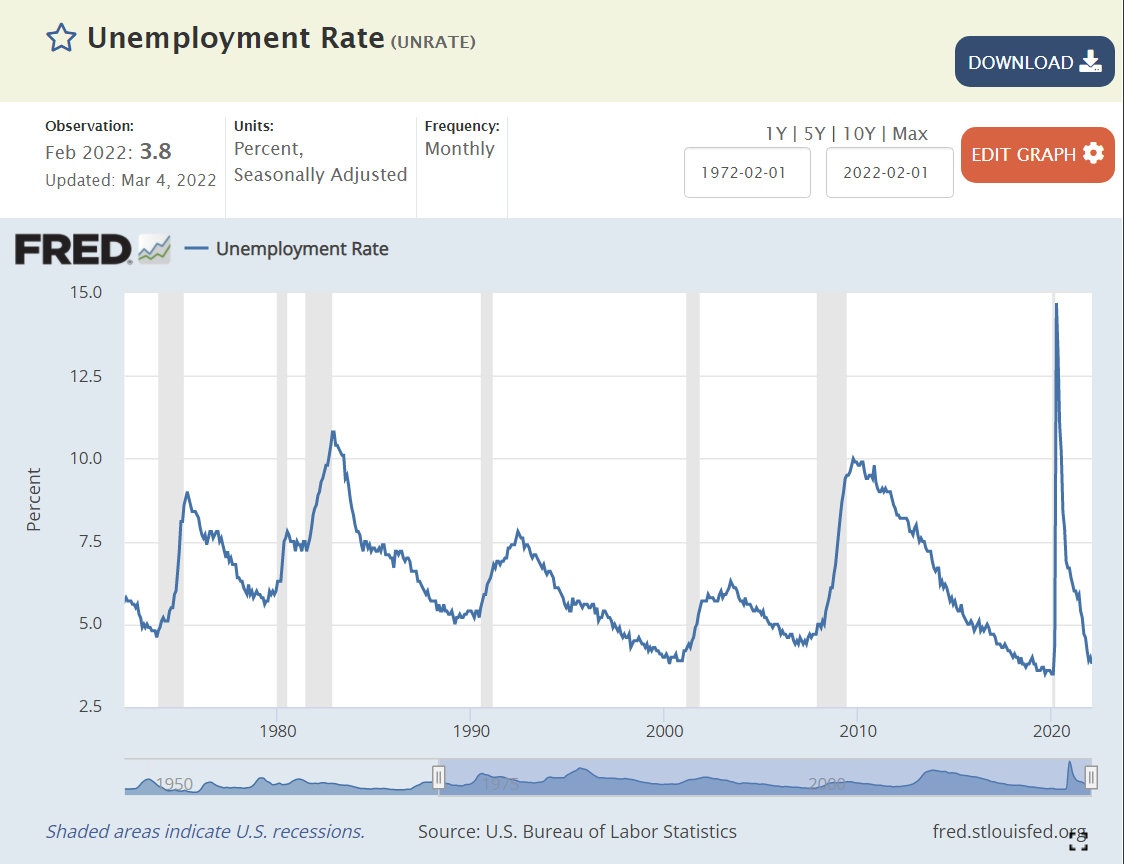
In the last 50 years, the last 600 months, the US unemployment rate has been below the current 3.8% for just 9 months (less than 2% of the time).
This is less than 2 years after the rate hit a modern HIGH of 15%.
9 states set all-time lows this month: Nebraska (2.1%), Vermont (2.1%), Indiana (2.3%), Kansas (2.5%), Montana (2.6%), Oklahoma (2.6%), Arkansas (3.1%), West Virginia (3.9%) and Mississippi (4.5%).
In February, 31 states had material decreases, while 19 had immaterial changes and NO states had material increases.
https://www.bls.gov/news.release/laus.nr0.htm
At the metropolitan area level, 50 areas sported unemployment rates of 3% or less, far below historical results.
11 areas were at crazy low 2.3% unemployment rates or lower: Lincoln, NE and Madison, Wi. Logan, Provo and Ogden UT. Elkhart, Columbus, Bloomington, Lafayette, Ft Wayne and Indianapolis, IN.
The average age of all US cars and light trucks in operation exceeded 12 years for the first time in 2021.
https://news.ihsmarkit.com/prviewer/release_only/id/4759502/

Typical vehicle age increased by one-quarter, from 9.6 to 12.1 years since 2002.
Typical vehicle age increased by more than one-half from 7.8 years in 1990.
Typical vehicle age more than doubled from just 5.3 years in 1969.
The rate of increase has remained relatively constant, with improved highways, driving, designs, quality and maintenance allowing the average age to increase by 1 year every 7-8 years.
summary table, page 60.
page 10, 1969
page 54, 1977. 1 of several somewhat different figures.
page 26, 1983.
page 104, 1990
page 78, 1995.
https://www.autodealertodaymagazine.com/366056/average-age-of-vehicles-on-the-road-increases

Public libraries serve 97% of the US.
https://www.imls.gov/research-evaluation/data-collection/public-libraries-survey
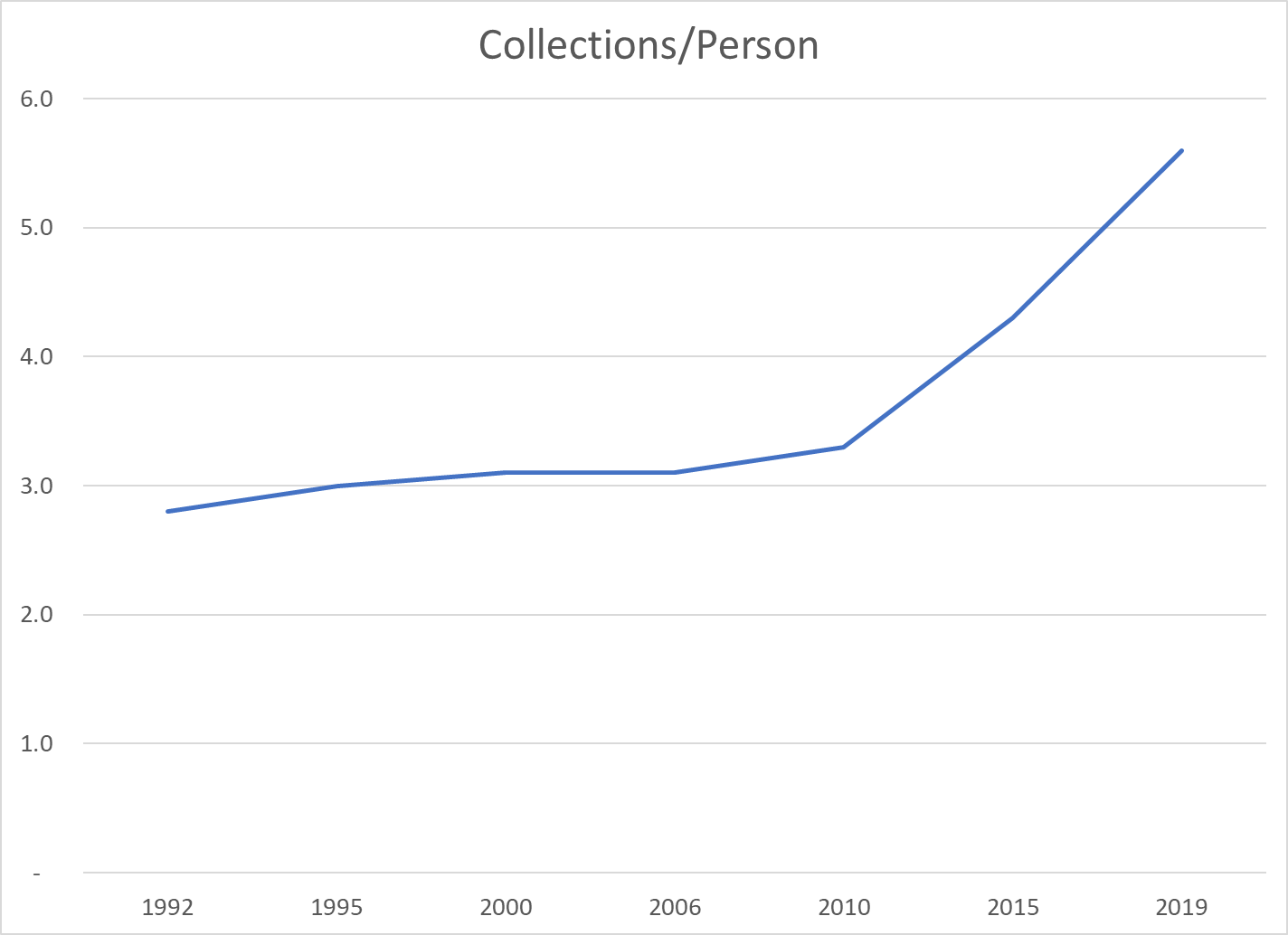
E-books have allowed libraries to nearly double their “per capita” holdings.

Printed books collections have purposefully declined by one-quarter in the last decade.

Electronic holdings have accelerated.
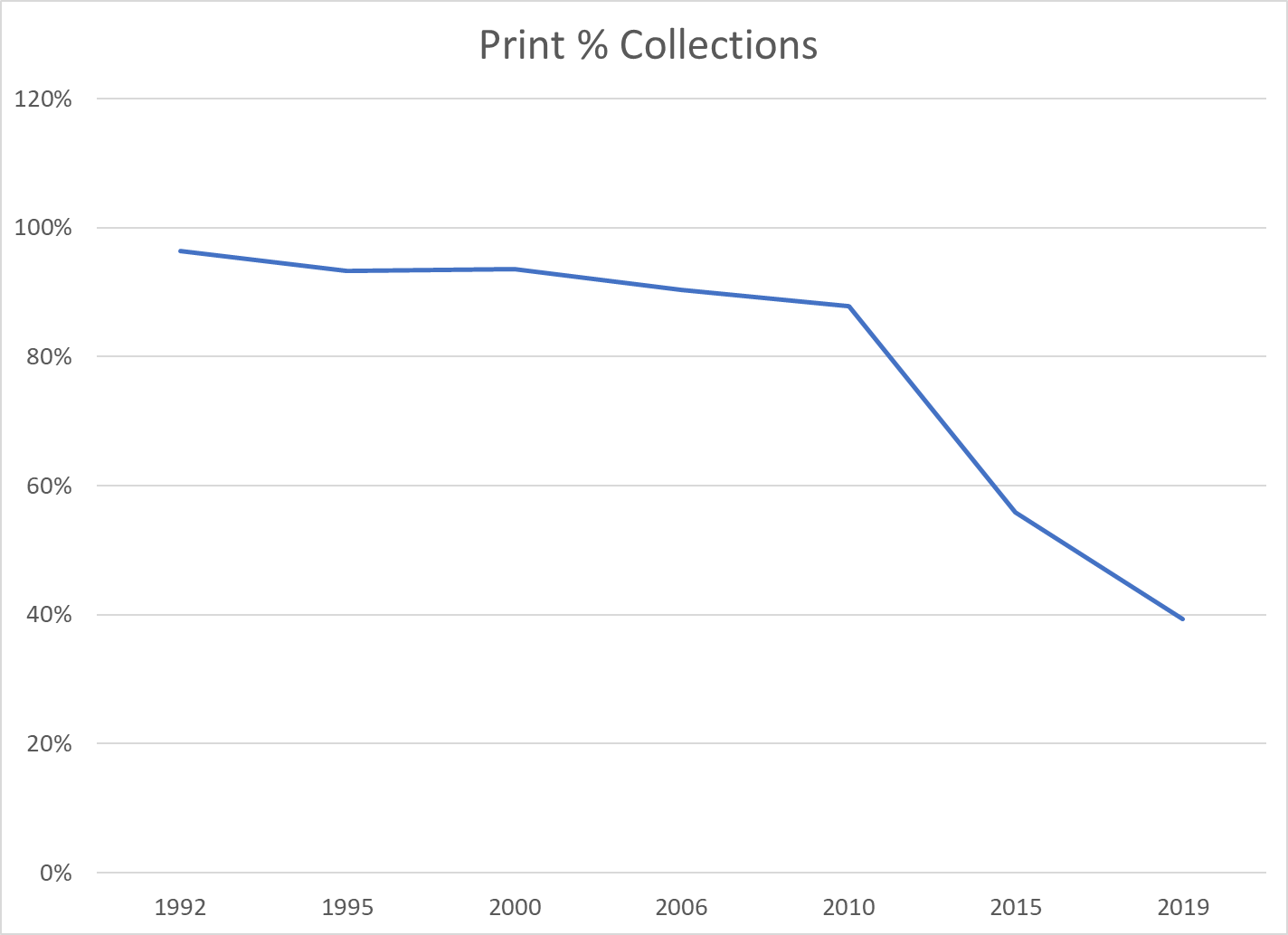
Printed materials have quickly fallen to less than half of total holdings.
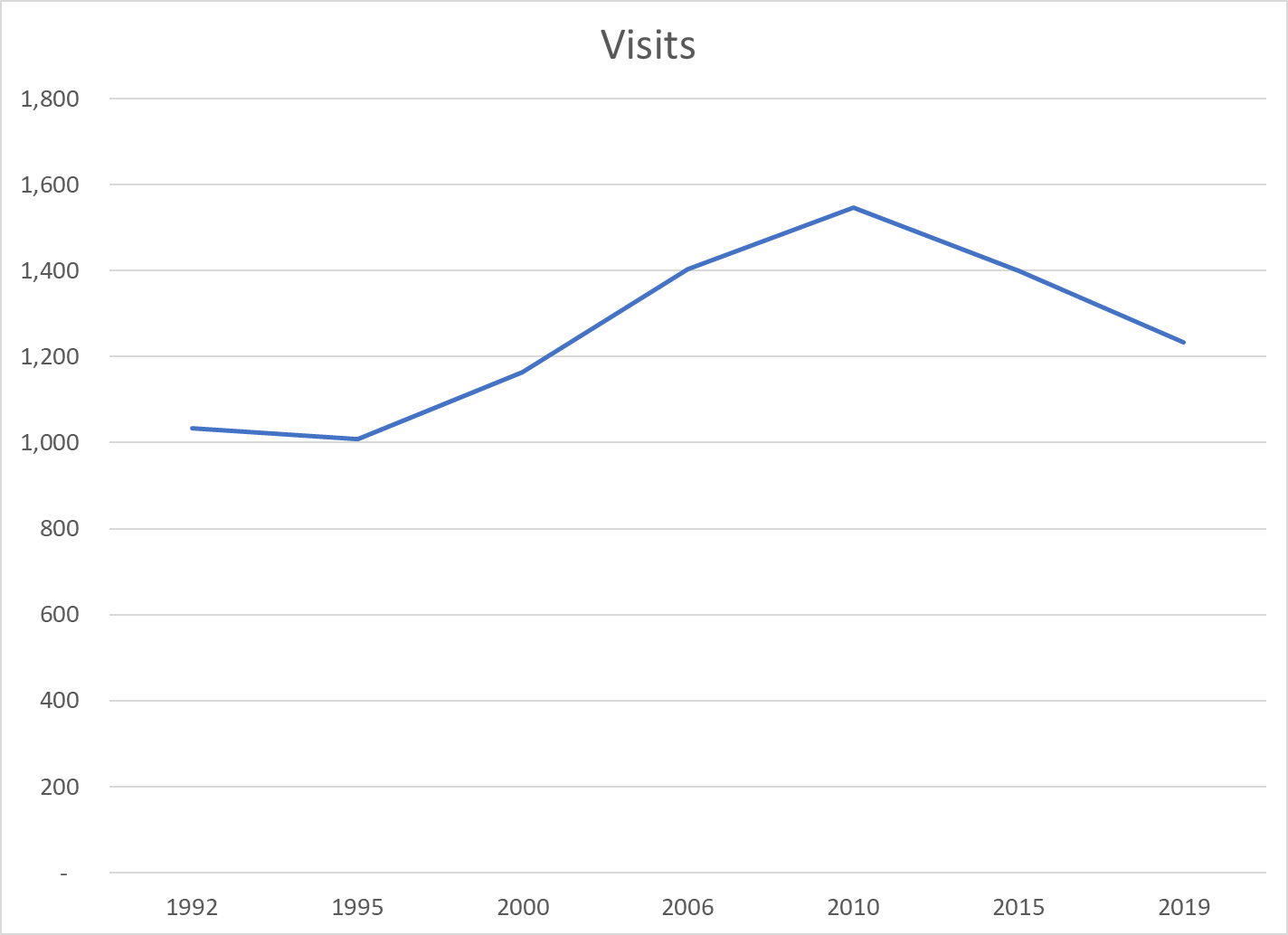
Total library visits increased from 1995-2010 before declining in the last decade.

Annual library visits remain above 4 per person.

Reference desk visits have fallen by one-quarter as the internet provides answers.
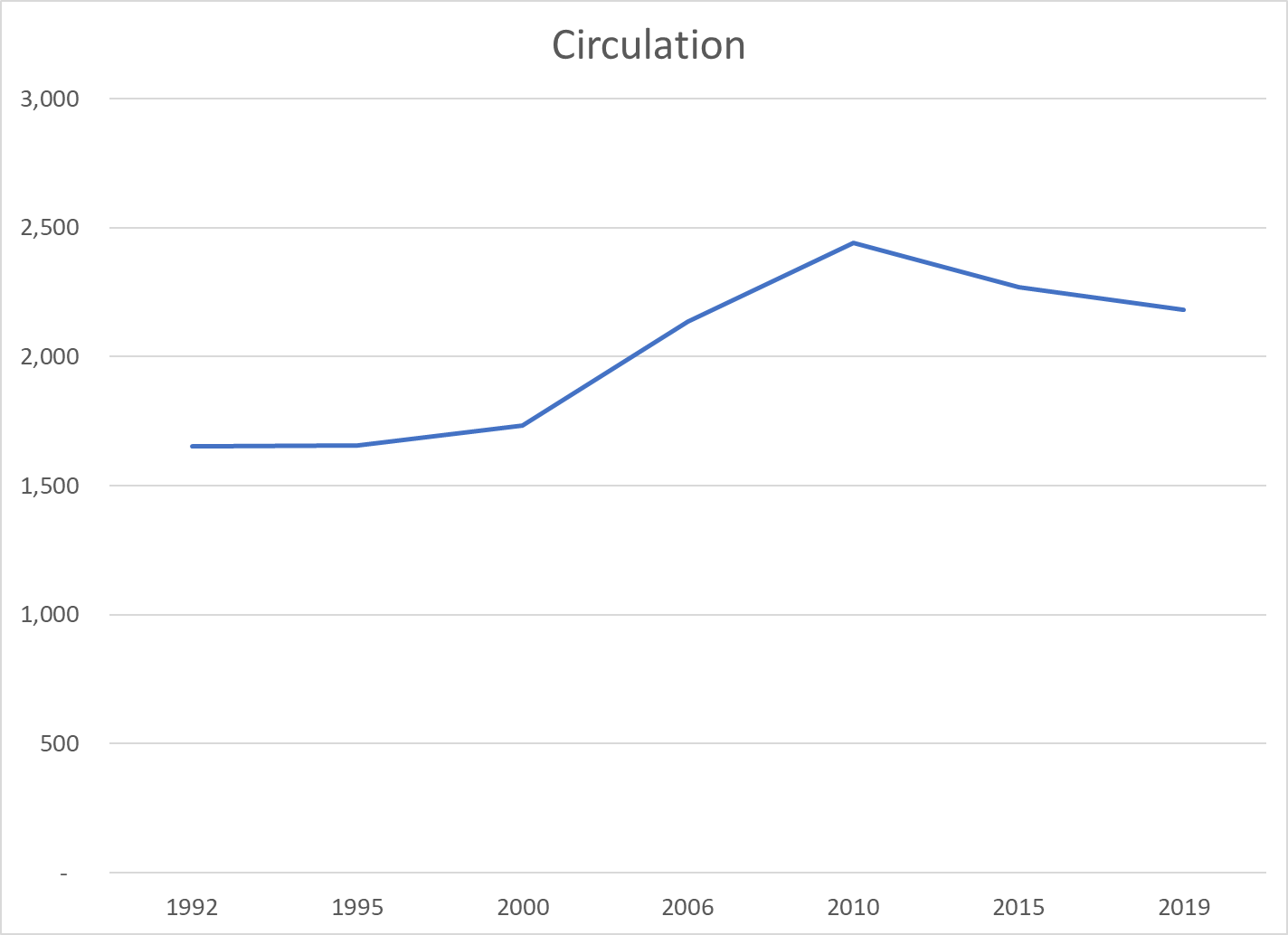
Total circulation remains above 2 billion items per year.
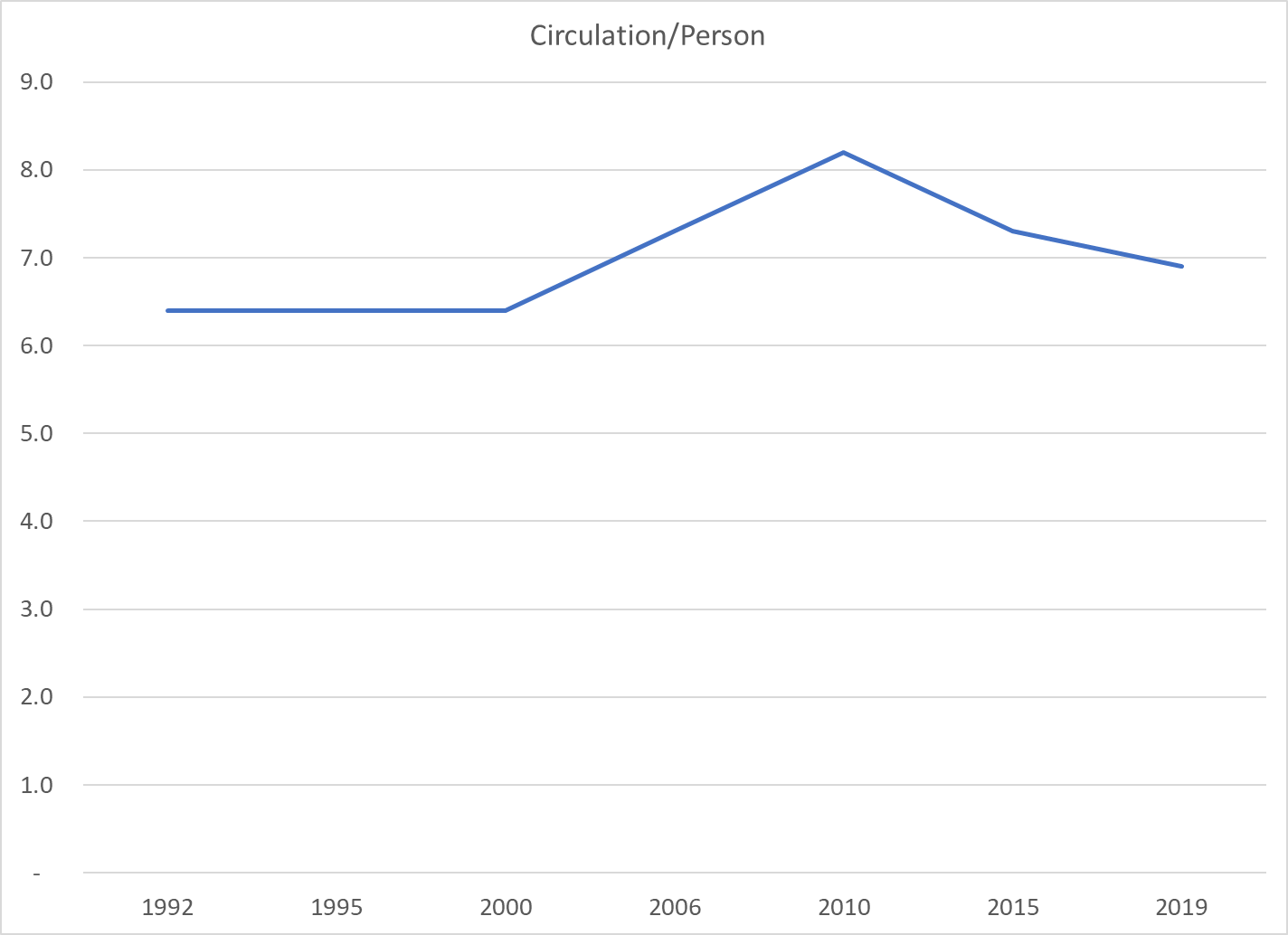
Total circulation per person remains above 7 items per year.
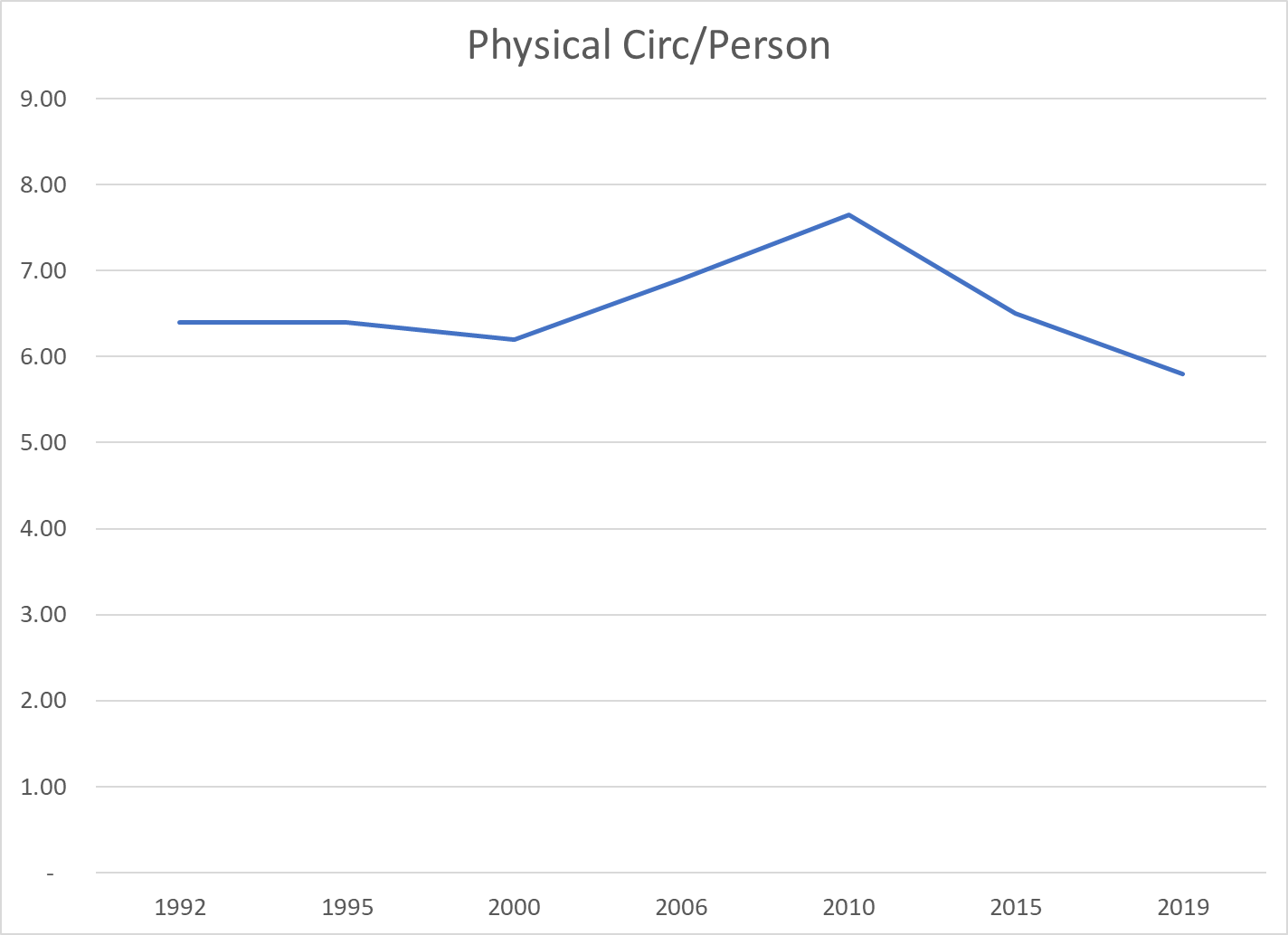
6 books per person per year are checked out of pubic libraries.
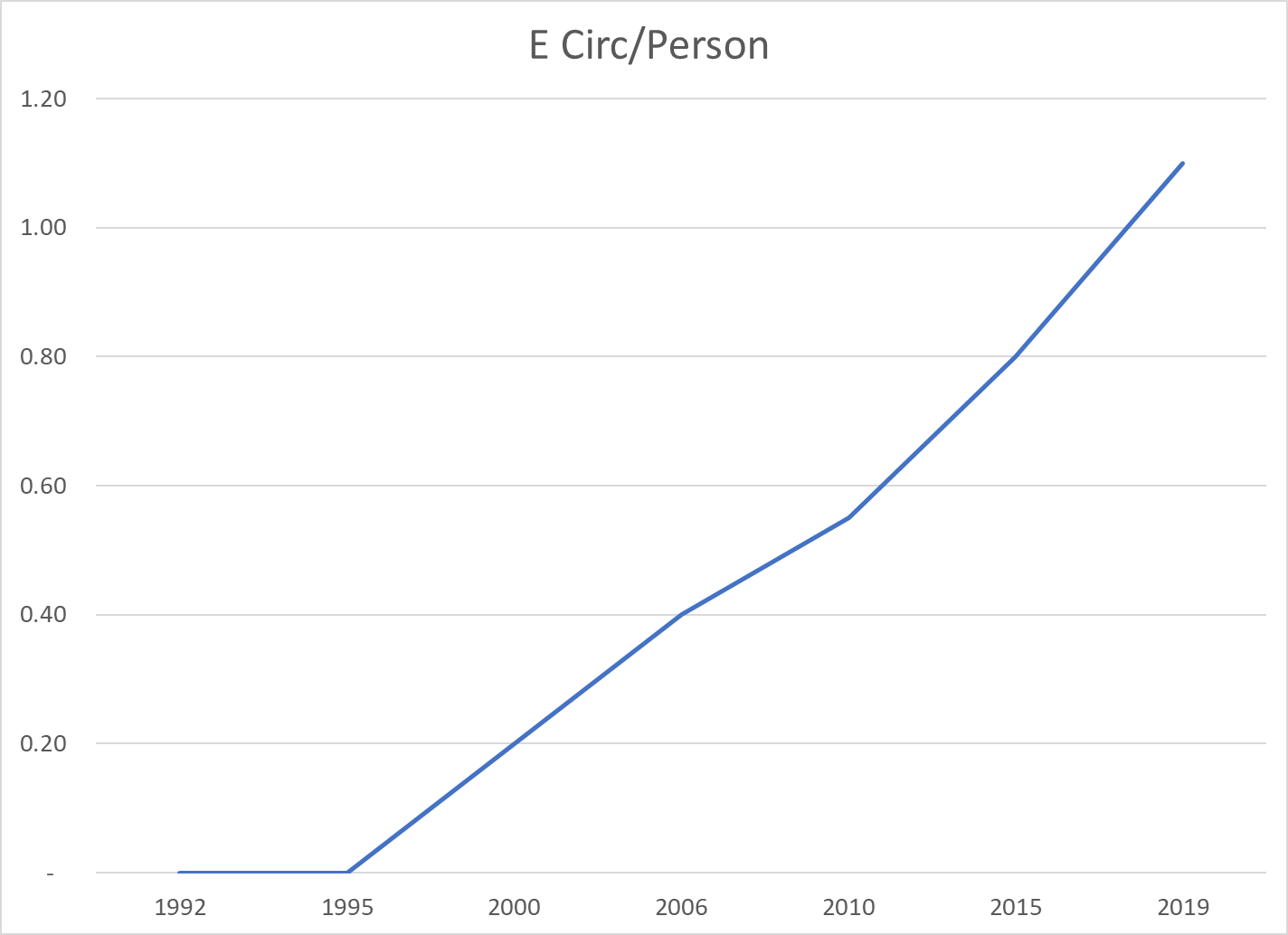
Electronic books have grown from zero to 1 title per person per year.

Libraries have doubled the number of programs they offer to the local community.

Program attendance has risen accordingly.

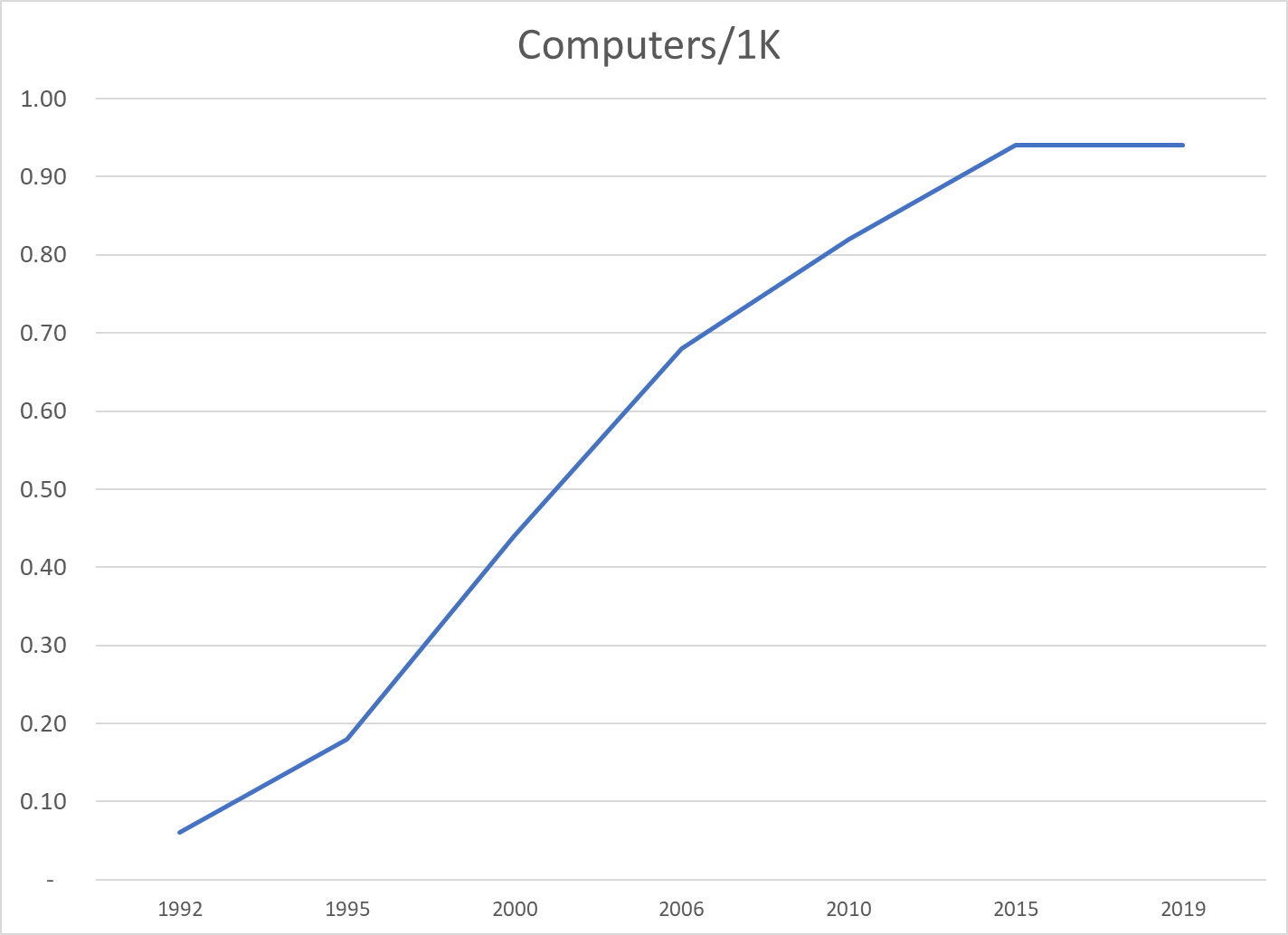
In the 1990’s and “oughts” libraries added internet accessible computers.

The number of computer sessions at the library peaked in 2010.
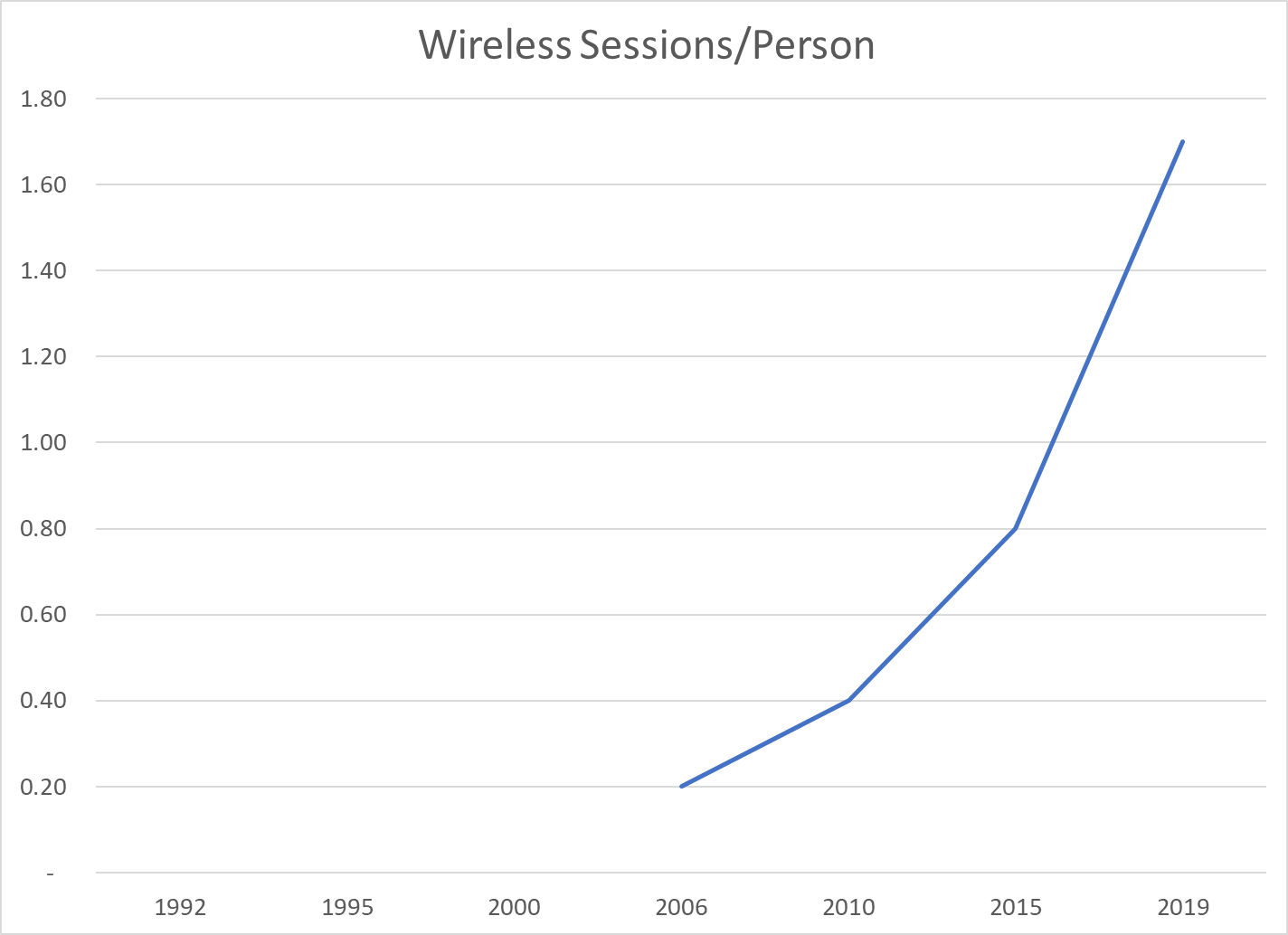
Starting in 2000, libraries provided internet access to patrons on their own computers.
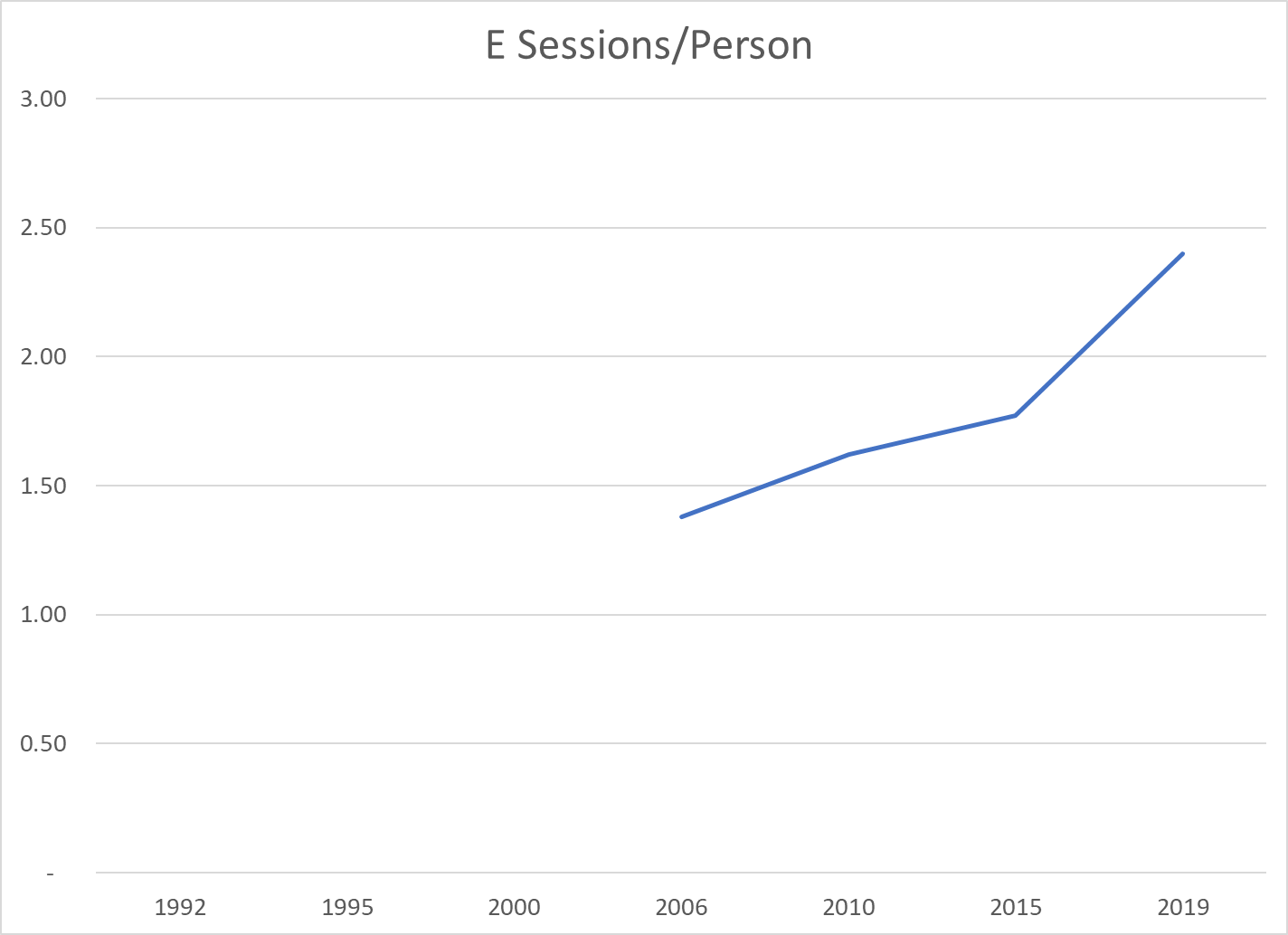
The sum of library computer plus library wi-fi access computers grows.

The real (inflation-adjusted) cost of public libraries per person has been flat for the last 20 years.
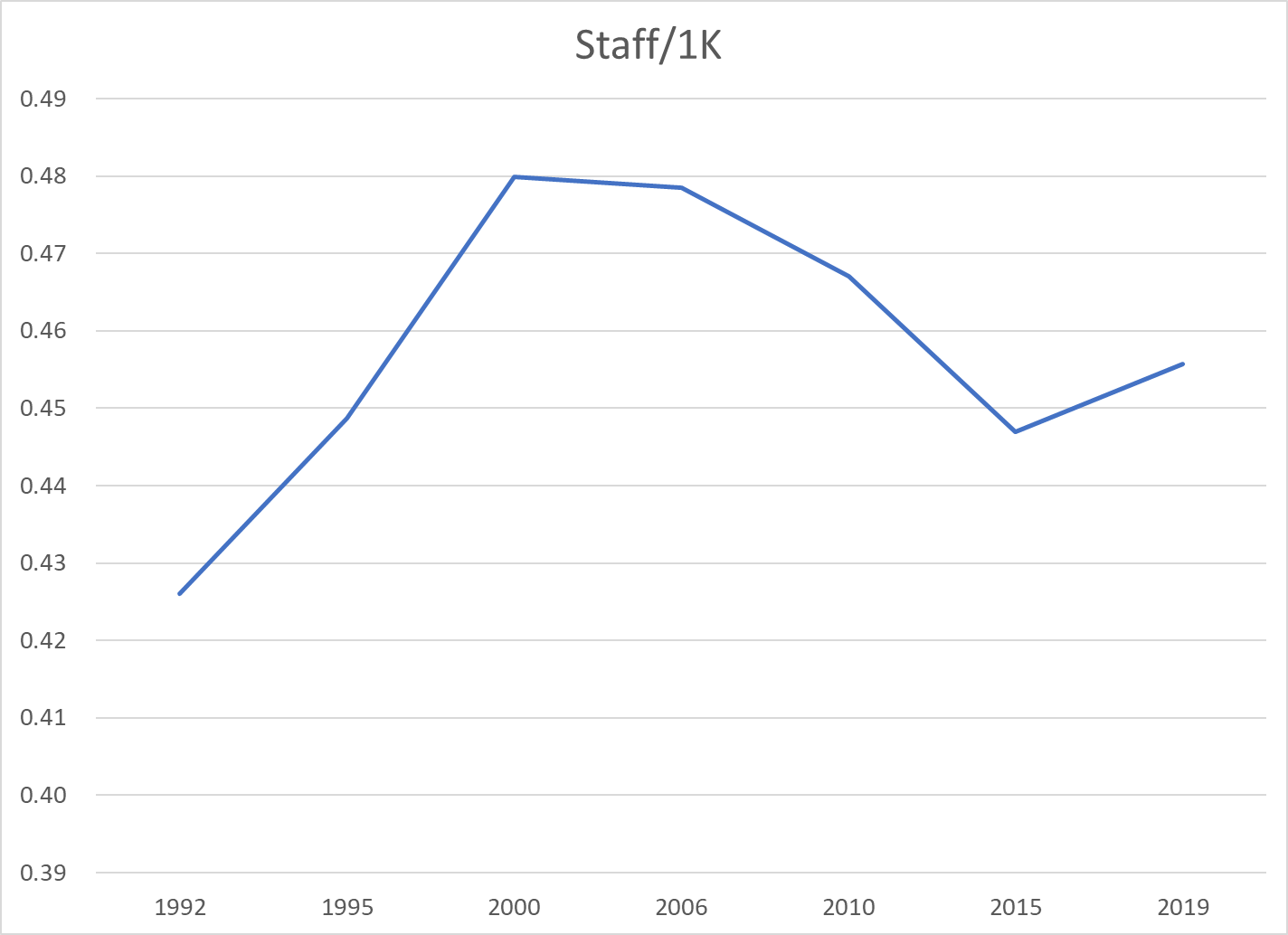
Library staffing peaked in 2000 and has declined since then.
Residential air conditioning was close to zero percent until after WWII.
https://www.smithsonianmag.com/smithsonian-institution/unexpected-history-air-conditioner-180972108/
Household AC grew to 50% by 1970 and 90% by 2017. It grew from 88% in 2011 to 91% in 2019.

http://www.freeby50.com/2011/08/percentage-of-homes-with-air.html

https://www.eia.gov/consumption/residential/reports/2009/air-conditioning.php

https://www.bloomberg.com/news/articles/2019-07-10/why-we-always-fight-over-air-conditioning
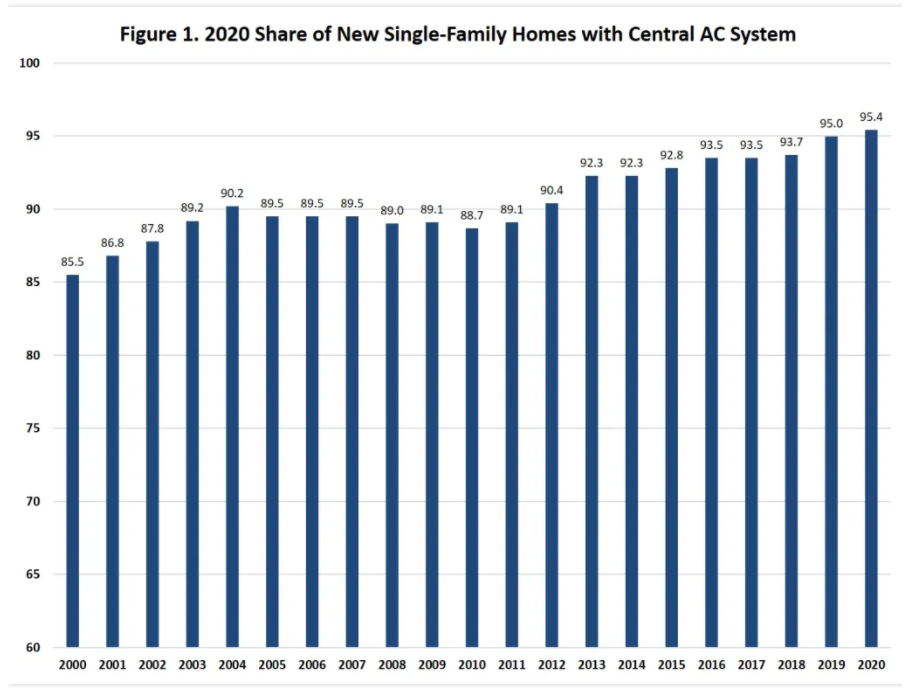
The increased level of air conditioning is largely driven by the increased level of air conditioning included in new home construction.

https://www.eia.gov/consumption/residential/reports/2009/air-conditioning.php


https://www.bloomberg.com/news/articles/2019-07-10/why-we-always-fight-over-air-conditioning
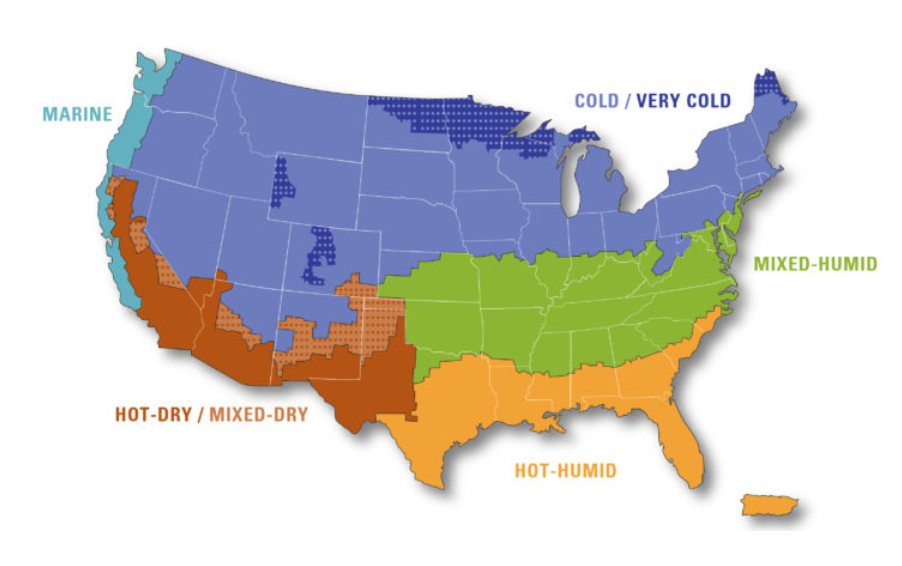
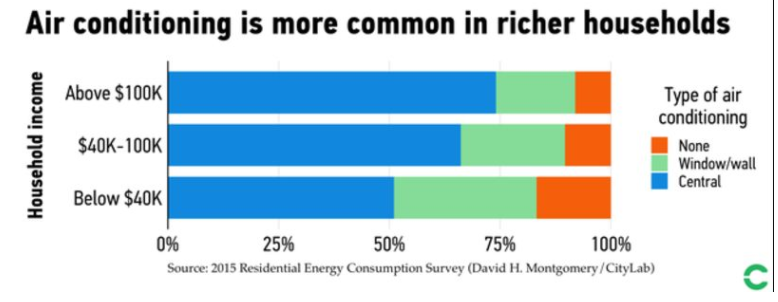
Air conditioning demand varies significantly by region/climate. AC use increased from 75-99% in the South, from 60-90% in the Midwest, from 50-85% in the northeast and from 40-60% in the West. AC demand varies based on peak temperatures, the number of days at peak temperature, the number of hours per day at peak temperature and the humidity (felt temperature). San Francisco, Portland and Seattle rarely “require” AC, even though their residents could afford this service.
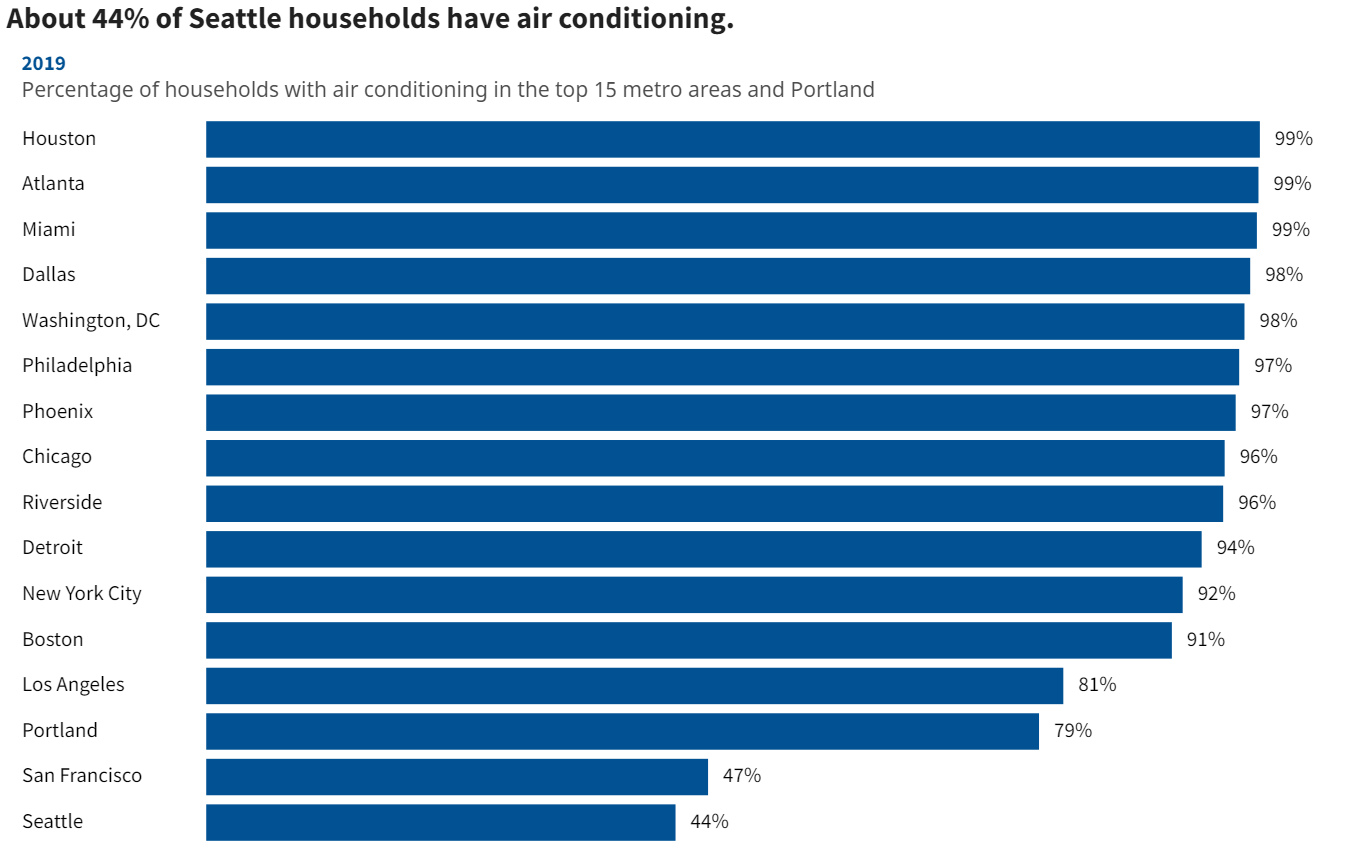
https://www.bloomberg.com/news/articles/2019-07-10/why-we-always-fight-over-air-conditioning

https://howtoguide.org/europeans-can-live-without-ac/

https://www.smithsonianmag.com/smithsonian-institution/unexpected-history-air-conditioner-180972108/
The US, Japan and Korea lead the world in households with air conditioning. China and Saudi Arabia are representative of moderate-income nations with relatively high AC usage. Most other nations, including the wealthier European nations, remain at very low rates of AC adoption (10%). This is a “good news” item for personal comfort, but not so good for energy consumption.
https://nces.ed.gov/programs/digest/d12/tables/dt12_310.asp
https://nces.ed.gov/programs/digest/d20/tables/dt20_318.20.asp
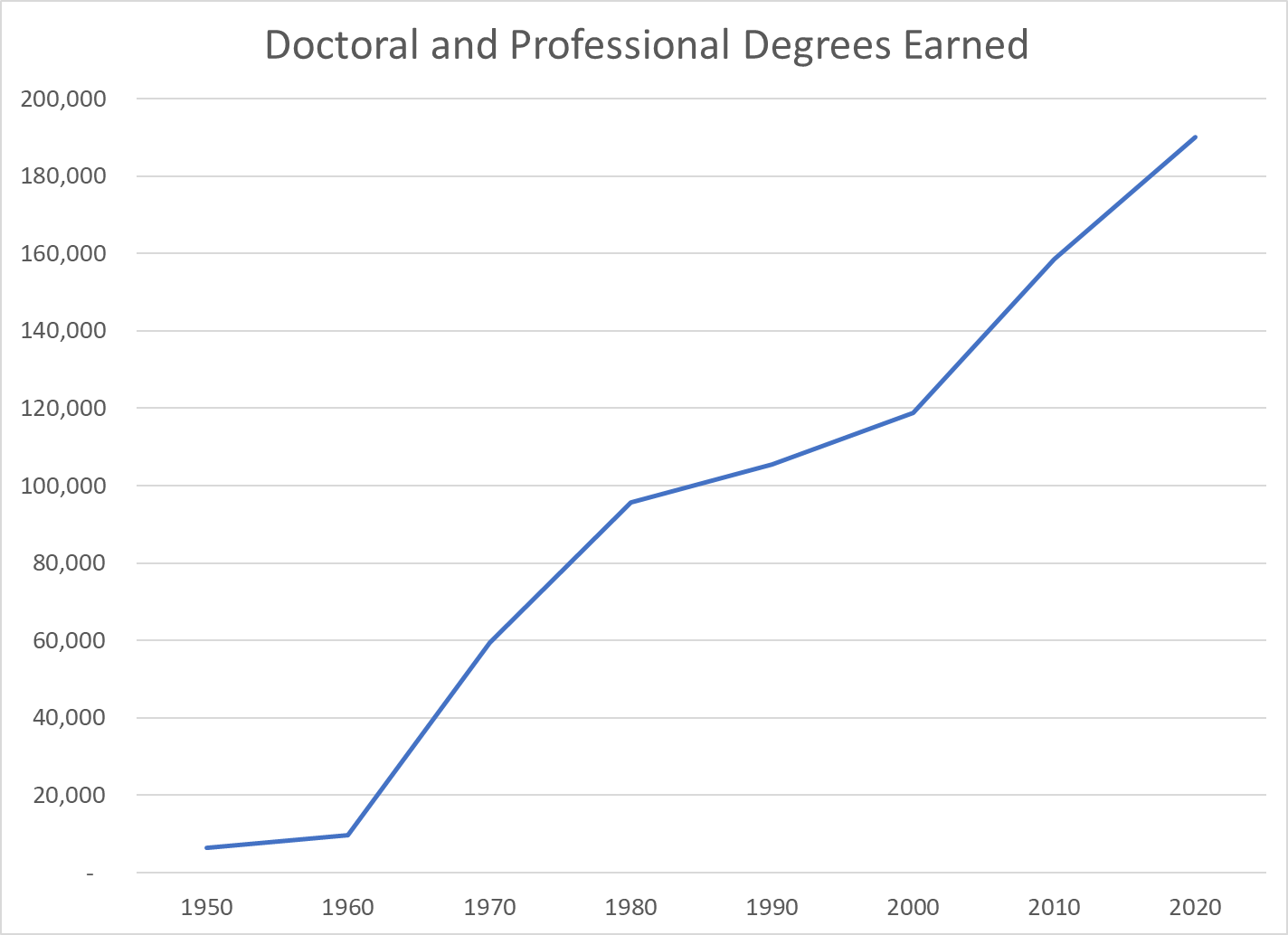
The annual number of “academic” and “professional” doctoral degrees awarded has increased 10-fold since 1960.
https://www.insidehighered.com/news/2021/12/03/survey-shows-annual-decline-number-phds-awarded
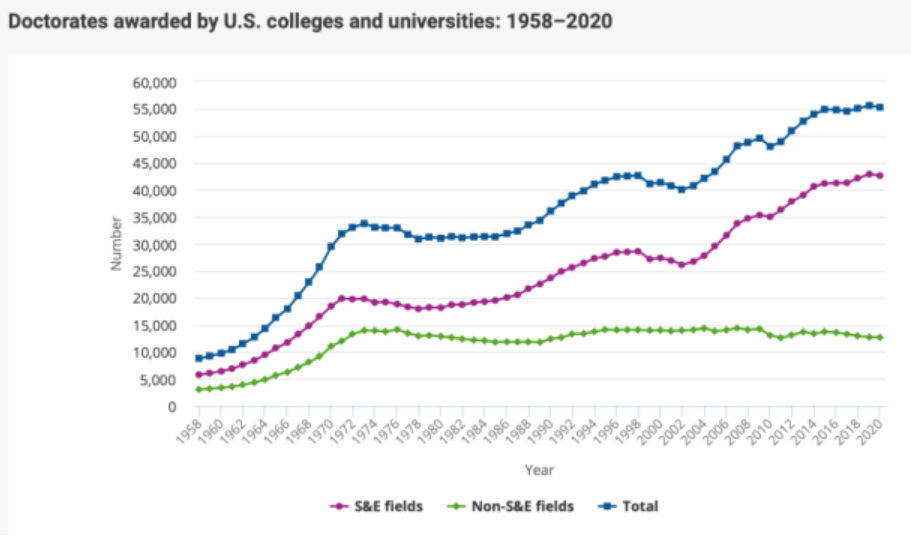
The number of “academic” doctoral degrees awarded has increased 5-fold since 1960.
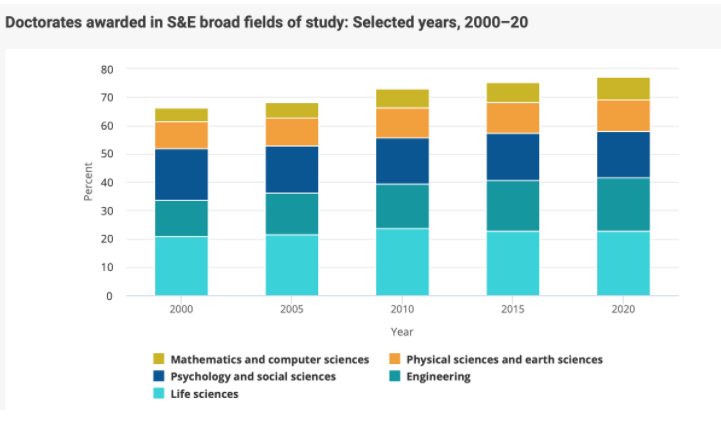
The increase in degrees has been totally accounted for by “scientific and engineering” degrees awarded.

https://www.insidehighered.com/news/2021/12/03/survey-shows-annual-decline-number-phds-awarded
More details on the decline of humanities doctoral degrees.
Detailed annual academic data.
https://ncses.nsf.gov/pubs/nsf22300/data-tables
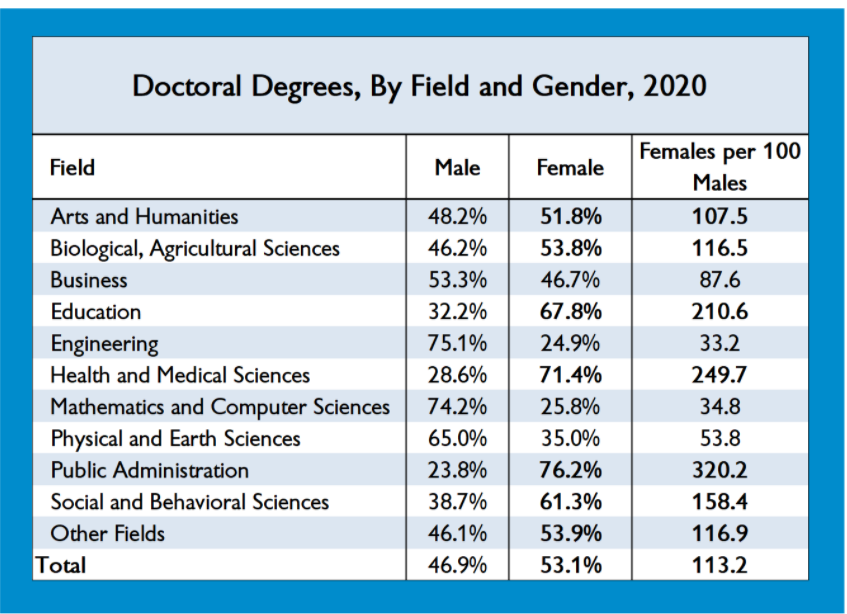
Women earn an increasing share of doctoral degrees.
Minority identified individuals earn an increasing share of doctoral degrees.
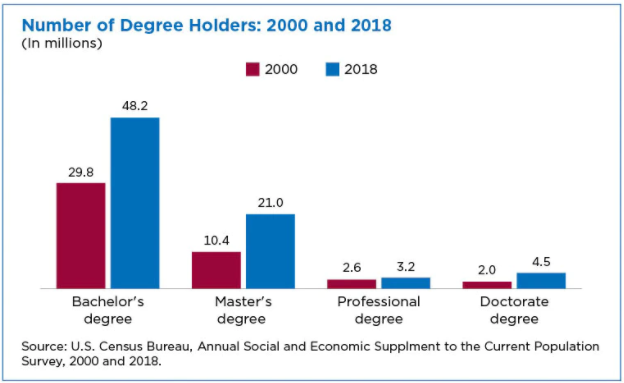
The cumulative number of advanced degree holders continues to increase.

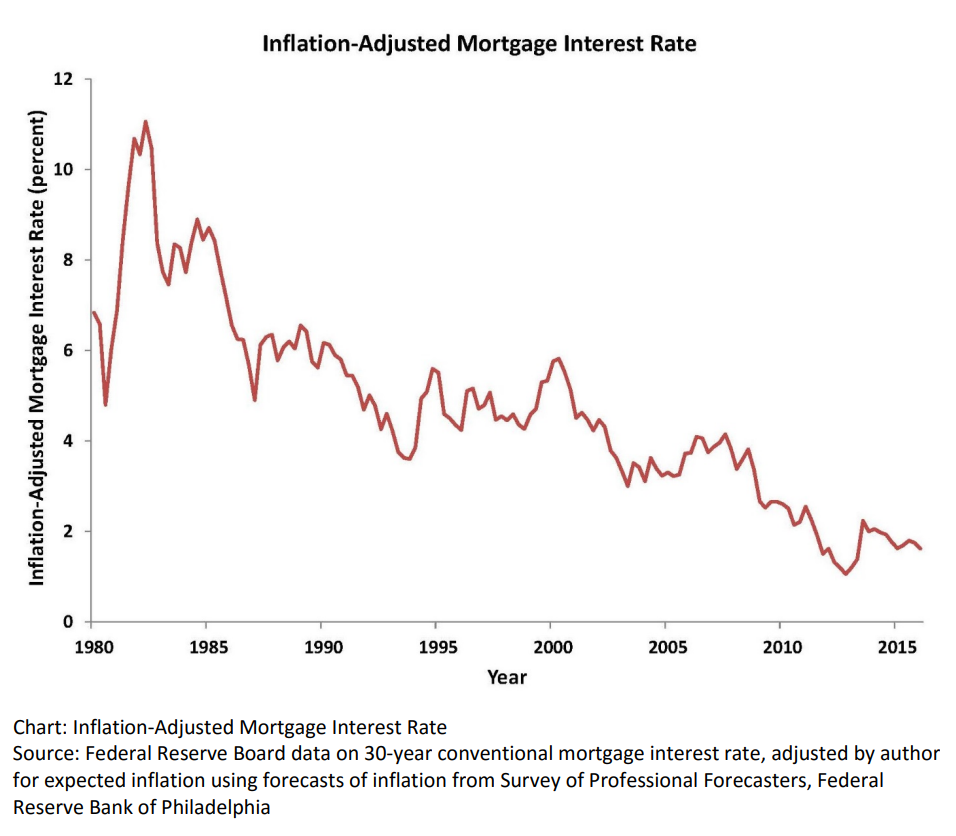
Real, inflation-adjusted, interest rates have declined greatly since 1980. At that time, with the risks of variable inflation and surging oil prices, the real mortgage interest rate was 8%. It declined to 5% in the 1990’s and 4% in the 2000’s before falling to 2% in the 2010’s. The financial cost of owning property has rarely been lower.

House prices grew relatively consistently from 1970 through 2000, with a spike in 2005-9 and a return to trend values in 2010-12. In the last 10 years, house prices have increased by 6% annually in nominal terms, or 4% annually in real terms.
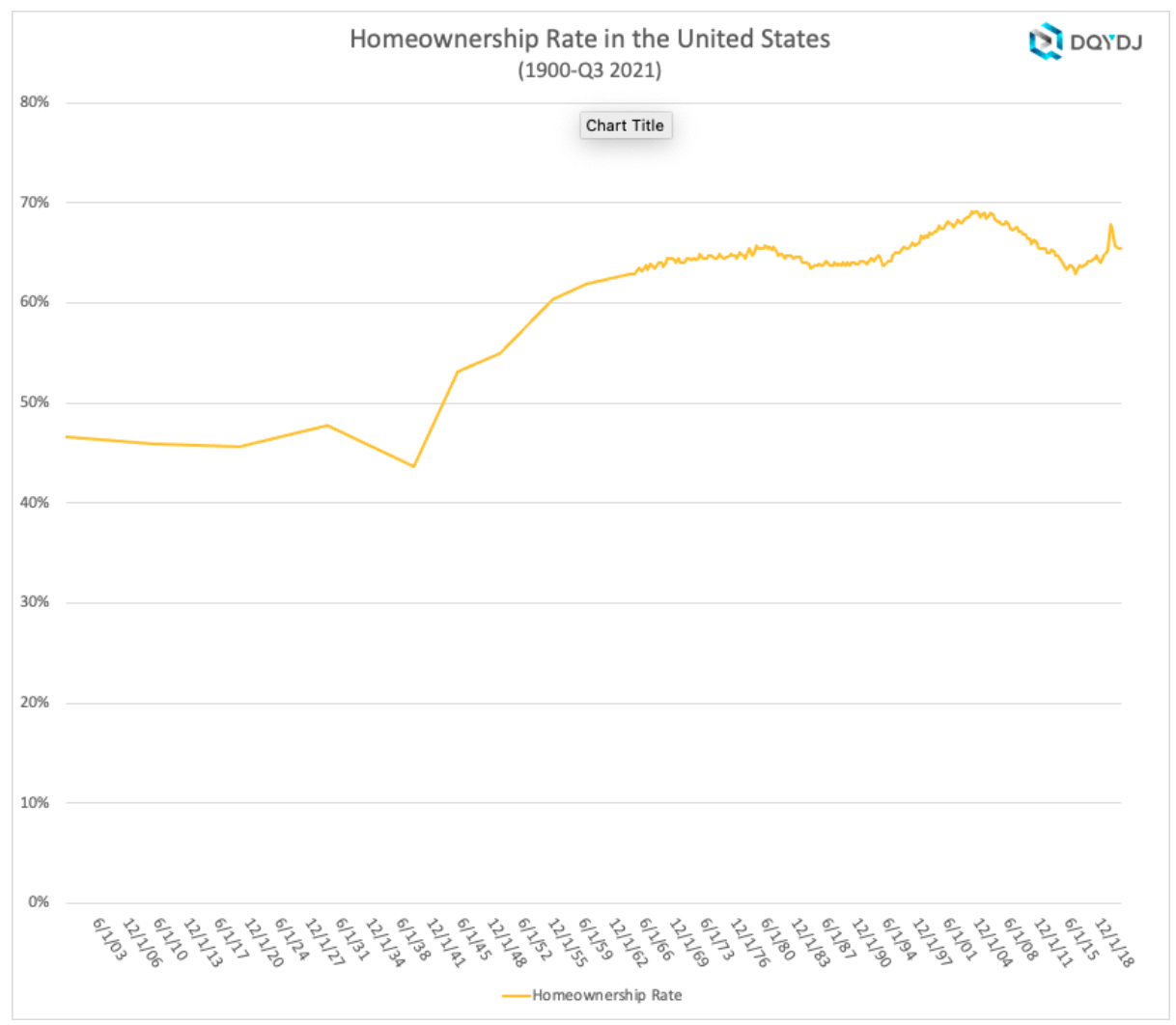
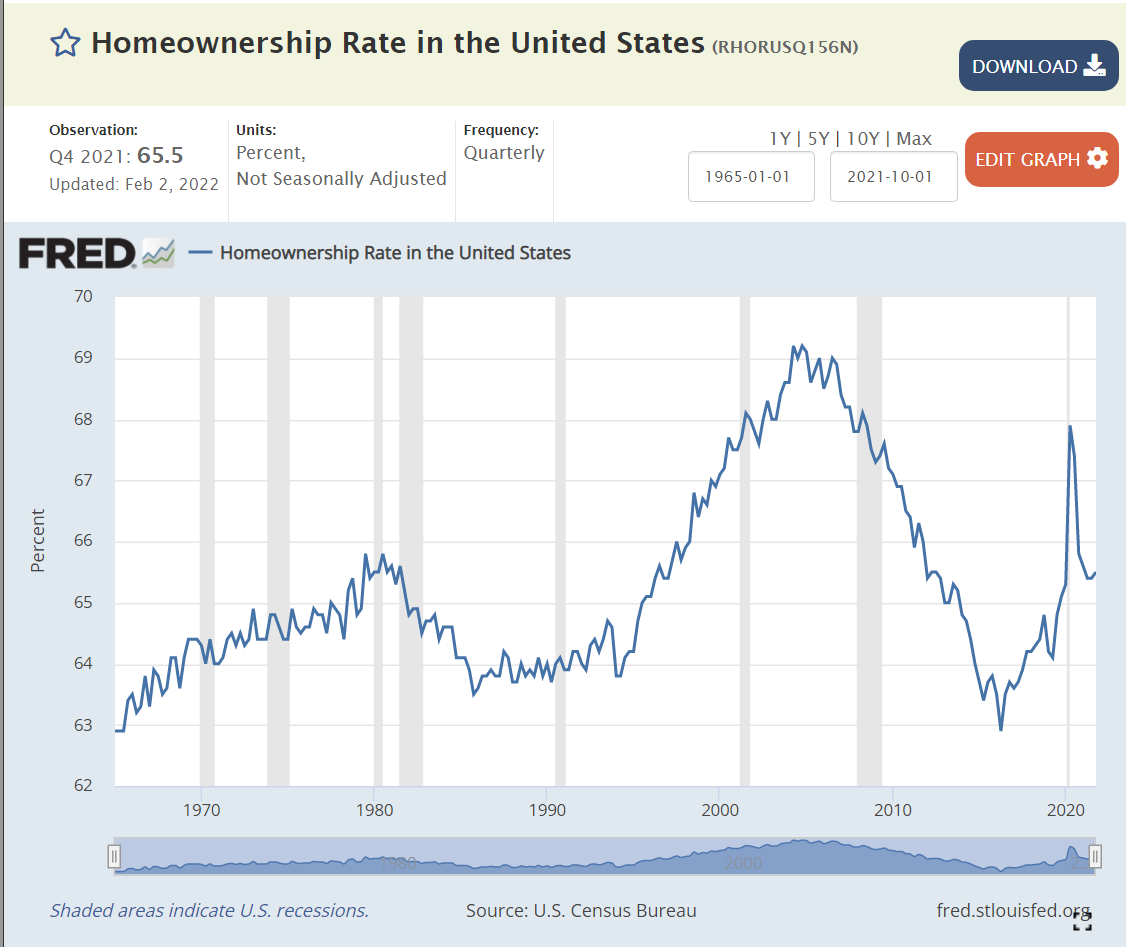
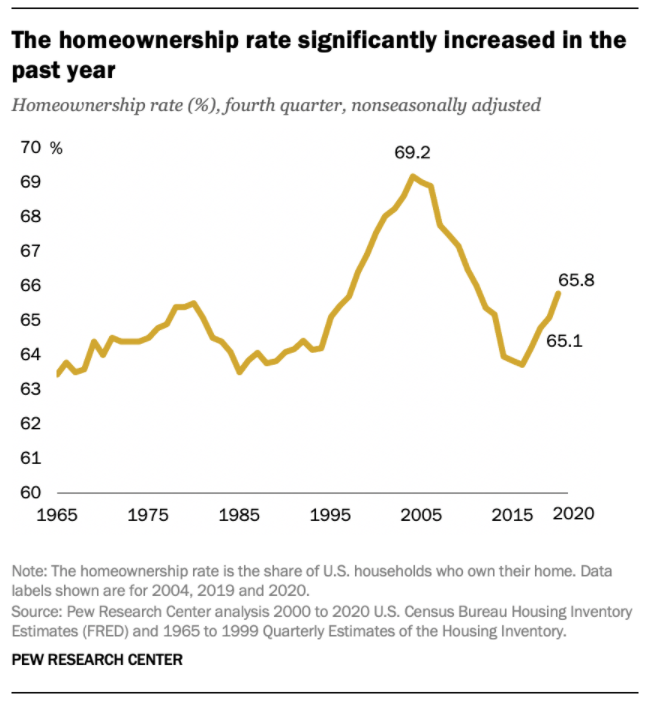
The US homeownership rate averaged 47% from 1900-40. It increased smartly in post WWII times to 60% by 1955 and 64% by 1965. Homeownership averaged 64%+ for the decade of 1969-78. It increased by 1% during 1979-81. In the midst of a difficult depression, homeownership rates dropped back to 64% by 1985, about the same for the last 20 years, setting a “normal” level. Homeownership rates stayed at 64% for the next decade. Ownership rates increased from 64% to 69% in the next decade before declining right back to 63% by 2015. In the last 7 years, despite many headwinds, the home ownership rate has increased by 2%.

In 2000, there were 69M owner-occupied homes in the US. This increased by a solid 7M to 76M by 2005. The housing market hit a lull and the number of owner-occupied homes essentially stayed flat for a dozen years, through 2017. The supply of owner-occupied homes then rose by a strong 7M in the next 4 years to 83M!
https://en.wikipedia.org/wiki/Home-ownership_in_the_United_States
US homeownership rates are similar to other developed economies.

https://www.mercatus.org/bridge/commentary/what-are-homeownership-rates-telling-us

The housing market is inherently volatile, typically rising by 2 times the trend and then falling to one-half of the trend. Annual housing starts averaged 1.6M from 1960-2008. They declined by a severe 75% to just 0.5M in 2009. Housing starts have subsequently grown 3-fold to 1.6M annual housing starts, but the accumulated lack of new supply is impacting housing markets today.


https://www.mercatus.org/bridge/commentary/what-are-homeownership-rates-telling-us

The period from 1982-2000 showed homeownership rates by the 5 age segments remaining relatively constant; 65+ 78%, 55-64 80%, 45-54 76%, 35-44 67% and <35 40%. The 65+ group increased homeownership from 75% to 80%. During this time, the overall US homeownership rate increased from 65% to 69%, mostly due to the aging of the population, now more heavily weighted towards the groups with 76-80% homeownership versus the 40-67% younger groups.
Homeownership rates grew from 2000 to peak rates in 2004, before declining significantly for all groups except for the 65+ cohort which essentially held it’s own. The adjacent 55-64 class fell 4%. The middle 45-54 group dropped 7%. The typically homeownership growing 35-44 group cratered by 9%. The young <35 group fell by 5%. Hence, the overall rate fell dramatically during this time.


This difference in home ownership experience is reflected in generational wealth summaries.

https://en.wikipedia.org/wiki/Home-ownership_in_the_United_States
There is a 30 point gap between married couples and other groups, with 84% of married couples owning homes versus about 55% for other family structures.
https://www.census.gov/newsroom/blogs/random-samplings/2016/12/homes_on_the_range.html
https://www.freddiemac.com/research/insight/20210602-rural-home-purchases
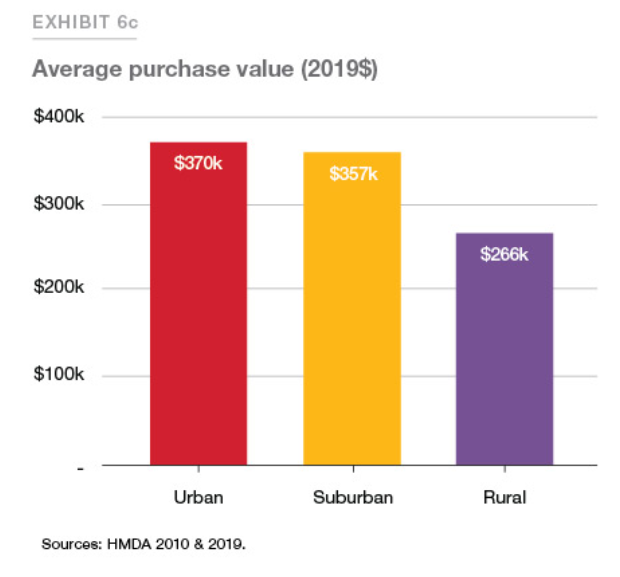
81% of rural households own their homes versus just 60% for urban households.
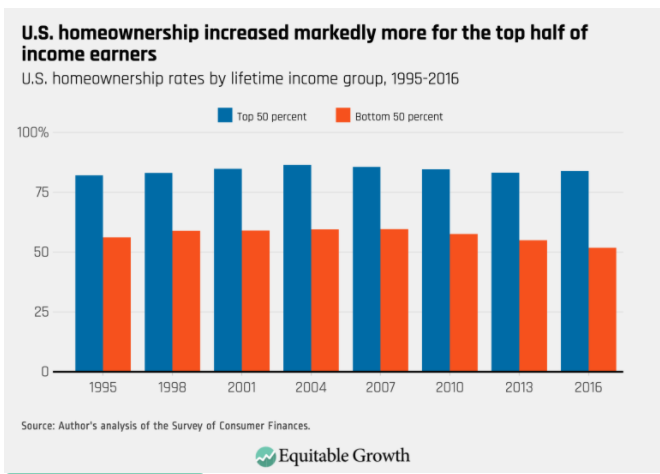
Historically, 80% of the top half of household incomes have been homeowners, while in the bottom half, just 50-60% have owned their homes.


The US shows dramatically different homeownership rates by racial category. The differences between the 1995 non-Hispanic White rate (70%) and Others/Asians (50%), Hispanics (42%) and Blacks (42%) remain large in 2021 where we see White (74%), Other (57%), Hispanic (48%) and Black (44%). The groups homeownership share gain from 1995 to 2005 were similar, ranging from 6-10%, but the decline from 2005-2015 was only 3-4% for Whites and Hispanics, but 7% for Blacks and Others. The improvement from 2015 to 2021 has been 2% for 3 groups and 4% for the Other/Asian group.
The Great Recession flattened the housing market. The number of owner-occupied homes in the US remained level at 76 million from 2006 – 2017. The number of housing starts plummeted from 2.0M to 0.5M per year, compared with an historic average of 1.6M. New home construction first exceeded 1.2M units (75% of historic average) again only in 2020, a dozen years later. New home-owning households have increased by 7M units in the last 4 years! The homeownership rate is up 2 points, from 63.5% to 65.5%. Supply is responding to increased demand and higher home prices. Homeownership rates will increase with the economic recovery, but be constrained by higher home prices.
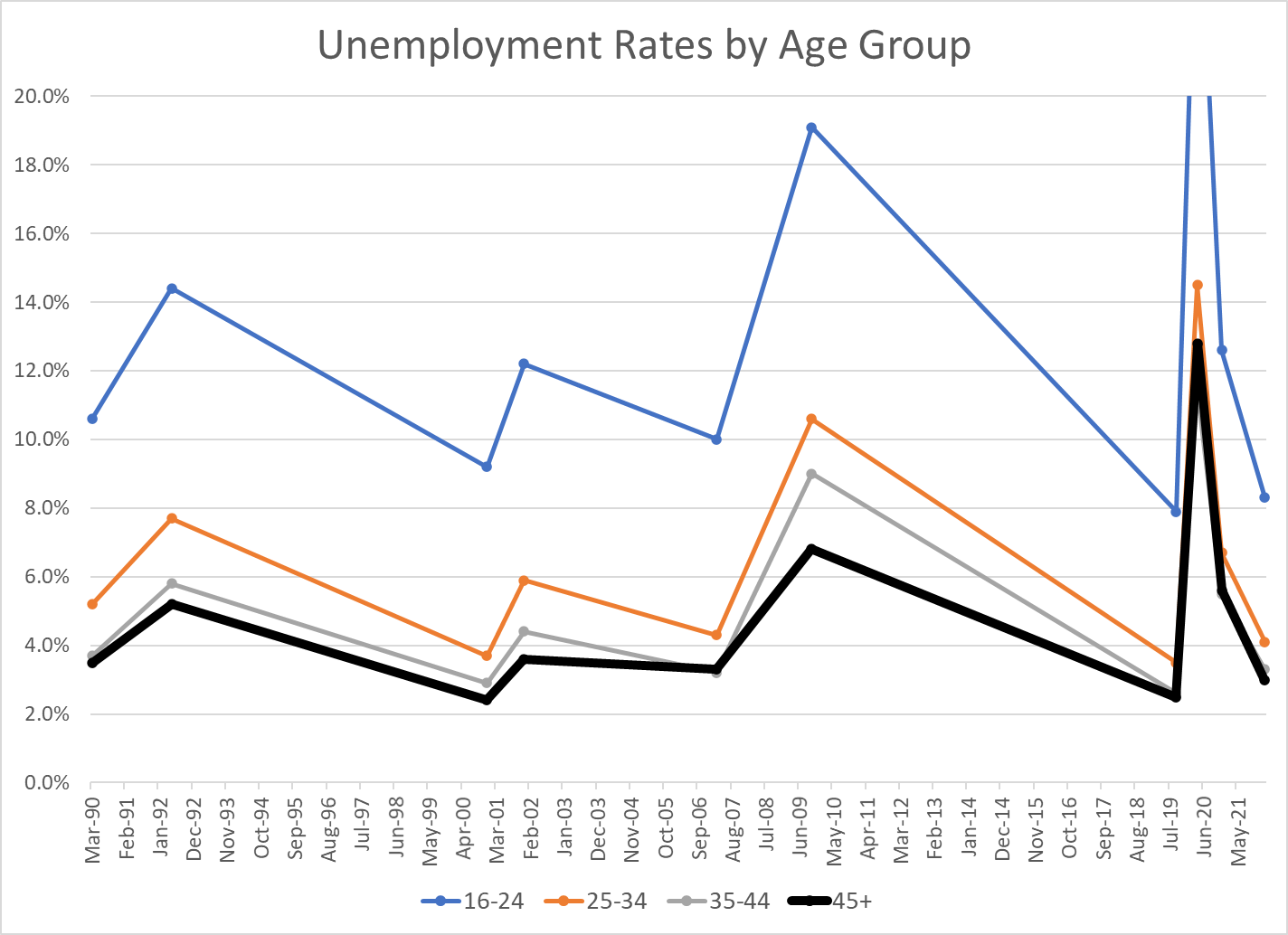
| Date | 16-24 | 25-34 | 35-44 | 45+ |
|---|---|---|---|---|
| Mar-90 | 10.6 | 5.2 | 3.7 | 3.5 |
| May-92 | 14.4 | 7.7 | 5.8 | 5.2 |
| Dec-00 | 9.2 | 3.7 | 2.9 | 2.4 |
| Dec-01 | 12.2 | 5.9 | 4.4 | 3.6 |
| Mar-07 | 10.0 | 4.3 | 3.2 | 3.3 |
| Oct-09 | 19.1 | 10.6 | 9.0 | 6.8 |
| Sep-19 | 7.9 | 3.5 | 2.6 | 2.5 |
| Apr-20 | 27.4 | 14.5 | 11.5 | 12.8 |
| Dec-20 | 12.6 | 6.7 | 5.5 | 5.6 |
| Feb-22 | 8.3 | 4.1 | 3.3 | 3.0 |
I’ve summarized the last 30+/- years of US labor market experience with just the peak unemployment rates of the business cycle, plus December, 2020 as a secondary indicator of the peak Covid/pandemic impact, since the actual peak numbers in April, 2020 were so extreme and short-lived.
Less experienced individuals have historically had higher unemployment rates in the US. Compared with the 45+ age group, the 35-44 age group has averaged 0.3% higher unemployment; 5.2% versus 4.9%, a relatively minor difference. The 25-34 year age group has averaged 6.6% unemployment, a substantial 1.7% higher rate. The job-seeking 16-24 year age group has averaged 13.2% unemployment, more than twice as high as the 25-34 year age group and more than 2.5 times the 45+ age group (8.3% extra).
The “extra” unemployment for 35-44 year olds versus the 45+ group has been zero for the last 15 years, versus a minor 0.5% premium historically. It appears that workers are reaching full employment value at an earlier age.
The “extra” unemployment for 25-34 year olds versus the 45+ group has been 1.0% for the last 15 years, a small reduction from the prior 1.5% premium.
The “extra” unemployment for 16-24 year olds at the peak of the business cycle versus the 45+ group averaged just 5.3% recently versus 7% historically.
The 2007-2009 recession showed a greater impact on modestly younger (25-44 year old) workers, with their unemployment rates increasing by 2.5% more than the 45+ group.
Despite the reduction in the inexperience penalty for youngest workers (16-24) in the last few years, they did experience much higher “extra” unemployment during both the 2007 and 2020 recessions.
Very young workers continue to be penalized for their inexperience, but other workers from ages 25+ seem to have relatively equal economic value today.
Note that the current unemployment rates for those aged 25+ already matches the average MINIMUM rates of the last 4 business cycles: 3-4%. The 8.3% unemployment rate for the 16-24 year age group is below the minimum in 1990, 2000 and 2007, and just above the 7.9% level of Sep, 2019.
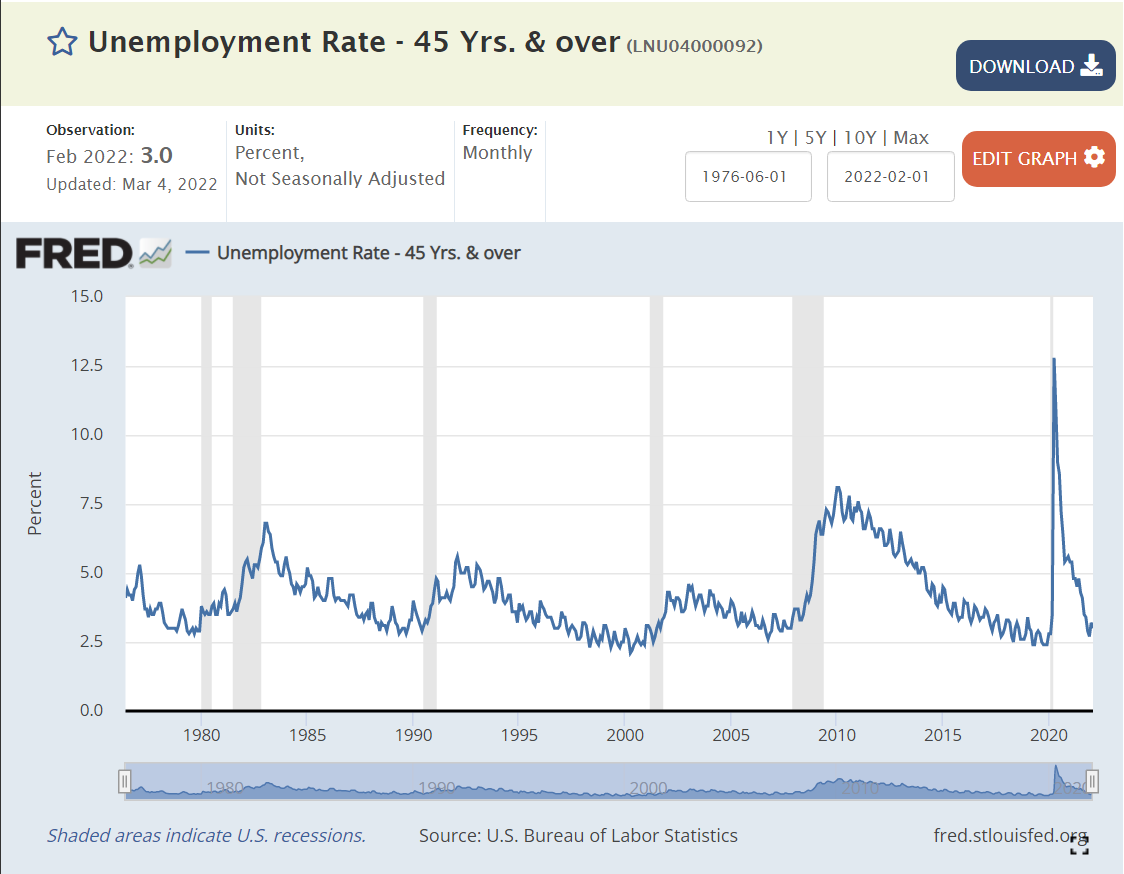
https://fred.stlouisfed.org/series/LNU04000092

https://fred.stlouisfed.org/series/LNS14000091

https://fred.stlouisfed.org/series/LNS14000089