

https://www.practicalrecovery.com/balancing-individual-and-community-needs-in-addiction/

https://www.goarmy.com/careers-and-jobs/specialty-careers/special-ops/civil-affairs
Google AI offers this interesting summary. The “world” is predisposed to see “civility” as a “soft” subject. Proponents of civility must work to overcome this preconception while leveraging the insights, commitment and support of those who “naturally” know that civility is needed for all.
The personality types most passionate about civility, politeness, and social harmony tend to be those with strong Extroverted Feeling (Fe) or Introverted Feeling (Fi) functions, which guide them to prioritize others’ emotions, social order, and strong moral values.
Key types that embody this passion include:
ESFJ (Consul/The Most Polite): Considered the most polite personality type, ESFJs highly value good manners, tradition, and maintaining social balance and harmony. They are warm, welcoming, and deeply care about the emotional well-being of those around them, actively working to create harmonious situations and avoiding conflict.
ISFJ (Defender/The Nurturer): ISFJs are driven by a strong sense of duty, integrity, and honesty, conducting themselves with the utmost decency. They value cooperation and consensus, and are often very sensitive to other people’s feelings, finding it frustrating when people engage in needless debate.
ENFJ (Protagonist/The Giver): Known for their optimism and ethical nature, ENFJs are highly aware of the needs of others and are naturally polite. They are motivated by helping people and communities meet their potential and strive to make a positive impact, often acting as “moral guidance”.
INFJ (Advocate): Thanks to their ability to intuit others’ emotions, INFJs are usually very polite and sensitive, with a strong focus on fairness and justice. They are often moved by social problems affecting society and work to address the suffering of others by focusing on authenticity and personal growth.
INFP (Mediator): As compassionate and caring types, INFPs are sensitive to the feelings of others and careful with their wording. They have a strong internal moral compass and are typically nonjudgmental when approaching someone in need, focusing on emotional comfort and inspiration.
In contrast, other types might prioritize efficiency, logic, or directness over social pleasantries, which can sometimes come across as less “civil” in the traditional sense, though they are not necessarily impolite deliberately.
https://www.16personalities.com/articles/16-compassionate-personality-types

https://civilitypartners.com/navigating-the-era-of-quiet-dei/
Civil rights.
Affirmative action.
Corporate training, legal, initiatives.
Reactions after George Floyd.
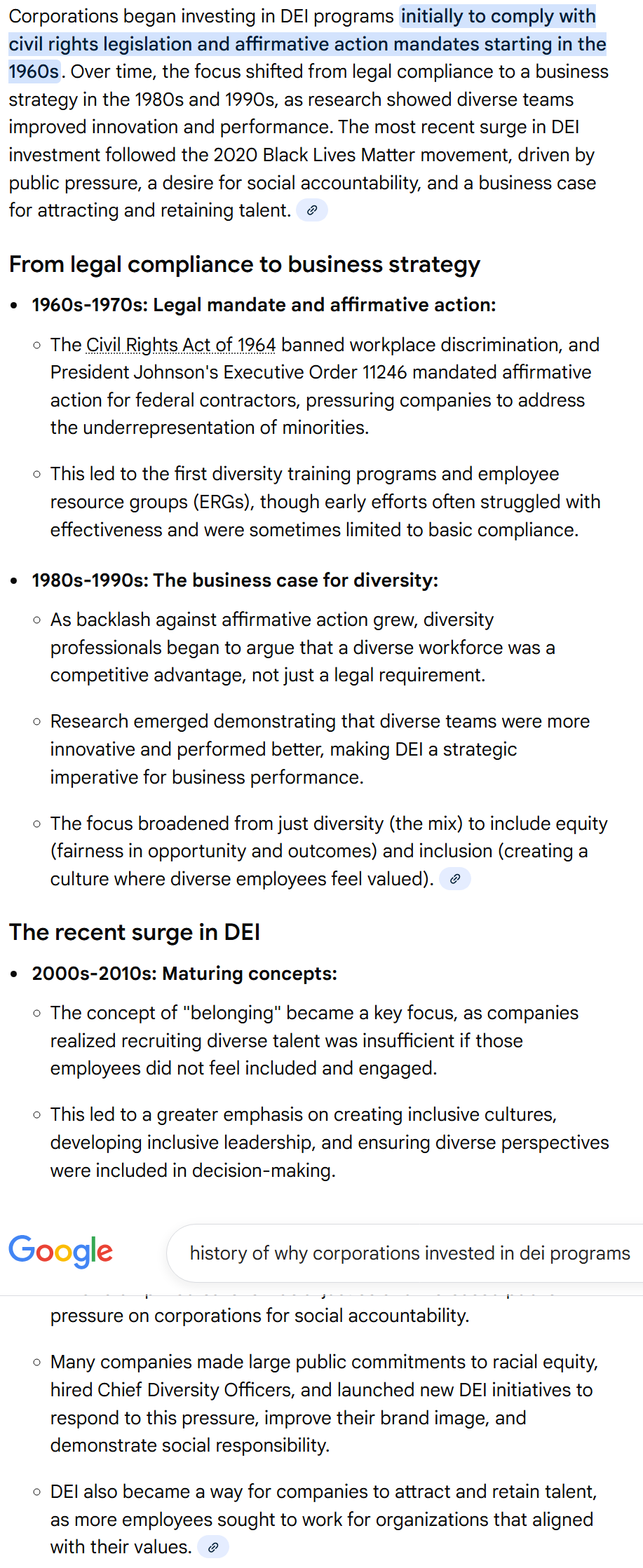

.https://urbanandracialequity.org/deitimeline/
As DEI programs grew in number, intensity, claims and impact, some individuals identified and objected to their perceived political agendas.
https://www.cnn.com/2025/01/22/us/dei-diversity-equity-inclusion-explained

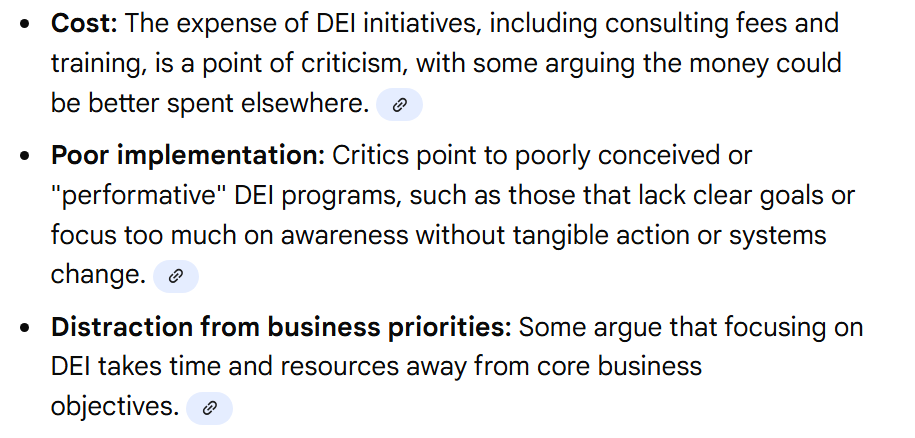
https://www.linkedin.com/pulse/most-common-arguments-against-dei-how-respond-felicity-menzies-ehwcc/
The common criticisms are not overly persuasive. The real issue is that this became part of the “culture wars”. Corporations didn’t invest in DEI because they suddenly became “woke”, they did so because DEI was beneficial for recruiting, retention and marketing. We live in a diverse world. Commercial enterprises recognized this and adjusted their activities accordingly.
Affirmative action is a step beyond “equal opportunity”. It says that our society systematically discriminates against minority groups and individuals and that we should take steps to offset this. This is a political issue that “Civility” chooses to not address in order to be actively nonpartisan.
Also missing above is the claim by postmodernists, professors, influencers, politicians and many progressives that society is inherently unfair, dominated by incumbent powerful forces, requiring revolutionary insight and reaction to overcome their power. Critics say that DEI is used as a political tool. Many disagree with the critics. “Civility” does not take a stance on this dispute. It is “above our paygrade”.
The presence of differences within a group, which can include race, gender, ethnicity, age, sexual orientation, religion, physical ability, and other aspects of social identity.
Embracing the differences everyone brings to the table, while acknowledging the benefit of the multiple perspectives, ideas, and solutions provided when individuals with different backgrounds, identities, and views collaborate and are heard.
The presence and participation of individuals with varying backgrounds and perspectives, including those who have been traditionally underrepresented.
Embracing the differences everyone brings to the table, whether those are someone’s race, age, ethnicity, religion, gender, sexual orientation, physical ability or other aspects of social identity.
Diversity ensures that a variety of perspectives are represented, whether they come from different races, genders, ages, sexual orientations, or cultural backgrounds.
https://www.cnn.com/2025/01/22/us/dei-diversity-equity-inclusion-explained

Creating an environment where people of all backgrounds can thrive and contribute to their fullest potential.
A sense of belonging in an environment where all feel welcomed, accepted, and respected.
Respecting everyone’s voice and creating a culture in which people from all backgrounds feel encouraged to express their ideas and perspectives.


Diversity and inclusion fit into the Civility value labelled “accepting” or “acceptance”. They are clear priority components of Civility.
Treating everyone fairly and providing opportunities for everyone to succeed, considering their traits, including resources, support, and potential accommodations to help those with disabilities thrive in the workplace.
Equal access to opportunities and fair, just, and impartial treatment.
Treating everyone fairly and providing equal opportunities.
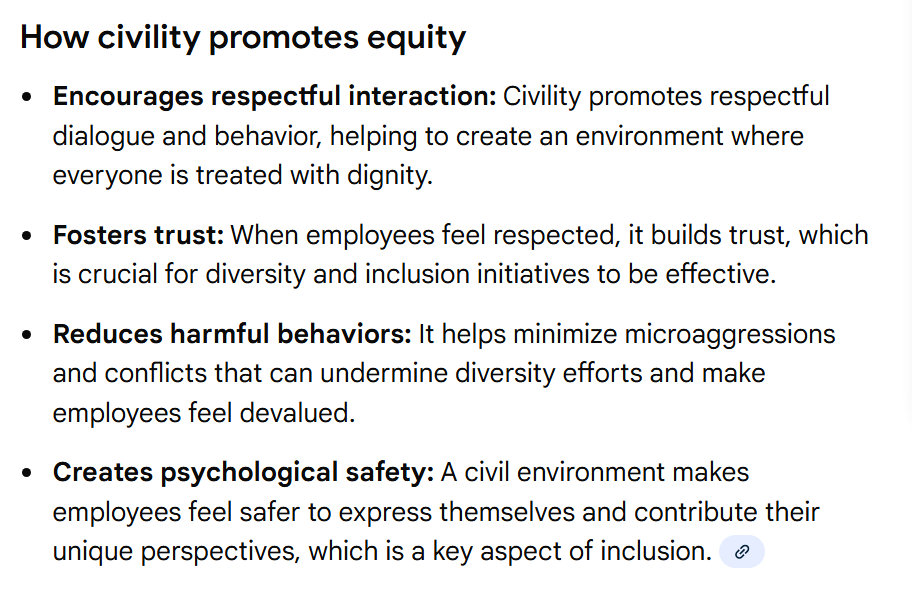
Equity is not exactly one of the 8 core values of Civility. Civility is based upon human dignity, respect for each other, responsibility, public-spiritedness, acceptance, intentionality, interactivity and constructiveness. Equity is a form of the value “fairness”. According to Jonathan Haidt, fairness is a widely held political value, but it is described in different ways by different people and considered much more important by liberals than by conservatives. “Civility” is not opposed to “equity”, but “equity” is not essential for the practice of “Civility”.
The highly influential human resources professional society SHRM removed “equity” from their historical support of DEI programming. Many opposed this change, arguing that equity is an essential component of DEI.
.https://www.inclusiongeeks.com/the-unexpected-consequence-of-workplace-civility/
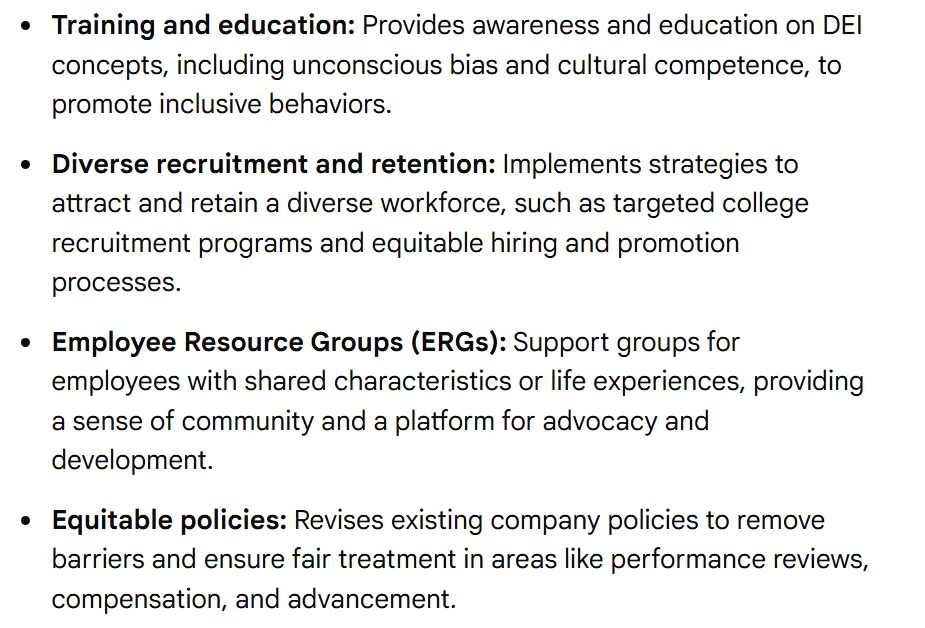

“Typical” DEI programs lean left. Civility, per se, does not support the more partisan views. “Unconscious bias” may be important, but it is not a civility value, behavior or skill. Civility does not take a stance on activist “equitable” HR processes. Every person has human dignity and is worthy of respect, check. Extra investment in mentorship and sponsorship of “underrepresented” employees is also optional from a Civility perspective.
https://www.shrm.org/executive-network/insights/impact-of-civility-on-organizational-success
Diversity and inclusion are part of the key Civility value of acceptance. Each person has human dignity and should be respected and accepted by others in their individuality. Civility is based upon commonly held values and promotes personal development and responsibility for being a good person, interacting with others and considering community needs. Like DEI, it promotes a subset of values to make our lives together safer, more pleasant and more effective. It focuses on how we interact with each other constructively, despite our differences.
Civility’s nonpartisan stance takes no position on the stronger claims of DEI providers or their critics. Civility recommends that they both engage in meaningful dialogue to better understand where they can work together and where they must accept that they have different social, political and moral perspectives that cannot be reconciled today. Civility actively opposes the angry outbursts, attacks, emotional appeals, insults, blaming, bullying, shaming, disrespect, blind loyalty, ignorance, prejudging, stonewalling and demonization sometimes seen in these interactions.
Cultures exist because individuals need to be combined into communities. Without cultural norms, expectations, education, rewards, penalties and taboos there wouldn’t be any culture, community or civilization. Modern “Civility” is a set of values, skills and behaviors required to hold together a diverse, multicultural society like the United States. With the growing breakdown of historic western Christian culture, the US needs to actively embrace the values subset of “Civility” in order to make our political, social and economic worlds function effectively. This requires society – and its leaders and influencers – to clearly define select important aspirational values AND to define what is TABOO, poison, shunned, beyond the pale, unacceptable, and rejected by all. We focus on the Civility values.
Taboos are a critical dimension of a deeply held moral framework. Civility is based upon society agreeing that some values and their implications are “rock solid”. A few of the taboos above are mainly embraced by the left, but ALL 45 (!!!!!!) are embraced by a supermajority of citizens.
The “liberal” virtue of tolerance can be interpreted as THE value, an allegedly supreme value more important than all/any others. It must NOT be elevated to this dominant role. Tolerance is important but it is not controlling.
Hence, the underlying Civility values of human dignity, respect, acceptance, responsibility, public spiritedness, intentionality, interaction and positivity combine to form a successful common framework for all.
Taboos provide the negative (unacceptable) side of values. Civil people, irrespective of their political opinions, must reject these beliefs, opinions, actions and communications. TRUTH is the ultimate standard. We must all reject beliefs that conflict with the truth.
Avoiding/rejecting these taboos is not easy. We humans are still imperfect. We have to work and work and work to reach for the positive dimensions of the proposed subset of civility virtues, and avoid the taboos.

It’s difficult to describe the complete revolution in the behavioral sciences that occurred around 1956 as practitioners began to experience a “paradigm shift” 6 years before Thomas Kuhn’s wildly influential “philosophy of science” description of this phenomenon.
https://en.wikipedia.org/wiki/Paradigm_shift
Psychology was dominated by the behaviorist approach of BF Skinner. Only observable scientific results mattered. In second place were Freud’s insights into the differences between the conscious mind and the unconscious struggles between the id, ego and superego. Psychologists, social psychologists, communications theorists, philosophers, linguists, and computer scientists rejected BOTH the philosophy-free behaviorist approach and the philosophy-entangled Freudian approaches. The “cognitive scientists” recognized that the mind, mental, consciousness, rationality, perception, memory, attention, will, drives, social influences, choice, morality, feelings, fears, instincts and many other constructs were “real” in some sense. Non-material concepts and structures were important complements to the material and observable world.
They embraced the scientific method to investigate these concepts. They began to combine experimental psychology, information theory and biology. Their work led to many breakthroughs in theory and in practical advice for how humans behave, where they fail/struggle and what they can do to improve. These scientifically based theories have accumulated to the great benefit of mankind in the last 70 years.
I want to highlight the key cognitive science / behavioral science breakthroughs that are relevant to practicing civility. I will limit references to a single work for each category.
https://en.wikipedia.org/wiki/Cognitive_revolution
This above list only scratches the surface. Consider corporate organizational development, counseling, cognitive behavioral theory, college residential life, community development, neutral DEI programs, listening, peer counseling, couples counseling, co-dependency, adult children of alcoholics, anxiety, negotiating, facilitation skills, strategic planning, game theory, risk management, project management, influence, thinking hats, personality styles, talents, etc. The list is almost endless.
We now understand how humans behave. We are imperfect and amazing. We have the ability to balance the individual and the other, the individual and the community, the individual and spirit/God.
Civility is based upon the human dignity of each individual. The modern “cognitive science” approach embraces this insight. It offers tools to make our lives more effective, meaningful and satisfying. Civil individuals should invest time to master these subjects.

https://www.reaganfoundation.org/civility-and-democracy
https://www.bushcenter.org/publications/civility-is-our-eternal-project
https://www.projectcivility.com/
https://greatlakescivilityproject.com/the-civility-project/
https://livingroomconversations.org/
Political polarization, impact of media changes, declining trust in people and institutions, lower community and civic participation and a president who promotes a purely transactional world that ignores Civility. People are worried about democracy, progress, relations and the future. They sense that the decline in Civility is one of the problems and that restoring Civility might be an answer.
While journalists focus on politics and the media, others are focusing squarely on day-to-day Civility in our interactions with each other. People are frustrated with political and institutional leaders’ seeming inability to guide us to a better world. Like the little girl in “the Tale of the Starfish” they refuse to accept a declining world and commit to taking small, personal actions in the face of great challenges, exclaiming “Well, I made a difference for that one”!
https://www.thestarfishchange.org/starfish-tale
These individuals and groups are focusing on improving personal Civility in all walks of life, leaving politics and the media for later action. They believe that improved behavior alone has the potential to “move the needle”. So, they are improving their own Civil behavior, promoting, teaching, sharing and encouraging others. They are organizing and holding meetings to find partners. They are developing curriculum to share the core values of Civility that can be embraced without diving into politics or religion. They are highlighting the many existing tools for better communications, interpersonal relations, problem solving and personal growth available to those who wish to be more effective in using and modeling Civility. They are using the interactions of thinking, feeling and doing to create better enduring habits.
Civility has been caught up in the political and religious wars. It is often misunderstood as just politeness, overpromising an end to disagreements, soft, emotional, utopian, relabeled liberalism, a new righteousness or an apology for the status quo and vested interests. The new Civility proponents have much work to do in order to clearly communicate its core content AND what it is not.
The power of Civility lies in its networking effects. Individuals who develop Civility skills in parenting can use them at work. People who build Civility skills to be better political advocates can use them in their volunteer roles. Individuals who demonstrate Civility in any arena influence others, even if they don’t notice. People tend to mirror the behavior that they experience. Other individuals behave better, and a virtuous cycle continues. Our problem for the last 20-50 years is that we have been in a vicious cycle of less and less Civil behavior becoming more and more accepted.
We live in an age of radical individualism. We naturally first evaluate ideas and options from only our personal perspective. Civility provides many personal benefits. It provides even more important community benefits. Because it is about public behavior that influences others it is often about both the individual and others or the individual and the community. Civility depends on the values of human dignity, respect, acceptance, responsibility, intentionality, interactions, constructiveness and public spirit. Hence, it claims many positive results for the individual and the community.
Practicing Civility will improve your health, effectiveness, sense of belonging, personal growth and leadership skills.
Civility is founded on human dignity, respect and empathy. Differences are expected. Individuals seek to understand others. They focus on people, process, interactions and results, not just winning. They employ tools to find acceptable solutions. They refuse to personalize differences. This approach reduces the chance of differences or disagreements escalating to become conflicts or crises. The habit of resolving or accepting differences creates an atmosphere that expects reasonable interactions and results.
Civility reduces the frequency and intensity of conflict. It minimizes the direct and indirect experience of personal attacks. Individuals are affirmed by each other, feeling respect and developing a stronger self-image. Others have higher morale, so they are less likely to fall “below the line” in their behaviors. Social norms guide positive behavior. Individuals expect that people, process and results will be good, or at least acceptable. They learn to depersonalize interactions, reframe conversations to avoid righteous religious or political issues and build upon their positive experiences.
Positive experiences and expectations reduce stress, tension, fear, anger and anxiety. They encourage engagement and issue resolution. They reduce the risk of burnout.
People in civil environments experience respect, acceptance, belonging, positivity, trust and good relationships. Civility leads to high achievement by developing communications, problem solving, relationship and influence skills. By applying the values of responsibility and intentionality, individuals improve their decision-making skills, especially those that require interaction, creativity and wisdom to manage complexity, uncertainty and differences. These experiences help people to become centered and composed.
The process emphasis of Civility supports personal growth. Individuals define goals, separate means and ends, welcome feedback, bridge differences and expect to change when they learn. Personal growth can cause anxiety at first, but extended experience provides a way to embrace change and expect positive personal and process results. Finally, Civility requires individuals to make choices about upholding values like human dignity, respect, responsibility, leadership and the public good. Individuals who define and strive to consistently live by moral values build justifiable self-assurance (#10).
When you demonstrate communications, problem solving, interpersonal, personal and change management skills, others notice. When you apply the virtues of respect and acceptance, responsibility and intentionality, positivity and interaction, others notice. They notice your personal, work and civic realms. Your personal brand value grows. They trust, respect and like you. They expect you to work well with others and to keep your commitments. They provide professional and leadership opportunities because you are effective in the modern complex, team environment.
Those who practice respect, acceptance and interactive problem-solving prime others to consider their views. Self-confident, centered, composed, responsible, intentional people are seen as natural leaders. Individuals who have solid interpersonal and communications skills, especially active listening, encourage others to work with them. The experience of mutual respect and creative problem resolution in difficult situations leads others to prefer to work with their highly Civil colleagues.
Civility makes building relationships a top priority. People, process and results. Civil people demonstrate empathy and self-regulation. They have good communications and interpersonal skills. They value respect and acceptance, responsibility and intentionality, positivity and interactions. Experiencing the give and take of shared decision-making or problem-solving benefits all parties.
The Civility values of interaction/dialogue, mutual respect and public spiritedness combine to create and enhance communities. They create shared purposes, meanings, interests, history and the experience of managing difficult decisions. Belonging improves with this stronger sense of community.
The Civility values of human dignity, respect and acceptance together with empathetic behavior contribute to forming and sustaining a kind, compassionate community. Individuals are affirmed, feel safe and belong.
When Civility is actively thriving, the overall environment is Civil or harmonious. Morale, well-being and relationships improve. Belonging flourishes.
The same forces that create belonging, apply to inclusion. True belonging, based on acceptance and human dignity, is for everyone, despite whatever differences they may have. A “big tent” welcomes all. The underlying values also make individuals feel respected, valued and affirmed even when they are different or hold different views.
Interacting with mutual respect using modern behavioral science tools leads to understanding differences of interests, perspectives, goals, beliefs, preferences and values. Understanding helps to avoid conflicts. It allows us to disagree without being disagreeable. It encourages us to find creative, compromise solutions. It helps us to identity where we do have shared views. By truly accepting differences we include others.
Civil people expect to encounter and manage differences. They willingly engage in group decision-making and problem-solving processes. They respect and empathize with others. They depersonalize crucial conversations. They identify common interests. They learn that they can discuss, trade, negotiate, advocate and influence civilly even when the stakes are high. They learn to accept and embrace compromise and avoid polarizing arguments about political and religious topics.
Civil people are supported by a civil environment of belonging and inclusion where others are mostly stable too. They practice the values of responsibility and intentionality. They know that they must make choices. They learn that some differences cannot be resolved and that they have personal growth opportunities. There is a virtuous cycle of self-control, with the experience of building greater confidence and reserves.
Anyone who has achieved 3 Happiness, built a 4 Good Reputation, become 5 Influential, created 6 Better Relationships and become 9 Emotionally Composed should be satisfied with life. If they are also succeeding in life and career based on developing and applying the key behavioral skills, they are further blessed. If they have been able to consistently follow their values, including public-spiritedness, they should be proud. If they have participated in group problem-solving and decision-making to shape their communities at any level, they know they have achieved something important.
Three of the five key Civility behaviors apply: empathizing with others, building relationships and self-regulation. The individual is required to interact with others, so he or she might as well be good at it. Self-knowledge is required for interacting effectively with others. Radical selfishness is simply not an option.
Personal management and interpersonal skills help people to insightfully look inward and outward to balance both worlds.
Six of the Civility values apply: recognizing the human dignity of others, respecting others, accepting others, interacting with others, being constructive in spite of others and considering the common good with others.
Civility does not elevate “others” or communities above the individual, but it recognizes them as valid agents in life’s drama. They are worthy of serious, intentional, responsible consideration. Civil individuals happily move beyond a state of self-absorption to engage with life’s full possibilities.
Civility begins with the insight that we each share a common human dignity. We each have equal worth. This is an essential view of reality and human potential. It cannot be disputed. The Civility values, behaviors and skills are derived from this base.
It means that we each have an infinite worth and value. We have humanity in common and the “common good”, relationships and community truly matter. The views and interests of others matter and must be considered. Individuals have inalienable rights of protection from others, groups, governments and society. Minority interests should be considered and protected. Individuals must be treated as “ends”, never just as means to ends per Immanuel Kant. Groups and ideologies must never be more important than actual people. Civility processes protect these individual rights while respecting the need for groups, communities, governments and societies to make imperfect decisions for the common good.
When individuals practice the Civility values, they are signaling that they trust others. Displaying respect and acceptance indicates trust in another person. Investing in intentional, responsible, interactive and constructive actions says that an individual believes that the others are worthy of investment and implicitly trustworthy. Considering the common good or public interest also shows a belief that others should generally be trusted.
Trust is often given altruistically, at least at first. Modern game theory says this is the optimal first step in typical two player games. It is also offered with an expectation that it will be reciprocated. Trusters hope and expect that they will be trusted back.
Trusters also believe that they will indirectly benefit from nudging others into creating more effective teams, groups and communities. These groups are more effective due to collaboration and deliver better results. They reduce the costs and risks of making decisions. They create a positive environment of lower stress and conflict.
Civility embraces positivity and a constructive approach to conflict management, negotiations, problem-solving, decision-making and politics. This value is supported ethically, tactically and strategically; NOT naively.
Responsibility and intentionality are adopted with the expectation that they will be at least partially reciprocated by others. Using a constructive approach to interactions helps to influence others to mirror this good behavior and engage positively.
Civility values an interactive and mutually respectful approach to the broad topic of problem-solving. Faith in interaction is based on the values of human dignity and respect. It is helped by empathetic behaviors. It is greatly facilitated by positive and constructive attitudes, thoughts and actions. This another area where a value (constructiveness) is first offered altruistically with the hope and expectation that it will be partially reciprocated.
Civiliteers hope that civil discourse will arise and become the norm. They hope that a positive environment will result with less stress and conflict. They expect better decision-making, especially when treating complex issues with real differences of views and interests. They believe that better decisions will arise from the recognition of differences, identification of the common good, creative solutions and constructive compromises that are “good enough”.
Civility promotes 9 values. It is an ethical system that is not dependent upon any specific philosophy, religion or political viewpoint. It is consistent with “classical liberalism” that was developed in the 1700’s in England, Europe and the United States.
It is a subset of a complete moral framework. It is fully adequate to support our day-to-day lives together at work, at play and in government. It attempts to balance the inherent conflicts between the self-aware individual and others and communities.
Individuals commit to this set of values because they believe they are in some sense “true”, morally right, adequate and necessary for society and politics. They hope that their imperfect application of these values will trigger others to make the same commitment. They understand that all humans are imperfect and that the serious pursuit of 9 values is much better than no pursuit at all. They adopt these values and invest in learning behavioral science skills and building habits because they want to do the right thing for future generations and ultimate values.
Civility offers direct and indirect benefits to individuals. In the end, it is both a practical and a moral choice. We live in a “secular age” where the received religious views can be challenged by well-meaning people. My belief is that our “classical liberal” democracy requires the support of a Civility subset of values. I also believe that our secular society requires this same subset of values to facilitate the interactions and transactions of modern life. I believe that almost all individuals can justify Civility values, behaviors and skill development on a practical basis alone. I hope that the 15 benefits described above will help everyone to make the right choice.

https://www.slideserve.com/gaia/the-source-of-lake-wobegon
As Civility begins to be embraced as a vital answer to our challenges, we’re starting to hear from the skeptics, the professional critics, the haters, the perpetually ironic, special interests, politicians, media interests, fundraisers, political consultants, the powerful, influencers, extremists, technologists, literalists, nativists, nationalists, environmentalists, talking heads, artists, postmodernists, materialists, therapists and humanists. Some struggle with Civility’s claim to represent everyone in addressing core human challenges. Instead, they say that the modern Civility project is really for elites only, too soft and emotional, too far left, too righteous, too far right, too simple/surface or too impractical/abstract.
Civility attempts to define a set of values, skills and behaviors that are “fully adequate” to support the required economic, social, religious and political needs of our society. Civility addresses the eternal conflict between the individual and “the other”; between the individual and communities considering the “common good”. It provides a subset of moral values adequate to support these dimensions of life while allowing individuals and groups to debate and negotiate the remaining political, social, personal, religious and economic options. As such, it is a “classical liberal” approach, embracing individual freedom while necessarily tolerating others and their opinions.
Civility has a long history in America of being embraced by all. City and country. North and South. East and West. Religious diversity was a key driver historically. The Catholic versus Protestant wars in Europe were seen as ridiculous for modern people. The great diversity of Protestant denominations promoted religious tolerance.
Civility applies to all domains. Family, neighbors, unions, civic clubs, not-for-profits, schools, universities, professions, religious organizations, interest groups, small businesses, big businesses, cooperatives, political parties, candidates and community groups. There is no “elite” preference here.
Civility begins at the local level. Family, neighbors, friends, local commerce, HOA’s, block watches, parishes, local schools, local sports, civic organizations, libraries, community centers, social welfare services, third meeting places, pubs, porching, volunteering, block parties, volunteer fire fighters and emergency services. Rural, agricultural, expanding America was founded on these voluntary organizations. It was re-founded around 1900 with political reforms, social services, scouts, civic organizations, YMCA’s, Chautauqua institutes, civil rights, labor unions, temperance, public libraries, public secondary education, etc.
Civility is an eternal challenge. The individual faces other individuals and other groups, communities and society. We’re each wired to be fully individual oriented. “It takes a village” to civilize us and make us productive members of society. Civility applies to all social classes and geographies.
Civility focuses on human dignity, respect and empathy. These are universal human values and experiences. They represent a radical view of human equality, indifferent to rank. These values are anti-elite and countercultural. They support the needs of all and constrain the [alleged] tendency of elites to construct exploitative structures and philosophies.
Civility focuses on practical skills for interacting with others, communicating and making good decisions. It is applicable for everyone.
The Civility Project is purposely taking a “bottoms up” approach to recapturing our institutions as responsible to the people.
The current social, political and economic institutions [often] primarily serve the interests of the privileged (the 1% and the 20% professional classes). The “tea party” was founded to challenge this situation. This wise populist insight has been captured by one political party for its sole benefit. Civility attempts to make clear the benefits to any political group of effective institutional structures.
Civility’s focus on human dignity ensures that individual freedom will be preserved. It is a “classical liberal” approach that recognizes that humans are imperfect and that many will attempt to capture political, social and economic institutions for strictly personal benefits. [In modern America, this is considered a “conservative” insight]. It accepts that some constraints must be placed upon individual “rights” to preserve the “common good”. There is often no obvious solution to these competing interests. Every society must find “reasonable” ways to protect both individual rights AND the common good, while allowing representative democracy to wrestle with the issues in the middle. We’re stuck with an uncomfortable “both/and” rather than a more satisfying “either/or”.
Civility is a “public good” which benefits everyone. The more that civility is practiced, the more that everyone benefits. Non-elites, who have lesser assets, benefit disproportionately from increased civility.
Investments in improving civility create a “virtuous cycle” which benefits everyone.
Elites have a much greater share of assets, so they have a greater interest in establishing and maintaining civility in any society. They need a supermajority of society to buy into “the rules of the game”. They could once rely upon ideas like divine providence, tradition, kings’ rights, land rights, the ancient regime, property rights, class rights, papal infallibility, social Darwinism, eugenics, racial supremacy, national rights, etc. Modern history and communications undermine these crude approaches. Elites need Civility to underpin support for representative democracy, regulated capitalism and international trade.
Critics argue that “Civility” is based solely on feelings, weakness and conflict avoidance.
Civility encourages individuals to be “dead serious” about their political and religious views. It does not take a position. It encourages individuals to engage in the political process and to develop deeply felt religious beliefs and practices [without becoming righteous and rejecting others’ rights].
Civility requires the “hard” virtues of respect and responsibility.
Civility requires the development of mature character in adults.
Civility promotes positive and constructive approaches to interpersonal relations and problem solving.
Civility is focused on results, not just ideas.
Project Civility is focused on actionable steps, not just a belief system.
Civility embraces the “little platoons” of classic and modern conservative thought. High commitment local organizations are essential for social life and forming moral character.
Civility is actively non-partisan. It requires no position on the historical debates. Central/decentral. Tradition/innovation. Risk/safety. Religious/secular. Individual/community.
Civility requires a limited moral foundation to support society. It rejects a purely individualistic basis for society. It rejects a purely community, organic, spiritual, religious basis for society.
Civility embraces the role of institutions, trust, productivity and growth in society.
The 8 civility values are nonpartisan. Respect, acceptance, public spiritedness and interactive lean left. Responsibility, intentionality and constructiveness lean right. Human dignity is equally left and right.
Human dignity is a radical idea opposed to domination by elites and structures.
Civility is inherently open, liberal and tolerant.
Civility does not embrace any dominant religious or cultural view.
Civility embraces positivity. It does not prioritize “no”.
Civility acknowledges conflict as an inherent part of life and embraces modern technologies.
Civility acknowledges power as a real force in life. It believes that personal and community beliefs are equally important.
Civility attempts to find the “common ground” of political debate. It tries to find the “least common denominator” or values, practices, beliefs and habits necessary for society to succeed, or at least muddle through.
Like all political, social, religious or philosophical belief systems, it tries to find the essence, the most important beliefs or assumptions needed for success.
It focuses on communications and interpersonal skills that are neutral.
It focuses on conflict resolution skills.
It promotes organizations like the “braver angels” that encourage interaction between individuals with different views.
It embraces the problem solving and personal growth results of cognitive behavioral therapy and modern organizational development.
Civility promoters believe that tolerance is essential.
Critics say that civility is too simple, too surface, too obvious. Civility is an approach based upon 500 years of the Western modern era.
Civility accepts the complex validity of modern politics and religion.
Civility embraces a required subset of values in the Western religious, philosophical, economic and social traditions. It requires respect, human dignity, acceptance, responsibility, public spirit, intention, interactivity and constructiveness.
Civility requires thinking, feeling and doing.
Civility accepts that individuals have deeply felt individual perspectives that do not align easily.
Civility promotes the development of individual character based upon philosophical, religious and political perspectives.
Civility combines a set of values with a set of practical skills to be applied in all domains of life.
Civility actively rejects oversimplified versions that are just politeness, magic wands to end disagreement, purely emotional, utopian, partisan, overreaching or merely supporting the status quo.
One definition is that “civility is a set of behaviors that recognize differences and build mutual respect.”
Behaviors are the primary focus, even though they are based upon widely agreed-upon values.
Individuals recognize differences between individuals and groups, and seek to understand and bridge them. This is a level-headed approach to recognizing and managing reality.
Individuals constructively take actions to build mutual respect. They work in the right direction, even though the steps don’t always work to resolve differences, solve problems or build relationships. They take steps forward because this is hard, necessary work, not because it is destined to succeed.
The communications, problem-solving, interpersonal, change and personal management tools used in implementing civility are practical insights, techniques and habits that can be taught to everyone.
The Civility Project roll-out strategy is “bottoms-up”, relying upon a broad cross-section of our nation learning, perfecting, applying and sharing these tools and values.
The Civility Project emphasizes actionable steps: education, interactions, commitments, teaching, porching, greeting, encouraging, joining, volunteering and engaging politically.
Civility offers personal benefits such as conflict management, stress reduction, self-management, better relationships, improved image, influence, acceptance and productivity.
Civility undermines the attraction of extreme individualism by emphasizing the shared humanity of all individuals and the necessity of constructive interactions. It helps individuals to find a balanced perspective that includes others, communities and values as complements to the individual alone.
Civility is similar to approaches like the “golden mean” and the “golden rule”. It attempts to combine a small number of values and skills into a practical tool kit that can be used and improved.
Civility is easy to caricature and dismiss. Simplistic “straw man” versions are easy to attack. They are inadequate to be helpful or embraced as a shared community asset. But Civility defined as a set of behaviors that combines values and tools and strives to both build relationships and manage differences is not simplistic or ineffective. It is a critical set of habits needed to promote effective interactions, engagement, trust and results in a complex society.
It is a moderate and moderating approach, so some might call it conservative. It values interactions, feedback, process, learning and growth, so some might label it liberal. We think that the Civility values are nonpartisan and that the tools are clearly neutral ones that can be used to be more effective in all walks of life, irrespective of politics or values.
Civility can overpromise and become righteous. We think that these values and tools are a solid combination for delivering personal, interpersonal, process and community results. But they don’t work miracles. We have different sets of values, perspectives, experiences, habits, talents, personalities and expectations. We can learn to listen, empathize, seek the common good and compromise effectively. This will help, but it won’t make any of us perfect people or negotiators.
Our goal in the Civility Project is to re-establish community expectations that promote these kinds of interactions and personal growth. We are confident that creating new norms of expected and taboo behaviors will help individual lives and our communities. In the modern world of complexity, uncertainty, insecurity and skepticism we need some help. Civility offers a nonpartisan common framework to rebuild a constructive, trusting, productive background for all of our interactions. Imperfect, but very powerful.
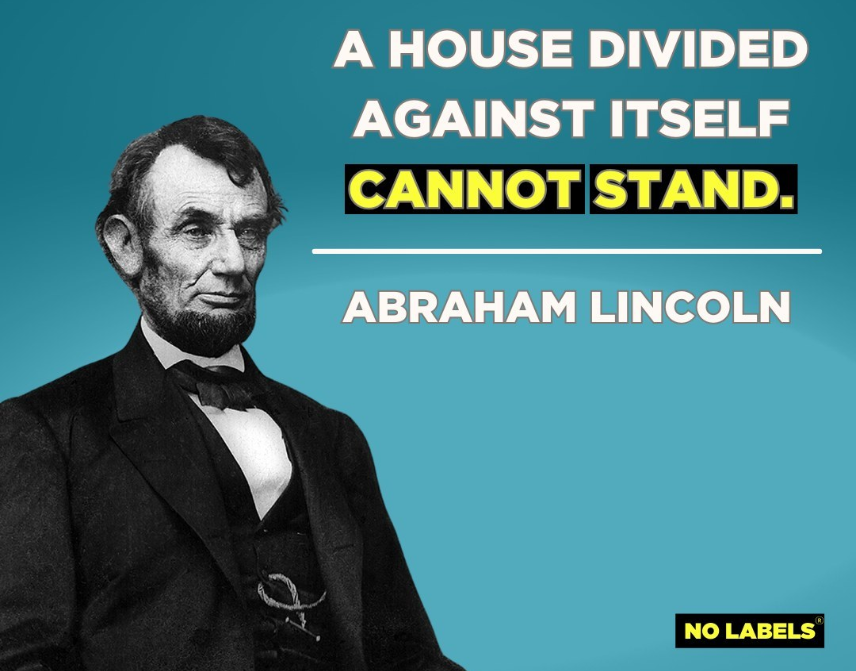
Our preferred definition of Civility is “a common values-based problem-solving process to make group decisions when individuals have differences”. A review of 5 dimensions indicates that Civility has no bias towards or against the left or the right.
Conservatism “conserves” history, culture, religion, norms, land, assets, classes, privileges, religion, power and institutions. It opposes risk-taking, conflict, rapid change and revolution. Civility is rooted in human dignity and concern for the “public good”.
Liberalism elevates the individual, rationality, progress, liberty, science and rights. It opposes unjustified power, wealth and cultural claims on the individual. Liberal political systems seek to balance individual rights with the “public good”.
Civility based problem-solving and relationship management emphasize the use of modern business, education and counseling techniques such as active listening, dialogue, objective evidence, separation of facts and values, common interests, devil’s advocate, process review, independent facilitators, strategic planning, values clarification, I/you statements, cognitive behavioral therapy, crucial conversations, shared accountability, win/win options, disclosed preferences, long-term perspective, walk-away option, rational incentives, aligned incentives, multiple rounds of negotiation, I’m OK/You’re OK, brainstorming, multiple intelligences, 6 thinking hats, supplier partnerships, shared administrative services, outsourced services, specific corporate culture, mission, vision and values. Corporate, not-for-profit, educational, counselling, government, religious and privately owned organizations have adopted these social science techniques because they are effective tools for translating resources into outputs in support of goals.
Different organizations emphasize different tools that best match their values, history and objectives. There is no clear left versus right emphasis. Solid tools help organizations manage their planning, workforce, resources, suppliers, customers and beneficiaries.
19 issues have appeared in the “top 10” most important issues lists since 1948. Civility can be neutral on all of these issues.
Civility is supported by left and right in America’s political history. Modern techniques for most effective group interactions and negotiations are neutral. The values that support Civility are neutral. Civility takes no stand on modern political issues. The latest attempt to define the “righteous” bases for politics provides no dimension opposed to civility. Civility can be used as a bipartisan base for our democracy and our day-to-day interactions.
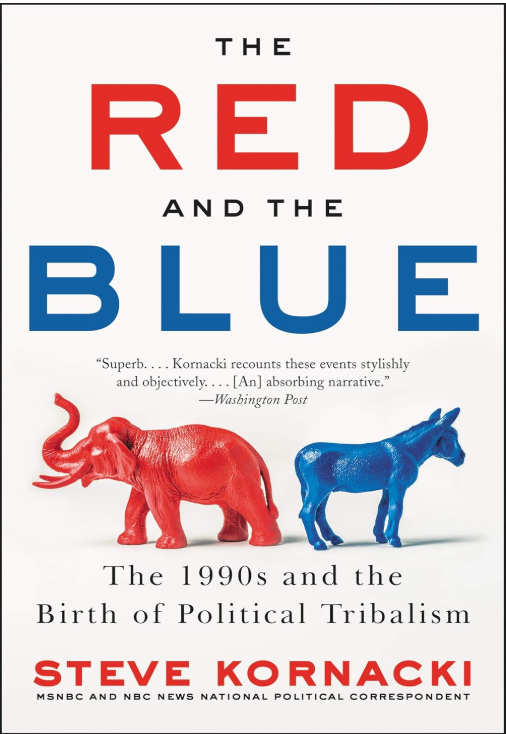
Political polarization is one of the main causes of the decline in civility. There are structural and historical causes for the tremendous decline in civility from 1960 to 2025.
https://www.projectcivility.com/
https://en.wikipedia.org/wiki/The_Better_Angels_of_Our_Nature
https://www.jimmycartertribute.org/index.html
https://en.wikipedia.org/wiki/Learned_optimism

