I think that we have inadvertently prioritized only the individual and completely discounted the role of “community” in American life. We desperately need to rebalance.
Here you’ll find
6 “good news” posts on American trends
7 “good news” posts on Hamilton County, Indiana
2 posts on the Indianapolis metro area
3 posts on the religious dimension of community
An overview on Our American Community and links to Our Kids, Why We’re Polarized and Little Pink Houses.
Solutions such as community assets (Janesville Plan), school curriculum, civility pledges and candidate approval boards.
Historical overview of the critical role of community, how we have more in common, the role of morality and the conflict between “only the individual” and the community.
Journalists, artists, pundits, entertainers and politicians all scheme for our attention. Once upon a time … we briefly thought that the internet and social media might usher in a new age of information, selection, objectivity, useful filtering, wisdom and cooperation!!!! Unfortunately, we are now deluged by “least common denominator” communications skillfully targeted to lure us into a non-stop cycle of clicking on marketable links. These communications very effectively use every trick and technique to appeal to our emotions, prejudices, weak attention, surface thinking, fears, hopes, exaggerations, etc.
Politicians of all flavors have conspired to convince us that the whole world is comprised of “good versus evil” people, politicians, parties, religions, states, policies and institutions. Everything is “win/lose”. Disagreement is motivated by bad ideas and motives rather than differences of opinion or interests. Compromise is a sign of weakness. Every political actor is purely motivated by self-interest.
We each have a moral, political, social, religious and personal responsibility to evaluate these “conclusions”. Let’s start with overturning the idea that we have nothing in common, that we must rely upon politicians to define opposing policies, parties and philosophies and fight to the death for one or the other to finally win.
Human Nature
Biologically we are all the same.
We intuitively and rationally combine thinking, feeling and doing; conscious and unconscious drives.
We each think that we are “right”. As in Lake Wobegon, we are all “above average”. We struggle to maintain self-awareness, to consider the needs of others, to even pursue our own goals consistently and effectively. We are functionally and morally imperfect.
We have a variety of needs and desires that cannot be fully met. Safety, acceptance, achievement, agency, transcendence, control, familiarity, influence, consistency, love, health, growth, expression, authenticity, loyalty.
We are primarily “analog” beings.
Human Experience
We face death, evil, suffering, disappointments, violations, violence and pain. Random, irrational, unavoidable experiences. We often respond with fear, anxiety, cautiousness, anger and victimhood. We search for ways to “manage”.
We experience life through time, learning, relationships, lessons, goals, planning, dreams, hope, commitments, doing, feeling, thinking, feedback, taking risks, managing risks and opportunities, engaging, disengaging, focusing, relaxing, looking outward, looking inward. The journey is complex and the perspective changes.
We balance and prioritize. Limited resources. Unlimited desires. Personal, family, social, community, religious, financial, and health dimensions compete. At best, we fight the many demands to a “draw”.
We struggle to keep up in a world that becomes more complex every decade: personal choices, goods and services available, information available, technical complexity, political complexity, social choices, religious choices, communications options, philosophical choices, scientific results, business complexity, international options, cultural options. More options, more choices, greater expectations.
We live in a culture that prioritizes the economic dimension of production and consumption. We have embraced a meritocracy that offers great rewards to the winners and a modest “safety net” to those who are not winning. Economic and status anxiety are very high in the most economically successful nation in history. We promote an extreme personal responsibility that undermines those who don’t always achieve and sustain their highest goals.
We live in a world that has been labelled the “therapeutic society” or the world of “expressive individualism”, summarized by the US Army slogan of “Be all that you can be”. The individual is responsible for living and achieving a great life of personal expression reflecting their talents and possibilities. The individual has many coaches, advisors, mentors and therapists, but is alone in choosing their “destiny”. They cannot rely upon tradition, religion, culture, nation, village, parents, personality profiles, or skills assessments. This radical secular humanism view places the responsibility for identifying and achieving a “world changing” destiny upon each person. Wise individuals find some way to “balance” this personal responsibility with other influences, refusing to adopt a godlike stance. They avoid becoming like Icarus and flying too close to the sun.
We live in a world that highlights the individual above nature, community, culture or religion. Complete individual liberty, freedom and opportunity are desired. No trade-offs with the other dimensions of life. “Natural consequences” frustrate those who embrace this libertarian ideal.
Life is hard. So many advances in society, business, education and technology. The challenges to “living a good life” are greater than ever. The progressive promise is undermined. All individuals must now make choices that were once reserved for kings, priests, princes, monks, scientists, philosophers, artists, governors, generals, financiers, industrialists, explorers, entrepreneurs, and presidents.
Culture
We digest the beliefs, norms and values of our culture subconsciously. The legacy of Christian Western Civilization continues. The legacy of secular humanism continues. We live in a “secular age” where deep faith and unskeptical religious commitment is unusual for the highly educated one-third. We’re “neither fish nor fowl”. Culture really matters but is today a blend of two streams like “oil and vinegar”. There is much in common. There are some big differences. We generally share the political, economic, social, religious, scientific and literary history of Western Europe, even though parts of the intellectual community have promoted disturbing alternate views for almost 200 years.
Despite living in a “secular age” and an “individualistic age”, we all need to be connected to various communities. Although community participation frequency, manner and depth vary greatly across the decades, humans always need to be connected.
We share a legacy and currency of art, media, design, architecture, music and entertainment. High-brow and low-brow. Mass market and specialized. Push versus pull connectivity. We are connected.
The US remains an unusual Western society where the not-for-profit, religious, social, volunteer world performs major social welfare functions. We share our experiences of funding, volunteering, leading and consuming from these organizations. The individual and community experience of managing these organizations shapes our world view. Our individualistic bias combines with our social/religious obligations to create and support these organizations.
We share our experiences in pre-K, elementary, high school and college education. Mainly public schools. The content shapes our perspectives.
We have moved from 6 to 4 to 3 to 2 to 1.X children per family. We invest like never before in the growth, education, experiences, guidance, mentoring, support and direction of our children. Helicopter parents. Summer programs. Internships. International experiences. The youth orientation reigns supreme.
We continue to value the “social esteem” provided by others. We comply with social norms in every dimension of life. We seek approval. We consume good and services to signal our social status. We achieve, perform and consume based on social influences.
We adopt “tolerance” as a supreme moral value. We don’t advise, influence or interfere with others, even when we strongly disagree.
We continue to struggle with the idea of a “class structure” in America despite the obvious growth in economic, social and political influence of the wealthy (top 1%) and the professional class (top 10%).
Communications
We share the American “English language”. It dominates the whole world.
We share the mass media, local newspapers, industry and professional journals, scientific and academic journals, the entertainment industry, social media platforms, community forums and the internet.
We share modern communications and information technology. A “smart-phone” is in every pocket, instantly accessing the cumulative knowledge and information of mankind.
Religion
Americans are much more “religious” than “Europeans”. We mostly believe in God and spirituality and Christianity. We have seen that shared cultural/religious beliefs can be maintained in a religiously pluralistic society. We believe in objective “right and wrong”. We intuitively accept “the golden rule”. We see “America” as part of God’s plan and history. A place for the pilgrims. A land of religious diversity. The overturning of slavery. American victories in the 2 world wars and the cold war. The moral dimension of life matters.
Economy
We still live in the world that Adam Smith described in 1776. The degree of specialization is only limited by the extent of the market. Our world is extremely specialized. A bewildering variety of products are available. Outsourcing of many functions. Regional, national and international sourcing.
We all specialize in our most productive functions today. Profession, sub-profession and industry. We all have talents. There are most highly rewarded in their professional roles.
We are producers and consumers, investors and suppliers, professionals and managers, entrepreneurs and directors. We are deeply engaged in the financial system, markets for labor, money, trade, property, goods and services. We sometimes elevate this role to be “everything”, to our detriment.
We are interdependent. We rely upon “essential workers”, universities, governments, builders, contractors, consultants, bankers, utilities, media, lobbyists, politicians, unions, secondary markets, employment firms, lawyers, engineers, IT and communications folks, etc.
We rely upon the US macroeconomy. Budget deficits. Fiscal policy. The Federal Reserve Bank. Monetary policy. Federal banking and industry regulators. The bond markets. The credit rating agencies. Animal spirits. Wall Street. Mutual funds. Municipal bonds. Mortgage bonds.
We rely upon our commitment to the capitalist, free market, free enterprise system. Laissez faire. Limited government regulation. There are specific situations and metrics that warrant government intervention, but we lean towards allowing the natural incentives of the market to police the behavior of great firms.
We believe that economic growth provides the opportunity for the political system to effectively “redistribute income”, ensuring that the economic value added by scientific and business innovation through time does not all accrue to the owners.
Globe
The benefits from international trade are well understood and have been demonstrated for 75 years.
There are opportunities to engage all nations to manage diseases, food supplies, hunger, human rights, refugees, public health, travel, immigrants, trade, communications, and ocean resources.
There are global threats that must be managed: climate change, nuclear war, chemical and biological weapons, computer hacking, artificial intelligence, species loss, food production, energy production.
Philosophy
An objective physical reality exists. An objective moral reality exists.
The individual really, really matters. Human rights.
The scientific method applied to technical issues is great. It is not everything.
Instrumental logic is a tremendous asset for science, business and life.
Pragmatism is always worth considering. “Show me the money”. Does this theory produce measurable results?
We reject anarchy, atheism, pure commercialism, communism, fascism, necessary progress, libertarianism, national socialism, racism, sexism, totalitarianism, utopian socialism, white nationalism, Christian nationalism. In essence, we reject extreme views. We’re comfortable with a “checks and balances” political system that slows changes until they’re embraced by a solid majority.
Politics
The US is a world of skeptical politics. Less is more. Trust no one. Engage the local community to find a solution. Accept the individual bias in economic and social laws. America is a special place, worthy of patriotic respect.
Political participation is a sacred duty.
Despite the structural constraints on change, the US has generally been a positive, constructive, progressive supporter of political changes through time.
Americans are willing to sacrifice for the good of the nation.
The US constitution is framed by the rationalist enlightenment. We deeply believe in “the rule of law”.
Differences can be resolved, technically, rationally, politically.
We are comfortable with “suboptimal” results from our political system. We accept that the federal, bicameral, functionally divided system is designed to prevent the “worst case” outcomes of raw democracy or concentrated power.
In general, we strongly support our government institutions, especially at the state and local levels. Judges do their jobs. Political parties hold each other accountable. Citizens participate in the democratic process as voters, poll workers, jurors, donors, and volunteers.
Summary
We live as individuals in a complex, interdependent world. We have more opportunities but less authoritative guidance for our lives. We worry about our freedom and liberty. We make many choices. We do the best that we can. We agree on many things yet disagree on many others.
Today, we understand the world better than ever. We also understand ourselves better, our strengths and weaknesses, our possibilities and limits. We manage complex technology and institutions very effectively. We know that some political and economic options don’t work or pose unacceptable risks or threats. The U.S. and Europe developed “limited government” systems apart from religious authority because disagreements were inevitable. We need to relearn those lessons today. We’re going to have a “mixed” capitalist/government economic system. We’re not going to empower any religious denomination or secular group to impose its views on society. We can delegate issues to the states and learn from their experiences. We can compromise. We can “agree to disagree”. Ideally, we can accept that there are some intractable political differences in our society and focus on those areas where we can find agreement.
The Roman Catholic church dominated western civilization for nearly 2 centuries. It was allied with the powers of civilization for most of that period and used that influence to preserve its institutional power. As the most successful organization in history, it was conservative, preserving its power. When “modernity” arrived circa 1500, it opposed the threats to its power and its opponents did their best to undermine the Church in every possible way. The Manichean story of “the bad Church and the good scientists” arose. Modern historians, philosophers, sociologists and specialists reject this story. However, this story has a strong hold on the modern imagination supporting a “materialist” view of reality. Let’s look at the 25 greatest scientific discoveries to see what they really say about the conflicts between a purely materialistic philosophy versus one that accepts that some form of supernatural or transcendent dimension of life is possible or likely.
There are many lists of the “greatest scientific discoveries”. I’m working from a nice summary of those lists.
Electricity and magnetism are two dimensions of a single immaterial, abstract, unobserved force. They can be measured and described by laws and equations that require advanced calculus. Non-material forces are essential to life. They could not be imagined by anyone prior to 1700. Advantage “immaterial forces”. Our modern economy is based upon this non-material dimension.
2. Laws of Gravity/Classical Mechanics
Nature is logical and can be described by equations! Newton created the possibility that everything can be described by mathematical laws. This undermined the prevailing Middle Ages view that embraced many active roles for the supernatural in daily life. This was a HUGE change in world views. Newton remained a Christian believer. He admitted that he had no idea how gravity worked across time and space or why it worked. Advantage materialism.
3. DNA as the Basis for Heredity
The chemical basis of life provided support to Mendelian genetics and Darwinian evolution. Life is based on chemicals. The reductionist view celebrated. Scientists offered lightning based chemical reactions that could have created the key amino acids naturally. The parallel with the newly evolving computer science world was truly amazing. Religious organizations mostly stopped opposing Darwinian evolution. Subsequent work challenged the idea that complex molecules like DNA could have evolved naturally. MIXED.
4. Heliocentric Model of the Solar System
The church opposed these innovative views. Opposed to common sense, without scientific evidence, a threat to theology, against some specific texts in scripture. The Church flubbed this one but eventually agreed that the details of astronomy are not an essential part of religious belief. Essential to consider the holistic, integrated nature of 1500 world views. Everything fit together nicely. Advantage materialism.
5. Periodic Table
All matter is based on a structure. Matter can be reduced to chemical atoms. The individual elements obey laws. God created the universe and declared that it was good. MIXED.
6. Evolution Based on Natural Selection
All of history COULD be based upon random variations. Darwin provided great evidence for instances where this had occurred. Professional biologists waited for 90 years to fully agree. Some religions embraced God as the designer of evolution or select changes like the emergence of men. Others opposed evolution completely. Advantage materialism.
7. X-Rays
Seeing through physical reality. Like magic. Advantage supernaturalism.
8. Relativity
Euclidean geometry and Cartesian coordinates are not exactly correct. Energy and matter are somehow deeply connected. Advantage supernaturalism.
9. Geology
The earth is much older than expected. It is subject to the laws of physics. Fossils support evolution, mostly, except for the bunching of new species. Advantage materialism.
10. Modern Drugs Like Penicillin
Science delivers results. Advantage materialism.
11. Circulatory System
MIXED.
12. Oxygen
Key individual elements can be isolated. Oxygen is the breath of life. MIXED.
13. Vaccinations
Power of biology. Materialism.
14. Radioactivity
Many elements are unstable! This can be described by probability functions. Advantage Supernaturalism.
15. Quantum Theory
The deep structure of reality is probabilistic. It is truly not “rational”. Advantage Supernaturalism.
16. Struture of the Atom
Protons, neutrons and electrons. Charged particles. A mini-solar system. SPDF levels for electrons. Probabilistic chances for positions of electrons. Supernatural.
17. Big Bang/Expanding Universe
Not a fixed, eternal structure. A beginning and possibly an end. Supernatural.
18. Microorganisms/Germ Theory
Life thrives at the microscopic level. MIXED.
19. Mendelian Genetics/Heredity
Mixed. Supporting logic for evolution.
20. Transistors
The flow of electrons and electricity can be managed. MIXED.
21. Human Anatomy
Identifiable organs. Later, the integration of many organs and systems. MIXED.
22. Cells
First, components of life and organs. Mostly well described by bio-chemistry. Then, questions about the components of cells and their evolutionary history. MIXED.
23. Speed of Light
The speed of light is fixed. It acts as a constraint on the universe. Time is not fixed. Matter, energy and the speed of light are intertwined. Supernatural.
24. Steam Engine
Mechanical marvel. Materialism.
25. Telegraph
Electricity and information can flow everywhere, through the air. Supernaturalism.
Summary
Galileo, Newton and Darwin led the way for a simple, deterministic materialism that rules out anything else. 7 of our 25 big discoveries mostly support this view. 9 have mixed evidence for a purely materialistic view versus one that allows for a transcendental dimension. 9 clearly point towards a supernatural dimension of some sort being very important. Electromagnetism, force fields. See-through X-Rays. Relativity of time, space, matter, light and forces. Probabilistic radioactivity. Spooky action at a distance of quantum mechanics. Light is both a wave and a particle? Atoms are not material; they are composed of subatomic particles that we cannot practically describe. Heisenberg uncertainty principle limits our knowledge at smaller scales. The universe appears to have a fixed beginning. The speed of light is fixed. Light is a wave and a particle. The universe is a crazy quilt of forces, particles, quantum pairs, subatomic particles, dark matter, dark energy, matter, energy and probability. Waves are everywhere. Lakes, radioactivity, electromagnetism, light.
We live life mostly as analog beings. We intuitively understand classical mechanics much better than modern physics, chemistry and biology. The many advances of physics in the last century are all quite distinct from a simple materialistic view of the world. The world is, perhaps, mainly immaterial, dynamic, probabilistic and unknown.
This does not provide strong evidence for a specific religious world view. It only shows that a purely reductionist, materialist world view is very unlikely to fully describe reality.
Daniel Bell was a sociologist and public intellectual throughout the post WW II era. His views on the emergence of the “Radical Right” as exemplified by Joseph McCarthy’s unexpected influence and impact are worth quoting extensively. Their pointed relevance to recent history is apparent. The quotes are from chapter 6 of “The End of Ideology”, 1960 which republished the first chapter of the earlier book.
America in mid-century is in many respects a turbulent country. Oddly enough, it is a turbulence born, not of depression, but of prosperity. … brings in its wake new anxieties, new strains, new urgencies.
One important reason is the restraining role of the electoral system. These factors of rigid electoral structure have set definite limits on the role of protest movements, left and right, in American life. [until the Tea Party]
The “common man” is the source of ultimate appeal if not authority. Harrison won [in 1840], and the lesson was clear. Politics as a skill in manipulating the masses became the established feature of political life. The upper classes withdrew from direct participation in politics. The lawyer, the journalist, the drifter, finding politics an open ladder for advancement, came bounding up from the lower middle classes.
But while sectional politics has somewhat diminished, class politics has not taken its place. Instead, there has been the spectacular rise of pressure groups and lobbies. The multiplication of interests and the fractioning of groups … make it difficult to locate the sources of political power in the United States. … Does not mean, however, that all interests have equal power. This is a business society.
These lines of thought do not help us … to explain the emergence of the new American right wing, the group that S. M. Lipset has dubbed the “radical right” — radical because it opposes traditional conservatism, with its respect for individual rights, and because it sought to impose new patterns in American life. All this is dramatized by the issue of McCarthy and the communists. … It is difficult to explain the unchallenged position so long held by Senator McCarthy. It still fails to take into account the extensive damage to the democratic fabric that McCarthy and others were able to cause. … Reckless methods disproportionate to the problem. … compulsive Americanism … loyalty oaths … wild headlines … the suspicion and miasma of fear that played so large a role in American politics.
Calling him a demagogue explains little. McCarthy’s targets were intellectuals, especially Harvard men, Anglophiles, internationalists, the Army. Important clues to the right-wing support … a strange melange … soured patricians … whose emotional stake lay in a vanishing image of a muscular America defying a decadent Europe … the “new rich” — the automobile dealers, real estate manipulators, oil wildcatters — who needed the psychological assurance that they … had earned their own wealth, rather than (as in fact) through government aid, and who feared that “taxes” would rob them of that wealth … the rising middle class strata of various ethnic groups.
The central idea of the status politics conception is that groups that are advancing in wealth and social position are often as anxious and politically feverish as groups that have become declasse. … Seek more violently than ever to impose on all groups the older values of a society which they once represented. This rise takes place in periods of prosperity. These political forces, by their very nature, are unstable.
There are several consequences to the changed political temper in American life, most notably the introduction on a large scale of “moral issues” into political debate. By and large, this is new. Throughout their history, Americans have had an extraordinary talent for compromise in politics and extremism in morality. In matters of manners, morals and conduct – particularly in the small towns – there has been a ferocity of blue-nose attitudes unmatched by other countries. The sources of the moralism are varied. There has been a middle class culture. Moral indignation … characteristic of religions that have abandoned otherworldly preoccupations and concentrate on thisworldly concerns. Piety gives way to moralism.
This moralism, itself not unique to America, is linked to an evangelicalism that is unique. … the peculiar evangelicalism of Methodism and Baptism, with its high emotionalism, its fervor, enthusiasm, and excitement, its revivalism, its excesses of sinning and high-voltage confessing, has played a much more important role. The revivalist spirit was egalitarian and anti-intellectual. The evangelical churches wanted to “improve” man, whereas the liberals wanted to reform institutions. This moralism … would be imposed with vehemence in areas of culture and conduct – in the censorship of books, attacks on “immoral art”, etc., and in the realm of private habits; yet it was rarely heard regarding the depredations of business or the corruption of politics.
The moralizing temper had another consequence: the reinforcement of the “populist” character of American society. While in American culture the small town has been “defeated”, in American politics it has still held sway. So long as world experiences could be assimilated into the perceptions of the small town … the dichotomy of politics and moralism could prevail. But with the growth of international ideologies, the breakdown of market mechanisms, the bewildering complexities of economic decisions … the anxieties of decision-making became overwhelming.
Americans, in their extraordinary optimism, find it hard to stand defeat. The cry of betrayal and charge of conspiracy is an old one in American politics. These men were “terrible simplifiers”. All politics was a conspiracy, and at the center of the web were the “international bankers” and “the money changers”.
An unsettled society is always an anxious one and nowhere has this been truer than in the United States. In an egalitarian society, where status is not fixed … the acquisition of status becomes all important, and the threats to one’ status anxiety provoking. The socio-psychological attitude that [Gunnar] Myrdal discerned in the South has been equally characteristic of the immigrant pattern in American life. As each successive wave of people came over, they grouped together and viewed the next wave with hostility and fear. In the 1890’s …there was an effort to create a ‘high society’ with its own protocol and conventions.
But the fact that the arena of politics [1950’s] was now foreign policy allowed the moralistic strains to come to the fore. While domestic issues have been argued in hard-headed, practical terms … foreign policy has always been phrased in moralistic terms.
Political debate, therefore, moves from specific clashes of interest, in which issues can be identified and possibly compromised, to ideologically tinged conflicts which polarize the various groups and divide society. The tendency to convert concrete issues into ideological problems, to invest them with emotional color and high emotional charge, is to invite conflicts which can only damage a society. It has been one of the glories of the United States that politics has been a pragmatic give-and-take rather than a series of wars-to-the-death.
Democratic politics means bargaining between legitimate groups and the search for consensus. This is so because the historic contribution of liberalism was to separate law from morality.
1955 Recap
American politics between 1870 and 1950 mostly focused on classic economic interests and ideologies. Mainly conservative dominance in the 19th century, interrupted by some “progressive” reforms at the turn of the century, a return to business rule and then two decades of FDR’s “New Deal”. Americans embraced democracy and modestly regulated capitalism, rejecting socialism/communism and totalitarianism/fascism. Bell argued in the 1950’s that we had reach the “end of ideology”, much like Fukuyama argued we had reached “the end of history” 40 years later. The Soviet communist option had been discredited in many ways. Politics and intellectuals would adapt to find new dimensions of differences. The “radical right” was one option that Bell described as new, different than the core conservative politics of the last 75 years but clearly leveraging existing factors in American politics.
Bell’s key insight as a sociologist is that groups of people have social, political and economic interests and pursue them. Marx’s simplistic economic determinism had proven to be unfounded, and his solutions had been disasters. Yet … individuals and groups of individuals are often driven by “status” first, not power or wealth. He highlighted the role of groups with new, unstable, threatened or declining status as very important.
The international economic competition revolution of the 1970’s and the “greed is good” cultural revolution of the 1980’s reflect the transformation of America into a meritocracy. Firms and organizations felt great pressure to perform so they did a much better job of defining needs, recruiting, socializing, retaining and compensating those who add the most value. They also gave up on their paternalistic roles and embraced the need to make economically rational decisions even when they conflicted with other factors and stakeholders. These changes obviously effected blue collar workers, but they also challenged supervisors, professionals, managers and executives. Job security and status security were shredded.
We now have a much, much more anxious society. This is obvious in rural America, the rust belt, and “fly over” country. But it is nearly as important on the coasts, in the growing Sunbelt cities and in the suburbs. The relative winners are preserving their gains. The modest middle-class winners are very insecure. The bottom one-third have largely lost hope, are angry and easily prodded to take a “victim” perspective.
Bell says that unstable groups can be manipulated by politicians. He describes the playbook. Populism, emotions, morality, religion, polarization, targets, anti-elites, anti-intellectuals. He notes that these factors apply to individuals at all economic levels of society. Individuals want to have a solid social status so that they can enjoy their wealth, power and lives. Trump’s offer to “make America great again” is a promise to provide this security against the various threats. Bell doesn’t think this approach is effective in the long run because mere promises will not deliver the promised results.
Big Picture Thoughts
Individuals require an ideology or a religious belief in order to be relatively secure within a true meritocracy. A revival of mainstream religious belief and participation is overdue in America. A purely secular worldview that provided security from pursuing one’s talents and rejecting economic and status goals might help some individuals.
The Trump coalition of bottom two-thirds social concerns with top 5% economic concerns is unstable in the long-run. “We won’t get fooled again”. “Meet the new boss, same as the old boss”. There are inherent, deep divisions between these two groups. The top 5% can thrive in a world with very limited public services, the bottom two-thirds cannot. The top 5% cannot allow the extreme Trump policies which threaten their wealth and status (anti-trade, lost allies, anti-universities, anti-media, irrational immigration policies, deficit spending/inflation, huge industrial policy investments, imperial president, undermined rule of law). They support human rights, globalism, DEI, minority interests, global health, global environment, global finance. Trump has managed to combine judge appointments, deregulation and tax cuts to maintain his minority coalition. It is only the weakness and strategic incoherence of the Democratic Party’s policies that has allowed this to succeed.
America has continued to grow wealthier. Its economy continues to be the envy of the world. The pie may be large enough to promise the 5% that they can keep their share while also promising the bottom two-thirds that we can run a society with a true safety net and some sharing of incremental income and wealth.
Americans may be ready to “take back” their government. Require civility. Prioritize real issues. Neutralize election policies. Set minimum character standards. Reward compromise and results. Require real majorities
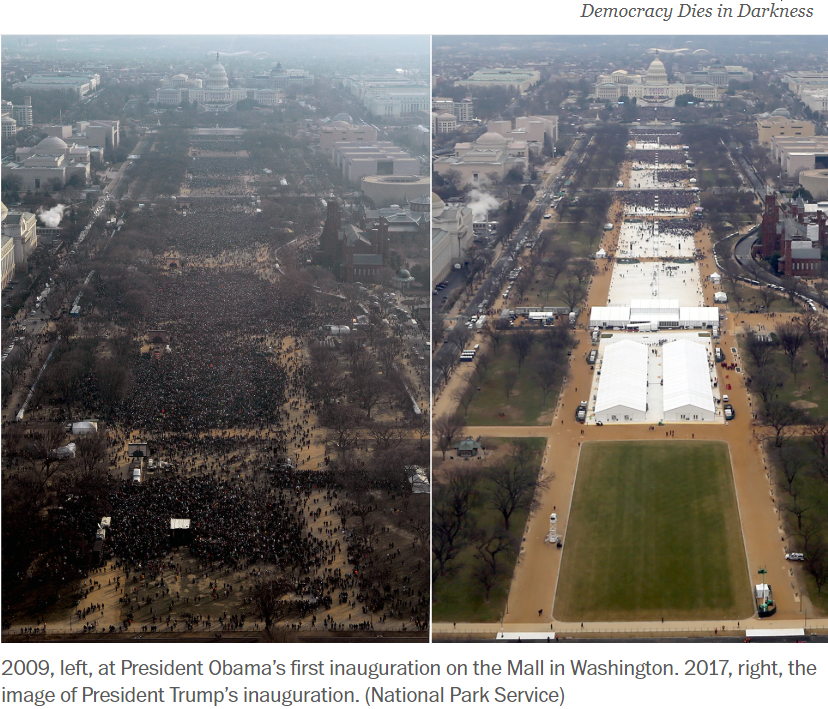
Trump’s 2017 inauguration crowd was only one-third the size of Obama’s in 2009. I was there in 2009. The wind chill was around 10 degrees. Trump’s REAL and deep foreign policy support among Republicans is similarly quite small.
Trade wars, attacking allies and driving an active industrial policy all undermine the US economy, resulting in lower GDP, lower tax revenues, higher spending, a greater budget deficit and higher inflation. Fiscal conservativism was recently the hallmark of the Republican party. It helped to unify the various flavors of conservatism. Everyone could agree on a balanced budget amendment, no trade-offs of higher taxes for increased spending, and threatening a government shutdown and possible debt default in order to force congress and the president to address the budget deficit and the growing federal debt. The real situation is worse today, with larger debt as a share of GDP, a forecast increase and a large annual budget deficit during a time of 4% unemployment. Trump’s headline foreign policies threaten the economy. Despite the Federal Reserve Bank’s reduction to the benchmark federal funds rate, long-term interest rates have drifted upwards. Will a Paul Ryan re-emerge?
(2) Corporate America
US based multinational corporations have thrived in the 75-year post-war era. They benefit greatly from the opportunities that free trade provides. Tariffs, trade wars, restrictions, industrial policy and presidential interference all reduce profits and increase risks. Trump may reduce corporate taxes and regulations, but international tariffs and regulations will hurt corporate bottom lines. The net benefits may quiet some corporate leaders. Others will incur greater harm and work to protect their interests.
(3) Agriculture/Rural America
American agriculture is a world class exporter. It thrives under consistent patterns of free trade. Trade retaliation is a big threat to agricultural revenues, profits and land values. Production agriculture is just 1% of US GDP, but it exceeds 5% of GDP in 1,130 American counties, averaging 14.11% of the value of production in this one-third of America geographically. In the other two-thirds of the country, agriculture accounts for just 0.36% of GDP, so it’s politically irrelevant. American agriculture has always been disproportionately effective in politics. Trade wars may soon have one-third of American counties up in arms.
(4) Philosophical Conservatives
Proven cultural and institutional frameworks are best. If it ain’t broke, don’t fix it. Support countries with similar cultural institutions and values. Protect the interests of the wealthy and powerful against the claims of the fringe interests. Isolationism, protectionism, and “do it yourself” foreign policy are unproven and risky strategies. The philosophical conservatives enjoyed a nice run from William Buckley’s 1950’s through the rise of the “tea party” in response to the Great Recession. They were amongst the first and strongest opponents of Trump’s views and have led the “never Trump” movement. They were never a large share of the party, but they provided a mental framework that allowed the components to work together and the conservative think tanks and media to earn a degree of respectability in the court of intellectual public opinion. Trump’s character challenges and blatant transactionalism and individualism cannot be reconciled with their views.
(5) Wall Street/Banking
America dominates international finance and banking. Raising capital, making markets, advising firms, and making risky investments. The global financial system works for Wall Street. Rapid and unpredictable changes to the “rules of the game” increases risk levels and makes global investments harder to plan, finance and execute.
(6) Hawks/Neoconservatives
Might makes right. Don’t fall for ideals. This group agrees with Trump on basic principles but can’t understand why anyone would undermine the highly valuable postwar alliances that the US has developed with NATO and individual countries because “they don’t pay enough” or “they win too much in trade”.
(7) Economic Free Marketers
True believers in capitalism and free markets see it as the best way to create and preserve value with the added side bonus of protecting individual liberty. Tariffs and active industrial policy are the traps that idealistic Democrats fall into. Republicans know that only the market, in the end, will deliver prosperity and liberty. Trump’s preference for a very active foreign economic policy and a relatively active and intrusive domestic economic policy does not match this group. They can embrace his general low tax, low regulation, only results matter views.
(8) Libertarians
Same as above on economic policy issues. There is a huge risk of the empowered centralized state, stripped of checks and balances, turning around and threatening individual liberties. A centralized totalitarian or fascist state is a huge threat that must be avoided at all costs. Trump has a libertarian streak, but he does not embrace libertarian principles.
(9) Main Street Republicans/Professional Class
This group wants to ensure that the hard-working professionals, managers and small business owners that add value for Americans overall continue to receive their fair share of the rewards. Trump’s “activist” foreign policy puts these rewards at risk. Firms and investors, large and small, will win or lose based upon imposed tariffs, regulations and industrial policies. The economic churn will be much faster, greater and random. A significant number of previously secure upper middle-class professionals will incur significant losses in a much more dynamic Schumpeterian age of creative destruction. The general demonizing of the elites, bureaucrats, experts, intellectuals, scientists, universities, teachers, media, economists, military leaders, pundits, market researchers, pollsters, high-tech leaders, foreign policy community, NGO’s, public health, etc. is a big negative for this group which naturally found a home in the Republican party in the post-war era. Trump’s belief in the “great man” theory of history is at odds with the mildly progressive culture of suburban, upper middle-class America.
(10) American Patriots/Neoconservatives
The US fought the “cold war” against communism for 50 years. Trump thinks that Putin is just another global competitor. Trump’s claim that “Putin’s actions are no better or worse than America’s historically” sounds like something Bernie Sanders might claim! He’s not worried about the communist views of China, North Korea or Vietnam. He’s ready to negotiate. He opposes the “communist” dictators in Cuba and Venezuela. There is no defense of the American values of democracy, equality, free markets or human rights in Trump’s approach. It’s simply America versus all other nations. Tactically and politically, Trump has repositioned China as the new great enemy. Historically, Americans fought the world wars, and the cold war based on the principles of democracy, liberty, freedom, individual values, capitalism and human rights. Trump wants to disengage from Europe and the Middle East while increasing assets to address China, just like Obama. Some patriots just need an enemy, others want to defend principles.
Many cultural conservatives have deep, fundamentalist religious beliefs. Their views are “right” and other views are “wrong”. Trump’s foreign policy is purely transactional. It doesn’t assert that the western or Christian world view is better, preferred or right. He’s not following Bush, Jr. to provide the world with the benefits of American political, economic and cultural systems. He just says that the American people, perhaps with their Christian/western opinions, are worth defending aggressively. It defends some dictators in Russia, Turkey and Hungary who do not share historical American values. Trump’s overall pragmatic, transactional, economics first views don’t square well with cultural conservatives who place moral and religious values first. Trump is delivering a set of Supreme Court and federal justices willing to overturn activist liberal judge rulings and to support legislation passed by culturally conservative states and the US Congress. He’s willing to poke at other cultures, races and nationalities as being “others”, not as good as the true Americans. Younger evangelicals seem less willing than their parents, who have been fighting the “culture wars” for 50 years, to embrace Trump at a transactional level and give up their ideals. Trump’s anti-immigrant posture, protecting America from the threat of the “others” does resonate with some cultural conservatives. Net, net, Trump is not losing support from this group due to his international policies.
(12) Victims of Economic and Social Change
This group clearly supports Trump’s populist diagnosis and prescriptions. The loss/decline of American industry was due to international traitors and coconspirators who undercut the owners and workers. It was all avoidable. Economic, banking, university, media and political elites conspired to undermine the domestic virtuous workers and owners in order to benefit “others”: other countries, religions, races, cultures, classes and interests. The story is just like Hitler’s description of the Weimar Republic leaders. The country was sabotaged by traitors. This is a very powerful story. Many Americans today buy this story. For how long?
Summary
Politics is all about telling a story and managing coalitions. Ronald Reagan told a very attractive story that wove together the various strands of conservatism into a coherent narrative. This story reframed American politics. Presidents Clinton and Obama confirmed the core conservative story, just like Eisenhower and Nixon confirmed the core New Deal story earlier. Newt Gingrich triggered both parties to adopt a polarized world view.
Trump leveraged this situation to attract economically and culturally disadvantaged individuals to embrace a greatly reformulated conservative, Republican, red, populist world view. Trump’s international relations policies don’t really fit well with the historical views of the Republican party. It remains to be seen if these mental conflicts will undermine his political support as he is able to implement them and deliver results. He is “riding on the coat tails” of broad popular support for “conservative” solutions to our many challenges.
International affairs have been secondary priorities for the last 50 years. They were top priority in the quarter century after WWII. Trump’s emphasis may make them top priority once again!
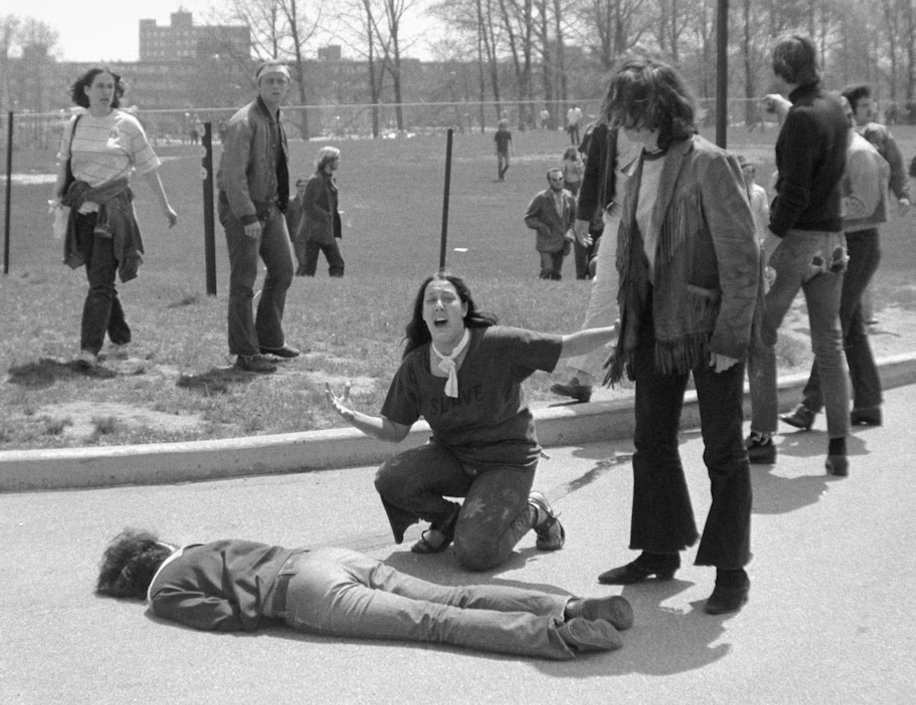
May 4, 1970. The world changed when 13 student protestors were shot and 4 killed by Ohio State National Guardsmen at Kent State University following the escalation of the “Vietnam War” into Cambodia.
Cleveland had experienced civil disorder in the hot summer of 1966 with the “Hough Riots”.
Governor Rhodes, who oversaw the state guard actions at Kent State, served for 16 years as the governor of Ohio from 1963-71, interrupted by constitutional limits, and then from 1975-83.
Like most major cities, Cleveland had two major daily newspapers, many radio stations and 3 network tv stations in the post-war era. Dorothy Fuldheim was a pioneering woman journalist who served throughout this period. She challenged the Kent State shootings.
I grew up in a small town of 4,000 people about 30 miles east of Cleveland, dominated by the Cleveland media. As a youngster, I delivered newspapers for the 2 big Cleveland and 2 local printers. Cleveland saw itself as a very major US city. 5th largest nationally in 1920. 8th largest in 1960. Cleveland was a major industrial supplier of the WWII war effort. It’s corporations greatly benefited from the post-war global industrial expansion. They struggled to face the 1970 challenges from international (Japanese) competition, environmental regulations, labor power/regulations, technological changes (IT, process), and consumer/retailer power changes.
The Cleveland economy was stagnant in the 1960’s and declining in the 1970’s. Locals supported the civil rights movement but recoiled from the Hough riots. The world was changing faster than the local economy and thought leaders could digest in 1969. With Kent State, the population and political leaders turned inward. The students were wrong. The guard did its job. A majority agreed. A substantial minority disagreed.
As a country we remain very divided, 54 years later.
The film “Network” expressed this passionate viewpoint in 1976. Economic and cultural changes were so great that people could not digest them. The difficulties of the 1960’s revolution continue 50 years later. Left and right both struggle with our situation today.
America is often described as an “individualistic” society. Sometimes as a compliment. More often as a criticism.
The positive reviewers note that it incorporated John Locke’s individualistic principles to form the first “classic liberal” democracy which has endured for more than two centuries of geographical expansion, rapid population growth, technological and social changes and foreign challenges. They argue that it demonstrates that a federal system of checks and balances, limited government and preservation of individual liberties can be economically and socially successful. Such a government can be effective even with diverse racial, ethnic, class, political and religious interests.
Only the Individual
The critics say that the society has always balanced individual and community interests, that the government system relies upon a strong culture of shared values and that “rugged individualism” is a myth that has been used to provide political support for laissez faire capitalism.
The heroic, self-sufficient individual has been promoted throughout American history. Washington and the founding fathers were memorialized. Jefferson’s ideal of the independent citizen farmer still resonates. Jackson further elevated the importance of the common man as central to American success. The explorer, pioneer, frontiersman, Lewis & Clark, Daniel Boone, and the self-made man were celebrated. The citizens and leaders who spread the new American individual rights across the continent were hailed for bringing about a new society, an example for the world to follow.
Americans embraced Thoreau’s retreat, Emerson’s “self-reliance”, Franklin’s “common sense”, Horatio Alger, cowboys, private detectives, military, political and superheroes. Proponents of laissez faire capitalism contrasted natural property and individual rights against unnatural government interference during the Gilded Age. Carnegie, Ford and Hoover promoted the same ends at the turn of the century highlighting the progress driven by individual inventors and owners. Hayek, Rand, Goldwater and Reagan argued that FDR style government was illegitimate and threatened the liberty and security of the nation, while praising job creation, technical innovation and entrepreneurs.
The Reagan revolution re-established the intellectual and popular legitimacy of holding conservative social and economic philosophies. Some successors pressed the arguments further, equating taxation with theft, comparing job creators and job killers, questioning the motives and results of government departments and employees, and promising no new taxes under any situation. “The self-sufficient individual is great, government is bad”, they said.
Community Plays a Supporting Role; Not a Leading Role
The role of community tends to get lost in the shadow of the great liberal versus conservative battle over the role of the state in “regulating” the economy and society. Most historians, political scientists and commentators agree that the American political system was constructed upon the assumption that citizens would share a common Christian culture with objective virtues complementing the God-given rights and responsibilities of citizens. The authors of the Federalist Papers, the Constitution and the Bill of Rights understood that this social glue was needed to support a democratic system of checks and balances, especially as the young nation expanded its small population across the Appalachian Mountains. They promoted “freedom of religion” but also relied upon enduring religious belief and participation. The founders held classic conservative ideas about the necessity of individuals to possess a sense of civic duty to participate in government, willingness to sacrifice for the common good and a commitment to the institutions of collective self-government.
Community is eclipsed by individualism in the public’s mind for many reasons. The promotion of liberty-loving and economically productive individuals who require only minimal government. The ease of highlighting outstanding individuals and individual types in the arts, journalism, history and marketing. The complexity, abstractness, variety and organic nature of community functions. The overlap of community and government when contrasted with “rugged” individualism. The soft, feeling, unmeasurable nature of community. The supporting rather than leading nature of community. The limited visibility of many community functions.
Community relations and results are exhibited throughout society. First, in the relations between citizens and their government. In the many voluntary associations that diverse citizens create and join in a nation with limited government and services. In local residential communities. In business, trade and agriculture. In the arts, travel and entertainment. In government organizations. In the country as a whole.
Community Is Essential for Democratic Government
The American government plan is based upon a relationship between the citizens and government. The citizens/individuals exist first and create the government. At the same time, they commit to fulfilling their duties as informed voters, candidates, soldiers, jurors, parents and supporters of the government and its institutional parts. Although the architects of the government warned against it, people soon clustered into political parties, movements and special interest groups to represent their interests. These parties have supported individual human, social and economic rights and the collective interests of classes, geographic areas, professions, industries, religions, ethnicities, sexes and races. Self-government requires a balance between the community and the individual.
The framers of the US Constitution were looking to the future. The US population was less than 3M in 1776, reaching 5M in 1800 and almost 10M in 1820. In today’s terms that’s the same as the states of Mississippi, South Carolina and Michigan or the metro areas of Charlotte, Phoenix and Chicago. This was a collection of 13 small states making sure that the central government would not become a tyrant. In 1780 the UK had 10M people, Spain 14M, Italy 16M, Germany 23M and France 28M. The US was about the same size as Sweden, Netherlands, Switzerland, Portugal and Belgium.
Community Through Voluntary Associations
The large role of voluntary associations in filling the services gap between citizens and limited government was a distinct feature of the early USA, described by Tocqueville in his famous 1835 “Democracy in America”. He noted that class was absent, no religion denomination was dominant, people were preoccupied with economic affairs and the government’s role was small. Religion actively shaped lives. Citizens created voluntary organizations to fill every need: universities, fraternities, sororities, professional associations, libraries, fire companies, hospitals, seminaries, prisons, missionaries and schools. In a sparsely populated new world composed of immigrants or their descendants the “rugged” individualism required for survival was paired with a deep commitment to community based upon necessity, civil and religious beliefs.
America experienced an explosion of new associations between 1880-1920 in response to the challenges of urbanization, immigration and industrialization. YMCA, civic organizations, social organizations, scouts, Chautauqua institute, women’s movement, professional organizations, conservation organizations, mutual aid associations, settlement houses, service clubs, prohibition clubs, cooperatives, social gospel services, community funds, credit unions and unions.
Community Through Religion
America was a very religious place from the start. The Puritans, Quakers and other Christian denominations practiced their faith in congregations, even if sin and being saved were deemed individual matters. Religious groups impacted civil society. The Great Awakenings were communal events leading to the modern era crusades of Billy Sunday and Billy Graham. Colleges and universities were mainly founded by religious denominations with religious influence extending into the late 20th century. US religious membership and participation declined 50 years after such changes in Europe.
Residential Community
The New England township model of direct democracy and the Northwest Territory same-day horse ride county government model that followed encouraged participation in local government. This engagement together with funding and delivering government services created a deep sense of local community even as the model spread across the Great Plains to the Rocky Mountains. We still see the county seat, county square, county courthouse model. This local community model continued in urban neighborhoods, suburbs and housing developments with HOA boards and services. Urban machine politics were based on the local precincts. Urban immigrants clustered in ethnic neighborhoods with familiar faces, languages, customs and churches. Conservative philosopher Edmund Burke praised the “little platoons” of family, kinship and neighborhood as the basis for teaching social skills and holding the larger community together. The individual was complemented by a meaningful local social and political community for most Americans through time.
Community at Work
America began as a farming nation with a few urban traders. Jefferson emphasized the importance of maintaining a high proportion of land-owning farmers who would be incentivized to take care of their families and participate in managing the shared resources of the community. Land was inexpensive, so agriculture was able to expand for more than a century.
Even agriculture was never solely about the individual. Family farms, shared harvest time, barn raising, going into town. Land grant universities developed agricultural science and local extension agents shared their knowledge. Grange organizations. Coops. Farmer-labor populist political parties. Farm banks. Political influence and programs. Rural electric coops.
Business and manufacturing were small scale originally. With access to natural resources and transportation, American manufacturing grew rapidly starting in the 1840’s. Many inventors and capitalists. Much wealth was created in the 19th century.
Manufacturing grew and organizations developed more effective administration. The railroads, steel, coal and limestone required social organization on a larger scale. The automobile and electricity spawned even greater innovations including vertical integration and the assembly line. Unions formed to balance the owners’ power. Industrial and trades unions viewed themselves as brotherhoods. Large economic organizations became the daytime home for most workers. Professional and industry associations grew to serve the needs of their members. New community ties were formed.
Further corporate growth through 1930 and then another boom after WWII. “The business of America is business”. “What’s good for GM is good for America”. Although it is rarely recognized today, the development of effective businesses that employed thousands and even a million people was and remains an historic social achievement, overcoming the different interests of those individuals. Corporations also developed social innovations such as R&D teams, joint ventures, outsourcing, project management, functional departments, divisions, cross-functional and lean teams to balance individual and collective interests.
Community in Leisure
Americans were always sensitive about being less cultured than their European peers. They invested in seminaries, universities, libraries, printing presses and theatres. They applauded American writers and artists. Itinerant preachers shared news and thoughts. Public lectures, pamphlets and news editorials were consumed. Theatre and orchestras expanded in the cities. Leisure time brought sports. Magazines boomed and circulated. Circuses and lecturers visited. Universities offered public lectures. Radio and movies greatly increased the consumption of high and popular culture. Orchestras and big bands entertained. Movie stars and lead singers gained fame. American jazz, swing, blues and rock and roll grew. Large attendance concerts began. Community was built and reinforced.
Community in Government
US government organizations were quite small historically. Mostly import tax collectors and judges. The government’s role grew with Hamilton’s national bank. The government began to invest in infrastructure like roads, ports, canals and railroads. The military grew and established forts to protect the settlers. It developed its own strong collective culture. Land grant universities and the continental railroad started in Lincoln’s time. The post office and pony express grew. Rivers were managed to provide reliable transportation, electricity and recreation. Interstate highways and airports were built. The government grew dramatically under FDR as a service provider, regulator, research sponsor, investor and owner. Although the 3 million Federal government employees get the most attention today due to the impact of their work, state and local governments employ 19 million, more than 6 times as many. Government employees are more likely to be unionized, serve long careers and view their work as serving the community.
American Community
The idea of a distinct and important American culture dates to the country’s founding as a breakaway republic seeking to preserve “the rights of Englishmen”. The country’s government, economy, immigrant citizens, diversity and shared war efforts shaped its self-image. Many saw the United States as a special country created to be a positive example for the world. “American exceptionalism” was described by both its citizens and Europeans. The individual based political system, the role of churches in shaping daily life and the large number of voluntary associations all played a role in describing the character of everyday life, hopes and dreams. Given its location between 2 oceans, the US mostly followed an isolationist path until WWII. Since then, it has seen itself as a global defender of democracy against communist and totalitarian states. The US has maintained elements of its individual, religious and associational character to this day.
The Role of Community Changes Through Time
Robert Putnam’s series on “Bowling Alone”, “Our Kids” and “The Upswing” documented how American social institutions have evolved through time to address new needs and how participation and engagement have risen and declined across long periods of time. During the Great Depression soup kitchens, potluck suppers, community gardens, small scale retail and personal donations complemented government programs. During WW II victory gardens, scrap collecting, bond sales, rationing, black outs, civil defense clubs and female factory workers contributed to the war effort. The post-war era saw a boom in sports, civic, neighborhood, professional and religious participation followed by a reversal at the end of the century. During the 2020-23 pandemic the country experienced lockdowns that highlighted our economic and social interdependence and the negative consequences of isolation.
Community is an essential and integral part of modern life. It operates in many dimensions. We need to recognize its critical role in complementing the individualistic view of the world.
I grew up in Greater Cleveland as a proud buckeye in “the best location in the nation” 1956 – 74. Learned about demography in my first 1974 quarter at New College in Sarasota from Dr. Peter Hruschka. Transferred to Indy in 1988. Remained ever since. Slowly became a “Hoosier”. Started documenting the Hoosier population in 2009, including the exceptional growth of our suburban Hamilton County.
The urban counties have tripled in growth. The others remain flat.
Rural America was behind in 1960. It was much further behind in 1980. The gap has continued to grow. This has huge political implications. George Wallace, Spiro Agnew and Richard Nixon deeply understood this in 1968. Not sure my Democratic party has yet caught on.
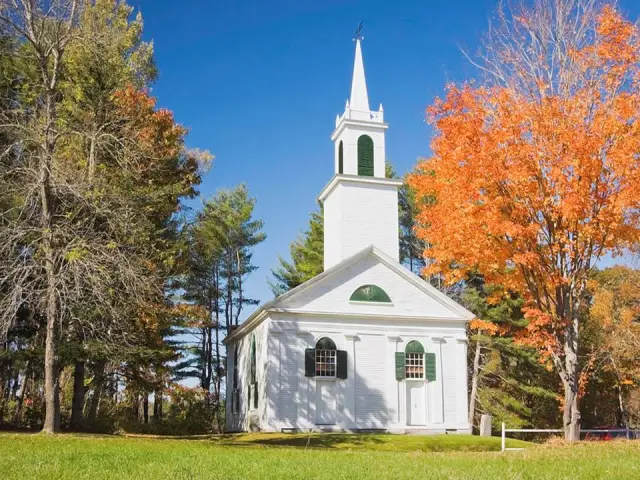
This leading mainline protestant denomination lost one-half of its membership between 2000 and 2022 following a slightly smaller decline in the previous 20 years.
The university, media, entertainment elite followed the “new left” political views from existentialism to postmodernism, making nonbelief a socially acceptable or even preferred position for the growing college educated professional class.
The mainline seminaries generally embraced the individualism, idealism, social justice, subjectivism, ecumenicism, personal growth, literary criticism, logical positivism and other trends of the post-WW II era.
Prosperity, social security, and longer lives combined to make people more self-sufficient, able to (temporarily) ignore the usual claims of mortality.
Expanded government services replaced the role of the church in education, health care, counselling, youth activities and social services.
The “Reagan Revolution” and neo-liberalism rebuilt a rationale for unfettered “laissez faire” capitalism and undercut the moral authority of the liberal church and liberal politics. Radical individualism, commercialism and libertarianism reestablished their credibility in a tolerant world.
The “liberal” positions on civil rights, women’s rights, social security/welfare, gender identity, differently abled, immigrants, ecumenism, globalism, and environmentalism prevailed. Presbyterian churches generally supported these social changes. These cultural changes generated a backlash with polarizing political consequences. Congregations lost members because they were either “too liberal” or “too conservative”.
Alternatives to mainline Protestant creedal denominations grew. Southern, rural and northern reactions to racial integration, busing and affirmative action generated white, socially traditional churches and schools.
Non-denominational, non-creedal churches built upon racial, cultural and political factors, including fundamentalism and the prosperity gospel.
The Roman Catholic church became more liberal intellectually, allowing some individuals to join or retain their membership even when they had significant disagreements.
Entrepreneurial megachurches evolved to provide “full services” to a transactional culture without the constraints of denominational creeds, seminaries or hierarchies. They leveraged technology, marketing, evangelizing, contemporary music, culture, individualism and economies of scale very effectively while mainline churches disdainfully called them merely “attractional”.
Previously “alternative” religions such as Pentecostalism, Mormonism and Asian religions became familiar and real options.
The polarization of religious and political views deepened beginning with the 1973 “Roe vs. Wade” Supreme Court abortion ruling and accelerated with Newt Gingrich’s leadership of the Republican Party in 1992. Individuals moved left or right, leaving the conservative theology plus liberal social justice combination in many Presbyterian churches as a strange combination, a duckbilled platypus option.
Like most mainline churches, PCUSA congregations mostly “doubled down” on their historical success and turned inward in the face of adversity. They reinforced their decisions on worship, social issues, congregational care, mission, and outreach. They did more of the same.
PCUSA churches turned to their historical strengths in thinking, theology, rational steps as the world discounted this dimension and increasingly turned towards feelings and action.
PCUSA churches doubled down on the “field of dreams” strategy. Build it and they will come. Preach it … Market it … Program it … Modernize it … Serve it … Outreach it … Church planting had some success, but existing churches, aside from a minority of very large ones, found that economically rational investments were inadequate or insufficient to stem the tide of the “megatrends” changing society, especially among the younger generations.
PCUSA churches invested in contemporary worship services, modernized and inspirational youth programs, partnerships, service projects, retreats, and mission strategies without major gains in membership or active church participation.
PCUSA churches maintained their commitments to national and international mission projects, social justice and missionaries, including a commitment to mission programs as a significant part of the church budget.
PCUSA churches maintained their collaborative governance model where congregational elders share power with the senior pastor and the Presbytery. This provided an inherent status quo bias to decision-making, preserving historical programs, retaining donors and limiting any major changes or experimentation.
After the 1960’s, the US continued to move towards a radical individualism with less community participation and trust in institutions.
The growing partnership between evangelical, fundamentalist Christian churches and the Republican Party further aligned the political and religious dimensions of life. Young adults increasingly bought into a “left versus right” perspective on political and religious views.
PCUSA churches, national leadership and seminaries embraced ecumenicism within Christianity and across faith communities, softening the distinctions between denominations in an increasingly brand sensitive world.
PCUSA churches, national leadership and seminaries failed to address the threats of existentialism, new left, postmodernism, skepticism, subjectivism, relativism, scientism, atheism, agnosticism, libertarianism, commercialism, secularism, scientism, logical positivism, utopianism, and radical environmentalism. A faith in “progress” remained.
PCUSA churches remained focused on their middle class and professional class congregations. Sometimes partnering with inner city churches and neighborhoods or immigrants. Sometimes sponsoring and supporting new ethnic churches.
PCUSA churches and national leadership generally took modestly “liberal” positions on cultural issues. Human rights, civil/racial rights, LGBTQ rights, women’s rights, abortion choice, gay marriage. Conservative members left.
PCUSA churches preserved membership numbers by not requiring financial, worship, volunteer, service, participation or other active engagement.
PCUSA churches have continued to discount the value of marketing, branding, strategy, stewardship, technology, business, process, administration as inherently less valuable than the ordained ministry program functions.
Recovery Strategies
Remain welcoming and open to former members or others who have a limited social need to be affiliated with a church for key life moments.
Develop and promote a “Christian Social Teaching” in parallel with “Catholic Social Teaching” to address the core issues of capitalism and power.
Invest in organizational “best practices” for strategy, marketing, technology, human resources, stewardship, finance and administration.
Outline key functional areas. Prioritize investments based upon expected cost/benefit ratios. Triage. Eliminate non-value-added programs and initiatives. Measure results. Hold staff, elders and volunteers accountable for results.
Invest in marketing directly and indirectly through service and outreach activities.
Consider minimal sustainable program sizes and economies of scale. Eliminate unsustainable programs. Partner with other churches.
Take clear moderate positions on social issues and communicate them. Welcome diverse opinions on issues that are not essential faith issues.
Clarify the role of individual creeds as definitive/determining or inspirational. Invest in deep understanding and commitment to the essential ones.
Reconsider historical distinctions within Christianity. Evaluate doctrinal precision/scholasticism versus effectiveness in attracting, retaining and engaging church members. What do Catholicism/liturgical, Pentecostal/spiritual and Fundamentalist/practical/local have to offer?
Strategically prioritize the resource investments in worship, spiritual growth, mission/service, outreach/evangelism, congregational care and stewardship.
Actively invest in programs and missions to oppose atheism.
Promote representative democracy and civility.
Actively create and promote Christian church partnerships
Outline and communicate the concept, benefits and requirements of the “missional church”.
Offer programs, small groups and pastoral care to emphasize the critical role of discipleship for supporting the church, it’s members and missions.
Reach out to struggling churches to provide services and transition assistance.
Ruthlessly review all communications to make them accessible and welcoming to individuals with no church background.
Review and revise all programs and ministries to first meet the needs of young adults.
Review and revise all programs and ministries to ensure they meet the needs of all other diversity dimensions.
Invest in outreach forums that allow individuals to learn about the church in a neutral environment.
Actively address the shortcomings of radical individualism in worship, activities and communications.
Review and adjust governance structures to ensure that strategies and programs can be defined, and their success measured.
Consider the impact on worship, growth, care, service, outreach and stewardship for each decision.
Communicate God’s eternal purpose and promise for men in terms that all can understand.
Emphasize the collective, community nature of the congregation as the only way to prepare for heaven.
Invest in Christian apologetics in “A Secular Age”. The alternate world view is now much clearer. Hold it accountable.
Invest in strategic planning facilitation, including the translation of mission, vision and values into strategic priorities and programs amongst worship, care, service, spiritual growth, outreach and stewardship.
Invest in program and project planning.
Invest in measurement systems to evaluate performance.