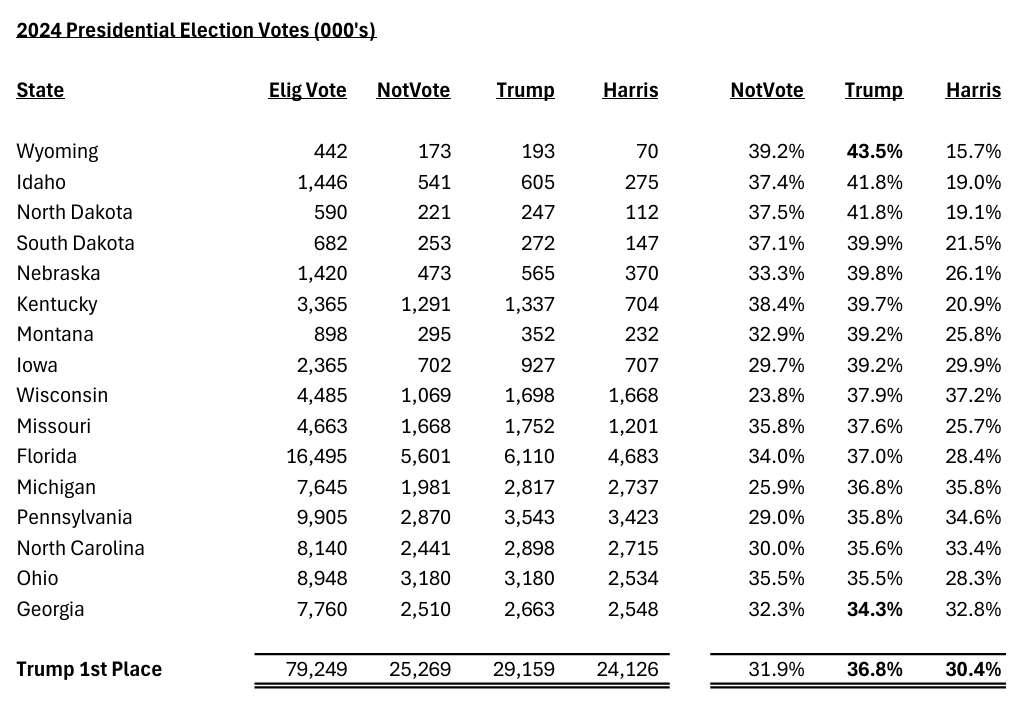
Donald Trump clearly won the 2024 electoral college by 312 to 226. He won a 49.8% plurality of the popular vote with 77.2 million versus Kamala Harris’ 75.0 million (48.3%).
The voter participation rate in 2024 was down from 2020, with 86.4 million eligible voters not voting. Hence, the non-voters at 35.8% of the total were the largest category in 2024. Trump earned support from 32.0% of eligible voters. Harris won 31.1% of eligible voters.
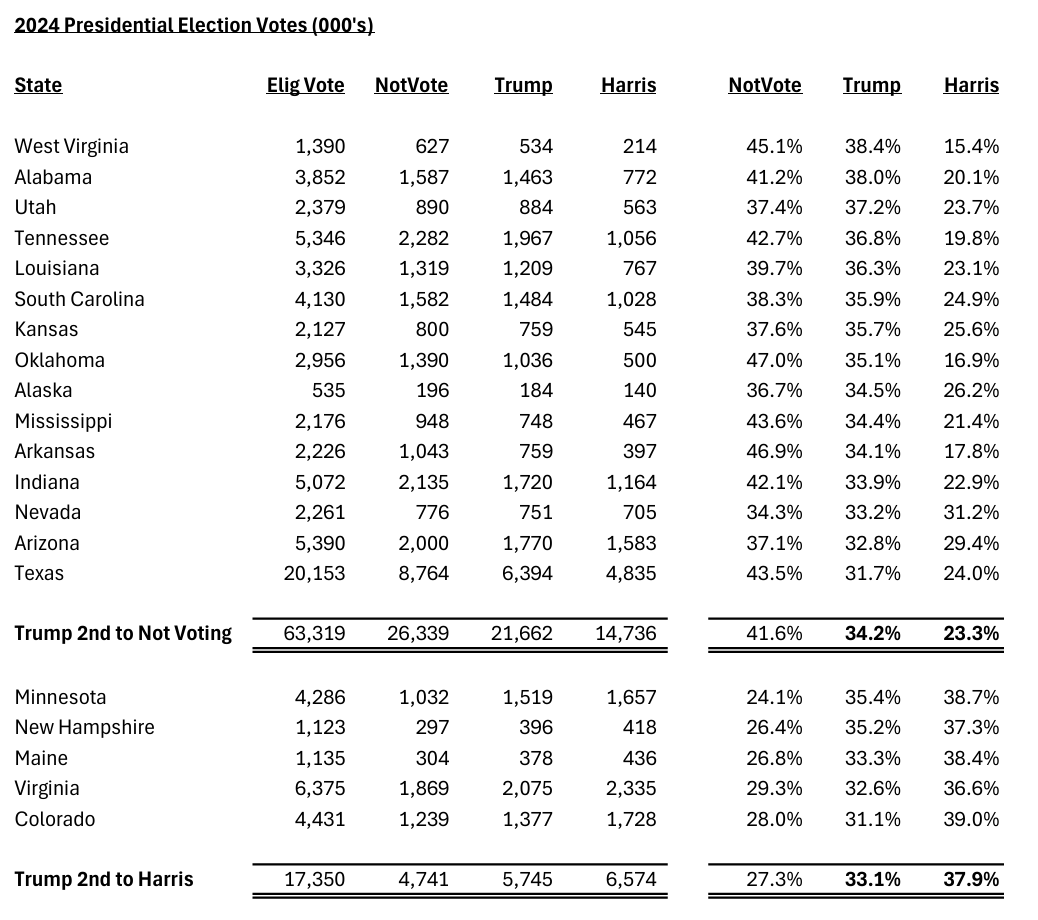
When the election is reframed as a 3-horse race, Trump finished second to those who did not cast a ballot.
Trump finished first in 16 of the 51 states (+DC), earning an average of 36.8% of eligible voters’ support. His best showing was 43.5% of Wyoming voters’ ballots. The eligible voter shares of these states to the total at 32.8% is close to the states’ share (16/51).
Trump earned more votes than Harris, but fewer votes than the number of non-voters in another 15 states. He collected 34.2% of the total here compared with 41.6% for the non-participants. Harris was far behind at just 23.3%. These states accounted for 26.2% of the total eligible voters.
Trump finished second to Harris and ahead of non-voters in 5 states, receiving 33.1% of the possible votes. Harris won 37.9%. The non-voter share was 27.3%. These 5 states accounted for just 7.2% of the grand total.
Trump finished in third place in 15 states, earning only 25.4% of the eligible vote. Harris won 36.2%, a shade behind the non-voters at 36.8%. This group of states had 33.8% of the eligible voters.
The US political system does not require or encourage voting. The electoral college system’s “winner takes all” approach discourages voting in states that have historical leaned one way or the other. The non-voters might split the same as the voters, be more favorable to the winner or less favorable to the winner.
In total, Trump won 32.0% of the eligible votes, typically 33-40% in the states that he won and 25-33% in the states that he lost to Harris. More than two-thirds of eligible voters did not vote for him, ranging from 60-75% in different states. Trump clearly won the electoral college, improving on his results in 2016 and 2020 on most demographic slices. His win is not clearly a mandate for assuming extraordinary executive authority.
In the 1970’s and 1980’s Ronald Reagan effectively knit together the various strands of “conservatism” under the umbrella term “conservative” within the Republican party, marking a big shift from FDR’s New Deal Democrats who had dominated US politics for two generations. Reagan’s assembly fit well within classical conservatism as outlined by Edmund Burke, Russell Kirk and William F. Buckley, Jr.
Conservatism was originally a reaction to secular humanism, the enlightenment, scientific revolution, progressivism, individualism and classical liberalism. Buckley summarized it: “A conservative is someone who stands athwart history, yelling Stop, at a time when no one is inclined to do so, or to have much patience with those who so urge it.” The key insight and rationale is that society is the result of trial and error, accumulated wisdom and demonstrated effectiveness. Change is to be considered, tried and adopted slowly. Society is a complex thing that cannot be reduced to science, philosophical and social science principles; analyzed, reformed and changed without great and irreversible risks. The institutions, lessons, wisdom and power of society must be honored for the benefits they provide, not treated as mere subject matter to be optimized.
This fits with social science research that says that “risk tolerance’ is the primary psychological dimension dividing conservatives and liberals. Conservatives are wary/skeptical about change, new situations, new solutions, “others” and mere ideas. Liberals welcome variety, change, ideas, possibilities, progress and ideals. Conservatives appeal to fears while liberals appeal to hopes. Conservatives embrace structures while liberals prefer flexibility. Conservatives are more pragmatic, incremental and results-oriented while Liberals value perfect ideals and honorable processes.
Philosophical conservatism is an umbrella that allows economic, social, international, religious, military and political conservatives to work together effectively despite the differences that exist in their more detailed views.
While Donald Trump promotes some policies that align with conservative principles, I will argue that most of his policies and actions are fundamentally opposed to classical conservatism. He is a radical, an extremist, a narcissist, a totalitarian who views the Republican party and “conservatism” as mere tools for achieving his personal goals which have no connection to the principles of conservatism. He is not seeking to promote the conservative agenda or preserve the best of American or Western civilization. He is not connected to liberalism either. Trump is a Nietzschean “superman” believing in himself, alone.
Culture/Civilization
Trump does not promote “Western Civilization”. No ringing words of inspiration and hope. Division between social and political groups. Neglect of history. No underlying principles like democracy, capitalism and globalism. Merely “might makes right”, realpolitik, leverage, “whatever it takes”, “the art of the deal”, “greed is good”, and “some very fine people on both sides”. The ideal Trump age is the 1970’s and 1980’s when he was making money, not the idyllic small-town, factory worker 1950’s. Universities are attacked. The “Lamestream media” is attacked. The Kennedy Center is acquired. The entertainment industry is criticized. Science is defunded and denied. Values are scorned. Allies are dumped. Europe, Canada, Mexico, NATO, Japan, South Korea, the UN and international agreements and organizations are disrespected. The accumulated wisdom and culture of the post-war era is disregarded. This is a nihilist view. Trump didn’t create it, so it must not be of value.
Citizenship
Trump promotes a “fake patriotism” that helps maintain his political support. He actively supports legislation to reduce “voting rights”. He undermines confidence in the voting process. He disputed and tried to overturn the 2020 presidential results. He never accepts the results of courts or legislative bodies that don’t agree with him. He interprets the constitution to meet his personal needs. He dishonors those who have served before as civil servants, military and political leaders. He sets no standards of excellence for his appointees to government office, merely loyalty. He issues no collective call to cooperation, sacrifice or common purpose even in the face of a global pandemic. He sees no obligation for those with greater resources and abilities to “serve their country”. He undermines the judicial system to meet his own needs. He considers Putin’s foreign policy to be the moral equal of America’s historical foreign policy.
Citizenship is a crucial role within philosophical conservatism. Society requires some form of government. That government must be seen as legitimate through the active participation of the citizens. Trump has promoted greater political participation through his polarized speech and actions. He has undercut the legitimacy of our government and citizenship.
Rule of Law
Conservatives embrace “the rule of law” because they distrust single individuals or mere ideas. Communities, property, firms, trade, organizations, governments, churches and families depend upon a stable background.
Trump completely disregards “the rule of law”. He has found that “might makes right” and money can purchase justice. He disrespects, challenges and undermines the courts, the department of justice, the FBI, Congress, contracts, agreements, allies, deals, rules, rulings, norms, relations, partners, legal counsel, professional associations, marriage vows, history, tradition, habits, judicial precedents, soft power, etc. He is amoral. He uses all tools and means to pursue his ends. Loopholes, appeals, distractions, bankruptcy, new loans, settlements. He lies, threatens, jokes, reverses course, denies, obfuscates, floods the zone, dog whistles, promises and reneges.
Community
Philosophical conservatives see culture and civilization transmitted, embodied and protected by actual communities; not individuals or abstract philosophical principles. Hence, communities of all kinds are essential: families, neighborhoods, churches, parishes, teams, scouts, civic organizations, professional and industry associations, social and sports organizations, social third places, special interest groups, political groups, fraternities. These are “the little platoons of society” that George W. Bush wanted to revive with his “compassionate conservatism.”
Trump offers only “individualism”, division and polarization. He is not a member or leader of other groups, aside from a few elite “clubs”. His life is focused on “deals”, transactions, not social relations. He shares no strategy to bind the country together, no ecumenicism, no third way, no civility project, no common good or purpose, no presidential volunteer program, no legislation to promote not for profits, no churchgoing example, no global idealism, no common morality, no “more effective” Congress, no international youth exchange/service program, no global warming cooperation, no next pandemic research, no cultural investment, no home team, no nonpartisan young Americans clubs, no long-term immigrants solution, no cultural discussion forums.
Class
Philosophical conservatives take a “realistic” view of society. Different people have different talents and capabilities, so they fill different roles for the overall benefit of society. “Birds of a feather flock together”. There are natural differences of experience and interests in different groups. There is no reason to fight this or to “equalize” groups. Hence, conservatives have generally supported the key roles and groups in their societies as being valuable and worthy of social support: landowners, farmers, capitalists, military leaders, priests, lawyers, doctors, bankers, entrepreneurs, scientists, political, government and business leaders.
Trump discounts all class groups except for a few exceptional billionaires and “the people”. He politically caters to factory and mine workers. He disparages corporate leaders, military leaders, bureaucrats, bankers, regulators, elected officials, judges, elites, media, technologists, unions, mayors, government employees, teachers, essential workers, civil servants, doctors, scientists and public health experts. He promotes a sense of “victimhood” in “the people” as he demonizes the various “elites”. The level of trust between individuals in our society continues to fall, undermining any sense of community, class or true national spirit.
Property
Conservatives tend to value property as the highest of individual rights. Without secure property rights, individuals cannot live a good life.
Trump supports tax cuts and deregulation which help to preserve property and wealth. But he also supports an “activist” economic public policy. Government actively manages international trade rules, tariffs and deals. Government maintains an active industrial policy. President directly controls independent agencies like the Federal Reserve Board. President uses all powers of the executive branch to force firms and individuals into cooperation, compliance and obedience. This is undeclared fascism, centralized control of economic power.
Institutions
Conservatives trust institutions, just like property and “the rule of law” because they are not subject to the whims of individuals, new ideas, and rapid change. Institutions develop in response to societies’ needs slowly through time. The political, economic and social elites lead institutions to balance goals, needs and interests.
Trump is an institutional wrecking ball. Every institution is weak, ineffective and suspect. None meet his standards or pursue his goals. Universities, public schools, performing arts, media, charities, hospitals, clinics, social workers, aid agencies, libraries, community centers.
Government
Trump goes beyond the traditional conservative desire for “limited government”. He wants to eliminate most government. He is actively dismantling the federal government. Even the military, research and state department. On the other hand, he wants to control the government for himself (FBI, DOJ, trade, tariffs). Classical conservatives see the government as the visible part of the political system, providing practical services to the citizens and a means for citizens to be heard. Its effectiveness helps to reinforce commitment to the political state. Trump actively undermines local governments as well, criticizing political leaders, teachers, librarians and essential workers.
Religion
Conservatives and the “classical liberal” founders of the US government system agree that governments are built upon the moral, social, cultural, ethical beliefs and commitments of the citizens. In a theocracy, the political and religious can be merged. In our system, the state cannot strongly define, dictate, educate, promote or enforce these values. We rely on individuals and families to choose and practice their own religion or beliefs. Conservatives emphasize the importance of this dimension of life.
Trump appointed judges to overturn “Roe v. Wade” and eliminate the “right” to abortion at the federal level. He then said that “abortion” is a state issue and he is done with it. Trump does not promote religion, philosophy, morality, community, dialogue, understanding, ecumenicism, prayer, civility, service, sacrifice, or cooperation. He promotes no religious values, only the rights of power. He provides no example of religious involvement.
Trump further divides the country into fundamentalist “social conservatives” and the enemy. He inflames the “culture wars” on libraries, public education, school choice, trans athletes, bathrooms, and DEI. He offers no solutions on how Americans can work together locally or nationally to find solutions, compromises and understanding. His policies are “tone deaf” to Christian teachings that call for attention to “the poor, the widow, the orphan and the stranger”. He used the Bible as a political prop.
Character
Conservatives have supported strong families, religions, and institutions so that they are able to transmit culture from generation to generation. “It takes a village to raise a child” is a conservative insight too. Society is based on individuals belonging to society and its institutions. Western societies have embraced individual freedom and liberty and so have had to find means to ensure the balance between the individual and society. We have defined, educated and promoted high character as an essential tool.
Trump displays and promotes no traditional character values. He is an extreme individualist. Truth does not exist. Complete subjectivity and moral relativity. He promotes victimhood rather than agency and responsibility. The end justifies the means. No sense of honor or commitment. Each day is a new day for negotiation. Only power really matters. Not family values. Not social justice. Not human rights, equality or equal opportunity. Strength matters. The courage to use power matters. Achieving and maintaining wealth matters. Social status matters. Achievement matters. No self-awareness or other awareness/empathy. No humility.
Stewardship
Conservatives generally accept an unequal distribution of talent, wealth, power and responsibilities as natural. Historically they have paired this situation with a focused responsibility to be effective stewards of society’s resources. “To those who are given much much is expected”. Noblesse oblige. Leaders care for the poor, widows and orphans. Social norms are used to assign and maintain this responsibility.
As western societies have tasked government with maintaining the “social safety net”, this typical responsibility of the upper and upper middle class has become fuzzier. In a more recent world of smaller government and no taxes, individuals and institutions are required to take up the slack. Trump provides no leadership on this matter. No expanded charitable giving tax deduction. No volunteer hour tax credit. No leading by example. No commitment or encouragement to “give it all away”.
Liberty
Conservatives have always embraced individual liberty for the governing classes. In the American tradition they have embraced liberty as a super value for a widening group of individuals. The US Bill of Rights has become part of the background of our existence. “Give me liberty of give me death”. The Tea Party.
Trump does not support individual liberties. Not “the rule of law” protections. Not freedom of speech. Not “freedom of expression”. Not “freedom of the press”. Not “checks and balances”. Not “due process of law”. Not human rights. Not the independent judiciary. Not civil service protections. Not freedom of religion. Not the right to vote. Not free trade. Not free travel. This looks like fascism, a very strong national state.
Summary
Trump is not a conservative. He sees himself as a Nietzschean superman. He believes in himself and that “might makes right”. He supported both political parties historically because it was helpful financially. He does not believe in “conservative values”. He is politically dispensable.
BERTHE: She climbs a tree And scrapes her knee Her dress has got a tear.
SOPHIA: She waltzes on her way to mass And whistles on the stair.
BERTHE: And underneath her wimpole She has curlers in her hair!
SOPHIA: I ever hear her singing in the abbey.
BERTHE: She’s always late for chapel,
MARGARETTA: But her penitence is real.
BERTHE: She’s always late for everything, Except for every meal.
MOTHER ABBESS: I hate to have to say it But I very firmly feel
BERTHE AND SOPHIA: Maria’s not an asset to the abbey!
MARGARETTA: I’d like to say a word in her behalf. Maria makes me laugh!
SOPHIA: How do you solve a problem like Maria?
MOTHER ABBESS: How do you catch a cloud and pin it down?
MARGARETTA: How do you find a word that means Maria?
BERTHE: A flibberti gibbet!
SOPHIA: A willo’ the wisp!
MARGARETTA: A clown!
MOTHER ABBESS: Many a thing you know you’d like to tell her, Many a thing she ought to understand.
MARGARETTA: But how do you make her stay And listen to all you say,
MOTHER ABBESS: How do you keep a wave upon the sand?
MARGARETTA: Oh, how do you solve a problem like Maria?
MOTHER ABBESS: How do you hold a moonbeam in your hand?
MARGARETTA: When I’m with her I’m confused, Out of focus and bemused, And I never know exactly where I am.
SOPHIA: Unpredictable as weather, She’s as flighty as a feather,
MARGARETTA: She’s a darling,
BERTHE: She’s a demon,
MARGARETTA: She’s a lamb.
SOPHIA: She’d out-pester any pest, Drive a hornet from his nest,
BERTHE: She can throw a whirling dervish Out of whirl.
MARGARETTA: She is gentle, She is wild,
SOPHIA: She’s a riddle.
MARGARETTA: She’s a child.
BERTHE: She’s a headache!
MARGARETTA: She’s an angel!
MOTHER ABBESS: She’s a girl.
ALL NUNS: How do you solve a problem like Maria? How do you catch a clown and pin it down? How do you find a word that means Maria? A flibberti gibbet! A willo’ the wisp! A clown! Many a thing you know you’d like to tell her, Many a thing she ought to understand. But how do you make her say, And listen to all you say? How do you keep a wave upon the sand? Oh, how do you solve a problem like Maria? How do you hold a moonbeam in your hand?
Context
Our polarized political situation is just the tip of the iceberg. We have similar challenges with our communities, economics and philosophies. We have well-meaning groups of individuals with apparently incompatible views without obvious ways to build bridges. We are facing a self-reinforcing cycle of increasing polarization, threatening modern civilization.
I’ve been focusing on the “root causes” of our situation recently and concluded that there are 6 interacting features that must be understood and addressed.
Radical individualism, which undermines “community” and self-awareness.
Human nature. We are psychologically and morally imperfect. Largely analog creatures wrestling with a much more complex world of choices.
Skepticism. We are good at criticizing, undermining and doubting. Not as good at problem solving, problem resolution, creativity, empathy and communication.
Living in a Secular Age. The default, background, unchallenged Christian worldview is gone. Individuals know they must make conscious choices.
Imperfect Myths. Religion, science, progress, romanticism, personal growth, libertarianism, populism, classic liberalism, conservatism, capitalism, postmodernism … None of the individual views or clusters of worldviews is fully adequate for many people.
Insecurity. Science, technology, business, international trade, specialization, computers, communications, and information all grow and become more complex. We are insecure in our “selves”, our roles and our economic situations.
In each case, the simple “left versus right” analysis or viewpoints are inadequate, misleading and ineffective.
Conservatives promote economic individualism. Liberals promote social and “human rights” individualism. We have jointly lost sight of the essential role played by community in all dimensions of life.
Conservatives tend to emphasize the negative, limited, sinful nature of man while liberals focus on the goodness and potential. Scientists conclude that we are both. Politicians and analysts tend to use overly simple models of man when seeking to understand or improve our situation.
Conservatives are skeptical about progress, change, risks and high ideals. Liberals are skeptical about power, wealth, interests, structure, and large organizations. Healthy skepticism has its place.
Conservatives fight the coming of a “Secular Age” with no cultural consensus on important questions. Liberals tend to welcome continued change towards a purely secular, scientific world where religion and philosophy disappear. We seem to be “stuck” needing a hybrid situation.
Conservatives tend to embrace “well-defined” philosophies, theologies and myths. Liberals tend to like more complex, dynamic, evolving, individually fine-tuned world views. Theologians, philosophers, politicians, scientists and real people have been unable to outline life paradigms that are “obviously true” to everyone. We have different views, and it looks like there is no single final answer that everyone welcomes.
6. Conservatives emphasize a return to a culture with fixed answers on all dimensions thereby eliminating the difficult questions and uncertainties. Liberals emphasize a larger role for the state to buffer the real and mental anxieties of the modern world. Rather than finding a blended approach, the two groups shout louder and louder. Conservative means to liberal ends? More choice and more government options?
Analysis
What do we see in common here? There is no simple solution that is going to be embraced by everyone. The moral, social, political world does not work like the science and business world. We don’t see cumulative progress and increasing consensus. We struggle to find new or revised solutions to our old and new challenges of living a good life within community.
We know more about reality today on each of these 6 dimensions. We can rule out some bad ideas. We better understand trade-offs. We understand where religious and political views inherently cause disagreements. Our challenge is to use this better understanding to find better solutions.
We appear to have many unavoidable trade-offs and paired perspectives. The individual and community. Individual choice and shared community understanding. Analog and spiritual nature. Nature, nurture, chance and other. Certainty and doubt. Idealism and pragmatism. Logic and stories. Individual and universal/eternal. Either/or vs. both/and. Win/lose or win/win.
We have a deep need for certainty, understanding and purpose. We tend to press this too far and expect too much. The progress of science, technology, business and practical areas is so great. Our personal experiences of getting what we want is so common. We are unwilling to accept messy, imperfect, complex, fuzzy answers to important questions. We embrace the general progress of society, politics, science, business, human rights, medicine … and conclude that everything works this way. We look at Newton, classical physics, the scientific method, the ancient Greek model of the atom/materialism and Plato’s ideal “forms” and conclude that a very well-defined world is our birthright.
It’s time for a “revolution of expectations”. We can work with existing philosophies, theologies, worldviews, politics and social institutions and make them more effective. We can learn to embrace paradigms/myths that are imperfect. We can adjust our views and institutions to better support us in this new world.
In general, we need to become more comfortable with “both/and” solutions without falling into the trap of radical skepticism, relativity and subjectivity. We must look more deeply at the scientific method, science and the philosophy of science and understand how they are also imperfectly certain. Even mathematics is not perfectly certain. This is OK. Our political, cultural, social and religious views don’t need to be perfectly certain. We can embrace Kierkegaard’s “leap of faith” as a gift, an insight, an experience rather than a curse.
How Do You Solve a Problem Like Maria?
It’s 1965. Maria means well. She can’t easily fit into a classical religious organization. She is too human, too dynamic, too modern. The cat is out of the bag. The horse is out of the barn. The genie is out of the bottle. “How do you hold a moonbeam in your hand?” Like the sisters, we need to embrace the tension, complexity, mystery, and potential of individuals, organizations and life. The classical answers are inadequate to the modern (or postmodern) situation. We have to understand our situation. We need to embrace the positive features. We should be optimistic and idealistic. We must work together on practical changes to make life better at all levels. This is not easy or trivial. We want simple answers. We want “either/or” style certainty. We want definitive rules and laws. We are “all in this together”. We can make progress. We can have a society with enough in common to work together and enough individual freedom to largely make our own choices.
High Level Solutions Strategy
First, we need to recognize where we are. We’re truly stuck “on the horns of a dilemma”. The historical conservative options of Christendom, nationalism, theocracy, libertarianism, laissez faire capitalism and totalitarianism ignore 500 years of Western culture and society. The liberal options of secular humanism, communism, progress, scientific materialism, romanticism, environmentalism, globalism, existentialism and postmodernism have not found broad public support [because they don’t fully meet human needs].
We seem to be “stuck in the middle” with a “classical liberal” form of representative government, a mixed market plus government form of capitalism and a mixed form of nationalism plus some internationalism for trade, defense and global issues. Our challenge is to refine, communicate and optimize the options and choices within the broad range of options here in the “middle”. We need to collectively reject the extreme views, so they don’t influence our debates. We need to define the essential elements of our middle view, wrap them in a story and constantly promote them as the key to historical, current and future success. The American “founding fathers” stories need to be updated for current use.
We need to address the 6 root causes of our current polarization and anxiety. We need to overhaul our political system to reflect what we have learned in 250 years. A brief outline of what is needed for each of the 6 root causes follows.
1. Radical Individualism and Community
We need leaders on the left and right to recognize the need for both the individual and community dimensions of life. First, limit the “rights” of individuals from becoming super values or God. Second, recognize and promote the critical roles of various communities in raising children, forming citizens, building trust, supporting institutions, trade, education and living a great life.
Our political, legal, educational and institutional systems must effectively support this balanced “both/and” view. We need to find ways to encourage and support “community” without allowing groups to impinge on individual liberties. Political parties must become refocused on their end-goals rather than “perfect” policies and means. Democrats need to provide more room for churches to express their views when it does not impact others. They need to embrace religious programs that deliver on Democratic ends. Republicans need to pursue cost reduction and earned benefits as separate policies aside from the core question of tax rates and zero taxes. Republicans need to find ways to reconcile the individualism of commercial capitalism with the community dimension of religion, family and institutions.
We need to review our tax and legal codes to promote not-for-profit organizations, political participation, volunteering and civility. Within the broad umbrella of “Western Culture” we have much in common that can be used to find solutions with broad public support.
We need leading social scientists to prepare a curriculum that helps everyone to understand what we really known about human nature. The extreme philosophical and political views are not supported. It’s not simple nature or nurture. We’re not simply good or bad. We’re not purely materialistic creatures. Personal growth is essential and critical, but not the only thing. We are social and moral beings. We have limited abilities to be fully focused and fully rational. All of us. We need to embrace our natures, build upon them and use them to our fullest advantage. The challenges of living in modern society with so many important choices require this. This should not be a political issue. Everyone can benefit.
Personality dimensions, flexibility, self-awareness, problem solving, creativity, multiple intelligences, behavioral economics, counseling, leadership, management, mentoring, stages of development, education, evolutionary psychology, cognitive behavioral therapy, influence, communications. We have the knowledge. We must share it.
Skepticism is a self-made trap. President Lincoln said “most folks are as happy as they make up their minds to be”. Individuals can choose to be happy, positive, optimistic. Keep a diary, volunteer, join a group, engage in a task, use your talents, believe in something, reject negativity, speak with a friend, have fun, speak with a counselor.
Try recommendations from the other 5 root causes. Find your communities. Build positive habits. Look at the long-run progress of civilization. Try one of the major religions or worldviews on for size. Refuse to be a victim.
Take control of your information diet. Social media. News media. Distinguish news from opinion. Choose high quality sources.
We need some help understanding our history. It’s often presented as a linear movement forward, all progress, renaissance, scientific revolution, enlightenment, modernity and then OUCH postmodernity.
By 1875, Nietzsche, Darwin, Marx and Freud had proven that “God is dead”. Somehow, we have managed to hold on for another 150 years. We need to teach real history in secondary school, college and continuing education. The history needs to include religion, philosophy and politics.
We have learned to be tolerant of “other” people, religions and nations. We have opportunities to improve, but Protestants and Catholics no longer fight wars against each other. We practice a basic common morality even as we fight about politics.
We need help dealing with uncertainty. See root cause 6 for solutions. It is human nature to crave certainty. But we get to define certainty. We can reject Euclidean geometry, Aristotelian logic, materialistic physics and self-proving mathematics. We can reject a perfection standard for religion, philosophy and worldviews. Reject the tyranny of “either/or”. “Science and religion” is supported by the best scholars. Uncertainty is not the same as pure subjectivity or relativity.
We need help moving from skepticism to idealism. We need a new concept of idealism that cannot be undercut by radical skepticism. Existentialism, pragmatism, postmodernism and logical positivism are inadequate.
Invest time learning about the major competing world views. Great courses, Ted talks, college courses, church classes. Choose one and engage with others. Live it. Share it. Challenge it. Apply a variant of “Pascal’s Wager”. If radical skepticism is true and there is nothing but meaninglessness, what must you do? If skepticism is wrong and you believed it, what did you lose?
We need leaders, thinkers, believers and communicators to do a better job of describing their world views. Especially within the context of our skeptical, uncertain secular age. What claims do they make? Why? Time for real apologetics. How do they apply today? How do we face death? Find a purpose beyond ourselves? Be deeply affirmed? Live in community?
Skepticism has won its battle. We can no longer be certain in a way we once thought was our due. How do we think about assurances, confidence, probability, weights, multiple dimensions, history, clarity, beauty, consistency, levels of meaning, unexpected results, effectiveness, feelings, insights, intuitions and faith as replacements for certainty? As with science and the scientific method, we have lost “absolute certainty”. How do we replace this and still feel great?
We need education on the role of paradigms/myths in history, science and cultures. We need to see how things fit together. We need them to fit together to have a society. Men have considered many religions and philosophies. We have built effective institutions. We once believed that some myth or paradigm would solve everything for us, now, perfectly. We elevated this to become a new God. We cannot give up hope. We have to step back and see our true history and progress. We have the knowledge, teachers and tools to provide the needed context.
Our paradigms need to recognize where they are weak, somewhat inconsistent, inadequate, fuzzy, unavoidably irreducible. There is no meta-paradigm for evaluating the paradigms. No paradigm is self-validating.
6. Personal Security
The other 5 “root cause” solutions can help. You are a member of many supportive communities. Join other communities and support others. Note that we are imperfect, complex, mysterious and still fully adequate. Reject victimhood. Be positive and constructive. Embrace your strengths and talents. Replace “absolute certainty” with OK and “good enough”. Choose and live a worldview that supports you as a person.
Take control of your life. Simplify. Set reasonable goals. Under promise and overperform. Learn about psychology, life skills, personal finance, careers, and government programs. Note that people usually “find a way” and that we do make economic and leisure progress through time. Save, hold assets, use insurance, limit debt. Engage in the political process. Make your voice heard.
Adopt some practical stoicism. Lynn Anderson – “I beg your pardon, I never promised you a rose garden”.
Summary
In order to solve our political problems, we need to face and solve the 6 underlying root causes. They are interconnected. They can be addressed mostly outside of the political process. This is cause for great hope and optimism.
Social conservatives have decried the decline of moral values since 1960.
Religious groups of all political views have done the same.
Robert Putnam has documented the loss of social capital in Bowling Alone, Our Kids, The Upswing and American Grace noting that morality, trust and institutions have declined at the same time.
Political scientists and pundits have noted the loss of civic virtue and wonder if a political system based on the “thin” virtues of “classical liberalism” can survive.
High schools, colleges and departments of education have begun to respond to the “crisis” but faced political challenges from both parties, educators and parents.
Corporations, universities, not for profits and military branches have attempted to define their core values as a way to build community, align resources and clarify direction. They note an absence of common values in their employees.
Personal growth advocates, even those emphasizing individual artistic expression, have increasingly noted that the community and spiritual dimensions of life are part of growth.
Big Disagreements
While social and political conservatives have pressed for moral reinforcements, both moderate and progressive liberals have pushed back on these efforts; wary of infringing on personal liberties and supporting community, cultural and institutional oppression. Economic conservatives and libertarians have not bemoaned the decline in community and shared values. Some “communitarian” philosophers and social scientists have begun to challenge the individualistic dogmas that have ruled universities since the Enlightenment. There is not a firm consensus that we need or can have on “shared values”. Many philosophers, theologians and social scientists are quite certain that this is a dead-end street.
Practically Speaking
A majority of citizens and leaders agree that the loss of a shared set of values is harming our country and society. We need to find some kind of solution. Promote religion. Educate students and adults. Conduct research. Create artistic vehicles for learning. Work together on teams. Join groups. Communicate better.
Let’s start by outlining the common moral values. We’ll ignore the experts. We’ll gloss over some inconsistencies. We won’t provide perfect definitions. We won’t outline an implementation strategy. We will provide a meaningful outline by combining the thoughts of some very different sources
Motivations
This is not a dead-end project. We live in “A Secular Age”. We’re not going to reach religious or political agreement on everything. Most people understand that we are forced to live together and that we have to “get along”. We have learned to be “tolerant” in most dimensions of life. We can learn to embrace a set of general moral principles that are self-evident. The principles cannot be proven or derived from core principles. They have to be “accepted”.
Individuals who learn these principles will do so for many reasons if they are presented well. They help the individual to live in a social world. Self-interest alone justifies developing these virtues, understanding and habits. These principles seem to be natural, widely seen across time, space and cultures. They may not be universal or “revealed” but they have proven their worth. Individuals are learning that extreme skepticism and subjectivity are inadequate. Every major worldview offers a set of moral principles like these. Individuals who strive to fulfill their potential understand that moral principles underlie “the good life”. These principles work together nicely in a logical, relatively succinct package.
Sources
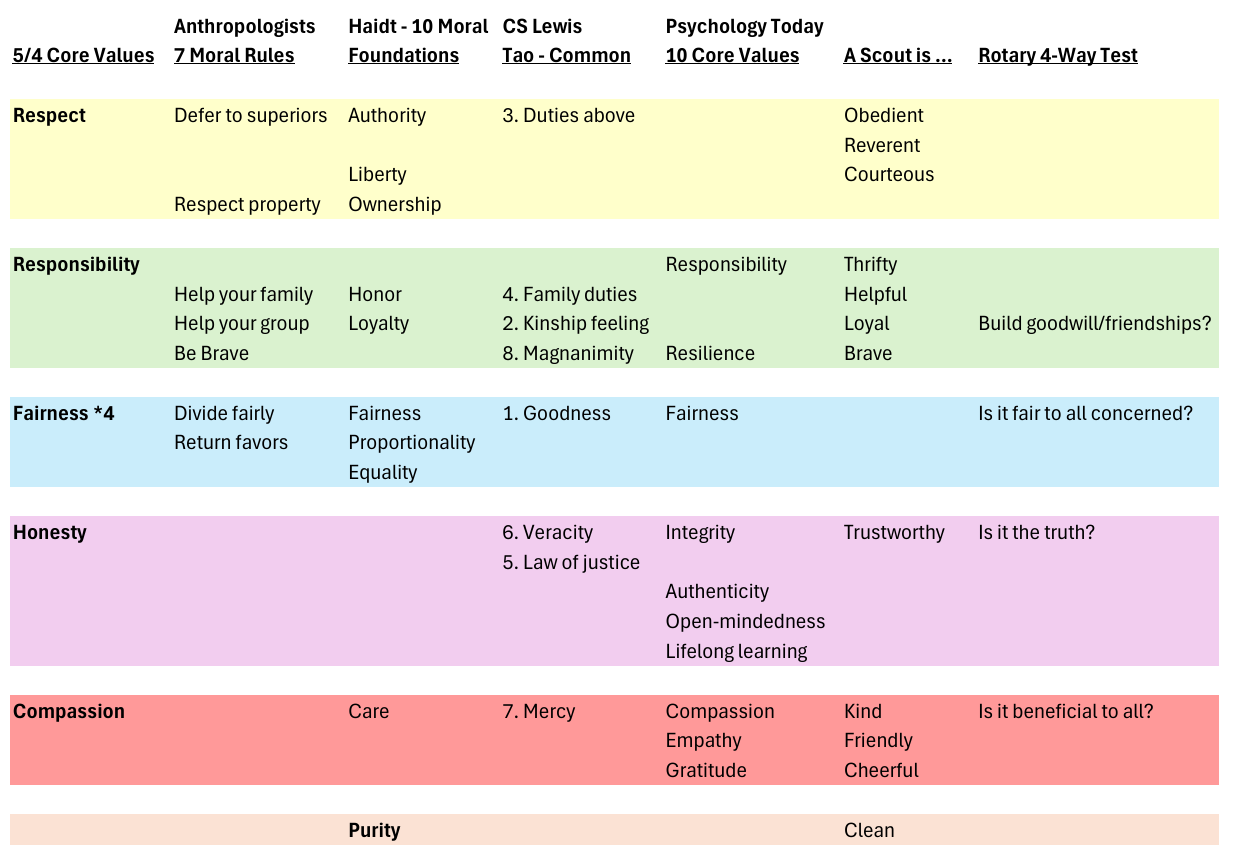
Corporate “core values” experts trying to find the essences so they can be easily taught. Anthropologists looking for the most widely seen values. The evolutionary psychologist Jonathan Haidt. Mid-century philosopher and Christian apologist C.S. Lewis claiming that all major civilizations share key ethical principles. Psychology Today advising us on how to best guide our behavior. The Boy Scout Oath. The Rotary 4-Way test.
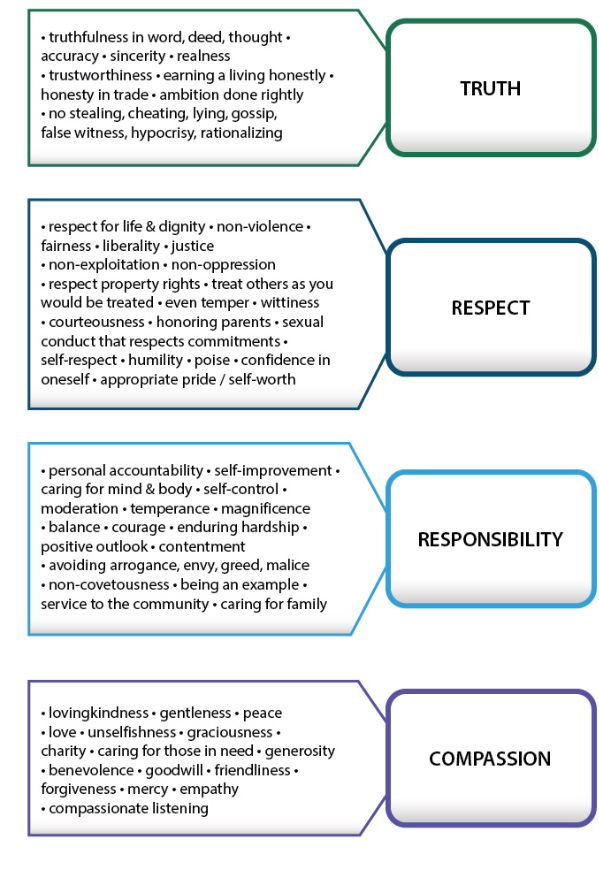
4 self-evident clusters of Respect, Responsibility, Honesty and Compassion. We know what these are. We know they are good and useful. We know that it requires work for children to learn them and for us to put them into practice consistently and effectively.
Another author calls out Fairness as a fifth cluster.
A group of Oxford anthropologists has surveyed the vast literature on cultures and identified 7 universal principles that are almost always evident and never contradicted. They begin to add some second-level definitions to the 5 clusters.
Respect is shown both by “deferring to superiors” and “respecting property”. Responsibility is shown by “helping your family”, “helping your group” and “being brave”. Fairness is exhibited by “dividing fairly” and “returning favors”. This group didn’t see honesty and compassion as universal values.
Haidt’s “The Righteous Mind” introduced the world to a set of moral flavors that varied between traditional and modern (WEIRD) societies and between left and right politicians. His team has added some flavors that have some plausible origin in the development of men from hunter-gatherers through farming and cities. For Respect, Haidt agrees that property ownership rights matter and that respect for authority is critical to holding together communities. Without it, the free rider problem undermines groups. He also argues that “liberty” is the “flip side” of authority. Individuals inherently feel the need to defend their individuality against potentially oppressive authority.
Haidt emphasizes the importance of family, kinship, honor and loyalty in traditional societies. He argues that these values are just as valid as the modern care, fairness and equality trio. He provides 3 flavors of fairness, adding proportionality and equality to the basic idea. He also skips “honesty” and emphasizes “care” as the result of compassion. He adds “Purity” as a separate factor reflecting both biological and religious forms of cleanliness for early men.
In 1943, C.S. Lewis had experienced enough modern analytic philosophy, subjectivity and intellectual progress and fired back with “The Abolition of Man”. He argued that without an objective moral framework, Western civilization was doomed. The Nazi and communist threats mattered. But the breakdown of common culture, values and beliefs within democracy was an equal threat. Lewis argued that a roughly common moral framework and principles existed in every thriving culture. His “natural law” view was not widely embraced at the time.
Lewis’s 8 components of the Tao, or “the way” fit nicely into the 5 clusters. His “duties to parents, elders and ancestors” fits with Respect. He filled out Responsibility with family duties, kinship feelings and magnanimity which emphasized the bravery of making the right decisions. His “law of general beneficence” fills out Fairness. He outlines Veracity as critical to honesty and expands it with the “Law of Justice”. He fills the Compassion group with his Mercy.
A recent Psychology Today article takes a more “personal growth” oriented view. The Respect drawer is empty, although “authenticity” could be seen as a form of self-respect. Dr. Koehler adds resilience to the Responsibility core value and includes Fairness. She adds 3 others to the Honesty cluster after Integrity. A growing individual needs to value authenticity, open-mindedness and lifelong learning. We start to see why there are differences at the second level, but I don’t think they are too great. The author embraces compassion, adding empathy and gratitude to this section.
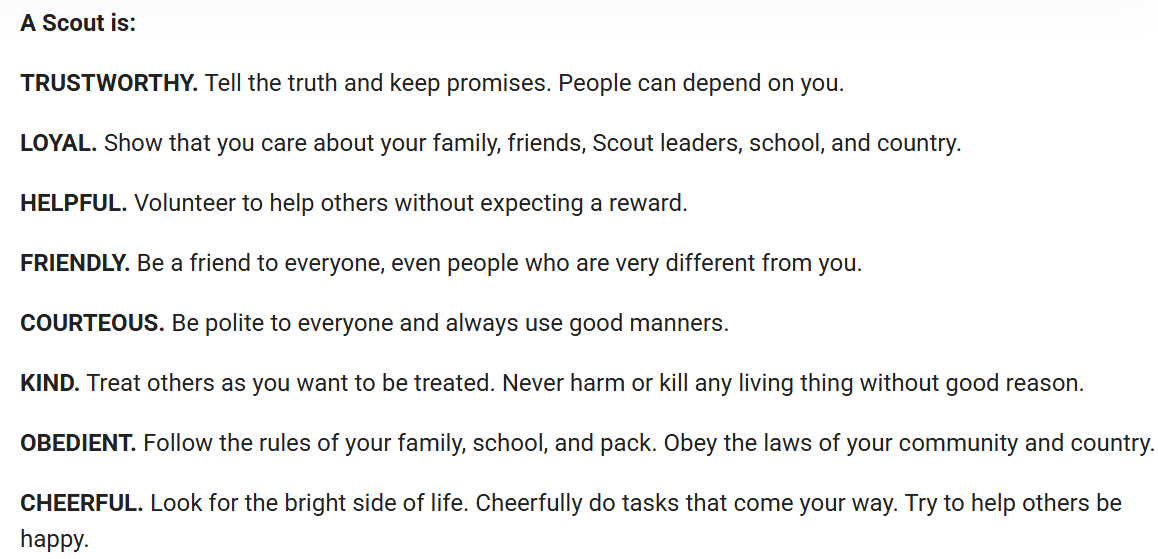
The Scout Oath was drafted in 1908. A Respectful scout is Obedient, reverent and Courteous. A Responsible scout is Thrifty, Helpful, Loyal and Brave. An Honest scout is Trustworthy. A Compassionate scout is Kind, Friendly and Cheerful. A scout is Clean.
The Rotary 4-Way test was drafted in 1932. It fits into 4 of the 5 main categories.
Summary
We have a nice head start on outlining a set of common moral principles that could be used for education, civics, personal growth and community building. The core ideas fit with traditional and modern societies, secular and religious views, left and right politics. The key, as with our political system, is to agree to work within a framework of practical application. We cannot and will not resolve deeply felt religious, philosophical and political views. But we can agree on what it takes to work together and live good lives together.
Jonathan Haidt’s “moral foundations” appear to be deeply rooted in human evolution. Democrats mostly embrace care, fairness and equality. Republicans emphasize the broader menu of loyalty, authority, purity, proportionality, honor, liberty, and ownership. Policy differences are unavoidable.
2. Citizens have differing interests/views in all 4 broad domains of international relations, economics, politics and culture.
3. The basic left/liberal/progressive versus right/conservative/traditional divide has endured for 2 centuries.
4. Social scientists agree that some form of the psychological dimension of “openness” is an important driver of left versus right political views. Individuals who are more intuitive (N)/abstract/open on the second Meyers-Briggs dimension tend to take liberal views. Those with more concrete/specific/applied views tend to be conservatives. Similarly, those who are more Judging rather than Perceiving on the 4th dimension tend to be conservatives, seeing the world in an orderly, structured manner. Meyers-Briggs (T)hinkers tend to be conservative, and (F)eelers tend to be liberal, but this is a weaker statistical link.
5. Philosophers and social scientists have worked intently for 2 centuries to find a “scientific”, objective, rational, modern view of how politics “ought” to be. Classical liberals, including Immanuel Kant and John Rawls, have proposed neutral, allegedly “value free” systems, but they have not been widely adopted.
6. Religious supporters have watched for a new “great awakening” or signs of the “end times” without success.
7. The progressive era of 1880-1920 overturned some of the political machines of the time and replaced them with scientific management style city managers and opposing political forces. “Good government” folks have since proposed and implemented city managers, commissions, outsourcing, sunset laws, zero based budgeting, process improvements and referendums but this has not removed politics from governing.
8. Philosophers have considered and combined pre-Socratic, Socratic, Neo-Platonian, Aristotelian, Augustinian, Aquinian, scholastic and modern views. They have discounted many views but not reached any true consensus on the important questions. We remain at a stalemate about the critical questions of the individual vs. community, objective vs. subjective reality, ideal/essential vs. existential/empirical world, natural and/or supernatural world, and a logical/designed vs. random/evolving world.
9. Philosophers and social scientists mostly agree that values, morality and character are inherently subjective. Some religious oriented people, philosophers and social scientists agree that a subset of core values is widely seen and shared, but this view has not gathered followers in the last half-century.
10. Classical liberals argue that the US system of democracy and representative government with “checks and balances” is fully adequate to guide society in making solid public choices. This group argues that the citizens can embrace the underlying required pluralistic political values without having to make further choices about broader cultural values. Conservatives and a growing number of moderates and liberals today complain that this approach offers a morality that is too “thin” to support a culture or a political system in the long run.
11. Perceived scarcity is not going to disappear soon, even with continued economic growth and 70 years’ worth of such predictions. Everyone remains interested in getting their fair share of the growing pie.
12. Class interests have not been destroyed. If anything, the life experiences between the top 1%, 10%, 20% and the middle 60% or the bottom 20% have diverged even further apart in the last 75 years. Although we don’t discuss “class” as an organizing principle for politics in the US, it has grown to become more important.
13. Social scientists have a much better understanding of “human nature”. We are imperfect. We have personality preferences. We can flex and learn but only so much. Nature and nurture. Tremendous potential. Education and experience are insufficient to create “perfect” citizens who can easily overcome our inherent political differences.
Despite the great progress of Western Civilization, we do not have and are very unlikely to find a single solution to our political differences. As individuals we have deeply experienced, considered and felt views of how our community should best operate. They are mutually inconsistent. We can work together to resolve some differences and agree to compromise on others. The apparently valid and opposing views don’t have an obvious resolution. I recommend that we constructively work together to find reasonable, decent compromise solutions and at the same time accept our inability to find an ideal solution without allowing that to discourage us.
From 1945 through 1985 the US economy regularly accelerated its growth, reached a peak, fell back and then recovered. Businesses, economists, politicians and the public expected that this 3-5 year business cycle would continue forever.
Looking back, it seems like the business cycle was broken by 1985. All of the subsequent downturns have been prompted by extraneous, outside of the system, shocks. In 1990 a second global oil shortage shock.
40 years without a classic business cycle recession is long enough to claim victory.
How could this happen? The independent Federal Reserve Bank has maintained a neutral monetary policy. We have not “shot ourselves in the foot” and we have implemented reasonable policies to offset external shocks. The federal government budget deficit has generally returned towards zero following depression periods. Automatic stabilizers and congressional action have addressed recessionary periods with enough stimulus to stop economic decline and restart recovery.
More importantly, the structure of the US economy has changed. The share of high fixed cost manufacturing has declined as “services” has increased as a share of the total economy. The share of international trade (imports and exports) less directly connected to the domestic economy alone, has increased. The power of labor (unionized or not) has fallen, allowing firms to reduce hours and real wages during a downturn. In most recent times, firms better recognize the cost of attracting and developing highly skilled labor in a complex production world, so they retain key staff even during downturns. Vertical integration has been reduced, allowing firms to respond to minor demand changes more effectively. Based upon the quality revolution, major firms have reset their capacity utilization targets to 80% rather than 95%, providing firms with greater flexibility in managing variable demand and not reaching the point where internal costs increase and the need to increase prices occurs.
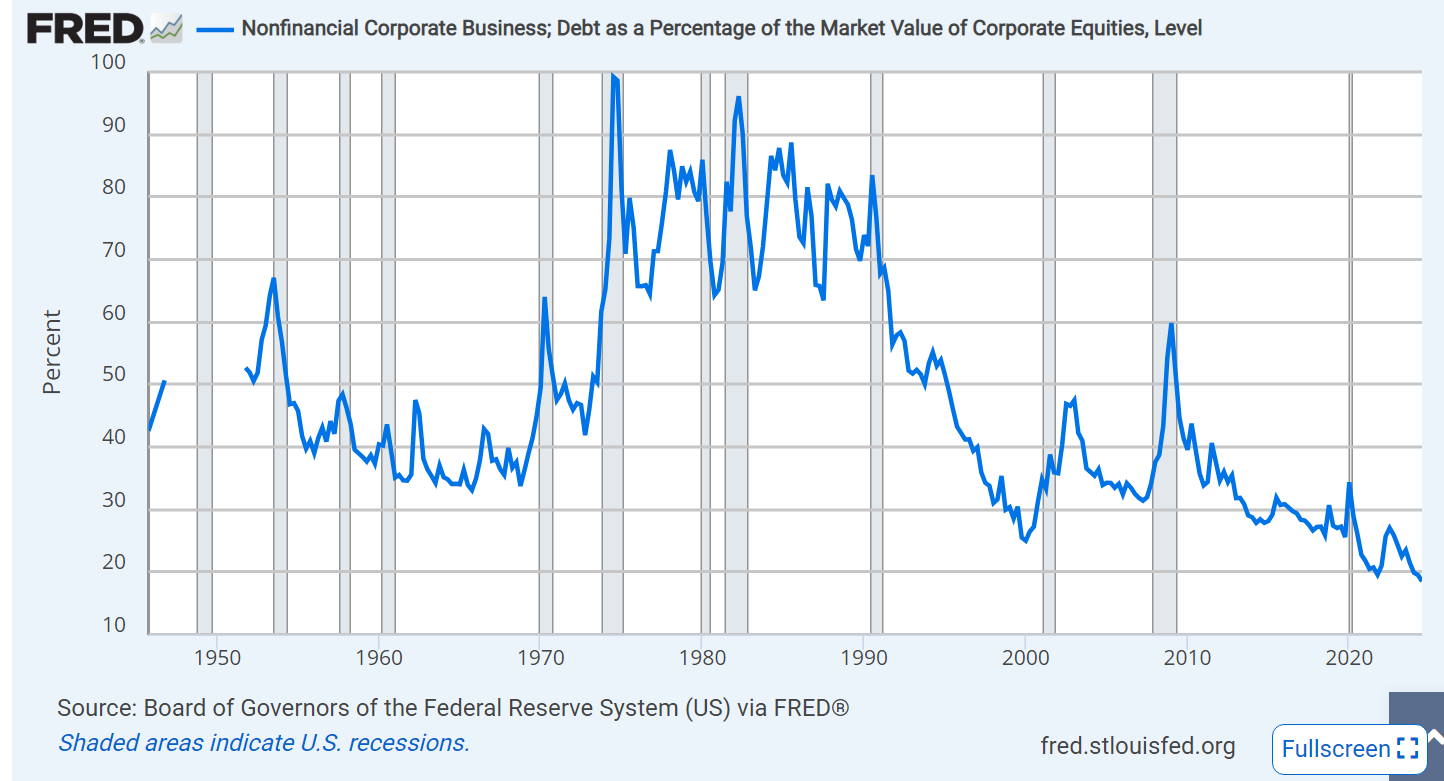
Financial leverage has also decreased. US firms have access to deep bond markets so are they able to incur only necessary levels of indebtedness.
Even with a much greater level of imported goods, retailers hold lower levels of inventory, allowing them to not overreact to changes in demand. Firms have more effective supply chain management processes.
The unemployment rate also shows this structural change. When it was pushed below 5% in the 1960’s, inflation increased and was not permanently checked for 20 years. By 2000 the economy was able to expand and keep unemployment below 5% for extended periods of time without triggering “cost-push” inflation. Unemployment still increases during an economic downturn, but low unemployment does not seem to trigger a recession.
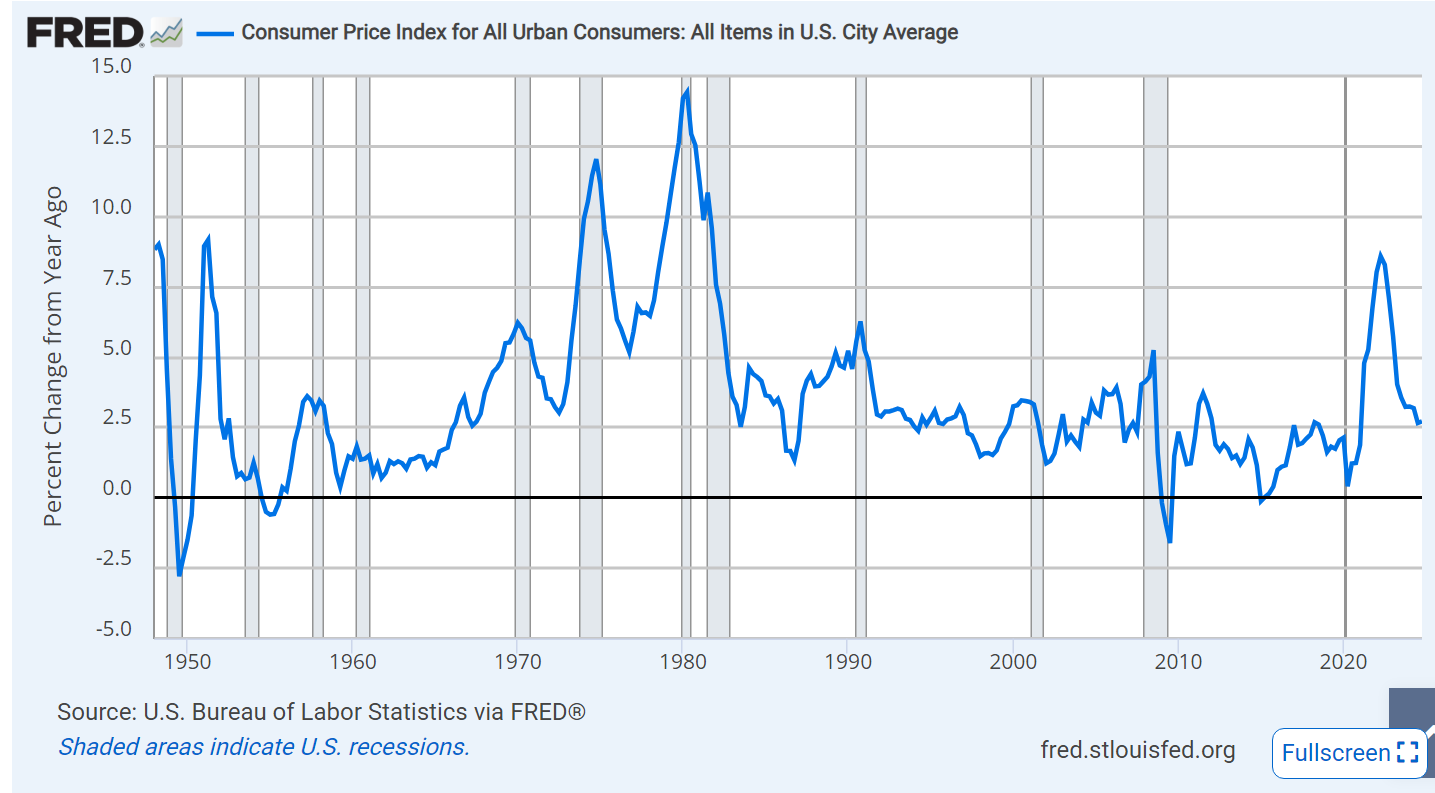
From the 1950’s through the 1980’s inflation tended to increase as the economy overheated before a reduction in credit availability would slow the overall economy. Aside from the Covid pandemic shortages, we no longer see major inflation increases.
Impact
The business cycle caused firms to underinvest because the best available forecast was always that the boom period would be interrupted in 1-5 years. Sales, margins and profits could not be assumed to increase forever.
The business cycle caused firms to follow a stop-start pattern for capital investment projects, process improvement, research & development, new product introduction, new markets, new channels and mergers & acquisitions. Seeing a downturn, firms would cancel existing initiatives, even at a significant cost, in order to conserve cash and signal to stakeholders that management was actively managing the business. Projects would slowly resume after it was clear that the business cycle recovery was under way 2 years later.
For individuals, the “last hired, first fired” cycle applied. Firms froze open position hiring. They released interns and summer workers. They prohibited overtime. They cancel contracts with temporary labor firms. Less experienced workers and minority groups suffered. Labor intensive industries, especially construction, were hard hit. Smaller firms closed. The hiring cycle would resume 2 years later.
Historically, stock market values also followed the pattern of the business cycle closely. Stock market declines were seen as an “early warning” indicator by forecasters. Since stock market values are theoretically determined by a risk-adjusted discount rate, the reduction of business cycle variability allows investors to use a lower interest/discount rate and value future earnings at a higher net present value.
Summary
The business cycle appears to be gone. The modern economy does not have the same high fixed costs it once had. Firms are able to increase their sales, profits and capacities in tandem without greatly overshooting the mark. Our national institutions help to keep growth at a sustainable level. Workers, firms, investors and society all benefit from this great advance, even if it is not publicly celebrated.
We have lost control of our political system and confidence in our institutions. I offer some root cause reasons for this situation in a series of posts. Sixth and final post in the series.
In 1943, Abraham Maslow outlined a theory of human motivation that argued that some factors are so important that they must be “satisfied” in order for individuals to pursue other human needs. “Safety and security” was the second layer, just above meeting physiological needs. When I review my first five attempts to get at the “root cause” of our challenging current situation and my remaining list of important factors, I conclude that insecurity may be THE root cause. If we are truly insecure, we will do “whatever it takes” to find security.
Let’s start at the highest level. Following the “progress” of the last 500 years, we are now expected to make important and consequential choices for ourselves in all areas of life: religion, politics, career, retirement, investing, insurance, health, recreation, leisure, marriage, parenting, sexuality, personal finance, consumption, travel, experiences, education, goals, personal expression, arts, branding, friends, community, communications, entertainment, media, social networks, privacy, tolerance, philosophy, clothing, transportation, food, hobbies, housing, banking, OMG! Today, we also have many more options within each category. We have better information and tools, but conflicting priority perspectives and uncertainty about how to find shortcuts. In total, we’re overwhelmed with no solution in sight [maybe AI]. This ongoing situation undercuts any basis for feeling deep security.
Science
Think of science as an expanding sphere or globe. The more we know, the more there is to add to our knowledge. By 1800, we had reached the limit of any man or woman “knowing everything”.
This does not trouble most people directly. Scientific advances since 1800 are estimated to have doubled every 15 years. That’s 15 more doublings or 32,768 times more knowledge since we first reached the limits of human understanding! Implicitly, this must trouble most people greatly. We are overwhelmed by a complex world that we cannot comprehend.
So … science provides us with better understanding and tools. It provides structure and some certainty. It also provides unexpected uncertainty. Modern science bears little resemblance to Newtonian classical mechanics. It is all probability, complexity, and unavoidable uncertainty. About one-third of high school students complete a basic physics course. Perhaps 5% of Americans complete a single college physics course. We tend to think of the world in simple, materialist terms, but scientists since Einstein’s 1910 results do not support this world view. We want certainty, but scientists no longer provide it.
War, pandemics, plague, nuclear war, food shortages, water pollution, air pollution, food processing contamination, cancer, thalidomide, vaccines, hexavalent chromium, sarin gas, fluoride, extinctions, global warming, sea level rise, climate extremes, solar flares, electrical outages, runaway thermonuclear reactions, ozone layer thinning, acid rain, global government agencies, multinational corporations, non-governmental organizations. So many threats, highlighted by the media and various interest groups. Great uncertainty for all.
Economic Life
Economic scale grows. Specialization increases. Everyone must engage with the system. We all become cogs in the machine. We are dehumanized.
Economic stability is weak. Greater economic competition and change. International competition. Loss of large company support for employees. Increased technological changes and disruptions. Administrative, engineering, process and legal changes. Regulatory changes.
Corporate competition. Mergers & acquisitions. Outsourcing. Work automation and obsolescence. Job insecurity.
Weakened effective safety net from government.
Meritocracy focuses the minds of parents, children and adults on careers only. We worry.
Consolidation of income and wealth leading to further power consolidation through economic, social and political channels.
Increased financial leverage through availability of credit. More individuals have high fixed payment requirements and the risk of bankruptcy in hard times.
Capitalism continues to offer diverse goods and services to meet every need and desire. The commercial mindset pervades society.
Technological innovation offers an unlimited supply of new goods and services.
Personal Life
We have generally embraced Rousseau’s perspective on life. Each individual is born with infinite potential. Our job is to help each child achieve their potential and destiny, leveraging their talents. They have the capacity to “be, all that you can be”. Unfortunately, the individual needs to be validated by someone. They don’t have direct access to a transcendent religion or philosophy or community. Hence, they have to reach out to “society” for validation. They create a personal brand. They gain clicks. It is never enough. They are insecure.
Philosophy
We live in a secular age where all belief is insecure.
We have a great diversity of theological and experiential religious perspectives. This helps some and undermines faith for many others.
Western society has considered “progress” as a substitute for religion for 4 centuries. The economic, political, scientific, and communications advances provide a background for the belief that there is a “pattern” to history and it is inevitably heading in the right direction. The backlash in the 20th century has been strong based upon the world wars, Great Depression and the horrors of totalitarianism and technology.
We experienced some return to faith in progress in the post – WW II period and at the end of the Cold War. However, “the end of history” marked by the permanent victory of democracy, capitalism and globalism was very short-lived.
Politics
Our political parties are fluid. The civil rights act of 1964 shattered the Democratic party. The Vietnam War, riots, the counterculture and Kent State shootings reoriented the parties. By 1981 Reagan consolidated conservatives of national, Main Street, Wall Street, philosophy. libertarianism, religious, cultural, and international flavors to form a new enduring majority to replace the previous FDR majority. By 1994 Newt Gingrich installed an oppositional view against President Clinton. The polarization of politics grew from there. A black and white, right versus wrong, good versus evil view grew upon the singular yardstick of left versus right, conservative versus liberal. The mass media splintered into politicized pundits. Politicians embraced a world where perception is reality. The ends soon justified the means. A simple “red versus blue” perspective was promoted and adopted. Civility, trust, consensus, reason, fairness, tradition, and the American way declined. The 2008 mortgage debt meltdown created the populist “tea party”. The Republican party absorbed this populist group and revised its policies, accelerating towards populist and nationalist views with candidate Trump in 2016. Some citizens find security in their political party, but a vast majority decry the polarized situation.
Culture
The majority of cultures through time and around the world have been “traditional”. European civilization since 1700 is the outlier, deemed WEIRD by Johnathan Haidt. Western, educated, industrialized, rich and democratic. Traditional cultures emphasize group-oriented loyalty, authority and sanctity more than the individual-oriented care and fairness factors.
During the 18th, 19th and first half of the 20th centuries, the common Christian cultural background allowed European and American societies to explore and embrace this individualistic dimension without abandoning the group-oriented values, traditions or Christianity. After WWII and especially after the countercultural 1960’s, the loose consensus on culture has been shattered. Many historical norms have been challenged or overturned in the areas of marriage, sexuality, gender, race, parenting, government authority, male authority, church authority, institutional authority, music, art, drugs, religious belief, history, tolerance, human rights, life, relativism, subjectivism and objective morality. The cultural changes were broad, deep and disorienting. They have been celebrated, accepted or opposed. Culture, religion and politics have become aligned in a secular versus religious, liberal versus conservative, traditional versus modern/postmodern way.
We have multiple cultures based on this major split, but also based upon age, social/professional class, and geography (rural/urban/suburban) (coastal, Midwest, Sunbelt). Some people find security in their smaller culture. Many are disoriented by the multiple options and the conflicts between the cultures. Modern media capabilities allow us to live in isolated ways or to engage in fighting to promote our culture and oppose other cultures.
The changes since WWII have reduced our participation in communities of all types while increasing our focus on the individual. Many people no longer have the support of meaningful community ties.
Modern man is surrounded by uncertainty as he is forced to make more decisions in more areas with more choices than ever before. Most of us try to ignore the surrounding forces and live our lives day to day as best as we can. We implicitly adopt some kind of philosophy of life. We stay busy. We pursue goals. We consider the changes in our worlds. But the underlying tensions make life difficult. Economic and personal striving are a cultural norm. Polarized politics is hard to avoid. It’s difficult to relax, center and fully engage in life. We treasurer peace and certainty. We’re still looking for answers that work well in a world filled with options and choices.
The US imports and exports about 1/8th (12%) of its Gross Domestic Product. Argentina, Brazil and Pakistan have a similar level of trade to GDP. China and Russia are closer to 1/5th (20%). The world imports and exports 30% of it’s GDP. European countries import and export 45% of GDP. The US is the most self-sufficient country in the world. It imports select commodities, labor intensive goods and luxury products. It exports high value-added goods and services supported by its high value-added and compensated workforce. As the US president threatens the large benefits of global trade to the US and the world, it’s very important to place the US within this context. U.S. trade may be less advantageous than someone’s vision of ideal, but based on size alone, international trade is clearly not a first-class priority for the country, its firms or citizens.
We have lost control of our political system and confidence in our institutions. I offer some root cause reasons for this situation in a series of posts. Fourth post in the series.
Classic liberal state, individual rights, liberty, freedom, fairness, justice
No era of human history has been perfect but “Western civilization” experienced net cumulative progress in its self-understanding, capabilities, confidence, positivity, justice and use of effective institutions for several centuries.
History Undermining Total Confidence in Any Single, Simple Cultural, Religious or Political Worldview
Natural disasters, plagues, wars, evil and oppression.
Religious conflicts, denominations, global religions, secular humanism, Deism, institutional failures.
Promise and obvious experienced shortcomings of utopian solutions such as socialism, communism, fascism, globalism, romanticism, environmentalism, and eugenics.
Rise of the modern nation state as an effective context for community, government, commerce, loyalty and security, followed by its totalitarian abuse, demonization of others and splintering into smaller geographic, religious and ethnic states.
The amazing, sustained progress of science and technology to “solve” all problems, followed by the realization that it cannot solve moral, political and social problems and that it creates many new ethical, commercial, and political challenges.
The sustained global economic progress driven by urbanization, industrialization, finance, administration, capitalism, government regulation and trade raising living standards, offering opportunity, improving health and reducing poverty, without reaching a clear consensus on how to capture the benefits of economic progress without being overwhelmed by the exploitative, unequal, monopolistic, political capture, environmental and cultural downsides.
The shock of the Great Depression and the 2 world wars to the popular, business and elite confidence that economic, social, global, military, political, educational, scientific and cultural progress was inevitable. The global successes of the post-war era and the collapse of the Soviet Union provided a very brief renewal in faith in progress and “the end of history”.
Philosophy worked very hard to keep up with the progress of science but has ultimately failed. Most of philosophy has been absorbed by science and social science. It provided some support for modern religion, science, arts and politics in the early modern period. It also offered deep skepticism about religion, objectivity, causality, and language. It didn’t solve “nature versus nurture”. It didn’t resolve idealism, essentialism, rationalism versus empiricism, pragmatism, existentialism. It provided us with several flavors of individualism, including Rousseau’s positive view of man outside of society. It served up Hegel’s historical/dynamic view, Marx’s insights and nonsense, Nietzsche’s replacement of God with Superman and the final retreat to logical positivism, materialism and postmodernism.
The expansion of individual rights has been a signature strength of the last 500 years. The true essential equality of individuals is broadly embraced. Race, gender, ethnicity, religion, class, social status, wealth, property, profession, sexuality, customs, appearance, and education are generally respected. Yet, we humans discriminate and prejudge upon such categories. Efforts by idealistic and minority groups to offset such shortcomings are hotly contested.
Major Options Today
Religious belief. The default secular worldview limits this approach to understanding the world and making important choices. Fundamentalist right to progressive left.
Personal growth. Design your life and your children’s lives to “be all that you can be”. You will have to look outside for validation of your progress. You may not find guidance by looking inward. You may find that you need community and links to eternity and the universe.
Libertarianism. Free market capitalism. Anti-government. Liberty. Freedom. Ayn Rand, Milton Friedman, Friedrich Hayek, and Ludwig von Mises developed a positive version of this worldview. It is embraced by a large share of the Republican party today. It is fundamentally anti-community and anti-religion. It elevates a single dimension of philosophy and morality above all others: economic liberty.
Populism. The “little guy” is exploited by “the elites”. A victim perspective. Farmers, peasants, factory workers, and small business owners take this perspective. In our individualistic, opportunistic, competitive, meritocratic, commercial, secular world all people need to justify their progress. We all “know” that we are “above average”, like the inhabitants of Garrison Keillor’s Lake Wobegon. If we don’t reach our goals, someone or something else must be to blame.
Authoritarianism. The world is too complex. We need a “great leader”.
Postmodernism. The powerful use every possible tool to oppress others. All minority groups are victims of the “ruling class”. Most modern philosophies, institutions and language are tools. Enlightened professors in the humanities and social sciences are waiting to lead the next revolution.
The Center Remains Missing
The Republican party has moved far right, embracing libertarianism, free markets, cultural conservatism and populism. The Democratic party and other cultural elites have been tempted by postmodernism, expected demographic trends and special interest groups. They have failed to provide a compelling mainstream alternative to the Republican party since Reagan and Gingrich. Socialists like Bernie Sanders, Elizabeth Warren and Alexandria Ocasio-Cortez win headlines. Democrats have consistently lost the framing battle, competing on shifting terms favorable to Republicans. They have failed to find a positive core message like opportunity, progress, pluralism, balance, rule of law, will of the people, decency, justice, reasonable fairness, shared winnings, sustained growth, win/win, security, or mutual interests.
I would also argue that a simple proposal to maintain the benefits of our historical political systems could be compelling and adequate for a supermajority of citizens and voters.
I return to Jonathan Haidt’s work on the moral foundations of politics and religion. The BIG change in human history is from a broad portfolio of factors in most historical and global societies to the WEIRD perspectives supported in part of the Western world: care, fairness and equality alone. “Liberals” now mostly ignore loyalty, authority, purity, proportionality, liberty, honor and ownership while “conservatives” wisely appeal to all of these moral flavors.
Western civilization has embraced rationality, science, and individualism. It has gone too far, forgetting about community and eternity/universality. Skepticism has grown as we have learned that no single, simple perspective is adequate to explain our world. There is now a risk that we reject all structured knowledge. There is also a risk that we embrace intuitive world views and leave rationality and criticism behind. The Republican party has managed to keep the various flavors of conservatism aligned in a far-right view. Democrats are unable to offer a compelling alternative to the general public.