The Power of Civility

Background

Civility is a set of behaviors that recognizes differences and builds mutual respect: self-awareness, self-management, social awareness, relationship management, communications, growth and problem solving.

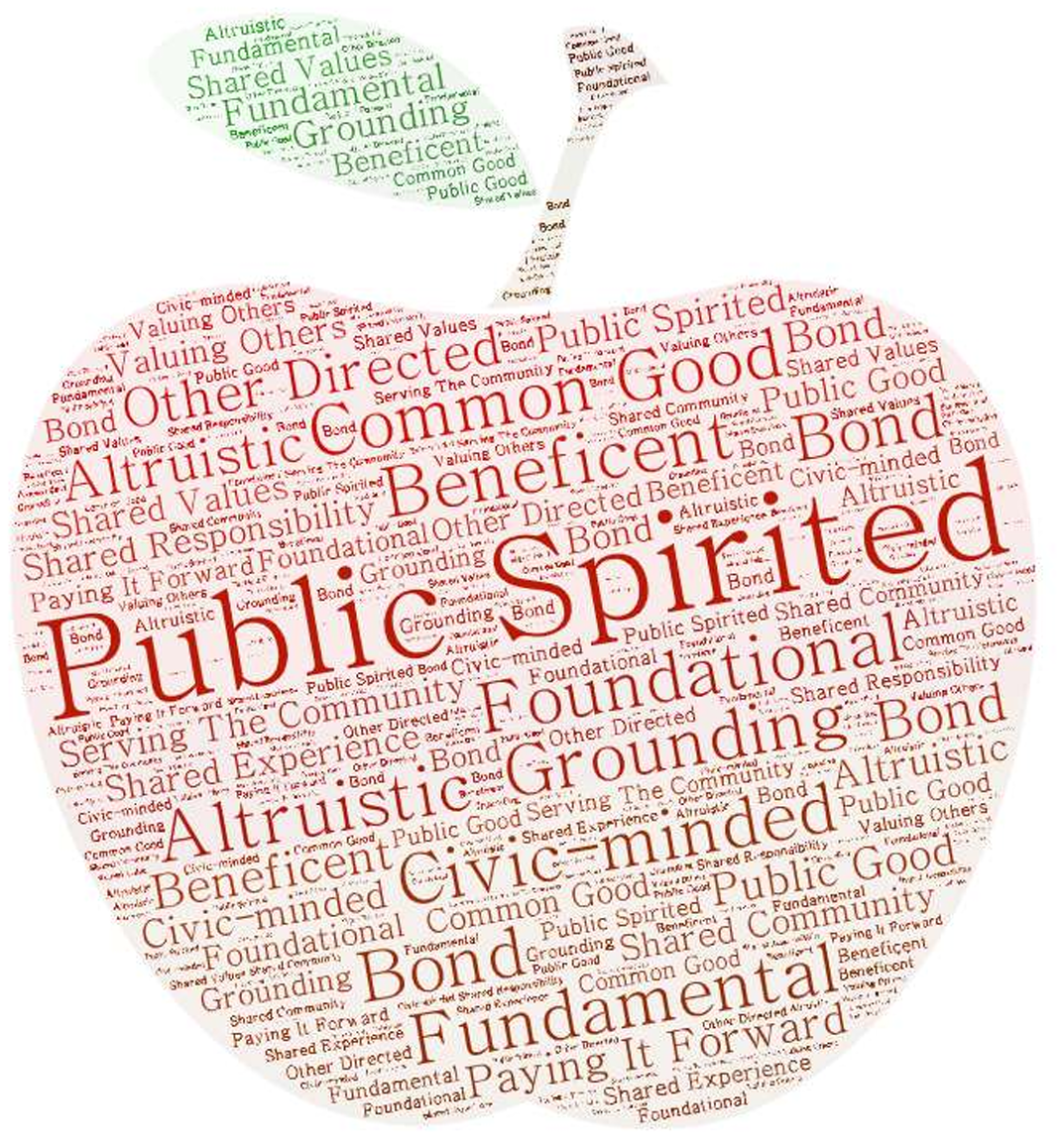
It is based on 7 nonpartisan values: human dignity, respect, acceptance, responsibility, intentionality, constructiveness and public-spiritedness.

Civility is required for a representative democracy to thrive. Citizens must practice and embrace these habitual behaviors. Social norms must press individuals to adopt these beliefs and improve their behaviors, despite the call of opposing forces.

Civility has declined in the United States of America since the 1960’s cultural revolution and the 1980’s Reagan revolution. Individualism has ascended [perhaps too far]. Religion and culture have lost influence. Many today are working to rekindle Civility as a core set of values and behaviors necessary for a society of free individuals to succeed.

In broad terms, I have identified 6 threats to our society. I’d like to outline how Civility can be used to address these challenges. Civility alone cannot save our society, but it has the ability to prevent us from spiraling down in a vicious cycle. Civility has the ability to trigger a virtuous cycle. It is a catalyzing and leveraging force.

Radical Individualism

Radical individualism dispenses with community, society, religion, morality and philosophy. ONLY the individual now matters. Many of us have unintentionally adopted this faulty worldview: in whole or in part.

Civility begins with the claim that every person possesses INFINITE human dignity.

This is an individualistic start. But it is paired with the logical complements of respect and acceptance. If I have infinite human dignity, then all others must also have infinite human dignity. They MUST be respected. They MUST be accepted. They are not perfect, faultless, better or good. But they have the same potential for good and excellence that I enjoy.

This insight requires me to try to be self-aware, to manage myself, to be aware of others and to responsibly and intentionally manage my relationships with others. “I’m OK, You’re OK”.

https://en.wikipedia.org/wiki/I%27m_OK_%E2%80%93_You%27re_OK

Civility calls on us to be positive and constructive, not as a weak Pollyanna view but as individuals who are hopeful, who seek to find the greatest possible results.

Civility embraces public-spiritedness. It acknowledges that we live in community at all times and are responsible to consider our community obligations. We are not called to blindly accept community views, norms or decisions. But we always consider our civic and community duties and responsibilities.

Human Nature

Humans are never satisfied with what they have. We compare themselves to others and come up short. Our logical reasoning is imperfect. We focus on losses, the short-term, concrete items and anchors.

Civility accepts our weaknesses. It encourages us to look outwards to our neighbors to really evaluate ourselves. It promotes the “rough and tumble” of interpersonal engagement in informal and formal life. Civility guides us to be self-aware and self-managing. Civility recognizes that personal growth is an ongoing process. We cannot simply digest best practices intellectually; we must experience them.

Skepticism

Healthy scientific skepticism is fine. Unfortunately, we have often come to reject everyone and every fixed idea. Political polarization has undermined any sense of the “common good” or objective reality.

Civility embraces positivity and constructiveness. We should always pursue and consider positive opportunities.

Responsibility and intentionality require us to step above the situation and assess it objectively. We cannot take the shortcut of simplistic naive kneejerk skepticism.

Civility embraces modern behavioral and cognitive science. It uses rational modern decision-making tools. We have much stronger insights into true human nature. It is imperfect but we are better positioned to purposely lead great lives.

Despite the intellectual attraction of skepticism, America has prospered economically for 250 years. It has demonstrated that a democratic republic can succeed. The US has overcome two world wars, the Great Depression, the Vietnam War, the cultural revolution of the 1960’s, the Cold War, the Great Recession, the Covid pandemic and populism.

Religion has not died. Utilitarianism is barely remembered. Atheism is mostly rejected. Simplistic philosophies are inadequate. Scientific progress marches forward. Pure scientific rationalism loses support as a philosophy of life. Nietzsche and existentialism forced men to face the prospect of meaninglessness and we have survived. Self-awareness and social awareness help us to understand the complexity, contradictions, inconsistencies and mysteries of real life.

Imperfect Myths

Modern worldviews generally fail to replace the peace and answers of the ideals of Christendom. Civility offers a set of values and behaviors that support the practical operation of modern life with its greatly enhanced diversity.

Civility supports the 4 deep challenges of: facing death, finding a purpose beyond self, being affirmed and living as a social being in community. The commitment to human dignity, respect and acceptance help with the need to be affirmed. I’m OK, You’re OK. Civility promotes the social, interactive, growing, dynamic person. It offers a safe environment where individuals can pursue religious perspectives. It emphasizes the role that the “other” can play in personal growth.

Civility does NOT replace any of the religious, historical, cultural and national myths that have addressed human needs in the past. Civility is a set of values and behaviors that allows for constructive interactions in all areas and levels of society despite our differences. It does not choose sides in religious, political and philosophical debates. It is a necessary, but insufficient basis for modern life.

Our Secular Age

Civility accepts that we cannot easily find final deterministic solutions to the great questions of life. We have experienced 600 years of modernity without finding rational, objective, scientific, secular answers. Civility provides a social platform that supports religious belief. It supports debate on difficult subjects. It focuses on how we can live together, accept and overcome our real differences.

Our Secular Age is one in which the biggest questions – about God, man and meaning – don’t have consensus answers. No single denomination or ecumenical group holds a dominant worldview. Atheists, agnostics and “none of the above’s” are a large and fast-growing group, especially among younger age cohorts.

The loss of certainty creates existential angst for citizens. Civility responds with “human dignity” as a core belief that elevates individuals and the human condition to something of importance, a matter of ultimate concern for all. Civility offers “acceptance” as a central value, acknowledging that different backgrounds, experiences and beliefs are to be expected and welcomed. Civility encourages a positive, constructive approach to our lack of consensus on political, religious and philosophical topics. Civility promotes the virtues of responsibility, respect and initiative as tools for the required interactions with others – on topics large and small.

Finally, Civility focuses on behaviors, habits and norms of practical interaction as being most effective in living actual lives in a Secular Age. The Protestant Reformation triggered centuries of religious conflict. The principles of Civility were used to heal this divide and can apply to our differences today.

Insecurity

Modern man is surrounded by uncertainty as he is forced to make more decisions in more areas with more choices than ever before. Most of us try to ignore the surrounding forces and live our lives day to day as best as we can. We implicitly adopt some kind of philosophy of life. We stay busy. We pursue goals. We consider the changes in our worlds. But the underlying tensions make life difficult. Economic and personal striving are a cultural norm. Polarized politics is hard to avoid. It’s difficult to relax, center and fully engage in life. We treasure peace and certainty. We’re still looking for answers that work well in a world filled with options and choices.

Civility’s focus on human dignity, respect and acceptance of each person and others serves to build a strong sense of self-worth. The self-awareness and self-management skills reinforce this central validation of each person.

The values of responsibility, intentionality and constructiveness reinforce the solid self with positive real-world experience and reinforcement. The social awareness, communications and relationship management skills operationalize this good intent.

Collectively, the Civility values and behaviors provide personal assets to be successful in a challenging world. They address the need for frequent interactions with “others”. They provide confidence that individuals have the capabilities and experience to thrive in difficult situations because they have managed them before.

Summary

Civilization and daily life are guided by unspoken norms and beliefs. We have experienced significant changes in the past century that undermined the consensus view and now requires individuals to consciously consider a greater share of their daily lives. We have not reached a new consensus and may not do so anytime soon. As we work through these differences we need to reinvest in Civility skills, habits and understanding. Civility helps us individually, in groups and as a society to interact effectively despite our differences. We don’t need perfection or infinite improvement, but we need to invest in Civility and use its power as a self-reinforcing system or virtuous cycle to guide us into the future.
Civility is Really About 7 Behaviors

Summary

Civility is a set of behaviors that recognizes differences and builds mutual respect.

  1. Self-awareness
  2. Self-management
  3. Social awareness
  4. Relationship management
  5. Communications
  6. Growth
  7. Problem-solving

Self-Awareness

Emotional Awareness – Identifying and understanding our emotions and their impact on our thoughts, behaviors, and others.
Accurate Self-assessment – Clearly understanding personal strengths and limitations without self-criticism or inflated self-perception.
Self-confidence – Firmly believing in one’s abilities, talents, and judgement.
Self-respect – Properly regarding and caring for the dignity of one’s person and character.
Authenticity – Acting in accordance with one’s true self, values and beliefs.

Self-Management

Emotional Self-control – Managing and regulating one’s emotional responses, preventing impulsive reactions.
Adaptability – Flexibly and efficiently learning and applying that knowledge across situations.
Achievement Motivation – Orientation towards success, mastery, and sense of purpose.
Initiative – Recognizing needs, taking action, and pursuing outcomes without waiting for direction.
Optimism – A mental attitude characterized by a positive outlook and expectations of favorable outcomes.
Apologizing – Acknowledging errors and guilt, expressing regret, repenting, asking for forgiveness.
Trustworthiness – Demonstrating credibility, reliability and intimacy buffered from self-interest.
Resilience – Bouncing back from adversity with flexibility & strength, maintaining wellbeing despite challenges.

Social Awareness

Empathy – Understanding what other people feel, seeing their point of view, and imagining yourself in their place.

Organizational Awareness – Interpreting a group’s emotional state, relationship dynamics and power structures.

Service Orientation – Willingly anticipating, recognizing, and meeting others’ needs,  before they are articulated.

Perspective Taking – Considering others’ thoughts, feelings, intentions, and motivations in a particular situation.

Cultural Awareness – Recognizing the different beliefs, values, and customs of someone based on their origins.

Relationship Management

Influence – Capacity to affect the character, development, or behavior of another person, group, or organization.

Conflict Management – Process by which disputes are resolved,  negative results are minimized and positive results are prioritized.

Teamwork and Collaboration – Combined effort of a group of people working together towards a common goal or objective.

Inspirational Leadership – Inspiring and guiding people to get the job done, to bring out their best.

Change Management – Providing approaches, tools, and techniques to achieve a desired future state.

Collaboration Tools – Offering any technology or tool that can be used to help people to better work together.

Meeting Management – Organizing and facilitating meetings to ensure productivity and alignment.

Project Management – Planning, organizing, and executing tasks to create a tangible product, service, or deliverable.

Communications

Commonality – Finding and emphasizing common interests, perspectives and experiences.

Be Patient – Encouraging others to speak, not interrupting them.

Overall Awareness – Paying attention to non-verbal cues, overall message of speakers.

Recognize/Validate Others – Listening, remembering and using names, acknowledging others’ views and emotions.

Mirror Communications – Confirming listening by restating what you heard in your own words.

Speak Kindly – Using words that are neutral or supportive, not attacking others.

Understand – Asking questions, clarifying, seeking first to understand, not to reply.

Manage Praise – Giving and receiving praise for communications, actions, intentions and results, when appropriate.

Defend Properly – Defining boundaries, expressing views in “I” statements, not overreaching.

Solve the Problem – Focusing on issues, not people.

Electronic Communications – Effective email and social media communications.

Growth

Experiential Learning – Benefiting from the experience and natural results of participating in civil processes.
Continuous Improvement – Maintaining newly developed skills and skill levels with support from civil colleagues.
Embracing Feedback – Encouraging honest feedback provides opportunities for personal growth.
New Perspectives – Gaining new approaches, viewpoints and paradigms from interacting with others.
Higher Expectations – Improving goals and behaviors in response to the expectations/norms of others.
Confidence – Using civil processes to address and resolve difficult situations builds personal and process confidence.
Broadly Applying Skills – Trying, testing and using civility skills in all domains of life.
Modelling Behaviors – Practicing civility skills helps to teach, influence and inspire others.
Developing Others – Recognizing and nurturing potential in others through encouragement and honest feedback.

Problem-Solving

Analytical Tools – Critical thinking, decision making, game theory, finance, economics and operations management.

Creative Thinking – Thinking about a task or a problem in a new or different way, or generate new ideas.

Strategic Thinking – Intentionally and logically making organization level decisions with long-term impacts. 

Organizational Design – Improving an organization’s effectiveness and performance.

Organizational Development – Structuring an organization to align with its strategic goals and objectives.

Systems Thinking – Cognitive skill and a way of understanding reality that emphasizes the whole rather than the sum of its parts.

Process Engineering – Approach to designing, analyzing, and optimizing steps to produce a consistent, repeatable outcome. 

Public Administration – Coordination of government activities to ensure the effective delivery of services and the application of laws.

Summary

We have lost our commitment to civility in our interactions with each other in the last 50 years. On the other hand, we understand exactly how and why we should act civilly. We can learn about acting civilly within all of our institutions, setting aside our political differences. The behavioral sciences have clearly described the practice of civility. We now have the ability to learn and sharpen our civility skills. We must implement this training for our children and our fellow citizens.

Civility Today Index

https://www.presidentialscholars.org/notable-scholars-1/2015/8/27/mitch-daniels-1967-scholar

Former Indiana governor and Purdue University president Mitch Daniels provides us with a model of civility in his public life, as we have seen from many American political leaders.

https://en.wikipedia.org/wiki/Mitch_Daniels

Current Articles

The articles below describe current attempts to define and promote civility.

Related Topics

Civility Hope and Solutions: Index

Civility and Politics: Index

Political Differences are Eternal; What Do We Do?

Polarization

Moral Foundations Theory: We’re All Righteous

Classic Liberalism, The End of History, New Conflicts

Civility Perspective

Civility Solutions

Causes of the Decline in Civility: Index

https://www.practicalrecovery.com/balancing-individual-and-community-needs-in-addiction/

Inspiring Civility

https://www.cml.org/home/topics-key-issues/civility-starts-here

Our Situation

The practice of civility is declining. But we must be hopeful! The grass roots counter-revolution to rebuild Civility has begun. We must not be discouraged. The United States started 250 years ago as an experiment in representative democracy based on universal ideals. It has succeeded against long odds. At the 1787 constitutional convention, Ben Franklin was asked what form of government was being formed. He replied, “a republic, if you can keep it”. In 1852 as the nation battled over slavery and “states’ rights”, Wendell Phillips noted that “eternal vigilance is the price of liberty”.

The US was formed after religious wars had ripped Europe apart and the central rule of kings, landed wealth, nobles and state churches proved inadequate to the challenges and aspirations of modern men and women. It was founded on new principles of individual rights and limited central power. It was not based on history, religion, military power, race, soil, elites, class or wealth. This abstract foundation has been a great asset through time, but it requires citizens to understand and fill their key roles.

Christianity, western culture, New England myths, cultural and educational institutions, patriotism, American exceptionalism, local governments, inertia, mass media and public intellectuals all encouraged Americans to fulfill their citizenship duties: to vote, monitor politics, set and enforce candidate expectations, uphold the constitution and rule of law, obey the laws, pay taxes, serve in the military, sacrifice for the nation, serve on juries, and conduct themselves in a Civil manner.

The cultural revolution of the 1960’s and the Reagan revolution of the 1980’s undercut these forces. Each individual was encouraged to think and act for himself. Individuals welcomed the new freedom to “express yourself”. Civic duties and civility declined through time. Left and right argued about the causes of the very apparent decay of civilization but no new solutions or Civility norms emerged.

Cole Porter’s 1934 “Anything Goes” viewpoint ruled. If we couldn’t agree on political issues, then we could at least agree to be tolerant of all different viewpoints. This was the modern way. Liberals elevated “tolerance” to become a supreme virtue. Liberal intellectuals confirmed that no central values, virtues, character or opinions were needed to support the political state. The fear of conservative, religious, or wealthy domination of culture, economics and politics reinforced this position. Main Street and Wall Street conservatives accepted the more socially moderate/liberal positions of the modern world. They celebrated economic growth, capitalism and the consumer society.

Philosophical and religious conservatives disagreed. The perceived slide towards tolerance, radical subjectivity and atheism was unacceptable. Social and religious conservatives doubled down on traditional views. They became more radical and non-tolerant. They embraced and then captured the Republican party. Small town, rural, working class, economically at-risk Americans saw a meritocratic, global, elitist nation that conspired against their interests. They also embraced the Republican party as the Democratic party proclaimed universal values and prioritized new special interests.

In 1990 Newt Gingrich demonstrated that polarized politics was very effective in the modern age. Bill Clinton and Barrack Obama tried to find a “third way” to triangulate and recapture the center but while they could win elections, they could not really change the polarized culture. Donald Trump embraced the polarized model with great success. The need for “Civility” was not part of his world view. Many in this newly defined party agreed with his win/lose, realpolitik, scorched earth view of politics.

Despite this political situation, most Americans continue to believe in civility. The threats to our system have prompted many people to become more active in politics and to support the core values and behaviors of Civility.

Inspired Civility

The counter-revolution to restore Civility as a core American value and set of behaviors is now well under way. Will it work? Why will it work?

Civility is a set of behaviors that recognizes differences and builds mutual respect. Civility is based upon the 7 commonly held values of human dignity, respect, accepting others, responsibility, public spirit, intentionality and constructiveness.

Civility is a social norm that influences behavior. It is a set of practices, skills, habits and behaviors. Civility requires self-awareness, self-management, social awareness and relationship management skills. It also requires communications, personal growth and problem-solving skills. This is a very heavy package of skills requiring a lifetime of personal investments. Yet, it is required for our representative democracy. Why would any individual choose to make this investment?

Passionate Humans

1 Corinthians 13. If I speak in tongues of men or angels, but do not have love, I am only a resounding gong or a clanging symbol.

Civility as a purely abstract, technical, secular, efficient, professional, dry, thin concept cannot win in the modern world. Civility must spring from the hearts of men and women. The values, education, steps, content and behavior of Civility alone are simply not enough. What will attract and engage modern individuals into making Civility a passionate priority? Why will the Civility counter-revolution win?

Humans are motivated by self-interest and specific situations but mainly by a passionate sense of duty.

Self-interest

In modern America, self-interest may be first!

  1. Personal benefits

Practicing Civility provides 15 benefits, primarily improved communications and conflict resolution skills, better personal and professional relations and personal well-being.

2. Personal growth. Civility’s focus on self-awareness, self-management, social awareness, relationship management, communications, growth and problem-solving drives personal growth. It is a great fit for the implicit modern philosophy of self-expression and Maslow’s top-level goal of self-actualization.

3.Local environment. Civility values and behaviors can help individuals to make their local environments more productive, effective and Civil. One individual can use these tools to improve their local environment.

4. Benevolent self-interest. Civility has inherent spillover or externality effects. Individuals who invest in civility sometimes aim to influence others and local communities to become more Civil for the good of the community. Individuals feel good about promoting these changes.

Situation

Sometimes the situation alone calls for an obvious response. We have such a situation today. Our society is at risk, and we fear the consequences of a downward spiral. We have the tools, knowledge and agency to prevent this. We must respond.

  1. Opportunity. Civility tools are widely accessible. The cognitive and behavioral sciences have grown tremendously in the last half century. Individuals learn and apply various Civility tools at all stages of their lives.

2. Consequence of Failure. Americans know about the “Decline and Fall of Rome”. They witnessed two world wars, a nuclear cold war and its end. They learned that Francis Fukayama’s proclamation of the end of history in 1992 was premature. Civilization is a precious thing. It faces many threats today. Combatting the possible failure of Western civilization is a worthwhile endeavor.

https://en.wikipedia.org/wiki/The_History_of_the_Decline_and_Fall_of_the_Roman_Empire

https://en.wikipedia.org/wiki/The_End_of_History_and_the_Last_Man

3. Generational Responsibility. “The Greatest Generation” has earned its rest. The “Baby Boomers” have dominated the last 75 years. We received “Western Civilization”, won the “cold war”, embraced individualism and expanded rights and freedoms. But we abandoned the cultural norms of civility. We have an opportunity to restore them in a better form with greater effectiveness without restricting individual freedoms.

4. Agency. We inhabit a “mass society” where global trade, banking systems, the United Nations, judges, lobbyists, politicians, the media, advertising, corporations, lawyers, banks, insurance companies, universities, computers, systems, processes and artificial intelligence seem to rule. Yet, we prize our individuality, independence, freedom, agency, identities and souls. Civility can be practiced and improved by each individual. No permission is required. We can teach others through our own actions and through education and changes to small communities like families, book clubs, prayer groups and work units. Small changes can have large impacts.

Duty

Civility rests upon 7 values. Human dignity, respect, acceptance and responsibility are broadly supported. Public spirit, intentionality and constructiveness attract less interest from some comprehensive value systems. People embrace, apply and grow such values when they feel a sense of duty., which can come from a variety of sources. Fortunately, Civility can be supported from any of 7 sources of duty.

Our society doesn’t require everyone to have the same religious or political beliefs. It doesn’t require everyone to actively practice Civility. It requires a “critical mass” of individuals who actively practice, improve themselves and promote Civility. We live in a time when we need to be very intentional about growing Civility.

  1. Civic Duty – Many citizens deeply understand the benefits of living in a democratic society. They support Civility because they understand it is necessary. Civility enables constructive dialogue, supports self-governance, builds trust and social cohesion, promotes effective governance and manages conflicts peacefully.
  2. Patriotic Duty – Americans are proud of their country’s history of establishing and maintaining a representative democracy as an example for the world. They practice civility to preserve democracy, uphold its founding principles, ensure social stability, and foster national unity and trust.
  3. Cultural Duty – Individuals live in communities and follow the norms of those communities. The history of Civility sets expectations for continuing to act in a Civil manner. Even in highly individualistic communities, we accept that informal norms, expectations and manners are required to avoid stronger laws, administration and enforcement that would reduce our freedoms. Most individuals are proud of their cultural history and happy to comply. Conservatives naturally honor such history. Many American liberals are also quite proud of the achievements of our society.
  4. Religious Duty – Many religions support at least some of the 7 Civility core values. Those who believe humans are created in God’s image emphasize human dignity, respect and acceptance. Many religious and ethical traditions teach the “Golden Rule”—to treat others as one wishes to be treated. This principle serves as a direct guide for civil behavior, encouraging empathy, courtesy, and kindness in all interactions. Many religions ask members to “love your neighbor”, and support the welfare of others, including strangers and those who are different. Religious texts and teachings often provide a moral framework that promotes virtues like patience, kindness, generosity, gentleness, self-control, and humility. Cultivating these virtues is considered part of a faithful life, which naturally leads to more civil interactions. A sense of humility, derived from the belief that only God can make the final judgment, encourages individuals to tolerate differing views and avoid a condescending attitude toward others.
  5. Philosophical Duty – Philosophers have always address the core challenge of forming community and governing even though individuals have different views, needs and interests. Hence, they outline governance structures that work to bridge that gap, often overlapping with the values of Civility. Humanism, secular humanism and philosophies of personal growth and expression emphasize the importance of human dignity, the need to give and receive respect and the importance of accepting or celebrating differences. Many philosophies are compatible with the “golden rule” which emphasizes the mutual respect and forbearance required for a healthy society.
  6. Personality. Individuals with a strong preference for “feeling” versus “thinking” behaviors naturally embrace the Civility values. This can be combined with either a “perceiving”/flexible or “judging”/inflexible approach to the world. Some individuals naturally prioritize responsibility/intentionality or positivity/constructiveness or public spiritedness/belonging.

7. Personal Identity. Many individuals today want to find, define, develop and refine their personal identities. They wish to consciously optimize their human potential. This includes being self-aware, managing themselves, being socially aware and managing relationships, the first 4 Civility behaviors. Individuals who build a secure personal identity are able to interact with others and accept their differences without feeling threatened or the need to resolve such differences. Individuals who have consciously made life choices and experienced personal growth understand that there are different options and views to be considered.

Summary

The practice of Civility is based upon core values like human dignity, respect, acceptance and responsibility. These values are supported by our worldviews. Civility is consistent with the 9 sources of strongly held beliefs. Each can actively and passionately support Civility. We need to rebuild the skills, habits and expectations of Civility. We can confidently look to self-interest, our current situation and the call of duty to make this happen.

Civil Personality Types

https://www.goarmy.com/careers-and-jobs/specialty-careers/special-ops/civil-affairs

Google AI offers this interesting summary. The “world” is predisposed to see “civility” as a “soft” subject. Proponents of civility must work to overcome this preconception while leveraging the insights, commitment and support of those who “naturally” know that civility is needed for all.

Google AI Answer

The personality types most passionate about civility, politeness, and social harmony tend to be those with strong Extroverted Feeling (Fe) or Introverted Feeling (Fi) functions, which guide them to prioritize others’ emotions, social order, and strong moral values.

Key types that embody this passion include:

ESFJ (Consul/The Most Polite): Considered the most polite personality type, ESFJs highly value good manners, tradition, and maintaining social balance and harmony. They are warm, welcoming, and deeply care about the emotional well-being of those around them, actively working to create harmonious situations and avoiding conflict.

ISFJ (Defender/The Nurturer): ISFJs are driven by a strong sense of duty, integrity, and honesty, conducting themselves with the utmost decency. They value cooperation and consensus, and are often very sensitive to other people’s feelings, finding it frustrating when people engage in needless debate.

ENFJ (Protagonist/The Giver): Known for their optimism and ethical nature, ENFJs are highly aware of the needs of others and are naturally polite. They are motivated by helping people and communities meet their potential and strive to make a positive impact, often acting as “moral guidance”.

INFJ (Advocate): Thanks to their ability to intuit others’ emotions, INFJs are usually very polite and sensitive, with a strong focus on fairness and justice. They are often moved by social problems affecting society and work to address the suffering of others by focusing on authenticity and personal growth.

INFP (Mediator): As compassionate and caring types, INFPs are sensitive to the feelings of others and careful with their wording. They have a strong internal moral compass and are typically nonjudgmental when approaching someone in need, focusing on emotional comfort and inspiration. 

In contrast, other types might prioritize efficiency, logic, or directness over social pleasantries, which can sometimes come across as less “civil” in the traditional sense, though they are not necessarily impolite deliberately.

https://www.truity.com/blog/ranking-16-myers-and-briggs-types-most-least-polite#:~:text=1.,personality%20type%20of%20all%2016.

https://www.16personalities.com/articles/16-compassionate-personality-types

https://www.psychologyjunkie.com/heres-what-you-get-impatient-about-based-on-your-myers-briggs-personality-type/

Civility and DEI

https://civilitypartners.com/navigating-the-era-of-quiet-dei/

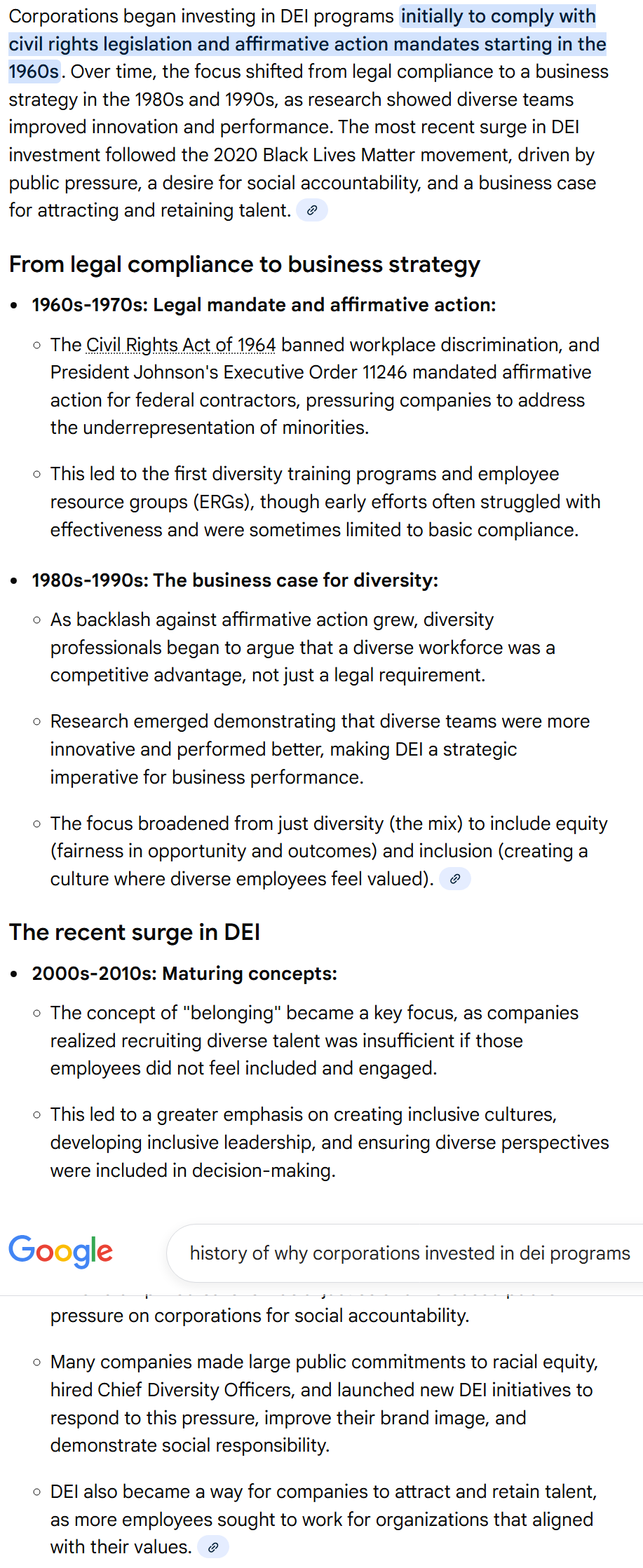
DEI History (Google AI Says …)

Civil rights.

Affirmative action.

Corporate training, legal, initiatives.

Reactions after George Floyd.

.https://urbanandracialequity.org/deitimeline/

https://insights.grcglobalgroup.com/the-history-and-growth-of-the-diversity-equity-and-inclusion-profession/#:~:text=Although%20a%20limelight%20has%20been,longer%20than%20a%20couple%20days.

https://www.bbc.com/worklife/article/20240304-us-corporate-diversity-equity-and-inclusion-programme-controversy

DEI Politicized

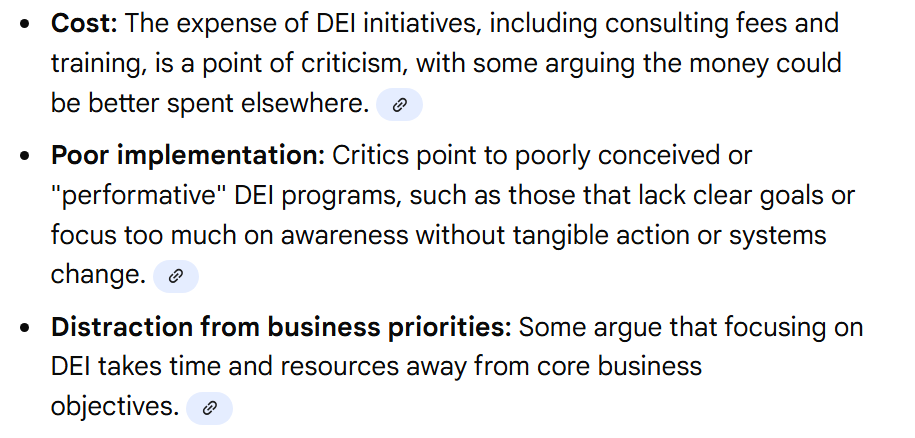
As DEI programs grew in number, intensity, claims and impact, some individuals identified and objected to their perceived political agendas.

https://en.wikipedia.org/wiki/Diversity,_equity,_and_inclusion#:~:text=In%20the%20United%20States%2C%20diversity,based%20on%20identity%20or%20disability.

https://www.whitehouse.gov/presidential-actions/2025/01/ending-radical-and-wasteful-government-dei-programs-and-preferencing/

https://www.cnn.com/2025/01/22/us/dei-diversity-equity-inclusion-explained

DEI Criticisms

https://www.linkedin.com/pulse/most-common-arguments-against-dei-how-respond-felicity-menzies-ehwcc/

The common criticisms are not overly persuasive. The real issue is that this became part of the “culture wars”. Corporations didn’t invest in DEI because they suddenly became “woke”, they did so because DEI was beneficial for recruiting, retention and marketing. We live in a diverse world. Commercial enterprises recognized this and adjusted their activities accordingly.

Affirmative action is a step beyond “equal opportunity”. It says that our society systematically discriminates against minority groups and individuals and that we should take steps to offset this. This is a political issue that “Civility” chooses to not address in order to be actively nonpartisan.

Also missing above is the claim by postmodernists, professors, influencers, politicians and many progressives that society is inherently unfair, dominated by incumbent powerful forces, requiring revolutionary insight and reaction to overcome their power. Critics say that DEI is used as a political tool. Many disagree with the critics. “Civility” does not take a stance on this dispute. It is “above our paygrade”.

Definitions of Diversity

The presence of differences within a group, which can include race, gender, ethnicity, age, sexual orientation, religion, physical ability, and other aspects of social identity. 

Embracing the differences everyone brings to the table, while acknowledging the benefit of the multiple perspectives, ideas, and solutions provided when individuals with different backgrounds, identities, and views collaborate and are heard. 

The presence and participation of individuals with varying backgrounds and perspectives, including those who have been traditionally underrepresented.

Embracing the differences everyone brings to the table, whether those are someone’s race, age, ethnicity, religion, gender, sexual orientation, physical ability or other aspects of social identity.

Diversity ensures that a variety of perspectives are represented, whether they come from different races, genders, ages, sexual orientations, or cultural backgrounds.

https://naacp.org/campaigns/diversity-equity-and-inclusion#:~:text=Diversity%2C%20equity%2C%20and%20inclusion%20are,%2C%20genders%2C%20and%20sexual%20orientations.

https://online.hbs.edu/blog/post/what-is-dei#:~:text=DEI%20can%20be%20broken%20down%20into%20three,integrated%20into%20your%20organization’s%20culture%20and%20operations

https://www.cnn.com/2025/01/22/us/dei-diversity-equity-inclusion-explained

Civility Supports Diversity

Definitions of Inclusion

  • Creating an environment where every individual feels respected, supported, and has a strong sense of belonging.
  • Encouraging all people to express their ideas and perspectives freely. 

Creating an environment where people of all backgrounds can thrive and contribute to their fullest potential.

A sense of belonging in an environment where all feel welcomed, accepted, and respected.

Respecting everyone’s voice and creating a culture in which people from all backgrounds feel encouraged to express their ideas and perspectives.

Civility Supports Inclusion (Acceptance)

Diversity and inclusion fit into the Civility value labelled “accepting” or “acceptance”. They are clear priority components of Civility.

Definitions of Equity

  • Providing fair and just treatment to all individuals, regardless of their differences.
  • Ensuring everyone has the resources and opportunities needed to succeed, rather than giving everyone the exact same thing. 

Treating everyone fairly and providing opportunities for everyone to succeed, considering their traits, including resources, support, and potential accommodations to help those with disabilities thrive in the workplace. 

Equal access to opportunities and fair, just, and impartial treatment.

Treating everyone fairly and providing equal opportunities.

Civility Supports Equity (Partially)

Equity is not exactly one of the 8 core values of Civility. Civility is based upon human dignity, respect for each other, responsibility, public-spiritedness, acceptance, intentionality, interactivity and constructiveness. Equity is a form of the value “fairness”. According to Jonathan Haidt, fairness is a widely held political value, but it is described in different ways by different people and considered much more important by liberals than by conservatives. “Civility” is not opposed to “equity”, but “equity” is not essential for the practice of “Civility”.

Is Equity Essential for DEI?

The highly influential human resources professional society SHRM removed “equity” from their historical support of DEI programming. Many opposed this change, arguing that equity is an essential component of DEI.

.https://www.inclusiongeeks.com/the-unexpected-consequence-of-workplace-civility/

DEI Program Components

https://en.wikipedia.org/wiki/Diversity,_equity,_and_inclusion#:~:text=In%20the%20United%20States%2C%20diversity,based%20on%20identity%20or%20disability.

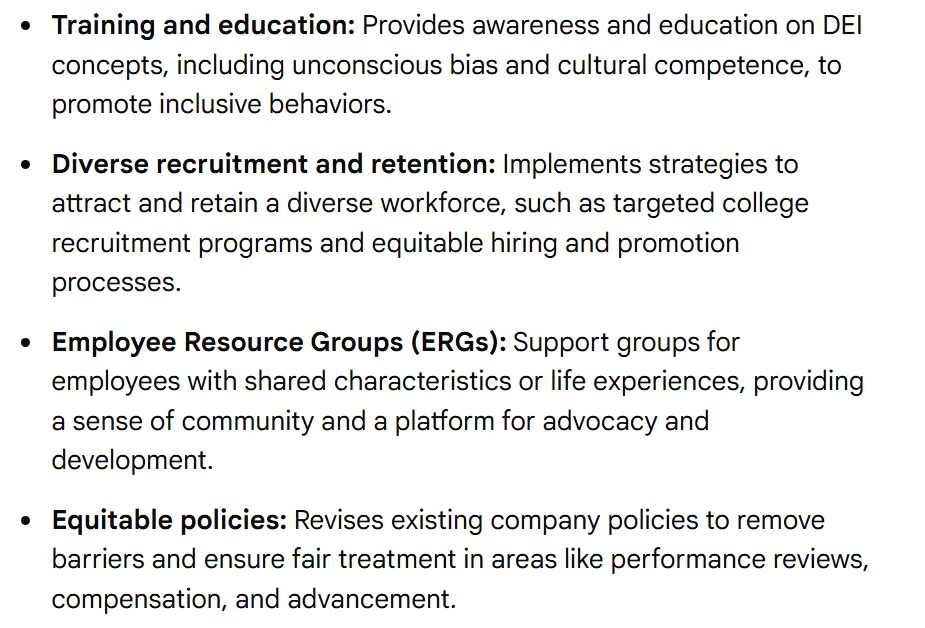
“Typical” DEI programs lean left. Civility, per se, does not support the more partisan views. “Unconscious bias” may be important, but it is not a civility value, behavior or skill. Civility does not take a stance on activist “equitable” HR processes. Every person has human dignity and is worthy of respect, check. Extra investment in mentorship and sponsorship of “underrepresented” employees is also optional from a Civility perspective.

Corporate Human Resources Professionals Generally Lean Left and Strongly Support DEI

https://www.shrm.org/executive-network/insights/impact-of-civility-on-organizational-success

https://neuroleadership.com/your-brain-at-work/workplace-civility-through-a-dei-lens#:~:text=Civility%20is%20about%20acting%20politely%20and%20adhering,Open%20dialogue%20*%20Everyone’s%20ability%20to%20contribute

Summary

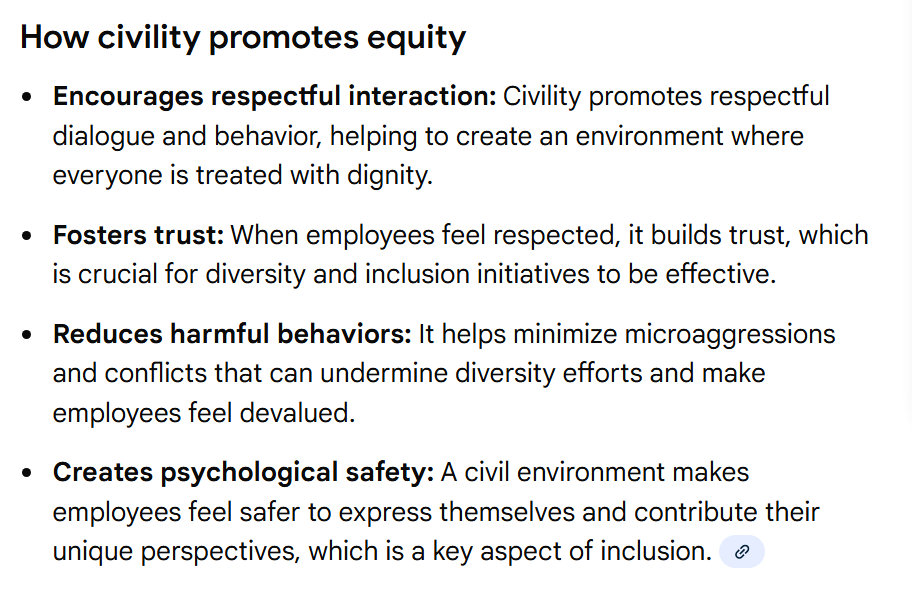
Diversity and inclusion are part of the key Civility value of acceptance. Each person has human dignity and should be respected and accepted by others in their individuality. Civility is based upon commonly held values and promotes personal development and responsibility for being a good person, interacting with others and considering community needs. Like DEI, it promotes a subset of values to make our lives together safer, more pleasant and more effective. It focuses on how we interact with each other constructively, despite our differences.

Civility’s nonpartisan stance takes no position on the stronger claims of DEI providers or their critics. Civility recommends that they both engage in meaningful dialogue to better understand where they can work together and where they must accept that they have different social, political and moral perspectives that cannot be reconciled today. Civility actively opposes the angry outbursts, attacks, emotional appeals, insults, blaming, bullying, shaming, disrespect, blind loyalty, ignorance, prejudging, stonewalling and demonization sometimes seen in these interactions.