Good News: More “Doctors”

https://nces.ed.gov/programs/digest/d12/tables/dt12_310.asp

https://nces.ed.gov/programs/digest/d20/tables/dt20_318.20.asp

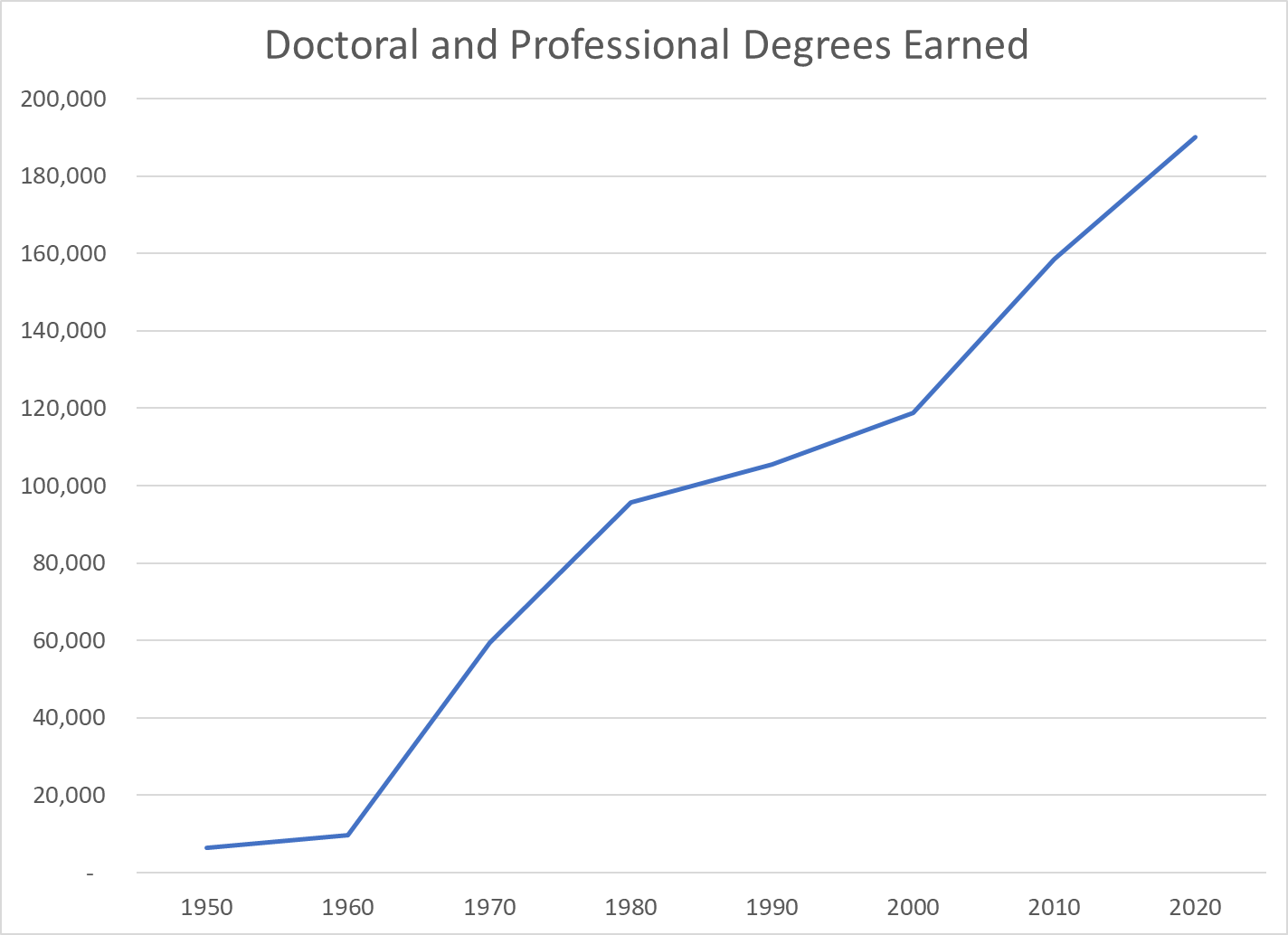
The annual number of “academic” and “professional” doctoral degrees awarded has increased 10-fold since 1960.

https://www.insidehighered.com/news/2021/12/03/survey-shows-annual-decline-number-phds-awarded

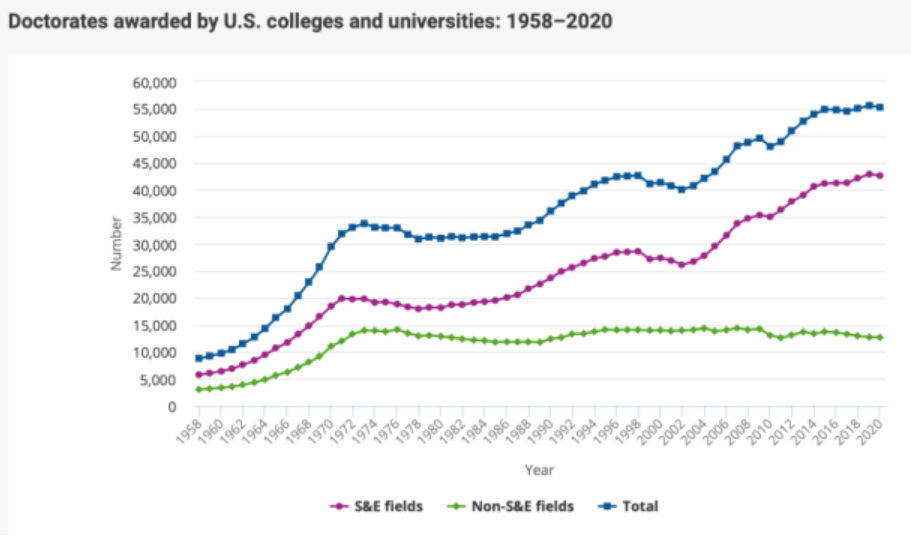
The number of “academic” doctoral degrees awarded has increased 5-fold since 1960.

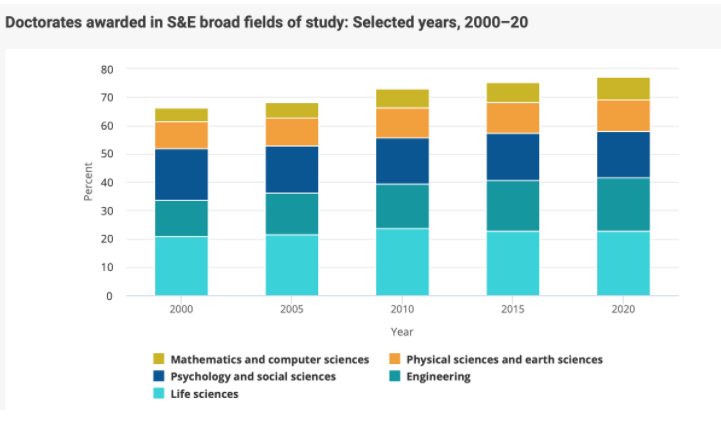
The increase in degrees has been totally accounted for by “scientific and engineering” degrees awarded.

https://www.insidehighered.com/news/2021/12/03/survey-shows-annual-decline-number-phds-awarded

More details on the decline of humanities doctoral degrees.

https://www.amacad.org/humanities-indicators/higher-education/humanities-share-all-advanced-degrees-conferred

Detailed annual academic data.

https://ncses.nsf.gov/pubs/nsf22300/data-tables

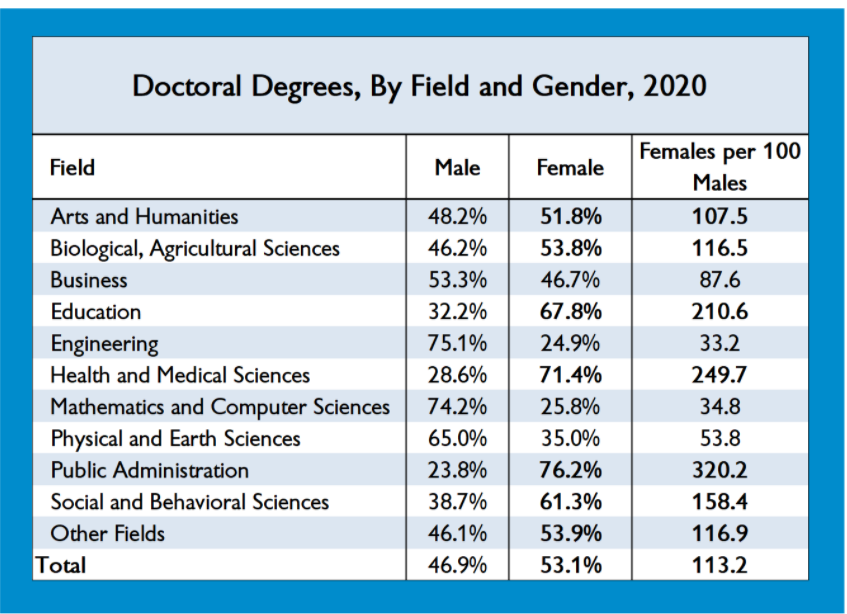
Women earn an increasing share of doctoral degrees.

https://www.forbes.com/sites/michaeltnietzel/2021/10/13/ten-ways-us-doctoral-degrees-have-changed-in-the-past-20-years/?sh=1e23eef32a71

Minority identified individuals earn an increasing share of doctoral degrees.

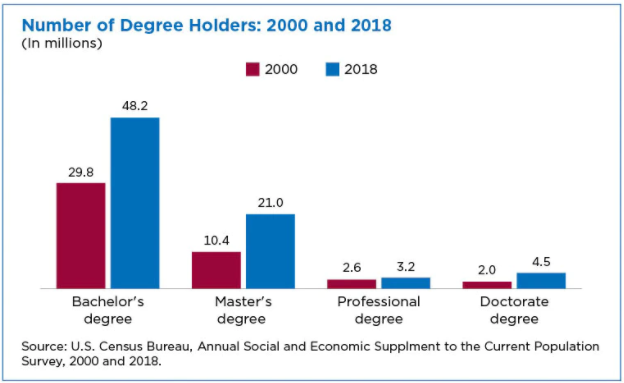
https://www.census.gov/library/stories/2019/02/number-of-people-with-masters-and-phd-degrees-double-since-2000.html

The cumulative number of advanced degree holders continues to increase.

Good News: US Housing Market

Real Interest Rates Remain at Record Lows

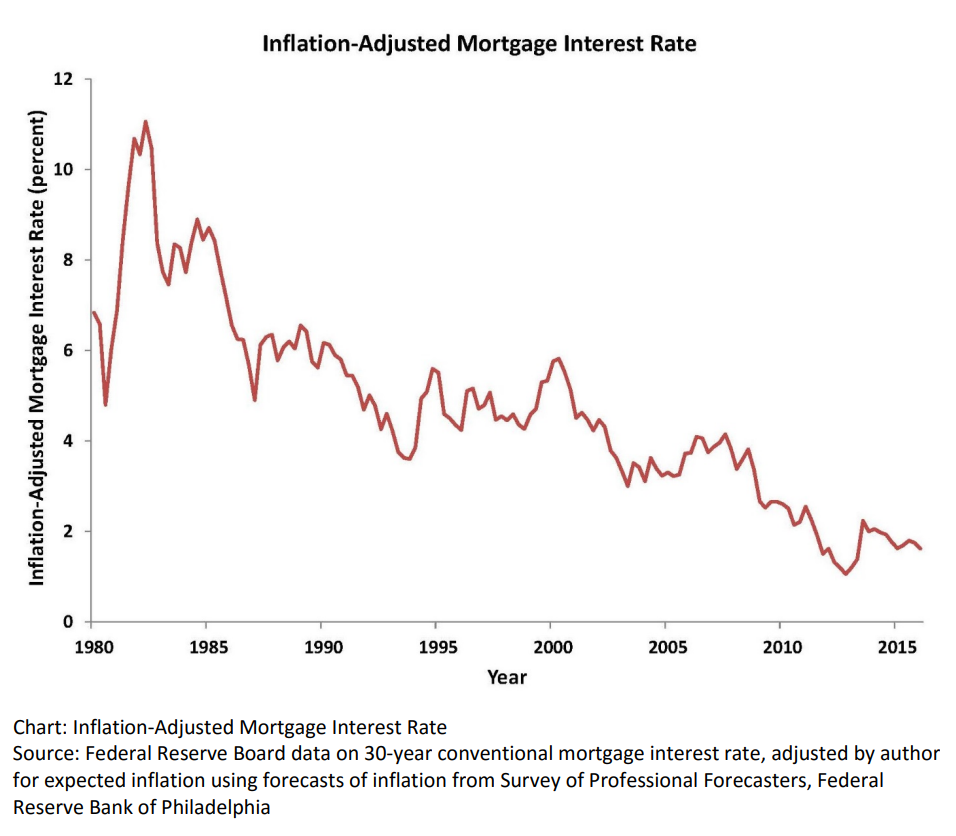
Real, inflation-adjusted, interest rates have declined greatly since 1980. At that time, with the risks of variable inflation and surging oil prices, the real mortgage interest rate was 8%. It declined to 5% in the 1990’s and 4% in the 2000’s before falling to 2% in the 2010’s. The financial cost of owning property has rarely been lower.

House Values are Up, Way Up

House prices grew relatively consistently from 1970 through 2000, with a spike in 2005-9 and a return to trend values in 2010-12. In the last 10 years, house prices have increased by 6% annually in nominal terms, or 4% annually in real terms.

Home Ownership Rate is Rebounding, Up 2%

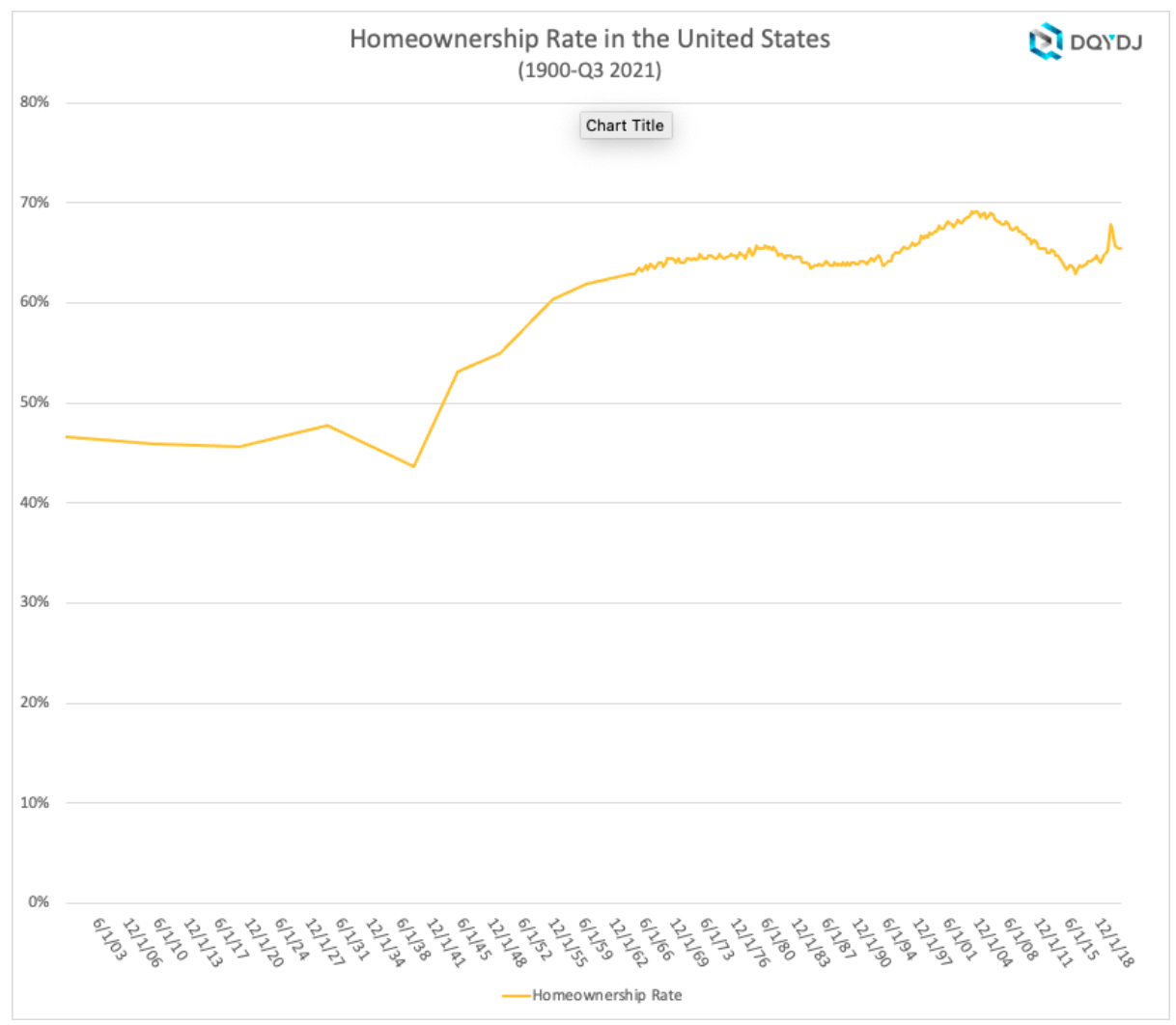
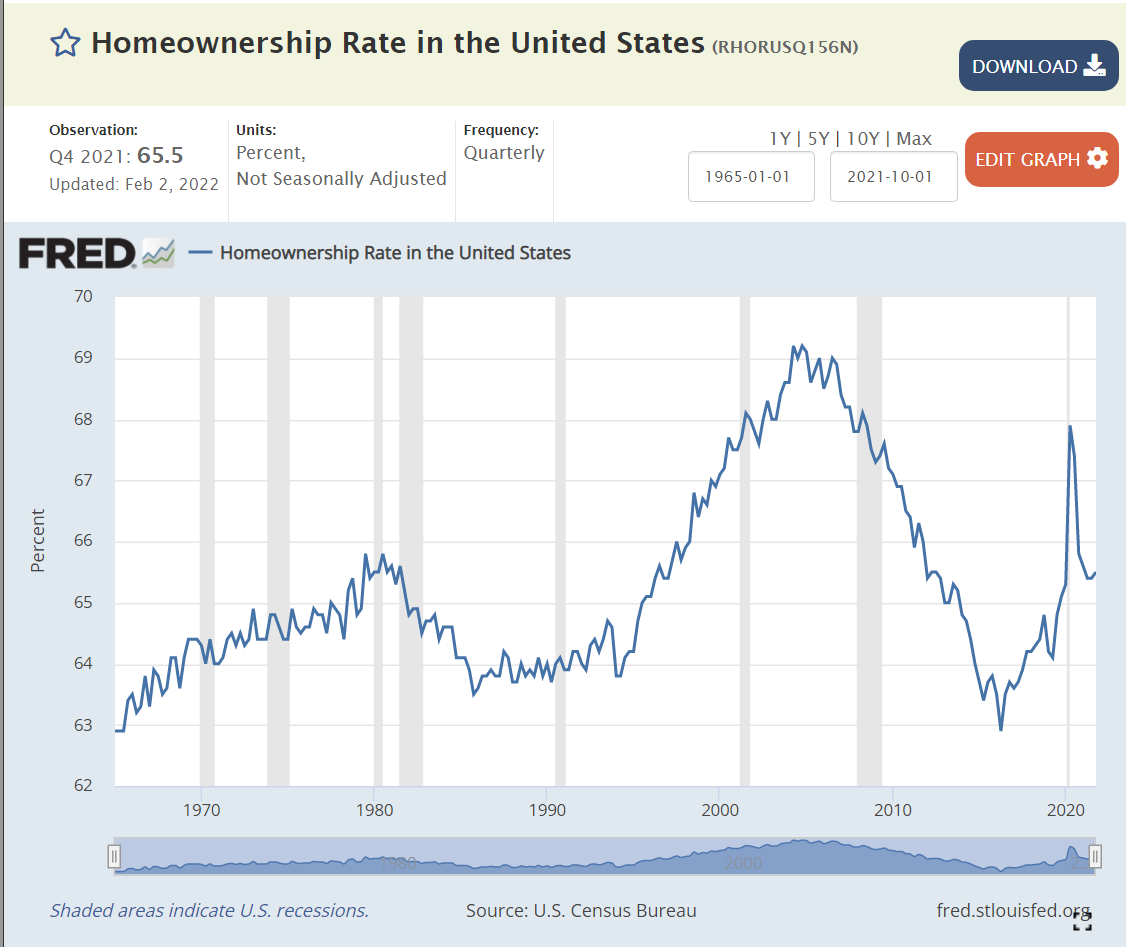
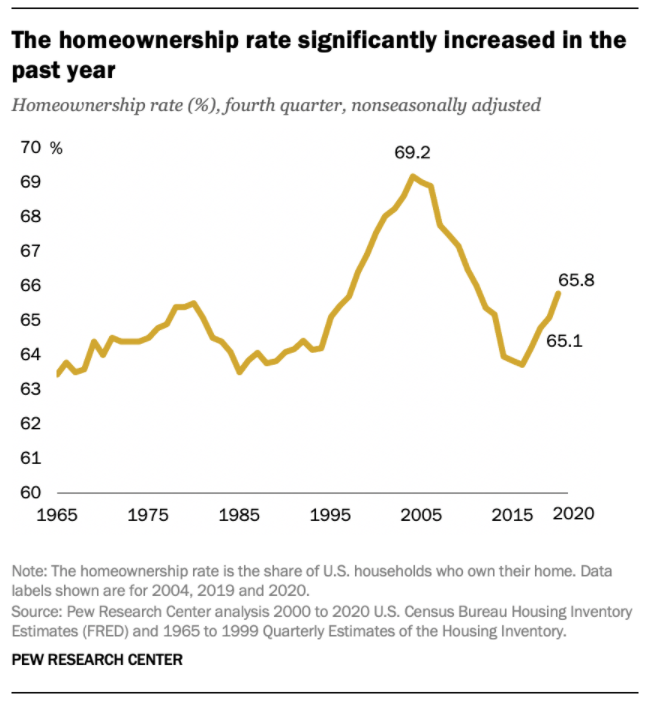
The US homeownership rate averaged 47% from 1900-40. It increased smartly in post WWII times to 60% by 1955 and 64% by 1965. Homeownership averaged 64%+ for the decade of 1969-78. It increased by 1% during 1979-81. In the midst of a difficult depression, homeownership rates dropped back to 64% by 1985, about the same for the last 20 years, setting a “normal” level. Homeownership rates stayed at 64% for the next decade. Ownership rates increased from 64% to 69% in the next decade before declining right back to 63% by 2015. In the last 7 years, despite many headwinds, the home ownership rate has increased by 2%.

Number of Homeowners has Jumped by 7 Million

In 2000, there were 69M owner-occupied homes in the US. This increased by a solid 7M to 76M by 2005. The housing market hit a lull and the number of owner-occupied homes essentially stayed flat for a dozen years, through 2017. The supply of owner-occupied homes then rose by a strong 7M in the next 4 years to 83M!

International Comparisons

https://en.wikipedia.org/wiki/Home-ownership_in_the_United_States

https://www.urban.org/urban-wire/us-homeownership-rate-has-lost-ground-compared-other-developed-countries

US homeownership rates are similar to other developed economies.

Housing Supply

https://www.mercatus.org/bridge/commentary/what-are-homeownership-rates-telling-us


The housing market is inherently volatile, typically rising by 2 times the trend and then falling to one-half of the trend. Annual housing starts averaged 1.6M from 1960-2008. They declined by a severe 75% to just 0.5M in 2009. Housing starts have subsequently grown 3-fold to 1.6M annual housing starts, but the accumulated lack of new supply is impacting housing markets today.

Housing Market by Segments

By Age Group

https://www.mercatus.org/bridge/commentary/what-are-homeownership-rates-telling-us

The period from 1982-2000 showed homeownership rates by the 5 age segments remaining relatively constant; 65+ 78%, 55-64 80%, 45-54 76%, 35-44 67% and <35 40%. The 65+ group increased homeownership from 75% to 80%. During this time, the overall US homeownership rate increased from 65% to 69%, mostly due to the aging of the population, now more heavily weighted towards the groups with 76-80% homeownership versus the 40-67% younger groups.

Homeownership rates grew from 2000 to peak rates in 2004, before declining significantly for all groups except for the 65+ cohort which essentially held it’s own. The adjacent 55-64 class fell 4%. The middle 45-54 group dropped 7%. The typically homeownership growing 35-44 group cratered by 9%. The young <35 group fell by 5%. Hence, the overall rate fell dramatically during this time.

https://www.bloomberg.com/opinion/articles/2021-04-15/home-ownership-for-millennials-may-finally-be-within-reach

This difference in home ownership experience is reflected in generational wealth summaries.

By Marital Status

https://en.wikipedia.org/wiki/Home-ownership_in_the_United_States

There is a 30 point gap between married couples and other groups, with 84% of married couples owning homes versus about 55% for other family structures.

By Location Type

https://www.census.gov/library/stories/2017/09/rural-home-ownership.html#:~:text=Rural%20areas%20have%20higher%20homeownership,holds%20in%20all%20four%20regions.

https://www.census.gov/newsroom/blogs/random-samplings/2016/12/homes_on_the_range.html

https://www.freddiemac.com/research/insight/20210602-rural-home-purchases

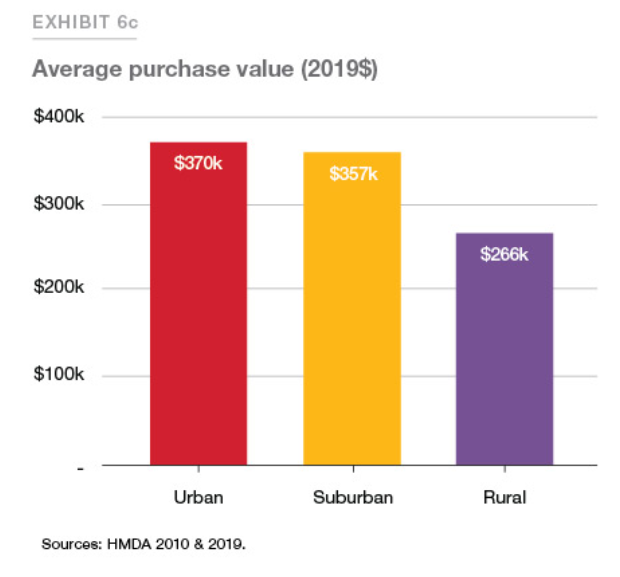
81% of rural households own their homes versus just 60% for urban households.

By Income Group

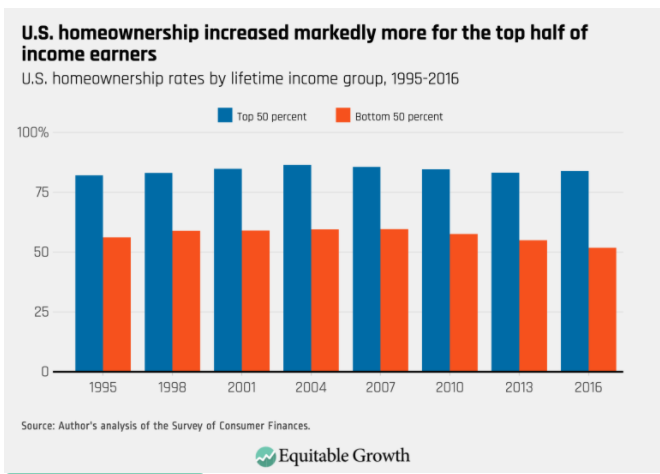
Historically, 80% of the top half of household incomes have been homeowners, while in the bottom half, just 50-60% have owned their homes.

By Racial Group

The US shows dramatically different homeownership rates by racial category. The differences between the 1995 non-Hispanic White rate (70%) and Others/Asians (50%), Hispanics (42%) and Blacks (42%) remain large in 2021 where we see White (74%), Other (57%), Hispanic (48%) and Black (44%). The groups homeownership share gain from 1995 to 2005 were similar, ranging from 6-10%, but the decline from 2005-2015 was only 3-4% for Whites and Hispanics, but 7% for Blacks and Others. The improvement from 2015 to 2021 has been 2% for 3 groups and 4% for the Other/Asian group.

Summary

The Great Recession flattened the housing market. The number of owner-occupied homes in the US remained level at 76 million from 2006 – 2017. The number of housing starts plummeted from 2.0M to 0.5M per year, compared with an historic average of 1.6M. New home construction first exceeded 1.2M units (75% of historic average) again only in 2020, a dozen years later. New home-owning households have increased by 7M units in the last 4 years! The homeownership rate is up 2 points, from 63.5% to 65.5%. Supply is responding to increased demand and higher home prices. Homeownership rates will increase with the economic recovery, but be constrained by higher home prices.

The Age/Experience Unemployment Rate Premium is Shrinking

Date16-2425-3435-4445+
Mar-9010.65.23.73.5
May-9214.47.75.85.2
Dec-009.23.72.92.4
Dec-0112.25.94.43.6
Mar-0710.04.33.23.3
Oct-0919.110.69.06.8
Sep-197.93.52.62.5
Apr-2027.414.511.512.8
Dec-2012.66.75.55.6
Feb-228.34.13.33.0

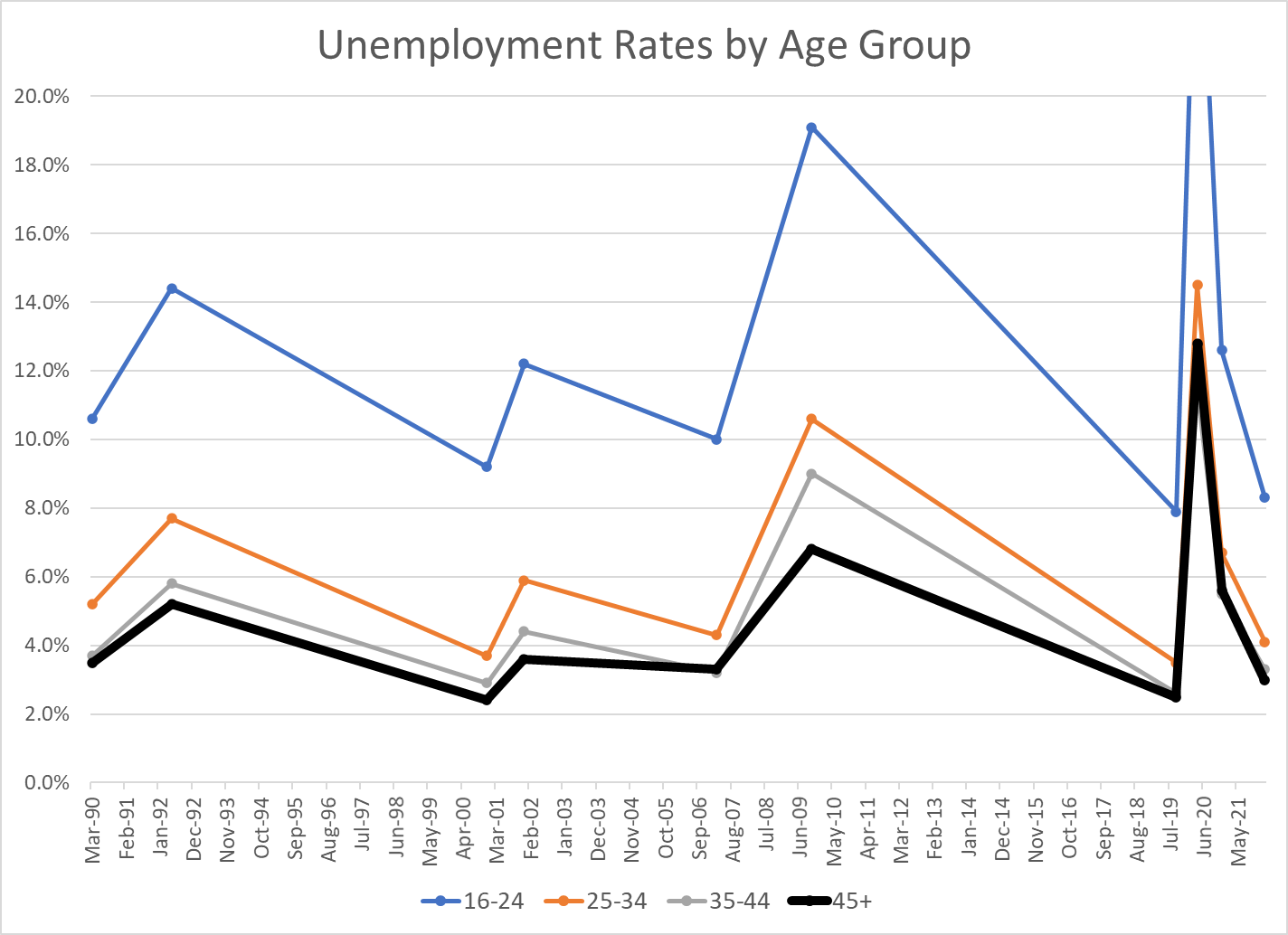
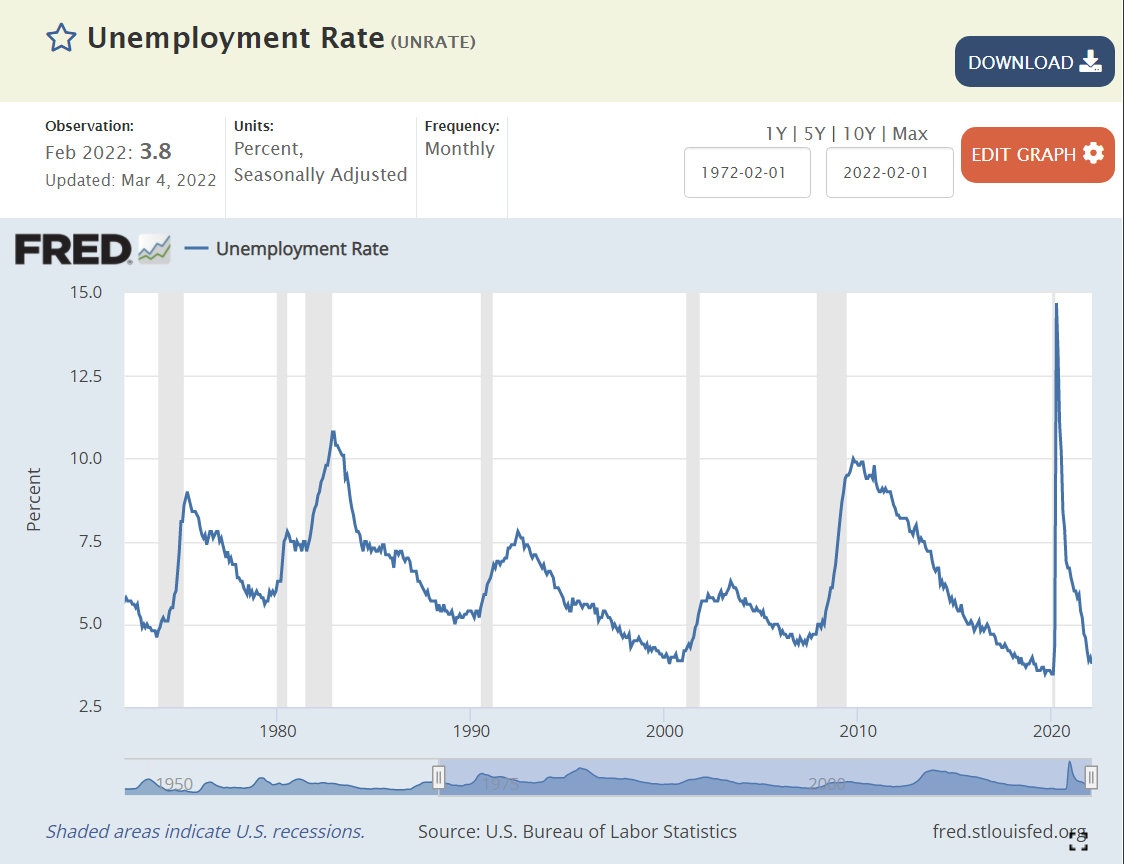
I’ve summarized the last 30+/- years of US labor market experience with just the peak unemployment rates of the business cycle, plus December, 2020 as a secondary indicator of the peak Covid/pandemic impact, since the actual peak numbers in April, 2020 were so extreme and short-lived.

Less experienced individuals have historically had higher unemployment rates in the US. Compared with the 45+ age group, the 35-44 age group has averaged 0.3% higher unemployment; 5.2% versus 4.9%, a relatively minor difference. The 25-34 year age group has averaged 6.6% unemployment, a substantial 1.7% higher rate. The job-seeking 16-24 year age group has averaged 13.2% unemployment, more than twice as high as the 25-34 year age group and more than 2.5 times the 45+ age group (8.3% extra).

The “extra” unemployment for 35-44 year olds versus the 45+ group has been zero for the last 15 years, versus a minor 0.5% premium historically. It appears that workers are reaching full employment value at an earlier age.

The “extra” unemployment for 25-34 year olds versus the 45+ group has been 1.0% for the last 15 years, a small reduction from the prior 1.5% premium.

The “extra” unemployment for 16-24 year olds at the peak of the business cycle versus the 45+ group averaged just 5.3% recently versus 7% historically.

The 2007-2009 recession showed a greater impact on modestly younger (25-44 year old) workers, with their unemployment rates increasing by 2.5% more than the 45+ group.

Despite the reduction in the inexperience penalty for youngest workers (16-24) in the last few years, they did experience much higher “extra” unemployment during both the 2007 and 2020 recessions.

Very young workers continue to be penalized for their inexperience, but other workers from ages 25+ seem to have relatively equal economic value today.

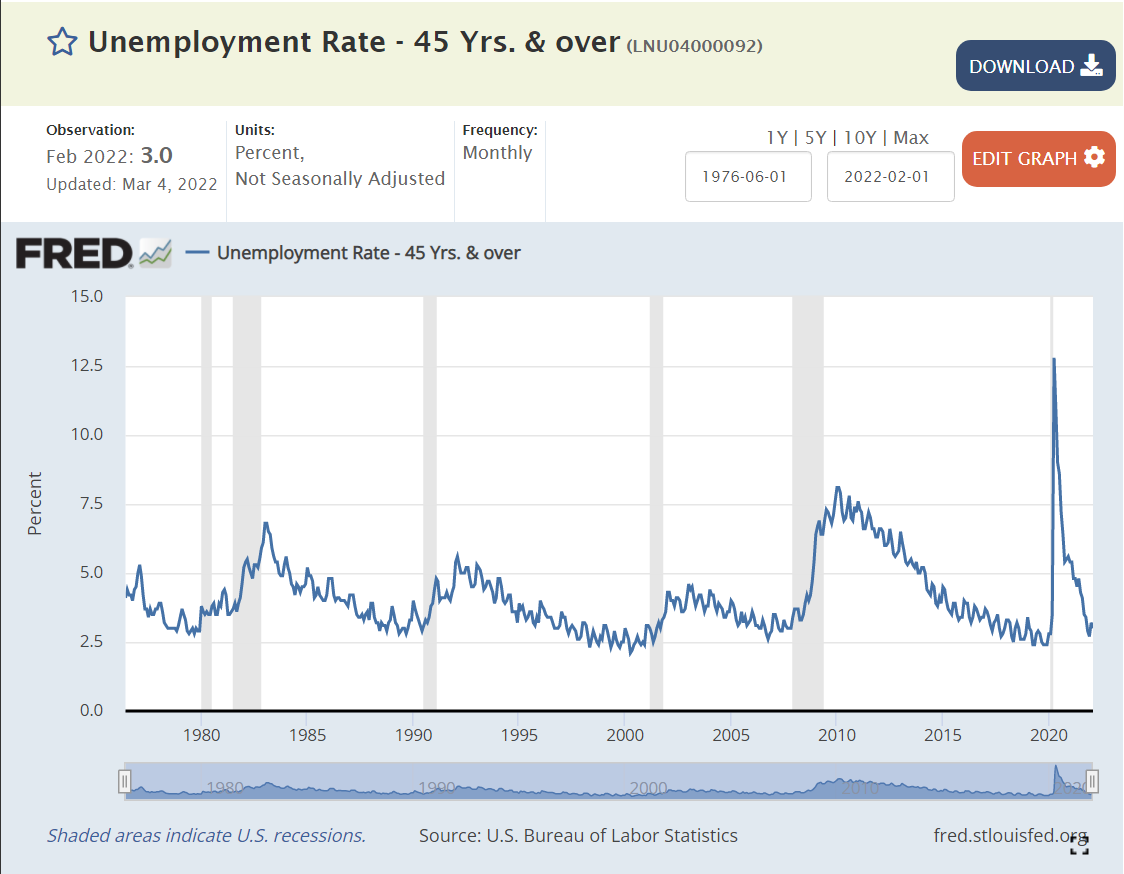
Note that the current unemployment rates for those aged 25+ already matches the average MINIMUM rates of the last 4 business cycles: 3-4%. The 8.3% unemployment rate for the 16-24 year age group is below the minimum in 1990, 2000 and 2007, and just above the 7.9% level of Sep, 2019.

https://fred.stlouisfed.org/series/LNU04000092

https://fred.stlouisfed.org/series/LNS14000091

https://fred.stlouisfed.org/series/LNS14000089

https://fred.stlouisfed.org/series/LNS14024887

Good News: Real $ US Exports are Up 180% since 1980.

Summary

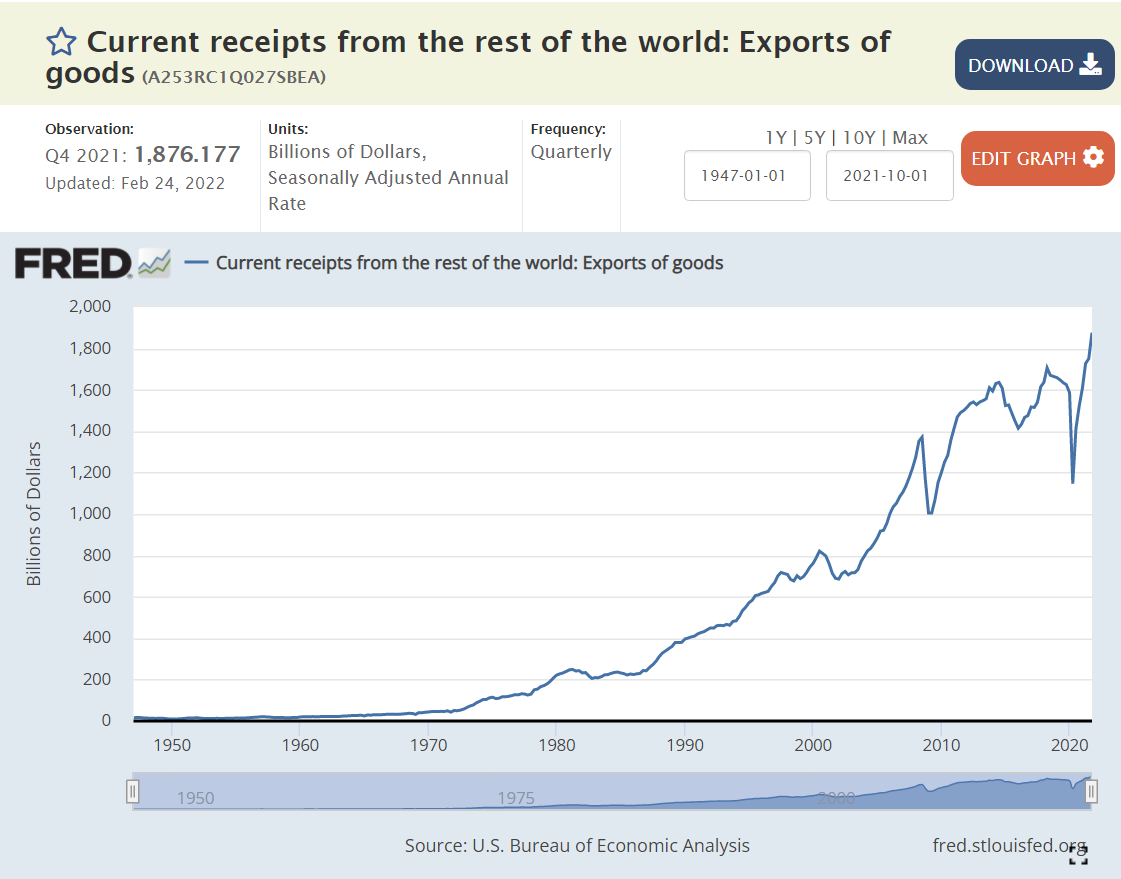
Critics complain about the US economy’s weak international performance in recent decades. Let’s set aside the trade balance (exports – imports) and focus just on exports. US exports occur when US goods and services are more competitive than ALL other countries in the world, subject to limits based upon transportation and purchasing costs, currency values and trade barriers. In real (inflation-adjusted) terms, US exports have increased by 180% since 1980, or 2.5% per year, year after year after year. Despite the 10% increased real cost of labor in the US, firms have leveraged their advantages, developed new products, found new markets and used better financing structures to greatly improve the US export results.

Total Goods and Services

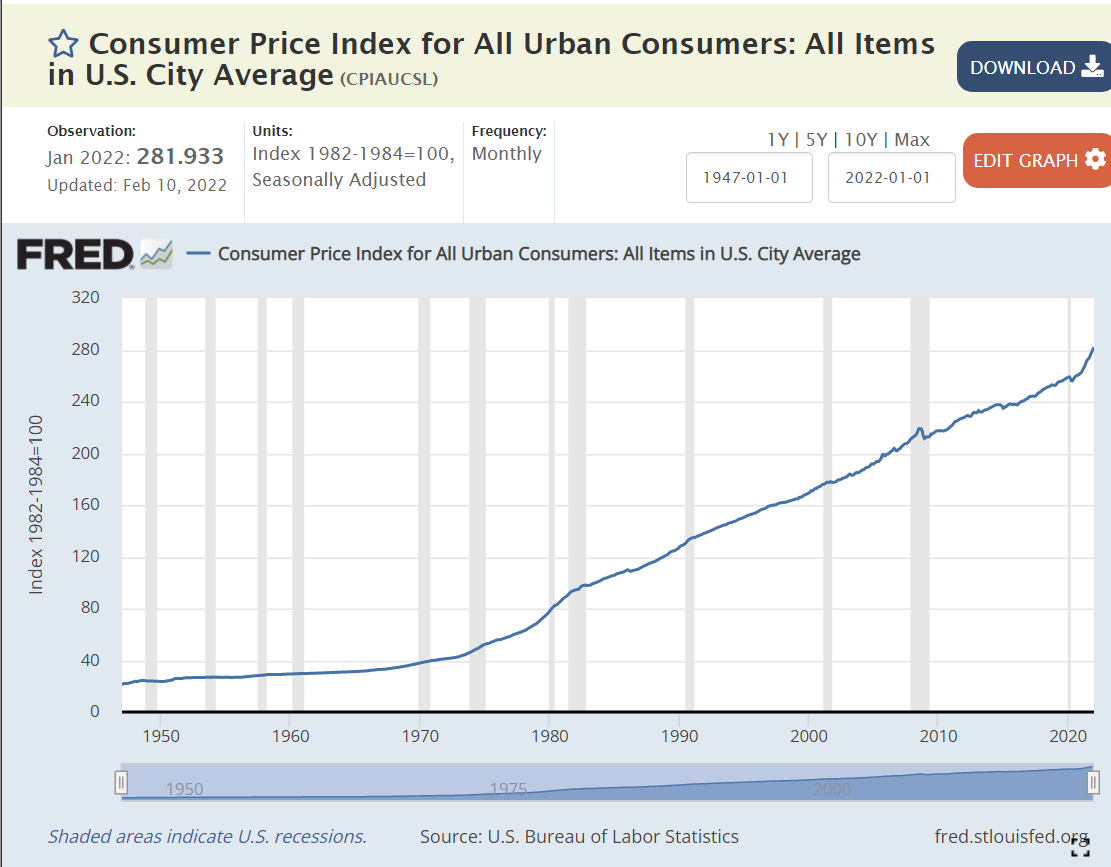
Real goods and services exports increased by 180% from 1980 until today. They increased 9-fold in nominal terms, but consumer prices increased by 230% (3.3x).

The US Dollar fell in value significantly in the 1980’s as US inflation exceeded inflation in other countries, but has since been relatively constant against a market basket of other currencies. The increase in exports is not due to a weaker US dollar.

Goods Exports

US goods exports have increased by 140% or 2.1% per year in real terms since 1980. They have fallen from 4/5ths to a little more than 2/3rds of the total as services exports have grown more rapidly.

Agriculture

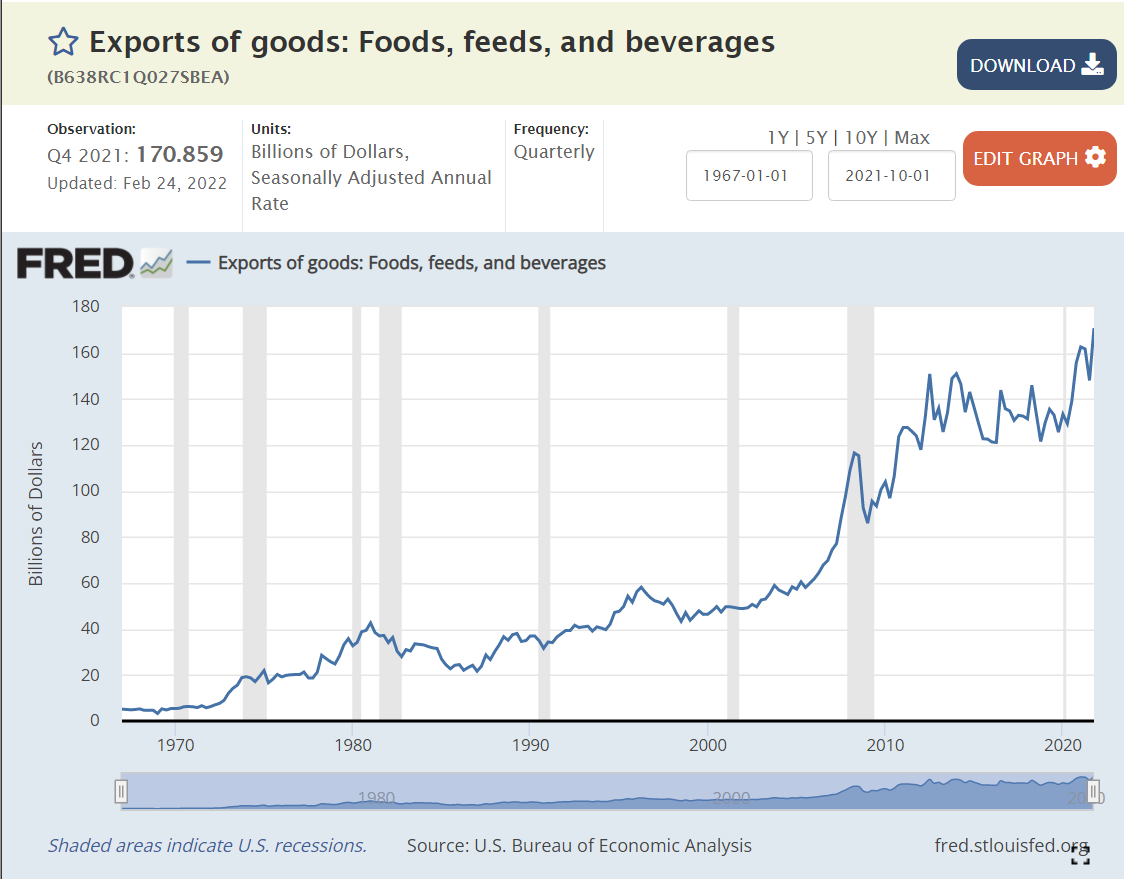
Ag exports grew very rapidly in the 1970’s and then flattened through the 80’s and 90’s before rapidly accelerating in the “oughts”. Ag exports grew by 30% in real terms over these 4 decades, a little less than 1% per year.

Industrial Supplies Exports

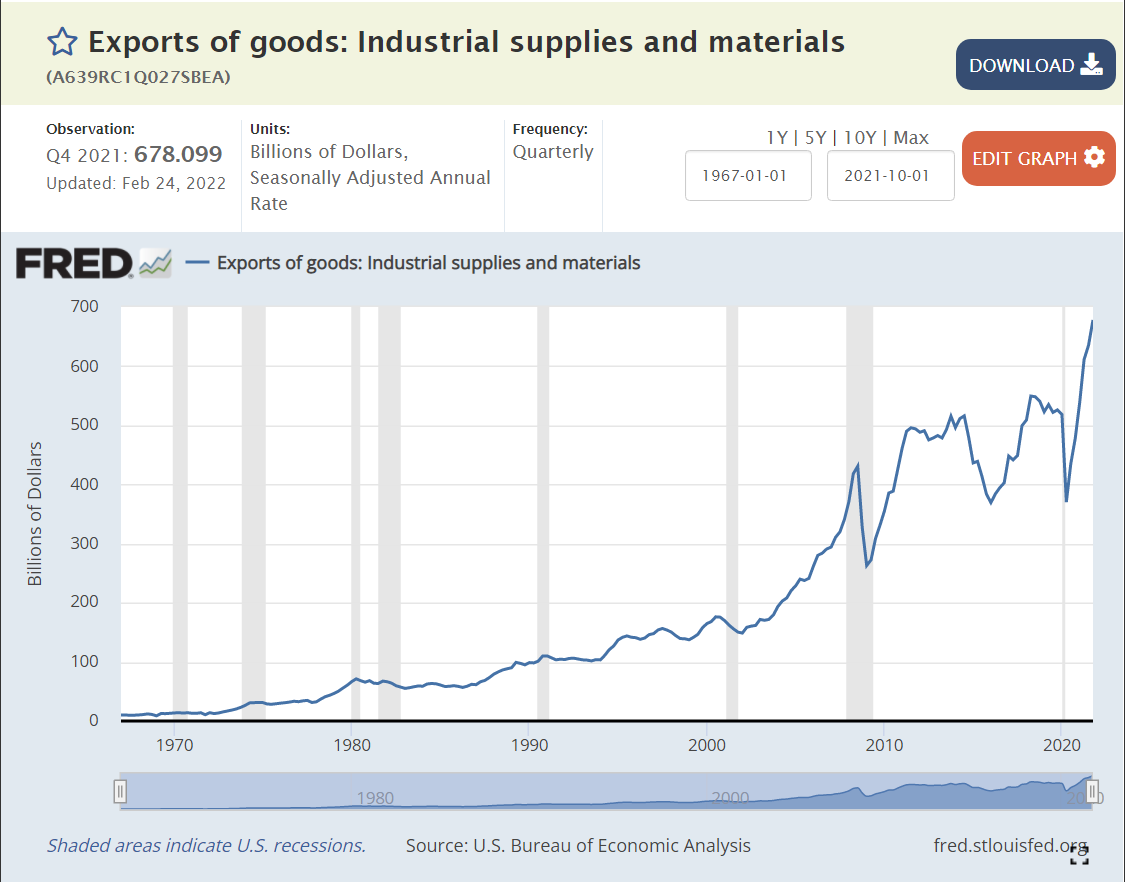
US chemistry based and other engineered supplies and components grew by 210%, or a strong 2.8% annually.

Petroleum Exports

From zero to something, now 10% of US exports.

Capital Goods Exports

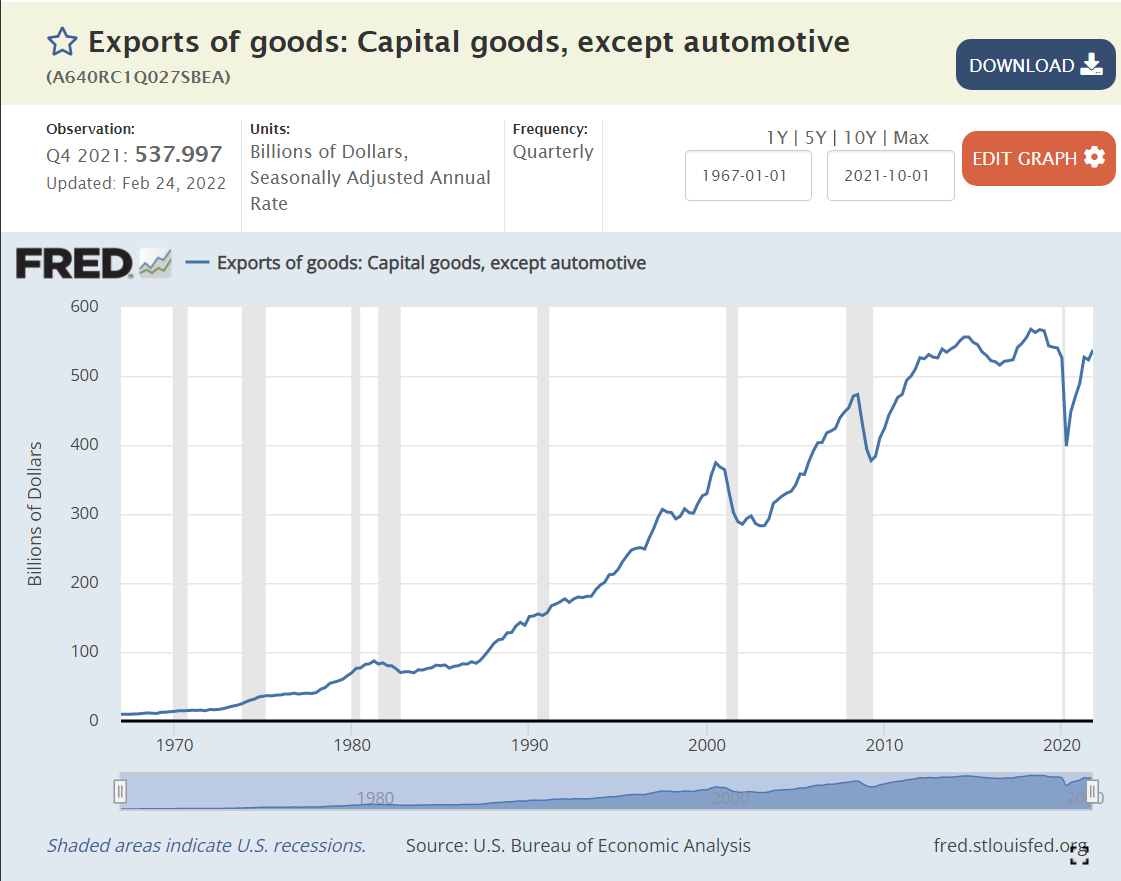
US exports of highly engineered capital goods increased by 100%, or 1.7% per year.

Automotive Exports

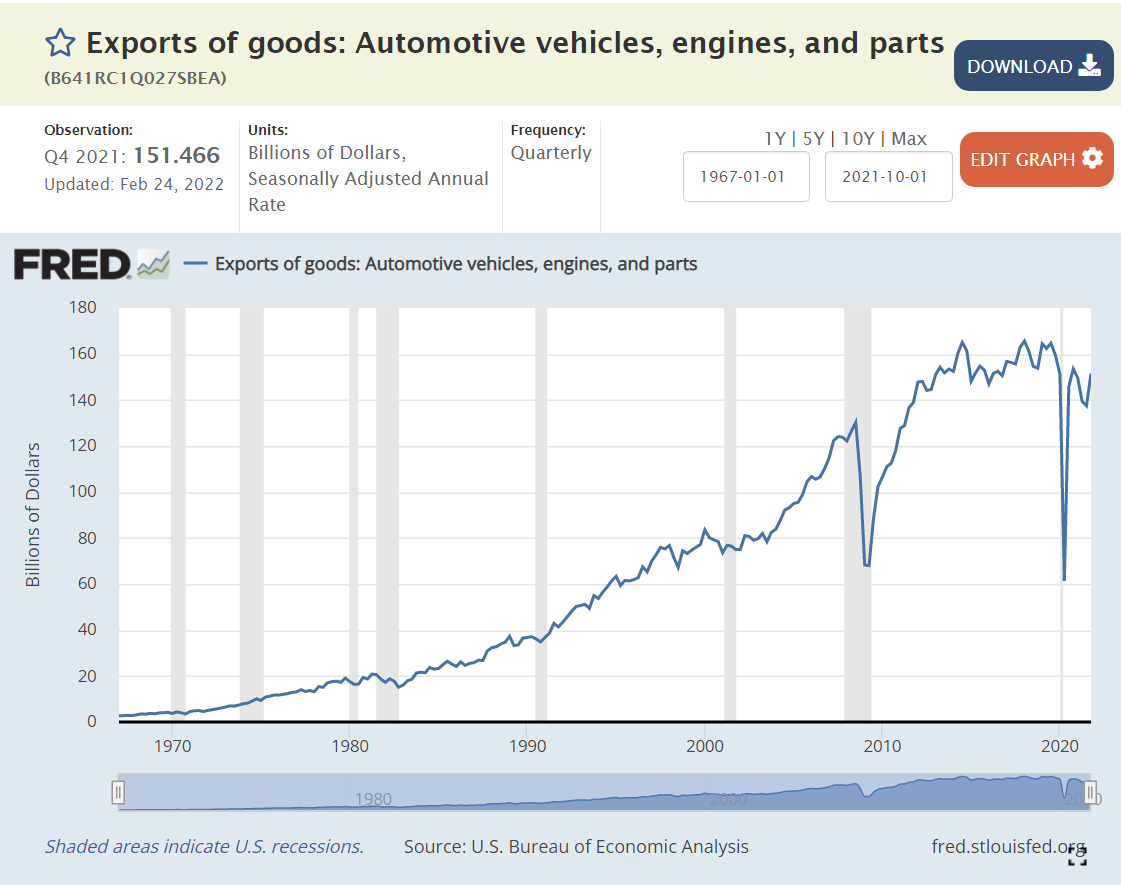
Another positive result. US auto exports are up 140% in real terms, or 2.1% per year.

Consumer Goods Exports

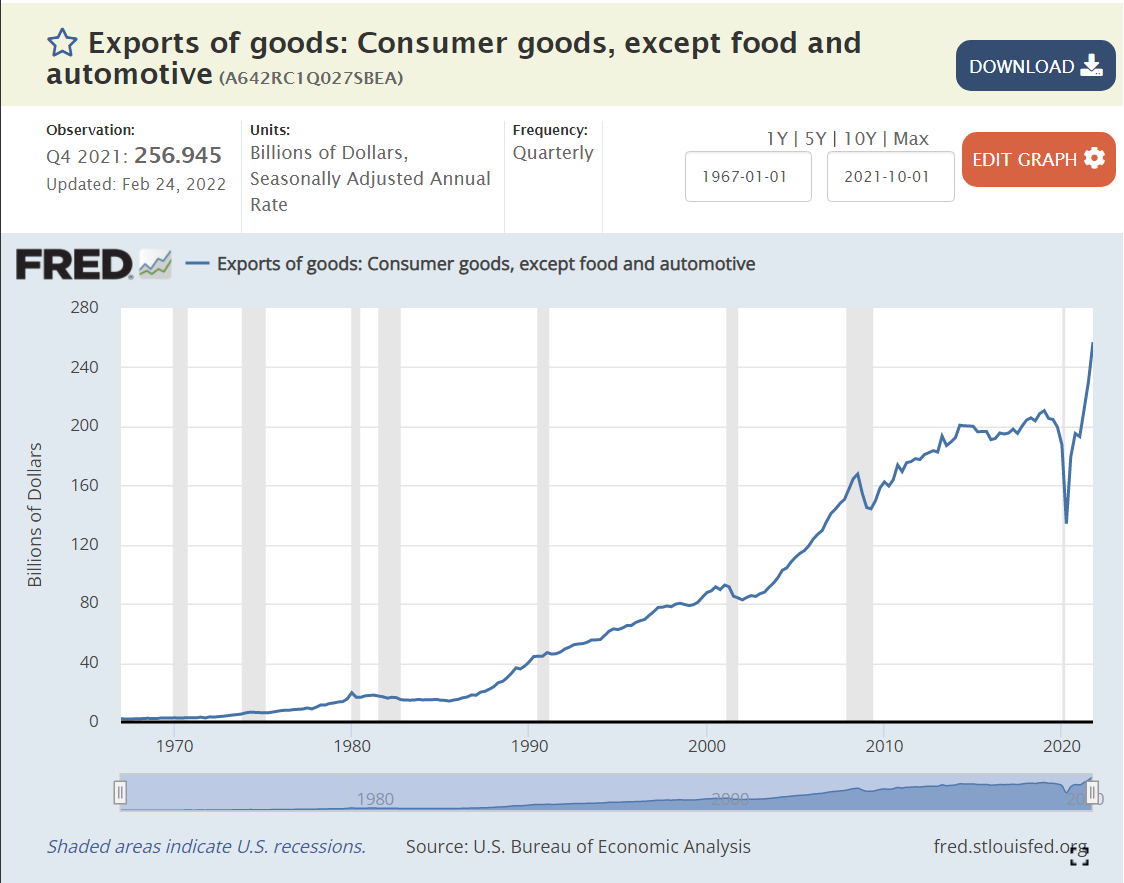
Miscellaneous consumer goods exports increased by 340% or 3.6% annually, an amazing performance!

Services Exports

US services exports grew by 350% in these 4 decades, by 3.7% annually. The US is very competitive in the “most competitive” areas of international trade.

Summary

The US economy continues to increase its internationally competitive real exports at a rate of 2.5% per year in the long-term. The US is very well positioned to prosper in an era of increased global and free trade.

Good News: Growing US Hotel Capacity, More Consumer Choice

Hotel capacity increased by 50% from 1995 to 2019.

Demand grew at the same 50% rate, although not always in lockstep.

Occupancy averaged a healthy 63% (almost two-thirds) through this period, with significant differences due to changes in construction and the economy.

The price per room averaged about $125 per night in real 2020 dollars, again varying based on supply and demand, but overall, relatively constant.

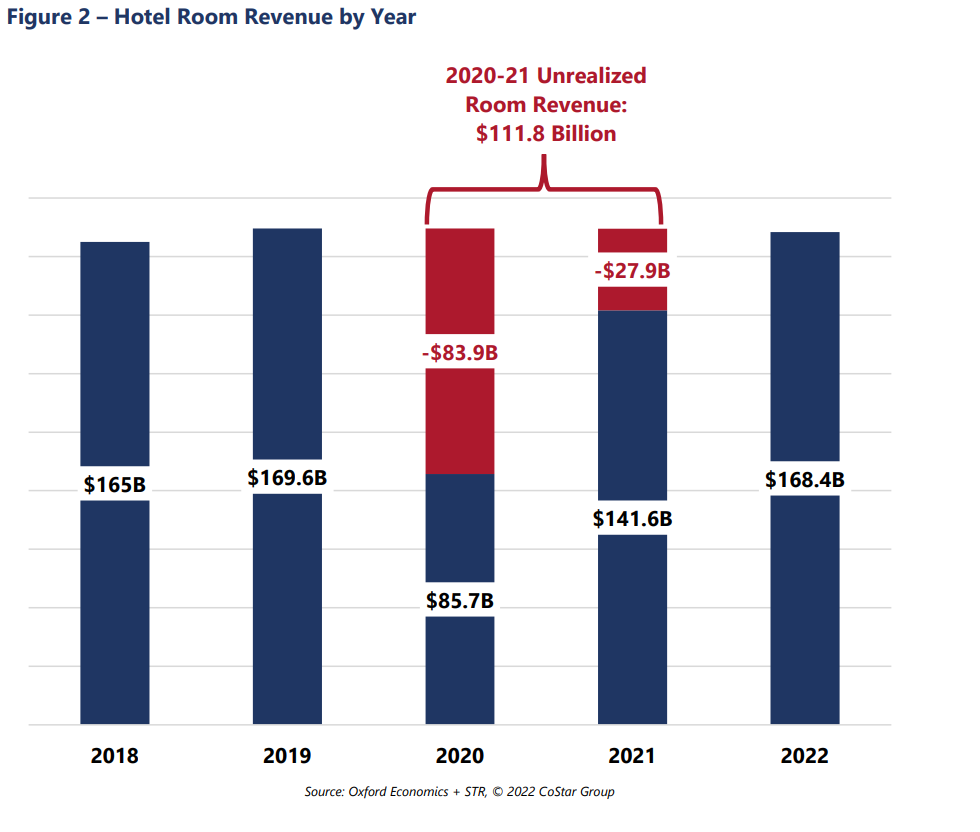
Total hotel industry real revenue ($2020) for the 21 years from 1998 through 2019 increased by a little less than 50% according to Bureau of Economic Analysis (BEA) figures.

Real consumer only (leisure) sales increased by nearly 100% during this period.

Real consumer sales per person increased by about two-thirds.

Resources

https://www.cushmanwakefield.com/en/united-states/insights/hospitality-and-gaming-lodging-industry-overview

https://apps.bea.gov/scb/2022/02-february/0222-travel-tourism-satellite-account.htm

https://www.bea.gov/tourism-satellite-accounts-data-sheets

https://fred.stlouisfed.org/series/CPIAUCSL#0

https://www.multpl.com/united-states-population/table/by-year

Other Historical Views

Domestic leisure travel doubled in the first 40 years of the 20th century.

https://data.bls.gov/pdq/SurveyOutputServlet

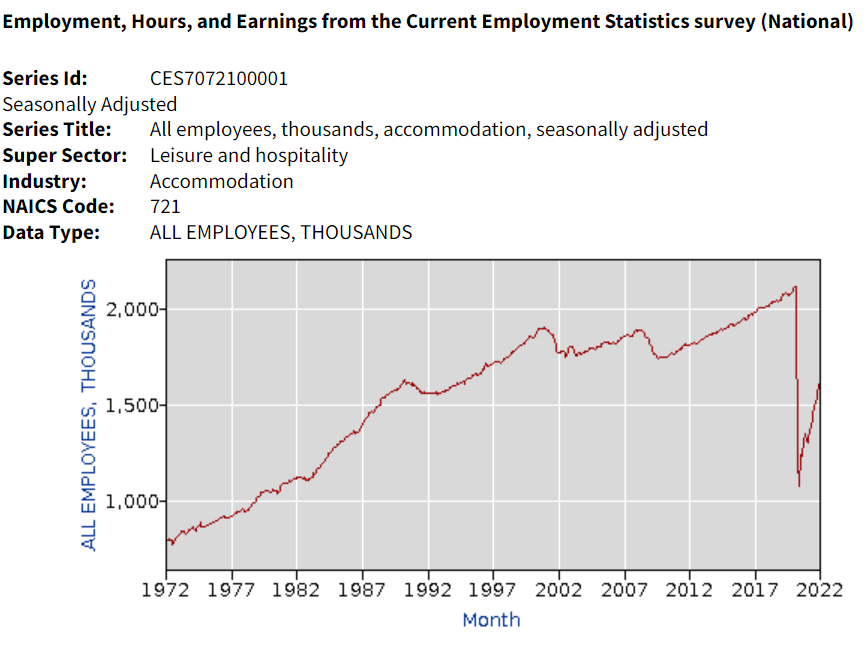
Hotel industry operating statistics before 1995 are not readily available. The tremendous growth of the industry in the last 30 years of the twentieth century is illustrated by the more than three-fold growth in industry employment, from one-half million to 1.8 million. Note that employment did not follow the growth of rooms during the first 20 years of the next century.

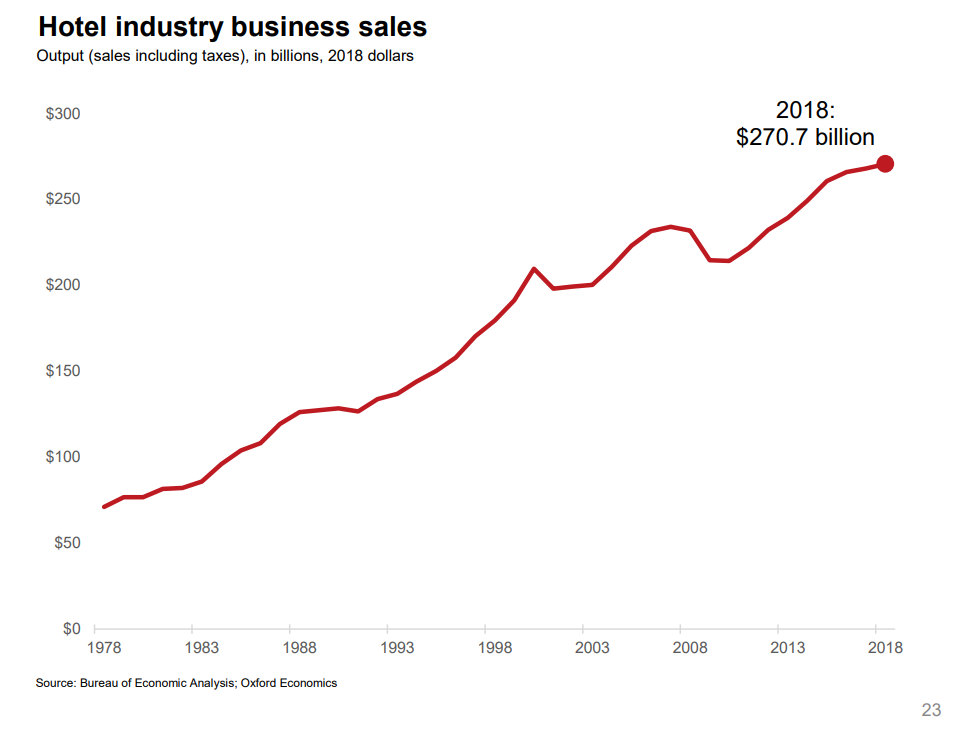
Oxford Economics developed an industry promotion brochure in 2019 that has some longer-term data. Total real (inflation adjusted) revenue is up more than 4 times in 40 years. Our 1995-2018 data shows relatively small changes in average hotel prices. I suspect that there were “real” increases from 1978 – 1995 as the industry was growing quickly in response to consumer demand.

A similar measure, gross domestic product (GDP), or production value added, net of the cost of inputs, increased 3-fold in 40 years.

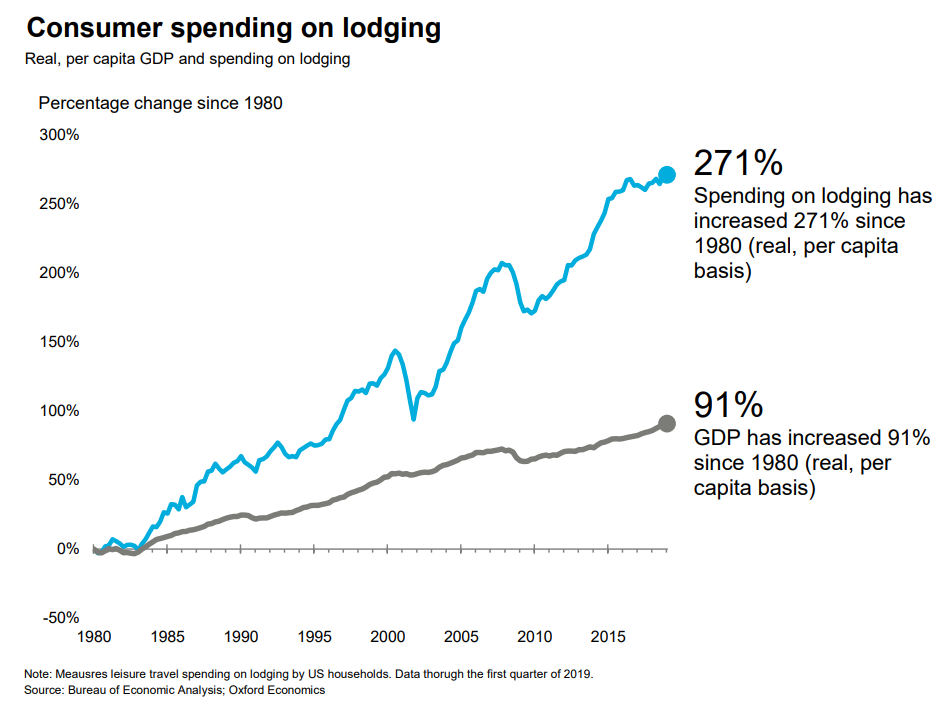
Consumer spending on accommodations has increased about 3 times as fast as GDP overall in the last 40 years.

Hotel purchases as a share of total consumer spending has increased by more than 80% in these 40 years.

Overall demand for hotel rooms per citizen for all uses (personal, business, government and foreign travelers) has increased by 20% across 30 years. Personal and foreign travel have grown at a faster rate.

https://www.hvs.com/article/8587-How-Many-Rooms-Is-Too-Many-Per-capita-Demand-and-the-Hotel-Cycle

Short-term Rentals

The short-term rental market (personal vacation rentals, Airbnb) has grown from zero to 10% of the hotel room volume and appears to have years of growth ahead of it. This growth is not included in the industry summary figures.

https://www.phocuswright.com/Travel-Research/Research-Updates/2017/US-Private-Accommodation-Market-to-Reach-36B-by-2018

https://www.grandviewresearch.com/industry-analysis/vacation-rental-market

Pandemic Impact and Future

Occupancy is forecast to return to the historical average of 63% for 2022 and increase further in the following years. The industry “lost” more than $100B of revenues due to the pandemic, so analysts estimate that the industry will return to “normal” employment, prices, profitability and reserves by 2025.

https://www.pwc.com/us/en/industries/hospitality-leisure/us-hospitality-directions.html

Summary

Consumer access to hotels and private rentals has increased by 3 or 4 times in the last 50 years, at a faster rate in the first 25 years, and somewhat slower in the last 25 years. Hotel business models at 63% occupancy seem to justify continued capital investments in new supply. Prices have been relatively flat for 25 years. Competition between brands, pricing segments, corporations and private owners seem to be effective at providing adequate capacity and service options at competitive prices.

25 Years of Inflation by Category

https://fred.stlouisfed.org/series/CWUR0000SA0#0

https://fred.stlouisfed.org/series/CWUR0000SAF#0
https://fred.stlouisfed.org/series/CWUR0000SAT#0
https://fred.stlouisfed.org/series/CWSR0000SAH
https://fred.stlouisfed.org/series/CWUR0000SAA#0
https://fred.stlouisfed.org/series/CWUR0000SAR#0
https://fred.stlouisfed.org/series/CWUR0000SAE#0
https://fred.stlouisfed.org/series/CWSR0000SAE2
https://fred.stlouisfed.org/series/CWSR0000SEEB#0
https://data.bls.gov/pdq/SurveyOutputServlet
https://fred.stlouisfed.org/series/CWUR0000SAG#0
https://fred.stlouisfed.org/series/CWUR0000SEGA#0
https://fred.stlouisfed.org/series/CPIMEDSL#0
Category97-20%97-22%%Share
All5975100.0
Food/Beverage648215.1
Transportation454521.9
Housing728539.9
Apparel-5-52.6
Recreation17224.4
Educn/Communicn27316.2
>Communication-25-23
>Tuition, Fees, Child Care165171
>>College Tuition191196
Other Goods/Services1221392.8
>Tobacco/Smoking362424
Medical Care1161257.1

Analysis

Inflation is back in the news after several quiet decades. The components of the All Urban Wage Earners and Clerical Workers are listed above, comparing Feb 2020 with a 1997 base of 100, and then Jan 2022 with the same base. The most recent weighting of categories is in the rightmost column.

Overall, consumer prices have risen by a modest 2-2.5% annually, just 59% through Feb 2020 and 75% through Jan 2022. Yes, that is a 10% price increase in the last 2 years: 175/159.

The 3 largest components have shown price rises close to the overall average. The biggest sector, Housing (39%), displays slightly higher inflation, at 72% and 85%, closer to 3% annually, with a possibility of higher rises for the next few years. Transportation (22%) reveals lower than 2% annual inflation with a 45% increase across the full period. Food and Beverage (15%) is close to the average with 64% and 82% growth.

Some smaller areas have seen slow price growth. Apparel (3%) has declined in actual prices during this period. Recreation prices (4%) have grown by less than 1% annually.

Education and Information (6%) prices have grown by 1% annually, but this category includes 3 very different subsectors. Information Technology prices have declined throughout the period. No simple 25- year summary is available. Communications prices have dropped by an average of 1% annually. Education prices have grown much faster, more than offsetting the decline in IT and communications prices. The Tuition, Fees and Child Care measure of prices increased by 165% and 171%, more than twice as fast as overall inflation, roughly 4% annually. College tuition (data not in Fred database) increased by 191% and 196%, about 4.5% per year.
The Other Goods and Services (3%) category mostly contains miscellaneous items that don’t fit cleanly in Housing or Food/Beverage. The category displays faster price increases (3.5%) on average due to the very sharp increase in Tobacco prices (taxes) which have grown 4-fold in 25 years (7%/year). Note that alcoholic beverage prices increased by a little more than 2% annually

Finally, Medical Care (7%) has grown by 116% – 125% during these 25 years, about 3.5% annually.

Overall goods prices have grown slowly and service prices more rapidly. Medical care and college prices stand out for their increases, while the price of housing/rentals is flashing warning signs.

The World is Not Atomistic, Deterministic, Materialistic

Blinded By “Science”

History of Atomism, Determinism, Materialism

Democritus in 300 BCE outlined a view of the world that has strongly shaped perceptions of reality to this day. All physical things can be reduced to smaller particles (atoms) that are irreducible. Everything can be “explained” by these particles.

https://plato.stanford.edu/entries/atomism-ancient/

The progress of science since 1500 has been shaped by a principle, called Occam’s Razor, which asserts that a simpler explanation is better than a more complex explanation. This is an untestable assertion, let alone a “law”, but the general progress of “science” and the “scientific method” since that time has reinforced this bias toward simple, rational, linear, logical explanations.

https://www.britannica.com/topic/Occams-razor

The progress of modern science was accelerated by Rene Descarte’s 3-dimensional right-angle coordinate system of space. It led to the belief that all space was composed of a substance called “the ether”. Physics experiments showed that this “materialist” view of space was inaccurate.

https://www.encyclopedia.com/reference/encyclopedias-almanacs-transcripts-and-maps/ether-physics-and-astronomy

However, the progress of science reinforced the atomist, determinist, materialist concept of the universe through the end of the 19th century (1800-1899).

https://plato.stanford.edu/entries/atomism-modern/

Early Modern Physics was Not Atomistic, Deterministic, Materialistic.

Newton defined concepts and equations for gravity and calculus. These were true breakthroughs, but perhaps misinterpreted as purely mechanical breakthroughs.

https://www.goodreads.com/quotes/168406-nature-and-nature-s-laws-lay-hid-in-night-god-said

To this day, we can describe gravity, but we have no idea how it works through space and time and matter. Gravity does not reinforce atomistic concepts, it challenges them with the notion of force at a distance, affecting those atoms.

https://science.howstuffworks.com/environmental/earth/geophysics/question232.htm

The next major progress in physics was in describing “waves”, as they flowed between atoms. Curvilinear, not linear. Waves have a role to play in mechanics, but they are more important in electromagnetic waves.

The equivalence of electricity and magnetism was one of the first true innovative discoveries in modern physics. Counterintuitive. Not atomistic. Not easy to understand. Not understood by most.

Click to access CHAP03.PDF

The role of heat or thermodynamics in physics and chemistry was one that allowed atomistic views to continue into the 20th century. With a plausible description of probablistic Brownian motion, the atomistic view remained ascendant through 1900.

Click to access CHAP03.PDF

Research into the “nature” of the atom eventually revealed that atoms were comprised of “particles”: protons, neutrons and electrons. However, the tiny electrons did not stand still. They rotated about the core of protons and neutrons. They also rotated at specific fixed distances away from the center of electrons. Or, they “tended” to appear at these 4 distances (SPDF) away from the center, based on a very complicated probability function. Atomistic, deterministic, materialistic concepts did not apply. This did not destroy the atomistic world view, I know not why.

Modern Physics Rejects Atomism, Determinism, Materialism: Einstein

Einstein showed that time is “relative” to other factors in the universe (gravity/speed). The simple world view of “fixed” time is wrong.

https://www.sciencealert.com/watch-the-famous-twin-paradox-of-special-relativity-explained

Einstein’s theory also asserted that space is curved, rather than linear as always assumed previously. No simple “billiard ball” universe.

https://en.wikipedia.org/wiki/Curved_space

Einstein did not like the new “quantum theory” of the universe that was described in his time. The inherently probabilistic nature did not resonate with him, even though the physics community adopted it.

https://www.livescience.com/65697-einstein-letters-quantum-physics.html

Einstein was a “determinist” at heart and devoted his later life to finding a way to reconcile the very different “forces” of gravity, electro-magnetism and atomic forces. He failed to find a simple, deterministic explanation of the universe.

https://www.aps.org/publications/apsnews/200512/history.cfm

Modern Physics Rejects Atomism, Determinism, Materialism

The universe appears to have a history and a future, it is not static.

https://www.space.com/25126-big-bang-theory.html

Light is a wave. No, it is a particle. No, it is both.

https://www.thoughtco.com/wave-particle-duality-2699037

All of reality is based on probability. Quantum theory of physics says that particles are connected/entangled at a distance. We don’t know which reality is real until we observe it.

https://www.discovermagazine.com/the-sciences/schroedingers-cat-experiment-and-the-conundrum-that-rules-modern-physics

How Bell’s Theorem Proved ‘Spooky Action at a Distance’ Is Real

If we try to observe nature more closely, we effect nature. Hence, we can never, ever, really know the world.

https://scienceexchange.caltech.edu/topics/quantum-science-explained/uncertainty-principle

The very best modern physics theory that attempts to integrate gravity, electromagnetic forces and atoms is “string theory”. It has no experimental evidence, only logic to support it. A world of “many dimensions” is far removed from an atomistic world.

Other Modern Applications of Probability or Non-Determinist Logic

Darwin’s theory of natural selection is based upon probabilistic events. Sexual reproduction. Genetic changes. Population results.
True Darwinism Is All About Chance

Mathematicians attempted to “systematize” their discipline at the end of the 19th century. Bertrand Russell was the leader.
https://en.wikipedia.org/wiki/Principia_Mathematica

Unfortunately for those who longed for a solid, formal structure, Kurt Goedel proved in 1931 that any logical system worthy of the name of mathematics could not be proven from a finite set of obvious first assumptions. Mathematicians, physicists and other scientists had long looked at classical logic and geometry as a model for their work. Goedel showed that this was impossible. Again, the world should have digested the implications of this HUGE change, but due to the complexity of the arguments it was, and has been, largely ignored.

https://www.britannica.com/topic/Godels-first-incompleteness-theorem

Modern portfolio theory, the basis of our financial system, is based upon system level probabilities.

https://en.wikipedia.org/wiki/Modern_portfolio_theory

Political theorists have determined that no voting system can fully represent the preferences of the voters.

https://www.investopedia.com/terms/a/arrows-impossibility-theorem.asp

All modern scientists conduct experiments trading off alpha and beta risks. The hypothesis may be right, but stats say it is wrong. The hypothesis may be wrong. but the stats say it is right. This is an unavoidable conflict. No deterministic system can solve this.
https://www.investopedia.com/terms/a/alpha-risk.asp

Determinist Philosophy

The scientific community, in reality, works based on existing paradigms, and changes its views slowly based upon new evidence and new paradigms.

https://www.theguardian.com/science/2012/aug/19/thomas-kuhn-structure-scientific-revolutions

Human consciousness remains a challenge to the deterministic world view.

The practical use of machine learning / artificial intelligence does not use pure logic. It searches for probabilistic patterns.

https://mitsloan.mit.edu/ideas-made-to-matter/machine-learning-explained

Summary

Atomism, determinism, materialism is an attractive view of our universe. However, we have much evidence to reject this world view. Our world is based on multiple levels of reality and probability. Most of it is “logical” and consistent, but it cannot be simply reduced to a mechanistic base.

Top 50 – 1963

The British Invasion had not started. R&B dominated the charts (17). Leading men (10) and women (4) were still featured. A few foreign/novelty hits (4). Blues (2) and folk (4) songs were revived. A few rock (3) and C&W (5) songs. The Beach Boys’ sound was brand new (4).

R&B – Ladies

R&B – Men

Leading Ladies

Leading Men

Novelty/Foreign

Blues

C&W

Folk

Rock

California

Why is Inflation 7%?

https://fred.stlouisfed.org/series/CPIAUCSL

Easy Monetary Policy

https://fred.stlouisfed.org/series/FII10

The “real” interest rate is the nominal interest rate minus the inflation rate. It reflects the “real” cost of borrowing. Prior to the “Great Recession”, 2% was a typical “real cost” of borrowing money. To entice lenders to lend, borrowers had to pay some “real” amount extra per year, 2%.

The Federal Reserve did what it could to “ease” monetary conditions and lower interest rates to offset the negative impact of the Great Recession in 2008-9.

By the end of 2011, real rates were ZERO or negative. In other words, the Fed went too far. By June, 2013, rates returned to positive territory, but only reached 0.5%, where they remained through the end of 2017, despite president Trump’s complaints that the Fed was constraining the Trump economy. Monetary policies were “easy” for a very long 7-year period.

By May, 2019, real interest rates were back to just 0.5%, having reached a peak of just 1% for 3 months at the end of 2018. With further “easy” money policy, real rates dropped back to ZERO percent by August, 2019. The economy was now 9 years into recovery. Interest rates should have been higher.

The Fed found new ways to “ease” monetary policy as the pandemic struck in 2020. Real interest rates dropped to -1% and stayed there. Monetary policy has been “easy” for more than a decade. Time for inflation. “Too much money chasing too few goods”. “Inflation is always and everywhere a monetary phenomenon”.

Supply Chain Disruption

The recovery has been faster than anyone expected, but most critically, with consumers less eager to buy “in-person” services, they have greatly increased their purchases of goods. The modern US economy relies on imports and modern manufacturers and retailers hold lower inventories to buffer changes.

https://fred.stlouisfed.org/series/ISRATIO

https://fred.stlouisfed.org/series/PCEDGC96

Yes, durable goods purchases jumped by 20% in 1 year, from $1.8T to $2.2T. Businesses have simply been unable to adapt to that scale of change.

Easy Fiscal Policy / Large Budget Deficits

https://fred.stlouisfed.org/series/FYFSGDA188S

Standard macroeconomic theory focuses on aggregate demand versus aggregate supply as the key driver of output, unemployment and inflation. When total demand grows faster than remaining excess capacity of total supply, inflation results. The biggest driver of changes in aggregate demand is the level of government spending (demand) minus government taxation (reduces demand).

Historically, various pressures have kept the federal budget deficit between -3% and +3% of GDP, allowing the government to buffer change in private demand through the business cycle. The large drop from -2.5% to -5% in 1979-82 was a factor that contributed to the last major round of US inflation. A similar decline from -2.5% to -4% in 1989-91 increased inflation, but not on such a large scale. It also served to convince President Clinton and congress to reduce the deficit to ZERO by 1997 and run a surplus for a few years.

The 2001 recession caused a 2.5% decrease in this ratio, from a surplus to a deficit. Bush tax cuts, foreign wars and congressional agreement lead to deeper deficits at 3.3% in 2003-4, before some recovery to -1% in 2007, prior to the Great Recession.

Bush, Obama and congress agreed to spend more to fight the Great Recession, pushing the deficit to a worryingly low -9.8% in 2009. There was no agreement on a second major round of spending, so the deficit improved a bit to -6.6% by 2012 and then to a more reasonable -2.5% in 2014-15. Instead of continuing to improve with the economic recovery, it fell a little, to 3.1% in the last year of the Obama economy.

President Trump’s first order of business was to enact “job creating” tax cuts. Unfortunately, the desired boost to economic growth to fund these tax cuts did not occur. The budget deficit increased from 3.1% to 4.6% of GDP, as the economy reached a record long recovery period of a full decade.

To address the pandemic, congress and Trump agreed to spend money to protect the economy and workers, leading to very large budget deficits of 15% and 12% in 2020 and 2021, respectively. Too much aggregate demand for the level of aggregate supply, so we have major inflation.

Summary

Easy money, easy fiscal policy and a 20% increase in demand for goods leads to major inflation. Like a frog getting boiled as a pot slowly warms up, we became complacent based on the apparently “just right” conditions of the late teens (2012-19). The federal budget deficit needs to get back above -5%, real interest rates need to become positive and consumers need to rebalance to consume more services and less goods. I don’t think we’ll see 7% inflation for 2022, but it looks like 4-5% is a good bet. Hold on.

Politics

Biden deserves a good share of responsibility for the government spending budget deficit, as he was seeking to make it even larger. I give him a “pass” on consumer demand for durable goods since it mostly occurred before he started. I also give him a “pass” for the loose Fed monetary policy which has been going on for a decade or so. He was wise to reappoint the Fed chairman, who I believe will raise interest rates as needed to get the real interest rate back to a proper level. In the meantime, Biden will pay politically for higher inflation, which has a “real” impact on the wallets of voters.

https://apnews.com/article/coronavirus-pandemic-business-health-prices-inflation-bd71ae9e491907a51956c1d4eb07fb90