Good News: 30 Topics

US Cars Last Twice as Long

US Libraries Have Adapted to the Digital Age

Air Conditioning is Nearly Universal in the US

US Housing Market Supply and Values are Growing

Unemployment Rates for Younger Works are Lower

More Earned Doctorates

More College Students Study Abroad

Growing US Exports

Hotel Options

Not “Living in a [Strictly] Material World”

Apparel prices

On-line Access

Lower Airfares

Agriculture Productivity Improvement Continues for Centuries

Take Care of Our Pets

Lawyers are Less Influential

More Beer Options!

More Car Choices

More Parks

More Women in Politics

Lower Consumer Debt

Less Air Pollution

Fewer Abortions

Fewer Fires

More Science Degrees

More College Grads

More High School Grads

More Charitable Giving, US is a Leader

Illegal Immigration is Down

Traffic Fatalities are Down

IQ Scores Rise

Good Economic News

Better off, job seekers/job openings.

US GDP/Capita versus Other Countries

Long-term Real US GDP Growth

6 million jobs added in 2021

Great Labor Market

Higher Effective Minimum Wage

Very Low Unemployment

Are You Better Off Economically? Yes!

Labor Productivity

Labor Force Participation

Good News: Apparel Prices

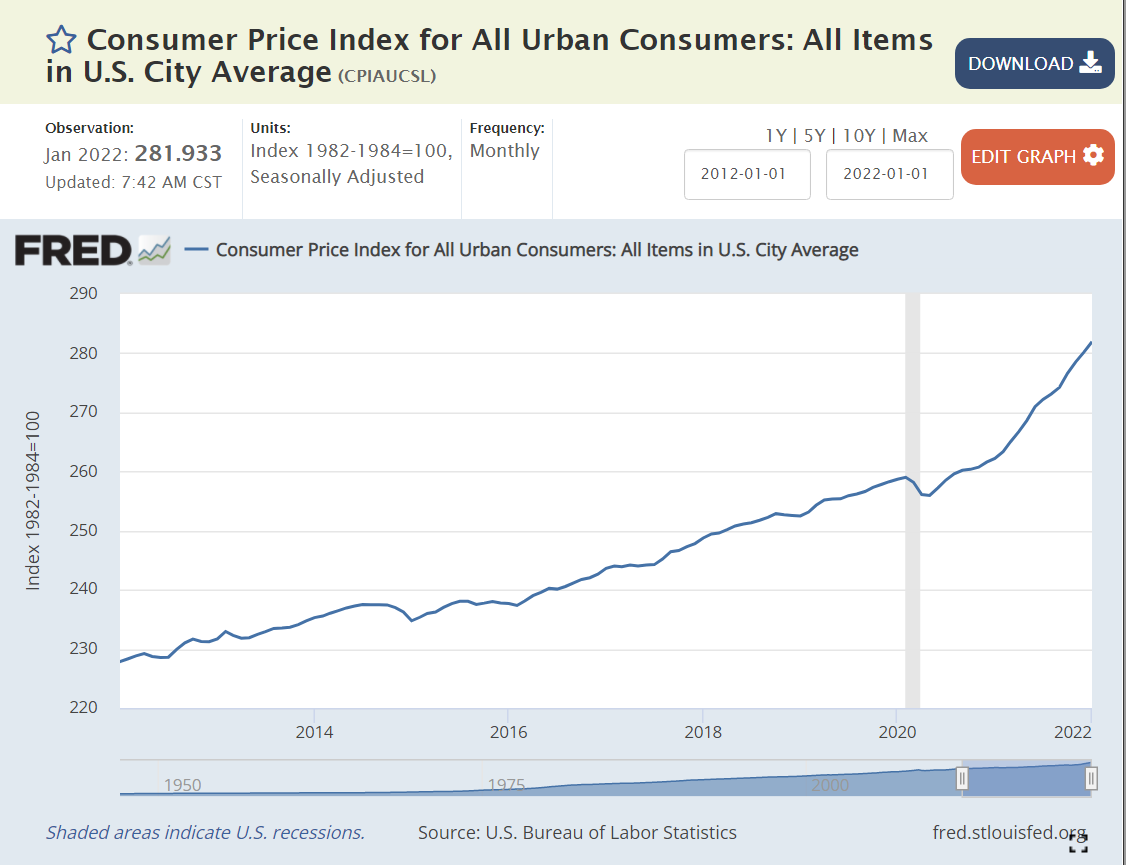
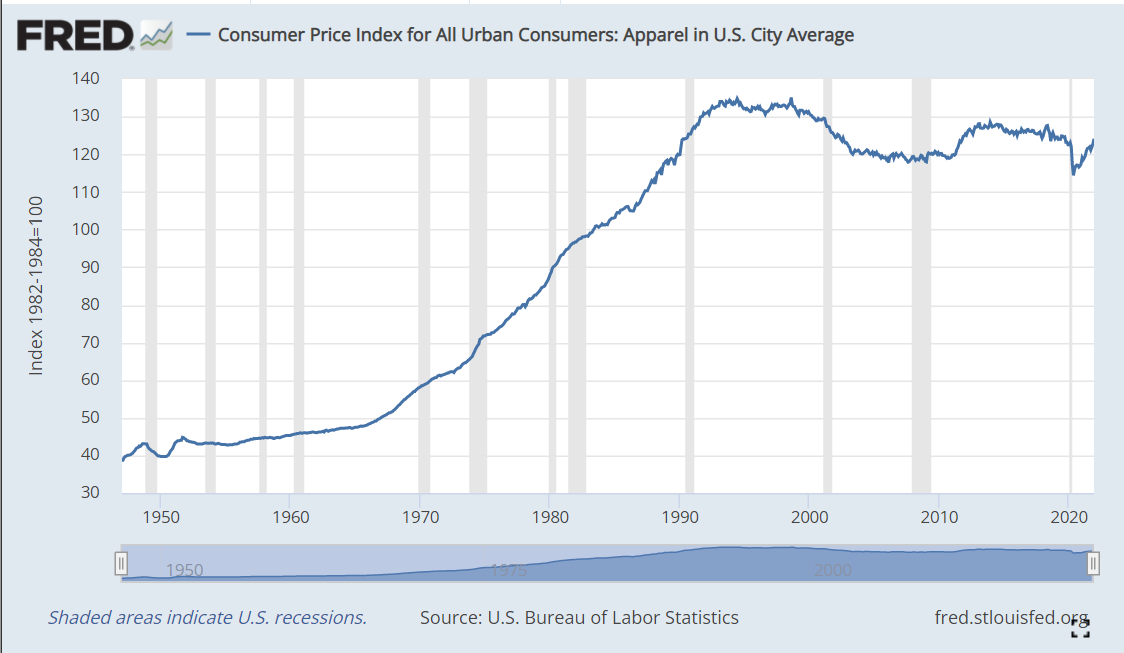
The nominal/actual average price of clothing today in the USA is 3% LOWER than it was 30 years ago, in 1991!!! Meanwhile, the overall consumer price index (CPI), has more than doubled (+106%). So, the price of clothing, relative to overall prices, has dropped by a mind-boggling 53% in the last 3 decades!

This is on top of the 37% real reduction in prices from 1970 to 1991.

From 1960 to 2021, the real reduction in clothing prices is a full 71%. More than two-thirds.

https://fred.stlouisfed.org/series/CPIAPPSL

https://fred.stlouisfed.org/series/CPIAUCSL

This illustrates the benefits of “free trade” to US consumers.

Money / Clothing for nothing …

Good News: Are You Better Off? (2)

Ronald Reagan taunted Jimmy Carter with this question to voters in the 1980 debates. It helped him win.

Twelve years later, James Carville helped Democrats return from the political wilderness in 1992 with his advice to Bill Clinton that “it’s the economy, stupid”.

https://en.wikipedia.org/wiki/It%27s_the_economy,_stupid

Politicians have used various measures, from unemployment to inflation to the “misery index” to jobs created to productivity to the stock market, to promote their success and detract from their opponents.

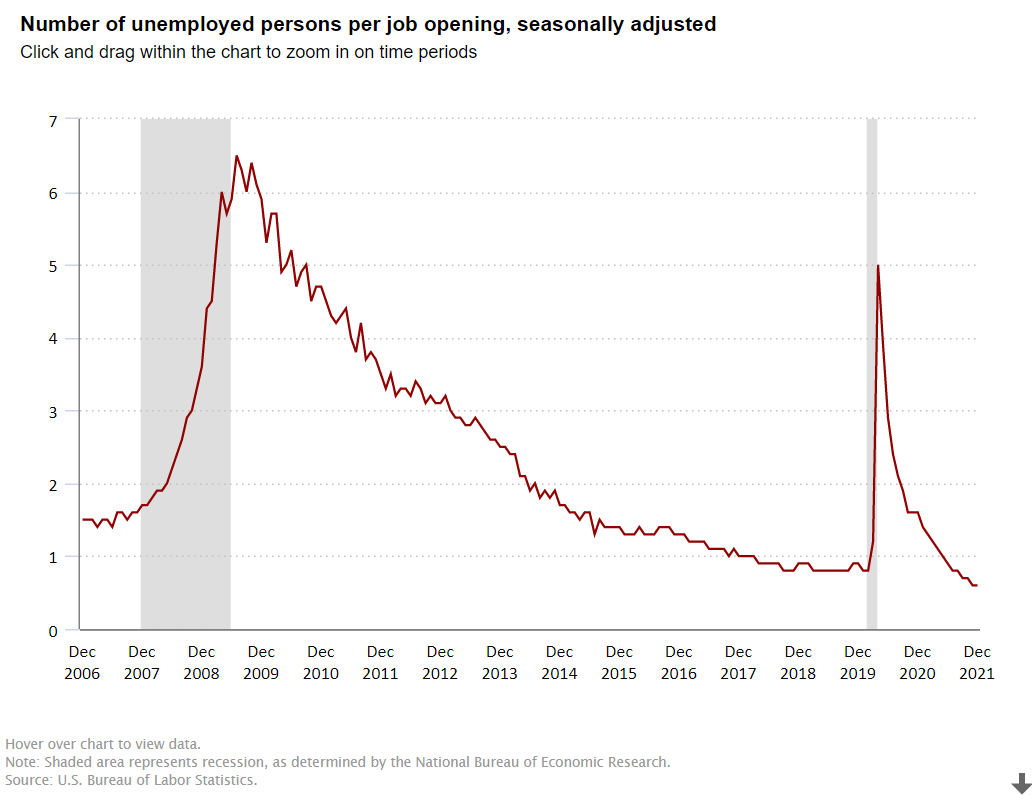
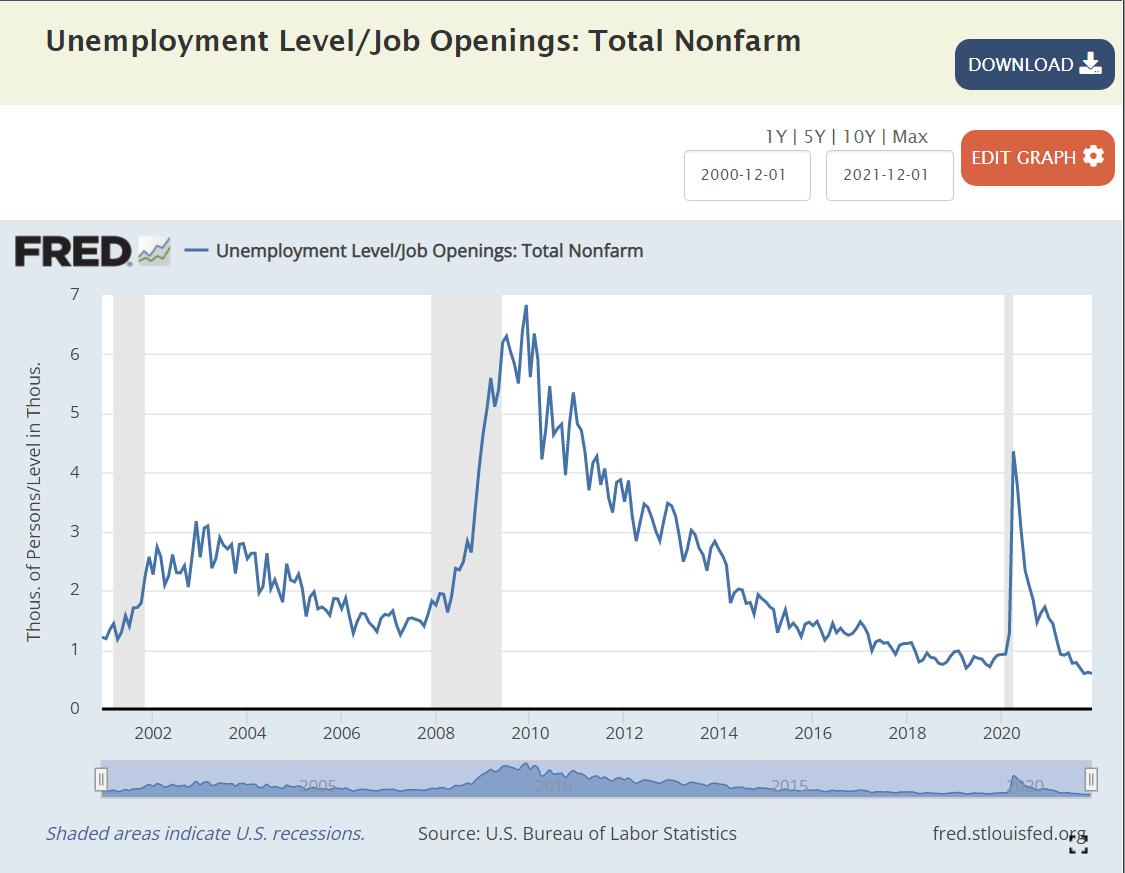
I want to focus on one measure, the ratio of the number unemployed to the number of job openings, to highlight the strength of the American economy in the last dozen years.

https://www.bls.gov/charts/job-openings-and-labor-turnover/unemp-per-job-opening.htm

https://fred.stlouisfed.org/graph/?g=p9aA

George W. Bush: Jobless Recovery in the “aughts”

The Bush economy was widely criticized for its “jobless recovery” following the economically healthier Reagan and Clinton presidencies. The presidency started at close to 1 unemployed person per job opening. The recession pushed this up to 2.5x and then 3.0x. In labor market terms, this is a huge difference. At 1:1 or 1.5:1, unemployed workers expect to be re-employed quickly. At 3:1, some may enter the dark days of the “long-term unemployed”. After 3 years, the economy DID recover to 1.5:1, but it was unable to improve further. The “Great Recession” was a brutal job killer, pushing this measure of labor market tightness up four-fold, from 1.5X to more than 6X before its peak in the first half of 2010, as Obama and congress and the federal reserve bank wrestled with the situation.

Obama: Recovery and “New Territory”

Between April, 2010 and April, 2012, the economy cut this ratio in half, from 6x to 3x, a very solid performance. It took 3 years, until April, 2015, to complete the next 50% reduction, from 3x to the historically “very solid” 1.5X. The economy continued its growth for the next 2 years, but at a slower pace, reducing this ratio to 1.3X.

Trump: Even Better

The Trump economy continued to improve for the first 18 months of his term, reducing this ratio from 1.3X to 0.8X by September, 2018. This was a time of record low unemployment and economists recalculating their standard of “full employment”. While the economy continued to grow, the unemployment rate continued to decline and the stock market continued to climb, THIS measure had reached its minimum before the 2018 mid-term elections. It remained steady at the very positive level of 4 job seekers for every 5 jobs (0.8) for the next 17 months, until the pandemic disrupted everything. The ratio quickly shot up to 5X, not as high as the 6X that Obama faced, but very high. It quickly recovered to 1.4X by the end of Trump’s term. This was partly job recovery and partly fewer job seekers, but it was an amazing recovery in historic terms. Recall that 1.5X was “a good as it got” during George W. Bush’s presidency.

Biden: Even Better, Again !

In the first 6 months of the Biden presidency, this ratio dropped from 1.4X back down to the prior record level of 0.8X. Yes, by July, 2021, there were 5 jobs available for every 4 job seekers. This was as low as the ratio had previously fallen, even as the Trump economy piggybacked on the Obama economy and continued its extraordinary run. The ratio continued to fall in the next 6 months to 0.6X, an unheard-of level. 5 jobs for every 3 job seekers. It’s “no wonder” that voluntary job quits are at unprecedented levels. For, perhaps, the first time in American history, “everyone who wants to work, can find a job”. Whether you are right or left, Dem or Rep, this is “good news”. This is “great news”. Wages for the “bottom 20%” are rising in real terms. Income inequality is declining, a bit. The economy seems to be able to digest this new condition. And, the economy is not done growing, innovating, creating businesses, creating jobs, exporting, etc. About 2% of Americans are likely to be attracted back into the workforce in the next year or two, keeping the headline unemployment rate from going much below 4%, but pushing US real GDP growth to 4% in 2022 and close to 4% in 2023.

Summary

The “Great Recession” and the “once in a century pandemic” have been unable to disrupt the ongoing progress of the American economy and labor market. As a nation, IMHO, we have cultural and political challenges, but we “aught” to appreciate the power of the American economy to move forward.

Good News: We’re (Almost) All On-line

Cable TV Subscriptions

https://www.economist.com/business/2019/05/09/american-pay-television-is-in-decline

https://en.wikipedia.org/wiki/Cable_television_in_the_United_States

Hey! Quick Summary

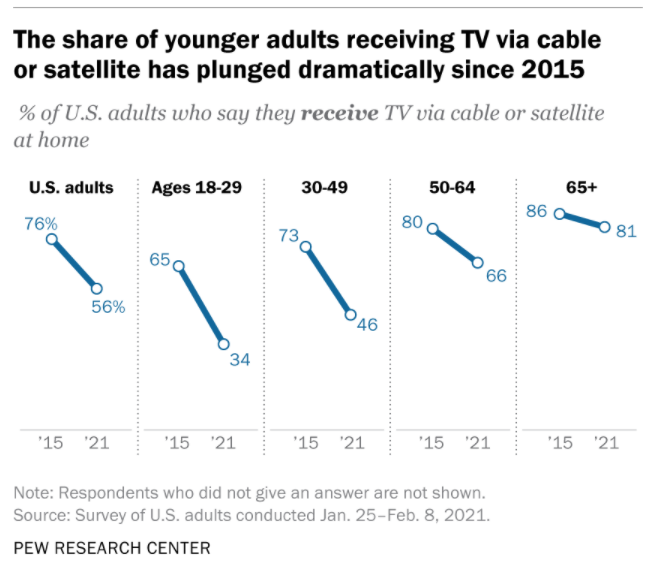
Cable TV subscribers and networks grew rapidly through the 1980’s and 1990’s reaching near universal availability. US subscribers plateaued from 2009-2014 at 100 million before rapidly declining to 74million in 2021. As the first graph shows, much of the decline has been a substitution of internet for cable access to media content. This is “good news” because everyone that wants it has access, but a new, better product has started to rapidly displace this 50 year-old technology.

Desktop/Laptop Computers

Ownership of a home desktop or laptop computer also remains near universal, at 77% in 2021. The ownership of tablet computers has risen from 14% in 2012 to a majority of homes (53%) in 2021.

Broadband Internet Access at Home

Broadband internet access has rapidly grown from 1% of homes in 2000 to 58% in 2008 to 77% in 2021. The retired generation (65+) lags behind at 64% connectivity. Black (71%) and Hispanic (65%) homes are below the average. Rural residents are also less connected (72%).

Internet Users

Pew Research also reports that the percentage of individuals that are internet users has nearly doubled from 52% in 2000 to (near universal) 93% in 2021. About three-fourths of older individuals (65+) are “surfing the web”. 97% of others are connected. There is no major difference between racial categories. Rural citizens are little less engaged (90%).

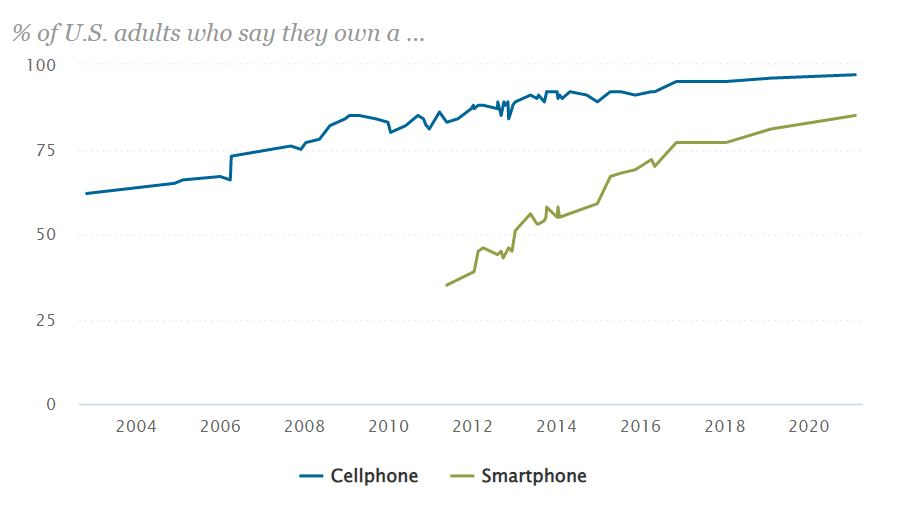
Mobile Phone and Smart Phone Owners

Mobile phone ownership has grown from 62% in 2002 to 97% today. Seniors (65+) have slightly lower ownership rates (92%). Racial groups have the same ownership. Rural residents have slightly lower ownership rates (94%).

Smart phone ownership has grown rapidly from 35% in 2011 to 77% in 2016 to 85% in 2021. Ownership rates vary by age: 18-49 (95%), 50-64 (83%) and 65+ (61%). There is no racial ownership gap. Rural residents have an 80% ownership rate.

Summary

Although we saw news coverage during the pandemic which highlighted the imperfect access to electronic devices and network required for effective on-line learning, the US is approaching a state where nearly everyone has access. Cable TV access is now post-peak. TV network access is increasingly through the internet. Broadband access is the weakest measure at 77% ownership. Cell phone ownership is universal and smart phone ownership will reach that level before the end of the decade.

Postscript: Economic Impact = 10% of GDP

Industry associations, journalists and consultants wrestle with each other to capture and communicate the economic value added by personal computers, smart phones and the internet. In rough terms, about 10% of GDP is due to the direct and indirect value of these technologies that did not exist in any economically material amount in 1980, just 40 years ago. Good news? No, GREAT NEWS.

https://www.reuters.com/article/us-usa-internet-economy/internet-sector-contributes-2-1-trillion-to-u-s-economy-industry-group-idUSKBN1WB2QB

https://www.iab.com/news/study-finds-internet-economy-grew-seven-times-faster/

Good News: Real Airfares are 43% Less than in 1995

This article combines data from 4 sources with slightly different data. Airfares were flat at the end of the 20th century, but then dropped by 19% by 2004. They remained flat, in real terms, through 2009. Airlines pushed through 8% higher prices in 2010-11 and maintained real fares at the same level through 2014. After 19 years, real airfares were 14% lower than in 1995.

Fares then dropped year after year through 2019, reaching 26% below the 1995 baseline. They have fallen further in the pandemic years to 43% below the level of 25 years ago.

Bureau of Labor Statistics / CPI

The Bureau of Labor Statistics compiles a consumer price index for air travel as part of the overall CPI. It compiles average prices and tries to adjust for changes in the quality of the product.

https://data.bls.gov/timeseries/CUUR0000SETG01?output_view=data

https://www.bls.gov/cpi/factsheets/airline-fares.htm

https://www.bts.gov/content/annual-us-domestic-average-itinerary-fare-current-and-constant-dollars

https://fred.stlouisfed.org/series/CPIAUCSL#0

https://fred.stlouisfed.org/series/CUSR0000SETG01#0

Bureau of Transportation Statistics

https://www.bts.gov/newsroom/figure-1-us-average-domestic-annual-fares-1995-2020

BTS graph and 20 more about the airline industry.

https://www.airlines.org/dataset/the-air-travel-value-proposition/

BTS: Revenue Per Passenger Mile

https://www.bts.gov/content/average-passenger-revenue-passenger-mile-indexes

Dept of Transportation: Average RoundTrip Fares

https://www.airlines.org/dataset/annual-round-trip-fares-and-fees-domestic/

Prior 25-50 Years

Real airfares declined consistently throughout the period, but no data source is fully compatible with the 4 summarized above. It appears that the real cost of flying declined by about one-third between 1979 and 1995 as the airline industry was deregulated.

https://www.travelandleisure.com/airlines-airports/history-of-flight-costs

https://www.travelandleisure.com/airlines-airports/airfare-cost-change

See How the Cost of a Flight Has Changed Since 1963 [Charts]

Air Industry Productivity (How’d they do it?)

https://www.econlib.org/library/Enc1/AirlineDeregulation.html

https://www.bls.gov/opub/mlr/2017/article/economic-productivity-in-the-air-transportation-industry.htm

Results of State Covid Strategies

Many states have legislatures and governors from the same party and voted for this party in both the 2016 and 2020 presidential elections. These states have adopted quite different Covid management strategies. There are 14 solidly Democratic states and 21 solidly Republican states, leaving 15 states with some level of “mixed” political control and influence.

https://ballotpedia.org/Partisan_composition_of_state_legislatures

https://www.ncsl.org/research/about-state-legislatures/partisan-composition.aspx#

https://www.cnn.com/election/2020/results/president

https://www.politico.com/2016-election/results/map/president/

https://en.wikipedia.org/wiki/List_of_U.S._states_and_territories_by_population

Fully Vaccinated, Age 18+

Democratic states average 80%, Republican states 66% and Mixed states 73%. The national average is 72%. Nevada (69%) is the only Blue state below 75%. Alabama, Wyoming and Mississippi have the lowest scores for the GOP at 59-60%. Florida has the highest rate at 75%. The split in world views is confirmed by this measure. The mixed group ranges from Louisiana and Georgia at 63% to Massachusetts (85%) and Vermont (86%).

https://covid.cdc.gov/covid-data-tracker/#vaccinations_vacc-total-admin-rate-pop18

Cumulative Death Rate / 100,000 Population

The overall death rate for the country is 256. The mixed states are similar at 265. The Democratic states average 221 deaths per 100K people. The Republican states average 282 deaths per 100K people. If the Republican states had the same rate as the Democratic states, they would have 59 fewer deaths per 100K people, for a cumulative total of 70,000. Economists use $10M as the value of a life in many cost-benefit calculations, so one measure of the difference is $700B.

California (196) and New York (227) drive the lower D result, but the Dems include higher fatality states such as Rhode Island (305) and New Jersey (344). The mixed states include some relatively high death rates in Michigan (315), Louisiana (329) and Arizona (350). The Republican group includes 3 states below the D average in Utah, Alaska and Nebraska, but 7 states at 300 or higher: Oklahoma, Indiana, West Virginia, Arkansas, Tennessee, Alabama and Mississippi.

https://covid.cdc.gov/covid-data-tracker/#cases_deathsper100k

As the median age for Covid deaths is 75, an argument could be made that the $10M economic value of a human life is too high in this analysis.

https://www.cdc.gov/nchs/nvss/vsrr/covid_weekly/index.htm#SexAndAge

Population density and the percentage of population aged 65+ did not have statistically material impacts on the pattern by political party control.

https://www.census.gov/data/tables/time-series/dec/density-data-text.html

Nonfarm Employment Recovery: Nov 2021 vs. Feb 2020

Overall employment is within 2% of the February, 2020 peak for the country as a whole. The “mixed” states have recovered to within 2.3% of the peak. The Democratic states are only at 96.4% of the peak, while the Republican states, on average, are just below breakeven at 99.9%. If the D states had the same level of recovery, there would be 1.8M jobs added in the recovery to date. At the recent median $1,000 per week wage, this would generate $94 billion of income annually.

https://www.bls.gov/news.release/laus.t03.htm#

https://view.officeapps.live.com/op/view.aspx?src=https%3A%2F%2Fwww.bls.gov%2Fsae%2Ftables%2Fannual-average%2Ftable-1-employees-on-nonfarm-payrolls-in-states-and-selected-areas-by-major-industry.xlsx&wdOrigin=BROWSELINK

I used the Feb 2015 to Feb 2020 period to generate a pre-Covid trend growth rate. This was 6.4% for the country, 5.4% for the mixed states, 7.0% for the D states and 6.7% for the R states. This indicates that the Republican faster recovery is not due to prior momentum. I used the 2020/2015 growth rate to create a solid estimate of the 2021/2020 recovery rate for each state (r = 0.63). It confirmed the 3%+ gap between the 2 parties was not due to prior trends. I also checked the percentage of 2019 employment in the leisure and hospitality sector, to see if this was driving the difference, but it did not have a material effect.

Mixed Political Control States

State% Vaccinated 18+Deaths/100KJob Recovery
AZ69350103
GA63304100
KS7025198
KY6628398
LA6332993
MD8221597
MA8531097
MI6731596
MN7720097
NH7715797
NC68192100
PA7530796
VT867893
VA8018698
WI7320597

Democratic Party States

State% Vaccinated 18+Deaths/100KJob Recovery
CA7919697
CO78187100
CT8627496
DE7625297
HA867988
IL7526396
ME8612696
NV6928397
NJ8334497
NM7929896
NY8422793
OR7714098
RI8730596
WA80136101

Republican States

State% Vaccinated 18+Deaths/100KJob Recovery
AL5934399
AK7013994
AR62314100
FL75296101
ID63241105
IN6430898
IA7126397
MS6036099
MO6427799
MT64278101
NE73184100
ND6527196
OH6627396
OK6630097
SC6529399
SD7129499
TN63322100
TX70264102
UT74125106
WV6531296
WY6027695

Good News: US Agriculture

At the height of the cold war, in the year on my birth (1956), Soviet First Secretary Nikita Khrushchev warned the US that “we will bury you”. Agriculture was still a very large share of the USSR and US economies. He couldn’t have been more wrong.

https://en.wikipedia.org/wiki/We_will_bury_you

US statisticians have long separated the farm and nonfarm economies. A “census of agriculture” is conducted every 5 years to complement other economic statistics collected. The USDA Economic Research Service (ERS) does a great job of compiling statistics for the narrow (farming), moderate (fishing, timber) and broad (ag based production) agriculture industries.

I’ve chosen to examine the near 60-year period from 1959-2017 covered by the censuses of agriculture. During this time, Real (inflation adjusted) US Gross Domestic Product (GDP), the value of all goods and services produced, increased from $3 to $18 trillion dollars, a near 6-fold increase, or 3% annually, year after year after year.

We don’t have an economic series that tracks wage and salary income back before 1979, but real disposable income per capita exists for this whole time period. This indicator or labor costs increased 3.4 times, from $12,600 to $42,900, or 2.1% annually. Given the strong growth of the US economy and its many new opportunities AND the increase in labor costs facing the oldest industry, one might have agreed with the Soviet premier back in 1956, at least regarding US agriculture. But, that prediction was wrong.

Index of Unit Outputs

The US agricultural economy grew to more than 2.5 times its 1959 base by 2017. It grew by 75% in the first 30 years and an additional 50% on top of that new base. The consistent pattern of growth is striking.

Real Market Value Produced

The Ag economy grew (based on variable market prices) 5-fold from $80B to $390B during these six decades, increasing by 110% in the first 30 years and a compounded 130% in the most recent 30 years.

Land Input (Acres)

The amount of land dedicated to production agriculture has decreased by 20% during our period of focus, from 1.1B to 0.9B. The decline was faster in the first 30 years (14%) than the second 30 years (7%). Despite this reduced demand for agricultural land, the value of such land has increased in real terms as its productivity has grown.

Labor Inputs FTE

The full-time equivalent labor force in the ag industry, as best as the USDA can measure it, dropped by nearly two-thirds in our six decades, from 2 million to about 700,000. It fell more rapidly in the first 30 years (50%), but a solid 25% in the most recent 30 years.

Total Factor Productivity

Economists try to measure land, labor and capital as inputs to the agricultural production process. As noted above, land and labor have declined. Capital – equipment, improvements, patents, inventory, etc. has increased. Overall, the total inputs have remained roughly flat for 60 years. Hence, almost ALL of the increased unit output is due to increases in productivity. Better crops, better labor skills, better processes, better methods, better irrigation, better crop rotation and selection, etc. Economists call this “total factor productivity”. After accounting for measurable increased inputs, the remaining improvement is called “productivity”.

The oldest industry in the world, increased its productivity in the US by 150% in these six decades; by two-thirds in the first 30 years and by one-half on the higher base in the second 30 years.

Output per Labor Unit (Labor Productivity)

The strong increase in production combined with the two-thirds reduction in FTE labor required resulted in a 7-fold measure of improved labor productivity. The land input was down by 20% and the capital input increased significantly, but in simple terms, each hour of labor in 2017 delivered 7 times as much output as the labor in 1959. The increase was 2.5x in the first 30 years and a solid 2x in the more recent 30 years.

US Agriculture Output Price Index

The index of agricultural industry output prices has increased by 3-4x versus 8x for the consumer price index or GDP price index.

Real Market Value Produced Per Acre

The real market value of ag goods produced increased 5-fold. The land acres required declined by 20%. The output value per acre figure improved 6-fold. Again, labor inputs declined and capital inputs increased. This measure of land productivity improved by 150% in both of the first and second 30-year periods.

Real Agricultural Exports

Real ag exports increased 4-fold in these 6 decades, doubling in the first and second 30-year periods.

Summary

Less land and labor. More capital (equipment). Much better R&D and processes. Total factor productivity up by 150% across 6 decades, an average of 1.6% year after year after year.

The US ag industry faces many challenges today. Environmental issues and climate change. Water shortages. Lower public and private R&D investment. Brain drain. Political polarization. Concentration of key property rights. Low wage labor access. Changing trade rules. Nonetheless, the last 60 years indicates that this industry is capable of delivering further increases in production and productivity for the next 60 years.

Sources

https://fred.stlouisfed.org/series/B359RC1A027NBEA

https://www.ers.usda.gov/data-products/agricultural-productivity-in-the-u-s/

https://data.ers.usda.gov/reports.aspx?ID=17835

https://www.ers.usda.gov/topics/farm-economy/land-use-land-value-tenure/farmland-value/

https://www.ers.usda.gov/topics/international-markets-u-s-trade/u-s-agricultural-trade/us-agricultural-trade-at-a-glance/

https://fred.stlouisfed.org/series/B181RC1Q027SBEA#0

https://www.ers.usda.gov/topics/international-markets-u-s-trade/u-s-agricultural-trade/outlook-for-u-s-agricultural-trade/

https://www.govinfo.gov/app/collection/ERP/2005

https://view.officeapps.live.com/op/view.aspx?src=https%3A%2F%2Fwww.govinfo.gov%2Fcontent%2Fpkg%2FERP-2005%2Fxls%2FERP-2005-table102.xls&wdOrigin=BROWSELINK

https://www.ers.usda.gov/data-products/ag-and-food-statistics-charting-the-essentials/farming-and-farm-income/

https://www.ers.usda.gov/data-products/ag-and-food-statistics-charting-the-essentials/agricultural-trade/

https://www.ers.usda.gov/data-products/ag-and-food-statistics-charting-the-essentials/agricultural-production-and-prices/

https://www.ers.usda.gov/data-products/agricultural-productivity-in-the-u-s/summary-of-recent-findings/

https://view.officeapps.live.com/op/view.aspx?src=https%3A%2F%2Fwww.ers.usda.gov%2Fwebdocs%2FDataFiles%2F47679%2Ftable01.xlsx%3Fv%3D6711.9&wdOrigin=BROWSELINK

https://www.ers.usda.gov/topics/farm-economy/land-use-land-value-tenure/farmland-value/

https://www.ers.usda.gov/topics/international-markets-u-s-trade/u-s-agricultural-trade/us-agricultural-trade-at-a-glance/

https://fred.stlouisfed.org/series/B181RC1Q027SBEA#0

https://www.govinfo.gov/app/collection/ERP/2005

https://view.officeapps.live.com/op/view.aspx?src=https%3A%2F%2Fwww.govinfo.gov%2Fcontent%2Fpkg%2FERP-2005%2Fxls%2FERP-2005-table102.xls&wdOrigin=BROWSELINK

https://fred.stlouisfed.org/series/OPHNFB