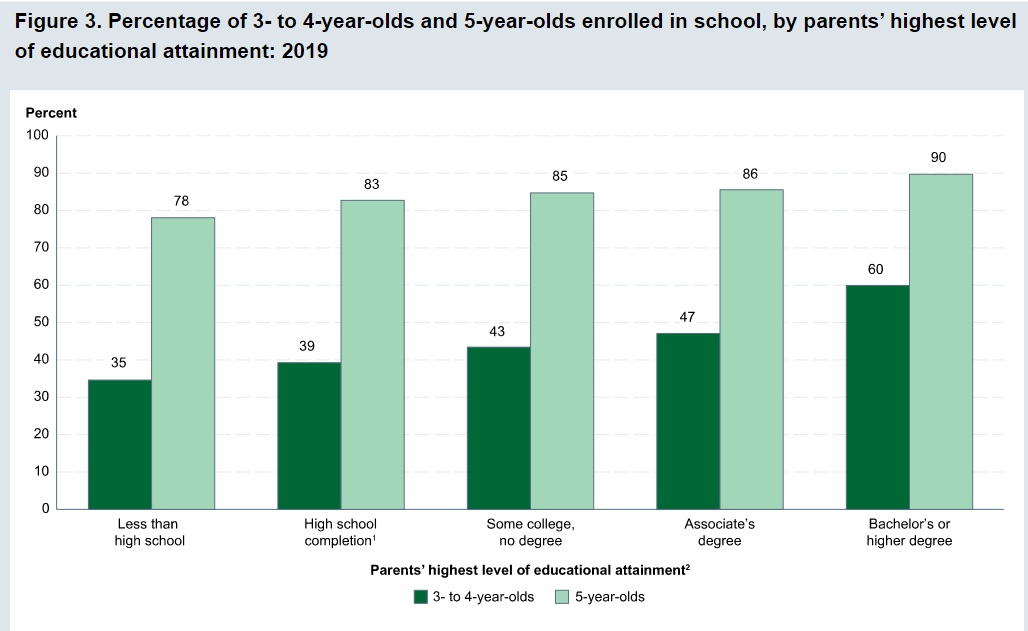
Higher Educated Parents Enroll Their Children at Somewhat Higher Rates, Especially at Ages 3-4
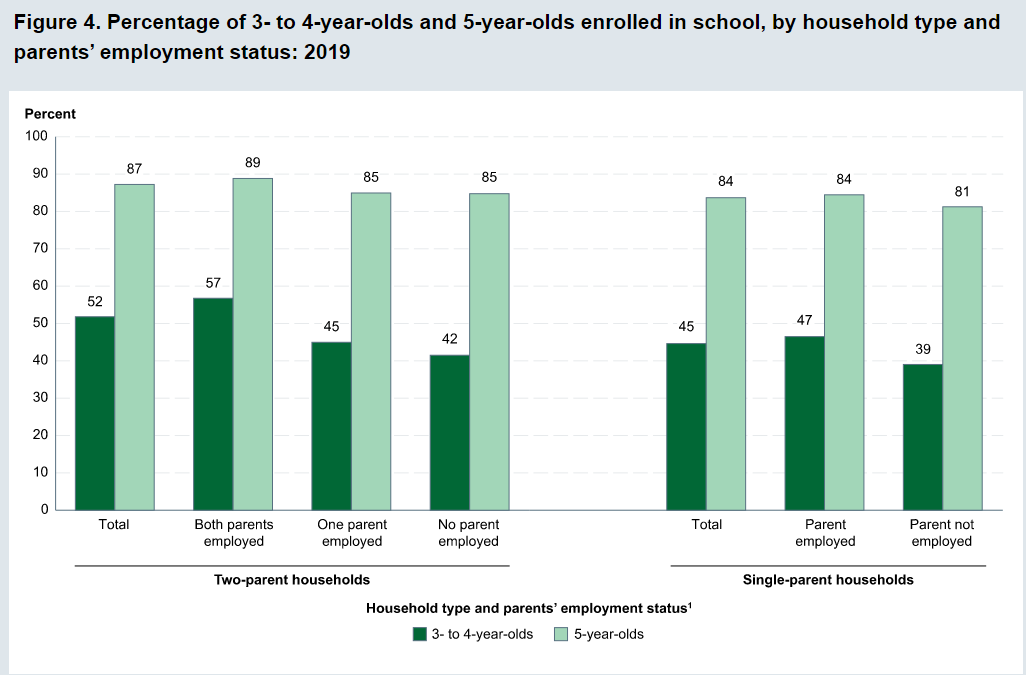
Single Parents Do OK, But the Unemployed Lag
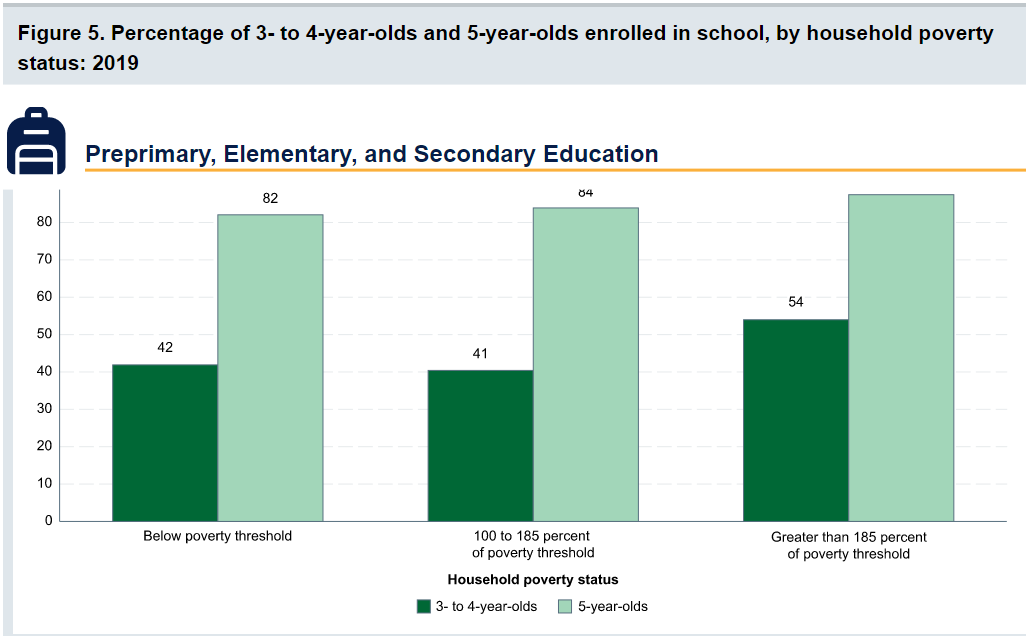
Poverty Level Has Limited Impact for 5 Year-olds, But Real Impact for 3-4 Year-Olds
Comments
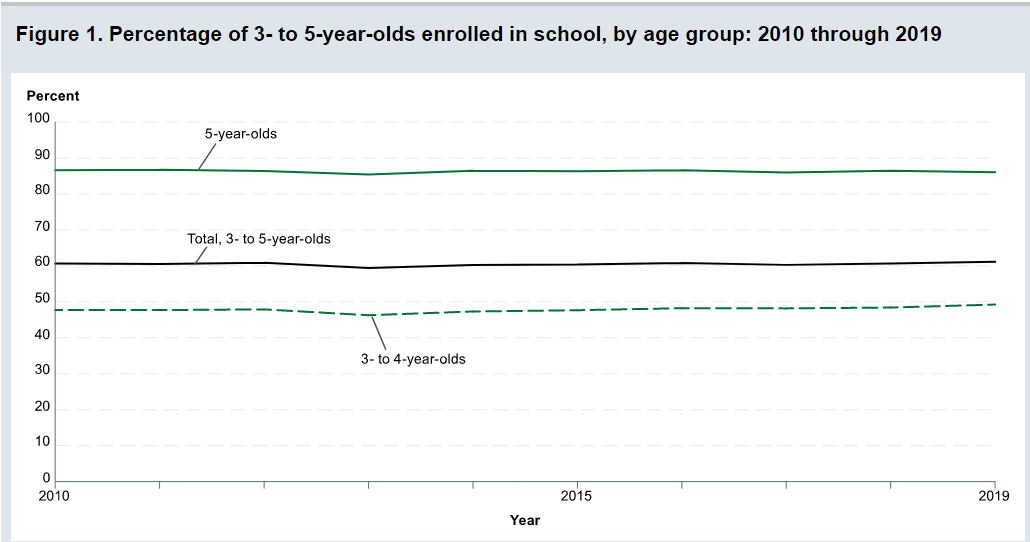
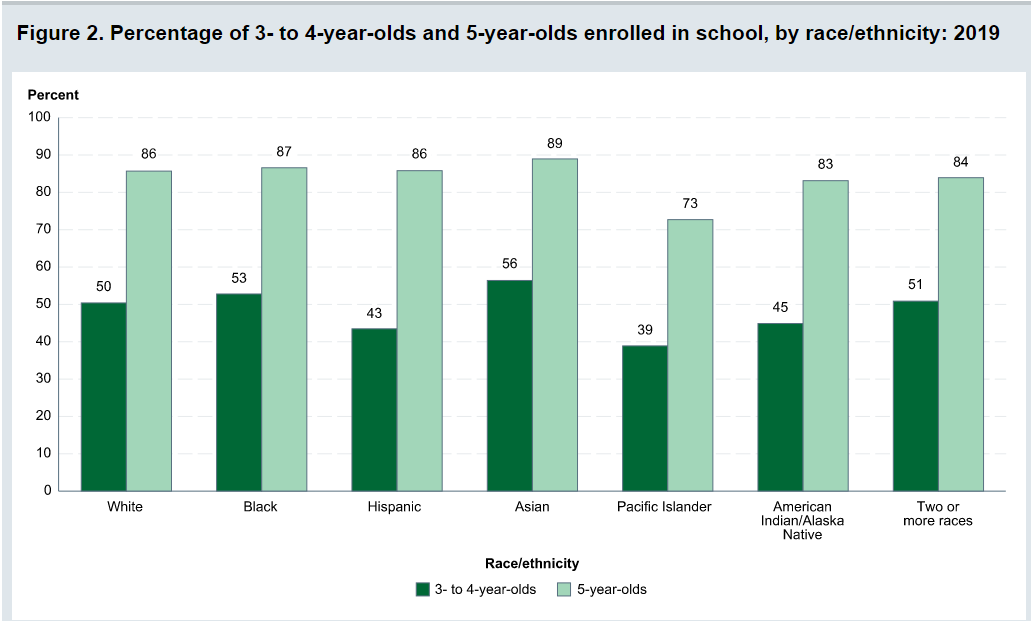
Research has shown that pre-school education can help children to prepare for school. More than 5/6 5 year-olds attend some kind of formal education. About one-half of 3-4 year-olds are enrolled. Some of the non-enrolled children could benefit from formal programs. State and local programs and funding could help these individuals. Access for 5 year-olds is relatively equal across groups, but access for 3-4 years-olds differs more significantly based upon race, income, household status and employment. There is room for improvement.
In the last 20 years, 40% more employees are “engaged” at their workplace and one-sixth less are “disengaged”. American employers have bought into claims by Gallup and others that “engaged workers are productive workers” and made the investment in building culture, training managers, measuring managers and work teams and attending to basic employee satisfaction dimensions. Firms have made these changes out of self-interest, believing that the investment in helping employees to be engaged will pay off.
While 26% or 36% “engaged” may seem like poor numbers, consider that the global average in Gallup surveys is just 20%. Gallup defined “engaged” at a high enough level in their survey to ensure that corporations would see the low numbers and turn to Gallup and other organizational development consultants for help.
Note that even with 36% engaged, that means that 64% are un-engaged or actively dis-engaged. Hence, the “Great Resignation” is not unexpected in a tight labor market.
More companies now take culture and management seriously, from CEO to front-line workers, making real, sustained changes as they did with total quality, lean six sigma operations and branding. Firms define mission, vision and values and operationalize these “soft” dimensions in performance reviews, promotion and retention.
Second, firms focus their organizational development efforts on front line managers, the people who impact the most employees. Good front-line managers are then prepared to be good middle managers, so this makes sense. Companies embrace organizational behavior research which says that managers must consider both task and people dimensions. Managers must be the responsible parties, adjusting their style and decisions to the situation. Gallup published a book that helps to train managers in applied situational leadership.
Other consulting firms and authors provide training materials and seminars to help managers be more effective.
Third, firms take communications seriously, overcommunicating, teaching communications, reviewing communications, etc.
Fourth, firms hold managers accountable for results. These measured results include employee satisfaction. Firms have learned to use 360-degree feedback systems to identify very weak managers, help average managers to develop and promote the most effective managers to greater responsibility and impact.
Most firms employ some version of “The Balanced Scorecard”, ensuring that managers are evaluated on, and therefor focus upon all four dimensions: earnings/mission, customer satisfaction/sales, operations effectiveness, asset management (including human resources).
Gallup statisticians crunched numbers from prior work to identify a small number of questions that are correlated to results such as turnover, productivity, sales, profits, etc. The Q12 survey is disarmingly simple. It can be administered monthly for all work teams and employees. Once managers are trained to understand the meaning of the results, opportunities for improvement are straightforward. Once employees see that managers are responding to their feedback, a positive feedback loop can be started. Q12 is not a “magic bullet”, but the questions touch on dimensions that employees truly value and improvements in management performance are noticed by employees.
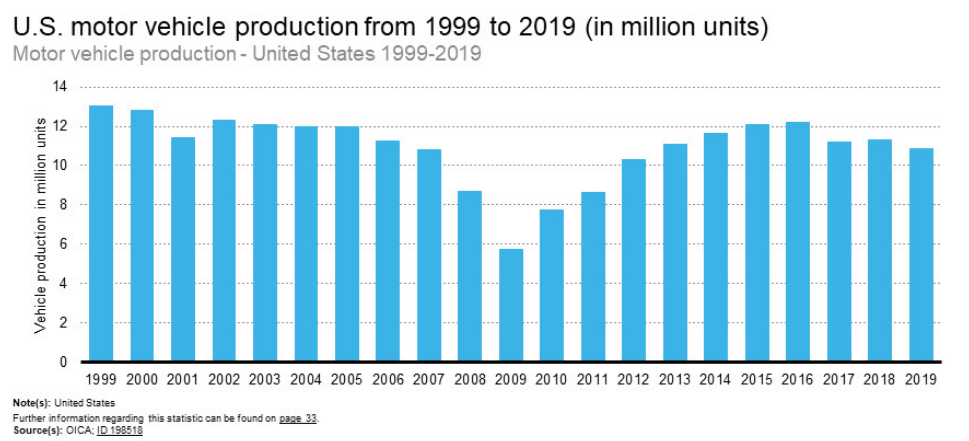
Japanese corporations produce about one-third of US output in the US. They export 400,000 vehicles from the US. Three-fourths of Japanese brand cars sold in the US are produced in the US. Japanese cars, on average, have more US (domestic) content than so-called American made cars.
It’s not all “good news”. Recent data indicates that life expectancy varies greatly between US states, counties, cities and census tracts. My hometown’s life expectancy is just 73.6 years, about 5% (3.7 years) less than the national average of 77.3 years. My suburban Indianapolis home for the last 30 years shows an 81.6 year life expectancy, about 5% (4.3 years) higher. That’s an 8 year (10%) difference between two midwestern cities.
6-month time limit. A dozen or less bipartisan dignitaries. Retired ambassadors, investors, CEO’s, federal reserve presidents, etc. Make Mitch Daniels the chair.
Assign 2 projects. One to cut government waste. The other anti-inflation policies. No more than a dozen recommendations in each half. Presented to congress for simple yes/no vote, without major amendments allowed.
2. Spend Less Government Money
Fiscal spending is too expansionary for the current situation. Back off. Reduce infrastructure spending for now, spend it in the next recession. Reduce marginal defense programs that only have political reasons. Cut state government spending by 3%, which is budgeted to increased by 9%.
Increase immigration to improve labor supply. Cut tariffs to reduce supplies costs. Lean on local regulators to reduce zoning restraints and one size fits all building codes. Strategically require a higher share of affordable housing and multifamily permits annually in each metropolitan region. Phase-out the mortgage interest tax deduction for second homes.
Loosen regulations for 5 years to encourage increased “all of the above supplies” energy through drilling, coal, oil and nuclear. Suspend federal gas tax for 3 years. Negotiate oil price minimums/maximums between US/Europe/Japan and OPEC.
Reducing inflation is a complicated policy area. The solutions proposed by “experts” are rarely politically appealing. Competing political parties hesitate to provide “wins” to the other. However, 8% inflation after a 2-year pandemic while the US faces Russian war actions is a “national emergency”, worthy of an FDR like approach to “try a few things”. It is an opportunity to overcome individual industry opposition to things that make sense for the country. It is an opportunity to try some left and right solutions.