Good News: The Increase of Producer Price Inflation Has Peaked

https://4kwallpapers.com/nature/jasper-national-park-alberta-canada-winter-glacier-4561.html
Measure2.5 YearsRecent 1 YrTrend
PPI Minus food, energy, trade11%7%Peaked
Total Final Demand16%11%Peaked
All Commodities37% !!20% !Flat
Energy56% !!!45% !!Flat
Foods23% !13%Down
Other Goods14%8%Peaked
Other Services6%3%Down
Transport and WH24% !20% !Peak?
Whlse and Retail Trade22% !14%Down

For each measure of produce prices, I’ve provided a 5- or 10-year framework of annual inflation AND a 5 year view of prices indexed to Jan, 2020 before the pandemic began. We did have 2% inflation before the pandemic.

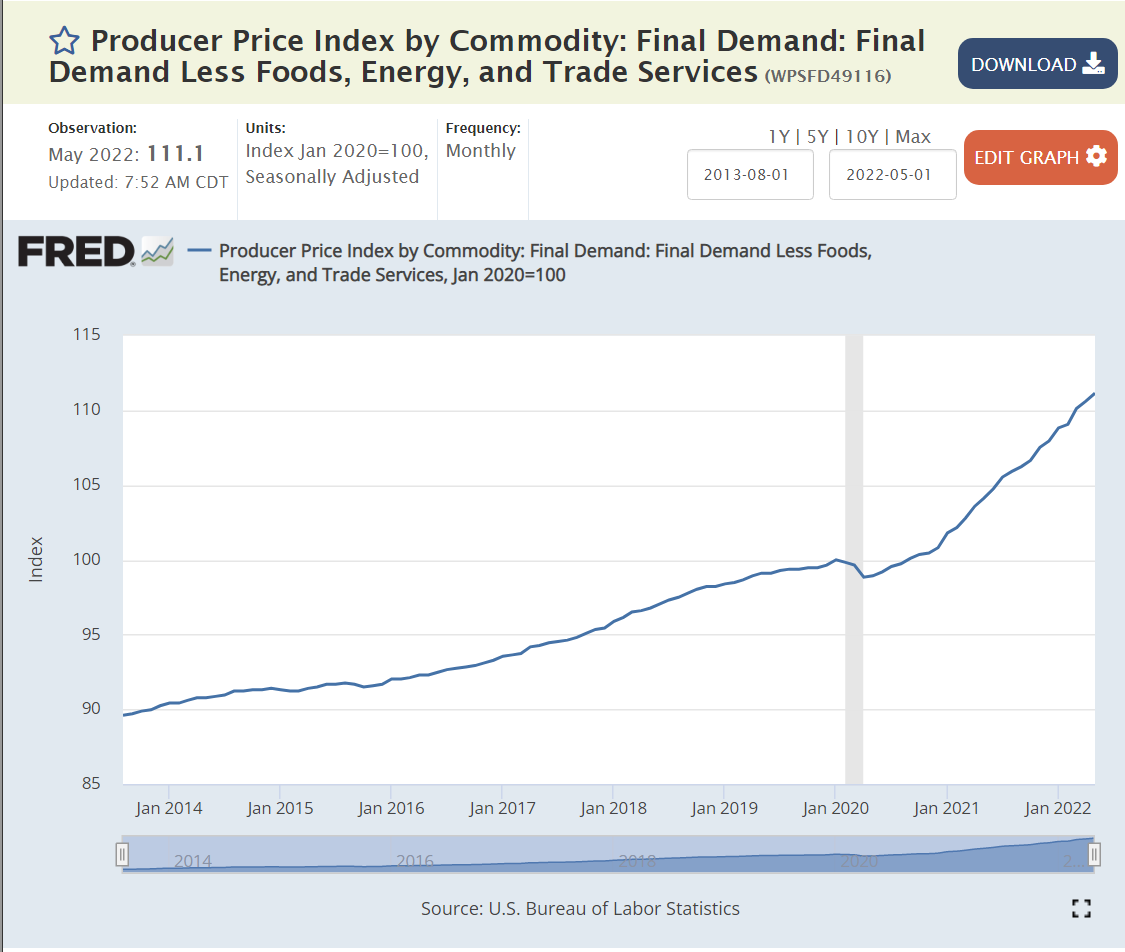
This traditional measure of ongoing inflation pressures peaked at 7% annual rate in 4Q, 2021. In total, just 12% in 2+ years.

Grand total PPI reached 10% annual inflation by the end of 2021 and has remained at that level. This provides pressure for CPI to be higher than 7% for a few more months.

Commodities pressure has been strong only recently, so the total PPI is just 3% higher than the measure excluding the volatile components.

Annual commodity inflation rocketed from 0% in Dec, 2021 to 20% by Jun, 2022 as the global economy was recovering from the pandemic and the extraordinary increase in durable goods demand was registered in supply chain purchasing decisions. Commodities are historically most volatile, but this increase in demand and prices was historic. Note this is way before the Ukraine invasion.

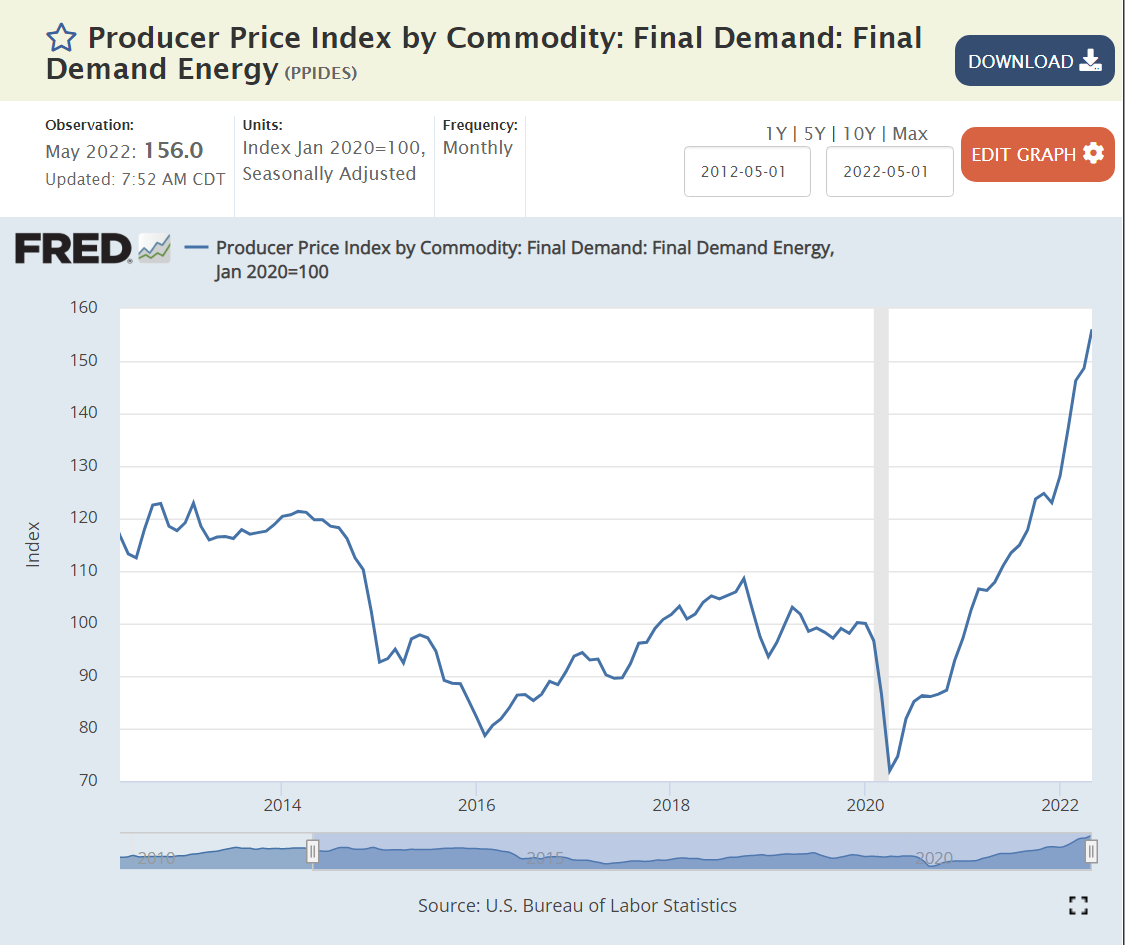
Energy prices were below the pre-pandemic level as late as Jan, 2021 (-3%). They increased exponentially to 50% higher by Apr, 2021. Energy prices have continued to increase at 35-40% annual rates as increased demand, mothballed assets and the Ukraine invasion effects combined to change the global markets. This is one measure where continued very high inflation is possible.

Food prices were a little slower to accelerate. Zero increase at Dec, 2020. 4% annual inflation at May, 2021. 13% inflation at Aug, 2021. Again, this is pre-Ukraine. The 13% ish inflation rate has continued, supported by Ukraine issues. Historically, food prices do not remain elevated for long periods.
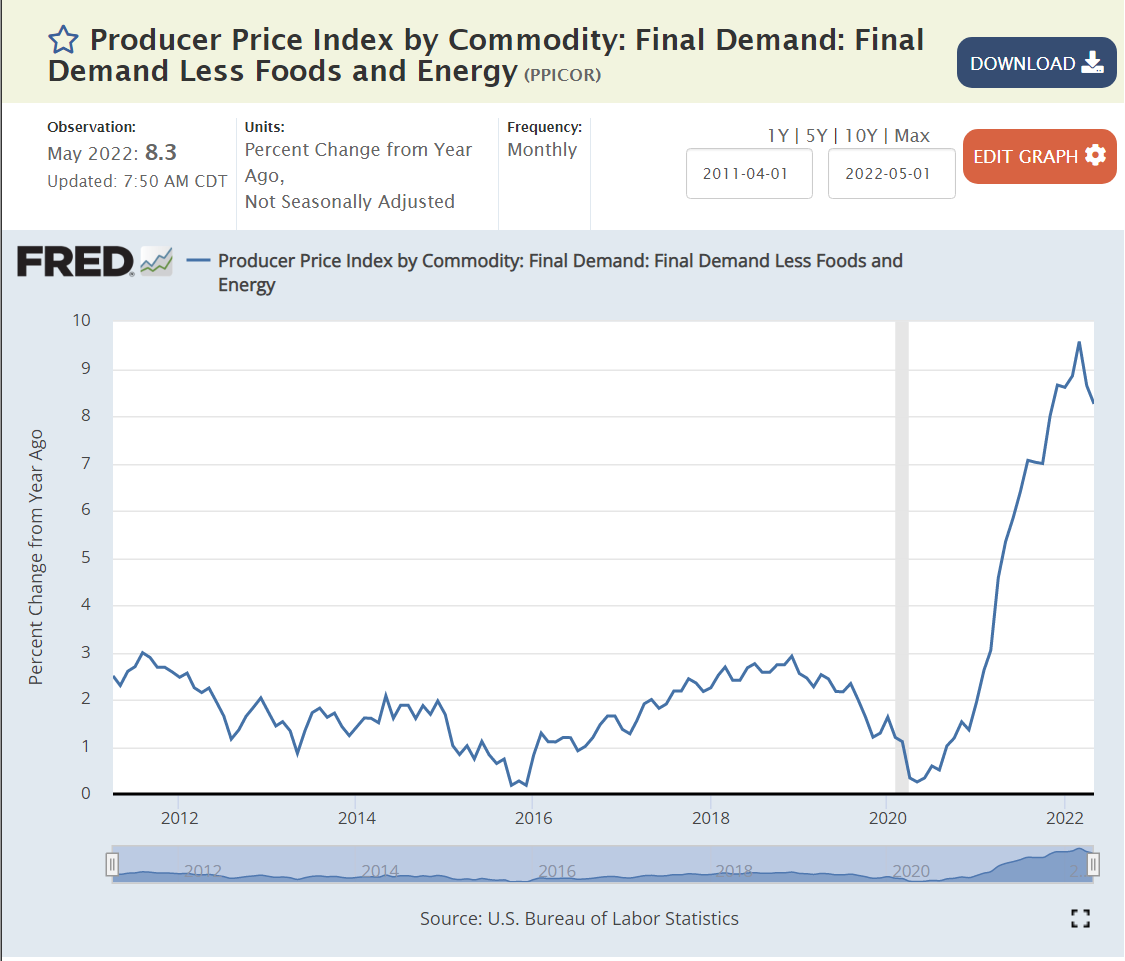
Another subtotal, excluding 2 more volatile sectors shows 8-9% inflation peaking.
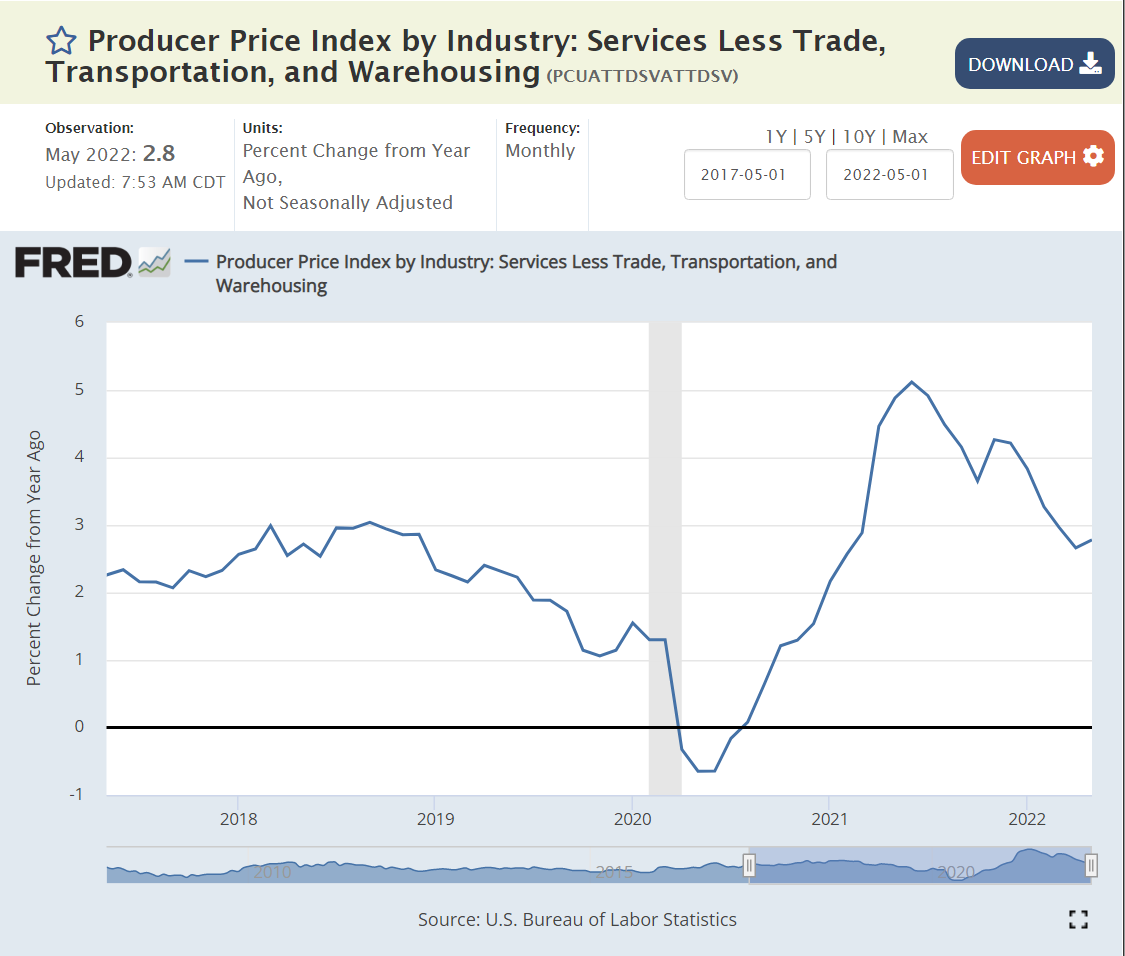
Business services inflation has remained tame, supporting the notion that cost-push inflation due to wage increases is not yet a major threat.

Transport and warehouse prices were also slow to “take off”, remaining below pre-pandemic level through Feb, 2021. Energy prices drive the transportation sector, so these prices also increased. The 20% annual increase seems to have peaked.

Wholesale and retail trade also lagged a bit, still at the historical average 2.5% inflation rate as of Mar, 2021. But, inflation grew to 10% by Aug, 2021 and a peak of 18% in Mar, 2022. The annual rate of inflation has receded to 15%, but that still offers some risks to the CPI for the next 6 months.

https://www.bls.gov/news.release/ppi.nr0.htm

https://www.bls.gov/ppi/

Summary

Six of the nine measures have peaked or are declining. The other three remain at worrying levels without clear signs of retreat. The “core” PPI inflation measure at 7% is not accelerating, so CPI should be able to decline in the second half of 2022. On the other hand, commodities inflation, mostly driven by energy inflation, remains very high without evidence of a meaningful decline in the near-term. Historically, energy and commodity prices fall back after a sharp increase. The general weakening in the global economy also points to a somewhat softer market for energy and commodities.

There is no evidence yet of labor-based cost-push inflation or accelerating/spiraling/self-reinforcing inflation.

“Price gauging” claims are always in the eye of the beholder/customer/politician. When I see relatively low historical price increases, followed by sharp increases, I imagine that business leaders are taking advantage of the situation to drive price increases that were impossible to propose and make stick during the less dynamic past. These can be spotlighted during a period of high inflation, but appear to be more reasonable across the whole business cycle. The food and energy price changes look similar to historical levels of volatility so are less easily questioned.

Big picture, IMHO, this looks like a global commodities “squeeze” due to the faster than expected recovery from the pandemic, especially the 50% growth in demand for durable goods as in-person services were less attractive and available. Loose fiscal and monetary policy in the US and other nations may have been a significant driver of the faster than expected global recovery, but this does not look like a classic case of excessive fiscal and monetary stimulus.

In hindsight, the slow response of the US Federal Reserve Board to the very rapid change in price levels from Jan, 2021 to Jun, 2021 looks like malpractice. Market prices quickly adapted to the current and expected disconnect between supply and demand.

Producer and consumer price increases are likely to remain in the 7-8% range during the 3rd quarter of 2022, but should begin to drift back to the 5-6% range in the 4th quarter of 2022, and still lower in 2023, especially if the Fed increases interest rates by the expected 3-3.5% and businesses slow their inventory, hiring, project and capital spending decisions accordingly.
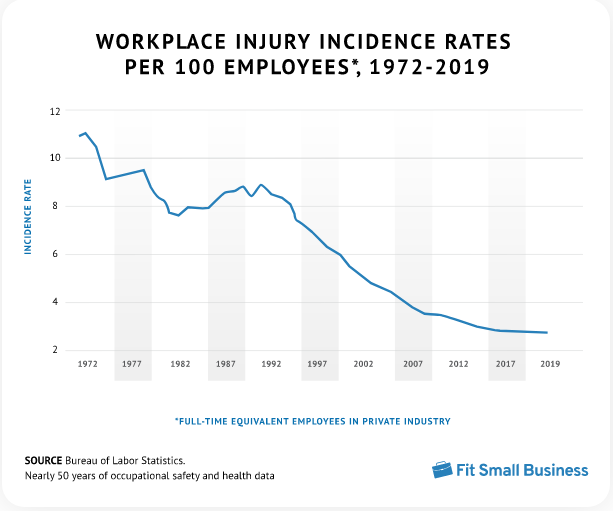
Good News: Lower US Workplace Injury and Death Rates

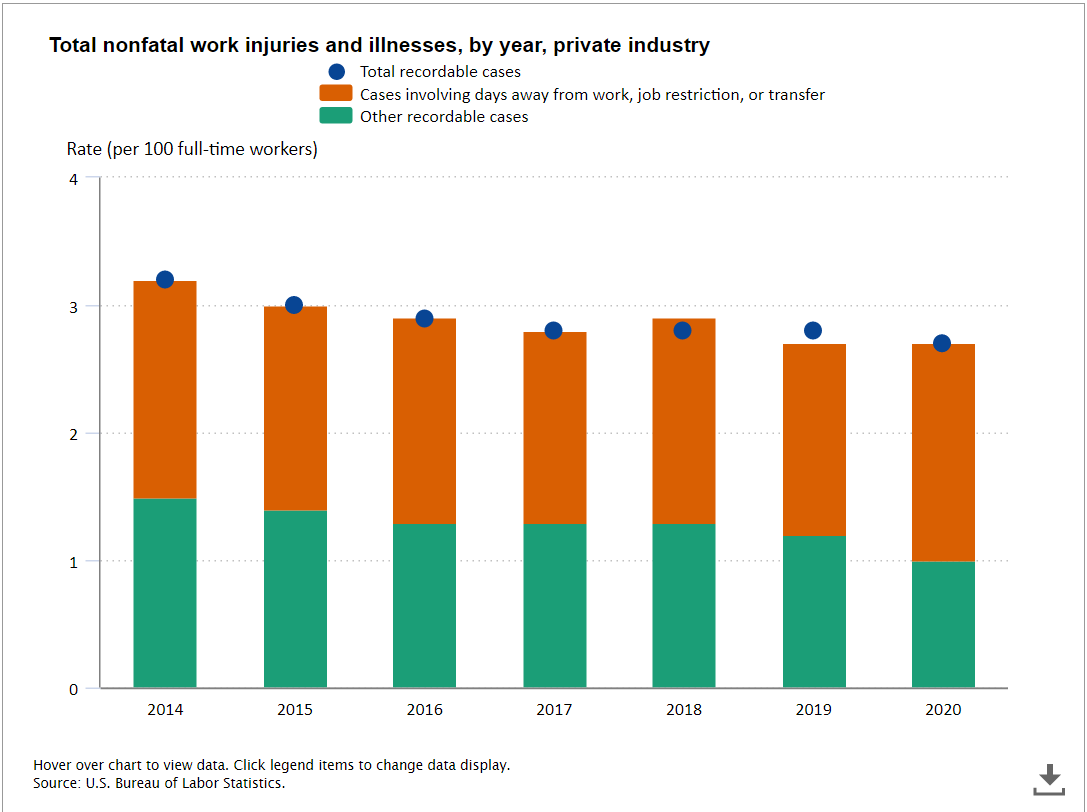
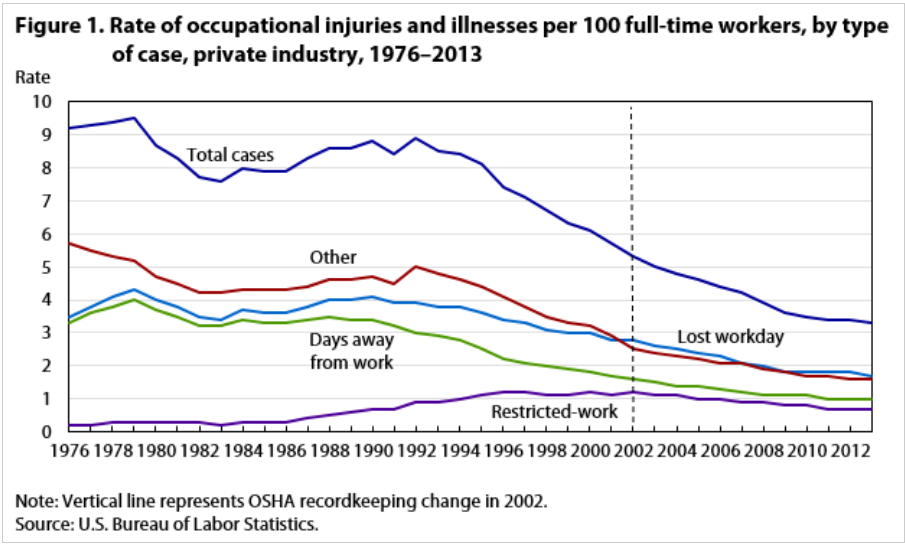
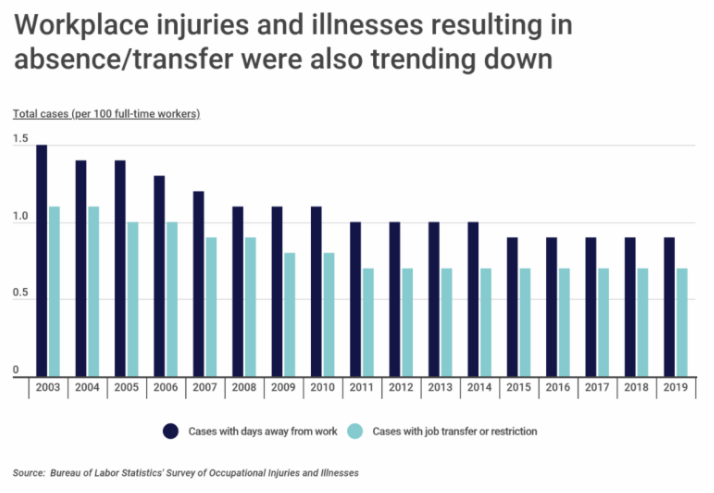
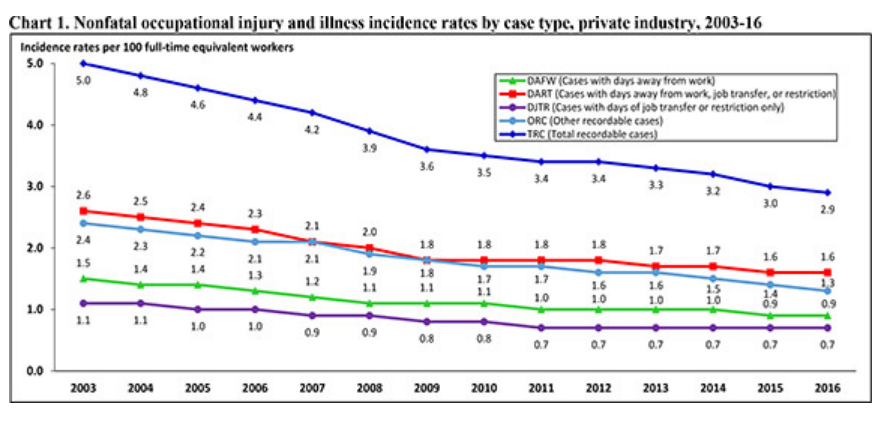
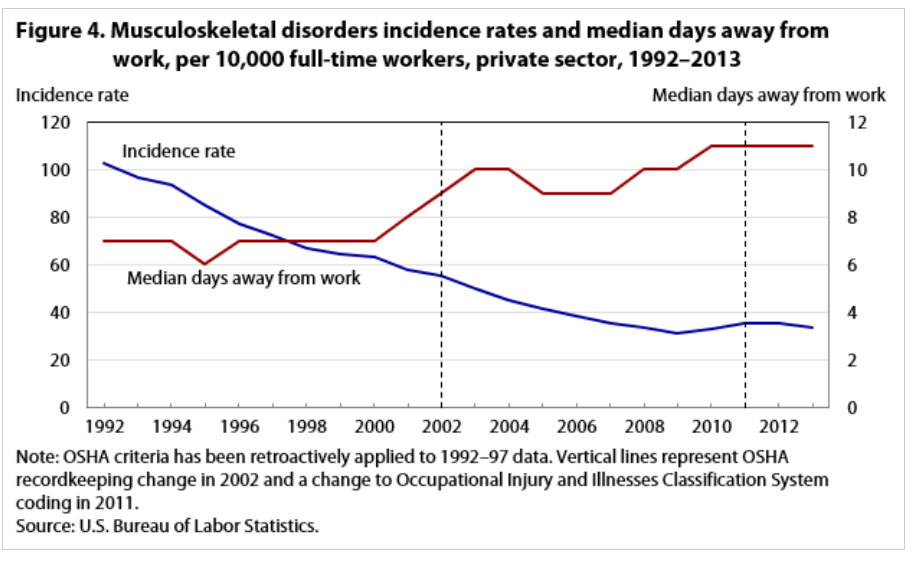
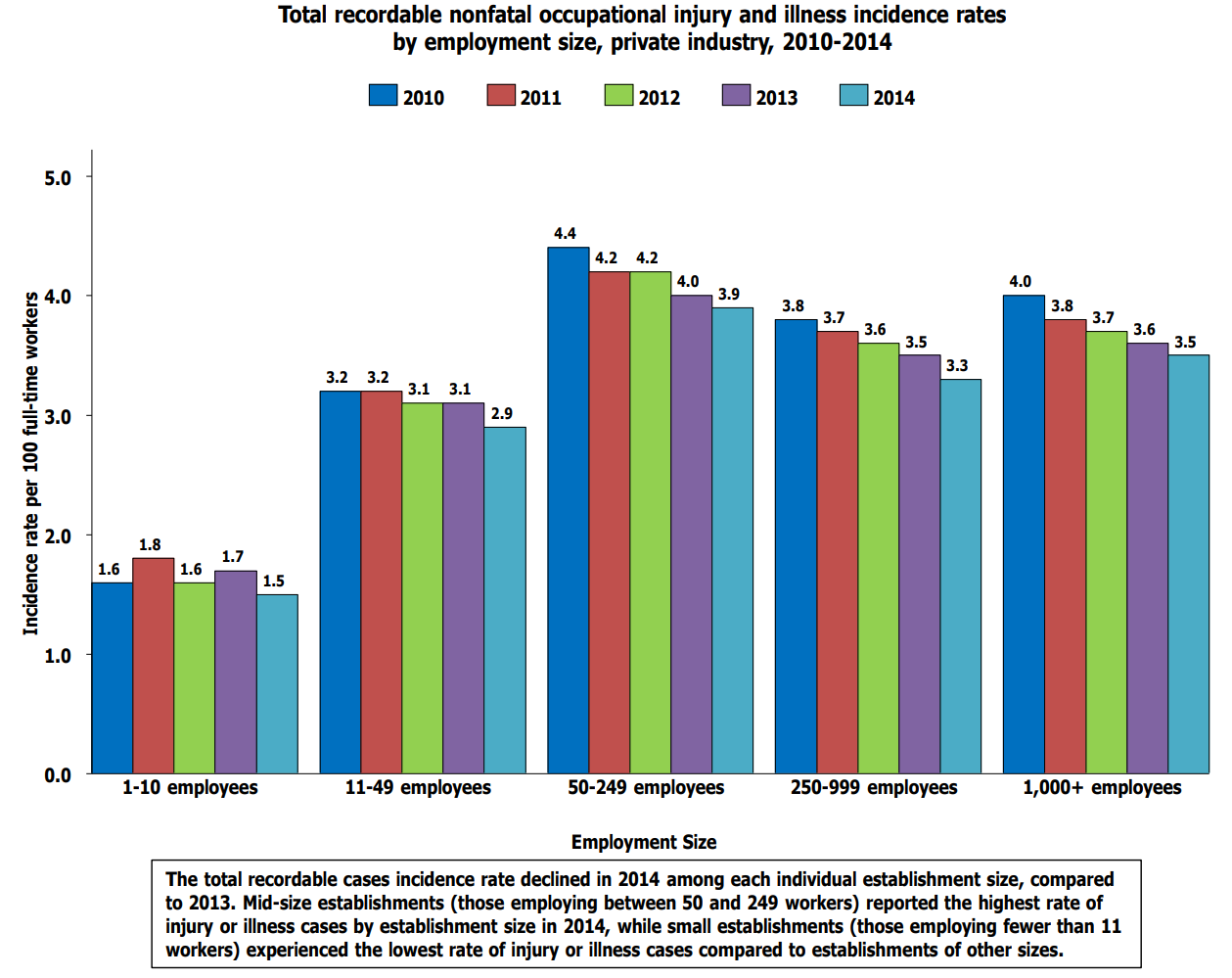
Injuries

https://fitsmallbusiness.com/workplace-injury-statistics/
https://www.bls.gov/charts/injuries-and-illnesses/total-nonfatal-work-injuries-and-illnesses-by-year.htm#
https://www.bls.gov/opub/mlr/2015/article/the-quest-for-meaningful-and-accurate-occupational-health-and-safety-statistics.htm
https://www.globaltrademag.com/industries-with-the-highest-rates-of-workplace-injuries/
https://www.workerscompensation.com/news_read.php?id=27835
https://www.bls.gov/charts/injuries-and-illnesses/number-and-rate-of-nonfatal-work-injuries-and-illnesses-by-industry.htm
https://www.bls.gov/iif/oshwc/osh/os/osch0054.pdf
https://www.bls.gov/opub/mlr/2015/article/the-quest-for-meaningful-and-accurate-occupational-health-and-safety-statistics.htm
https://www.bls.gov/iif/oshwc/osh/os/osch0054.pdf

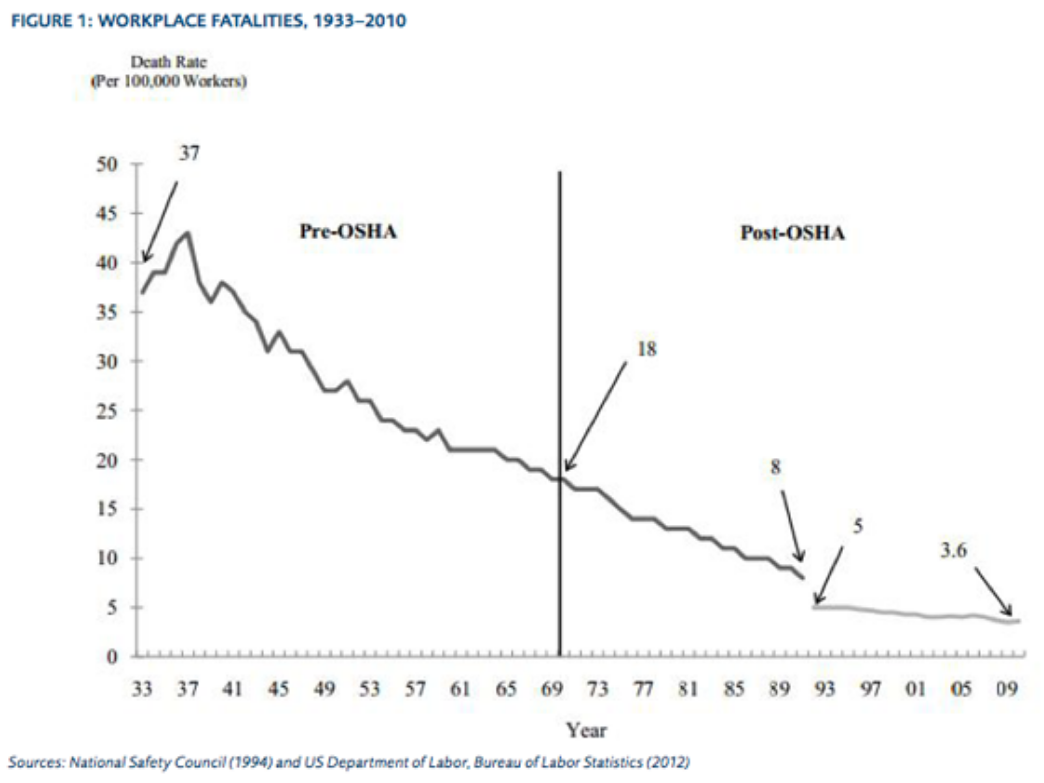
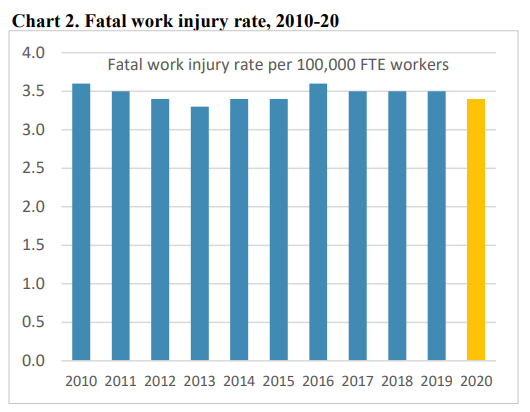
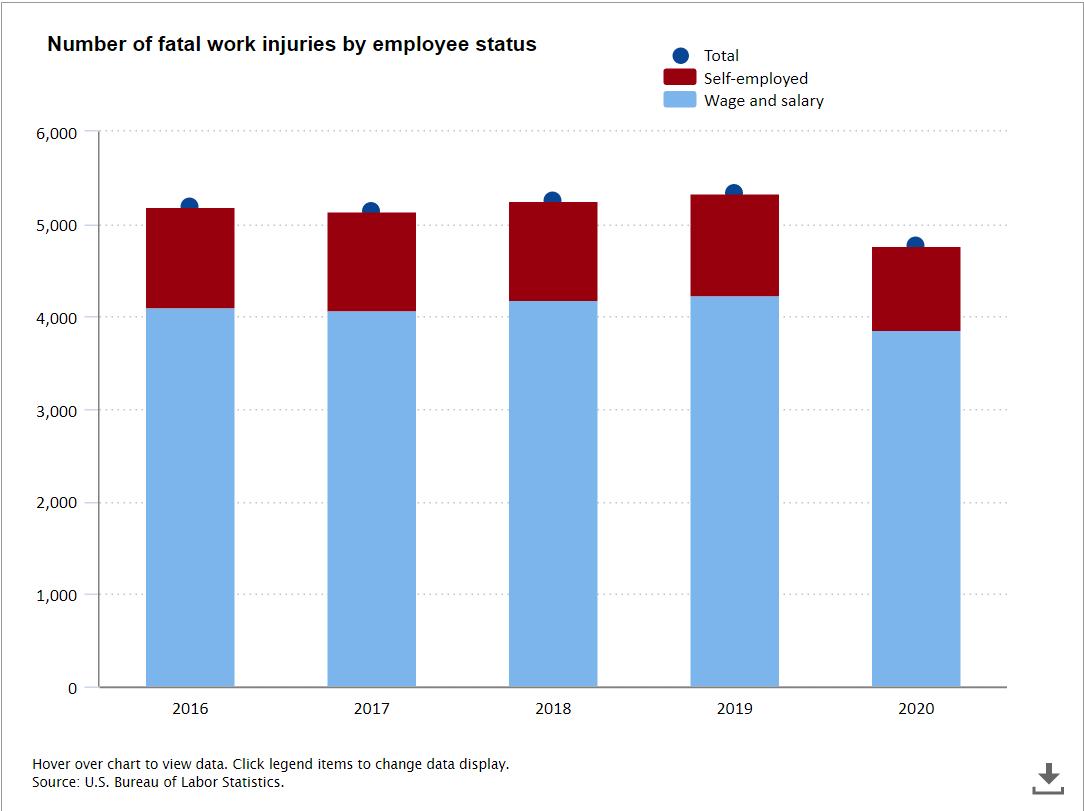
Workplace Fatalities

https://www.insurancejournal.com/news/national/2020/02/21/558963.htm
https://www.bls.gov/news.release/pdf/cfoi.pdf
https://govfailure.com/item/osha-didnt-speed-decline-in-workplace-deaths/

1915 rate estimated to be 60.

https://www.bls.gov/opub/mlr/2016/article/the-life-of-american-workers-in-1915.htm

https://www.bls.gov/news.release/pdf/cfoi.pdf
https://www.bls.gov/iif/oshwc/cfoi/cfch0016.pdf
https://www.bls.gov/charts/census-of-fatal-occupational-injuries/number-of-fatal-work-injuries-by-employee-status-self-employed-wage-salary.htm
https://www.bls.gov/iif/oshwc/cfoi/worker_memorial.htm
https://www.cdc.gov/mmwr/preview/mmwrhtml/mm4822a1.htm
https://www.bls.gov/news.release/pdf/cfoi.pdf
https://www.cdc.gov/mmwr/preview/mmwrhtml/mm4822a1.htm
https://www.bls.gov/iif/oshwc/cfoi/worker_memorial.htm
https://www.cdc.gov/mmwr/preview/mmwrhtml/mm4822a1.htm
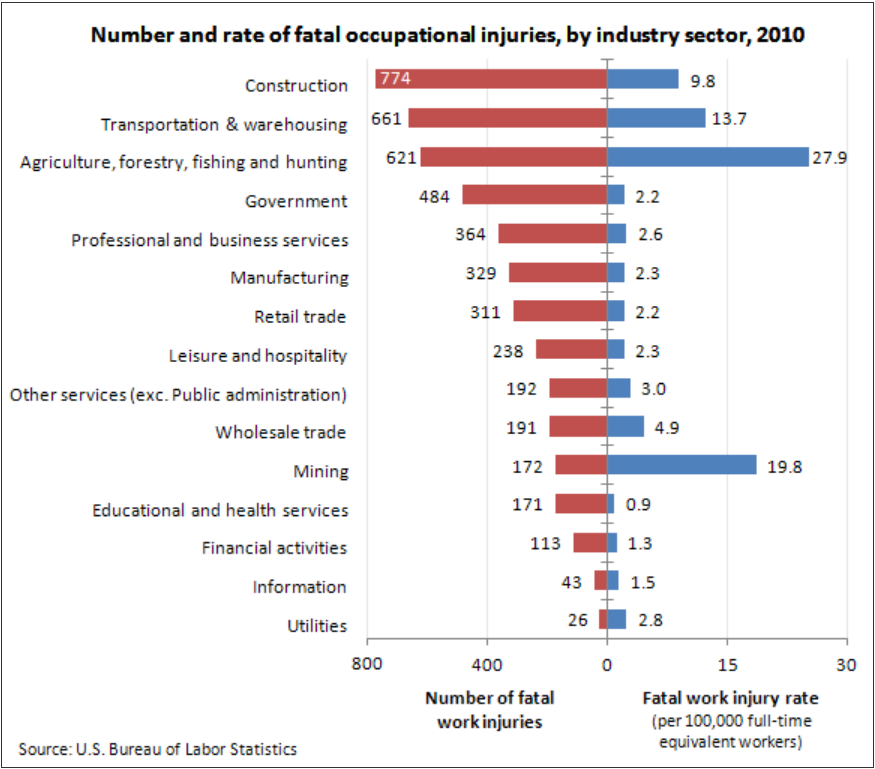
https://www.bls.gov/charts/census-of-fatal-occupational-injuries/number-and-rate-of-fatal-work-injuries-by-industry.htm
https://www.bls.gov/iif/oshwc/cfoi/worker_memorial.htm
https://www.bls.gov/iif/oshwc/cfoi/cfch0016.pdf
https://www.bls.gov/charts/census-of-fatal-occupational-injuries/civilian-occupations-with-high-fatal-work-injury-rates.htm
https://www.bls.gov/iif/oshwc/cfoi/cfch0013.pdf
https://www.bls.gov/charts/census-of-fatal-occupational-injuries/number-and-rate-of-fatal-work-injuries-by-occupation.htm
https://www.publichealthpost.org/databyte/men-hard-at-work/
https://www.insurancejournal.com/news/national/2020/02/21/558963.htm
https://www.bls.gov/charts/census-of-fatal-occupational-injuries/rate-of-fatal-work-injuries-per-100000-fte-by-age.htm

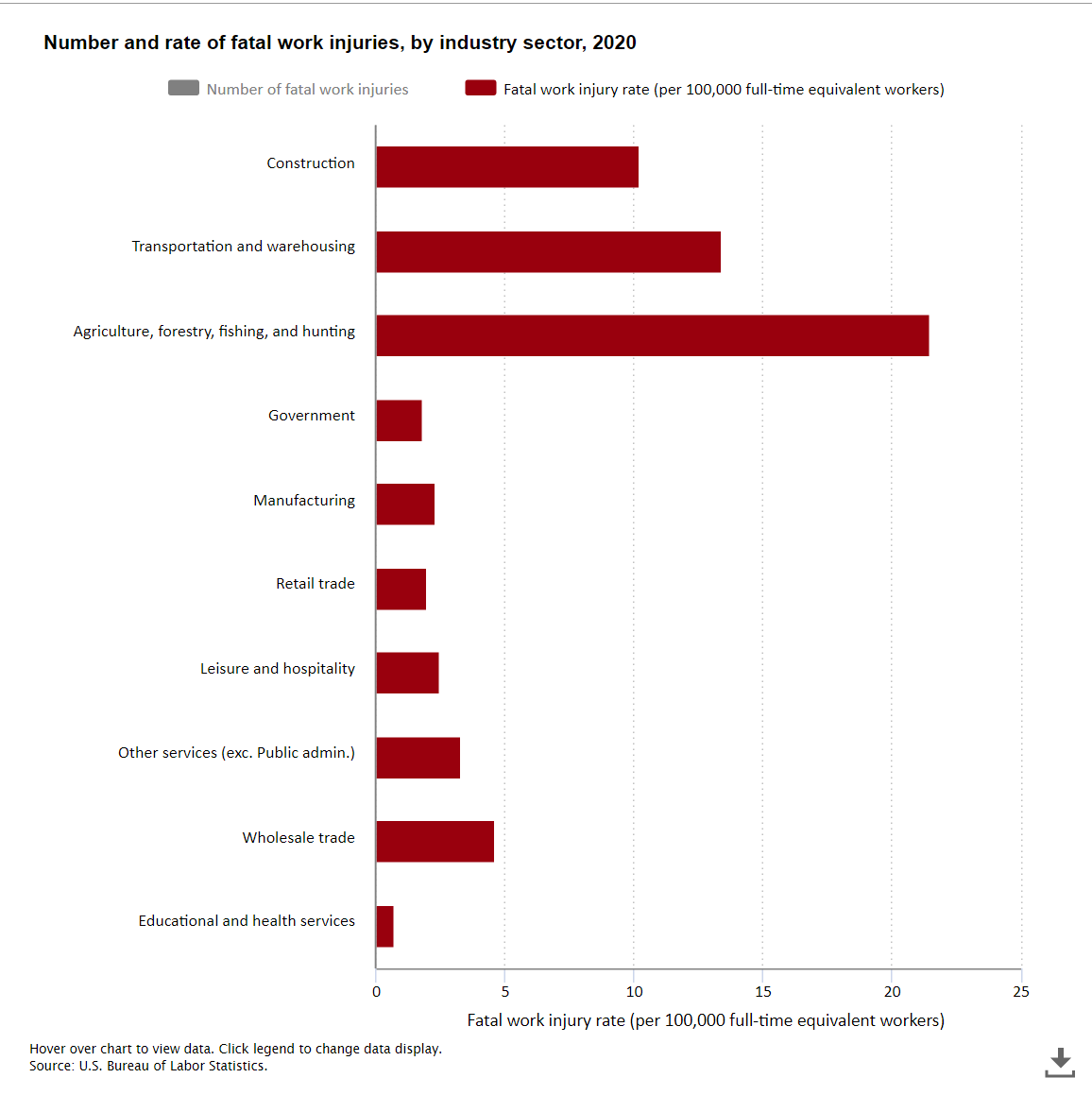
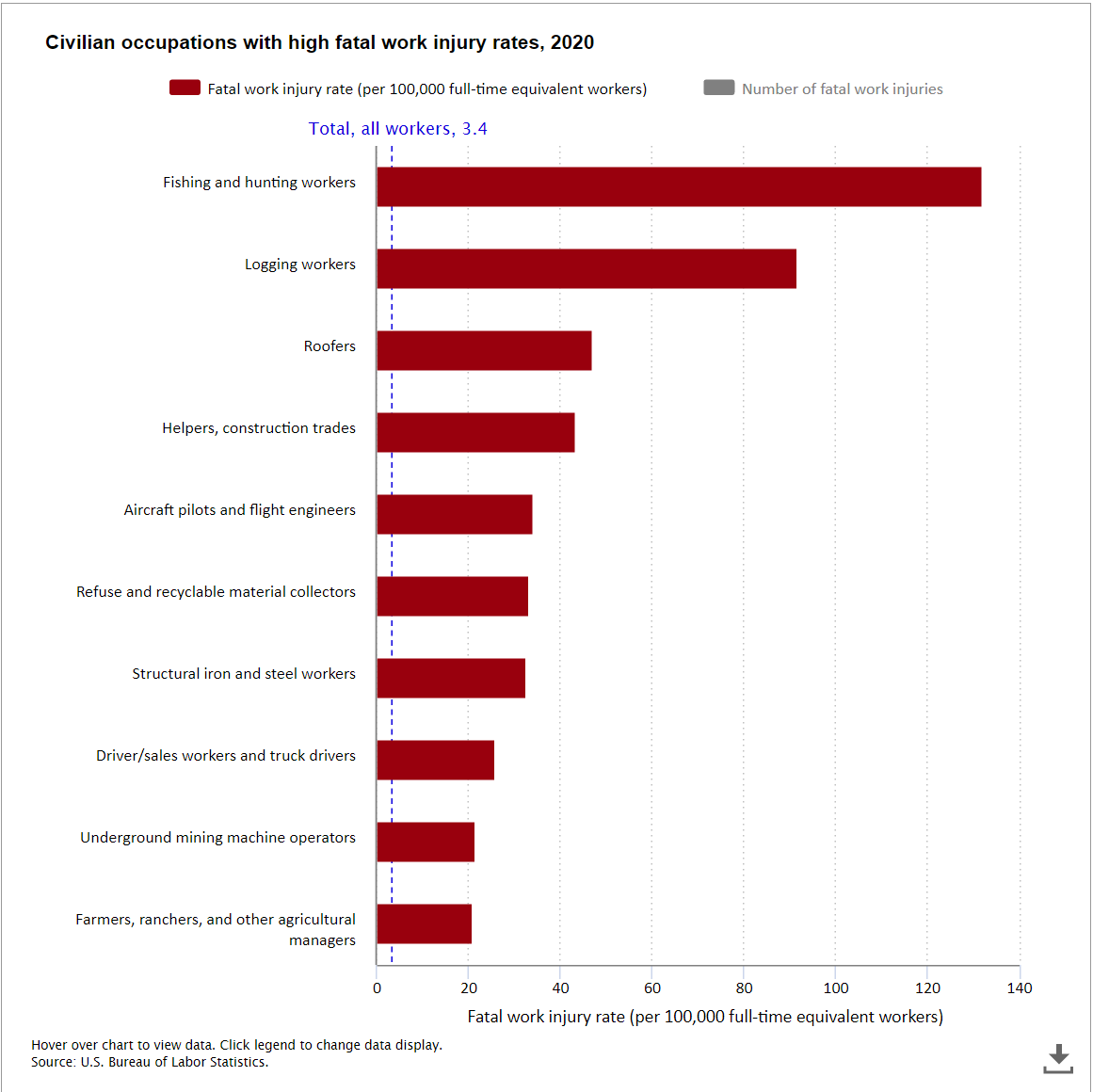
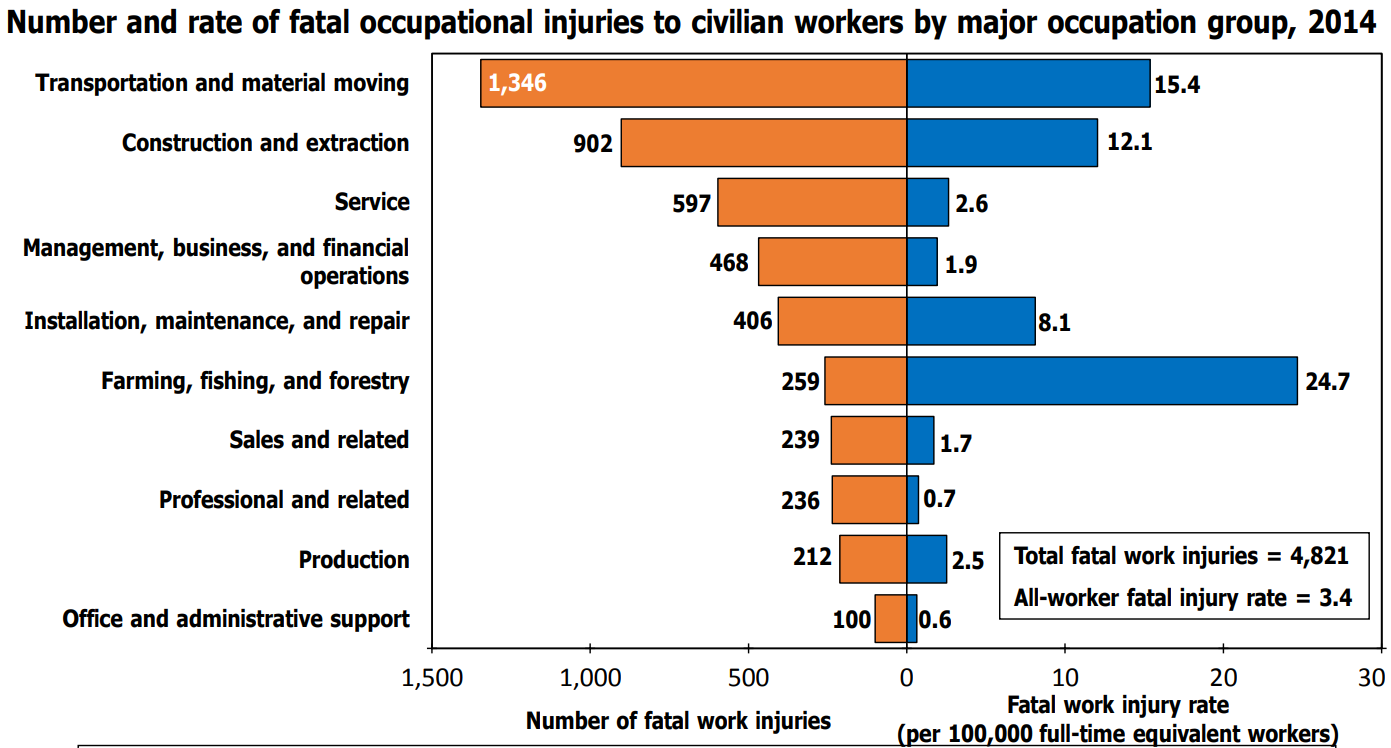
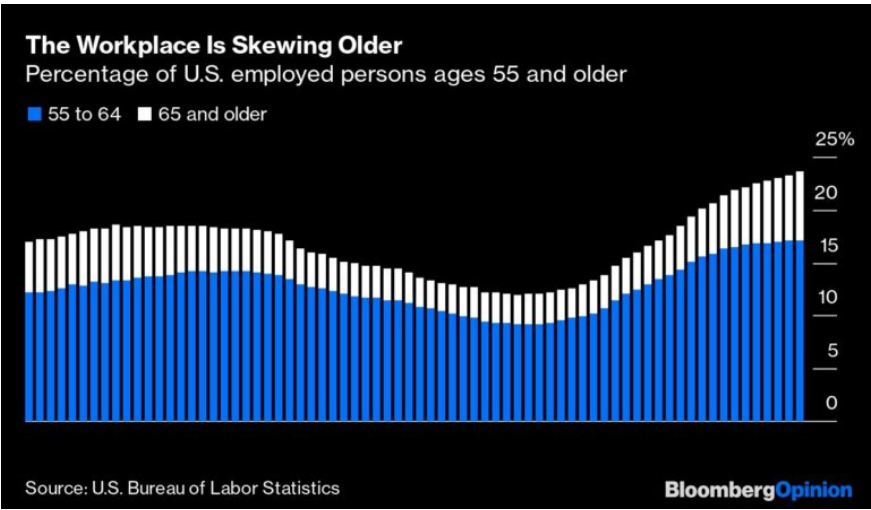
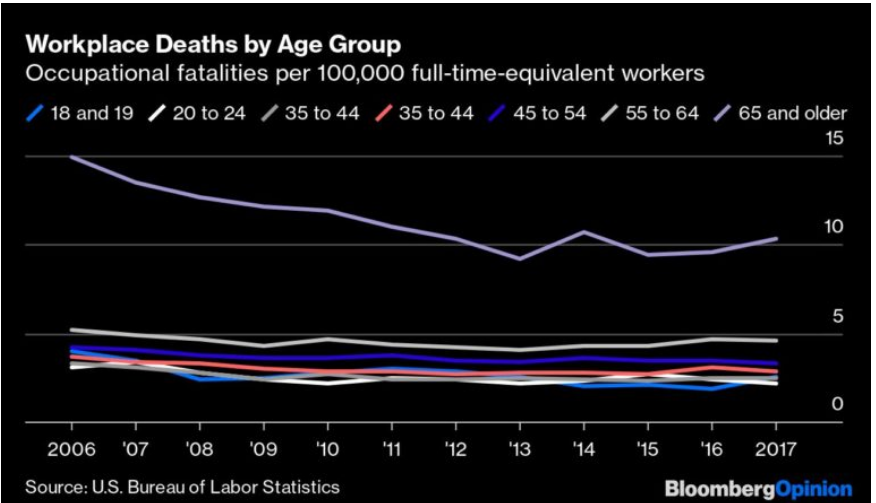
The baby boomers have caused the relatively higher death rate aged 55+ groups to almost double their share of total workers. While the death rate for EACH age group has gone down in the last 20 years, the blended average has been flat for the last decade.

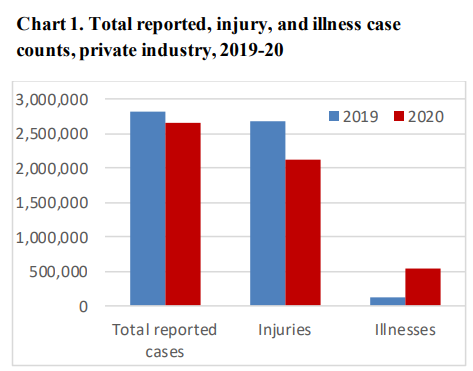
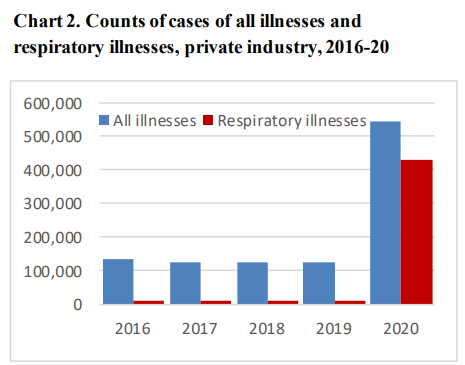
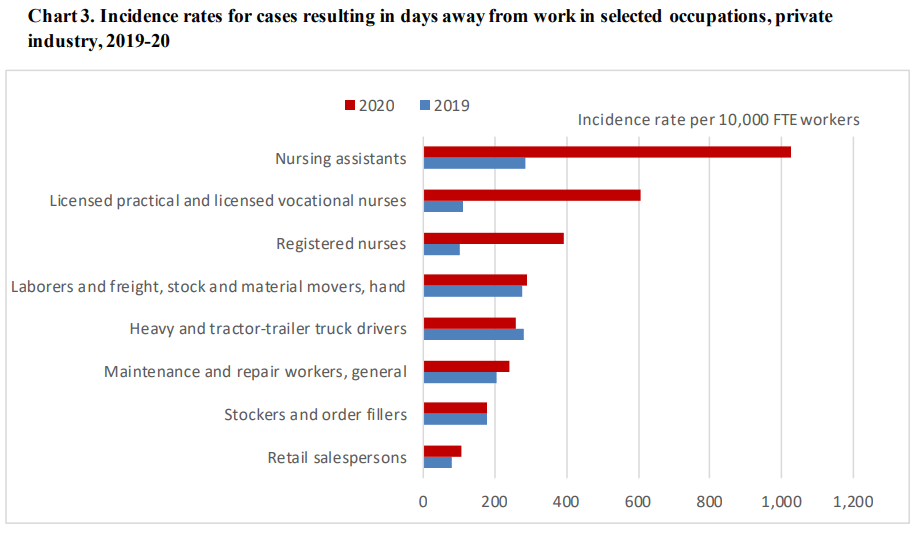
Covid Provided Special Challenges and the Results Could Always Be Even Better

https://www.bls.gov/news.release/pdf/osh.pdf

https://www.cnbc.com/2021/12/29/bls-estimates-that-13-us-workers-die-on-the-job-per-day-on-average.html

https://aflcio.org/reports/death-job-toll-neglect-2021

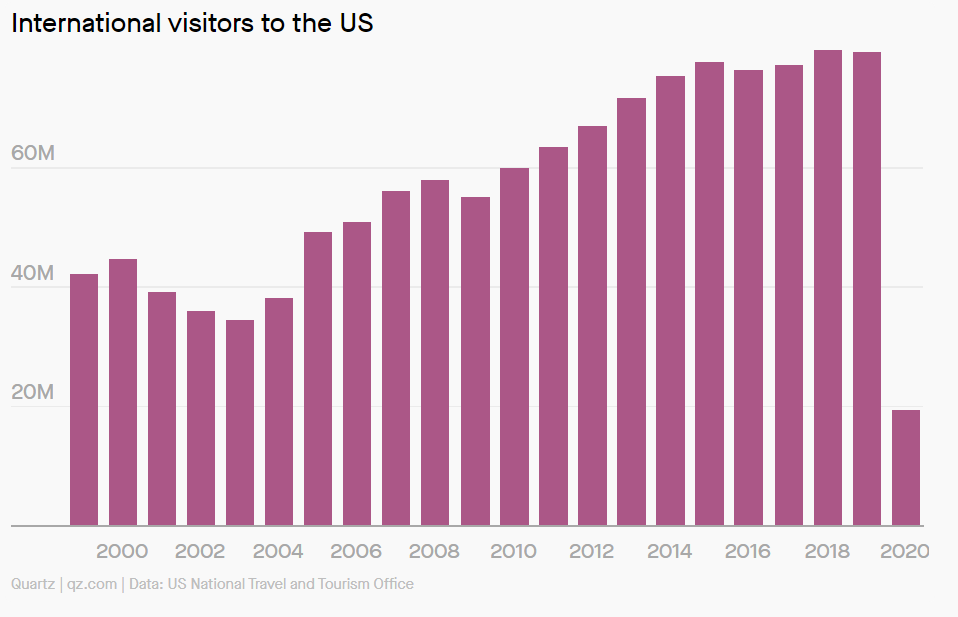
Good News: International Travel to US Trends Upward in 21st Century

https://ntlrepository.blob.core.windows.net/lib/79000/79200/79277/TSAR_2020_Compressed_20210104.pdf
https://qz.com/2020189/the-us-is-losing-its-appeal-as-a-global-tourism-destination/
https://www.trade.gov/sites/default/files/2021-03/Fact%20Sheet%20International%20Visitation%20FINAL.pdf
https://ntlrepository.blob.core.windows.net/lib/79000/79200/79277/TSAR_2020_Compressed_20210104.pdf
https://qz.com/2020189/the-us-is-losing-its-appeal-as-a-global-tourism-destination/

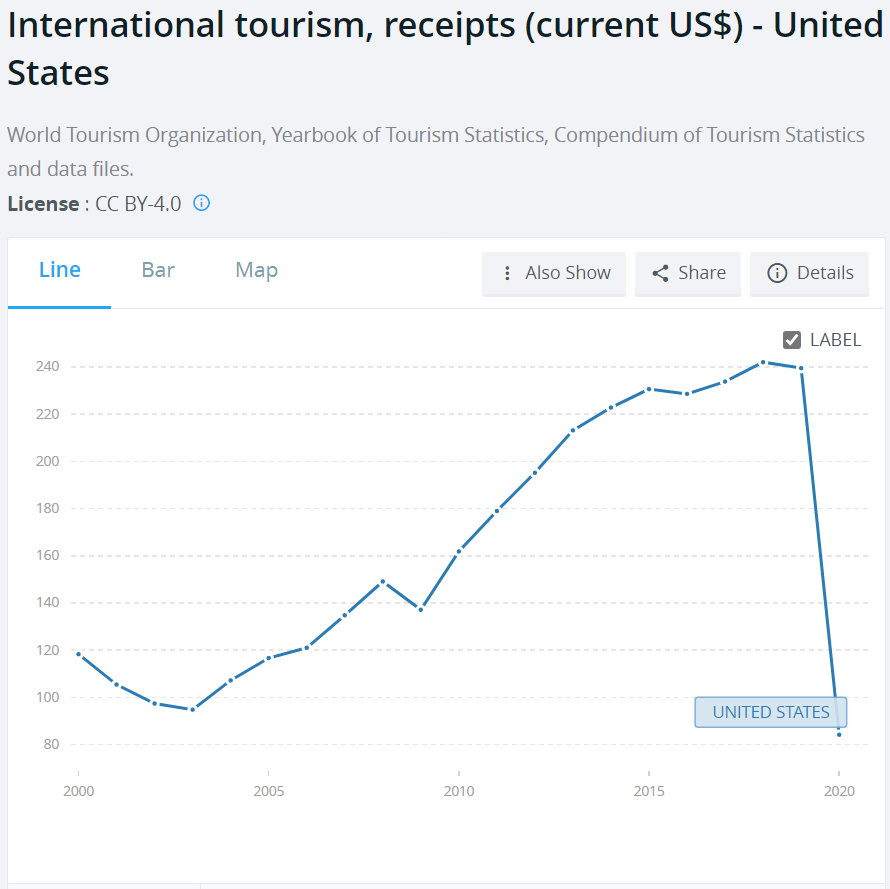
US Top Recipient of Foreign Travel Dollars

https://data.worldbank.org/indicator/ST.INT.RCPT.CD?most_recent_value_desc=true
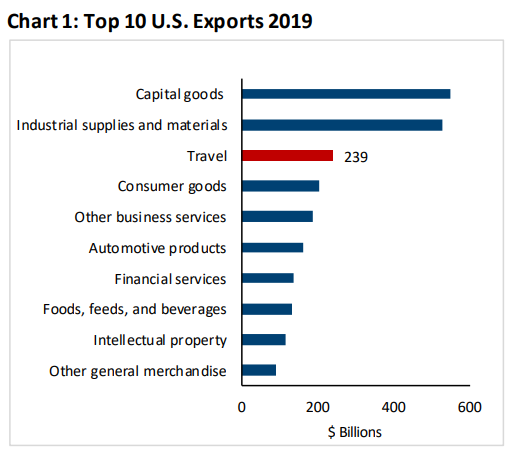
https://www.trade.gov/sites/default/files/2021-03/Fact%20Sheet%20Exports.pdf
https://www.ustravel.org/sites/default/files/2021-12/research_fact-sheet_travel_and_trade.pdf

Many US Cities/Destinations Remain Attractive

https://www.worldatlas.com/cities/america-s-10-most-visited-cities.html

https://www.bts.gov/archive/publications/state_transportation_statistics/summary/table_04_19

Future: Forecast, Challenges, Opportunities

72% Recovery in 2022, 100% in 2024

https://www.ustravel.org/research/travel-forecasts

Less “America First” Headwinds

https://qz.com/2020189/the-us-is-losing-its-appeal-as-a-global-tourism-destination/

Marketing Investment Opportunities

https://www.ustravel.org/press/us-travel-market-share-continue-decline-through-least-2023-report

Good News: US (Still) Produces 10 Million Motor Vehicles Annually

https://www.thomasnet.com/articles/top-suppliers/car-manufacturers-in-usa/

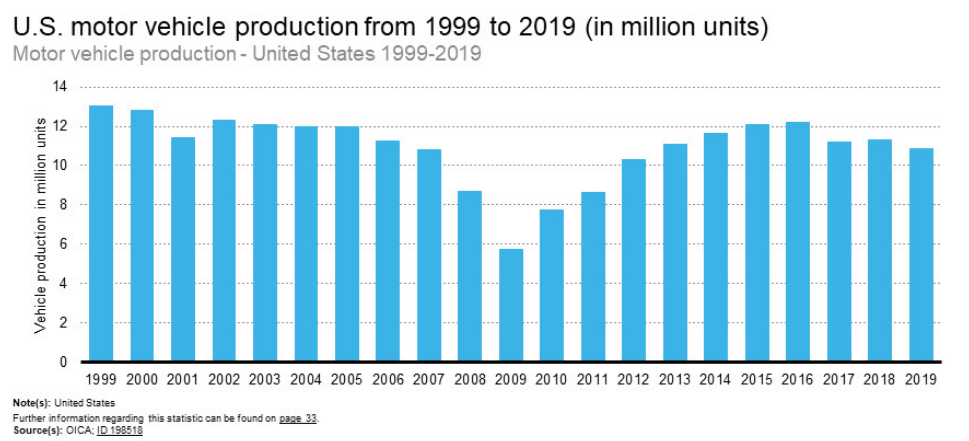
https://www.ceicdata.com/en/indicator/united-states/motor-vehicle-production

US production is roughly same size as the EU, a larger developed market.

https://www.acea.auto/figure/eu-passenger-car-production/#:~:text=9.9%20million%20passenger%20cars%20were,during%20the%202010%2D2021%20period.

Japanese corporations produce about one-third of US output in the US. They export 400,000 vehicles from the US. Three-fourths of Japanese brand cars sold in the US are produced in the US. Japanese cars, on average, have more US (domestic) content than so-called American made cars.

https://www.autocarpro.in/feature/america-japanese-car-usa-26972

https://www.cnn.com/2019/06/26/business/japan-american-honda-hnk-intl/index.html

https://www.bizjournals.com/columbus/news/2016/06/01/japans-big-3-automakers-built-more-cars-in-u-s.html

https://www.cnbc.com/2019/05/21/japanese-automakers-tout-all-time-high-us-job-creation-pressure-on-trump.html

https://www.businessinsider.com/all-the-japanese-cars-made-in-the-usa-2017-11#toyota-avalon-toyota-motor-manufacturing-kentucky-georgetown-kentucky-13

https://www.detroitnews.com/story/business/autos/foreign/2019/06/25/american-made-cars-sold-us-japanese/39620085/

https://www.hotcars.com/11-foreign-cars-made-in-the-us-and-12-american-cars-that-arent/

https://www.motortrend.com/features/8-foreign-cars-might-surprised-made-america/

A Dozen Ways to Slay Inflation

1. Blue Ribbon Panel

Imitate the 1983 Greenspan Social Security committee.

https://www.washingtonpost.com/archive/business/1988/03/27/a-blue-ribbon-challenge-to-nations-red-ink/fe86db9f-2abf-49bb-8a1f-1e4c96c285ae/

6-month time limit. A dozen or less bipartisan dignitaries. Retired ambassadors, investors, CEO’s, federal reserve presidents, etc. Make Mitch Daniels the chair.

https://www.theatlantic.com/magazine/archive/2020/04/mitch-daniels-purdue/606772/

Assign 2 projects. One to cut government waste. The other anti-inflation policies. No more than a dozen recommendations in each half. Presented to congress for simple yes/no vote, without major amendments allowed.

2. Spend Less Government Money

Fiscal spending is too expansionary for the current situation. Back off. Reduce infrastructure spending for now, spend it in the next recession. Reduce marginal defense programs that only have political reasons. Cut state government spending by 3%, which is budgeted to increased by 9%.

https://www.nasbo.org/reports-data/fiscal-survey-of-states

https://rollcall.com/2021/10/18/congress-blocks-cuts-to-top-contractors-weapon-budgets/

3. Incentivize Consumers to Save More

Less aggregate demand will lower prices in many markets.

Increase 401(k) limit by $10,000 for 3 years.

Provide federal government match on first 5% of savings for all employees.

https://www.shrm.org/resourcesandtools/hr-topics/benefits/pages/2022-irs-401k-contribution-limits.aspx

https://www.tsp.gov/making-contributions/maximize-your-savings/

4. Encourage Corporate Pricing Restraint

Offer corporate income tax incentives for firms to hold prices fixed for 2 years.

Wage and price “controls” are widely criticized. Perhaps a voluntary nudge would work.

5. Add Older Workers to the Labor Supply

Stop all social security fund contributions (taxes) by workers aged 62 and older.

https://www.investopedia.com/articles/personal-finance/060515/when-do-i-stop-paying-social-security-tax.asp

Eliminate the “clawback” of social security benefits to retirees who do choose to work.

https://money.usnews.com/money/retirement/social-security/articles/what-happens-if-you-work-while-receiving-social-security

Tweak labor laws to fight age discrimination.

6. Increase Supply of Legal Immigrants

https://www.cnn.com/2022/01/11/economy/chamber-of-commerce-inflation/index.html

https://www.businessinsider.com/immigration-inflation-labor-shortage-chamber-commerce-suzanne-clark-jobs-work-2022-1

7. Eliminate Hidden Tax of Tariffs and Trade Regulation

Unilaterally eliminate all tariffs with Europe, Central America, South America, Japan, South Korea, New Zealand, India. Negotiate with China.

https://finance.yahoo.com/news/one-way-biden-could-cut-inflation-131832592.html

https://www.cnbc.com/2021/11/30/removing-us-china-trade-tariffs-would-ease-inflation-jacob-lew.html

8. Windfall Profits Taxes

https://www.cbsnews.com/news/biden-tax-how-billionaire-minimum-income-tax-works-cbs-news-explains/

https://rollcall.com/2022/03/24/windfall-profits-tax-consumer-rebate-options-under-discussion/

NEWS: Sanders Introduces Legislation to Reinstate the WWII Windfall Profit Tax to Combat Rising Inequality, Inflation, and Corporate Profiteering

https://www.bloombergquint.com/gadfly/to-fight-inflation-biden-should-tax-the-rich-shrink-the-deficit

9. Cut Transportation Costs

Tax incentive for more truck drivers.

https://www.truckinginfo.com/10166531/new-bill-aims-to-reduce-truck-driver-tax-liabilities

Open ocean shipping to competition.

Open trucking to Mexico based carriers.

10. Negotiate Drug Prices, Allow Interstate Health Insurer Competition

https://hbr.org/2021/10/the-u-s-can-lower-drug-prices-without-sacrificing-innovation

https://www.sidley.com/en/insights/newsupdates/2021/11/us-looks-to-introduce-europeanstyle-drug-price-controls

https://www.freep.com/story/news/nation/2014/09/05/dems-try-gop-idea-on-health-care-put-states-in-charge-of-cost-control/15106115/

https://www.marketwatch.com/story/six-ways-republicans-can-reduce-health-care-costs-in-their-new-plan-2017-03-11

https://www.manhattan-institute.org/reforming-health-insurance-across-states

https://www.commonwealthfund.org/blog/2017/selling-health-insurance-across-state-lines-unlikely-lower-costs-or-improve-choice

11. Increase the Supply of Housing

Increase immigration to improve labor supply. Cut tariffs to reduce supplies costs. Lean on local regulators to reduce zoning restraints and one size fits all building codes. Strategically require a higher share of affordable housing and multifamily permits annually in each metropolitan region. Phase-out the mortgage interest tax deduction for second homes.
https://www.bloomberg.com/news/articles/2022-02-04/in-sizzling-u-s-housing-market-normal-is-a-long-way-off

https://www.whitehouse.gov/cea/written-materials/2021/09/01/alleviating-supply-constraints-in-the-housing-market/

https://www.shrm.org/resourcesandtools/hr-topics/benefits/pages/2022-irs-401k-contribution-limits.aspx

12. Cut Energy Prices

Loosen regulations for 5 years to encourage increased “all of the above supplies” energy through drilling, coal, oil and nuclear. Suspend federal gas tax for 3 years. Negotiate oil price minimums/maximums between US/Europe/Japan and OPEC.

https://www.reuters.com/world/us/bidens-menu-options-high-gasoline-prices-is-not-appetizing-2022-03-23/

https://www.cbsnews.com/news/gas-prices-inflation-us-president-cbs-news-explains/

https://nymag.com/intelligencer/2022/03/heres-how-biden-can-lower-gas-prices.html

Summary

Reducing inflation is a complicated policy area. The solutions proposed by “experts” are rarely politically appealing. Competing political parties hesitate to provide “wins” to the other. However, 8% inflation after a 2-year pandemic while the US faces Russian war actions is a “national emergency”, worthy of an FDR like approach to “try a few things”. It is an opportunity to overcome individual industry opposition to things that make sense for the country. It is an opportunity to try some left and right solutions.
Good News: Oil 2022 is not Oil 1972!

World Oil Dependency is Less than One-Half What It Was

https://www.energypolicy.columbia.edu/research/report/oil-intensity-curiously-steady-decline-oil-gdp

Oil Matters, But Other Energy Sources are Growing

https://www.energypolicy.columbia.edu/research/report/oil-intensity-curiously-steady-decline-oil-gdp

Oil Intensity is Declining on Many Continents

https://www.energypolicy.columbia.edu/research/report/oil-intensity-curiously-steady-decline-oil-gdp

https://www.northerntrust.com/africa/insights-research/2022/weekly-economic-commentary/oil-intensity

Oil Intensity Has Declined Even While Demand Has Grown

https://www.energypolicy.columbia.edu/research/report/oil-intensity-curiously-steady-decline-oil-gdp

https://www.mckinsey.com/industries/electric-power-and-natural-gas/our-insights/the-decoupling-of-gdp-and-energy-growth-a-ceo-guide

Context of Historical Real Prices

http://chartsbin.com/view/oau

https://www.mckinsey.com/industries/electric-power-and-natural-gas/our-insights/the-decoupling-of-gdp-and-energy-growth-a-ceo-guide

Future Global Oil Intensity is Declining

https://www.energypolicy.columbia.edu/research/report/oil-intensity-curiously-steady-decline-oil-gdp

https://www.reuters.com/business/energy/why-todays-economy-can-handle-oil-100-barrel-or-higher-2021-10-21/

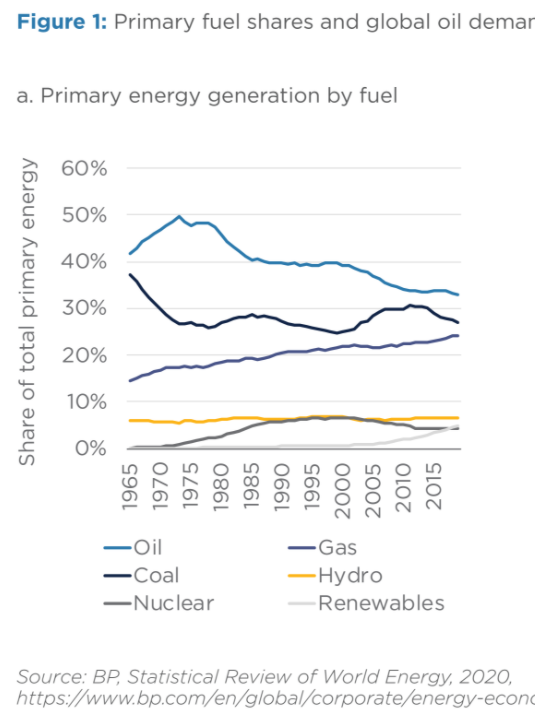
Energy intensity is down as the service economy becomes a greater share of GDP, energy efficiency improves for consumer and industrial uses, electricity power grows with its inherently higher efficiency, and renewable energy grows as a source of power.

https://www.mckinsey.com/industries/electric-power-and-natural-gas/our-insights/the-decoupling-of-gdp-and-energy-growth-a-ceo-guide

Recent Global Oil Price Spikes Had Limited Impact

https://www.energypolicy.columbia.edu/research/report/oil-intensity-curiously-steady-decline-oil-gdp

https://www.reuters.com/business/energy/why-todays-economy-can-handle-oil-100-barrel-or-higher-2021-10-21/

US Economy Energy/Oil Intensity Improves

https://www.eia.gov/outlooks/aeo/consumption/sub-topic-03.php

https://www.eia.gov/todayinenergy/detail.php?id=42895

https://www.jpmorgan.com/wealth-management/wealth-partners/insights/stagflation-is-not-here-to-ruin-our-economy-once-again-heres-why#infographic-text-version-uniqId1649120345700

Future Energy Intensity Improvements in All US Sectors

https://www.eia.gov/todayinenergy/detail.php?id=42895

https://www.eia.gov/outlooks/aeo/consumption/sub-topic-03.php

https://www.northerntrust.com/africa/insights-research/2022/weekly-economic-commentary/oil-intensity

Risks

US consumer price index still weights motor fuel consumption at 4%, so spikes in market prices effect consumers and politics.

The long-term downward trend in oil required per dollar of GDP slowed after 2014.

https://www.energypolicy.columbia.edu/research/report/oil-intensity-curiously-steady-decline-oil-gdp

It’s possible that ALL energy prices may increase, especially during the transition to renewable energy sources.

https://www.reuters.com/business/energy/why-todays-economy-can-handle-oil-100-barrel-or-higher-2021-10-21/

Finally, individual country risks still matter: Russia, Iran, Venezuela and Saudi Arabia.

Summary

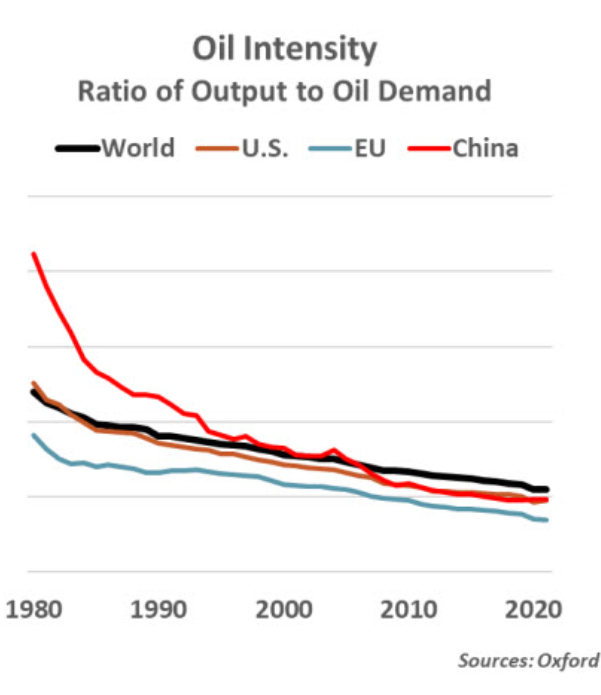
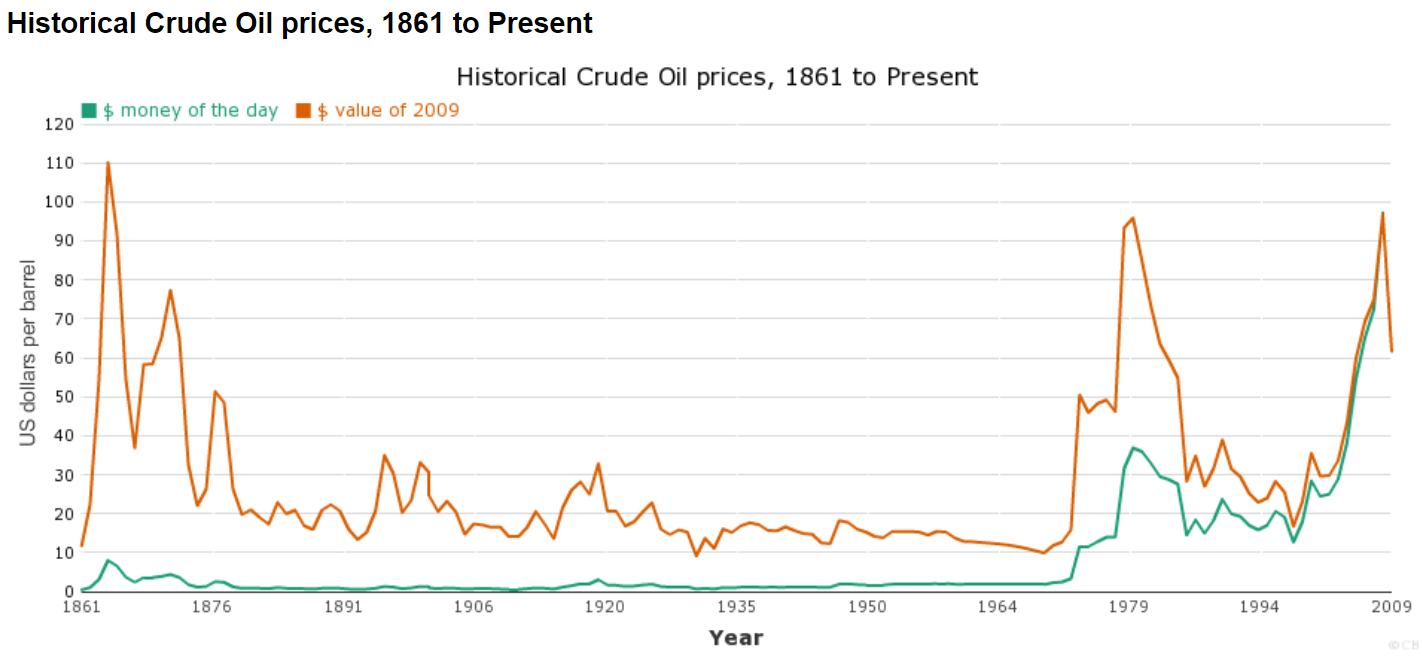
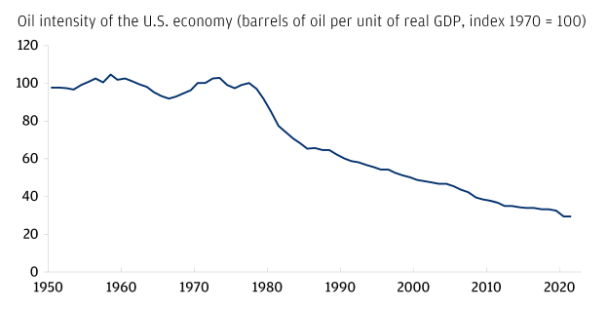
The Oil Shocks of the 1970’s were due to a drastic shift in the pricing power of the OPEC countries following 30 years of greatly accelerated global demand for oil while it was priced attractively. Demand and supply have both grown in the last 50 years. The role of oil in the global and US economies (compared with real output/GDP) has dropped by more than one-half. Increased oil prices can and will have a significant effect today, but less than one-half of that in the past. Long-run trends indicate that the role of oil as a critical resource will continue to decline, although there remain risks as the world closes coal and nuclear power plants and makes the investments required for a renewable energy world.
Good News: Average US Car is 12 Years Old

The average age of all US cars and light trucks in operation exceeded 12 years for the first time in 2021.

https://news.ihsmarkit.com/prviewer/release_only/id/4759502/

Typical vehicle age increased by one-quarter, from 9.6 to 12.1 years since 2002.

Typical vehicle age increased by more than one-half from 7.8 years in 1990.

Typical vehicle age more than doubled from just 5.3 years in 1969.

The rate of increase has remained relatively constant, with improved highways, driving, designs, quality and maintenance allowing the average age to increase by 1 year every 7-8 years.

Data

summary table, page 60.

page 10, 1969

page 54, 1977. 1 of several somewhat different figures.

page 26, 1983.

page 104, 1990

page 78, 1995.

Articles

https://www.usatoday.com/story/money/cars/2021/06/14/used-cars-suvs-trucks-used-car-prices/7638769002/

https://www.autodealertodaymagazine.com/366056/average-age-of-vehicles-on-the-road-increases

https://www.iseecars.com/longest-lasting-cars-study

25 Years of Inflation by Category

https://fred.stlouisfed.org/series/CWUR0000SA0#0

https://fred.stlouisfed.org/series/CWUR0000SAF#0
https://fred.stlouisfed.org/series/CWUR0000SAT#0
https://fred.stlouisfed.org/series/CWSR0000SAH
https://fred.stlouisfed.org/series/CWUR0000SAA#0
https://fred.stlouisfed.org/series/CWUR0000SAR#0
https://fred.stlouisfed.org/series/CWUR0000SAE#0
https://fred.stlouisfed.org/series/CWSR0000SAE2
https://fred.stlouisfed.org/series/CWSR0000SEEB#0
https://data.bls.gov/pdq/SurveyOutputServlet
https://fred.stlouisfed.org/series/CWUR0000SAG#0
https://fred.stlouisfed.org/series/CWUR0000SEGA#0
https://fred.stlouisfed.org/series/CPIMEDSL#0
Category97-20%97-22%%Share
All5975100.0
Food/Beverage648215.1
Transportation454521.9
Housing728539.9
Apparel-5-52.6
Recreation17224.4
Educn/Communicn27316.2
>Communication-25-23
>Tuition, Fees, Child Care165171
>>College Tuition191196
Other Goods/Services1221392.8
>Tobacco/Smoking362424
Medical Care1161257.1

Analysis

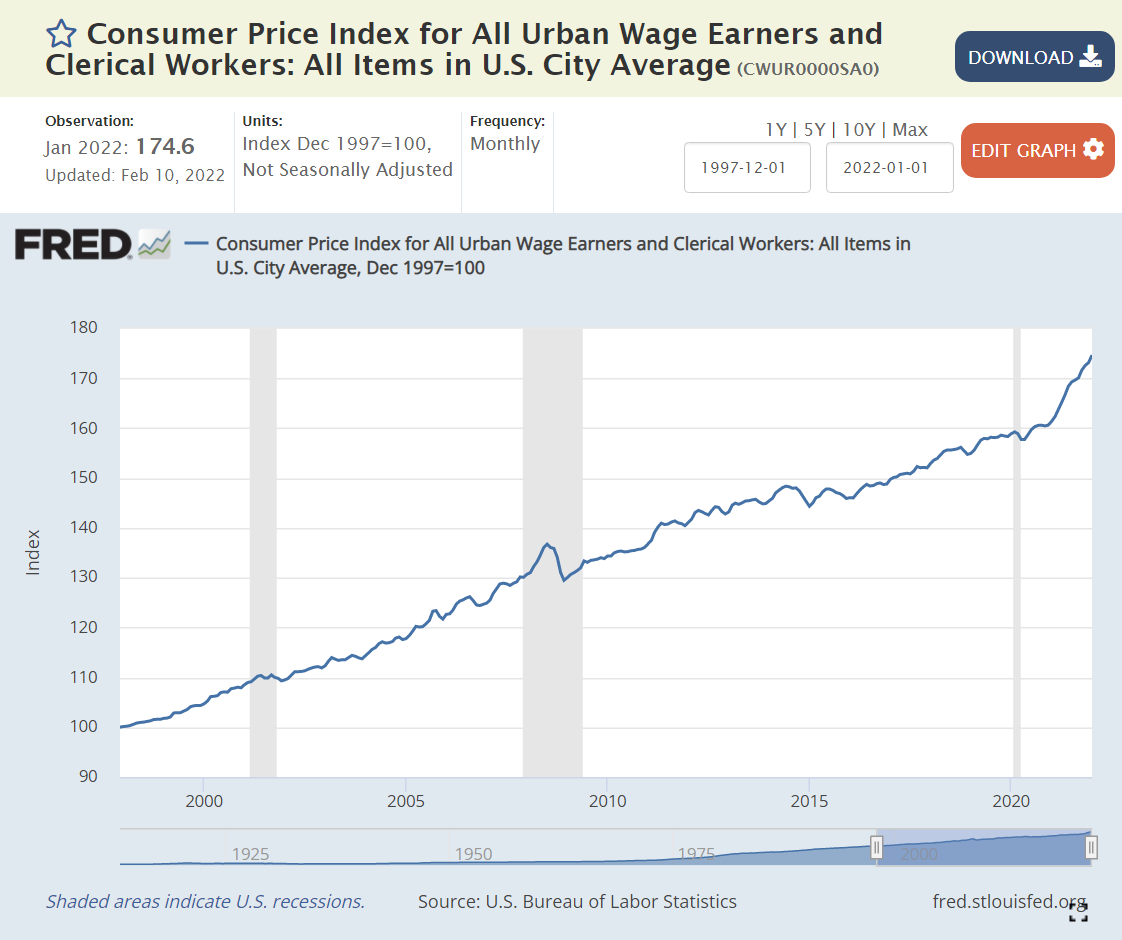
Inflation is back in the news after several quiet decades. The components of the All Urban Wage Earners and Clerical Workers are listed above, comparing Feb 2020 with a 1997 base of 100, and then Jan 2022 with the same base. The most recent weighting of categories is in the rightmost column.

Overall, consumer prices have risen by a modest 2-2.5% annually, just 59% through Feb 2020 and 75% through Jan 2022. Yes, that is a 10% price increase in the last 2 years: 175/159.

The 3 largest components have shown price rises close to the overall average. The biggest sector, Housing (39%), displays slightly higher inflation, at 72% and 85%, closer to 3% annually, with a possibility of higher rises for the next few years. Transportation (22%) reveals lower than 2% annual inflation with a 45% increase across the full period. Food and Beverage (15%) is close to the average with 64% and 82% growth.

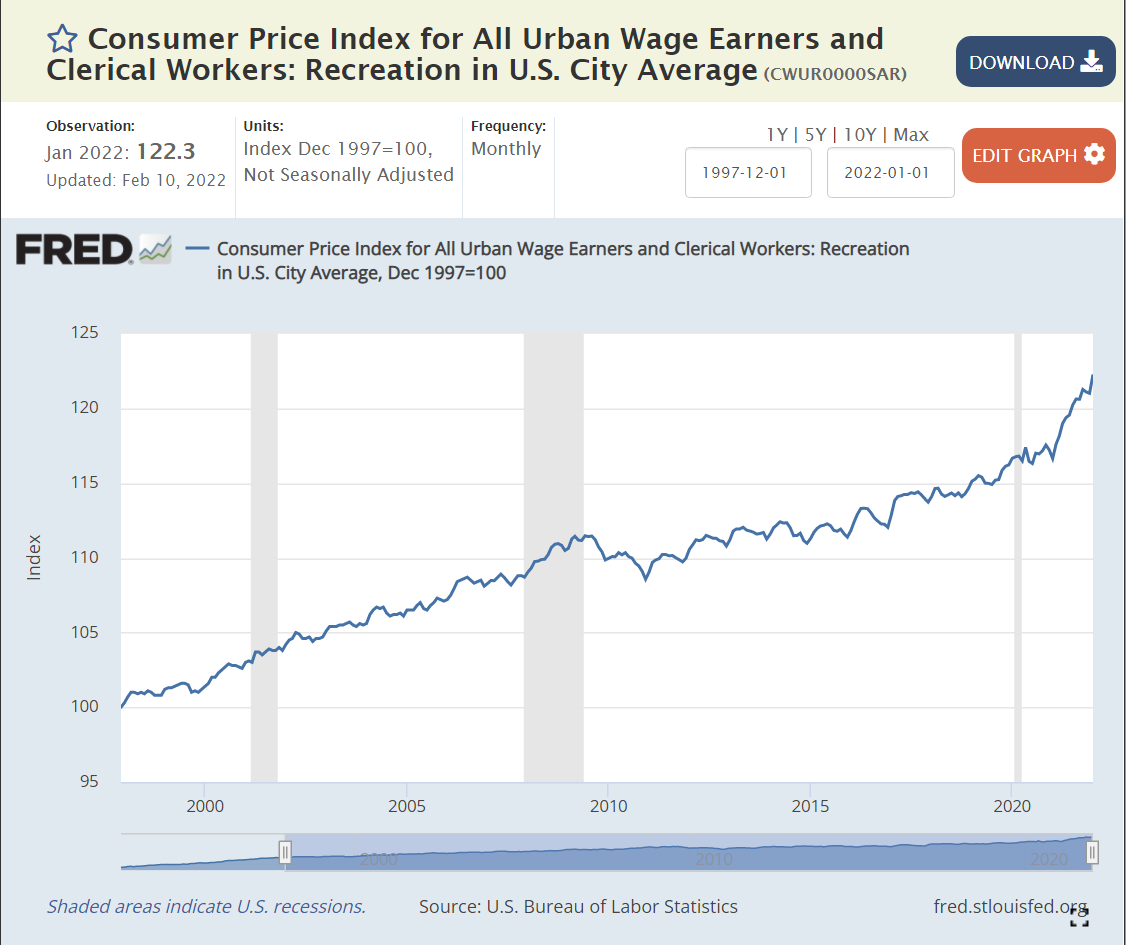
Some smaller areas have seen slow price growth. Apparel (3%) has declined in actual prices during this period. Recreation prices (4%) have grown by less than 1% annually.
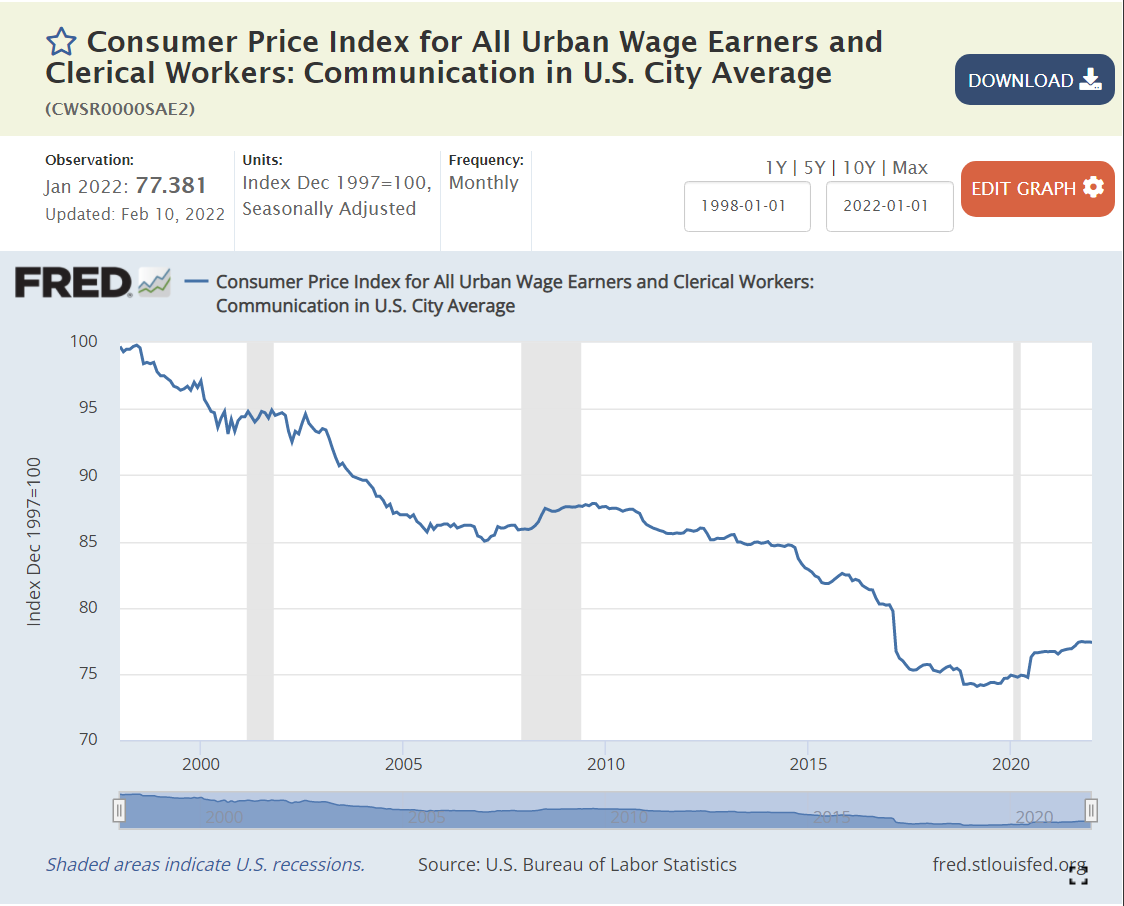
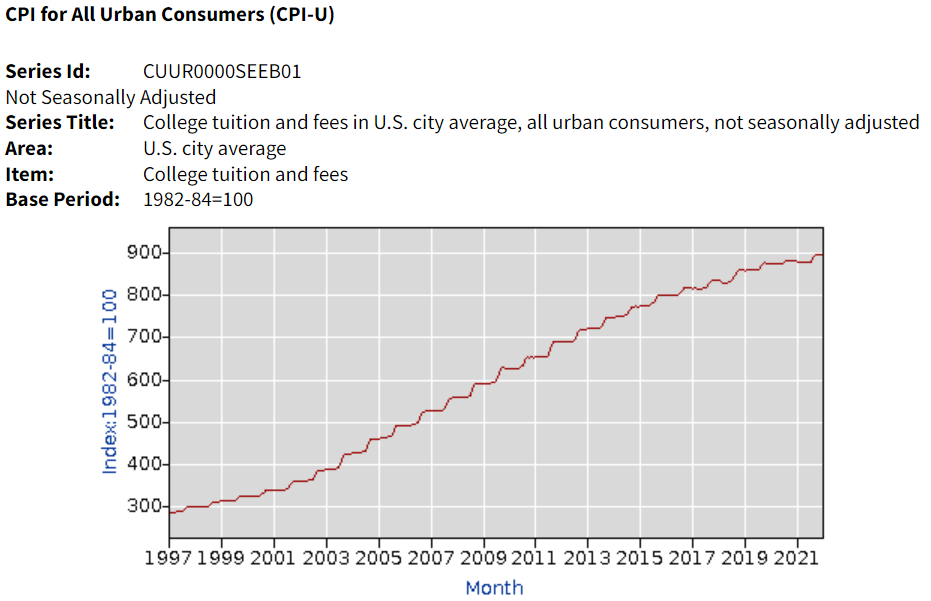
Education and Information (6%) prices have grown by 1% annually, but this category includes 3 very different subsectors. Information Technology prices have declined throughout the period. No simple 25- year summary is available. Communications prices have dropped by an average of 1% annually. Education prices have grown much faster, more than offsetting the decline in IT and communications prices. The Tuition, Fees and Child Care measure of prices increased by 165% and 171%, more than twice as fast as overall inflation, roughly 4% annually. College tuition (data not in Fred database) increased by 191% and 196%, about 4.5% per year.

The Other Goods and Services (3%) category mostly contains miscellaneous items that don’t fit cleanly in Housing or Food/Beverage. The category displays faster price increases (3.5%) on average due to the very sharp increase in Tobacco prices (taxes) which have grown 4-fold in 25 years (7%/year). Note that alcoholic beverage prices increased by a little more than 2% annually

Finally, Medical Care (7%) has grown by 116% – 125% during these 25 years, about 3.5% annually.

Overall goods prices have grown slowly and service prices more rapidly. Medical care and college prices stand out for their increases, while the price of housing/rentals is flashing warning signs.

Good News: Real Airfares are 43% Less than in 1995

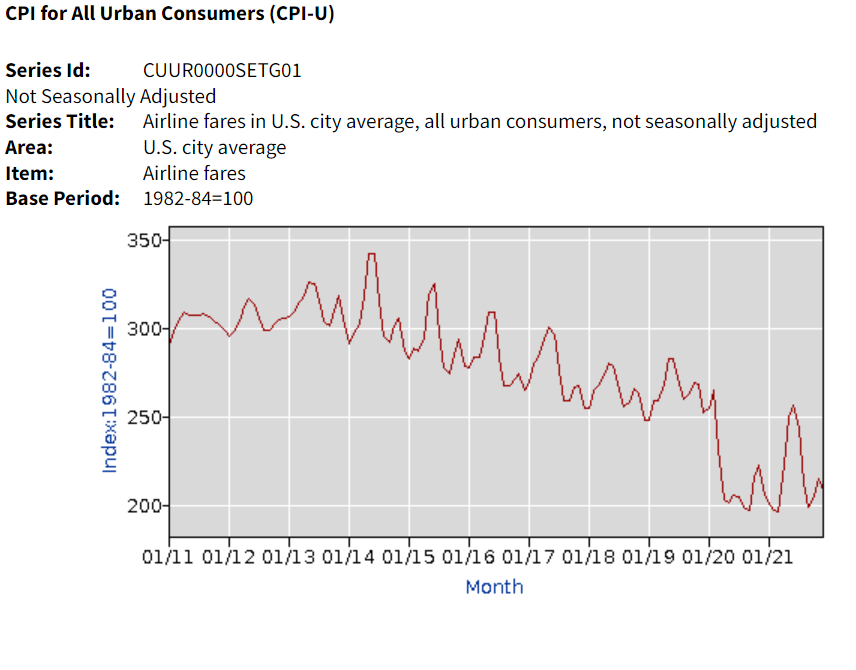
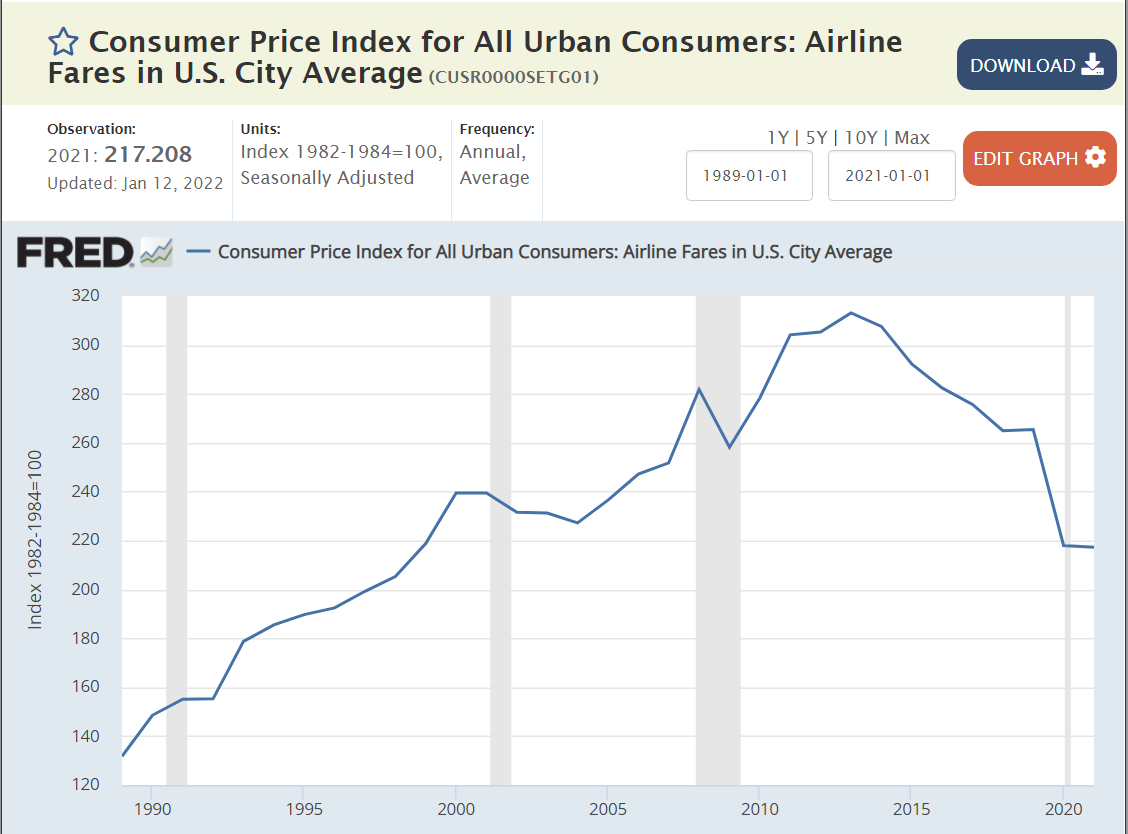
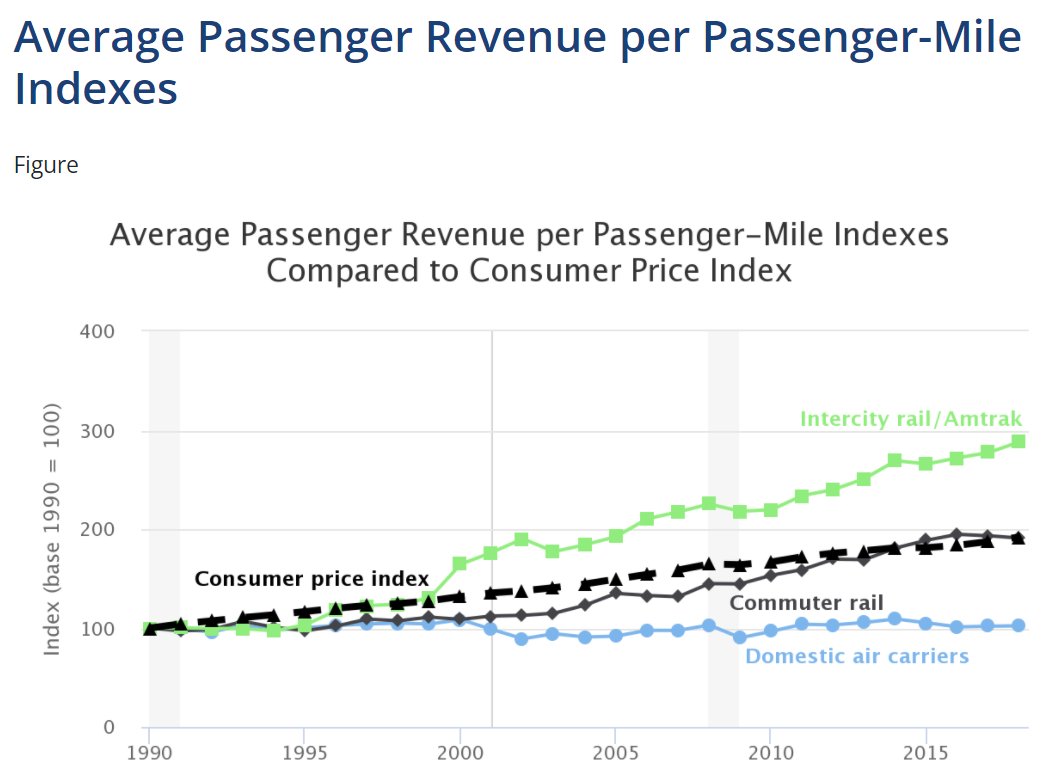
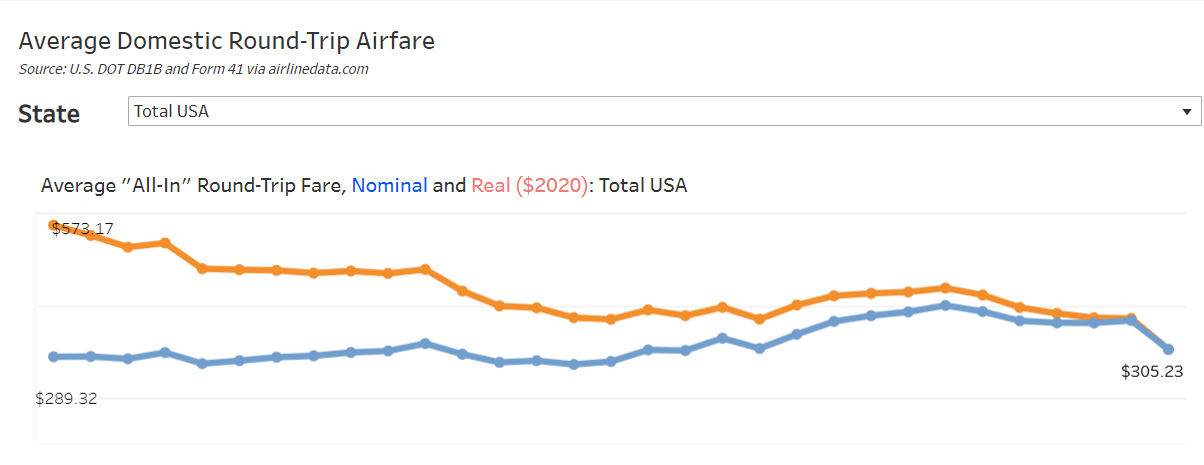
This article combines data from 4 sources with slightly different data. Airfares were flat at the end of the 20th century, but then dropped by 19% by 2004. They remained flat, in real terms, through 2009. Airlines pushed through 8% higher prices in 2010-11 and maintained real fares at the same level through 2014. After 19 years, real airfares were 14% lower than in 1995.

Fares then dropped year after year through 2019, reaching 26% below the 1995 baseline. They have fallen further in the pandemic years to 43% below the level of 25 years ago.

Bureau of Labor Statistics / CPI

The Bureau of Labor Statistics compiles a consumer price index for air travel as part of the overall CPI. It compiles average prices and tries to adjust for changes in the quality of the product.

https://data.bls.gov/timeseries/CUUR0000SETG01?output_view=data

https://www.bls.gov/cpi/factsheets/airline-fares.htm

https://www.bts.gov/content/annual-us-domestic-average-itinerary-fare-current-and-constant-dollars

https://fred.stlouisfed.org/series/CPIAUCSL#0

https://fred.stlouisfed.org/series/CUSR0000SETG01#0

Bureau of Transportation Statistics

https://www.bts.gov/newsroom/figure-1-us-average-domestic-annual-fares-1995-2020

BTS graph and 20 more about the airline industry.

https://www.airlines.org/dataset/the-air-travel-value-proposition/

BTS: Revenue Per Passenger Mile

https://www.bts.gov/content/average-passenger-revenue-passenger-mile-indexes

Dept of Transportation: Average RoundTrip Fares

https://www.airlines.org/dataset/annual-round-trip-fares-and-fees-domestic/

Prior 25-50 Years

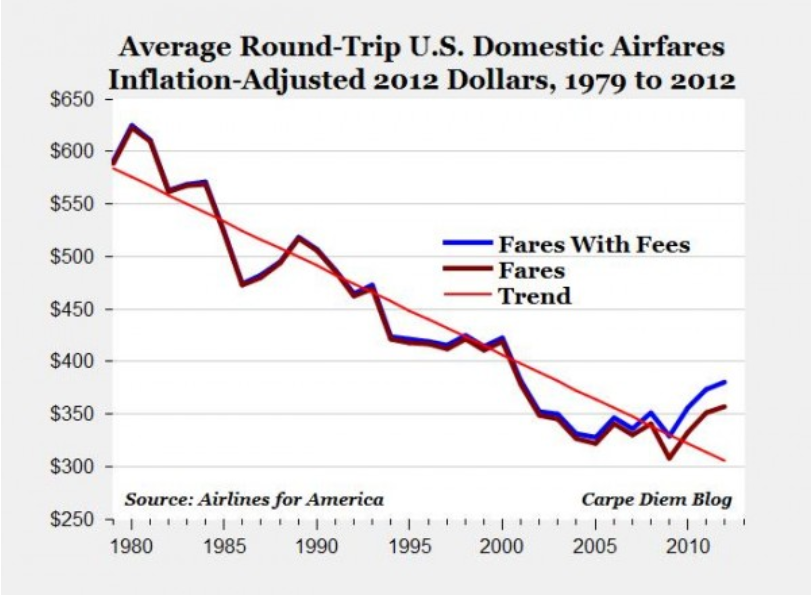
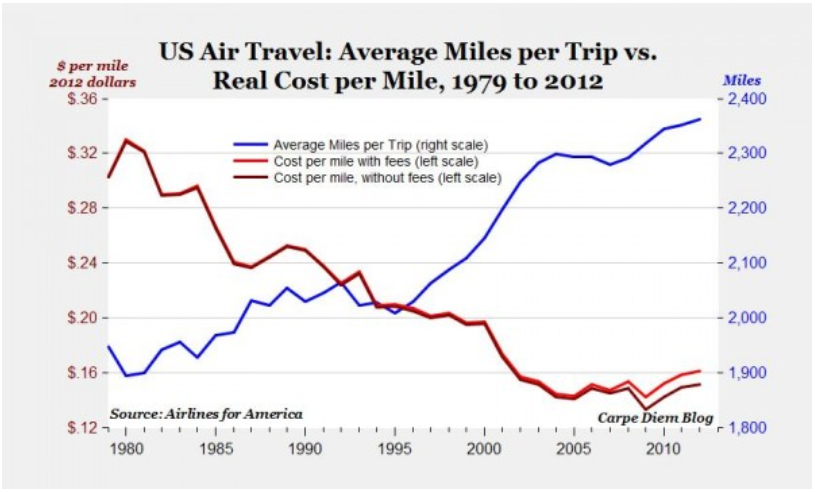
Real airfares declined consistently throughout the period, but no data source is fully compatible with the 4 summarized above. It appears that the real cost of flying declined by about one-third between 1979 and 1995 as the airline industry was deregulated.

https://www.travelandleisure.com/airlines-airports/history-of-flight-costs

https://www.travelandleisure.com/airlines-airports/airfare-cost-change

See How the Cost of a Flight Has Changed Since 1963 [Charts]

Air Industry Productivity (How’d they do it?)

https://www.econlib.org/library/Enc1/AirlineDeregulation.html

https://www.bls.gov/opub/mlr/2017/article/economic-productivity-in-the-air-transportation-industry.htm