
https://quotefancy.com/quote/988783/Wendell-Berry-The-earth-is-what-we-all-have-in-common

https://www.yourobserver.com/news/2023/dec/01/construction-begins-legacy-trail-overpasses/

From 1945 through 1985 the US economy regularly accelerated its growth, reached a peak, fell back and then recovered. Businesses, economists, politicians and the public expected that this 3-5 year business cycle would continue forever.
Looking back, it seems like the business cycle was broken by 1985. All of the subsequent downturns have been prompted by extraneous, outside of the system, shocks. In 1990 a second global oil shortage shock.
https://en.wikipedia.org/wiki/Early_1990s_recession_in_the_United_States
In 2000-2001, a stock market bubble popped.
In 2007, a mortgage lending bubble popped.
https://en.wikipedia.org/wiki/Great_Recession
In 2020, a pandemic driven recession, followed by a very unexpected rapid recovery.
https://en.wikipedia.org/wiki/COVID-19_recession
40 years without a classic business cycle recession is long enough to claim victory.
How could this happen? The independent Federal Reserve Bank has maintained a neutral monetary policy. We have not “shot ourselves in the foot” and we have implemented reasonable policies to offset external shocks. The federal government budget deficit has generally returned towards zero following depression periods. Automatic stabilizers and congressional action have addressed recessionary periods with enough stimulus to stop economic decline and restart recovery.
More importantly, the structure of the US economy has changed. The share of high fixed cost manufacturing has declined as “services” has increased as a share of the total economy. The share of international trade (imports and exports) less directly connected to the domestic economy alone, has increased. The power of labor (unionized or not) has fallen, allowing firms to reduce hours and real wages during a downturn. In most recent times, firms better recognize the cost of attracting and developing highly skilled labor in a complex production world, so they retain key staff even during downturns. Vertical integration has been reduced, allowing firms to respond to minor demand changes more effectively. Based upon the quality revolution, major firms have reset their capacity utilization targets to 80% rather than 95%, providing firms with greater flexibility in managing variable demand and not reaching the point where internal costs increase and the need to increase prices occurs.
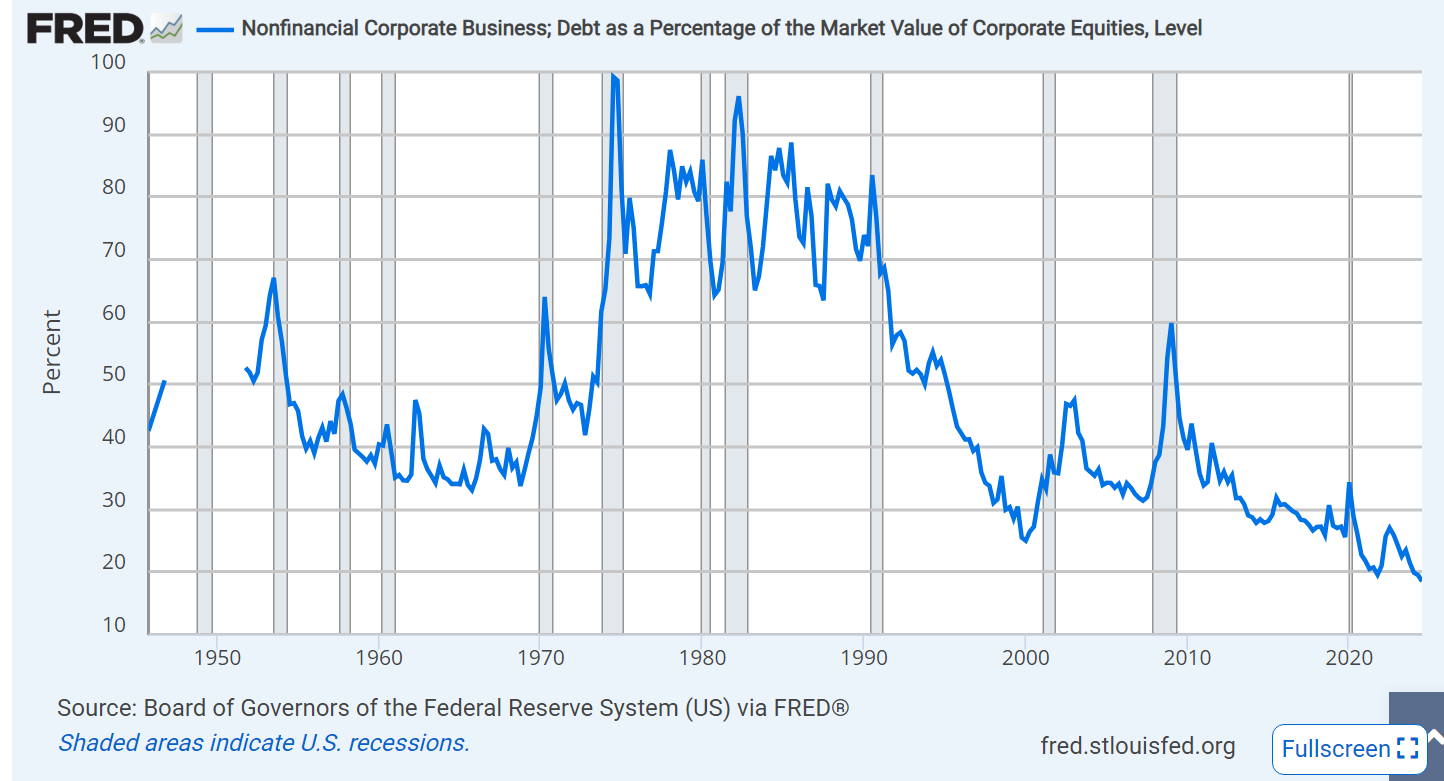
Financial leverage has also decreased. US firms have access to deep bond markets so are they able to incur only necessary levels of indebtedness.
Even with a much greater level of imported goods, retailers hold lower levels of inventory, allowing them to not overreact to changes in demand. Firms have more effective supply chain management processes.

The unemployment rate also shows this structural change. When it was pushed below 5% in the 1960’s, inflation increased and was not permanently checked for 20 years. By 2000 the economy was able to expand and keep unemployment below 5% for extended periods of time without triggering “cost-push” inflation. Unemployment still increases during an economic downturn, but low unemployment does not seem to trigger a recession.

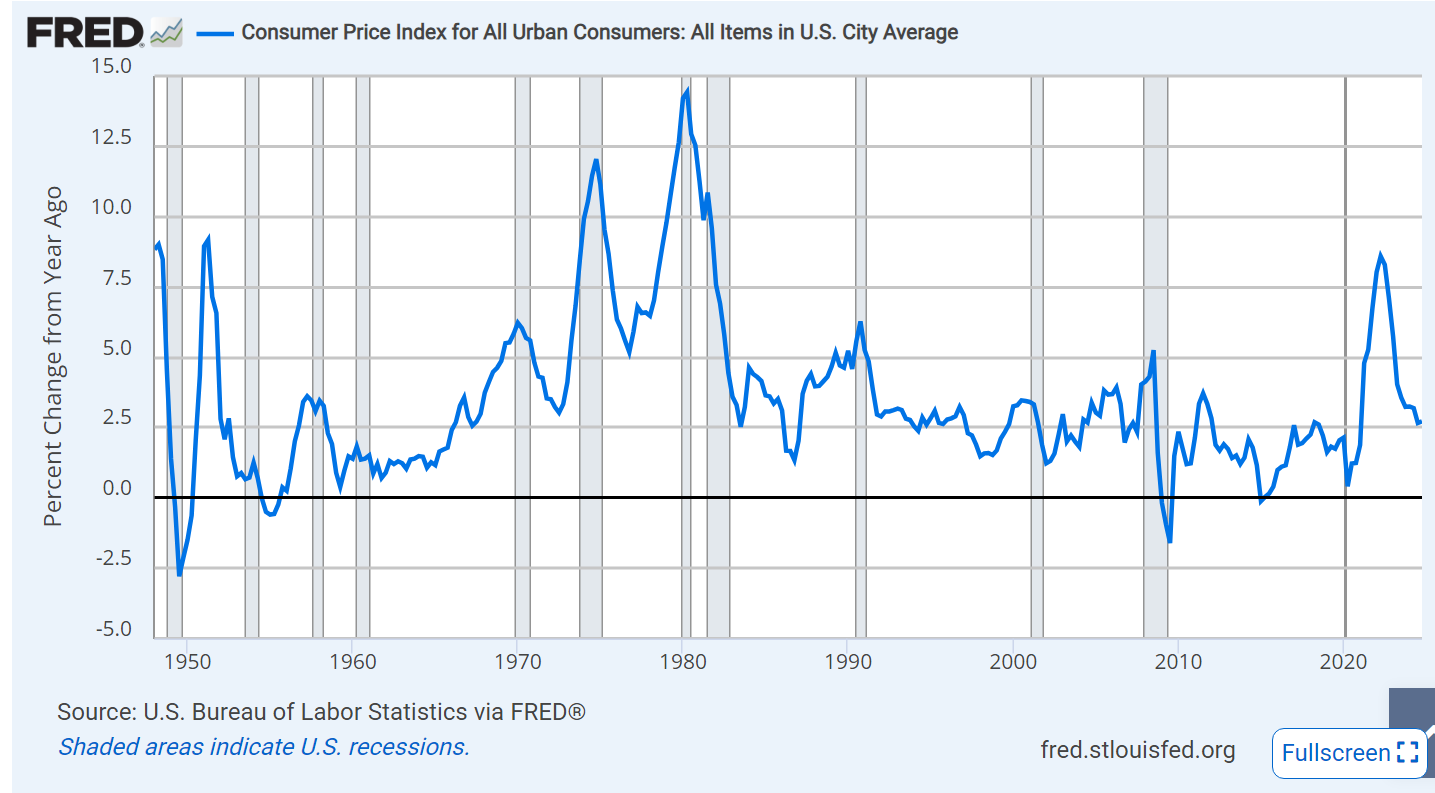
From the 1950’s through the 1980’s inflation tended to increase as the economy overheated before a reduction in credit availability would slow the overall economy. Aside from the Covid pandemic shortages, we no longer see major inflation increases.
The business cycle caused firms to underinvest because the best available forecast was always that the boom period would be interrupted in 1-5 years. Sales, margins and profits could not be assumed to increase forever.
The business cycle caused firms to follow a stop-start pattern for capital investment projects, process improvement, research & development, new product introduction, new markets, new channels and mergers & acquisitions. Seeing a downturn, firms would cancel existing initiatives, even at a significant cost, in order to conserve cash and signal to stakeholders that management was actively managing the business. Projects would slowly resume after it was clear that the business cycle recovery was under way 2 years later.
For individuals, the “last hired, first fired” cycle applied. Firms froze open position hiring. They released interns and summer workers. They prohibited overtime. They cancel contracts with temporary labor firms. Less experienced workers and minority groups suffered. Labor intensive industries, especially construction, were hard hit. Smaller firms closed. The hiring cycle would resume 2 years later.
Historically, stock market values also followed the pattern of the business cycle closely. Stock market declines were seen as an “early warning” indicator by forecasters. Since stock market values are theoretically determined by a risk-adjusted discount rate, the reduction of business cycle variability allows investors to use a lower interest/discount rate and value future earnings at a higher net present value.
The business cycle appears to be gone. The modern economy does not have the same high fixed costs it once had. Firms are able to increase their sales, profits and capacities in tandem without greatly overshooting the mark. Our national institutions help to keep growth at a sustainable level. Workers, firms, investors and society all benefit from this great advance, even if it is not publicly celebrated.

We have lost control of our political system and confidence in our institutions. I offer some root cause reasons for this situation in a series of posts. Second post in the series.
https://news.gallup.com/poll/647303/confidence-institutions-mostly-flat-police.aspx

Real, inflation adjusted, gross domestic product (GDP) is up 4 and 1/2 times since WWII when the American economy was the savior of Western Civilization and about to invest in the recovery of Europe and Japan. In this long-term perspective, growth is very constant. Critics can point to the capture of a greater share by the wealthy. Optimists can point to the radical improvement in quality not captured by GDP, increased consumer choices available and a larger share of retirees in the population.
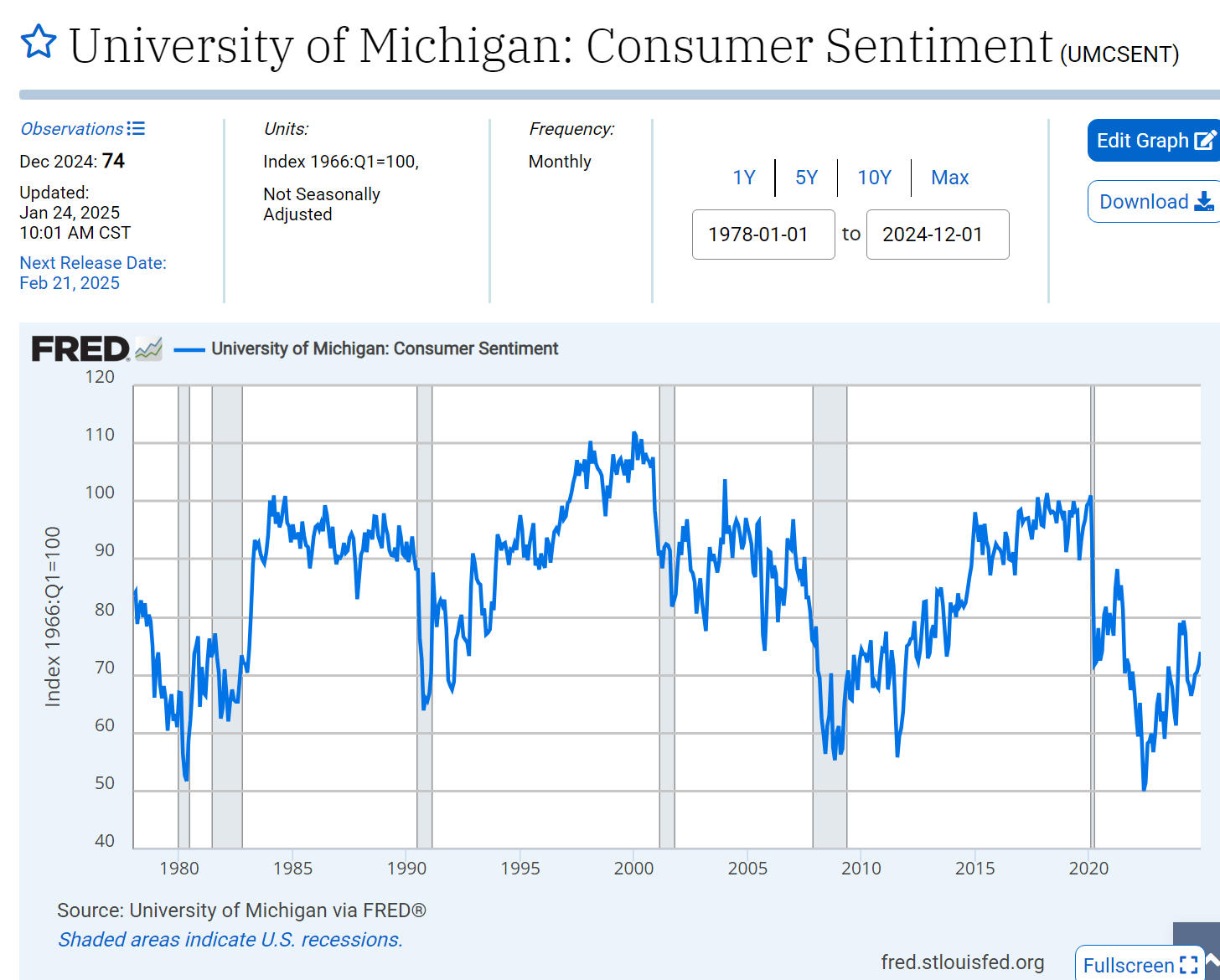
Consumer confidence rises with the economy and declines with recessions and polarized politics, but it has no upward trend to match real incomes!
Economists assume that people have unlimited wants. Most research and common-sense experience show that this is true.
http://www2.harpercollege.edu/mhealy/eco211/lectures/microch1-17.htm
Post-war economists have persistently claimed that Americans “now” have everything they need materially to be happy, but they have been persistently wrong.
https://en.wikipedia.org/wiki/The_Affluent_Society
Other research shows that beyond a certain level of income, more money doesn’t make people happier.
https://penntoday.upenn.edu/news/does-more-money-correlate-greater-happiness-Penn-Princeton-research
Real people, at all levels of income, report that they would be happy, satisfied and secure if they only earned 50% more.
Our happiness often is based on our perceptions of comparative social and economic status. There is always someone with more.
We focus on our most recent experience rather than seeing the big picture.
https://en.wikipedia.org/wiki/Recency_bias
Once we have an idea in mind, we tend to consume information that confirms the idea and avoid or deny challenges. Positive, constructive people will be optimists. Others will be pessimists and follow the bad news media.
https://en.wikipedia.org/wiki/Confirmation_bias
When we do try to rationally assess our current situation, we compare it with something obvious. It’s usually something prominent, recent, large, and shiny. We compare today with our best ever experience or situation. We reset our expectations to compare with something prominent in our experience. We don’t plot graphs of our real annual earnings, wealth and leisure. Our expectations are anchored in our best experiences. Current expectations tend to move back to a neutral evaluation.
https://en.wikipedia.org/wiki/Anchoring_effect
Humans want more. We are rarely satisfied. That means we are easily distracted in the modern world by marketers, influencers, journalists, bloggers and politicians. Human nature has not changed. Our true economic condition has improved with little impact. Our access to information, education, knowledge and wisdom has increased with minor impact. The ability of communicators to influence our perceptions of the world has greatly increased and we have generally not improved our defenses. “We have much, much work to do today” – Mr. Thoburn Dunlap, 1970, Fairport Harbor, Ohio high school teacher.
P.S. Focus on how the media works.
P.S.S. Positive view of economic and social progress.

https://ylcube.com/c/blogs/broadly-speaking-community-interests-vs-individuality/
I think that we have inadvertently prioritized only the individual and completely discounted the role of “community” in American life. We desperately need to rebalance.
Here you’ll find
6 “good news” posts on American trends
7 “good news” posts on Hamilton County, Indiana
2 posts on the Indianapolis metro area
3 posts on the religious dimension of community
An overview on Our American Community and links to Our Kids, Why We’re Polarized and Little Pink Houses.
Solutions such as community assets (Janesville Plan), school curriculum, civility pledges and candidate approval boards.
Historical overview of the critical role of community, how we have more in common, the role of morality and the conflict between “only the individual” and the community.

Journalists, artists, pundits, entertainers and politicians all scheme for our attention. Once upon a time … we briefly thought that the internet and social media might usher in a new age of information, selection, objectivity, useful filtering, wisdom and cooperation!!!! Unfortunately, we are now deluged by “least common denominator” communications skillfully targeted to lure us into a non-stop cycle of clicking on marketable links. These communications very effectively use every trick and technique to appeal to our emotions, prejudices, weak attention, surface thinking, fears, hopes, exaggerations, etc.
Politicians of all flavors have conspired to convince us that the whole world is comprised of “good versus evil” people, politicians, parties, religions, states, policies and institutions. Everything is “win/lose”. Disagreement is motivated by bad ideas and motives rather than differences of opinion or interests. Compromise is a sign of weakness. Every political actor is purely motivated by self-interest.
We each have a moral, political, social, religious and personal responsibility to evaluate these “conclusions”. Let’s start with overturning the idea that we have nothing in common, that we must rely upon politicians to define opposing policies, parties and philosophies and fight to the death for one or the other to finally win.
Biologically we are all the same.
We intuitively and rationally combine thinking, feeling and doing; conscious and unconscious drives.
We each think that we are “right”. As in Lake Wobegon, we are all “above average”. We struggle to maintain self-awareness, to consider the needs of others, to even pursue our own goals consistently and effectively. We are functionally and morally imperfect.
We have a variety of needs and desires that cannot be fully met. Safety, acceptance, achievement, agency, transcendence, control, familiarity, influence, consistency, love, health, growth, expression, authenticity, loyalty.
We are primarily “analog” beings.
We face death, evil, suffering, disappointments, violations, violence and pain. Random, irrational, unavoidable experiences. We often respond with fear, anxiety, cautiousness, anger and victimhood. We search for ways to “manage”.
We experience life through time, learning, relationships, lessons, goals, planning, dreams, hope, commitments, doing, feeling, thinking, feedback, taking risks, managing risks and opportunities, engaging, disengaging, focusing, relaxing, looking outward, looking inward. The journey is complex and the perspective changes.
We balance and prioritize. Limited resources. Unlimited desires. Personal, family, social, community, religious, financial, and health dimensions compete. At best, we fight the many demands to a “draw”.
We struggle to keep up in a world that becomes more complex every decade: personal choices, goods and services available, information available, technical complexity, political complexity, social choices, religious choices, communications options, philosophical choices, scientific results, business complexity, international options, cultural options. More options, more choices, greater expectations.
We live in a culture that prioritizes the economic dimension of production and consumption. We have embraced a meritocracy that offers great rewards to the winners and a modest “safety net” to those who are not winning. Economic and status anxiety are very high in the most economically successful nation in history. We promote an extreme personal responsibility that undermines those who don’t always achieve and sustain their highest goals.
We live in a world that has been labelled the “therapeutic society” or the world of “expressive individualism”, summarized by the US Army slogan of “Be all that you can be”. The individual is responsible for living and achieving a great life of personal expression reflecting their talents and possibilities. The individual has many coaches, advisors, mentors and therapists, but is alone in choosing their “destiny”. They cannot rely upon tradition, religion, culture, nation, village, parents, personality profiles, or skills assessments. This radical secular humanism view places the responsibility for identifying and achieving a “world changing” destiny upon each person. Wise individuals find some way to “balance” this personal responsibility with other influences, refusing to adopt a godlike stance. They avoid becoming like Icarus and flying too close to the sun.
We live in a world that highlights the individual above nature, community, culture or religion. Complete individual liberty, freedom and opportunity are desired. No trade-offs with the other dimensions of life. “Natural consequences” frustrate those who embrace this libertarian ideal.
Life is hard. So many advances in society, business, education and technology. The challenges to “living a good life” are greater than ever. The progressive promise is undermined. All individuals must now make choices that were once reserved for kings, priests, princes, monks, scientists, philosophers, artists, governors, generals, financiers, industrialists, explorers, entrepreneurs, and presidents.
We digest the beliefs, norms and values of our culture subconsciously. The legacy of Christian Western Civilization continues. The legacy of secular humanism continues. We live in a “secular age” where deep faith and unskeptical religious commitment is unusual for the highly educated one-third. We’re “neither fish nor fowl”. Culture really matters but is today a blend of two streams like “oil and vinegar”. There is much in common. There are some big differences. We generally share the political, economic, social, religious, scientific and literary history of Western Europe, even though parts of the intellectual community have promoted disturbing alternate views for almost 200 years.
Despite living in a “secular age” and an “individualistic age”, we all need to be connected to various communities. Although community participation frequency, manner and depth vary greatly across the decades, humans always need to be connected.
We share a legacy and currency of art, media, design, architecture, music and entertainment. High-brow and low-brow. Mass market and specialized. Push versus pull connectivity. We are connected.
The US remains an unusual Western society where the not-for-profit, religious, social, volunteer world performs major social welfare functions. We share our experiences of funding, volunteering, leading and consuming from these organizations. The individual and community experience of managing these organizations shapes our world view. Our individualistic bias combines with our social/religious obligations to create and support these organizations.
We share our experiences in pre-K, elementary, high school and college education. Mainly public schools. The content shapes our perspectives.
We have moved from 6 to 4 to 3 to 2 to 1.X children per family. We invest like never before in the growth, education, experiences, guidance, mentoring, support and direction of our children. Helicopter parents. Summer programs. Internships. International experiences. The youth orientation reigns supreme.
We continue to value the “social esteem” provided by others. We comply with social norms in every dimension of life. We seek approval. We consume good and services to signal our social status. We achieve, perform and consume based on social influences.
We adopt “tolerance” as a supreme moral value. We don’t advise, influence or interfere with others, even when we strongly disagree.
We continue to struggle with the idea of a “class structure” in America despite the obvious growth in economic, social and political influence of the wealthy (top 1%) and the professional class (top 10%).
We share the American “English language”. It dominates the whole world.
We share the mass media, local newspapers, industry and professional journals, scientific and academic journals, the entertainment industry, social media platforms, community forums and the internet.
We share modern communications and information technology. A “smart-phone” is in every pocket, instantly accessing the cumulative knowledge and information of mankind.
Americans are much more “religious” than “Europeans”. We mostly believe in God and spirituality and Christianity. We have seen that shared cultural/religious beliefs can be maintained in a religiously pluralistic society. We believe in objective “right and wrong”. We intuitively accept “the golden rule”. We see “America” as part of God’s plan and history. A place for the pilgrims. A land of religious diversity. The overturning of slavery. American victories in the 2 world wars and the cold war. The moral dimension of life matters.
We still live in the world that Adam Smith described in 1776. The degree of specialization is only limited by the extent of the market. Our world is extremely specialized. A bewildering variety of products are available. Outsourcing of many functions. Regional, national and international sourcing.
We all specialize in our most productive functions today. Profession, sub-profession and industry. We all have talents. There are most highly rewarded in their professional roles.
We are producers and consumers, investors and suppliers, professionals and managers, entrepreneurs and directors. We are deeply engaged in the financial system, markets for labor, money, trade, property, goods and services. We sometimes elevate this role to be “everything”, to our detriment.
We are interdependent. We rely upon “essential workers”, universities, governments, builders, contractors, consultants, bankers, utilities, media, lobbyists, politicians, unions, secondary markets, employment firms, lawyers, engineers, IT and communications folks, etc.
We rely upon the US macroeconomy. Budget deficits. Fiscal policy. The Federal Reserve Bank. Monetary policy. Federal banking and industry regulators. The bond markets. The credit rating agencies. Animal spirits. Wall Street. Mutual funds. Municipal bonds. Mortgage bonds.
We rely upon our commitment to the capitalist, free market, free enterprise system. Laissez faire. Limited government regulation. There are specific situations and metrics that warrant government intervention, but we lean towards allowing the natural incentives of the market to police the behavior of great firms.
We believe that economic growth provides the opportunity for the political system to effectively “redistribute income”, ensuring that the economic value added by scientific and business innovation through time does not all accrue to the owners.
The benefits from international trade are well understood and have been demonstrated for 75 years.
There are opportunities to engage all nations to manage diseases, food supplies, hunger, human rights, refugees, public health, travel, immigrants, trade, communications, and ocean resources.
There are global threats that must be managed: climate change, nuclear war, chemical and biological weapons, computer hacking, artificial intelligence, species loss, food production, energy production.
An objective physical reality exists. An objective moral reality exists.
The individual really, really matters. Human rights.
The scientific method applied to technical issues is great. It is not everything.
Instrumental logic is a tremendous asset for science, business and life.
Pragmatism is always worth considering. “Show me the money”. Does this theory produce measurable results?
We reject anarchy, atheism, pure commercialism, communism, fascism, necessary progress, libertarianism, national socialism, racism, sexism, totalitarianism, utopian socialism, white nationalism, Christian nationalism. In essence, we reject extreme views. We’re comfortable with a “checks and balances” political system that slows changes until they’re embraced by a solid majority.
The US is a world of skeptical politics. Less is more. Trust no one. Engage the local community to find a solution. Accept the individual bias in economic and social laws. America is a special place, worthy of patriotic respect.
Political participation is a sacred duty.
Despite the structural constraints on change, the US has generally been a positive, constructive, progressive supporter of political changes through time.
Americans are willing to sacrifice for the good of the nation.
The US constitution is framed by the rationalist enlightenment. We deeply believe in “the rule of law”.
Differences can be resolved, technically, rationally, politically.
We are comfortable with “suboptimal” results from our political system. We accept that the federal, bicameral, functionally divided system is designed to prevent the “worst case” outcomes of raw democracy or concentrated power.
In general, we strongly support our government institutions, especially at the state and local levels. Judges do their jobs. Political parties hold each other accountable. Citizens participate in the democratic process as voters, poll workers, jurors, donors, and volunteers.
We live as individuals in a complex, interdependent world. We have more opportunities but less authoritative guidance for our lives. We worry about our freedom and liberty. We make many choices. We do the best that we can. We agree on many things yet disagree on many others.
Today, we understand the world better than ever. We also understand ourselves better, our strengths and weaknesses, our possibilities and limits. We manage complex technology and institutions very effectively. We know that some political and economic options don’t work or pose unacceptable risks or threats. The U.S. and Europe developed “limited government” systems apart from religious authority because disagreements were inevitable. We need to relearn those lessons today. We’re going to have a “mixed” capitalist/government economic system. We’re not going to empower any religious denomination or secular group to impose its views on society. We can delegate issues to the states and learn from their experiences. We can compromise. We can “agree to disagree”. Ideally, we can accept that there are some intractable political differences in our society and focus on those areas where we can find agreement.

The president-elect’s tariff threats are rejected by all professional economists and almost all business leaders. They are mistakenly intended to provide international relations negotiating leverage, force firms to build US factories, and increase domestic manufacturing employment employment. They are based upon the misguided belief that the US economy is broken. It is ironic that Democrats and liberal have trumpet the amazing condition of the US economy.
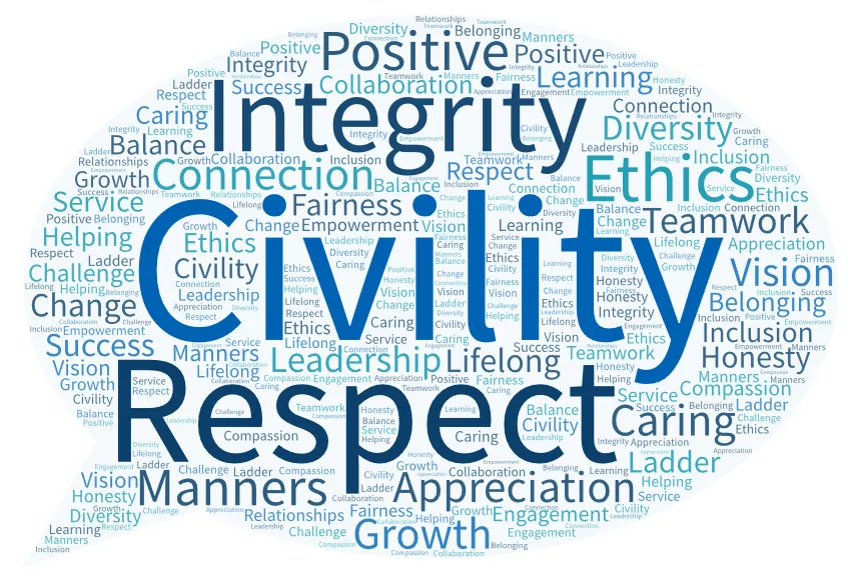
https://toddpopham.com/civility-a-matter-of-respect/
I pledge to participate in my community.
I obey its laws.
I am civil with my fellow citizens.
I participate in our political, economic, social, and spiritual communities.
I respect the innate human dignity and rights of my neighbors.
I accept that we each think, feel, and act differently.
I work to improve my participation, compliance and civility skills and encourage others.
In Carmel, we seek to promote an environment of civility defined as the disposition to respect every human being we interact with as our moral equal and worthy of respect. Therefore, we encourage any candidate seeking public office and asking the citizens of Carmel for their vote, to agree to the following tenets of civility.
The Carmel Civility Project: Candidates Pledge
As a candidate for public office in Carmel, I hereby commit to the following five essential tenets of campaign conduct:
1. Civility and Respect: I will maintain a respectful demeanor towards everyone, regardless of our differences, and foster an environment of open-minded dialogue.
2. Integrity and Truthfulness: I promise to uphold truth and transparency in my campaign rhetoric and actions, swiftly correcting any mistakes should they arise.
3. Positive Focus: My campaign will highlight my vision and policies, eschewing negative attacks on my opponents’ character or record.
4. Informed Discourse: I pledge to inform citizens accurately about my platform and engage in constructive discussions to promote understanding and educated voting.
5. Democratic Process and Accountability: I vow to respect the democratic process, accept its outcomes, and encourage my supporters to engage in campaigns with integrity and decency in support of these principles.
By taking this pledge, I affirm a dedication to dignified campaigning not just out of respect for each resident of Carmel, but also in admiration for the institutions we cherish in our community.

https://www.eso.org/public/news/eso1225/
I encourage us to always “look at the big picture”: across time, nations, industries, occupations, institutions and political views when considering the “state of the economy”.
Recent surveys indicate that many (partisan) Americans believe that the economy is in recession, the stock market is down, and unemployment is up (false). The US economy continues to lead the world out of the pandemic driven recession. I’ve documented the tremendous strength of the US economy in GDP growth, job creation, wage growth, profit growth and wealth creation. Today I’d like to focus on entrepreneurship and new firm creation, where the US once again leads the world.
The US economy led the world in creativity, technology, job growth and firm creation in the 1990’s as it recovered from the global economic challenges of the late post-war era. The deregulation and technology driven changes produced benefits into the “oughts”, the first decade of the new century. Unfortunately, the dynamic pace of new firm creation based on economic, trade, relocation and technological changes did not strongly continue in the first 20 years of 21st century. New firm creation lagged. Larger firms held onto jobs as they consolidated industries and protected their positions. Venture capital firms facilitated the most successful new companies to quickly expand market share and vanquish weaker competitors. Many Schumpeter disciples worried that the engines of “creative destruction” had lost their momentum and effectiveness.
The Great Recession of 2007-10 destroyed wealth, slowed economic growth, job creation and new firm starts. The Obama-Trump expansion was longer than expected by historical standards, but slower growing. Many critics and commentators concluded that the US had “lost its entrepreneurial spirit”.
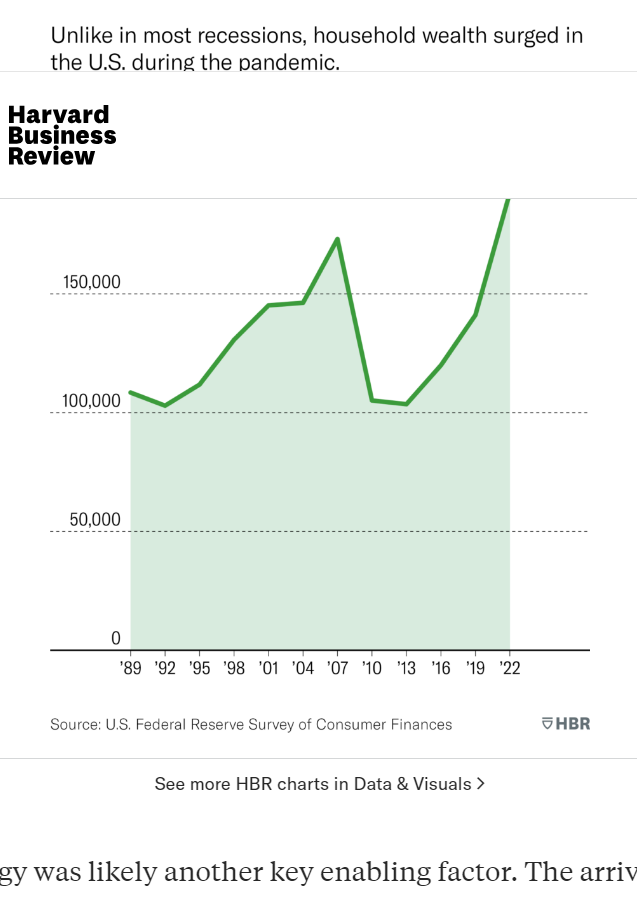
https://hbr.org/2024/01/how-the-pandemic-rebooted-entrepreneurship-in-the-u-s
New firm creation since the pandemic has basically been 50% higher than before the pandemic.
This is an AMAZING and unexpected result for the US. During the pandemic, economic activity ground to a halt. Supply chains stopped functioning. People stayed home. 20 million jobs were lost. 1 million lives were lost in the US. Many firms closed. Global trade and military tensions increased. Trust in governments, corporations and other institutions was damaged. In 2020, there was no reason to believe that the pandemic would be medically controlled soon, or that economic growth would quickly rebound and resume its trend growth rate. But it did!

https://www.census.gov/econ/bfs/current/index.html
The IRS tracks new firm tax license applications. Most firms never really do business, but the ratio of initial applications to real firm creations has been stable through history. The Census Bureau has determined which subset of IRS license applications leads to real new firm creations. Both measures show the tremendous 50% increase between the pre-pandemic and post-pandemic eras.
As Wendy’s Clara spokeswoman exclaimed long ago, “show me the beef”. Did the increased rate of tax applications during 2021-22-23-24 result in new firm creation?

Firms less than one year old are up 16%, not 50%, still a significant increase.
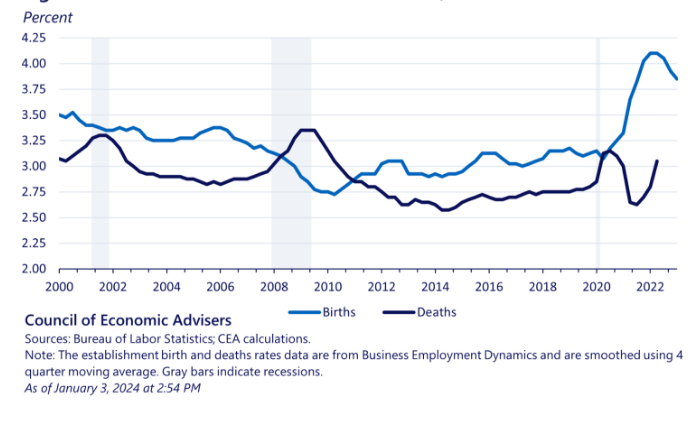
New firms are up by about one-third by this measure.
https://www.bls.gov/news.release/cewbd.t08.htm
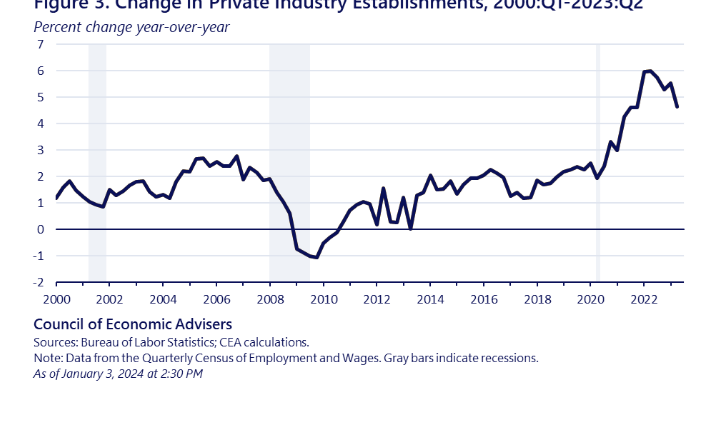
The growth rate of private industry establishments has accelerated.

Three measures reinforce the growth of new firms.
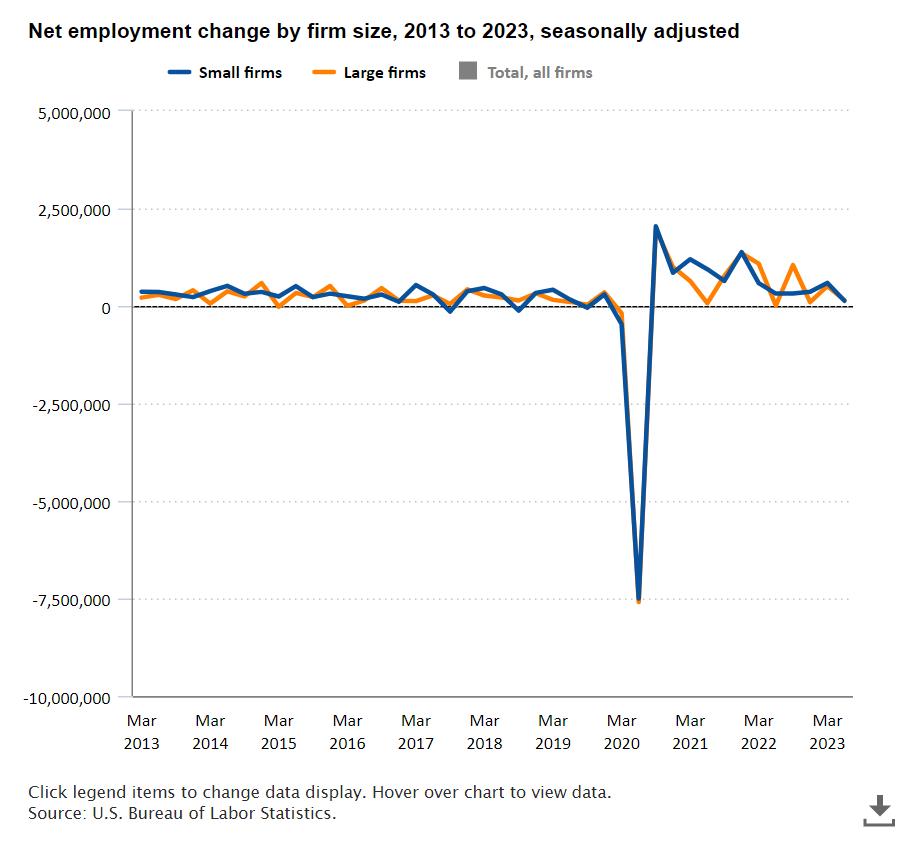
Overall, small businesses have prospered following the pandemic.
The growth in new business formation is real, solid and sustained. Who benefitted?

An unusual cluster of SE and SW US showed the highest percentage growth rate.
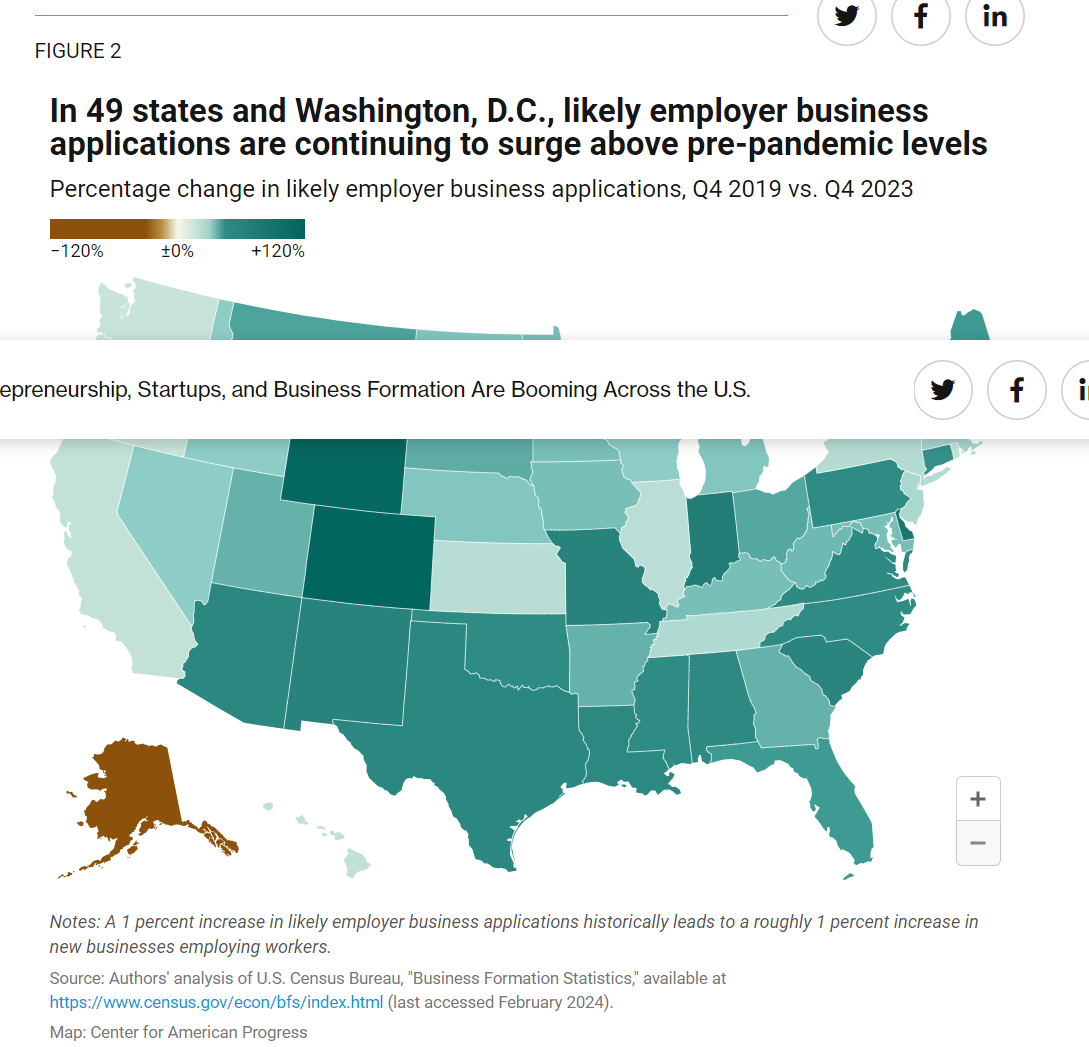
Once again, a very broad set of states adding new businesses.
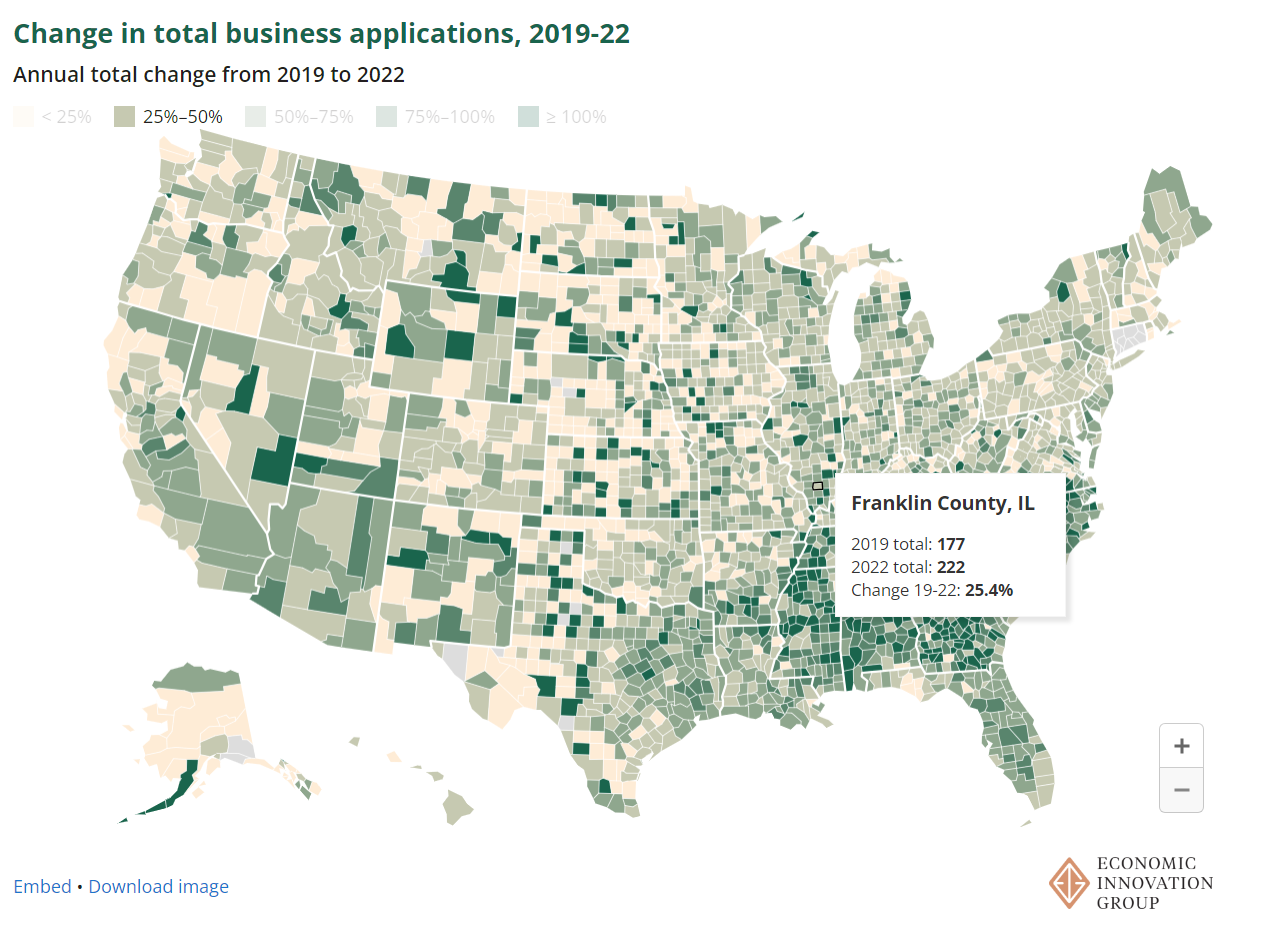
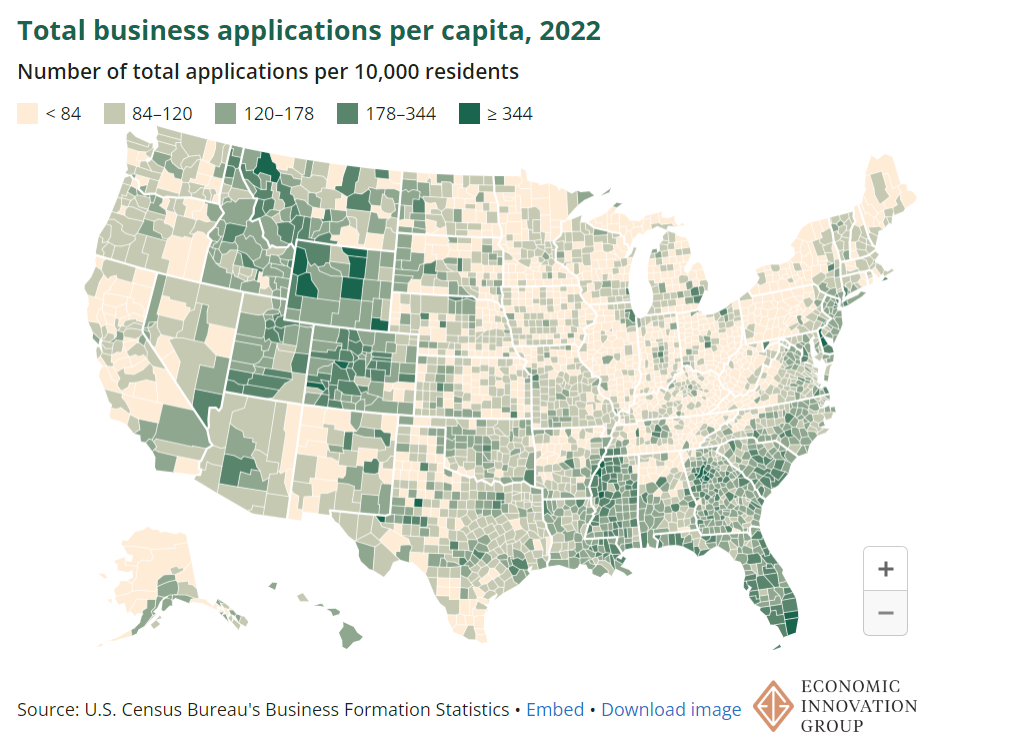
The southeast is winning, but growth is widespread.


Nine out of 15 industries saw very strong growth out of the pandemic.

https://www.uschamber.com/small-business/new-business-applications-a-state-by-state-view
The initial surge in new businesses did NOT include the IT or manufacturing sectors which look ready to benefit from AI and government investment policies. Firm creation should continue at its record pace for the next 2-3 years.
https://hbr.org/2024/01/how-the-pandemic-rebooted-entrepreneurship-in-the-u-s
Why/how did this happen? US economy did not see wealth destruction during the pandemic as occurred in the Great Recession. Bipartisan government funding during the pandemic protected small businesses and individuals. The US labor market was strong before the pandemic and recovered very quickly to full employment with high quit rates, high job openings, low layoffs, wage growth, high labor force participation, and new immigrants included. There was no “credit crunch” destroying businesses. Venture capital firms were flush with capital, able to invest in the very best prospects. The US economy was mature as an “information age” economy, identifying opportunities. The virtual economy was mature, allowing individuals with minimal technical skills to easily create new businesses, market their services, and engage skilled resources. Individuals experienced being out of work and at home and determined that they could create new firms from home.
The Biden administration claims that its various public policies have leveraged the “natural” rebound.
Various moderate to conservative sources have documented this positive result.
https://www.uschamber.com/small-business/new-business-applications-a-state-by-state-view
https://www.forbes.com/sites/rhettbuttle/2024/01/12/three-year-small-business-boom-is-unprecedented/
https://www.entrepreneur.com/business-news/why-are-new-business-applications-at-all-time-high/474614
 Good News