Record high of 6.6 million hires per month, above pre-pandemic record 6.0M.
Record low layoffs at 1.3M per month, down from 1.8M pre-pandemic record. Yes 5 new hires for every layoff!
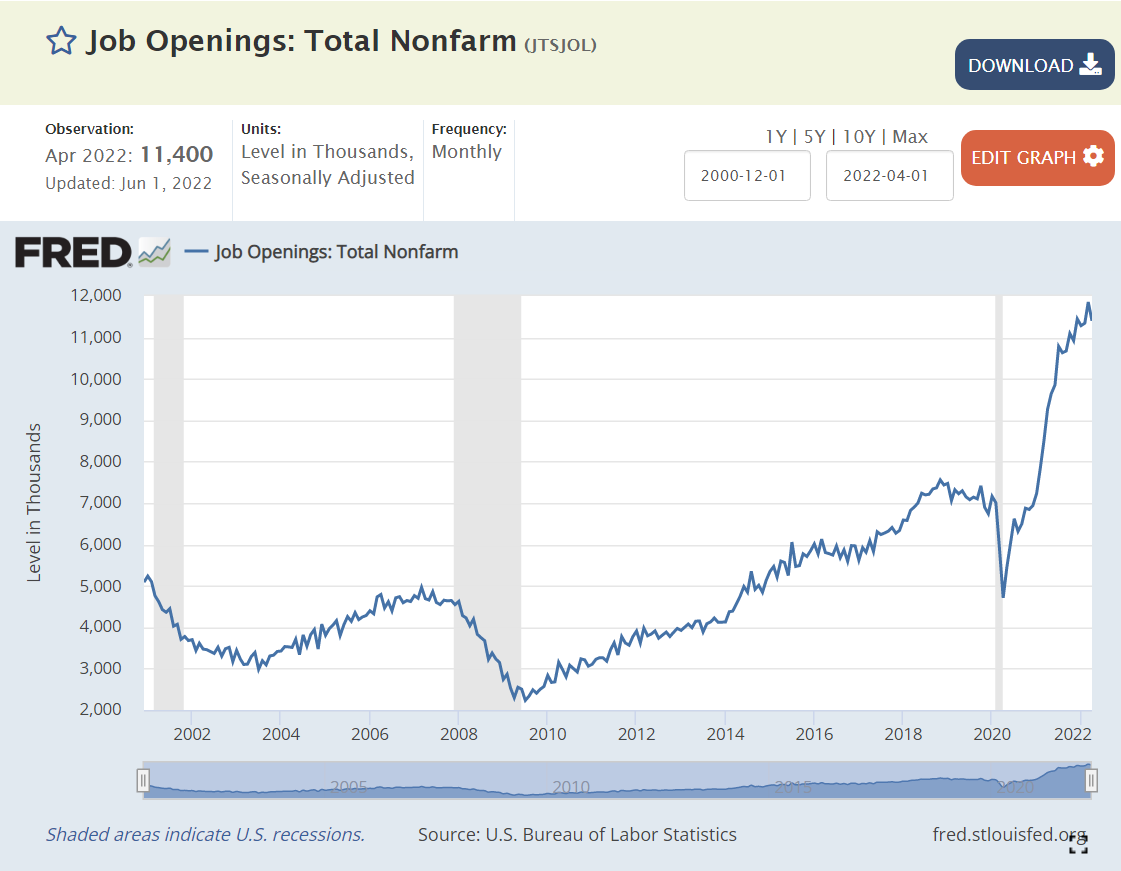
Record 11 million plus, up from pre-pandemic record of 7 million.
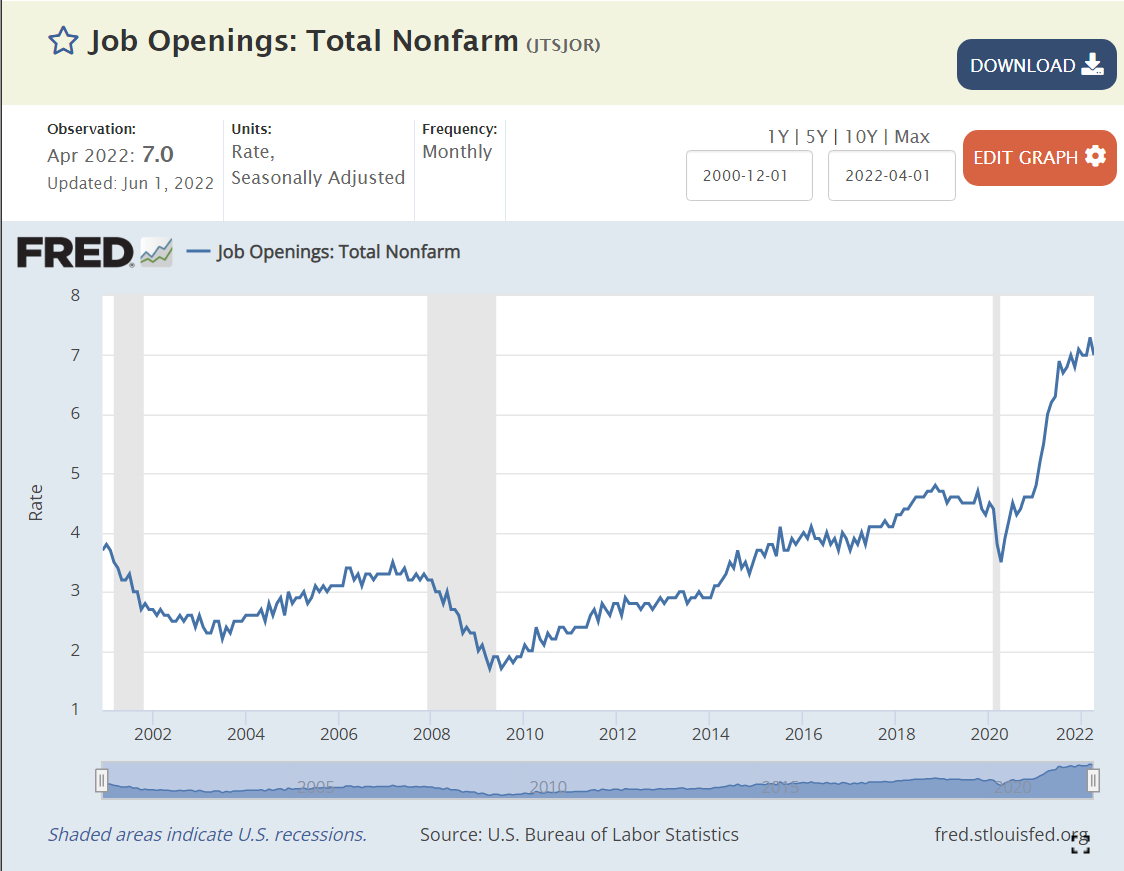
Record 7% of jobs are open, far above pre-pandemic 4.4% record level.
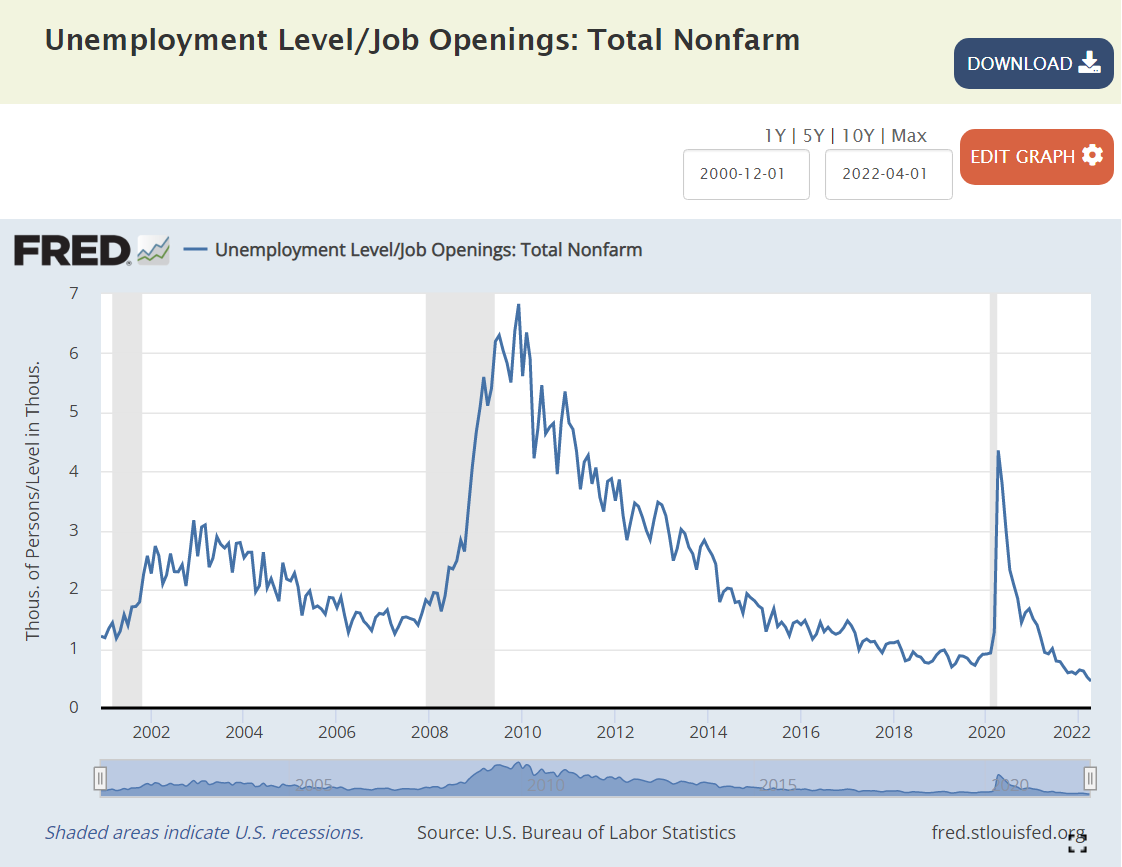
Job seekers to open positions ratio is less than 1/2, all-time record low, down from pre-pandemic record that was just below 1:1.
Average hourly wage up 12% to record $31.95.
Hours worked is slightly higher than before the pandemic.
Record high 2.9% versus pre-pandemic record of 2.3%.
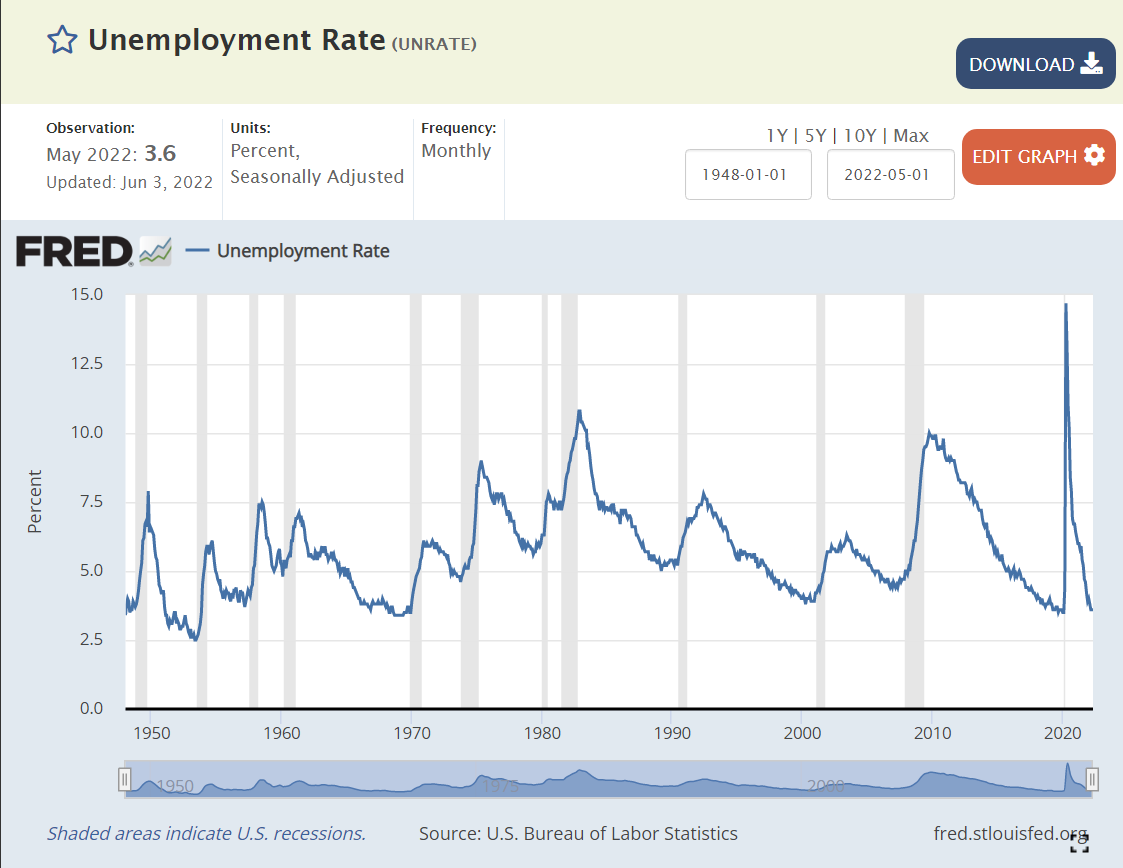
Unemployment rate is 3.6%, just above pre-pandemic 3.5%. Prior 3.5% rate was in 1969. This is the best in 50 years.
Underemployment rate at 7.1% is just above 7.0% pre-pandemic level. Underemployment rate was last this low in 2000.
Long-term unemployment is at 1.2%, same as pre-pandemic level. The economy last delivered this positive level in 2000.
African-American unemployment rate is at a near-record 6% low. It was a little lower briefly before the pandemic.
Initial unemployment claims reached the pre-pandemic low of 190,000 during 2022, but has increased slightly to 210,000. This compares with typical levels of 400,000 in recent decades.
Continued unemployment claims are at a 50-year record low of 1.3 million, down from the pre-pandemic level of 1.8M. 1.3M was last seen in 1969!
Civilian labor force at 164.4M is just below the all-time record of 164.6M.
Prime age labor force participation rate fell from 84% to 81% by 2014. It recovered to 83% by the end of 2019. It has reached 82.5% so far in 2022.
Teen labor force participation has slowly increased for a decade.
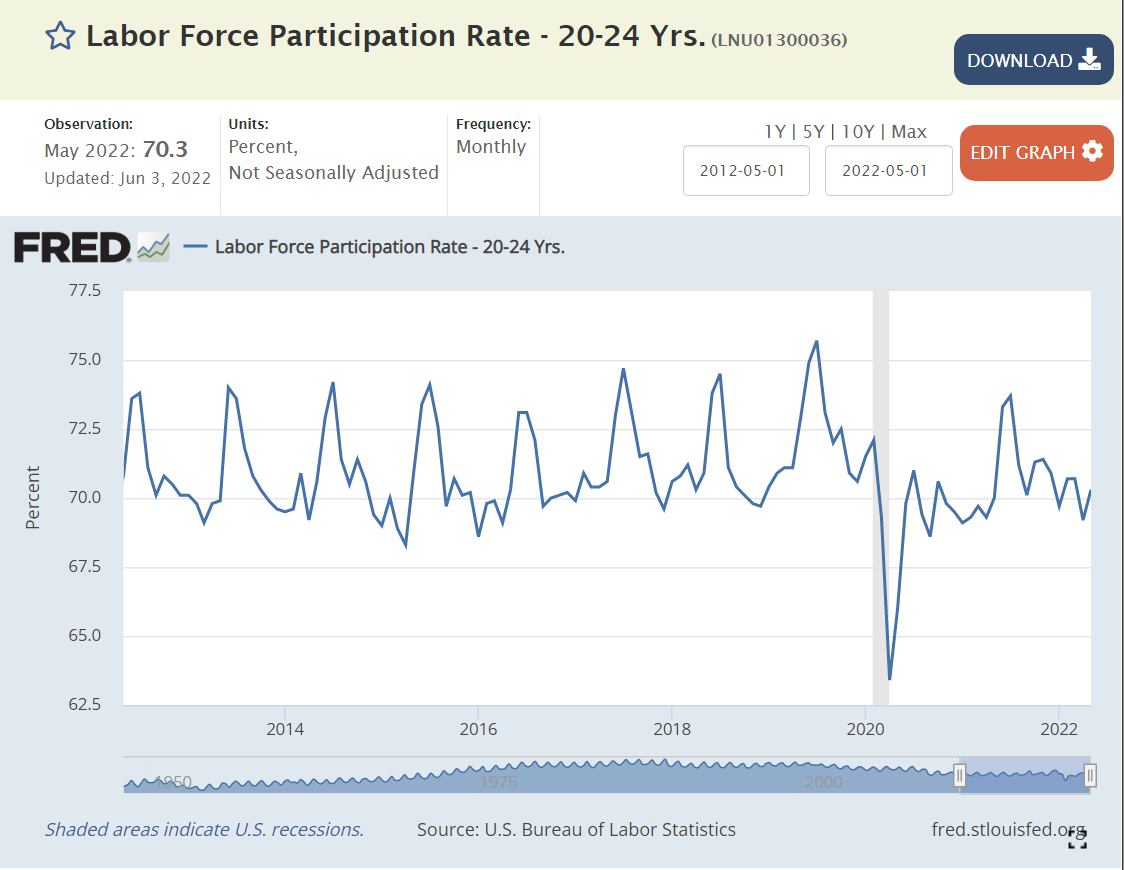
College age labor force participation has remained the same.
“Older” age labor force participation hit an all-time low of 29% in the early 1990’s, and then began to climb all the way to 41% in 2012. It remained at 40% throughout that decade. It dropped with the pandemic and has since recovered to 39%.
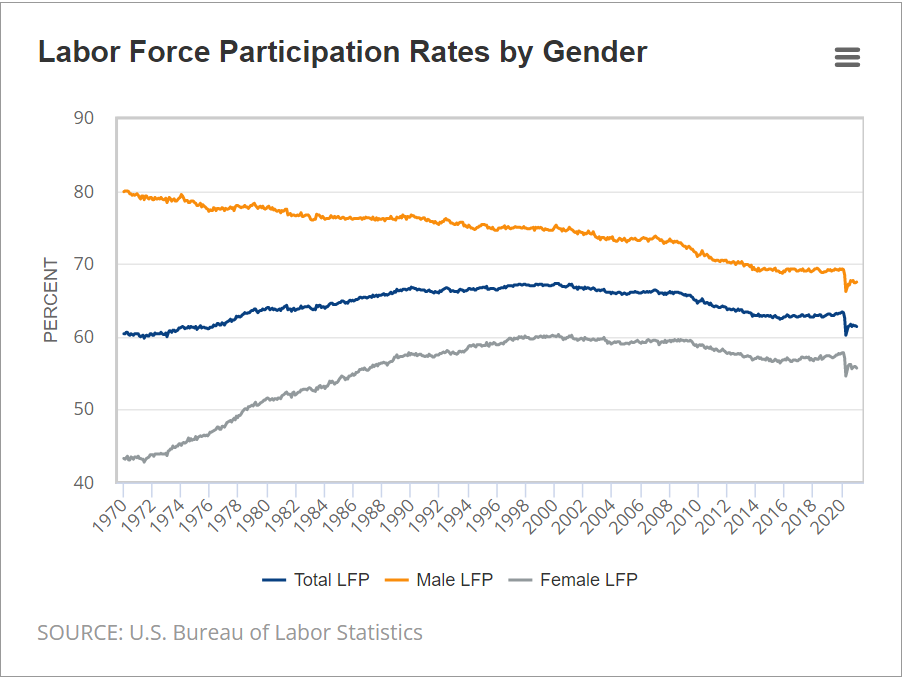
Female labor force participation continued its long climb to a peak of 60% in the late 1990’s. It dropped below 57% by 2014. It increased to 58% in the last 2 years of the decade. It has recovered to 57% after the pandemic.
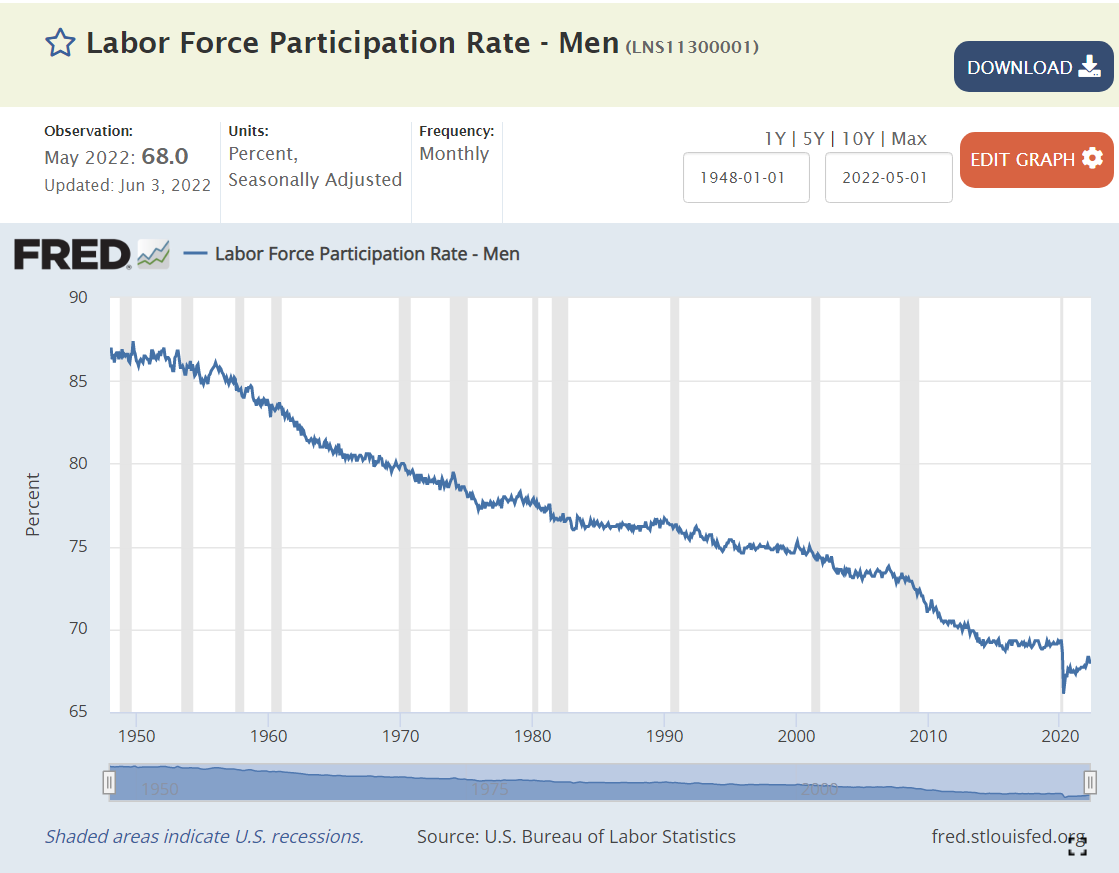
The male labor force participation rate has been declining for 70 years. It reached 69% in 2014 and remained there, without falling, throughout the decade. The rate dropped to 66% during the pandemic and has since recovered to 68%.
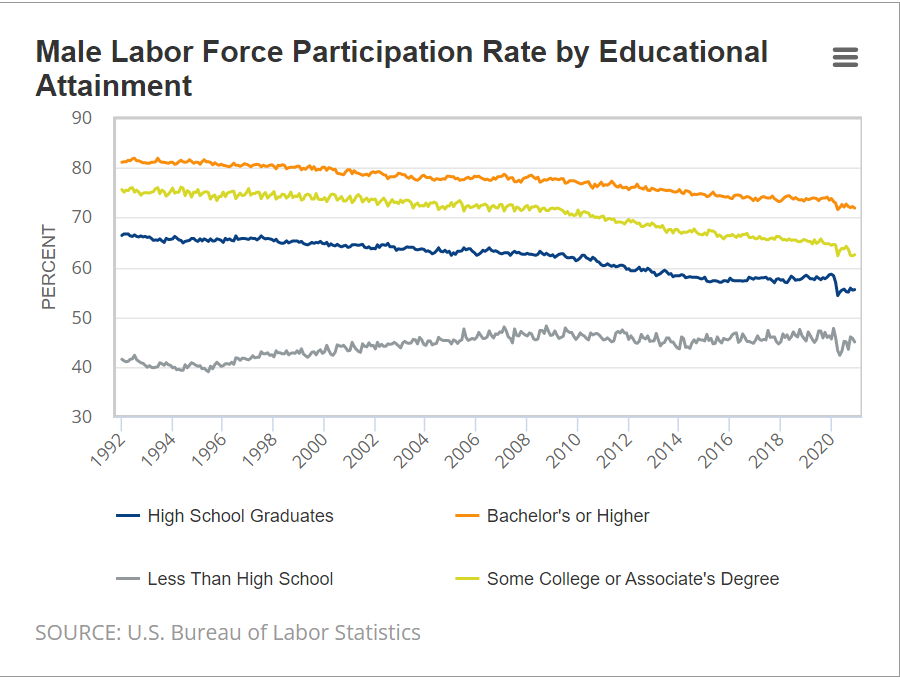
Labor force participation has declined by about 10% for HS grads, some college and college grad groups. Non-HS grads’ participation has actually increased. The similarity of participation changes by education and gender points to broader social factors playing a major role in these “economic” changes.
Summary
The measures of demand for labor are all at record levels. Unemployment rates are at long-term lows, just above the pre-pandemic levels which were driven by a decade long economic recovery. Labor force participation is down by 1% compared with pre-pandemic levels. Overall, this recovery from the pandemic challenges exceeds all expectations.
In 1974, when I graduated from high school, there were 3 national TV networks that delivered “over the air” content from major city TV stations. Major cities usually had a public broadcasting station focused on “educational TV” and perhaps an “independent” TV station that catered to reruns of movies, cartoons and TV shows, local news and weather, variety shows, political commentators, sports and traffic. At night, you might sometimes be able to get a fuzzy picture from 2-3 other TV stations 60-100 miles away if you moved the roof or tv antenna around a bit. “Maximum TV” was 10 stations.
We now have cable, satellite and internet connections to provide hundreds or thousands of channels to most citizens for viewing now or later. It is challenging to convey this “two orders of magnitude” change.
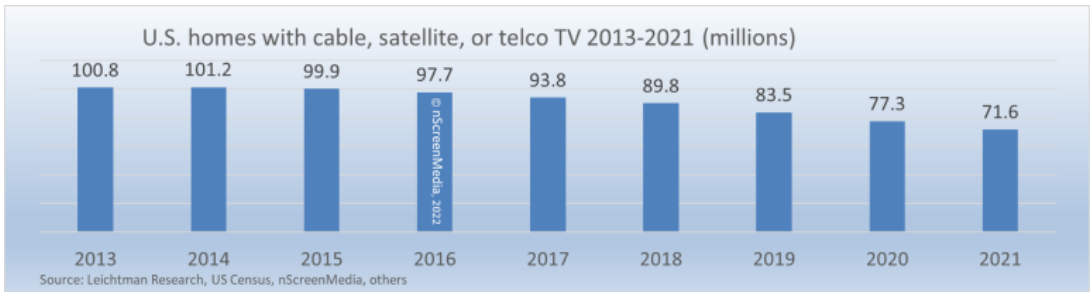
The US TV market grew from zero to 100M homes with cable access by 2005, before beginning a slow decline in direct connections replaced by internet connections.
Close to 30% of TV content is now consumed in a time-shifted manner versus zero historically. When “The Wizard of Oz” was played on TV every 2-3 years, we all watched it.
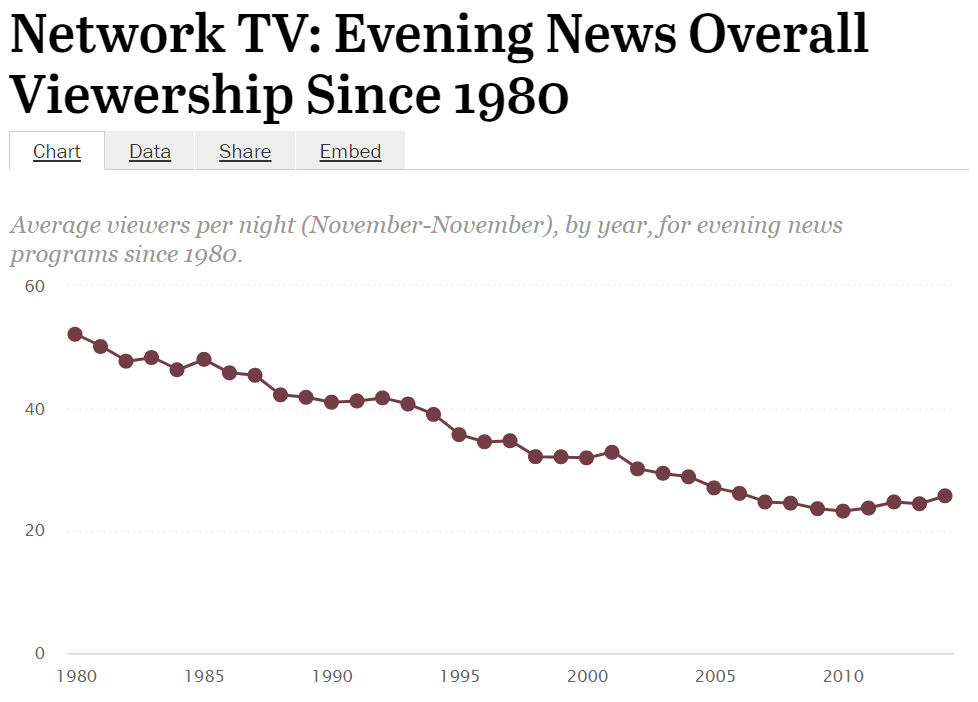
Decline of the Big 3/4 Networks’ TV Market Share
1980 – 85-90%
1990 – 60%
2000 – 40%
2010 – 35%
2021 – 30%
Conversely, this means that “independent” content increased from 10% to 70% of available programs.
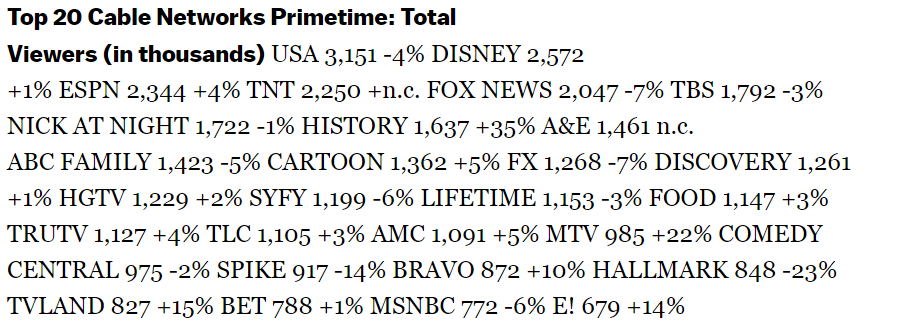
Of the top 29 in 2010, 14 remain strong competitors in 2021. ESPN, Fox News, TBS, History, Ion, Discovery, HGTV, Lifetime, Food, TLC, Bravo, Hallmark, TV Land, MSNBC. 5 retain more than 500K average daily visitors, but dropped by at least 50% from 2010 to 2021: USA, TNT, A&E, FX and AMC. 10 dropped by more than 50% to less than 500K daily viewers: Disney, Nick, Cartoon, SyFy, TruTV, MTV, Comedy, Spice, BET and E! 8 networks moved up to more than 500K viewers per day: CNN, telemundo, CW, Insp, Me, Invest, Hallmark movie and Unimas. This is a very competitive marketplace.
Most states and local governments have chosen to pay their employees less than market salaries and higher than market fringe benefits since the WW II era. The Republican focus on reducing the size, pay and power of government has increased significantly in the post-Reagan era. Grover Norquist summarized this in 2001: “I don’t want to abolish government. I simply want to reduce it to the size where I can drag it into the bathroom and drown it in the bathtub.” Hence, Republicans have focused the spotlight on the “underfunded” status of state and local government fringe benefit plans, especially defined benefit pension plans.
Although the rhetoric is sometimes grating to the “left” ear, this spotlight does serve as a disinfectant, requiring political leaders to be more accountable for their decisions, especially in “one party” states where accountability was lacking historically.
On the other hand, pension accounting, funding, goals and policies are inherently complex and difficult to simply summarize or explain. This is true for both government and corporate defined benefit pension plans. It is easy to “cherry pick” pension statistics and overexaggerate the “crisis” in state pensions.
I will focus on the data and commentary from just 2 sources: Reason.org, a right-leaning policy group that cleverly adopted a left-side name and Pew Research, a centrist research group that has chosen to emphasize right-leaning data and commentary on this topic.
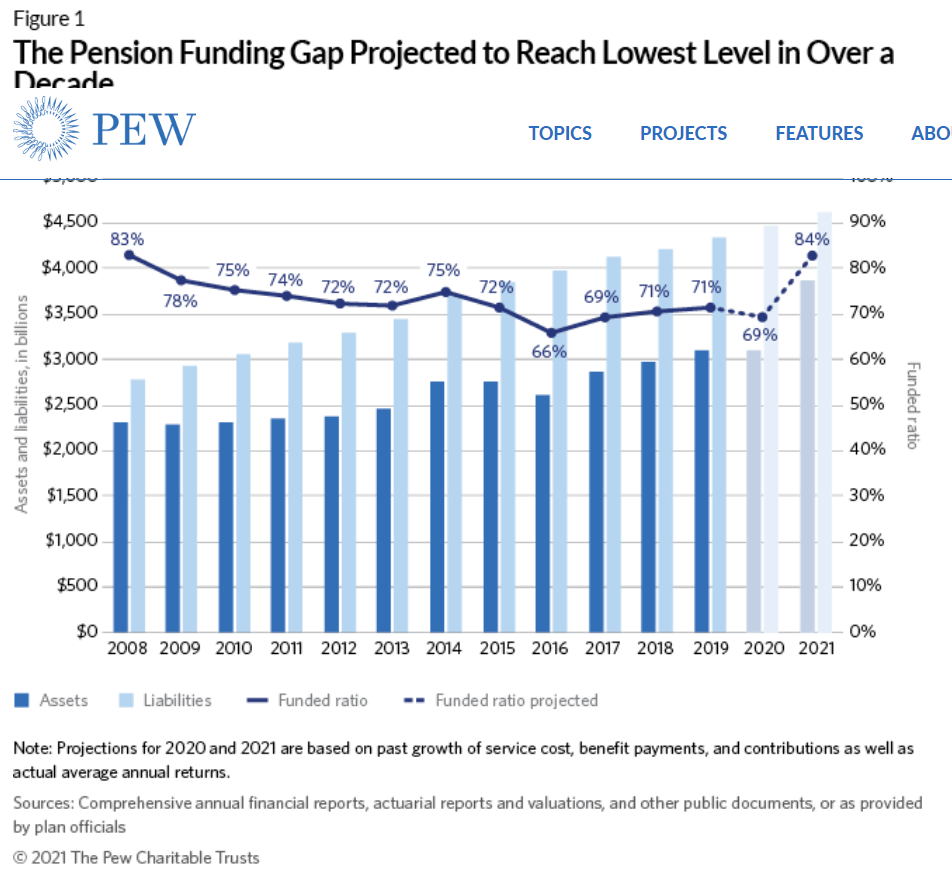
The average state pension plan funding level, the ratio of assets to forecast liabilities, is expected to reach 84% when final 2021 data is summarized. This is a huge improvement from the 70% average of the prior 5 years. It is the highest level since 2008.
2. The system is working. Plan assets were $2.3T versus $2.8T in 2008. Assets grew by $1.5T to $3.8T, while liabilities grew by $1.8T to $4.6T. Since the added $1.5T/$1.8T is 5/6ths or 86%, the overall ratio increased. The “system” of policies, accounting, audits, contributions, investment strategies and actual investment returns, etc. appears to be functional across a quite challenging economic period. The funding ratio was relatively consistent throughout this period, even if it was not at the 100% level highlighted by some as “the goal”.
3. The gap between estimated liabilities and funded assets is less than $1T for the first time since 2014.
4. For the first time in this time period, the minimum expected funding level has been met. This is defined as a year in which contributions exceed benefits plus the “amortized” funding requirements based on past funding shortfalls. In 2014 only 17 states met this standard. In 2019, 35 states complied. Again, this is not perfection, but it is significant progress.
5. Overall contributions have increased by 8% annually. The states with the lowest funding ratios have increased their contributions even faster. The lowest 10 rated states growing by 15% annually and the 4 worst states by 16%.
6. A measure of benefits paid minus funding contributions, as a percentage of plan assets, has improved from 3% more benefits to 2.5% more benefits paid versus new funding contributions.
The Funding Gap (2016). Funding ratio 66%. Few states reach 90%.
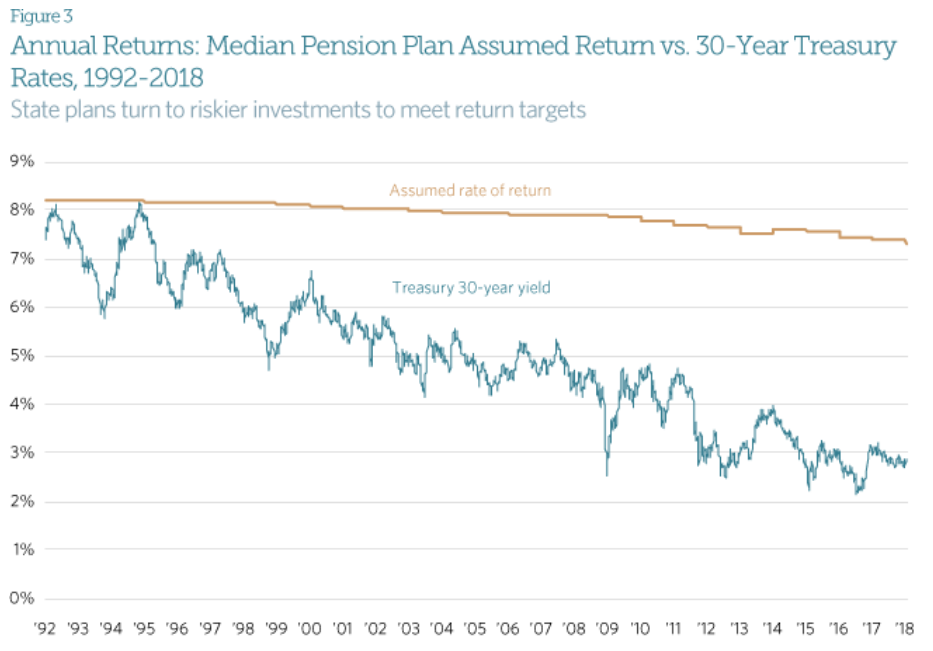
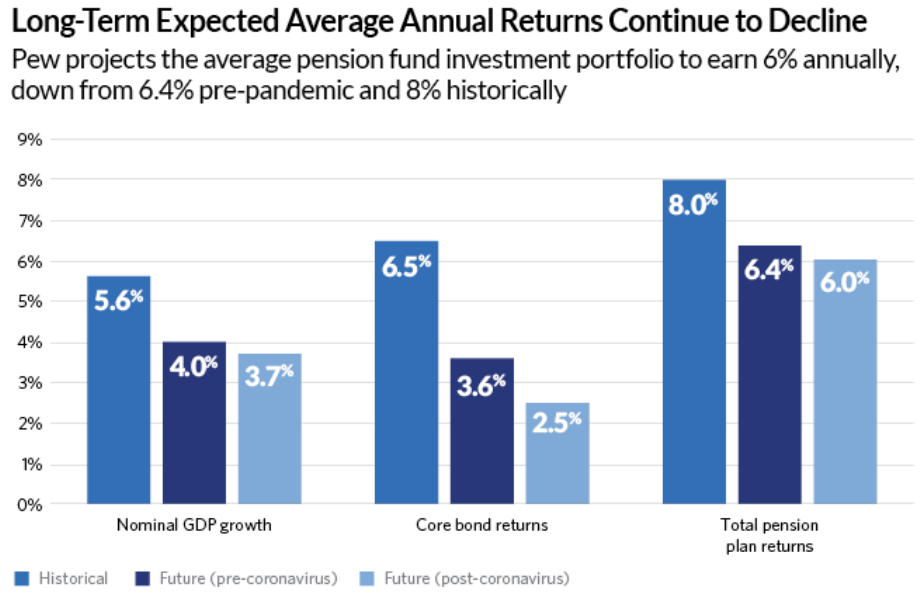
Bond interest rates have fallen faster than pension plan expected returns. Of course, because equity returns are much higher, more volatile, difficult to forecast and a higher share of plan assets.
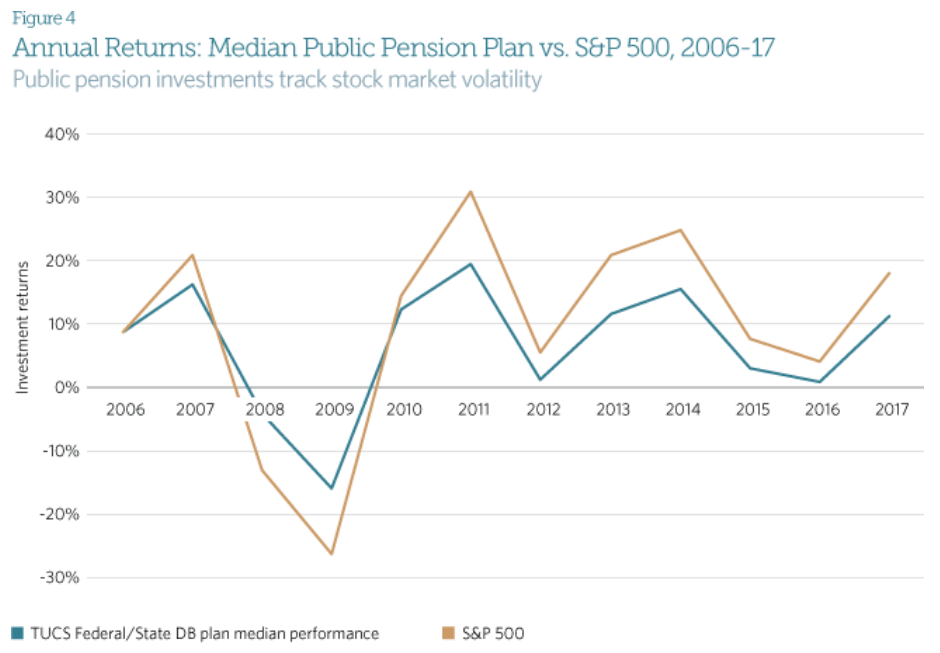
State pension plan returns trail the S&P 500 returns. Of course, because plans hold significant (30-40-50%) in lower yielding bonds.
A lower “discount rate”, the assumed future interest rate used to calculate the present value of future pension benefits/liabilities, will increase current liabilities and the current net liability. Yes, this is how discounting works. As market interest rates and stock returns have been reduced with lower inflation rates, the discount rate used by financial professionals in all applications has slowly declined for the last 20 years. This “sensitivity analysis” is misleading. The sensitivity of present liabilities is inherent, it cannot be avoided.
Some states have amortization rates, the amount of new contributions required to eventually offset prior funding or investment return shortages, that are quite high compared to their annual payrolls. This is true. 7 are above 5% deficits, but 7 are above 5% surpluses.
Pew highlights what they call the “operating cash flow” ratio as another sign of trouble. Contributions minus benefits paid as a ratio to assets is the definition. The result is negative!!!! And increasing to negative 3%! Contributions should almost always be less than benefits paid in a long-term (20-30-40 year) pension plan because the plan trustees assume that there will be some positive return on plan assets. Given a 2/1 equity to debt mix, with 7% to 3% expected returns, the expected plan return is more than 5%, so a 3% “negative” return is not a concern. The insurance industry operates in the same way with “negative” operating ratios being offset by investment returns.
Reason.org Graphics
This group highlights the extraordinary 100% ratio in 2001 versus the more normal ratios of 82% in 2005, the quite low level of 66% in 2012 and the still below average 74% level in 2019. They provide state by state graphics to highlight the decline since the very high 2001 baseline and to emphasize the count of states that are below 90%, 80% and 60% “funded”.
Their websites do not allow their graphs to be linked/captured.
Reason.org breaks 2 rules. First, they implicitly assume that a 100% funding level is the “obvious” goal. That is untrue. Historically, US corporations and actuaries considered 80% to be a “fully funded” target. More was better. A little less was worth watching (70-75%). Much lower required increased focus and contributions. Due to the inherent uncertainties in investment returns and participant assumptions (lifespan, retirement dates, turnover, average salaries, etc.) short-term movements of 2-3-5% were never considered to be an issue. Long-term or persistent ratios significantly below 80% were considered to be a concern.
Second, they assume that all states will perform at the same level. The “laws” of probability prohibit this “ideal” result. In a normally shaped (bell curve) probability distribution, there will always be underperforming and overperforming states. This is inherent in a multiple probability-based system. Of course, if a state remains at the bottom of the funded percentage list for more than 5 years, it probably does have a challenge to face.
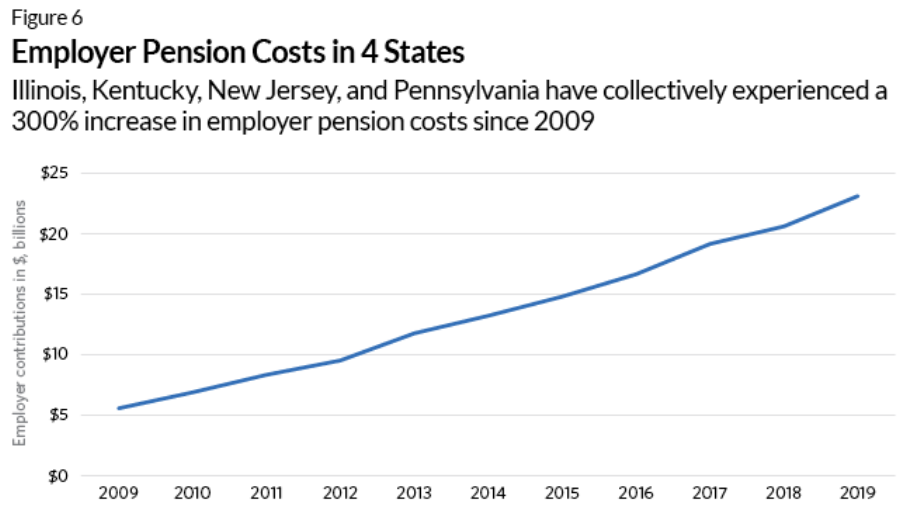
Greater state pension contributions have “crowded out” other spending and reduced states’ ability to respond to emergencies. Well, you can’t have it “both ways”. States have responded to the shortfalls highlighted since 2000 with greater contributions. This has improved the funding level despite the Great Recession, the slow recovery and the pandemic challenge.
The recent funding level improvement is due to a “one-time” stock market return in 2021. Yes, stock market returns, both gains and losses, are volatile. That is why pension plans use long-term expected returns for stocks and bonds. That is why pension funds use longer time periods (10 years) to amortize the annually calculated gains or losses into the “required” contributions. Yes, a significant part of the increase from 70% to 84% funded is a short-term increase of investment returns, and probably unsustainable.
The stock market is volatile. Recently. Yes, a once in a century pandemic drives increased volatility. Stock market volatility through time and across markets is well understood as a probability function with mean expected real percentage returns and a predictable range of returns volatility. All investors face this volatility and manage portfolios accordingly. As state pension plans have grown in value, they have been able to hire competent investment advisors.
4. Economic growth is slowing. Some assert this. Others disagree.
5. Future stock and bond returns will be lower, per Pew. The long-term decline in inflation does drive investment returns lower. The increased efficiency of financial markets, including global investment flows, also drives returns lower. However, pension plans have reduced their expected annual returns. Recent stock market volatility indicates that equity returns may not decline.
6. Increased funding of underfunded pension plans can be portrayed as “increased spending”, rather than the required adjustments for those plans which had historically lower investment returns, contributions or higher ultimate benefits.
Summary
State and local governments are faced with managing inherently variable pension plan decisions. They have choices to make about plan policies, goals, funding, investment policies, audits, advisors, etc. An 80% funded level goal (not 100%) is supported by 100 years of experience around the globe, in public, private and not for profit sectors. The increased publicity/focus on underperforming states and municipalities has forced these public bodies to make tough choices regarding defined benefit versus defined contribution plans, benefit levels, retirement ages, investment policies and advisors. Following the Great Recession, states struggled to increase their funding, but they did not allow the average funding level to fall below 70% for more than a year at a time. On a cumulative basis, they have increased their contributions, reduced benefits and captured the long-run benefits of equity investments.
The increased scrutiny of funding levels in state and local government defined benefit pension plans has forced elected officials and their professional advisors to address shortfalls in pension funding. This is very good news.
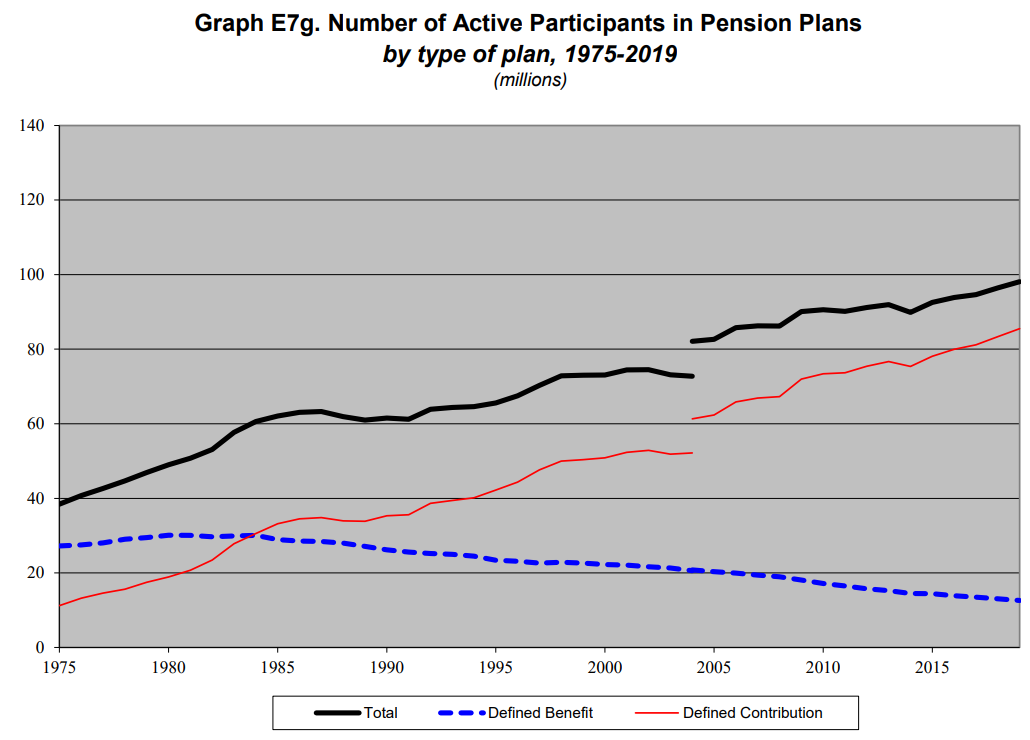
2.5 times as many active plan participants since 1975.
Plan assets have doubled since 2008, quadrupled since 1995, quintupled since 1991 and grown 10-fold since 1984.
The growth of plan assets is mainly due to investment returns, as contributions and disbursements have grown at similar rates.
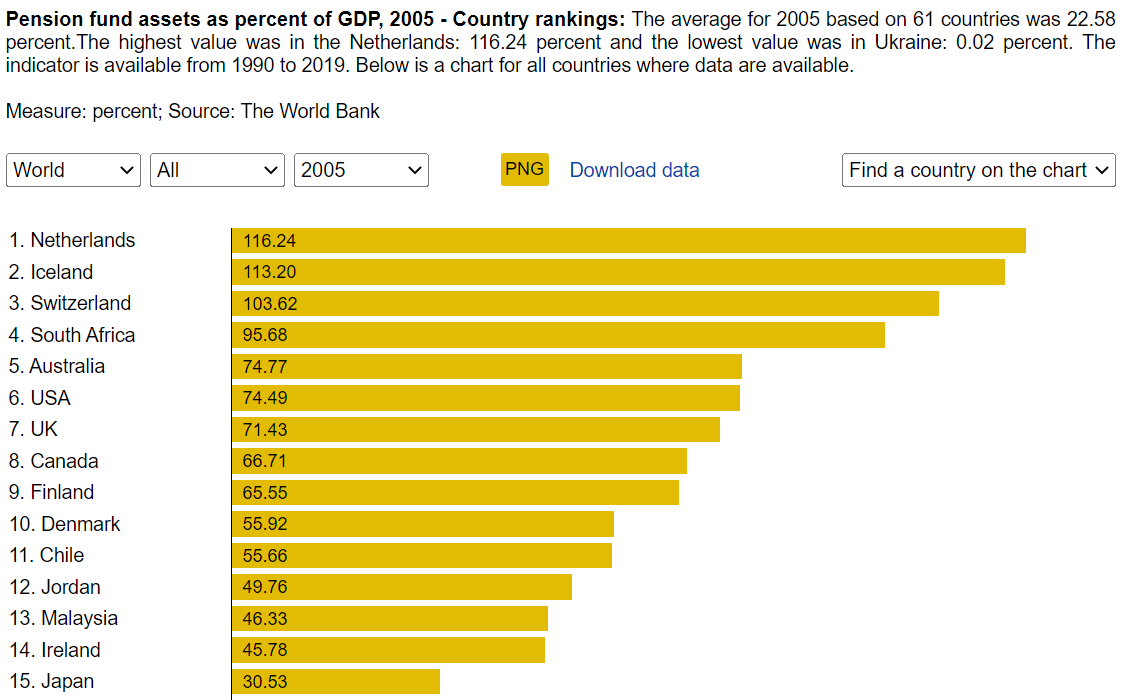
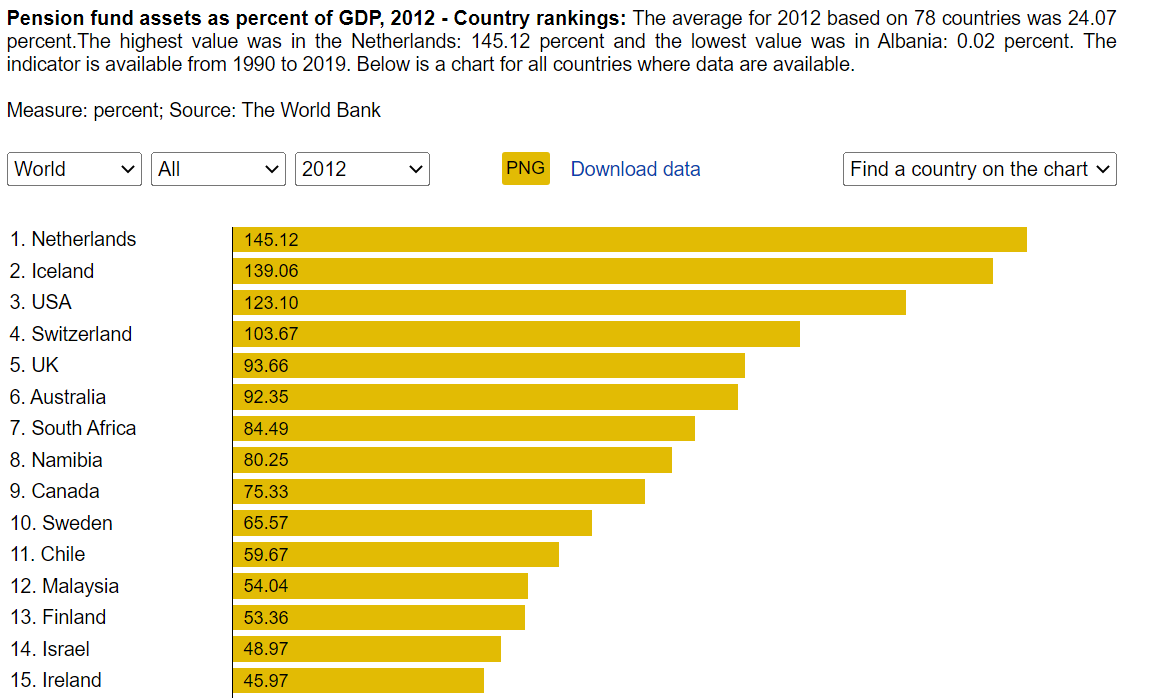
US pension plans account for more than one-half of global pension plan assets.
The US ratio of plan assets to GDP is typically 5th out of the 30-50 countries tracked by the World Bank.
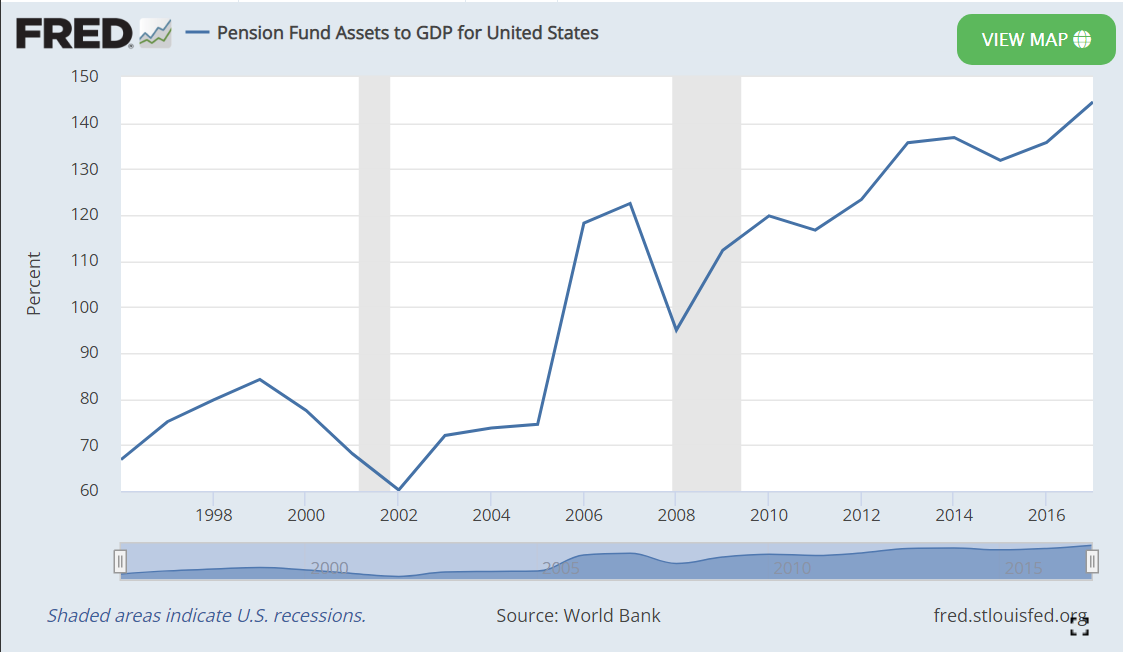
US plan assets as a percentage of GDP grew from just above 100% in 2010 to 157% in 2020. US plan assets from 1996-2005 averaged just 70% of GDP, so the relative amount of savings has doubled from 2005 to 2020.
Just 5% of the largest plans have a funded status (assets/liabilities) less than 80%.
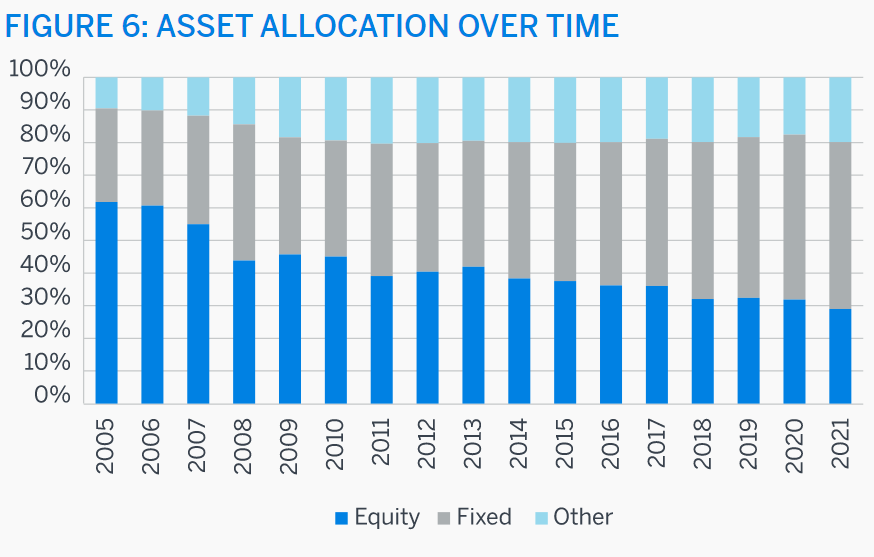
This is in spite of an increase in lower risk/lower return fixed income/bond funding growing from 30% to 50% of invested assets.
Plan assets took a big hit in 2008 but have slowly recovered.
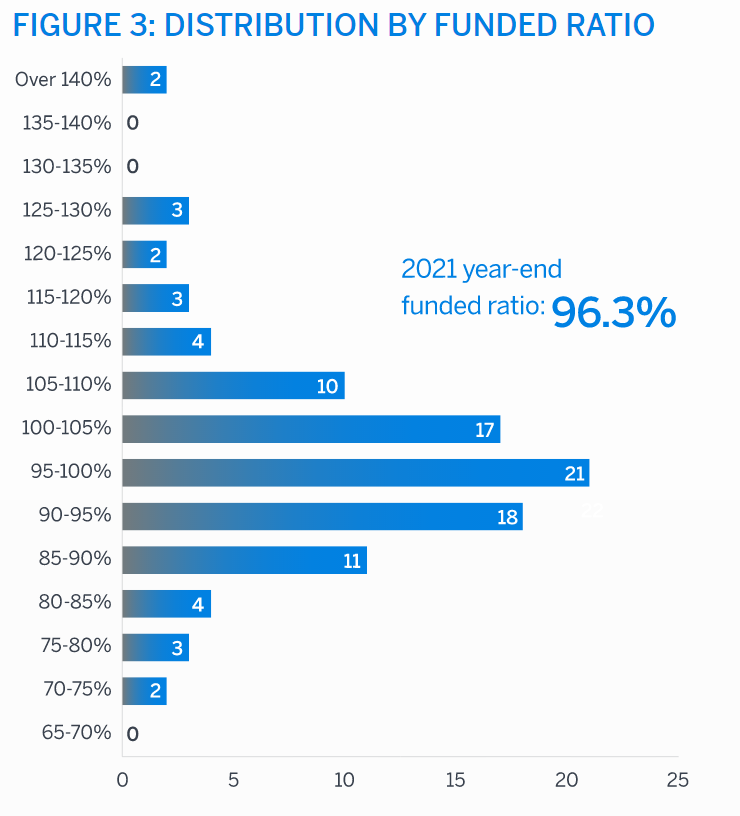
Historically, 80% funded was considered to be “fully funded”. Corporations increased contributions after 2008 to slowly ensure plan funding ratios would increase. The 96% level in 2021 is unusually high, driven by many years of increased corporate cash contributions and higher than expected investment returns that have offset planned future investment returns which have dropped from 9% to 6.5%, thereby decreasing the ability of firms to simply rely upon investment returns to fund their pension liabilities.
Almost one-half of the largest firms have funded ratios of 90-105%, a very safe level. More firms have greater than 105% funding than have less than 90% funding.
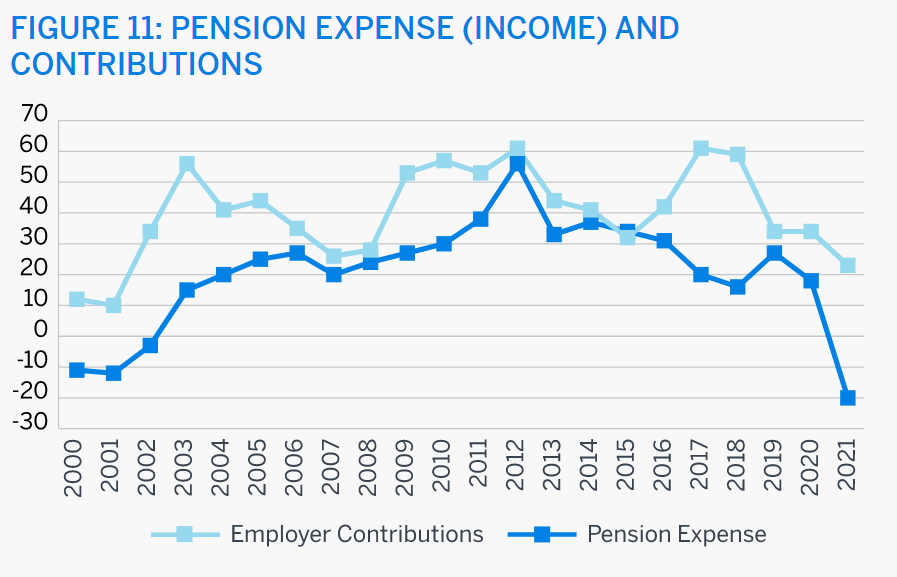
Pension accounting is a complex and subjective area. Cash contributions have consistently exceeded the accounting basis expenses recognized. This reflects a conservative actual funding strategy.
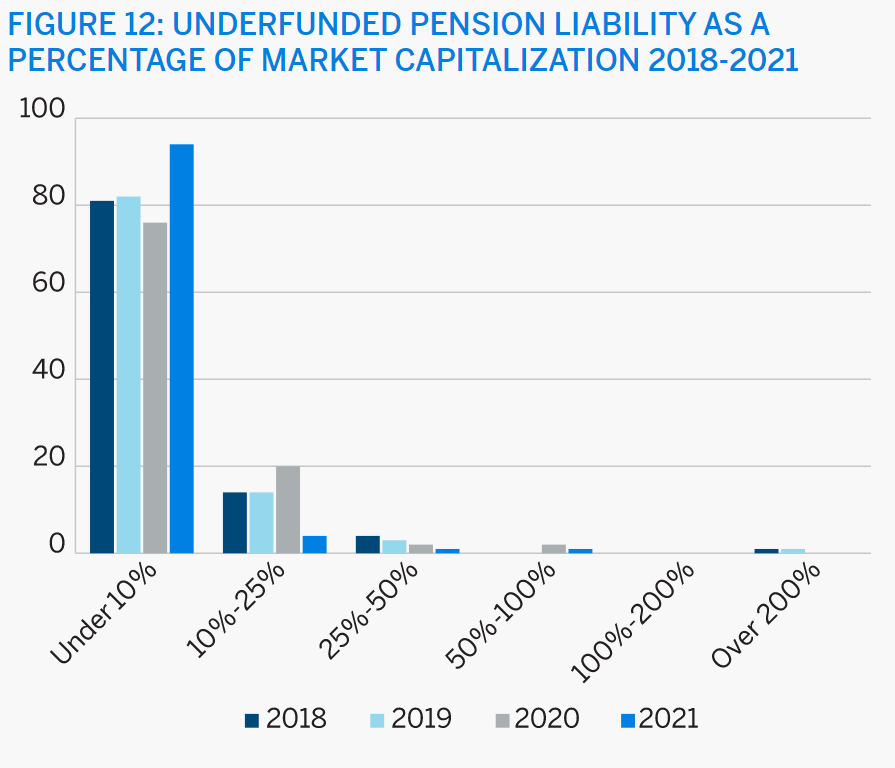
The net unfunded pension liability is an immaterial share of the value of major corporations.
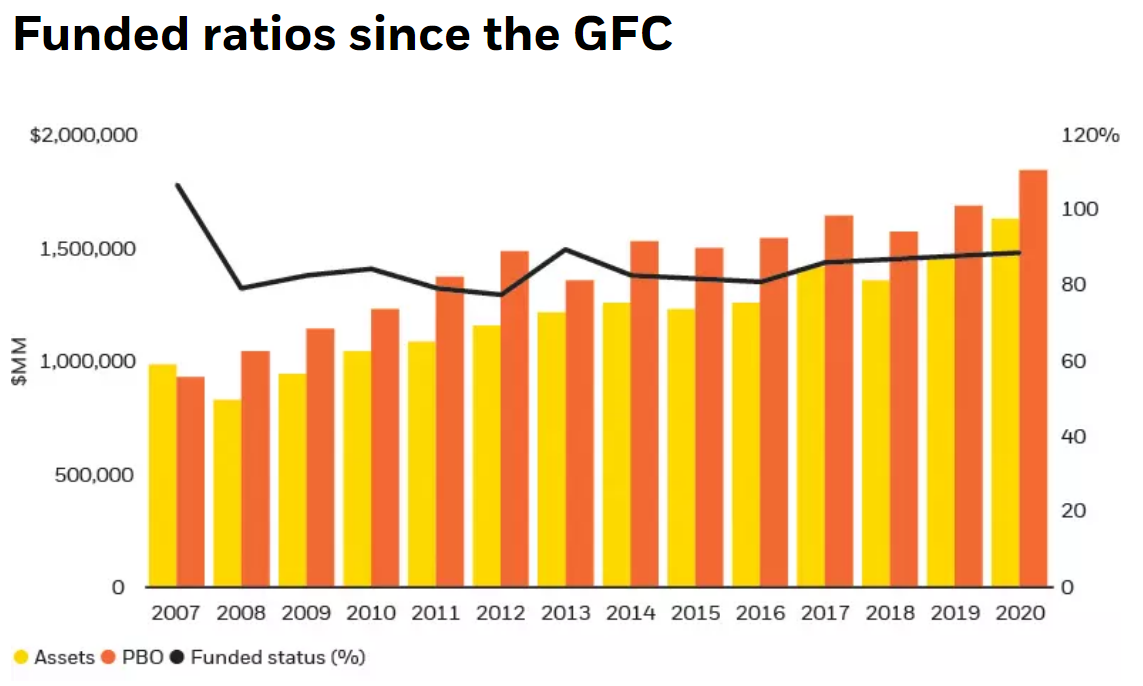
Blackrock summarizes funded status for 200 large defined benefit pension plans. The funded ratio declined in 2008 and has slowly recovered. It reached 95% in 2021.
Mercer summarizes 1,500 defined benefit pension plans. 80% funded is pretty typical since the Great Recession. Mercer reports 97% funded status at the end of 2021.
Summary
Defined benefit pension plans are an increasingly smaller share of all retirement savings plans. However, corporations are funding their future liabilities at a fully adequate level.
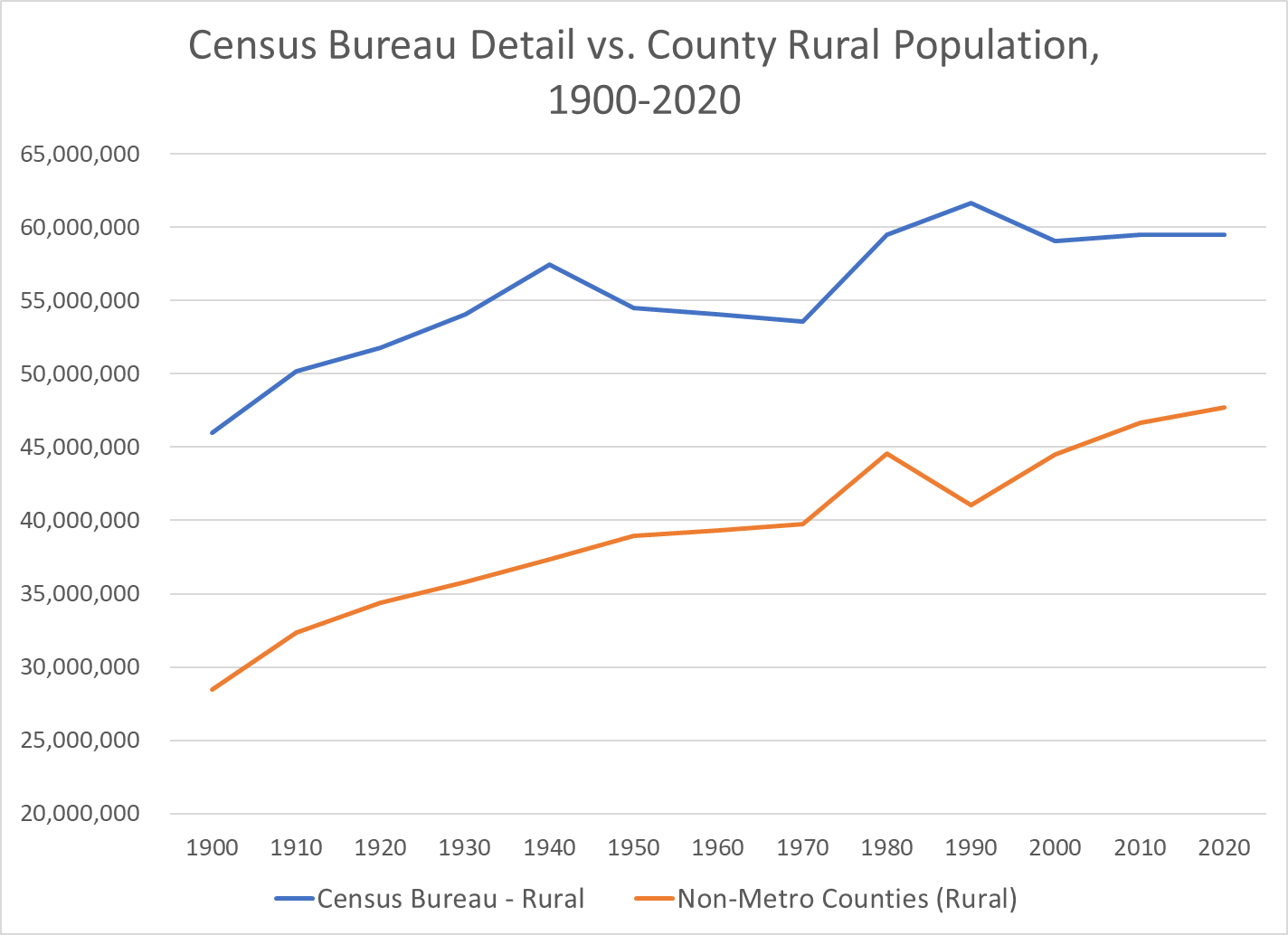
Rural America Grew Very Slowly in the 20th Century, Flattened and May Now be Declining
There are a variety of measures of “rural” US population. The Census Bureau has used local populations of 2,500+ to define urban. It focuses on population density and commuting to define urban counties that map to metropolitan (urban) areas. Other federal agencies use other definitions. Overall, the basic trends are clear.
The US Census Bureau’s detailed measure of “urban areas” essentially says that any area with 2,500+ people is an “urban” area. This clearly exaggerates the urban population, but this approach has been used for more than a century on a consistent basis, providing useful data. The 2020 measure of urban has been proposed using about 5,000 as the minimum for “urban”, but this definition has not been finalized.
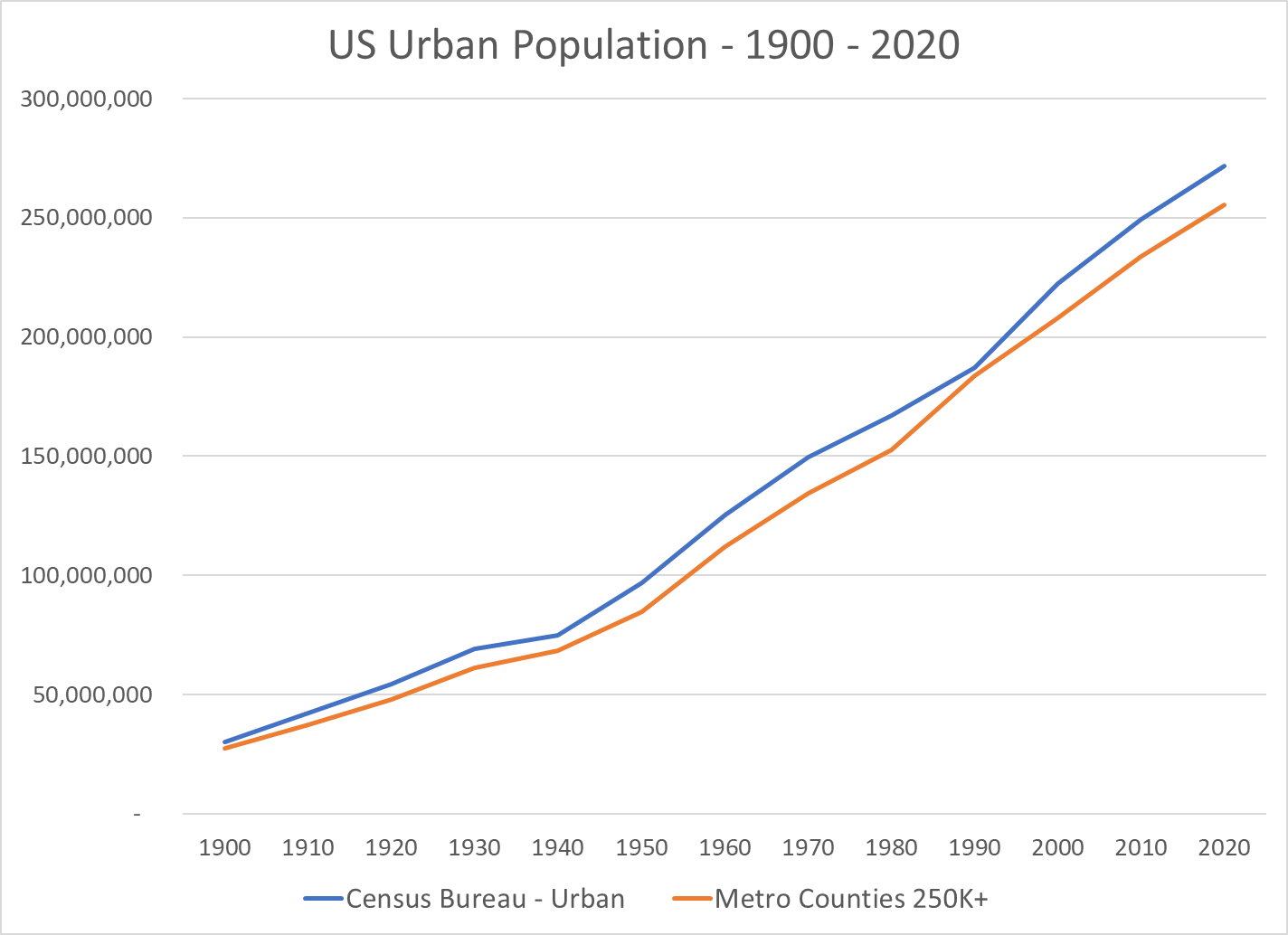
I have focused on the Metropolitan Statistical Areas (MSA) as defined in 2020 and recreated their populations back to 1900 based upon the county to MSA maps.
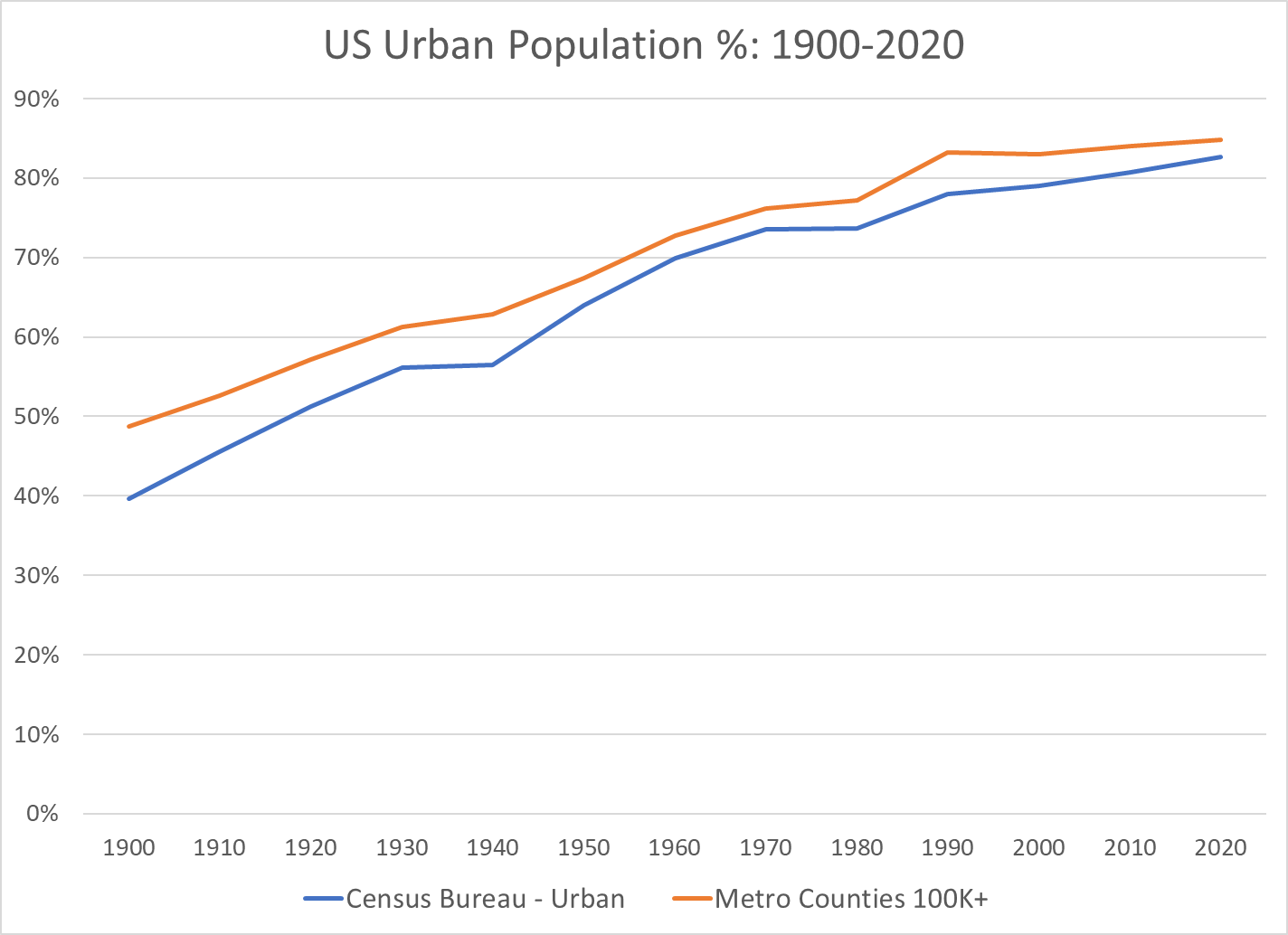
The measure of “percent urban” based upon the metro areas with 100K+ population or 250K+ populations very closely tracks the US Census Bureau’s detailed definition of urban areas (and therefor rural areas).
In summary, US urban population grew from 40% of the total in 1900 to 70% in 1970, about 3/7ths (0.42) of a percent more urban every year for 70 years. The move to “urban” continued in the next 50 years, but at a much slower rate, just 1/5th of a percent per year. But, this accumulates to move the urban percentage from 70% to 80%.
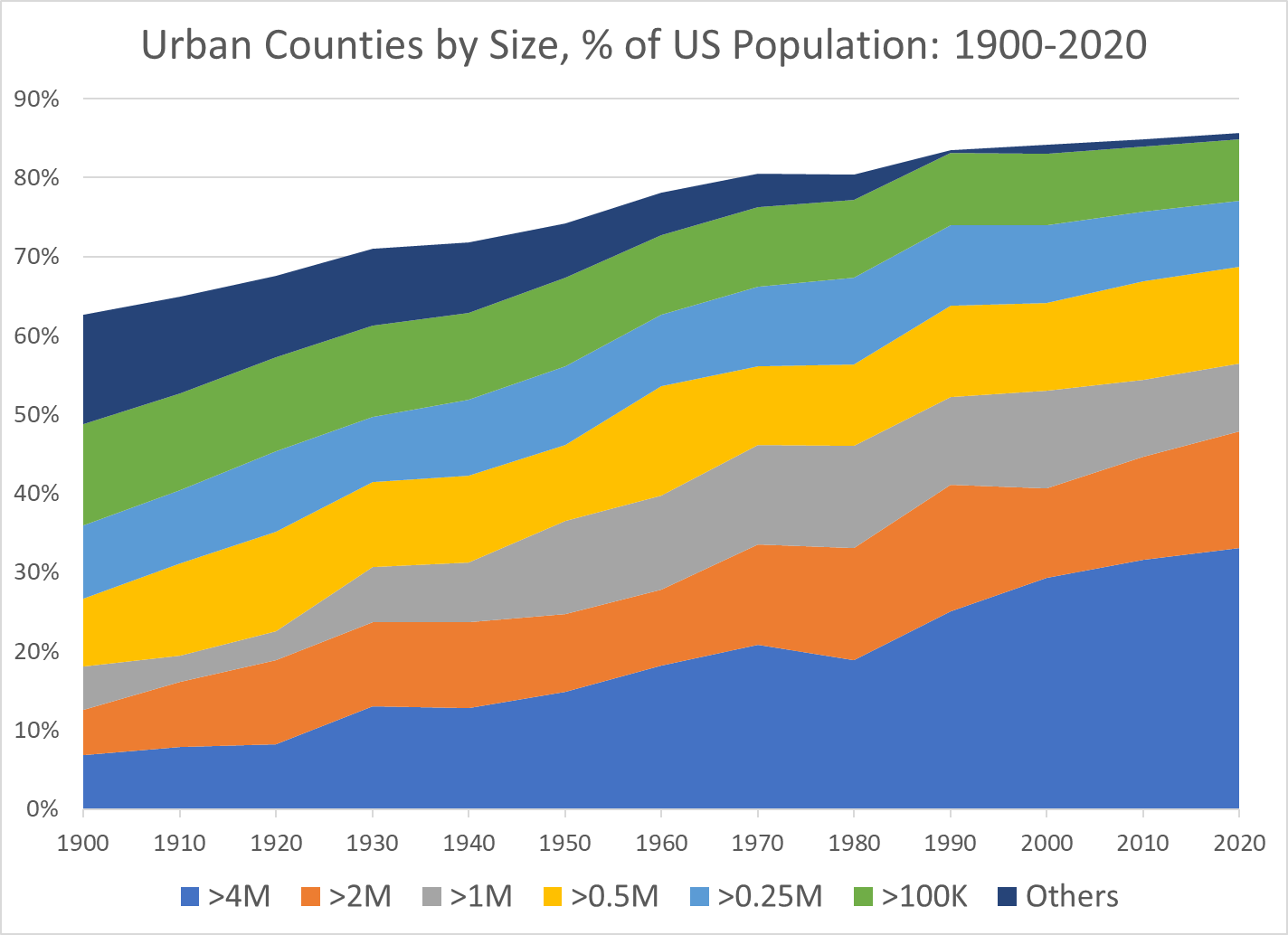
Growth of Very Large Metro Areas Has Driven the Growth in Urban Areas
The 4M+ metro areas have grown the most. The 2M+ and 1M+ areas have also grown. The smaller metro areas have made a smaller contribution to the growth of “urban” America.
The 50th Largest US Metro Area’s Population Has Increased 5-Fold Between 1900 and 2020
The Number of US Metro Areas with 1M, 2M or 4M Populations Has Expanded for a Century
Decade Reaching 1 Million Population
1900 New York Chicago Philadelphia Boston Pittsburgh St. Louis 1910 1920 Detroit Cleveland 1930 Los Angeles San Francisco Mpls-St Paul Baltimore Cincinnati Providence 1940 Washington 1950 Dallas-Ft Worth Houston Atlanta Seattle 1950 Kansas City Milwaukee Buffalo 1960 San Diego Columbus, OH Indianapolis 1970 San Bernardino Phoenix Tampa-St. Pete Denver Portland, OR 1970 Charlotte San Jose Virginia Beach New Orleans Hartford 1980 Miami Sacramento San Antonio 1990 Orlando Nashville Memphis Rochester 2000 Austin Las Vegas Louisville Oklahoma City Richmond Jacksonville 2010 Birmingham Salt Lake City Raleigh 2020 Tulsa Fresno Tucson
Decade Reaching 2 Million Population
1900 New York Chicago Philadelphia 1910 Boston 1920 Pittsburgh 1930 Detroit Los Angeles 1940 1950 San Francisco 1960 St. Louis Cleveland 1970 Mpls-St Paul Baltimore Washington Dallas-Ft Worth Houston 1980 Atlanta Seattle 1990 San Diego San Bernardino Phoenix Tampa-St. Pete Miami 2000 Cincinnati Denver 2010 Kansas City Portland, OR Charlotte Sacramento San Antonio Orlando 2020 Columbus, OH Indianapolis Austin Las Vegas
Decade Reaching 4 Million Population
1900 New York 1910 1920 1930 Chicago 1940 1950 Los Angeles 1960 Philadelphia 1970 Detroit 1980 1990 Boston Washington Dallas-Ft Worth Miami 2000 San Francisco Houston Atlanta 2010 San Bernardino Phoenix 2020 Seattle
The Rapid Growth of the Largest US Metro Areas Has Driven the Growth of the Total Population
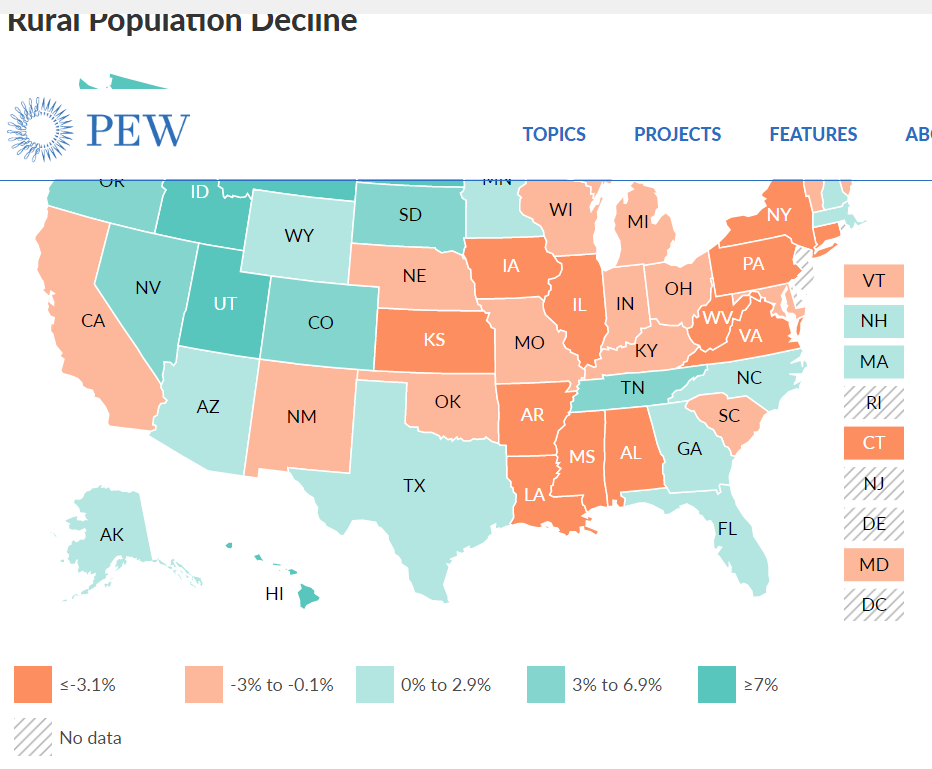
The Tipping From Very Slow Rural Growth to Possible Decline Has Attracted Attention from Demographers and Political Commentators
The disproportionate growth of “urban” and very large urban metro areas has continued in the last 50 years. This has a tremendous impact on the lives and perspectives of those in relatively declining rural and growing urban areas.
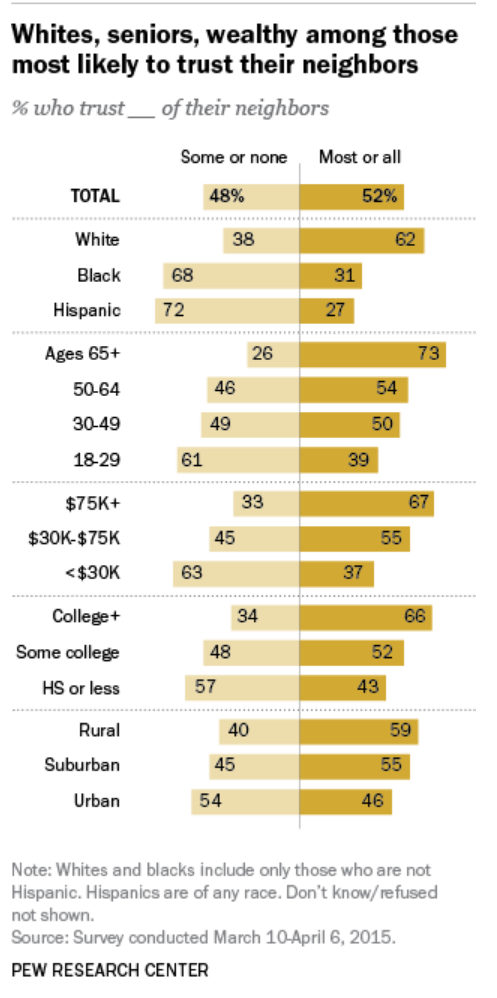
The US Bureau of Justice recently revised its definitions of urban, suburban and rural locations. The rural violent crime rate appears to be 20-25% lower than the urban crime rate. Note that rural property crime rates are 60% lower than urban rates.
Rural Versus Urban Violent Crime Trends
I’m not finding any consistent long-term “rural versus urban” crime rate statistics. As a substitute, I’m comparing the 15 most rural states versus the 15 most urban states based upon the “538” definition.
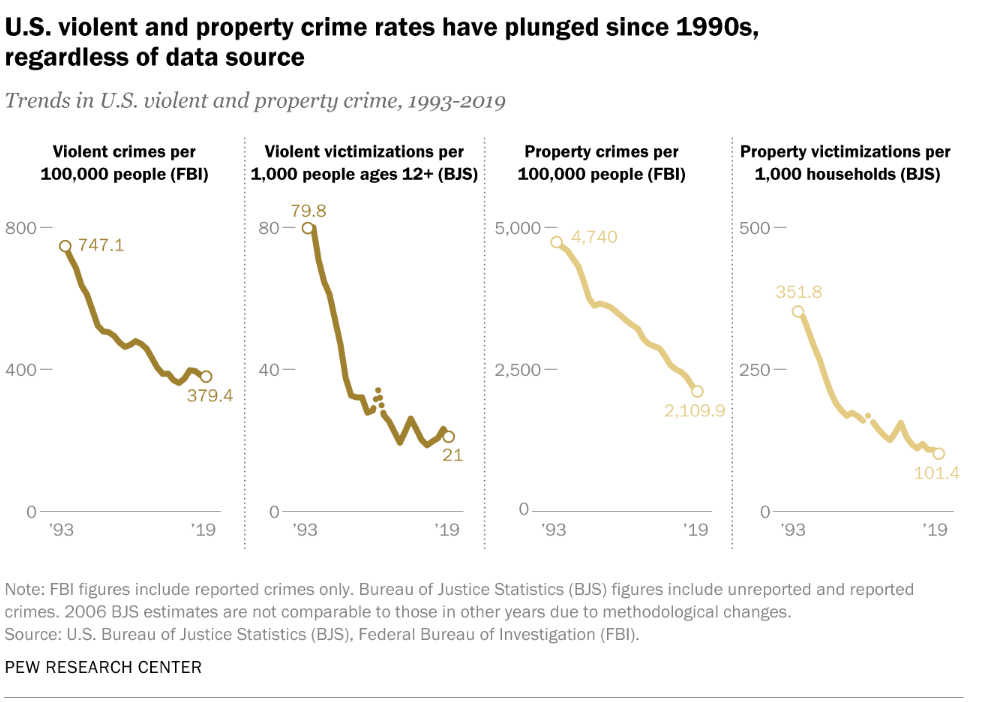
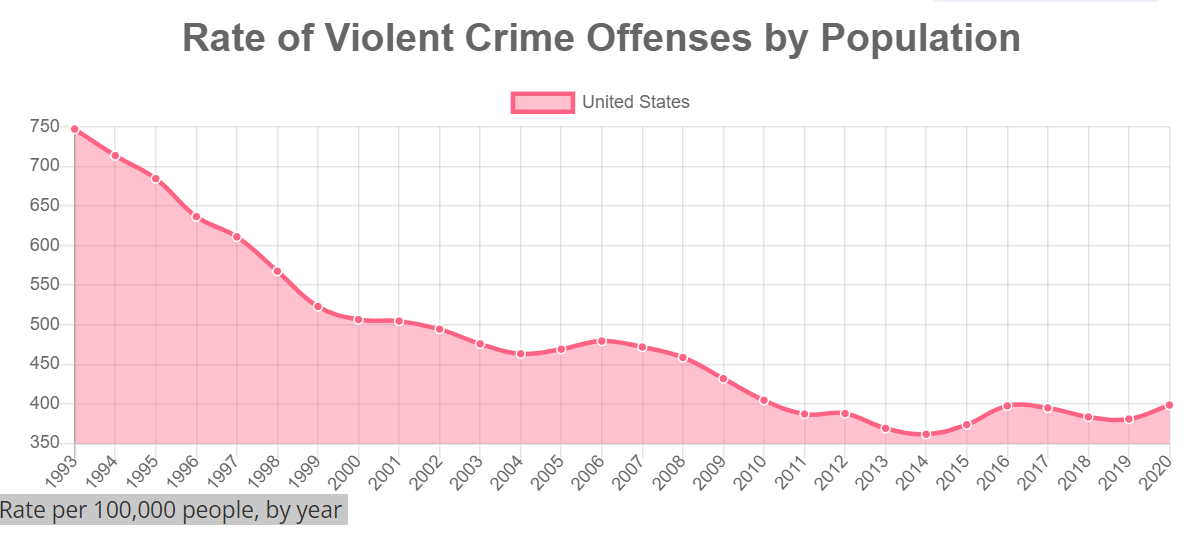
I’m choosing to focus on 2000-2010-2020 to simplify the analysis. Crime rates were dropping “like a rock” from 1993-2000 everywhere (see above).
The total US violent crime rate dropped by an additional 22% from 2000 to 2010. It was flat between 2010 and 2020.
15 Urban States
The 15 most “urban” states averaged 508 events/100,000 people in 2000, above the national average. This group dropped by 19% in the first decade to 413 incidents per 100K people. This subset of states continued its downward trend by 13% in the next decade, reaching 361 reported violent crimes per 100K in 2020. At 361 incidents, these 15 relatively urban states had a violent crime rate 10% below the national average of 400.
Urban 15: WA, PA, CO, TX, AZ, CT, FL, IL, MD, RI, NV, MA, CA, NJ, NY.
The greatest reductions in violent crime rates in these “urban” states occurred in Florida, Maryland, New Jersey and Connecticut.
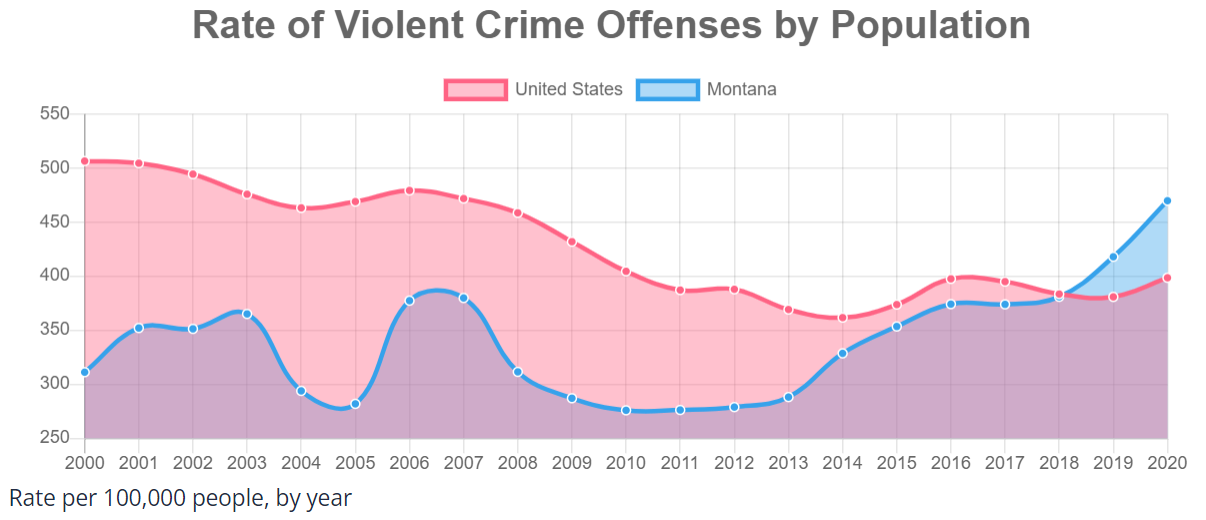
The 15 most rural states had crime rates of 321, 309 and 400 versus the national averages of 510, 400 and 400. The 15 rural states in 2000 had violent crime rates more than one-third lower than the national average. By 2020, they had increased to match the national average.
Six of the 15 states had very high violent crime rate increases. North Dakota and South Dakota based upon the “fracking” boom disruptions and Vermont, Montana, Arkansas and Alaska based upon other drivers.
Despite the news media’s focus on urban homicide rates in 2019-20-21, the overall US violent crime rate continued to fall from 2000-2010 after an amazing drop from 1993-2000 and then stayed constant/flat for the next 10 years. This “flat” crime rate from 2010 to 2020 was AFTER a 40% drop in violent crime measured by the FBI stats and a 75% drop measured by the Bureau of Justice surveys of crime victims from 1993-2010.
The 15 urban states’ violent crime rates fell by 29% between 2000 and 2020. The 15 rural states’ violent crime rates INCREASED by 25% between 2000 and 2020, then roughly equaling the national average.
Violent crime rates fell by another 10% between 2010 and 2014, reaching a modern low. Unfortunately, they increased back to the 2010 level in 2020.
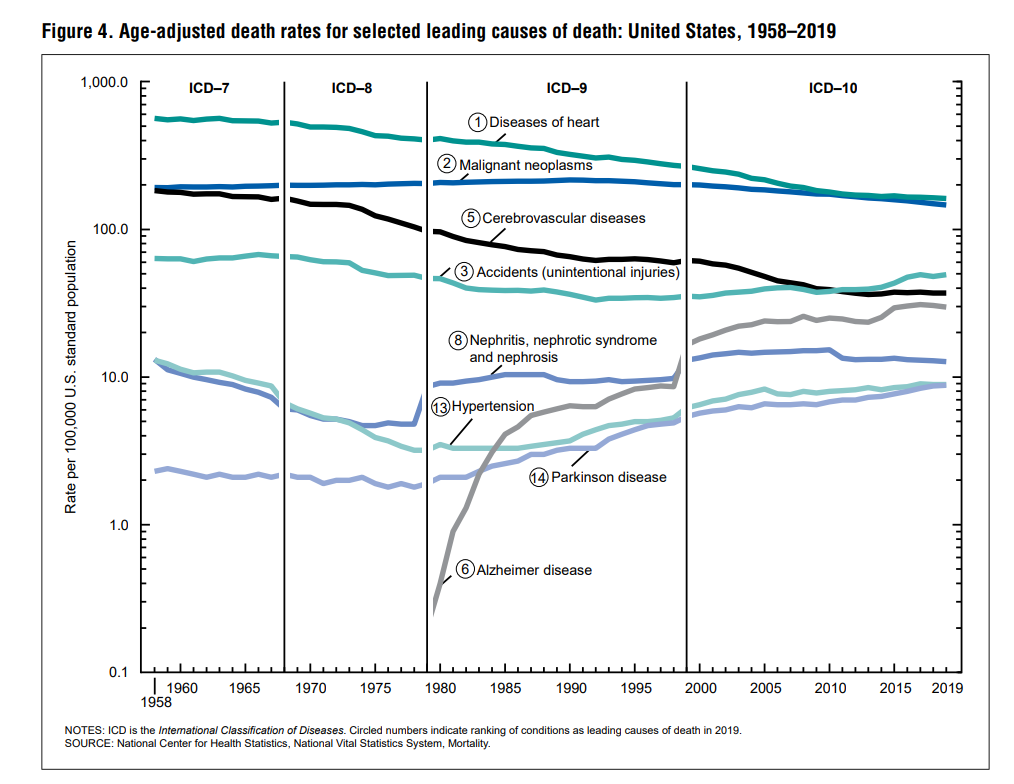
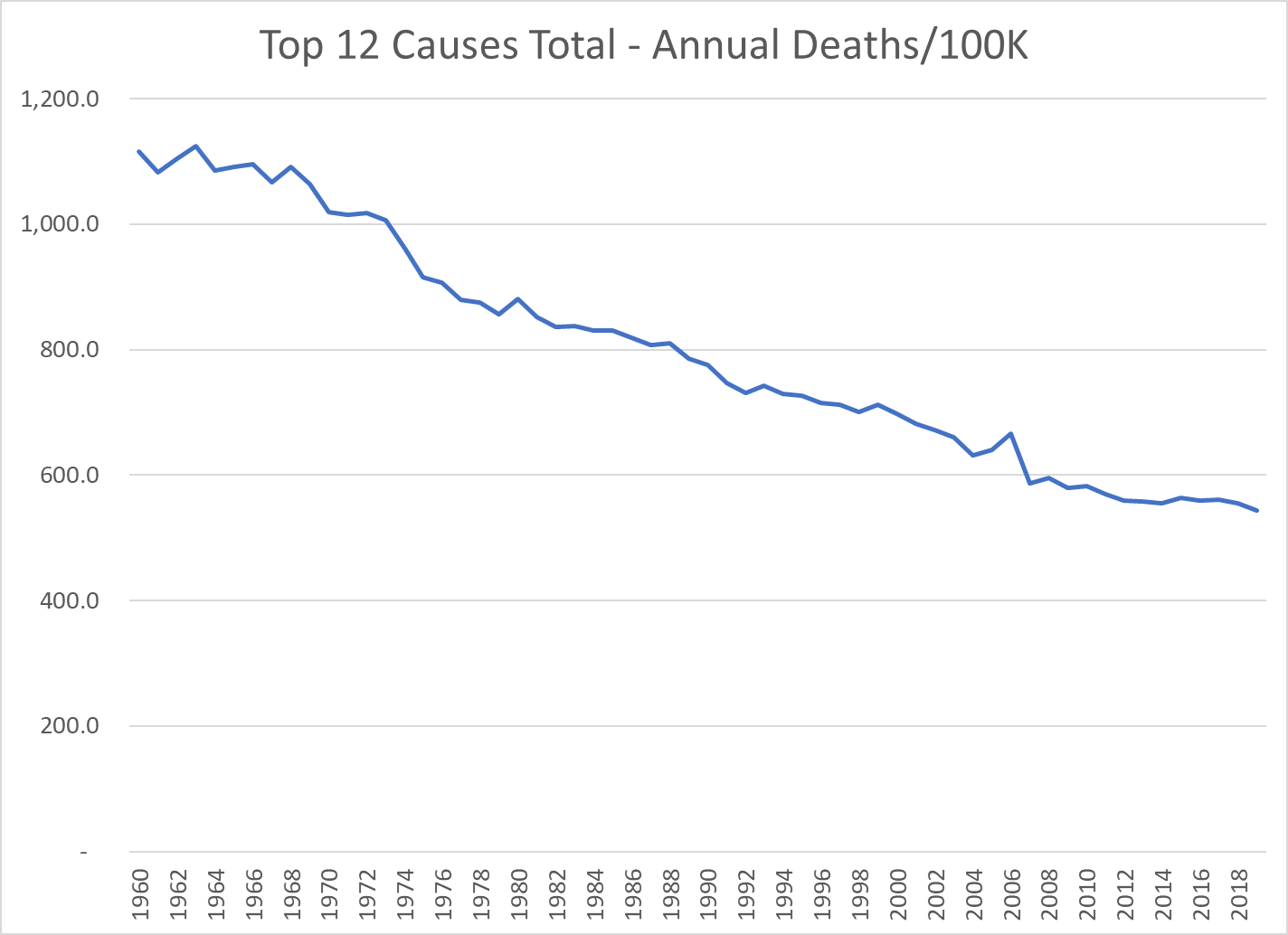
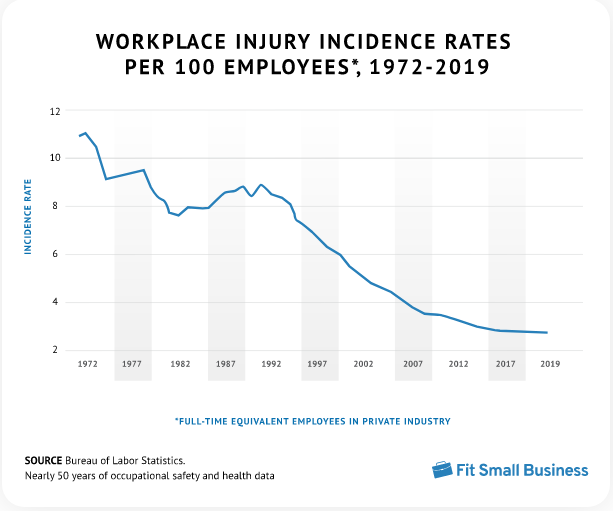
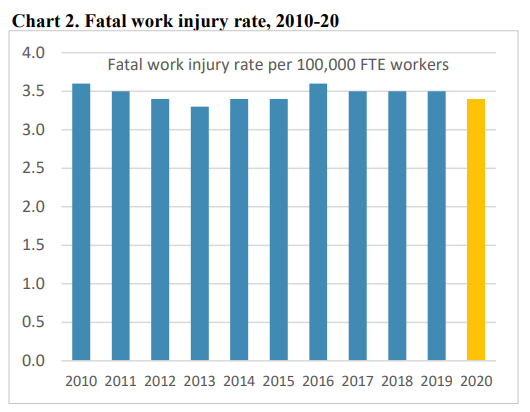
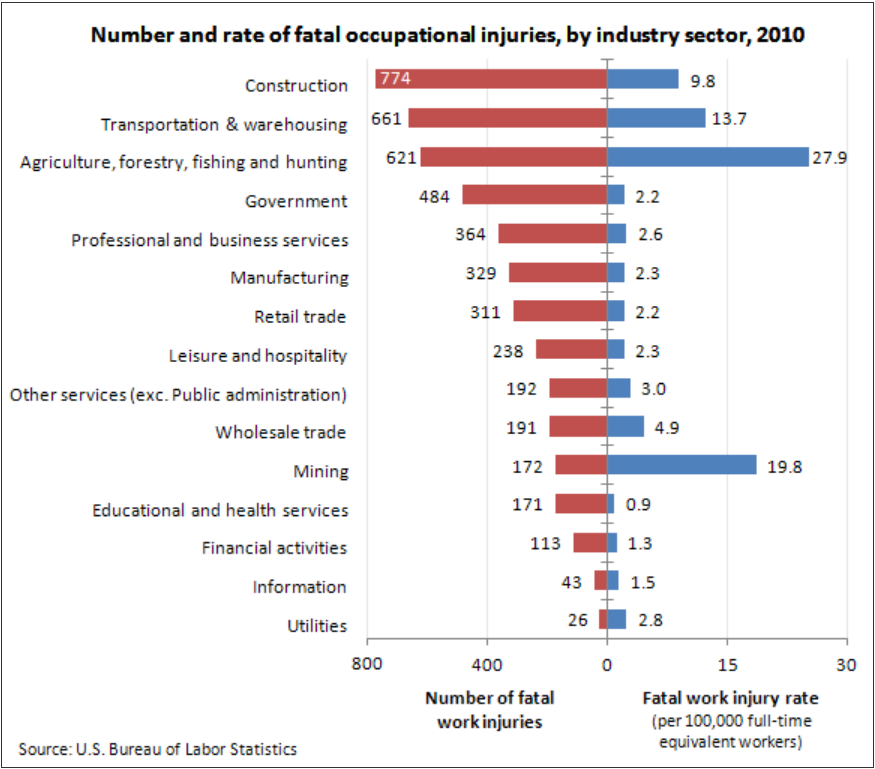
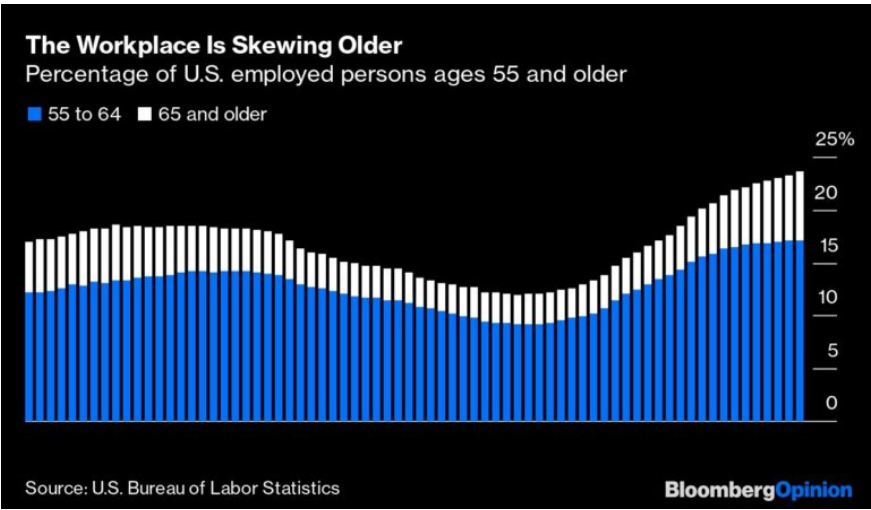
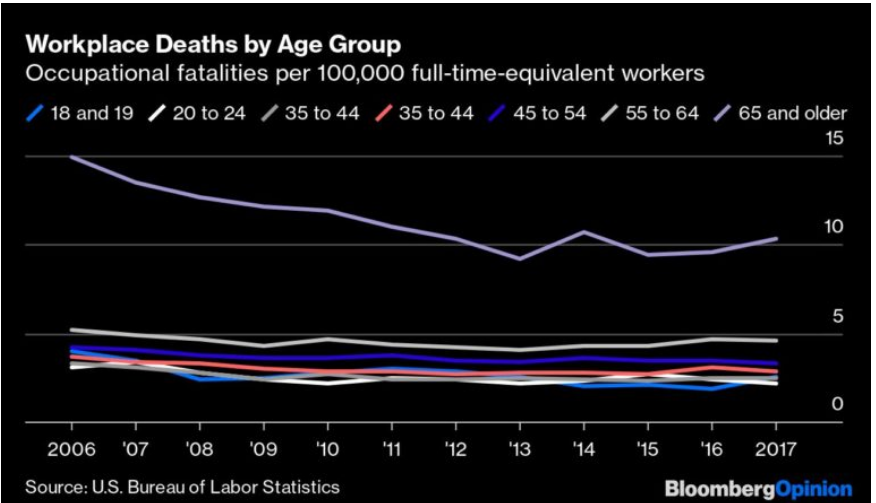
The baby boomers have caused the relatively higher death rate aged 55+ groups to almost double their share of total workers. While the death rate for EACH age group has gone down in the last 20 years, the blended average has been flat for the last decade.
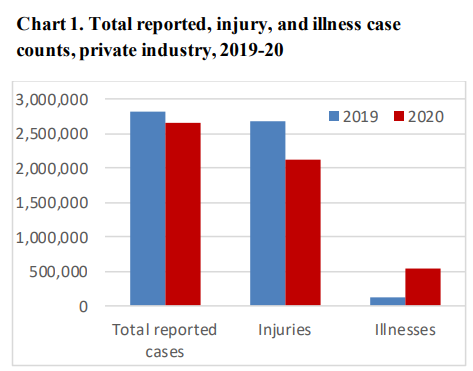
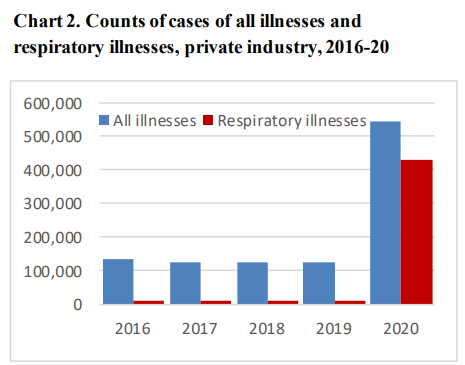
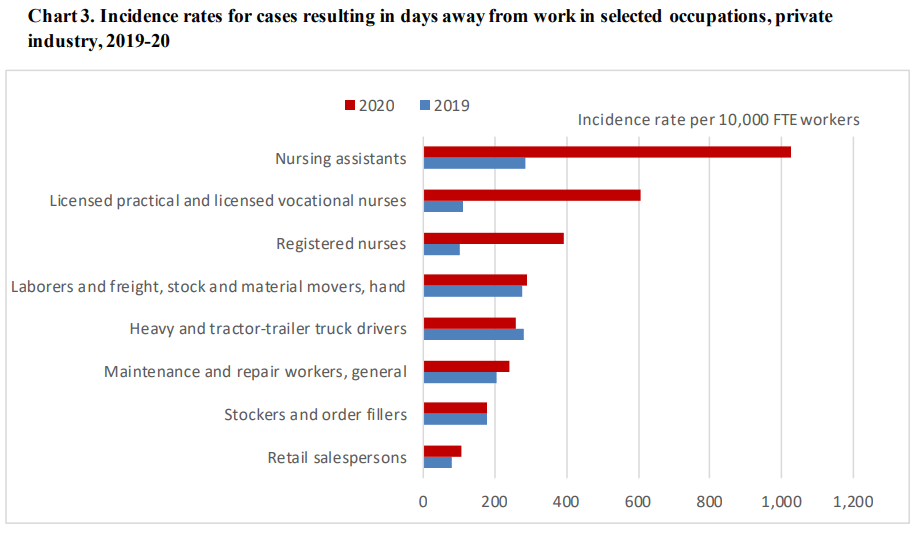
Covid Provided Special Challenges and the Results Could Always Be Even Better