11 Million Open Jobs! 2 Jobs for Every Applicant

Available Positions

Industry2007 Pos2019 Pos2022 PosAdds
Govt12.212.511.8-.4
Other5.45.95.6.2
Construct7.77.57.6-.1
Manufacturing14.212.812.7-1.5
Mining.7.7.6-.1
Logistics5.06.16.91.9
Education3.03.83.7.7
Health15.320.320.45.1
Leisure13.316.515.11.8
State/Local Educn10.210.410.20
Finance8.48.78.9.5
Information3.02.82.9-.1
Profl Svcs17.820.921.84.0
Retail15.715.615.8.1
Wholesale5.95.85.8-.1
Total137.8150.3149.812.0
https://www.bls.gov/jlt/

Industry2007 Open2019 Open2022 OpenMore Open
Government.3.5.7.4
Other.2.2.4.3
Construction.2.3.4.2
Manufacturing.3.5.9.5
Mining0000
Logistics.1.3.5.4
Education.1.1.2.1
Health.71.21.91.2
Leisure.61.01.61.0
State/Local Ed.1.2.3.2
Finance.3.4.5.2
IT.1.1.2.1
Profl Svcs.91.32.01.2
Retail.5.91.10,6
Wholesale.2.2.3.1
Total3.67.111.26.6
https://www.bls.gov/jlt/

Open Positions as a Percent of Jobs Available

Industry2007 Rate2019 Rate2022 Rate
Government2.43.65.4
Other3.14.07.3
Construction2.23.84.8
Manufacturing2.33.46.4
Mining2.13.85.6
Logistics2.74.87.4
Education Svcs2.42.94.9
Health4.35.48.6
Leisure4.35.79.8
State/Local Ed1.32.03.2
Finance3.54.25.4
IT4.64.76.7
Profl Svcs4.85.78.6
Retail3.05.26.4
Wholesale2.93.55.0
Total3.34.57.0
https://www.bls.gov/jlt/

Open Positions by Industry, 2021-22

The Department of Labor’s monthly survey provides various measures by industry. I’ve broken down the data into 15 industry segments. Eight (8) of these segments account for 5/6ths of all positions and I’ll focus on these 8.

The number of open jobs in the last year, July, 2021 – July 2022, is lead by Professional Services (2.0), Health (1.9), Leisure (1.6), Retail (1.1), Manufacturing (0.9), Government (0.7), Logistics (0.5) and Finance (0.5).

Seven industries accounted for 5/6ths of the increase from 4.6M openings in 2006-7 to 11.2M open jobs today. Health (1.2), Profl Svcs (1.2), Leisure (1.0), Retail (0.6), Manufacturing (0.5), Government (0.4) and Logistics (0.4) are the open job gainers.

The pre-pandemic increase averaged 40% of the total 15-year increase for most industries. The Manufacturing industry showed job declines between 2006 and before the Pandemic, so 80% of it’s openings increase has been since the pre-Pandemic peak. The Business and Professional Services industry has also grown faster since the Pandemic, with 68% of its job growth in recent years. The Retail industry shows an opposite pattern, with 60% of it’s job growth before the Pandemic and a relatively weaker 40% post-Pandemic (on-line sales growth impact).

Total Positions Available by Industry

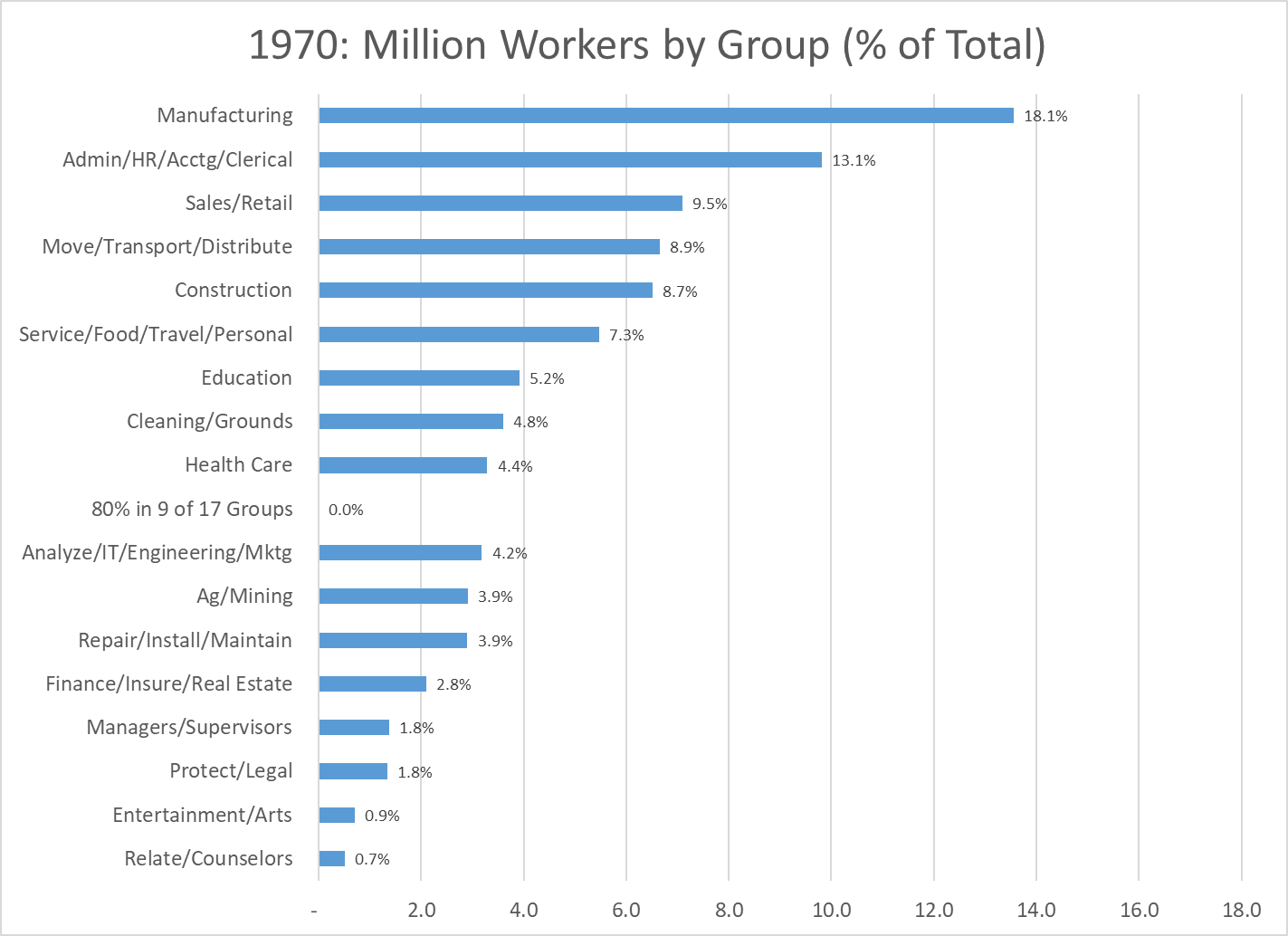
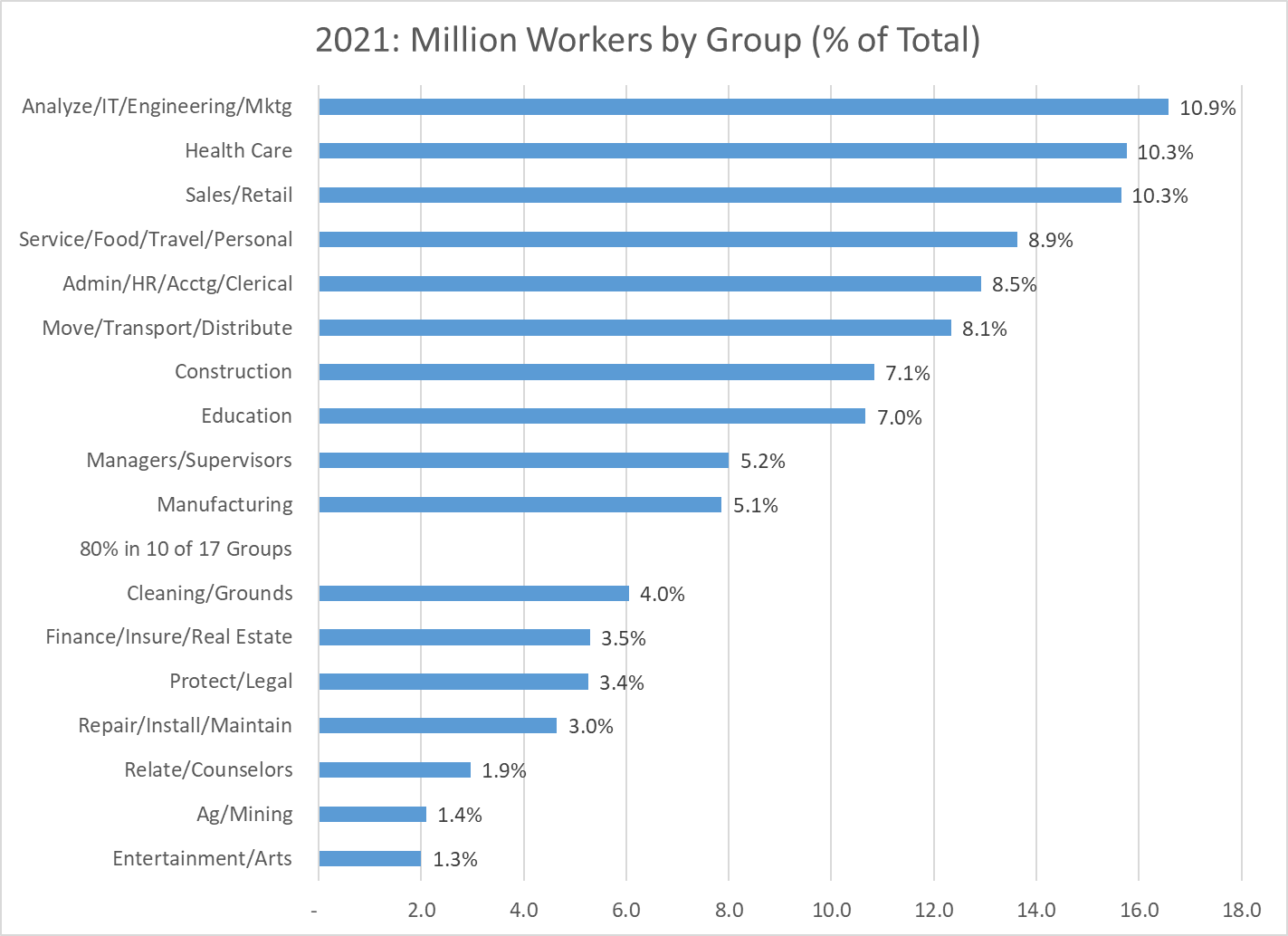
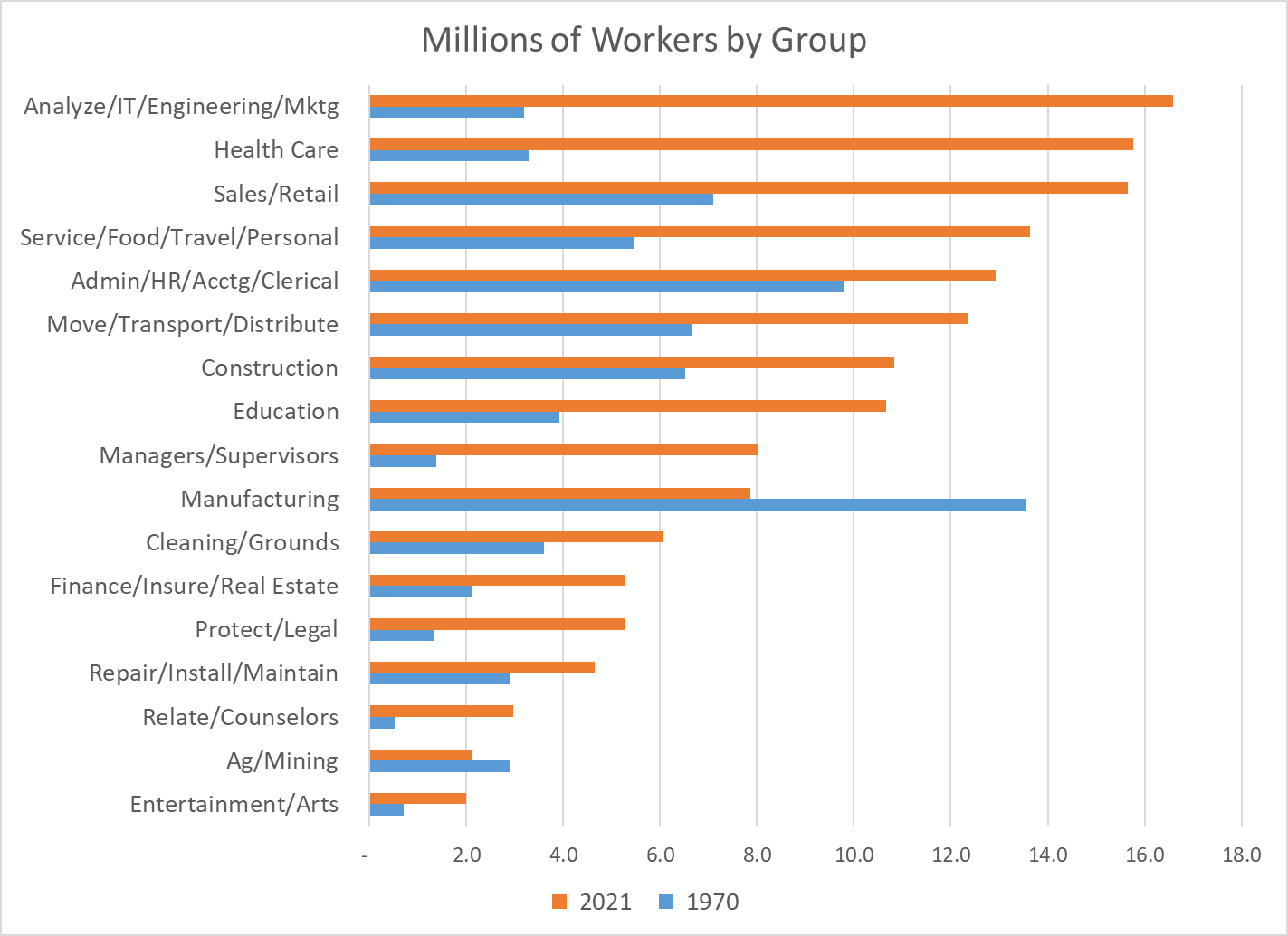
Total positions increased by 12M, from 138M in 2006-7 to 150M in the last year. Just 4 industries account for all of the growth, lead by Health (5.1), Profl Svcs (4.0), Logistics (1.9) and Leisure/Hospitality (1.8). The migration from ag/extraction to manufacturing to pure services is accelerating.

Open Positions Rate by Industry

The open positions rate more than doubled, from 3.3% in 2006-7 to 4.5% in 2018-19 to 7.0% in the last year. Unfortunately, the larger and growing industry sectors have above average open position rates. Leisure and hospitality shows an incredible/unsustainable 9.8% job openings rate. Professional and business services and Health Care report nearly as high 8.6% vacancy rates. The Logistics industry has a higher than usual rate of 7.4% as it adds jobs at a faster rate in the home delivery era. The Retail and Manufacturing industries show elevated 6.4% open jobs rates. The Government and Finance industries exhibit 5.4% openings rates.

Changes in the Job Openings Rate

The overall job openings rate more than doubled from 2006-7 to the last year, from 3.3% to 7.0%. Keep in mind that 2006-7 was the peak of that business cycle with job openings at a cyclical low point. The Leisure and Hospitality industry had the largest increase, from its usually relatively high 4.3% to an “other worldly” 9.8%. The pandemic drove down travel and it has slowly recovered. The Logistics industry displayed the second highest increase, from 2.7% (it’s usual Manufacturing-like rate) to 7.4% as the Pandemic drove individual shipments to consumers. The Health Care industry continued its labor intensive growth, doubling from 4.3% to 8.6% of open positions. The Manufacturing industry evolved from its usual low 2.3% all the way up to 6.4% as labor demand in other industries grew and attracted its workers. The Professional and Business Services industry kept growing, resulting in a 3.8% increase in unfilled roles, from a typically high 4.8% to a very high 8.6%. The Retail and Government sectors had lower increases at 3%. The Finance sector had a lower than average 2% increase in open jobs.

Just a “Mix” Variance?

The US economy is very dynamic. Industries with low, medium and high job openings rates in 2006-7 each employed about 45M people. The low job openings rate industries (Govt, Manufacturing, Mining, and Educn Svcs) actually LOST 1.4M positions between 2007 and 2022. The middle rate of job openings industries (Logistics, finance, trade, other) added 2.6% net new jobs (1.7M). The high job openings rate industries (Health, Leisure, IT and Profl/Bus Svcs) added an incredible 10.8M jobs (22%)! The US has moved from agriculture to extractive to manufacturing to services employment. The personal and professional services industries are both the fastest growing and the most difficult to staff today.

What Happens During a Mild Recession?

Business and Professional Services openings drop by 3% of the total or 600K people. Health industry jobs decline by a smaller 1% as they are less sensitive to the business cycle, falling by 100K. Leisure and Hospitality are very understaffed and this is harming their growth. They might trim their employment by 2% or 300K positions. The Retail industry is in a long-run decline, so a 2% decline is likely, eliminating 300K jobs. Manufacturing is more cyclical than other industries, so its labor demand will fall more sharply, 3%, removing 400K job postings. The Government sector is somewhat buffered from recession pressures, so job openings might fall just 1% or 100K. Logistics firms are struggling to deliver, so a 2% job decline is the most I see, cutting another 100K positions. The Finance sector has been less volatile, so I estimate a 1% decline and 100K dip.. The remaining industries are likely to fall in tandem, requiring an additional 400K open jobs decline to meet budgets. This total 2.4M open position trim reduces the balance to 8.8M, far above the 7.1M pre-Pandemic level in 2018-19. I don’t think that the labor market will play its usual role in transmitting/amplifying negative finance, banking, housing, international trade, energy and other disruptions through the American economy.

Summary

The US economy was at “full employment” in 2006-7 with just 4.6M unfilled positions. The extended recovery after the Great Recession delivered an even lower unemployment rate, but it also delivered a much increased 7.1M open positions. The post-Pandemic economy has returned to an amazing 3.5% unemployment rate, but the unfilled position count has climbed to a much higher 11.2M and stayed there. The current 7% vacancy rate is largely driven by 6 of the 15 industries with the highest rates: Leisure (9.8%), Health (8.6%), Profl Svcs (8.6%), Logistics (7.4%), Manufacturing (6.4%) and Retail (6.4%). American business is slowly learning to manage with a tight labor very market. Demand for labor should fall significantly in the future as firms employ greater technology, processes, capital goods and imports.

NOT.

Indianapolis Crime Rate

I’m using data from the FBI Unified Crime Reports. Total country violent crime increased by 25% from 600 events per 100,000 people in 1980 to 758 events in 1991 (thick black line). Violent crimes dropped dramatically to 500 events (33%) by 2001. There was a minor decline to 479 in the next 5 years and then another major decline to a minimum of 362 events, a 52% decline from the peak. Violent crime has increased to 399 in 2020, a 10% increase from the 4-decade minimum, but still 47% below the 1991 peak rate. In summary, the total country violent crime rate increased by 25% in the 1980’s, dropped by more than half in the next 25 years and has bumped back up to a level about one-half of the peak and one-third lower than the 1980 start. This is a quite positive result.

Indiana’s (orange line) general pattern mirrors the national figures. However, Indiana started at 378 violent events per 100K people in 1980, more than one-third lower than the national average. This is a quite significantly lower crime rate. Indiana’s violent crime rate increased by a larger 42% to a peak of 537 events in 1996. This was half again faster than the 27% increase for the country as a whole. Indiana was becoming more like the rest of the nation. Indiana’s violent crime rate dropped very quickly to just 349 events by 2000 (-35%), returning to 69% of the national level from 84% of the national level in 1996, a modest amount above the 63% ratio in 1980. Indiana violent crime inched down by 10% to 314 by 2010. The national crime rate was falling twice as fast, so Indiana was now at 78% of the average. In the “teens” decade, Indiana violent crime increased by 10%, returning to where it had been in 2000. National violent crime was flat during the “teens”, ending at 400 events. Indiana violent crime rate was essentially the same as the national rate during the “teens”, no longer one-third lower. It had returned to its starting point of roughly 400 events per year.

The city of Indianapolis (yellow line) is measured by the right hand scale, twice as high as the other 3 measures. Like most central cities, its violent crime rate is much higher than the national average. The Indianapolis crime chart follows the nation from 1980 through 2006. It starts at 1,134 events per 100K people, increases by 42% (like IN) to 1,611 in 1996, then drops by 45% to 884 events in 2003. The city’s violent crime rate is 1.9 times the national average at the beginning and the end of this 23-year period, but peaked at 2.5 times the average in 1996. The crime rate leapt up by 28% in 2007, reaching 2.6 times the national average. Violent crime in Indianapolis grew by 11% by the peak in 2016, 3.6 times the national average. The reported Indy crime rate has fallen by more than one-third in the last four years, ending at 2.2 times the national average. Looking at ten-year averages to smooth out the difficult to interpret variability, Indy has increased from 1.8 to 3.0 times the national average. The last 2 years look suspiciously low, just like 2007 looked suspiciously high. The 1,300 level for most of the last decade is more than 10% below the 1,500 peak level of the 1990’s. So … Indiananapolis violent crime is now down a little compared with the peak, up very significantly compared with the national average and roughly within the range of the first 30 years.

The Indy metro data follows the city of Indianapolis pattern very closely.

The national homicide rate per 100,000 people averaged 9 from 1980 to 1995. It dropped by one-third to just 6 by 2000 and stayed at that level through 2007. It declined to an average of just 5 for the next decade, before spiking up in 2020 (and 2021, FBI official data unavailable). The national homicide rate is up significantly, but one-third lower than in the eighties and early nineties.

Indiana started at an unusually high 9 homicides per 100,000 people in 1980, but averaged just 6 for most of the eighties, just two-thirds of the national level. Indiana homicides jumped quickly to a peak of 8.2 in 1992 and remained near 8 for six years. The national homicide rate fell rapidly from 10 to 6 during the nineties, leading to a six-year period (1997-2002) where Indiana homicide rates were slightly above the national average. Indiana homicide rates closely matched the national average for the next decade, falling to 5 in 2008. Indiana homicides increased by 50% between 2014 and 2020, from 5.0 to 7.5 while the national average increased about 50% from 4.4 to 6.5 events per 100K people. Indiana has averaged about 6 homicides per 100K people during this 4-decade period except for the 8 homicides rate in the mid-nineties. The most recent murder rate has returned to that peak level.

The city of Indianapolis very closely matches the Indiana pattern for the first two decades, with 12 homicides per 100K people in 2000, about double the national average of 6. The Indy rate pops back up to 14.2 in 2001 versus the 5.6 rate for the country (2.5 times higher). Indy follows the slow national decline through 2012 to 11.6 events versus the 4.7 country level (2.5X). Indy’s murder rate jumped 31% to 15.2 in 2013, and has climbed steeply since then. It reached 19.5 in 2019, a two-thirds increase in 7 years. It jumped again in 2020 to 24.2 and is estimated to be more than 28 in 2021. Indy averaged about 14 murders per 100,000 people in the first 32 years of this period. 2019 was a 40% increase. 2020 was a 73% increase. 2021 is a doubling.

The Indy metro area pattern follows the city of Indianapolis. Metro Indy’s homicide rate averaged 1.35 times the national rate from 2003-2011. It has averaged 1.76 times the national average from 2012 to 2020.

Summary

Indianapolis has a huge violence and murder problem. Period. Violence at the national level is way down. Murders at the national level are much lower than the peak period. Indianapolis’ violence rate shot up in 2007 and only declined in the past 2 years. Indianapolis’ murder rate shot up in 2013 and has continued to climb. I try to highlight the “good news”. I emphasize long-term data to provide context. I try to minimize/offset the sirens of local and national journalists. But, for this topic, there is no apparent “silver lining” or “on the other hand” conclusion.

https://www.fbi.gov/services/cjis/ucr/publications

https://ucr.fbi.gov/crime-in-the-u.s/1999

https://www.macrotrends.net/cities/us/in/indianapolis/crime-rate-statistics

https://www.disastercenter.com/crime/incrime.htm

https://crime-data-explorer.app.cloud.gov/pages/explorer/crime/crime-trend

https://ucr.fbi.gov/crime-in-the-u.s/2019/crime-in-the-u.s.-2019

https://www.themarshallproject.org/2016/08/18/crime-in-context

https://www.savi.org/feature_report/equity-and-criminal-justice-the-cradle-to-prison-pipeline-in-indianapolis/

https://abcnews.go.com/US/12-major-us-cities-top-annual-homicide-records/story?id=81466453

https://www.wrtv.com/news/local-news/crime/2022-indianapolis-homicide-map

https://www.wrtv.com/news/local-news/crime/indianapolis-had-271-homicides-in-record-breaking-2021

https://fox59.com/news/indycrime/crime-mapping-neighborhoods-impacted-the-most-by-homicides-in-2021/

https://www.wthr.com/article/news/crime/762-people-shot-in-indianapolis-in-2021-shooting-cold-case-violence-indiana-impd/531-7e477cf2-31cc-4147-9005-4e4dab7b3366

https://www.wfyi.org/news/articles/law-enforcement-community-work-to-solve-more-homicides

US Labor Market: Just Like Living in Paradise

https://fred.stlouisfed.org/series/CE16OV

US labor force employment grows and grows. 60M employed in the very glorious 1950’s. 80M by the end of the dynamic 1960’s. 100M by the end of the transforming 1970’s. 120M by the end of the conforming 1980’s. Not quite 140M by the turn of the millennium (2M shy). Just 140M at the end of the “oughts” decade. 158M before the pandemic, resuming the 20M new jobs per decade record of the sixties, seventies, eighties and nineties in the teens decade.

That is 100 million net new jobs added in my lifetime. 160M, up from 60M.

https://fred.stlouisfed.org/series/PAYEMS

We have two sources, a payroll survey and a household survey. They both tell the same story.

https://fred.stlouisfed.org/series/PAYEMS

A once in a century pandemic? No problem. 27 months later, total employment has been recovered, despite a 20M worker decline! Set aside politics. This is an amazing result for the US labor market, businesses and citizens.

https://www.nytimes.com/live/2022/08/05/business/jobs-report-july-economy

US economy continues to add about 400,000 jobs each month. This is almost 5M jobs per year, more than twice as fast as the usual 2M jobs per year in recent history.

https://fred.stlouisfed.org/series/LNU01300060

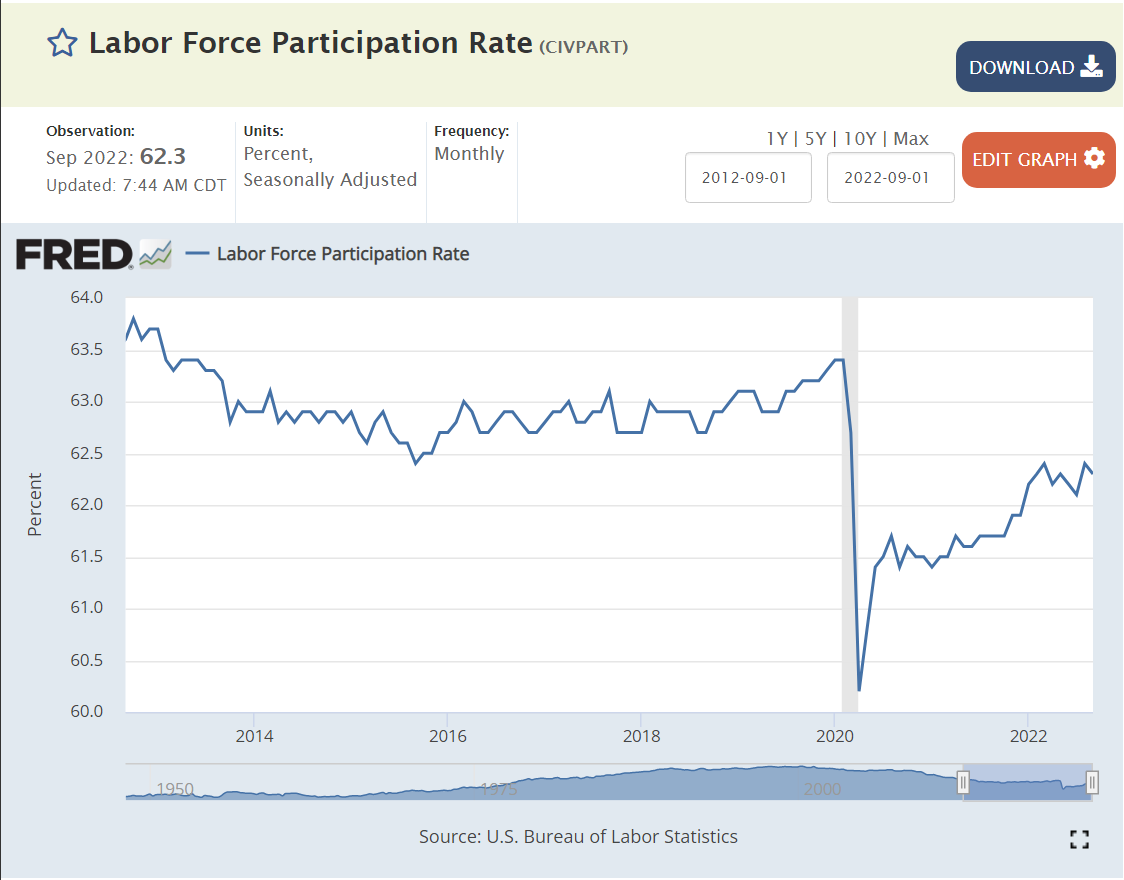
The labor force participation rate for prime aged individuals (25-54) increased from 65% to 84% between 1950 and 1990 as women were accepted into the labor force. 84% was maintained for a decade and 83% for the next decade. The teens decade saw a decline to 81%. The market has remained in the 81-82% participation rate range.

https://fred.stlouisfed.org/series/JTSHIL

New hires averaged 5M per month in the slower growth “oughts”. New hires dropped further to just 4M per month after the Great Recession. New hires slowly built up to a new record level of 6M per month before the pandemic arrived. The pandemic had just a minor impact on new hires, with a record 6.5M new employees being hired each month in late 2021 and 2022.

https://fred.stlouisfed.org/series/JTSQUR

Voluntary quits averaged 2%, 1 in 50 employees, during the first decade of the 21st century. Quits dropped sharply to just 1.4%, just 1 in 70 employees, in the 3 years afterwards. The quit rate slowly returned to “normal” by 2016 and climbed further to 2.3% as the economic recovery continued for a full decade.

By October, 2021 quits had returned to the solid pre-pandemic rate of 2.3%. The quit rate jumped up to 2.8% by April, 2021 and has remained at this historically high rate.

https://fred.stlouisfed.org/series/JTSJOL

Job openings averaged 4M before the Great Recession. They dropped below 3M during 2009-13. They increased to 5M in 2014 and to 6M by 2016. They remained at the 6M level during 2017, before climbing to 7M for 2018-19. By Jan, 2021 job openings had recovered to 7.2M. By October, job openings had increased to a historic 11M and have remained at this unprecedented level.

This is a greater than 50% increase in open positions since before the pandemic, just 29 months ago. This is 120% more than the peak level before the Great Recession.

Most Important Measure

Profit maximizing businesses, managers and HR departments work through internal processes to list/post a job opening only when:

  1. It’s within the annual financial and headcount budget.
  2. Hiring managers conclude that current staff are unable to serve current demands from internal and external customers.
  3. Hiring managers and financial analysts believe that the incremental hired employees will generate incremental measurable profits.
  4. Hiring managers believe that they can hire new staff using existing processes to fill well defined positions.
  5. Hiring managers believe that it is worth their time to go through the firm’s hiring process.
  6. Hiring managers cannot find an “adequate” labor source through stretching existing staff or using temporary, contract, supplier or agent work forces.

11M job openings means that firms believe that they can generate material incremental profits by hiring up to 11M new employees.

https://www.bls.gov/charts/job-openings-and-labor-turnover/unemp-per-job-opening.htm

11M open jobs is a startling number, but the ratio of unemployed persons to open positions is much more important. The Great Recession created a 6 applicants per job market. This declined to 2:1 in 2014. During the historic extended expansion it declined to just below 1:1, an unprecedented low number. The ratio fell below 1:1 in 2021 to the current 0.5 level. Two open positions for every unemployed job seeker.

https://fred.stlouisfed.org/series/UNRATE

Unemployment was quickly driven to the pre-pandemic record low of 3.5% this summer. Unemployment was below its usual minimum of 5% for 5 years just before the pandemic, leading most economists to recalibrate the “non-accelerating inflation rate of unemployment” (NAIRU) down to 4% or slightly below. This is a very efficient labor market.

https://fred.stlouisfed.org/series/LES1252881600Q#

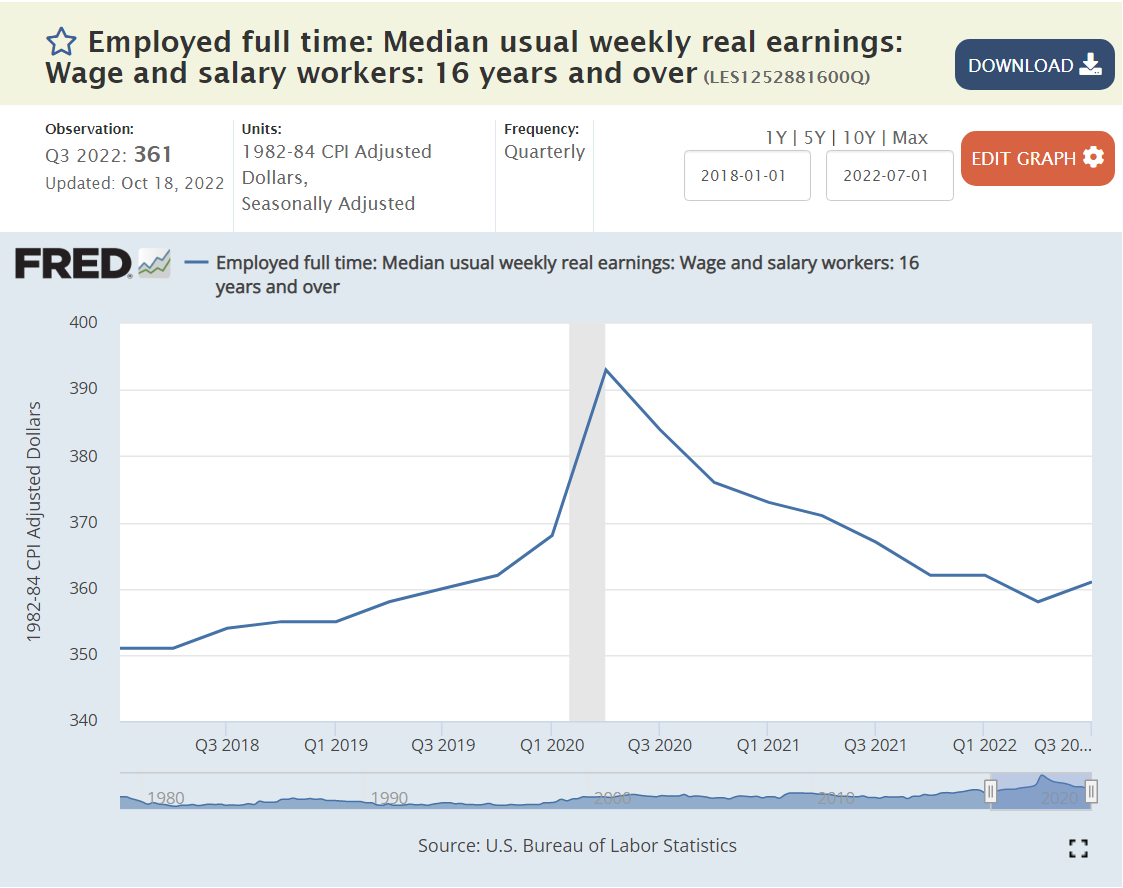
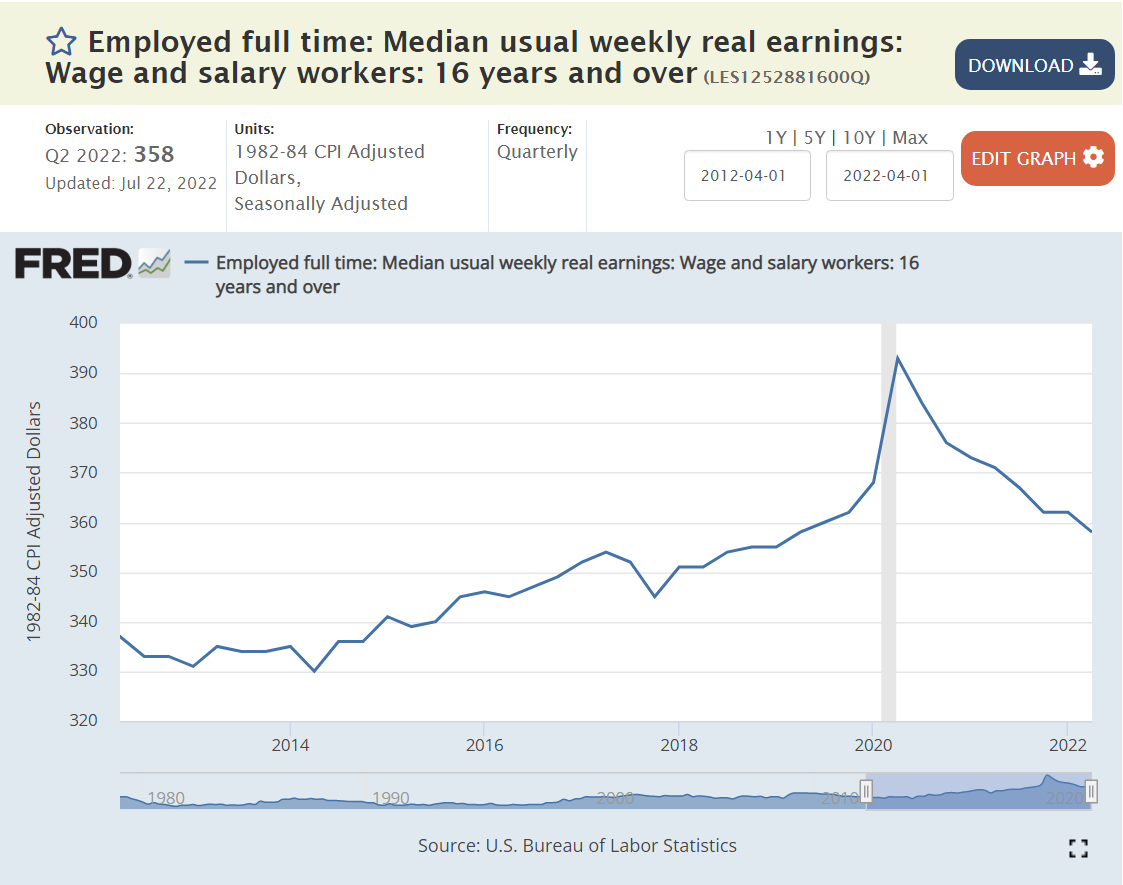
Real (inflation-adjusted) wages have reflected this labor market situation. They remained at the $335/week level from 2000 through 2014, reflecting the slow growth of employment and GDP. Wages began to raise in real terms in 2015, reaching $360 by 2019, a 7.5% real increase. Wages were growing rapidly just before the pandemic and climbed to $390/week in the second quarter of 2020, an additional 8% increase in a few months. Real wages have since declined back to the $360 per week level as high inflation has offset higher than usual nominal wage increases. Firms have chosen to live with 11 million open positions rather than increase real wages.

Summary

Firms have 11M open positions that they believe will help them to make greater profits. Real wages are the same as they were just before the pandemic started. Firms have chosen to not increase hiring and regular wages any faster because they judge that this will cost them more profits than allowing 11M positions to remain unfilled. This is the first time in at least 50 years that firms have had to manage a labor market where employees and applicants have some market power. Despite this “standoff” in the labor market, total employment is back to the pre-pandemic level, firms are hiring record numbers of employees and labor force participation is recovering towards the pre-pandemic level, which was at a 10-year high. The overall economy has clearly slowed its growth rate to near zero, but the labor market remains in a very positive state for workers.

Trump Presidency Accomplishments

  1. Tax cuts. Corporate rates cut from 35% to 21%, closer to OECD norms. Incentives for returning profits to US. Higher income tax rate cuts.
  2. Regulation cuts. Environment, business, banking, labor.
  3. Lower environmental standards. Withdraw from Paris climate deal. Methane limits. Wetlands. Vehicle milage and emissions standards.
  4. New limits to welfare benefits: Medicare and SNAP.
  5. Antitrust investigations for telecommunications, media, internet, network advantaged firms.
  6. Increased use of Congressional Review Act (1996) to allow Congress to vote down newly implemented regulations.
  7. Economic recovery continued for 3 more years. 2.5% annual growth. 3.5% unemployment. Stock market gains. 6.5M jobs added. Tighter labor market. Increased wages. Minority and lower income gains.
  8. Bipartisan Covid relief spending for individuals and firms.
  9. Home building increased during Trump term and afterwards.
  10. More “Middle Americans” believed that they were heard and represented.
  11. NAFTA agreement renegotiated.
  12. China relations re-evaluated. Higher tariffs on both sides. Technology limits.
  13. Presidential “bully pulpit” used to maintain some US jobs.
  14. Legislation and executive orders used to support US steel, coal and manufacturing businesses and employment.
  15. Legislation passed to improve visibility to tax shelters and tax fraud enforcement.
  16. Agriculture industry subsidies offered to offset trade costs.
  17. Trade deals with South Korea, Japan and EU.
  18. Enhanced trade policy for communications, IT, technology and AI.
  19. Increased military spending.
  20. Revised defense strategy focused on China and Russia.
  21. Flexed US military muscle in limited attacks.
  22. Actions reduced Islamic State threats to low level.
  23. Supported Israel diplomatic relations with 4 Arab states.
  24. US troops withdrawn from Afghanistan, Syria and Iraq.
  25. Opposition to dictators in Cuba, Venezuela, China and Nicaragua.
  26. Reduced support for international organizations such as WHO.
  27. Built 80 miles of new wall and 300 miles of enhanced walls on Mexico border.
  28. Negotiated improved coordination with Mexico and Central American nations regarding immigration.
  29. Reduced legal immigration from all countries.
  30. Reduced opportunities for asylum seekers.
  31. Used “zero tolerance” family separation policies to disincentivize immigrants.
  32. Removed Affordable Care Act individual mandate.
  33. Streamlined FDA approval process and made financial commitments to ensure rapid COVID vaccine development.
  34. Took steps to reduce drug price inflation.
  35. Invested in opioid drug addiction prevention and correction.
  36. Enacted market friendly policies and regulations to expand domestic energy development, furthering American energy independence.
  37. Supported the bipartisan First Step Act which reduces minimum sentences and supports recovery from incarceration.
  38. Invested in historically Black colleges and universities and vocational education (Perkins).
  39. Made small steps to support “school choice”.
  40. Appointed 3 conservative Supreme Court justices and 225 federal justices.

Trump Presidential Results

Economic Policy

  1. Deficit spending is permanently entrenched. 3-5-7% annual budget deficits do not appear to have major economic downsides in investment crowding out or inflation.
  2. Tax cuts do not generate extra growth, investment, productivity or economic resiliency. They transfer dollars to the recipients.
  3. Concentrated supply chains (China) are subject to significant trade, logistics, military and emergency risks which must be managed.

Foreign Policy

  1. U.S. remains the leading superpower and can pursue its own goals with less allied cooperation and attention to “niceties”, at least in the short run. See NATO, Japan, Korea, climate.
  2. China is the number one competitor.
  3. U.S. and Russia relations are no longer based on Cold War issues. The “Hawks versus Doves” dimension competes with domestic political parties.
  4. Negotiating with nuclear states (Iran, North Korea) is very difficult, even for a superpower.
  5. Europe has its own international interests. It will pursue them. It cannot rely upon the U.S. for its defense.

Domestic Policy

  1. Bipartisan immigration policy may be impossible.
  2. Supreme Court and judicial politicization may drive structural changes/reforms.
  3. Racial relations and inequality will be a top political issue for decades.
  4. Wedge issues – abortion, guns, school content/choice, liberty, gay rights – will remain a focus of both parties.
  5. Traditional social security, Medicare and Medicaid are untouchable.
  6. Obamacare is now essentially untouchable. Lower income citizens will have health insurance.

Democracy at Risk

  1. Legitimacy of media, press, free speech threatened.
  2. Government employees, courts, justice system, law enforcement threatened.
  3. Schools, universities and teachers threatened.
  4. Legitimacy of voting processes threatened.
  5. Illiberal democracy, authoritarianism have more support.
  6. Gerrymandering, voting rules, campaign funding rules undercut public confidence.
  7. Voter participation has increased in response.

Communications Policy

  1. Media attention is priceless and can be manipulated by extreme statements and behavior.
  2. Traditional media “fairness” approach (quotes from both sides) can be manipulated to support unsupportable claims.
  3. Every media outlet or actor has some degree of bias. Consumers are more aware, but many choose to only reinforce existing beliefs.
  4. The president has the opportunity to control/influence the attention of the media.
  5. Facts and objectivity are not respected by some media voices. The pattern of communications statements and framing of subjects can be much more important than content.
  6. Political actors are not held accountable for false claims or exaggerated promises. Claims and promises are just tools to motivate the faithful.

Rules of Politics

  1. President has tremendous power. International agreements. Regulations. Executive orders. Bully pulpit. Political party discipline. Using power seems to have little downside.
  2. Only winning matters. Not popularity, broad support, bipartisanship, appearances, fairness, mud, litigation, critics, impeachment, norms, tradition or relations.
  3. Polarization strategy is more effective than building a central coalition. Motivating your team to vote is more important than persuading independent voters.
  4. Candidate character does not matter. Politicians are salesmen and saleswomen. They are lawyers. They are tools, not statesmen.
  5. Party/team winning is most important factor. 400,000 covid deaths were not enough to spark a revolution. Deaths were traded off against economic opportunity without negative political impact.
  6. Harry Truman’s “buck stops here” responsibility position is not required. No one was responsible for Covid results.
  7. Administrative competence is not required to hold office or to run the federal government (so far). Slow appointments, fast cabinet turnover, acting secretaries, department heads that oppose the role of their departments.
  8. President represents his team and interests, not the whole country.

Party Policy

  1. Philosophical conservatives have departed the Republican party and lost influence.
  2. Moderate Republicans (RINO) have mostly departed, have no political candidates and no influence in the national party.
  3. Extremist groups (race, religion, military, nationalist) are not opposed.
  4. Traditional business interests have much less influence (immigration, social issues, antitrust, trade limits, industrial policy, presidential threats, banking, bailouts).
  5. Pragmatic policies and legislation remain largely unimportant. No party platform for 2020. Everyone in the party “knows” basic positions on all issues. No budget policy debates. No health care alternative to Obamacare. No abortion policy. Statements of preference and intent and belief are more important than wonkish details.
  6. Highlighting the threats and follies of the most leftist Democrats is the most effective means to motivate true believers and maintain support of more independent minded voters.
  7. Only a few federal level policies really matter. Tax and regulation cuts. Social wedge issues. Most other topics can be “managed” with small policy victories and messaging.
  8. Party discipline is essential. Republicans are obligated to support the political winners in their party, not to represent all Republicans or all Americans or to “solve problems”.
  9. Managing the voting system (districts, rules, methods) is as important as policies, candidates, fundraising and communications strategies.

Summary

Trump has revolutionized modern American politics. The Reagan revolution consolidated conservative voters, clearly aligning them with the Republican party. The Gingrich revolution further separated the two parties, emphasizing winning and party allegiance. Republican candidates and voters engaged in a reinforcing cycle of “purist” policy aims such as no tax increases, “drill baby drill” environmentalism, banning abortions, and “bomb baby bomb” anti-terrorism. The Great Recession and the tea party further motivated populist leaning voters to demand populist policies and appeals. Trump modified many historical Main Street and Wall Street Republican policies to make the party better embrace the populist mood and “make American great again”.

Trump’s “only results matter” approach has further transformed the party and the nation. His presidency delivered some key political accomplishments. It also produced many “results” that will shape American politics, economics, society and debate for years to come.

https://www.bbc.com/news/world-us-canada-37982000

https://www.pewresearch.org/2021/01/29/how-america-changed-during-donald-trumps-presidency/

https://www.washingtonpost.com/politics/2021/01/20/trump-promised-his-supporters-everything-he-didnt-deliver-most-it/

https://www.politifact.com/truth-o-meter/promises/trumpometer/

https://www.politico.com/news/magazine/2021/01/18/trump-presidency-administration-biggest-impact-policy-analysis-451479

https://trumpwhitehouse.archives.gov/trump-administration-accomplishments/

https://www.vox.com/policy-and-politics/2019/12/2/20970521/trump-administration-achievements

https://www.reuters.com/article/us-usa-trump-legacy-factbox/factbox-donald-trumps-legacy-six-policy-takeaways-idUSKBN27F1GK

https://www.propublica.org/article/the-government-donald-trump-left-behind

https://www.mcleancountyrepublicans.org/trump_administration_accomplishments

https://www.businessinsider.com/trump-biggest-accomplishments-and-failures-heading-into-2020-2019-12#failure-covid-19-pandemic-12

https://www.washingtonpost.com/outlook/2021/01/20/trump-legacy/

https://apnews.com/article/fact-check-donald-trump-farewell-remarks-f911b5ea84a2b69291aa6f52b9ef6318

https://www.barnesandnoble.com/w/trump-got-it-done-jack-t-adams/1139526046

https://foreignpolicy.com/2020/10/14/trump-foreign-policy-wins-losses-over-four-years-china-middle-east-coronavirus-pandemic/
https://www.maciverinstitute.com/2021/01/on-policy-donald-trump-was-by-far-the-most-effective-consequential-conservative-since-reagan/

https://www.newsmax.com/bestlists/donald-j-trump-accomplishments-america-first/2021/06/14/id/1025067/

https://www.thedailybeast.com/even-liberals-have-to-admit-trump-had-real-successes-on-the-economy

https://www.cbsnews.com/news/trump-view-historians/

https://www.pewresearch.org/fact-tank/2021/03/29/a-partisan-chasm-in-views-of-trumps-legacy/

https://www.belfercenter.org/publication/trump-legacy-and-its-consequences

https://www.cnn.com/2021/08/30/politics/trump-legacy-fake-news/index.html

https://www.reuters.com/article/usa-trump-legacy-analysis-int/analysis-trumps-legacy-a-more-divided-america-a-more-unsettled-world-idUSKBN29P0EX

https://www.cfr.org/article/donald-trumps-costly-legacy

https://www.usatoday.com/story/news/politics/2021/01/20/trump-legacy-how-history-see-presidents-tumultuous-four-years/4158507001/

https://www.pbs.org/newshour/show/what-will-trumps-legacy-be-after-leaving-office

https://www.yahoo.com/video/what-is-president-trumps-legacy-203123599.html

https://thehill.com/opinion/white-house/531734-trumps-legacy-an-enduring-contempt-for-truth/
https://www.brookings.edu/research/tracking-turnover-in-the-trump-administration/

Good News: The US Economy is a Job Creating Machine

https://www.copelandintl.com/blog/oilfield-equipment/the-best-allison-transmission-models-for-your-industry/

In 1942, the US economy employed 41.9 million people in firms. At the end of 2022, the number will be 153.8 million, an increase of 267%. Yes, for very 3 jobs in 1942, we have 11 today. Yes again, almost 4 times as many in 2022 versus 1942, despite the 9 million jobs lost in 2008-9 and the 9 million jobs lost in 2020.

https://fred.stlouisfed.org/series/PAYEMS#0

The US economy added 12 million jobs between 1942 and 1960, growing from 42 to 54 million positions. Job growth averaged nearly 700,000 per year or 1.4% annually. This was a period of solid growth, despite the 4 recessions.

https://fred.stlouisfed.org/series/PAYEMS#0

The period from 1960 through 2001 showed truly remarkable job growth. The economy added 78 million jobs, almost 1.9 million each year or 2.2% annually. STOP and think about this. The Greatest Generation, WW II saving the planet team was just 40 million employees in the US. The immediate post-war boom increased employment to 55 million when the US was the only advanced economy running at full speed. But employment growth accelerated from 1960 to 200. These 4 decades essentially tripled the size of the US economy.

https://fred.stlouisfed.org/series/PAYEMS#0

Overall, the last two decades have delivered much slower job growth. Using 2019 as an ending measure, the economy grew by 21 million jobs, from 131 to 152 million since 2001. This is just 1.1 million per year, or a growth rate of 0.8%, far below the 2% plus rate of 1960-2000. Or, the 21 million added jobs is one-half of the jobs in 1942 in the heart of WW II.

But, these two decades experienced the post-millennium downturn, the great recession and the covid pandemic.

The economic recovery from the millennium (Y2K) was quite slow. The recovery from the Great Recession was slow but strong and extended, allowing unemployment rates to eventually reach 3.5%. The recovery from the pandemic situation was much faster than expected, reaching pre-pandemic levels of GDP and employment within 2 years.

The economy has been adding 400,000 jobs each month since the beginning of 2021, almost an amazing 5 million jobs annually.

Million Jobs Added Per Year in Economic Recovery Periods

1948: 2.0

1952: 2.2

1956: 1.8

1959: 2.0

1969: 1.9

1973: 2.4

1980: 2.2

1990: 2.5

2000: 2.7

2007: 1.6

2019: 2.2

The US economy adds 2 million jobs each year when the economy is expanding. The percentage growth rate is slower through time, but the 2 million jobs added each year remains a solid capacity or capability.

Summary

The US economy added 1.4% new jobs annually from 1942-1960. The jobs growth rate averaged a very strong 2.2% from 1960-2021. It then slowed to just 0.8% annually while digesting the Great Recession and the COVID pandemic. The economy added more than 2 million jobs each year after the Great Recession, pushing unemployment to a very low 3.5%. The economy rebounded from the pandemic much faster than the consensus view,

https://fred.stlouisfed.org/series/PAYEMS#0

Despite

  1. increased international trade
  2. greater share of immigrants
  3. greater percentage of federal government spending
  4. fewer new businesses started
  5. declining shares for agriculture, mining and manufacturing
  6. greater outsourcing of corporate functions
  7. greater share of contracting, non-traditional employment, part-time employment
  8. lower rates of geographic mobility
  9. lower rates of economic upward mobility
  10. greatly increased political polarization at the state and local level
  11. decreased labor force participation rates
  12. increased opioid and drug damage rates
  13. lower community service participation rates
  14. lower church attendance and membership rates
  15. lower male college attendance and graduation rates

Despite the very many headwinds, the US economy is still able to add 2 million jobs annually during economic recovery periods. It added 9 million positions in 2021 and looks to add almost 5 million positions in 2022 despite the weakening business cycle. Even with a slowing economy, the US is likely to add 2 million new positions in 2023 and 2024.

Good News: Better Refrigerator Capacity, Energy Efficiency and Real Prices

https://www.vox.com/energy-and-environment/2019/5/31/18646906/climate-change-california-energy-efficiency
https://appliance-standards.org/blog/how-your-refrigerator-has-kept-its-cool-over-40-years-efficiency-improvements

Between 1972 and 2014, the size of an average refrigerator grew by about one-fourth, adding 5 cubic feet.

From 1972 to 2010, the real, inflation adjusted, price of a refrigerator was cut in half.

From 1972 to 2010, the average annual energy use was reduced by three-fourths (75%), from 2,000 to just 500 KwH per year.

https://blog.sense.com/how-much-energy-does-your-refrigerator-really-use/

An Energy Star model in 2020 was another 30% more energy efficient than in 2010.

https://www.eia.gov/todayinenergy/detail.php?id=3030

The US consumes more than 8 million new refrigerator units each year.

https://www.eia.gov/todayinenergy/detail.php?id=3030

Refrigerators have become more reliable through time, now averaging 12 years old.

https://www.energy.gov/energysaver/shopping-appliances

https://www.eia.gov/consumption/residential/reports/2015/overview/

The share of homes with more than one refrigerator doubled between 1997 and 2015, reaching 30%.

https://www.ibisworld.com/industry-statistics/market-size/refrigerator-freezer-manufacturing-united-states/

The US market is roughly $5 billion dollars, growing slowly.

https://fred.stlouisfed.org/series/CUSR0000SAH3

The US Dept of Labor does not publish a consumer price index specifically for refrigerators, but the category it belongs in showed essentially zero nominal inflation between 1994 and 2018. The real price decline shown in the first chart probably continued through 2018.

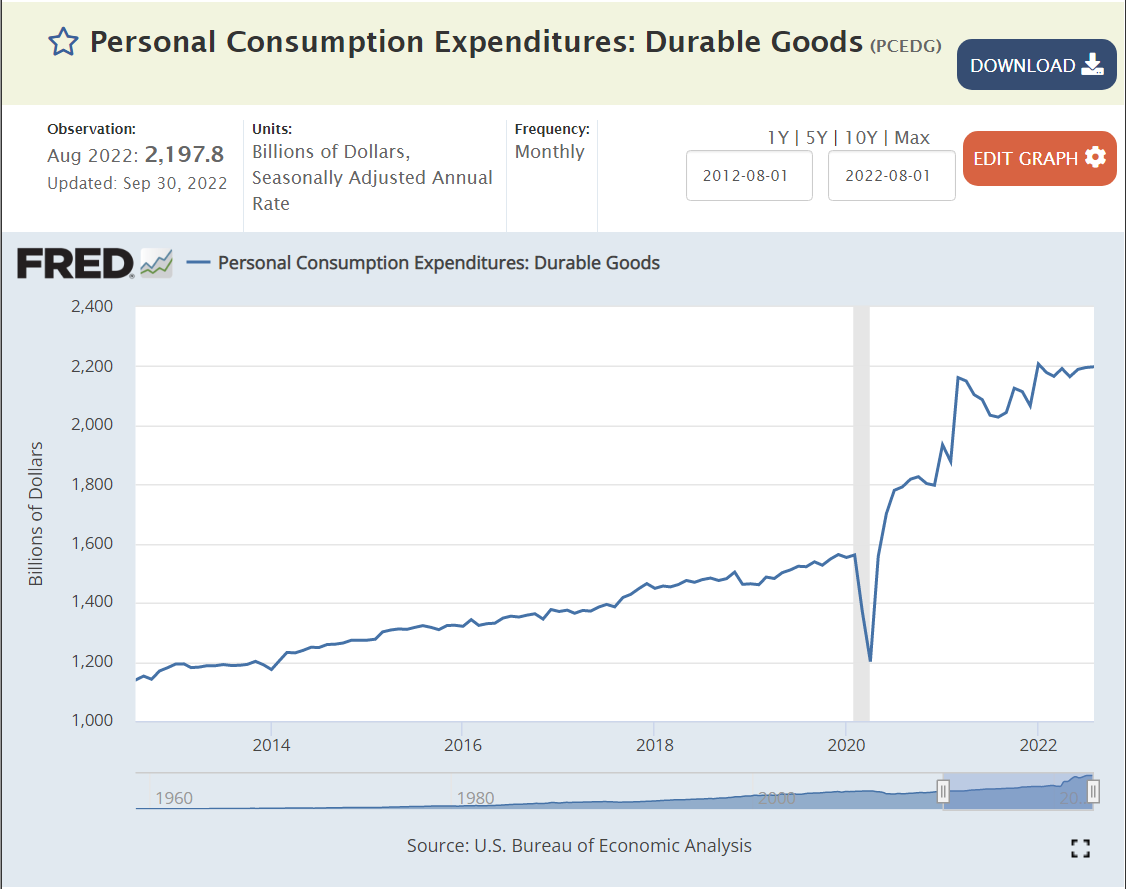
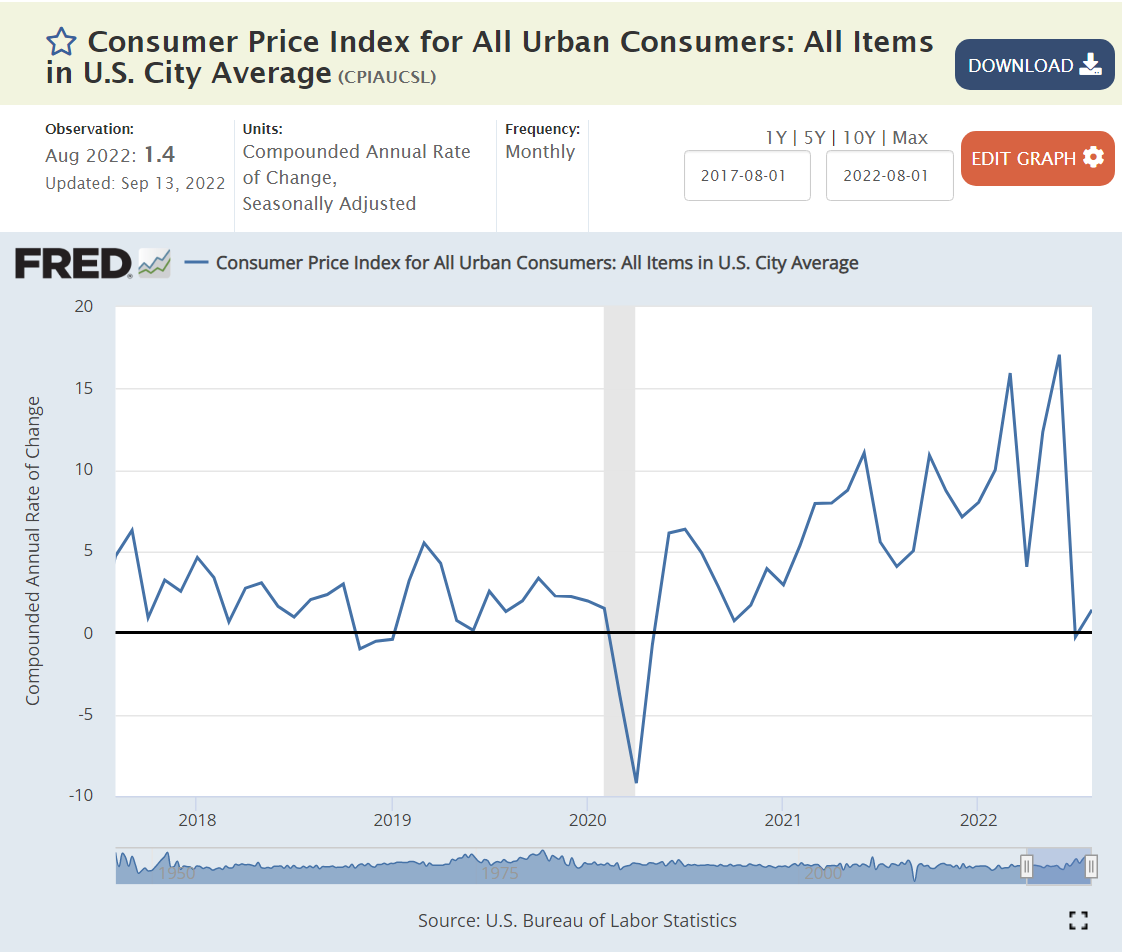
Refrigerators and appliance prices spiked by more than 10% in 2021 as consumer demand for durable goods grew 20% during the pandemic, supported by government transfer payments.

https://www.foxbusiness.com/economy/consumers-slapped-with-home-appliance-price-hikes-as-input-costs-soar

https://www.eia.gov/todayinenergy/detail.php?id=37813#:~:text=As%20a%20group%2C%20refrigerators%20use,of%20total%20refrigeration%20consumption%20nationwide.
https://www.researchgate.net/figure/Household-Electricity-Consumption-Source-Adapted-from-EIA-2001-Figure-1_fig1_228665463

Refrigerators now account for just 7% of home electricity consumption, down from 14% in 2001.

Opinion writers differ on who gets credit for the improved price/performance results for refrigerators, but it seems clear that both energy standards and inventive firms share credit.

https://www.vox.com/energy-and-environment/2019/5/31/18646906/climate-change-california-energy-efficiency

https://appliance-standards.org/blog/how-your-refrigerator-has-kept-its-cool-over-40-years-efficiency-improvements

https://fee.org/articles/thanks-capitalism-refrigerators-are-awesome/

Trust in the DOJ and the FBI

Republican Trust in the DOJ Has Improved Significantly Since 2015

https://www.pewresearch.org/politics/2018/07/24/growing-partisan-differences-in-views-of-the-fbi-stark-divide-over-ice/
https://www.pewresearch.org/politics/2019/10/01/public-expresses-favorable-views-of-a-number-of-federal-agencies/
https://www.pewresearch.org/politics/2020/04/09/public-holds-broadly-favorable-views-of-many-federal-agencies-including-cdc-and-hhs/

Trust in the Department of Justice (DOJ), overall, has been relatively flat. Republican support has increased while Democratic support has dropped.

Historically, Republicans Strongly Supported the FBI

https://fivethirtyeight.com/features/why-democrats-and-republicans-did-a-sudden-180-on-the-fbi/
https://www.pewresearch.org/politics/2018/07/24/growing-partisan-differences-in-views-of-the-fbi-stark-divide-over-ice/

Historically, Republicans have been conservative, supporting the police, military, FBI, defense, “law and order”, criminal justice and “black and white” law enforcement. While the DOJ and some other federal agencies have been staffed by left-leaning coastal elites, the FBI has been staffed by more conservative leaning individuals.

https://www.politico.com/story/2016/11/fbi-donald-trump-base-230755

Overall Support for the FBI has Remained High, but has Become Polarized

https://www.pewresearch.org/politics/2018/07/24/growing-partisan-differences-in-views-of-the-fbi-stark-divide-over-ice/
https://news.gallup.com/poll/257489/fbi-positive-job-ratings-steady-among-americans.aspx
https://www.pewresearch.org/politics/2019/10/01/public-expresses-favorable-views-of-a-number-of-federal-agencies/

Different survey questions produced different results, but the FBI is one of the most respected federal agencies.

Trump’s 2018 Attacks on the FBI Drastically Reduced Republican Support for the FBI (see above and below)

https://www.pbs.org/newshour/politics/fbi-support-is-eroding-but-most-americans-still-back-bureau-poll-says

The Republican versus Democratic split widened.

https://www.vox.com/latest-news/2018/2/3/16968372/trump-fbi-republican-poll-confidence

https://www.huffpost.com/entry/republican-confidence-in-the-fbi-has-dropped-since-2015_n_5a721bbbe4b09a544b5616a7

https://ssri.psu.edu/news/mccourtney-institute-mood-nation-poll-examines-public-trust-fbi

Republican’s Response to Trump’s Claims Were Severe

https://democracy.psu.edu/poll-report-archive/poll-report-republicans-no-longer-trust-the-fbi/
https://www.huffpost.com/entry/republican-confidence-in-the-fbi-has-dropped-since-2015_n_5a721bbbe4b09a544b5616a7

https://www.politico.com/story/2018/02/03/conservatives-fbi-trump-republicans-389076

Republicans Were Much Less Supportive of the FBI in 2019 versus the Democrats

https://www.pewresearch.org/politics/2019/10/01/public-expresses-favorable-views-of-a-number-of-federal-agencies/
https://news.gallup.com/poll/257489/fbi-positive-job-ratings-steady-among-americans.aspx

Context: Americans’ Belief in or Trust of Institutions Has Been Declining for Decades

https://news.gallup.com/poll/192581/americans-confidence-institutions-stays-low.aspx

Huge 10% drop in the middle of George W Bush’s presidency. 5 institutions with 10% or greater drops in support.

https://news.gallup.com/poll/352316/americans-confidence-major-institutions-dips.aspx

Widespread further decline in support of “institutions” during the pandemic.

https://news.gallup.com/poll/394283/confidence-institutions-down-average-new-low.aspx

The broad decline continues in 2022. Can it continue?

I’m Very, Very, Very Scared

538 has a similar article but refuses to link directly. Worth your time to query and copy.

“What Happens When Americans Don’t Trust Institutions?”

If only one-quarter of Americans trust in its basic institutions, how can we have democracy and capitalism and “western civilization”? If “everything is broken”, then we need a dictator or a revolution. Really? Really? Really?

I have to blame the 16 year-old me for some of this. In 1972, we were all opposed to “the man”, “the organization man”, “the establishment”, etc. We were children of the hard-won victory of democracy and capitalism against fascism and imperialism and communism. We believed in progress, science, growth and possibilities. We were skeptical about the Vietnam war, the military, McNamara and his whiz kids, General Curtis LeMay, big corporations, compromises, limitations, bureaucracy, bigness (small is beautiful), population growth, technology, etc. Many of us deeply believed in a romantic idealism or utopianism, making stodgy historical institutions so irrelevant.

Fast forward 50 years and I (we) possess a fundamentally conservative view, embracing the need/value of institutions and channeling our inner Edmund Burke to emphasize the value of the accumulated wisdom of society.

https://en.wikipedia.org/wiki/Edmund_Burke

So, the overall decline in trust of American institutions is a real challenge. The decline in trust in the FBI is clearly (IMHO) a Trump driven result. This, too, is a real challenge to our democracy. Do we (I) really believe that the leadership and staff of the FBI have abandoned their democratic principles which we have lived and supported for almost 250 years? I don’t think so. But the decline in trust/belief in all institutions combined with the increasingly politically polarized view of individual institutions makes this a reasonable view for many of our fellow citizens. We have much, much work to do in order to preserve our institutions, government and society.

Americans, Are You Better Off?

Presidential candidate Ronald Reagan skewered the incumbent Jimmy Carter in the 1980 presidential debate with this question and framing of economic issues.

https://www.youtube.com/watch?v=rU6PWT1rVUk

We are economically better off today than we were in 2019, 2016, 2012 or 2008. As a nation, we need to recognize the strong economy that has been built across several 4-year periods.

Let’s focus on just 2 measures: unemployment and real gross domestic product (GDP).

The US encountered its worst or “tied for worst” economic downturn in almost a century in 2008-9 with the Great Recession.

https://fred.stlouisfed.org/series/UNRATE

The economic recovery was relatively slow, but the economic expansion continued for a RECORD 10 years! This was followed by the pandemic recession which drove unemployment up to 15% in a mere 3 months!! In 2 years, with a never before encountered global pandemic raging and evolving, the US unemployment rate dropped from 15% back to 3.6%!!! It has since levelled off at 3.6%, just shy of the 3.5% rate before the pandemic. This is an AMAZING outcome for the economy and our citizens

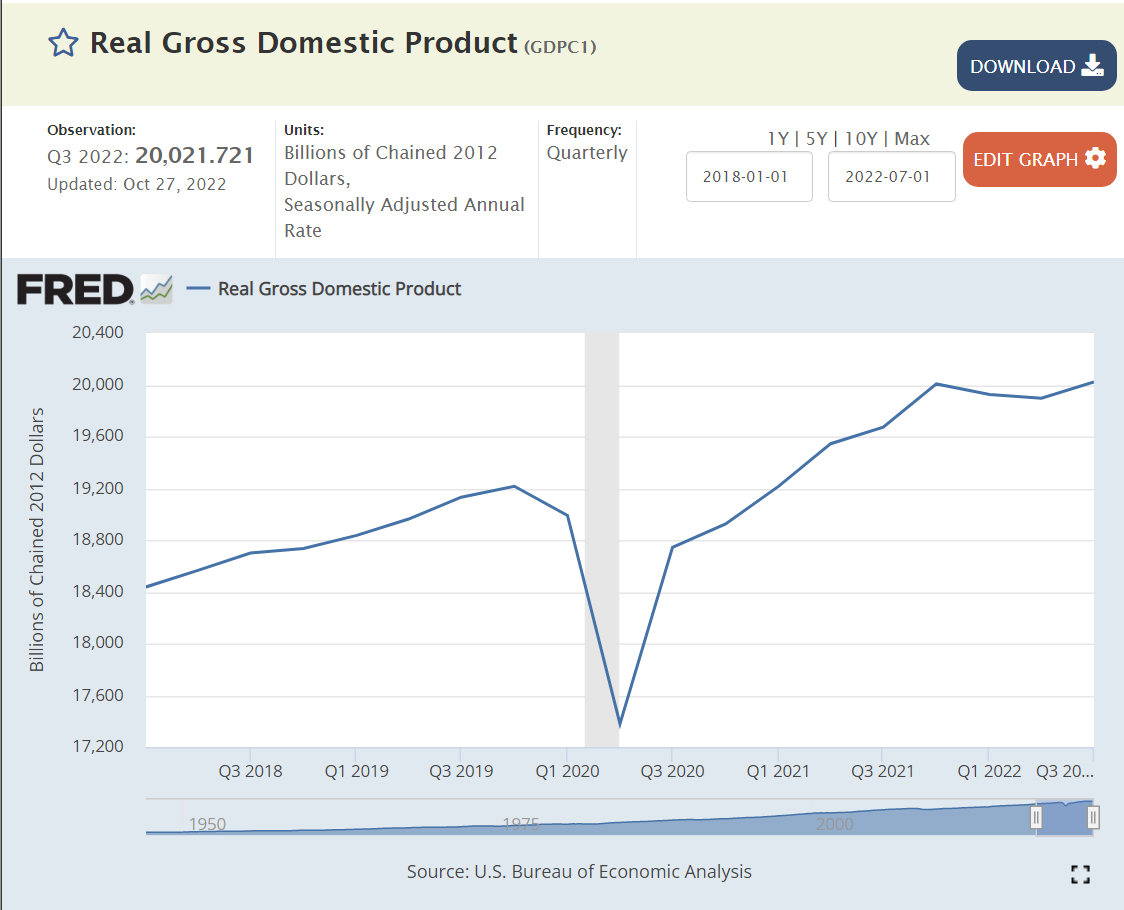
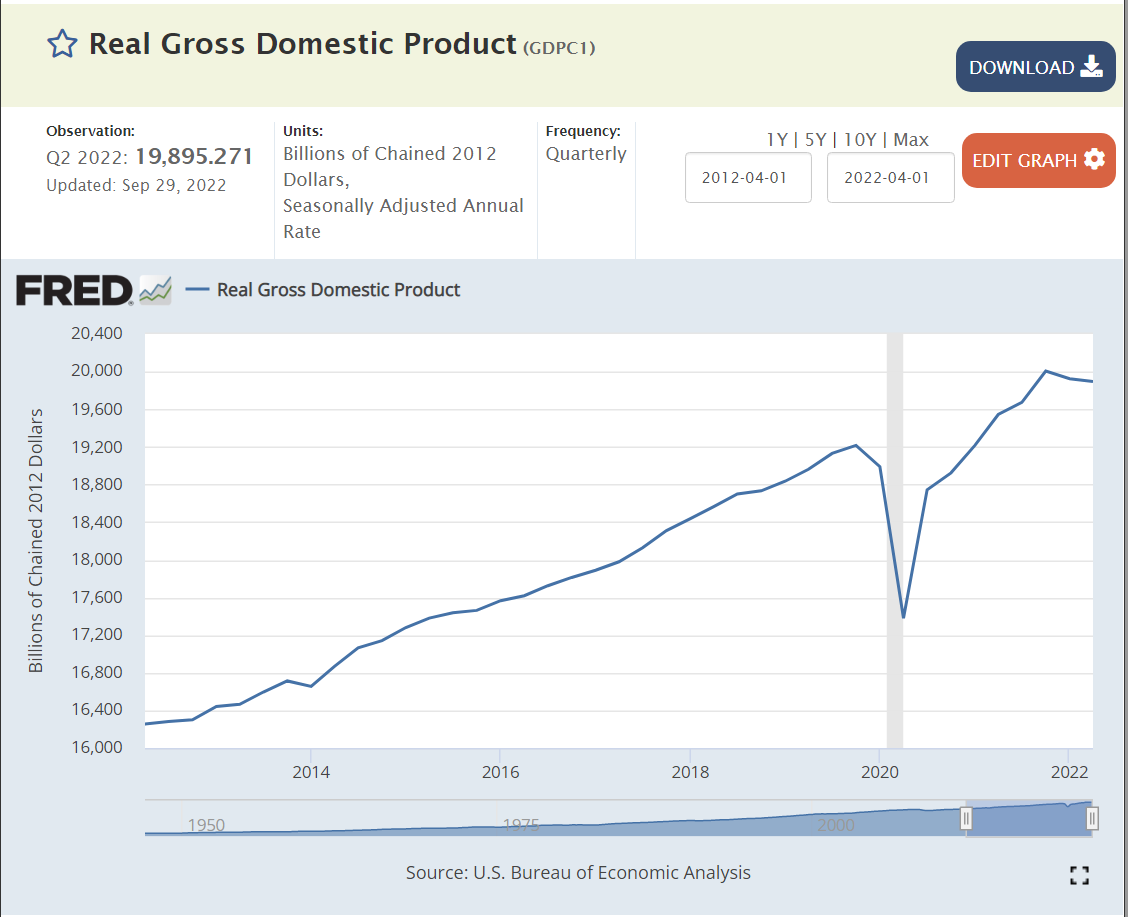
https://fred.stlouisfed.org/series/GDPC1

Since WWII (1947), the real, inflation adjusted, “no fooling”, GDP of the US has increased TEN-FOLD! We can honor the “greatest generation” and the country’s sacrifices to win WWII, but the economy in the 1940’s was less than 10% of the size that it is today. This is a true “order of magnitude” change. The economy has rotated from agriculture to manufacturing to services and trade.

The real economy is THREE TIMES as large as it was when Reagan was debating Carter in 1980.

It is 25% higher in 2022 than it was in 2008, despite two major recessions.

Unemployment measures the available labor capacity that is unused. The Depression saw extended periods of 20% unemployment. The post-war period enjoyed low 4% level unemployment through 1957. The next 7 years were above 5%, setting a new expectation of what the reasonable, long-term, natural, non-accelerating inflation rate of unemployment (NAIRU) was. The next 6 years of Vietnam and social welfare spending drove a 4% average unemployment rate which most economists believed was unsustainable and which eventually drove significant increases in inflation. The 1970 recession drove unemployment above 5% where it stayed for nearly 30 years, before finally starting with a 4 in 1997. Unemployment remained below 5% for 3 years, touching a 4% low before the millennium recession. Unemployment then averaged a sustainable 5%+ for the next 6 years, reaching a low of 4.5%.

So, when unemployment rocketed up to 10% in the Great Recession, no mainstream economist expected it to return to less than 4% soon, maybe never. Unemployment eventually reached 5.0% by the end of 2015. Professional economists were sure that it had reached its bottom. But Mr. Market, Dr. Copper and Senor Economy had news for the pundits. Consistently through the next 4 years, unemployment declined another 30% from 5.0% to 3.5% without triggering increased inflation.

The subsequent reduction of unemployment from 15% to 3.6% in 2 years is an incredible result reflecting a robust economy.

Next, let’s turn to a set of global comparisons to gauge if we are “better off”.

Just 12 Countries Account for 70% of Global GDP

US, China, Japan, Germany, UK, India, France, Italy, Canada, S Korea, Russia and Brazil provide the framework for evaluating global economic results today.

https://data.worldbank.org/indicator/NY.GDP.MKTP.CD?locations=JP-DE-BR

US Unemployment Rate is Low

India, France, Italy and Brazil are saddled with 7% unemployment rates, double the US level. Canada and China encounter 5% unemployment. The UK, South Korea and Russia enjoy below 4% unemployment rates with the US. Japan and Germany glory in sub-3% rates. The 12 country average is 5.3%, almost 2 points above the US 3.6% rate.

https://www.economist.com/economic-and-financial-indicators/2022/07/28/economic-data-commodities-and-markets

US Inflation Rate is Above Average

The most recent 9.1% annualized US inflation rate is above the 7.7% average. Russia and Brazil are struggling with 10%+ inflation. Canada, Italy, India, UK and Germany face 6-7% inflation. France and South Korea encounter 5% inflation. Japan and China see just 2% inflation.

Combining the unemployment rate and inflation rates to create a “misery index”, the US scores 12.7%, just above the 12.2% average.

https://www.economist.com/economic-and-financial-indicators/2022/07/28/economic-data-commodities-and-markets

The US Remains the “Big Dog” in the Global Economy

At 24% of global GDP, it is first. China and Japan together add up to 24%. The remaining 9 large countries add up to just less than 24%. Being large provides the advantage of a larger domestic market that attracts investors, entrepreneurs, researchers, supplier, labor, traders, etc. On the other hand, continuing to grow in the same percentage terms through history or compared with smaller countries as the largest economy is a handicap. (This is a great graphic worth exploring for a few minutes)

US Leads in Per Capita Income by a Wide Margin

US reports $63,200 per year. Germany, Canada, UK, Japan and France range from $39K – $46K, roughly two-thirds of the US level. Italy and South Korea check-in at $32K, about one-half of the US level. China and Russia earn $10K annually, while Brazil ($7K) and India ($2K) lag further behind.

https://www.investopedia.com/insights/worlds-top-economies/

US Gross Domestic Product Increased 8% from 2019 to 2021

GDP figures are not widely available for the first half of 2022 for countries, so we can use the pre-pandemic 2019 compared with the late pandemic 2021 to gauge recent economic performance.

The US GDP in 2021 was 8% higher than in record breaking 2019. It increased by $1.63 trillion in 2 years. Global GDP in 2021 was $90T. US GDP grew from $21.37 to 23.0 trillion.

China (factory to the world), in a period when demand for durable goods increased by 20% and nondurable goods by more than 10%, grew even faster, from $14.3 to 17.7 trillion, an increase of $3.4 trillion. I believe this is overstated somehow, given other data that indicates 6-7% annual growth in China each year, but it’s first place two-year ranking is clear.

The other 10 major economies combined grew from $26.4 to $27.7 trillion, an increase of $1.3 trillion, totaling less than the US $1.6 trillion growth. Their 5% combined growth rate trails the US 8% growth rate.

In percentage terms, the UK, India and Canada grew by 10% or more. Germany, France and South Korea grew by 8-9%. Russia and Italy grew by 5%. Japan and Brazil endured economic declines.

https://data.worldbank.org/indicator/NY.GDP.MKTP.CD?locations=JP-DE-BR

US Leads Long-term Stock Market Gains

From the end of 2012 through July, 2022, almost 10 years, the US Standard & Poor’s stock index gained 175%. Fast growing India and previously undervalued Japan reported the same kind of amazing 10 year returns, compounding at more than 11% annually. Germany, France and Brazil grew by a decent 75%. Resource based Canadian and previously overvalued Chinese stocks gained a modest 50%. The UK, Italy and South Korea edged up by 25%, while Russia dropped by 25%.

Stock market returns reflect relative initial evaluations, changes in investor preferences, terms of trade and the underlying profitability/sustainability of each country’s economy. By this measure, the US has a very bright future.

US Leads Short-term Stock Market Returns

Comparing July, 2022 with a pre-pandemic base of December 31, 2019 shows a 25% gain for the US, Japan and India, even with the 20%ish stock market declines in the first half of 2022. Canada and South Korean markets are up a respectable 10%. China and France report a modest 5% gain. Germany and the UK show no gain. Italy, Russia and Brazil are in the 10% loss range. Even with strong gains from 2012 through 2019, the US stock market lead the world through the pandemic recovery period.

Summary: Very Solid US Economy

US inflation has returned to threatening levels and consumer confidence has fallen sharply while confidence in the incumbent president has continued to decline. The current “mood” is negative despite many positive economic factors such as the labor market and growth in GDP, housing and stock values. We are having journalistic, academic and partisan debates about hanging the “recession” label on the economy.

Big picture, the US economy is in great shape. It continues to grow, employ labor, increase wages, export, generate profits and build asset values. The economy worked through a “once in 100 years” global pandemic, with limited long-term economic damage.

There is a risk of a recession, even a moderately painful 3-5% downturn. There is a risk that inflation will remain elevated for more than 1 year, reducing the value of wages and assets. But these are normal business cycle issues, not the “end of the world”. The responses of consumers, investors, suppliers, businesses, bankers, central bankers, regulators and … politicians to the last two recessions were constructive and helpful. We have the ability to work through our current economic headwinds if we choose to do so.

US Recession? Probably Not Yet

https://www.un.org/en/coronavirus

I tried to find a “mainstream media” article that objectively and insightfully evaluates the state of the US economy as of the end of the second quarter without success. So, I’ll take a shot at it.

First, I want to highlight that “this time, it’s different”. The US and global economies are recovering from a global pandemic situation last seen more than 100 years ago. The global economy is more integrated than ever. Viruses spread faster than ever. Businesses and governments have more information and ability to change quickly than ever before. The economic contraction was sharp, far more severe than the Great Depression or the Great Recession. The health care experts were unable to immediately evaluate the threat or recommend public policies. Nonetheless, “they persisted” and the medical, travel and economic recovery was far quicker than ANYONE expected in March, 2020 or December, 2020 or September, 2021 or January, 2022.

Second, I apologize for the required details involved to evaluate the simple question, “are we in a recession?”. Unfortunately, there is some judgment involved, as we have to evaluate three factors. Is there a clear downturn versus the trend rate? Is the downturn of significant length? Is this a widespread downturn, effecting most sectors of the economy?

Einstein said “be simple, but not too simple”.

https://wiki.c2.com/?EinsteinPrinciple

Sir Walter Scott noted the “tangled web we weave”.

https://nosweatshakespeare.com/quotes/famous/oh-what-a-tangled-web-we-weave/

The Ancient Greeks noted “many a slip twixt cup and lip”.

https://en.wikipedia.org/wiki/There%27s_many_a_slip_%27twixt_the_cup_and_the_lip#:~:text=There%27s%20many%20a%20slip%20%27twixt%20the%20cup%20and%20the%20lips,your%20chickens%20before%20they%20hatch%22.

Cheech and Chong rambled on with ” recession, repression …”

https://www.lyricsfreak.com/c/cheech+chong/santa+clause+and+his+old+lady_20745568.html

Total Economy Level

https://fred.stlouisfed.org/series/GDPC1

At the aggregate level, we clearly have a peak. Do we have an extended downturn? Not yet, based on the total. The rapid recovery from the second quarter 2020 bottom could not be sustained. A significant slow-down in the growth rate was expected. Typical annual real GDP growth in recent years has been only 2%, so the difference between “extended expansion” and “recession” is thin.

Components

Macroeconomic theory focuses on aggregate demand and aggregate supply. Real, inflation adjusted, gross domestic product (GDP) is a measure of the productive output of a nation. The demand side is split into consumption, investment, government and net exports. I’ll go one level deeper, reviewing 9 components of GDP.

The business cycle is influenced by the relative sizes of the components of GDP and their relative variability from quarter to quarter and typical changes as the business cycle moves from expansion to decline to recovery.

From most to least correlated with the business cycle, with their current percentage share of GDP (sums to more than 100 because imports are a negative factor and changes in private investment can be negative), the 9 components are: Change in private inventories (1%), Residential Investment/Housing (5%), Business Investment (14%), Durable Goods Consumption (9%), Imports (16%), Non-durable Goods (food, energy) (15%), Services (45%) !!!!, Exports (8%) and Government (17%).

Overall, I see 4 sectors as “maybe” trending to a recession and 5 sectors currently at “no”. Unfortunately, the two most sensitive, Housing and Business Inventories, are in the “maybe” category, along with non-durable goods consumption and government consumption.

It is critical to look at the longer-term trends and context to evaluate short-term changes. There is significant month-to-month and quarter-to-quarter variability in the final numbers for GDP and especially for the initial estimates, like those we just saw for the second quarter of 2022. Significant revisions are made for 6 months, which is why the NBER committee which officially declares recessions is typically waiting longer to make a final call than everyone desires. Hence, I won’t usually share a long-term graph, a short-term graph, annual percentage changes and quarterly percentage changes annualized for each component. The media tends to focus on the preliminary quarterly percentage change annualized as the “gospel”. This is unwise. Let us begin to review the 9 main components.

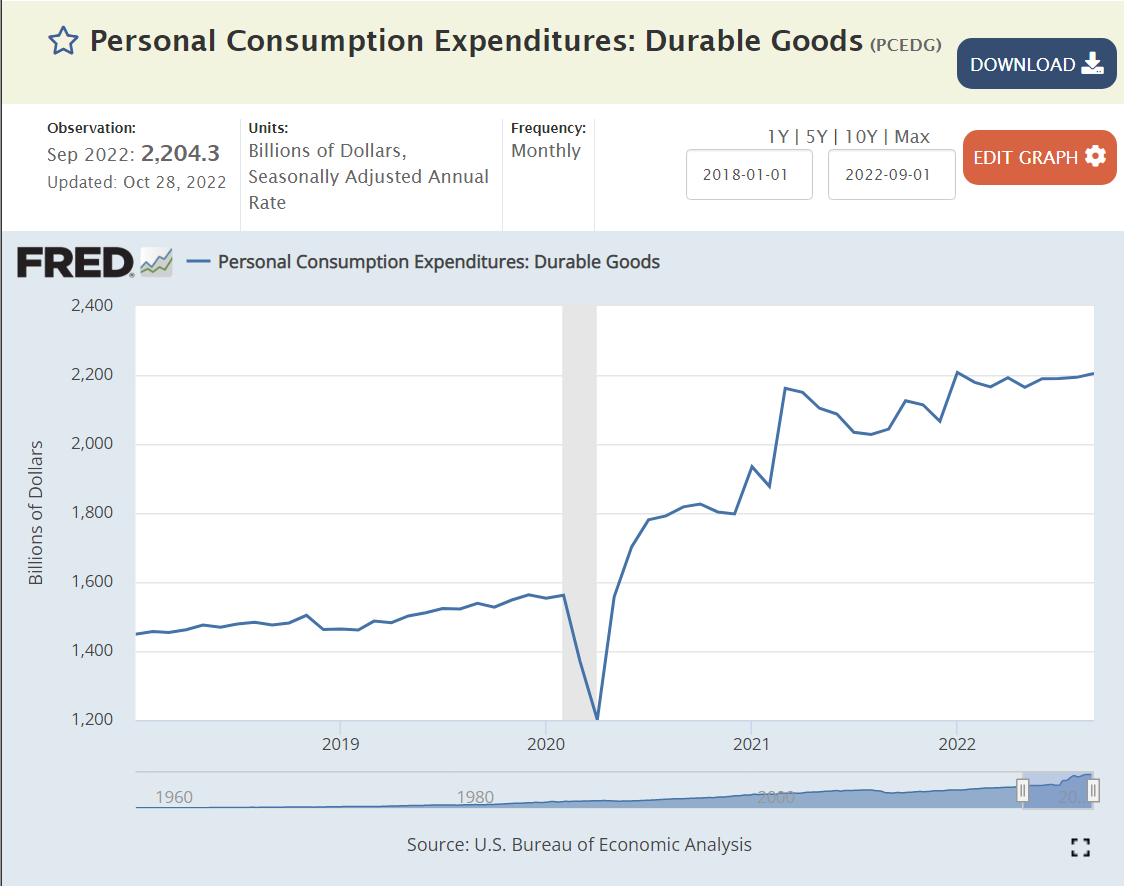
Durable Goods (9% of GDP, 4/9 Volatile)

https://fred.stlouisfed.org/series/PCEDGC96#0

Durable goods demand spiked by an incredible 20-30% during the pandemic, fueled by government transfers and fewer opportunities to consume services. Demand for durable goods has flattened at this 20% higher level, it has not declined. In my view, this sector is not signaling recession.

Non-durable Goods (15%, 6/9 Volatile)

https://fred.stlouisfed.org/series/PCENDC96

Non-durable goods consumption jumped by a real 12% during the pandemic and has essentially remained at this elevated level. We have two quarters at slightly lower consumption levels, so I rate this as “maybe” moving to a recession. Focus on the “big picture”. Both durable and non-durable goods consumption increased by historic percentages during the pandemic period and have remained at that elevated level 2 years later. It is not surprising that this demand has flattened or fallen off a bit. The surprising feature is the willingness of the American consumer to voluntarily spend much more money on “things” during the pandemic and maintain that level of spending as service opportunities returned, government transfers ended, and savings were drawn down.

Services (45%, 7/9 Volatile)

https://fred.stlouisfed.org/series/PCESC96
The very large (44% of GDP) services sector was slower to recover from the pandemic, but demand for services remains quite strong, even though the percentage growth rate is lower than during the initial recovery period.

Business Investment (14%, 3/9 Volatile)

https://fred.stlouisfed.org/series/PNFIC1

Business investment was above trend in the two years before the pandemic and has resumed its solid level. No recession indicator here.
Housing (5%, 2/9 Volatile)

https://fred.stlouisfed.org/series/PRFIC1

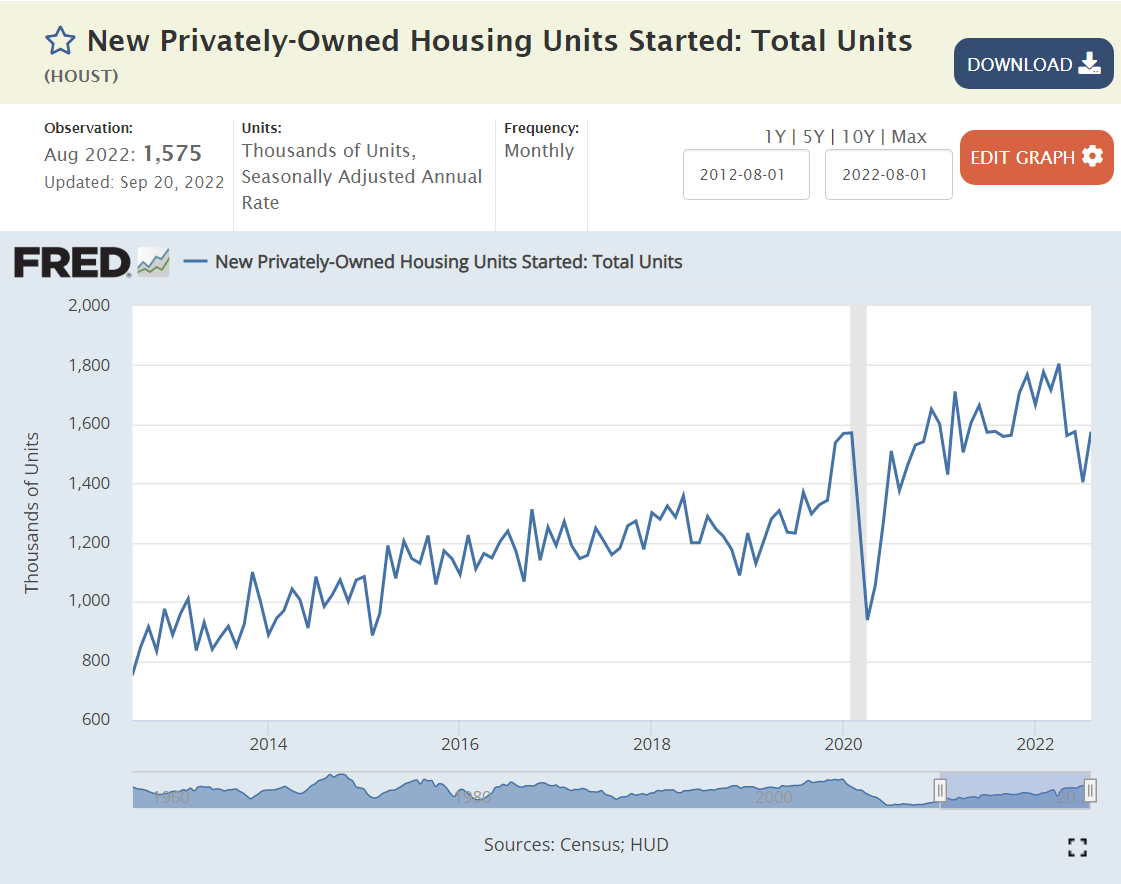
New housing investment grew by 50% between 2012 and 2016 and then remained at that level for the next 4 years before the pandemic. Long-run supply and demand factors indicate a “need” for more housing construction in the US to make up for the “missing” construction from 2008-2016. New housing construction did not decline with the pandemic, it increased by 15% in real terms! As with durable and nondurable goods consumption/production, this would not have been predicted in March, 2020 by anyone. Residential construction has levelled off 15% above 2019, equal to 2007 before the Great Recession. The increased mortgage interest rates indicate that demand will soften and this sector will decline somewhat in the second half of 2022, so this is a “maybe”. The long-term shortage of housing supply provides a floor for this sector.

Business Inventories (1%, 1/9 Volatility)

https://fred.stlouisfed.org/series/CBIC1
https://fred.stlouisfed.org/series/A371RX1Q020SBEA

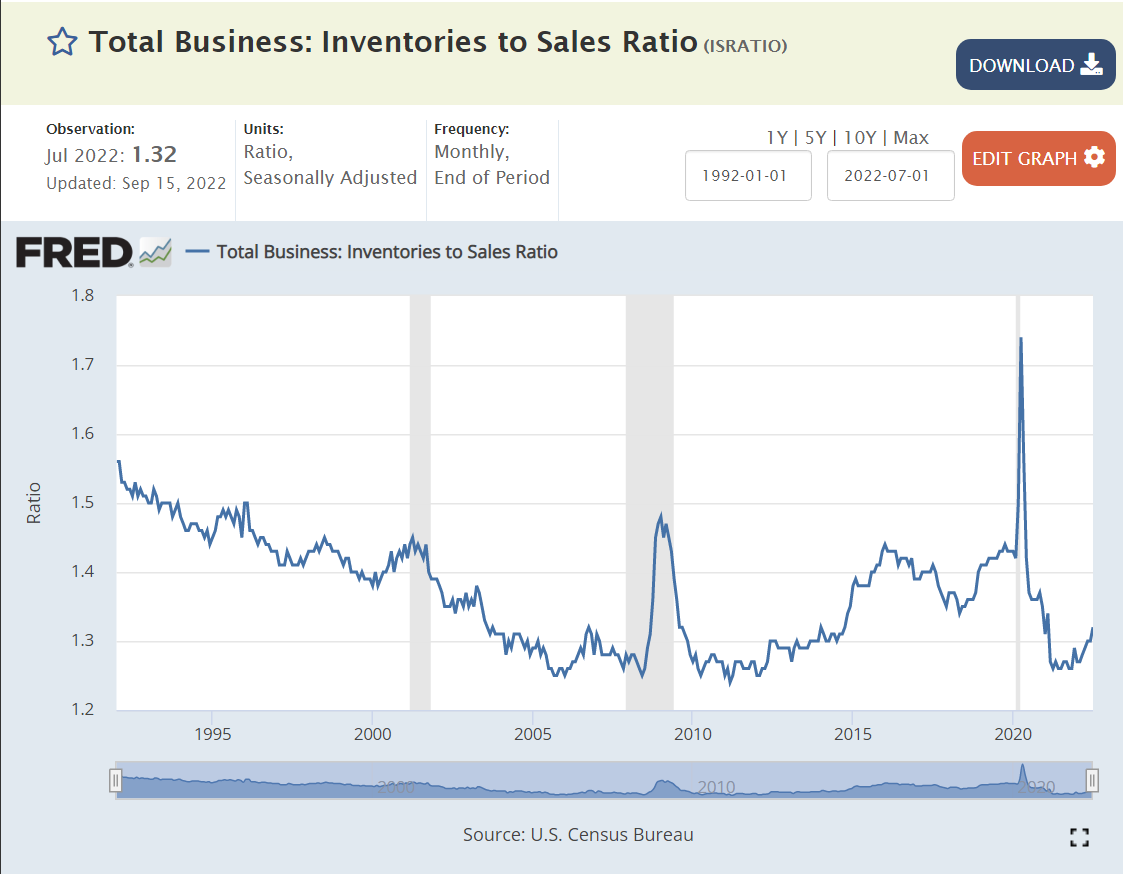
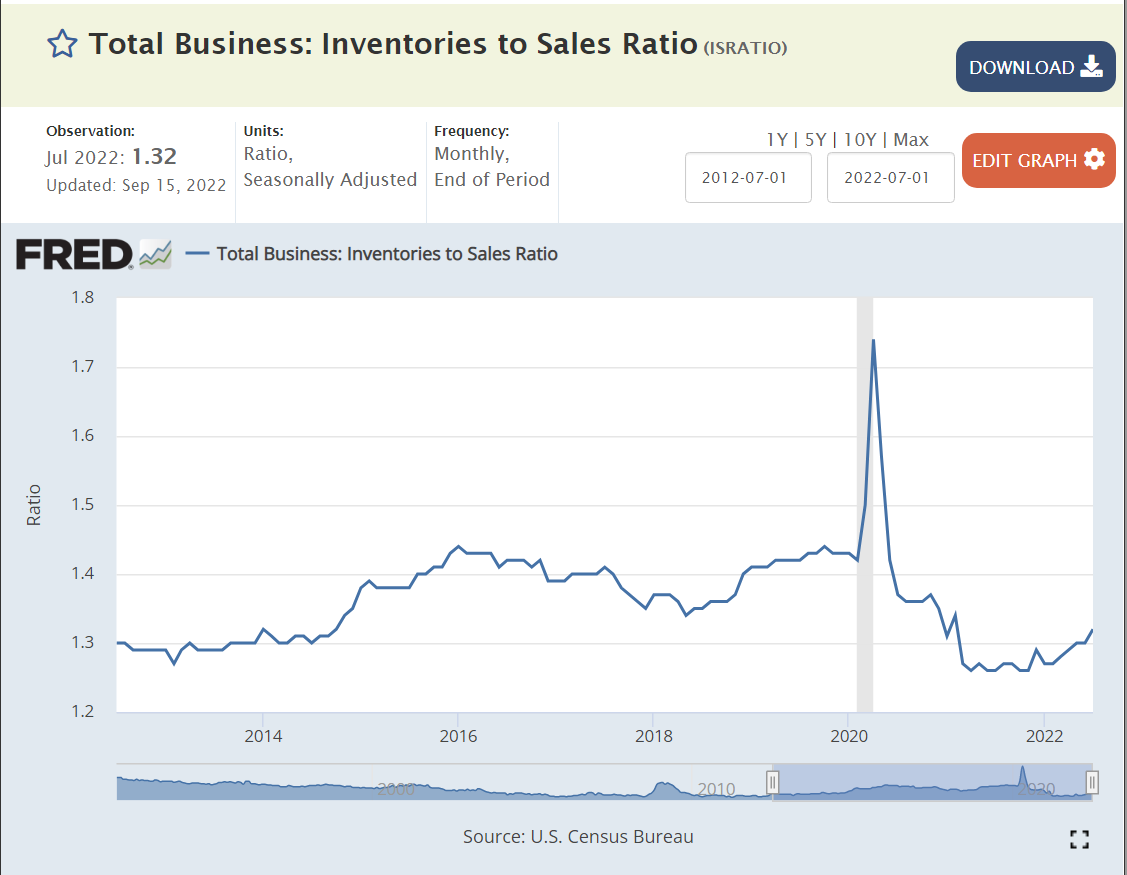
“Supply chain issues” have restricted the accumulation of business inventories since the pandemic began. The unexpected spike in demand for durable and nondurable goods and residential construction lead to shortages. Worries about supply chain resiliency have led to higher targeted business inventory levels. Retailers have overstocked some product categories as the recovery has slowed and are being forced to discount prices to move these goods. Overall, this is a slight “maybe” recession indicator. I think that businesses would like to have 20% higher inventories overall.

https://fred.stlouisfed.org/series/ISRATIO

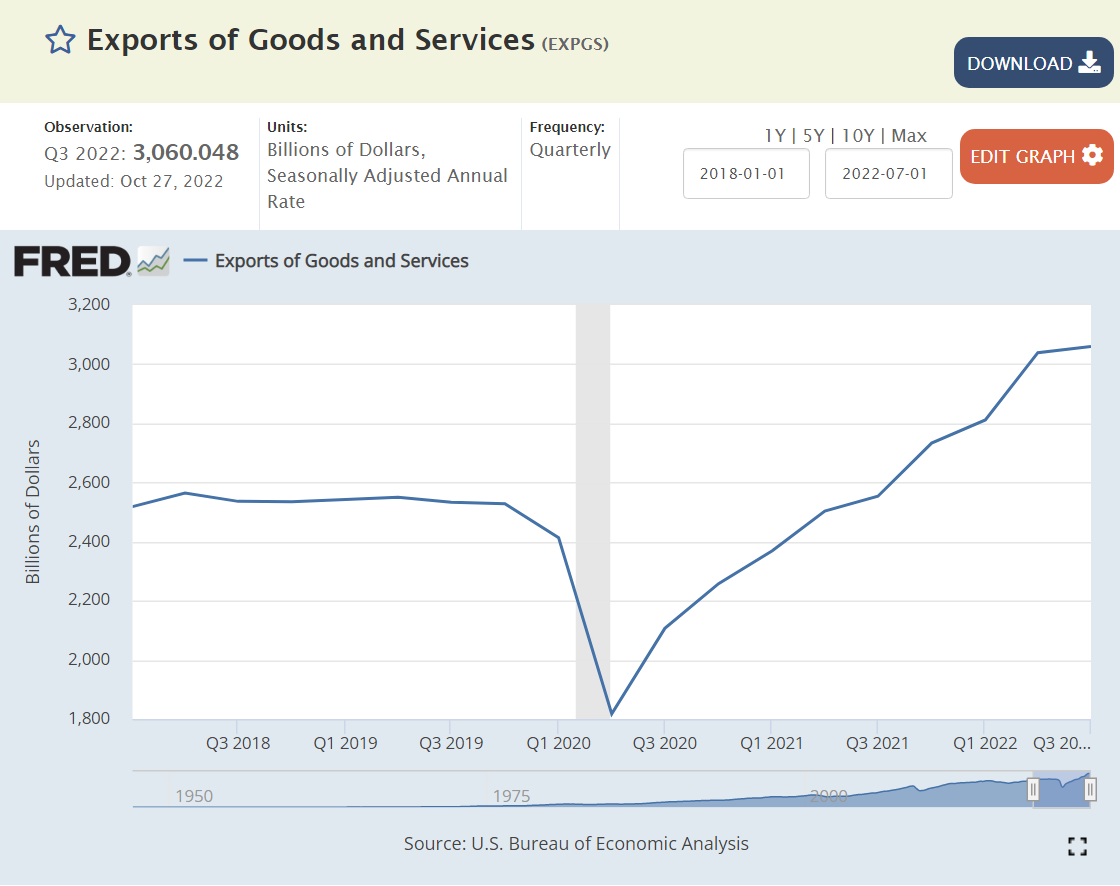
Exports (12%, 8/9 Volatility)

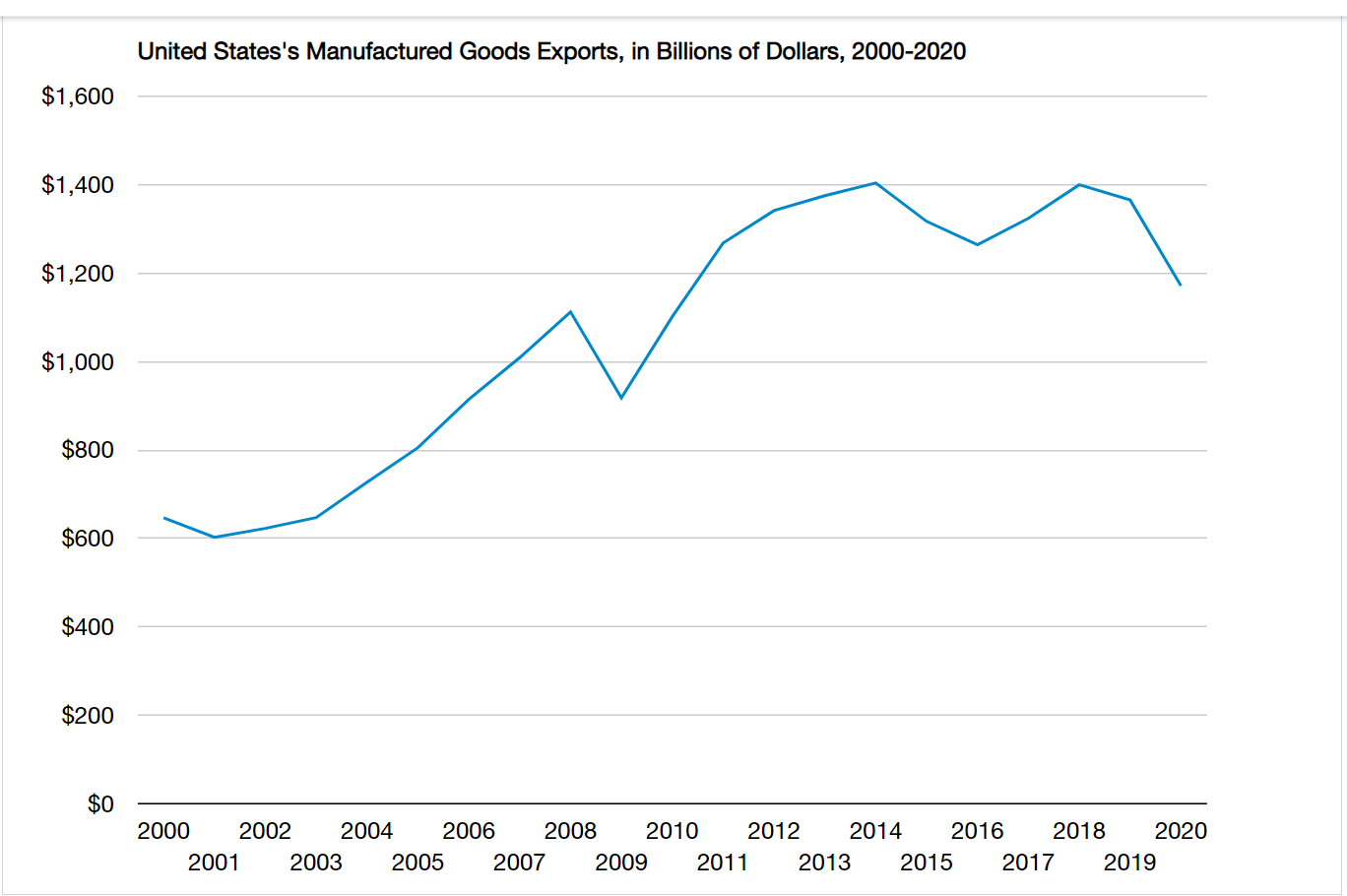
https://fred.stlouisfed.org/series/EXPGSC1

US exports continue to solidly recover from the pandemic.

Imports (16%, 5/9 Volatile)

https://fred.stlouisfed.org/series/IMPGSC1\

Although imports act as a reduction in the calculation of GDP, they tend to decline when the US economy declines. Import demand remains high, not indicating a recession.

Government (17%, 9/9 Volatile)

A majority of government spending is accounted for as a simple transfer, not part of the annual production of goods and services.

https://fred.stlouisfed.org/series/GCEC1

Government production activity grew quite significantly from 2014 to 2020. It has since declined by less than 1%. I rate this as a “maybe” indicator of recession, even though government activity is typically a countercyclical indicator, rising when recession arrives.

Summary

Services (45%), Business Investment (14%), Exports (12%), Imports (16%) and Durable Goods (9%) are NOT in recession. Housing (5%) and Non-durable Goods (15%) point towards recession, while Government (17%) and Business Inventories (1%) show warning signs. If I were a member of the NBER board, I would not designate a recession in the first half of 2022 as of today.

For the second half of 2022, a recession is possible. The Fed raising interest rates is already affecting the housing industry. But businesses continue to report solid to record profits. The stock market has declined by a bear market 20% but may or may not have found a bottom. The global risks from Russia’s attacks on Ukraine and China’s Covid lockdown strategy remain. Consumer confidence is weak, especially in a partisan world. Business confidence is weaker than in recent months, but most measures remain marginally positive. The labor market is at its strongest position in 50 years, supporting consumer demand. Higher than expected inflation has slowed consumer spending, but not to recession levels. Consumer savings and debt levels remain positive. Business debt levels have increased, but most businesses locked in low debt interest rates during 2020-22.

Why So Positive?

  1. Governments operate with expansionary fiscal policy, ensuring that aggregate demand is adequate. There is a risk of too much stimulus and “modern monetary theory” excesses, but so far this is not a risk in the major economies.
  2. Central banks are more effective. They provide credit in downturns, increase interest rates when required, coordinate with each other and pressure banks to hold adequate capital.
  3. Governments and central banks take proactive steps to avoid currency crises,
  4. After the Great Recession, lending in the US housing market is more reasonable.
  5. Businesses have worked through many challenges in the last 15 years and are well positioned to prosper.
  6. The overall economy is increasingly based on services more than manufacturing, mining and agriculture. The operations leverage of manufacturing facilities is a smaller factor in the world economy.
  7. Labor power is lower. Cooperation with management is stronger.
  8. Demand for labor is high. US has record open jobs and voluntary quits. The effective minimum wage has increased from $8-10 per hour to $12-15 per hour without major business disruptions.
  9. Trade is lightly restricted.
  10. Global economy is multipolar, relying on US, EU, Japan, China, India, Middle East, etc.
  11. Technological progress continues. Better goods and services. Better processes, trade, transportation, markets, communication and insights.

Good News: Vehicle Dependability Continues to Improve

https://www.vwvortex.com/threads/jd-power-dependability-2001-vs-2011.5350295/
https://www.jdpower.com/business/press-releases/2021-us-vehicle-dependability-study-vds

Ongoing defects dropped by 60% from 2001 to 2011 and then dropped by another 20% from 2011 to 2021. The compounded reduction is 68%, a little more than two-thirds of the defects disappearing in 20 years.

JD Powers started its initial quality surveys in 1987 and its Vehicle Dependability surveys in 1990. The summary results are not easily found on the internet. The Consumer Reports defect rates are similarly restricted to paying customers.

https://www.yahoo.com/news/30-years-iqs-perspectives-history-222747086.html

In the 1980’s, Toyota and Honda offered significantly higher vehicle quality. Other manufacturers essentially “caught up” in the next 20 years. A snapshot from 1985 illustrates the gap that was closed by 2000-5, before the Vehicle Dependability improvements shown above.

https://www.carqualityinfo.net/reliability-durability-gpas/car-brands—7-best-brands-of-my-1985/
https://www.jdpower.com/business/press-releases/2022-us-vehicle-dependability-study

The very disappointing 2022 results are inconsistent with the downward defect trend of the last 20 years, reflecting the pandemic production, supply chain sourcing and vehicle prep problems of the last 2 years.