Fukuyama defends “classical liberalism” as a political structure. Not US “liberals” or UK “liberal democrats” or neo-liberals. It was born in the 18th century, child of the enlightenment and religious wars, emphasizing the individual over the group, the equality of individuals, the human species rather than any subset, and practical political structures that provide reasonable results. Individual rights, rationality, human dignity, the rule of law, institutions, compromise and tolerance. Typically connected with objectivity, the scientific method and free trade versions of capitalism. The mixed economic and political systems that he celebrated in 1992 as the “end of history” when fascism and communism were defeated.
“Classical liberalism” is threatened from the right and the left. First, from the right with Reagan/Thatcher neoliberalism which elevates economic property rights as a super-value, undercutting other political and social values. Second, from populist, authoritarian leaders who are actively “illiberal”, campaigning against “free trade”, international bodies, immigration, elites and various “others”, discounting the value of institutions and the “rule of law”. Third, from the left as the progressive, new, radical left has adopted the postmodernist views that elevate “power” as the central political value/insight and claim that powerful elites always control society unless they are opposed by “marginalized” groups to lead a revolution against the dominant groups.
Fukuyama criticizes neoliberalism for being too extreme, opposing the role of government even where it is needed per elite opinion: some regulations, public investments, income redistribution, fiscal and monetary policy, international trade and development, public utilities, environmental externalities, etc. He challenges the notion that property rights are significantly more important than other “rights”. He agrees that the intellectual foundations for “classical liberalism” tend to result in a “thin” basis for morality and community, but argues that neoliberalism makes this even worse, ignoring the moral and community dimensions. He recommends that voters and politicians focus on improving the “quality” of necessary government services.
“Classical liberalism” was developed within a Christian religious and moral worldview, which provided the required moral and community dimension for their 18th century societies. However, Luther’s Protestant Reformation was radically individualistic, downplaying the church as an institution and elevating the individual’s reading of the Bible and personal relationship with God. Philosophers like Rousseau further elevated the role of the individual and criticized the potentially corrosive role of society. Philosophers like Kant developed frameworks that were independent of history and culture, using reason alone to develop morality. Fukuyama notes that a full-fledged individualistic society really grew after WWII, in the shadow of Darwin, Freud and Marx. He notes that John Rawls’ 1971 “Theory of Justice” provides an overly abstract approach to morality and politics, further eliminating the role of “community”. Fukuyama doesn’t have a simple solution to the individualistic imbalance in society.
Fukuyama invests two chapters outlining the development of the post-modernist philosophical and political worldview. 19th century philosophers like Nietzche declared that “God is dead” and that objectivity is dead. They tried to find a “subjective” basis for philosophy, rejecting the core tenants of “classical liberalism” and prior objective, idealistic models. Objectivity, causation and the scientific method were shaky foundations. Dynamic, organic, artistic, natural, revolutionary, evolving worldviews were proposed. After WWII this coalesced into the post-modernist approach. Post-modernism provided a new home for those who supported communism. The elites and power structure oppress the marginalized communities because “they can”. The intellectuals have the role of ensuring that the oppressed understand their abused role and work to overthrow the repressors. The parallel with Marxism is strong. Fukuyama admits that “power” is really important and that powerful people and institutions have used and sometimes abused their power. Yet, he points to the progress of “classical liberal” societies in providing economic success, making life better for poor and minority communities, expanding individual rights, providing a framework for progress, a forum for participation and safeguards against extreme policies or leaders, etc. Philosophically, he cannot support the singular emphasis on power or the subjective worldview. He claims that the “burden of proof” for overthrowing the “classical liberal” model remains on the critics.
Fukuyama leaves us with 10 principles: quality of government, inequality matters, federalism can help, freedom of speech is critical, privacy matters, the scientific method and rational problem-solving work, individual rights have a solid intellectual and historical basis, while group rights do not, the individual and group/morality both matter, civic participation matters and moderation is a virtue.
Franchising provides an opportunity for qualified individuals to own a business and earn equity-like rewards, without outstanding industry expertise, with lower business failure risk, requiring relatively modest equity investments and the opportunity for advantageous bank and small business loans.
Franchising provides the owner of a product or service concept with the opportunity to expand using “other people’s money”. It facilitates geographic and international expansion leveraging locally knowledgeable managers/investors. It allows differentiated products, services and systems to be replicated quickly and consistently. It provides legal agreements that ensure that the franchisor’s brand is enhanced and not damaged by the franchisee’s operations. It provides a system that strongly aligns the interests of local managers/owners with those of the central business.
History
Franchising has experienced several “boom and bust” periods, fraudulent deals and changing relations between franchisors and franchisees through time. Initial growth began in the 1850-1920 period together with the growth of the manufacturing and transportation industries. Automobiles, farm equipment, sewing machines, service stations, auto parts, pharmacies, soft drinks and train stop/car hop restaurants lead the way originally using the product franchising model. The depression interrupted the growth of franchising. Automobile dealers, service stations and soft drink distributors accounted for 80% of franchising before the depression.
Franchising accelerated again after WWII with fast-food restaurants leading the way, accompanied by a diverse set of laundry, hotel, rental car, real estate and convenience stores. These businesses were often still tied to products or patented equipment. However, McDonalds (1955) offered the first business format franchises which provided greater opportunities in a growing, travelling society.
Business format franchising “includes not only the product, service, and trademark, but the entire business format itself: a marketing strategy and plan, operating manuals and standards, quality control, and a continuing process of assistance and guidance.”
With rapid growth came accounting fraud by franchisors, one-sided contracts, overlapping deals, pyramid schemes and conflicts between franchisors and franchisees. The Energy Crisis of the 1970’s bankrupted a large share of service stations. State and federal regulations enacted in the 1970’s ensured that standard disclosure agreements were used, allowing potential franchise owners to work with their lawyers to ensure that they understood the deals they were making.
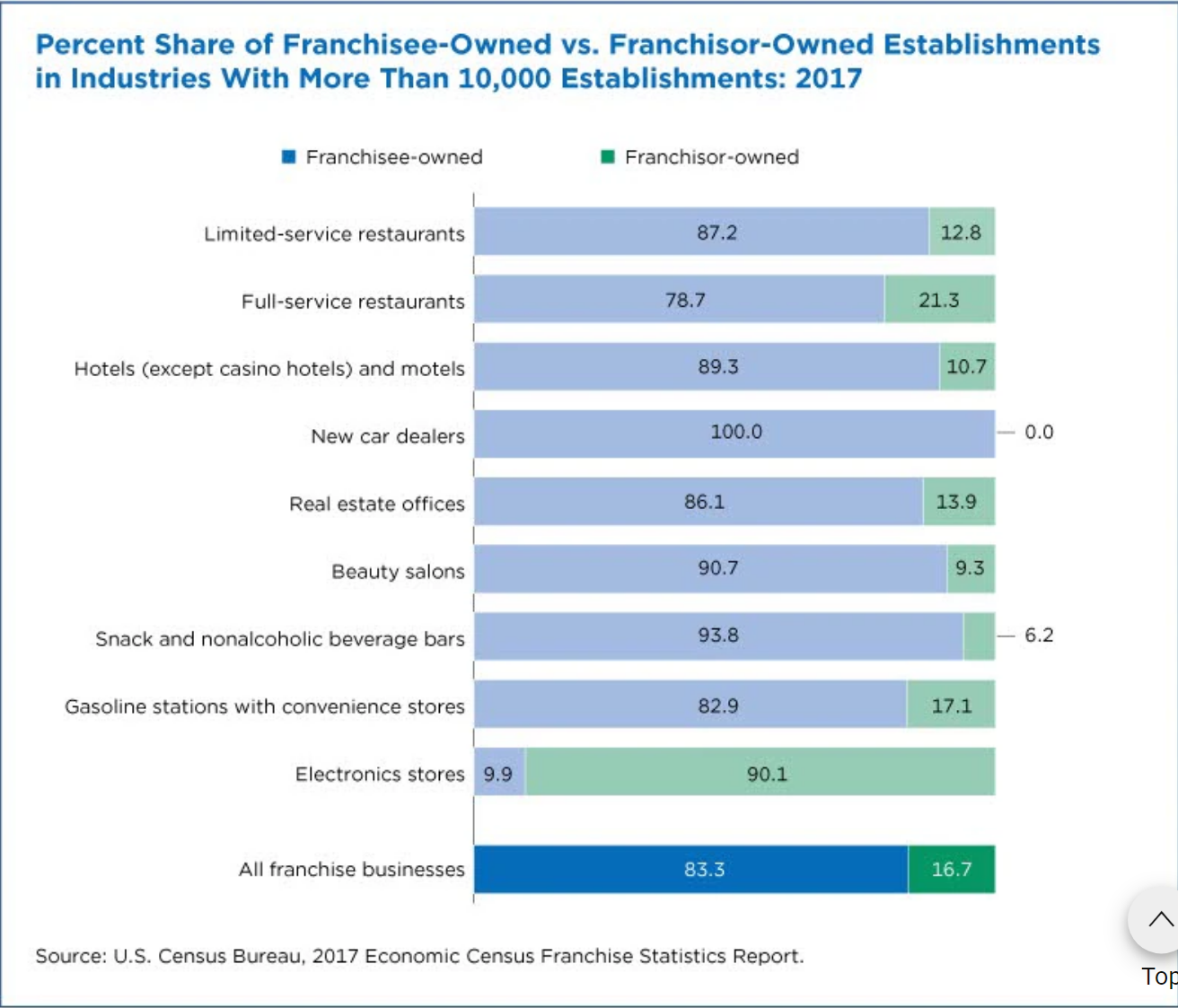
Data on the franchising industry is not standardized. Two industry associations and the US Census Bureau provide somewhat inconsistent data. Nonetheless, the growth of franchising after the “bust” in the 1970’s is amazing. The number of establishments has grown from 375,000 (1973) to 420,000 (1988) to 530,000 (1990) to 775,000 (2021). Total employment has grown more slowly, from 7 million (1988) to almost 10 million (2017). Sales has grown much faster from $160 billion (1975) to $350 billion (1980) to $530 billion (1985) to $1 trillion (2004) to $1.3 trillion (2007) to $1.5 trillion (2012) to $1.7 trillion (2017).
Leading sectors by annual earnings include senior care ($155K), real estate ($153K), personal services ($126K), business services ($122K) and pet services ($119K).
Trump’s 2016 election win was unremarkable statistically. He won the usual share of Republican voters in most demographic sectors and attracted extra non-college graduate white voters. Our political system has built an increasingly polarized electorate based on appeals to identity politics (red versus blue). We vote for our team or against the “other” team, setting aside our other concerns.
Both political parties contained liberals, conservatives and moderates in the 1950’s. The Civil Rights and Voting Rights Acts of the 1960’s broke the Democrats’ grip on the “solid South”. Regional, local, character, ideology and other factors mattered more to voters, politicians and parties through the 1990’s. By 2016 even self-identified independents were polarized, views of the “other” party dropped from 45 to 29 degrees and 43% of partisans saw their opponents as a “threat to the nation’s well-being”.
Voters and political parties are increasingly aligned by a single conservative to liberal dimension, with other dimensions of identity running in parallel: race, religion, region, urban/rural, and gender. This builds on the personality trait of openness, fluidity, and tolerance of threats.
Individuals are inherently attracted to group membership, like sports teams and easily oppose other teams and seek to win. As the two major political parties began to clearly sort on the “left versus right” dimension by the 1980’s wise political actors clarified the differences between the two parties in extreme terms. Political messaging is simpler, more extreme and more effective in this environment. Group identity and membership trumps facts, science, beliefs, thinking, policies, and detailed ideologies.
Rational individuals outsource politics to parties and politicians. Individuals adjust their views to match the views of the parties and politicians. More politically engaged individuals are more easily influenced. Higher knowledge and skilled individuals use their talents to challenge the opposition but not their own party’s views.
The decline of cultural and political power held by White Christians due to demographic changes has encouraged conservatives to emphasize traditional values and liberals to emphasize diversity. President Obama’s presidency punctured the “post-racial myth”, as the country became much more divided on racial issues. The cultural power of media, university and corporate elites and institutions threatens some conservatives while increasing Republican political power and actions threaten some liberals.
Modern journalists and media compete for attention. They are biased towards “loud, outrageous, colorful, inspirational and confrontational”. They reinforce the cycles of polarization, mostly leaving behind historical norms of objectivity and balance. More information and choices have not helped media consumers to better evaluate parties, politicians, messages or issues.
Polarized voters and media outlets have combined to make elections be based on national parties and wedge issues. Political candidates focus on these issues and raise more money from small donors, independent of the wishes and interests of political parties which tend to be more moderate, optimizing their chances of winning competitive districts. Gerrymandering, rural/urban political sorting, direct primaries and fundraising have undercut the power of political parties.
A polarized country, roughly evenly split politically, leads political actors to focus more than ever on “winning”, decreasing the role of norms, tradition, civility, pragmatism, patriotism and institutional preservation. The emphasis on national issues reduces the incentive and scope for transactional, local based politics, log-rolling, earmarks, and compromise. By 2012 the radicalization of the Republican Party was complete with Democrats not far behind. Klein uses former Attorney General William Barr’s words to highlight the increasingly expressed Republican view that they are fighting a war to preserve their culture from extinction by the secular elites of the other party. He doesn’t describe the coastal Democrats complementary view of a Trump-led nation.
Solutions
Agree to move some issues beyond politics: debt ceiling approval, longer-term budget program approval. Improve political system legitimacy: cut bias of electoral college overrepresenting rural voters through changes or the Popular Vote Compact. Use independent commissions to draw election districts. Eliminate the Senate filibuster. Award DC and Puerto Rico congressional representation. Consider a multi-party-political system and multiple seat districts and ranked choice voting. Increase the size of Supreme Court and make some appointments outside of politics. Reduce the Speaker of the House’s total control of the legislative agenda. Make everyone aware of their “political identity” and how media and politicians use this to persuade or control. Proactively choose, evaluate and challenge media sources. Invest time in politics, especially state and local politics.
The overall US unemployment rate at 3.6% remains at a 50-year low. The metropolitan area rate is a shade lower. I summarized metro area unemployment rates for those which have a city in the top 100 of population. Only 73 metro areas remain, since 27 cities are the second or smaller city in their metro areas. The average metro area unemployment rate for these top 100 areas is 3.4%. The median metro unemployment rate is 3.3%.
Democratic mayors led the main cities in two-thirds of the largest metro areas. Republicans, independents, nonpartisans or split results led in the remaining one-third (24/73).
Democratic mayor lead metro areas have median and average unemployment rates at 3.2%, significantly below the national 3.5-3.6% rate. The Republican+Other metro areas show 3.4% median and 3.9% average unemployment rates, just slightly higher.
The claim that Democrats are “bad” for the economy is not supported by this data.
Republicans and independents/nonpartisans/split mayors lead 8 metro areas with unemployment in the historically unheard of 2% range:
Denver, Colorado Springs, Omaha, Tulsa and Oklahoma City in the prairie states. Miami, Virginia Beach and Honolulu complete the set.
Non-Democratic mayors also lead 8 southwestern cities with higher-than-average unemployment (4%+): Reno, Las Vegas, Laredo, Corpus Christi, Riverside, Stockton, Fresno and Bakersfield.
Only 5 Democratic lead cities, versus 8 Republican/Other cities, had 4%+ unemployment rates in May, 2023: New York and Los Angeles, Houston, El Paso and New Orleans.
31Democratic mayor lead metro areas had strong 3% unemployment. 13 boasted amazing 2% unemployment rates: Boise, Lincoln, Nashville; Madison, Minneapolis-St Paul; Jacksonville, Tampa, Orlando; Richmond, DC, Boston, Baltimore.
Summary
Metro area unemployment is even lower than the 50-year low national average.
Democratic led metro areas have slightly lower unemployment rates.
We have 6 large metro areas with 2.5% or lower unemployment: Lincoln, Madison, Omaha, Boston, Baltimore and Miami.
Our very worst metro areas (of 100) are El Paso, Corpus Christi and Laredo at 4.5% and Las Vegas (5.6%), Stockton (5.9%), Fresno (7.5%) and Bakersfield (8.6%).
The American economy is delivering truly amazing results.
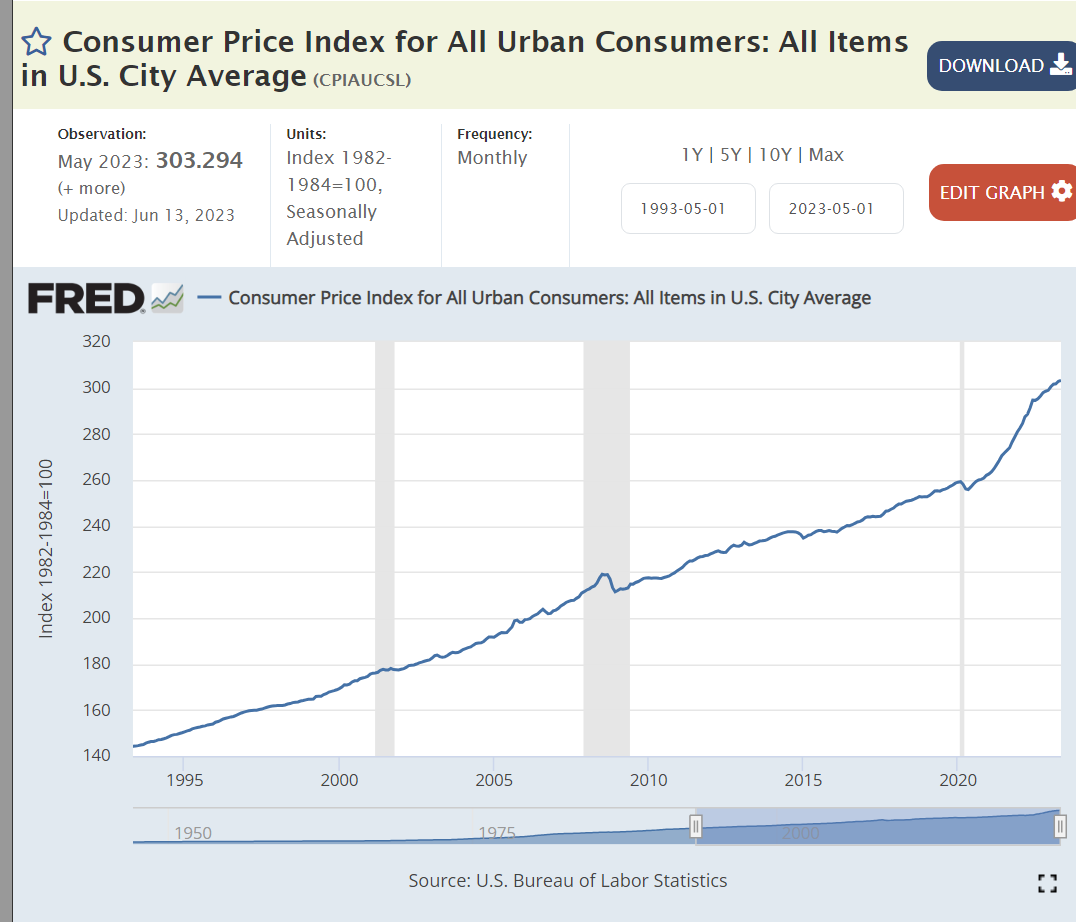
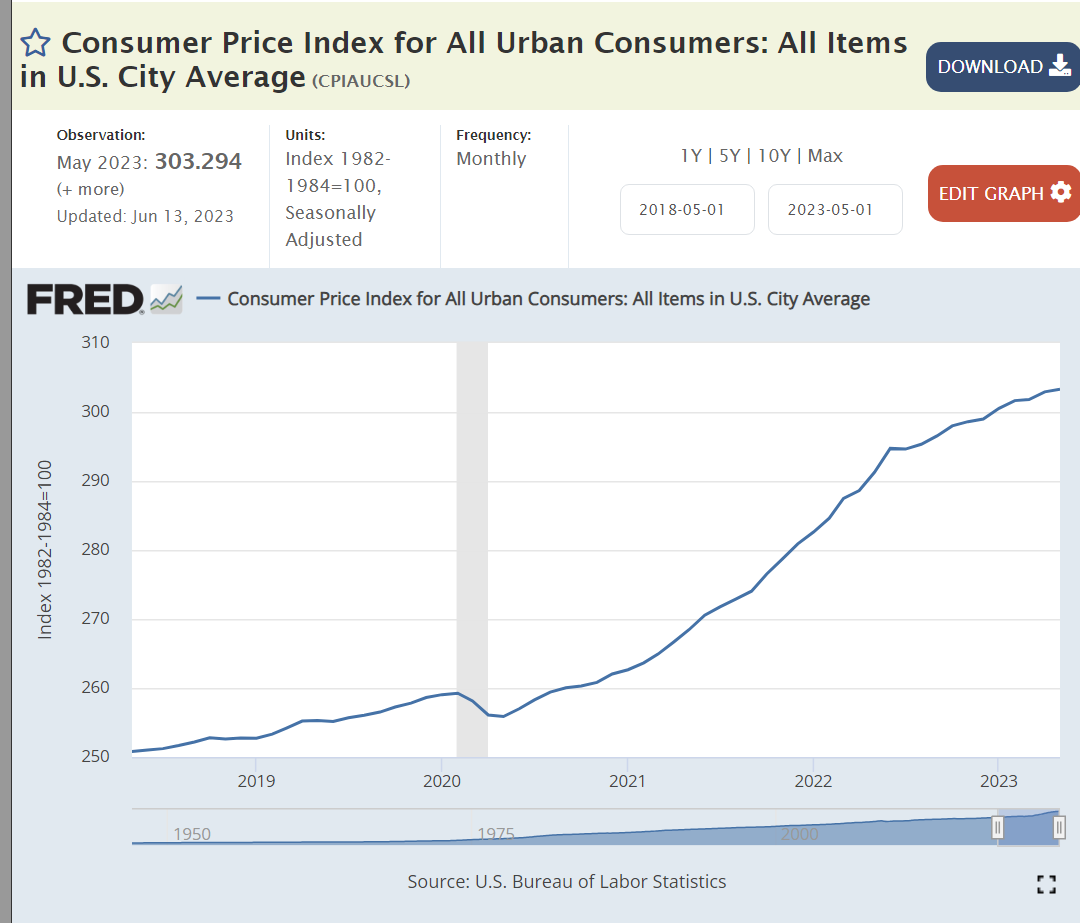
The overall CPI index increased smoothly during the last 30 years until the pandemic. The Great Recession created a small blip up and down. Prices have recently increased by a very large 15% in less than 3 years versus the usual 5% in that time.
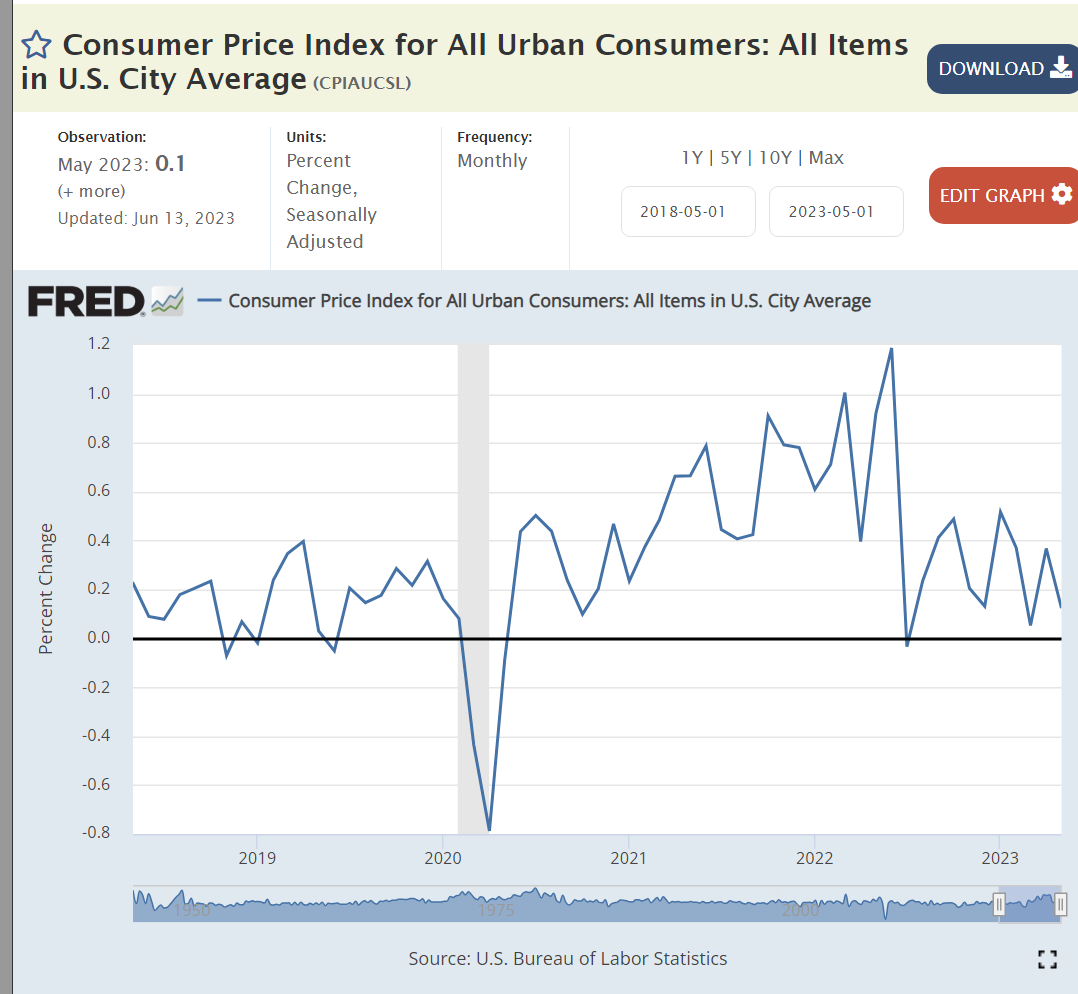
From June, 2020 through September, 2021 annual inflation jumped up to 5%. In the 9 months from October, 2021 through June, 2022, annual inflation spiked up to 10%.! This was mainly driven by durable goods prices as the unexpected rapid recovery from the pandemic encouraged consumers to buy “stuff” since they could not buy services. Since July, 2022 annual inflation is CLEARLY much lower, just 3% to 4% depending on the exact months chosen. Inflation appears to be decelerating as the May, November and May indices are 291, 299 and 303. The last 6 months’ inflation is just two-thirds of the prior 6 months.
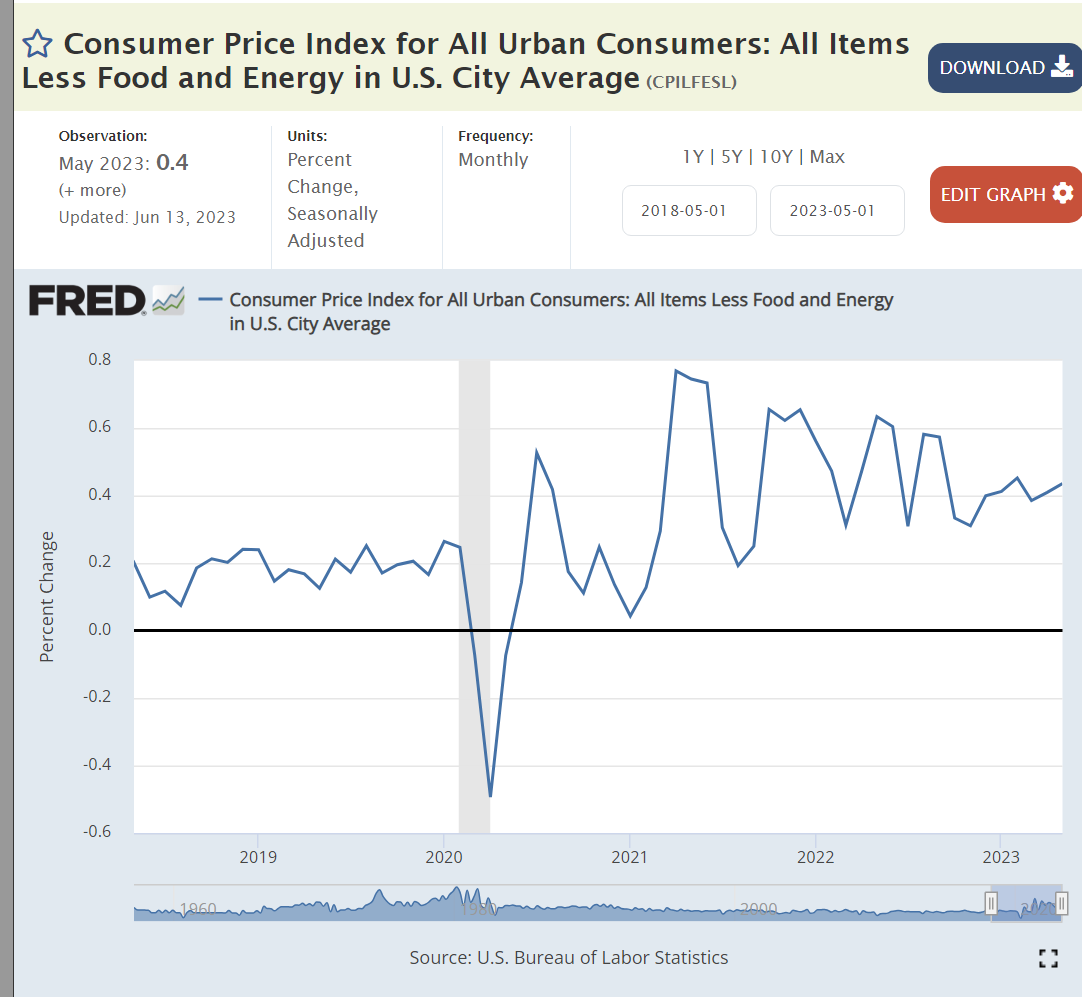
Unfortunately, the core inflation measure, excluding food and energy, remains near 5%.
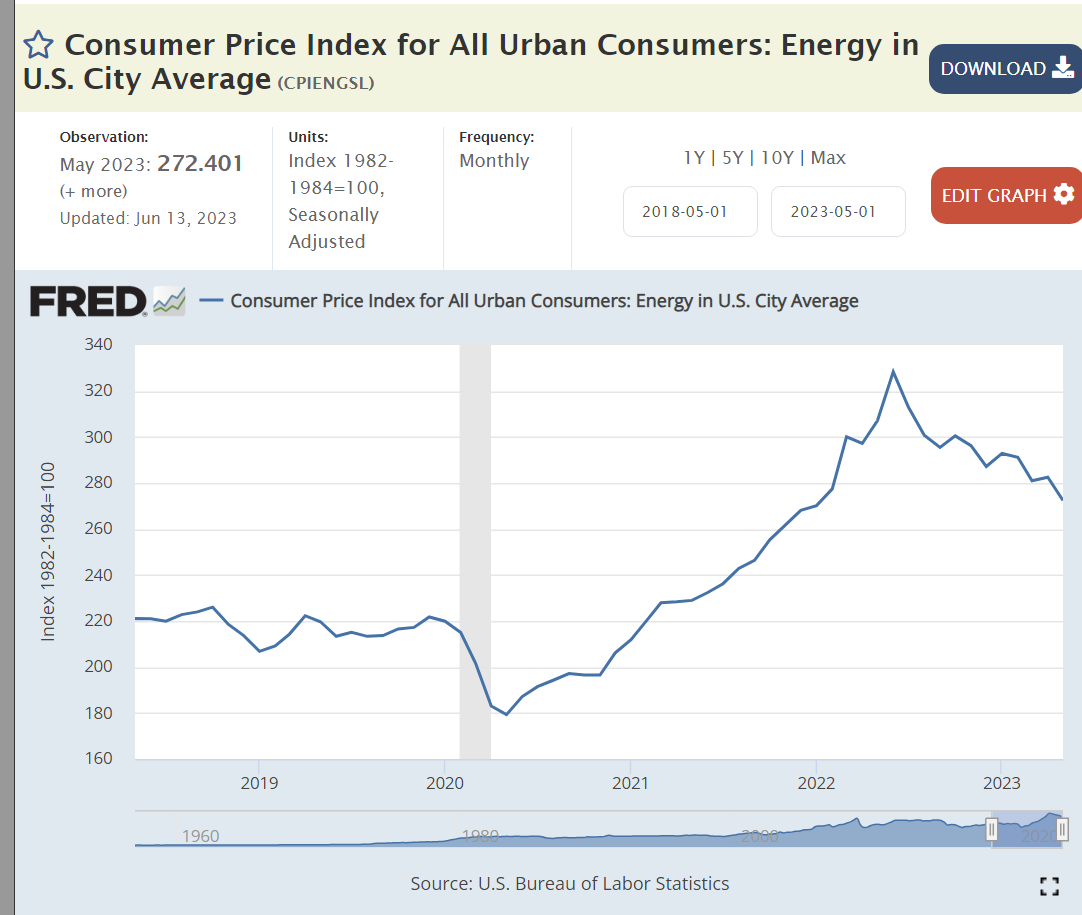
Energy prices have fallen quickly from their peak in June, 2022.
Auto gas prices are volatile, determined by the global oil market. The spike from $2/gallon to $4.50/gallon impacted American consumers. The return to $3.50/gallon is welcome, but prices are still 50% higher than the 2015-20 period.
In 25 years, durable goods prices had dropped by 25% due to globalization. In 2 years, they spiked up by 25% as global manufacturers were unprepared for the rapid recovery in demand. Manufacturers, wholesalers and retailers have NOT given back any of that 25% increase in prices, but durable goods inflation has returned to zero.
Nondurable goods followed a similar pattern with a 19% increase followed by flat prices.
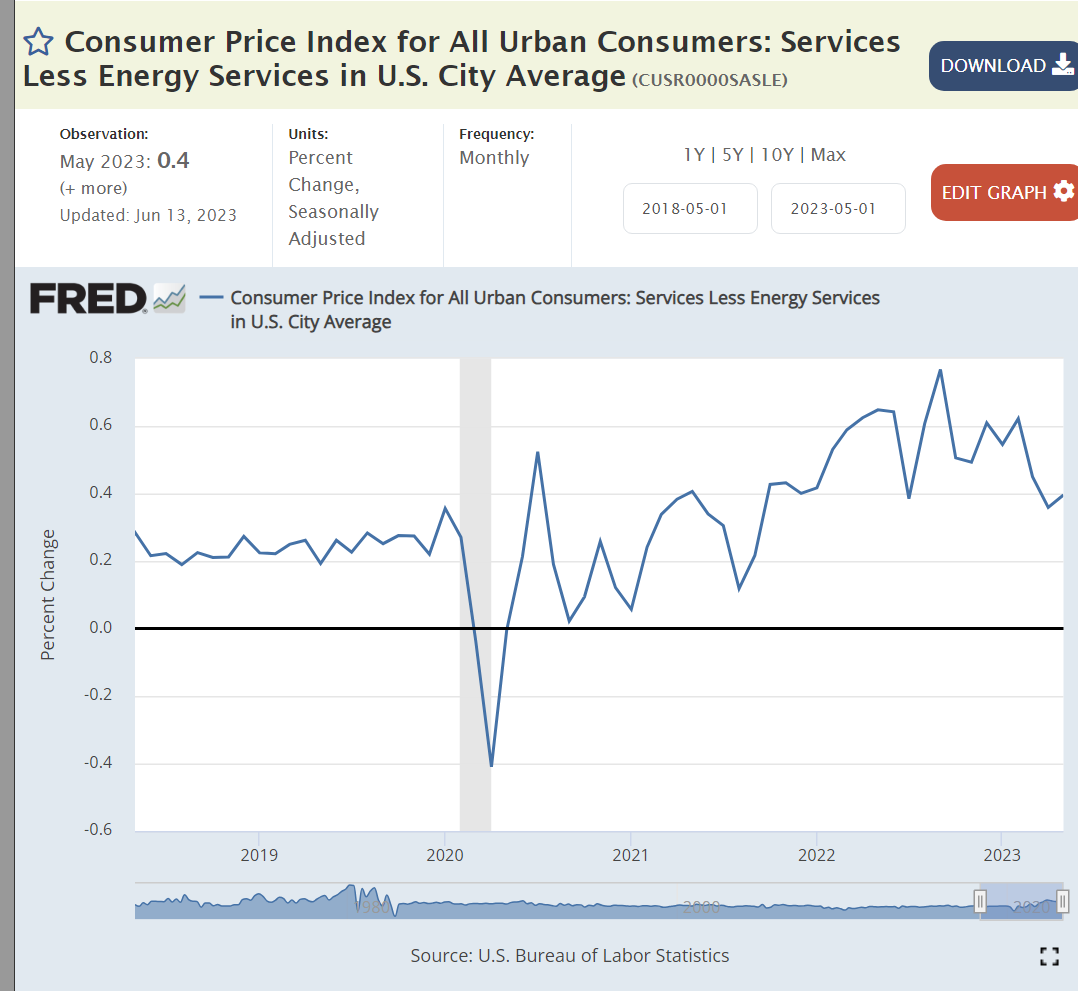
The services sector experienced mild inflation during the first 18 months of the pandemic, but has increased to a 6% annual rate as businesses re-established their business models and labor supplies. This sector has slowed to 5%, but remains the greatest concern for reducing the overall inflation rate.
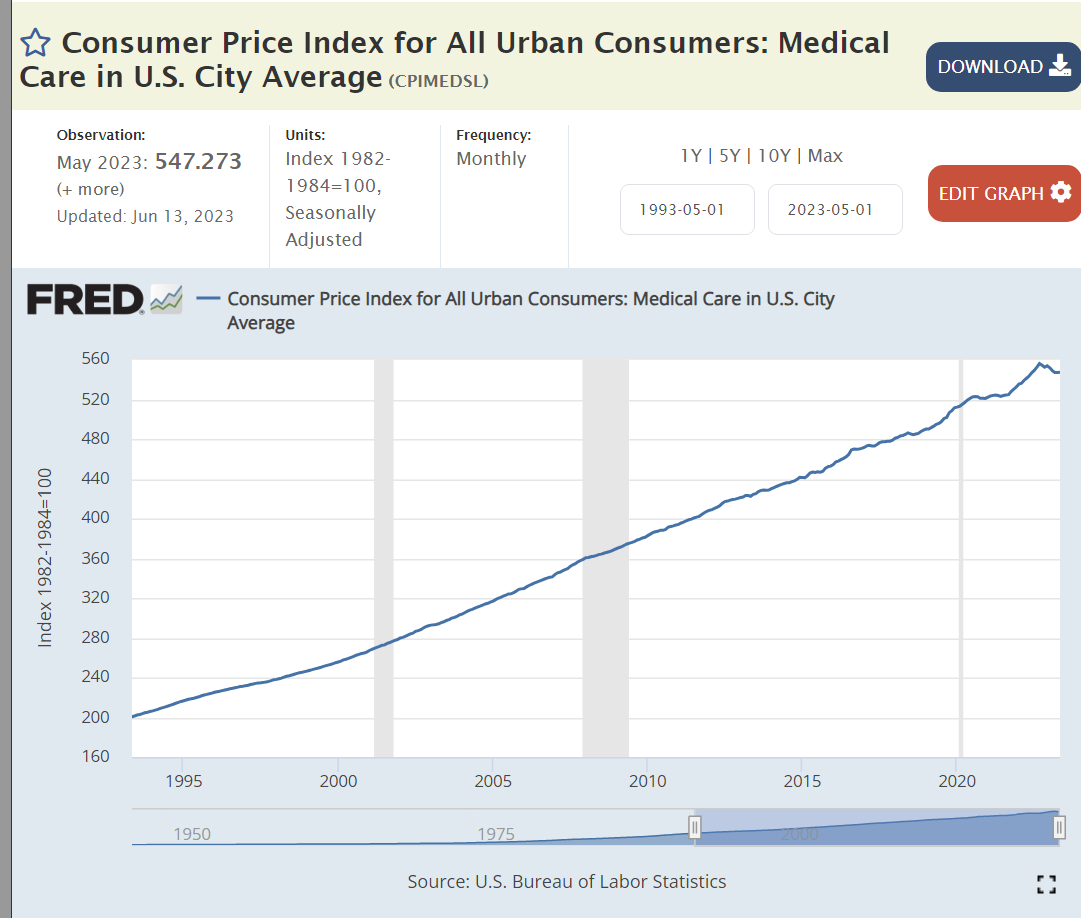
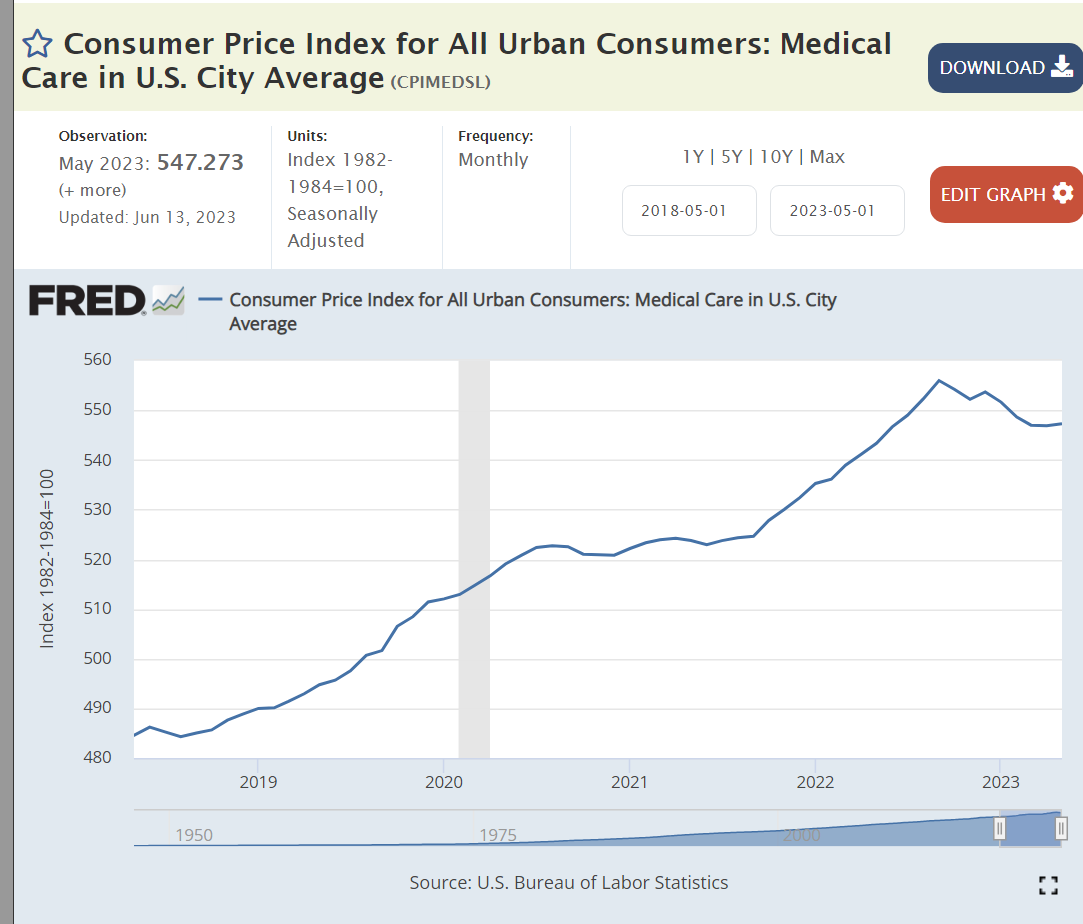
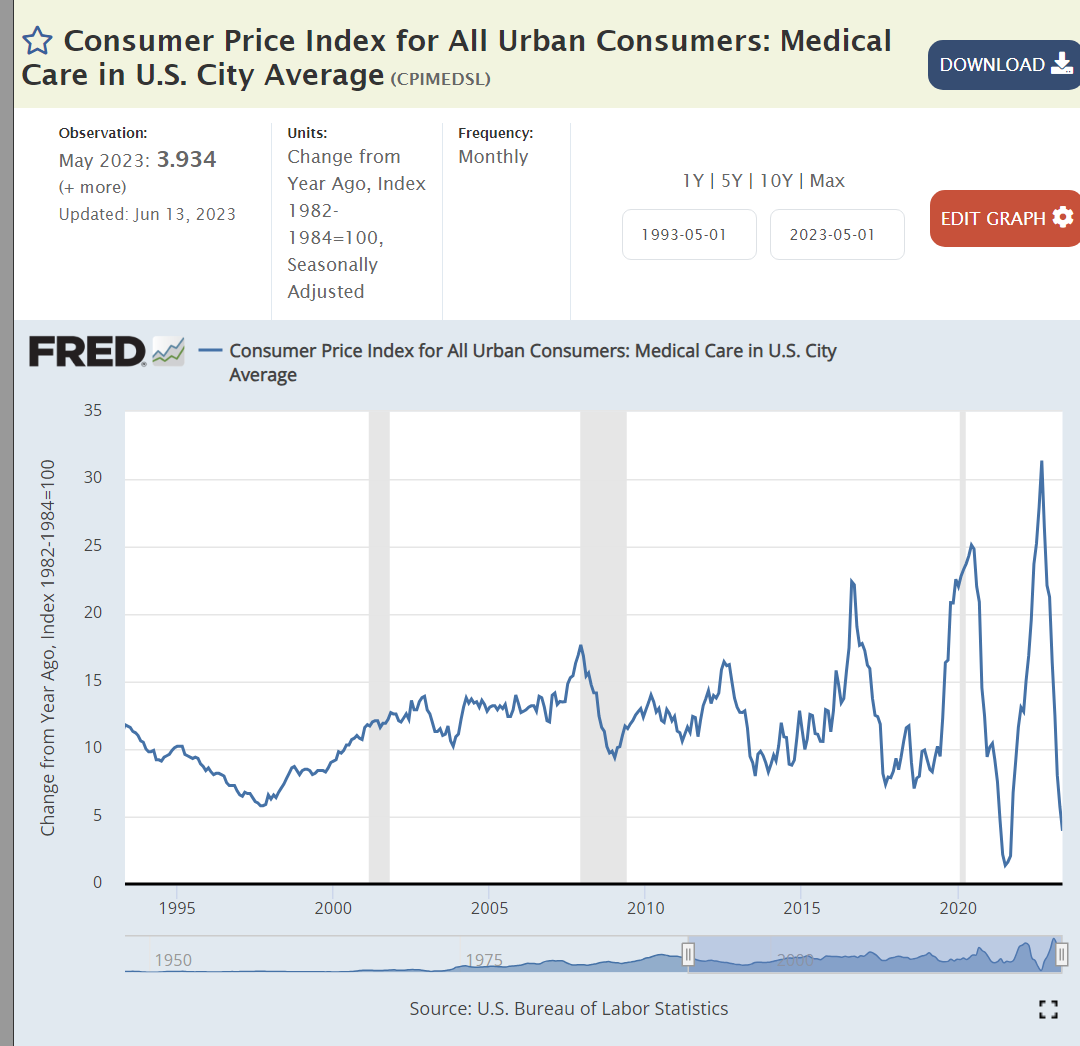
Medical care inflation remains at its 20-year level of 10% or more per year. As medical care has grown significantly as a share of the economy, it’s inflationary disease further infects the economy. Labor shortages play a minor role in this industry. The lack of competition or other incentives for real productivity improvements (Baumol’s disease) drive massive inflation even as US health results such as lifespans decline.
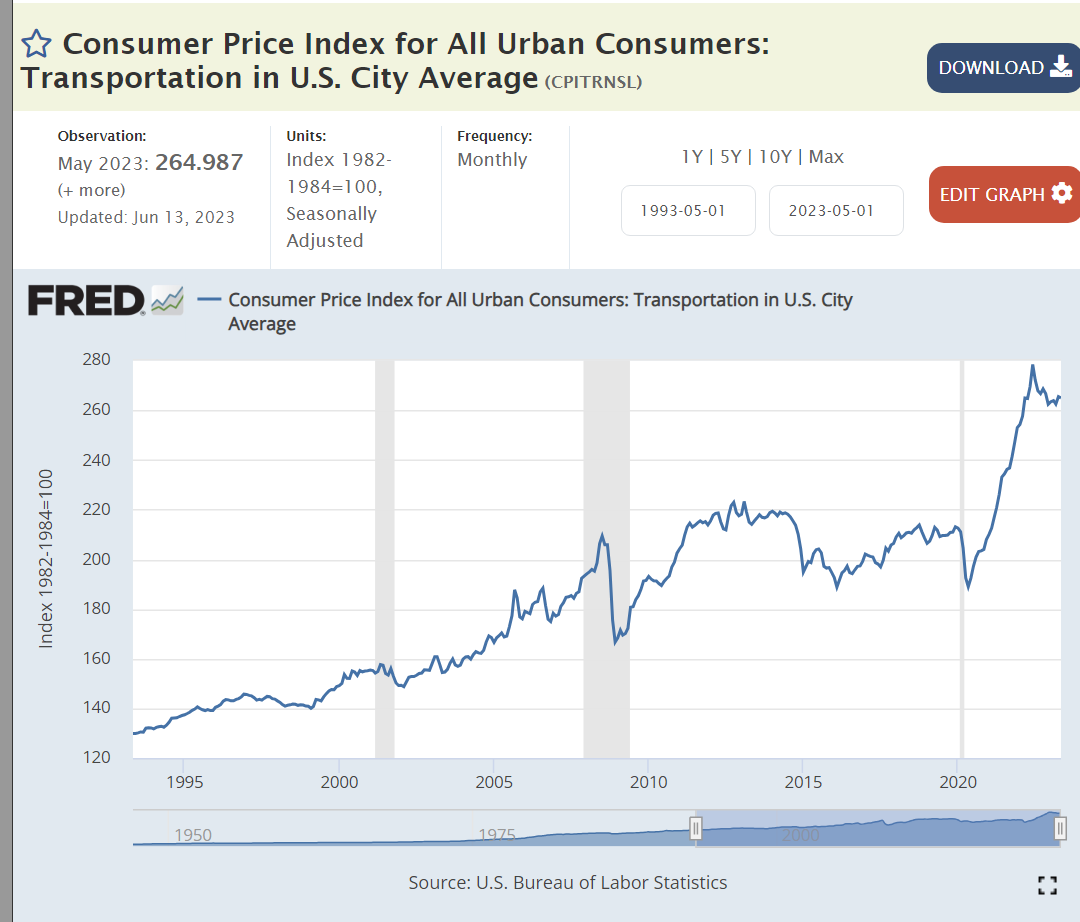
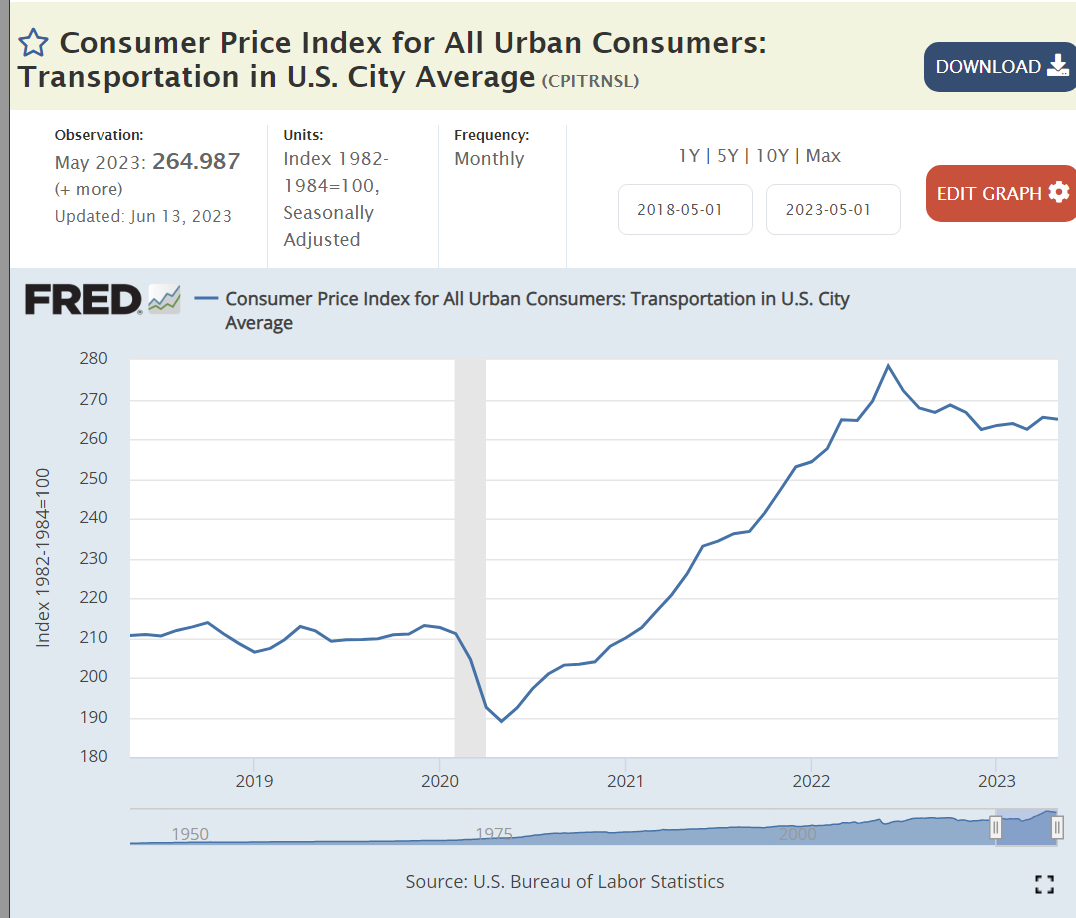
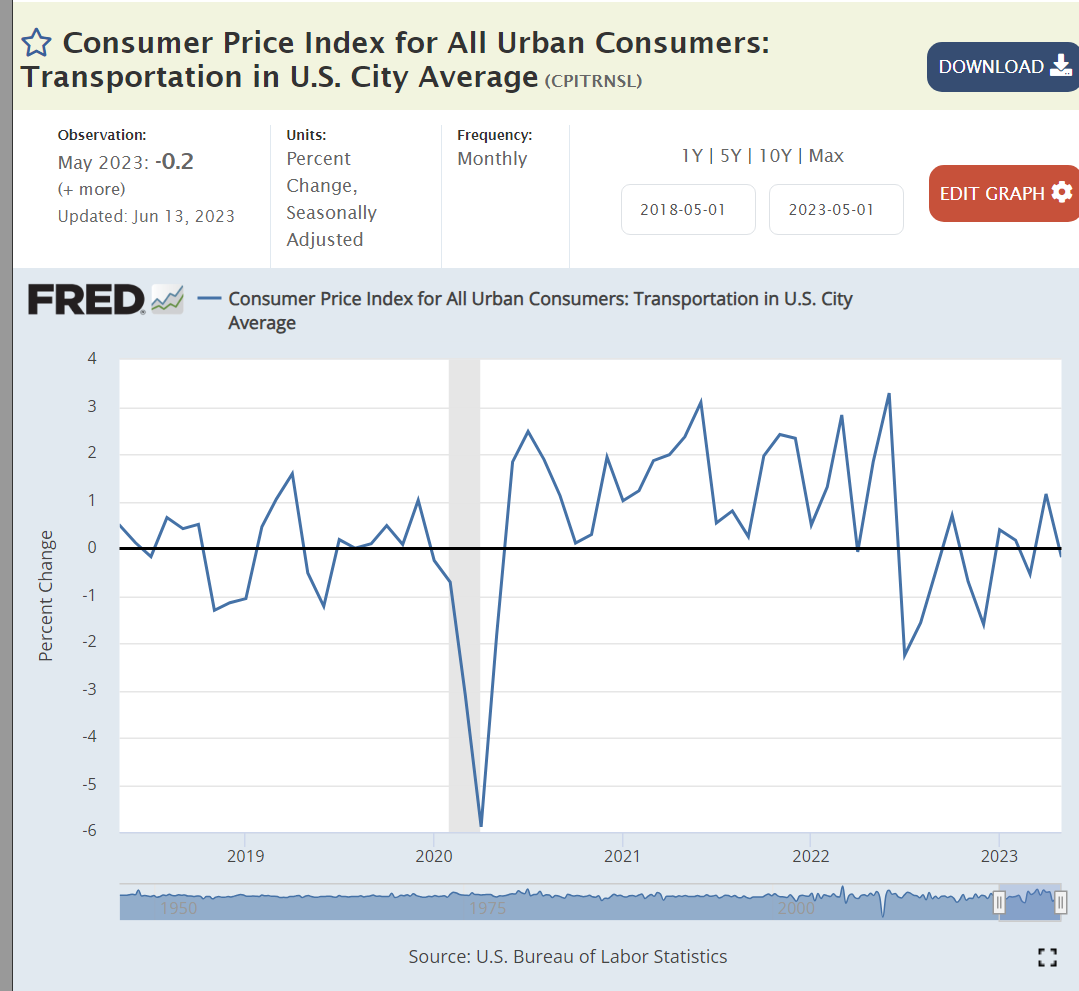
Transportation includes both durable goods and energy prices. A 25% price increase before it flattened off.
The used car and truck market experienced 50% price increases when the new car and truck pipeline was disrupted. Once again, prices have flattened, but not declined significantly to return to the pre-pandemic level.
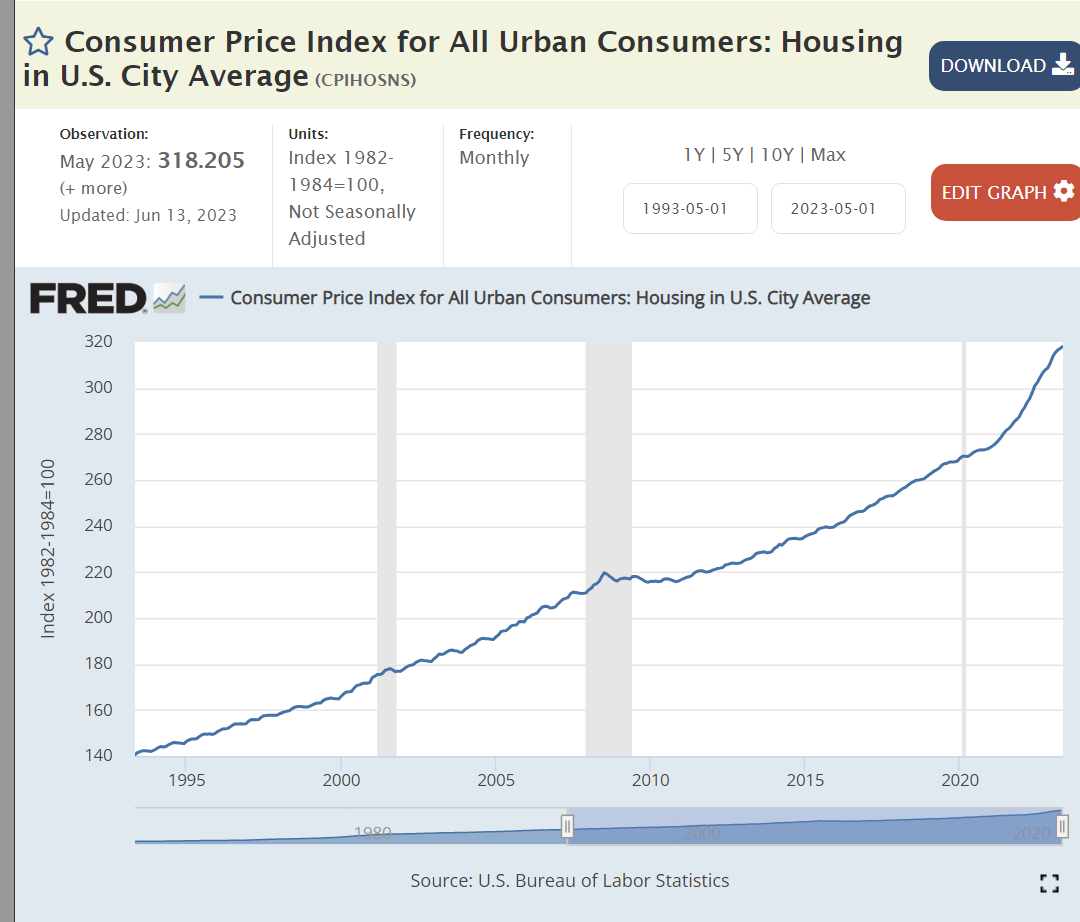
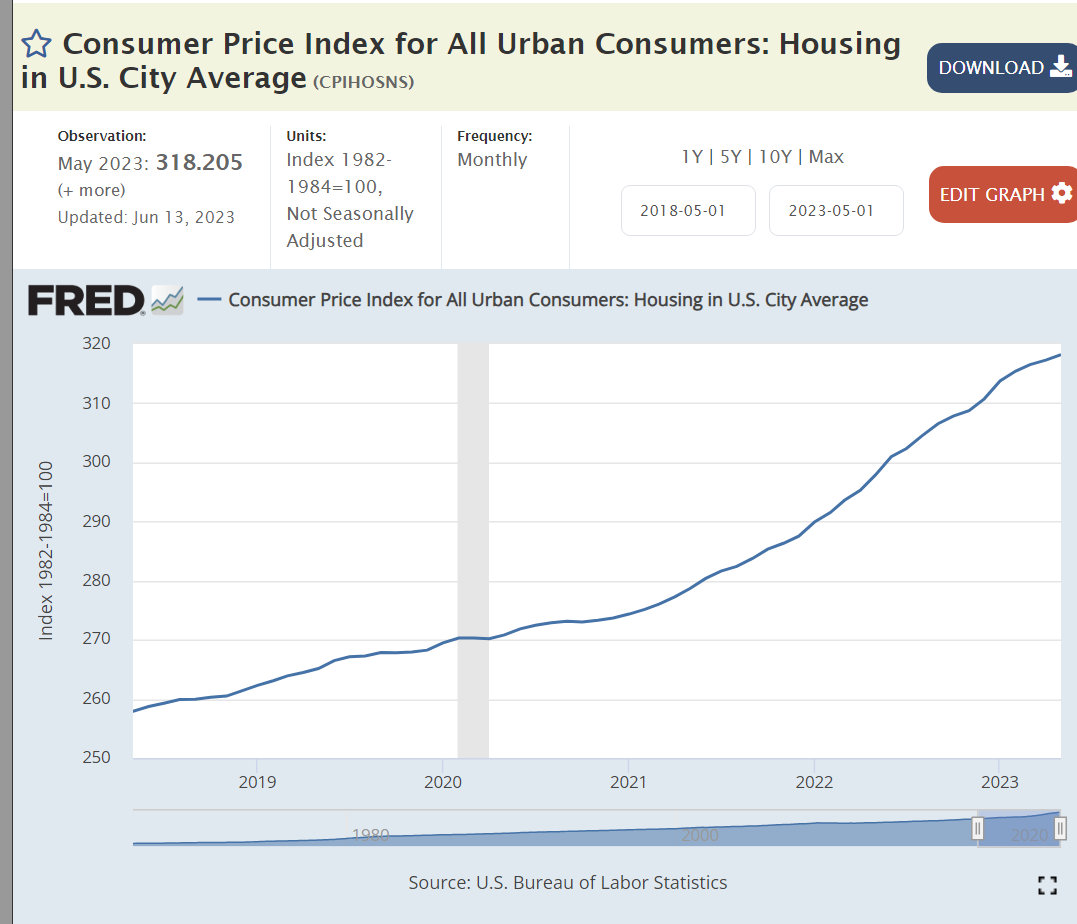
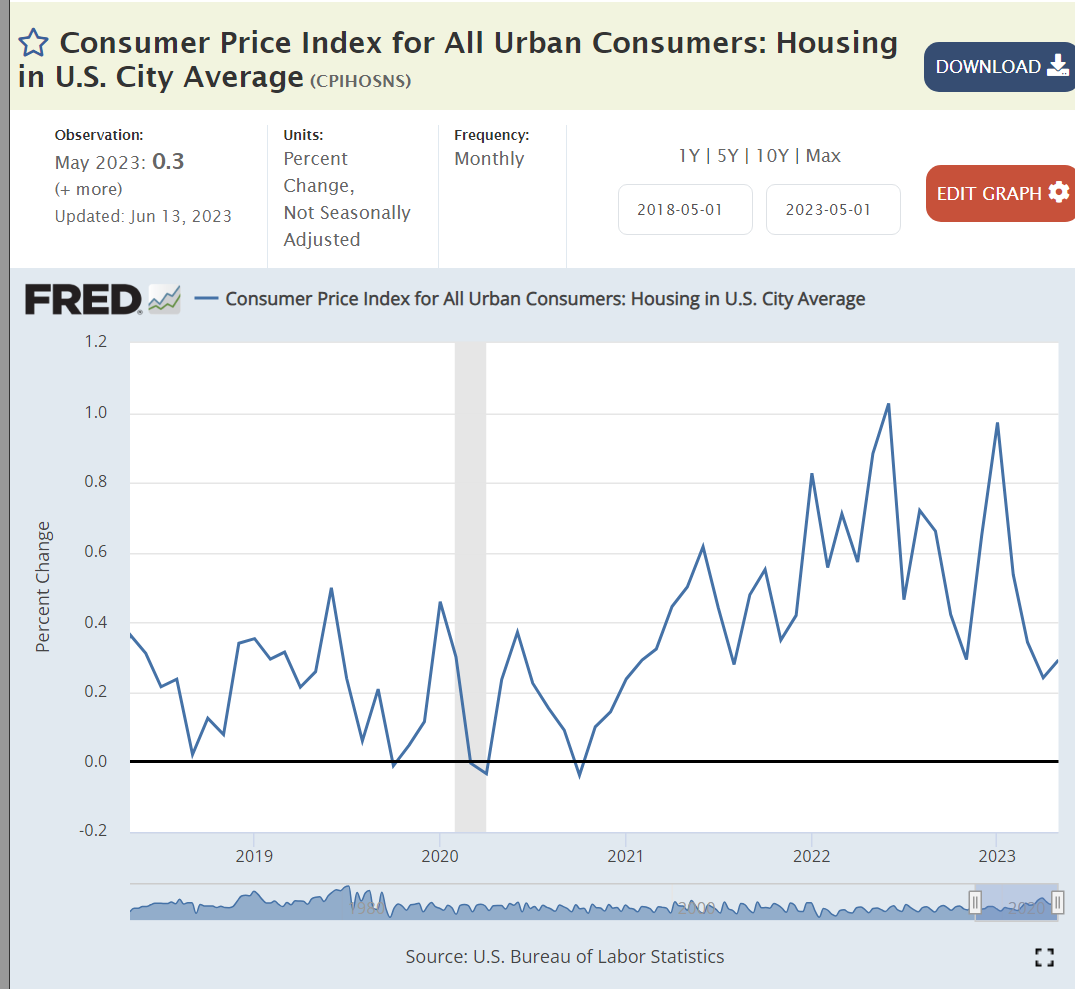
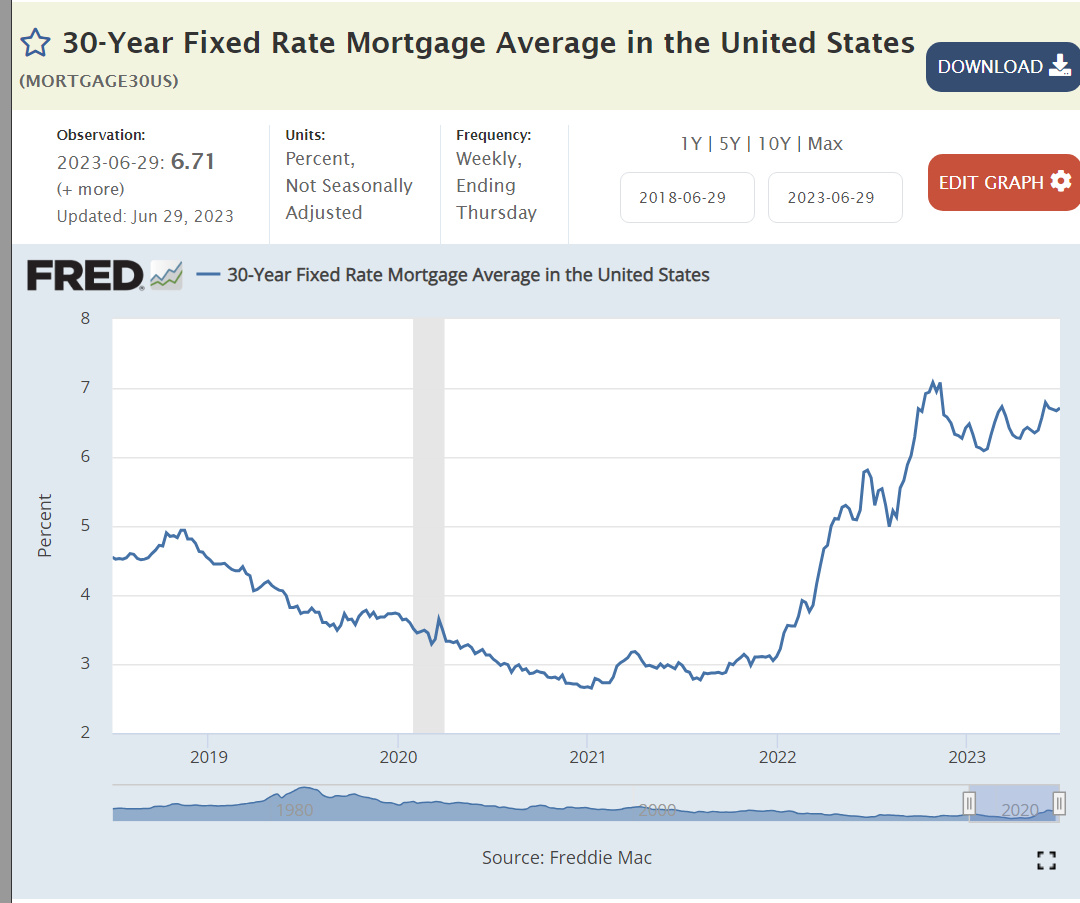
Housing inflation jumped up from 2% to 7% as the pandemic and subsequent Federal Reserve Bank mortgage interest rate increase disrupted the housing construction market. While housing inflation has declined from its peak, the long-term imbalance between supply and demand predicts some future inflation.
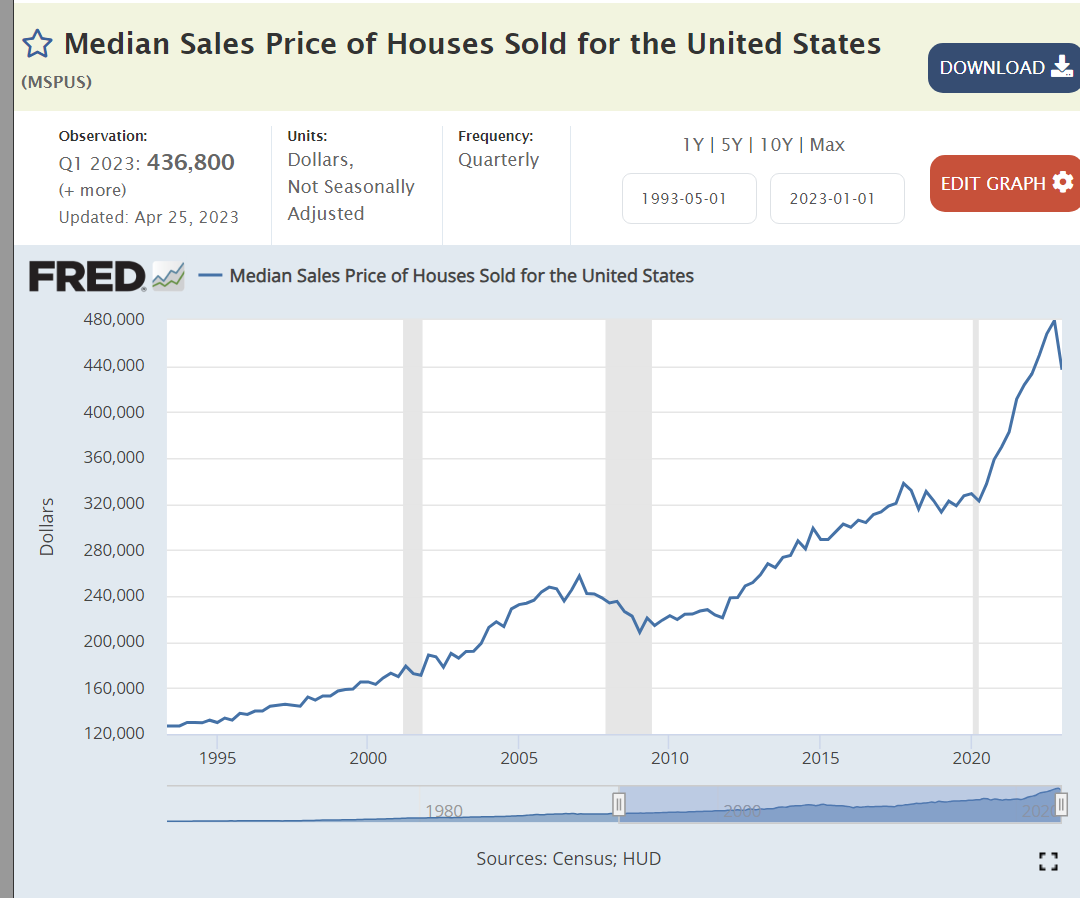
The 40% spike in home values was even higher than that shown for durable and nondurable goods. Flat prices make sense for the next year or two.
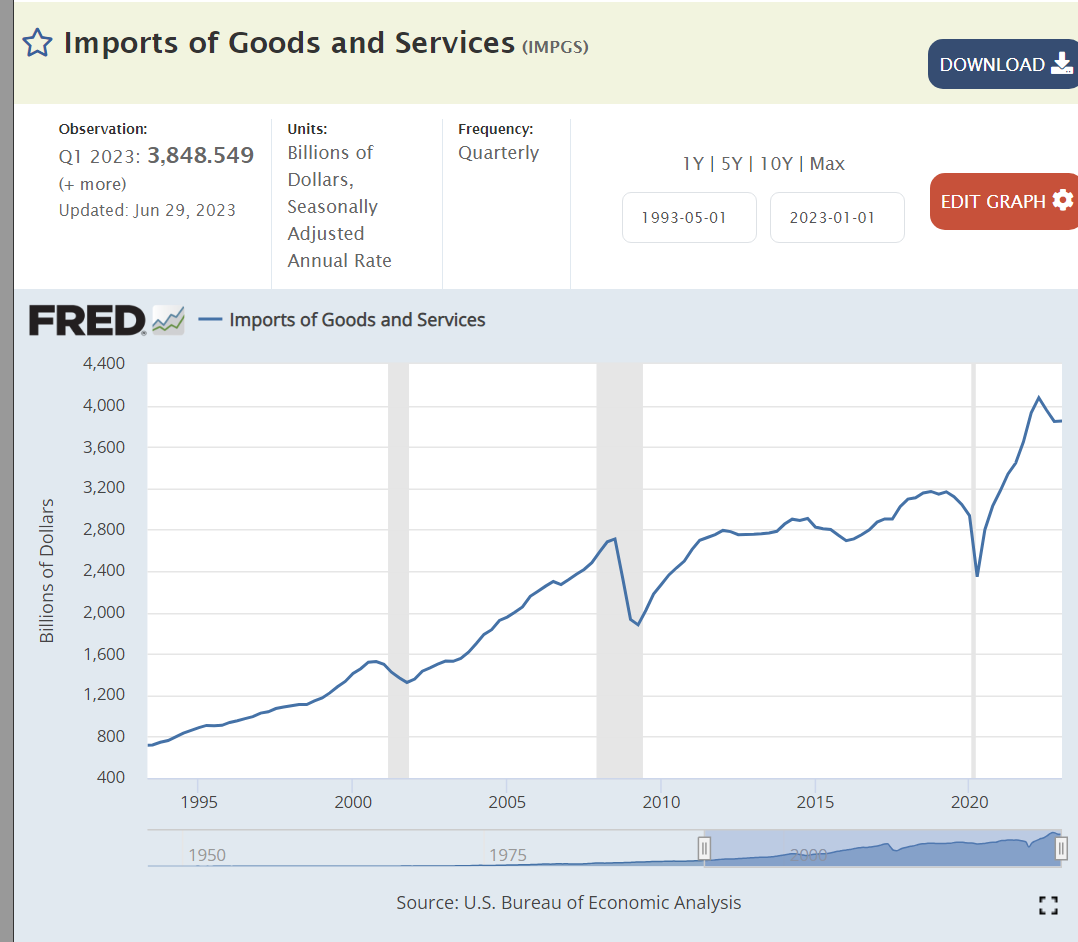
The jump in imports was driven by the increased demand for durable goods.
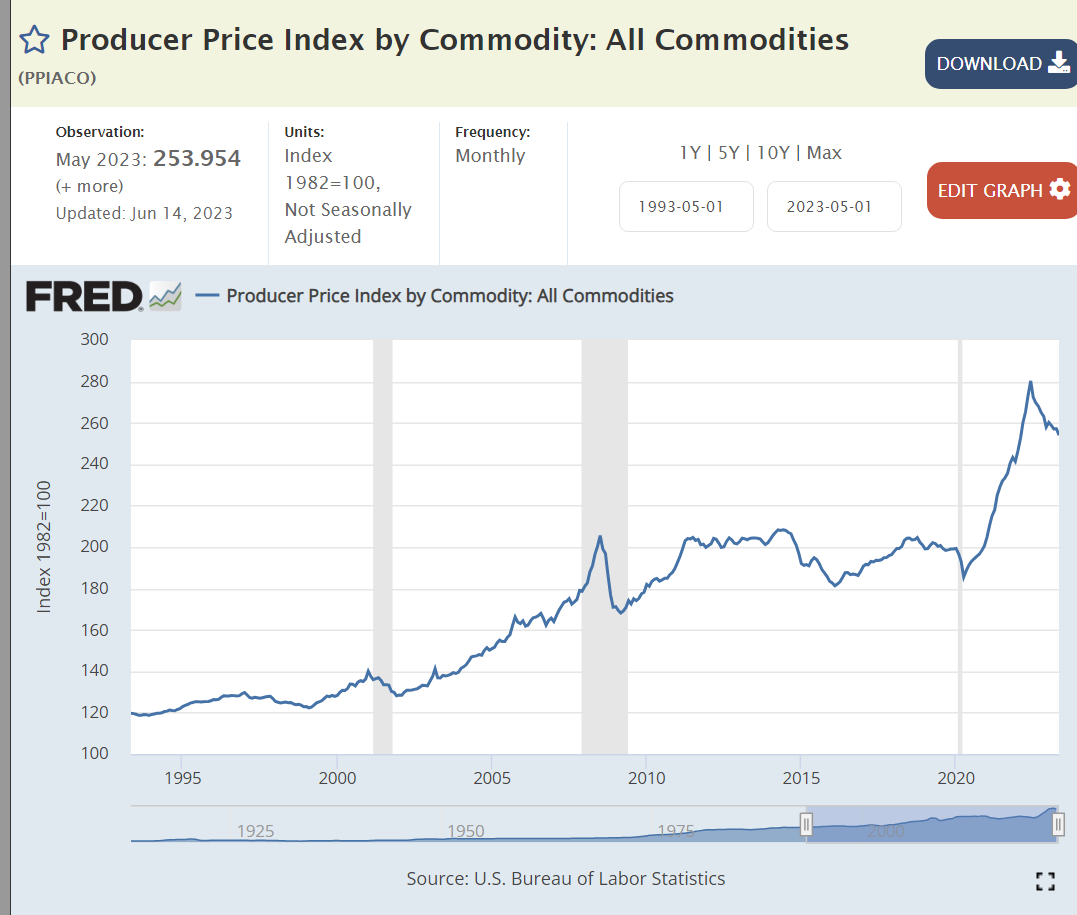
Producer prices were flat for 10 years, then up by 30%. No inflation remains, but some deflation is possible.
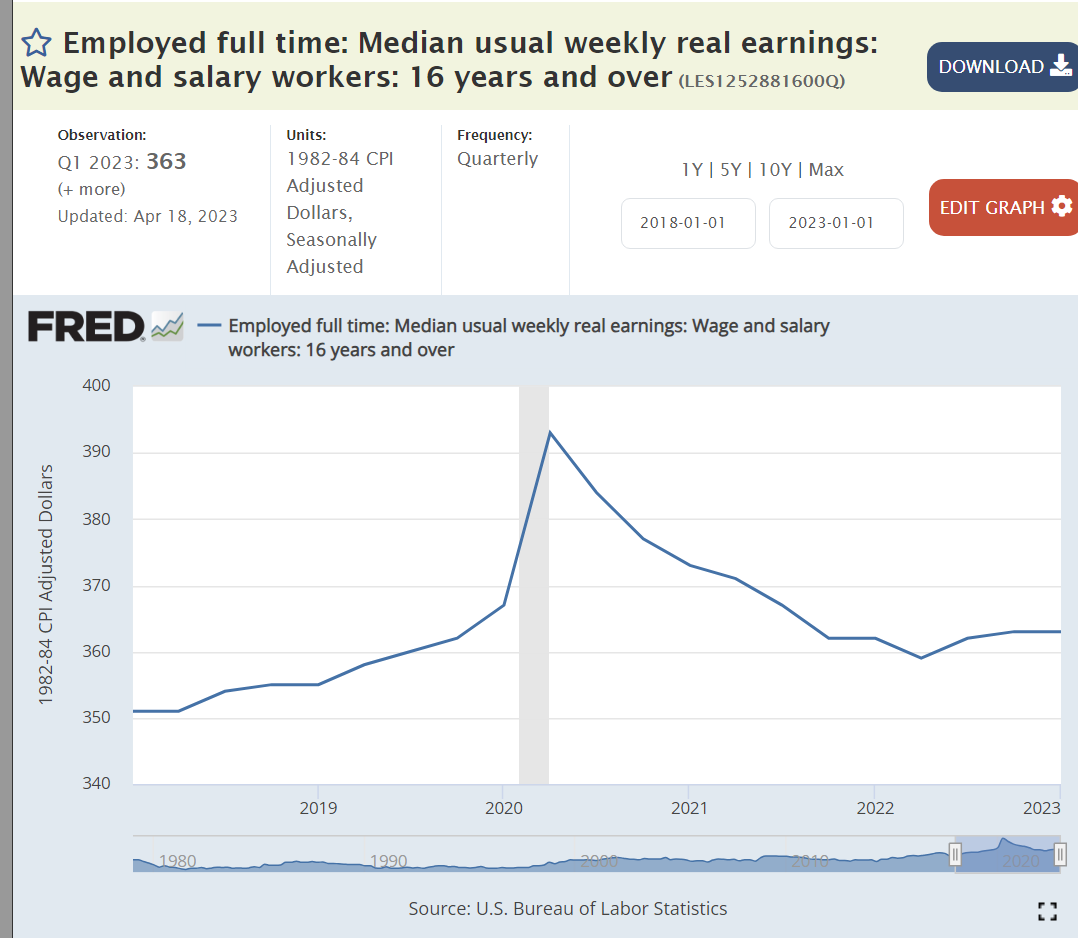
From 2015-20 historically high demand for labor drove a 7% increase in real wages as unemployment reached a 30 year low of 3.5%. For the last 3 years wages have trailed inflation. No wage-price spiral.
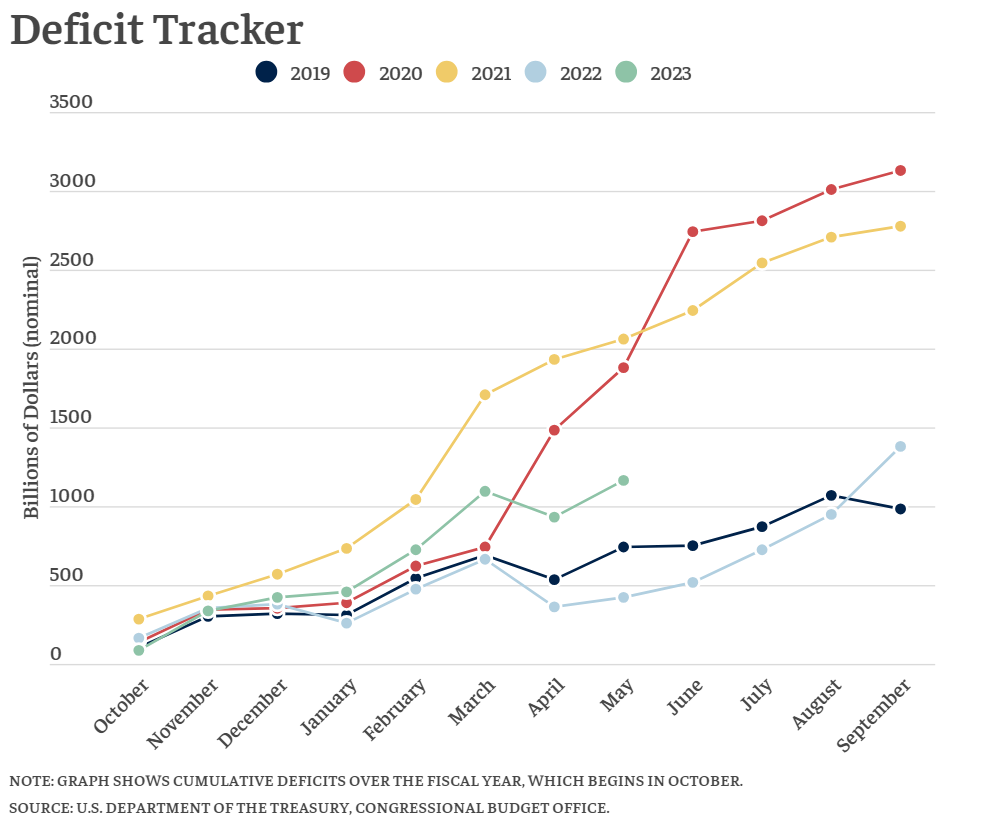
Until February, the federal government budget deficit had returned to the pre-pandemic 2019 pattern. In the last 3 months spending has accelerated, adding to aggregate demand and causing the economy to expand faster, perhaps beyond its limits, supporting greater price inflation.
The government response to the pandemic threat generated much greater savings and subsequent spending/aggregate demand than any recent recession situation. The benefits have now mostly run out. Consumer demand has remained high but will likely decline.
The unprecedented expansion of the money supply by the Federal Reserve Bank in 2020 is difficult to explain or analyze. The Fed responded to the clear risk of a banking system collapse by providing “loose money” access to all entities. This monetary expansion did not result in immediate consumer inflation, but it did help to inflate asset prices: investments and housing. The Fed has begun to reduce its holdings of assets as it tries to increase interest rates.
The Fed has more than doubled interest rates. This has slowed down the housing, stock and acquisition markets.
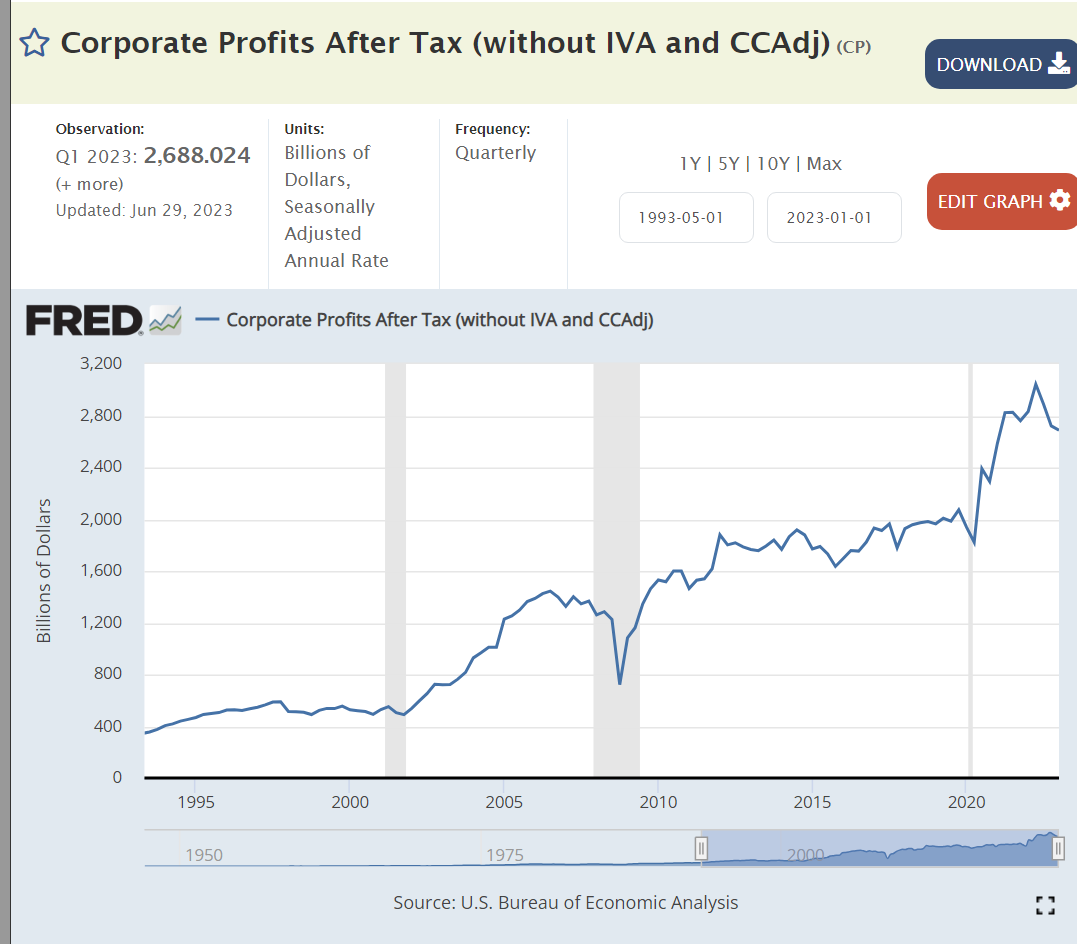
Corporate profits tripled from $500 billion in 2000 to $1.5 trillion in 2007. Profits slowly grew up to $2.0 trillion by 2019. Profits spiked by another 40% in response to the pandemic opportunities.
The drivers and components of inflation mostly point towards lower inflation in 2023 and 2024. The Fed is going to increase interest rates again this year which will reduce housing starts and corporate capital and inventory investments. The economy has so far resisted the higher interest rates, but the cumulative impact of tighter credit and lower savings will eventually offset the optimism of a historically positive labor market.
Summary
The pandemic caused producers to initially reduce their productive capacities. The unexpected rapid recovery of demand prompted by loose monetary and fiscal policies caused demand to greatly exceed supply. Inflation peaked at 7% and then began to drift back down. Corporations took advantage of the disruption to sharply increase prices, which have now flattened but not declined. Excessive fiscal policy (budget deficits) and high consumer spending driven by extremely tight labor markets driven by historically high corporate profits have maintained aggregate demand and prices.
There is a “tipping point” situation in this economy. The Fed is increasing interest rates. This is slowing consumer borrowing and housing demand in the face of demographic factors that normally promote new household formation and the economic benefits that typically accompany this investment. Consumers are using their pandemic driven savings to consume but are now running out of savings. The stock market very quickly recovered from the pandemic, but then declined and has since partially recovered based on a narrow set of AI based tech companies. The banking and credit sector is at risk, with several high-profile bankruptcies, but no clear evidence of a panic. Corporations are earning record profits, benefitting from prior low-cost debt, but struggling to hire employees. Overall, I think that prices will fall back to the 2% level by the middle of 2024.
In his 1999 “Bowling Alone”, Robert Putnam documented the widespread decline of “community” in America since the second world war. In his 2015 “Our Kids” he breaks down the data showing that the “professional class” has mostly survived, maintaining the institutions and benefits of community, while the “working class” has lost community attachment, support and equal opportunity. He recommends that we invest in child-care and pre-K services to support “our kids”.
Francis Fukuyama shot to fame in the 1990’s when he proclaimed the “end of history”. Mixed capitalism and representative democracy had permanently won the global war of ideologies against fascism, communism and totalitarianism! His most recent book outlines the history and core content of “classic liberal” representative democracy and the threats to our political community from the left and right.
Political commentator and social media entrepreneur Ezra Klein outlines the history of our two main political parties and their 1960-80 ideological realignment and polarization. He describes the role that social media has played in separating citizens from each other and the unfortunate melding of our various identities into overly simplistic singular “red versus blue” categories.
Next, consider Johnathan Haidt’s book “The Righteous Mind”; subtitled “why good people are divided by politics and religion”. This 2012 book argues that there are 6 foundations for morality: care, fairness, loyalty, authority, sanctity and liberty/oppression. Like personality traits, individuals weigh them differently and rationalize accordingly. Politicians use this knowledge to divide or unify our communities.
Let’s turn to history through John Meacham’s book “The Soul of America”. The historian provides a half-dozen mini histories to place our current political and cultural conflicts into context and provide hope that “the better angels of our nature” can once again prevail. Like Teddy Roosevelt, he emphasizes our need to make widespread political participation a top priority.
Finally, examine David Brooks’ book “The Road to Character”. The leading columnist contrasts the “resume virtues” with the “eulogy virtues” and argues that we have lost the moral vocabulary needed to encourage our communities to participate in our moral journey. He provides a half dozen biographical vignettes to illustrate this path in a manner that should appeal to all. These individuals might inspire us personally and help us to identify what changes to our society, institutions and politics could help our society to encourage, or even demand, high character from us and our leaders.
Humans seem to have always contrasted the individual and the community, left and right. Today, in the United States, we lean too far towards the secular, scientific, materialistic, capitalist, individualistic end, in my view.
The Reagan/Thatcher revolution of neo-liberalism promoted individualistic, libertarian, liberty-obsessed capitalism as the supreme value and virtue, leaving other religious and community values behind. Many in the fundamentalist Christian wing of the party embraced the complementary individualist “prosperity gospel”. Other Christians; Pentecostals, Catholics, and main-line Protestants; struggled with a flat, thin, earthly, deterministic, commercial only world view.
The progressive world has largely embraced the misleading “science versus religion” perspective and mostly concluded that science has won, and religion is irrelevant. A purely scientific world has no room for non-scientific dimensions, objects or perspectives. Atheism, agnosticism and relativism reign supreme. Global community might be accepted or embraced.
The philosophical secular humanists moved on to socialism/Marxism and then to existentialism and then to postmodernism, adopting a “value free”, but community-based world view. Oppressed communities, (race, gender, disability, religion, feeling, ethnicity) are the fundamental components of a just world. Otherwise, there is no objective reality or values.
It seems to me that we have simply not found a good way to integrate the needs of the individual and the community. Community clearly exists at the local, state, nation and global level. Community clearly exists in the social, political and religious dimensions.
Jonathan Haidt contrasts traditional and “modern” societies. Stereotypical modern societies are WEIRD: western, educated, industrial, rich and democratic. They tend to subsist on a “thin” individualistic-only morality of care and fairness, leaving religion and community behind. This purely individualistic basis for morality is insufficient to support a good life, in my view.
Consider the purely “secular states” in Turkey, China or communist Russia. Too thin. The political state is insufficient as the only basis for community and the religious, eternal, infinite, natural, mystical, mythical, spiritual dimension.
Consider the modern “social welfare” states in Western Europe. Organized religion fills a small role, space and influence. It is replaced by community membership at the neighborhood level, in professions, in political, social and athletic groups, in voluntary cooperatives, in family societies, in local historical societies. Perhaps, minimally adequate.
Is a variety of voluntary, limited liability, communities adequate for the “good life”? Intuitively, I think not. We humans can tolerate some uncertainty, but we long for a “North Star”. Certainty would be best, of course, but clear direction would be “good enough”.
Moving back to current, practical terms. What do we do about the Trump based far-right, reactionary, populist, ruling wing of the Republican Party? It believes that it is right and worthy of imposing its own values on the rest of American society.
The Main Street, Wall Street, international, New England, WASP factions of the Republican Party could collaborate to retake control of their conservative party.
The Democrats could clarify their views, policies and practices to make clear that the remaining “independent” or “centrist” individuals would be welcomed and happy in a “center-left” Democratic Party that is not merely a front for socialism.
The politically interested class could actively campaign to change the rules of the game. New fundraising rules that survive Supreme Court challenges. Different voting rules that favor centrists. Filtering groups that restrict extremists. Neutral voting rules and district drawing groups. Increased power for political parties to emphasize central results.
I don’t have a “silver bullet” solution. But I know that our current political polarization is destructive and that we can do better.
“Americans today have little trust in government; household income lags behind our usual middle-class expectations … the alienated are mobilized afresh by changing demography, by broadening conceptions of identity, and by an economy that prizes Information Age brains over manufacturing brawn.”
Gunnar Myrdal described the American Creed as “devotion to the principles of liberty, of self-government and of equal opportunity”. “The war between the ideal and the real, between what’s right and what’s convenient, between the larger good and personal interest is the contest that unfolds in the soul of every American”. “We cannot guarantee equal outcomes, but we must do all we can to ensure equal opportunity. Hence a love of fair play, of generosity of spirit, of reaping the rewards of hard work and faith in the future”. “The United States has long been shaped by the promise … of forward motion, of rising greatness, and of the expansion of knowledge, of wealth, of happiness”.
“Our greatest leaders have pointed toward the future – not at this group or sect.” “The president of the United States has not only administrative and legal but moral and cultural power”.
Fear: feeds anxiety and produces anger, about limits, points at others, assigning blame, pushes away, divides. Hope: breeds optimism, about growth, points ahead, working for a common good, pulls others closer, unifies.
One: The Confidence of the Whole People
America began with dreams of God and Gold. In 1630, John Winthrop said “For we must consider that we shall be as a City upon a hill”. Meachem argues that we must understand the dynamic between the presidency and the people at large, between a powerful chief and a free, disputatious populace. The presidency was defined in the shadow of the ineffective Articles of Confederation and the hatred of monarchy. Walter Bagehot in 1867 contrasted the dignified and the efficient parts of British parliamentary system. We have no king, so the US president must fill the dignified, symbolic, honorary, universal, ideal, inspiring, cohering role. “Our past presidents have unified and inspired with conscious dignity and conscientious efficiency”.
LBJ: “the moral force of the Presidency is often stronger than the political force”. Jefferson sought “to unite himself with the confidence of the whole people”. “Jackson believed in the nation with his whole heart. To him, the nation was a sacred thing”. Jackson: “The president is the direct representative of the American people”. Lincoln moved from a compromising, tentative early tone to exerting moral leadership for the country in the Gettysburg address, defining America ever after in terms of democracy and equality, followed by appeals to the “better angels of our nature” and binding the wounds of war.
Teddy Roosevelt coined the term “bully pulpit” to describe the president’s unique opportunity for moral leadership. Woodrow Wilson wrote of the president: “His position takes the imagination of the country. He is the representative of no constituency, but of the whole people”. Character and temperament clearly matter in such a president. FDR perfected the “fireside chat”. Meacham notes “A leader’s balancing act, then, was the education and shaping of public opinion without becoming overly familiar or exhausting”.
The character of the country is as important as the character of the president. It’s inclinations, aspirations, customs, thought and the balance between the familiar and the new. The Declaration of Independence introduced “the pursuit of happiness” to the world stage, not as individual self-interest but the joint pursuit of private and public good, the good of the whole.
Even by 1750, commentators noted the strong American belief in progress. Reason, religion and capitalism all contributed to forming this hopeful view. Actual progress “does not usually begin at the top and among the few, but from the bottom and among the many”. Referring to civil rights and Womens’ rights, Meacham says, “It took presidential action to make things official … but without the voices from afar, there would have been no chorus of liberty”.
Two: The Long Shadow of Appomattox
Robert E Lee’s surrender to Ulysses S Grant was a solemn, respectful, muted, balanced, even hopeful event, but it did not mark the end of America’s struggle with equality between the races. Grant fought against the Klan, but Andrew Johnson tried to prevent progress and Rutherford B. Hayes ended Reconstruction in 1877, allowing the Confederate States to return to “home rule”.
The decades before the Civil War had been intensely fought off the battlefield. The war killed one-fourth of the Rebel soldiers. The war resolved the question of union (sort of) and emancipation (sort of), but the path forward was uncertain and debated at the national and state levels. Northerners and Southerners debated the cause of the war (states rights or slavery) and the cause of the Union’s military victory (industrial and military capacity, leadership, tactics, bravery or God). Even the great American hero, Abraham Lincoln, held mixed, moderate, evolving, tactical and ideal values and positions about slavery and the equality of the races. He didn’t have a clear plan because he was not sure about actual equality, he recognized that a majority of citizens did not believe in true equality or intermixing, and he understood that social institutions don’t change quickly or easily.
Virginian Edward Pollard published the “Lost Cause” in 1866, outlining a defensive and proud Southern position that did not embrace defeat, but triggered a new war for the preservation of Southern culture. “The war has left the South with its own memories, its own heroes, its own tears, its own dead”. The war “did not decide negro equality; it did not decide negro suffrage; it did not decide states’ rights … the Southern people will still cling to, still claim, and still assert them in their rights and views”. This was couched as a holy war against the oppressors.
The Ku Klux Klan was formed in 1866. It terrorized blacks and “others”. It worked to undermine Reconstruction. It supported the political actions required to completely disenfranchise blacks from voting and to segregate all services and social relations.
The “voice of the people” initially drove the federal government to pass the historic constitutional amendments, the Civil Rights Act of 1866 and the Reconstruction legislation of 1867 despite President Johnson’s opposition. He was impeached but escaped removal by one vote.
President Grant leaned into further steps towards racial equality but found that northern support for significant change was weak and that Southern opposition to any legislation, or compromise discussions, was consistent and universal. He was able to pass the Enforcement Act of 1870 that gave the federal government powers to pursue the Klan. The Klan’s public face disappeared, and its private actions faltered for some time, but violence and the threat of violence were used to complement the Jim Crow laws and establish a one party, dictatorial state throughout the “solid South” for decades into the future.
Three: With Soul of Flame and Temper of Steel
Womens’ suffrage, immigration and labor protections joined civil rights as major issues by the turn of the 19th century, epitomized in modern, progressive, reformist politicians such as Teddy Roosevelt.
Israel Zangwill’s play “The Melting Pot” celebrated the positive interactions of various races, religions and ethnic groups in teeming New York City. Teddy Roosevelt approved of the message as he interpreted it. America welcomes foreign groups if they embrace their Americanness and downplay their roots. Roosevelt employed logic and morality to conclude that it is “a base outrage to oppose a man because of his religion or his birthplace”. On the other hand, Roosevelt held no such accommodating views regarding native Americans. Like his contemporaries, he was influenced by Herbert Spencer’s social Darwinism, scientific eugenics and apologetics for Britain’s imperial rule (White Man’s Burden). He believed that the progress of the Anglo-Saxon nations in the last 100-300 years reflected some form of superior readiness for the modern world.
Teddy Roosevelt was born in New York City in 1858 to a prominent family and benefited from their wealth, perspective and social standing. Teddy decided at an early age to be a “muscular”, driven individual, embracing the outdoors, adventure and change, especially when driven by himself. His “Citizen in a Republic” or “Man in the Arena” speech summarizes his view of a fully engaged life well lived. Roosevelt said, “Like all Americans, I like big things; big prairies, big forests and mountains, big wheat fields, railroads and herds of cattle, too, big factories, steamboats and everything else”.
Roosevelt’s progressive politics were influenced by Jacob Riis’ 1890 illustrated book “How the Other Half Lives”, which showed real urban living and working conditions. They were also influenced by Jane Addams’ Hull House initiatives to support the acclimation of immigrants to the United States.
Roosevelt crusaded against machine politics, monopolies, poor working conditions, and for conservation, railroad regulation, food safety, Womens’ suffrage and political reform.
Roosevelt invited Book T. Washington to dinner at the White House, a small step forward, which was criticized by many and elevated by many Southern journalists and politicians as an unremovable stain.
In each Roosevelt situation, we see a heroic man of privilege making decisions and taking actions to move his country forward. In hindsight, he was shaped by the views of his society, for good and for bad. He believed in progress, rationality, betterment and action. He was a Republican, a representative of the powerful Northeastern region, interests and his social class. He was idealistic, confident in the ability of individuals and governments to make things better. “We have room for but one flag, the American flag, for but one language, the English language, for but one soul loyalty, and that is loyalty to the American people”.
Four: A New and Good Thing in the World
The teens and twenties provided the 19th amendment for Women’s suffrage, but also a rebirth of the Ku Klux Klan opposed to blacks, Catholics, Jews and foreigners. Meachem reviews Wilson, Harding and Coolidge on these issues and finds just lukewarm support for “equal rights” a century ago.
In 1918 Wilson reversed his long-standing opposition to Women’s suffrage as it had become politically more favorable in the 70 years since the movement’s founding in Seneca, New York. The leaders had adopted a strategy of civil disobedience: lectures, protests, marches, lobbying, arrests for trespassing, and starvation pledges.
Wilson maintained his Virginian view of the Civil War, Reconstruction and negro rights. He met with black leaders at the White House but did not listen or engage, emotionally walking them out the door. Wilson denounced lynching and purged two racist senators from the Democratic party in 1918. Seeking support for his progressive economic policies in a 50th anniversary Gettysburg speech, he spoke of “the people themselves, the great and the small, without class or difference of kind or race or origin”, but also indicated that the combatants were morally equal.
A North Carolinian, Thomas Dixon, published a series of three novels between 1902 and 1907 reviving support for the “Lost Cause” version of the Civil War. One of the novels was filmed by D. W. Griffith in 1914 as “The Birth of the Nation”. It celebrated white supremacy and attacked African Americans. Wilson showed the film at the White House but later distanced himself from any formal support. In 1915 the new Klan was re-founded near Atlanta based upon “unease about crime, worry about anarchists, fear of immigrants flooding in from Europe desolated by war, and … anxiety about Communism”. The Klan promised racial solidarity and cultural certitude as the transition from an agricultural to an industrial and urban world accelerated. Klan Imperial wizard Evans claimed, “we demand a return of power into the hands of the everyday, not highly cultured, not overly intellectualized, but entirely unspoiled and not de-Americanized average citizens of the old stock”.
The first world war led to the Espionage Act of 1917 and the Sedition Act of 1918, restricting free speech. Dissident groups, including labor unions and socialists, were pursued, charged and imprisoned. Eugene Debs was imprisoned for his opposition to the war. The Postal Service was used to restrict the dissemination of publications. Anarchist bombs exploded in 1919, leading to greater federal investigation of “threatening” sectors. Socially, politically and journalistically Americans were pressured to become more patriotic and completely support American institutions.
The pendulum started to swing back after 1920 when the New York legislature tried to unseat 5 duly elected Socialist party members. Leading voices remembered the core principles of democracy, confident that the system could survive a small amount of dissent.
The Klan reached a peak of influence in 1925, with 2 million members and strong political representation and influence at the state and national levels. A Democratic Party plank criticizing “secret organizations” like the Klan failed to be adopted in 1924. The Klan’s 1925 march on Washington attracted 30,000 participants. The Klan’s extreme positions were later rejected in many states and by national politicians and the Supreme Court and its influence once again faded by the end of the 1920’s. Harding was a leader in opposing the extra-legal actions of the Klan. Coolidge also took steps in the mid-1920’s to oppose the Klan. Yet, the National Origins Act of 1924 greatly restricted immigration.
The teens and twenties witnessed some progress for women, threats to free speech or nonconformity, and an expanded opposition to “others” by race, ethnicity or religion. Economic progress in the twenties softened the edges of opposition to “others”. The US, like most other nations, became more nationalistic or patriotic in the shadow of the Great War. The general positive attitude towards scientific, business and government progress continued, leading most politicians to reject extremist, irrational positions even if they were not quite ready to fully embrace the implications of “equality” expressed by Lincoln 50 years earlier.
Five: The Crisis of the Old Order
The Great Depression threatened the US as it threatened Europe. 20% unemployment. In 1932, FDR saw army chief of staff, Douglas MacArthur as a threat to democracy, leaning towards a military government. Louisiana governor and senator Huey Long posed a leftist populist threat. Father Charles Coughlin’s radio broadcasts stirred populist, nativist and anti-Jewish sentiments. Charles Lindbergh inspired the isolationists who wanted to leave Europe to its intramural squabbles. Novelists such as Nathanael West and Sinclair Lewis highlighted the attractions of fascism and populism to a suffering public. A group of Wall Street investors conspired to overthrow FDR in a military coup in 1933.
Business and political leaders understood the nation’s challenges. They were unsure about FDR’s policies, political judgements, character and ability. Columnist Walter Lippman wrote, “Franklin D. Roosevelt is no crusader. He is no tribune of the people. He is no enemy of entrenched privilege. He is a pleasant man who, without any important qualifications for office, would very much like to be president”.
Roosevelt exceeded expectations. His themes of “the salience of hope, the dangers of fear, and the need for open American hearts” were effective. He prioritized the most important topics and mostly won his battles. He used his communications skills to speak with the nation, each small town, neighborhood and person. He believed in idealism and pragmatism. He promoted plans but adapted and adjusted quickly. He moved quickly but didn’t preach revolution. He overreached and then reset. He courageously faced situations as they were, not how he wished them to be. He delayed decisions when he could. He played off advisors against each other. He used his wife for political advantage. He was self-aware, knowing that he was leading in an extraordinary time, that his decisions effected civilization and that he was surely making some mistakes. Yet, he maintained a sense of hope and a spirit of optimism.
Despite the country’s strong isolationist leanings, FDR prepared the nation for war. He found ways to support the UK, such as the lend-lease program. He fought against the isolationist views of many important political and banking leaders.
FDR took small steps to reduce racial discrimination. With A. Philip Randolph’s Pullman Car Union threatening a march on Washington, he opened up employment in the defense industries to African Americans. Eleanor Roosevelt promoted racial progress, including resigning from the DAR when it prohibited Marian Anderson from performing at their Constitution Hall. Anderson garnered national publicity with her concert on the steps of the Lincoln Memorial. FDR signed the executive order that moved 120,000 Japanese Americans from their West Coast homes to internment camps further inland away from the potential war zone.
FDR took some early steps to promote greater emigration of Jews from Europe to the US and elsewhere. However, by 1940 he had concluded that preparing for war and winning the war was the best way to save the most Jews from Naziism.
As Allied troops were landing in northern France in 1944, FDR was at his idealistic best, praying for the world, “Almighty God: Our sons, pride of our Nation, this day have set upon a mighty endeavor, a struggle to preserve our Republic, our religion, and our civilization, and to set free a suffering humanity. … Help us to conquer the apostles of greed and racial arrogancies. Lead us to the saving of our country, and with our sister Nations into a world unity that will spell a sure peace — a peace invulnerable to the schemings of unworthy men”.
Six: Have You No Sense of Decency?
The post-war world in the US offered a contrast between widespread prosperity plus political moderation and the emergence of a new strain of anti-establishment conservatism fueled by the power of the mass news media.
Harry Truman won a surprise presidential victory in 1948 on the coattails of FDR’s New Deal and war victory. Eisenhower cruised to victory in 1952 and 1956, nominally as a Republican, but truly as a moderate centrist eager to preserve the peace and gains of the last decades. The growing prosperity, baby boom and suburbanization prompted recognition of the wonders of a growing middle class.
Economists, journalists and politicians had all worried that the end of the war would lead to a recession or depression due to lack of aggregate demand, hiccups from war production transitions and Europe’s slow recovery. Instead, pent-up demand and increased American production capacity led to a boom period. The business cycle had not been tamed, but it was less threatening. Business and labor fought over contracts but settled their differences as the US increased its production for the world. Per capita income, birth rates, employment rates, college education, home ownership, women’s opportunities, farm incomes and life expectancy all grew rapidly.
Meachem notes that the “middle class” became a more recognized term and a larger group as many earned greater incomes, formed businesses and joined professions. There was a pride in the “bourgeois” class as the US competed with the USSR for world leadership. He also highlights the role that government has played in spurring economic success (despite the popular emphasis on individual effort), noting the earlier railroad, infrastructure, homestead and land-grant college investments; regulatory and labor changes of the progressive era; the various New Deal safety net programs and the continued post-war investments in highways, GI’s, aerospace, R&D, defense, etc.
With the economy humming and fascism defeated, politicians turned to the Cold War, excess government, socialism, welfare and liberty to win attention, votes and power. Eisenhower easily won elections, but his moderate positions did not help the Republican Party to distinguish itself from the Democrats or to greatly increase its state or national powers.
Robert Welch, a Massachusetts business owner, founded the John Birch Society in 1954 focused on a conspiracy among American elites, including Ike, to cooperate with the communists. Welch and his followers saw the world in “black and white” terms, contrasting secular communism with a Christian-style western civilization. The nuclear weapons race and threats of the Cold War provided an existential survival context for this world view. The “loss of China” to communism raised the specter of a global communist state. The US did have several high profile and damaging espionage cases. There were communist “fellow travelers” in the media, entertainment, university and international affairs worlds.
Wisconsin Senator Joseph R. McCarthy exploited these worries. Beginning in 1950 he promoted this “conflict of civilizations” view, pushed the limits in alleging conspiracies and traitorous acts and managed to attract and keep attention from the growing mass print, radio and TV media. Although the State Department had implemented a loyalty program and cleared out “marginal” staffers, McCarthy was able to use his alleged “list of 205 members of the Communist Party” for several years to build political power.
Most politicians ignored him. Eisenhower chose to not respond to his claims, even though they were addressed at him, George Marshal and John Foster Dulles in his cabinet. Eventually, in Spring, 1954, an Edward Morrow investigative report, Eisenhower speech and US Army counsel Joseph Welch’s congressional committee testimony undercut McCarthy. Morrow: “We must not confuse dissent with disloyalty”. Ike: “We are worried about Communist penetration of our country … the need that we look at them clearly, face to face, without fear, like honest, straightforward Americans, so that we do not develop the jitters or any kind of panic, that we do not fall prey to hysterical thinking.” Welch: “Until this moment, Senator, I think I never really gauged your cruelty or your restlessness. You have done enough. Have you no sense of decency, sir, at long last? Have you no sense of decency?”
Meachem contrasts the 1955 conservative revival of William F. Buckley with that of the John Birch Society and Joe McCarthy. He considers Buckley’s philosophy and media-based opposition to be more legitimate. Opposing the flow of power to the state following 20 years of New Deal and liberal orthodoxy is described as a valid perspective. On the other hand, Meachem shares Richard Hofstadter’s description of “pseudo-conservatism” as “incoherent about politics”, “largely appealing to the less educated members of the middle classes”, “feels that his liberties have been arbitrarily and outrageously invaded”, reflecting “status aspirations and frustrations”. Political philosophy and material interests are subordinated to personal views, feelings, loyalties, interests, status and projections in this form of political attraction.
Seven: What the Hell is the Presidency For?
The Civil Rights Act of 1964 and the Voting Rights Act of 1965 are widely seen as the most important steps in securing individual rights in the last century. Their passage relied upon prior political steps, Supreme Court decisions, JFK’s legacy, the civil rights movement, Martin Luther King’s actions and ideas, American ideals and the unique qualities of Lyndon Baines Johnson.
In 1948 Hubert Humphrey and other progressives urged Americans to “get out of the shadow of states’ rights and walk forthrightly into the bright sunshine of human rights.” Strom Thurmond walked out of the Democratic convention to form the Dixiecrat Party, winning 4 states. Truman took steps to integrate the US military in 1948. The Civil Rights Commission and the Civil Rights section of the Department of Justice were created in 1957. The Civil Rights Act of 1960 strengthened the federal government’s ability to enforce voting rights and enforce judicial decisions. The Warren Court’s 1954-55 decisions rejected the “separate but equal” principle for public education.
President John F. Kennedy observed the civil rights movement. He protected the federal government’s rights. He enforced court rulings. He nationalized state troops. His Department of Justice monitored Civil Rights. Kennedy spoke with civil rights leaders. In June 1963 he addressed the nation and introduced legislation that became the Civil Rights and Voting Rights Acts.
The South fought against desegregation. In 1960, the South was 21% non-white while the rest of the country was 7% non-white. Georgia (29%), Alabama (30%), Louisiana (32%), South Carolina (35%) and Mississippi (42%) had the largest minority populations. Southern congressmen and Senators held the “swing vote” in the Democratic Party and used their seniority to block legislation. A leading public intellectual, Robert Penn Warren, wrote in 1956 about two curses on the nation. Southerners used the “Lost Cause” version of the Civil War as a “Great Alibi” to excuse any behavior. Northerners rejoiced in the “Treasury of Virtue” from their war victory, secure in their moral superiority for all time. Lynching and threats from the Klan were real. Blacks could not register or vote. Violence was a constant presence, especially in response to the civil rights actions.
George Wallace became governor of Alabama in January 1963 declaring “segregation now … segregation tomorrow … segregation forever” from the state capitol steps. Wallace was a gifted politician and populist. He lost the governor’s race in 1958 to a more racist Democratic candidate and vowed “never again”. He said “I’m gonna make race the basis of politics in this state … and I’m gonna make it the basis of politics in this country”. He blocked desegregation of the University of Alabama. Meachem emphasizes his personal style. “A visceral connection to crowds”. “Simply more alive than all the others”. “He made those people feel something real for once in their lives”. “He provoked devotion and rage”. Kennedy was able to desegregate the university. Meachem comments, “He [Wallace] savored the hour, however hopeless it was. The very hopelessness of it all was in fact part of the defiance, for Southerners loved tragic stands against the inevitable”. LBJ was able to pass civil rights legislation over Wallace’s opposition. Wallace won 5 states in the 1968 presidential election, providing Nixon with a victory over Humphrey.
The civil rights movement worked relentlessly from 1955 to 1965 to prepare the American public for this change. Non-violent, civil disobedience. Persistence. Strategic confrontations. Leveraging the media. Visual images. Dignity and discipline. Daily life. Buses, education, church, lunch counters, voting, jobs, soldiers, workers. Integrated partners. Patience. Courage. Numbers. Messaging. Patriotism. Rights. Citizens. Justice. Tired. The Founders. Persistence.
Martin Luther King supercharged this with his rhetoric. “Stand up for righteousness. Stand up for justice. Stand up for truth”. “I have a dream”. “Judged not by the color of their skin but by the content of their character”. “Work and fight until justice runs down like water and righteousness as a mighty stream”. “I have a dream that one day every valley shall be exalted, every hill and every mountain shall be made low”.
LBJ had a large view of himself, history and the presidency. Note the chapter title. “Now I represent the whole country and I can do what the country thinks is right”. “The president is the cannon”. “I want you guys to get off your asses and do everything possible to get everything passed as soon as possible”. “The job of the President is to set priorities for the nation, and he must set them according to his own judgment and his own conscience”.
Lady Bird Johnson said, “Lyndon acts as if there is never going to be a tomorrow.” “Lyndon is a good man to have in a crisis”. Despite the political risks of moving ahead with Kennedy’s progressive legislation, LBJ courageously decided to proceed quickly, leaving a legacy to the fallen leader. LBJ was a Texan, a southerner, a politician, a Democrat, a New Dealer, a deal maker and a bully. He became the “master of the Senate” by using his talents and being re-elected in a rural, conservative Texas district. He used all of these skills, especially his legislative skills, to buttonhole individual members of Congress and overcome the 33-vote filibuster.
LBJ, like JFK and other civil rights proponents of the last 30 years, mostly used relatively practical messages to appeal to the American public. “I’m going to fix it so everyone can vote, so everyone can get all of the education they can get.” “Who among us would be content to have the color of his skin changed and stand in his place?” “Helen Williams, an employee of the vice-president … would squat in the road to pee. That’s just bad. That’s wrong”. “We’re all Americans. We got a Golden Rule”. Meachem wrote, “The key thing, LBJ believed, was to make the moral case for racial justice so self-evident that the country could not help but agree”. Johnson was mainly pragmatic. How to get preachers to help. How to get politicians to see their own interest in equal rights.
His speech in support of the Civil Rights Act was more elevated. “I speak tonight for the dignity of man and the destiny of democracy. Our lives have been marked with debate about great issues. Rarely in any time does an issue lay bare the secret heart of America itself … to the values and purposes and meaning of our beloved Nation. The issue of equal rights for American Negroes is such an issue. For with a country as with a person, ‘what has a man profited, if he shall gain the whole world, and lose his own soul?’ It is the effort of American Negroes to secure for themselves the full blessings of American life. Their cause must be our cause too”.
LBJ knew that these Acts were historic but still just steps along the way. “It is difficult to fight for freedom. But I also know how difficult it can be to bend long years of habit and custom to grant it. There is no room for injustice anywhere in the American mansion. But there is always room for understanding toward those who see the old ways crumbling”.
Conclusion: The First Duty of an American Citizen
Teddy Roosevelt: “The first duty of an American citizen, then, is that he shall work in politics; his second duty is that he shall do that work in a practical manner; and his third is that it shall be done in accord with the highest principles of honor and justice.” The citizen should be like his “man in the arena”, fully engaged in important matters.
Eleanor Roosevelt: “Great leaders we have had, but we could not have had great leaders unless they had a great people to follow”.
Harry Truman: “I’m everybody’s president. Those – the Bill of Rights – apply to everybody in the country”. American scripture. Equal opportunity.
Meachem: “America of the twenty-first century is, for all its shortcomings, freer and more accepting than it has ever been.” Apply the historical perspective.
“Every advance must contend with the forces of reaction”. An eternal struggle. “The perfect should not be the enemy of the good”.
The better presidents do not cater to the reactionary forces. Reagan recalling the virtues of other presidents and outlining his shining city on the hill, “teeming with people of all kinds living in harmony and peace”. Clinton healing the nation after the Oklahoma City bombings and Bush, Sr resigning from the NRA when they tried to fundraise from the disaster. Bush, Jr clearly distinguishing Muslims and Arabs from terrorists after 9//11. Obama eulogizing the Bible study victims of a white supremacist, invoking God’s freely given grace and its potential to heal individuals and countries.
Some “equal rights” changes happen quickly: LGBTQ.
Resist tribalism.
Respect facts and deploy reason.
Find a critical balance.
Maintain a free press.
Truman’s description of Lincoln: “He was the best kind of ordinary man … he’s one of the people and becomes distinguished in the service that he gives other people. I don’t know of any higher compliment you can pay a man than that.”
By 2004, Haidt saw that his preliminary findings applied to national politics in the US. Democrats relied on just one or two of the moral foundations, or even zero, while Republicans appealed to all five in effective ways. He contrasts Bush, Sr and Bush, Jr, neither a naturally gifted politician, with cool and cerebral Dukakis, Gore and Kerry, who they handily defeated. The Bushes appealed to Republicans, independents and Democrats by using a variety of emotional pitches. Separately, Bill Clinton stands out as a naturally gifted politician and manipulator of emotions.
By 2011, Haidt and his associates had developed and perfected a variety of questionnaires and attracted 100,000 on-line respondents to make their results scientifically sound. Liberals greatly valued the Care and Fairness dimensions and disregarded the Loyalty, Authority and Sanctity dimensions. Moderates were like liberals in terms of their rank orderings but had much closer scores on the 5 attributes. Conservatives valued all 5 equally and Very Conservative individuals valued Authority, Sanctity and Loyalty above Care and Fairness.
Colleagues corroborated the findings based on religious sermon content, dog preferences and brainwaves! The author began to write articles for the general public to share his findings. Many of the responses were predictable. Liberals downplayed or rejected the 3 conservative foundations. Conservatives tentatively complimented an academic who “go it”. But many conservatives were as critical as the unhappy liberals. They questioned Haidt’s morals and lack of understanding of the differences between Democrats and Republicans. They emphasized that Democrats really don’t believe in fairness, just equality and rights. The respondents saw fairness as proportionality and earned rewards.
Haidt and his team reconsidered the 5 moral foundations and made two changes. First, they redefined “Fairness” to be based on the idea of proportionality of work/contibution and rewards. Haidt found evolutionary psychology support from Christopher Boehm’s research on humans and primates. While the original “reciprocal altruism” foundation basis does have support in human history, the development of larger communities with shared property 500,000 years ago required the development of people and norms with group concepts and different fairness behaviors. With more powerful tools/weapons and communications, groups were able to limit the direct power of alpha males and use gossip and communications to support a moderate hierarchical structure with a leader or leading group that commanded extra resources, power and respect, but not too much. This “goldilocks” scenario is considered by many anthropologists and evolutionary psychologists to be a key turning point in human history. Proportional fairness is more highly valued by conservatives but moderately valued by liberals.
Second, while considering this same turning point in human development, Haidt decided to add a sixth moral foundation: Liberty/oppression. In larger groups with an “authority” moral foundation required to support the leader, there is a need for a complementary value to oppose excessive use of authority. Individuals accept, follow and respect valid, legitimate authority, but they rebel against being abused. They can embrace hierarchy and disproportionate rewards to a point, but they are able to band together and oppose any abuse of power. Haidt shares anthropological details to make this plausible. This moral foundation is supported by both the left and the right. The left emphasizes relative equality of rewards and generic antiauthoritarianism. The right emphasizes the personal liberty side, “give me liberty or give me death”, “don’t tread on me”, don’t regulate me, don’t restrict my choices, guns, family or religion. A powerful moral foundation indeed.
Haidt returns for a third time to share John Stuart Mill’s vision of a just society. It is based on the enlightenment, individuals, rationality, utility and a theoretical contract between individuals and society. “The only purpose for which power can be rightfully exercised over any member of a civilized community, against his will, is to prevent harm to others”. This modern, progressive, Western view is based upon Care and Fairness alone.
He then shares sociologist Emile Durkheim’s view of how society works. It is organic, based on community, evolving to meet actual needs, incrementally changing, inherently conserving order and tradition, skeptical of change, based upon existing well-functioning institutions like the family and church. Durkheim argues that man needs to belong to a binding moral system comprised of institutions larger than the individual in order to have a sense of place, stability, order, belonging and meaning. Without this grounding, he is rootless, anxious, experiencing anomie, a lack of grounding. This world view prioritizes self-control over self-expression, duty over rights, and loyalty to one’s groups over concern for out-groups. Historically, Durkheimian societies have predominated. WEIRD societies have been the minority. Haidt encourages the reader to consider both conceptions to have legitimacy. He does not dwell on the possibility of a “both/and” blending of these views or ways to accommodate both at the individual, institution and society level, but consider these possibilities. The individual and the group both matter. Different individuals prioritize individual versus group needs differently and the 6 moral foundations. Given our seemingly intractable differences of opinion, how do we make society function?
Haidt shares more details about conservatives, liberals and libertarians, but the main point is most essential. Different people have different moral worldviews. They are not changing. No one worldview is clearly superior by any broadly accepted ethical standard. We are going to have to “agree to disagree” or as Rodney King said, “Can we all get along?” Can each side understand all six foundations and others who value them differently? Can liberals understand and appreciate Durkheim’s view of a group-based society? Can conservatives appreciate the “individual” and abstract principled, universal, secular insights of liberals, aside from liberty?
Nine: Why Are We So Groupish?
Individuals express both selfish and group-oriented thoughts and behaviors. Everyone knows this. We join and support teams and nations. We donate anonymously. We “do the right thing” when no one is looking at least some of the time (ring of Gyges theory be damned). We embrace religions and consider others. We volunteer. We participate in politics. Not always. Not everyone. But enough to say that this is a feature of humanity, not a bug or a flaw or a mistake. Haidt admits that he has pushed hard on the cynical view of humanity to demonstrate what individuals often do or do “on average”. Nonetheless, group thought, and behavior is part of our human make-up.
Haidt addresses this based on evolution. George Williams in 1955 and Richard Dawkins in 1976 made strong arguments against existing theories of “group selection” in nature and for humans. The differential positive survival of groups based upon group cohesion, solidarity and individual sacrifice is possible in evolutionary theory, but depends upon the group being able to control the individual member’s behavior so that he generally does what the group needs and does not “free ride”, avoiding the personal cost of a behavior that helps the group. Williams and Dawkins debunked many “group selection” examples, demonstrating that they were caused by individual selection or near-kin selection.
Haidt shares Darwin’s view which supports group selection in concept, especially with regard to morality! He provides four rather technical scenarios that support the idea that human group level selection has been a major factor in the development of morality.
The history of biology is that of transitions from one level of competition to a higher level of competition. Bacteria to mitochondria to cells to … animals to societies. 8 transitions in all of recorded time. In each case, the next higher level absorbed the prior lower level, making it secure and dependent upon the higher level, disabling the disruptive competition at the prior level. The development of queen bees and workers in a hive is an example. These more recent changes took place when a persistent, defensible resource was involved (nest and food). They also involved a need to feed infants and the need to defend against other groups of the same species. Human societies fit this model: caves, needy children and aggressive neighbors. Fixed location crops and city-states match this pattern. Group level competition by bands of humans makes sense.
Michael Tomasello argues that “it is inconceivable that you would ever see two chimpanzees carrying a log together”. Humans, on the other hand, have what is described as “shared intentionality”. We have some sense of what another person is seeing, feeling, doing and thinking. We have a mirror image capability. This allowed groups of 2-3 to cooperate and communicate effectively. Even before formal language, humans could use signals, expressions and actions to share ideas and confirm mutual understanding. This is a critical underpinning for moral thought and behavior. It allows groups to share expectations and norms, to consistently provide feedback on acceptable and unacceptable behavior.
Once a group has mutual understanding, empathy and communications it can define a culture and sustain that culture though time. The culture can evolve to further and cumulatively improve group level effectiveness. The culture can take advantage of biological evolution, teamwork, communications and innovations. Biological and cultural evolution can interact. Dairy herds, lactose tolerance, more food, more herds, cheese, more people. Abstract symbols and markings and language evolve. The components or vocabulary become richer and support faster and innovative growth. The sense of groupness increases as the communications skills and feedback loops improve. The group level matters even more. Group innovations such as shame and guilt develop. The authority, sanctity/cleanliness, liberty, fairness and loyalty moral foundations become more effective. Effective societies “self-domesticate”, restraining extreme individualism and promoting cooperation and support of the group.
Biologists argue about the speed of evolution. Haidt shares examples of rapid individual and group evolution in 10-30 generations. He argues that the migration of humans around the globe during a period of warming and cooling provided a challenging environment for humans that could have triggered very rapid evolutionary changes at the biological and cultural levels in the last 50,000 years.
Haidt concludes that we are 90% selfish chimp and 10% cooperative bee. Once again, this is assuming that the evolutionary framework is the “alpha and omega”, without any religious, spiritual or sacred dimension working in the universe.
Ten: The Hive Switch
Haidt asserts that humans have evolved to live at both the individual and group levels. In this chapter he describes this potential in more detail, emphasizing his 90/10 theory that we mostly live in the profane, individual, day to day world, but at times we “switch” to the group, sacred, infinite, eternal, religious level.
His favorite sociologist, Emile Durkheim, describes these two levels and emphasizes, in contrast to the individualist views expressed by other scientists, social scientists and philosophers from 1500-1900, that the social, group or religious level is an essential part of man’s nature. No man does or can live without a “thick” attachment to his culture, neighborhood, community and nation. Durkheim describes the lack of connection as the dreaded “anomie” or emptiness experienced by individuals who leave their community and emphasizes the “collective effervescence”, or energy felt by individuals in group settings.
Haidt opens the chapter describing a simple version of an “altered state of consciousness” created by the muscular bonding of military drills. He connects this with the rhythmic dancing to exhaustion reported in many primitive cultures by anthropologists. The individual is moved from being an individual, conscious agent to being a part of the collective, aligned, bonded, trusting, equal, outwardly focused group. He describes another half dozen ways in which individuals shift from a “me” to a “we” world view, in each case experiencing a different consciousness. Awe of nature, drugs, initiation ceremonies, sporting events, political rallies, religious ceremonies and meditation all produce this change in perspective.
Haidt outlines two biological channels that appear to be involved. The hormone oxytocin is associated with bonding, love and attention. Experimental psychology studies show that it improves feelings towards others in a group, not to broader humanity and that it does not create negative feelings for out-group members. The mirror neuron system allows humans to have the emotion of empathy. Seeing others, especially those we view favorably, perform an action triggers the same brain circuits as when the individual does the same action. Haidt describes this as “parochial altruism” or “parochial love”, the exact range of impact consistent with the development of group level bonding in an evolutionary mechanism.
The author reminds us of his earlier amazement at the scale of organization level cooperation seen in the modern world, especially in large corporations. Without inherent group level bonding and interaction capabilities, this would not be possible. He notes that modern organizations try to use “transformational” rather than merely “transactional” leadership styles to shift team members from a purely economic exchange to more of a partnership or group membership.
Haidt takes a quick tour through political groups which appear everywhere in human history. The nation state shows that group feelings can apply at a large scale. Manipulative leaders such as fascists can misuse groupness. He notes Robert Putnam’s research that shows the many ways in which “social capital” can be built and provide benefits in smaller scale political and social organizations.
Finally, the author relates his belief that human “happiness” does not come from the individual, self and soul alone as promoted by some religions and philosophies. Instead, he proposes that it comes primarily from positive relationships between the individual and others, groups and the sacred realm.
Eleven: Religion is a Team Sport
The chapter opens with a description of University of Virginia football traditions. Symbols, chants, songs, dances, traditions, rites, colors, colleagues, fraternities, sororities, ecstasy, collective effervescence, sanctity, sacred objects and locations. Yes, just like a religion, perhaps a Pentecostal religion! Sporting events and religions are “social facts”. They exist in almost all times and places.
After 9/11, many scientists, philosophers and journalists could no longer withhold their contempt for “organized religion”, especially any version of fundamentalist religion. The “New Atheists” documented why religion is almost all “bad” and an evolutionary mistake that could be overcome if everyone would follow their lead in eliminating it. Their model of human behavior is the familiar Platonic one where belief determines behavior. Haidt offered much evidence to question this simple model earlier in the book. He also presents a model of religious psychology where Beliefs, Actions and Belonging interact as equals.
“To an evolutionist, religious behaviors ‘stand out like peacocks in a sunlit glade'” according to D.C. Dennett. Evolution prunes away wasteful behaviors since they require the use of scarce energy. Yet, religion is everywhere. The New Atheists begin with the “hypersensitive agency detective device” that humans possess. We identify patterns. We assume an agent is behind any behavior, activity, shape, result, situation, effect, outcome, sight, sound, taste, image, memory, belief … Although philosophers argue about the existence of “cause and effect”, regular humans simply know that this is true. We assign causal agents in almost any situation as an instantaneous first hypothesis.
Once humans lived together in larger communities and used language, someone described agency in the form of God or spirits for all kinds of events: weather, wind, animal attacks, good harvests, bad fishing, attacking neighbors, etc. Other translations of human capabilities to serve the “God hypothesis” may have helped. Love of man to love of God. The idea that bodies and minds, souls, and God are different. In this analysis, religion was never a valuable tool at the individual or group level, merely a strange accident.
However, religions that did a better job of convincing people that they were correct, for whatever reason, would have continued through time and survived, attracted new groups while other less believable or effective religions would have passed away. This is a fine point, but a critical one. Selection is based on the ability of religious ideas, stories and leaders to survive and reproduce, irrespective of whether they provided any benefits to groups or individuals. In other words, appearances matter most in evaluating supernatural concepts. Religions are described by the “New Atheists” as viruses or parasites that promote themselves, even at high costs to their hosts.
Some anthropologists and evolutionary psychologists propose a similar evolutionary explanation for religion’s pervasive existence and influence. They argue that religions that made groups more cohesive and cooperative DID provide clear benefits at the group level, and possibly personal benefits too. As groups got bigger and adopted agriculture, making assets and a hierarchical structure more important, the need for cohesion increased and the opportunity for “more effective” concepts of God arose. Gods who can see everything. Gods who hate cheaters and oath breakers. Gods who administer collective punishment. Angry gods.
Haidt shares research on the survival of communes to support the idea that religions can greatly improve group solidarity. Religious communes survive 6 times as often as secular communes. Religious communes that required the most personal sacrifices from members did best. Personal sacrifices did not make a difference for secular communes. Haidt and some researchers argue that the “sacredness” of sacrifices, rituals, laws and practices allows them to become invisible, held at God’s level, unchallengeable and more effective.
Biologist David Sloan Wilson’s book “Darwin’s Cathedral” offers a theoretical framework combining Darwin’s idea of group level evolution to create morality and eliminate the “free rider” problem with Durkheim’s definition of religion as a “unified system of beliefs and practices that unites members into one single moral community”. Religion, as a social institution, arises and then evolves by delivering group level cohesion benefits. He refers to John Calvin’s strict Protestantism, medieval Judaism and Balinese rice farmers solving complex water management challenges as evidence for how this works. Haidt likens God to a maypole that serves the function of giving people a central figure to coordinate their lives as a community.
Robert Putnam and David Campbell in “American Grace” relate that individuals who “practice” a religion are significantly more generous than others, first to members of their religion and second to the larger community.
Haidt describes religions as “moral exoskeletons”. “If you live in a religious community, you are enmeshed in a set of norms, relationships and institutions that work primarily on the elephant to influence your behavior”. If you are not shaped by a religious community then you have to rely upon individual, rational decision-making, allowing the rider to try to guide the elephant, who has nonetheless picked up moral beliefs. Haidt is very skeptical that a society can be effective if it is comprised of individuals trying to “reason” their way through life rather than adopting some “religious” perspective that provides an agreed upon moral framework.
“Moral systems are interlocking sets of values, virtues, norms, practices, identities, institutions, technologies and evolved psychological mechanisms that work together to suppress or regulate self-interest and make cooperative societies possible”. This is a functionalist definition describing what morality does, not what it “ought to do”. Haidt suggests that utilitarianism, supplemented by the value of maintaining social order and cohesiveness, is a good philosophy (Ought) for making public policy decisions. Produce the greatest good for the greatest number, subject to the need to preserve the social order.
Twelve: Can’t We All Disagree More Constructively?
American politics has become more polarized in the last 50 years for the familiar reasons: Voting Rights Act of 1964 triggered alignment of conservative = Republican and liberal = Democratic parties. The Reagan Revolution consolidated varied “conservative” groups into one “conservative” umbrella allied in opposition to the “liberals”. The Gingrich Revolution further exaggerated these differences and staked out extreme positions and undercut compromise. These opposing parties have increasingly disregarded formerly shared norms on how “our democracy” works (2011 debt ceiling vote, Supreme Court nominations).
Haidt devoted a whole book to isolating six different dimensions of political, moral and religious beliefs, but returns to the simpler “left versus right” yardstick because it is most researched and provides solid insights. He adds libertarians to liberals and conservatives in some of his analysis. He notes that research shows that individuals pursue their moral/belief/worldview self-interest, not their economic self-interest in politics. Self-interest, but not naked self-interest.
Research documents that there is a genetic basis to political beliefs. Liberals tend to be less reactive to threats and more attracted to change and novelty. Conservatives are more attentive to threats of all kinds and value the familiar. Twins studies show that political views are about one-third predicted by genes, like many other personality traits. As individuals develop into young adults they adapt to their environments, where their initial preferences are reinforced or modified. Eventually they adopt a political/moral matrix world view and buy into a life narrative/story that makes sense for them. These life narratives are filled with moral content.
The grand narrative of liberalism is the heroic liberation narrative. “The arc of justice curves forward”. The world progresses from the darkness of oppression towards increasing fairness and equality. “Modern, liberal, democratic, capitalist (?), welfare societies” prevail. Authority, hierarchy, power and tradition are overcome. The grand narrative of conservatism is the heroic defense of the valued society. Reagan’s speeches illustrate this with a consistent pattern of outlining liberal threats and championing conservative responses to restore the just society. All of the moral foundations are employed. The organic and sacred roles of community, family, neighborhood, church and nation, are highlighted.
Haidt’s research shows that moderates and conservatives can generally imagine and understand, if not “appreciate”, the liberal narrative and priority moral dimensions. However, liberals, especially those who are “very liberal” struggle to even understand how loyalty, authority and sanctity belong in a moral worldview. The extreme rational, individualists struggle to see the community, group or religious dimension of life, morality and politics. “Morality binds and blinds”.
Haidt’s research shows that liberals fail to understand or appreciate the necessary role of “social capital” in building support for society, institutions and politics. He quote’s Putnam’s 1999 “Bowling Alone” which documents the huge decline in social activities in the US since the 1950’s and the impact on trust in others, institutions, politics and society. He does not “blame” liberals directly but points to the individualist bias of the modern world as a driving factor.
Haidt takes yet another pass at making “conservatism” accessible to his liberal colleagues in the academy, noting that much of his research is consistent with modern (1776+) conservative philosophy. Historian Jerry Muller argues that the original modern conservatives, David Hume and Edmund Burke, reason within the Enlightenment framework, attempting to outline political ideas, frameworks, concepts, institutions and structures that improve human happiness. They emphasize history, tradition, caution, moderation, community, institutions, beliefs, real people and skepticism. Muller contrasts this with “orthodoxy” which emphasizes a “transcendent moral order”.
Haidt argues that this worldview supports the value of “social capital” and “moral capital”. As outlined in the last two chapters, humans have the capacity to shift between the profane and sacred dimensions. Religions use this sacred, group, infinite, eternal dimension to bind people together in a solid group. This achievement of a deeply, intuitively shared worldview allows society to function more effectively, reducing the need for external laws and enforcement, building trust which simplifies daily life, reducing transaction costs, and offsetting pure self-interest.
Haidt contrasts the Chinese complementary framework of yin/yang or the pluralist (not relativist) philosophy of Isaiah Berlin with the monist (one) moral frameworks of pure utilitarianism or deontology (pure reason) or the Manichaean religious perspectives (good/evil). He is never so crass as to just say, “both the individual and the group matter”, but I believe that is the essence of his work. The WEIRD, academically liberal descendants of the rational, scientific, individual “enlightenment” believe that some form of fixed, final, perfect, just, fair, ideal philosophy and state is possible and will arrive. Orthodox religious believers and social conservatives idealize the community above the individual and perceive their own version of an ideal, well-run state arriving. The “silent majority” of Americans know that we need both the individual and community perspectives, the profane and the sacred, to have an effective community, nation and world [TK speaking].
Haidt proposes “Durkheimian utilitarianism” as the standard for public policy decisions. Create the most good for all people but preserve the core commitment to our shared community life. Promote the “little platoons” of life. He says that liberals are right to propose government as a necessary regulator and counterweight to the superorganism known as a multinational corporation. He says that libertarians are right to emphasize the benefits of the capitalist market system. He says that conservatives are right to emphasize the importance of preserving social and moral beliefs, laws, policies and institutions. He notes that liberals hate the idea of exclusion, so they prioritize, even sacralize, the defense of individual rights and the importance of shared humanity. This sometimes leads to policies that unintentionally undercut social structures (welfare and out-of-wedlock births).
Haidt does not dwell on solutions. He has a website, http://www.civilpolitics.org, with details. He discounts civility pledges or a miraculous insight that will change minds. He believes we are 90% individualistic chimp and 10% social bee. He believes that we “should” begin with honestly trying to empathize and understand the views of others. From his beliefs, actions, belonging model of religious psychology, he advises taking actions to interact with others.
Conclusion
Intuitions come first, strategic reasoning is second. The elephant leads, the rider acts as a press secretary.
There’s more to morality than harm and fairness. 6 flavors of morality at the cafe.
Morality binds and blinds. We are selfish and we are groupish. 90% chimp and 10% bee.
TK Commentary
We all have political, religious and moral worldviews that seem to be correct and obvious. We struggle to see why others don’t see the world as we do.
Yet, after 50,000 years of progressively more complex societies, politics and economics, we are stuck with each other now more than ever.
I’m not convinced that Haidt has “THE” 6 moral foundations identified and described or “explained” by evolution. But I think that he has clearly outlined our dual individual and group, moral, community, religious, sacred nature. And, it’s a good thing that we are inherently individuals and naturally community members. We live in a world that requires both at every level: family, neighborhood, community, profession, organization, state and world.
The author gently focuses on the excesses of the academic, new, far left without addressing the even more extreme postmodernist flavors common in the academy, media and progressive politics today. This an “orthodoxy” just as close-minded as the fundamentalist religious orthodoxy on the right, IMHO.
I believe that our politics is dominated by the extreme “orthodoxies” of religious fundamentalism, libertarian individualism and grievance/victim populism on the right and postmodernism, secular humanism, and identity grievance/victim populism on the left. Both extremes provide simple solutions to our complex modern challenges while demonizing the opposition to make us feel righteous.
During the challenges of the depression and WWII and in the post-war breather period, Americans largely set aside their political differences to support the nation first in 3 existential struggles (survival, fascism, communism). Racial, cultural and military events in the 1960’s conspired to set the stage for polarization. Some politicians have attempted to appeal to the “better angels of our nature”. Eisenhower and Kennedy, in their own ways. Reagan as an “above politics”, traditional, American, Teflon, city on the hill, idealist and communicator. Carter, Clinton and Obama as centrists. Bush, Sr and Bush, Jr. as less ideological Republicans. The political forces of extremism, simplicity and populism have been winning for 50 years. 😦
I believe that Haidt’s work provides the conceptual basis for some kind of new consensus that accepts that we are “stuck with each other”. The original US constitution took this same negative, but practical, view of reality. The US didn’t experience the religious and political wars as Europe did, so it is not so sensitive to the risk of such wars. We had the “Civil War”, but it has mostly receded from the public imagination as a force for compromise in modern politics. We are seeing the disfunction of solid red states and solid blue states. At some point, I predict that the “elites” in society will reassert control. These divisions are “bad for business”, threatening national security, undermining democracy, risking civil war, dividing neighbors, and damaging children and families.
Evolutionary psychologist Jonathan Haidt wants the general reader to understand how man’s evolution has shaped his psychology, especially as it applies to “politics and religion”. He and his colleagues have considered a wide variety of theories from evolutionary psychology. He has concluded that real world men and women first have intuitive views of politics and use their “rational” skills to justify their views and avoid changing. Second, he identifies a half dozen evolutionary behaviors and thought patterns that underly most political beliefs. Third, he shares research that shows that liberals generally only emphasize 2-3 of these viewpoints while conservatives apply all 6. Fourth, he argues that humans are 90% solitary individuals and 10% collective or community animals who naturally live at both the profane and sacred levels. Fifth, he argues that religious belief has co-evolved in the last 10,000 years with the domestication of animals, increased value of assets and development of larger groups in civilization who threatened each other.
Many religious people struggle to even consider a book that uses “evolution” to outline politics and religion. Haidt does not take a determinist approach, nor does he disregard a sacred basis for religion. Many progressives, especially those who believe that only fairness and equality are proper bases for political views and who discount religion, also struggle with this book which provides a “broader” picture. I encourage readers to set aside their political views, even though Haidt shares many studies that say we are very poor at doing so, because I think that his insights into people using intuition and rationalizing, overall, are objectively true. I also think that understanding the 6 underlying thought patterns supporting our deeply held political beliefs can help to reduce our polarization and make us more accepting of the beliefs of other people [Are those who think differently from me really EVIL?].
Finally, I think that his analysis of the individual and community and the role of religious belief is applicable today as we struggle to accommodate a variety of political and religious views. I think that it is possible that we could get a consensus among 80% of Americans that we “need” some degree of community to balance a purely individualistic perspective and that religious belief is a valid worldview that is not going to disappear in the next century, so we ought to recognize, at a public policy level, that religious belief and organizations have played and can play a very constructive role in American life, with the encouragement from all, even as we preserve the “separation of church and state”, freedom of belief and a commitment to the ideals of America’s founders regarding individual rights and equality. The genius of the American political system, in my view, is that it allows us to define pragmatically effective institutions and norms, while allowing individuals to hold diametrically opposed views about politics, religion and philosophy. We can “agree to disagree” about many things while working together to make a great life for ourselves and our descendants.
Introduction: The Wisdom of Rodney King (1992)
Rodney King was nearly beaten to death by 4 LA police officers. Despite a videotape of the attack, the officers were not convicted of a crime. LA erupted in riots. King then said “please, we can get along here. We can all get along. I mean, we’re all stuck here for a while. Let’s try to work it out.” We all hold “righteous” beliefs about right and wrong, politics and religion. We’re right and the other guy is wrong.
One: Where Does Morality Come From?
Haidt provides the reader with a quick history of how psychology has treated morality as a “special way of thinking”. In the “nature versus nurture” debate, psychologists generally chose nurture. From Rousseau through Piaget, Kohlberg and Turiel, psychologists found that a “stages of growth” model effectively described the progress of moral thinking in children. The detailed research focused on perceptions of harm and fairness. The research confirmed that children universally progressed through stages of understanding leading to an “adult” level view of harm, fairness, justice and moral behavior. As Rousseau described the world in 1750, humans are born with a “blank slate” mind and easily develop language, thought and morality. In this view, society and its institutions, including parents, teachers and religion, mostly interfere with the “natural” development of children. The “conventional wisdom” through 1990 supported this worldview. Haidt deems this a “rationalist” worldview because in it all children can develop moral views rationally, through their basic interactions with the world, without need for cultural education or innate capabilities beyond general reasoning.
Haidt studied philosophy, politics, anthropology and psychology before starting to work on his doctoral thesis. Like many students in the seventies, eighties and nineties, he found the mainly behaviorist psychology of the time to simply be too “neat and tidy”, objective, simplistic, static, deterministic, dry, rational, logical, machine-like, inhuman. Input-processing-output. Homo economicus. Stimulus-response. No gap, no consideration. No social context. No biological or evolutionary basis. Certainly no religion.
Richard Shweder challenged the consensus view of how people conceive of morality in 1987. He started from an anthropological perspective. Successful cultures all find a way to balance the needs of the individual and the community. Most choose to emphasize the needs of the community. Only a few, mainly modern Western ones, strongly prioritize the needs of the individual. The modern West had doubled down on the individualistic view in the 18th and 19th centuries with the growth of Protestant religious sects, science, capitalism and new individual based political systems. In the 20th century, the extreme “social” views of fascism and communism were rejected, reinforcing the individualist perspective. Shweder saw that the progress of modern psychology was based solely on the individualistic perspective. His research showed that moral views differed by culture and that both harm/fairness and social conventions matter.
Haidt’s dissertation research pushed this a little further along. He emphasized moral stories that could trigger reactions of disgust or disrespect. He found that the US and Brazil, urban and rural, upper- and lower-class people had quite different moral views. There was no single moral conclusion.
Haidt also found that individuals were strongly predisposed to justify their moral views, no matter how normal or unusual they appeared to the interviewer. We all need to believe and feel that our moral views are “righteous”, no matter where they came from. He quotes David Hume (Rousseau’s contemporary) that “reason is and ought only to be the slave of the passions and can never pretend to any other office than to serve and obey them”.
Morality includes factors from both individual and social community perspectives. Individualistic and abstract fairness, harm and justice are not enough. Social taboos, food prohibitions, sexual taboos, hierarchy, loyalty and family ties also matter.
Moral views in traditional, social based communities are generally quite similar. They are very different from individualistic societies.
Haidt is working hard to be an objective scientist, describing how moral views exist, not how they “ought to be”. Social centered communities have quite different views. These “traditional” views continue to be held by some, even in modern, individualistic societies.
Haidt rejects the psychological mainstream view. Individuals do not simply “figure it out” rationally. They are shaped by logic/reason, social influences and innate thought patterns.
Two: The Intuitive Dog and Its Rational Tail (Tale)
How do people really address moral decisions? Philosophers tend to emphasize individual rationalism, even though Plato’s discussion, Q&A, social model was the beginning of modern philosophy. They emphasize reasoning (the head) and mostly or totally ignore emotion (the heart). While philosophers were aware of Hume’s view of reason as a slave to the passions, they ignored this possibility. As noted in chapter one, psychologists followed the “rationalists” until 1990, when some challenges arose.
Frans de Waal documented that chimpanzees possessed most of the building blocks human use to build communities and moral systems: feelings of sympathy, fear, anger and affection. Feelings might matter more.
Antonio Damasio documented a type of brain damage in humans that reduced their emotional skills to near zero. This caused them to lose their ability to make rational decisions about daily choices. Without a gut level, intuitive sense, they were overwhelmed by the complexity of making common daily rational decisions. Emotions are part of decision making.
Edward O. Wilson proposed in his 1975 book Sociobiology that natural selection influenced human behavior. He argued that there is in some sense a human nature that rationality and social pressures cannot simply ignore. The response from the “rational” psychology community and many others holding Rousseau’s “blank slate” view of the mind as a necessary underpinning for their political views was extremely negative, making the idea “untouchable” for more than a decade. A number of researchers quietly picked up Wilson’s approach and renamed it evolutionary psychology. New research defined hypotheses that could be scientifically tested.
In 1987 Howard Margolis, a public policy professor published Patterns, Thinking and Cognition. He demonstrated that there is a clear difference between the quick, intuitive cognition of pattern matching (seeing-that) and the slower, conscious, more complex and formally rational logic used to reason or justify (reasoning-why). Both are forms of cognition, but they use different parts of the brain.
Haidt developed experiments to help distinguish between the roles of the head and the heart, reason and emotions. He first found that individuals can make moral decisions just as well when being stressed by other demands on their thinking (a heavy load). Moral judgements seemed to match Margolis’ intuitive, pattern matching, quick, subconscious form of cognition. He next found that in a wide variety of cases, initial moral judgments could not be changed even with the strongest forms of logic, evidence and persuasion. Participants stuck with their initial choices. They defended themselves with good and bad reasons. When their bad logic was challenged, they doubled down with new reasons or just claimed that they didn’t need to justify their choices.
In his 2006 book The Happiness Hypothesis, Haidt consolidated this thinking into the analogy of an elephant (automatic processes, including emotion, intuition, and all forms of “seeing-that” and a rider of the elephant (controlled processes, including reasoning-why). In behavioral economist Daniel Kahneman’s 2011 work Thinking, Fast and Slow, he calls them simply system 1 and system 2. The rider can see into the future, learn new skills, master new technologies, consider complex situations and justify or rationalize choices. For most moral decisions, individuals react intuitively and rationalize their gut feelings. Hence, a simple model has the individual interacting with the environment, the elephant/heart/emotions/intuition making moral judgements and the rider justifying the choices.
Haidt argues that few moral decisions involve rational choices, and few decisions are revised by individual reconsideration. On the other hand, he notes that man is a social animal who wants to be held in high esteem by his peers and looks to them for feedback on a variety of topics including moral decisions. Hence, Haidt’s model of moral decision making adds a feedback loop from society to the individual. This is about social pressure that can persuade an individual to reconsider the basis for a moral decision and potentially provide a different intuition that replaces the old one.
On the one hand, individuals make subconscious, intuitive moral decisions rapidly without the benefit of “logical” thought and tend to “stick to their guns”. On the other hand, individuals are capable of logical introspection and they can be influenced by others and they can consider new or competing models, insights, perspectives, paradigms, etc. Individuals tend to have “their minds made up” on moral issues (politics and religion), but there is some ability to consider the views of others and to reconsider moral insights.
Three: Elephants Rule
Intuitions come first, strategic reasoning second. The social intuitionist model is summarized in just 6 words.
Hypnotized subjects instructed to feel a flash of disgust by a word evaluated stories containing the word more negatively. Even a story with no moral violation triggered such a response in 30% of subjects and they tried to rationalize their initially stated feelings.
Brains evaluate instantly and constantly. The founder of experimental psychology, Wilhelm Wundt, in 1890 described affective primacy. Individuals feel small positive or negative flashes of emotion with most perceptions and impressions. Feelings are associated with perception. Although the feelings may be weak and fleeting, they are triggered hundreds or thousands of times a day. In 1980, Robert Zajonc demonstrated that we attach mini feelings even to neutral objects like made-up words, Japanese characters and shapes. We are built to respond emotionally to the world.
Social and political judgements are particularly intuitive. Research shows that the positive or negative connotations of words effect our ability to interpret the positive or negative nature of a second, following word. The pair “love-cancer” requires extra mental energy and time to evaluate the emotional nature of “cancer”. Negative prejudices have also been shown to impact our reactions to succeeding pictures, stories or events. Liberal and conservative biases have been demonstrated using these techniques. Other research shows that research participants make several intuitive judgements of photos in a very short period of time. Subjects’ evaluations of “competence” allowed them to predict 2/3rds of political elections.
Our bodies guide our judgments. We use “affect as information”. Positive or negative feelings generated by smells or objects change perceptions. Subjects who wash their hands evaluate stories with higher moral intensity. Immorality makes people feel dirty. The link between the body and morality flows in both directions.
Psychopaths reason but don’t feel. Their lack of social feeling leaves them without a moral compass. Their “logical” brain merely pursues self-interest, treating others as objects. Feelings matter for moral judgments.
Babies feel but don’t reason. Six-month-old infants have innate understanding of basic physical movements and will respond to anomalies by staring longer. In a similar fashion, such infants understand “niceness” and respond differently to nice and “not nice” puppets. Even before they have reasoning abilities, babies have some ability to reason morally.
Affective reactions are in the right place at the right time in the brain. Damasio’s studies of brain damaged patients without emotions have been followed by related studies on “normal” individuals. Stories that involved direct personal harm triggered negative reactions, while those with only impersonal conflict situations triggered much less of a response. Other games, experiences and situations have been presented and subjects’ brains measured. Emotional areas are triggered by such personally impactful experiences leading to greater degrees of moral evaluations as predicted.
Elephants are sometimes open to reason. The intuition does not always “win”. The rational mind is always tempted to defend the intuitive response. If given time to consider, it is more likely to look at a variety of factors and may become more independent of the elephant’s initial reaction. The “rider” is also attentive to social pressures, reactions, influences and arguments and will consider the thoughts, stories and reasons of others that it considers socially influential.
Four: Vote for Me (Here’s Why)
Haidt begins the chapter with another trip to philosopher land. He presents Plato’s story about Glaucon who claims that people are virtuous only because they fear the consequences of being caught. The legal/criminal consequences; but especially the social consequences that will interfere with their social standing and ability to work within the community as a trusted member. Glaucon describes the mythical gold ring of Gyges, which allows an individual to be invisible at will. He claims that anyone possessing such a ring would do as he pleases, without regard to any notion of morality. Haidt believes that Glaucon is right, and that Plato and subsequent philosophers have been caught up in a delusion that rational thinking is and can be the basis for outstanding morality.
Haidt says that humans are the world champion of cooperation beyond kinship. We work effectively in formal and informal systems of accountability, defined as the “explicit expectation that one will be called upon to justify one’s beliefs, feelings or actions to others”. In later chapters Haidt digs into the evolutionary basis for this remarkable social ability, supported by natural capabilities. Haidt cites researcher Phil Tetlock who sees the world as Haidt does, describing how we act like intuitive politicians striving to maintain appealing moral identities. In simplest terms, we could not work in large, non-kinship based, organizations without having the common ability to interact on a basis of trust, including feedback loops that build such skills and reinforce the incentive to build trust. Tetlock’s research shows that when experimental subjects know that they will have to explain their decisions, they think more systematically and self-critically, avoiding the many “sloppy thinking” errors typically found in experimental psychology settings. When socially required, humans can focus, self-evaluate and justify adequately their reasoning. He argues that conscious reasoning is carried out largely for the purpose of persuasion, not finding truth.
Researcher Mark Leary developed experiments that demonstrated that all individuals, even those who claim that they ignore the opinions of others, see and respond to negative feedback from others, even anonymous others. Leary says that at a nonconscious and pre-attentive level we continuously scan the social environment for any negative feedback.
Haidt uses the presidential press secretary to illustrate our tendency and ability to justify any previously expressed conclusion. Research in 1960 by Peter Wason defined the idea of “confirmation bias”. When asked to brainstorm or defend a position we can easily generate many new related ideas. We prefer to generate confirming ideas and evidence while neglecting contrary evidence. Researcher David Perkins demonstrated that higher IQ individuals generated more arguments to support their views, but not more contrary hypotheses or evidence.
Haidt summarizes the United Kingdom’s Parliament scandal of 2009, when it was revealed that nearly all members, given an opportunity to be reimbursed for nearly any expense, made claims at this scale for years and were surprised by the public’s very negative response to their egregious behavior. Humans can easily rationalize their opinions and behavior, even convincing themselves of its righteousness. Psychologists have emphasized the role of “plausible deniability” in shaping immoral or borderline immoral decisions and actions. Dan Ariely’s more recent experiments show that nearly all people with secrecy and plausible deniability will cheat, not greatly, but somewhat. Ouch.
Social psychologist Tom Gilovich studies the cognitive mechanisms of “strange beliefs”. He finds that such individuals employ a double standard. When an individual wants to believe something, a small amount of roughly plausible evidence will suffice. When opposing evidence is presented, any possible reason to discount the evidence is considered conclusive. Psychologists have deep evidence of our ability and propensity to pursue “motivate reasoning”. People can see what they want to see, given just a little ambiguity. Hence, they can discount scientific studies and mainstream media and political opponents.
Political scientists, following economists, once believed that people voted, volunteered and donated out of individual self-interest. Most political scientists today would at least say that people are also motivated by their groups’ best interests. People belong to various groups with various degrees of attachment. They participate for both their own self-interest and their groups’ interest. Haidt claims that the group dimension is very dominant.
Haidt directly attacks the “rationalist delusion” that the ability to reason well about ethical issues causes good behavior. No surprise, he has research studies that demonstrate that elite moral philosophers behave no differently from other people. He also cites Hugo Mercier and Dan Sperber who summarized the research on motivated reasoning and reasoning biases/errors stating, “skilled arguments … are not after the truth but after arguments supporting their views”. Haidt claims that no teaching method has been developed to overcome the confirmation bias since it is so strong. [TK doubts this based on personal experience]
The author then reclaims his scientific authority and allegiance to reason. “We must be wary of any individual’s ability to reason”. Most individual people, 80%, 90%, 95% or more remain trapped, most of the time, in non-self-aware decision making about moral situations. However, social processes (science, structured decision making, projects, political systems?) can be structured to overcome the individual biases. This requires a structure, individual buy-in, communications, techniques, trust, leadership, participation, etc. Most individuals, even highly educated, intelligent, experienced ones tend to make moral, religious and political decisions without challenging their intuitions. Yet, individuals can be self-reflective and social systems can improve outcomes.
Five: Beyond WEIRD Morality
Most psychology research is based on individuals who are Western, educated, industrialized, rich and democratic (WEIRD). How could it possibly represent universal, scientific truths?
Worldviews matter. Moral worldviews matter. Richard Shweder’s 1991 publication spanned anthropology and psychology, termed cultural psychology. He and his colleagues said that the two fields are intertwined. You can’t study mind alone, because it is situated within a culture. You can’t study culture alone, because many of its views, myths and beliefs are generated from the common views of minds.
Shweder described 3 different varieties of fully functioning moral worldviews: the ethics of autonomy (individual), community and divinity (infinite, beyond). All of anthropology supports the view that different moral worldviews exist. Haidt asks that we defer discussions of which are “best” or “right” until later after we have learned about them, appreciated them and learned about methods to not simply defend our worldview and criticize all others.
[Yes, Haidt is an unusual academic. He shares his own liberal leaning political views. In the end, he believes that learning and cooperation can help us all to get along. But he relies on scientific evidence from anthropology, biology, psychology, political science, behavioral economics, philosophy, social psychology and sociology, even when it does not support his political leanings or academic theories. Hence, he is criticized both as a “closet conservative” and as a “secular utopian”]
The ethic of autonomy is our world, especially the upper middle class professional world epitomized in Haidt’s U Penn Ivy League students. They strongly believe in the classic liberal worldview expressed by John Stuart Mill in 1859: “the only purpose for which power can be rightfully exercised over any member of a civilized community, against his will, is to prevent harm to others”. This is the modern mainstream Western, English and American worldview. The world is comprised of individuals first and foremost. Individuals have inalienable rights. Political and moral systems must protect these rights. Life, liberty and the pursuit of happiness. First, do no harm. Contract theory of politics. Individual rights. Human rights. Freedom and liberty. Libertarianism. Utilitarianism focused on the best summarized results treating each individual as equally valuable.
The ethic of community begins with the community, relationships, structures, institutions and roles first. The whole is greater than the sum of the individuals and distinctively different. Haidt points to Asia for examples. He could have pointed to pre-Enlightenment, pre-Reformation, pre-Renaissance Europe. In this world, people are first and foremost members of larger entities such as families, teams, armies, companies, tribes and nations. People have an obligation to the groups. Moral concepts of duty, hierarchy, respect, reputation and patriotism matter greatly.
The ethic of divinity envisions people as temporary, immaterial components of a comprehensive divine whole. The whole world is infused with the divine spirit. Individuals are also divine objects with a divine purpose. There is a hierarchy of most divine and least divine or degraded things. Disgust at despicable, dirty things is natural. The body is a temple when alive and even after death. Moral concepts of sanctity and sin, purity and pollution, elevation and degradation are employed. Again, Europe before 1500 qualifies as following this ethic. See Charles Taylor’s 2018 A Secular Age. My grandmother from rural Hungary, near Ukraine, brought this worldview with her to America in 1903 and still followed it when she died in a small Ohio village in 1966.
Haidt relates his personal story. A New York Jew, descendant of Russian grandparents, garment industry workers, Haidt inhaled the liberal air, FDR’s semi-divine status and the undergraduate Yale University atmosphere. Stops at the Universities of Pennsylvania and Chicago reinforced the “conventional political consensus”. Democrats were right/correct. Republicans were wrong/right/evil/fooled/deluded/impaired. Haidt was attracted to philosophy, psychology, biology, anthropology, etc. He was a free thinker. Good academic, trying to find a multidisciplinary perspective that would provide new, better scientific insights.
Shweder’s work was a breakthrough for Haidt, psychology, cultural psychology and evolutionary psychology. His work provided a paradigm shift, first described by Thomas Kuhn in The Structure of Scientific Revolutions in 1962. Science moves forward incrementally and smoothly until … it doesn’t. For Haidt, mid-way through writing his dissertation after finishing his field research, it provided a framework for his provocative moral stories that were viewed so differently by different nations, classes and regions. His “best” stories were either those of disrespect that violated the ethics of community or those of disgust or carnality which violated the ethics of divinity.
Even is a modern WEIRD society, some individuals did not conform to the prevailing individualistic/autonomous norms. They were greatly offended by violations of community and divinity-based norms and taboos. Cultures and individuals have multiple moral worldviews innately!!!!
Haidt provides more details about his 1993 research in India, where the ethics of community and divinity prevail. He was able to appreciate how these systems create an internally consistent society that meets most social needs. He sees how these ethics do not mesh well with the ethic of autonomy, but learns to see the value, beauty, worth, history, results, flexibility, hope, ideals and reality of India at that time. He returns to the US and can appreciate the views of social conservatives. He is released from partisan anger.
Six: Taste Buds of the Righteous Mind
Haidt provides an analogy between taste buds for enjoying food and evolutionarily derived “moral modules” that are used to construct real world moral cultures, beliefs, intuitions, responses and language. He returns to the history of philosophy through modern rationalist psychology once again. He notes that rationalist philosophers since the “Englightenment” have sought to derive a moral philosophy that can be reduced to a single principle, model or framework. He notes that Jeremy Bentham and Immanuel Kant were great systematizers and poor empathizers, which allowed them to propose these kinds of systems and attract followers.
He recalled that the Enlightenment has been characterized as a war between Reason and ignorant Religion, with Reason winning. He returned to David Hume’s philosophy which rejected a reductionist approach and embraced a pluralist approach, even quoting the same analogy between taste and moral philosophy. He describes utilitarianism as the “arithmetic” of pain and pleasure and Kant’s version of the Golden Rule as the “logic” of noncontradiction. He rejects both as too simple to scientifically describe how real-world moral thinking takes place.
Haidt seeks to develop a Moral Foundations Theory comprised of “moral modules” that are consistent with the main findings of evolutionary psychology and the variety of moral cultures and thinking described by anthropologists. He warns the reader 3 times that it is very easy to find a plausible evolutionary basis for nearly any observed behavior but believes that he and his partner Craig Joseph were able to identify robust rationales for 5 clusters of morality.
His model starts with the original adaptive challenge and triggers, notes current triggers of intuitive, emotional reactions, notes the primary linked emotion and the relevant virtues for 5 flavors of morality.
The first flavor is care/harm focused on the care and protection of children. A child’s suffering triggers a compassionate response which we call caring or kindness. Today baby seals or cartoon pictures might trigger the same response!
Sensitivity to fairness/cheating derives from the need to develop two person partnerships. (Anger, gratitude, guilt)
Sensitivity to loyalty/betrayal is needed for the formation of larger social groups. (group pride, rage at traitors)
Sensitivity to authority/subversion is needed to manage hierarchical relationships without constant battling. (Respect, fear)
Sensitivity to sanctity/degradation is required to avoid contaminants. (Disgust)
Haidt ends the chapter saying that “theories are cheap”.
Seven: The Moral Foundations of Politics
In this chapter, Haidt digs deeper into the proposed 5 moral foundations of politics. He wants us to agree that these “modules” drive many currently important political/moral beliefs and that they make sense in terms of key evolution developments for humans. He is also working hard to help his tribe, the liberals, truly appreciate that these are ALL legitimate moral principles held by billions around the world and how the mainstream Western liberal emphasis on just the individual and rationality, summarized in John Stuart Mill’s 1859 maxim about very limited rightful political restraints on individuals, is an outlier historically and cross-culturally. [He’s still dodging the question of whether this path of philosophy is in some sense right or better than the others].
He begins with another stab at homo economicus, the utilitarian version of man who simply maximizes personal pleasures versus pains. [We could have long discussions about the details, power and uses of the philosophy at the individual and community levels, but for now his focus is on real moral behavior and his point well taken, IMHO]. Haidt shares five paired research questions that demonstrate our inherent, innate, intuitive, subconscious, primal, unlearned, universal, easily triggered reaction to violations of moral rules or taboos on the 5 posited moral dimensions. Stick a needle into a child’s arm. Receive a stolen TV. Criticize the US on Al-Jazeera. Slap dad in the face. Attend a play of naked, grunting actors. Most of us react negatively to the stories even if intellectually we see “no real harm”.
Haidt circles back to the definition of “innateness”, emphasizing that a pre-1970 strict definition of “exactly so in every culture” is not supported by scientists today. Instead, they describe humans as 50/50 “nature versus nurture”, prewired and flexible versus hardwired, starting with some abilities but adding to them and refining them through experience. For example, we are prewired to quickly react with “fight or flight” when seeing a snake, but some people have much stronger reactions than others and this response can also be triggered by a “squiggly line”. This is critical because he is arguing that the “moral modules” are each innate, ready to be used and fine-tuned by all humans.
Humans give birth to children who require 3-5-7 years of care to be able to survive. Woman and men who innately were predisposed to respond to infant signals of need were best positioned to shepherd these needy animals into early childhood survival. Psychology’s “attachment theory” says that the “serve and return” interaction of moms and children is required for development. Cute kids, dolls, cartoons and stuffed animals all trigger the loving, protective response. Liberals emphasize the “caring” dimension, applying it to disenfranchised groups of all kinds. Conservatives “care” for more closely related sets of kin, neighbors, co-religionists, racial and ethnic allies, fellow patriots, etc.
Humans evolved to function in hunter-gatherer societies and then in fixed agricultural societies. This required an ability to judge the real cooperation of others. Robert Trivers’ 1971 theory of “reciprocal altruism” agrees with much game theory research that shows that a “tit for tat” strategy of interacting with others is optimal. Individuals who took a step away from simple self-interest were able to cooperate effectively without being “suckered” by others. A genetically common group with this insight could radically outperform its strictly individualist peers. They felt “pleasure, liking and friendship when people show signs they can reciprocate … [and] .. anger, contempt and even disgust when people try to cheat us or take advantage of us.” Liberals emphasize ideal, abstract “fairness” while conservatives emphasize proportional “fairness”. Equal results versus equal opportunity and proportionate rewards for performance.
As groups further increased in size, humans required additional signals to evaluate who was “pulling their fair share” versus being a “free rider”. Individuals that actively bought into a group identity and willingly displayed this commitment were able to form larger, more tightly knit communities. On an evolution basis, they would have succeeded far more often than the pure individualists or groups with just better “one on one” bonds. Haidt points to Muzarif Herif’s 1954 research that documented the “tribal” nature of 12-year-old boys, as we still see in scout packs today. Boys want to be part of a team, to be leaders, to compete, to stake out territory, to adopt names, flags, songs and secrets. Just like irrational sports team allegiances. In a world of tribal warfare, groups that bonded together would have survived better. Identifying (loving) teammates and (hating) traitors was essential. Conservatives naturally employ this dimension. Liberals apply it to more universal groups: humanity, union brothers, seekers, the enlightened, academics, the disenfranchised, the working class.
As groups increased in size even further and necessarily became more hierarchical, individuals who could effectively navigate the two-way required dominance/submission relations became more valuable. Respecting “legitimate” authority and willingly delivering signs of respect, dominance and submission became highly valuable at the community level. We’re moving from bands of 10-20-50 to groups of 50-100-150 to communities of 250-1,000-10,000. Adam Smith outlined the advantages of specialization in larger societies in 1776, but they also applied 10-20-50-100,000 years ago. Haidt notes that “pecking order” signs are common in nature. He also emphasizes that agreement on roles reduces constant fighting between individuals and that high-ranking individuals typically take on the role of maintaining order and justice for the community. Haidt notes that this power can be abused, but it is not inherently abusive. Conservatives love this one. “Anything that is construed as an act of obedience, disobedience, respect, disrespect, submission, or rebellion, with regard to authorities perceived to be legitimate” triggers a response. Today, anything that subverts traditions, institutions or values is suspect from the right. Liberals generally struggle with the importance of this dimension.
The fifth proposed basis of morality is more fundamental. Humans are omnivores. We migrate. We eat new foods. We interact with new people. We need to know what is safe or not. The negative reactions to filth, excrement, disease, sores, pus, smells, blood, mixtures, darkness, caves, the unknown, the other, is probably one of the oldest moral foundations. It is found in most cultures and religions. “Cleanliness is next to godliness”. Dietary restrictions. God is high and the devil is low. God’s temple. Human body as a temple. Chastity. Not polluted. Unclean. Sacred and profane. Body and soul. Haidt summarizes this as the sanctity/degradation foundation. The human body/soul is more than a piece of meat. Sexual intercourse is more than animal husbandry. Sex with a relative is repulsive. Some individuals are “untouchable”. Sacred places, objects, saints, symbols, words, books, images, limits, smells, roles, and relics are … sacred. Blasphemy is “beyond the pale”, unimaginable, dead serious, unforgiveable, ruthless, diabolical. This is not just a Manichaean dualist “good versus evil” abstraction. It becomes a definition of the eternal, the infinite, the all-powerful, the best, moral excellence against its evil opposite.
Humans have intuitions about moral issues that were developed to make an increasingly complex society succeed. They are about the individual and the group, the individual and death from disease, and God. These accessible “moral modules” can be applied to current events. Wise politicians understand the strength of these modules and seek to use them to attract political support.
In my adult lifetime, the minimum possible sustainable unemployment rate was said to be 5%. It could be a little bit lower without driving inflation much higher, but not much lower. Well … in 2018-2019-2020 we reached a solid sub-4% rate and stayed there, without triggering accelerating inflation. In a short 2 years after the pandemic shock, we returned to sub-4% unemployment.
At the state level, we have 19 states with less than 3% unemployment, a previously unimaginably low level. We have 40/50 states below 4%.
At the metro area level, the results are even more amazing. A majority of the 389 areas have unemployment rates of 2.9% or lower. 3 New Hampshire areas have unemployment rates of 1.1%. Seven Alabama metro areas show 1.6% unemployment!