The world faces five issues that require global solutions.
Risk of global war, including nuclear war
Risk of a pandemic that kills billions of people
Risk of global warming accelerating out of control
Risk of China and the US unintentionally destabilizing all global systems
Risk of the international economic order breaking down, impoverishing billions
The world has found a variety forums, agreements, institutions, relationships, indirect promises, incentives and threats that have “managed” such risks for 80 years. Unilateral bargaining has not been the best solution.
Some Trump Approaches to Consider
International relations, economics, military and migration are very important and should be treated as top priority by the USA.
The US has a variety of power bases that could be more actively used. Military power, nuclear power, dollar as the reserve currency, tariffs and trade restrictions, soft cultural powers, SWIFT currency system, immigration laws and enforcement, educational systems, regulation of major global corporations, treaties, global military bases, market size to allow protectionist policies/threats, leading universities, intellectual property, strategic asset reserves, technology leadership, flexible/dynamic economy, small expected role for government, low tax rates, trusted economic institutions, support for the rule of law, independent and effective central bank, extended track record of innovation and economic growth, younger population, global economic and cultural connections, multi-cultural, multi-racial, multi-religious society. Trump emphasizes some advantages more than others, but the basic point that the US has the resources to pursue a more “active” set of foreign policies and negotiations is clear and worthy of consideration.
Pragmatic, transactional, realpolitik approaches should be balanced against idealistic, principled approaches. Win/lose and win/win frameworks should both always be considered and re-assessed based on the current situation in each area of application.
Making automatic value judgements about dictators, authoritarians, fascists, socialists, cultures, races, religions, human rights, capitalism, free trade, globalism, isolationists, and globalists is not the best approach. Countries and leaders resent this presumptuous approach. They oppose the inevitable shortcomings, inconsistencies and self-dealing of the winning post-war coalition. East vs. West. North vs. South. Emerging markets. BRICS. Everyone thinks that they are “right”. Relating at a neutral level has many advantages.
Some situations can be addressed on a purely transactional level without making them more complicated by considering all of the potential issues between the parties.
The US has leverage in specific one-on-one situations where it holds the overall advantage or a single trump card.
Other countries have internal political situations which can be exploited.
Single country deals are easier to reach than regional or global deals.
The views of America’s foreign policy elites, including the military, are relatively similar. They and we could benefit by considering alternative approaches in many situations.
Some degree of inconsistency, deception, changes, flexibility, bluffing, fakes, misdirection, multiple paths, opportunism, threats, espionage, bribes, breaking the rules, etc. are valid components of making and breaking deals.
Less powerful states should not automatically be elevated to “most favored nation” or “sovereign equality” status.
The economic, diplomatic, military, communications and polemical responsibility for maintaining the “global economic order” must be shared by all of those who benefit and not upwardly delegated to the US.
Where Trump Goes Too Far
Soft power is quite valuable for the US. Don’t undermine it on principle.
Alliances multiply the power of the US. Don’t discount or undermine them.
Global bodies and principles can support US interests.
The US is a smaller share of global population, cultural, military and economic power. Going it alone is a risky strategy.
There are very significant advantages of global free trade, especially for the most competitive US based multinational corporations.
Direct pursuit of pure power politics is not supported by many Americans.
The US benefits greatly from maintaining the existing international system of trade and finances.
Sovereign nations and politicians do not automatically respond rationally. They are willing to take “irrational” steps to protect and promote their sovereignty.
There is a value with allies and opponents of maintaining some belief or trust that the US will uphold its commitments, even in the face of adversity or opportunities.
Some results (nuclear annihilation) are so bad that they must be avoided at all costs.
Maintaining long-term allies is quite valuable.
Public criticism of allies undermines their incentive to cooperate.
Trade deficits “come and go”, no real reason to oppose them on a country-to-country basis.
Very successful countries incur trade deficits without harm for many decades.
Embracing or engaging with authoritarian leaders undermines the support of traditional liberal leaders of allied countries.
A consistently transactional approach undermines the expectation that a nation will do “whatever it takes” to pursue its big picture goals and ideals.
There are significant long-term benefits from developing and maintaining allies.
Trade wars are inherently unpredictable, but historically they have devolved into a race to the bottom, greatly reducing valuable trade.
Summary
Trump overemphasizes a win/lose perspective, leverage and direct negotiations. Individuals, firms and countries since WWII have learned that there are win/win strategies and tactics to be considered even when the stakes are highest. Actors have used these strategies because they deliver sustainable results. The best negotiators use all of the tools which are available. They don’t use a hammer as their only tool.
This 2017 bestseller was applauded by the WSJ, The Economist, Harvard sociologist Robert Putnam, JD Vance (as a complement to Hillbilly Elegy) and Barrack Obama. It tells the story of Janesville, Wisconsin as a General Motors assembly plant with 3,000 workers was permanently closed in the turmoil of the Great Recession. It focuses on the impact on real people and the community’s response. The author concludes that neither the liberal response of job training nor the conservative response of economic redevelopment incentives was adequate to meet the community’s needs. What could work?
The Core Issue
The US economic and legal system protects the property rights of investors, corporations, and banks. It doesn’t protect or promote the property rights of the other actors in society quite so well: workers, suppliers, local governments, charities, retirees, and children. It is the fundamental discrepancy between different groups that is highlighted in this book, catalyzing the last 15 year’s populist reaction against our system, and begging for a practical solution.
The Core Challenge
Financial interests are flexible. They can be bought, sold and mortgaged. They are geographically mobile. Money and financial instruments are fungible. They can be exchanged with zero to small loss of value.
Other interests are much less flexible and mobile. Labor assets are tied to an individual. Individual labor assets may be tied to a specific situation OR broadly applicable. Real property is tied to a local and regional location. Local governments and charities are tied to a geography. Families are emotionally tied to a location.
The historical political conflict was between the wealthy and the non-wealthy. Landed aristocracy and peasants. Capitalists and workers.
Wealth still matters. The advantages of financial wealth have multiplied in the modern world. Financial rates of return are higher. International opportunities exist. Financial markets are effective and efficient. Risk can be managed through portfolios and derivatives. The shear amount of wealth, and wealth per person, is large enough to be scientifically managed. Generational wealth is preserved. Wealthy interests have effectively “captured” the political system to ensure they are not over-taxed or over-regulated. Network effects from neighborhoods and elite colleges accumulate. The network effects from large metropolitan areas accumulate.
As the advantages of financial wealth have compounded in our society, the distribution of income and wealth has become more and more unequal. For the good of our whole society, it’s time to take some steps to “level the playing field”. This is not strictly about protecting the poor or “fairly” taxing the rich. It is about providing “roughly” equal protection to the various property interests in our society.
The Pinches
In a meritocratic, capitalist society, there will be an unequal distribution of income and wealth. It is difficult to find an obvious “rule of thumb” to limit this dispersion. The higher income and wealth individuals are sure that they have “earned” their returns. Many libertarians and conservatives believe that the “job creators” and “value creators” in society are under rewarded, even before progressive taxation claims a greater share. Most working, middle and professional class earners are sure that they are underpaid compared to their value-added and that the tax system is designed to benefit “others”. Many vote for the conservative political party because they accept this as unavoidable, see disincentives and unintended consequences from attempts to change this, or aspire to become one of the winners. Economists and psychologists report that individuals are much more motivated by economic losses, taxes, risks or takeaways than gains. Hence, any kind of straightforward income or wealth redistribution system is difficult to achieve or maintain. The incentives to pull towards one end or the other are very strong. The philosopher John Rawls’ argument that everyone can, should, will agree to a set of reasonable policies pointing towards limiting income and wealth inequality has been applauded by the left, criticized by the right and ignored by most everyone. We need to find a different framework aside from the “tug of war”.
A dynamic capitalist economic system will include Schumpeterian “creative destruction”. There is enough new wealth to be made and captured that competitors will disrupt and compete with existing leaders in all markets. Firms will grow and die. New firms will be founded. Some will succeed. The real and financial capital within some firms at some times will be destroyed. For some firms this will be part of the portfolio of growing, stable and dying components. For some firms, this will be death. Capitalists will focus on the core goals of value creation, value capture and value preservation. They will do whatever is required to meet these goals. As Milton Friedman argued, at the extreme times they will not look out for the interests of other stakeholders. In good times, perhaps, a little. Based on social pressures, in good times, perhaps, a little. We need to clearly separate “what is” from “what should be”.
Financial investors do not have geographical responsibilities. They have financial responsibilities to owners and lenders. They have secondary interests in maintaining positive relations with suppliers, customers, key employees, key executives and regulators. Large organizations will close low performing assets as required, be they small stores or 3,000 employee factories. New and existing businesses locate plants, offices and distribution centers based on expected costs and benefits, risks and rewards. They are also guided by the convenience and views of their senior executives who generally prefer to live in cosmopolitan surroundings. Firms will decentralize and decentralize to meet various needs. For most firms, local economic incentives are a very minor factor.
Employees, suppliers, governments and charities are fundamentally local. They live real lives with a small number of interactions. They stay in place and appreciate the familiarity of their home, church, school and community. They might move when they finish college or before they have children in school or to meet an extreme need. The move from the east coast to the Midwest to the west took centuries. The move from the farms to the cities has continued for more than a century. The consolidation of the population into less than 100 metro areas has accelerated in the last 75 years. The move from the Midwest, northeast and Middle-Atlantic states to the sunbelt has continued for 75 years. Individuals move based on circumstances and incentives. A fair society provides support for individuals who do not wish to move because economic situations have changed.
The Solution: Protected Assets for All
Individuals who honestly review the growth of incomes, wealth and standards of living in the US for the last 75 years must celebrate the amazing 6-fold increase in real per capita Gross Domestic Product (GDP). Labor productivity and overall productivity have improved similarly. Median incomes rose with GDP and productivity until 1975, stalled for 25 years and have since slowly resumed their climb. Quality of life, including health, economic choices, economic security, leisure, safety, product quality, entertainment, and product choices has continued to improve, even when income growth lagged behind output growth. The US economic system produces great wealth and benefits. There is an inherent tendency for the owners of financial wealth to capture an increasing share. We need to find a balanced solution, not undermine the economic system through misguided taxation or regulation.
Health Assets
The US is an outlier in the developed world in not managing health care as a public good. Liberals see health care as a human right. A majority of Americans disagree. We will not soon adopt “socialized health care”. We can work together to adopt policies that reduce the total cost of health care, and which prevent health care costs from bankrupting our fellow citizens.
Provide catastrophic health care coverage for all, covering single event expenses exceeding $25,000.
Provide payroll contribution funded ($200,000 max) annual income catastrophic family medical insurance (>$100,000/year) to all citizens. (alternative to $25K government provided fund)
Invest in nominal co-pay front-line mental health screening, intervention, listening, training, group sessions and counseling services for less critical conditions.
Allow any group of 10 states to create a “medicare for all” health care program as a substitute for the Affordable Care Act.
Allow any group of 10 states to create a private insurance-based (qualify in 2 states, qualifies for all states to ensure competition) health care program as a substitute for the Affordable Care Act.
Pay-off all student loan debt for professional degree medical professionals serving 5 years in non-metropolitan county or metropolitan county with less than 300,000 population.
Require states to provide tuition free medical care and residency spots for one doctor per 10,000 citizens each year.
Reduce medical school preparation requirement to 3 years.
Offer reciprocal medical licensing arrangements with 30 leading countries and expedited review and specific qualifications training and experience requirement defined for all others within 90 days of application.
Family Assets
Provide an annual $10,000 childcare funding source for up to 4 children aged 0-6.
Provide home childcare volunteer refundable tax credit up to $100 per week.
Offer a supplemental 5% Earned Income Tax Credit for two-income families with combined family income below $60,000, phased out to zero at $90,000.
Exclude the first $100K of owned homestead property from taxation and prohibit property taxes on first $250,000 for those aged 70 or above.
Community Assets
We live in a society that prefers to support communities locally and not rely upon government support. We can fine-tune our laws to encourage local support.
Provide a $15/hour volunteer hour tax credit for up to 200 hours annually, including service with religious organizations.
Remove the limits on charitable donation tax deductions for gifts made to public charities and local governments (not private foundations).
Allow large employers to setup new employees with default 1% contribution to local United Way/Community Chest umbrella funding services.
Determine paternity for all births, set and enforce child support agreements, provide basic level support from the state as required.
Subsidize high-speed internet for rural counties.
Offer 10 year T-bill interest rate financing for qualified “low cost” retailers to build stores more than 15 miles away from any existing qualified store.
Levy a $500 per employee annual “closing costs” fee on large employers (250+) for a maximum 20 years to fund local redevelopment programs starting with $5,000 per discontinued employee.
Levy a 0.5% of annual rentals fee on landlords to fund local redevelopment of abandoned properties and areas.
Limit state and local economic development incentives to no more than $10 million per project or location.
Offer a 50% federal tax credit for first $10,000 of cross-state moving expenses.
Offer workers up to $5,000 for relocation or temporary housing as an alternative to up to 2 years of unemployment benefits. (alternative to tax credit for moving expenses)
Restrict issuance of new building permits in counties that do not have one-third of affordable housing permits proposed for units below the existing median unit property value.
Greatly expand availability of 1-2 year National Service programs for young adults and senior citizens.
Invest in prison to work transition programs.
Increase the minimum foundation endowment spending from 5% to 6% to provide more current social benefits and limit the accumulation of assets by universities and other not for profits with $100 million plus of invested assets. Provide an option to pay a 0.5% of assets annual fee to keep 5% or a 1% fee to only spend 4%.
Financial Assets
In our modern world we have to ensure that all individuals are financially prepared for 30 years of retirement. Early and constant savings. Wise investments. Good advisors. For everyone.
Provide a 50% federal 401(k) match on the first $5,000 of savings. Offer a federally backed guaranteed return fund for 401(k) accounts with an after-inflation return of 3%.
Make social security employee tax payments optional after age 62.
Remove social security payment offsets from earned income after age 65.
Auction to private firms the right to offer standard 401(k) financial advisory services for 0.5% of asset value with 100% federal match below $50,000 and 50% federal match below $100,000.
Create voluntary 5% of income home down payment savings program that accumulates to $50,000 after 10 years of full-time employment contributions.
Financial Security
Lifetime employment is gone. Fixed benefits pensions are gone. We live 20 years longer. We need a more robust unemployment insurance system. Individuals may secure a position that pays 25% – 33% – 50% more than their “second best” alternatives. When individuals lose their jobs, we need to buffer their losses and nudge them towards their “next best” options in a timely manner.
Reform unemployment insurance to provide 75% of historical income for 6 months and 50% of income for 12 months. Limit coverage to $60,000 of base income.
Provide a 50% “bridging subsidy” for individuals whose income has dropped by more than 25% for up to 3 years. This would handle the effects of international trade and firm bankruptcies.
Overhaul the “welfare system” to combine various programs into a single program combining a universal basic income (UBI) and the earned income tax credit (EITC).
Create a self-funded unemployment lump-sum payment system based on prior 5 years earnings. 4 months award available after 10 years. 6 months after 15 years. 8 months after 20 years. (Alternative to higher benefits and bridging option)
Maintain a present value of future social security benefits asset balance for each participant. After age 35, allow once per decade 10-year term loan at 10-year T-bill plus 2% for up to 20% of balance, maximum of $50,000 loan balance. Repayment through social security system earnings.
Set a $15/hour adult minimum wage, indexed to 70% of the median income.
Consumer Assets
In the modern world, consumers face sophisticated marketers and professional services firms. They can benefit from centralized support.
Set all import tariffs at zero percent, eliminating the effective tax on purchases.
Eliminate all specific import tariffs but levy a 3% tariff on all goods to “protect” domestic producers and help fund government programs. (alternative to 0%)
Set maximum prices per service and per hour for home and auto repair firms.
States contract for metro and area multiple listing services and limit total real estate commissions to 4% of transaction value.
Require financial advisors to meet the fiduciary standard of professional care, putting the client’s interests first.
Certify public advisors to provide general advice on consumer economics, budgeting, banking, investing, real estate, insurance and health insurance for $100/hour to citizens, with a $50/hour, 8-hour maximum annual refundable tax credit.
Staff state professional licensing boards with a minority of regulated active professionals. Reduce licensing requirements to meet public safety standards.
Set a national cap on individual and class-action lawsuits at $2 million per person, adjusted for inflation.
Auction regional licenses for private firms or states to offer low annual milage limit used car leases to low to medium credit score individuals using federal funding for the inventory.
Education/Human Capital Assets
It looks like our economic system is going to require one-thirds college educated and two-thirds less than college degreed adults. Economically and socially, we need to support all individuals to serve in their roles and for all of us to support the various roles. Think “essential workers” during the pandemic.
Offer $10,000 for 2 years for high school graduates for their education and training, including “career and technical” training.
Create German-style public-private partnerships for broad range of vocational training opportunities.
Offer career and technical training grants for up to 2 years equal to state subsidy of college education.
Provide alternate sets of courses and experience to meet minimum requirements for standard level high school diploma, rather than requiring gateway courses like Algebra II.
Offer an all-industries state administered “career skills” certification program that can be earned in 3 years of employment and classes, including some classes for academic credit in high school.
Require governments and large employers to justify any strict “BA needed” job requirements versus “education and experience” options.
Tax university tuition income above $15,000 at 25% rate to fund public colleges.
Expand veterans hiring preferences to state and local governments, government suppliers and large employers.
Increase the minimum foundation endowment spending from 5% to 6% to provide more current social benefits and limit the accumulation of assets by universities and other not for profits with $100 million plus of invested assets. Provide an option to pay a 0.5% of assets annual fee to keep 5% or a 1% fee to only spend 4%.
Government Services Assets
The corporate world reduces costs and improves valued results by 1-2% year after year after year. We need to set the same expectations for local, state and federal governments.
Sunset laws requiring reapproval of substantive changes after the first 10 years.
Bipartisan staff recommended simplification and clean-up laws, one functional area per year, package approval, no amendments.
Independent staff recommendation of lowest 10% benefit/cost ratios for regulations by agency every 10 years, package approval, no amendments.
Implement balanced budget across the business cycle law that considers unemployment rate and debt to GDP levels.
Require offsetting spending cuts or funding sources for new spending programs.
Require federal programs to have a minimum 20-year payback from investments.
Migrate to minimum 80% federal funding of all federal programs assigned to states.
Outsource the USPS by region, maintaining 3 day per week delivery minimums.
Tax Fairness
Set a separate 10% income tax rate on hourly earned overtime income, excluding it from regular “adjusted gross income”.
Limit corporate type taxation to 10% for revenues below $1 million and 20% for revenues below $5 million.
Limit combined state and local sales taxes to 5% of purchase values.
Revise the “independent contractors” social security law to require the 12.4% self-employed contribution to be identified and deposited for all income.
Eliminate the “carried interest” loophole benefit for investors.
Limit the reduction of “capital gains” taxes versus labor income to a maximum of 20%. Increase the minimum period for long-term capital gains to 3 years. Provide a 50% of annual inflation above 4% credit in the detailed calculation.
Require income earners to pay social security taxes on $1 million annually.
Eliminate the mortgage interest deduction on second homes.
Increase the IRS audit budget by 50%.
Levy a 20% tax on inherited assets above $5 million, allowing a 10-year tax payment plan.
Funding Sources for “Everyone Has Assets”
Levy an annual 0.25% of assets tax on banks and financial institutions.
Levy a 0.25% financial transactions tax on stock and bond investors and traders.
Set a 10% “luxury tax” on all transportation asset transactions worth $1 million or more.
Set a 0.25% annual federal “luxury” real estate tax on all residences worth more than $2 million.
Levy a 0.25% of deal value fee on all “mergers and acquisitions” transactions of $100 million or more.
Levy a 0.25% excess profits tax on earnings above a 5% real, inflation adjusted return on assets (ROA) for firms with revenues of $100 million or more.
Reduce the depletion allowance base on mineral assets by 10% of the acquisition cost.
Starting with the 35% tax bracket ($462,501 married filing jointly), reduce allowable itemized tax deductions to 0 at $2 million of income.
Add a 40% tax bracket at $2 million of income.
Levy a 5% of excess price paid on personal vehicles sold for more than $50,000, boats for more than $100,000 and recreational vehicles for more than $100,000. (alternative to 10% above $1M)
Add a 10% surcharge to property tax rates for residential properties larger than 5,000 square feet. (alternative to surtax above $2 million)
Setting Firm Limits on Taxes
I have separately proposed a set of constitutional amendments that limit taxation of the wealthy, allowing them to support steps like those above without fear of being fleeced.
Our society hasn’t found a clear organizing principle to guide it between the claims of the people and its leaders. We tend to lean towards the individual, liberty and freedom. This has led to a large number of modest initiatives. We have an opportunity to help our community embrace and support the political steps required to achieve our goals.
On a personal note, I grew up in Fairport Harbor, Ohio, a small village of 3-4,000 people. The Diamond Alkali chemical plant once employed 5,000 people. It shut down in 1976. My dad was a pipefitter and union leader. My uncle Joe was also an employee and a union and political leader. The negative community impact was very large. The negative impacts described by Amy Goldstein in Janesville were exactly the same in Painesville 40 years earlier.
The president-elect’s tariff threats are rejected by all professional economists and almost all business leaders. They are mistakenly intended to provide international relations negotiating leverage, force firms to build US factories, and increase domestic manufacturing employment employment. They are based upon the misguided belief that the US economy is broken. It is ironic that Democrats and liberal have trumpet the amazing condition of the US economy.
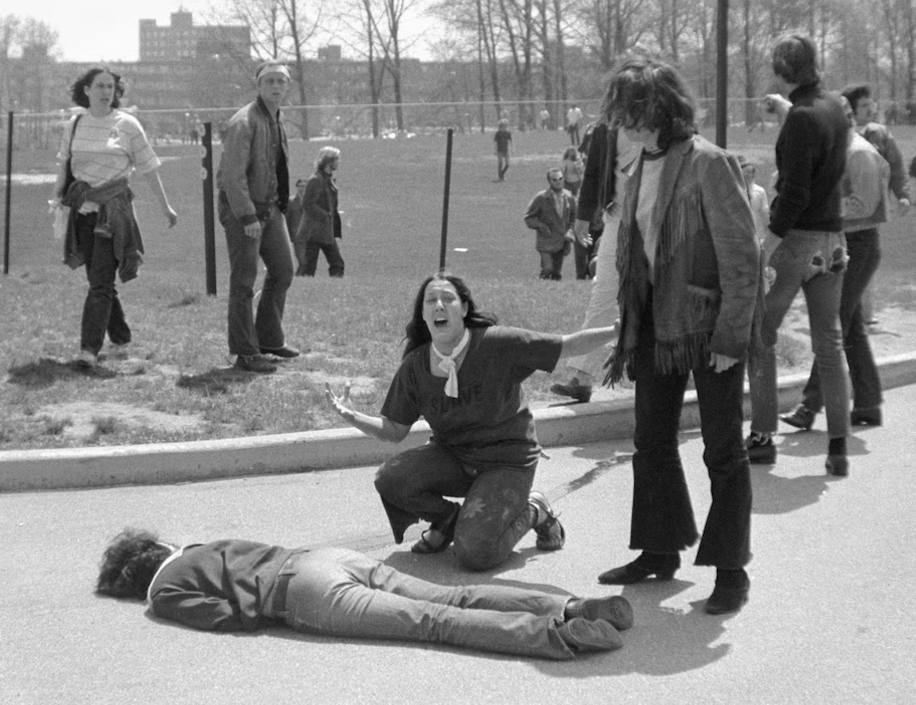
May 4, 1970. The world changed when 13 student protestors were shot and 4 killed by Ohio State National Guardsmen at Kent State University following the escalation of the “Vietnam War” into Cambodia.
Cleveland had experienced civil disorder in the hot summer of 1966 with the “Hough Riots”.
Governor Rhodes, who oversaw the state guard actions at Kent State, served for 16 years as the governor of Ohio from 1963-71, interrupted by constitutional limits, and then from 1975-83.
Like most major cities, Cleveland had two major daily newspapers, many radio stations and 3 network tv stations in the post-war era. Dorothy Fuldheim was a pioneering woman journalist who served throughout this period. She challenged the Kent State shootings.
I grew up in a small town of 4,000 people about 30 miles east of Cleveland, dominated by the Cleveland media. As a youngster, I delivered newspapers for the 2 big Cleveland and 2 local printers. Cleveland saw itself as a very major US city. 5th largest nationally in 1920. 8th largest in 1960. Cleveland was a major industrial supplier of the WWII war effort. It’s corporations greatly benefited from the post-war global industrial expansion. They struggled to face the 1970 challenges from international (Japanese) competition, environmental regulations, labor power/regulations, technological changes (IT, process), and consumer/retailer power changes.
The Cleveland economy was stagnant in the 1960’s and declining in the 1970’s. Locals supported the civil rights movement but recoiled from the Hough riots. The world was changing faster than the local economy and thought leaders could digest in 1969. With Kent State, the population and political leaders turned inward. The students were wrong. The guard did its job. A majority agreed. A substantial minority disagreed.
As a country we remain very divided, 54 years later.
The film “Network” expressed this passionate viewpoint in 1976. Economic and cultural changes were so great that people could not digest them. The difficulties of the 1960’s revolution continue 50 years later. Left and right both struggle with our situation today.
Donald Trump won. He improved in many demographic segments. The Republican Party won. The Democratic policies, politicians and messages lost. Democrats seems to be in denial.
Most are blaming someone or something: Biden’s late withdrawal, Kamala’s tight link with unpopular Joe, American sexism, Trump’s magnetic hold on the country, the media’s unwillingness to hold Trump and Republicans accountable for lies, plainly inaccurate or misleading claims, an uninspiring centrist platform, too many far-left positions that can be exploited by the opposition, billionaire dark money, Trump’s undermining of any normal frame of reference for character or policies through his years of speaking and acting that would have never been accepted before him, the thumb of the Supreme Court on political activities that benefit Republicans, Trump’s reassembly of the Republican Party into a personality cult where no opposition exists to provide options, discussion or pressures, the Republican news media’s amazing power to shape beliefs of Republicans, independents and Democrats, the undercutting of all institutional frames of reference (media, universities, FBI, DOJ, courts, churches, intellectuals, movies, civic organizations, business, schools, government), Republican manipulation of the state election systems to create a built-in advantages, the lack of a charismatic Democratic leader, polarized politics turns out politicians and their party every 4 years, a lack of belief in any politician or political party, a “what have you done for me lately” transactional politics from many voting blocs, the transition of minority groups from being solidly Democratic to better reflecting a normal distribution of left to right views, the global embrace of populism in a post Western, capitalist, democratic, human rights, global trade and development consensus, the inherent disadvantage of progressive parties who must deliver on their promises rather than oppose and check the misguided, unrealistic opposition. The list is unlimited.
There may be important content in many of these explanations. But, overall, they fail to focus on the two core issues. What policies, politicians and messages COULD be attractive to persuadable voters, either from the base or the middle? How does the Democratic Party reestablish itself as a credible voice to be considered?
The Center or the Edge?
This election once again confirmed that the US is an individualistic, capitalist, local, independent, freedom loving, patriotic, culturally moderate society. Economics and culture both matter. A supermajority of Americans wants moderate policies. They don’t really want revolution. This is a real problem for the idealistic wing of the Democratic Party which has grown from 5% to 20% of the country and 10% to 35% of the party. The national American electorate does not support policies that can be framed or challenged as extreme, costly, risky, uncertain, elite, cosmopolitan, global, socialist, irrational, idealist, utopian, etc. Whenever these more progressive policy options are promoted, the Republican Party wins at the national level. To have a chance of winning, the Democratic Party needs to have the discipline to frame policy options that deflect Republican counterattacks yet motivate the base to support the party goals. This is difficult, requiring creative development and communications.
First, take a firm stand as a center-left party and consistently reject “far left”, “new left”, “socialist”, “green”, and “postmodernist” policies that are so easily defeated. Second, focus on pragmatic policies that clearly benefit middle Americans economically. Focus on equal opportunity, rather than redistribution. Focus on basic economic fairness rather than demonizing the rich, the billionaires, the bankers, Wall Street, the 1%. See my RESPECT proposals. Focus on the middle class, not “the poor”. This strategy maximizes consideration from the persuadable voters at all income levels, in all locations.
What Do Citizens Really Expect from Politicians? Not Much.
There was a time when Americans required presidential candidates to meet high standards. Goldwater was thrashed because he was considered unstable by many. McGovern could not recover from his association with “acid, amnesty and abortion”. His running mate Eagleton’s mental health history was a big issue. Muskie could not recover from his public crying about one of Nixon’s dirty tricks and withdrew from the campaign. Bush Sr’s broken “no taxes” promise was fatal. Dukakis could not overcome the “Willy Horton” released prisoner crimes or the comic picture of him in a tank as a military leader. Kerry could not overcome the “swift boat” attack on his military career. Most importantly, Bill Clinton was elected because he convinced Americans that “I feel your pain”. His impeachment raised questions about presidential character that still resonate today. Democrats argued that personal matters are not all that important. This opened the door for Newt Gingrich and a purely “ends justify the means” approach to politics.
In a “postmodern” world, we’ve lost objective knowledge, truth or morality. We are wrestling with the loss of this agreed upon reality among our citizens and leaders. The 1960’s opened the door for a radically “relative” world view. The shift was jarring. As commentators noted about the Clinton campaigns in 1992, 1996 and 2016 we were still arguing about the 1960’s cultural revolution and the politics of the Vietnam War. The bottom line is that many citizens, left, right and center, no longer believe in a fixed, objective world defined by science, religion or natural law.
Hence, our expectations of politicians are very low. Solid truth, honesty, and objectivity are no longer required. I think what we see from Trump is that “authenticity” has been elevated to become the premier value. “I don’t agree with him but at least he is authentic. He does what he says. He is not a phony”.
We may be at a place where all we can expect is for them to keep “most” of their “largest” promises.
Political Grey Zone
We have a complicated situation regarding political ethics. We either believe there are core objective ethical values or not. In general, I see most Democrats of both left and center perspectives as ethical idealists. There is an ethical standard. We know what it is. We ought to follow it. I agree with respect to personal decisions. I’m not sure this is the best practical rule for politicians and political parties. I think that there is an element of “the end justifies the means” that applies to real world politics. We see the same tension between idealistic and pragmatic politics at the international level (real politic). I think that pragmatism must compete with idealism in real world politics.
One Very Important Hillary Clinton Debate Question
I’ll never forget when Hillary Clinton was asked what was either a “softball” or a “gotcha” question in a 2016 debate. “As president or secretary of state, are there times when you must lie or ‘manage the truth’?” Hillary gave the George Washington response, “I can never tell a lie”. I screamed at the television. Really? As Secretary of State? Our chief international negotiator? As a leader? As a motivator? As a communicator? As a politician? Trying to appeal to diverse coalition partners? As a presidential candidate, trying to engage both the base and the undecideds? As president, trying to lead the whole country? I think that my “in-authenticity” button was pressed.
I thought about salespeople, negotiators, purchasers, supply chain managers, account managers, marketers, persuaders, speakers …. The whole capitalist system is driven by these kinds of communications that blend facts, history, relations, cultures, promises, implied threats, incentives, short-term and long-term, risks and rewards, opportunities, possibilities. It’s complicated. That’s why we collectively invest so much in managing these relationships.
Politics is the same. International politics is the same. Why do we want to claim that our politics are perfect, pure, above board? They are not. They cannot be. They should not be. When political leaders pretend to be “holier than thou”, they lose credibility with a majority of the electorate.
We’re stuck in a moral grey area. We want to think of ourselves as ethical. But, to achieve our desired ends for society we cannot be perfectly ethical. I don’t have an answer as to where the line is, or the exact tradeoffs, or a perfect example of what to do. I am sure that there is a need to consider ethical ideals and political reality when making political decisions.
Don’t Compromise on Core Values
Don’t hold the country hostage to approve an increase in the deficit ceiling.
Don’t manipulate the election process to win.
Don’t embrace special interest groups to attract funding and votes.
Don’t use the judicial and administrative regimes to win political battles.
A party that can establish credibility here will possess a major asset.
Political Parties Must Deliver on Their Promises
LBJ as senator and president is exhibit #1. Whatever it takes.
Laws are like sausages, it is better not to see how they are made.
Ideals are “nice”, but I elected you to deliver. In a pragmatic, transactional world, results matter more than ever.
Some “Delivering Results” Examples
Inflation was growing rapidly in 2021. Biden needed to address it. Lower government spending. Pressure the Federal Reserve Board to raise interest rates. Apply “bully pulpit” pressure on corporations to not raise prices. Implement excess prices or excess profits controls under emergency presidential authority.
Immigrant volumes increased after Biden took office. Engage the military and national guard to “secure the borders”. Reallocate federal appropriations to “solve the problem”. Use the finances and political power of the US to intercept immigrants at the southern Mexican border.
Aggressive antitrust reviews and enforcement, given expressed Republican support.
Consolidate all welfare spending into a single bill to increase benefits while “solving” the problems of earned benefits and equity. Invest in “welfare fraud” investigators together with IRS agent funding.
Make a $15/hour minimum wage bill a top priority. Organize strikes to support it. Engage corporate supporters. Fine-tune the details to deal with teenager and agriculture exceptions.
Israeli PM Netanyahu wishes to wage war in Gaza and expand West Bank settlements. Provide a clear set of support and limits. Enforce the limits up to complete withdrawal of military support.
Create a “blue ribbon commission” on Social Security funding structured to ensure that the compromise recommendations will be approved.
Engage with Republicans to support policy proposals that benefit middle Americans.
Biden followed this “deliver results” strategy to cancel many varieties of student loan debt. A majority of Americans opposed this. it is only effective if most Americans agree. Delivering for the base or individual constituencies is inherently suspect.
Rapidly deliver visible “pilot project” results from the 2 large infrastructure bills that were passed.
Resolve the “temporary” status of the 2 federal home mortgage guarantee agencies.
Determine a long-term solution for the US Postal Service that provides some local mail delivery and reduced costs and employment.
The key to providing credibility is proactively finding solutions that meet the needs of the general public even when party supporters must incur some of the costs or risks of the solutions.
Summary
Democrats need to take a hard look in the mirror. They have lost the support of the American people. To recover, they need to refocus their policies on the economic opportunity needs of “middle America”. They must convince “middle America” that they have no extreme economic or cultural policy agendas. They need to deliver results that match their promises. There are no “moral victories” in politics. Parties must win elections in order to deliver results. When in power they must use all of the levers of power. Pragmatic means for progressive ends.
According to some on the left (and some on the right), the “wealthy, capitalists, billionaires or 1%” are evil, irredeemable, “vampire squids” only interested in making, keeping and growing wealth, power and influence. They say that the only solutions to this situation are to tax, regulate and publicize their finances and influence. Any number of laws should be enacted to fight against this force against the public good.
History shows …
The wealthy and powerful actively invest to protect and expand their wealth. In the United States, they have repeatedly “captured” the political system with two interludes of effective opposition during the progressive era and the New Deal from FDR to LBJ. Their tools include political contributions, network influence, legal actions, administrative agency capture, media control, social influence, lobbying, contracting, funding political parties and thought influencers. They can easily hire the most effective professionals to pursue their goals in all areas.
Wealth Will Find a Political Way
The American political system generally undermines centralized governmental power. [Although the imperial presidency under Trump with possible Supreme Court support will be a big test]. Federal agencies, the Senate, Congress, the President and the courts jockey for federal power and compete with state and local governments. Focused investments by a relatively small group of wealthy individuals have a strong chance of finding the weakest spots in “the government of the people, by the people and for the people”. If this group makes good choices in setting goals, investing in politics, selecting strategies and showing that they are willing to do “whatever it takes” to win, they attract political supporters and greatly leverage their relatively small investments and very small voting numbers.
Repeated Failures of Their Opponents
Progressives have tried to legislate their way to victory. The wealthy have fought back and reversed many of the gains in limiting their power to pursue greater wealth without limits placed upon them by other stakeholders: labor, consumers, investors, nations, nature, religion, or local communities. There have been some permanent gains in labor conditions/rights, consumer safety, environmental protection, progressive taxation, public education, public infrastructure, monopoly regulation, anti-discrimination, etc. There are some real changes between 1850 and 2020. No one wants to turn back the hands of time.
Yet, on the enduring core political issues, the wealthy have successfully pursued counter-offensives. Lower taxes of all kinds. Undermined support for government and government services. Judicial challenges and rulings. Weakened regulations.
They have maintained effective control of the Republican party for 175 years. They have partnered with middle America, urban elites, WASP America, industry, corporate America and small business/entrepreneurial America, mainstream and fundamentalist religion, anti-slavery and states’ rights groups, Main street America, rural America, southern America, sunbelt America, isolationists and pro-traders, anti-communist hawks and America firsters, assertive neo-conservative foreign policy wonks and inherently defensive thinkers, promoters of American power through international relations and doubters, international free traders and mercantilist tariff warriors, libertarians, the professional class and the working class, skeptical protestants and conservative true believers, farmers and bankers, philosophical conservatives and political pragmatists, fiscal conservatives and political idealogues, preserving and restoring American culture, separation of church and state versus promoting one religious group, liberal and conservative social policies, the mainstream media is authoritative or fake. The end justifies the means. Some coalition of voters and interests can always be assembled to support their core financial interests.
The defenders of wealth have effectively shaped political debates by prioritizing issues, framing positions and policies to be considered, crafting favorable and unfavorable language and stories, shaping debates against extreme strawman positions, and polarizing positions. Democrats have attempted to use the same techniques but have been much less effective. Democrats have also shifted their positions on issues and reassembled their coalitions through time but been unable to secure a solid base of support in the last 50 years. They repeatedly point to a demographic “emerging majority” and the “rightness” of their causes and hope for more success soon.
Root Cause Analysis
Why does a small group of wealthy individuals consistently capture one political party and oppose efforts to reduce their wealth and power? Are they unusually evil? Is there a “class interest”? Don’t they care about our country and those less fortunate? I think there are two key factors. First, we have lived in an individualistic, relatively equal opportunity, relatively meritocratic economy for two centuries in the US. The economic winners can honestly look in the mirror and say, “I earned this”. [note the Obama buzzsaw around “you didn’t build this”]. Like each of us, they exaggerate their own merits and discount chance, privilege, inherited assets, opportunities, and ethical choices. Second, they have such great assets that they must protect them. The scale of accumulated wealth in the US is almost [or actually] beyond comprehension. Current GDP is nearing $23.4 Trillion, up 10 times in real terms from $2.2 Trillion in 1947. Stop for a minute to let this sink in. The US was truly the savior of the world in 1947. We now have 10 times as much wealth, resources, assets, power. Real $ GDP in 1850 was only $62 Billion. Real GDP increased 35 times in that century, perhaps the most amazing century of growth in world history, despite the Great Recession and WW II.
America has grown its population, its productivity/per capita GDP, and its corporate profits by at least 350 times in the last 175 years. A million here and a million there, and pretty soon you have real money. This is the power of compound interest. Wealth begets wealth. This is Thomas Piketty’s point.
A well invested portfolio provides 3-5% real returns per year. It accumulates to infinity sooner than you might imagine.
So … America has 350 times more annual economic output than in 1850. The wealthy have captured more than an equal share, so their wealth per person has grown 500-fold. Digest this ratio. There are more wealthy individuals. The winnings are divided across a larger population. Wealthy individuals control 500 times more assets per person than they did in 1850.
Average incomes have also increased. The reported $144/month for farmhands with board in 1850 becomes $5,800 today with 40X inflation. The current median income is $37,600, so the “typical” worker is 6.5 times better off today than in 1850.
The bottom line is that wealthy individuals or families have tremendous wealth to “manage” or protect. Some will highly value the other factors that produced their wealth and their obligations to society. Others will discount them and be the leading investors in political actors to preserve their wealth even though they too will face the “free rider” dilemma. Why should I invest to protect my wealth if others will do so for my benefit? As wealth has grown, a greater share of wealthy individuals has rationally invested in the political system to protect their wealth.
What is the Greatest Risk?
Wealthy individuals and families have much to worry about. If you have a billion dollars of assets, there are many risks and obligations, duties and responsibilities, social obligations, political interests, generational interests, black swan risks, portfolio effects, opportunities, and legacies. I would argue that the greatest risk is posed by democracy. Plato, Socrates and Aristotle all pointed to pure democracy as a threat to the wealth of the ruling class. This was clear when extreme wealth was a mere 1/1,000th of the level today. The individuals with the lowest incomes and wealth could use the power of the state to capture a greater share. Everyone thinks that they deserve more. This is human nature. The many outnumber the few. In a pure democracy they will “take from the rich”. They might reduce the top quintile by 20% to benefit the bottom 3 quintiles. They might flatten incomes. They might confiscate wealth. They might confiscate ALL wealth. This is the greatest fear of the economic winners in our society. The political system might “take” more than half of their income and all of their wealth. Wealthy individuals are “highly motivated” to prevent these outcomes. This is not spoken of “in polite company”.
Removing the Greatest Risks
Although most Democrats, liberals, leftists and progressives have an intuitive sense that they must fight wealth and power because it is right and fair, I argue that we ought to agree to permanently remove the risk of significant confiscation of wealth and income from the economic winners in our society. As those who claim to look at the big picture and the long run, we should set limits on how much income and wealth redistribution is required to meet our goals of a fair and prosperous society.
We should agree to set permanent structural limits on these areas. Enact constitutional amendments to clarify the redistribution limits of our society. We are so much wealthier today as a society.
JK Galbraith in 1958 was way ahead of the people in 1958 with his Affluent Society argument.
The wealthy can “make do” with a lesser share of our continually growing wealth. But no one wants to lose or give up what they have. This is human nature. I think the time has arrived to stop fighting the economic redistribution war that has never been won and find a solution that can gain support from a majority of wealthy individuals.
Federal marginal income tax rate shall not exceed 50%.
Combined wealth or property taxes shall not exceed 3% of value per year. Zero tax rate on the first $50 million of assets.
Any inheritance tax rate shall not exceed 15% of net assets received. First $5 million of assets is tax free. 10-year interest free period provided to pay inheritance taxes in excess of $100,000.
The tax rate on long-term capital gains shall not exceed 75% of the tax rate on earned income. Any long-term capital gains tax must include a deduction for at least 50% of the inflation rate during the asset holding period.
Any tax on financial transactions shall not exceed 0.5% of the transaction amount.
Fix the independence of Federal Reserve Board to pursue its joint goals of minimizing inflation and unemployment.
Limit the federal workforce to no more than 1% of the US population.
Require Congress to pass a budget each year that reduces any prior year budget deficit by one-third whenever the unemployment rate is 5% or lower.
Require the Treasury to pay any legally incurred debts of the government in a timely manner (no government shutdown crisis risk).
Limit federal government net spending to no more than 25% of prior year GDP, which restriction may be waived by the President with concurrence of at least 50% of the Senate in times of war or national emergency.
No limit on charitable deductions for donations to governments as an offset to earned income for federal taxation purposes.
Maximum corporate income tax rate of 30%.
Corporations are not considered persons. They do not have “free speech” rights with respect to political contributions.
State and federal election campaign communications shall be funded solely by the government and the active period of campaigning and voting shall be limited to 6 months or less.
If citizens do not agree with 100% government funding of political campaign communications, then individual or corporate contributions to any political organization shall be publicly reported each quarter.
Summary
Wealthy individuals and families have great wealth to protect. As a nation and society, we have an obligation to eliminate this concern from being a primary role in our political decisions. We can set reasonable limits on the maximum contributions required from prosperous individuals in our society. Many left-leaning individuals are focused on increasing the share of taxes paid by wealthy individuals on an equity basis. I argue that the nation would be best served by setting maximum taxation limits. Wealthy individuals might prefer lower tax rates, but they will be able to relax knowing that there is a limit on what political groups might choose to extract. Fewer would be highly motivated to invest extraordinary amounts in our political system if their greatest risks were already protected.
I encourage national Democratic Party leaders to quickly acknowledge that the American people have chosen to support candidate Trump’s policy proposals. They need to find areas of agreement and work quickly with the new president and his party to support and implement policies where agreements can be found. Democrats ought to fight against other proposals that they cannot support.
Support proposals that help the working class and middle class.
Eliminate taxes on tips income.
Eliminate taxes on social security income.
Increase the child tax credit from $2,000 to $5,000.
Eliminate taxes on overtime pay premiums.
Cap credit card interest rates at 10% – 15%.
Fix an earlier attack on states’ rights.
6. Eliminate the $10,000 federal tax limit of state and local income tax (SALT) deduction.
Take reasonable steps to pursue American foreign policy goals.
7. Negotiate a settlement to Russia’s invasion of Ukraine.
8. Negotiate a settlement to Israel’s response to being attacked. Leverage world opinion to impose a settlement that creates a Palestinian state that is better for everyone.
9. Negotiate a trade deal with China that promotes “fair trade”, environmental equity, labor equity, and protects American intellectual property.
10. Pressure NATO allies to commit to 3% of GDP commitment to national defense spending by 2030.
Protect American borders.
11. Pass the compromise border security bill negotiated in 2024.
Control government spending.
12. Appoint a “blue ribbon commission” to identify systematic ways to reduce federal government spending. Include Democratic members.
13. Support a “balanced budget” constitutional amendment. Find language that forces Congress to reduce spending or increase taxes when material % of GDP budget deficits exist in a “full employment” economy. For example, “When Federal Budget deficit exceeds 2% of GDP and unemployment is less than 5%, Congress shall reduce the deficit by at least 33% in the next year”.
Address the Social Security funding situation.
14. Appoint a “blue ribbon commission” to recommend a combination of tax increases, benefits limits, inflation measures and age qualifying rates that ensures promised social security benefits will be paid for the next 50 years.
Address Health Care Costs
15. Appoint a “blue ribbon commission” to recommend methods to systematically reduce total health care costs as a percentage of GDP by 5% by 2035.
Summary
Democrats and Republicans need to look out for the interests of all Americans. There are big issues where compromise solutions must be found. Democrats should step forward and provide a list of areas where they are willing to work with the new president to serve the American people.
America is often described as an “individualistic” society. Sometimes as a compliment. More often as a criticism.
The positive reviewers note that it incorporated John Locke’s individualistic principles to form the first “classic liberal” democracy which has endured for more than two centuries of geographical expansion, rapid population growth, technological and social changes and foreign challenges. They argue that it demonstrates that a federal system of checks and balances, limited government and preservation of individual liberties can be economically and socially successful. Such a government can be effective even with diverse racial, ethnic, class, political and religious interests.
Only the Individual
The critics say that the society has always balanced individual and community interests, that the government system relies upon a strong culture of shared values and that “rugged individualism” is a myth that has been used to provide political support for laissez faire capitalism.
The heroic, self-sufficient individual has been promoted throughout American history. Washington and the founding fathers were memorialized. Jefferson’s ideal of the independent citizen farmer still resonates. Jackson further elevated the importance of the common man as central to American success. The explorer, pioneer, frontiersman, Lewis & Clark, Daniel Boone, and the self-made man were celebrated. The citizens and leaders who spread the new American individual rights across the continent were hailed for bringing about a new society, an example for the world to follow.
Americans embraced Thoreau’s retreat, Emerson’s “self-reliance”, Franklin’s “common sense”, Horatio Alger, cowboys, private detectives, military, political and superheroes. Proponents of laissez faire capitalism contrasted natural property and individual rights against unnatural government interference during the Gilded Age. Carnegie, Ford and Hoover promoted the same ends at the turn of the century highlighting the progress driven by individual inventors and owners. Hayek, Rand, Goldwater and Reagan argued that FDR style government was illegitimate and threatened the liberty and security of the nation, while praising job creation, technical innovation and entrepreneurs.
The Reagan revolution re-established the intellectual and popular legitimacy of holding conservative social and economic philosophies. Some successors pressed the arguments further, equating taxation with theft, comparing job creators and job killers, questioning the motives and results of government departments and employees, and promising no new taxes under any situation. “The self-sufficient individual is great, government is bad”, they said.
Community Plays a Supporting Role; Not a Leading Role
The role of community tends to get lost in the shadow of the great liberal versus conservative battle over the role of the state in “regulating” the economy and society. Most historians, political scientists and commentators agree that the American political system was constructed upon the assumption that citizens would share a common Christian culture with objective virtues complementing the God-given rights and responsibilities of citizens. The authors of the Federalist Papers, the Constitution and the Bill of Rights understood that this social glue was needed to support a democratic system of checks and balances, especially as the young nation expanded its small population across the Appalachian Mountains. They promoted “freedom of religion” but also relied upon enduring religious belief and participation. The founders held classic conservative ideas about the necessity of individuals to possess a sense of civic duty to participate in government, willingness to sacrifice for the common good and a commitment to the institutions of collective self-government.
Community is eclipsed by individualism in the public’s mind for many reasons. The promotion of liberty-loving and economically productive individuals who require only minimal government. The ease of highlighting outstanding individuals and individual types in the arts, journalism, history and marketing. The complexity, abstractness, variety and organic nature of community functions. The overlap of community and government when contrasted with “rugged” individualism. The soft, feeling, unmeasurable nature of community. The supporting rather than leading nature of community. The limited visibility of many community functions.
Community relations and results are exhibited throughout society. First, in the relations between citizens and their government. In the many voluntary associations that diverse citizens create and join in a nation with limited government and services. In local residential communities. In business, trade and agriculture. In the arts, travel and entertainment. In government organizations. In the country as a whole.
Community Is Essential for Democratic Government
The American government plan is based upon a relationship between the citizens and government. The citizens/individuals exist first and create the government. At the same time, they commit to fulfilling their duties as informed voters, candidates, soldiers, jurors, parents and supporters of the government and its institutional parts. Although the architects of the government warned against it, people soon clustered into political parties, movements and special interest groups to represent their interests. These parties have supported individual human, social and economic rights and the collective interests of classes, geographic areas, professions, industries, religions, ethnicities, sexes and races. Self-government requires a balance between the community and the individual.
The framers of the US Constitution were looking to the future. The US population was less than 3M in 1776, reaching 5M in 1800 and almost 10M in 1820. In today’s terms that’s the same as the states of Mississippi, South Carolina and Michigan or the metro areas of Charlotte, Phoenix and Chicago. This was a collection of 13 small states making sure that the central government would not become a tyrant. In 1780 the UK had 10M people, Spain 14M, Italy 16M, Germany 23M and France 28M. The US was about the same size as Sweden, Netherlands, Switzerland, Portugal and Belgium.
Community Through Voluntary Associations
The large role of voluntary associations in filling the services gap between citizens and limited government was a distinct feature of the early USA, described by Tocqueville in his famous 1835 “Democracy in America”. He noted that class was absent, no religion denomination was dominant, people were preoccupied with economic affairs and the government’s role was small. Religion actively shaped lives. Citizens created voluntary organizations to fill every need: universities, fraternities, sororities, professional associations, libraries, fire companies, hospitals, seminaries, prisons, missionaries and schools. In a sparsely populated new world composed of immigrants or their descendants the “rugged” individualism required for survival was paired with a deep commitment to community based upon necessity, civil and religious beliefs.
America experienced an explosion of new associations between 1880-1920 in response to the challenges of urbanization, immigration and industrialization. YMCA, civic organizations, social organizations, scouts, Chautauqua institute, women’s movement, professional organizations, conservation organizations, mutual aid associations, settlement houses, service clubs, prohibition clubs, cooperatives, social gospel services, community funds, credit unions and unions.
Community Through Religion
America was a very religious place from the start. The Puritans, Quakers and other Christian denominations practiced their faith in congregations, even if sin and being saved were deemed individual matters. Religious groups impacted civil society. The Great Awakenings were communal events leading to the modern era crusades of Billy Sunday and Billy Graham. Colleges and universities were mainly founded by religious denominations with religious influence extending into the late 20th century. US religious membership and participation declined 50 years after such changes in Europe.
Residential Community
The New England township model of direct democracy and the Northwest Territory same-day horse ride county government model that followed encouraged participation in local government. This engagement together with funding and delivering government services created a deep sense of local community even as the model spread across the Great Plains to the Rocky Mountains. We still see the county seat, county square, county courthouse model. This local community model continued in urban neighborhoods, suburbs and housing developments with HOA boards and services. Urban machine politics were based on the local precincts. Urban immigrants clustered in ethnic neighborhoods with familiar faces, languages, customs and churches. Conservative philosopher Edmund Burke praised the “little platoons” of family, kinship and neighborhood as the basis for teaching social skills and holding the larger community together. The individual was complemented by a meaningful local social and political community for most Americans through time.
Community at Work
America began as a farming nation with a few urban traders. Jefferson emphasized the importance of maintaining a high proportion of land-owning farmers who would be incentivized to take care of their families and participate in managing the shared resources of the community. Land was inexpensive, so agriculture was able to expand for more than a century.
Even agriculture was never solely about the individual. Family farms, shared harvest time, barn raising, going into town. Land grant universities developed agricultural science and local extension agents shared their knowledge. Grange organizations. Coops. Farmer-labor populist political parties. Farm banks. Political influence and programs. Rural electric coops.
Business and manufacturing were small scale originally. With access to natural resources and transportation, American manufacturing grew rapidly starting in the 1840’s. Many inventors and capitalists. Much wealth was created in the 19th century.
Manufacturing grew and organizations developed more effective administration. The railroads, steel, coal and limestone required social organization on a larger scale. The automobile and electricity spawned even greater innovations including vertical integration and the assembly line. Unions formed to balance the owners’ power. Industrial and trades unions viewed themselves as brotherhoods. Large economic organizations became the daytime home for most workers. Professional and industry associations grew to serve the needs of their members. New community ties were formed.
Further corporate growth through 1930 and then another boom after WWII. “The business of America is business”. “What’s good for GM is good for America”. Although it is rarely recognized today, the development of effective businesses that employed thousands and even a million people was and remains an historic social achievement, overcoming the different interests of those individuals. Corporations also developed social innovations such as R&D teams, joint ventures, outsourcing, project management, functional departments, divisions, cross-functional and lean teams to balance individual and collective interests.
Community in Leisure
Americans were always sensitive about being less cultured than their European peers. They invested in seminaries, universities, libraries, printing presses and theatres. They applauded American writers and artists. Itinerant preachers shared news and thoughts. Public lectures, pamphlets and news editorials were consumed. Theatre and orchestras expanded in the cities. Leisure time brought sports. Magazines boomed and circulated. Circuses and lecturers visited. Universities offered public lectures. Radio and movies greatly increased the consumption of high and popular culture. Orchestras and big bands entertained. Movie stars and lead singers gained fame. American jazz, swing, blues and rock and roll grew. Large attendance concerts began. Community was built and reinforced.
Community in Government
US government organizations were quite small historically. Mostly import tax collectors and judges. The government’s role grew with Hamilton’s national bank. The government began to invest in infrastructure like roads, ports, canals and railroads. The military grew and established forts to protect the settlers. It developed its own strong collective culture. Land grant universities and the continental railroad started in Lincoln’s time. The post office and pony express grew. Rivers were managed to provide reliable transportation, electricity and recreation. Interstate highways and airports were built. The government grew dramatically under FDR as a service provider, regulator, research sponsor, investor and owner. Although the 3 million Federal government employees get the most attention today due to the impact of their work, state and local governments employ 19 million, more than 6 times as many. Government employees are more likely to be unionized, serve long careers and view their work as serving the community.
American Community
The idea of a distinct and important American culture dates to the country’s founding as a breakaway republic seeking to preserve “the rights of Englishmen”. The country’s government, economy, immigrant citizens, diversity and shared war efforts shaped its self-image. Many saw the United States as a special country created to be a positive example for the world. “American exceptionalism” was described by both its citizens and Europeans. The individual based political system, the role of churches in shaping daily life and the large number of voluntary associations all played a role in describing the character of everyday life, hopes and dreams. Given its location between 2 oceans, the US mostly followed an isolationist path until WWII. Since then, it has seen itself as a global defender of democracy against communist and totalitarian states. The US has maintained elements of its individual, religious and associational character to this day.
The Role of Community Changes Through Time
Robert Putnam’s series on “Bowling Alone”, “Our Kids” and “The Upswing” documented how American social institutions have evolved through time to address new needs and how participation and engagement have risen and declined across long periods of time. During the Great Depression soup kitchens, potluck suppers, community gardens, small scale retail and personal donations complemented government programs. During WW II victory gardens, scrap collecting, bond sales, rationing, black outs, civil defense clubs and female factory workers contributed to the war effort. The post-war era saw a boom in sports, civic, neighborhood, professional and religious participation followed by a reversal at the end of the century. During the 2020-23 pandemic the country experienced lockdowns that highlighted our economic and social interdependence and the negative consequences of isolation.
Community is an essential and integral part of modern life. It operates in many dimensions. We need to recognize its critical role in complementing the individualistic view of the world.
I grew up in Greater Cleveland as a proud buckeye in “the best location in the nation” 1956 – 74. Learned about demography in my first 1974 quarter at New College in Sarasota from Dr. Peter Hruschka. Transferred to Indy in 1988. Remained ever since. Slowly became a “Hoosier”. Started documenting the Hoosier population in 2009, including the exceptional growth of our suburban Hamilton County.
The urban counties have tripled in growth. The others remain flat.
Rural America was behind in 1960. It was much further behind in 1980. The gap has continued to grow. This has huge political implications. George Wallace, Spiro Agnew and Richard Nixon deeply understood this in 1968. Not sure my Democratic party has yet caught on.











 Good News