Trust in the DOJ and the FBI

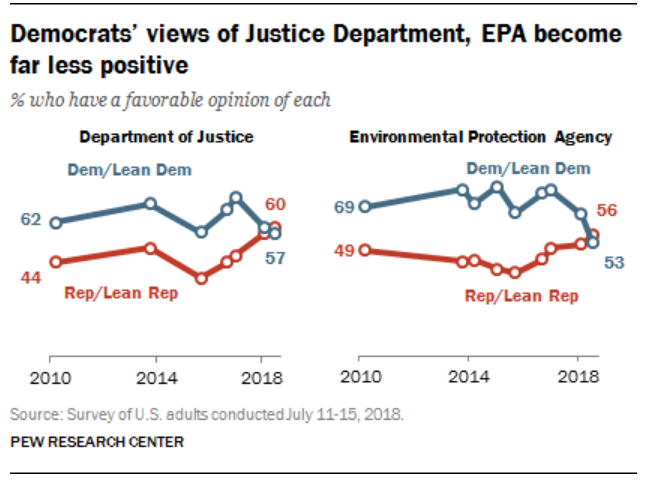
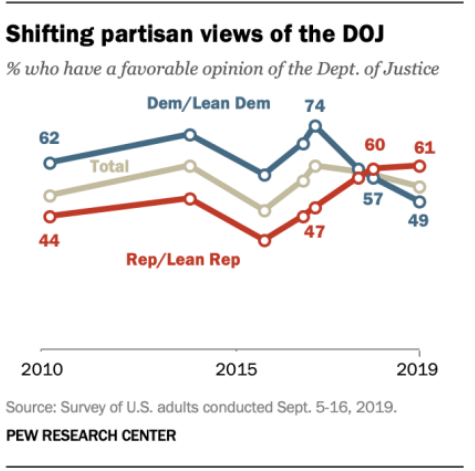
Republican Trust in the DOJ Has Improved Significantly Since 2015

https://www.pewresearch.org/politics/2018/07/24/growing-partisan-differences-in-views-of-the-fbi-stark-divide-over-ice/
https://www.pewresearch.org/politics/2019/10/01/public-expresses-favorable-views-of-a-number-of-federal-agencies/
https://www.pewresearch.org/politics/2020/04/09/public-holds-broadly-favorable-views-of-many-federal-agencies-including-cdc-and-hhs/

Trust in the Department of Justice (DOJ), overall, has been relatively flat. Republican support has increased while Democratic support has dropped.

Historically, Republicans Strongly Supported the FBI

https://fivethirtyeight.com/features/why-democrats-and-republicans-did-a-sudden-180-on-the-fbi/
https://www.pewresearch.org/politics/2018/07/24/growing-partisan-differences-in-views-of-the-fbi-stark-divide-over-ice/

Historically, Republicans have been conservative, supporting the police, military, FBI, defense, “law and order”, criminal justice and “black and white” law enforcement. While the DOJ and some other federal agencies have been staffed by left-leaning coastal elites, the FBI has been staffed by more conservative leaning individuals.

https://www.politico.com/story/2016/11/fbi-donald-trump-base-230755

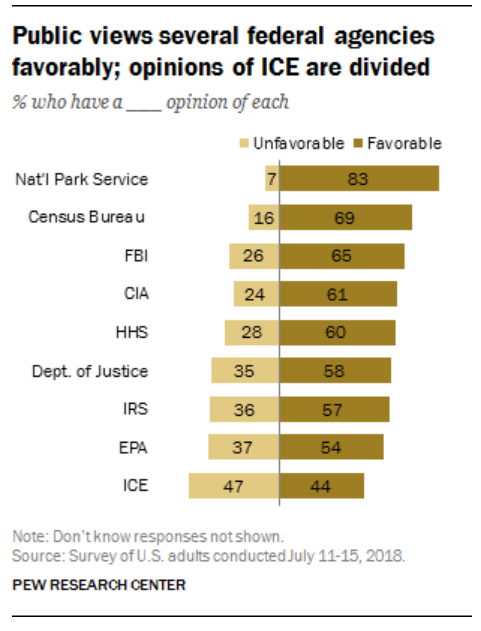
Overall Support for the FBI has Remained High, but has Become Polarized

https://www.pewresearch.org/politics/2018/07/24/growing-partisan-differences-in-views-of-the-fbi-stark-divide-over-ice/
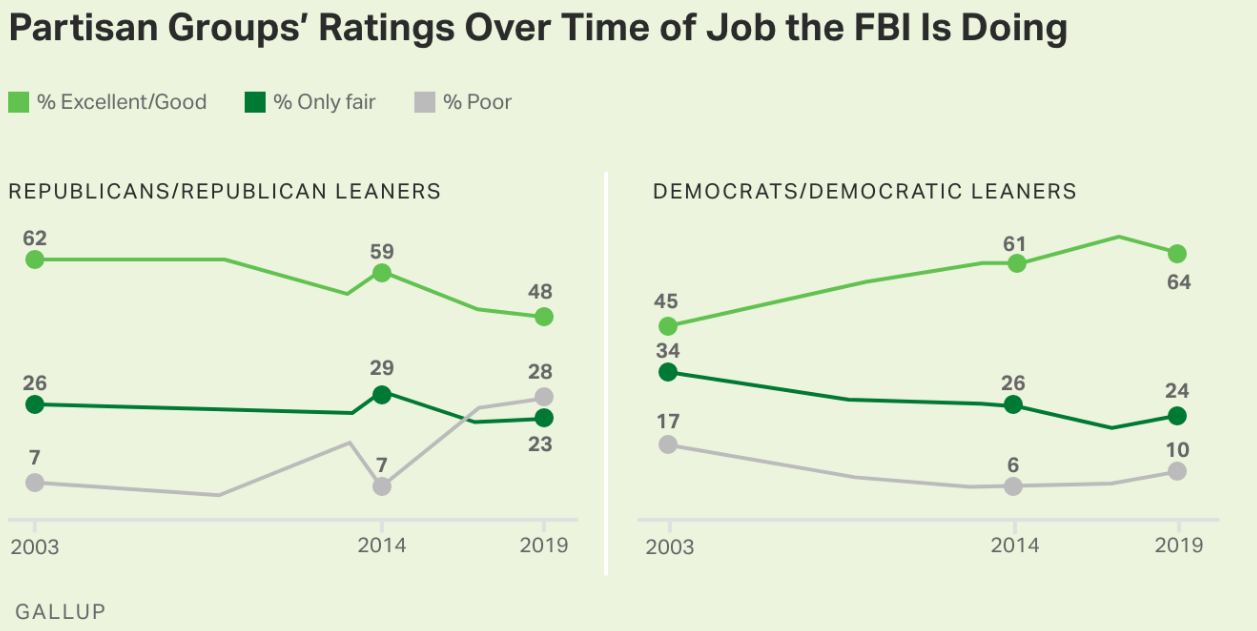
https://news.gallup.com/poll/257489/fbi-positive-job-ratings-steady-among-americans.aspx
https://www.pewresearch.org/politics/2019/10/01/public-expresses-favorable-views-of-a-number-of-federal-agencies/

Different survey questions produced different results, but the FBI is one of the most respected federal agencies.

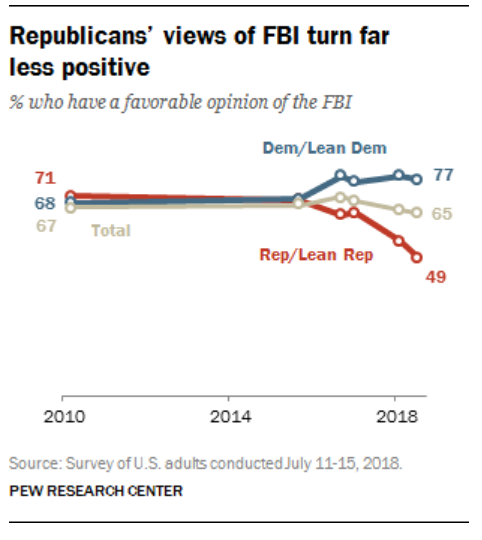
Trump’s 2018 Attacks on the FBI Drastically Reduced Republican Support for the FBI (see above and below)

https://www.pbs.org/newshour/politics/fbi-support-is-eroding-but-most-americans-still-back-bureau-poll-says

The Republican versus Democratic split widened.

https://www.vox.com/latest-news/2018/2/3/16968372/trump-fbi-republican-poll-confidence

https://www.huffpost.com/entry/republican-confidence-in-the-fbi-has-dropped-since-2015_n_5a721bbbe4b09a544b5616a7

https://ssri.psu.edu/news/mccourtney-institute-mood-nation-poll-examines-public-trust-fbi

Republican’s Response to Trump’s Claims Were Severe

https://democracy.psu.edu/poll-report-archive/poll-report-republicans-no-longer-trust-the-fbi/
https://www.huffpost.com/entry/republican-confidence-in-the-fbi-has-dropped-since-2015_n_5a721bbbe4b09a544b5616a7

https://www.politico.com/story/2018/02/03/conservatives-fbi-trump-republicans-389076

Republicans Were Much Less Supportive of the FBI in 2019 versus the Democrats

https://www.pewresearch.org/politics/2019/10/01/public-expresses-favorable-views-of-a-number-of-federal-agencies/
https://news.gallup.com/poll/257489/fbi-positive-job-ratings-steady-among-americans.aspx

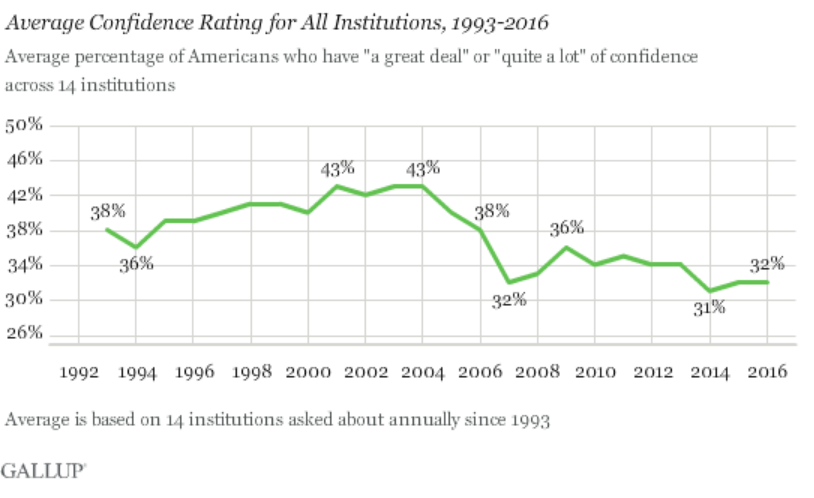
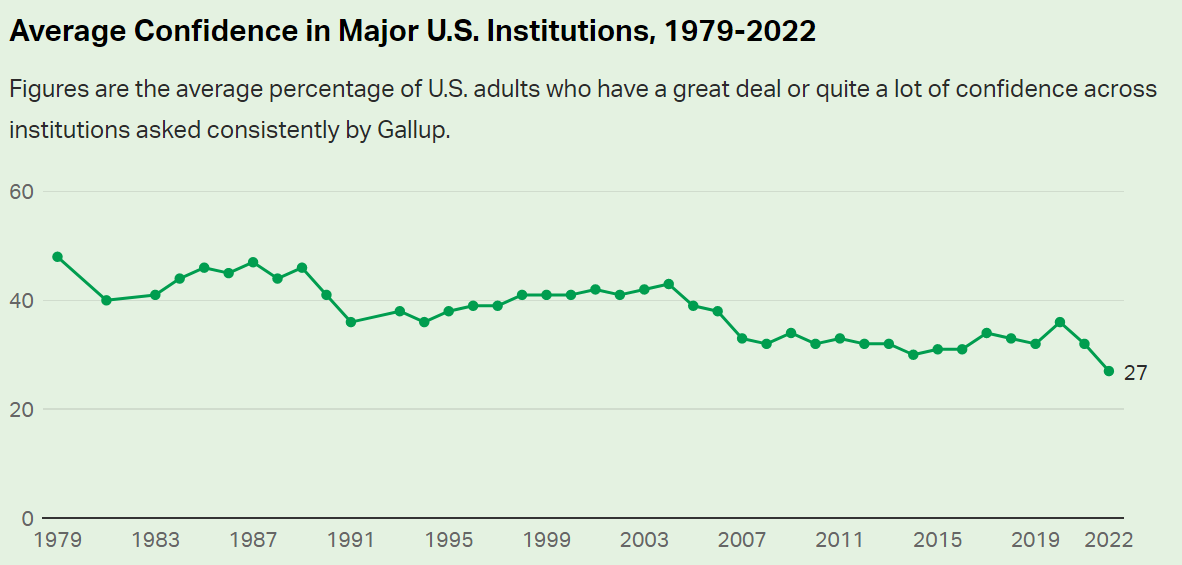
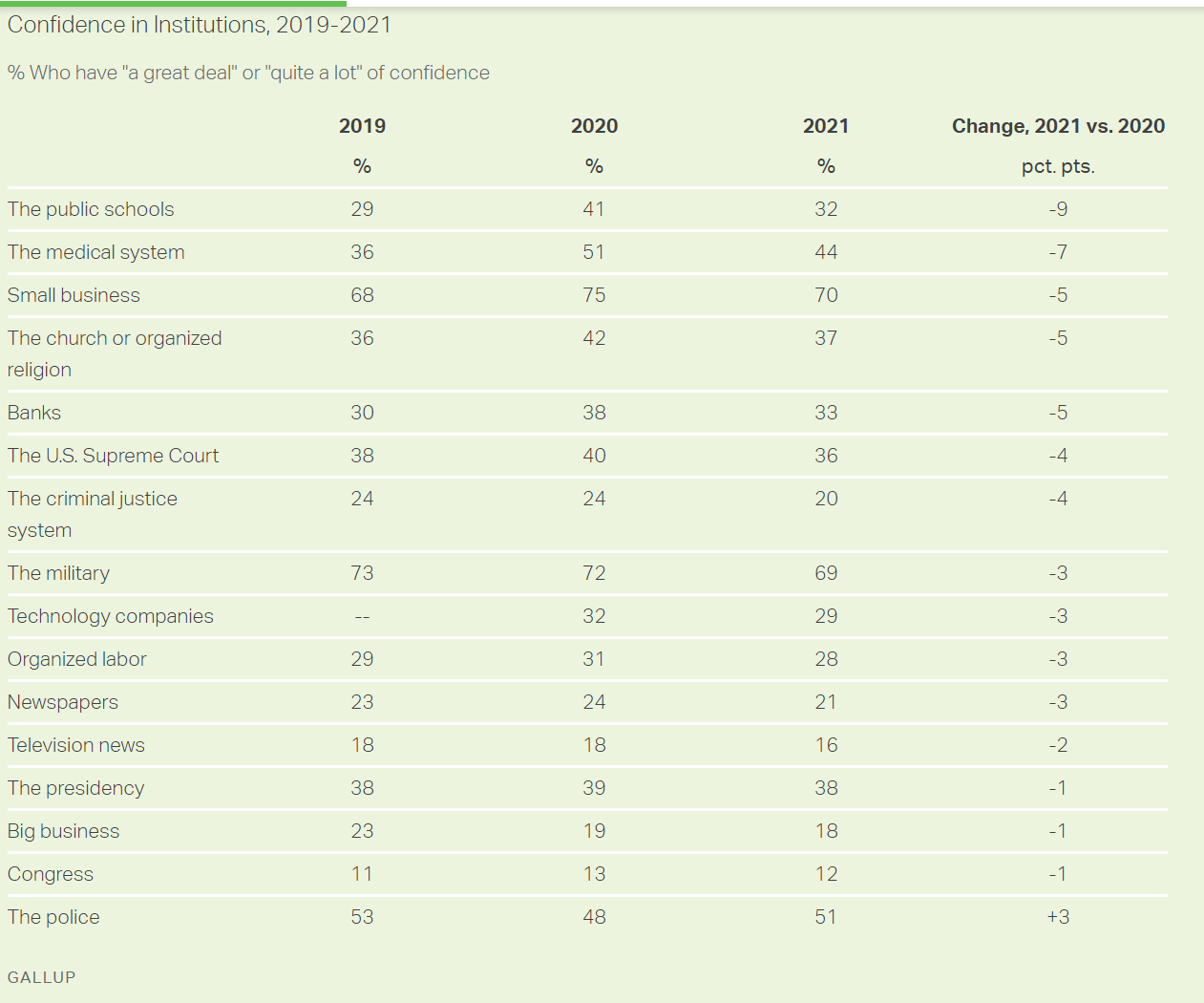
Context: Americans’ Belief in or Trust of Institutions Has Been Declining for Decades

https://news.gallup.com/poll/192581/americans-confidence-institutions-stays-low.aspx

Huge 10% drop in the middle of George W Bush’s presidency. 5 institutions with 10% or greater drops in support.

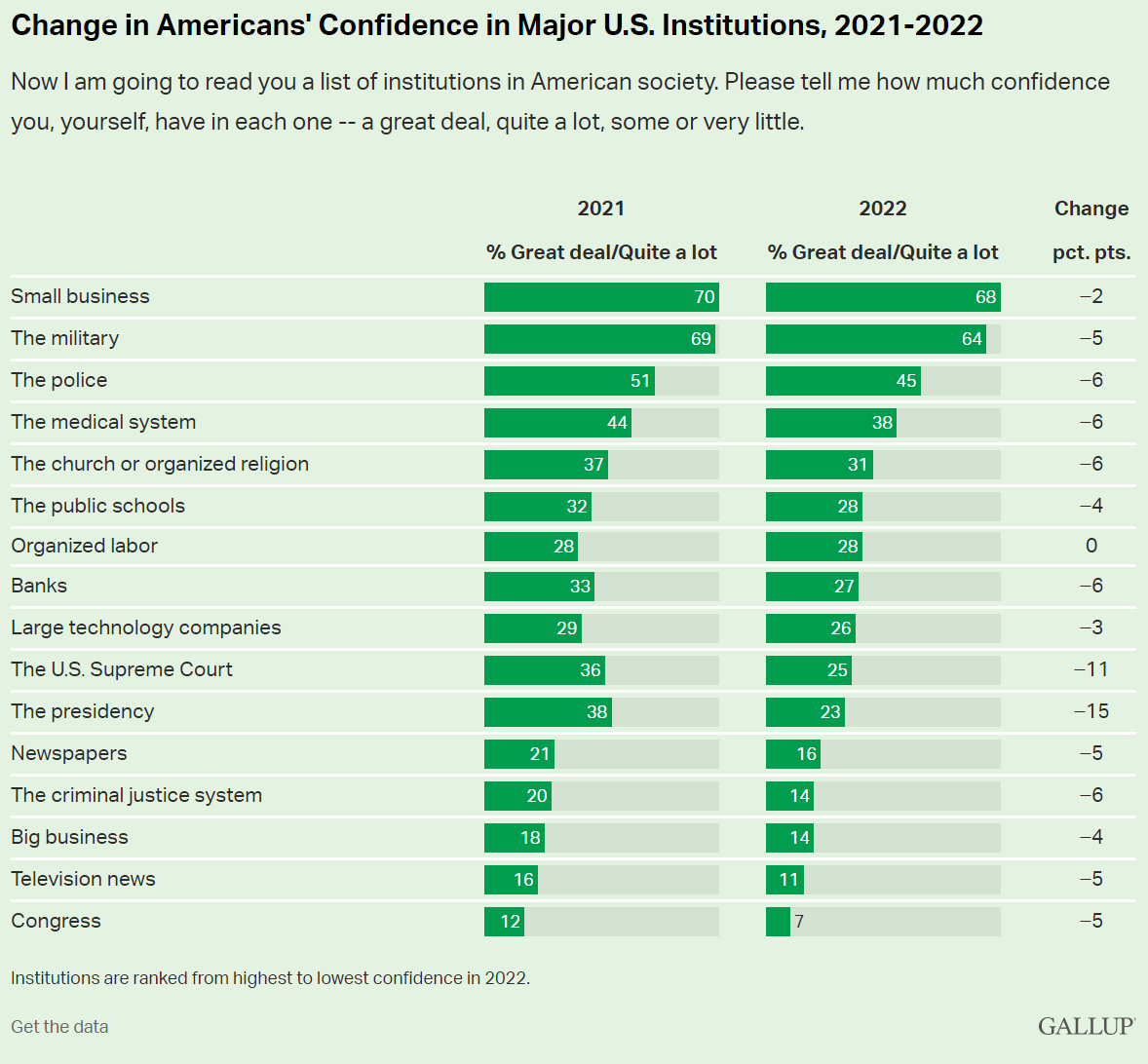
https://news.gallup.com/poll/352316/americans-confidence-major-institutions-dips.aspx

Widespread further decline in support of “institutions” during the pandemic.

https://news.gallup.com/poll/394283/confidence-institutions-down-average-new-low.aspx

The broad decline continues in 2022. Can it continue?

I’m Very, Very, Very Scared

538 has a similar article but refuses to link directly. Worth your time to query and copy.

“What Happens When Americans Don’t Trust Institutions?”

If only one-quarter of Americans trust in its basic institutions, how can we have democracy and capitalism and “western civilization”? If “everything is broken”, then we need a dictator or a revolution. Really? Really? Really?

I have to blame the 16 year-old me for some of this. In 1972, we were all opposed to “the man”, “the organization man”, “the establishment”, etc. We were children of the hard-won victory of democracy and capitalism against fascism and imperialism and communism. We believed in progress, science, growth and possibilities. We were skeptical about the Vietnam war, the military, McNamara and his whiz kids, General Curtis LeMay, big corporations, compromises, limitations, bureaucracy, bigness (small is beautiful), population growth, technology, etc. Many of us deeply believed in a romantic idealism or utopianism, making stodgy historical institutions so irrelevant.

Fast forward 50 years and I (we) possess a fundamentally conservative view, embracing the need/value of institutions and channeling our inner Edmund Burke to emphasize the value of the accumulated wisdom of society.

https://en.wikipedia.org/wiki/Edmund_Burke

So, the overall decline in trust of American institutions is a real challenge. The decline in trust in the FBI is clearly (IMHO) a Trump driven result. This, too, is a real challenge to our democracy. Do we (I) really believe that the leadership and staff of the FBI have abandoned their democratic principles which we have lived and supported for almost 250 years? I don’t think so. But the decline in trust/belief in all institutions combined with the increasingly politically polarized view of individual institutions makes this a reasonable view for many of our fellow citizens. We have much, much work to do in order to preserve our institutions, government and society.

US Recession? Probably Not Yet

https://www.un.org/en/coronavirus

I tried to find a “mainstream media” article that objectively and insightfully evaluates the state of the US economy as of the end of the second quarter without success. So, I’ll take a shot at it.

First, I want to highlight that “this time, it’s different”. The US and global economies are recovering from a global pandemic situation last seen more than 100 years ago. The global economy is more integrated than ever. Viruses spread faster than ever. Businesses and governments have more information and ability to change quickly than ever before. The economic contraction was sharp, far more severe than the Great Depression or the Great Recession. The health care experts were unable to immediately evaluate the threat or recommend public policies. Nonetheless, “they persisted” and the medical, travel and economic recovery was far quicker than ANYONE expected in March, 2020 or December, 2020 or September, 2021 or January, 2022.

Second, I apologize for the required details involved to evaluate the simple question, “are we in a recession?”. Unfortunately, there is some judgment involved, as we have to evaluate three factors. Is there a clear downturn versus the trend rate? Is the downturn of significant length? Is this a widespread downturn, effecting most sectors of the economy?

Einstein said “be simple, but not too simple”.

https://wiki.c2.com/?EinsteinPrinciple

Sir Walter Scott noted the “tangled web we weave”.

https://nosweatshakespeare.com/quotes/famous/oh-what-a-tangled-web-we-weave/

The Ancient Greeks noted “many a slip twixt cup and lip”.

https://en.wikipedia.org/wiki/There%27s_many_a_slip_%27twixt_the_cup_and_the_lip#:~:text=There%27s%20many%20a%20slip%20%27twixt%20the%20cup%20and%20the%20lips,your%20chickens%20before%20they%20hatch%22.

Cheech and Chong rambled on with ” recession, repression …”

https://www.lyricsfreak.com/c/cheech+chong/santa+clause+and+his+old+lady_20745568.html

Total Economy Level

https://fred.stlouisfed.org/series/GDPC1

At the aggregate level, we clearly have a peak. Do we have an extended downturn? Not yet, based on the total. The rapid recovery from the second quarter 2020 bottom could not be sustained. A significant slow-down in the growth rate was expected. Typical annual real GDP growth in recent years has been only 2%, so the difference between “extended expansion” and “recession” is thin.

Components

Macroeconomic theory focuses on aggregate demand and aggregate supply. Real, inflation adjusted, gross domestic product (GDP) is a measure of the productive output of a nation. The demand side is split into consumption, investment, government and net exports. I’ll go one level deeper, reviewing 9 components of GDP.

The business cycle is influenced by the relative sizes of the components of GDP and their relative variability from quarter to quarter and typical changes as the business cycle moves from expansion to decline to recovery.

From most to least correlated with the business cycle, with their current percentage share of GDP (sums to more than 100 because imports are a negative factor and changes in private investment can be negative), the 9 components are: Change in private inventories (1%), Residential Investment/Housing (5%), Business Investment (14%), Durable Goods Consumption (9%), Imports (16%), Non-durable Goods (food, energy) (15%), Services (45%) !!!!, Exports (8%) and Government (17%).

Overall, I see 4 sectors as “maybe” trending to a recession and 5 sectors currently at “no”. Unfortunately, the two most sensitive, Housing and Business Inventories, are in the “maybe” category, along with non-durable goods consumption and government consumption.

It is critical to look at the longer-term trends and context to evaluate short-term changes. There is significant month-to-month and quarter-to-quarter variability in the final numbers for GDP and especially for the initial estimates, like those we just saw for the second quarter of 2022. Significant revisions are made for 6 months, which is why the NBER committee which officially declares recessions is typically waiting longer to make a final call than everyone desires. Hence, I won’t usually share a long-term graph, a short-term graph, annual percentage changes and quarterly percentage changes annualized for each component. The media tends to focus on the preliminary quarterly percentage change annualized as the “gospel”. This is unwise. Let us begin to review the 9 main components.

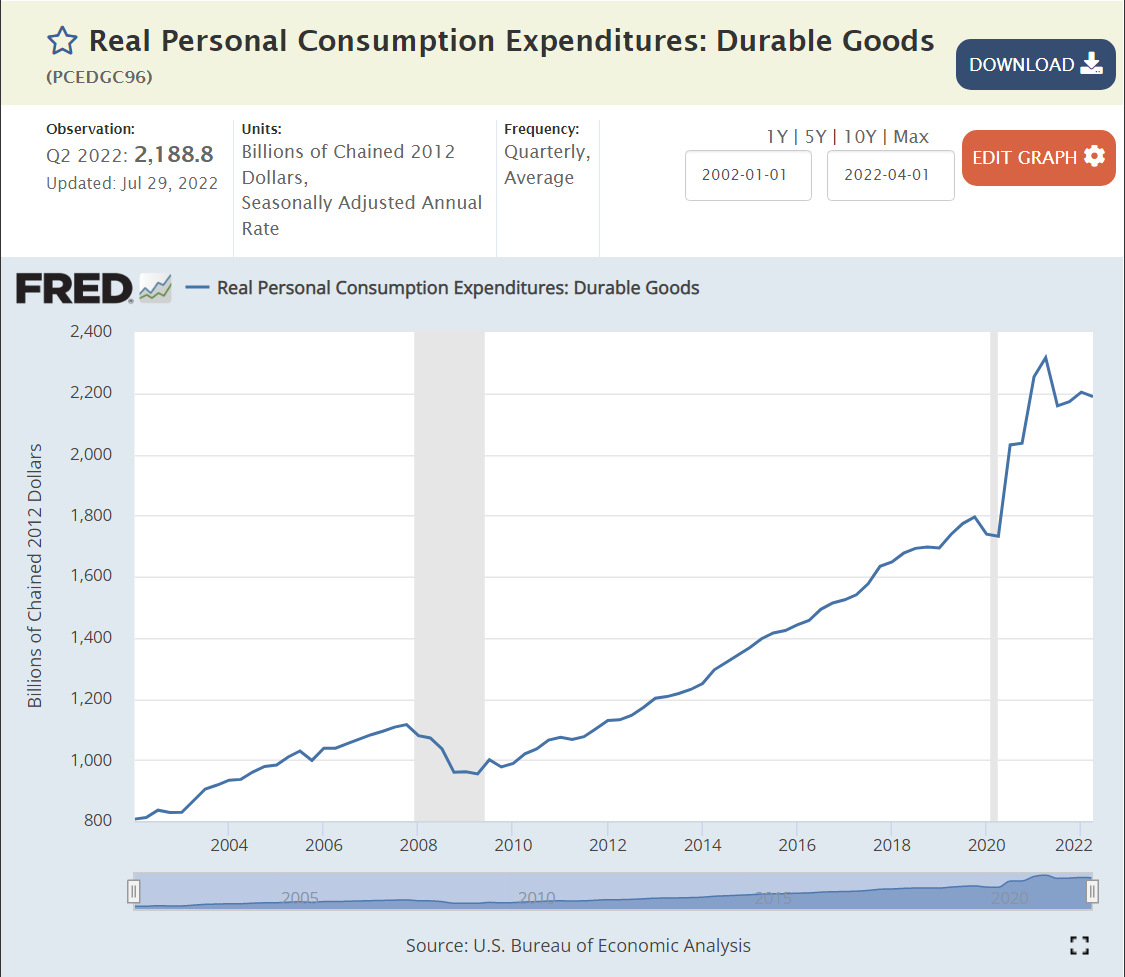
Durable Goods (9% of GDP, 4/9 Volatile)

https://fred.stlouisfed.org/series/PCEDGC96#0

Durable goods demand spiked by an incredible 20-30% during the pandemic, fueled by government transfers and fewer opportunities to consume services. Demand for durable goods has flattened at this 20% higher level, it has not declined. In my view, this sector is not signaling recession.

Non-durable Goods (15%, 6/9 Volatile)

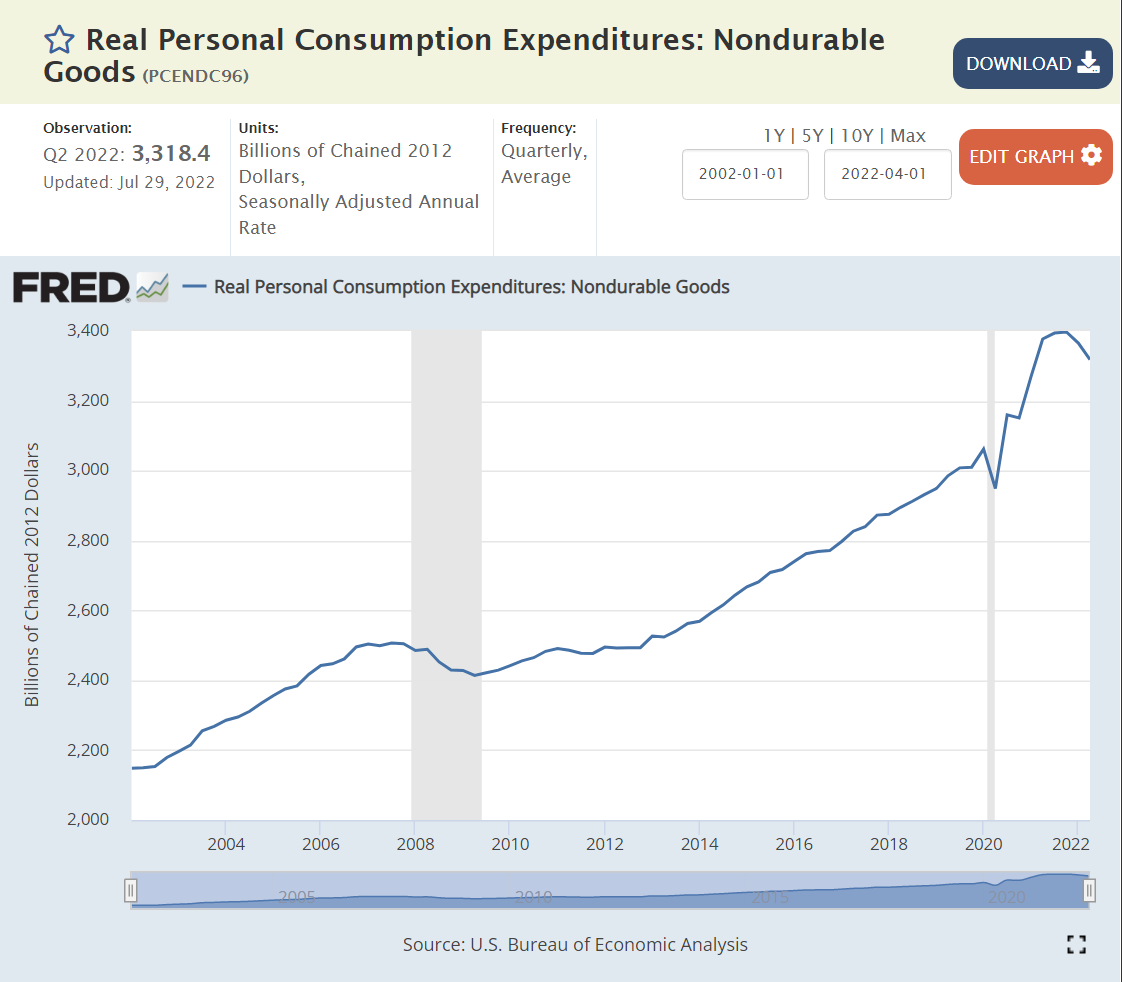
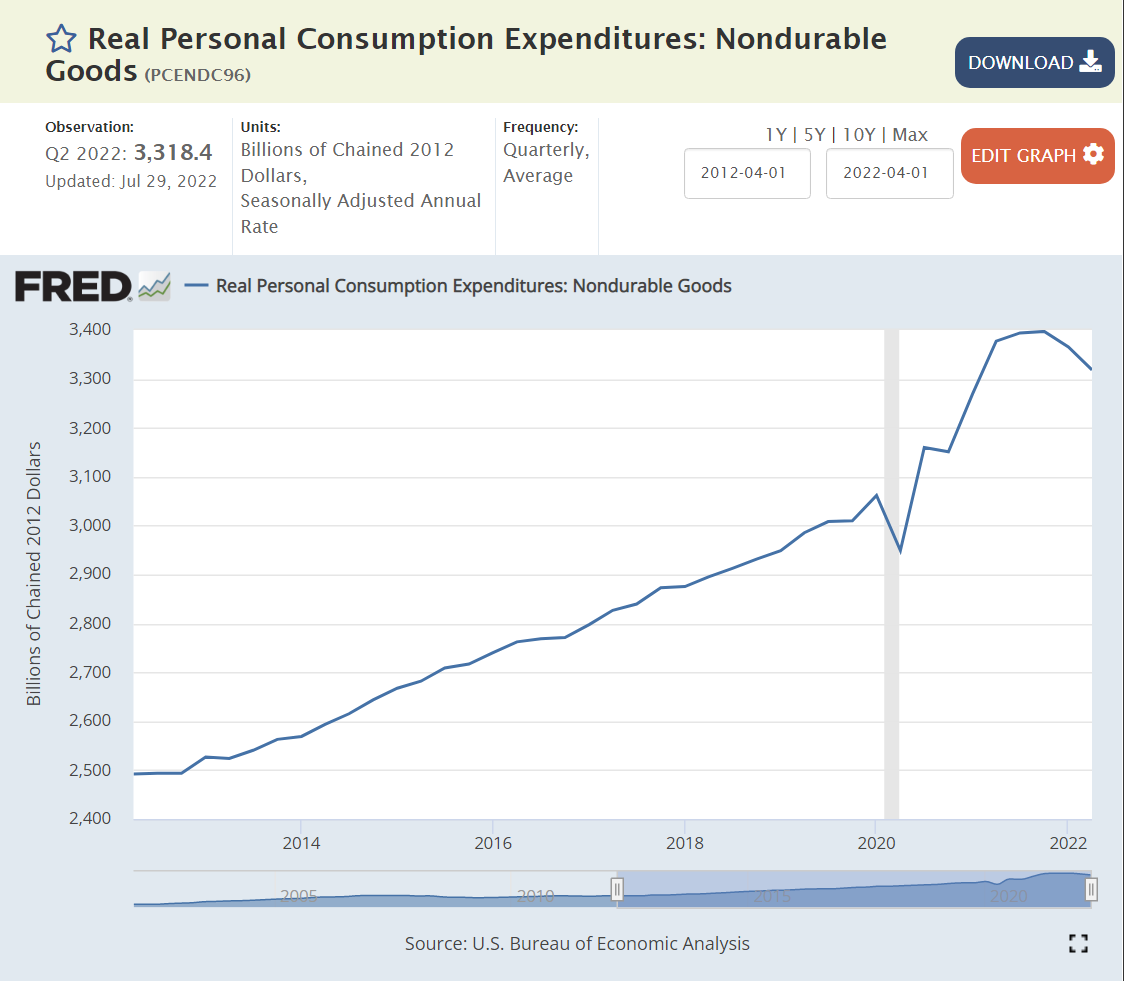
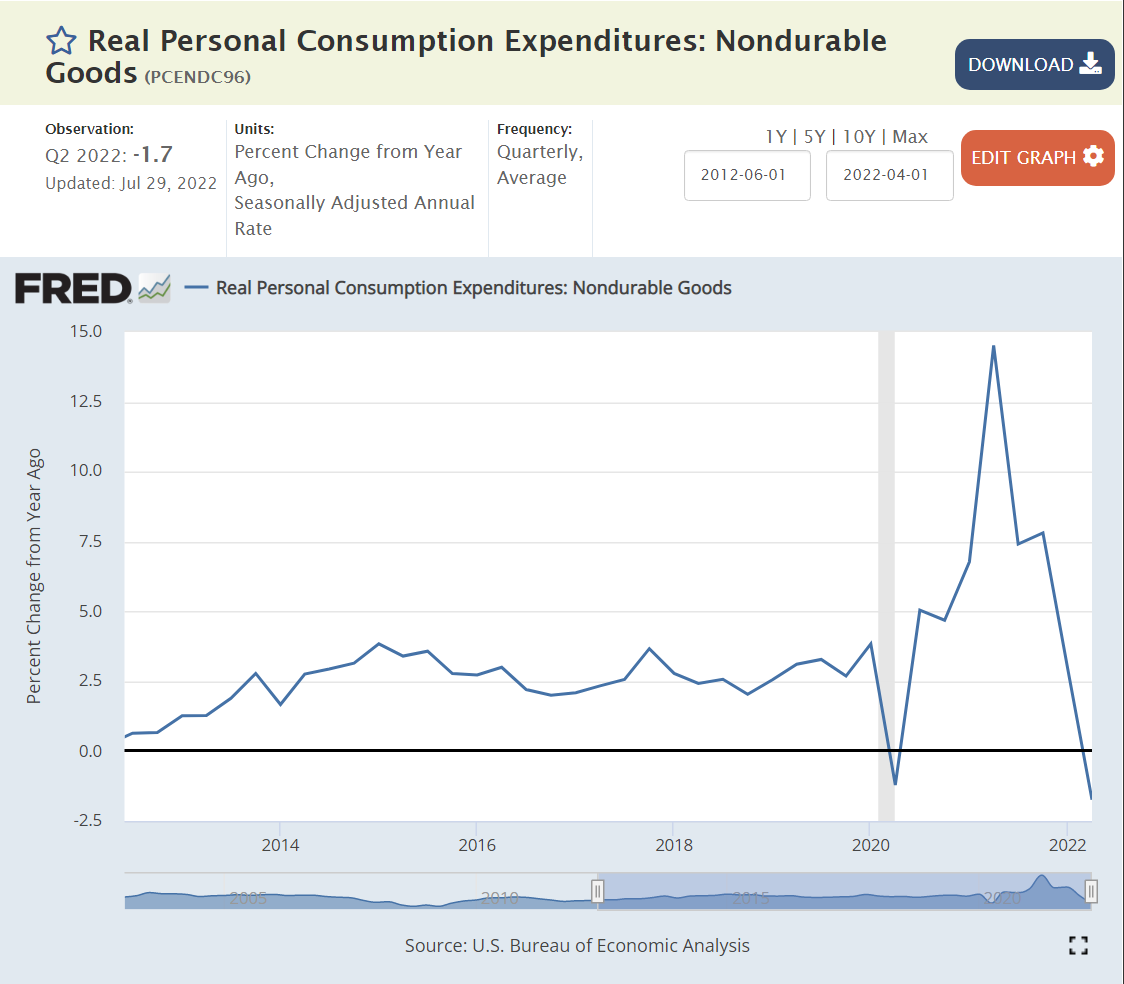
https://fred.stlouisfed.org/series/PCENDC96

Non-durable goods consumption jumped by a real 12% during the pandemic and has essentially remained at this elevated level. We have two quarters at slightly lower consumption levels, so I rate this as “maybe” moving to a recession. Focus on the “big picture”. Both durable and non-durable goods consumption increased by historic percentages during the pandemic period and have remained at that elevated level 2 years later. It is not surprising that this demand has flattened or fallen off a bit. The surprising feature is the willingness of the American consumer to voluntarily spend much more money on “things” during the pandemic and maintain that level of spending as service opportunities returned, government transfers ended, and savings were drawn down.

Services (45%, 7/9 Volatile)

https://fred.stlouisfed.org/series/PCESC96

The very large (44% of GDP) services sector was slower to recover from the pandemic, but demand for services remains quite strong, even though the percentage growth rate is lower than during the initial recovery period.

Business Investment (14%, 3/9 Volatile)

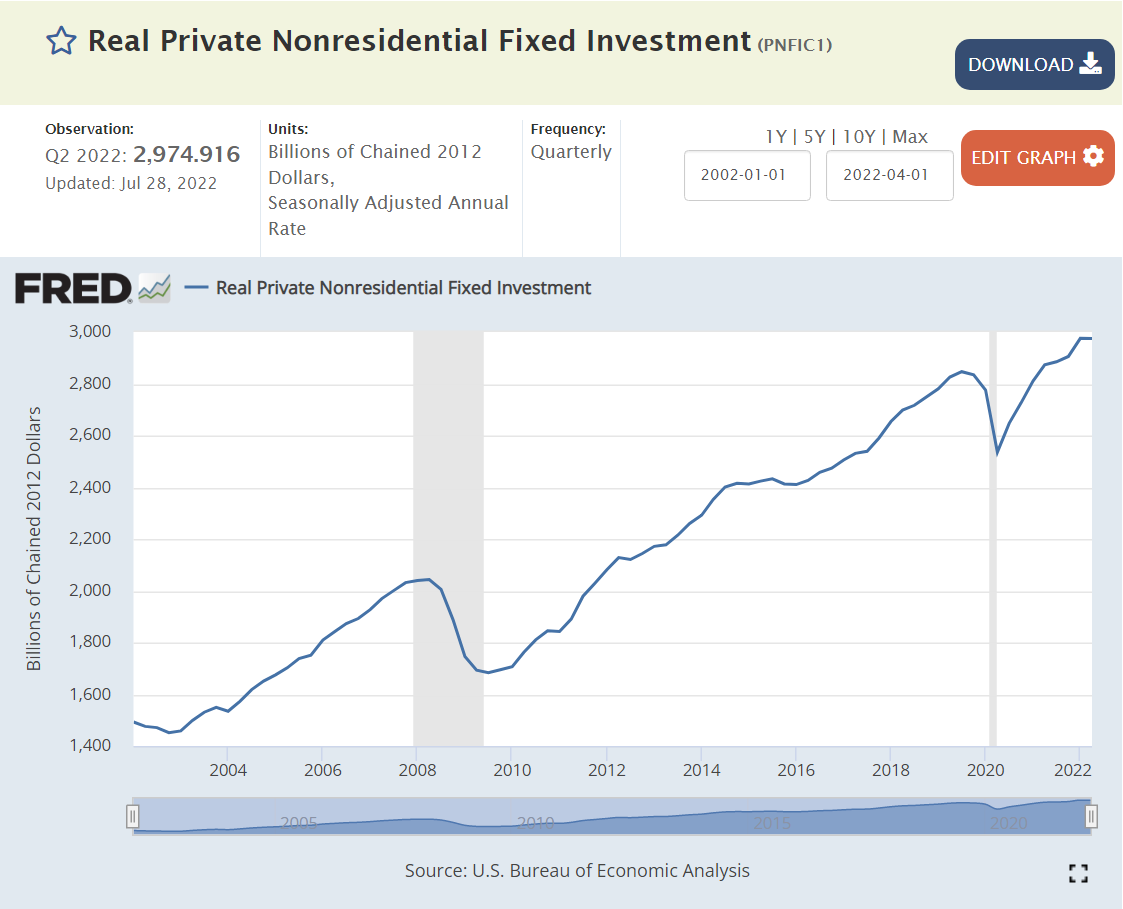
https://fred.stlouisfed.org/series/PNFIC1

Business investment was above trend in the two years before the pandemic and has resumed its solid level. No recession indicator here.

Housing (5%, 2/9 Volatile)

https://fred.stlouisfed.org/series/PRFIC1

New housing investment grew by 50% between 2012 and 2016 and then remained at that level for the next 4 years before the pandemic. Long-run supply and demand factors indicate a “need” for more housing construction in the US to make up for the “missing” construction from 2008-2016. New housing construction did not decline with the pandemic, it increased by 15% in real terms! As with durable and nondurable goods consumption/production, this would not have been predicted in March, 2020 by anyone. Residential construction has levelled off 15% above 2019, equal to 2007 before the Great Recession. The increased mortgage interest rates indicate that demand will soften and this sector will decline somewhat in the second half of 2022, so this is a “maybe”. The long-term shortage of housing supply provides a floor for this sector.

Business Inventories (1%, 1/9 Volatility)

https://fred.stlouisfed.org/series/CBIC1
https://fred.stlouisfed.org/series/A371RX1Q020SBEA

“Supply chain issues” have restricted the accumulation of business inventories since the pandemic began. The unexpected spike in demand for durable and nondurable goods and residential construction lead to shortages. Worries about supply chain resiliency have led to higher targeted business inventory levels. Retailers have overstocked some product categories as the recovery has slowed and are being forced to discount prices to move these goods. Overall, this is a slight “maybe” recession indicator. I think that businesses would like to have 20% higher inventories overall.

https://fred.stlouisfed.org/series/ISRATIO

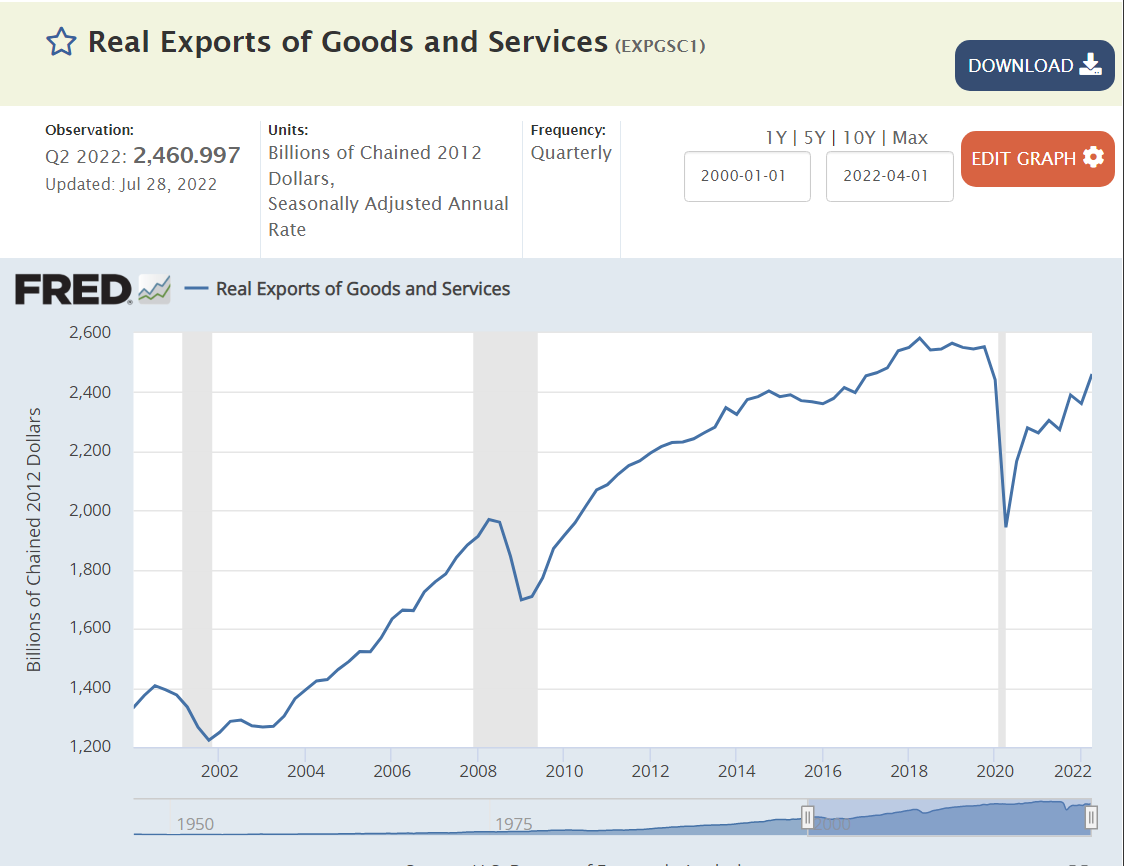
Exports (12%, 8/9 Volatility)

https://fred.stlouisfed.org/series/EXPGSC1

US exports continue to solidly recover from the pandemic.

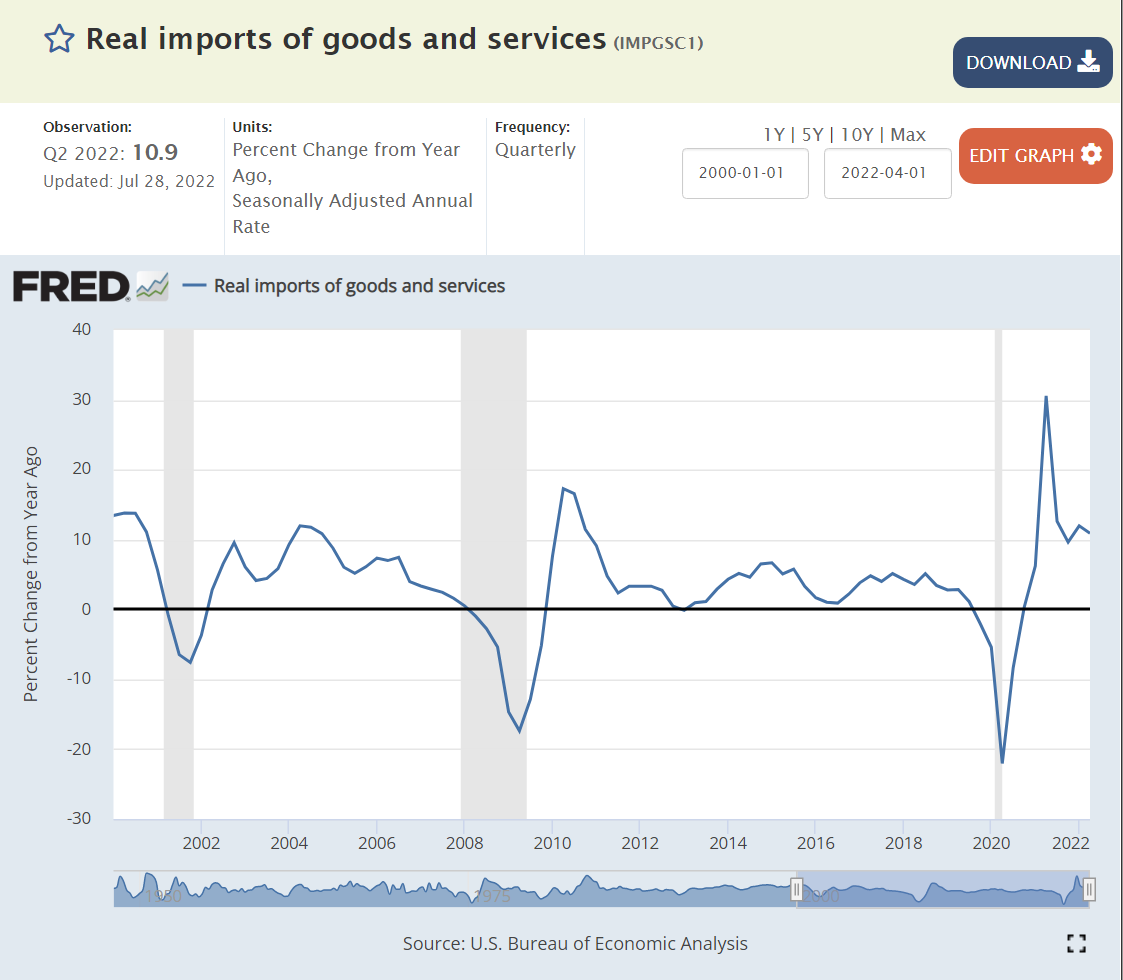
Imports (16%, 5/9 Volatile)

https://fred.stlouisfed.org/series/IMPGSC1\

Although imports act as a reduction in the calculation of GDP, they tend to decline when the US economy declines. Import demand remains high, not indicating a recession.

Government (17%, 9/9 Volatile)

A majority of government spending is accounted for as a simple transfer, not part of the annual production of goods and services.

https://fred.stlouisfed.org/series/GCEC1

Government production activity grew quite significantly from 2014 to 2020. It has since declined by less than 1%. I rate this as a “maybe” indicator of recession, even though government activity is typically a countercyclical indicator, rising when recession arrives.

Summary

Services (45%), Business Investment (14%), Exports (12%), Imports (16%) and Durable Goods (9%) are NOT in recession. Housing (5%) and Non-durable Goods (15%) point towards recession, while Government (17%) and Business Inventories (1%) show warning signs. If I were a member of the NBER board, I would not designate a recession in the first half of 2022 as of today.

For the second half of 2022, a recession is possible. The Fed raising interest rates is already affecting the housing industry. But businesses continue to report solid to record profits. The stock market has declined by a bear market 20% but may or may not have found a bottom. The global risks from Russia’s attacks on Ukraine and China’s Covid lockdown strategy remain. Consumer confidence is weak, especially in a partisan world. Business confidence is weaker than in recent months, but most measures remain marginally positive. The labor market is at its strongest position in 50 years, supporting consumer demand. Higher than expected inflation has slowed consumer spending, but not to recession levels. Consumer savings and debt levels remain positive. Business debt levels have increased, but most businesses locked in low debt interest rates during 2020-22.

Why So Positive?

  1. Governments operate with expansionary fiscal policy, ensuring that aggregate demand is adequate. There is a risk of too much stimulus and “modern monetary theory” excesses, but so far this is not a risk in the major economies.
  2. Central banks are more effective. They provide credit in downturns, increase interest rates when required, coordinate with each other and pressure banks to hold adequate capital.
  3. Governments and central banks take proactive steps to avoid currency crises,
  4. After the Great Recession, lending in the US housing market is more reasonable.
  5. Businesses have worked through many challenges in the last 15 years and are well positioned to prosper.
  6. The overall economy is increasingly based on services more than manufacturing, mining and agriculture. The operations leverage of manufacturing facilities is a smaller factor in the world economy.
  7. Labor power is lower. Cooperation with management is stronger.
  8. Demand for labor is high. US has record open jobs and voluntary quits. The effective minimum wage has increased from $8-10 per hour to $12-15 per hour without major business disruptions.
  9. Trade is lightly restricted.
  10. Global economy is multipolar, relying on US, EU, Japan, China, India, Middle East, etc.
  11. Technological progress continues. Better goods and services. Better processes, trade, transportation, markets, communication and insights.

Good News: The Increase of Producer Price Inflation Has Peaked

https://4kwallpapers.com/nature/jasper-national-park-alberta-canada-winter-glacier-4561.html
Measure2.5 YearsRecent 1 YrTrend
PPI Minus food, energy, trade11%7%Peaked
Total Final Demand16%11%Peaked
All Commodities37% !!20% !Flat
Energy56% !!!45% !!Flat
Foods23% !13%Down
Other Goods14%8%Peaked
Other Services6%3%Down
Transport and WH24% !20% !Peak?
Whlse and Retail Trade22% !14%Down

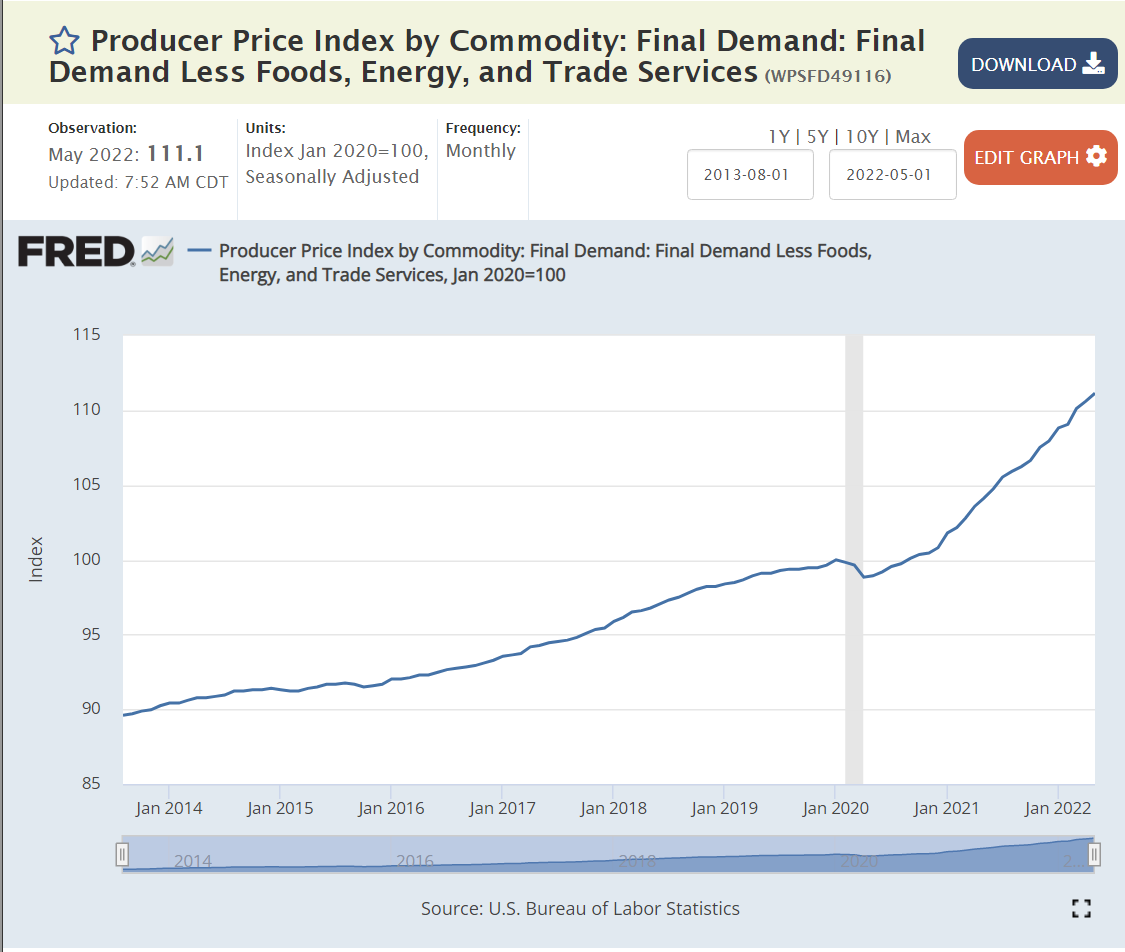
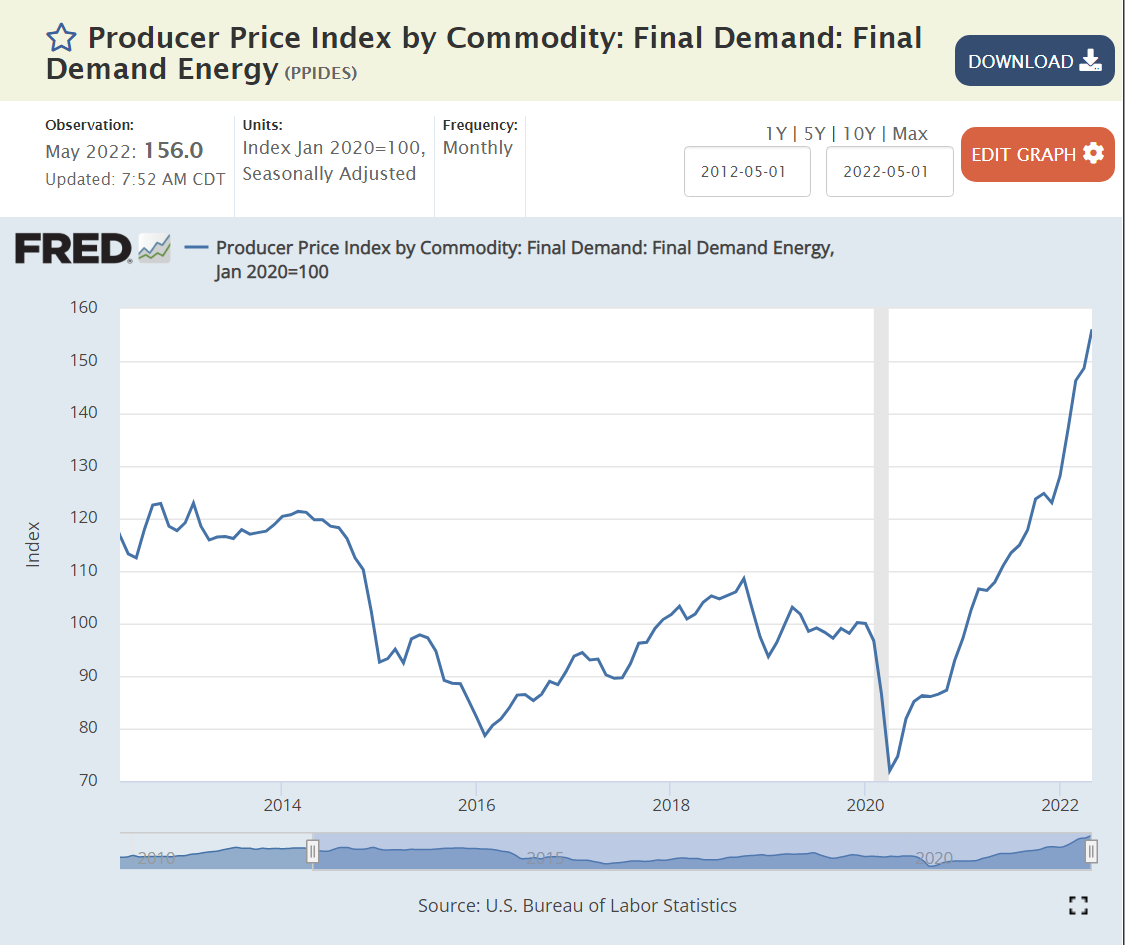
For each measure of produce prices, I’ve provided a 5- or 10-year framework of annual inflation AND a 5 year view of prices indexed to Jan, 2020 before the pandemic began. We did have 2% inflation before the pandemic.

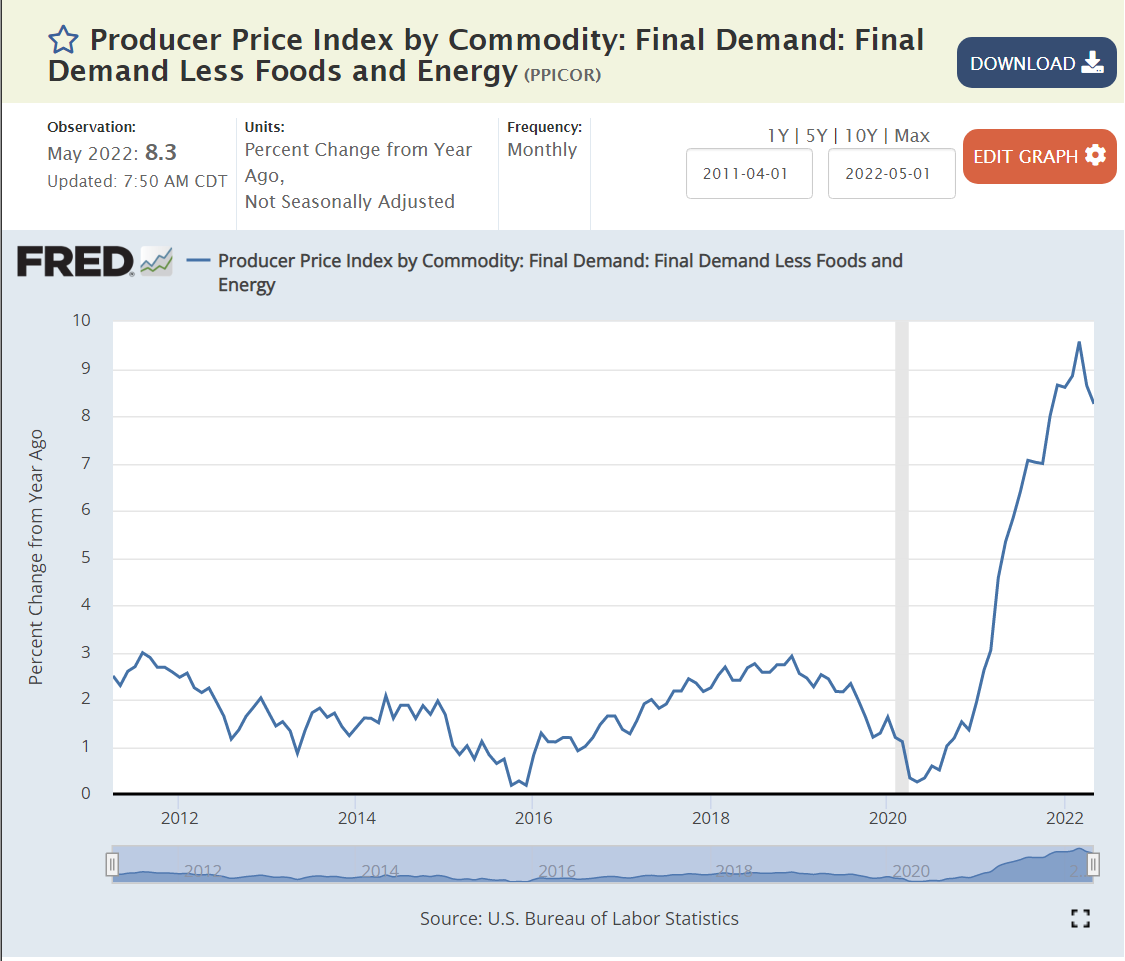
This traditional measure of ongoing inflation pressures peaked at 7% annual rate in 4Q, 2021. In total, just 12% in 2+ years.

Grand total PPI reached 10% annual inflation by the end of 2021 and has remained at that level. This provides pressure for CPI to be higher than 7% for a few more months.

Commodities pressure has been strong only recently, so the total PPI is just 3% higher than the measure excluding the volatile components.

Annual commodity inflation rocketed from 0% in Dec, 2021 to 20% by Jun, 2022 as the global economy was recovering from the pandemic and the extraordinary increase in durable goods demand was registered in supply chain purchasing decisions. Commodities are historically most volatile, but this increase in demand and prices was historic. Note this is way before the Ukraine invasion.

Energy prices were below the pre-pandemic level as late as Jan, 2021 (-3%). They increased exponentially to 50% higher by Apr, 2021. Energy prices have continued to increase at 35-40% annual rates as increased demand, mothballed assets and the Ukraine invasion effects combined to change the global markets. This is one measure where continued very high inflation is possible.

Food prices were a little slower to accelerate. Zero increase at Dec, 2020. 4% annual inflation at May, 2021. 13% inflation at Aug, 2021. Again, this is pre-Ukraine. The 13% ish inflation rate has continued, supported by Ukraine issues. Historically, food prices do not remain elevated for long periods.

Another subtotal, excluding 2 more volatile sectors shows 8-9% inflation peaking.

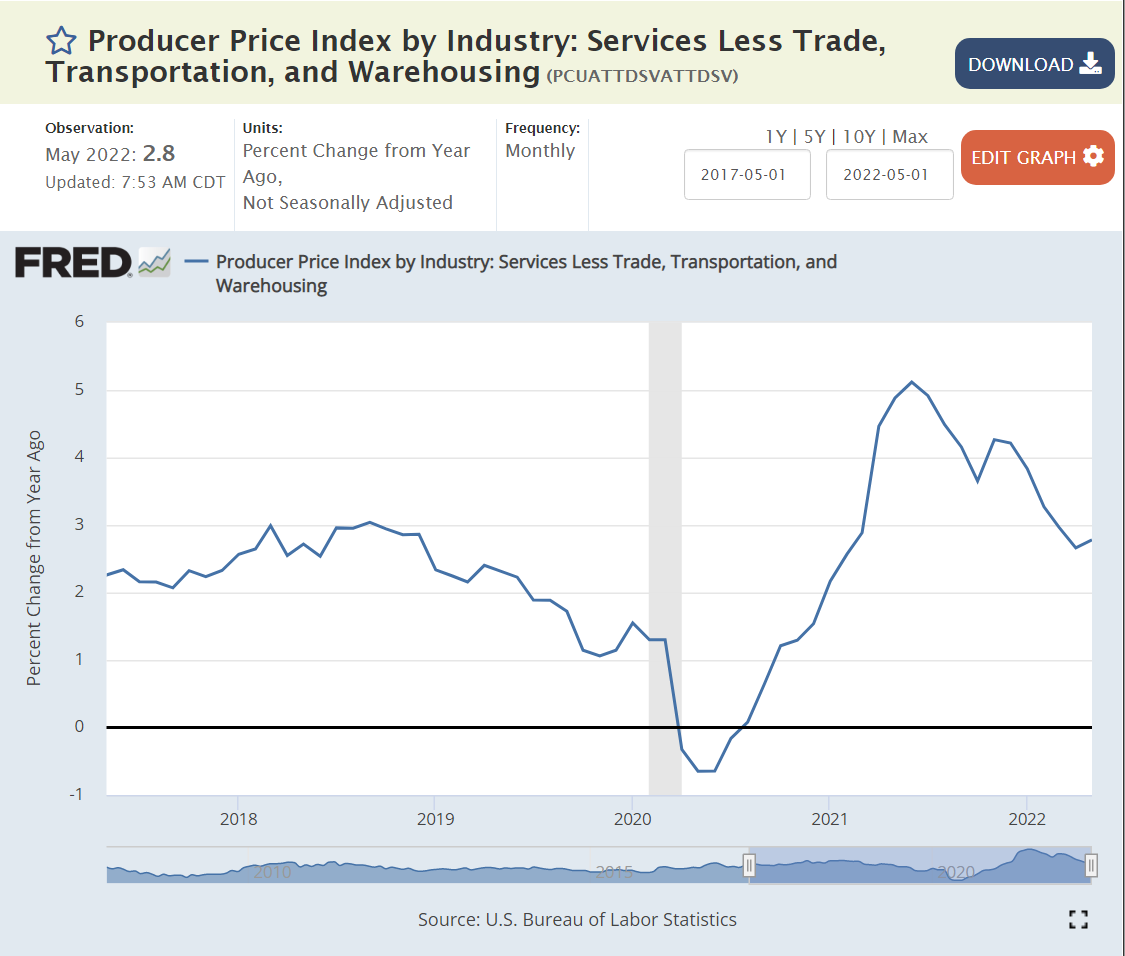
Business services inflation has remained tame, supporting the notion that cost-push inflation due to wage increases is not yet a major threat.

Transport and warehouse prices were also slow to “take off”, remaining below pre-pandemic level through Feb, 2021. Energy prices drive the transportation sector, so these prices also increased. The 20% annual increase seems to have peaked.

Wholesale and retail trade also lagged a bit, still at the historical average 2.5% inflation rate as of Mar, 2021. But, inflation grew to 10% by Aug, 2021 and a peak of 18% in Mar, 2022. The annual rate of inflation has receded to 15%, but that still offers some risks to the CPI for the next 6 months.

https://www.bls.gov/news.release/ppi.nr0.htm

https://www.bls.gov/ppi/

Summary

Six of the nine measures have peaked or are declining. The other three remain at worrying levels without clear signs of retreat. The “core” PPI inflation measure at 7% is not accelerating, so CPI should be able to decline in the second half of 2022. On the other hand, commodities inflation, mostly driven by energy inflation, remains very high without evidence of a meaningful decline in the near-term. Historically, energy and commodity prices fall back after a sharp increase. The general weakening in the global economy also points to a somewhat softer market for energy and commodities.

There is no evidence yet of labor-based cost-push inflation or accelerating/spiraling/self-reinforcing inflation.

“Price gauging” claims are always in the eye of the beholder/customer/politician. When I see relatively low historical price increases, followed by sharp increases, I imagine that business leaders are taking advantage of the situation to drive price increases that were impossible to propose and make stick during the less dynamic past. These can be spotlighted during a period of high inflation, but appear to be more reasonable across the whole business cycle. The food and energy price changes look similar to historical levels of volatility so are less easily questioned.

Big picture, IMHO, this looks like a global commodities “squeeze” due to the faster than expected recovery from the pandemic, especially the 50% growth in demand for durable goods as in-person services were less attractive and available. Loose fiscal and monetary policy in the US and other nations may have been a significant driver of the faster than expected global recovery, but this does not look like a classic case of excessive fiscal and monetary stimulus.

In hindsight, the slow response of the US Federal Reserve Board to the very rapid change in price levels from Jan, 2021 to Jun, 2021 looks like malpractice. Market prices quickly adapted to the current and expected disconnect between supply and demand.

Producer and consumer price increases are likely to remain in the 7-8% range during the 3rd quarter of 2022, but should begin to drift back to the 5-6% range in the 4th quarter of 2022, and still lower in 2023, especially if the Fed increases interest rates by the expected 3-3.5% and businesses slow their inventory, hiring, project and capital spending decisions accordingly.

Good News: 2022 Federal Budget Deficit is Way Down

https://fred.stlouisfed.org/series/FYFSGDA188S and forecasts described below

Good News: Early Forecasts: 2022 Deficit Cut in Half

https://www.crfb.org/blogs/no-president-biden-has-not-implemented-historic-deficit-reduction
https://datalab.usaspending.gov/americas-finance-guide/deficit/trends/

Better News: In May, CBO Forecasts Closer to $1Trillion, About the Same as 2019

https://www.crfb.org/papers/analysis-cbos-may-2022-budget-and-economic-outlook

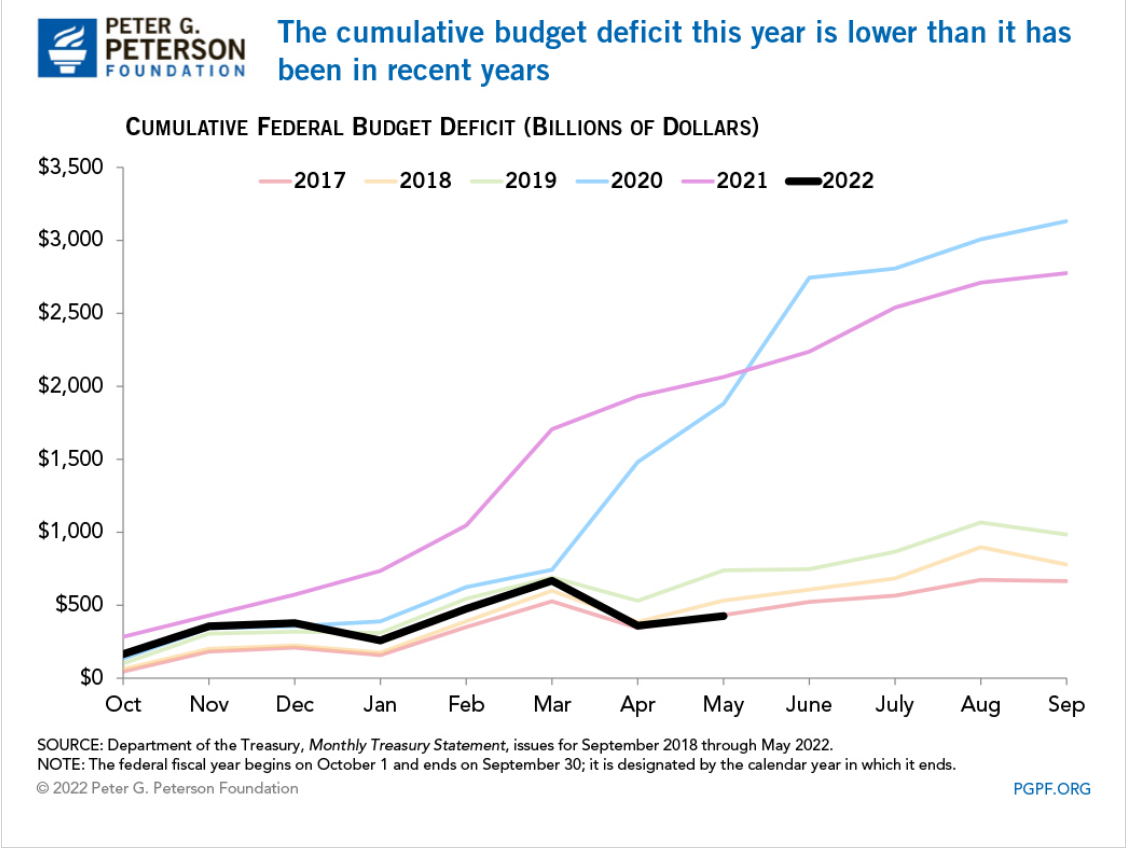
Best News: May Data Indicates a Decline to 2017’s $0.7 Trillion Level (3/4ths Reduction)

https://www.pgpf.org/the-current-federal-budget-deficit
https://www.pgpf.org/the-current-federal-budget-deficit/budget-deficit-september-2019
https://bipartisanpolicy.org/report/deficit-tracker/

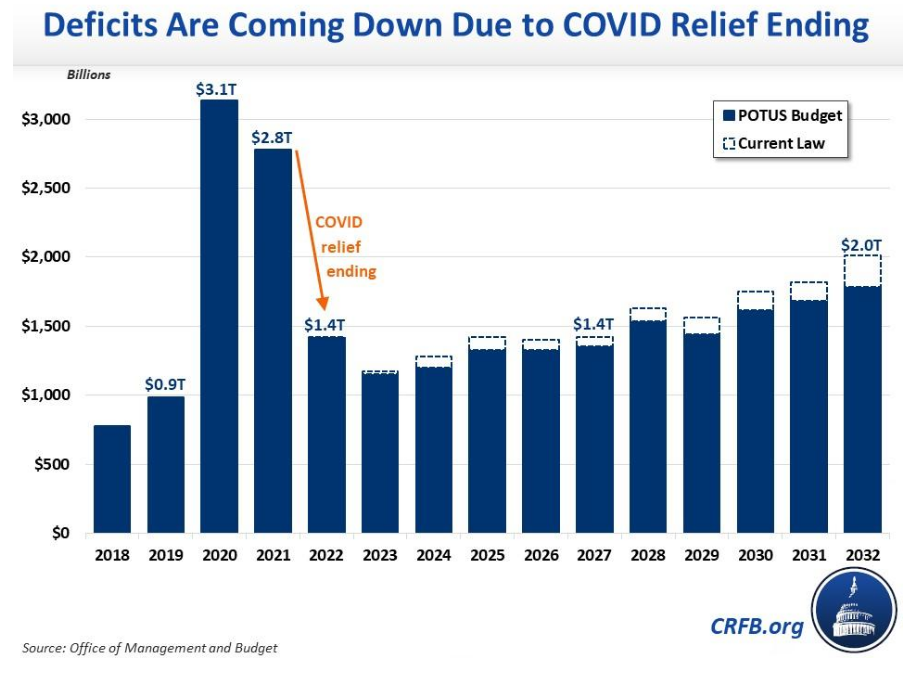
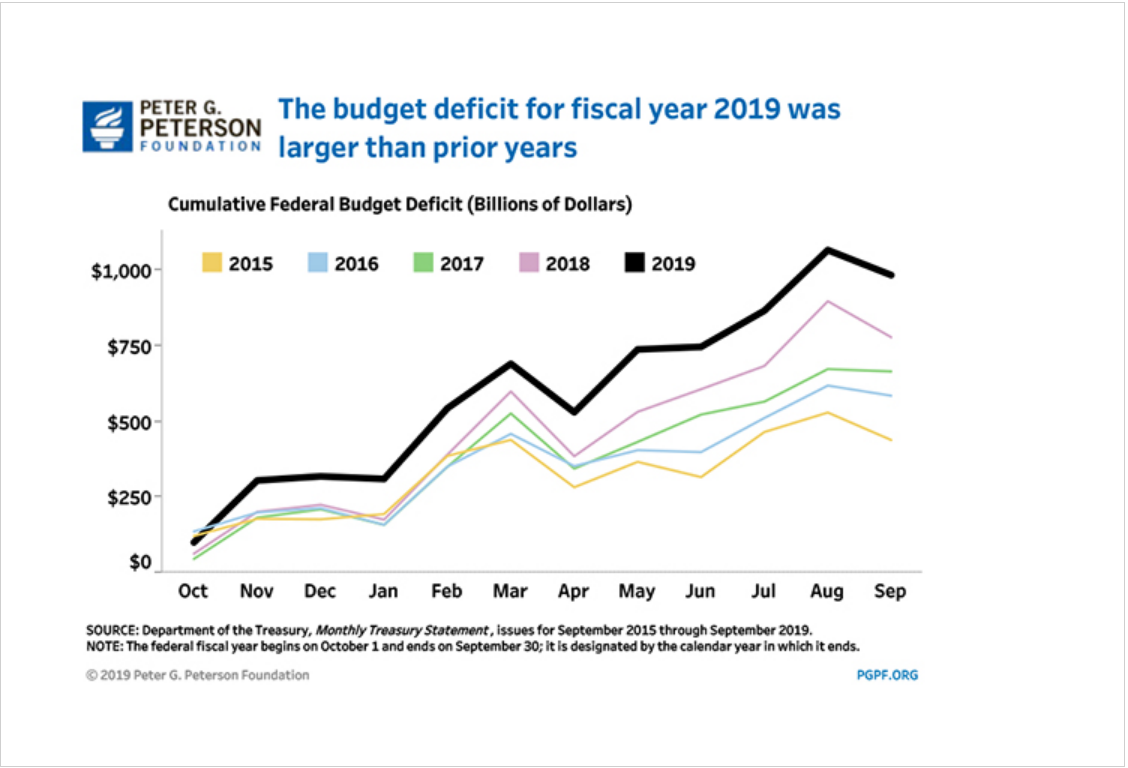
The May YTD deficit for fiscal year ending in September, 2022 was $426B, down 79.4% from the $2,064B level of FY 2021. The total FY 2021 deficit was $2,772B, so the same percentage reduction for the whole year estimates a $572B deficit for FY 2022. Visually, the year-to-date pattern most closely matches 2017 which ended with a $666B deficit. In fiscal years 2018 and 2019, the additional deficit for the last 4 months of the year was $245B and $247B, respectively. That gives us a forecast of $672B for FY 2022. DC insider, Wrightson ICAP, recently forecast a deficit of $600-700B.

https://rollcall.com/2022/05/09/tax-revenue-boom-fuels-steep-budget-deficit-decline/

Good News: CBO Forecasts FY 2023 and FY 2024 Deficits at Same Levels as FY 2022

https://www.crfb.org/papers/analysis-cbos-may-2022-budget-and-economic-outlook
https://www.cbo.gov/publication/57950#section0

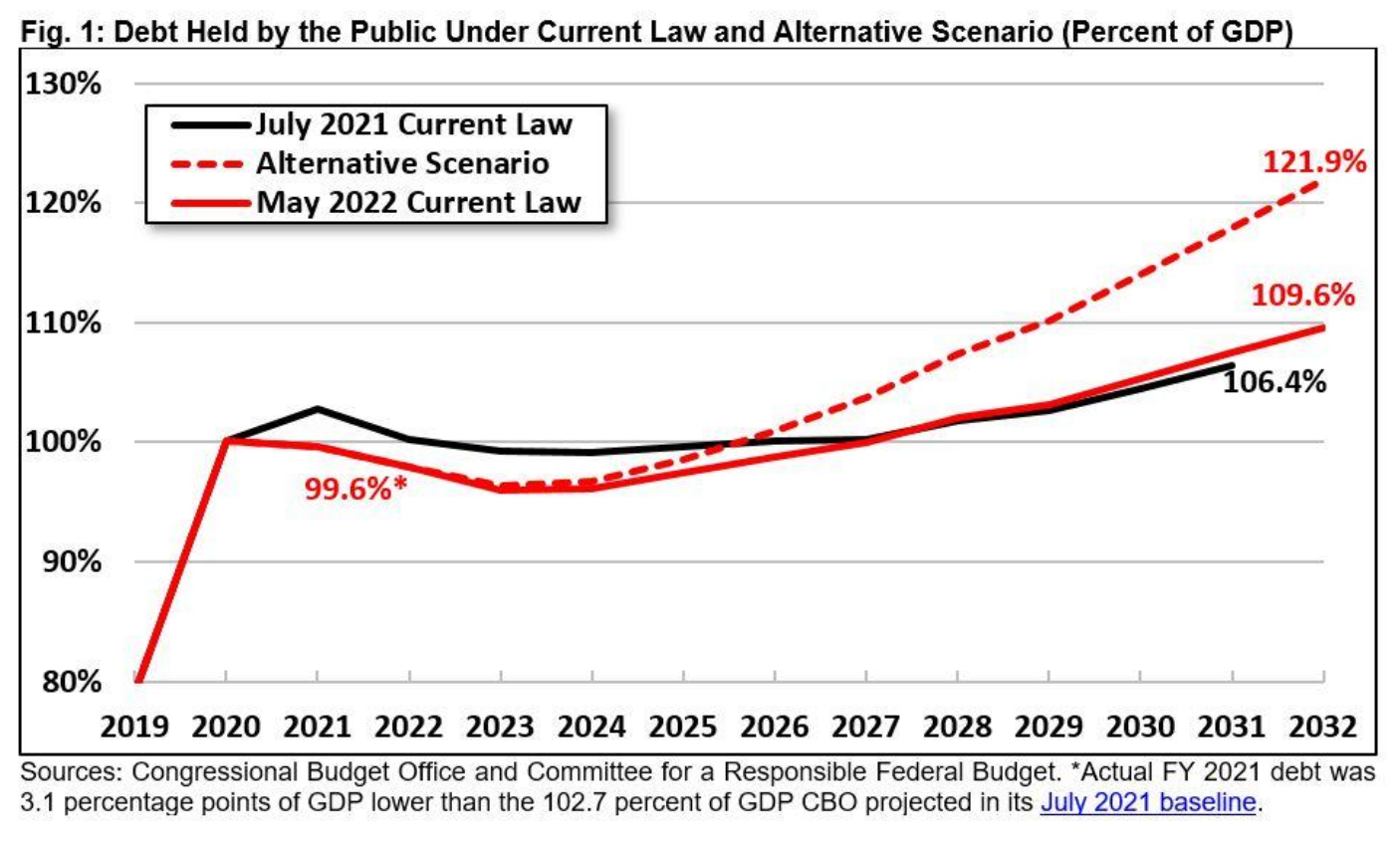
Good News: Public Debt as % of GDP is Forecast to Be Down for 2022-27

https://www.crfb.org/papers/analysis-cbos-may-2022-budget-and-economic-outlook

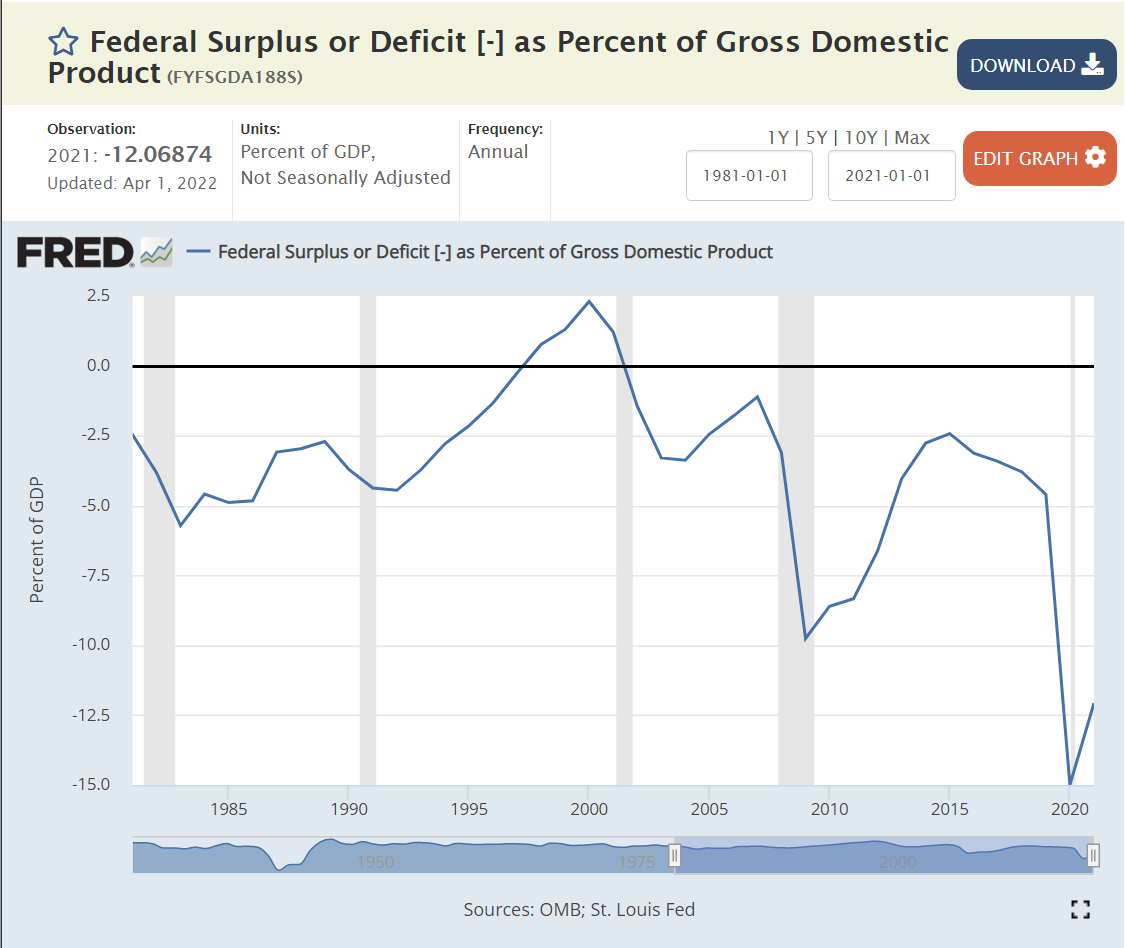
Good News: FY 2022 Government Deficit % of GDP is Best Since FY 2015

https://fred.stlouisfed.org/series/FYFSGDA188S

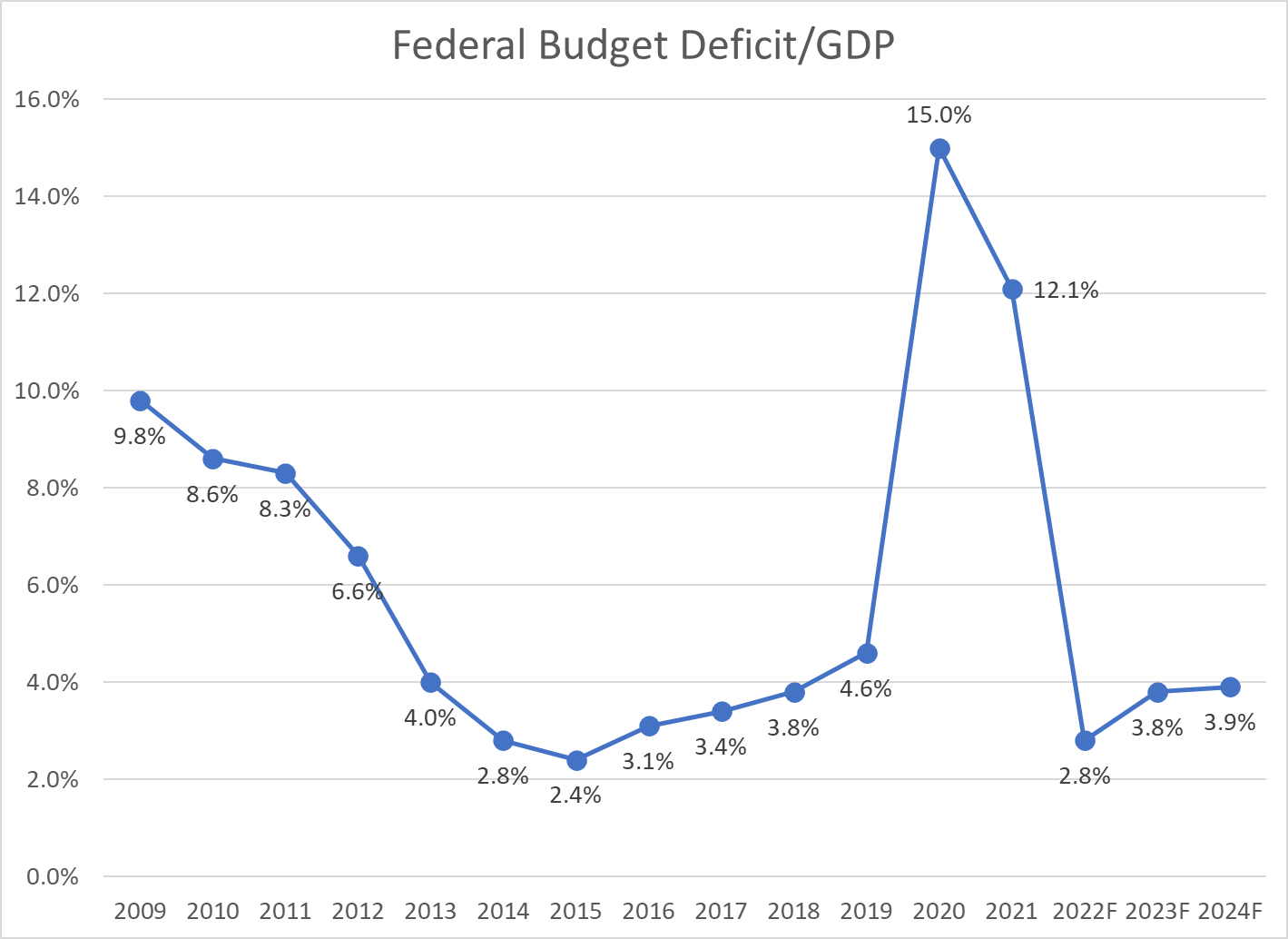
The conservative forecast of $700B deficit for FY 2022 is 2.8% of the CBO estimate of FY 2022 GDP at $24,694B. The CBO forecast Deficit/GDP ratios of 3.8% and 3.9% for the next 2 years, roughly the same as the pre-pandemic 2018 rate.

Good News: Government Fiscal Stimulus is a 3.5% Annual Drag on the Economy

https://www.brookings.edu/interactives/hutchins-center-fiscal-impact-measure/

The reduced federal deficit and state/local deficits compared with history provided a very large drag on first quarter GDP, but the economy recovered in the second quarter and is forecast by the CBO to deliver 3% overall real GDP in FY2023 after a very strong 4.4% in FY2022.

https://www.cbo.gov/data/budget-economic-data#4

Context

https://www.pgpf.org/the-current-federal-budget-deficit

Spending reductions are sustainable.

https://www.pgpf.org/the-current-federal-budget-deficit

Revenue increases are not sustainable, coming in as much as 2% of GDP higher than trend or expectations. The 2021 economy was very healthy, resulting in spillover tax receipts in 2022 that will not continue.

https://www.crfb.org/papers/analysis-cbos-may-2022-budget-and-economic-outlook

Spending at 22-24% of GDP cannot be funded by revenues of 18% in the long-run.

https://fred.stlouisfed.org/series/FYFSGDA188S

Our economy has operated effectively for the last 4 decades with a federal budget deficit averaging 2.5% across the business cycle. Starting with 2.8% in 2022 is an unexpectedly good place. Congress and the president will struggle to maintain this level without significant spending or revenue changes in the next budgets.

https://www.crfb.org/press-releases/cbo-reports-63-billion-deficit-may

https://www.politico.com/news/2022/05/25/u-s-deficit-congressional-budget-office-00035052

https://rollcall.com/2022/05/09/tax-revenue-boom-fuels-steep-budget-deficit-decline/

Good News: US Taxes Remain Low

https://www.oecd.org/tax/tax-policy/revenue-statistics-united-states.pdf

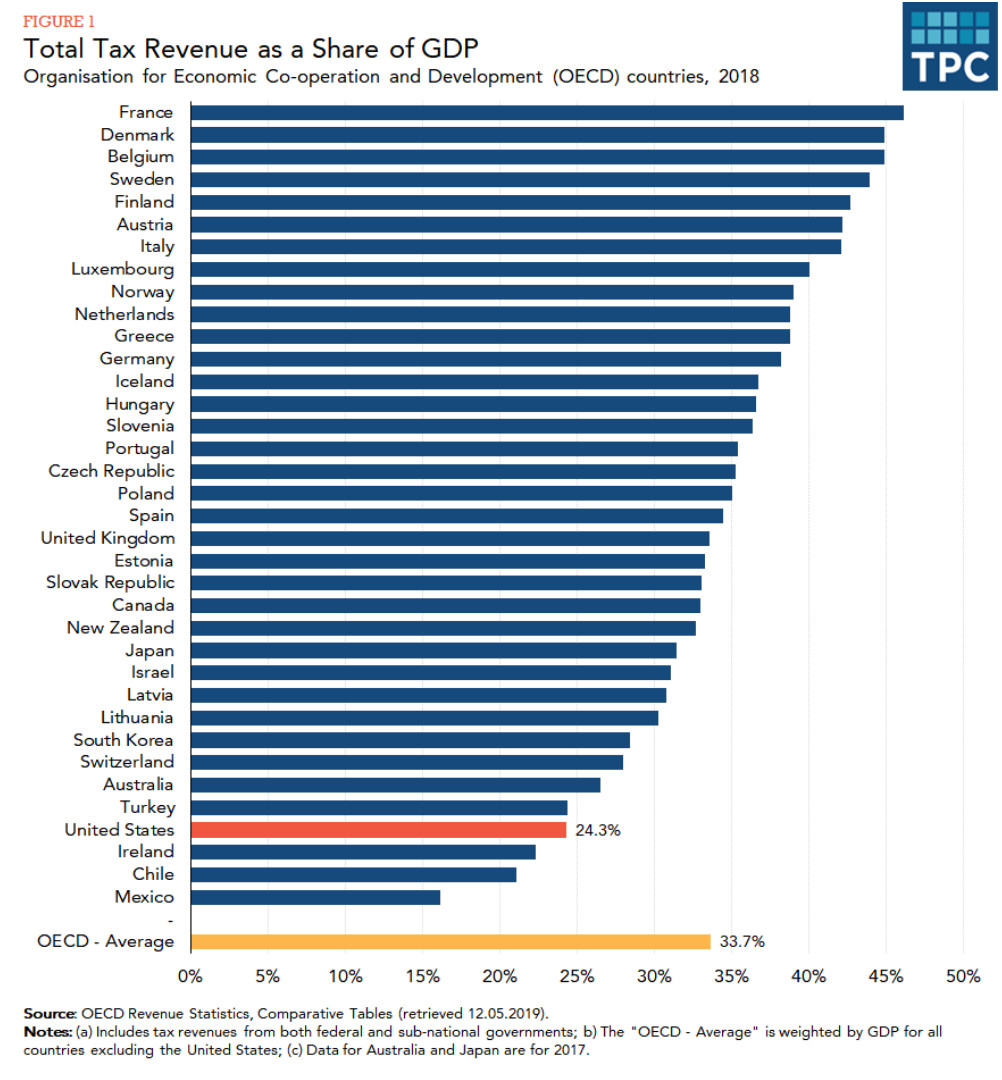
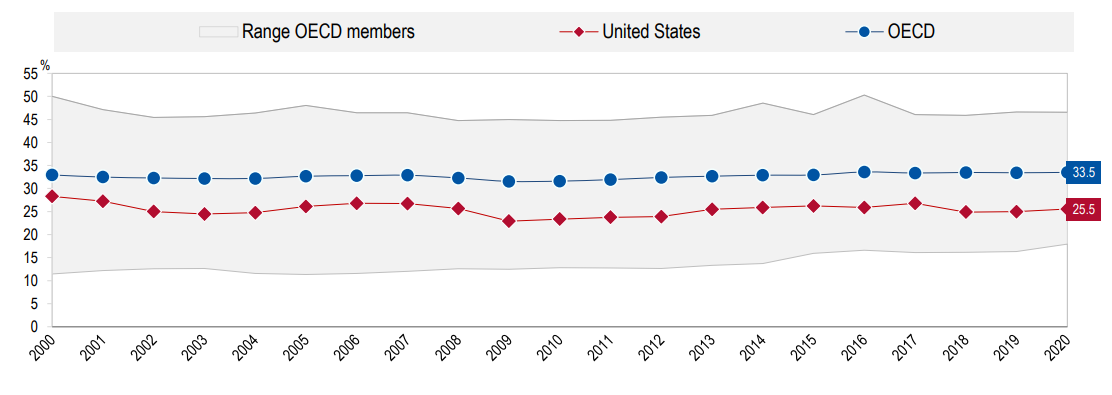
US taxes as a share of GDP have declined by 3% of GDP since 2000 and are about one-fourth lower than the average of other developed countries.

https://fred.stlouisfed.org/graph/?g=ffB4

Government taxes (excluding social security) have declined by 1-2% of GDP since 1950’s.

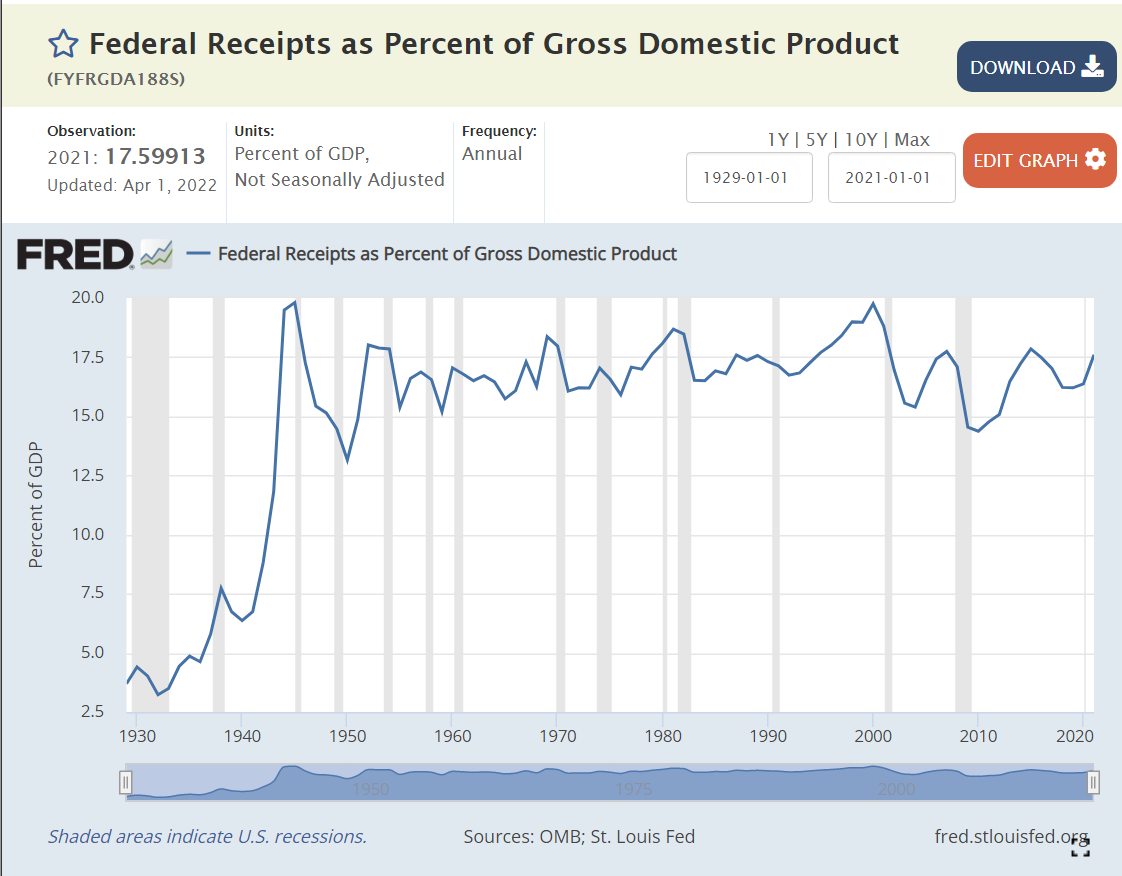
https://fred.stlouisfed.org/series/FYFRGDA188S

Federal taxes as a percent of GDP have remained flat since the 1950’s.

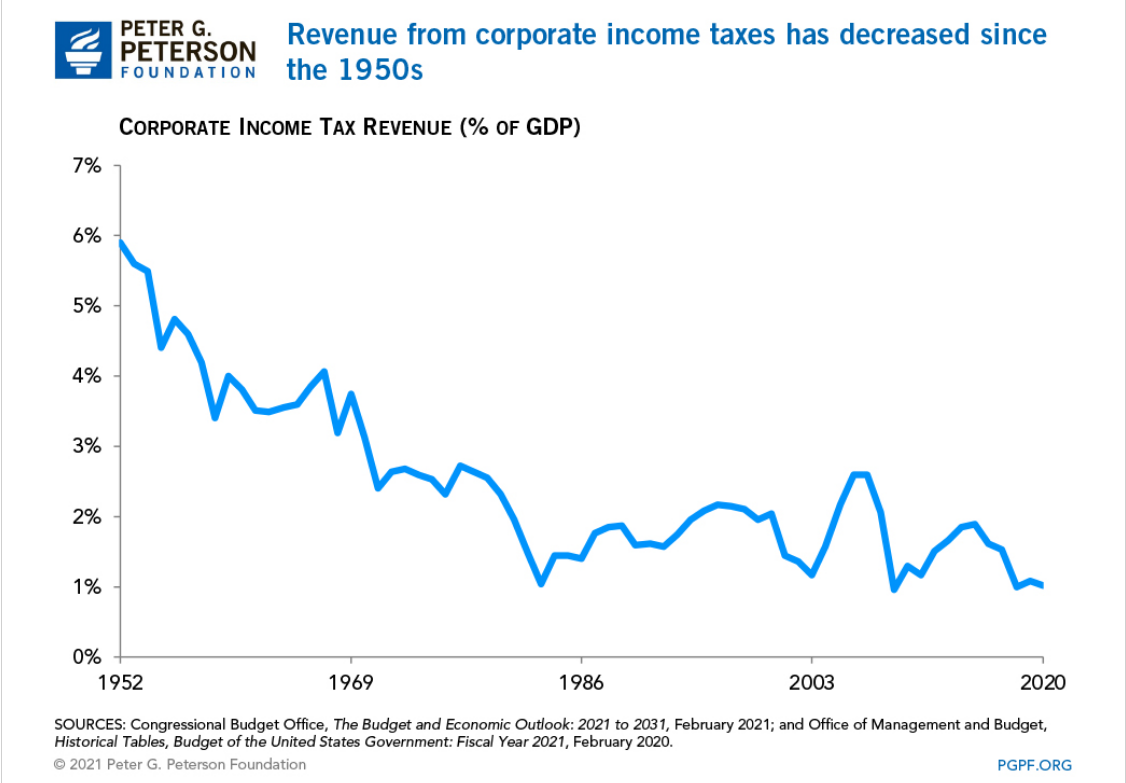
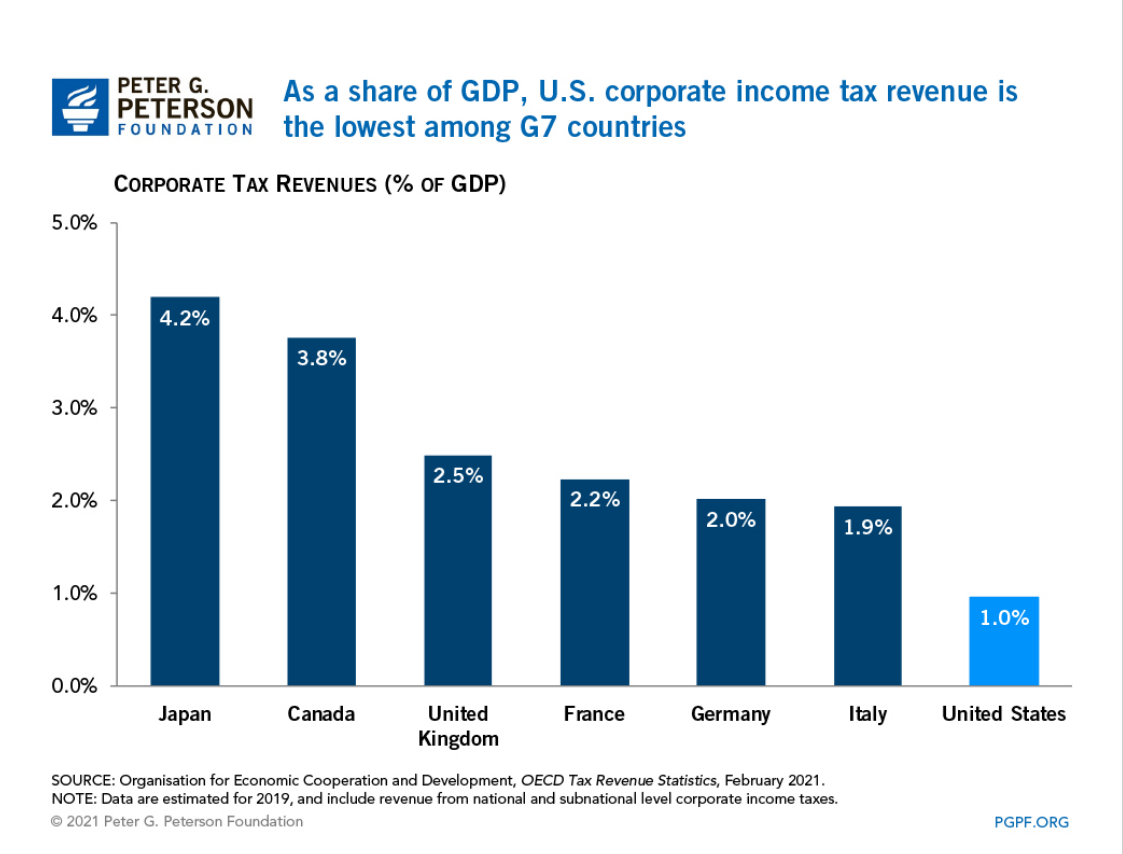
https://www.pgpf.org/blog/2021/04/six-charts-that-show-how-low-corporate-tax-revenues-are-in-the-united-states-right-now

Effective corporate tax rates in the US are very low.

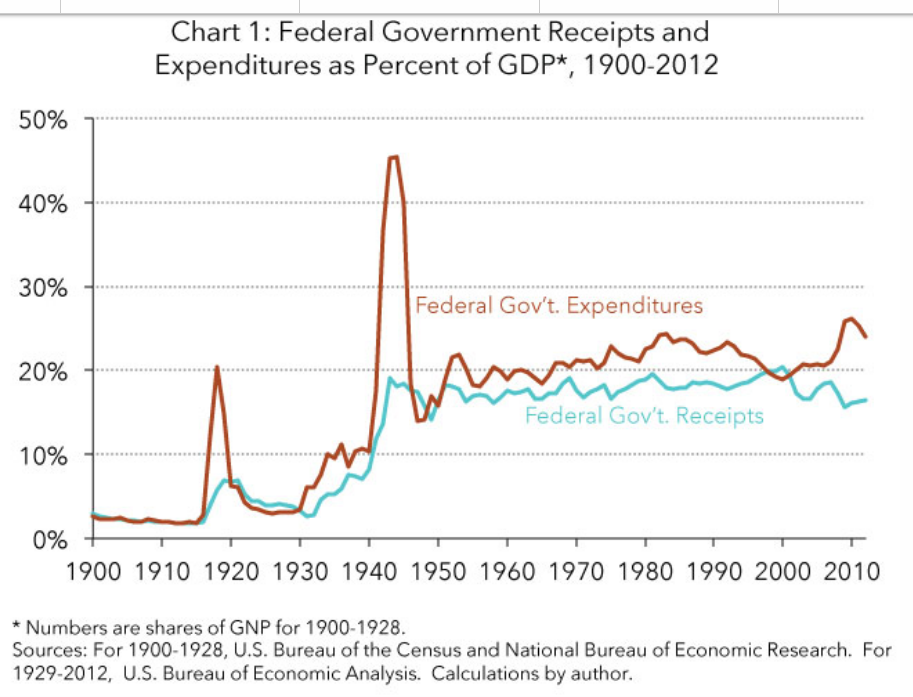
https://taxfoundation.org/short-history-government-taxing-and-spending-united-states/

Federal government tax receipts have been essentially flat as a share of GDP for more than 70 years.

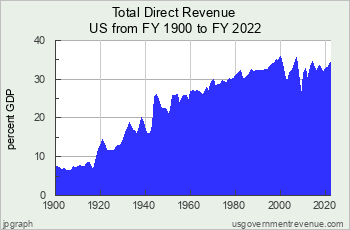
https://www.usgovernmentrevenue.com/revenue_history

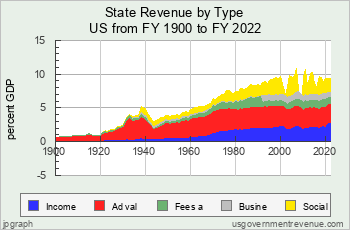
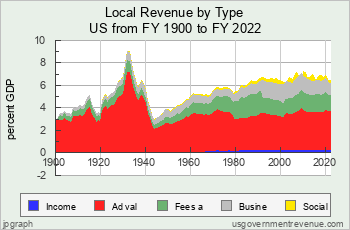
A source with more details shows that any growth since the 1950’s has largely taken place at the state level.

https://www.visualcapitalist.com/comparing-tax-systems-around-the-world/
https://www.taxpolicycenter.org/briefing-book/how-do-us-taxes-compare-internationally

US total taxes as a percent of GDP are exceptionally low among developed countries.

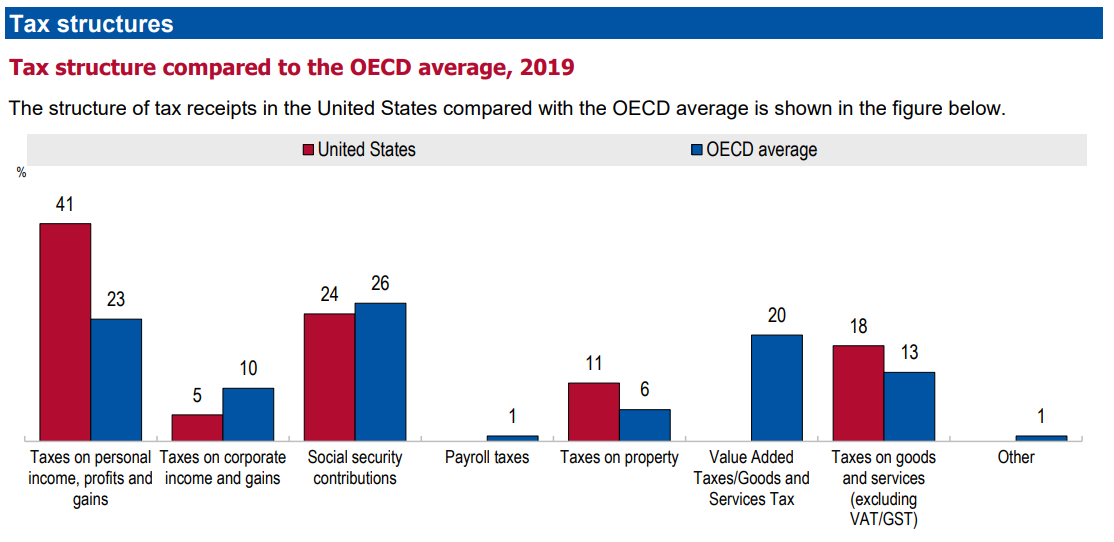
https://www.oecd.org/tax/tax-policy/revenue-statistics-united-states.pdf

US income and property taxes are relatively higher than other developed countries, but corporate taxes are half as high, and the US does not use value added taxes (VAT) to quietly collect revenues.

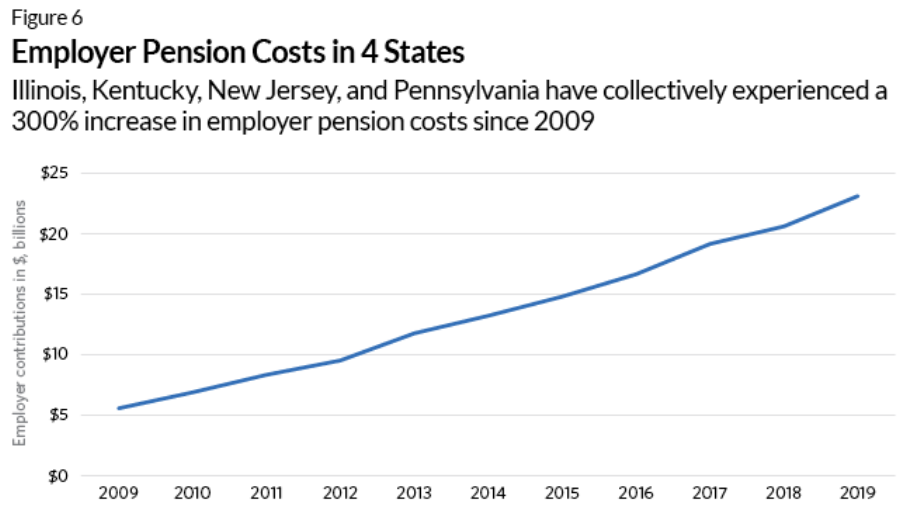
Good News: State Pension Funding is at a 13 Year High!

Background

Most states and local governments have chosen to pay their employees less than market salaries and higher than market fringe benefits since the WW II era. The Republican focus on reducing the size, pay and power of government has increased significantly in the post-Reagan era. Grover Norquist summarized this in 2001: “I don’t want to abolish government. I simply want to reduce it to the size where I can drag it into the bathroom and drown it in the bathtub.” Hence, Republicans have focused the spotlight on the “underfunded” status of state and local government fringe benefit plans, especially defined benefit pension plans.

Although the rhetoric is sometimes grating to the “left” ear, this spotlight does serve as a disinfectant, requiring political leaders to be more accountable for their decisions, especially in “one party” states where accountability was lacking historically.

On the other hand, pension accounting, funding, goals and policies are inherently complex and difficult to simply summarize or explain. This is true for both government and corporate defined benefit pension plans. It is easy to “cherry pick” pension statistics and overexaggerate the “crisis” in state pensions.

I will focus on the data and commentary from just 2 sources: Reason.org, a right-leaning policy group that cleverly adopted a left-side name and Pew Research, a centrist research group that has chosen to emphasize right-leaning data and commentary on this topic.

Current (2021) Good News

https://www.pewtrusts.org/en/research-and-analysis/issue-briefs/2021/09/the-state-pension-funding-gap-plans-have-stabilized-in-wake-of-pandemic
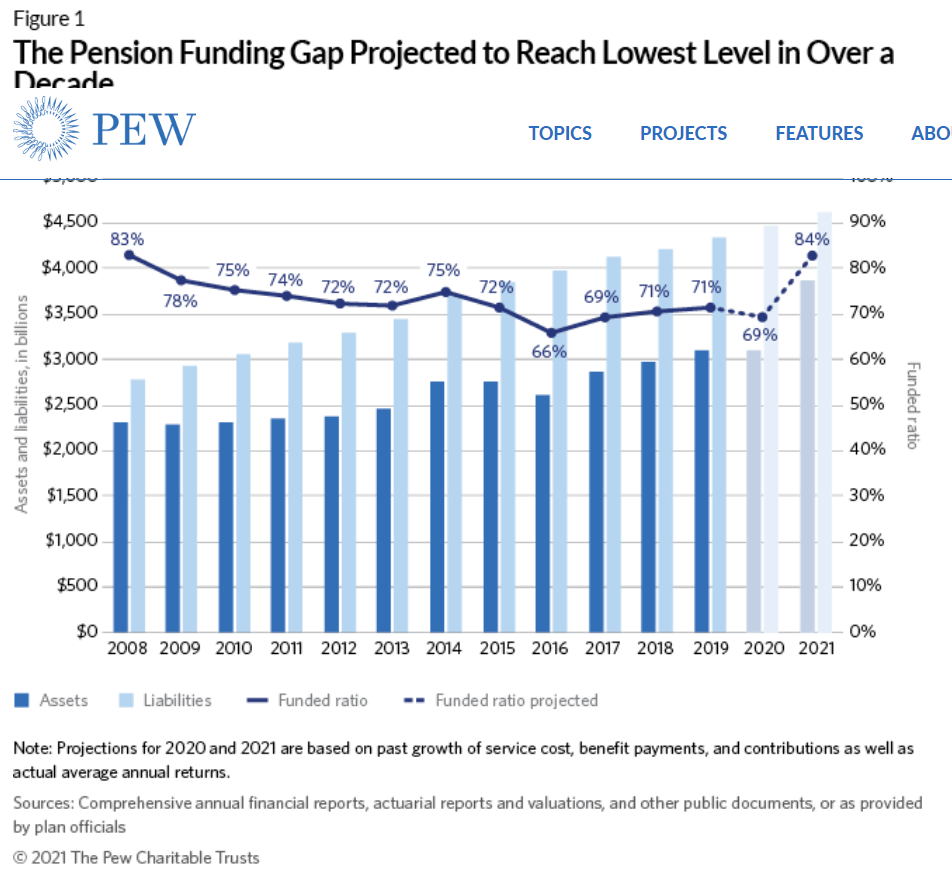
  1. The average state pension plan funding level, the ratio of assets to forecast liabilities, is expected to reach 84% when final 2021 data is summarized. This is a huge improvement from the 70% average of the prior 5 years. It is the highest level since 2008.

2. The system is working. Plan assets were $2.3T versus $2.8T in 2008. Assets grew by $1.5T to $3.8T, while liabilities grew by $1.8T to $4.6T. Since the added $1.5T/$1.8T is 5/6ths or 86%, the overall ratio increased. The “system” of policies, accounting, audits, contributions, investment strategies and actual investment returns, etc. appears to be functional across a quite challenging economic period. The funding ratio was relatively consistent throughout this period, even if it was not at the 100% level highlighted by some as “the goal”.

3. The gap between estimated liabilities and funded assets is less than $1T for the first time since 2014.

4. For the first time in this time period, the minimum expected funding level has been met. This is defined as a year in which contributions exceed benefits plus the “amortized” funding requirements based on past funding shortfalls. In 2014 only 17 states met this standard. In 2019, 35 states complied. Again, this is not perfection, but it is significant progress.

5. Overall contributions have increased by 8% annually. The states with the lowest funding ratios have increased their contributions even faster. The lowest 10 rated states growing by 15% annually and the 4 worst states by 16%.

6. A measure of benefits paid minus funding contributions, as a percentage of plan assets, has improved from 3% more benefits to 2.5% more benefits paid versus new funding contributions.

Historical Commentary

The Trillion Dollar Gap (2010)

https://www.pewtrusts.org/en/research-and-analysis/reports/2010/02/10/the-trillion-dollar-gap

The Funding Gap (2016). Funding ratio 66%. Few states reach 90%.

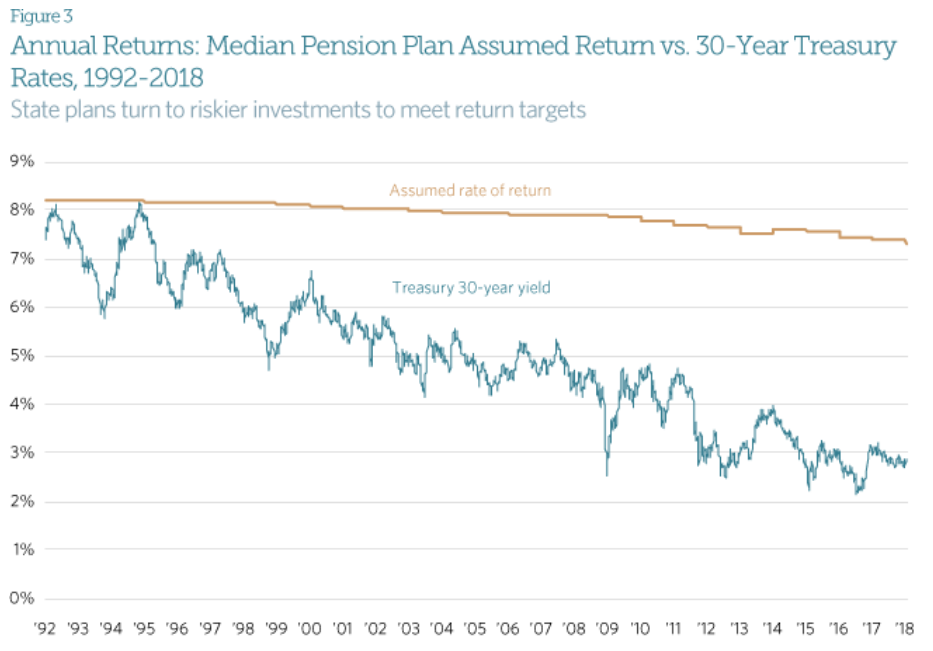
Bond interest rates have fallen faster than pension plan expected returns. Of course, because equity returns are much higher, more volatile, difficult to forecast and a higher share of plan assets.

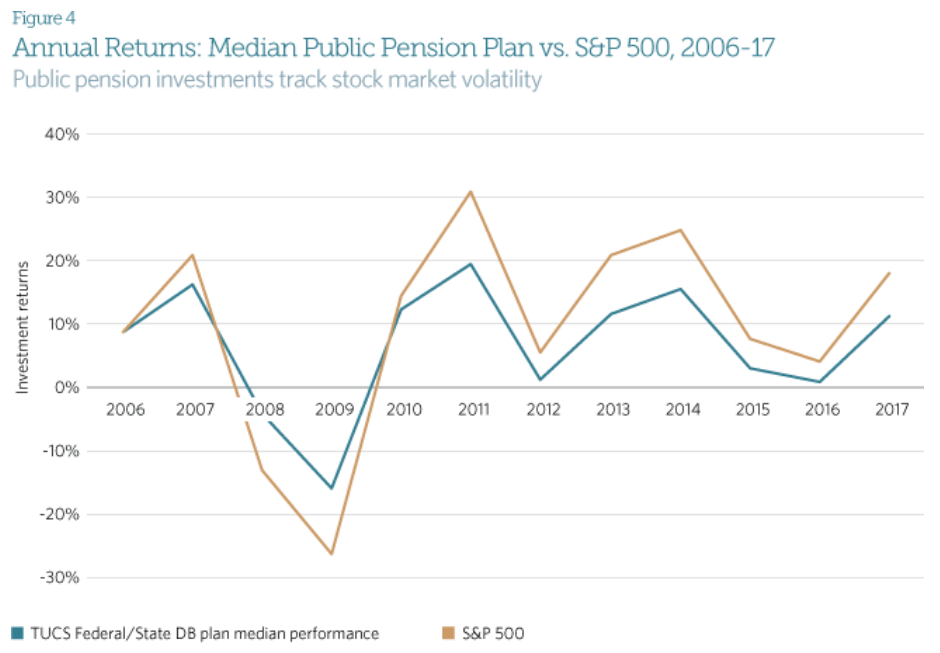
State pension plan returns trail the S&P 500 returns. Of course, because plans hold significant (30-40-50%) in lower yielding bonds.

A lower “discount rate”, the assumed future interest rate used to calculate the present value of future pension benefits/liabilities, will increase current liabilities and the current net liability. Yes, this is how discounting works. As market interest rates and stock returns have been reduced with lower inflation rates, the discount rate used by financial professionals in all applications has slowly declined for the last 20 years. This “sensitivity analysis” is misleading. The sensitivity of present liabilities is inherent, it cannot be avoided.

Some states have amortization rates, the amount of new contributions required to eventually offset prior funding or investment return shortages, that are quite high compared to their annual payrolls. This is true. 7 are above 5% deficits, but 7 are above 5% surpluses.

Pew highlights what they call the “operating cash flow” ratio as another sign of trouble. Contributions minus benefits paid as a ratio to assets is the definition. The result is negative!!!! And increasing to negative 3%! Contributions should almost always be less than benefits paid in a long-term (20-30-40 year) pension plan because the plan trustees assume that there will be some positive return on plan assets. Given a 2/1 equity to debt mix, with 7% to 3% expected returns, the expected plan return is more than 5%, so a 3% “negative” return is not a concern. The insurance industry operates in the same way with “negative” operating ratios being offset by investment returns.

Reason.org Graphics

This group highlights the extraordinary 100% ratio in 2001 versus the more normal ratios of 82% in 2005, the quite low level of 66% in 2012 and the still below average 74% level in 2019. They provide state by state graphics to highlight the decline since the very high 2001 baseline and to emphasize the count of states that are below 90%, 80% and 60% “funded”.

Their websites do not allow their graphs to be linked/captured.

Reason.org breaks 2 rules. First, they implicitly assume that a 100% funding level is the “obvious” goal. That is untrue. Historically, US corporations and actuaries considered 80% to be a “fully funded” target. More was better. A little less was worth watching (70-75%). Much lower required increased focus and contributions. Due to the inherent uncertainties in investment returns and participant assumptions (lifespan, retirement dates, turnover, average salaries, etc.) short-term movements of 2-3-5% were never considered to be an issue. Long-term or persistent ratios significantly below 80% were considered to be a concern.

Second, they assume that all states will perform at the same level. The “laws” of probability prohibit this “ideal” result. In a normally shaped (bell curve) probability distribution, there will always be underperforming and overperforming states. This is inherent in a multiple probability-based system. Of course, if a state remains at the bottom of the funded percentage list for more than 5 years, it probably does have a challenge to face.

Pew Emphasizes Risks in 2021

https://www.pewtrusts.org/en/research-and-analysis/issue-briefs/2021/09/the-state-pension-funding-gap-plans-have-stabilized-in-wake-of-pandemic

  1. Greater state pension contributions have “crowded out” other spending and reduced states’ ability to respond to emergencies. Well, you can’t have it “both ways”. States have responded to the shortfalls highlighted since 2000 with greater contributions. This has improved the funding level despite the Great Recession, the slow recovery and the pandemic challenge.
  2. The recent funding level improvement is due to a “one-time” stock market return in 2021. Yes, stock market returns, both gains and losses, are volatile. That is why pension plans use long-term expected returns for stocks and bonds. That is why pension funds use longer time periods (10 years) to amortize the annually calculated gains or losses into the “required” contributions. Yes, a significant part of the increase from 70% to 84% funded is a short-term increase of investment returns, and probably unsustainable.
  3. The stock market is volatile. Recently. Yes, a once in a century pandemic drives increased volatility. Stock market volatility through time and across markets is well understood as a probability function with mean expected real percentage returns and a predictable range of returns volatility. All investors face this volatility and manage portfolios accordingly. As state pension plans have grown in value, they have been able to hire competent investment advisors.

4. Economic growth is slowing. Some assert this. Others disagree.

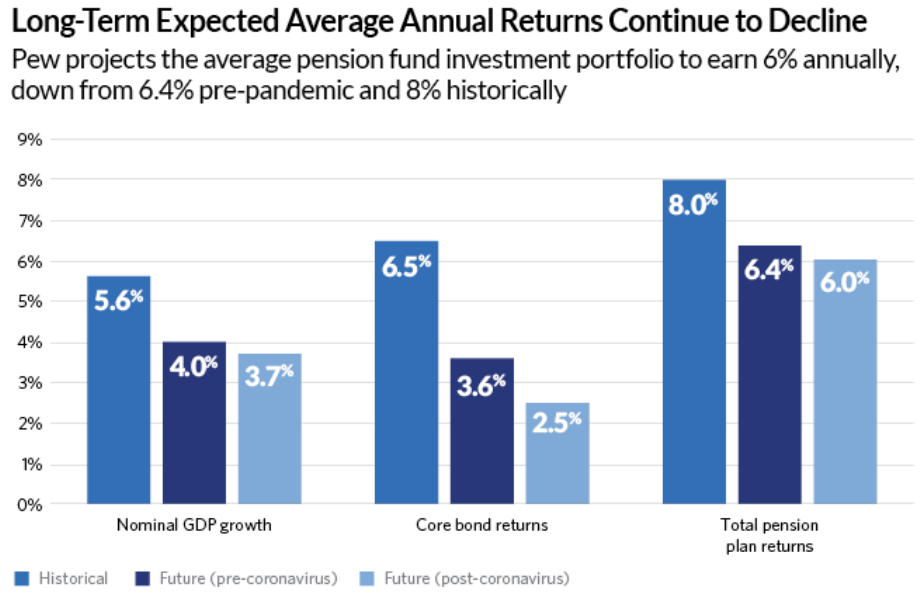
5. Future stock and bond returns will be lower, per Pew. The long-term decline in inflation does drive investment returns lower. The increased efficiency of financial markets, including global investment flows, also drives returns lower. However, pension plans have reduced their expected annual returns. Recent stock market volatility indicates that equity returns may not decline.

6. Increased funding of underfunded pension plans can be portrayed as “increased spending”, rather than the required adjustments for those plans which had historically lower investment returns, contributions or higher ultimate benefits.

Summary

State and local governments are faced with managing inherently variable pension plan decisions. They have choices to make about plan policies, goals, funding, investment policies, audits, advisors, etc. An 80% funded level goal (not 100%) is supported by 100 years of experience around the globe, in public, private and not for profit sectors. The increased publicity/focus on underperforming states and municipalities has forced these public bodies to make tough choices regarding defined benefit versus defined contribution plans, benefit levels, retirement ages, investment policies and advisors. Following the Great Recession, states struggled to increase their funding, but they did not allow the average funding level to fall below 70% for more than a year at a time. On a cumulative basis, they have increased their contributions, reduced benefits and captured the long-run benefits of equity investments.

The increased scrutiny of funding levels in state and local government defined benefit pension plans has forced elected officials and their professional advisors to address shortfalls in pension funding. This is very good news.

Red and Blue States: Federal Government Net Spending Subsidies

Using Current Senators to Denote 22 Red (Republican), 22 Blue (Democratic) and 6 Mixed states

Republican states (including 1/2 of mixed) contain 43% of population. Democratic states 57% of population.

https://www.infoplease.com/us/states/state-population-by-rank

Latest (2017) Analysis Shows Federal Revenues of $3.1T and Expenses of $3.7T (20% extra spending).

https://www.voanews.com/a/which-us-states-get-more-than-they-give/4809228.html

Some States Subsidize; While Others Are Subsidized

https://www.voanews.com/a/which-us-states-get-more-than-they-give/4809228.html

I have mapped this data onto the “Red vs. Blue” states list based on current senators.

Red (Republican) States Benefit Greatly

Democratic states pay 63% of all taxes, 5% more than their population share and 13% more than their senators’ (power) share.

Federal expenditures in Democratic states are 58% of the total, more than 4% less than their share of revenues contributed. Federal expenditures in Republican states are 42% of the total, more than 4% above their share of revenues contributed. Hence the total gap is almost 9% of the total.

The referenced article focused on two measures: net dollar subsidy (expenses > revenues) and net dollar subsidy per person.

I’m going to use a slightly different measure. The large (20%) difference between total expenditures and revenues skews these figures. I’d like to assume that the “equal” situation is one in which each party’s states pays the same ratio of revenues to expenses (or conversely, expenses to revenues). I’ve standardized the figures assuming that the “neutral” state receives 10.6% more expenditures than it pays in taxes, the same level as the Democratic states. Hence, by definition, the Democratic states, in total, are “neutral”. Their $2.155T expenditure is 10.6% higher than their $1.948T revenues.

The Republican states have $1.168T of revenues paid to the federal government but receive $1.555T of local expenditures. This is 33% more expenditures than revenues, a huge extra (22%) budget deficit. If the Republican spending was just 10.6% higher than revenues, it would be $1.292T, with a deficit of “just” $0.123T. This is $0.264T less than the actual deficit of $0.387T.

Subsidized States (>$10B)

6 Democratic states receive subsidies of more than $10 billion, totaling $180B.

Georgia (15), Michigan (16), New Mexico (17), Arizona (26), Maryland (29) and Virginia (78). Most of this is due to the DC employment and contracting bias.

Twice as many Republican states receive major subsidies, totaling $246B; $66B more than the Democratic states.

Indiana (10), Oklahoma (13), Arkansas (13), Louisiana (14), Tennessee (19), Mississippi (19), Missouri (19), South Carolina (21), Florida (26), North Carolina (26), Alabama (29) and Kentucky (38). Ironically, much of this excess spending was started when Democrats controlled southern states through much of the twentieth century.

Subsidizing States

Texas sends $19B more revenues to the federal government than it receives in expenditures, the only large subsidizing Republican state.

Seven Democratic states provide major subsidies to the federal government, totaling $218B, for a net subsidy versus Republican states (Texas) of $199B.

Washington (10), Illinois (19), Connecticut (20), Massachusetts (26), New Jersey (34), California (46) and New York (63). These states have the highest per capita incomes, so with a progressive income tax system, they pay a disproportionate share of federal taxes. (The state and local tax limit on deductions for federal taxes is a big issue in these states).

Summary

The Senate’s seats are based on geography, providing a major benefit to states with more rural and less urban/metro populations, benefitting the Republican party today more than in previous decades when Democrats were competitive in some of these states. Southern and rural states (Red, Republican) have lower incomes and receive more federal spending than coastal states (Blue, Democratic). In total, the Democratic states are paying 63% of taxes, while receiving 58% of federal expenditures, yet have just one-half of the senators and political power to determine taxing and spending policies. This discrepancy serves to reinforce the increasingly polarized political environment in the US.
The US Political Split Grows

Dems Win Even Fewer Counties in 2016, But an Increased 64% of GDP!

https://www.brookings.edu/blog/the-avenue/2016/11/29/another-clinton-trump-divide-high-output-america-vs-low-output-america/

The rural versus urban split in American politics was very clear in the 2016 presidential election.

Trump Won 2016 in Rural Leaning Areas

https://www.brookings.edu/blog/the-avenue/2016/11/11/the-small-town-big-city-split-that-elected-donald-trump/

Democrats are the Metro Party, Representing Just 20% of the Land Area

Democratic Congressional Districts are Increasingly More Economically Productive

https://www.brookings.edu/blog/the-avenue/2018/11/16/americas-two-economies-remain-far-apart/

Larger Metro Areas Continue to Grow Faster

https://www.brookings.edu/research/countering-the-geography-of-discontent-strategies-for-left-behind-places/

Threat of Automation Job Reduction Haunts Republican States More

https://www.brookings.edu/blog/the-avenue/2019/03/25/automation-perpetuates-the-red-blue-divide/

Trump Counties Employment Growth Increased in 2018, Due to Cyclical Expansion of Maunfacturing

https://www.brookings.edu/blog/the-avenue/2019/05/06/trump-counties-may-be-winning-a-bit-more-but-their-prognosis-remains-dim/

Democratic versus Republican Local Economies Split Becomes Much Clearer by 2018

https://www.brookings.edu/blog/the-avenue/2019/09/10/america-has-two-economies-and-theyre-diverging-fast/

Dems represent just 20% of the US land area.

Dem GDP/district is 50% higher than Republican areas.

Dem district median income is 15% higher.

Dem district productivity is 75% higher.

Dem districts have 36% college degree holders versus 28%.

Reps have more basic manufacturing (56%) and agriculture/mining (60%).

Dem districts have more foreign-born population (20/8) and more non-white residents (50/28).

Biden Democratic Coalition Represents 71% of US $GDP

https://www.brookings.edu/blog/the-avenue/2020/11/09/biden-voting-counties-equal-70-of-americas-economy-what-does-this-mean-for-the-nations-political-economic-divide/

Democrats Represent 61% of GDP at Senate Level

Just 6 of 50 states have split US Senate representation. WV, OH, PA, ME, WI and MT account for slightly less than 10% of the 2021 US GDP.

Republicans have 2 Senators in 22 states, which account for $6.6T of GDP.

Democrats have 2 Senators in 22 states, which account for $10.8T of GDP.

Splitting the GDP for the 6 split states 50/50 results in $7.5T in Republican states and $11.7T in Democratic states. The Democratic states have 57% greater GDP in 2021.

The Democratic percentage advantage in 1997 GDP per state is identical. Republican states produced $4.5T while Democratic states produced $7.1T. Between 1997 and 2021, Democratic and Republican states grew at equal percentages. In dollar terms, Democratic states added $4.6T, while Republican states added $3.0T.
Percentages are difficult to digest. One way to compare the 2021 GDP of the two parties is to use “paired comparisons” and then examine the remaining non-paired states. 13 roughly equal pairs can be identified. WY-VT, AL-RI, ND-DE, ID-MA, KS-NV, MS-NH, AR-NM, SC-OR, LA-AZ, MO-CT, TN-MN, IN-MD and NC-MA.
The remaining Republican states have lower $GDP figures but can be mapped to equal $GDP Democratic states. IA+NE+SD=CO. FL+TX=CA. KY+AL+OK+UT=IL.
This leaves 6 states that represent the $4.5T (57%) Democratic state advantage: Michigan ($0.5T), New Jersey ($0.6T), New York ($1.5T), Virginia ($0.5T), Georgia ($0.6T) and Washington ($0.6T).

Summary

The Post-Trump Republican Party is distinctively different, representing a broader share of the American geography, but a smaller share of its income, production and diversity. This split reinforces the polarizing tendencies of recent decades, making attempts to find “common ground” at the national level more difficult.

US Murder Rates Up in 2020-21

https://www.cnn.com/2021/12/12/us/homicides-major-cities-increase-end-of-year-2021/index.html

Above: Another Murder in Bridgeport Neighborhood of Chicago, My Home 2010-18

https://crime-data-explorer.app.cloud.gov/pages/explorer/crime/crime-trend

1985-95 8/100K. 1999-2008 5.5/100K. 2009-19 5/100K.

1966-2020 Context. 1970-95 Very High Rates.

https://www.pewresearch.org/fact-tank/2021/10/27/what-we-know-about-the-increase-in-u-s-murders-in-2020/

Twentieth Century Context: US Has High Homicide Rates

https://en.wikipedia.org/wiki/Crime_in_the_United_States#/media/File:Homicide_rates1900-2001.jpg
https://www.jrsa.org/projects/Historical.pdf

Relative Violent Crime Rates

https://usafacts.org/data/topics/security-safety/crime-and-justice/crime-and-police/violent-crimes/?utm_source=google&utm_medium=cpc&utm_campaign=ND-StatsData&gclid=Cj0KCQjw8_qRBhCXARIsAE2AtRYrdjEGFcHhSe1xpRQXCK59y0pe3Dkh9pOCg2WBHhO3fRPrXWDCz0QaAuqYEALw_wcB

Firearms Involved in Homicides and Suicides

https://usafacts.org/state-of-the-union/crime/

Homicide Rate Up 30% in 2020, 5% in 2021

https://www.pewresearch.org/fact-tank/2021/10/27/what-we-know-about-the-increase-in-u-s-murders-in-2020/

Focus on Rates Per 100K for US or All Cities, Not Counts in Individual Cities

https://abcnews.go.com/US/12-major-us-cities-top-annual-homicide-records/story?id=81466453

Many Factors Proposed to Explain the Increase

https://www.vox.com/2020/8/3/21334149/murders-crime-shootings-protests-riots-trump-biden

https://www.theatlantic.com/ideas/archive/2021/09/america-having-violence-wave-not-crime-wave/620234/

Good News: US Property Crime Rates Cut in Half Since 1998

https://crime-data-explorer.app.cloud.gov/pages/explorer/crime/crime-trend
https://ncvs.bjs.ojp.gov/multi-year-trends/crimeType

Property Crime Rates Were Very High 1975-90

https://www.factcheck.org/2020/06/trump-wrong-on-crime-record/

FBI and Bureau of Justice Data Both Show Declines, Reporting of Crimes Remains Consistent

https://www.pewresearch.org/fact-tank/2020/11/20/facts-about-crime-in-the-u-s/

Property Crime Rates Have Fallen Despite Changes

https://porch.com/advice/most-urbanized-states
https://www.pewresearch.org/social-trends/2018/05/22/demographic-and-economic-trends-in-urban-suburban-and-rural-communities/
https://www.pewresearch.org/fact-tank/2020/08/20/key-findings-about-u-s-immigrants/
https://www.pewresearch.org/fact-tank/2021/08/23/most-americans-say-the-declining-share-of-white-people-in-the-u-s-is-neither-good-nor-bad-for-society/
https://www.pewresearch.org/social-trends/2020/01/09/trends-in-income-and-wealth-inequality/
https://theconversation.com/gun-violence-has-fuelled-enduring-trust-issues-for-many-americans-144413
https://www.pewresearch.org/social-trends/2014/03/07/millennials-in-adulthood/
https://www.pewresearch.org/fact-tank/2016/04/13/americans-divided-on-how-much-they-trust-their-neighbors/