
Welfare Benefits: Order of Magnitude

“Typical welfare family”, a single parent and 2 children (cue the video), receives $35,000 of welfare benefits annually claims the Wisconsin congressman in 2014. That number has stuck in our minds, just like the “welfare queen” and escaped prisoner “Willie Horton”.

https://www.washingtonpost.com/news/fact-checker/wp/2014/12/05/grothman-single-parents-welfare/

Fact checkers debunked this claim, but it’s important to work through the details to get back to a reasonable “order of magnitude” estimate of “welfare benefits”.

If a family has ZERO income, they may receive maximum benefits. The Clinton “welfare reforms” limited the primary benefits to a total of 60 months. Families cannot receive benefits “forever”. Most household heads do work and have some income during the year. The maximum benefit number is an inappropriate “anchor”.

Temporary Assistance for Needy Families (TANF) (welfare) participation rates have fallen from 80% of those eligible to less than 25% since “reform” was implemented. The reform has had it’s intended effect. Two-thirds of those previously participating no longer do so. Some have become more productive and income earning members of society. Others “make do”.

Click to access what_was_the_tanf_participation_rate_in_2016_0.pdf

The percentage of families “in poverty” receiving welfare benefits has fallen from 68% to 23%.

https://www.cbpp.org/research/family-income-support/temporary-assistance-for-needy-families-tanf-at-25

Current average TANF benefits in my home state of Indiana are $346/month or $4,152. That’s a long way from $35,000 of cash benefits, which is the “anchor” that needs to be removed. $4,000 per year of cash is the typical Indiana welfare benefit. The maximum is $700/month or $8,400/year, twice as high. More kids, no income, still eligible. This is possible, but it’s not a useful reference point. The normal received benefit is just one-half of the maximum.

https://www.needhelppayingbills.com/html/indiana_cash_assistance.html

Supplemental Nutritional Assistance Program (SNAP of food stamps) is the next welfare program. For an Indiana family of 3, current benefit value is $6,240 per year. A family of 3 can earn up to $25,000 annually before benefits start to decline. The national ratio of SNAP to TANF recipients is 82%. In Indiana, just 75% of those eligible receive ANY SNAP benefits.

https://www.fns.usda.gov/usamap/2018#

https://www.in.gov/fssa/dfr/snap-food-assistance/about-snap/income/

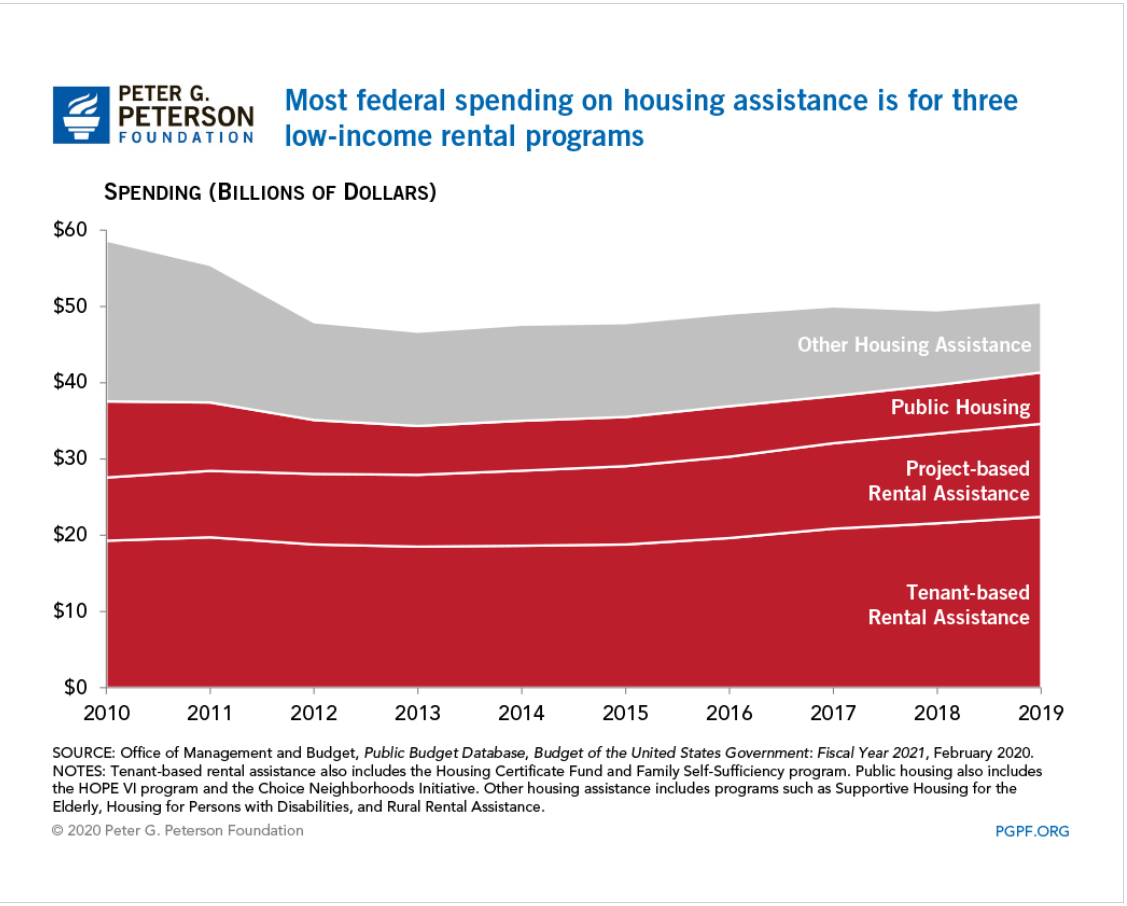
Housing assistance is listed at $9,000. There are various federal and state programs. This is like “winning the lottery” for low income families. In Indiana, 1 in 8 eligible families (12%) receive housing subsidies. These average $736/month or $8,832 per year. On an “expected value” basis, this is only $1,060 per year. From a public policy point of view, this is the relevant number.

See pages 23-24.

Support has not increased materially since 2013.
https://www.pgpf.org/blog/2020/07/how-does-the-federal-government-support-housing-for-low-income-households

In the Wisconsin representative’s model, there is $7,000 of higher education benefits. This is clearly irrelevant to public policy. Individuals do not make ongoing annual work choices based on education benefits.

The Cato Institute started this “conversation” about “welfare versus work” in 1995 and updated their analysis in 2013.

Like the congressman, they note that the “welfare benefits” received are in “after-tax” dollars, so they “should” be translated back into pre-tax dollars to be “fair”. Since the marginal tax rate for low-income wage earners is often just 10%, this is immaterial. More importantly, the emotional, political currency is cash. “how much do THEY receive?” is THE question. This is an after-tax amount. No “grossing up” is required.

The Cato folks also include the full value of Medicaid benefits received by those below the eligible income transition. The value paid per child ($2,145) and per adult ($4,211) yields an $8,501 annual “benefit” currently. Is this a “welfare” benefit or a “citizen” benefit? The US health care system is primarily funded through tax-deductible employer plans. Medical plan subsidies are now available up to 400% of the federal poverty level. From a federal budget perspective, lowest income families receive more value. From an “incentive” perspective, low income families are generally indifferent between federal and employer sponsored plans. This $9,000 does not belong in “the cost of welfare”.

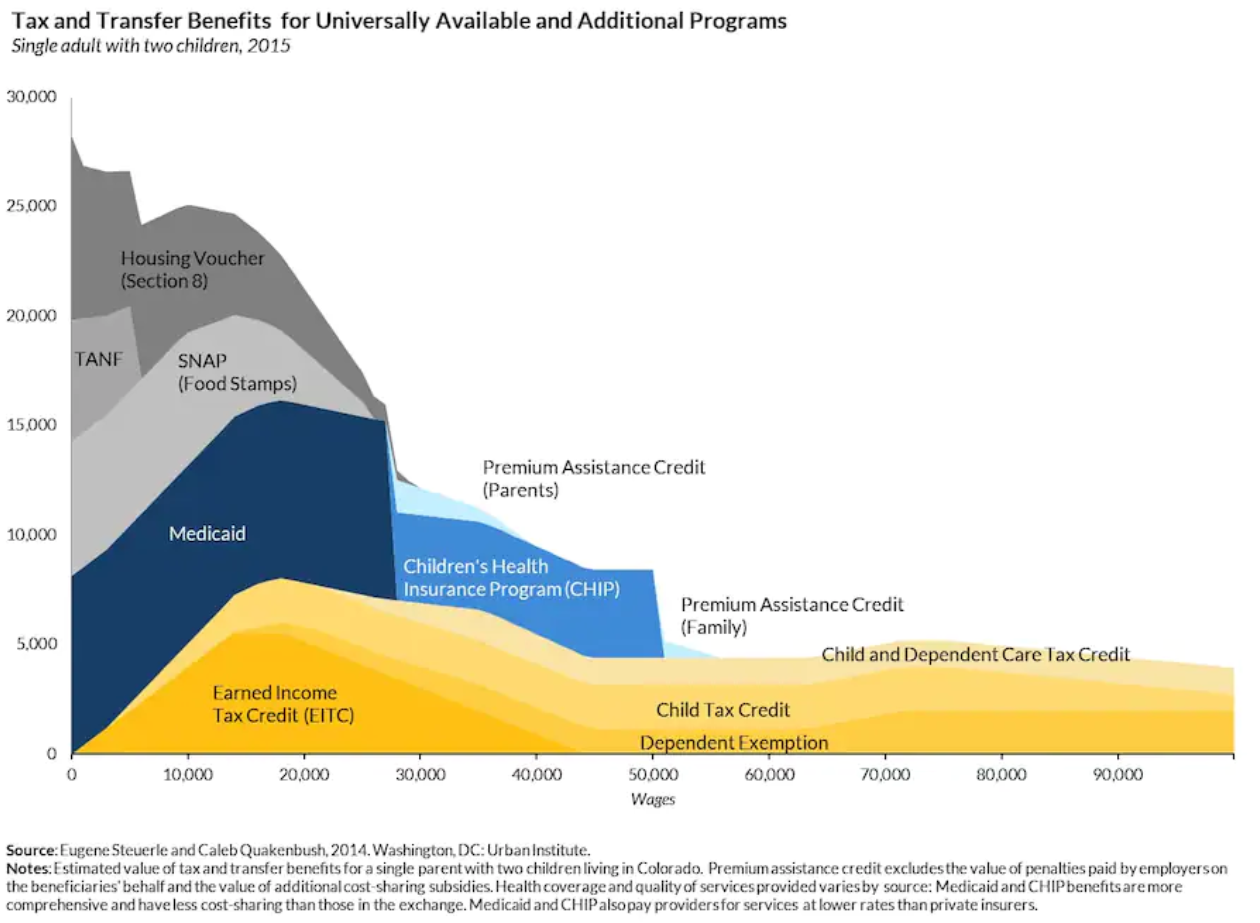
The Cato analysis includes the cost of the “earned income tax credit” (EITC) as a welfare benefit. The EITC was created and enhanced as an incentive for unemployed persons to work and earn some income, thereby providing themselves with short-term and long-term benefits and reducing the cash level welfare benefits. It grows quickly with earned income up to about $18,000 and then falls back down nearly as quickly as income grows to $40,000 per year. This is not what most people think of as a “welfare benefit”.

https://en.wikipedia.org/wiki/Earned_income_tax_credit

The Cato analysis also focuses on welfare benefits versus the minimum wage, emphasizing that overly generous welfare benefits provide a disincentive for recipients to seek paid employment (ignoring the 60 month TANF benefits limit). As the effective minimum wage in 2021 approaches $15/hour and $31,200/year, we won’t be hearing this comparison again.

As a professional “cost accountant” since 1978, I was often asked to provide the “exact cost” of various products or services. College courses, residence hall rooms, food service meals, buildings for rent, account managers, computer hardware, installed cables, telephone services, computer maintenance, software development, dresses, tops, retail stores, extension cords, surge protectors, imported goods, cell phones, returned cell phones, etc. The answer is always “it depends”. This is never a popular answer. It depends on what decision you are making. Short-term, medium-term or long-term timeframe. Do we include opportunity costs? Which externalities should we consider, if any? Do we include strategic, brand or cultural consistency as factors?

For the “welfare benefits” question, I think that the relevant public policy/budget and personal incentive numbers are largely the same. Welfare/TANF and food stamps/SNAP matter. EITC, medicaid, education benefits, housing assistance, and income taxes don’t matter.

Welfare/TANF for an Indiana family of 3 is worth $4,152 annually. The complementary food stamp/SNAP benefits are worth $6,240. The total quasi-cash welfare payment is $10,392 per year of eligibility. Maximum of 5 years. This is the right “anchoring” number: $10,000 per year for a family of 3. They will be going to the local food pantry every week. They will be seeking family and private charity. They will be leaning on friends, relatives and neighbors for “subsidized” child care. They will be working and seeking to advance themselves.

There are disincentive challenges remaining in our current systems.
https://www.washingtonpost.com/news/fact-checker/wp/2014/12/05/grothman-single-parents-welfare/

But, these technical, marginal, incremental, opportunity rates are not the heart of the matter. Lower income families are not “optimizing” their benefits. I volunteered to provide low income/elderly federal income tax services for several years. The benefit and tax rules are complex beyond comprehension.

The core public policy question is “Is $10,000 of annual benefits a reasonable amount for our state to pay to a family of 3 with no income?”. I would argue that it is too low, half what it ought to be.

Support for a universal basic income (UBI) has grown in recent years, as the economy, productivity and equity returns have grown by 3% annually but wages have remained flat for 40-50 years in the US.

https://www.investopedia.com/news/history-of-universal-basic-income/

Typical welfare benefits at $10,000 are now irrelevant compared with $30,000 effective minimum wage.
The U.S. Senate: Unrepresentative

The United States was founded as an aspirational representative democracy. No taxation without representation. One man, one vote. Yet, the Senate was created at the 1787 Constitutional Convention to equally represent the states in the federation, not to equally represent the citizens. This was a compromise between the small states and the large states.

How the Great Compromise and the Electoral College Affects Politics Today – HISTORY

The Unconstitutional Implications of the Two-Senator-Per-State Rule — Northwestern Undergraduate Law Journal (thenulj.org)

Distortions

Recent critics focus on the extent of the distortions favoring the citizens of small versus large population states.

California’s 39M residents have the same representation as Wyoming, Vermont, Alaska and North Dakota who each have three-quarters of one million residents. This is a larger than 50 to 1 advantage for these four states. The California-Wyoming ratio is 68X, meaning that California citizens have just 1.5% as much power as Wyoming citizens.

A majority of states comprised of the 26 with the lowest populations represent 18% of the population. In theory, they could combine to outvote the other 24 states with 82% of the population. States with 57M people have more power than states with 269M citizens. The “lucky duckies” in the small population states, on average, get more than 5 times as much power as those in the large population states.

Distorted democracy: Change the Constitution or the states to fix it (usatoday.com)

The 9 most populous states contain more than one-half of the US population, but get only 18% of the Senators. The other 41 states with less than half of the people get 82% of the Senators. The filibuster rules that allow 40% of Senators to block Senate action give 41 Senators representing 11% of the country a potential veto. The two-thirds requirement for constitutional amendments and treaties gives this power to 34 Senators representing 5% of the population.

Abolish the Senate (bestdemocracy.org)

The 50/50 Democratic/Republican split in the Senate shows Democrats representing 185M residents versus 143M for Republicans. Democrats represent 40M more people with the same number of Senators. They represent 29% more citizens each. If California (D) and Texas (R) are removed from the calculation, Democrats have 30M extra voters to represent for the same number of Senators.

Demographers estimate that the disproportionate influence of small states will increase further in the next 20 years. In 2040, the 15 largest states will have 30% of the Senators (power) and 70% of the population, while the 35 states with 30% of the population will have 70% of the power.

‘The Senate is broken’: system empowers white conservatives, threatening US democracy | US Senate | The Guardian

Who Benefits from the Small State Advantage?

Republicans tend to be more popular in small states. In the 30 least populous states, Republicans have 35 Senators versus 25 for the Democrats, a 10 seat advantage. In the 20 most populous states, Republicans have 16 Senators versus 24 for the Democrats, an 8 seat disadvantage (2018).

Small states are getting a much bigger say in who gets on the court | CNN Politics

Most statisticians estimate the Republican advantage in the Senate to be the equivalent of 3%.

The Senate is a much bigger problem than the Electoral College – Vox

In 1950-1960, the impact of small states was more evenly split between Republicans and Democrats. The benefit to Republicans grew through time.

‘The Senate is broken’: system empowers white conservatives, threatening US democracy | US Senate | The Guardian

The Senate Has Always Favored Smaller States. It Just Didn’t Help Republicans Until Now. | FiveThirtyEight

Historically, small population states (mostly rural) have taken advantage of their relative power advantage to gain proportionately more federal spending, military bases and employment (earmarks, committee chair advantages). They have looked out for the interests of their citizens with distinctive federal policies for agriculture, natural resources/oil, highways versus mass transit, gun control/gun rights, criminal justice views, etc.

Lower population states have lower levels of immigration, fewer non-English speaking residents, higher per capita health care spending, higher % households with student debt, lower poverty rates and higher % of home owners.

the-senate-is-an-irredeemable-institution.pdf (filesforprogress.org)

Various calculations indicate that minorities lose representation and power versus Whites. Non college grad whites +12% extra representation. Non college grad blacks -20%. Non college grad Hispanics -30%.

the-senate-is-an-irredeemable-institution.pdf (filesforprogress.org)

As Blacks make up 11% of the 26 least populated states, but 15% of the 24 most populated states, they are 25% underrepresented.

Distorted democracy: Change the Constitution or the states to fix it (usatoday.com)

One author estimates that Whites get 0.35 Senators per 1M population, while Blacks get 0.26/1M and Hispanics just 0.19/1M.

‘The Senate is broken’: system empowers white conservatives, threatening US democracy | US Senate | The Guardian

Another author says that rural residents get 37% extra say, Whites get 13% extra compared to the average voter while non-Whites get 22% less for a total 35% minority voter penalty.

The 2021 Senate Will be Unrepresentative | by Michael Ettlinger | Medium

Why is This Such a Hot Issue?

The Republican advantage is material and is likely to continue.

The country’s political parties are more clearly aligned on a single conservative-liberal dimension, making parties and voters more polarized and reducing the opportunity for compromises based on other dimensions.

Starting with Newt Gingrich, the Republican Party discovered the power of 100% party discipline in both the House and Senate, making trade-offs, compromises, deals and log rolling less likely.

While rural/urban differences have always existed in the US (Federalists vs Democratic Republicans, North/South, Farm populists), the alignment of cultural and economic interests with the 2 parties now reinforces these differences.

The electoral college includes a vote for each Senator, so distortions are reflected to a lesser, but material, extent in presidential contests. US Supreme Court nominees require Senate confirmation.

The White/minority power difference.

With a divided population, the legitimacy of government is threatened.

Not a Problem (Opposing Views)

US Congress has stood the test of time with its “checks and balances”, including the purposeful compromise between large and small population states.

In the long-run, the advantages to one political party have faded.

The Pareto Principle (80/20) rule applies to many calculations like these. The forecast 30% of people with 70% of votes is less distorted than 80/20.

The US was formed as a federation of states with equal rights, like the sovereignty rights of nation states.

Voters do get “equal representation” in the House.

Geography and property are valid dimensions of political power, with a right to be represented.

There are many dimensions to political power. Urban areas are over represented in the economy, universities, media and culture. This gives rural areas/citizens an opportunity to be heard.

Constitutional Amendment?

Article 5 states that “no state, without its consent, shall be deprived of its equal suffrage in the Senate”. Hence, some would argue that no amendment can change these voting rules. Perhaps unanimous consent of the original 13 states would be sufficient. If a regular amendment was possible, it would require the support of two-thirds of the Senators and three-fourths of the states. Realistically, any amendment would require the potential support of 40 states, with only 10 left behind. This would require support from a majority of Republican states and all Democratic states. A Constitutional Convention with all options on the table may be required to change the basic 2 Senators per state rule.

The Senate is a much bigger problem than the Electoral College – Vox

Potential Solutions

Replace House and Senate with a unicameral legislature.

Abolish the Senate (bestdemocracy.org)

Allow states with some high ratio of the smallest or average state to divide into 2 or 3 or more states. “Encourage”/incentivize states with less than 1% of national population to merge with another state. Start with California and Texas.

The United States Senate was explicitly designed to be undemocratic. (milforddailynews.com)

Assign a “bonus” Senator to states with a population greater than 3 times the average population.

Redraw the whole state map to reflect natural economic areas with population differences of no more than 5 to 1.

Assign Senators based on 1 per state plus 1 per population with 110 total Senate seats.

The Unconstitutional Implications of the Two-Senator-Per-State Rule — Northwestern Undergraduate Law Journal (thenulj.org)

Change Senate election rules to have both Senators from a state be elected in the same election. Allow 2 candidates per party. If 1st place winner does not win at least 52.5% of votes, choose second Senator from party with second highest vote total.

U.S. Senate has fewest split delegations since direct elections began | Pew Research Center

Add District of Columbia and Puerto Rico as states. Consider Guam, American Samoa, Northern Marianas and US Virgin Islands.

Finally, some “political” solutions.

Provide economic development assistance grants for 10 smallest states to increase their population, especially their urban population.

Target economic policies/incentives to small, rural states to support the Democratic party.

Examining America’s Farm Subsidy Problem | Cato Institute

Provide incentives for 400,000 Democrats to move from California to Wyoming (125K), Montana (61K), Alaska (45K), North Dakota (36K) and South Dakota (132K) to narrowly win elections in 5 small states!!

US Poverty Rate, 1965-2019

YearRateAdjusted RateAdjustSingle Female HOH Pov RateSingle % of FamiliesSingle % of PoorNon Single Rate
20199.07.41.62518515.4
201511.59.32.23119526.9
201010.68.62.02919526.2
20059.88.11.72818515.8
20009.98.11.83018535.6
199511.69.52.13518536.6
199010.68.91.73417526.1
198511.710.21.63516477.4
19809.58.31.13215495.7
19759.38.70.63313446.0
197010.610.40.23311347.9
196516.016.00.040102613.3

Table 13.

Historical Poverty Tables: People and Families – 1959 to 2019 (census.gov)

I summarized the data in this table into 5 year buckets, just 4 years for the most recent 2016-19 period, to make it easier to review.

The poverty rate is the number of families out of 100 who meet the Census Bureau’s evolving standard of being poor, based on family size and location. For the last 4 years, 9.0% of families were considered poor.

The adjusted rate in the 3rd column calculates what the poverty rate would be in each period, if the nation had a constant 10.2% of families in the female head of household, no spouse present category (single moms), as was the case in 1965.

The adjustment is shown in the fourth column, reducing the average measured poverty rate.

The poverty rate for only single moms is shown in the 5th column.

The share of ALL families headed by single moms is in the 6th column.

The share of all POOR families headed by a single mom is displayed in the 7th column.

The poverty rate for families headed by a male is listed in column 8.

The OVERALL poverty rate dropped sharply (by 42%) from the early 1960’s at 16% to nearly 9% in the early 1970’s. The overall poverty rate was finally a shade lower in the 2016-2019 period, down to 9%. The overall poverty rate was in the 11% range throughout the 1980’s and first half of the 1990’s. It improved to 10% at the turn of the millennium, but rose back to 11% for the next decade. Overall, the rate was roughly flat for 50 years, ranging from 9-11%.

Partisans love to argue about the “war on poverty”. This data indicates that the early war was effective, but the enemy fought the proponents to a draw for the next 50 years.

Table 13 highlights the growing number and share of single female headed households. Single moms were just 10% of all households in 1965. They increased by 80% to 18% of the total by the early 1990’s, and have stayed in the 18-19% range thereafter.

The single mom poverty rate was unusually high in the early 1960’s at 40%. From 1970 through 1995 it averaged one-third. Single mom poverty rates were reduced by 10% to 30% for the next 20 years. The rate has fallen again, to 25% in the latest period. However, the single mom poverty rate has consistently been 4+ times as high as the male head of household group. Single mom headed households doubled their share of all poor households, from 26% to 52% in the last 50 years..

The male head of household group started with a 13% poverty rate. It dropped to 6% by 1970 and generally remained there for 40 years, aside from 7% rates in the 1985 and 2015 periods. Note that this is a greater than 50% reduction in the share of poor families. The “war on poverty” appears more successful from this vantage point. The rate edged down to a record low of 5.4% in the most recent period, as the extended economic recovery reduced unemployment and started to increase wages for lower skilled workers. This is a 60% reduction in poor families since the early 1960’s for this subgroup.

Column 4 shows the negative impact (mix variance) of having nearly twice as many families in the 33% poverty rate group versus the 6-7% poverty rate core group. By 1980, this change increased the poverty rate by 1%. By 1995, the impact was 2% and has remained in this range.

The adjusted poverty rate, standardized at the 1965 10.2% share of single moms may be a better measure of the effectiveness of overall policies and economic results. The adjusted rate starts with the same 16%. The effective poverty rate drops to 10% in 1970 and further to 8.5% in 1975-80. There is a spike back up above 10% in 1985 before falling back to 9% for 1990-95. The revised rate drifts down to 8% for 2000-2005 (50% reduction from 1965). It pops back up to 9% for 2010-15, before falling to 7.4%, a record low, finally less than half of the starting rate.

Adjusting for the mix of single mom households versus others provides a better view of the country’s effectiveness in reducing poverty. The adjusted poverty rate has been reduced by 60%, not just by 44%.

We can review poverty rates by age, race and education another day. The recent COVID-19 funding bills appear to be very effective at further reducing the US poverty rate. A relatively small amount of money seems to be working. The causes of more single mom headed households and focused policy solutions is also a topic for another day.

Is Indiana Better Off?

Population Rank of 50 States

Indiana maintained its 11th place rank from 1920 through 1970.

Since 1970 it has fallen 6 places to just 17th.

Of the 9 “nearby” states, only Iowa, dropping 7 places performs worse at attracting and retaining citizens. Missouri, Wisconsin and West Virginia are essentially the same as Indiana, dropping 5 places each in this half century. Michigan and Kentucky slipped by 3 places. Illinois and Ohio, starting near the top at 5th and 6th place, declined just one place. Tennessee gained one place, from 17th to 16th, moving ahead of Indiana.

Indiana Population 2021 (Demographics, Maps, Graphs) (worldpopulationreview.com)

Indiana’s Population Gains: What’s Our Rank?

90 Years and Indiana Doubles Its Population (January-February 2015)

Census 2020: Indiana population up, Midwest population down in 2020 (indystar.com)

Personal Income Growth Since the Great Recession

The economic recovery between 2007 and 2019 was one of the slowest after a recession. Average U.S. personal income grew by 2.0% overall. Indiana’s 4 way tie for 19th place at 1.9% is above the median state, even though it is slightly below the U.S. 2.0% average. 10 states grew by 2.4% annually or faster. 19 grew by 1.5% or less per year. Among the nearby states, Indiana was the second fastest grower, trailing only Tennessee at 2.2%. Iowa, Wisconsin, Ohio and Kentucky grew just a little less quickly, with 1.5-1.6% rates. Michigan (1.4%), Missouri (1.3%), West Virginia (1.1% and Illinois (1.0%) trailed significantly.

States 2020 Personal Income Growth Was Highest in 20 Years | The Pew Charitable Trusts (pewtrusts.org)

Relative Per Capita Income

YearINUSIN/USDecade IN – US %
19703,8494,21891.3
19809,36510,20491.8+1%
199017,76819,64190.5-3%
200028,23330,64092.1+3%
201035,45340,51887.5-7%
202051,34059,75485.9-3%

Indiana per capita income has trailed the national average throughout the last half century, starting at 91% of the national figure. Indiana gained a small amount in the first 30 years, reaching 92%. Indiana has slipped quite significantly to 86% in the last 20 years.

Per Capita Personal Income in Indiana (INPCPI) | FRED | St. Louis Fed (stlouisfed.org)

Personal income per capita (A792RC0A052NBEA) | FRED | St. Louis Fed (stlouisfed.org)

• Indiana: per capita real GDP 2000-2019 | Statista

United States | Per Capita Personal Income Trends over 1958-2020 (reaproject

Per Capita State GDP Rankings

State19982018Change
IL1112-1
IA3321+12
WI2824+4
OH2025-5
IN2732-5
TN3136-5
MI2637-11
MO2338-15
KY3544-9
WV4748-1

In the 20 years from 1998-2018, Indiana per capita GDP grew by an average level for the heartland, 19%, the same as Ohio, West Virginia and Tennessee. Kentucky, Missouri and Michigan grew by only 10-14%. Illinois, Wisconsin and Iowa grew by 24% or more, close to the national average.

During this time, Indiana dropped from a middling 27th rank to a lower 32nd rank. Ohio and Tennessee also dropped by 5 places. Kentucky dropped by 9, Michigan by 11 and Missouri by 15 places. Illinois and West Virginia slipped by 1 notch. Iowa and Wisconsin increased their rankings.

Useful Stats: Per Capita Gross State Product, 1998-2018 | SSTI

Median Household Income Rank

State19842018Change
IL14140
IA2918+11
WI1826-8
MO1731-14
OH1932-13
MI1633-17
IN3034-4
TN4741+6
KY4244-2
WV5247+5

Over a slightly longer time period, 1984-2018, Indiana again slipped by a few places, from 30th to 34th place. Four states dropped by 8 or more places: Wisconsin, Ohio, Missouri and Michigan. Illinois and Kentucky maintained their relative positions. West Virginia, Tennessee and Iowa improved their rankings.

Median Household Income by State: 2018 Update – dshort – Advisor Perspectives

Useful Stats: Median Household Income by State, 1984-2018 | SSTI

Summary

Indiana has been average or above average versus its “peer group” of 9 nearby states, but it has lost position versus the nation on all 5 measures. Personal income growth since 2007 is the best result, at 1.9% versus 2.0% national average. Indiana population has fallen 6 spots to 17th in 50 years. Per capita income versus the nation has slipped by 6% to just 86% of the average in 20 or 50 years. Per capita state GDP has dropped 5 places to 32nd place in 20 years. Median household income has fallen 4 places to 34th place in 34 years.

Indiana’s business friendly low tax/low service strategy has helped the state do better than its peers, but has not delivered above average growth by any measure.

Good News: U.S. Air Travel Climbs.

YearAir-Miles10 Year % Change
196033
1970118258%
198021986%
199035964%
200053148%
20105555%
201975436%

• U.S. passenger-miles in air traffic 2007-2020 | Statista

U.S. Passenger-Miles | Bureau of Transportation Statistics (bts.gov)

Revenue Passenger Miles for U.S. Air Carrier Domestic and International, Scheduled Passenger Flights (RPM) | FRED | St. Louis Fed (stlouisfed.org)

BTS | Table 1-37: U.S. Passenger-Miles (umich.edu)

Since 1970, US air travel has grown by 4% annually, year after year after year.

Air travel in 2019 is more than 6 times as large as 1970 and more than 20 times as large as 1960 when the term “jet-setters” was coined.

How Could We Lose? Democrats Lament.

In the 2020 elections, Democrats once again earned a smaller share of votes than expected. Republican candidates in national, state and local election outperformed. Candidate Trump registered 74M votes, 11M more votes than in 2016. Americans were voting for the “real Trump”, not just the imagined populist candidate Trump. He earned 47.0%, up from 46.4%. Biden registered 81M votes, 15M more than Hillary’s performance. The Democratic share increased from 48.5% to 51.3%. A presidential win, a narrow House win and a very narrow Senate win.

“How can this be?” questioned the Democratic party leaders and supporters. “Where is our landslide victory?”

There was a higher voting percentage, which usually helps Democrats.

There were more registered and voting minorities, which always helps Democrats.

There were more young voters and fewer older voters, which helps Democrats.

The “special” negatives of Hillary as a candidate could not effect the results.

America is becoming less religious and less evangelical, which helps Democratic results.

Voter surveys show 60% plus support for many leading Democratic policies.

Despite the 2010 “Citizens United” Supreme Court case that eliminated restrictions on campaign contributions, Democrats raised money as effectively as Republicans.

Obama was able to win convincingly in 2008 and 2012 as a moderate Democrat, increasing the number of independents who would consider voting for Democrats at all levels.

Democrats deliver results on social, environmental, international, military and economic issues.

Like all political parties, Democrats “know we are right”.

Setting aside the “policy content” of the 2020 election for this article, Republicans had their own advantages in these elections.

The “megatrend” in the US and west continues to lean toward conservative politicians since the Reagan/Thatcher switch. There is great momentum in voting.

The U.S. Senate and electoral college provide an advantage to Republican leading states, adding 2-4% to the pure voting totals.

Republicans captured a greater share of state legislatures in 2010 and took advantage of this position to gerrymander state and national districts in their favor. At the national level, this adds 1-2% to the Republican House team.

The Republican supporting media (Fox) and talking heads continue to be more effective than the Democrats who are still “catching up.” Republicans have effectively undercut the legitimacy of the “mainstream media” for many, causing them to abandon centrist platforms and consume only Republican supporting sources.

The Republican advantage in the public policy “think tank” arena continues. See the article aggregators at RealClearPolitics or RealClearMarkets for samples of “policy pieces”. Left-leaning contributors from the academy, unions, not-for-profits, entertainment industry and Democratic party publish fewer articles and generally restrict their content to research articles.

Republicans continue to have an advantage in painting Democrats as extremists, socialists, communists, radicals, anarchists, irresponsible, anti-American, soft on crime, atheists, secularists, relativists, opportunists, special interest supporters, pinkos, big spenders, etc.

While Democrats always considered themselves “the party of the big tent”, Ronald Reagan was able to erect a tent which welcomed various somewhat incompatible streams of “conservativism”: philosophical, main street, wall street, religious, social, economic, libertarian, traditional, military and American. Republicans have leveraged this advantage, cooperating on “conservative” policies and ignoring those with conflicts.

Republicans since Newt Gingrich have effectively defined a very polarized world view. Democrats are the enemy. Party discipline is paramount. Results matter most. Insufficiently conservative or loyal reps have been chased from the party. This means that all Republicans vote for all Republican candidates in the general election. Any Republican is better than any Democrat.

Far left, new left, progressive Democrats take a different stance. They support progressive policies and candidates. They are not sure that a moderate, center-left Democrat is “better” than a Republican. They may not vote, cast a write-in ballot, or choose the libertarian or the socialist option. This costs mainstream Democratic candidates 1-4% of the general election vote. In Europe, they would have a party to vote for and the coalition building stage of a parliamentary government would give them influence, from time to time.

Republicans continue to win the framing and communications wars, better positioning their policies and candidates. Pro-choice versus pro-life. American versus globalist. Free market versus government control. States rights versus central government. Regulations versus necessary limits. Common man versus elites. Balanced budget versus deficit spending! US versus UN.

In recent years, Republicans have started to shape election laws to favor turnout from their supporters and discourage turnout from their opponents. This did not appear to have a major impact on the 2020 results, but could do so in the future.

“politics ain’t beanbag”.

Republicans have very effectively managed their political resources and campaigns in recent years. The Democratic demographic trends are simply not enough to assure wins in the short-run.

Good News: Fewer Fires

Fire Incidents

NFPA report – Fire loss in the United States

YearOutsideStructureVehicle
19801,4001,000470
19901,000650450
2000900550350
2010700500220
2020600500220

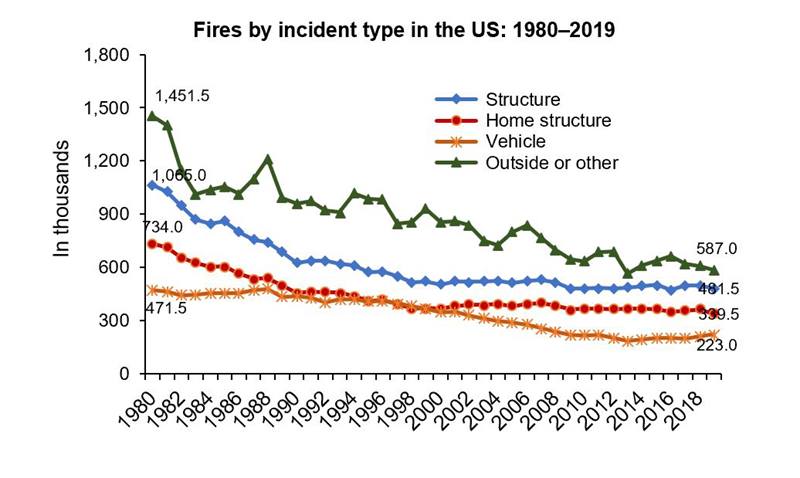
As with most well-defined problems and risks, the incidence or occurrence of fires has declined through time. In the last 40 years, the incident rate has been cut in half for outside, structure and vehicle fires. The US population grew by 45%, from 227M to 330M during this period. Hence, the incident rate per person declined by 70%.

Fire Deaths

Fire-related Fatalities and Injuries – Injury Facts (nsc.org)

YearDeathsUS Pop (M)Deaths/M
19787,50022334
19885,80024524
19983,90027614
20083,60030412
20183,60032711

Fire deaths have been cut in half over the last 50 years. The population has increased by 47%. The number of fire deaths per million has decreased by two-thirds, from 34 to just 11.

Real Cost of Fires Per Person

Archived Tables | III

US Population by Year (multpl.com)

Consumer Price Index, 1913- | Federal Reserve Bank of Minneapolis (minneapolisfed.

YearNominal Cost $B2019 Real Cost/Person
19991269
20001472
20011787
20021888
200321102
20041781
20052193
20062087
200724101
200831121
200928110
20102078
20112072
20122486
20131966
20142275
20152067
20162478
201737116
201847146
201937113

While the incident and deaths figures show a clear pattern of significant decline from 1980 to 2010, with relative stability from 2010 to 2020, the real cost of fires per person has much greater annual variability and a less certain trend in the last 20 years. Using 1990-2016 as the time period, the trend is clearly downward, from $90 to $80 per person per year. Adding the last 3 years, with their higher costs, the trend line moves upward from $80 to $100 per person per year.

Overall, the cost of fires per person is flat in the last 20 years, even though the outside incident rate has declined by one-third, the vehicle fire rate has declined by one-third and the structure rate has declined by 10%. Clearly, structure fires have the greatest weight on the cost measure. The unusually high costs in the last 3 years must be driven by a greater number of very high cost incidents.

Federal Government Employees

YearExecPostalEx+PostActMilTotalSubDefSubCivilianU.S. Pop
19551.9.42.32.95.24.11.1166
19601.8.42.22.54.73.51.2181
19651.9.42.42.75.03.71.3194
19702.2.52.83.15.94.31.6206
19752.1.62.82.14.93.21.7216
19802.2.52.82.14.83.01.8227
19852.3.73.02.25.23.31.9238
19902.3.83.12.15.13.12.0250
19952.0.82.81.54.32.32.0265
20001.8.82.61.44.02.02.0282
20051.9.72.61.44.02.02.0295
20102.1.62.81.44.22.22.0309
20152.1.52.61.34.02.11.9321
20202.2.52.81.44.12.12.1331
YearExecPostalEx+PostActMilTotalSubDefSubCivilian
19551.1%.22%1.4%1.8%3.1%2.5%.64%
19601.0%.23%1.2%1.4%2.6%2.0%.66%
19651.0%.23%1.2%1.4%2.6%1.9%.69%
19701.1%.27%1.4%1.5%2.8%2.1%.76%
19751.0%.26%1.3%1.0%2.3%1.5%.79%
19801.0%.24%1.2%0.9%2.1%1.3%.79%
19851.0%.30%1.3%0.9%2.2%1.4%.80%
19900.9%.30%1.2%0.8%2.1%1.2%.82%
19950.8%.28%1.1%0.6%1.6%0.9%.76%
20000.6%.28%0.9%0.5%1.4%0.7%.70%
20050.6%.24%0.9%0.5%1.4%0.7%.68%
20100.7%.19%0.9%0.5%1.4%0.7%.65%
20150.7%.15%0.8%0.4%1.2%0.6%.59%
20200.7%.15%0.8%0.4%1.3%0.6%.62%

All Employees, Federal (CES9091000001) | FRED | St. Louis Fed (stlouisfed.org)

All Employees, Federal, Except U.S. Postal Service (CES9091100001) | FRED | St. Louis Fed (stlouisfed.org)

All Employees, U.S. Postal Service (CES9091912001) | FRED | St. Louis Fed (stlouisfed.org)

1970 (usps.com)

US Population by Year (multpl.com)

DCAS Reports – Active Duty Deaths by Year and Manner (osd.mil)

U.S. Military Personnel 1954-2014: The Numbers (historyinpieces.com)

How Many People Does the U.S. Federal Government Employ? (historyinpieces.com)

Federal Workforce Statistics Sources: OPM and OMB (fas.org)

Executive Branch Civilian Employment Since 1940 (opm.gov)

Total Federal Government employment has ranged from 4-5 million across the last 65 years, from 1955, when post WW II changes were in effect until today, 2020.

While Federal Government jobs have been flat to down 20%, the U.S. population has doubled, from 166 million to 331 million people.

Hence, the ratio of federal jobs to population has dropped from 3.1% in 1955, or 2.6% in 1960-1965 to just 1.25% in 2020. The much maligned and mistrusted federal government is less than half as large, in relative terms, as it was from 1955-1965.

The detailed components are somewhat complex. The judicial and legislative branches have employed a relatively immaterial 30,000 to 66,000 during this time, doubling with the population.

The Executive Branch includes both the Department of Defense and other civilian agencies. It does not include active military employees. It typically does not include the postal service (USPS), which is seen as a truly independent agency. The Executive Branch started with 1.860 M employees and ended with 2.206 M in 2020. The low was 1.778 M in 2000 and the high was 2.252 M in 1990. In rough terms, flat employment for 65 years. As a percentage of the population, it has ranged from 1.12% to 0.65%, declining throughout the period.

The postal service started with 367,000 in 1955, grew to 761,000 in 1990, flattened out for 1995-2000, before declining to 492,000 in 2015 and 496,000 in 2020. So, we have a doubling in the first 45 years, adding 400,000 staff, followed by a reduction of one-quarter million in the last 20 years. As a percentage of the population, it grew from 0.22% to 0.30%, before declining to 0.15% in 2015-2020.

Combining the executive, legislative, judicial and postal branches, we get a subtotal that excludes the active military category. This is what most people think of as “federal” employees. This started at 2.3 M in 1955, grew to 3.1 M in 1990 before settling down a bit to 2.8 M in 2020. As a percentage of the population, it began at 1.36% and ended at 0.84%. This is a 38% reduction, removing more than 0.5% of the population from government employment.

The active military population has declined from 2.9M in 1955 and 3.1M in 1970 (Vietnam winding down) to 1.4M in 2000 (peace dividend), where it has remained. As a percentage of the population, this function declined from 1.77% in 1955 to 0.99% in 1975 to 0.49% in 2000 to 0.42% today. This is a 3/4ths reduction. moving 1.25% of the population out of military service.

The “Total” column shows the 5.2M start and 4.2M end. The percent of population falls from 3.13% down to 1.25%. The Federal Government is a much smaller employer today than in the “post-war” era.

The next column combines the Department of Defense in the Executive Branch with the active military to give a total military. This does not include the Veterans Affairs or Department of Homeland Security which serve quasi-military functions. We start with 4.1M in 1955, touch 4.3M in 1970, fall to 3.2M in 1975 and 2.0M in 2000, ending at 2.1M in 2020. The percentage of populations falls from 2.5% down to 0.6%.

The remaining federal employees began with 1.1 M in 1955 and grew fairly constantly to 2.0M in 1990, remaining flat for the next 30 years, ending at 2.05M in 2020. As a percentage of the population, this measure started at 0.64%, peaked at 0.82% in 1990 and has since declined to 0.62%, just below where it started.

After the Clinton/congress budget compromises in the mid-1990’s, criticism of the size and growth of Federal employment quieted down for the next 2 decades. Some criticism has restarted, as Federal agencies have increased the amount and variety of outsourcing employed through contracting and grants. The main summary shows that “contract” employees, those who work directly on Federal contracts, have been in the 3-5 million range since 1985. It reports that grant funded employees have been 1-2 million per year. The total is 4-7 million, the same order of magnitude as “regular” federal employment. I was unable to find comparable numbers for the 1955-1980 timeframe, so cannot be sure that this category has grown faster than the U.S. population. My guess is that there is some degree of “employee shifting” from regular to contracted employment. A subset of this is probably politically motivated, to please congressional oversight committees. On the other hand, corporate America discovered outsourcing to foreign factories and specialized firms in the 1980’s and probably moved 15-25% of jobs out of the Fortune 500. At one point, firms like GM and AT&T had 1 million employees.

Public service and the federal government (brookings.edu)

How big is the federal workforce? Much bigger than you think. – The Washington Post

The True Size of Government | The Volcker Alliance

The true size of government is nearing a record high (brookings.edu)

The sheer size of our government workforce is an alarming problem | TheHill

Indiana: Red State

In presidential elections since 1960, Republicans have won 14/16 races. LBJ won 56% of the vote in 1964. Obama won 50% of the vote in 2012. Democrats earned just 33-38% of the vote in 6 of those elections, including 2016. Democrats earned only 40-42% of the vote in 4 elections, including in 2020. The median Democratic result is 41%.

United States presidential elections in Indiana – Wikipedia

Indiana leans Republican in surveys of party affiliation. Voters do not permanently register for a party. They declare a party only when they vote in each election. According to one survey, Indiana voters are tied for 18th most Republican leaning. Indiana has just 42% of voters reporting as strong or “leaning” Democratic.

Party affiliation by state – Religion in America: U.S. Religious Data, Demographics and Statistics | Pew Research Center (pewforum.org)

In the last 6 presidential elections, 15 states have always voted for Democrats and 20 states have always voted for Republicans. Indiana is part of the 15 in the mixed middle due to the Obama result. Indiana has not been highlighted as a “swing state” in recent years.

Blue and Red States (270towin.com)

Indiana has elected 10 different governors since 1960, with Republicans serving 10 of the 16 terms (63%), including each of the last 5.

List of governors of Indiana – Wikipedia

Since 1984, the results have been similarly divided, with 6 Republican and 4 Democratic terms. From 1988-2000, Evan Bayh and Joe Kernan won 71/92 counties (77%), on average. In 2002, Mitch Daniels won his first term with 53% of the vote, but carried 73 (79%) of the counties. This broad geographical Republican dominance has continued, with Democrats winning just 13, 19, 13 and 3 counties in the last 4 elections. When Mike Pence won with 50% of the vote in 2012, he carried 73 counties. When Eric Holcomb won with 51% in 2016, he carried 80 counties.

1984 Indiana gubernatorial election – Wikipedia

At the U.S. Senate level, Indiana has elected 10 different senators, with Republicans serving 13 of the 22 terms (59%). Democrat Joe Donnelly was replaced by Republican Mike Braun in 2019.

List of United States senators from Indiana – Wikipedia

Since 1960, Republicans have won 42 of the 68 congressional races (62%). Since 2000, the median party split has been 7 Republicans and 2 Democrats. This balance has been consistent in each of the last 5 terms. Democrats did hold a small 5-4 advantage in 2006 and 2008.

List of United States representatives from Indiana – Wikipedia

2020 United States House of Representatives elections in Indiana – Wikipedia

The Indiana Senate has been controlled by Republicans since 2009, with Democrats holding an average of only 22% of the seats.

Indiana Senate – Wikipedia

The Indiana House is closer to the overall 40% +/- Democratic population, with Dems holding an average of 31% of the seats in recent years. The concentration of Democrats in a relatively small number of counties drives some of this situation.

Indiana House of Representatives – Wikipedia

Since 1970, Marion County and Indianapolis have been combined into a common City-County Council and Mayor system, usually termed unigov. Since Mayor Lugar’s first term in 1968, Republicans have held the mayor’s office for 16 of 26 terms (62%). Democrats have held office for 10 of the last 14 terms (71%).

List of mayors of Indianapolis – Wikipedia

The City-County Council has been a competitive body. Democrats held a 15-14 majority in 2003. Republicans lead 16-12 in 2007. Democrats resumed the majority by 16-12 in 2011, and more narrowly by 13-12 in 2015 when the “at large” districts were removed. Democrats won a large victory in 2019 of 20-5. It is unclear if this lopsided result will continue in the future.

Since Obama’s surprising presidential win in 2012, metropolitan Indianapolis area Democrats have become more active, with more candidates running for suburban offices, more financial and volunteer support and a few of them winning. This has been newsworthy, because many suburban counties and cities had zero or only nominal Democratic candidates historically. Joe Biden narrowly won some precincts in the 2020 presidential election, generating more news coverage.

2020 Election: How Trump, Biden performed in Hamilton County, Indiana (indystar.com)

However, Biden’s relative progress in the Indianapolis suburbs, like his results in other U.S. suburbs, did not translate into Democratic gains in the state and local races, where Republicans consistently outperformed Trump and won races by margins significantly higher than pollsters forecast.

Indiana elections: Dems see few wins as still sign for optimism (indystar.com)

Indiana election results: Democrats look for answers after losses (indystar.com)

The 19 counties that voted for John Gregg (D) against Mike Pence (R) in the close 2012 race account for 43% of the state’s 2019 population. That is consistent with 43% in 2010 and down a little from the 44% share in 2000. The Democratic leaning counties are not growing faster than the Republican leaning counties.

Indiana Democrats like Evan Bayh, Joe Kernan and Joe Donnelly appear to be unable to re-assemble a winning “blue dog” coalition of voters at the state level. Barrack Obama’s narrow 1% point victory over John McCain and Sarah Palin looks like an “outlier” result. Indianapolis seems to be an increasingly solid base for the party and its suburbs may fall from 70% to 55% Republican through time. However, for the foreseeable future, Indiana will be a solid Republican (Red) state.

Indiana: How Much Political Power?

Indiana is the 17th largest U.S. state ranked by population, with 6.7 million residents.

Indiana’s GDP is the 18th largest. Its GDP per capita is only 32nd.

List of states and territories of the United States by GDP – Wikipedia

Indiana has 11 electoral college votes, tied for 13th most of all states. Indiana did not lose an electoral college vote in the latest census, although 3 neighboring states did. With 538 total votes, the average state has almost 11 votes, so Indiana is average by this measure. From 1872-1926, Indiana had 15 electoral votes. From 1932-40 it had 14. From 1944-88 it had 13. From 1984-2000 it had 12, so the trend is clearly downward.

Indiana Presidential Election Voting History (270towin.com)

Indiana has not been a “swing” state with disproportionate clout in our lifetime.

Party affiliation by state – Religion in America: U.S. Religious Data, Demographics and Statistics | Pew Research Center (pewforum.org)

Indiana can claim its fair share of U.S. presidents. 1 out of 46, with the 23rd president, Benjamin Harrison (1889-93). Indiana can partly claim Harrison’s grandfather William Henry Harrison who briefly served as the 9th president and who served as governor of the Indiana Territory from 1801-12, although he was not born there. Indiana also claims to be Lincoln’s boyhood home (1816-30).

Indiana also has its fair share of losing presidential candidates with Wendell Wilkie (1940) and Socialist Party stalwart Eugene Debs (1900-20).

Indiana Presidents: Learn About the 3 Hoosiers Who Became President (visitindiana.com)

Indiana truly stands out at the VP level, with 4 serving in this office: Charles Fairbanks (1905-9), Thomas Marshall (1913-21), Dan Quayle (1989-93) and Mike Pence (2017-21). It has provided 12 VP candidates.

Witnessing History: Hoosiers for President (indianahistory.org)

At the Supreme Court, Indiana claims more than its fair share of the 120 justices with 4: Willis Van Devanter (1911), Sherman Minter (1949), current Chief Justice John Roberts (2005) and recently appointed Amy Coney Barrett (2021).

A quick look at U.S. Supreme Court Justices from Indiana « Capitol & Washington (capitolandwashington.com)

Since WWII there have been 35 individuals serving in the top political appointment office, the White House Chief of Staff. Ron Klain currently holds that role, as the only Hoosier to do so.

White House Chief of Staff – Wikipedia

Historically and recently, Indiana has shown above average political influence at the national level in the U.S.