Good News: Are You Better Off? (2)

Ronald Reagan taunted Jimmy Carter with this question to voters in the 1980 debates. It helped him win.

Twelve years later, James Carville helped Democrats return from the political wilderness in 1992 with his advice to Bill Clinton that “it’s the economy, stupid”.

https://en.wikipedia.org/wiki/It%27s_the_economy,_stupid

Politicians have used various measures, from unemployment to inflation to the “misery index” to jobs created to productivity to the stock market, to promote their success and detract from their opponents.

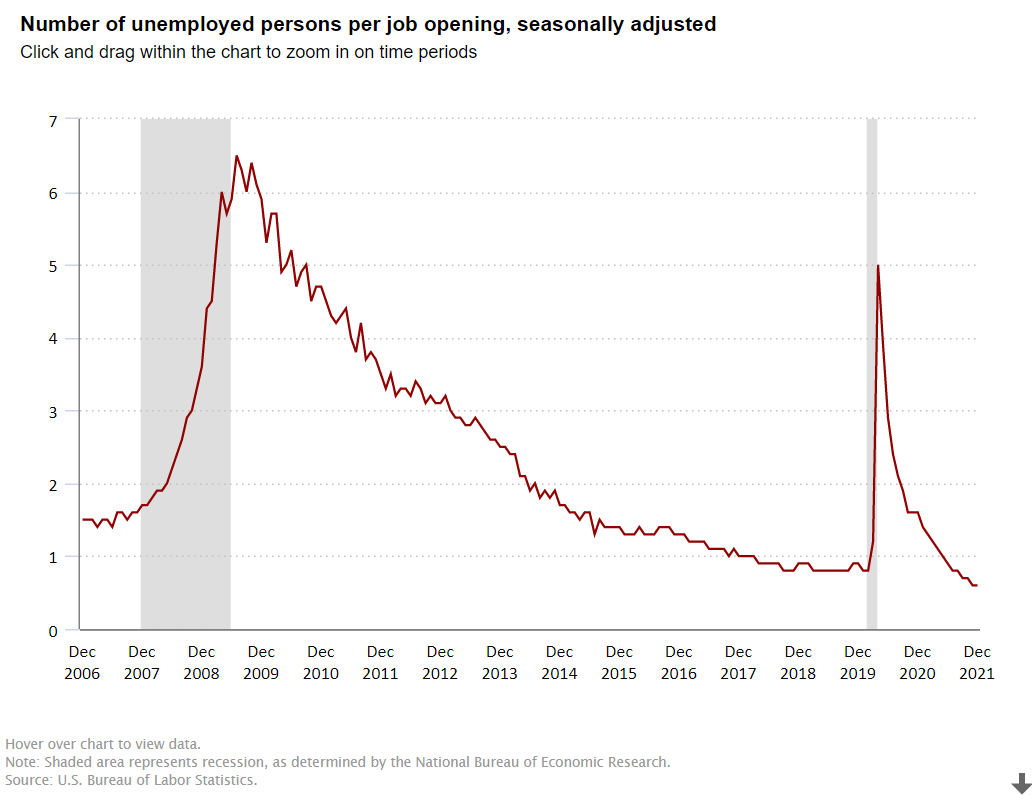
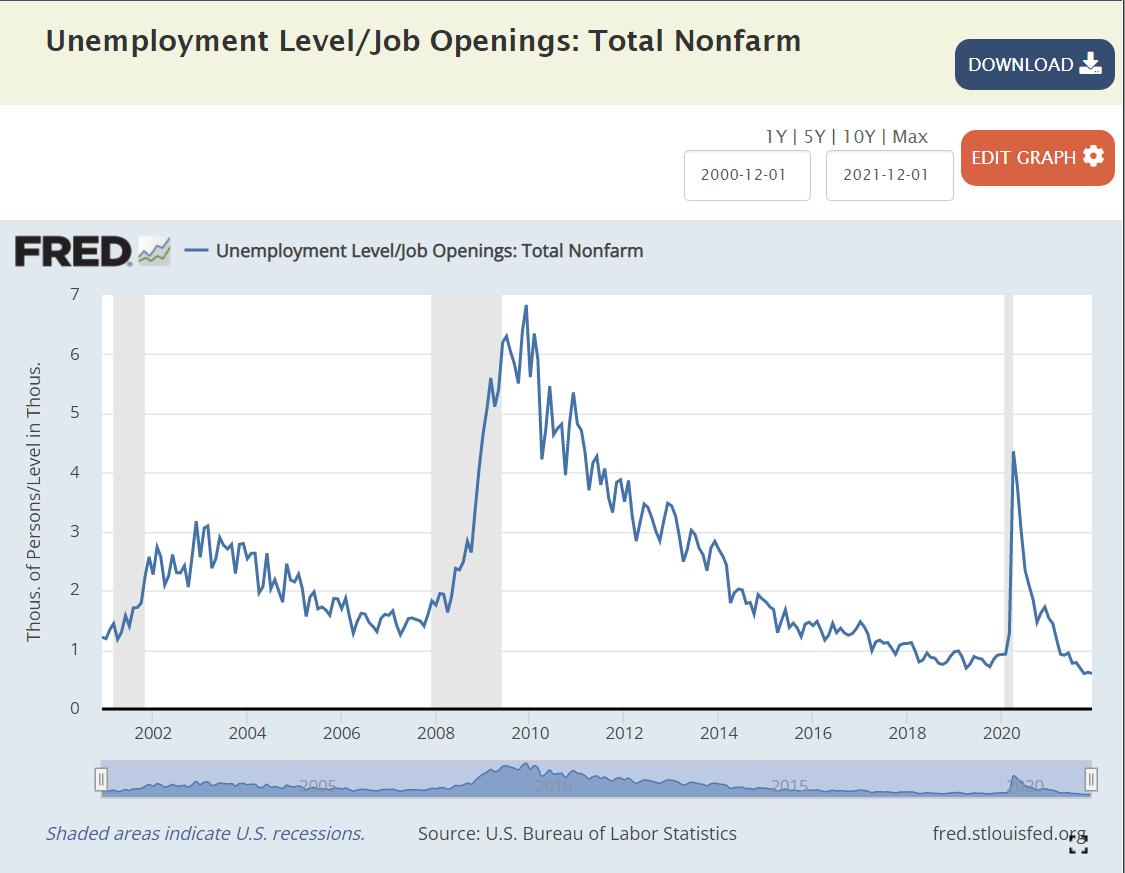
I want to focus on one measure, the ratio of the number unemployed to the number of job openings, to highlight the strength of the American economy in the last dozen years.

https://www.bls.gov/charts/job-openings-and-labor-turnover/unemp-per-job-opening.htm

https://fred.stlouisfed.org/graph/?g=p9aA

George W. Bush: Jobless Recovery in the “aughts”

The Bush economy was widely criticized for its “jobless recovery” following the economically healthier Reagan and Clinton presidencies. The presidency started at close to 1 unemployed person per job opening. The recession pushed this up to 2.5x and then 3.0x. In labor market terms, this is a huge difference. At 1:1 or 1.5:1, unemployed workers expect to be re-employed quickly. At 3:1, some may enter the dark days of the “long-term unemployed”. After 3 years, the economy DID recover to 1.5:1, but it was unable to improve further. The “Great Recession” was a brutal job killer, pushing this measure of labor market tightness up four-fold, from 1.5X to more than 6X before its peak in the first half of 2010, as Obama and congress and the federal reserve bank wrestled with the situation.

Obama: Recovery and “New Territory”

Between April, 2010 and April, 2012, the economy cut this ratio in half, from 6x to 3x, a very solid performance. It took 3 years, until April, 2015, to complete the next 50% reduction, from 3x to the historically “very solid” 1.5X. The economy continued its growth for the next 2 years, but at a slower pace, reducing this ratio to 1.3X.

Trump: Even Better

The Trump economy continued to improve for the first 18 months of his term, reducing this ratio from 1.3X to 0.8X by September, 2018. This was a time of record low unemployment and economists recalculating their standard of “full employment”. While the economy continued to grow, the unemployment rate continued to decline and the stock market continued to climb, THIS measure had reached its minimum before the 2018 mid-term elections. It remained steady at the very positive level of 4 job seekers for every 5 jobs (0.8) for the next 17 months, until the pandemic disrupted everything. The ratio quickly shot up to 5X, not as high as the 6X that Obama faced, but very high. It quickly recovered to 1.4X by the end of Trump’s term. This was partly job recovery and partly fewer job seekers, but it was an amazing recovery in historic terms. Recall that 1.5X was “a good as it got” during George W. Bush’s presidency.

Biden: Even Better, Again !

In the first 6 months of the Biden presidency, this ratio dropped from 1.4X back down to the prior record level of 0.8X. Yes, by July, 2021, there were 5 jobs available for every 4 job seekers. This was as low as the ratio had previously fallen, even as the Trump economy piggybacked on the Obama economy and continued its extraordinary run. The ratio continued to fall in the next 6 months to 0.6X, an unheard-of level. 5 jobs for every 3 job seekers. It’s “no wonder” that voluntary job quits are at unprecedented levels. For, perhaps, the first time in American history, “everyone who wants to work, can find a job”. Whether you are right or left, Dem or Rep, this is “good news”. This is “great news”. Wages for the “bottom 20%” are rising in real terms. Income inequality is declining, a bit. The economy seems to be able to digest this new condition. And, the economy is not done growing, innovating, creating businesses, creating jobs, exporting, etc. About 2% of Americans are likely to be attracted back into the workforce in the next year or two, keeping the headline unemployment rate from going much below 4%, but pushing US real GDP growth to 4% in 2022 and close to 4% in 2023.

Summary

The “Great Recession” and the “once in a century pandemic” have been unable to disrupt the ongoing progress of the American economy and labor market. As a nation, IMHO, we have cultural and political challenges, but we “aught” to appreciate the power of the American economy to move forward.

Good News: US Economy Added 6 Million Jobs in 2021

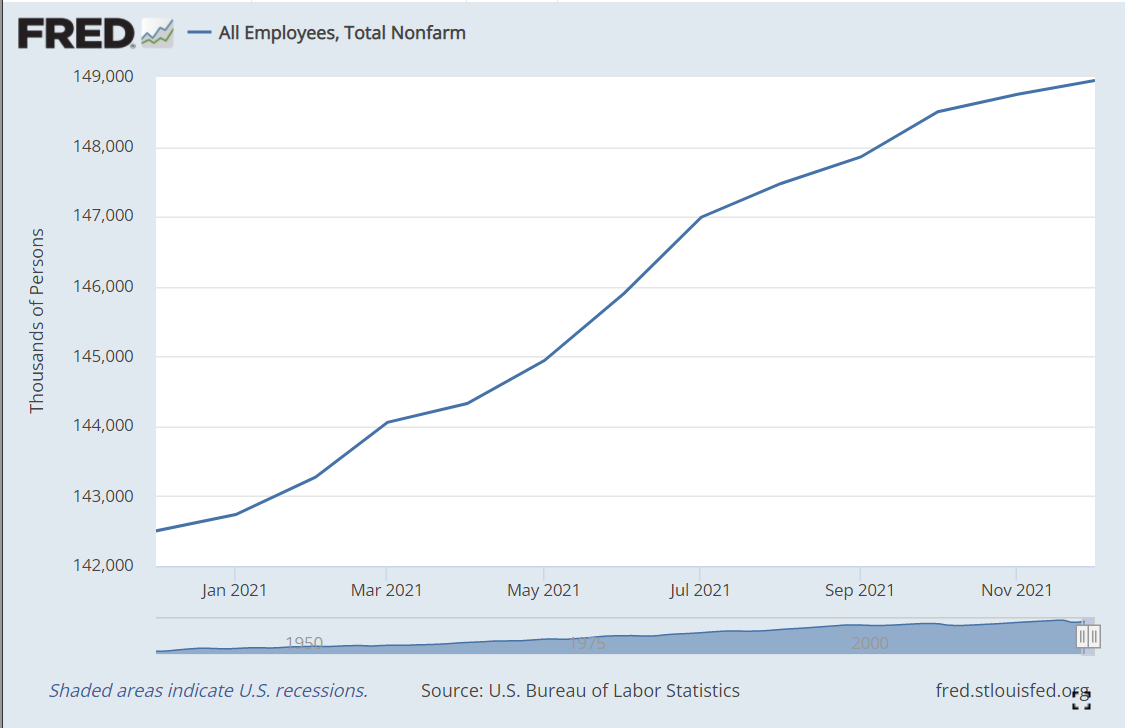
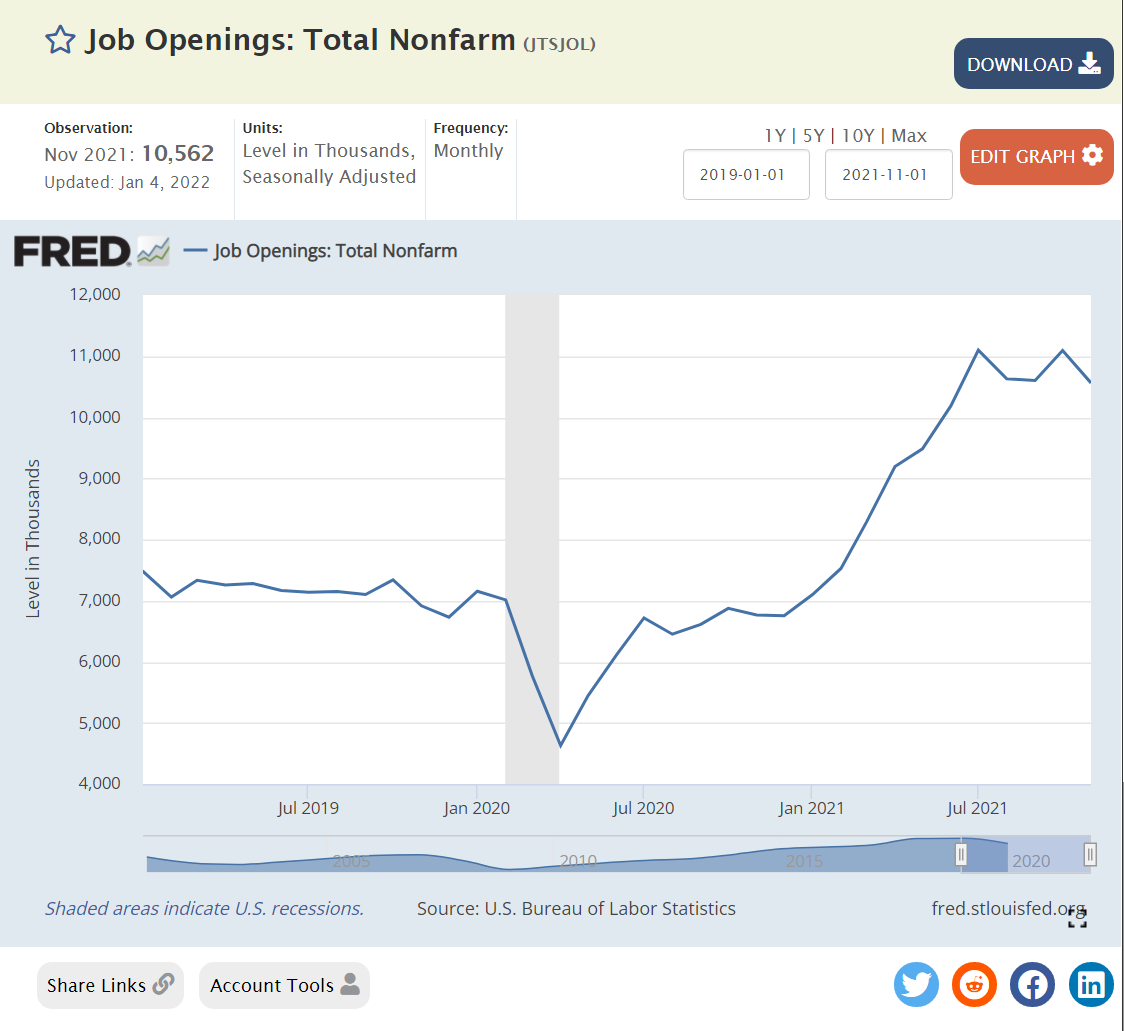
Today’s news releases show 6.0M jobs added during 2021 according to the household survey and 6.5M jobs added according to the employer survey. The ADP employer jobs survey released this week showed 6.2M jobs added. The employer reported number of open jobs increased from 6.8M to 10.6M this year. Hence the total filled plus open jobs increased by 10.6M, from 149.3M to 159.6M, a truly incredible expansion of the US economy’s production potential and demand for labor. This is 1M more filled plus open jobs than the December, 2019 peak of 158.6M. Employers are clearly struggling to work this backlog down from the 10-11M range back to the pre-pandemic 6-7M level. This provides the demand side for another 8-12 months’ worth of 500K filled jobs added per month.

The 3 underlying measures use different definitions and survey methods, but in the long-run they generally agree.

https://www.bls.gov/web/empsit/ces_cps_trends.htm#intro

The monthly changes are much less consistent. Much of the media highlighted that the employer survey data showed just 200K jobs added in December. The household survey indicated 600K jobs added, while ADP reported 900K jobs.

It’s best to look at all 3 measures to try to get a best estimate of the most recent changes. I see roughly 500K new jobs added each month from July through December. A flat number, not an increasing one. The first half of the year was probably adding a few more jobs each month, closer to 600K each.

https://adpemploymentreport.com/2021/December/NER/NER-December-2021.aspx

Look Past the “Spin”

https://www.foxbusiness.com/economy/biden-december-jobs-figure-unemployment-decline

https://www.dailymail.co.uk/news/article-10379015/US-employment-report-misses-expectations-Just-199-000-jobs-added-December.html

 https://www.realclearpolitics.com/2022/01/07/another_disastrous_jobs_report_lands_on_bidens_desk_560237.html


Good News: A Great Labor Market

Layoffs

From 2000-2009, the dynamic US labor market laid off workers at a consistent 2M per year rate. This declined a bit to 1.8M per year in the next decade. After the pandemic, the economy quickly returned to this 1.8M per year rate from July to December, 2020.

It has dropped and remained at a 1.4M per year rate at the end of 2021, fully 30% lower than its normal level. Good news, indeed.

Unemployment Claims

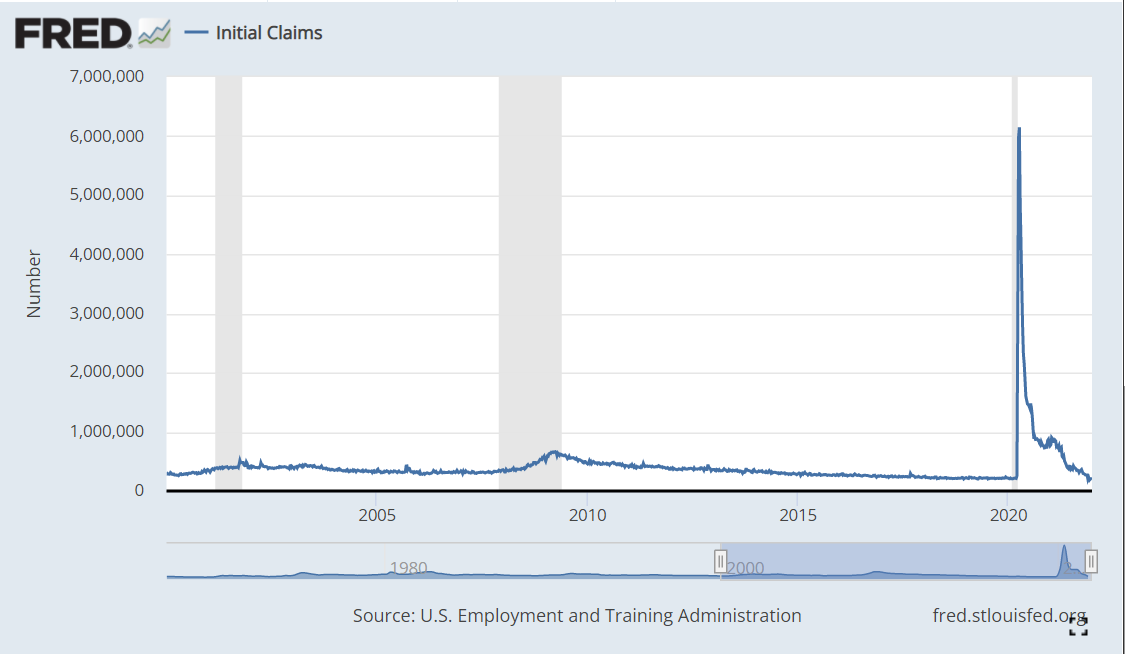
Historically, the US economy generated 350,000 new unemployment claims each week. This measure declined slowly after the Great Recession, reaching a nice 300,000 level in 2014. It slowly declined to a record low of 205,000 in Feb, 2020. The disruption rate dropped back down to the very high but stable 800,000 level from Aug, 2020 through Apr, 2021. In the last 8 months the rate has dropped very quickly back down to the record low 200,000 level!

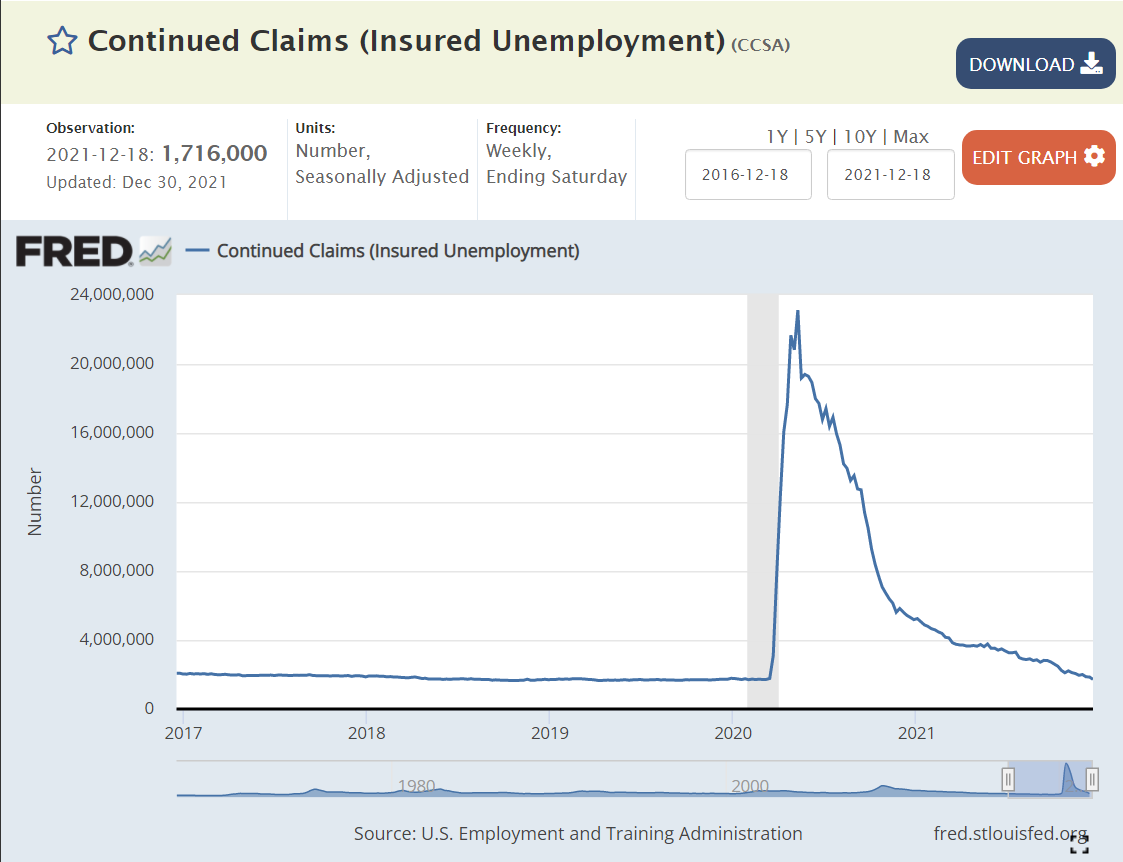
Cumulative individuals claiming unemployment benefits has historically varied with the business cycle. We can see the increase from 2M to 4M at the turn of the century. The “Great Recession” had a greater negative impact, driving this number from 2M – 4M – 7M. This number fell throughout the extended business cycle recovery period, breaching 2M in Feb, 2017 and reaching a low of 1.7M in Feb, 2020. The unemployed number reached a full order of magnitude higher at 23M during the pandemic, then dropping to 13M in Sep, 2020 and 4M in Mar, 2021 and 2M in Nov, 2021 and finally equaling the record low in December, 2021 at 1.7M. This is great news!

Unemployment Rate

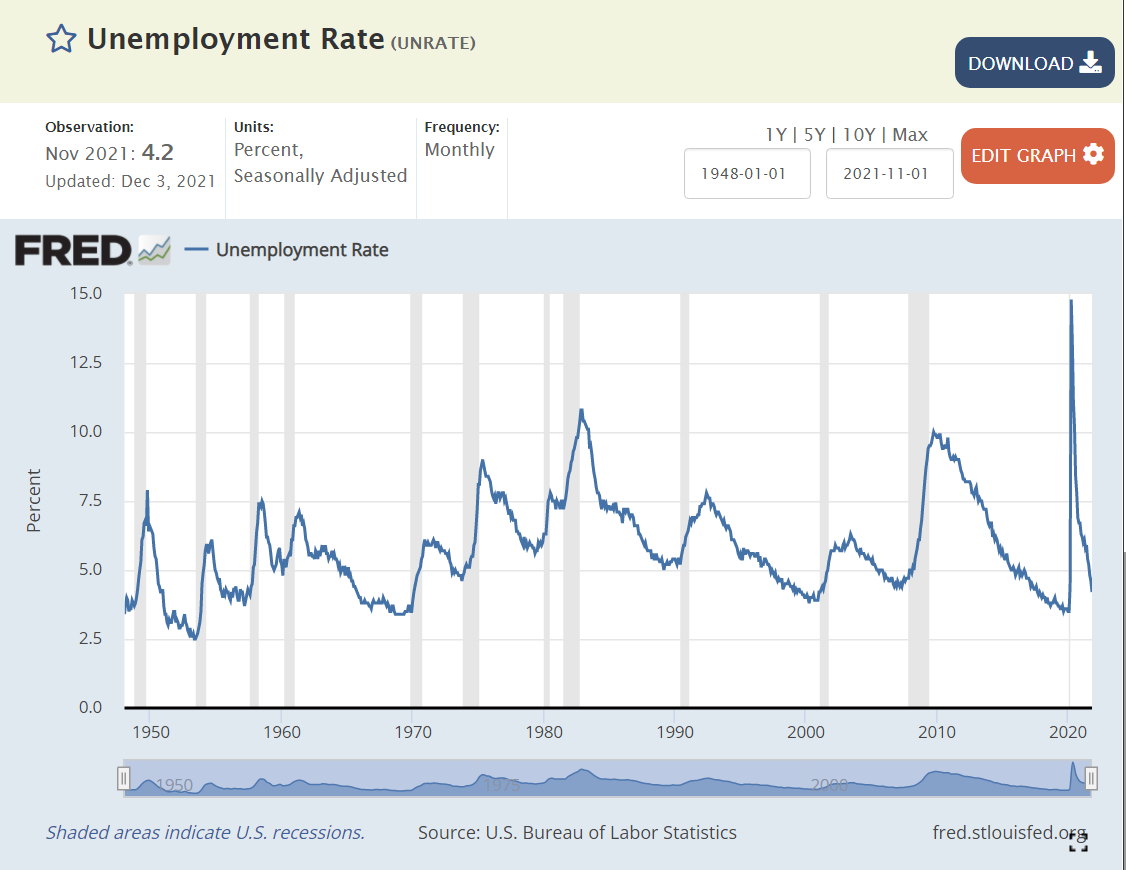
The unemployment rate has reached 4.2% and will return to its historical low of 3.5% in the next 4-6 months.

Minority Unemployment Rate

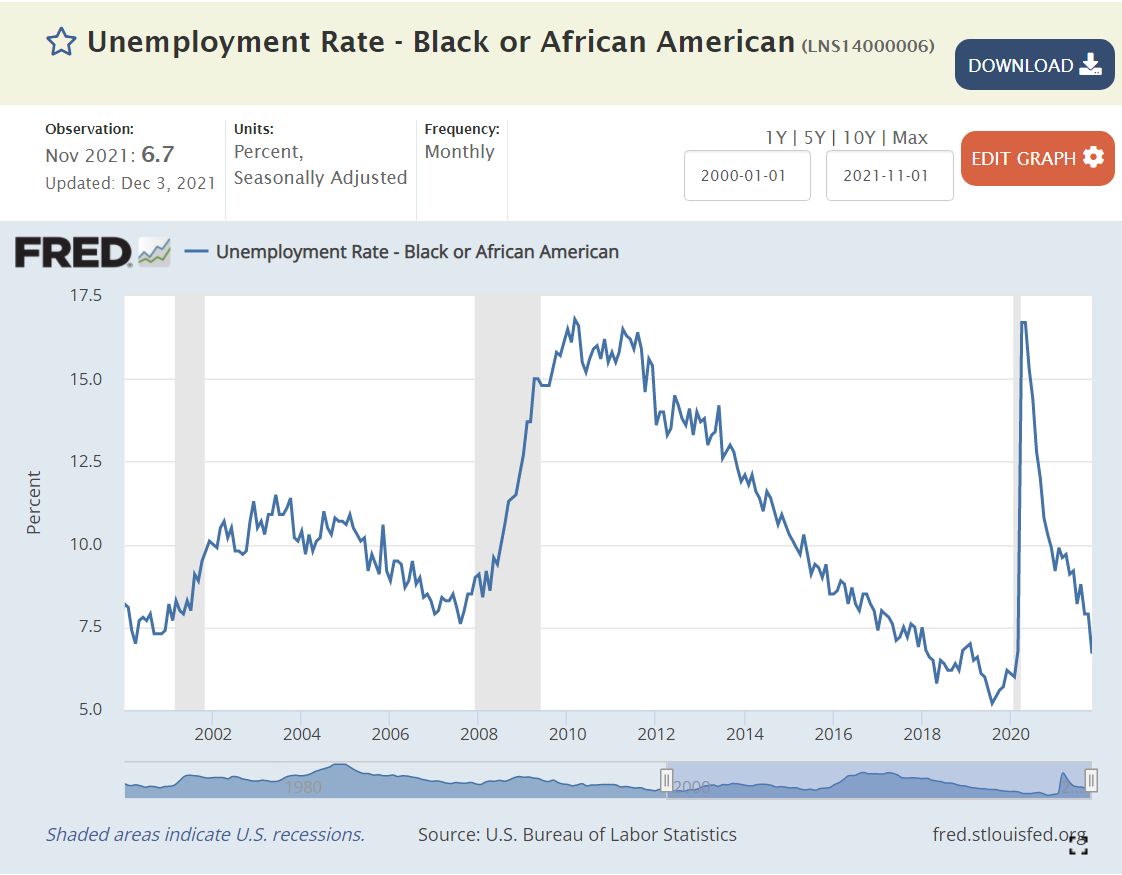
African-American unemployment was typically in the 8-10% range. It was driven down to the 5-6% level after the Great Recession during the extended business cycle expansion period. The rate is now below 7% and falling.

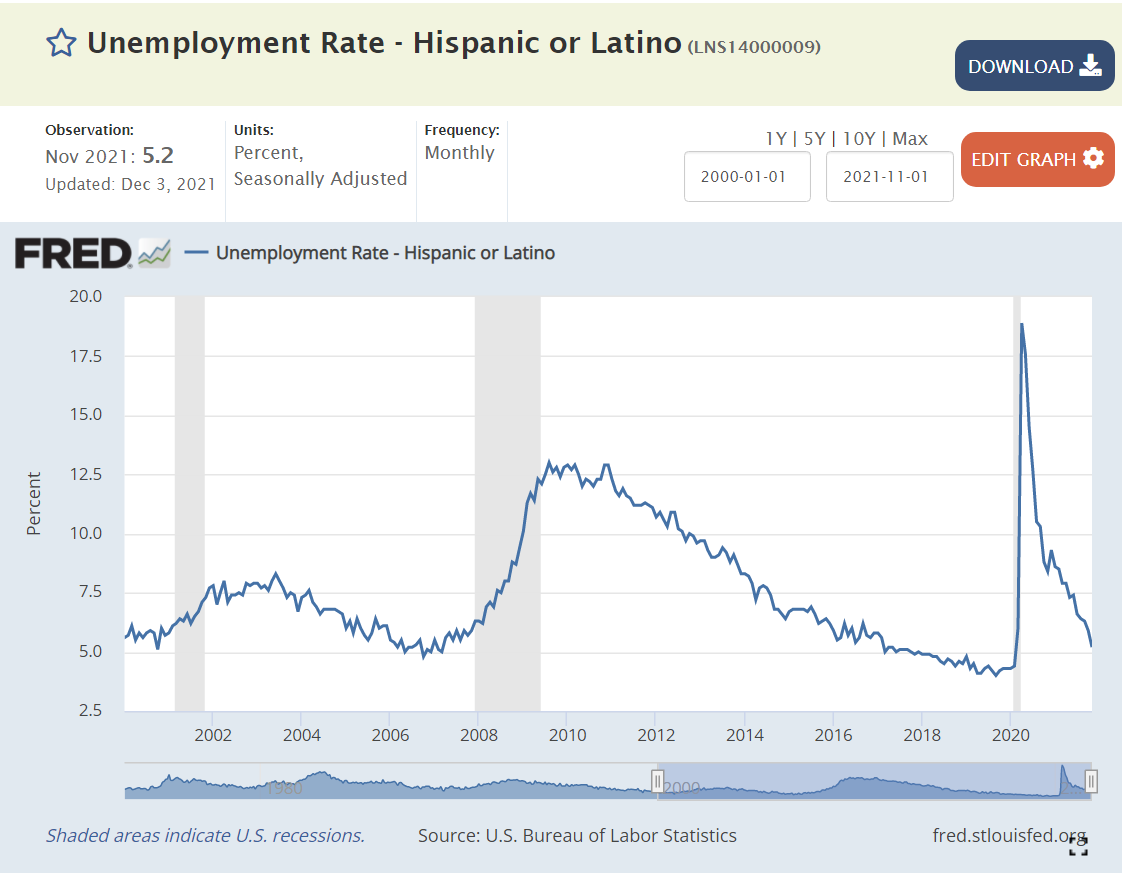
Hispanic American unemployment averaged 5-7% in the 2000’s. It spiked after the Great Recession to 13%, then slowly declined to 4.3%. It has since recovered to 5.2% and is dropping quickly.

Broadly Defined Unemployment

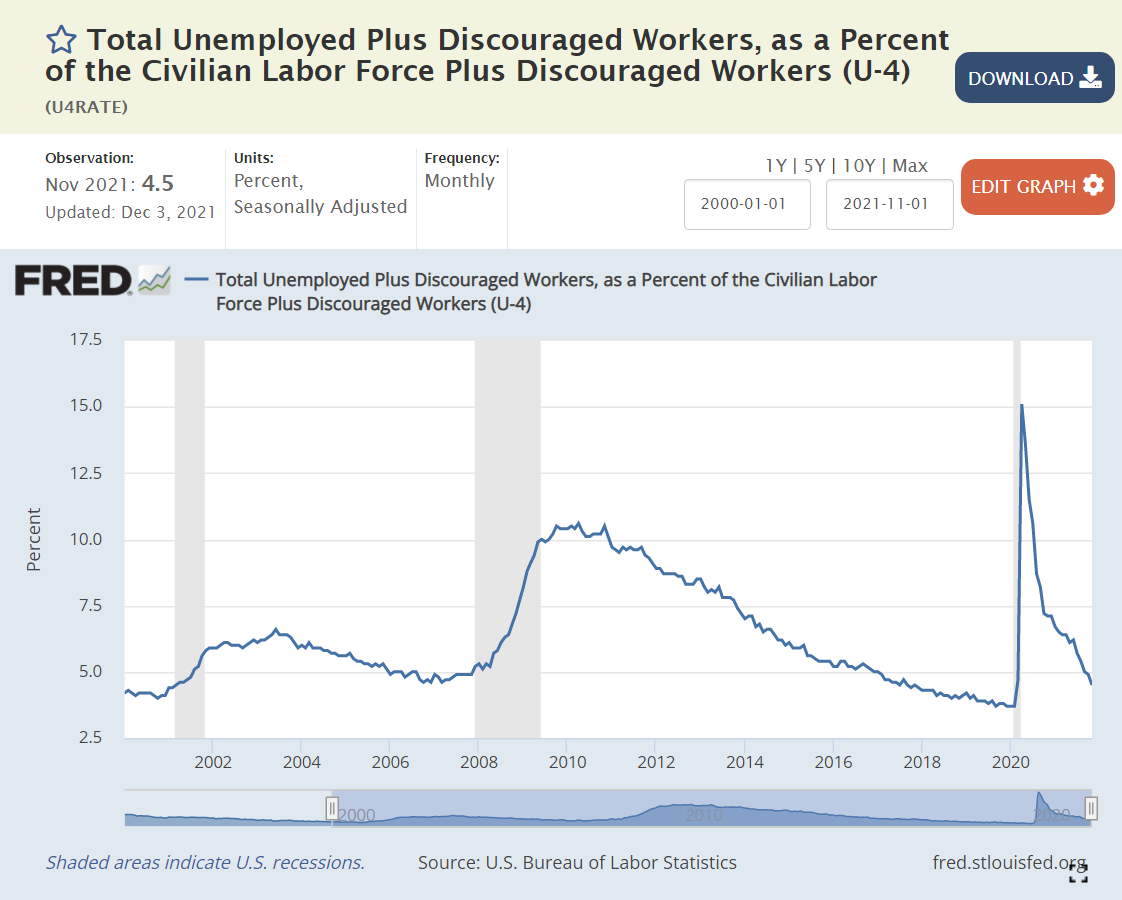
Broader definitions of unemployment show the same swift recovery from the pandemic situation.

Labor Force Participation

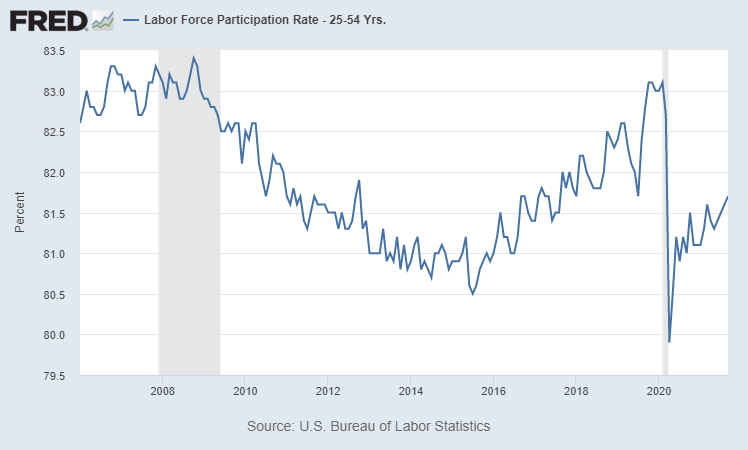
Labor force participation among the core 25-55 year age group reached an historic, and possibly unsustainable high of 83% in late 2019. It stayed around 81% at the end of 2020 and has since improved to 81.8%. This is one of the few labor market indicators that clearly shows that we have NOT “fully recovered”. There is 1% of the population waiting to be attracted back into the labor force.

Quits Rate

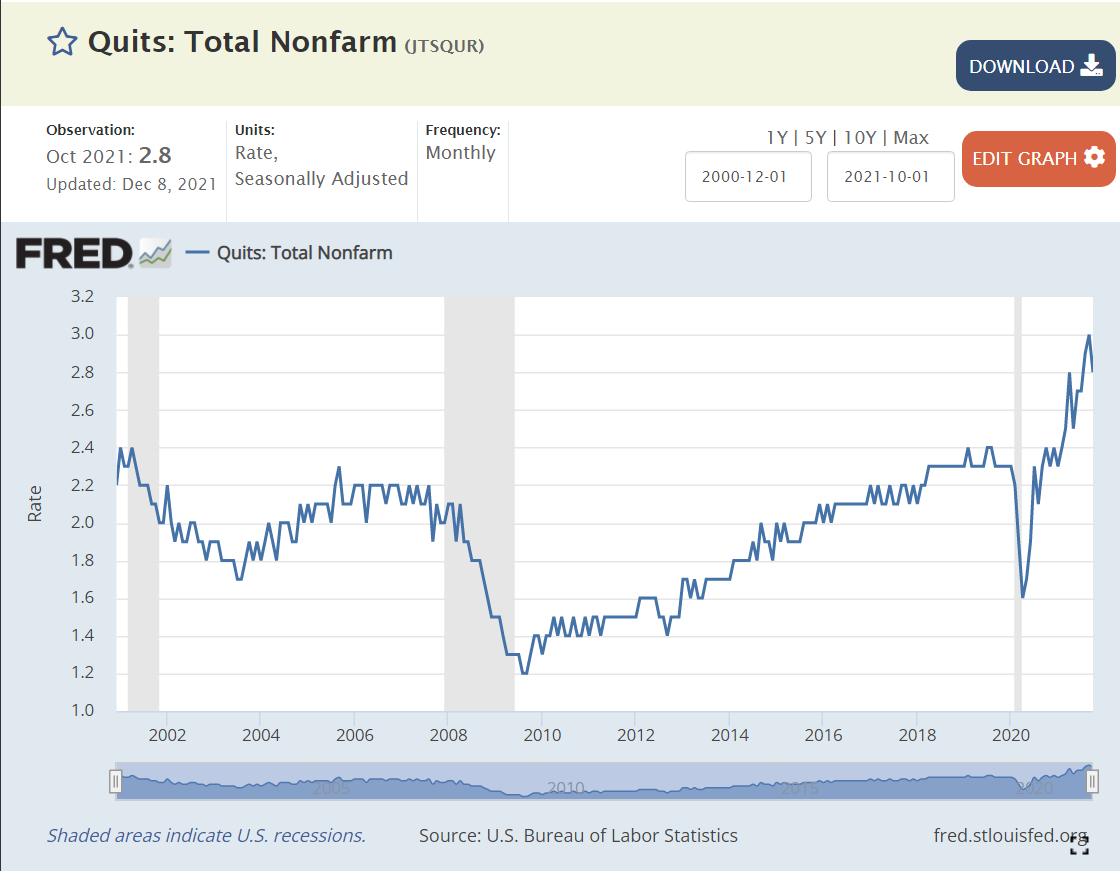
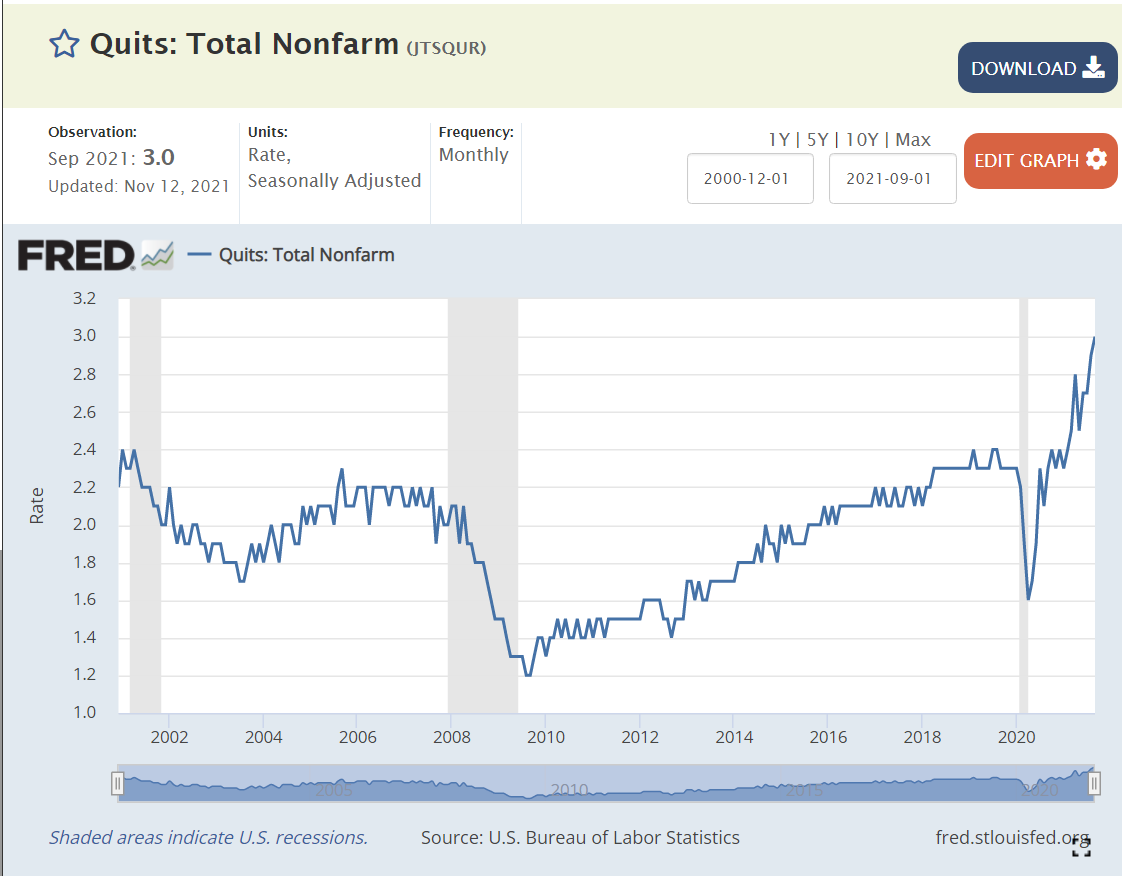
The voluntary “quit” rate has doubled since the good side of the “Great Recession”. It is 50% higher than during the very favorable labor market of 2018-2020. Employees are confident that they can leave their current employer and find another position quickly.

Job Openings

This is the CRAZY positive labor market chart. Historically, we see 3-5M job openings. Expansion to 6M in 2016-17 as the post Great Recession recovery faced its “end”. But, the expansion continued even further, with 7M open positions available in 2018-20. The economy recovered to 6.8M open positions in Dec, 2020. This figure has since climbed to an incredible 11M open positions, more than double the historic norm.

This is truly a “good news” labor market!

Good News: Very Low Unemployment

The official US unemployment rate has rarely gone below 5%, and has typically risen back above 5% in a matter of months. The post WWII boom from 1951-53 was one positive period. The Vietnam War + Great Society spending period of 1965-69 was another. The second Clinton presidency from 1997 to 2001 was another 4 year period of prosperity.

The Obama presidency started with 7.5% unemployment. It peaked at 10% in 2009, before falling consistently to 4.7% at the end of his term in 2016 (cut in half). The Trump presidency saw a continued reduction of the unemployment rate to a minimum of 3.5% 2 years later, exceeding the expectations of mainstream economists and forecasters.
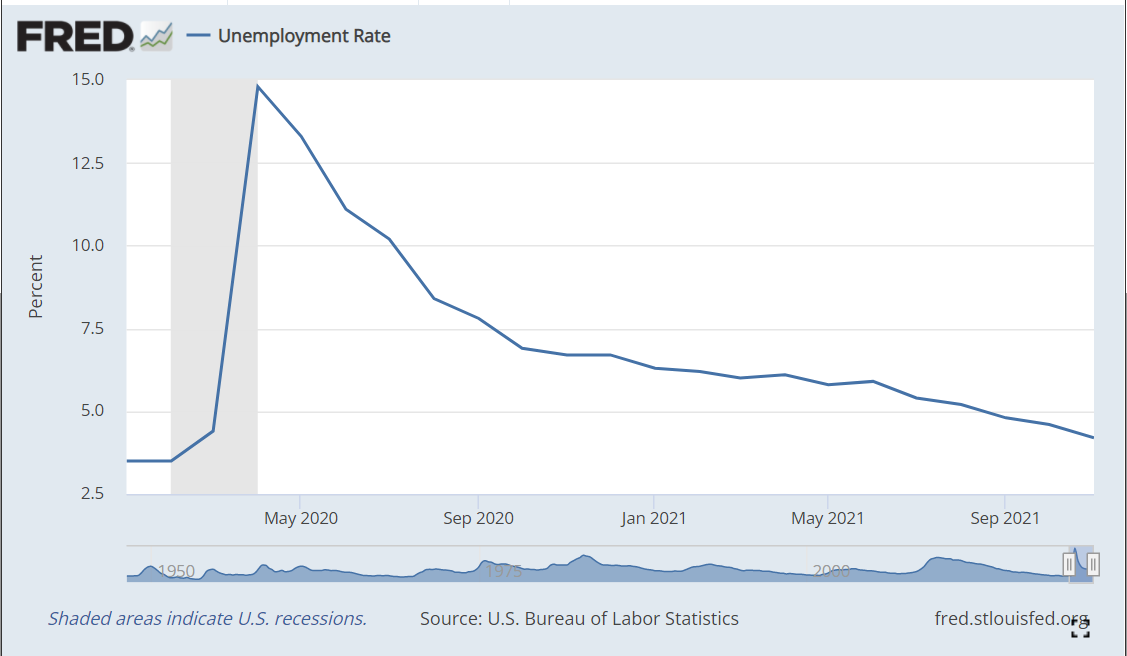
Unemployment quickly climbed to 15% during the pandemic, before falling back to 6.7% by the end of the year (2020). In the 2 years of the Biden administration, it has declined by 2.5% to 4.2%, a rate last seen in November, 2017.

Historically, “full employment” has been pegged close to 5%.

https://en.wikipedia.org/wiki/Full_employment

The extended period of lower unemployment from 2016-2020 lead many economists to revise their estimate of “full employment” to be an unemployment rate of just under 4.5%.

https://www.bloomberg.com/quicktake/full-employment

Candidate Trump repeatedly claimed that candidate Biden would “ruin” the economy. It has proven to be more resilient to a change in administrations.

https://www.cbsnews.com/news/trump-economic-club-new-york-recovery-jobs/

The economic expansion has lead to unprecedented low 1.5% unemployment rates in some Midwest communities.

https://www.indystar.com/story/news/local/hamilton-county/2021/12/28/carmel-zionsville-among-states-lowest-unemployment-rates-november/8980831002/

The recent economic recovery has had a disproportionately positive effect on Republican leaning (Red) states., which have a median 3.5% unemployment rate. Nebraska, Utah, Oklahoma, Idaho, South Dakota and Montana enjoy sub 3% unemployment rates. Democratic leaning (blue) states have a median 5.4% unemployment rate, with only the blue states of Vermont and Minnesota experiencing below average unemployment. The purple battleground states are in the middle with a median 4.5% unemployment rate.

https://www.bls.gov/web/laus/laumstrk.htm

https://www.270towin.com/content/blue-and-red-states

Large metropolitan areas have seen a slightly better than national reduction in their unemployment rates. 25 of the top 50 metro areas have unemployment rates below 4.0%. 8 have rates below 3%. Nashville (2.8%), Milwaukee (2.8%), Minneapolis (2.6%), Birmingham (2.5%), Atlanta (2.4%), Indianapolis (2.4%), Oklahoma City (1.9%) and Salt Lake City (1.4%) are clearly experiencing full employment. Another 14 metro areas have unemployment rates of 4.0 – 4.9%; in the “full employment” range. Just 11 have unemployment rates of 5% or higher.

Chicago, Houston, Philadelphia, San Diego, Sacramento, New Orleans and Hartford display marginally high unemployment rates of 5.1% – 5.4%. Just 4 of the nation’s 50 largest metro areas encounter higher rates: NYC (6.3%), LA (7.1%), Riverside (6.3%) and Las Vegas (6.6%).

https://www.bls.gov/web/metro/laummtrk.htm

Despite the prevailing “negative” media attention, if the economic recovery continues at its current rate, the unemployment rate will reach 3.5% or lower in March, 2022. This rate has been recorded only in Feb, 2020, Jul, 1969 and Nov, 1953. In the shadow of a global pandemic last experienced in 1918, this is amazing news.

We are clearly living in “interesting times”.

Personally, I agree with Fukuyama that western liberal democracies and mixed capitalist economies have won the ideological wars, leaving fascist, communist and dictator regimes behind. This is despite the rise of populist movements on the right in western democracies, the resilience of dictatorships on many continents and especially the retrograde actions of China to preserve its central place on earth as a “special” nation. The war is not complete. It calls for liberal capitalist nations to refine their ideologies and wisely play their global roles.

https://en.wikipedia.org/wiki/The_End_of_History_and_the_Last_Man

https://www.theguardian.com/books/2014/mar/21/bring-back-ideology-fukuyama-end-history-25-years-on

https://www.newyorker.com/magazine/2018/09/03/francis-fukuyama-postpones-the-end-of-history

https://www.theatlantic.com/politics/archive/2014/09/its-still-not-the-end-of-history-francis-fukuyama/379394/

https://www.opendemocracy.net/en/endism/

Are You Better Off? Yes, Today, November, 2021.

Ronald Reagan skewered Jimmy Carter with this taunt in the 1980 presidential debate. Joe Biden’s approval rating is falling quickly in recent months. US voters need to assess the true state of the US economy under Biden’s leadership after 2 years of a global pandemic, last seen in 1918.

Real Disposable Personal Income Per Capita

Real, inflation adjusted income per person continues to rise. In 2000, average income was just $33,000 per year. It rises quite significantly to $38,000 in booming 2007-10. It remains at this level through 2013. This is a 15% increase over 13 years, a little better than 1% per year. The economy adds another $6,000 in the next 7 years before the pandemic. That’s growth twice as fast, 2% per year during this boom time. Real income has grown another $2,000 to $47,000 in the last 2 years, 2% annually, after the pandemic. Very good news.

Employed Persons

US employment was typically 130M from 2000-2012. Great growth occurred from 2012 to 2020, reaching an unprecedented 152M. The pandemic dropped employment to 130M, an incredible 22M lower. Employment quickly rebounded about half-way to 142M during 2020. It has grown by another 6M in the last year. The employment growth from 2010-20 averaged 2M per year. The 2021 record is a very strong performance, reflecting a healthy economy that has robustly adapted to the challenges of a pandemic environment.

Unemployment Rate

Unemployment averaged about 5% during the first decade of the century, a generally good result compared with 20th century history. It doubled to 10% during the “Great Recession” and then slowly declined to 5% by 2015 and then even further, exceeding economists’ expectations, to 3% in 2018-2020. The pandemic rocketed it up to 15%, but it quickly recovered to 7%. It has since declined to less than 5%, which has historically been the typical definition of “full employment”.

Job Quits

From 2000-2008, about 2% of employees voluntarily left their positions in any given month. The quit rate dropped to 1.5% in the aftermath of the “Great Recession” (2010-13). It very slowly recovered to 2.2% during 2016-18. It increased a little bit to 2.3% in 2019-2020. It rebounded to 2.3% in 2020, and has since increased to an unprecedented 3%. This reflects a labor market where 50% more employees are making a voluntary choice to leave their current employer, apparently confident that they can find an equal or better position.

Job Openings

Job openings averaged 4M from 2000-2014. Openings fell to 3M in 2010-12 after the “Great Recession”. Job openings then grew to 6M in 2017-18 and further to 7M in 2019-20. Job openings quickly returned to 7M early in the pandemic and then began their climb to the current 11M level. Again, these are unprecedented levels, twice as many open jobs as in any time from 2000-15.

Unemployed Persons Per Job Opening

The 2006-7 baseline was 1.5 unemployed persons per open position. The “Great Recession” peak was 6 to 1, an incredibly different labor market, where many older people “retired”; new college graduates went to graduate school, accepted lower positions or remained unemployed; and mid-career professionals accepted positions at 20% lower salary levels. It took 5 years to return to the typical 1.5/1 ratio. This ratio declined a little bit further to 1/1 during 2017-2020 in a tight labor market. The ratio very quickly returned to the historical 1.5 baseline during 2020. It is now at an unprecedented 0.8/1 level. Fewer unemployed people than jobs, not 1.5 to 1, but 0.75/1, half as many potential applicants. This is the first “employees” labor market since the 1960’s.

Home Values

The US Home Price Index was set to 100 in 2000. It increased to 180 during 2005-7. It dropped back to 140 in 2010-13, indicating that part of the rise before “the Great Recession” was a bubble. Prices climbed steadily from 140 to 210 (50% increase) from 2013 to 2020. Despite the pandemic, house prices have continued their climb, exceeding 260, another 25% increase in the last 2 years.

Mortgage Interest Rates

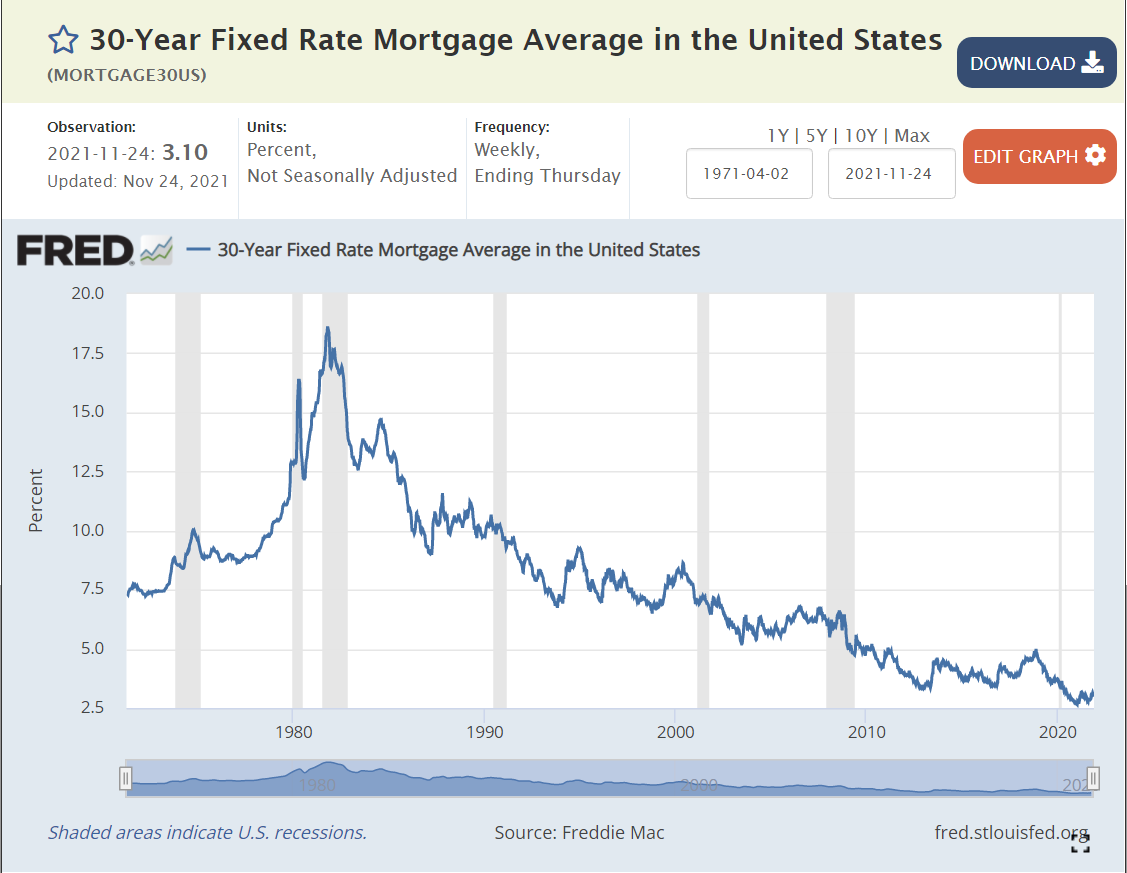
Mortgage interest rates averaged 8% during the 1990’s. They averaged 7% in the 2000’s. They declined even further to 4% during the 2010’s. They fell even further to 3% in 2020-21. The interest cost to finance a house is at an all-time low.

Stock Market

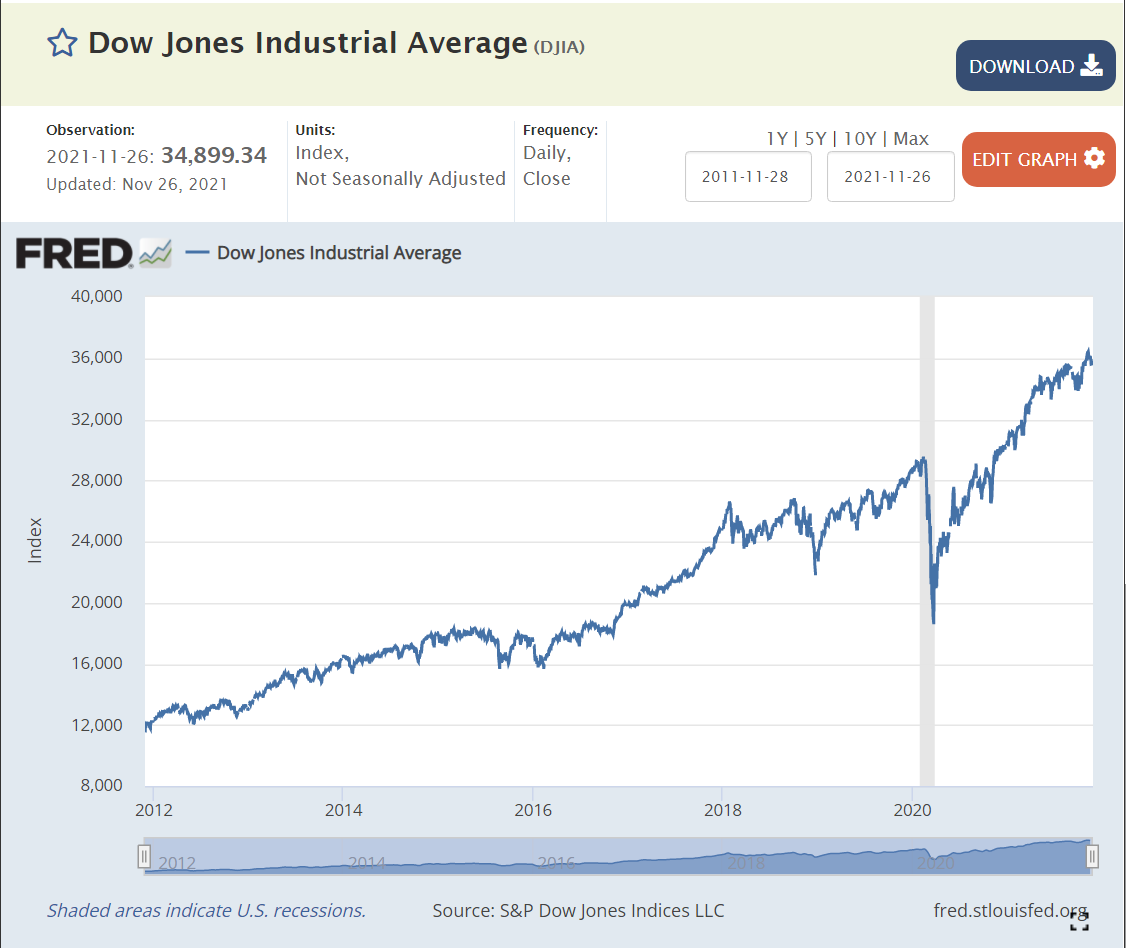
The US stock market averaged 16,000 points from 2014-16. It increased by 50% to 24,000 in 2018, and then climbed to 26,000 and 28,000 before the 2020 pandemic crash. Despite the real financial costs of the pandemic, the market quickly rebounded to 25,000 in the middle of 2020. It has since continued its climb to 36,000, 20% above the pre-pandemic level.

In 1992 James Carville claimed that “it’s the economy, stupid”.

https://en.wikipedia.org/wiki/It%27s_the_economy,_stupid

If so, voters should provide some support to president Biden’s results. Real income is up 2% annually, a record level. Reduction in number of unemployed is 6M in 1 year, another record. Unemployment rate is at 4.6%, below historical “full employment” level. Voluntary quit rate is 50% higher than history, indicating tremendous worker confidence. Nearly twice as many job openings as the historical level, providing great options for job seekers to find their “best” opportunities. Mortgage interest rates remain at historical lows, supporting home purchases. House values have grown by another 25%. The stock market is 20% higher.

This is all at a time when the pandemic unfortunately continues to claim lives and greatly disrupt life and the economy. Overall, the recovery is proceeding at a rate far faster what anyone thought was possible during 2020.

The Great Resignation: Labor Markets Run Amuck

Lots of press on the topic of a “new” labor market. Some of the experience seems to be genuinely new, some of the situation seems to be our old favorites, supply and demand.

Derek Thomson’s recent Atlantic article is a good one,

https://www.theatlantic.com/ideas/archive/2021/10/great-resignation-accelerating/620382/

On the supply side, labor force participation is the big driver.

Focus on the core 25-54 age group to avoid the impact of various “mix variances” with changing enrollment rates and different retirement patterns. HUGE increase from 1950 to 1990, 65% to 84%, as women joined the US workforce across 4 decades. The rate stayed roughly constant for 2 more decades, through 2010, falling back a little to 83% in the late 2010’s.

Since 2006, we’ve had some modest changes. The rate fell from the relatively stable 83% rate through 2009 down to 81% in 2012. The recession knocked 2% of the population out of the workforce. For the next 4 years, through 2016, the participation rate remained at 81%. This is a variable that does not change quickly. People make long-term decisions, knowing that re-entering the work force requires very significant “effort”, investments, networking and accepting lower wages versus history. By the middle of 2016, almost 8 years after the decline that started in early 2009, the participation rate started to increase again. Note the many articles about the “jobless recovery” during W Bush’s time and Obama’s first term. The labor markets are not quite as responsive as desired. In the next 4 years, the participation rate returned to its prior level. That’s an increase of 0.5% per year during a prolonged economic boom period. Again, this measure of available supply does not change rapidly in normal times.

The pandemic dropped participation back to 81% in a short few months! In the last year, the participation rate has risen by a little more than 0.5% to 81.7%. We can expect to see this same kind of improvement for each of the next 3 years based upon recent history. But, even with all of the measures of underemployment and open positions, it is unlikely that the labor market will attract new employees faster than this rate.

The number of nonfarm workers employed reflects the results of labor markets. This is another measure that typically changes slowly.

The number of US employees stayed relatively flat from 2000-2004. The W Bush (jobless) recovery DID add 6 million workers. The “Great Recession” dropped the headcount by 8 million, back down to the 130 million level of the prior recession. Note that we had 11 years with essentially ZERO net job growth.

The economy found its footing in 2010 and we had 9 years or growth, adding 22 million employees, a truly remarkable period of prosperity. This recovery is remarkable for the steady pace of job growth, a constant 2.4 million per year.

By the end of the 2020 pandemic year, employment was down to 143 million, a decline of 9 million. This is similar in size to the “Great Recession’s” 8 million job loss. In the last year, the economy has added 5 million jobs, a pace TWICE the level of the prior recovery. We may be slowing down, or the job adds may continue between the 2.4 – 5 million annual rate. This is VERY GOOD news.

In the long-run, the US economy struggles to reduce and hold unemployment below 5%.

In the post-WW II boom times, 4% was reached several times, but thereafter quickly increased back above 5%. The “stagflation” era of the 1970’s indicated that “full employment” might be as high as 6%. The boom periods of the late 1990’s and 2000’s drove actual unemployment below the presumed 5% unemployment rate, but always just briefly. The long and smooth 2010’s recovery broke the rules. Unemployment rates fell and fell down to an unexpected 3.5%.

By the end of 2020, the unemployment rate had dropped to a more reasonable 6.7% from the measured peak of 15%.

It has recovered by a very strong and quick 2% in the last year, reaching 4.8%. This is near the long-term level of “full employment”, where demanders must provide increasingly attractive offers to entice supply.

This recent disconnect between supply and demand is seen in the unusually high job openings rate.

From 2000-2014, the economy averaged a 3% rate of job openings to labor market participants. About 1 in 30 or 33 jobs were “open”. The “Great Recession” drove this ratio as low as 2%, with just 1/50 jobs open. Following the “Great Recession” this ratio of job market demand increased for a full decade, from 2% to 4.5%, where only 1 in 22 jobs were open. Note that this is more than twice as many as in the depths of the “Great Recession”.

The job openings rate snapped back to the recent 4.5% level in the second half of 2020. It has since grown to a record 7%, or 1 in 14 positions unfilled. This is a “loose” labor market of historic proportions. Demand is clearly exceeding the slow response of supply in the labor force participation rate.

The “quits” rate has attracted the most media attention as it is even more extreme.

The voluntary quits rate averaged 2% from 2001-2008, 1 in 50 workers. It dropped to just 1.5% (1/66) during the Great Recession. It slowly increased with the recovery to 2.3% in the heady days of 2018-19 (1/44). The quit rate returned to its recent level very quickly by July, 2020. It has since increased to 2.8% or 1 in 36 workers each month. On an annual basis, this is 1 in 3 workers voluntarily leaving their employment!
As we’ve seen with the supply chain bottlenecks, the labor market is currently unable to recover quickly enough.

The economy did employ 152 million workers before the pandemic. We need 4 million more to reach that level. Based on recent history, this is an achievable level, but it will require 18 months or more to achieve.

In the mean time, employers will raise wages and provide more flexible terms to attract marginal workers back into employment.

As the “great resignation” pundits say, the pandemic experience changed the expectations of potential employees. They have found that they can “survive” rather than accept low wage positions with poor work conditions. This will change their behavior for years to come.

Good News: Labor Productivity from 1970 to 2020, A Personal Perspective

Nonfarm Business Sector: Real Output Per Hour of All Persons (OPHNFB) | FRED | St. Louis Fed (stlouisfed.org)

I formally retired this Spring at age 65. I started working in 1966 at age 10 as a newspaper delivery boy. I’d like to reflect on the big changes in the economy during these 5 decades.

The US Bureau of Labor Statistics tracks the real output per hour in the nonfarm business sector, or “labor productivity”. The media reports this number as it has “real” and “political” importance. The average annual improvement has been 1.9%. That is a 95% increase in 50 years, nearly a doubling, on an arithmetic basis. However, productivity compounds geometrically, just like compound interest, so the 2020 worker is actually 159% more productive. Or, the 1970 worker was 39% as effective as the 2020 worker!!! The 2020 worker delivered 5 units of output for every 2 units of output in 1970!!! Expressed in these terms, it’s clear to see this is a really important measure.

The annual productivity increase has ranged from -1.6% (1974, when I finished high school) to 4.5% (1992). 3 times below 0% and 3 times above 4%. The measured productivity growth increases and decreases through time. From 1970-76, labor productivity grew by 2.4% annually, a very good result. This was the end of the post WWII boom period. Japanese and European competition, oil cartels, sleepy consolidated industries, environmental laws and stagflation disrupted this progress. The next 13 years (1977-89) were a time of transition (disco). Labor productivity grew by just 1.4% per year, despite the early positive effects of the computer revolution. 1% per year lower doesn’t look like much, but it means that output in 1989 was 13% less than it would have been if the country had maintained it’s early 1970’s productivity improvements. The impact of the “Reagan Revolution” in freeing American capitalism from regulations and taxation was not clear during his presidency. The next 8 years (1990-97) showed some improvement, to 1.7% annually, but not a true revolution that either Bush or Clinton could celebrate. The next 13 years (1998-2010) were the golden years for improved labor productivity, averaging 2.9% annually, DOUBLE the improvements from 1977-89. The later Clinton years and the whole George W Bush presidency witnessed these results. The next 6 years (2011-16) reflected the slow recovery from the Great Recession with labor productivity growing by just 0.7% annually, half of the poor 1977-89 time frame. Productivity growth started to recover in the last 4 years, averaging 1.7%.

Economists tend to focus on the role of “capital” in driving labor productivity. In essence, if workers have more or better machines and computers, they will produce more per hour. In very rough terms, about one-half of labor productivity improvements come from better tools.

How Capital Deepening Affects Labor Productivity (stlouisfed.org)

The economists who try to measure the output part of labor productivity (real GDP) try to be consistent and conservative. That means that they understate real GDP. They don’t include the value of reduced pollution. They try to adjust for the improved quality of goods and services, but count only the obvious benefits. In a world dominated by services, this is a major gap. They make no attempt to estimate the benefits of less time spent buying goods and services. They make no estimate of the value of shorter delivery times. They are unable to account for the benefits of transparent and deep markets for goods and services.

Finally, they do not account for the value of product variety, broader consumer choices and customized goods. The fact that modern products more exactly fit consumer needs adds no value to GDP. By the 1990’s firms understood the universal customer value framework (QSFVIP) outlined by Deming, Juran, Shingo, Schonberger and others.

Amazon.com: Building a Chain of Customers eBook: Schonberger, Richard J.: Books

Firms understood Marshall Field’s dictum to “give the lady what she wants” and pursued it with a vengeance in order to gain market share, fight imports and improve margins. Based on my experience, firms devoted at least as much time to delivering upon these “soft”, qualitative, unmeasured productivity factors throughout the last 50 years. Hence, true productivity growth may have been twice as high as officially reported.

What changed in 50 years?

Secretaries and administrative assistants disappeared. Managers and professionals learned to do their own “paperwork”.

Clerks disappeared. Fewer transactions. Lower transaction costs. Standardized transactions. Automated transactions. No data entry operators.

All processes were subject to measurements like Ford’s assembly line.

More “analysts” working to improve all functions. Not just chemistry and engineering specialists. Financial analysts, marketing analysts, pricing analysts, logistics specialists, forecasters, inventory specialists, brand managers, compensation analysts, trainers, quality specialists, process engineers, systems engineers, professional purchasing analysts, etc.

Documentation revolution. Policies and procedures. Standardization. Say what you do.

Quality/process/TQM/lean 6 sigma revolution. Every activity can be defined and improved. Do what you say. Improve.

Process management via Goldratt’s theory defined in “The Goal”.

Import substitution due to lower transport, finance and transaction costs.

Outsourcing and specialization. Finance, accounting, HR, engineering, IT, facilities, marketing, advertising, logistics, distribution, legal, labor, manufacturing, design, project management, testing, returns, maintenance, leasing, equipment rental, etc. Stick to your core functions.

Flatter organizations. Fewer middle management layers.

New product introduction as a well-defined process that can be improved and outsourced.

Business viewed as a portfolio of products and channels and markets.

Competitive banking. Competitive equity markets. Venture capitalists. Bankruptcy processes. Leveraged buyouts. Asset based financing. Leases. Portfolio theory. International funds flows.

Reduced barriers to international trade. Tariffs. Regulations. Lower shipping costs due to containerization. Rule of law reducing costs like letters of credit. Fax machines. Reduced foreign travel costs. Japanese supplier partner concepts.

Improved suppliers. Supplier partnerships. Supplier measures. Contracts. Supplier improvement plans. Less bidding, negotiations or transactions.

Capital allocation/investment within firms. Basic ROI/NPV education. Portfolio of products. New products, new channels, new brands, process improvements, supplier improvements. Improved supplier opportunities. Acquisition value. Improved project management and risk management.

Jack Welch view: be number 1 or 2 or else. Walmart or niche service positioning, not JC Penney or Sears or Kmart. Firms dedicated their products to what customers would willingly buy.

Benchmarking to world class standards. Belief that reaching this performance level is possible and required.

Computerization of all processes. Transactions. Planning. Scheduling. Forecasting. Controls. Budgets.

Immediate communications. Supplier transactions. Product development. Project management. Inventory management.

Digital replacement of analog publishing.

Role of network effects. Clear standards.

Internal planning and scheduling tools.

Improved current and futures markets for all commodities and business inputs.

Reduced costs for transportation, agriculture, manufacturing, minerals and standardized inputs.

Reduced construction costs through design, standardization, sourcing, project management tools.

Greatly improved hiring frameworks and tools (fill the bucket). Management development training. Employee evaluation and feedback tools.

Social support for necessary “downsizing” at larger firms during economic downturns.

Basic productivity improvements from Microsoft Office tools: spreadsheets, word processing, publishing, web publishing, forms, database structure, queries, reporting, projects, etc.

Internal planning, analysis and control tools. Activity based costing. Balanced scorecard.

Much of the productivity improvements of the last 50 years have been due to improvements in “administration”. The lean 6 sigma quality revolution points to continued improvements in the future, perhaps with a lesser measured impact.

Breakthrough improvements in chemistry, biotechnology, physics, nanotechnology, DNA, plastics, materials, communications and energy may be required to drive productivity improvements in the next 50 years.

I’m an optimist. Science delivers opportunities. Profit oriented firms in competitive market find and apply these opportunities. Output per labor hour will be 150% higher again in 2070 (5/2 X). That means that workers in 2070 will be more than 6 times as productive as those in 1970!

Good News: Consumer Debt Payments at Record Low

Household Debt Service Payments as a Percent of Disposable Personal Income (TDSP) | FRED | St. Louis Fed (stlouisfed.org)

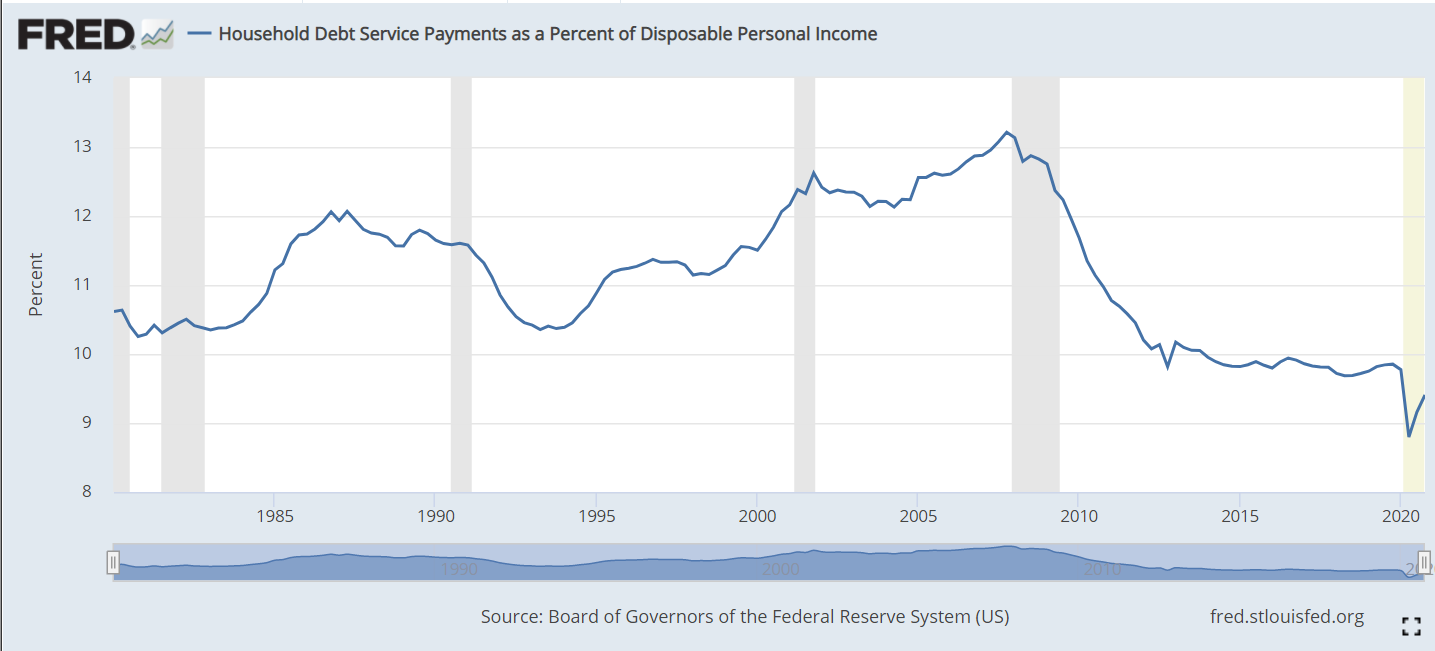
The ratio of household debt service (loan payments) to disposable personal income includes both mortgage payments and consumer debt payments. From 1980-2000 it fluctuated between 10.5% and 12%. Following the 2001 recession it increased to more than 13% before falling steeply to 10% in 2012. During the long recovery from the Great Recession it remained just below 10%. During the pandemic time it fell as low as 9% as personal incomes were boosted through stimulus payments. In total, this is a healthy situation. American families worked through an unsustainable runup of debt and payment during the “ought” decade, the Great Recession and the pandemic. They are well positioned at les than 10% to either save or spend, depending on their preferences. This is good news for the economy, the housing market and risks to financial markets. This is often called the Debt Service Ratio (DSR).

Mortgage Debt Service Payments as a Percent of Disposable Personal Income (MDSP) | FRED | St. Louis Fed (stlouisfed.org)

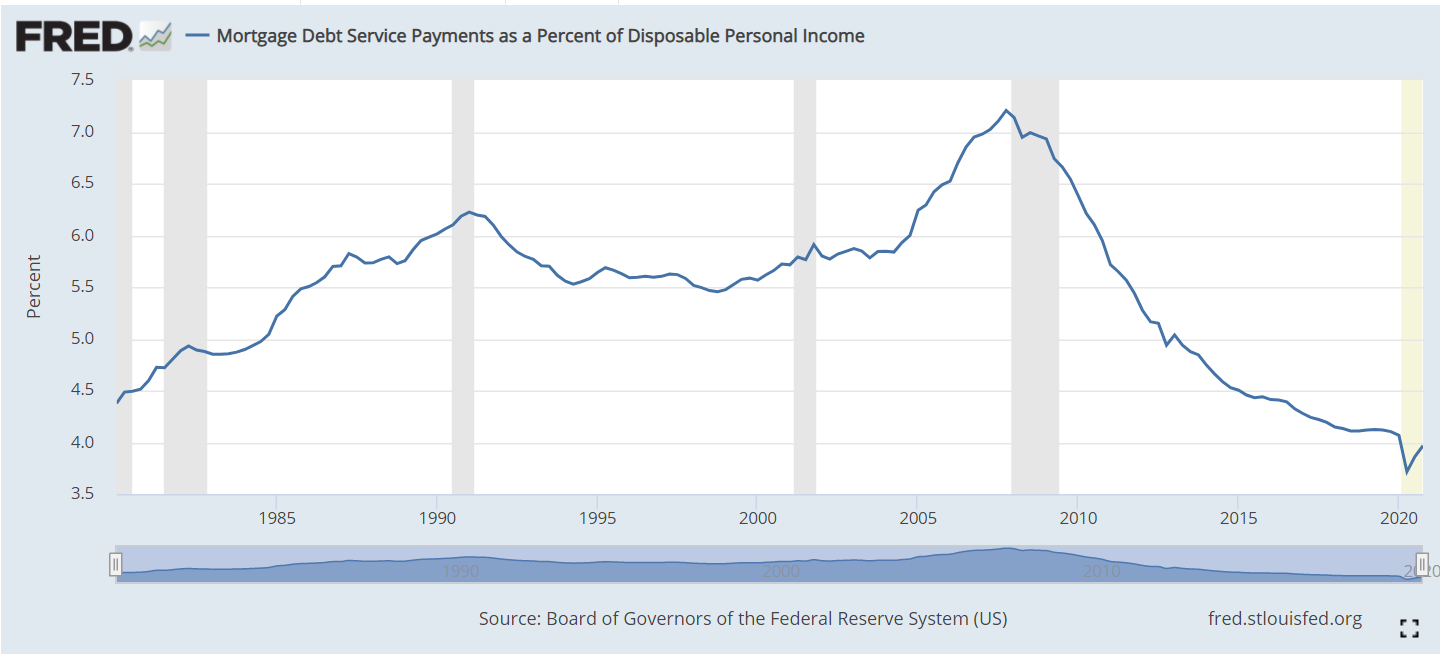
The mortgage component averaged 5.5% of personal income from 1980-2000. It remained below 6% through 2004, before increasing quickly to 7% in 2007. This was unsustainable. Mortgage foreclosures and revised lending standards reduced mortgage lending balances quickly. The Fed reduced interest rates and kept them low. Mortgage payments as a percent of disposable personal income fell to just above 4%. This is a 40% drop (3/7). Even compared with the 5.5% average, this is a 27% reduction in debt service expenditures. This ratio is threatened by future interest rate increases, but current mortgage holders will benefit from years of low mortgage rates and refinancing for decades to come.

Consumer Debt Service Payments as a Percent of Disposable Personal Income (CDSP) | FRED | St. Louis Fed (stlouisfed.org)

Consumer debt has also fluctuated across these 40 years, reaching an early peak of 6.4% in 1986 during the confusing era of stagflation. In the next 6 years, families reduced their debt percentage by 1.7% to a safe minimum of 4.7%. Consumers were more confident through the 1990’s and took on more debt, allowing the payment ratio to rise to a new record of 6.6% before the 2000-2001 recession triggered less borrowing. Although mortgage payments increase during the 2000’s, consumer debt payments eased back to just 6.0%. Families were scared by the Great Recession and reduced their debt levels (and helped by lower interest rates) and payments to just 5% in 2010. The ratio remained low for 2 years, before resuming a familiar optimistic climb to 5.8% of disposable income before the pandemic.

Household Financial Obligations as a percent of Disposable Personal Income (FODSP) | FRED | St. Louis Fed (stlouisfed.org)

The Household Financial Obligations Ratio (FOR) follows the same pattern as the Debt Service Ratio (DSR). It is a higher percentage as it includes other “fixed” obligations such as rent. We see relative stability between 16-17% through 2004. The mortgage driven increase to 18% by 2008 is evident, followed by a very rapid fall to 15% in 2012. This broader ratio has remained flat since then. The pandemic drop is due to extra stimulus income.

File:Total US household debt and its composition over time.png – Wikimedia Commons

The composition of total consumer debt for the last 20 years highlights the rise and fall and rise of mortgage debt and the increase in student loan debt.

Household Debt to GDP for United States (HDTGPDUSQ163N) | FRED | St. Louis Fed (stlouisfed.org)

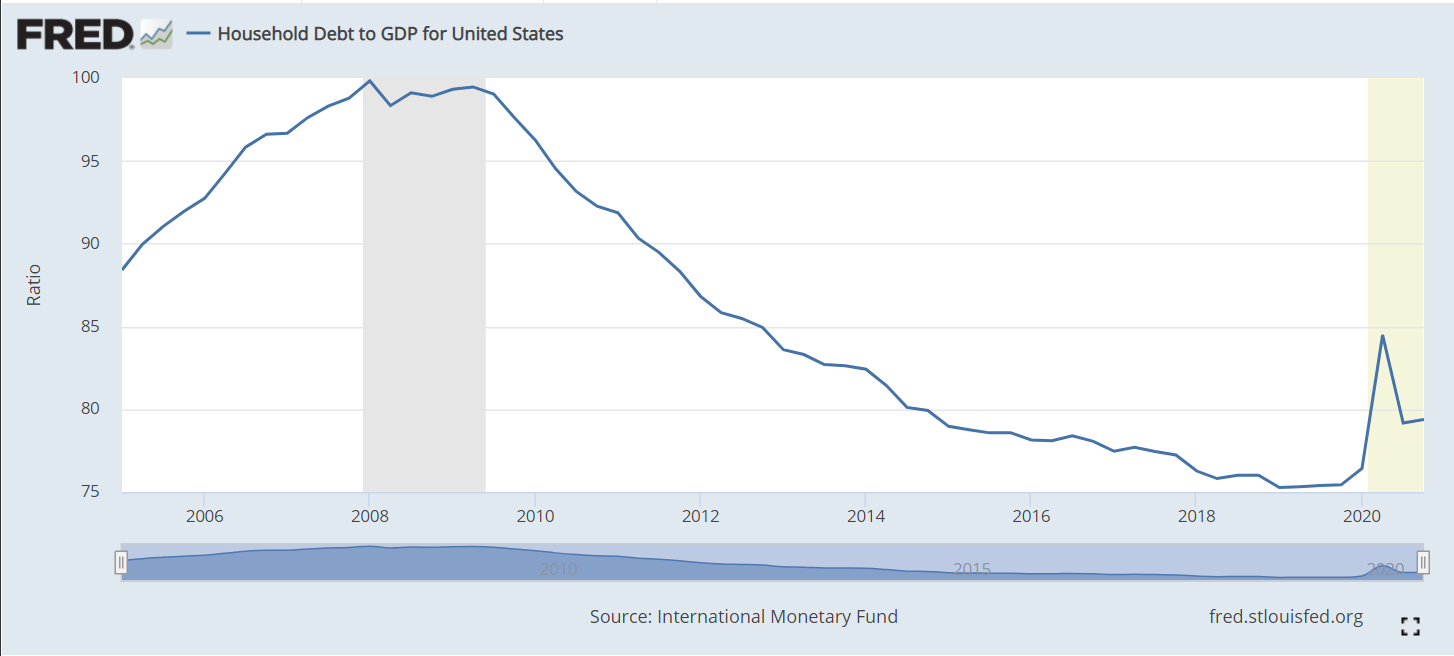
Household debt to GDP peaked at 100% before the Great Recession and has fallen by one-fourth in the next 10 years. Unpaid mortgages and other consumer debt have begun to accumulate in the last year.

Personal Saving Rate (PSAVERT) | FRED | St. Louis Fed (stlouisfed.org)

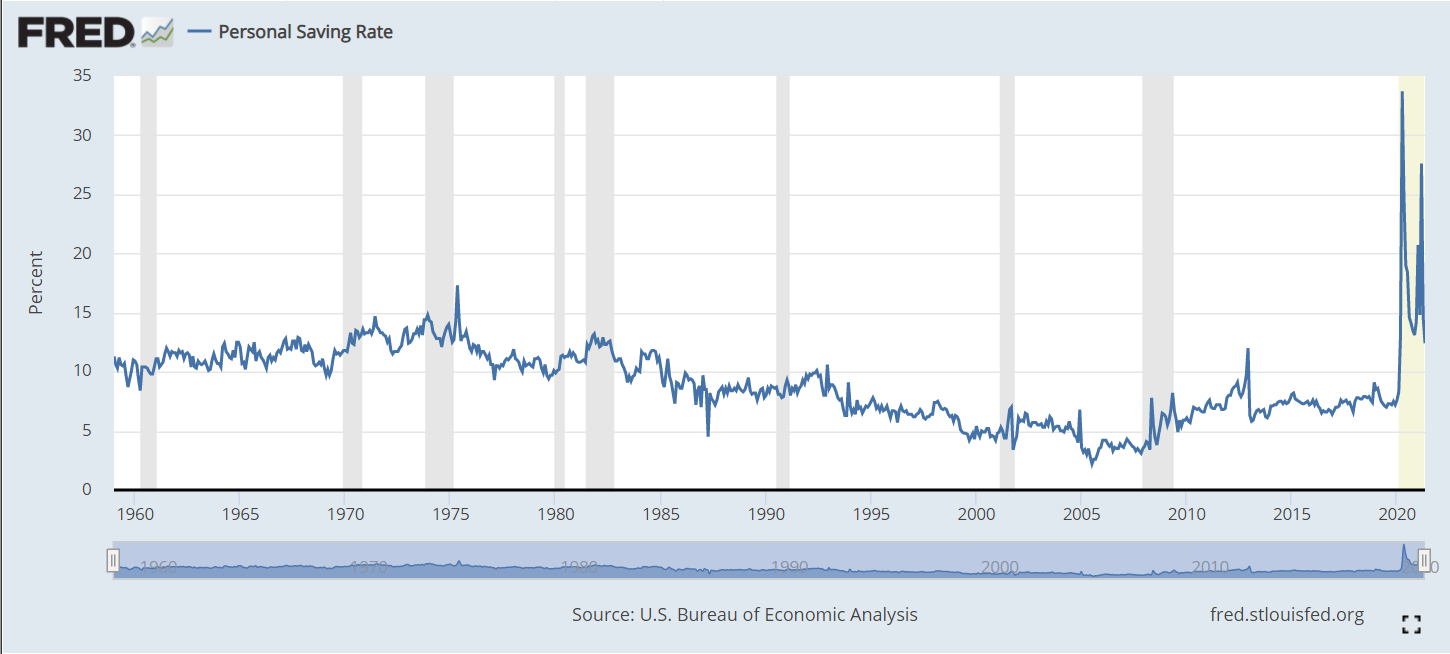
The personal savings rate averaged 10-13% from 1960-1985. The country’s economic challenges lead families to save less to maintain their standard of living, falling in half (5%) by 1999. It remained in the 4-5% range through the next expansion. The Great Recession triggered families to replenish their savings, with a 7-8% rate. The pandemic period shows a 15% savings rate. In all likelihood, this rate will fall back below 10% soon.

Education | How has the percentage of consumer debt compared to household income changed over the last few decades? What is driving these changes? (frbsf.org)

How Stretched are Today’s Borrowers? Debt Service Levels in Fourth District States (clevelandfed.org)

Not Every Household Feels Relief amid Our Record-Low National Household Debt Service Ratio | Urban Institute

Household debt jumps the most in 12 years, Federal Reserve report says (cnbc.com)

Household Debt Service Drops to a Record Low – AIER

Household Debt Rising, but Payments Remain Under Control | LPL Financial Research (lplresearch.com)

Labor Force Participation Rates

Rates by Racial Group

Racial Grp195019601970197919902001200720182021
Total595960646767666362
White (non-Hisp)585960646767666361
Black616465646361
Hispanic60636870696765
Asian68666363
Non-white626668676563

The overall US labor force participation rate is the ratio of those employed plus those actively looking for work among the non-institutional (military, prison, etc.) working age (16-64) population. It rose a quite substantial 8 points, from 59% in 1950 to 67% in 1990, mainly due to increased female participation rates. It remained in the 66-67% range through 2007, before declining by 5% in the last 14 years, a quite rapid decline. Note that the years selected are the ends of business cycle expansions plus the current year.

The overall rate mirrors the White rate as White’s make up the largest share of the population and because other racial participation rates are similar to the White rate. Black labor force participation has followed the White pattern, but been 2-3% lower than the White rate for most periods. The Hispanic rate started just below the White rate, but exceeded it by 1990, growing to a 3% advantage in 2021 at 65% versus 62%. The Asian participation rate has matched the White rate, sometimes being 1% higher.

Labor Force Participation Rate (CIVPART) | FRED | St. Louis Fed (stlouisfed.org)

Labor Force Participation Rate – Black or African American (LNS11300006) | FRED | St. Louis Fed (stlouisfed.org)

Labor Force Participation Rate – Hispanic or Latino (LNS11300009) | FRED | St. Louis Fed (stlouisfed.org)

Labor Force Participation Rate – Asian (LNU01332183) | FRED | St. Louis Fed (stlouisfed.org)

Racial Groups Percent of US Total Population

Racial Group195019601970197919902001200720182021
White (non-Hisp.)878583797669666060
Black101111121212121212
Hispanic2356913161819
Asian001234566

The decline in the White share of the US population, especially in new births and school age children has been highly publicized and politicized for 40 years. The White share of the population has fallen from 5/6ths to just 3/5ths since 1950. African-American share grew by 2% in the 50’s and 60’s before settling at 12%. The Hispanic population has grown rapidly, from just 2% to 19%, passing the Black share by 2001. The broadly defined Asian population has grown from less than 1% to 6%. This breakdown does not include multi-race categories, which now amount to 3%. For labor force participation purposes, racial composition plays a minor role in the total rate.

U.S. Census Bureau QuickFacts: United States

Male/Female Rates, Ages 16+

Group195019601970197919902001200720182021
Total595960646767666362
Men878480787775736967
Women333743525860595756
55+ Men6761574740414646
55+ Women2022262222273235
25-64 Men9797969493909088
25-64 Women3942506273777674

Male participation in the labor force has fallen by 20 percentage points, from 87% to 67%. The increase in the 65+ age group from less than 4% to almost 8% of the total population accounts for more than 4% of this 20% decline, but 3/4ths or more is due to other factors. Female participation rates, working against this same 4% reduction due to the mix of older residents, grew from just 33% to a peak of 60% in 2001 before declining by 4%, about half of the male decline from 2001 to 2021. The expansion of opportunities for women and their choices to pursue the opportunities in the US is well understood. The increased share of aged 65+ women accounts for almost 3% of the 4% female decline. The reduction in male labor force participation is the big story.

Women, aged 55+ averaged just 22% participation through 1990. Most of the increased labor force participation in these 40 years was among younger women. More than one-third (35%) of women aged 55+ are now active labor market participants.

Their male counterparts in this age bracket show a 21 point decline, mirroring the overall male decline, but starting at the lower rate of 67% and ending at 46%. There is a mix variance here, as 55-64 year olds made up 4% of the population in the first 50 years, but now account for 6%, while the 65+ age group started at 4% for the first 25 years and then grew to 8%, so the share of 65+ citizens out of the 55+ total has risen from 45% to 56%. The mix variance accounts for a 5% decline in the participation rate, but the other 16% is due to other factors.

Demographers refer to the 25-54 year age group as the prime labor force. Here, we see women double their participation rate from 1950 (39%) to 2001 (77%) before falling off a bit to 74%.

For prime age men, we see a 9% point drop, from a near universal participation rate (97%) in 1950-60 down to 88% by 2018.

Labor Force Participation Rate – Women (LNS11300002) | FRED | St. Louis Fed (stlouisfed.org)

Labor Force Participation Rate – Men (LNU01300001) | FRED | St. Louis Fed (stlouisfed.org)

Participation Rates by Race within Gender

Group195019601970197919902001200720182021
Men878480787775736967
White Men888683807877767270
Black Men79767472716866
Hisp Men85858585848079
Women333743525860595756
White Women333641495860605857
Black Women51556165646260
Hisp Women45495660596058

The White women data follows the total. A majority of Black women were labor force participants in 1970, 10 points higher than White women. They increased their labor force participation by 14 points, to a peak of 65% in 2001, before falling back by 5 points to 60% in 2021. This generally matches the pattern of White women, except that Black women have averaged an extra 4 participation points. Hispanic women started between the other two groups, at 45% in 1970 and then climbing to 60% in 2001. Their participation has remained close to 60%. Overall, relatively minor racial differences in female participation. About a 25 point increase in the second half of the 20th century followed by a 2 point decline in the last 20 years.

White men make up the largest share of the male total, so their data is close to the total, declining by 18 points, from 88% to 70%: from 7 out of 8 in the labor force to just 7 in 10. Black men follow the same Total pattern, but are consistently 4% less active in the labor market versus White men. Hispanic men first appear in the data in 1970, with an 85% participation rate, just above the 83% White male rate. However, Hispanic males stay at this level through 2007, while the White rate falls by 7%. In the last 14 years, the Hispanic male participation rate has dropped by the same 5% as the White and Black male rates, ending at 79%, 9 points above the 70% White rate.

Labor Force Participation Rate – 20 Yrs. & Over, White Men (LNS11300028) | FRED | St. Louis Fed (stlouisfed.org)

Labor Force Participation Rate – 20 Yrs. & Over, White Women (LNS11300029) | FRED | St. Louis Fed (stlouisfed.org)

Labor Force Participation Rate – 20 Yrs. & Over, Black or African American Women (LNS11300032) | FRED | St. Louis Fed (stlouisfed.org)

Labor Force Participation Rate – 20 Yrs. & Over, Black or African American Men (LNS11300031) | FRED | St. Louis Fed (stlouisfed.org)

Labor Force Participation Rate – 20 Yrs. & Over, Hispanic or Latino Men (LNU01300034) | FRED | St. Louis Fed (stlouisfed.org)

Labor Force Participation Rate – 20 Yrs. & Over, Hispanic or Latino Women (LNU01300035) | FRED | St. Louis Fed (stlouisfed.org)

Participation Rates by Age Group

Age Group195019601970197919902001200720182021
Total595960646767666362
16-19504448565350403434
20-24646568777878747170
25-54656972788384838281
55-64616162565660646565
65+282018121112172020
55+434139333032394039
25-64646870757981807978
non-prime504748504645464443

Age Group Percent of Population

Age195019601970197919902001200720182021
0-1527.231.428.823.822.222.221.219.018.6
16-197.27.49.49.67.47.47.46.66.6
20-247.66.27.89.48.06.87.27.06.8
25-5450.646.645.848.052.053.253.853.252.4
55+16.417.017.018.218.419.021.026.828.0
55-649.08.68.89.08.08.610.612.612.4
65+7.48.48.29.210.410.410.414.215.6
25-54 % 16-6469.567.964.363.066.868.468.365.764.4
non-prime % work age30.532.135.737.033.231.631.734.335.6

Let’s start with the prime age labor force (25-54). From 1950 to 2001, we see a 19 point increase, from 65% to 84%. This is all due to the increase in female participation, which more than offset the significant decline in male participation. In total, from an economic point of view, this is great news. The total participation rate has slipped back a bit, from 84% to 81% in the last 2 decades, with men and women both falling back, but men falling faster. Aside from the distortion of the baby boom when it declined to 46%, the prime age group has typically been about 52-53% of the population. It has fallen by 1% in the last decade as the growth in older population groups has been faster than the decline in the childhood group.

The non-working age 0-15 year old childhood group reached a full 31% of the population total in 1960 and has since fallen to 19%. From an economic point of view, this too is good news, as the dependency ratio of non-workers to workers declines.

The teenager participation averaged 46% from 1950-1970. It averaged 55% in the mid-70’s to mid-90’s, but has quickly declined to just 34% in recent years. As teenagers make up 11% of the working age population, this drives a 2% decrease in the overall workforce participation rate. From an economic point of view, it is possible that the other activities of teens today are more valuable in creating human capital than the part-time entry level work that many more were performing in the 1970’s-90’s.

The labor force participation for young 20’s rose quickly from 64% to 77% by 1979 with increased participation by young women in the economy. The rate has declined to 70%. As this group accounts for 11% of the work age population, this has driven a nearly 1% point decrease in the overall work age participation rate.

The 55-64 year old group has a different pattern, averaging 61% in the 1950’s to 1970’s, decreasing 5 points to 56% in the mid-70’s through mid 90’s, before growing all the way back to 65% recently. The increased female participation rate did not impact this group significantly. During the 1975-95 time, more men took advantage of early retirement possibilities, some forced and some voluntary. This group increased from 9% to 12% of the total population. The 9 point participation rate increase since 1990 adds about one and one-half points to the overall participation rate, offsetting some of the 16-25 year old reduction.

The 65+ group pattern is similar to the 55-64 year olds, starting above 20%, falling down to 11% and returning to 20%. Economically, this recovery adds to the nation’s output, even if this group is not considered part of the work age population. This group has more than doubled as a share of the total population, reaching 15%.

With men and women combined, the total participation rate drops 5 points, from 67% in 2001 to 62% in 2021. The prime age group accounts for one-half of the working age population and shows a 3 point decline from 84% to 81%, with a one and one-half percent negative impact on the total rate. The significant declines in the 16-25 age group drives the rest of the 5 point decrease.

An Aging Labor Force and the Challenges of 65+ Jobseekers – AARP Insight on the Issues

Civilian labor force participation rate by age, sex, race, and ethnicity : U.S. Bureau of Labor Statistics (bls.gov)

Labor Force Participation Rate – 16-19 Yrs. (LNS11300012) | FRED | St. Louis Fed (stlouisfed.org)

Labor Force Participation Rate – 20-24 Yrs. (LNS11300036) | FRED | St. Louis Fed (stlouisfed.org)

Labor Force Participation Rate – 25-54 Yrs. (LNU01300060) | FRED | St. Louis Fed (stlouisfed.org)

Activity Rate: Aged 55-64: All Persons for the United States (LRAC55TTUSA156S) | FRED | St. Louis Fed (stlouisfed.org)

Labor Force Participation Rate – 55 Yrs. & Over (LNS11324230) | FRED | St. Louis Fed (stlouisfed.org)

Labor Force Participation Rate – With No Disability, 65 Years and Over (LNU01375379) | FRED | St. Louis Fed (stlouisfed.org)

Population of United States of America 2019 – PopulationPyramid.net

Rates by Educational Attainment (Ages 25-64)

Group197019791990200120072018
Total707579818079
Less than HS grad666161596361
HS grad707478767673
Some college748083828282
College grad +828686878687
Percent of Population
Less than HS grad453122161310
HS grad333738323129
Some college101518262726
College grad +111721262935

Data on labor force participation by educational attainment for ages 25-64 is available for 1970 through 2018. During this nearly 50 year period, the total participation rate increased from 70% to 79%, with a peak of 81% in 2001. Recall that the official total participation rate included the 16-24 year age brackets where participation fell significantly. We have only a 2 point decline from 2001 to 2018 rather than 5 points.

The big take-away is that participation rates for each group don’t change much through time. Those who didn’t complete high school average 61% pretty consistently. There are changes in the male and female participation rates and racial composition rippling through the data, but on average 3 of 5 people without a high school diploma participate in the labor market.

High school graduates average 76%, with a 3 point decline to 73% for 2018.

Individuals with some college classes have averaged 82% participation, except in 1970 when it was only 74%.

Those holding a college degree have averaged 86% participation, except in 1970 when they averaged 82%.

The proportion of citizens in each group has changed dramatically. Less than high school graduates dropped from 45% to just 10% of the post college working age population. College degree holders increased from11% to 35%. College attendees grew from 10% to 26%. High school grads started at 33%, increased to 38% and then declined to 29%. In total, the country shifted one-third of the population from non-high school education to college degree holders (BA and AA).

Given the consistency of labor force participation by level of educational attainment, the overall increase from 70% to 79% makes sense. Applying “typical” participation rates to each group (61.8, 74.5, 80.5, 85.7) produces an estimated participation rate for each year: 70, 73, 74, 77, 78 and 79. The 1990 and 2001 years stand out as having significantly higher actual than estimated labor force participation rates (+5 and +4). Perhaps some of the decrease in various rates since 1990 is due to there being an unusually high participation rate during this period as the economy expanded for relatively long periods with relatively mild recessions.

1960 Census: Educational Attainment of the U.S. Population

Educational attainment of workers, March 1981 (bls.gov)

Handout_1.pdf (duke.edu)

ECON 390 – Labor Force Participation Data (fortlewis.edu)

Labor force participation, employment, and unemployment of persons 25 to 64 years old, by sex, race/ethnicity, age group, and educational attainment: 2016, 2017, and 2018

Prime Age Participation (25-64)

Group195019601970197919902001200720182021
Total 25-64656972788384838281
Women394250627377767675
Men979796949390908988
White Men979594939189
Hispanic Men959491919090
Black Men908885838279

The prime age category is more than one-half of the labor force and contains individuals with the greatest earning power. Most attention has been focused on the 3 point drop from 2001 to 2021. It is also important to note the 19 point increase from 1950. We have data for men and women in this age group. Female participation essentially doubled from 1950 to 2001, before flattening out (down 2 points).

The male participation rate declines throughout the 70 year period, not just in the last 20 years. It falls from near universal 97% to 88%, meaning that 1 in 8 prime age males is not in the work force. As usually, the White rate matches the Total rate. Hispanic men have seen a 5 point decline from 1970-2018 while Whites fell 8 points. Hispanic men in 2018 had a higher participation rate than Whites. Black men started 7 points behind Whites at 90% and declined by an even larger 11% to just 79%. Whatever factors are driving prime age White men out of the labor force appear to be negatively impacting Hispanics and Blacks as well.

Activity Rate: Aged 25-54: Males for the United States (LRAC25MAUSM156S) | FRED | St. Louis Fed (stlouisfed.org)

Activity Rate: Aged 25-54: Females for the United States (LRAC25FEUSM156S) | FRED | St. Louis Fed (stlouisfed.org)

Activity Rate: Aged 55-64: All Persons for the United States (LRAC55TTUSM156S) | FRED | St. Louis Fed (stlouisfed.org)

Federal Reserve Bank of San Francisco | The Prime-Age Workforce and Labor Market Polarization (frbsf.org)

Chmura | Prime-Age Participation Rate

20160620_cea_primeage_male_lfp.pdf (archives.gov)

Summary

The overall participation rate for work age individuals (16-64) increased from 59% in 1950 to 67% in 1990 and has since dropped to 62%. The prime age group (25-54) increased from 65% to 84% before sliding back to 81%. For various age groups, the female participation rate doubled from mid 30 percent to high 60 percent range between 1950 and 2000 before slipping back a little. This drove the overall participation increase through 2001. The male participation rate for ages 16+ fell from 87% to 67% between 1950 and 2021. The prime age male (25-54%) rate dropped from 97% to 88%. Similar declines were seen for all races. The Obama white paper above (CEA) provides relevant details. The IBD article below is a good summary of this situation.

Labor Force Participation Rate Mystery: Why Have So Many Americans Stopped Working? | Investor’s Business Daily (investors.com)

The recent rebound in prime-age labor force participation (brookings.edu)

combined—hearing-figures-07-14-2015-final-.pdf (senate.gov)

U.S. Labor Force Trends (prb.org)

Good News: U.S. Charitable Giving

U.S. charitable giving to GDP ratio is 1.44%. Canada is second at 0.77%. UK is third at .54%. Italy at 0.3% is representative of Europe. U.S. giving is 5 times as high as other developed countries. (Table 27). U.S. private overseas aid is $44B. UK is second at $5B. (Table 25).

U.S. Generosity (philanthropyroundtable.org)

The World Giving Index has consistently rated the U.S. as the most generous country of 125 reviewed. Across 2010-19, US is 3rd highest percentage of those surveyed reporting they had “helped a stranger in the last year” at 72% compared with 48% global average. US was 5th highest with 42% reporting they had volunteered time for a charity in the past year versus 20% global average. US was 11th highest in percent reporting monetary donations in the last year (61%), versus global average of 30%.

WGI_2019_REPORT_2712A_WEB_101019.pdf (cafamerica.org)

In general, total US charitable giving has grown on a per capita or percent of GDP basis for more than 50 years. There is a clear “step up” in giving in the late 1990’s. Real (inflation adjusted) per capita giving has nearly doubled from representative $600 in 1970’s to $1,100 in 2000’s. (table 1). The US nonprofit sector reflects that growth, even though program fees are a much larger share of revenues, rising from less than 2% of GDP in the 1930’s-50’s to 3% in the 1970’s to more than 5% by the 2010’s. (table 6).

U.S. Generosity (philanthropyroundtable.org)

The US nonprofit sector now has 1.5M organizations and employs 10% of the US workforce. (table 5).

U.S. Generosity (philanthropyroundtable.org)

The Nonprofit Sector in Brief 2019 | National Center for Charitable Statistics (urban.org)

These sources also report that roughly one-fourth of Americans volunteer each year, donating 136 hours of work. (graph 8).

U.S. Generosity (philanthropyroundtable.org)

The Nonprofit Sector in Brief 2019 | National Center for Charitable Statistics (urban.org)

Total US charitable donations as a share of disposable income ratio has averaged roughly 2% across the last 40 years. Charitable giving as a percent of GDP averaged 1.7% in the 80’s and early 90’s, before increasing to 2.1% in the “oughts” and teens.

The most widely reported figure shows total real (inflation adjusted) US charitable giving since 1979. This has increased together with real US GDP. Representative years and amounts: 1982 ($150B), 1992 ($194), 2002 ($317), 2012 ($355) and 2019 ($450B).

FUNDRAISING INSIGHTS FROM THE GIVING USA 2020 REPORT – AskRIGHT

Giving by individuals has fallen from 80% to 70% of the total. Bequests have increased from 7-8%. Foundation giving has more than doubled as a share of the total, from 7 to 16%. Hence, the real individual giving numbers are solid and rising, but their growth rate has slowed through time. 1982 ($130B), 1992 ($160), 2002 ($250), 2012 ($250), 2019 ($310).

FUNDRAISING INSIGHTS FROM THE GIVING USA 2020 REPORT – AskRIGHT

While the total and individual charitable donation amounts have increased, the percentage of individuals donating has declined significantly. Years, percentages and average donation. 2002: 67%, $2,000. 2008: 65%, $2,300. 2012: 59%, $2,400. 2016: 53%, $2,500. Various authors speculate that the decline is caused by increasing inequality, lower confidence in institutions and changes in tax deduction laws.

Fewer Americans are giving money to charity but total donations are at record levels anyway – Lilly Family School of Philanthropy (iupui.edu)

In the early 2010’s there was a significant decrease in charitable giving percentages by non-itemizers (10%) and a much smaller decrease by itemizers (5%).

Leadership 18 Applauds New Legislation Aimed at Halting Decline in the Number of Americans Who Give to Charity | Business Wire

There are various reports that break down giving rates by state, city, religion, politics, region, marital status, generation and income. Perhaps most important is that the decrease in the giving percent from 67% to 53% means that the percentage giving zero, and dragging down the average, has increased from 33% to 47% of the population, from one-third to nearly one-half.

More than 90% of individuals with income above $125K donate to charity. 77% of those with incomes of $50-125K donate. This drops off to 58% at the $25-50K range and 37% under $25K (graph 11).

U.S. Generosity (philanthropyroundtable.org)

As a percentage of disposable income, individuals below $50K donate 1.5%, those at $50-200K donate 1.75% and those above $200K donate 2-3-4%.

Massive charitable donations by the rich and famous are making the same big splash as always (phys.org)

Many predicted that 2020 would be a reduced year for giving due to the pandemic or post-election concerns.

Presidential Elections and Charitable Giving: What Does the Data Tell Us? | CCS Fundraising

Percentage of Americans Donating to Charity at New Low (gallup.com)

One source indicates that actual 2020 giving increased by 5%, with 1% more people making donations. This report also indicated that 23% of affluent donors increased their contributions to local projects and increased their unrestricted contributions.

One way wealthy people changed their charitable giving during the pandemic – MarketWatch

Another source indicates that 2020 donations were up by 11% and the number of donors was up by 7%. They reported a 15% increase in small donations (<$250), an 8% increase in medium-sized donations and a 10% increase in large donation ($1,000+).

Fundraising Effectiveness Project: Giving Increases Significantly in 2020, Even as Donor Retention Rates Shrink | Association of Fundraising Professionals (afpglobal.org)

The US has a solid track record of individual charity. Donations have risen in real terms through time. Americans support nonprofits through cash and time donations. The decline in the percentage of individuals making donations is a concern. The “one-time” tax deduction for non-itemizing filers may help to spur increased contribution habits.

Charitable Giving Statistics & Facts for 2021 | Balancing Everything