

We have lost control of our political system and confidence in our institutions. I offer some root cause reasons for this situation in a series of posts. Second post in the series.
https://news.gallup.com/poll/647303/confidence-institutions-mostly-flat-police.aspx
Non-stop Growth of Economic Prosperity

Real, inflation adjusted, gross domestic product (GDP) is up 4 and 1/2 times since WWII when the American economy was the savior of Western Civilization and about to invest in the recovery of Europe and Japan. In this long-term perspective, growth is very constant. Critics can point to the capture of a greater share by the wealthy. Optimists can point to the radical improvement in quality not captured by GDP, increased consumer choices available and a larger share of retirees in the population.
Economic Satisfaction Stagnates
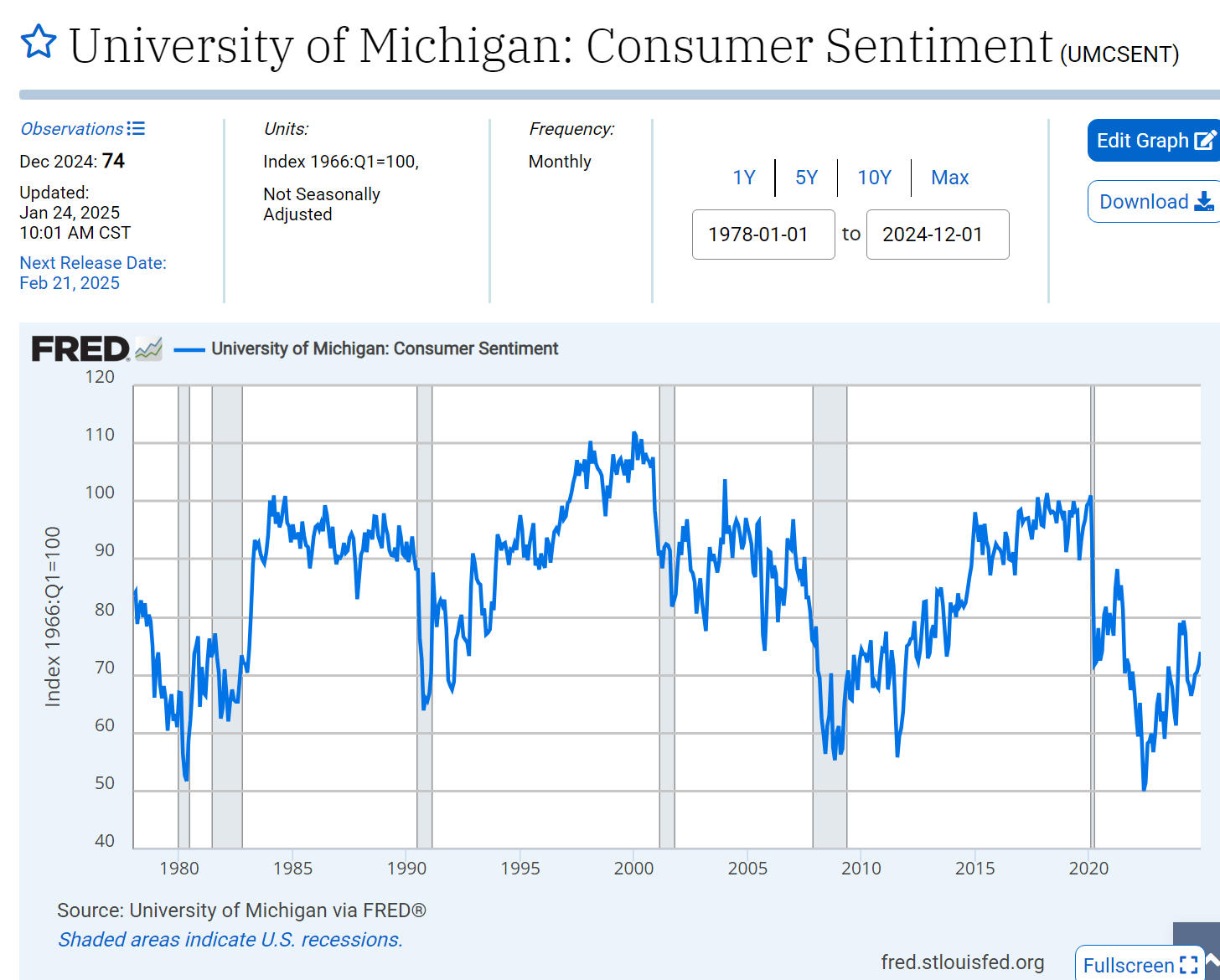
Consumer confidence rises with the economy and declines with recessions and polarized politics, but it has no upward trend to match real incomes!
Unlimited Wants, Limited Satisfactions
Economists assume that people have unlimited wants. Most research and common-sense experience show that this is true.
http://www2.harpercollege.edu/mhealy/eco211/lectures/microch1-17.htm
Post-war economists have persistently claimed that Americans “now” have everything they need materially to be happy, but they have been persistently wrong.
https://en.wikipedia.org/wiki/The_Affluent_Society
Other research shows that beyond a certain level of income, more money doesn’t make people happier.
https://penntoday.upenn.edu/news/does-more-money-correlate-greater-happiness-Penn-Princeton-research
Real people, at all levels of income, report that they would be happy, satisfied and secure if they only earned 50% more.
Behavioral Economists Say That Human Nature is at Fault
Our happiness often is based on our perceptions of comparative social and economic status. There is always someone with more.
We focus on our most recent experience rather than seeing the big picture.
https://en.wikipedia.org/wiki/Recency_bias
Once we have an idea in mind, we tend to consume information that confirms the idea and avoid or deny challenges. Positive, constructive people will be optimists. Others will be pessimists and follow the bad news media.
https://en.wikipedia.org/wiki/Confirmation_bias
When we do try to rationally assess our current situation, we compare it with something obvious. It’s usually something prominent, recent, large, and shiny. We compare today with our best ever experience or situation. We reset our expectations to compare with something prominent in our experience. We don’t plot graphs of our real annual earnings, wealth and leisure. Our expectations are anchored in our best experiences. Current expectations tend to move back to a neutral evaluation.
https://en.wikipedia.org/wiki/Anchoring_effect
Summary
Humans want more. We are rarely satisfied. That means we are easily distracted in the modern world by marketers, influencers, journalists, bloggers and politicians. Human nature has not changed. Our true economic condition has improved with little impact. Our access to information, education, knowledge and wisdom has increased with minor impact. The ability of communicators to influence our perceptions of the world has greatly increased and we have generally not improved our defenses. “We have much, much work to do today” – Mr. Thoburn Dunlap, 1970, Fairport Harbor, Ohio high school teacher.
P.S. Focus on how the media works.
P.S.S. Positive view of economic and social progress.
 Good News
[…] What’s the Root Cause of Our Problems?: Human Nature […]
[…] The Root Cause of Our Problems?: Radical Individualism What’s the Root Cause of Our Problems?: Human Nature What’s The Root Cause of Our Problems?: Skepticism What’s The Root Cause of […]
[…] What’s the Root Cause of Our Problems?: Human Nature What’s the Root Cause of Our Problems?: Insecurity […]
[…] Radical Individualism Community Articles Index Community Really Matters: Index What’s the Root Cause of Our Problems?: Human Nature What’s The Root Cause of Our Problems?: Skepticism What’s The Root Cause of […]
[…] What’s the Root Cause of Our Problems?: Human Nature […]
[…] We Have More in Common Than You Think Our Political Differences are NOT Going Away; And That’s OK Moral Intuitions, Personality and Politics … Oh My! What’s the Root Cause of Our Problems?: Human Nature […]
[…] What’s the Root Cause of Our Problems?: Human Nature – Good News […]
[…] What’s the Root Cause of Our Problems?: Human Nature […]