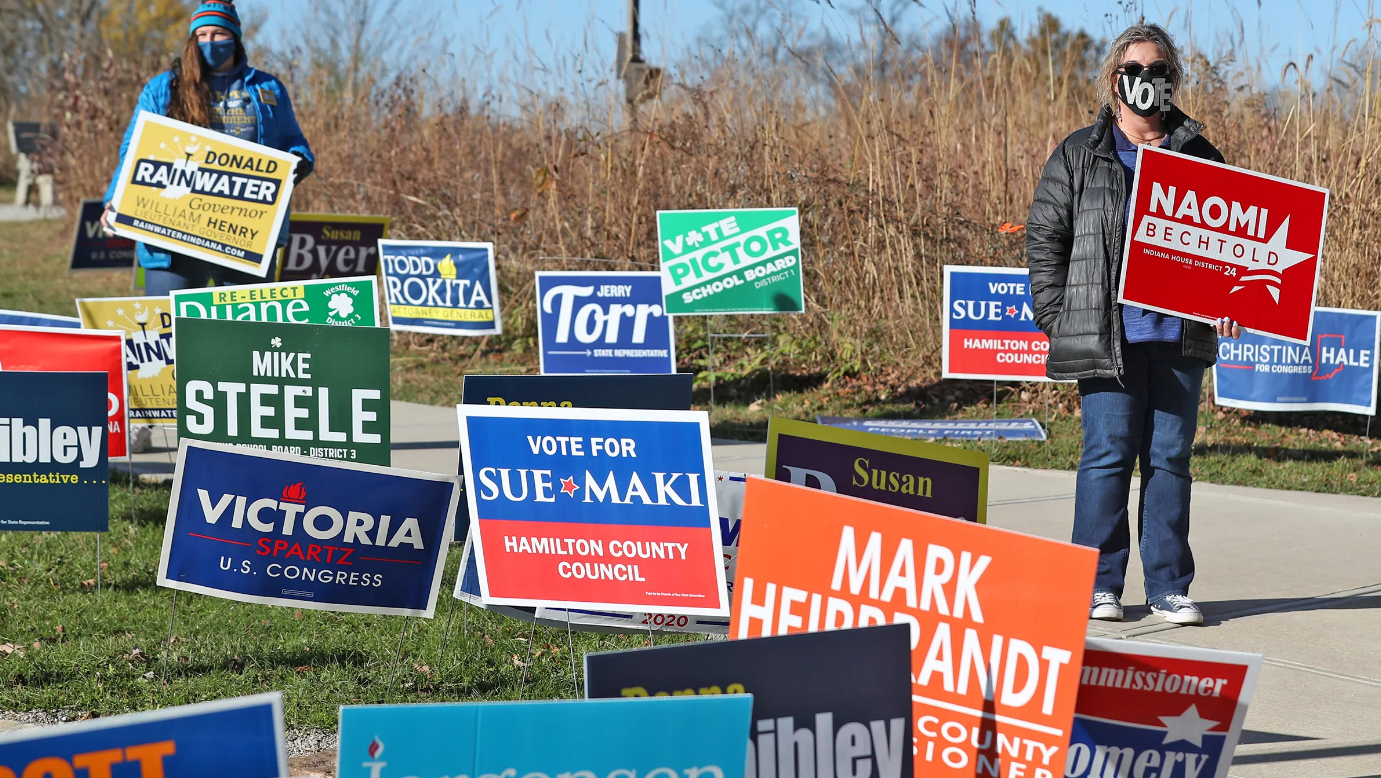
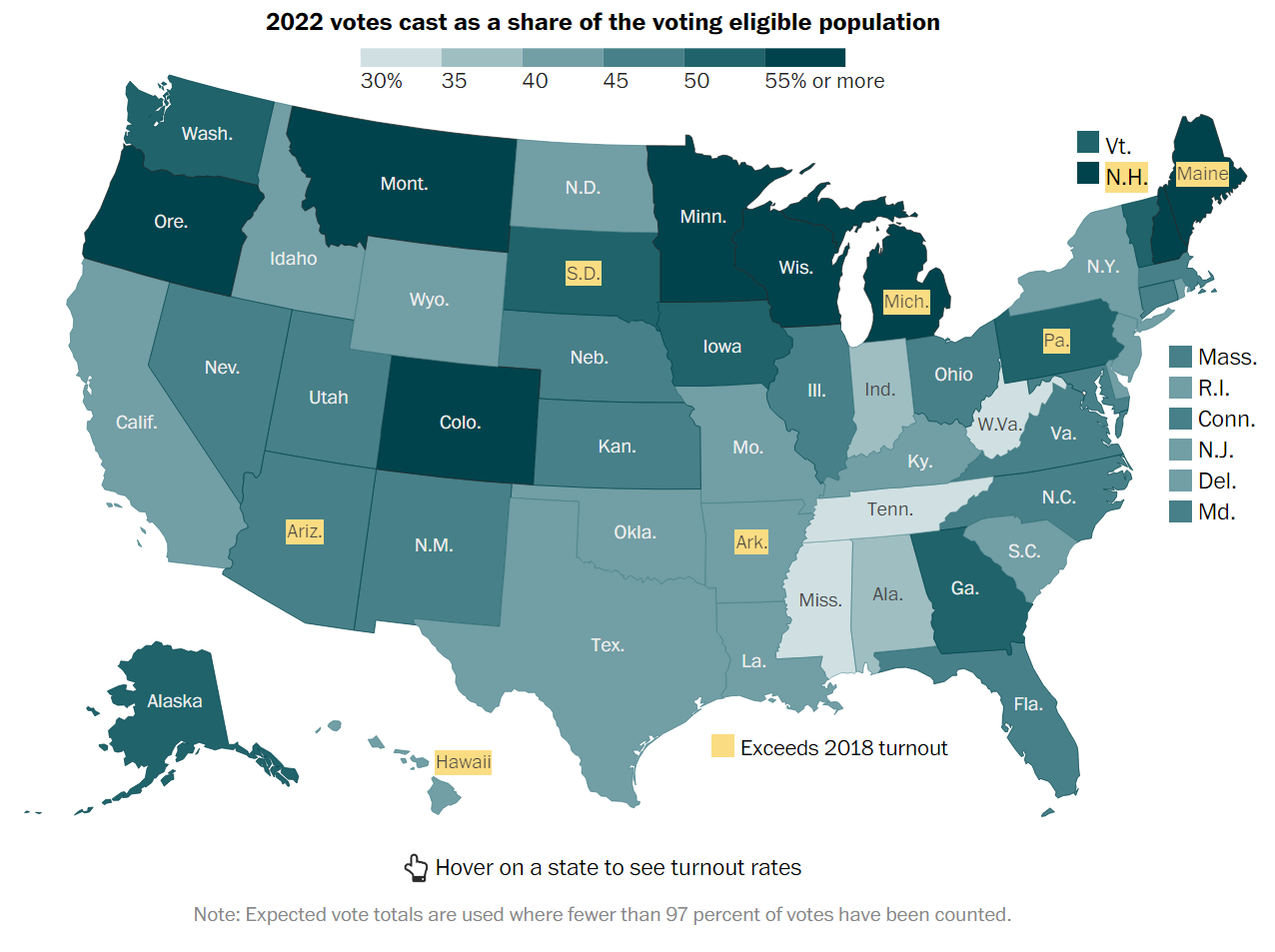
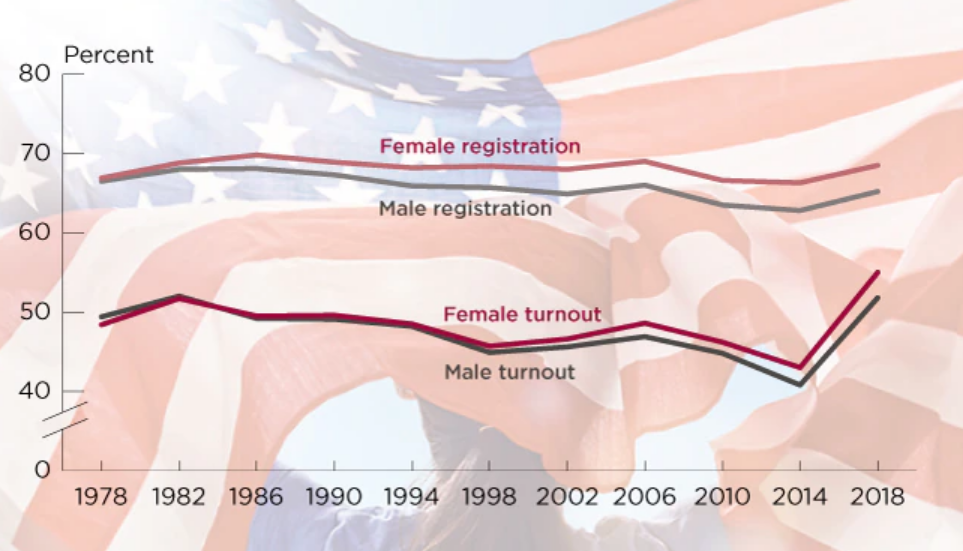
2018 and 2022 elections showed widespread increased voter participation. Increases were seen by all races, genders, income, ages, states and education levels. Increased voting by the youngest age group and Hispanic Americans were most notable.
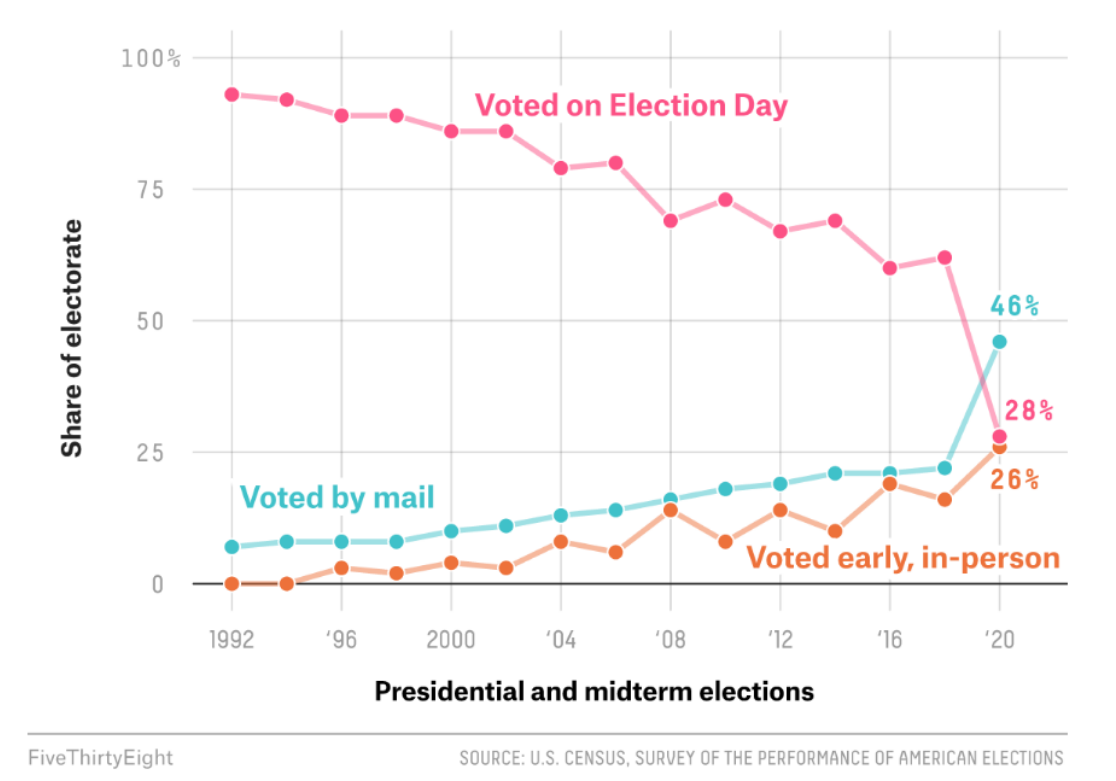
The 2020 and 2022 elections both relied heavily upon mail-in and early voting options. Early voting participation, especially in competitive states, was equal to or ahead of 2018. Hence, election day participation in 2022 was somewhat lower than in the record year.
Voter Registration is as Important as Participation
Voter registration in the states with party-preference records increased from 108 million in 2017 to 117 million in 2021 and then a little to 120 million in 2022. Registrations have increased a little faster than voting age population, but have not made a material difference.
The Democratic party share has declined significantly in the last 2 decades, replaced by “independent” voters. The Republican party share has declined by just 3%.
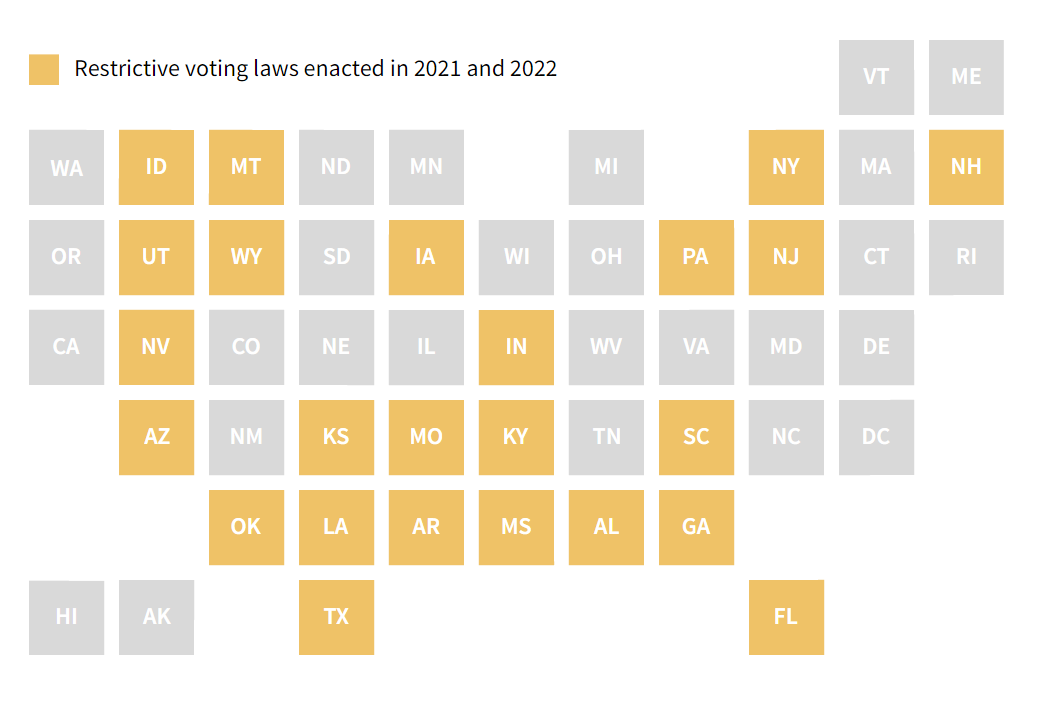
Good data on the impact of various voting law changes is not yet available. Anecdotal media reporting of the 2022 election did not indicate extremely large changes in voter behavior.
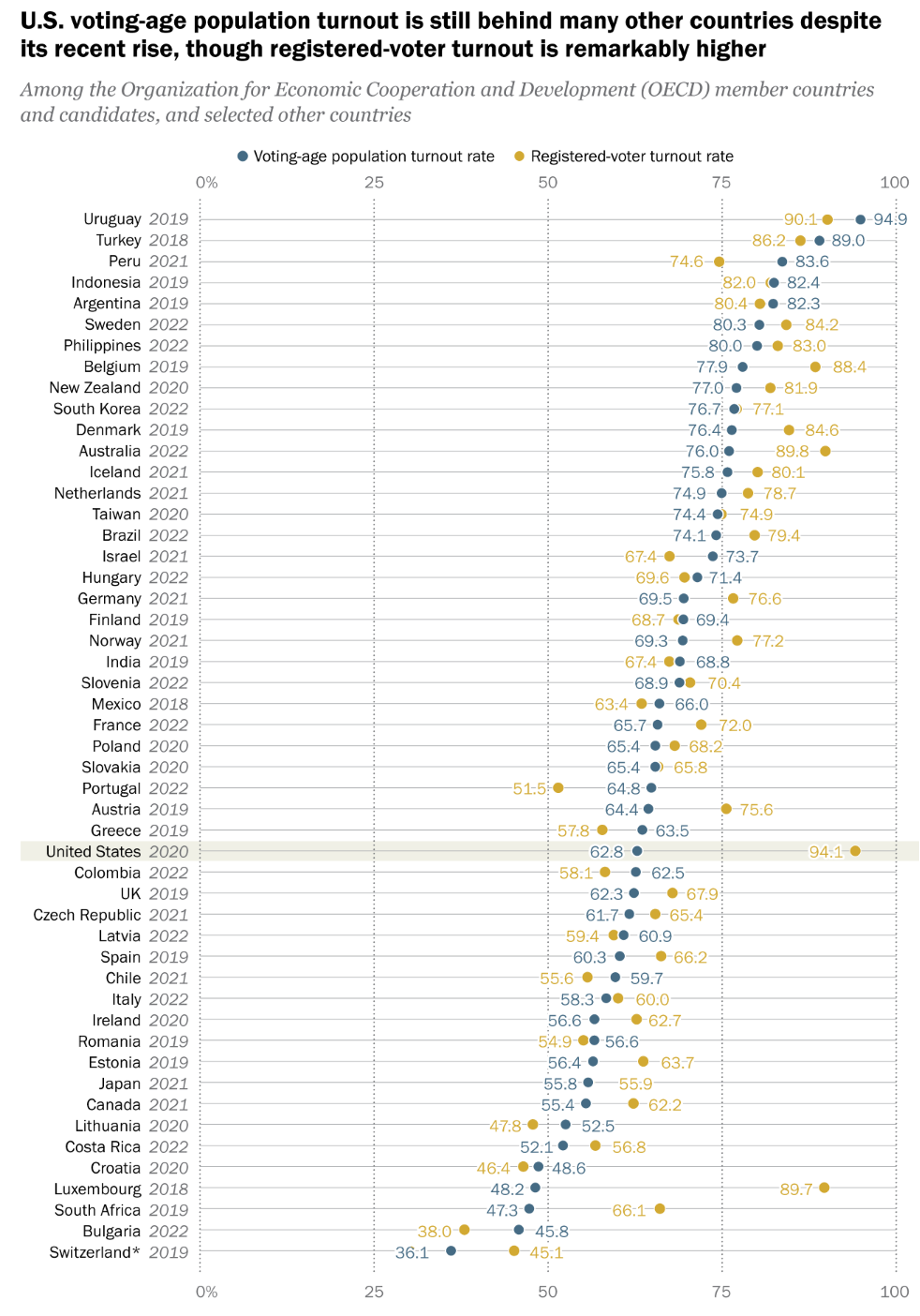
US Registration and Net Participation is Low versus other Advanced Economies
Voting participation in the US varies significantly by gender, race, age, state, income and education level. It recovered to some degree in 2018-22 following a 40-year low period. Voter registration has increased by a small amount in the last 10 years, but increased participation among registered voters has been the driver of overall results. The availability of mail-in and expanded early voting clearly boosted turn-out in 2020 and 2022. The impact of additional voting restrictions is unclear, but obviously intended to reduce turnout. Polarized politics in the US has increasing voter turnout, but only by 10-15% versus recent history. Presidential years boost turnout by 15%. State by state participation in election years ranges from 58% to 76% (excluding a few extremes), based on habits, demography and state laws. Presidential elections could have 10% higher participation if all states followed the examples of the high participation states.
Government has an increased impact on all citizens. Democracy requires participation to make the decisions and programs of governments (at all levels) legitimate. The US can do better.
Claims of election fraud have a long history in the US. They exist for 3 reasons. Losers hate to lose. Fraud claims support efforts to restrict voting by opponents. Fraud claims undermine the legitimacy of US democratic processes (Russia).
TRUTH
Historically, without “checks and balances” or other controls, political parties and machines had taken advantage to ensure that they won. We’re mostly talking about 1820-1900. Even in the 20th century, there were states and cities where one party had control and could “deliver” votes at the city, state or national level. This kind of fraud largely ended by the 1960’s based on journalists, lawyers, political opponents and activists overturning this corruption of democracy. Then and now, the numbers of fraudulent votes were very small as a percentage of the votes cast, less than 1%. Fraudulent votes are effective in a democracy only when their small share can tip the election. Most claims of voter fraud are based on a misunderstanding of voting, statistics or logic.
History
In 2007, before the partisan push for photo-ID’s and Trump’s 2016 and 2020 pre-emptive and post-emptive claims of fraud, the Brennan Institute consolidated the research and concluded that voter fraud was statistically irrelevant, 1 in 10,000 or 1 in 1,000 at the most.
We are blessed with an incredibly low level of election fraud in the US for the last 50 years. With a simple two-party system, partisans from both sides have ensured that fraudulent voting is difficult to do, highly punished if discovered and easy to discover (and therefor highly disincentivized). US voting is largely managed at the lowest levels: counties, cities, precincts, where citizens know their neighbors. It is effective because enough Americans of various political beliefs today believe in this process and volunteer their time to make it effective.
Analysis
Republicans generally take a negative view of human nature, expecting individuals to actively pursue their self-interest. Hence, they expect that Democrats, with influence over the election process in some venues, will take steps to optimize their results. In an earlier age this was partially true. But, in the modern world (post 1920’s), several factors work against this direct pursuit of self-interest. The country’s laws make voting fraud a felony with significant penalties. Local election officials are elected. In a two-party system it is relatively easy to engage both parties to monitor the election process. The US has very many lawyers ready to assist their preferred party. Election results are public. Statistically improbable results are very easy to identify today. Each precinct has a historical preference which is unlikely to change materially in any single election, so any fraudulent voting is easily identified.
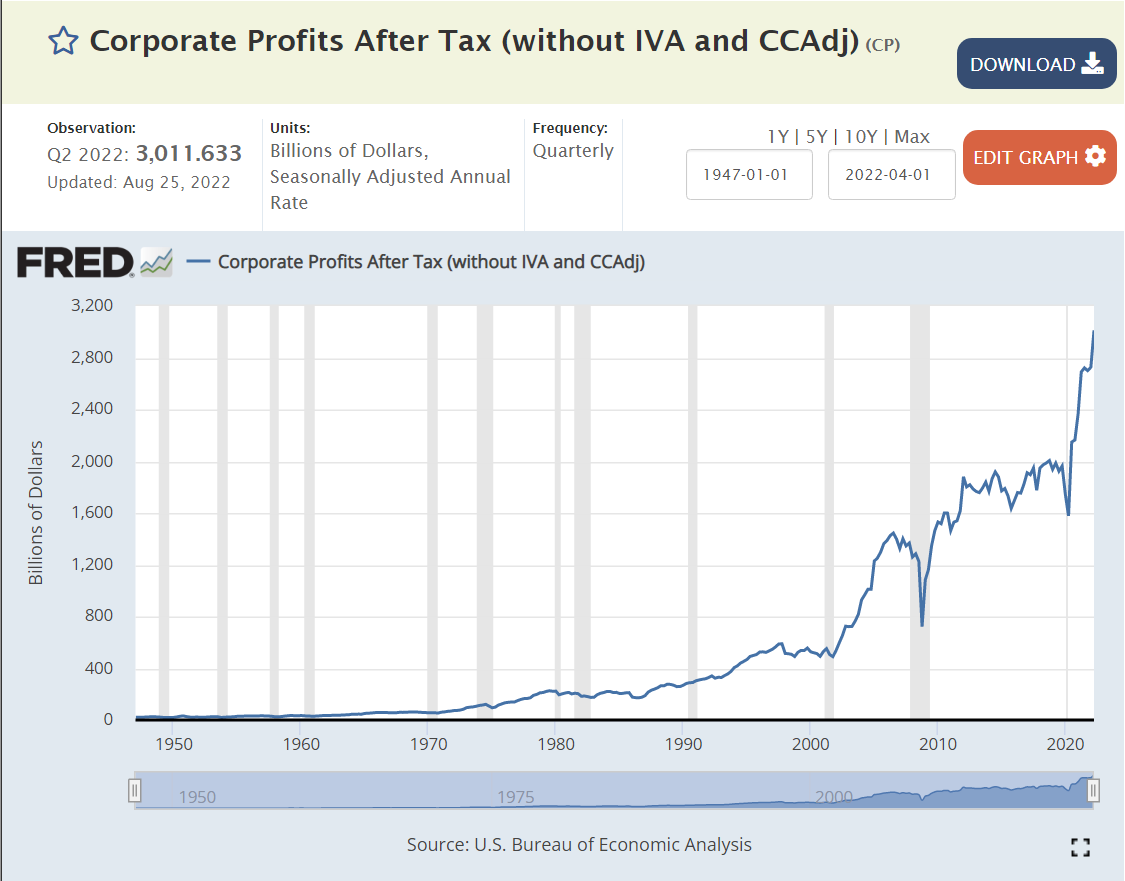
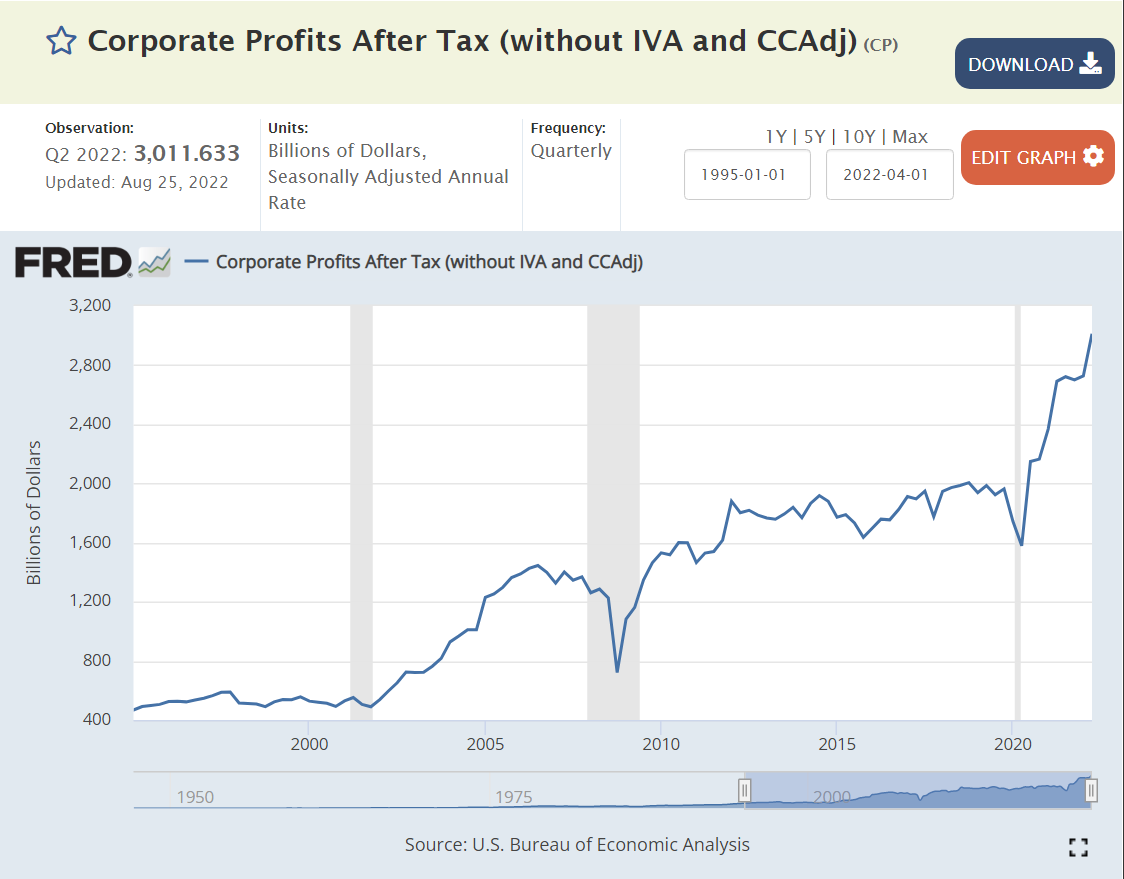
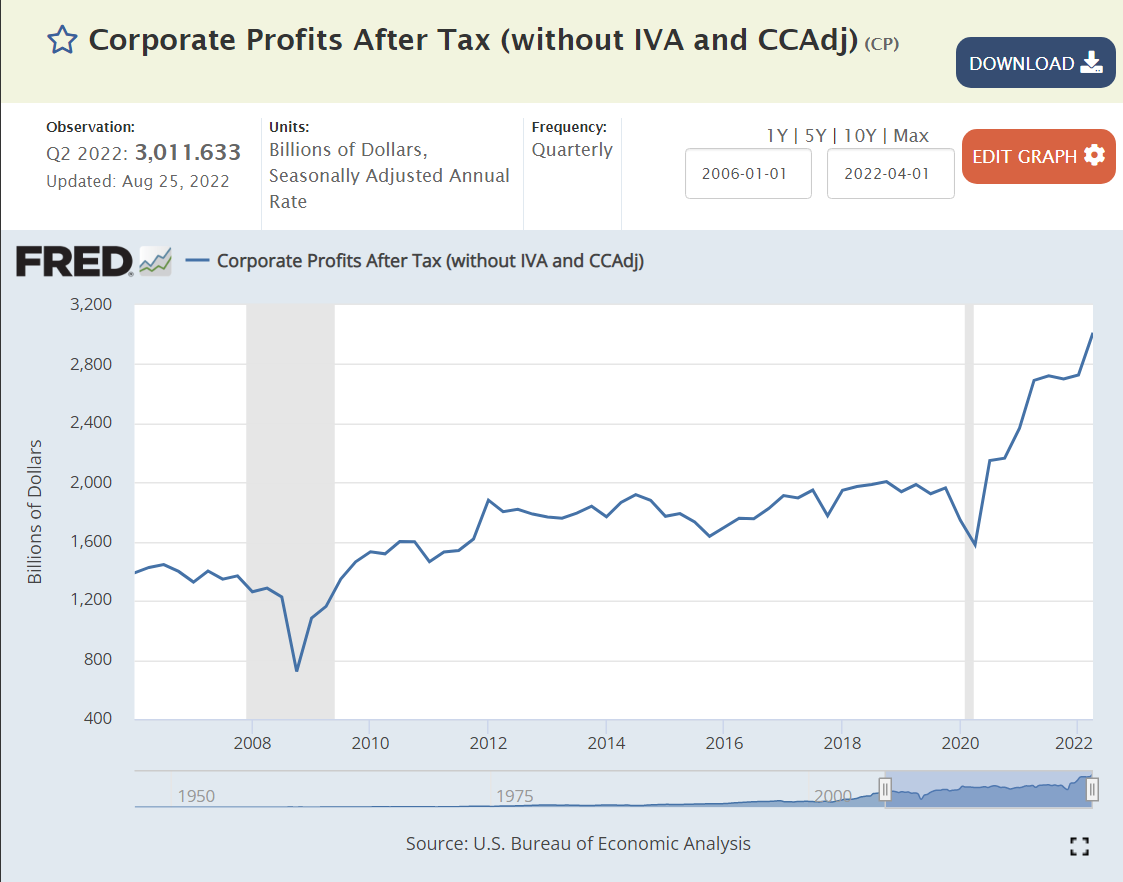
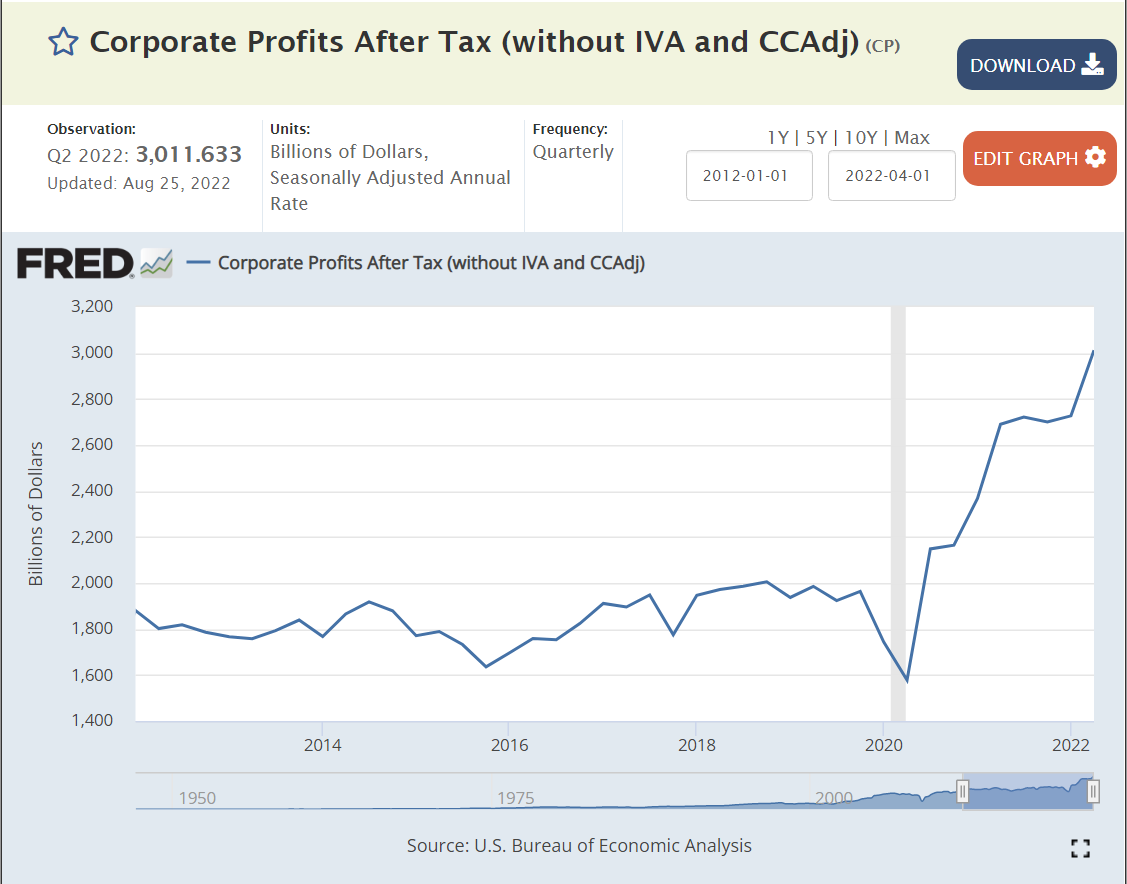
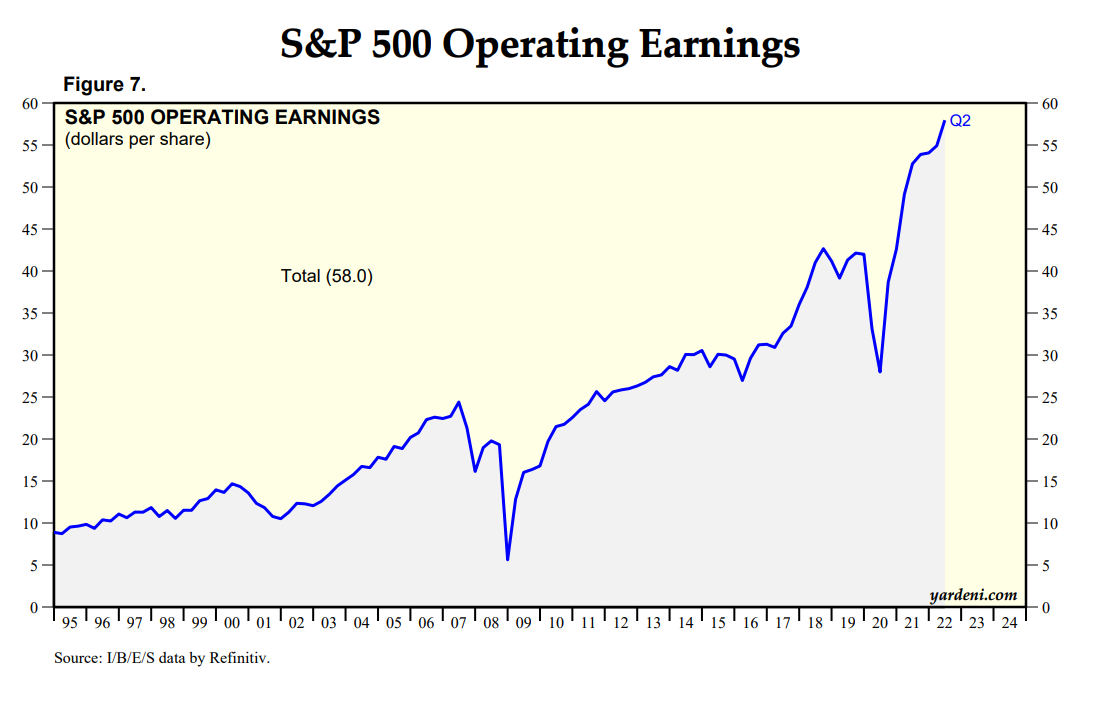
US Corporate profits grew from $1.9 Trillion(T) on an annual basis in the second quarter of 2019 before the pandemic to $3.0T in the second quarter of 2022; plus $1.1T (+57%)!!! US nominal gross domestic product (GDP) grew by 17%, from $21.3T to $24.9T, an increase of $3.6T. Real, inflation-adjusted, GDP grew by just 4%, accounting for a $0.8T increase in the real economy. Inflation grew by 13%, causing the other $2.8T of measured GDP. The $1.1T of increased corporate profits represents 39% of the inflation which has occurred in the last 3 years.
Analysis
Let’s look at the growth of US corporate profits from a half-dozen starting points to try to put this into perspective.
US corporate profits reached $3 Trillion in 2022, up from essentially zero in 1950. I’ve selected 7 peak profit years to outline this growth. Nominal profits increased from $55B in 1970 to $3.0T in 2022. In real, inflation-adjusted terms, profits have grown from $142B to $1,023B, a 7-fold increase in 52 years! Annual profit growth has been erratic, increasing by a high of 8% from 1995 to 2006 and a low of -1% from 2012 to 2018. The cumulative annual real profit growth has stayed near 4% throughout the period. 4% compounded for 52 years is a little more than 7x.
The US population grew from 200.3M to 338.3M during this period, 1.0% per year. So, corporate earnings grew by 3% per year above the rate of population growth for 52 years!!!! This kind of compound growth rate cannot continue for long periods of time without greatly impacting other sectors of the economy.
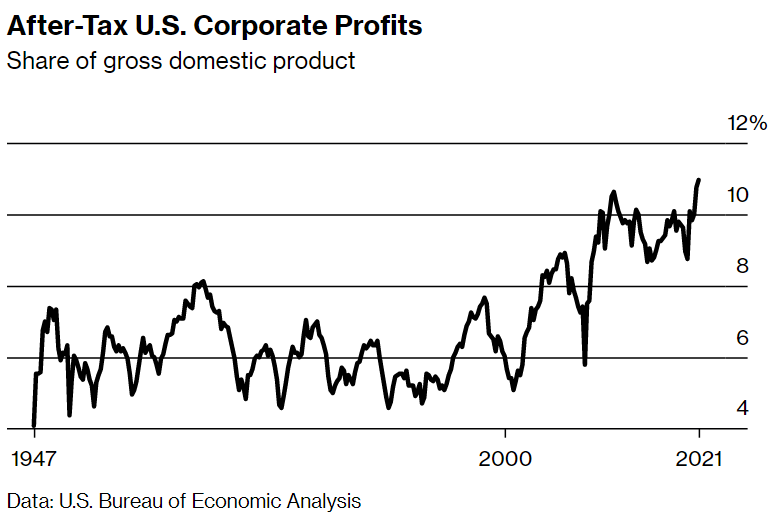
Corporate profits fluctuated in the 4-6% of GDP range from 1947 through 2000. Profits jumped up to 10% of GDP by 2010 and have largely remained at this two-fold elevated level for a decade. Profits reached a new record of 12% in 2022!
This measure shows profits growing eight-fold since 1970. (I’m going to ignore the detailed differences between the various measures of profit. They are important, but not necessary to see the major growth in profits, which is broadly consistent across the various measures.)
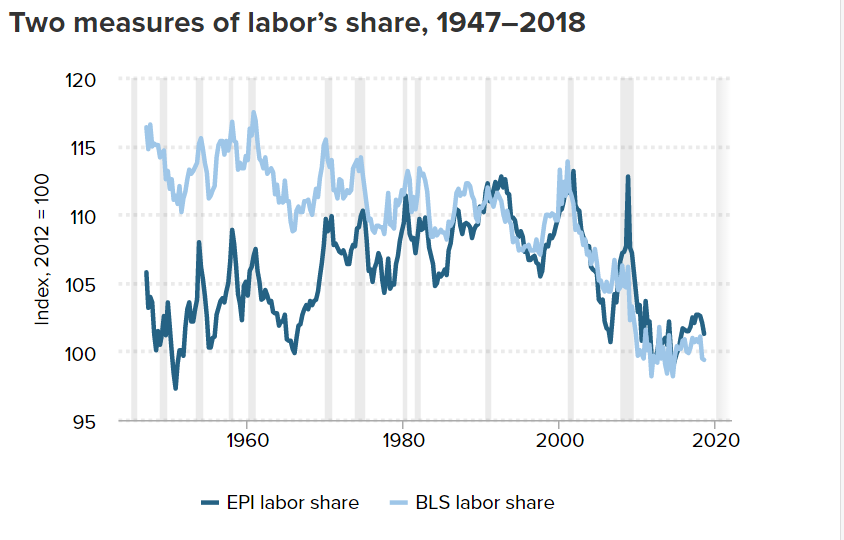
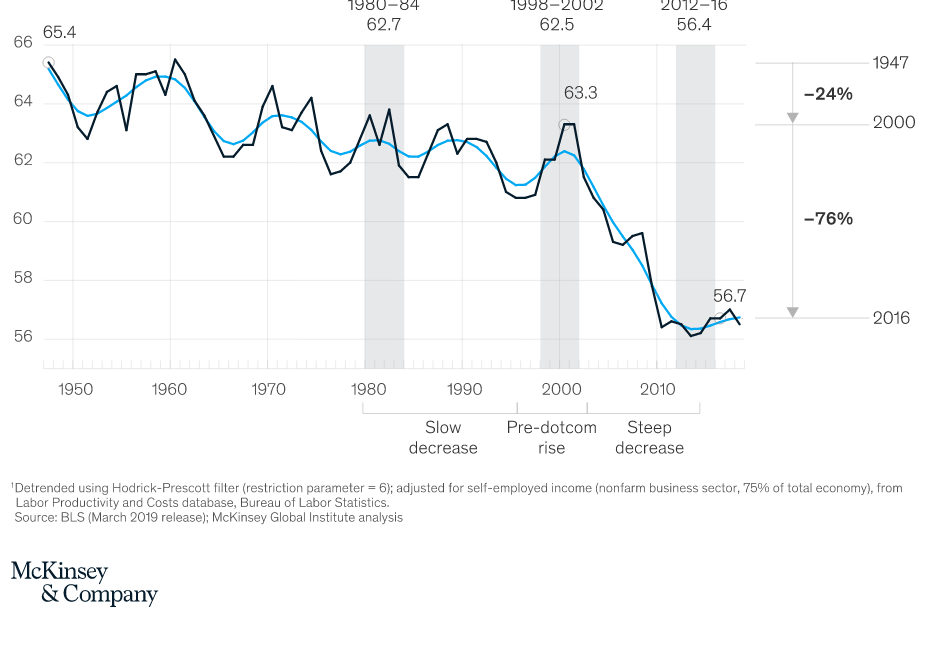
Most analyses of the growth in profits and decline in relative wages note that labor productivity has continued to rise by 2% or more annually, but labor has received almost no portion of those gains in the last 30 years.
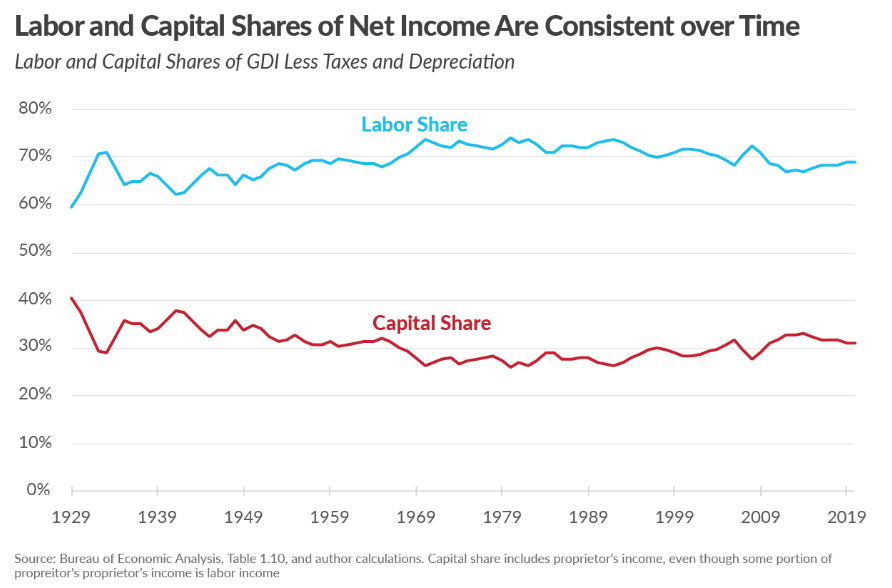
A right-leaning think tank adjusts the data and claims that labor’s share remains constant in the long-run. The Tax Foundation does delve into the various measures of income and provides arguments for their preferred measure.
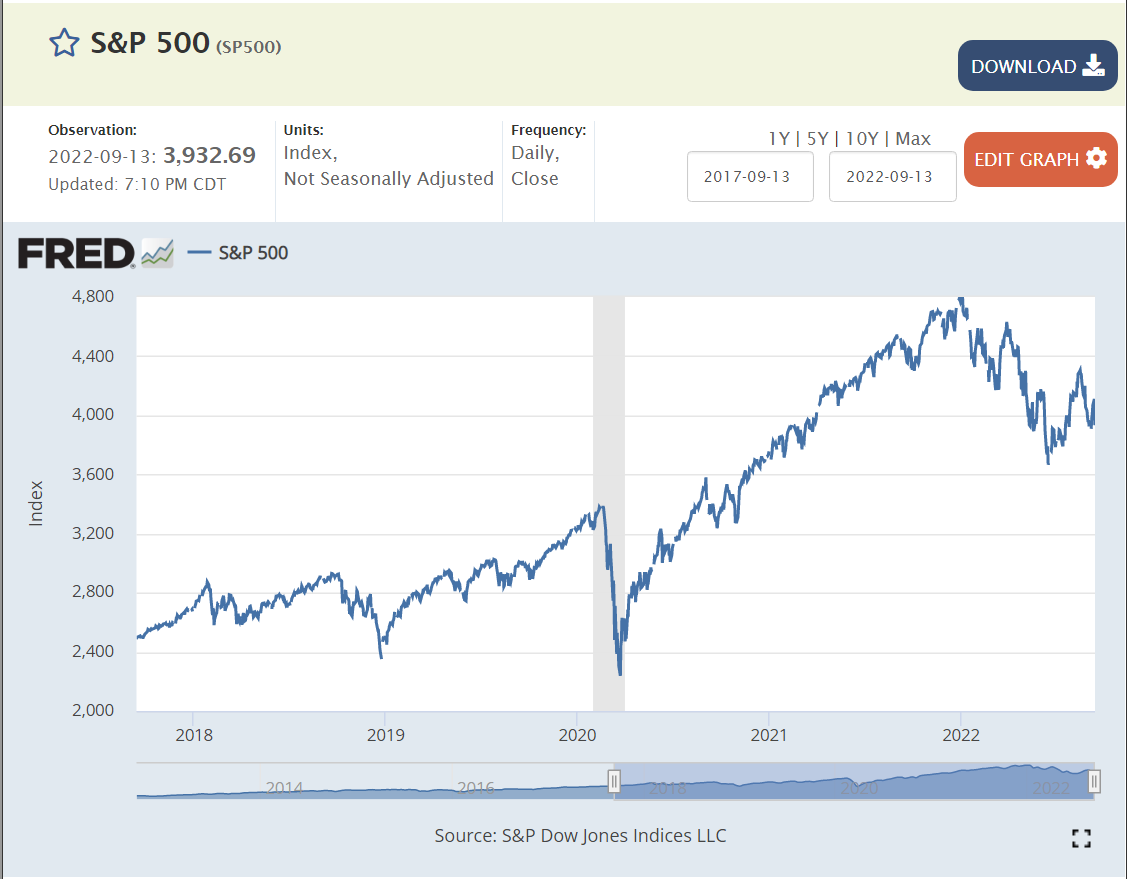
Stock prices tend to follow profits. The S&P 500 index has grown by 50% in the last 2 years (despite the recent decline), reflecting the amazing growth in corporate profits during a “once in a century” pandemic driven recession.
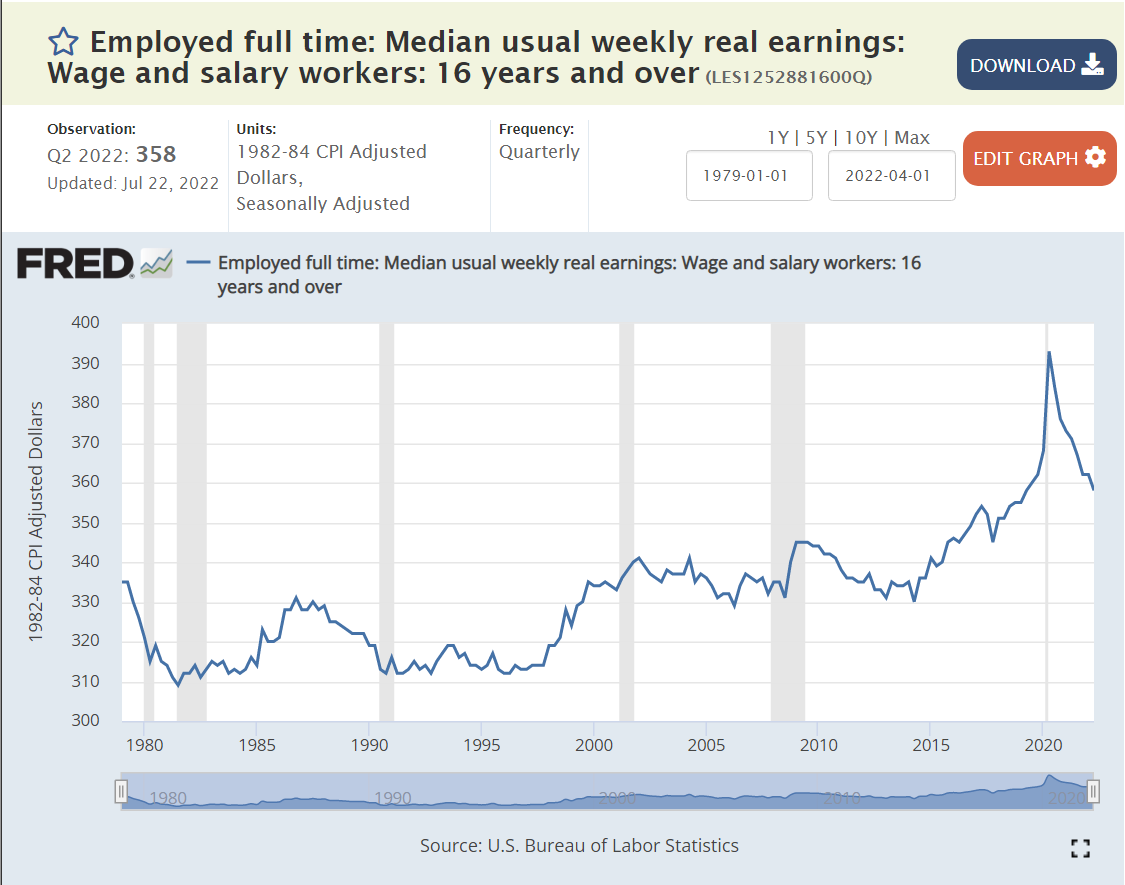
Median REAL, inflation-adjusted, earnings remained flat at $330/week from 1979 through 2014, a period of 35 years! This is during periods where profits were growing at 4% per year in REAL terms. In the last 8 years, REAL wages have increased by 9%, a bit better than 1% per year on average.
The media has published many articles, especially noting the increase of profits, overall, since before the pandemic. This is a popular topic because the result is certainly counterintuitive and because President Biden and the more left-leaning national Democrats have been criticizing corporations for “price gauging” and causing the recent inflation spike.
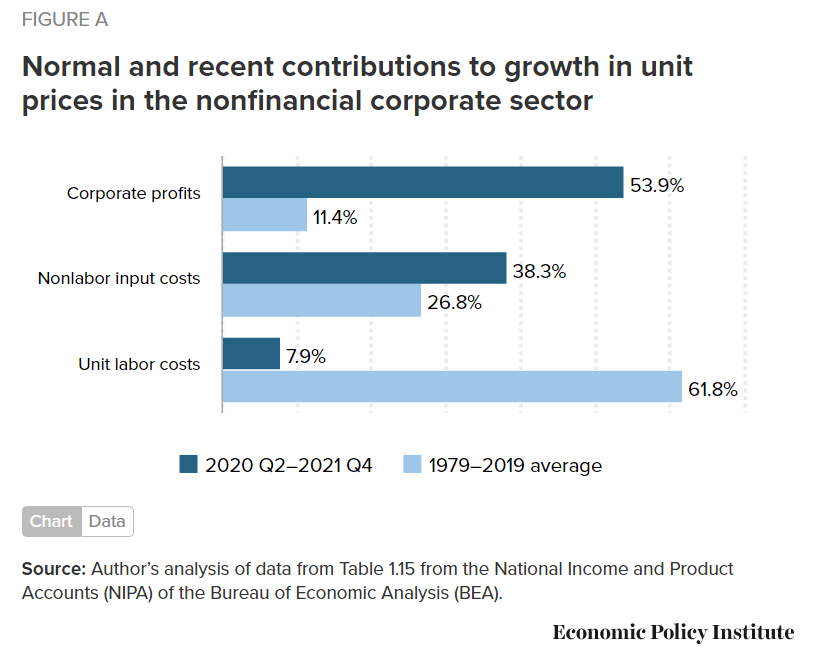
A variety of sources provide compelling data and logic to indicate that corporations are “taking advantage of” the post-pandemic inflation caused by supply chain issues and expansive fiscal and monetary policies to boost prices at rates faster than their costs of inputs (suppliers, labor, capital).
Most economists and analysts point to the increased concentration of firms (fewer) by industry increasing their pricing power and allowing them to raise prices during periods of change.
This is pretty dense and dry stuff. There is a general consensus among economists who focus on this topic that concentration and pricing power have risen very significantly. This is partly due to the simple aging of industries with fewer players left standing. The winners in a world of global competition are simply “much better” than the losers so they continue to take market share. US anti-trust enforcement in the last 40 years has been very limited, following the theory that “open competition” in the long run (Schumpeter’s creative destruction) eventually undermines leading companies with innovative products, processes and market strategies.
The US Chamber of Commerce argues that industry concentration has not increased, noting that consumer choices in broadly defined industries have increased greatly through time.
By a dozen measures, profit has consistently grown as a share of the American economy in the last 40-50 years. This necessarily means that the share of output and income received by labor is much smaller as a percentage of the total pie. The recent surprising ability of American corporations to effectively work through the pandemic supply chain disruptions, lose more than 10% of their labor force, increase nominal wages significantly, encounter severe input price inflation and still engineer price increases to come out much further ahead on profits is a major story for our time.
It is attracting attention to what I believe is an even more important story: the ability of corporations to incrementally capture nearly all of the increased value added by the productive American economy across 40-50 years and share very little with labor. This structural advantage of a very effective corporate sector “doing its job” within the relatively low-tax and low-regulation US political context is now completely proven.
In an ideal world, we would be developing and considering serious policy options that would limit this excess power without “killing the goose that lays the golden eggs”. Unfortunately, the Republican party remains focused on tax and regulation cuts as the main economic tools and the Democratic party alternates between 1960-70’s era Biden “centrist” policies and much further-left Bernie Sanders style policies.
Lower environmental standards. Withdraw from Paris climate deal. Methane limits. Wetlands. Vehicle milage and emissions standards.
New limits to welfare benefits: Medicare and SNAP.
Antitrust investigations for telecommunications, media, internet, network advantaged firms.
Increased use of Congressional Review Act (1996) to allow Congress to vote down newly implemented regulations.
Economic recovery continued for 3 more years. 2.5% annual growth. 3.5% unemployment. Stock market gains. 6.5M jobs added. Tighter labor market. Increased wages. Minority and lower income gains.
Bipartisan Covid relief spending for individuals and firms.
Home building increased during Trump term and afterwards.
More “Middle Americans” believed that they were heard and represented.
NAFTA agreement renegotiated.
China relations re-evaluated. Higher tariffs on both sides. Technology limits.
Presidential “bully pulpit” used to maintain some US jobs.
Legislation and executive orders used to support US steel, coal and manufacturing businesses and employment.
Legislation passed to improve visibility to tax shelters and tax fraud enforcement.
Agriculture industry subsidies offered to offset trade costs.
Trade deals with South Korea, Japan and EU.
Enhanced trade policy for communications, IT, technology and AI.
Increased military spending.
Revised defense strategy focused on China and Russia.
Flexed US military muscle in limited attacks.
Actions reduced Islamic State threats to low level.
Supported Israel diplomatic relations with 4 Arab states.
US troops withdrawn from Afghanistan, Syria and Iraq.
Opposition to dictators in Cuba, Venezuela, China and Nicaragua.
Reduced support for international organizations such as WHO.
Built 80 miles of new wall and 300 miles of enhanced walls on Mexico border.
Negotiated improved coordination with Mexico and Central American nations regarding immigration.
Reduced legal immigration from all countries.
Reduced opportunities for asylum seekers.
Used “zero tolerance” family separation policies to disincentivize immigrants.
Removed Affordable Care Act individual mandate.
Streamlined FDA approval process and made financial commitments to ensure rapid COVID vaccine development.
Took steps to reduce drug price inflation.
Invested in opioid drug addiction prevention and correction.
Enacted market friendly policies and regulations to expand domestic energy development, furthering American energy independence.
Supported the bipartisan First Step Act which reduces minimum sentences and supports recovery from incarceration.
Invested in historically Black colleges and universities and vocational education (Perkins).
Made small steps to support “school choice”.
Appointed 3 conservative Supreme Court justices and 225 federal justices.
Trump Presidential Results
Economic Policy
Deficit spending is permanently entrenched. 3-5-7% annual budget deficits do not appear to have major economic downsides in investment crowding out or inflation.
Tax cuts do not generate extra growth, investment, productivity or economic resiliency. They transfer dollars to the recipients.
Concentrated supply chains (China) are subject to significant trade, logistics, military and emergency risks which must be managed.
Foreign Policy
U.S. remains the leading superpower and can pursue its own goals with less allied cooperation and attention to “niceties”, at least in the short run. See NATO, Japan, Korea, climate.
China is the number one competitor.
U.S. and Russia relations are no longer based on Cold War issues. The “Hawks versus Doves” dimension competes with domestic political parties.
Negotiating with nuclear states (Iran, North Korea) is very difficult, even for a superpower.
Europe has its own international interests. It will pursue them. It cannot rely upon the U.S. for its defense.
Domestic Policy
Bipartisan immigration policy may be impossible.
Supreme Court and judicial politicization may drive structural changes/reforms.
Racial relations and inequality will be a top political issue for decades.
Wedge issues – abortion, guns, school content/choice, liberty, gay rights – will remain a focus of both parties.
Traditional social security, Medicare and Medicaid are untouchable.
Obamacare is now essentially untouchable. Lower income citizens will have health insurance.
Democracy at Risk
Legitimacy of media, press, free speech threatened.
Government employees, courts, justice system, law enforcement threatened.
Schools, universities and teachers threatened.
Legitimacy of voting processes threatened.
Illiberal democracy, authoritarianism have more support.
Gerrymandering, voting rules, campaign funding rules undercut public confidence.
Voter participation has increased in response.
Communications Policy
Media attention is priceless and can be manipulated by extreme statements and behavior.
Traditional media “fairness” approach (quotes from both sides) can be manipulated to support unsupportable claims.
Every media outlet or actor has some degree of bias. Consumers are more aware, but many choose to only reinforce existing beliefs.
The president has the opportunity to control/influence the attention of the media.
Facts and objectivity are not respected by some media voices. The pattern of communications statements and framing of subjects can be much more important than content.
Political actors are not held accountable for false claims or exaggerated promises. Claims and promises are just tools to motivate the faithful.
Rules of Politics
President has tremendous power. International agreements. Regulations. Executive orders. Bully pulpit. Political party discipline. Using power seems to have little downside.
Only winning matters. Not popularity, broad support, bipartisanship, appearances, fairness, mud, litigation, critics, impeachment, norms, tradition or relations.
Polarization strategy is more effective than building a central coalition. Motivating your team to vote is more important than persuading independent voters.
Candidate character does not matter. Politicians are salesmen and saleswomen. They are lawyers. They are tools, not statesmen.
Party/team winning is most important factor. 400,000 covid deaths were not enough to spark a revolution. Deaths were traded off against economic opportunity without negative political impact.
Harry Truman’s “buck stops here” responsibility position is not required. No one was responsible for Covid results.
Administrative competence is not required to hold office or to run the federal government (so far). Slow appointments, fast cabinet turnover, acting secretaries, department heads that oppose the role of their departments.
President represents his team and interests, not the whole country.
Party Policy
Philosophical conservatives have departed the Republican party and lost influence.
Moderate Republicans (RINO) have mostly departed, have no political candidates and no influence in the national party.
Extremist groups (race, religion, military, nationalist) are not opposed.
Traditional business interests have much less influence (immigration, social issues, antitrust, trade limits, industrial policy, presidential threats, banking, bailouts).
Pragmatic policies and legislation remain largely unimportant. No party platform for 2020. Everyone in the party “knows” basic positions on all issues. No budget policy debates. No health care alternative to Obamacare. No abortion policy. Statements of preference and intent and belief are more important than wonkish details.
Highlighting the threats and follies of the most leftist Democrats is the most effective means to motivate true believers and maintain support of more independent minded voters.
Only a few federal level policies really matter. Tax and regulation cuts. Social wedge issues. Most other topics can be “managed” with small policy victories and messaging.
Party discipline is essential. Republicans are obligated to support the political winners in their party, not to represent all Republicans or all Americans or to “solve problems”.
Managing the voting system (districts, rules, methods) is as important as policies, candidates, fundraising and communications strategies.
Summary
Trump has revolutionized modern American politics. The Reagan revolution consolidated conservative voters, clearly aligning them with the Republican party. The Gingrich revolution further separated the two parties, emphasizing winning and party allegiance. Republican candidates and voters engaged in a reinforcing cycle of “purist” policy aims such as no tax increases, “drill baby drill” environmentalism, banning abortions, and “bomb baby bomb” anti-terrorism. The Great Recession and the tea party further motivated populist leaning voters to demand populist policies and appeals. Trump modified many historical Main Street and Wall Street Republican policies to make the party better embrace the populist mood and “make American great again”.
Trump’s “only results matter” approach has further transformed the party and the nation. His presidency delivered some key political accomplishments. It also produced many “results” that will shape American politics, economics, society and debate for years to come.
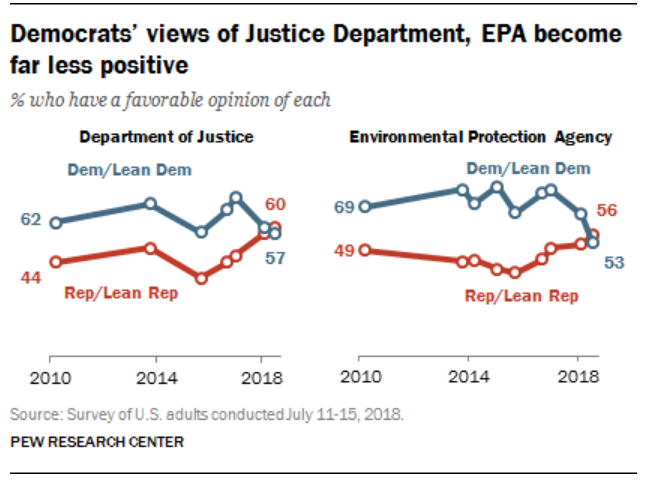
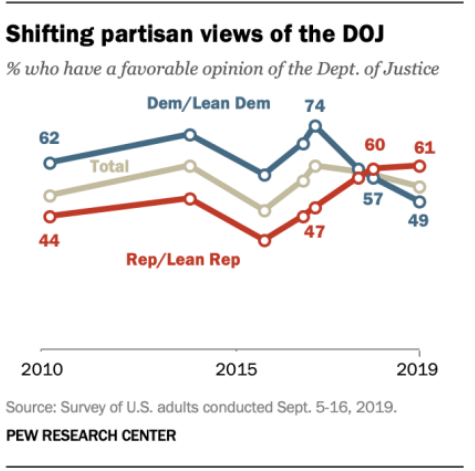
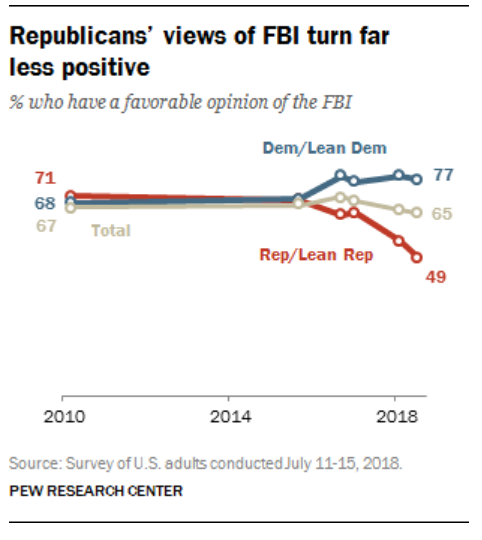
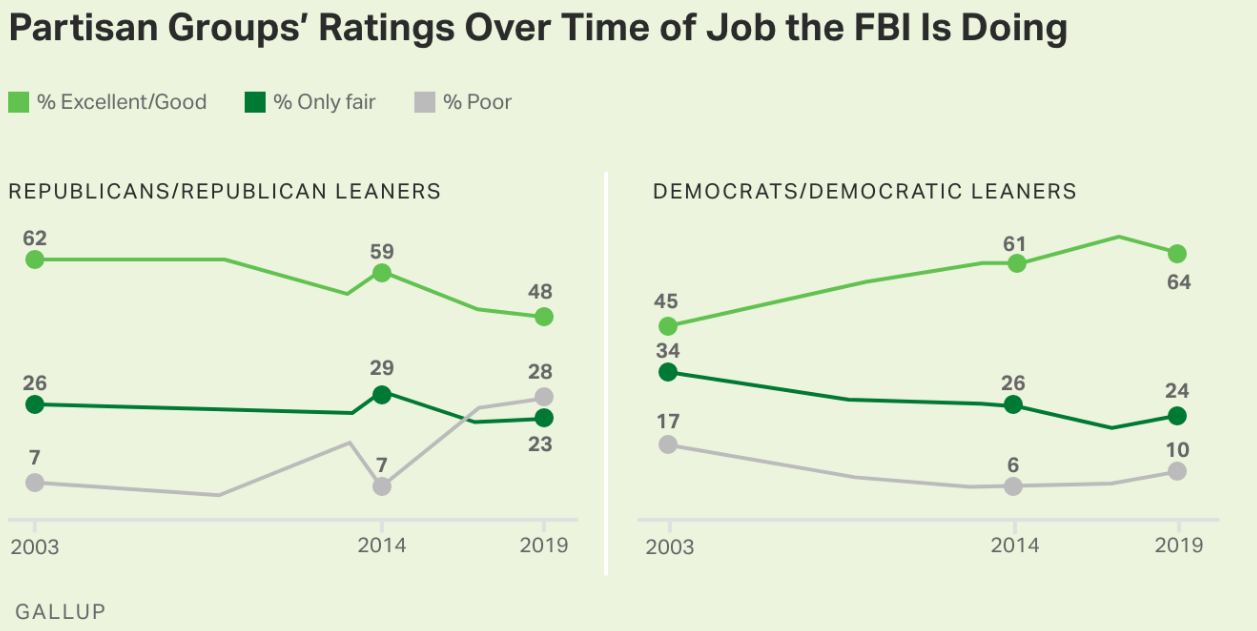
Historically, Republicans have been conservative, supporting the police, military, FBI, defense, “law and order”, criminal justice and “black and white” law enforcement. While the DOJ and some other federal agencies have been staffed by left-leaning coastal elites, the FBI has been staffed by more conservative leaning individuals.
538 has a similar article but refuses to link directly. Worth your time to query and copy.
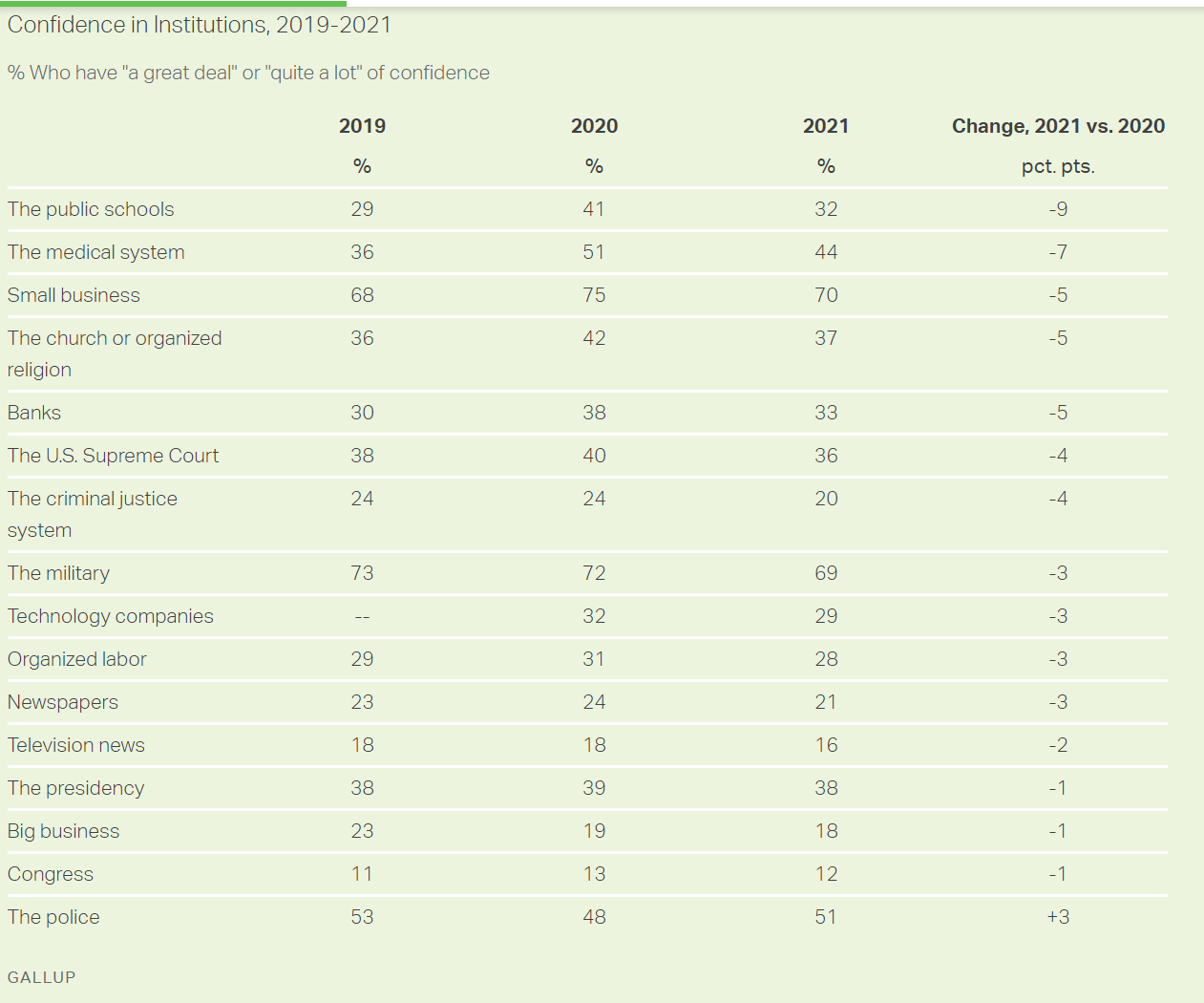
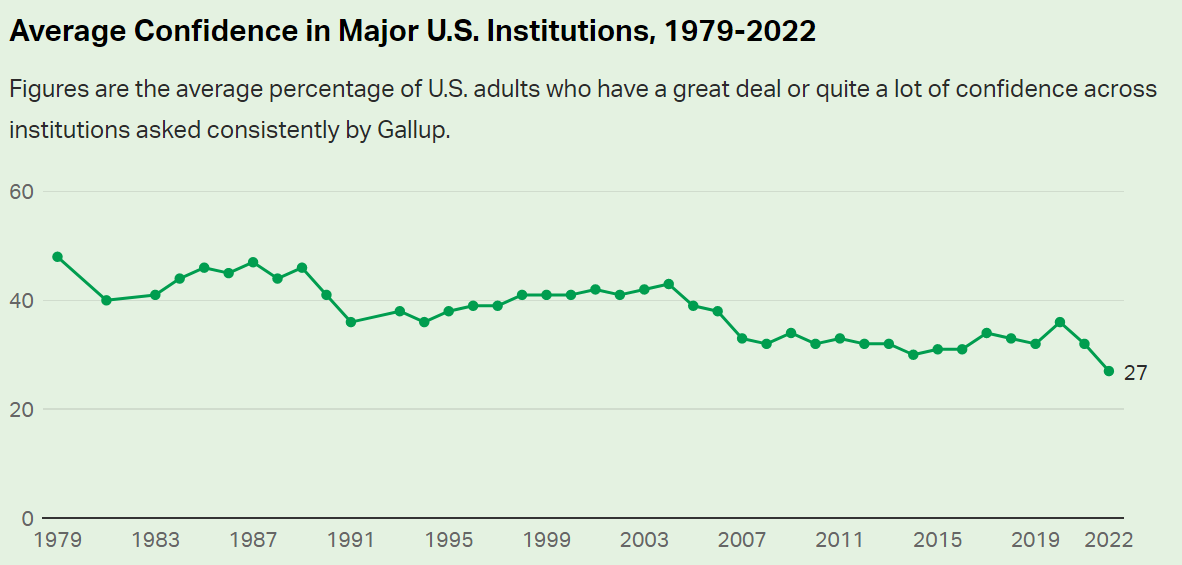
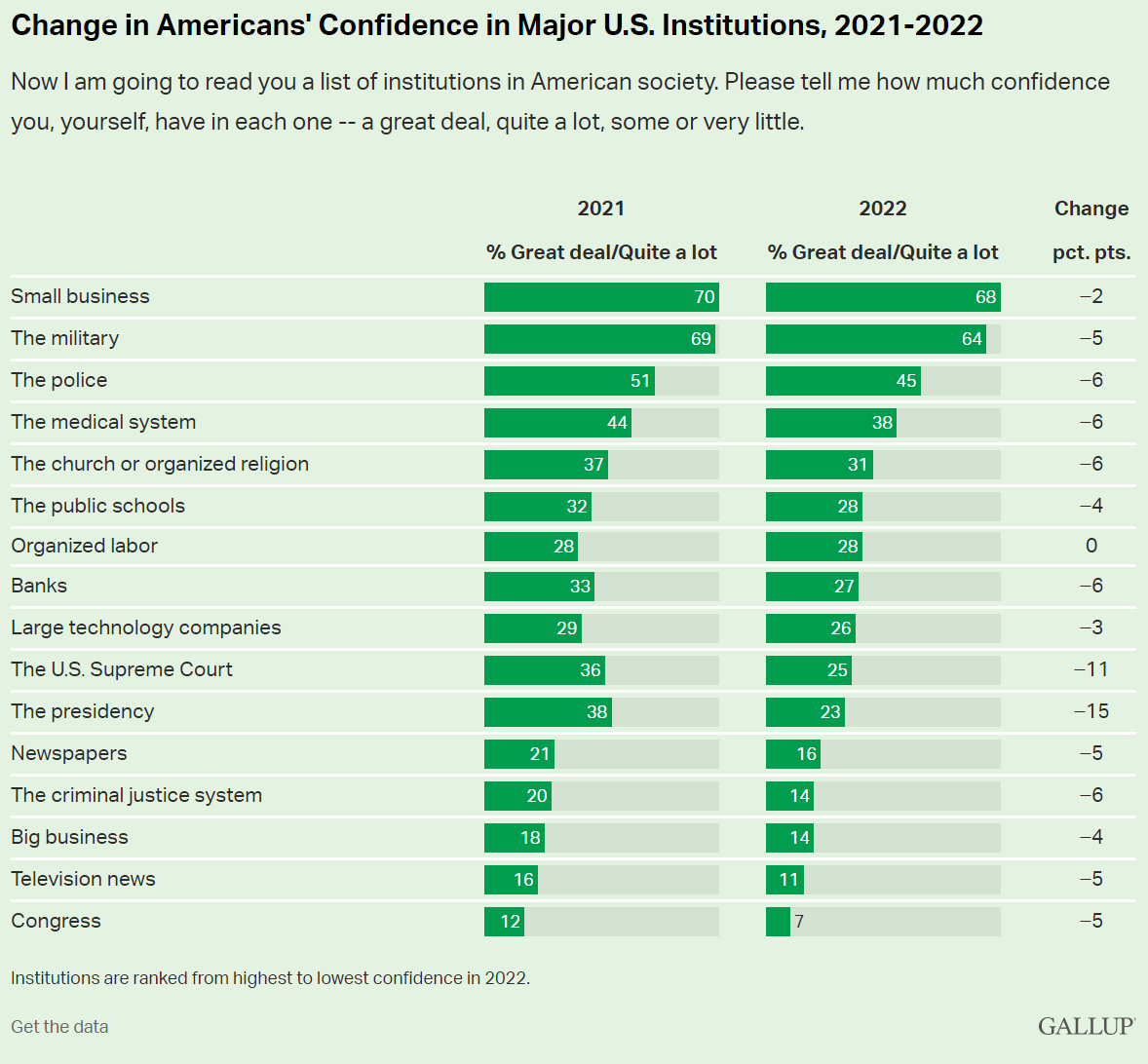
“What Happens When Americans Don’t Trust Institutions?”
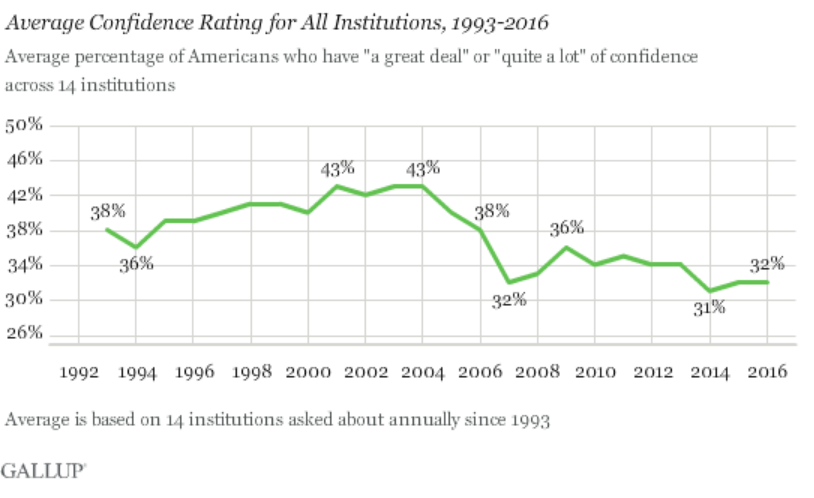
If only one-quarter of Americans trust in its basic institutions, how can we have democracy and capitalism and “western civilization”? If “everything is broken”, then we need a dictator or a revolution. Really? Really? Really?
I have to blame the 16 year-old me for some of this. In 1972, we were all opposed to “the man”, “the organization man”, “the establishment”, etc. We were children of the hard-won victory of democracy and capitalism against fascism and imperialism and communism. We believed in progress, science, growth and possibilities. We were skeptical about the Vietnam war, the military, McNamara and his whiz kids, General Curtis LeMay, big corporations, compromises, limitations, bureaucracy, bigness (small is beautiful), population growth, technology, etc. Many of us deeply believed in a romantic idealism or utopianism, making stodgy historical institutions so irrelevant.
Fast forward 50 years and I (we) possess a fundamentally conservative view, embracing the need/value of institutions and channeling our inner Edmund Burke to emphasize the value of the accumulated wisdom of society.
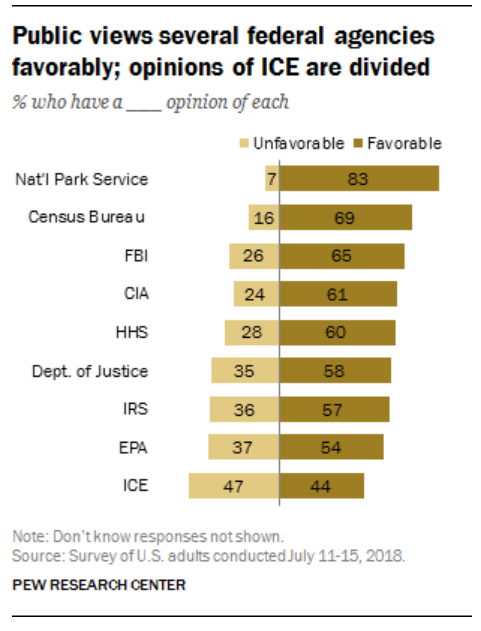
So, the overall decline in trust of American institutions is a real challenge. The decline in trust in the FBI is clearly (IMHO) a Trump driven result. This, too, is a real challenge to our democracy. Do we (I) really believe that the leadership and staff of the FBI have abandoned their democratic principles which we have lived and supported for almost 250 years? I don’t think so. But the decline in trust/belief in all institutions combined with the increasingly politically polarized view of individual institutions makes this a reasonable view for many of our fellow citizens. We have much, much work to do in order to preserve our institutions, government and society.
Political views are rationalizations of moral intuitions. They are demonstrably not the result of dispassionate analysis by individuals.
A small number of moral intuitions are broadly held across time and cultures and can be “explained” on the basis of evolutionary pressures on mankind.
The prevalence of the six logically defined and statistically confirmed dimensions differ markedly between liberal and conservative minded people in various cultures.
1. Care/Harm
Desire to protect children and weaker others from harm. Caring, kindness, gentleness, nurturance, compassion, feelings, empathy. Liberals and conservatives both show an interest in this dimension of morality. Liberals value this dimension most highly. Conservative men and libertarians, on average, show much less interest in this dimension.
2. Fairness/Reciprocity/Cheating
In a social setting, there is a need to rely upon others keeping their word, being honest, doing their share of work, etc. Justice, rights, cooperation, deception, trust. Liberals tend to interpret this in terms of equality. Equal rights, equal opportunity and equal results. Conservatives are closer to the evolutionary basis as seen in game theory / the prisoners dilemma / “tit for tat” winning strategy. They highly value proportionality, closely linking results to inputs or effort.
3. Liberty/Oppression
No one wants the “alpha dog” to take advantage of their position. Individual and group opposition to domination, tyranny, restrictions, bullies and cruelty. Liberals and conservatives both value this dimension in modern, western, secular, commercial societies. They define the oppressor differently, with liberals focusing on business and institutional sources of power and conservatives focusing on government and regulators. Libertarians value this dimension most highly. These first 3 sources of morality are more individual oriented, mediating the tensions between individuals and groups.
4. Group Loyalty
Clear commitment to the group. More than “limited liability”. Betrayal, in-group attachment, patriotism, nationalism, betrayal, self-sacrifice, us vs. them, tribe, religion, party, flag, clan, neighbors, family. Conservatives value this dimension very highly, with felt loyalties to several groups. Liberals value this dimension, but not nearly as highly; with a tendency to value the largest groups: nation, humanity, nature. The liberal focus on “diversity” and valuing others, outgroups and the “oppressed” is very different from the conservative worldview. Western, secular, commercial societies value this dimension less.
5. Authority/Respect
Larger groups require some degree of hierarchy. Leader and follower. This is a complement to the liberty/oppressor value. Respect for authority, leader, institution, rules, history. Safety, order, predictability. Obedience, deference, submission. Against subversion, revolution. This is the classic conservative value, supporting the known value/benefits of a given system against the potential value/risks of change. Modern, individualistic liberals tend to not value this dimension highly, instead choosing to “challenge authority”.
6. Purity/Sanctity
The sixth dimension differs from the first 5. It is not so clearly about managing the “individual to group” challenges. It focuses on the disgust/gag reflex to things or situations that are so threatening as to be beyond consideration. This takes place at both the practical and the abstract levels. Degradation, disgust, disease, infection, dirt, germs, contamination, carnality, body, sex. Piety, chastity, temperance, compliance, burning, cleanliness, food rules. Everyone has some sensitivity to this dimension, but conservatives have much higher concern. Research says that conservatives, on average, have a lower interest in new (unsafe, novel) activities or experiences. Moral values 4-6 retain higher priority outside of western, commercial, secular societies. Liberal references to purity may focus on things like the environment.
Haidt is a self-professed “liberal” who intuitively/instinctively rejected the “rational” morality theories he learned in graduate school in the 1980’s. During his early research on alternate approaches, he had the “aha” insights that 1) other cultures have very different moral values and that 2) moral/political views are intuitive and rationalized. He hoped/hopes that liberals can see that their more limited moral palate (3 items) is not the only one and that this difference between including or not including the other 3 bases is a huge insight, even if liberals choose to not value the other 3 dimensions. He analyzed national politics in each election cycle from 2000, highlighting the large advantage that Republican politicians have in monopolizing the 3 other dimensions. In 2016, he advised the Dems to fight against Trump on the “conservative” moral dimensions of loyalty (Putin?), authority/order (Trump chaos/revolution/policy changes), and purity (sex allegations) instead of policy positions or personal character.
Haidt collaborated with a CATO scholar to analyze the 2016 Democratic and Republican candidates for the presidency, analyzing their supporters in terms of the Moral Foundations Theory.
The basic conclusions are supported, but all details are not. The 1 Care / 2 Fairness versus other dimensions emphasis between liberals and conservatives is supported. But, statistically, there may just be individual versus group moral foundations (2 dimensions versus 5-6).
Group? Which group? Small or large? In-group or out-group? Research is now focused on defining questions that clarify in-group versus out-group attraction and then, the difference between liberals versus conservatives, if any.
Academics have been busy working on the details. One criticism is that the 5 or 6 dimensions were defined in an ad hoc manner, rather than part of an overall theory of how man evolved. One group has stepped up to propose a theory that is solely based upon the various forms of cooperation, resulting in 7 dimensions.
On the academic left, Haidt’s “moral equivalence” approach to the 3 modern, secular, liberal values and the 3 historic, religious, conservative values has been sharply criticized. An alternate view that highlights bias/bigotry, social dominance, right-wing authoritarianism, Schwartz Value Theory and Evolutionary/Coalitional Theory (ECT) has been proposed.
Haidt and his colleagues have defined 6 dimensions of moral thinking which underly modern political views that make sense based on evolution. The “west” could clearly learn something about the moral/political views of other societies that did not have the same historical evolution into a commercial/largely secular situation. Politicians could seek to more effectively target their messages to trigger all of these 6 values in their target audiences. Civic minded individuals could promote greater understanding of these insights to lessen the Manichaean “good versus evil” polarization we see in politics today.
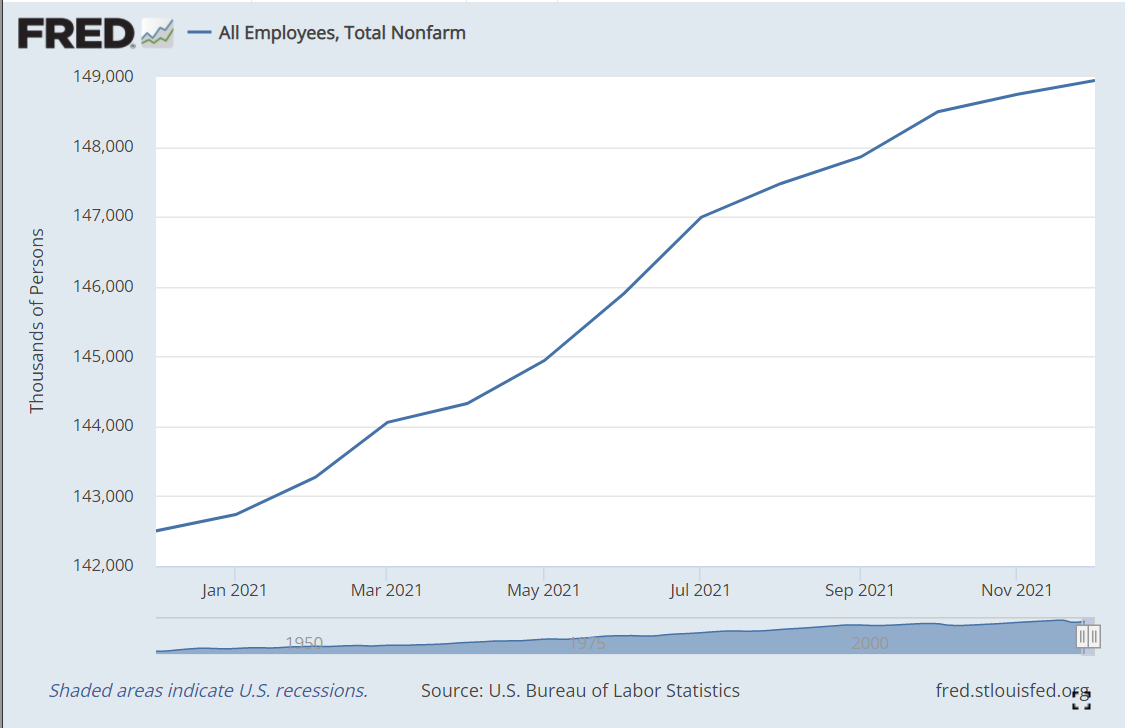
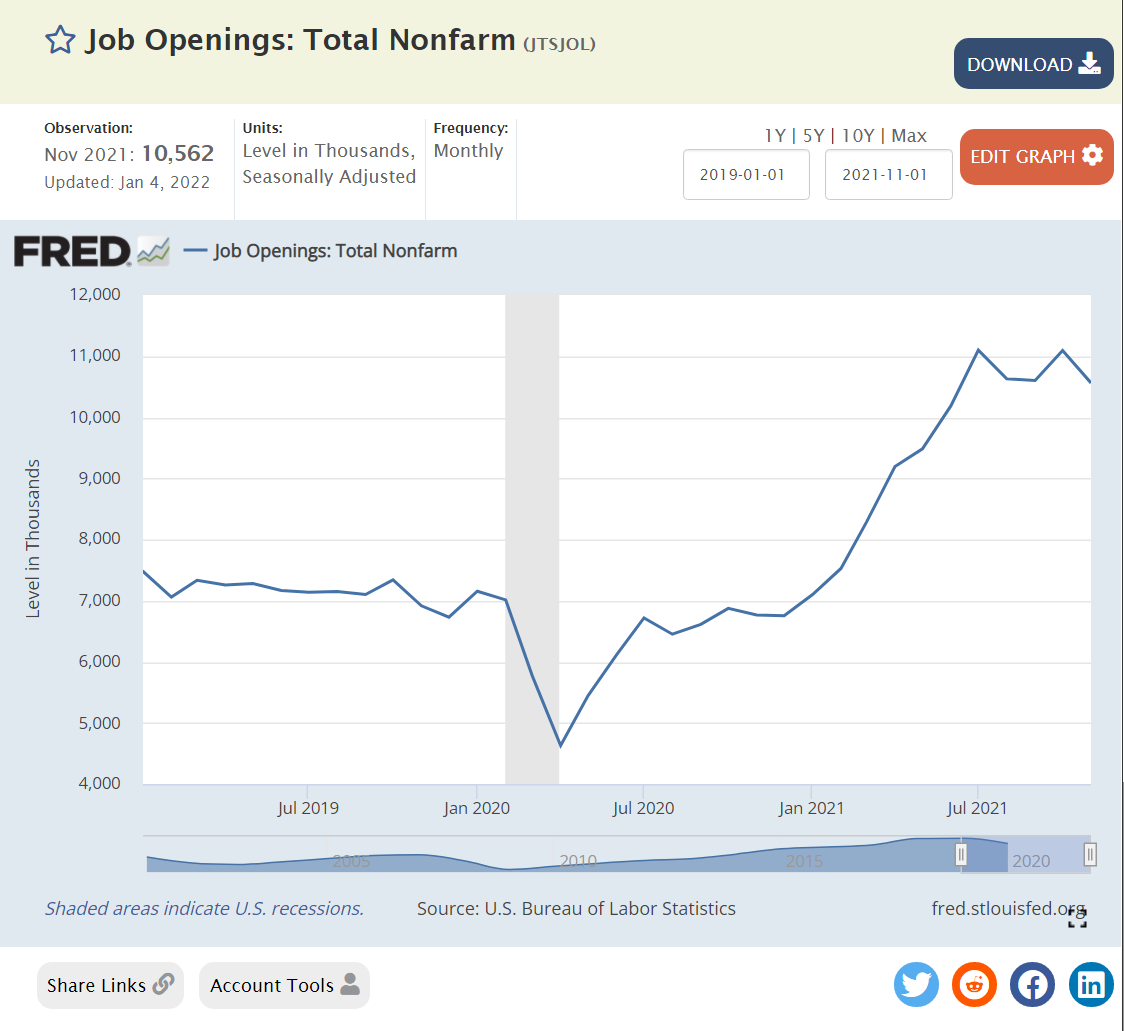
Today’s news releases show 6.0M jobs added during 2021 according to the household survey and 6.5M jobs added according to the employer survey. The ADP employer jobs survey released this week showed 6.2M jobs added. The employer reported number of open jobs increased from 6.8M to 10.6M this year. Hence the total filled plus open jobs increased by 10.6M, from 149.3M to 159.6M, a truly incredible expansion of the US economy’s production potential and demand for labor. This is 1M more filled plus open jobs than the December, 2019 peak of 158.6M. Employers are clearly struggling to work this backlog down from the 10-11M range back to the pre-pandemic 6-7M level. This provides the demand side for another 8-12 months’ worth of 500K filled jobs added per month.
The 3 underlying measures use different definitions and survey methods, but in the long-run they generally agree.
The monthly changes are much less consistent. Much of the media highlighted that the employer survey data showed just 200K jobs added in December. The household survey indicated 600K jobs added, while ADP reported 900K jobs.
It’s best to look at all 3 measures to try to get a best estimate of the most recent changes. I see roughly 500K new jobs added each month from July through December. A flat number, not an increasing one. The first half of the year was probably adding a few more jobs each month, closer to 600K each.
From 2000-2009, the dynamic US labor market laid off workers at a consistent 2M per year rate. This declined a bit to 1.8M per year in the next decade. After the pandemic, the economy quickly returned to this 1.8M per year rate from July to December, 2020.
It has dropped and remained at a 1.4M per year rate at the end of 2021, fully 30% lower than its normal level. Good news, indeed.
Unemployment Claims
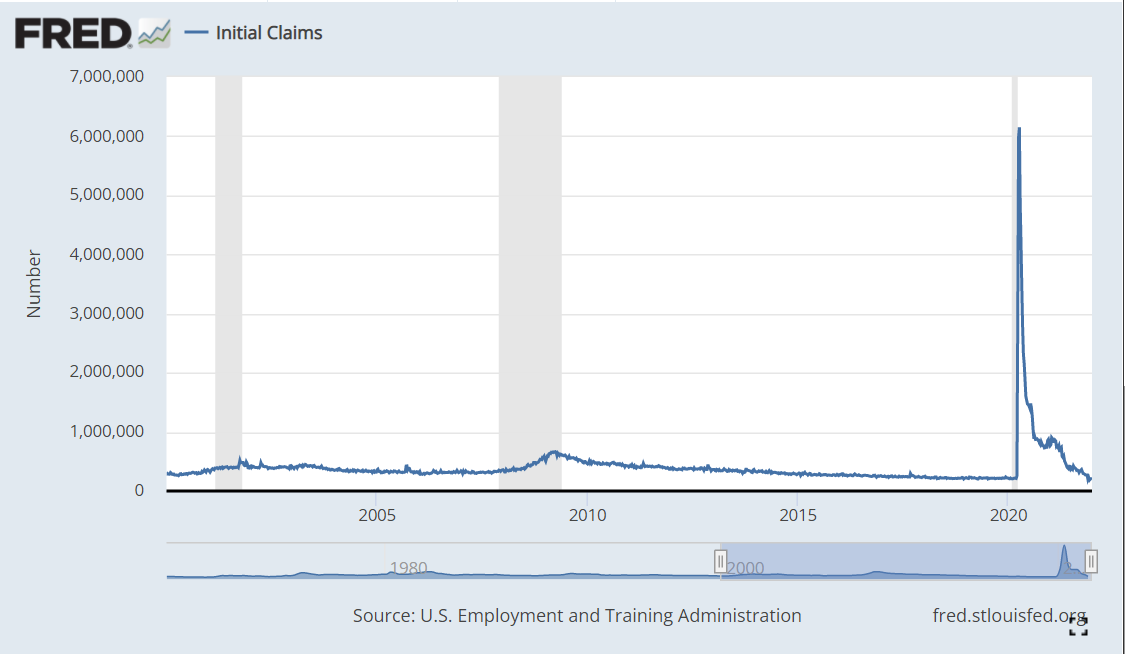
Historically, the US economy generated 350,000 new unemployment claims each week. This measure declined slowly after the Great Recession, reaching a nice 300,000 level in 2014. It slowly declined to a record low of 205,000 in Feb, 2020. The disruption rate dropped back down to the very high but stable 800,000 level from Aug, 2020 through Apr, 2021. In the last 8 months the rate has dropped very quickly back down to the record low 200,000 level!
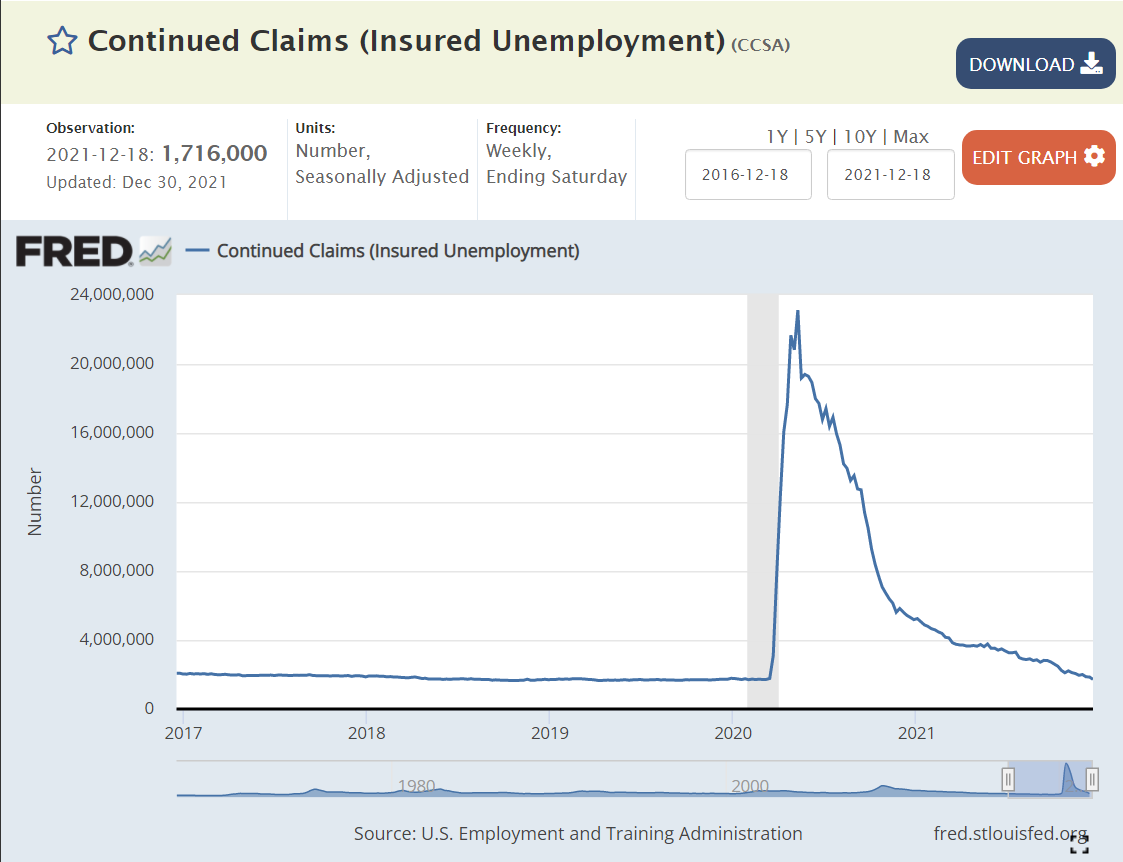
Cumulative individuals claiming unemployment benefits has historically varied with the business cycle. We can see the increase from 2M to 4M at the turn of the century. The “Great Recession” had a greater negative impact, driving this number from 2M – 4M – 7M. This number fell throughout the extended business cycle recovery period, breaching 2M in Feb, 2017 and reaching a low of 1.7M in Feb, 2020. The unemployed number reached a full order of magnitude higher at 23M during the pandemic, then dropping to 13M in Sep, 2020 and 4M in Mar, 2021 and 2M in Nov, 2021 and finally equaling the record low in December, 2021 at 1.7M. This is great news!
Unemployment Rate
The unemployment rate has reached 4.2% and will return to its historical low of 3.5% in the next 4-6 months.
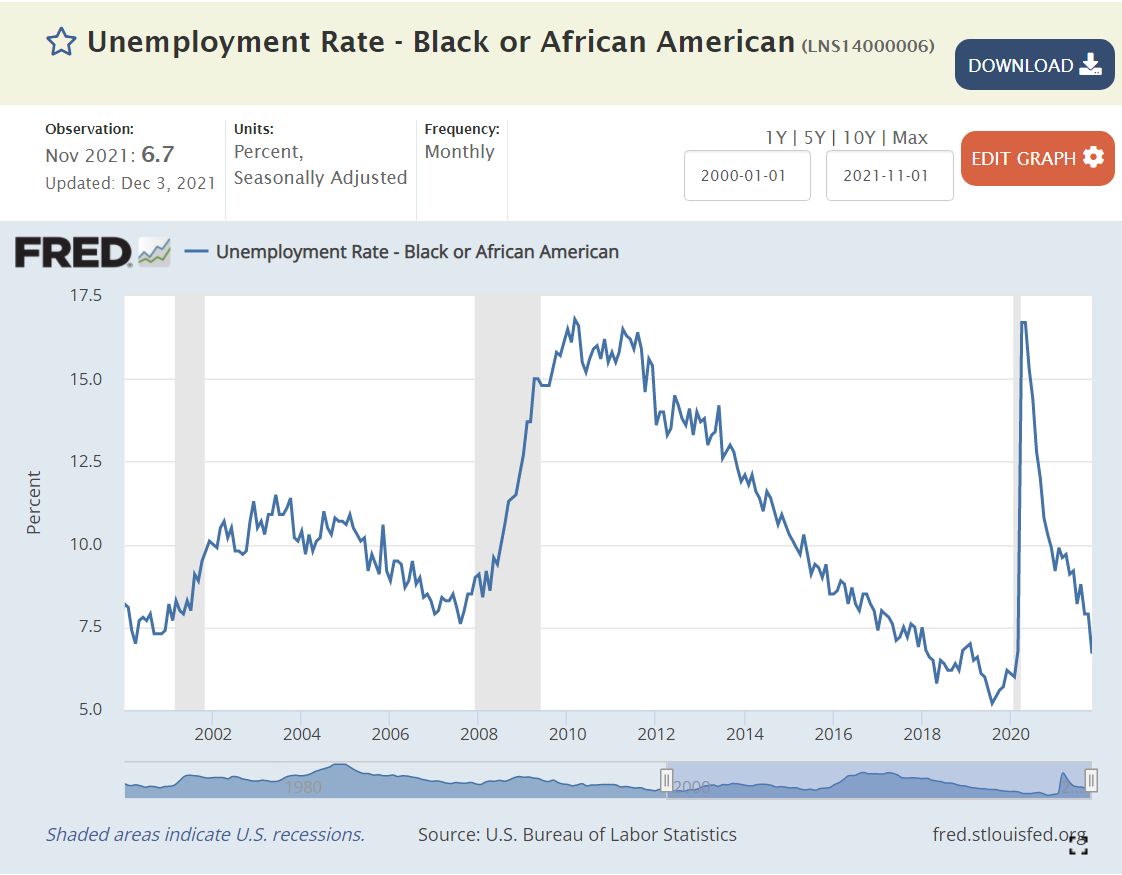
African-American unemployment was typically in the 8-10% range. It was driven down to the 5-6% level after the Great Recession during the extended business cycle expansion period. The rate is now below 7% and falling.
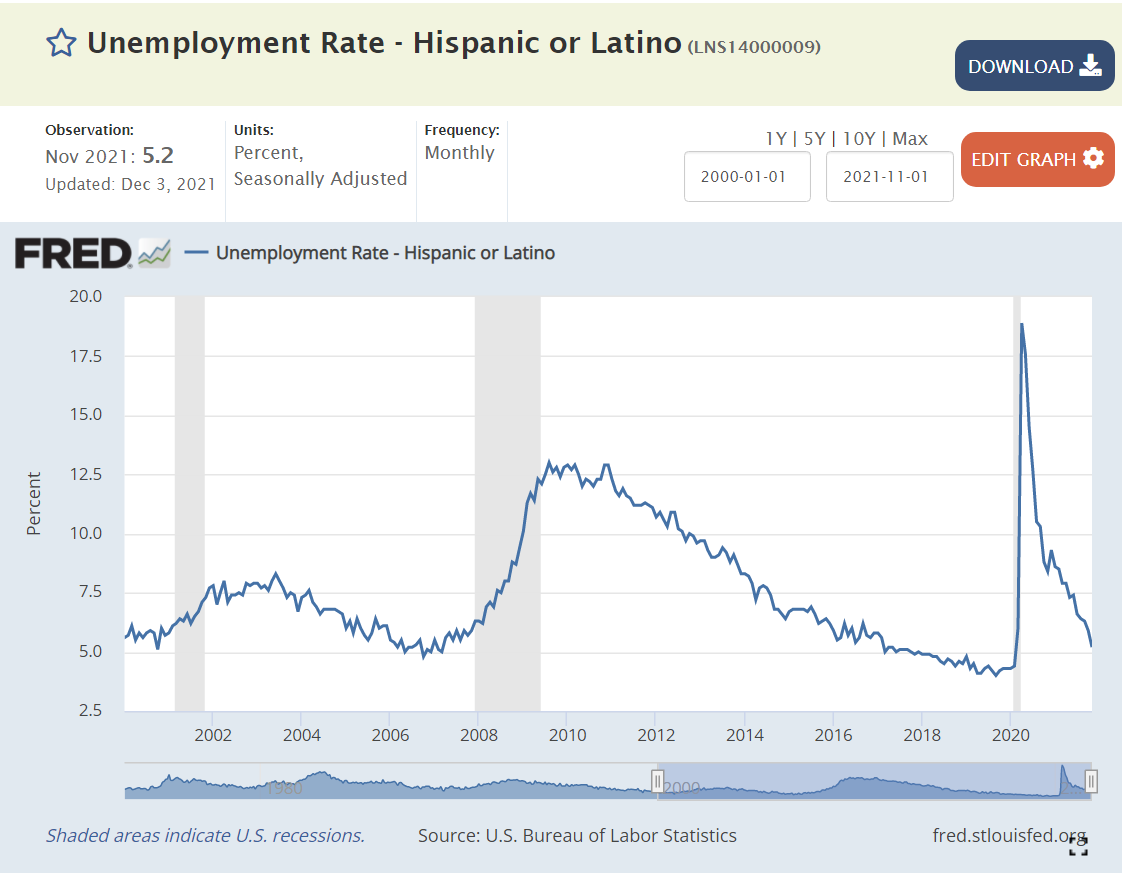
Hispanic American unemployment averaged 5-7% in the 2000’s. It spiked after the Great Recession to 13%, then slowly declined to 4.3%. It has since recovered to 5.2% and is dropping quickly.
Broadly Defined Unemployment
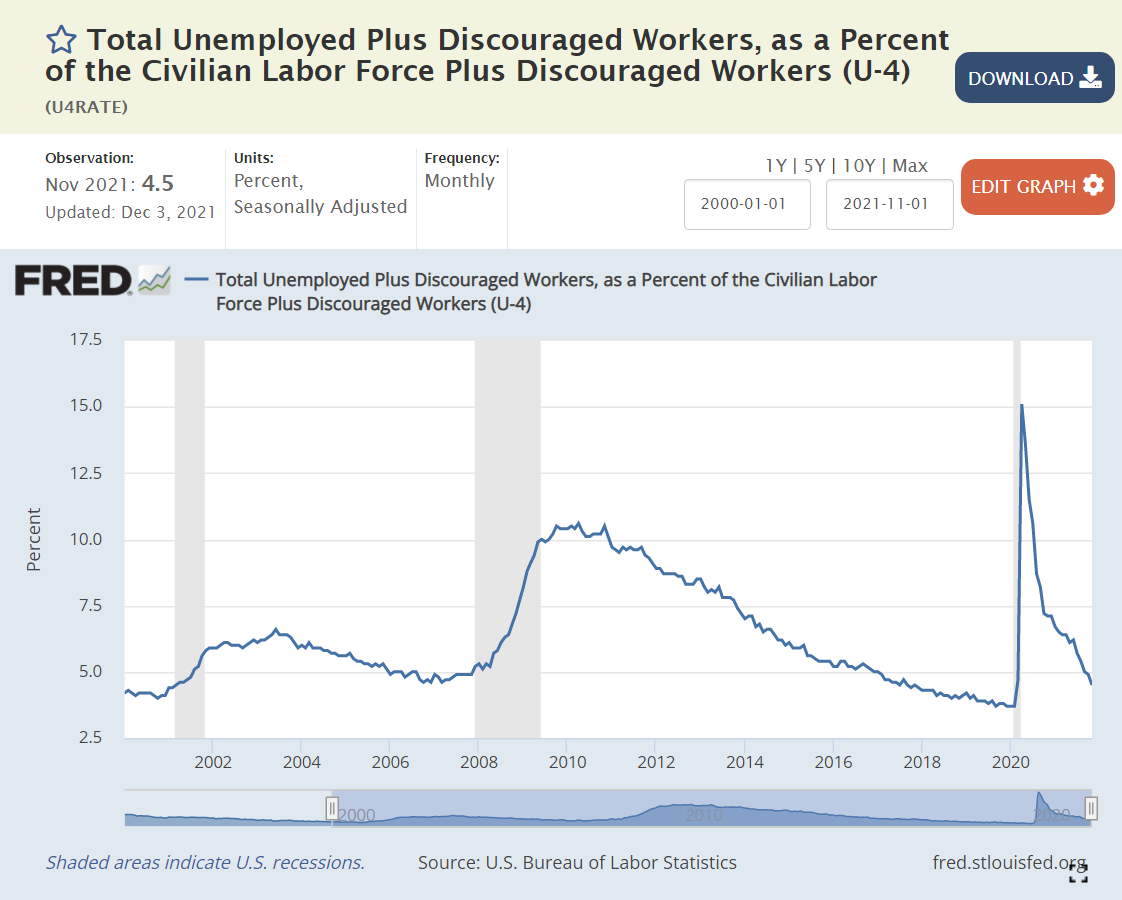
Broader definitions of unemployment show the same swift recovery from the pandemic situation.
Labor Force Participation
Labor force participation among the core 25-55 year age group reached an historic, and possibly unsustainable high of 83% in late 2019. It stayed around 81% at the end of 2020 and has since improved to 81.8%. This is one of the few labor market indicators that clearly shows that we have NOT “fully recovered”. There is 1% of the population waiting to be attracted back into the labor force.
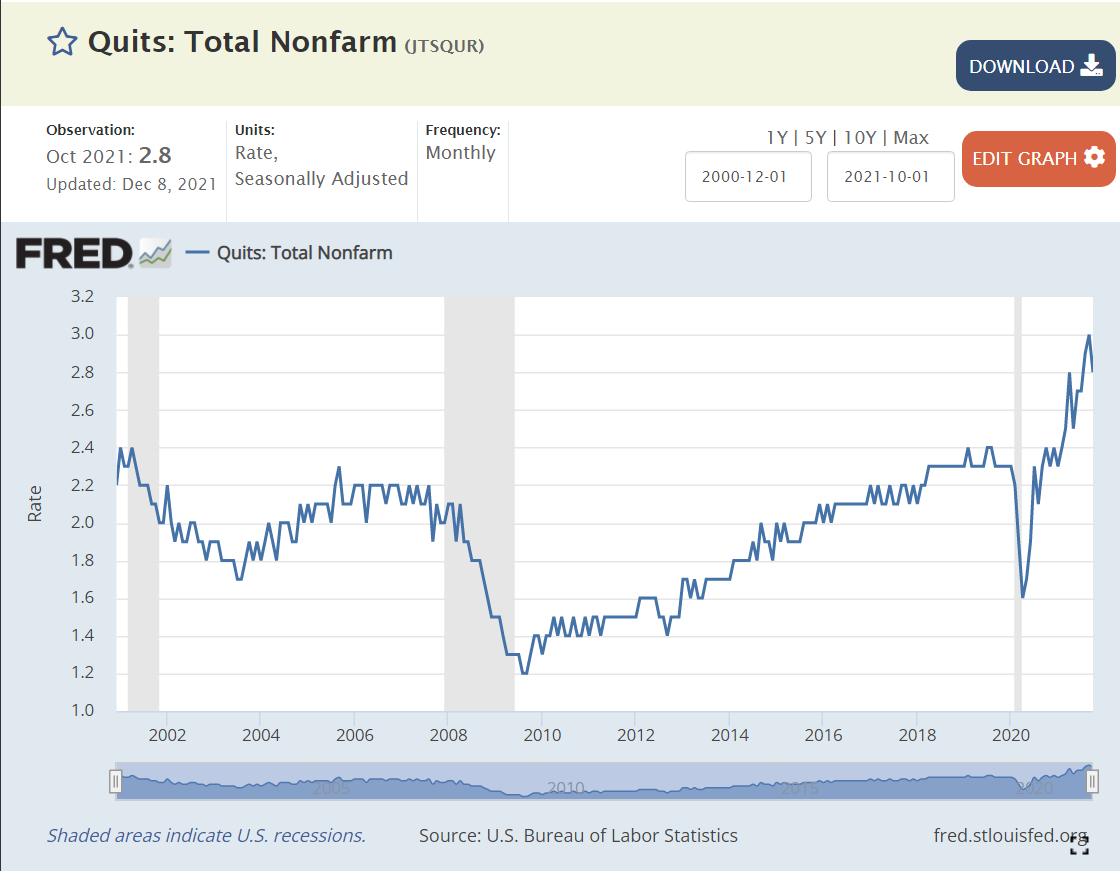
The voluntary “quit” rate has doubled since the good side of the “Great Recession”. It is 50% higher than during the very favorable labor market of 2018-2020. Employees are confident that they can leave their current employer and find another position quickly.
This is the CRAZY positive labor market chart. Historically, we see 3-5M job openings. Expansion to 6M in 2016-17 as the post Great Recession recovery faced its “end”. But, the expansion continued even further, with 7M open positions available in 2018-20. The economy recovered to 6.8M open positions in Dec, 2020. This figure has since climbed to an incredible 11M open positions, more than double the historic norm.
Historically, economists generally emphasized the negative short-term and long-term impacts of significantly higher, broadly applied minimum wage increases. Studies in the 1990’s indicated that the negative effects of moderate minimum wage increases could be relatively small, so economists’ articles have been more balanced in the past 3 decades.
Some more liberal leaning economists have been actively suppporting minimum wage increases as the US minimum wage has continued to decline on a real, after inflation basis, US minimums have fallen compared with other developed countries and the US distribution of income has become more unequal and poverty rates have not fallen despite US economic progress.
Some economists even point to the self-serving benefits of higher minimum wages for corporations, including greater productivity, innovation and retention.
But, large corporations are increasing their own minimum wages and trying to position themselves as supportive of “common sense” public policy changes that do not impact themselves very much. Some critics say that this is because large corporations can absorb higher minimum wages through their economies of scale and pricing power, while smaller businesses cannot and will go out of business, resulting in further growth of power for large businesses.
Perhaps more importantly, large corporations in a variety of industries have voluntarily increased their minimum wages from the $12/hour to the $15/hour plus range in the last 2 years. (Out of self interest).
Wages for less skilled and less experienced positions are increasing – dramatically – in the USA – in the last 5 years, especially since the pandemic reduced the supply of labor, and going forward. Larger companies have seen the costs of higher turnover and decided that they are going to offer relatively higher wages and find ways to generate enough economic value added to justify these marginal (incremental) investments. Politicians in left-leaning and centrist areas have pushed through higher minimum wages. Lower experience and lower skilled workers are able to take advantage of this situation. This is “good news” for these individuals. It is also “good news” for the economy because it has prompted firms to find ways to restructure work, processes, tools, technology, etc. to add more value from each employee.


































 Good News