1967: The Pop Music Doors Opened

The majority of “top 40” hits or “top 100” annual hits in 1967 were melodic and similar to the last 5 years of music. But a subset of 50 less popular songs pointed towards a very different future.

Most of these songs could not be created 5 years earlier or played on the radio in 1962. It’s very hard to explain the break from traditional music and views that began in 1967. Here goes …

“Folk music” was clearly becoming countercultural in 1967, questioning societal norms.

Classic R&B was adopting a sharper edge.

R&B/Soul/Jazz was starting to become much more funky.

The Beatles continued to crank out singles. Less pop, more questions.

The “rockers” were becoming much more “edgy”.

The Stones were adapting …

Jimi Hendrix offered a once in a lifetime music lesson.

Countercultural rock emerged as a major force in 1967, for good or for bad.

Summary

50 edgy new singles in 1967. 1967. 1967. The British invasion continued, with the Beatles, Stones and others making their music and lyrics more current, dynamic and experimental. Core US R&B/Motown/Soul groups adopted a more experimental and critical tone. Folk music poked at societal norms. Rock ‘n Roll leveraged the sharper, electronic riffs. The San Francisco sound wailed. The Doors “broke on through” to the other side. Jimi Hendrix emerged.

The world would never be the same. Music belonged to the young. The sound would be somewhat discordant. The message would be challenging. Musical standards would forever be so much higher.

Good News: More Retirees

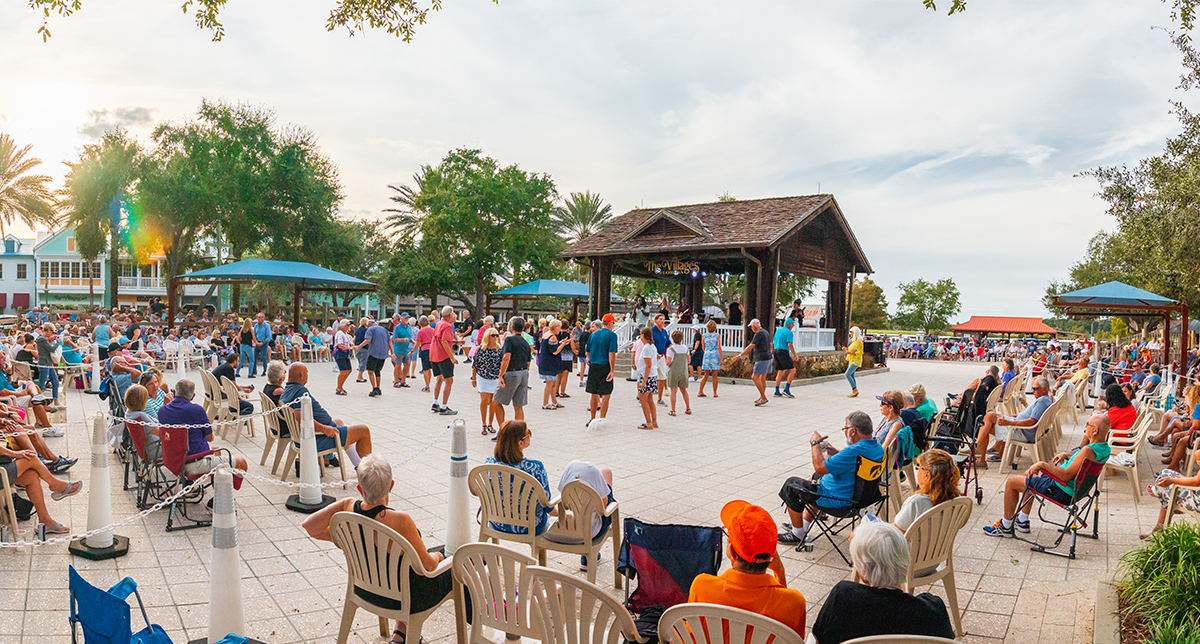
https://www.thevillages.com/

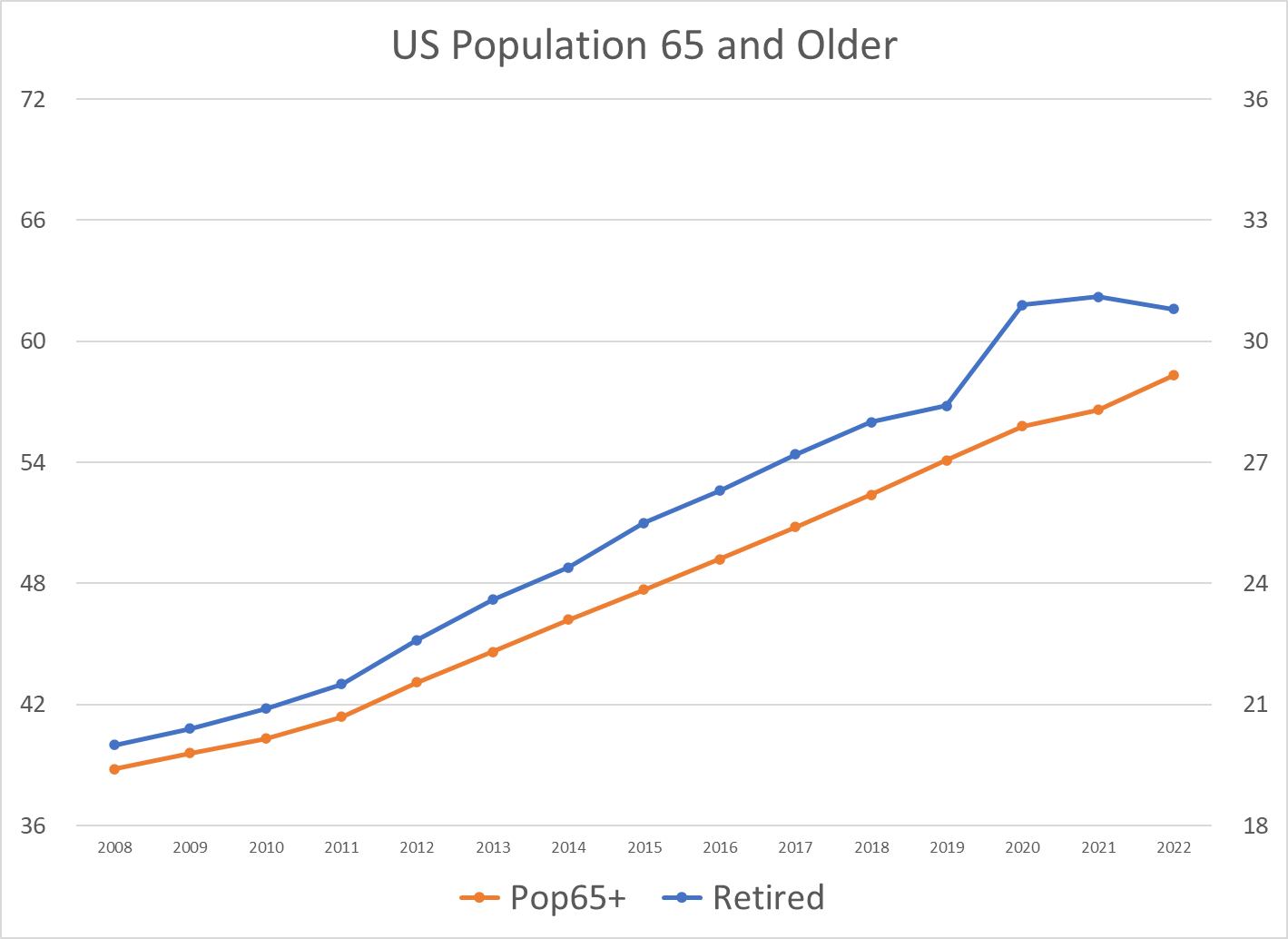
The number of retirees, aged 65+, has increased by more than 50% since 2008, from 20M to almost 31M.

The retirement age population has grown by 4% of the total population in the last 14 years.

The retired 65+ population has grown a little faster than the total 65+ age group. The initial pandemic impact in 2020 was a 5% increase in the retirement rate, indicating about a 2.6M increase in early retirements in 2020.

The retirement rate in 2020 was about 2% higher than the trend, indicating an extra 1.2M extra retirees. The percentage of retired individuals has since fallen back below the trend line.

https://fred.stlouisfed.org/series/LNU05075379#0

The “retired” measure returned (close) to its trend line by June, 2022.

Early estimates of the impact of the pandemic on retirement age workers indicated 2-3 million “extra” workers retired during this time.

https://www.cnn.com/2021/12/18/business/labor-shortage-boomers-millennials-nightcap/index.html

https://www.cbsnews.com/news/retirement-covid-pandemic-unretire-labor-shortage/

https://research.stlouisfed.org/publications/economic-synopses/2021/10/15/the-covid-retirement-boom

https://www.stlouisfed.org/on-the-economy/2021/december/excess-retirements-covid-19-pandemic

https://www.axios.com/2021/10/29/millions-of-baby-boomers-retired-early-during-the-pandemic

Later estimates indicated about 1M early retirements, and then a reversal in late 2021 – 22 as individuals chose to defer their retirements due to the uncertain economic conditions.

https://www.pewresearch.org/fact-tank/2021/11/04/amid-the-pandemic-a-rising-share-of-older-u-s-adults-are-now-retired/

https://www.plansponsor.com/study-shows-baby-boomers-pushed-workforce/

Bloomberg noted that new Social Security filings did not increase, so even though there were some retirement candidates with adequate resources to delay claiming Social Security benefits, it was unlikely that there were 3M extra early retirees.

CNBC documented the late Pandemic swing towards more potential retirees deferring this step.

https://www.cnbc.com/2022/07/09/economic-fears-further-retirees-pandemic-era-plans-to-keep-working.html

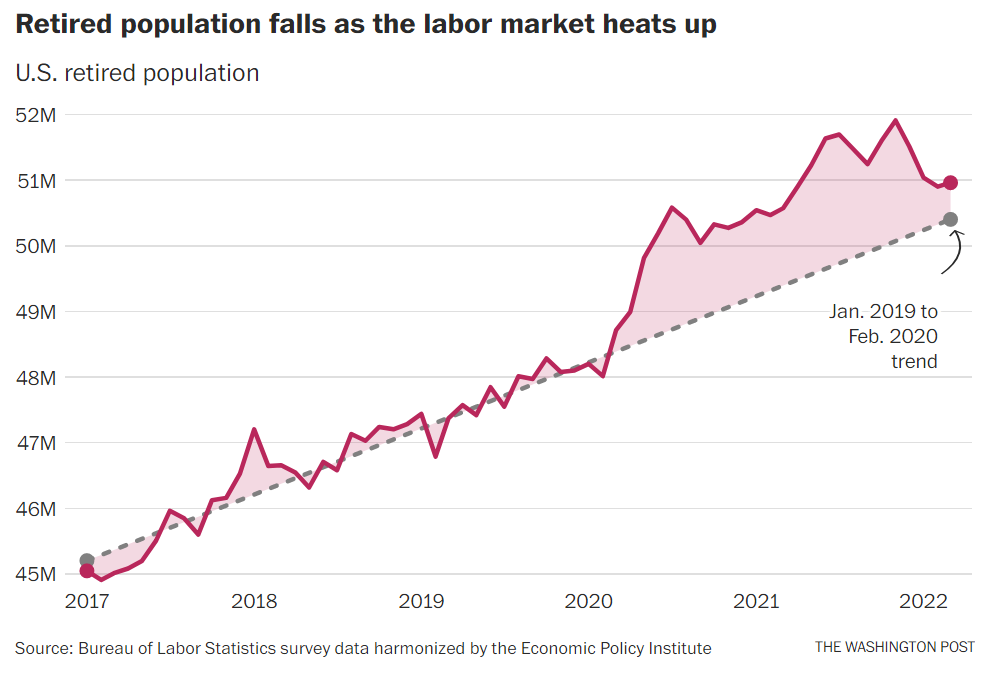
The Washington Post documented the early retirees returning to work and the variability of retirement choices versus the long-term trend lines.

https://www.washingtonpost.com/business/2022/05/05/retirement-jobs-work-inflation-medicare/

The Washington Post’s approach shows a peak of 2 million extra retirees, falling back to about one-half million in 2022.

Summary

The US economy, political system and social norms have supported the number of aged 65+ retirees growing from 20 million to more than 30 million since 2008. Some of the increase in “retirees” at the start of the pandemic was not voluntary and some retirees have returned to work in the last year as the labor market remains tight and workers worry more about economic conditions. However, overall, an extra 10 million individuals have chosen to retire from active employment and enjoy their retirement years.

Trust in the DOJ and the FBI

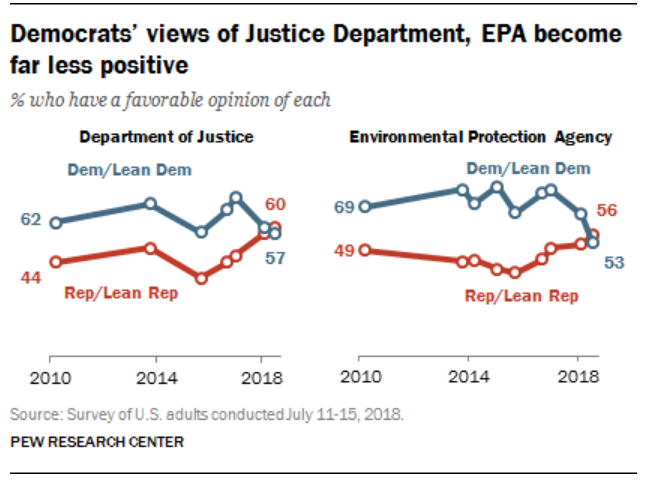
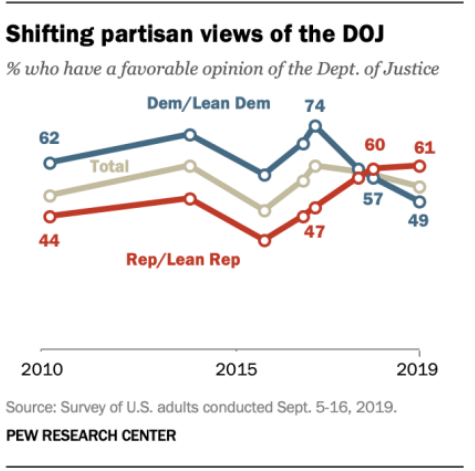
Republican Trust in the DOJ Has Improved Significantly Since 2015

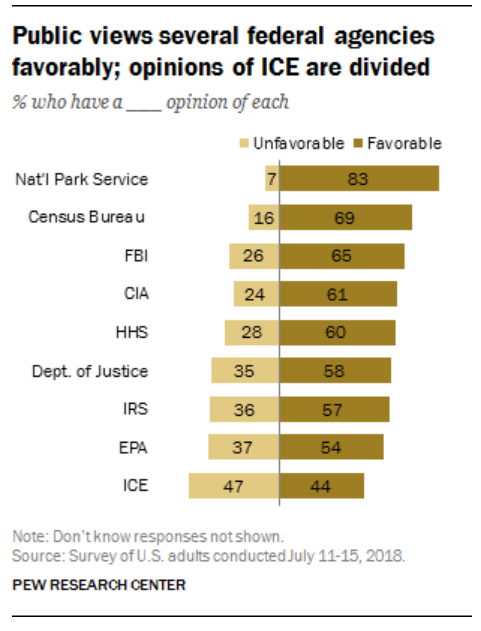
https://www.pewresearch.org/politics/2018/07/24/growing-partisan-differences-in-views-of-the-fbi-stark-divide-over-ice/
https://www.pewresearch.org/politics/2019/10/01/public-expresses-favorable-views-of-a-number-of-federal-agencies/
https://www.pewresearch.org/politics/2020/04/09/public-holds-broadly-favorable-views-of-many-federal-agencies-including-cdc-and-hhs/

Trust in the Department of Justice (DOJ), overall, has been relatively flat. Republican support has increased while Democratic support has dropped.

Historically, Republicans Strongly Supported the FBI

https://fivethirtyeight.com/features/why-democrats-and-republicans-did-a-sudden-180-on-the-fbi/
https://www.pewresearch.org/politics/2018/07/24/growing-partisan-differences-in-views-of-the-fbi-stark-divide-over-ice/

Historically, Republicans have been conservative, supporting the police, military, FBI, defense, “law and order”, criminal justice and “black and white” law enforcement. While the DOJ and some other federal agencies have been staffed by left-leaning coastal elites, the FBI has been staffed by more conservative leaning individuals.

https://www.politico.com/story/2016/11/fbi-donald-trump-base-230755

Overall Support for the FBI has Remained High, but has Become Polarized

https://www.pewresearch.org/politics/2018/07/24/growing-partisan-differences-in-views-of-the-fbi-stark-divide-over-ice/
https://news.gallup.com/poll/257489/fbi-positive-job-ratings-steady-among-americans.aspx
https://www.pewresearch.org/politics/2019/10/01/public-expresses-favorable-views-of-a-number-of-federal-agencies/

Different survey questions produced different results, but the FBI is one of the most respected federal agencies.

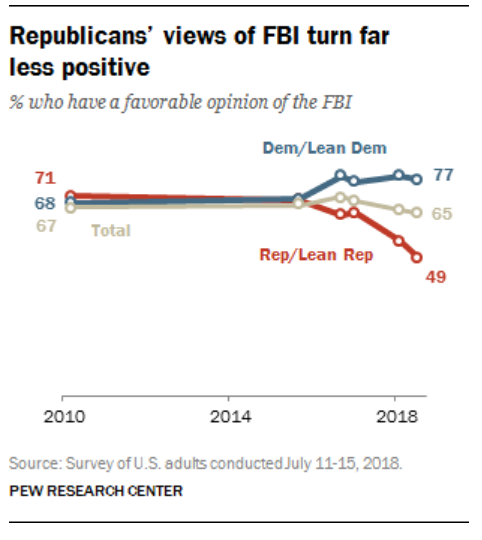
Trump’s 2018 Attacks on the FBI Drastically Reduced Republican Support for the FBI (see above and below)

https://www.pbs.org/newshour/politics/fbi-support-is-eroding-but-most-americans-still-back-bureau-poll-says

The Republican versus Democratic split widened.

https://www.vox.com/latest-news/2018/2/3/16968372/trump-fbi-republican-poll-confidence

https://www.huffpost.com/entry/republican-confidence-in-the-fbi-has-dropped-since-2015_n_5a721bbbe4b09a544b5616a7

https://ssri.psu.edu/news/mccourtney-institute-mood-nation-poll-examines-public-trust-fbi

Republican’s Response to Trump’s Claims Were Severe

https://democracy.psu.edu/poll-report-archive/poll-report-republicans-no-longer-trust-the-fbi/
https://www.huffpost.com/entry/republican-confidence-in-the-fbi-has-dropped-since-2015_n_5a721bbbe4b09a544b5616a7

https://www.politico.com/story/2018/02/03/conservatives-fbi-trump-republicans-389076

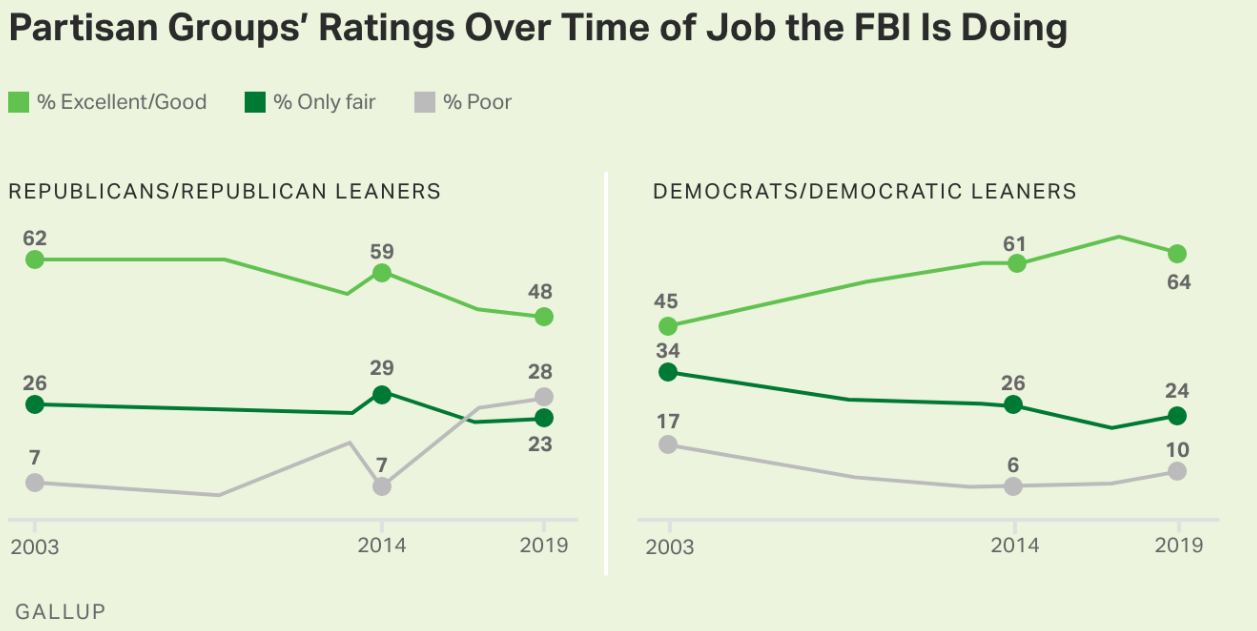
Republicans Were Much Less Supportive of the FBI in 2019 versus the Democrats

https://www.pewresearch.org/politics/2019/10/01/public-expresses-favorable-views-of-a-number-of-federal-agencies/
https://news.gallup.com/poll/257489/fbi-positive-job-ratings-steady-among-americans.aspx

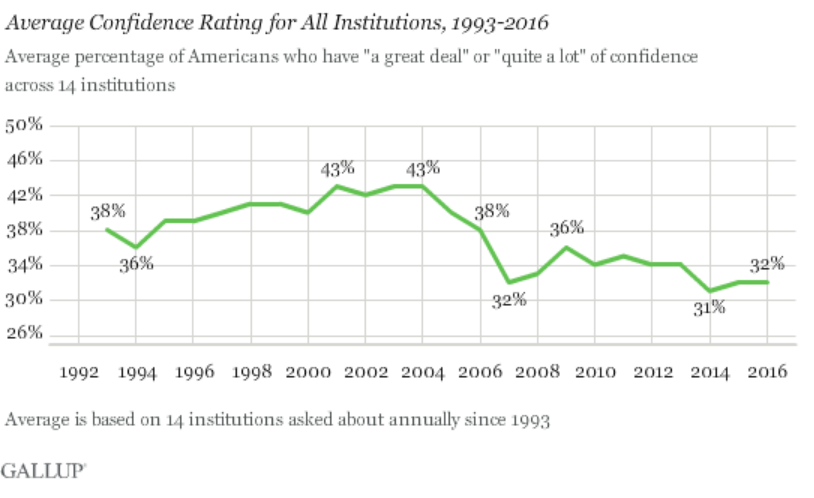
Context: Americans’ Belief in or Trust of Institutions Has Been Declining for Decades

https://news.gallup.com/poll/192581/americans-confidence-institutions-stays-low.aspx

Huge 10% drop in the middle of George W Bush’s presidency. 5 institutions with 10% or greater drops in support.

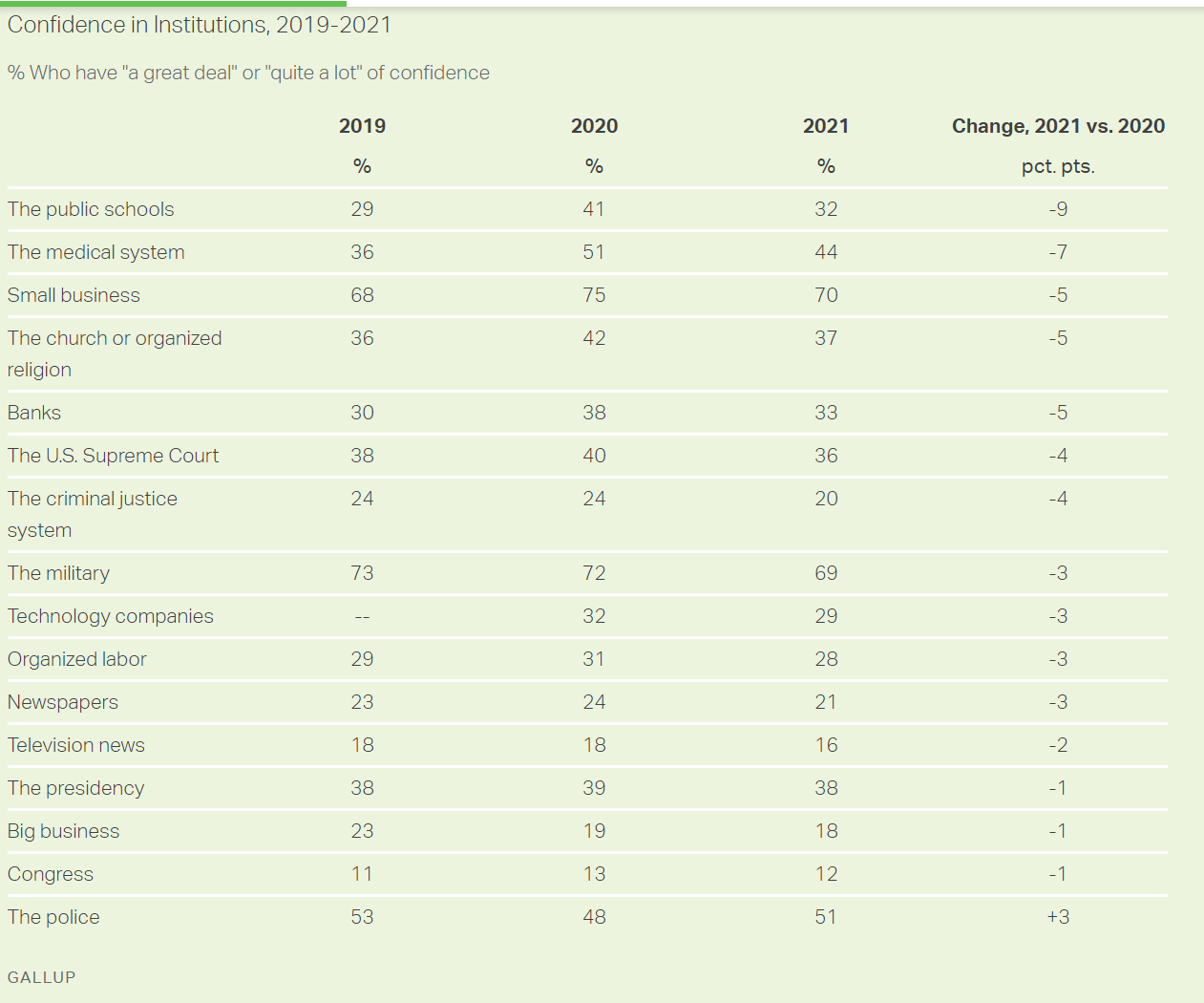
https://news.gallup.com/poll/352316/americans-confidence-major-institutions-dips.aspx

Widespread further decline in support of “institutions” during the pandemic.

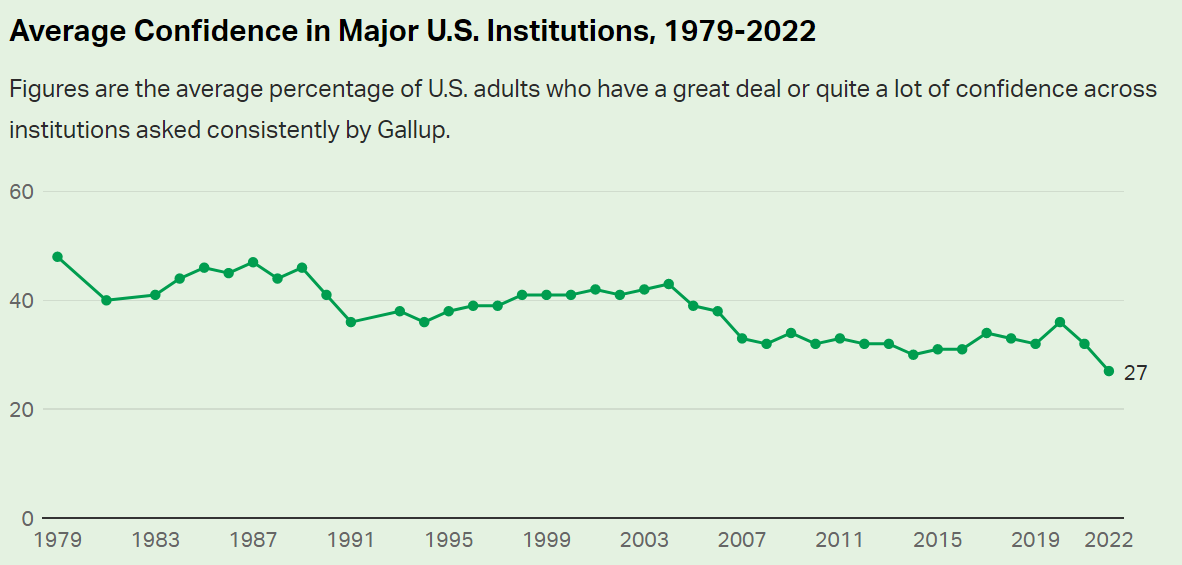
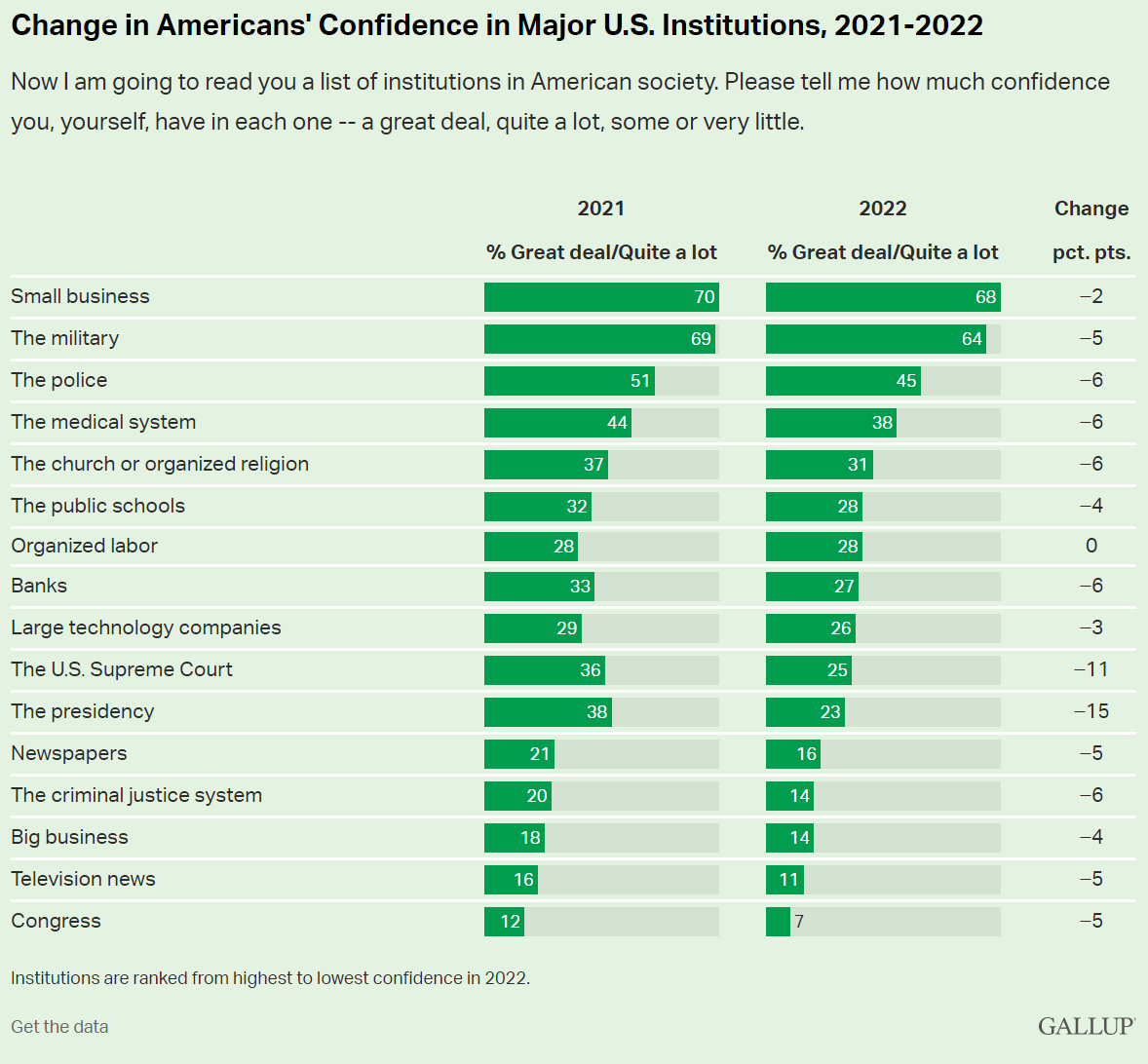
https://news.gallup.com/poll/394283/confidence-institutions-down-average-new-low.aspx

The broad decline continues in 2022. Can it continue?

I’m Very, Very, Very Scared

538 has a similar article but refuses to link directly. Worth your time to query and copy.

“What Happens When Americans Don’t Trust Institutions?”

If only one-quarter of Americans trust in its basic institutions, how can we have democracy and capitalism and “western civilization”? If “everything is broken”, then we need a dictator or a revolution. Really? Really? Really?

I have to blame the 16 year-old me for some of this. In 1972, we were all opposed to “the man”, “the organization man”, “the establishment”, etc. We were children of the hard-won victory of democracy and capitalism against fascism and imperialism and communism. We believed in progress, science, growth and possibilities. We were skeptical about the Vietnam war, the military, McNamara and his whiz kids, General Curtis LeMay, big corporations, compromises, limitations, bureaucracy, bigness (small is beautiful), population growth, technology, etc. Many of us deeply believed in a romantic idealism or utopianism, making stodgy historical institutions so irrelevant.

Fast forward 50 years and I (we) possess a fundamentally conservative view, embracing the need/value of institutions and channeling our inner Edmund Burke to emphasize the value of the accumulated wisdom of society.

https://en.wikipedia.org/wiki/Edmund_Burke

So, the overall decline in trust of American institutions is a real challenge. The decline in trust in the FBI is clearly (IMHO) a Trump driven result. This, too, is a real challenge to our democracy. Do we (I) really believe that the leadership and staff of the FBI have abandoned their democratic principles which we have lived and supported for almost 250 years? I don’t think so. But the decline in trust/belief in all institutions combined with the increasingly politically polarized view of individual institutions makes this a reasonable view for many of our fellow citizens. We have much, much work to do in order to preserve our institutions, government and society.

Good News: Amazing Visual Media Choices

In 1974, when I graduated from high school, there were 3 national TV networks that delivered “over the air” content from major city TV stations. Major cities usually had a public broadcasting station focused on “educational TV” and perhaps an “independent” TV station that catered to reruns of movies, cartoons and TV shows, local news and weather, variety shows, political commentators, sports and traffic. At night, you might sometimes be able to get a fuzzy picture from 2-3 other TV stations 60-100 miles away if you moved the roof or tv antenna around a bit. “Maximum TV” was 10 stations.

We now have cable, satellite and internet connections to provide hundreds or thousands of channels to most citizens for viewing now or later. It is challenging to convey this “two orders of magnitude” change.

Rise of Cable TV Delivery

https://www.sec.gov/Archives/edgar/data/874292/000144526019000024/defm14a.htm
https://nscreenmedia.com/big-tv-channel-bundle-losses-3-7m-2021/
https://www.grandviewresearch.com/industry-analysis/pay-television-tv-market

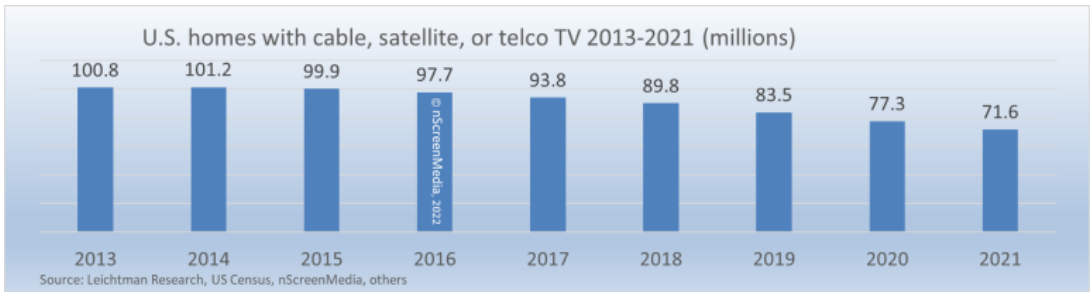
The US TV market grew from zero to 100M homes with cable access by 2005, before beginning a slow decline in direct connections replaced by internet connections.

Now or Later: Streaming Increases

https://www.cnbc.com/2021/06/17/nielsen-streaming-makes-up-only-26percent-of-time-spent-in-front-of-tv.html

https://www.prnewswire.com/news-releases/the-gauge-nielsens-monthly-total-tv-and-streaming-snapshot-for-december-301460235.html

Close to 30% of TV content is now consumed in a time-shifted manner versus zero historically. When “The Wizard of Oz” was played on TV every 2-3 years, we all watched it.

Decline of the Big 3/4 Networks’ TV Market Share

1980 – 85-90%

1990 – 60%

2000 – 40%

2010 – 35%

2021 – 30%

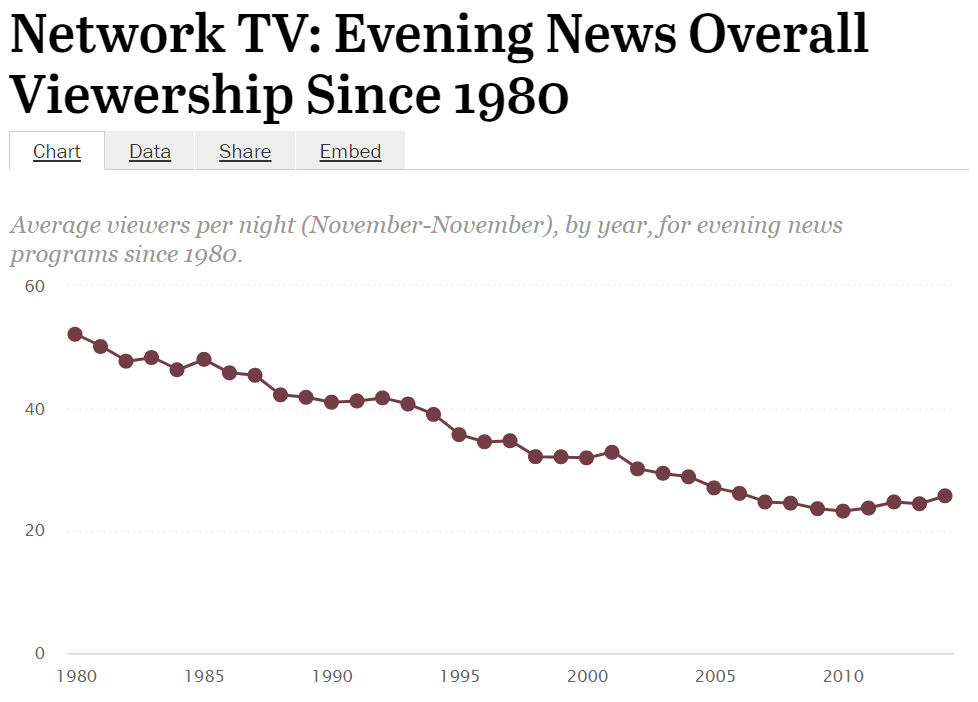
Conversely, this means that “independent” content increased from 10% to 70% of available programs.

https://www.latimes.com/archives/la-xpm-1991-04-17-ca-128-story.html

https://variety.com/vip-special-reports/fading-ratings-a-special-report-on-tvs-shrinking-audiences-1235142986/

https://www.tvguide.com/news/2010-11-ratings-1033838/

https://apnews.com/article/eff68f5c5a5a15bcbc17cf788a17556d

http://www.thetvratingsguide.com/1991/08/2000-01-ratings-history.html

https://www.pewresearch.org/journalism/chart/network-tv-evening-news-overall-viewership-since-1980/

Decline in Ratings of 10th Ranked Major Network Shows

1950 Mama 40

1960 Jack Benny 26

1970 FBI 23

1980 Little House 22

1990 Golden Girls 17

2000 The Practice 12

2010 Criminal Minds 9

2019 Good Doctor 7

https://en.wikipedia.org/wiki/Top-rated_United_States_television_programs_of_1950%E2%80%9351

https://en.wikipedia.org/wiki/Top-rated_United_States_television_programs_of_1960%E2%80%9361

https://en.wikipedia.org/wiki/Top-rated_United_States_television_programs_of_1970%E2%80%9371

https://en.wikipedia.org/wiki/Top-rated_United_States_television_programs_of_1980%E2%80%9381

https://en.wikipedia.org/wiki/Top-rated_United_States_television_programs_of_1990%E2%80%9391

https://en.wikipedia.org/wiki/Top-rated_United_States_television_programs_of_2000%E2%80%9301

https://en.wikipedia.org/wiki/Top-rated_United_States_television_programs_of_2010%E2%80%9311

https://en.wikipedia.org/wiki/Top-rated_United_States_television_programs_of_2018%E2%80%9319

1980 – Still Just 3 Networks

50 news items. Just 4 cable items. USA Network, BET, ESPN, Cinemax.

49 debut programs. 3 PBS, 1 ESPN, 2 CNN, 1 Nickelodeon. 42 (6/7ths) major networks.

https://en.wikipedia.org/wiki/1980_in_American_television

Other Network Options Grew Exponentially

5 in 1970-80.

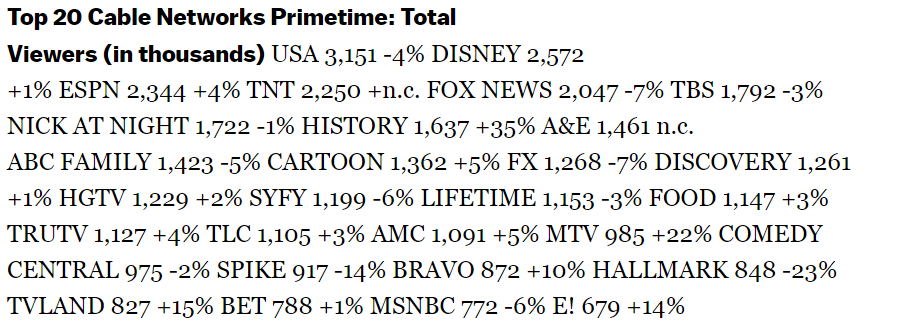
153 networks in 2021. 97 with “material” average daily viewership of 100,000+.

https://variety.com/2021/tv/news/network-ratings-2021-top-channels-1235143630/

29 largest networks in 2010.

‘www.deadline.com

Of the top 29 in 2010, 14 remain strong competitors in 2021. ESPN, Fox News, TBS, History, Ion, Discovery, HGTV, Lifetime, Food, TLC, Bravo, Hallmark, TV Land, MSNBC. 5 retain more than 500K average daily visitors, but dropped by at least 50% from 2010 to 2021: USA, TNT, A&E, FX and AMC. 10 dropped by more than 50% to less than 500K daily viewers: Disney, Nick, Cartoon, SyFy, TruTV, MTV, Comedy, Spice, BET and E! 8 networks moved up to more than 500K viewers per day: CNN, telemundo, CW, Insp, Me, Invest, Hallmark movie and Unimas. This is a very competitive marketplace.

https://variety.com/2021/tv/news/network-ratings-2021-top-channels-1235143630/

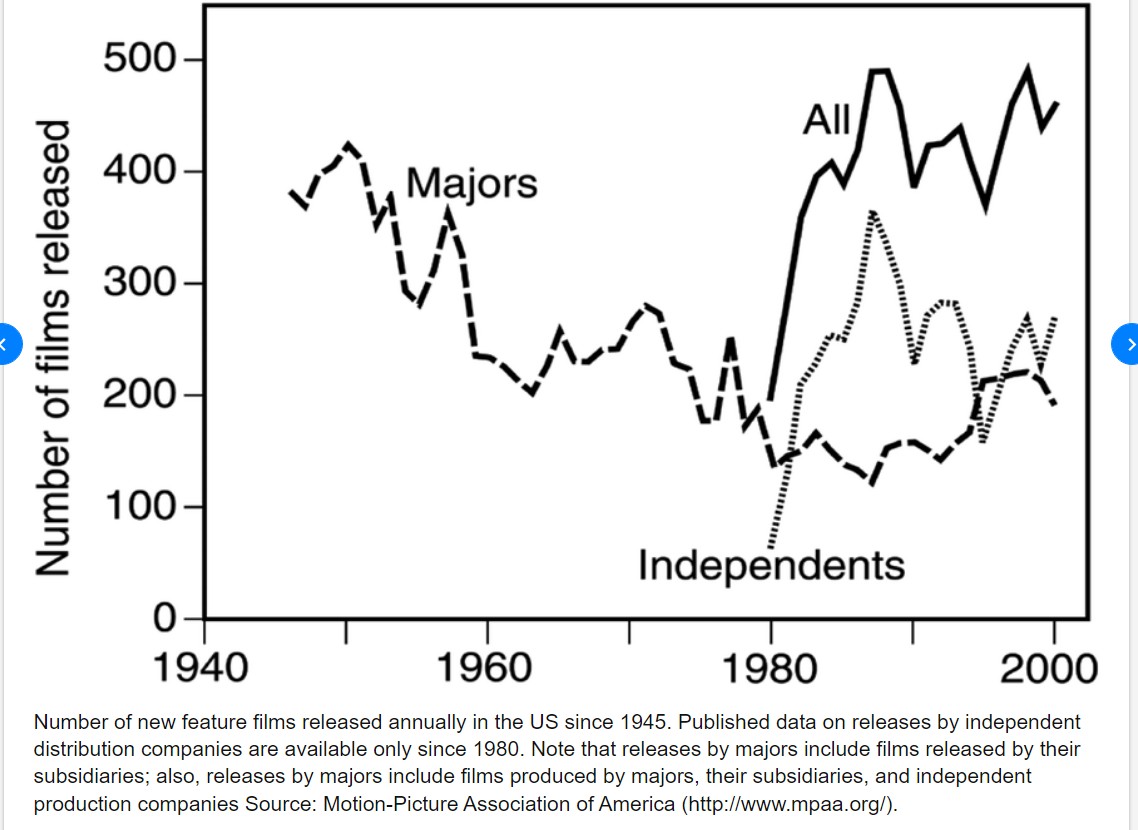
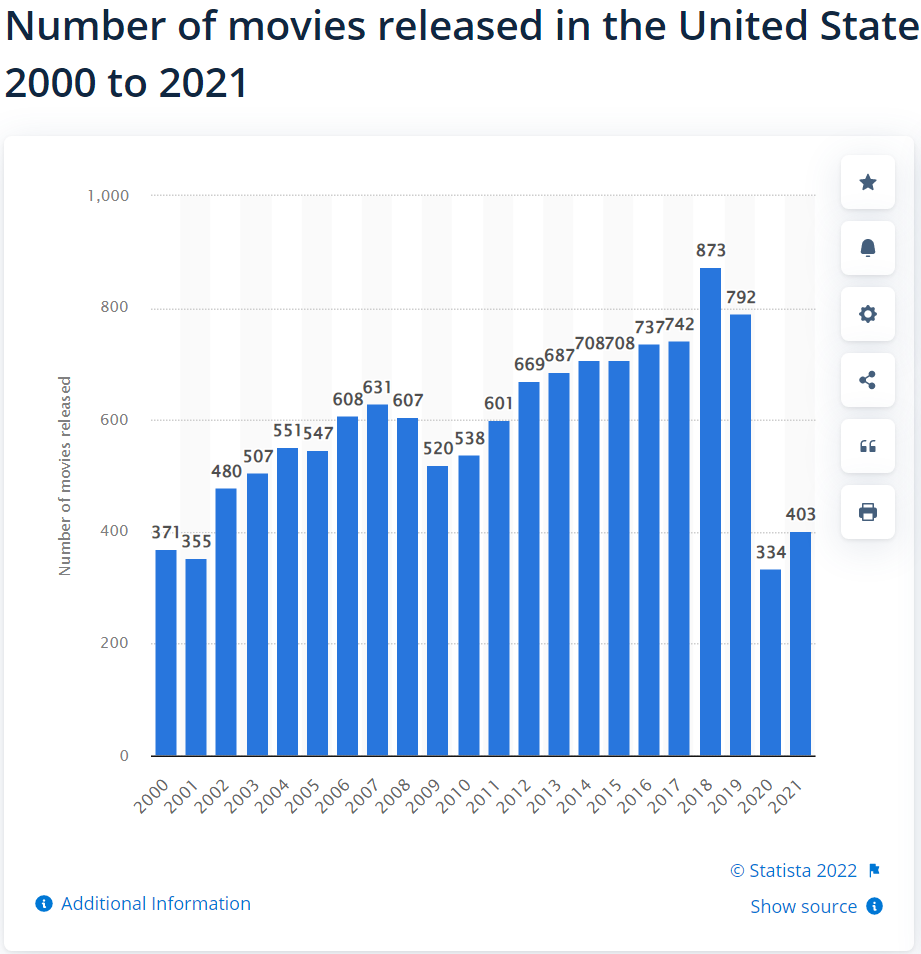
Much More Original Content is Now Provided

https://www.nytimes.com/2020/01/09/business/media/tv-shows-2020.html
https://stephenfollows.com/how-many-films-are-released-each-year/
https://www.researchgate.net/figure/Number-of-new-feature-films-released-annually-in-the-US-since-1945-Published-data-on_fig1_233132735
https://www.statista.com/statistics/187122/movie-releases-in-north-america-since-2001/

https://www.criterionforum.org/forum/viewtopic.php?t=6273

Good News: God is NOT Dead In the US

Nietzsche Declared It In 1882: 7 Generations Ago

https://philosophybreak.com/articles/god-is-dead-nietzsche-famous-statement-explained/

Time Magazine Taunted 1966: 3 Generations Ago

80-90% Believe in God or a “Higher Power”

https://www.pewtrusts.org/en/trust/archive/fall-2018/when-you-say-you-believe-in-god-what-do-you-mean

56% believe in God as described in the Bible. Another 23% have a less literal belief in God. Of the 20% who answer “no”, fully one-half believe in some kind of higher power or spiritual force. Only 10%, in 2017, fully rejected any supreme being/force/concept.

Time Says 90% Believe in God

https://time.com/4283975/god-belief-religion-americans/

Gallup Poll Reinforces 80-90% Belief

https://news.gallup.com/poll/268205/americans-believe-god.aspx

US Belief In God Is Twice as High as In Europe

56% in US believe in Biblical God versus 27% in Europe.

https://www.pewtrusts.org/en/trust/archive/fall-2018/when-you-say-you-believe-in-god-what-do-you-mean

U.S. adults are more religious than Western Europeans

Belief in God Forecast to Grow Globally

The Future of World Religions: Population Growth Projections, 2010-2050

However: Non-Religion Affiliated Folks Grew

https://www.christianitytoday.com/news/2019/march/evangelical-nones-mainline-us-general-social-survey-gss.html

From 7% to 22% by this measure!

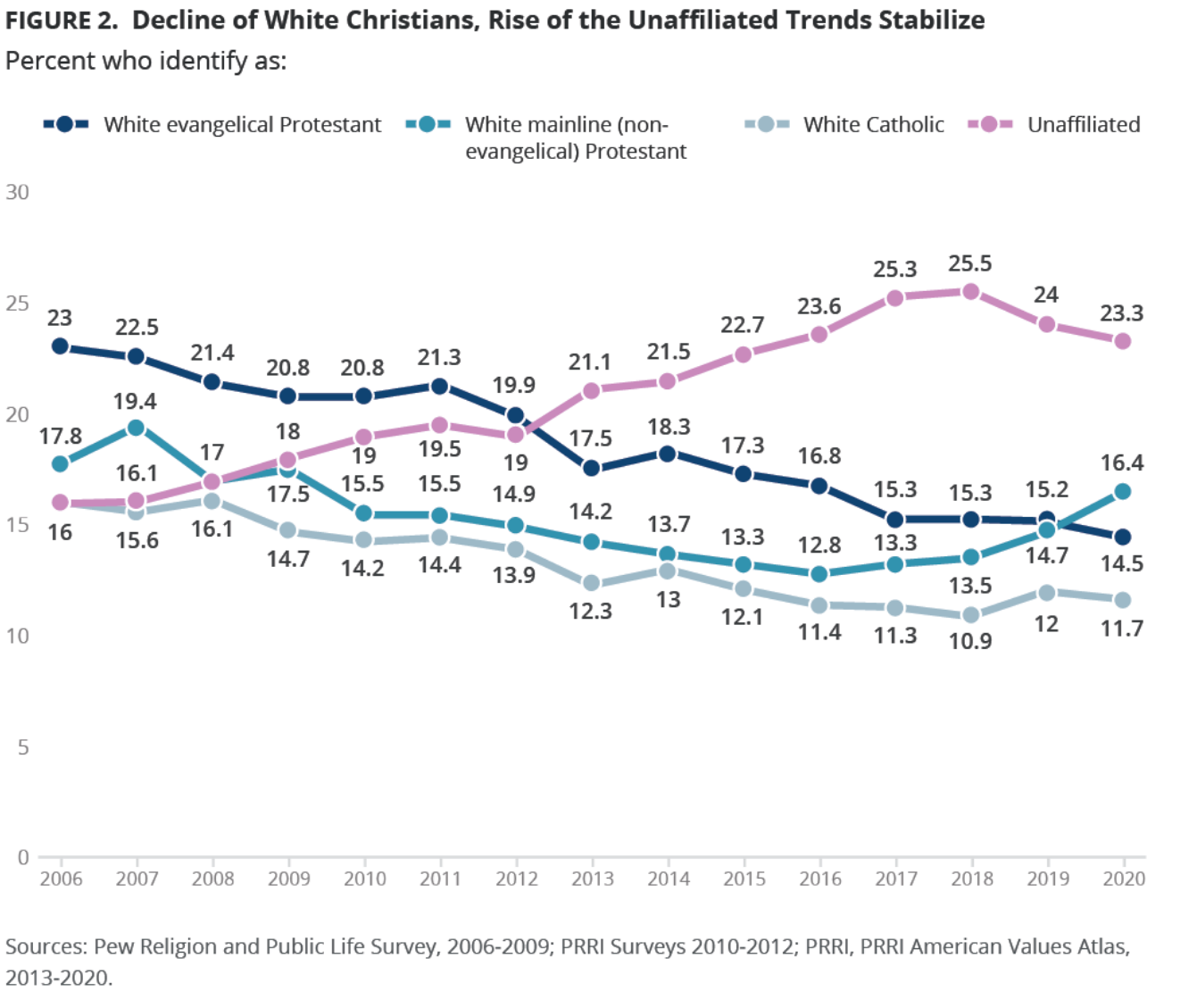
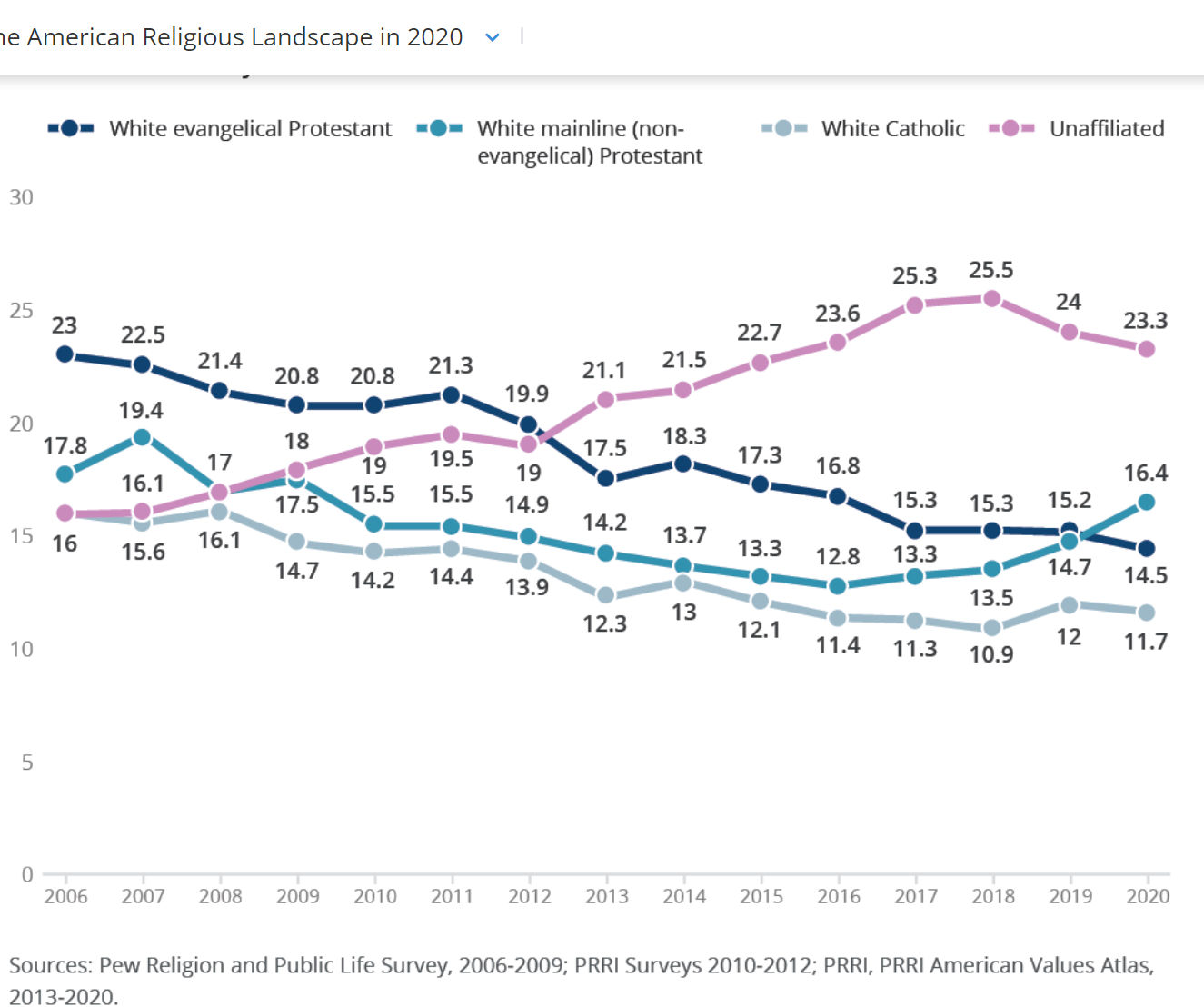
PRRI summarizes their data and Pew data to assert that the unaffiliated population grew from 16% to 25% but has recently fallen back to 23%.

Other analysts conclude that the “nones” account for up to 30% of the population.

https://www.deseret.com/faith/2022/4/14/23022509/god-is-not-dead-religion-data-politics-faith-in-america

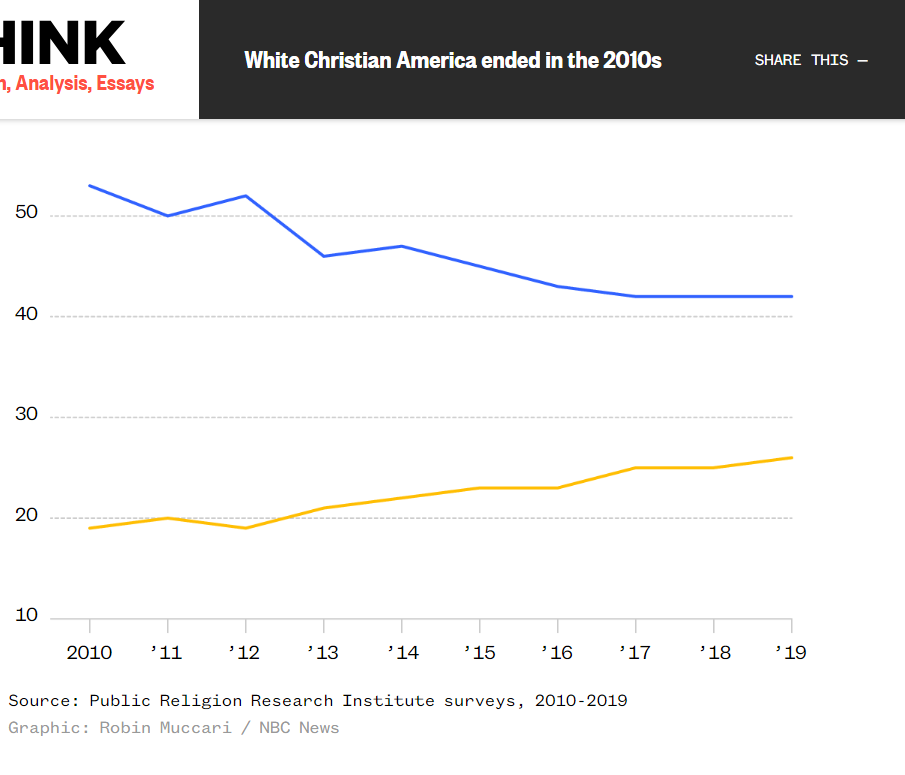
https://www.nbcnews.com/think/opinion/2010s-spelled-end-white-christian-america-ncna1106936

This survey shows the “unaffiliated” category increases from 20% to 26%.

Fewer Young Adults Belong to Churches

Religious Believers Maintain Same Activities

https://www.deseret.com/faith/2022/4/14/23022509/god-is-not-dead-religion-data-politics-faith-in-america

Mainstream Protestants Fell, Bottomed, Recovered

https://www.christianitytoday.com/news/2019/march/evangelical-nones-mainline-us-general-social-survey-gss.html

From 28% to 12%, or from 18% to 13%.

Evangelicals Grew, Then Declined

https://www.christianitytoday.com/news/2019/march/evangelical-nones-mainline-us-general-social-survey-gss.html

About Three-in-Ten U.S. Adults Are Now Religiously Unaffiliated

Based on a “born again” definition, evangelicals have declined by 6%.

https://www.cnn.com/2021/07/10/opinions/american-evangelicals-protestantism-butler-bass/index.html

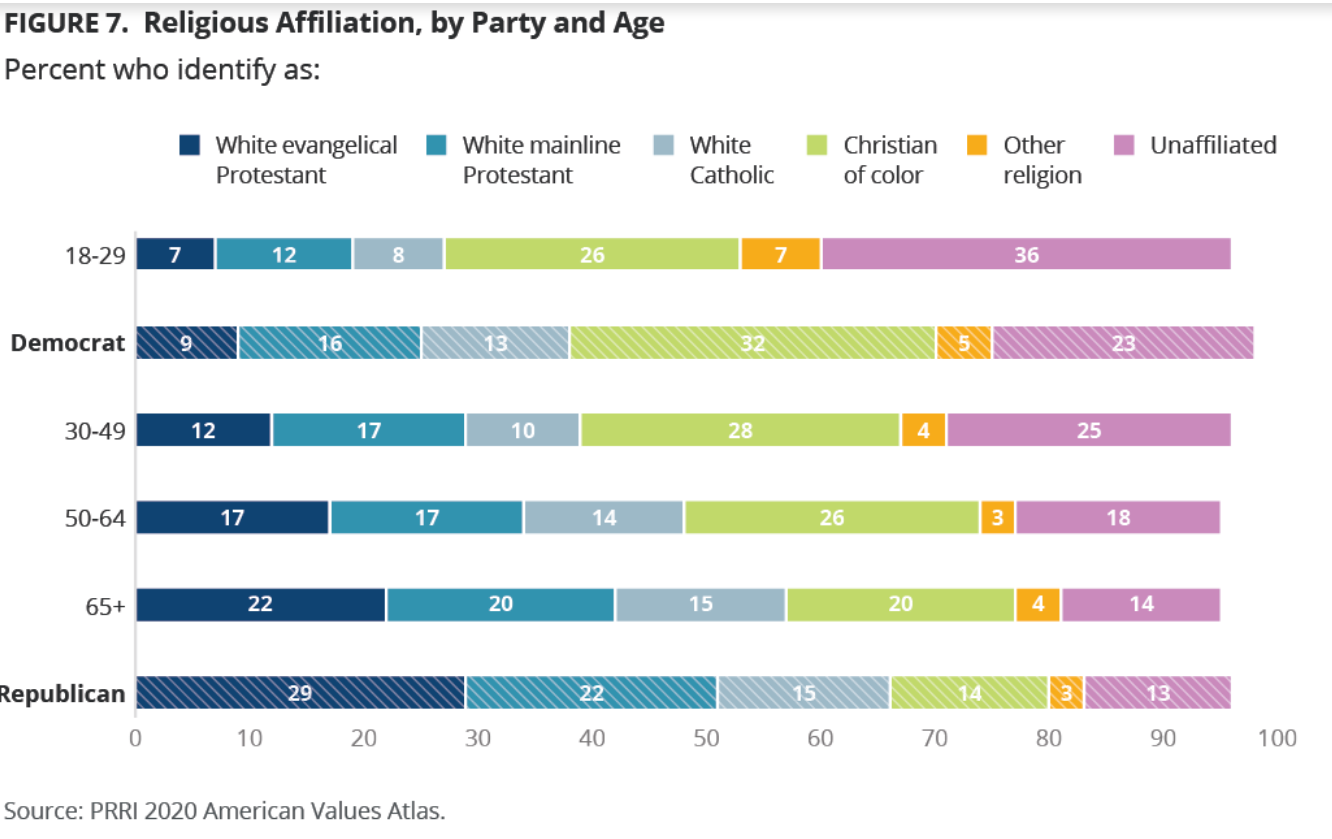
Evangelicals Increasingly Overlap With Republican Party Identification

https://www.christianitytoday.com/news/2019/march/evangelical-nones-mainline-us-general-social-survey-gss.html

https://www.sltrib.com/opinion/commentary/2021/10/27/ryan-burge-why/

Summary

US citizens belief in God remains strong, between 80-90%. Church affiliation has declined to 70%. Mainline (liberal-centrist) Protestant believers have declined dramatically, but recently stabilized. Evangelical Protestant believers increased in the 1980’s and 1990’s, but have declined somewhat since then. Catholic membership has remained roughly constant, with Hispanics replacing Whites.

The decline in Whites as a percentage of the US population, combined with the increase in non/other believers has lead to headlines proclaiming the end of a majority White Christian America. This is true statistically, with politicians attempting to take advantage of the situation.

https://www.nbcnews.com/think/opinion/2010s-spelled-end-white-christian-america-ncna1106936