Little Pink Houses …

I’ve lived in the Indy suburbs for 34 years, 80 miles away from Johnny Cougar Mellencamp’s hometown of Seymour, IN. These songs were published in 1983 and 1985, VERY early warning signs of the rapidly growing gap between rural and urban America.

Let’s take a look at 2020 per capita income levels for the 92 counties in Indiana.

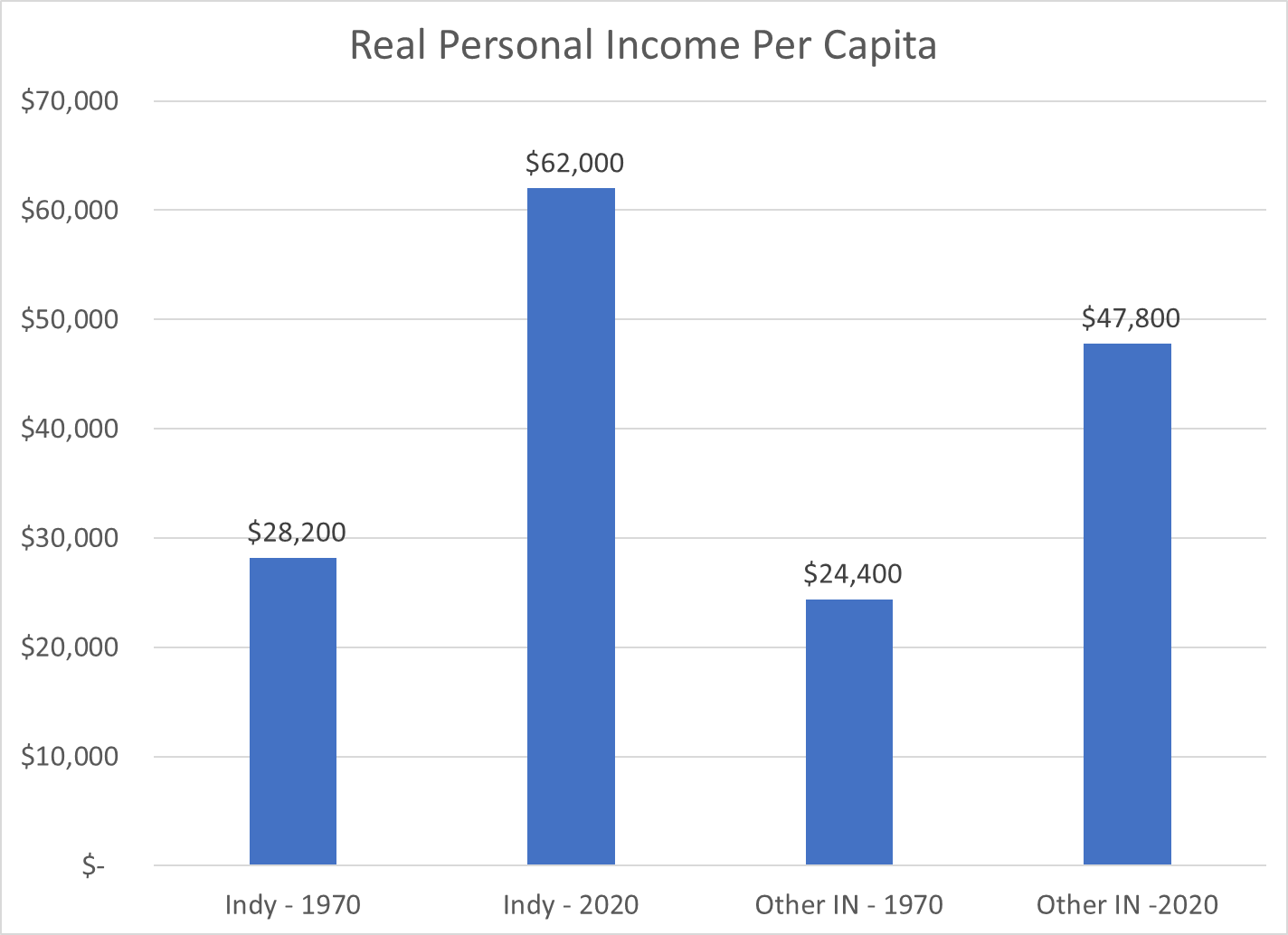
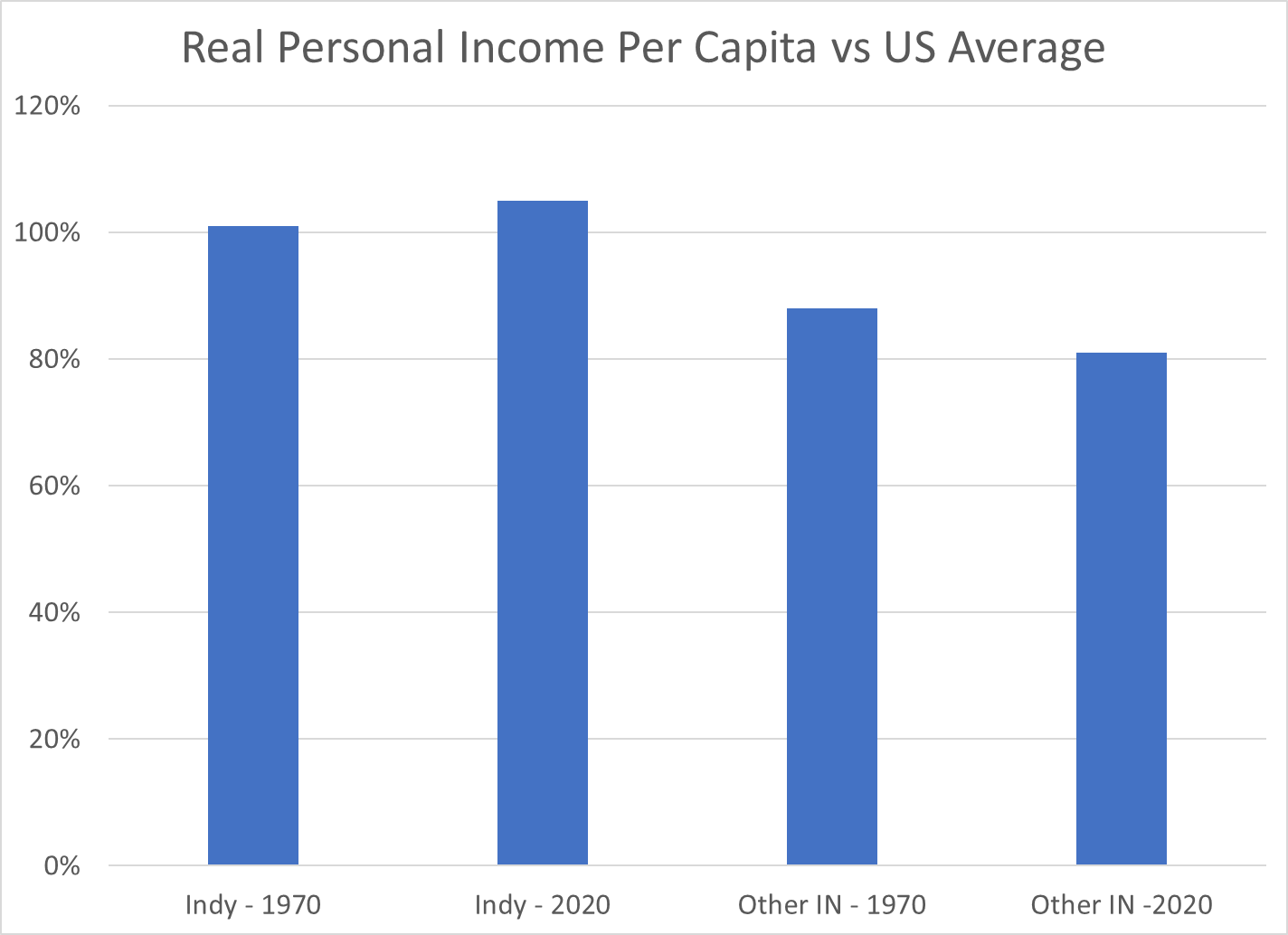
Indiana per capita income was $51,900, now just 87% of the US average of $59,500.

In 1970, Indiana per capita income was indistinguishable from the national average: $3,020 versus $3,119 (nominal/current dollars). Indiana was the 18th highest rated state, leveraging its manufacturing prowess, highly productive agriculture, central logistics location, proximity to Chicago and ports on the Great Lakes and the Ohio River.

In 2020, just 5 Indiana counties had per capita incomes above the US average. 87 had lower levels. In just 2 generations, nearly the whole state had moved from a proud “average American” level to well below average.

In 2020, only 11 of Indiana’s 92 counties earned 90% of the national average. Just 41 of 92 Indiana counties earned even 80% of the national average.

The distribution of per capita income levels within Indiana expanded. In 2020, just 13 of 92 counties were “above average” compared with the Indiana average, which was already 13% below the national average.

Indianapolis suburban counties Hamilton and Boone averaged $80,000 of per capita income in 2020, far above the US and Indiana averages. No other Indiana counties averaged as much as 80% of this level. Just 4 others reached 70% of this aspirational level: $56,300. Only 11 of 92 counties earned two-thirds of the wealthy suburban level at $53,600. 39 of 92 Indiana counties had per capita incomes above 60% of the suburban winners.

Income distribution matters within counties and across counties. The increasing disparity in incomes is driving American politics.

https://www.bea.gov/data/income-saving/personal-income-county-metro-and-other-areas

Indiana Population Grew Half as Fast as the US from 1970-2020.

The US population increased by 61%, from 205 to 330 million.

Indiana population increased by 30%, from 5.2 to 6.8 million. Indiana added nearly 1.6 million people during these 5 decades. It would have added another 1.6 million if it grew as fast as the US average.

Indy Metro Area Grew by a Strong 72%.

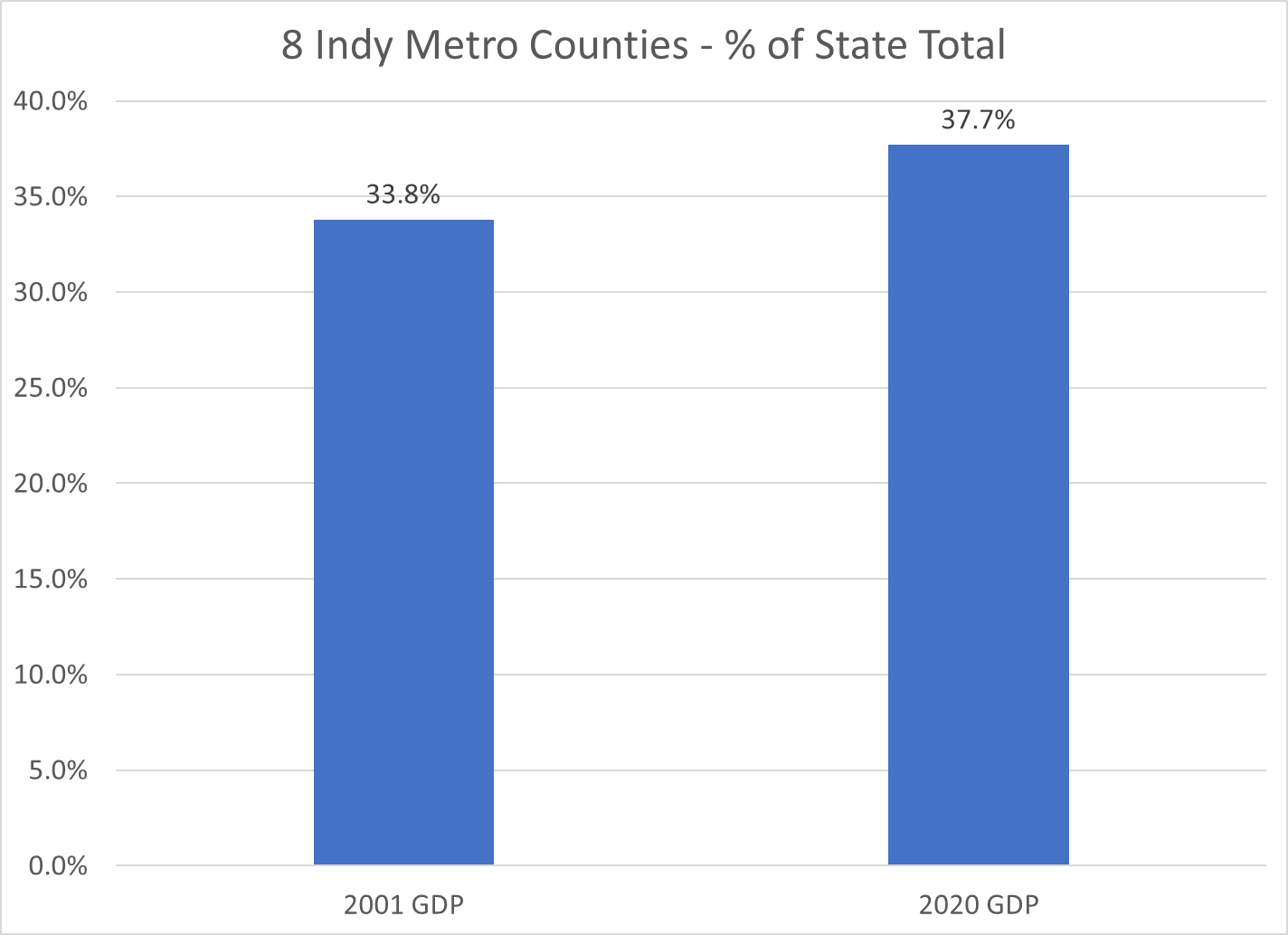
The 8-county area grew from 1.1 to 1.9 million, adding 800,000 people and accounting for one-half of the whole state’s growth during this period. Growth has been consistently strong in each of the last 3 decades, adding 230,000, 220,000 and 220,000. The Indy Metro area has grown from 21% to 28% of the state’s total population.

6 Other Suburbs Grew by 76%

Porter (CHI) added 84K. Dearborn (CIN) added 20K. Warrick (EVN) added 35K. Harrison (20K), Floyd (23K) and Clark (43K) added to the metro Louisville population. In total, these 6 counties added 226,000 people to their 296,000 base, reaching 523,000 in 2020. They grew from 6% to 8% of the Indiana total.

Indiana and Purdue University Counties Grew by 79%

Monroe (76%) and Tippecanoe Counties (81%) displayed very similar growth rates. Their combined population increased by 153K, from 194K to 348K. Their share of the Indiana total increased from 4% to 5%.

These 18 counties out of Indiana’s 92, accounted for 76% of the population growth, increasing by 1.2M, from 1.6M to 2.8M people! Their share of the state total grew from 31% to 41%!

Northern Indiana Tier (South Bend, Elkhart, Ft. Wayne) Added 38%

The 10 counties stretching from St. Joseph (South Bend) to Allen (Ft. Wayne) showed modest, but consistent growth throughout the period. Elkhart was most successful, adding 81,000 people (64%). Ft. Wayne added 101,000 people, but just 36% growth. St. Joseph managed to add 27,000, but just an 11% growth rate. Marshall, Kosciusko, LaGrange, Noble, Whitley, Steuben and DeKalb counties each added at least 10,000 residents.

In total, this section added 326,000 citizens, growing from 860,000 to 1,190,000. It’s share of Indiana’s population shaded up from 16% to 17%.

Lake County (Gary) Lost 11%

Population dropped by 62K, from 546K to 484K. Lake County reduced its Indiana population share from 10.5% to 7.2%.

8 Small City Counties Lost 5%

These stand-alone counties each had at least 75,000 citizens in 1970. Together, with 902,000 people they accounted for 17.4% of Indiana’s total. Their population fell by 48,000 to 855,000, representing just 12.4% of the Indiana total in 2020. From best to worst population growth, using their main city for easy identification: Evansville (+13K), LaPorte (+1K), Kokomo (-1K), Terre Haute (-8K), Anderson (-9K), Richmond (-14K), Muncie (-15K) and Marion (-19K).

57 Rural Counties Added 13%

These counties all started with populations of less than 60,000 in 1970. The average county had 23,000 residents. This increased to 25,000 by 2020. 17 counties actually lost population across 50 years. Another 24 counties added less than 5,000 people. Just 16 counties added 6,000 people or more (including the next 5). Jaspers, Dubois, Jackson and Putnam each added more than 10,000 people. Bartholomew (Columbus) was the outlier, adding 28,000 people, growing by 48%, from 57,000 to 85,000 people.

In total, this group added 167,000 people, growing slowly from 1.283 to 1.449 million. Their share of the state total population dropped from 24.7% to 21.4%.

These 3 slower growing areas represent 66 counties, or 70% of the Indiana total. Their combined population increased by 2% in a half-century, edging up from 2.7 to 2.8 million. Their share of the Indiana total has declined from 53% to 41%, so possible future slow growth will have a relatively lesser impact on the state total.

Summary

The Indianapolis area, 6 other suburban counties and the homes of Indiana and Purdue Universities grew nicely at 75%, above the 61% national growth rate. 10 counties in the northern tier and Columbus showed modest growth. Two-thirds of Indiana’s counties grew at close to zero percent across 50 years. The 2000-2010 and 2010-2020 periods showed the same overall results.

Indiana shares these stagnant rural and old tech manufacturing county challenges with its neighboring states.

Good News: US Unemployment is at Record Lows

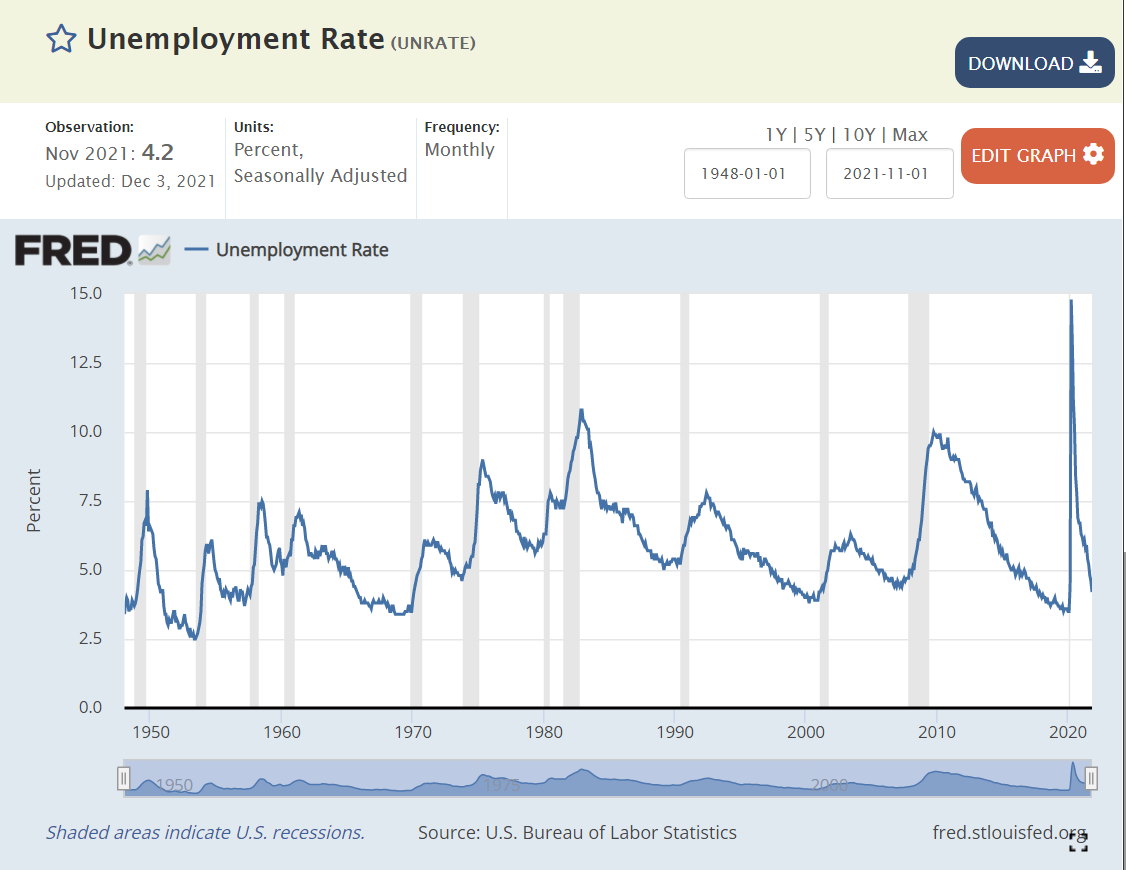
https://fred.stlouisfed.org/series/UNRATE

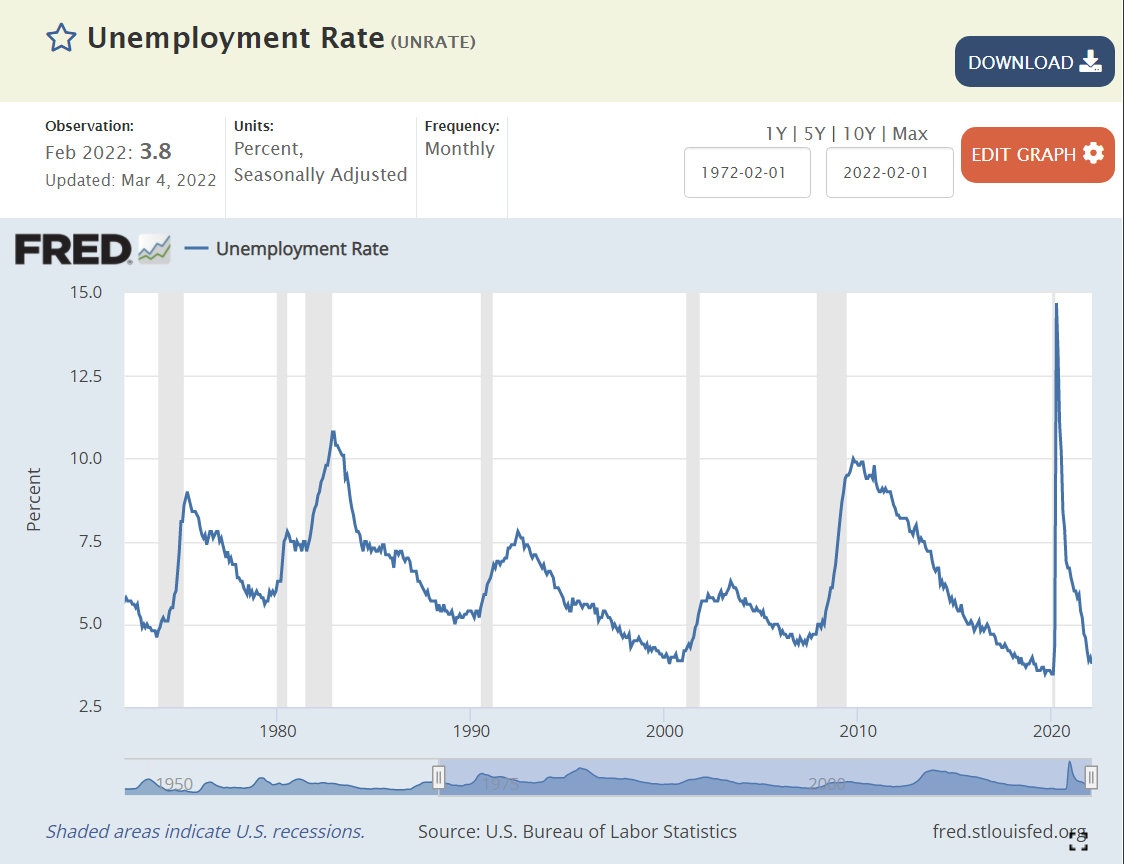
In the last 50 years, the last 600 months, the US unemployment rate has been below the current 3.8% for just 9 months (less than 2% of the time).

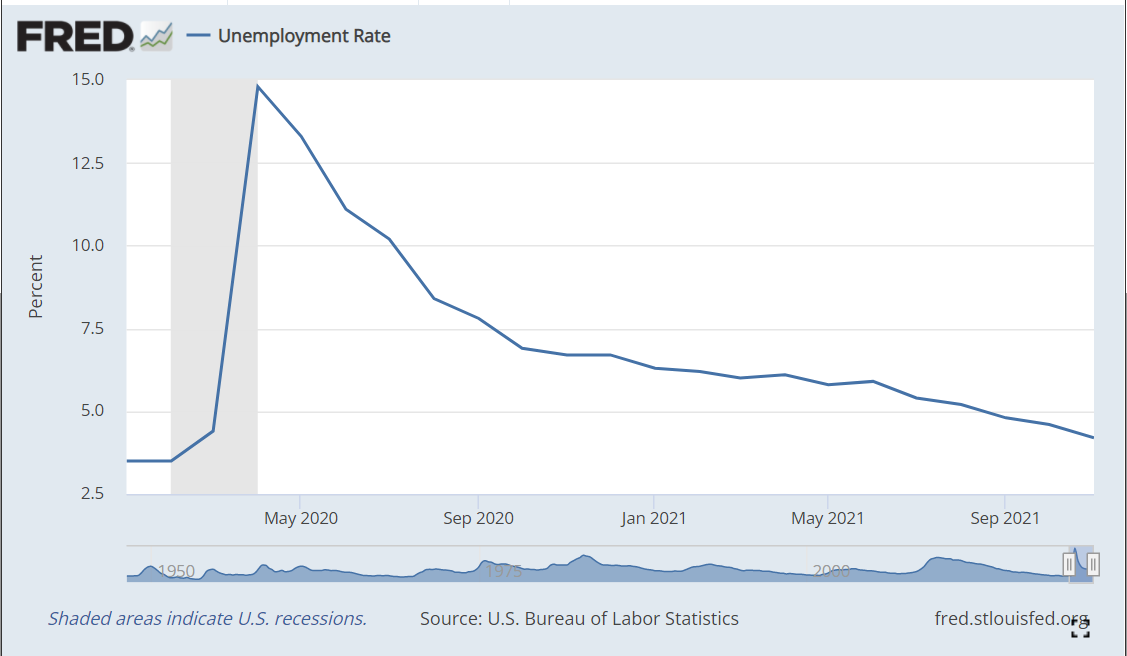
This is less than 2 years after the rate hit a modern HIGH of 15%.

9 states set all-time lows this month: Nebraska (2.1%), Vermont (2.1%), Indiana (2.3%), Kansas (2.5%), Montana (2.6%), Oklahoma (2.6%), Arkansas (3.1%), West Virginia (3.9%) and Mississippi (4.5%).

In February, 31 states had material decreases, while 19 had immaterial changes and NO states had material increases.

https://www.bls.gov/news.release/laus.nr0.htm

At the metropolitan area level, 50 areas sported unemployment rates of 3% or less, far below historical results.

11 areas were at crazy low 2.3% unemployment rates or lower: Lincoln, NE and Madison, Wi. Logan, Provo and Ogden UT. Elkhart, Columbus, Bloomington, Lafayette, Ft Wayne and Indianapolis, IN.

https://www.bls.gov/web/metro/laummtrk.htm

Results of State Covid Strategies

Many states have legislatures and governors from the same party and voted for this party in both the 2016 and 2020 presidential elections. These states have adopted quite different Covid management strategies. There are 14 solidly Democratic states and 21 solidly Republican states, leaving 15 states with some level of “mixed” political control and influence.

https://ballotpedia.org/Partisan_composition_of_state_legislatures

https://www.ncsl.org/research/about-state-legislatures/partisan-composition.aspx#

https://www.cnn.com/election/2020/results/president

https://www.politico.com/2016-election/results/map/president/

https://en.wikipedia.org/wiki/List_of_U.S._states_and_territories_by_population

Fully Vaccinated, Age 18+

Democratic states average 80%, Republican states 66% and Mixed states 73%. The national average is 72%. Nevada (69%) is the only Blue state below 75%. Alabama, Wyoming and Mississippi have the lowest scores for the GOP at 59-60%. Florida has the highest rate at 75%. The split in world views is confirmed by this measure. The mixed group ranges from Louisiana and Georgia at 63% to Massachusetts (85%) and Vermont (86%).

https://covid.cdc.gov/covid-data-tracker/#vaccinations_vacc-total-admin-rate-pop18

Cumulative Death Rate / 100,000 Population

The overall death rate for the country is 256. The mixed states are similar at 265. The Democratic states average 221 deaths per 100K people. The Republican states average 282 deaths per 100K people. If the Republican states had the same rate as the Democratic states, they would have 59 fewer deaths per 100K people, for a cumulative total of 70,000. Economists use $10M as the value of a life in many cost-benefit calculations, so one measure of the difference is $700B.

California (196) and New York (227) drive the lower D result, but the Dems include higher fatality states such as Rhode Island (305) and New Jersey (344). The mixed states include some relatively high death rates in Michigan (315), Louisiana (329) and Arizona (350). The Republican group includes 3 states below the D average in Utah, Alaska and Nebraska, but 7 states at 300 or higher: Oklahoma, Indiana, West Virginia, Arkansas, Tennessee, Alabama and Mississippi.
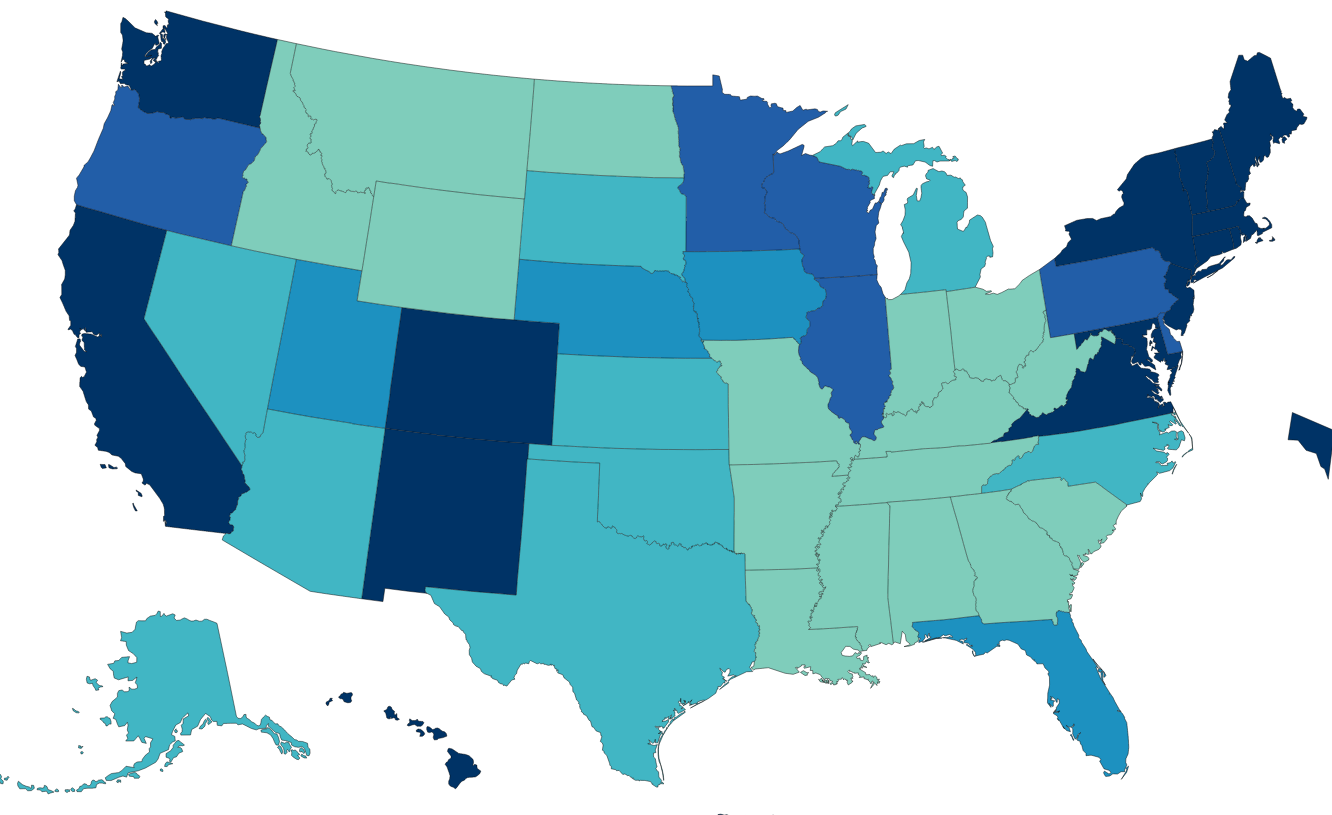
https://covid.cdc.gov/covid-data-tracker/#cases_deathsper100k

As the median age for Covid deaths is 75, an argument could be made that the $10M economic value of a human life is too high in this analysis.

https://www.cdc.gov/nchs/nvss/vsrr/covid_weekly/index.htm#SexAndAge

Population density and the percentage of population aged 65+ did not have statistically material impacts on the pattern by political party control.

https://www.census.gov/data/tables/time-series/dec/density-data-text.html

Nonfarm Employment Recovery: Nov 2021 vs. Feb 2020

Overall employment is within 2% of the February, 2020 peak for the country as a whole. The “mixed” states have recovered to within 2.3% of the peak. The Democratic states are only at 96.4% of the peak, while the Republican states, on average, are just below breakeven at 99.9%. If the D states had the same level of recovery, there would be 1.8M jobs added in the recovery to date. At the recent median $1,000 per week wage, this would generate $94 billion of income annually.

https://www.bls.gov/news.release/laus.t03.htm#

https://view.officeapps.live.com/op/view.aspx?src=https%3A%2F%2Fwww.bls.gov%2Fsae%2Ftables%2Fannual-average%2Ftable-1-employees-on-nonfarm-payrolls-in-states-and-selected-areas-by-major-industry.xlsx&wdOrigin=BROWSELINK

I used the Feb 2015 to Feb 2020 period to generate a pre-Covid trend growth rate. This was 6.4% for the country, 5.4% for the mixed states, 7.0% for the D states and 6.7% for the R states. This indicates that the Republican faster recovery is not due to prior momentum. I used the 2020/2015 growth rate to create a solid estimate of the 2021/2020 recovery rate for each state (r = 0.63). It confirmed the 3%+ gap between the 2 parties was not due to prior trends. I also checked the percentage of 2019 employment in the leisure and hospitality sector, to see if this was driving the difference, but it did not have a material effect.

Mixed Political Control States

State% Vaccinated 18+Deaths/100KJob Recovery
AZ69350103
GA63304100
KS7025198
KY6628398
LA6332993
MD8221597
MA8531097
MI6731596
MN7720097
NH7715797
NC68192100
PA7530796
VT867893
VA8018698
WI7320597

Democratic Party States

State% Vaccinated 18+Deaths/100KJob Recovery
CA7919697
CO78187100
CT8627496
DE7625297
HA867988
IL7526396
ME8612696
NV6928397
NJ8334497
NM7929896
NY8422793
OR7714098
RI8730596
WA80136101

Republican States

State% Vaccinated 18+Deaths/100KJob Recovery
AL5934399
AK7013994
AR62314100
FL75296101
ID63241105
IN6430898
IA7126397
MS6036099
MO6427799
MT64278101
NE73184100
ND6527196
OH6627396
OK6630097
SC6529399
SD7129499
TN63322100
TX70264102
UT74125106
WV6531296
WY6027695

Good News: Very Low Unemployment

The official US unemployment rate has rarely gone below 5%, and has typically risen back above 5% in a matter of months. The post WWII boom from 1951-53 was one positive period. The Vietnam War + Great Society spending period of 1965-69 was another. The second Clinton presidency from 1997 to 2001 was another 4 year period of prosperity.

The Obama presidency started with 7.5% unemployment. It peaked at 10% in 2009, before falling consistently to 4.7% at the end of his term in 2016 (cut in half). The Trump presidency saw a continued reduction of the unemployment rate to a minimum of 3.5% 2 years later, exceeding the expectations of mainstream economists and forecasters.

Unemployment quickly climbed to 15% during the pandemic, before falling back to 6.7% by the end of the year (2020). In the 2 years of the Biden administration, it has declined by 2.5% to 4.2%, a rate last seen in November, 2017.

Historically, “full employment” has been pegged close to 5%.

https://en.wikipedia.org/wiki/Full_employment

The extended period of lower unemployment from 2016-2020 lead many economists to revise their estimate of “full employment” to be an unemployment rate of just under 4.5%.

https://www.bloomberg.com/quicktake/full-employment

Candidate Trump repeatedly claimed that candidate Biden would “ruin” the economy. It has proven to be more resilient to a change in administrations.

https://www.cbsnews.com/news/trump-economic-club-new-york-recovery-jobs/

The economic expansion has lead to unprecedented low 1.5% unemployment rates in some Midwest communities.

https://www.indystar.com/story/news/local/hamilton-county/2021/12/28/carmel-zionsville-among-states-lowest-unemployment-rates-november/8980831002/

The recent economic recovery has had a disproportionately positive effect on Republican leaning (Red) states., which have a median 3.5% unemployment rate. Nebraska, Utah, Oklahoma, Idaho, South Dakota and Montana enjoy sub 3% unemployment rates. Democratic leaning (blue) states have a median 5.4% unemployment rate, with only the blue states of Vermont and Minnesota experiencing below average unemployment. The purple battleground states are in the middle with a median 4.5% unemployment rate.

https://www.bls.gov/web/laus/laumstrk.htm

https://www.270towin.com/content/blue-and-red-states

Large metropolitan areas have seen a slightly better than national reduction in their unemployment rates. 25 of the top 50 metro areas have unemployment rates below 4.0%. 8 have rates below 3%. Nashville (2.8%), Milwaukee (2.8%), Minneapolis (2.6%), Birmingham (2.5%), Atlanta (2.4%), Indianapolis (2.4%), Oklahoma City (1.9%) and Salt Lake City (1.4%) are clearly experiencing full employment. Another 14 metro areas have unemployment rates of 4.0 – 4.9%; in the “full employment” range. Just 11 have unemployment rates of 5% or higher.

Chicago, Houston, Philadelphia, San Diego, Sacramento, New Orleans and Hartford display marginally high unemployment rates of 5.1% – 5.4%. Just 4 of the nation’s 50 largest metro areas encounter higher rates: NYC (6.3%), LA (7.1%), Riverside (6.3%) and Las Vegas (6.6%).

https://www.bls.gov/web/metro/laummtrk.htm

Despite the prevailing “negative” media attention, if the economic recovery continues at its current rate, the unemployment rate will reach 3.5% or lower in March, 2022. This rate has been recorded only in Feb, 2020, Jul, 1969 and Nov, 1953. In the shadow of a global pandemic last experienced in 1918, this is amazing news.

We are clearly living in “interesting times”.

Personally, I agree with Fukuyama that western liberal democracies and mixed capitalist economies have won the ideological wars, leaving fascist, communist and dictator regimes behind. This is despite the rise of populist movements on the right in western democracies, the resilience of dictatorships on many continents and especially the retrograde actions of China to preserve its central place on earth as a “special” nation. The war is not complete. It calls for liberal capitalist nations to refine their ideologies and wisely play their global roles.

https://en.wikipedia.org/wiki/The_End_of_History_and_the_Last_Man

https://www.theguardian.com/books/2014/mar/21/bring-back-ideology-fukuyama-end-history-25-years-on

https://www.newyorker.com/magazine/2018/09/03/francis-fukuyama-postpones-the-end-of-history

https://www.theatlantic.com/politics/archive/2014/09/its-still-not-the-end-of-history-francis-fukuyama/379394/

https://www.opendemocracy.net/en/endism/

My Favorite Airport Landings and Takeoffs

I’ve been flying for business and pleasure for more than 40 years. I’d like to share some of my favorite domestic and international airports.

Cleveland Burke Lakefront: steps from downtown; my boss Ron Diderich used to fly here daily from DTW in 1982.

Sarasota: My first landing in 1974; so much busier today where Sue and I have our winter home.

Indy Exec Airport. I served on the local airport board for 8 years.

Boston Logan is a major NE hub with an ocean approach which I first experienced landing in 1975.

Mackinac Island is a small airport with varied service.

Chicago Midway Airport

Chicago’s Midway Airport is a Southwest hub and used to be a hub for Indy’s American TransAir (ATA). The airport is in a 1 x 1 mile block in Chicago with a very short 5,200 foot long main runway.

New York is a huge US hub; enjoy a Newark approach.

Maui (’nuff said).

Key West; Another Island Paradise

San Diego; more exciting landing than expected.

San Francisco; I observed this approach from the front seat in 1998.

Washington, DC: Reagan. The greatest mainstream US airport approach, every time.

Aspen, CO. A mountain approach and a very exciting takeoff.

Tokyo.

Nice, France.

Old Hong Kong Airport (I first experienced in 1997).

https://www.cnn.com/travel/article/hong-kong-kai-tak-airport/index.html

https://www.atlasobscura.com/articles/kai-tak-hong-kong-airport-scary-landing

Queenstown, NZ. Truly Amazing.

Hiking – Less than 2 hours from Indianapolis

I hiked in each of the 200 counties within 3 hours (210 miles) of Indianapolis during 2020-2021. I’d like to share hikes in 10 of the 60 counties within 110 miles of Indy.

Morgan-Monroe State Forest

Morgan-Monroe State Forest offers a variety of moderately challenging woods and stream valley hikes just an hour southwest of Indy. You might combine this with a hike in Yellowwood State Forest just 30 miles further south.

No photo description available.

https://www.in.gov/dnr/forestry/properties/morgan-monroe-state-forest/

Portland Arch Nature Preserve

Portland Arch Nature Preserve is less than 90 minutes NW of Indy via I-74 and US 41 near the Illinois border. It features deep stream valleys, cliffs and a small “arch” with a stream running through it. Combine this hike with a visit to 90 foot high Williamsport Falls just 8 miles to the north or Shades State Park 35 miles to the south.

No photo description available.

https://www.nature.org/en-us/get-involved/how-to-help/places-we-protect/portland-arch-1/

McCloud Nature Park

McCloud Nature Park is 40 miles WNW of Indy. Trails follow the hills and valley of Big Walnut Creek. Combine this with a hike in Big Walnut Nature Preserve 8 miles west, Sugar Creek Nature Park 30 miles NW or Fern Cliff Nature Preserve 30 miles SW.

No photo description available.

https://www.visithendrickscounty.com/listings/mccloud-nature-park/186/

Spring Mill State Park

Spring Mill State Park is 90 miles south of Indy, past Bloomington and Bedford via IN-37. This is limestone country. The park features history, steep valleys, hills, forests, lakes and an inn. Combine this with a stop at Cedar Bluffs Nature Preserve 30 miles north or Hardin Ridge Recreation Area on Lake Monroe 30 miles north.

Spring Mill State Park: Memories and Some Photos ⋆ Stephanie A. Cain
No photo description available.

https://www.in.gov/dnr/state-parks/parks-lakes/spring-mill-state-park/

Clifty Falls State Park

Clifty Falls State Park is 90 miles SE of Indy. It features several trails that view waterfalls or rapidly flowing streams that are moving from the standard elevation of SE Indiana down to the Ohio River. Combine this hike with a visit to Madison, IN or Versailles State Park 30 miles north.

Clifty Falls State Park — terryangel.com
May be an image of tree, nature and body of water
May be an image of nature and body of water
May be an image of tree and nature

https://www.in.gov/dnr/state-parks/parks-lakes/clifty-falls-state-park/

Calli Nature Preserve

Calli Nature Preserve is located 70 miles southeast of Indianapolis along the Muscatatuck River. The short trail explores a small stream valley and the river valley. It is best visited when Spring wildflowers are in bloom. Combine this hike with a visit to Selmier State Forest just 5 miles north or Muscatatuck National Wildlife Refuge 12 miles to the west.

Calli Nature Preserve (North Vernon) - 2021 All You Need to Know BEFORE You  Go (with Photos) - Tripadvisor
No photo description available.

Versailles State Park

Versailles State Park is located 75 miles southeast of Indianapolis. The park features a lake and trails that follow streams/historic roads upland to the east. Combine this hike with a stop at Calli Nature Preserve or Selmier State Forest 20 miles to the west.

Versailles State Park : r/Indiana
No photo description available.

https://www.in.gov/dnr/state-parks/parks-lakes/versailles-state-park/

France Park

France Park is located 80 miles north of Indy in the Wabash River Valley. The park features a lake in an old quarry, overlooks, waterfall, a beach and some geological history. Combine this hike with a stop on the Nickel Plate Rail Trail between Peru and Kokomo 25 miles east.

France Park Falls
No photo description available.

https://visitindiana.com/things-to-do/54745-france-park

Ouabache State Park

Ouabache State Park is located 110 miles northeast of Indy, south of Ft. Wayne, about 30 miles from the start of the Wabash River in Ohio. This is still relatively flat, agricultural Indiana, but the park features pines forests, wetlands, a small lake and a herd of bison. Combine this hike with a stop at the JE Roush Fish and Wildlife Area 25 miles to the NW or the Loblolly Marsh 16 miles south.

Ouabache State Park | David, Janet, and our Van
Info for campers - Review of Ouabache State Park, Bluffton, IN - Tripadvisor
May be an image of animal and nature

https://www.in.gov/dnr/state-parks/parks-lakes/ouabache-state-park/

Kickapoo State Recreation Area (IL)

Kickapoo State Recreation Area is 100 miles NW of Indy, just across the Illinois border. It features trails along the Versailles River in an area that was once only strip mines. Combine this with a visit to the Forest Glen Preserve 20 miles to the south or the Portland Arch 30 miles to the east.

No photo description available.

https://www2.illinois.gov/dnr/Parks/Pages/Kickapoo.aspx

Hiking – East North East Indiana

This area is mostly flat, with a few smaller river valleys and many well-maintained rail-trails.

2 mile paved trail from Blackford HS, east or Marion, IN.

https://www.facebook.com/Blackford-Greenway-Inc-140018430028350/

Follow the Cardinal Greenway from Richmond, IN to Losantville to Muncie to Gas City to Marion. 60 miles of gently rolling terrain on a rail-trail, part of the American Discovery Trail.

Trail near Richmond heading north. - Picture of Cardinal Greenway, Muncie -  Tripadvisor

https://www.indianatrails.com/cardinal-greenway

Rail trail west of Marion, IN.

Heavily used rail-trail in Hamilton County, north of Indianapolis.

Monon Trail Homes for Sale | m.s.Woods Real Estate | Homes for Sale Near Monon  Trail

https://www.visithamiltoncounty.com/things-to-do/outdoors/monon-trail/

Rail-trail west of Indianapolis.

https://www.greenfieldin.org/component/content/article/107-content/170-pennsy

Impounded lake with trails south of Muncie, IN.

https://www.in.gov/dnr/state-parks/parks-lakes/summit-lake-state-park/

Rail-trail beginning in Kokomo, IN by the Wildcat Creek.

http://www.nickelplatetrail.org/

Wetlands area north of Portland, IN.

Blog Archives - Friends of the Limberlost

Hiking along the White River plus Indian mounds near Anderson, IN.

https://www.in.gov/dnr/state-parks/parks-lakes/mounds-state-park/

Highly used rail-trail for 10 miles in Indianapolis.

https://www.visitindy.com/indianapolis-monon-rail-trail

Explore the streets and rail tracks of this small town north of Indianapolis.

Hiking – SW Indiana

From the Wabash River to Patoka River/Lake to the Hoosier National Forest, scenic trails and preserves abound.

Hike the central road of Dogwood Lake at Glendale FWA, SE of Washington, IN.

Glendale Fish & Wildlife Area - Southern Indiana

https://www.in.gov/dnr/fish-and-wildlife/properties/glendale-fwa/

The 6 mile main trail is rugged, providing a view of Totem Rock. Patoka Lake is south of French

Lick, IN.

https://www.in.gov/dnr/state-parks/parks-lakes/patoka-lake/

The Snakey Point Marsh offers trails and road hikes in Patoka River Wildlife Refuge, north of Evansville.

Spring Mill State Park, south of Bedford, IN, is one of the largest Indiana State Parks with an inn and extensive hilly, wooded hiking trails.

https://www.in.gov/dnr/state-parks/parks-lakes/spring-mill-state-park/

Southwest of Bedford, IN, adjacent to Hoosier National Forest, Martin State Forest offers a variety of moderate to challenging hikes in the forested hills.

https://www.in.gov/dnr/forestry/properties/martin-state-forest/

1 mile old growth forest trail south of Bedford, IN. (Pioneer Mothers Memorial)

https://www.fs.usda.gov/recarea/hoosier/recarea/?recid=41586

Tipsaw Trail is 6 miles long in rugged country near Tipsaw Lake in the southern Hoosier National Forest, 20 miles north of the Ohio River.

Hoosier National Forest - Wikipedia

https://www.fs.usda.gov/recarea/hoosier/recarea/?recid=41500

West of Jasper, IN, Pike State Forest encompasses the bottomlands of the Patoka River and small hills.

https://www.in.gov/dnr/forestry/properties/pike-state-forest/

South of Evansville on the banks of the Wabash River, Harmonie State Park offers moderately rugged woods hiking.

Harmonie State Park - State of Indiana
Harmonie State Park Indiana HD wallpapers, Backgrounds

https://www.in.gov/dnr/state-parks/parks-lakes/harmonie-state-park/

South of Jasper, IN, Lincoln State Park offers 10 miles of hiking trails in varied areas.

Free Admission to Lincoln State Park - Santa Claus Indiana

https://www.in.gov/dnr/state-parks/parks-lakes/lincoln-state-park/

Short hike in community park and adjacent neighborhoods in Evansville.

https://www.visitevansville.com/sports/price-park

Challenging hike through creek bottoms and steep cliffs, west of Louisville.

https://www.crawfordcountyindiana.com/attractions/park-scenic/yellow-birch-ravine/

Off-road vehicle park, with some trails open to hikers on this formerly strip-mined site. Northeast of Evansville.

https://www.in.gov/dnr/outdoor-recreation/properties/interlake-state-recreation-area/

Vincennes community park with Wabash River and woods trails.

Ouabache Trails County Park | The Dyrt