
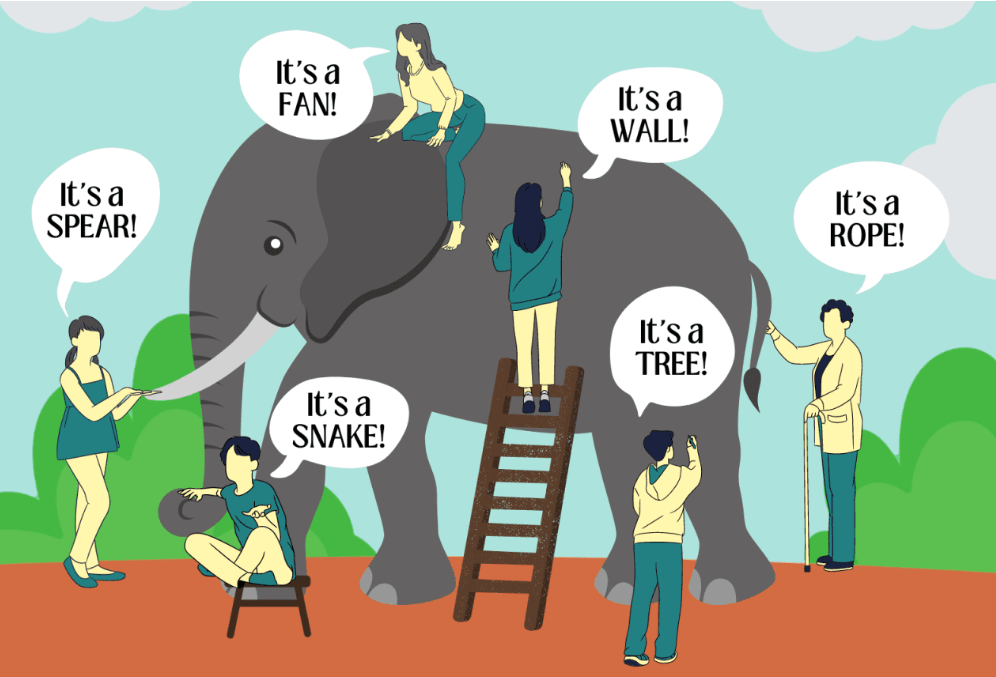
The blind men and the elephant: Is perception reality?
In recent times, eight older men lived in an Indiana community. Each was successfully retired and quite confident. Their neighbors loved the older men and encouraged their breakfast group meetings. Since the older men were no longer actively engaged at work, they had to imagine how things really operated. They listened carefully to stories about the active world of business, government, politics, health care, science, and leadership told to them by others.
The men were curious about many of the stories they heard, but they were most curious about Civility as a super solution to social challenges. They were told that Civility could fix politics, solve tough problems, promote personal growth, reinsert facts and logic into debate, revive trust, social relationships and institutions, and restore the balance between individuals and community.
They remembered Indiana as a very special place with great leaders. They recognized Birch and Evan Bayh, VP’s Quayle and Pence, representatives Lee Hamilton and Julia Carson, Indianapolis mayors Hudnut, Goldsmith, Petersen, Ballard and Hogsett, mayor and senator Lugar, but especially Governor Mitch Daniels. They knew that Daniels had been effective for Indiana, America and Purdue. Did Daniels believe in this Civility miracle solution?
The older men argued day and night about Civility. “Civility must be too simple,” claimed the first man. He had heard stories that it ignores real differences and big solutions.
“No, you must be wrong,” argued the second man. “Civility is complicated, combining values and habits in search of perfection. That is why people struggle to follow it.”
“You’re wrong! Civility seeks compromise, the middle ground and the golden mean. It combines the best that participants can offer,” said the third man.
“Please,” said the fourth man. “You are all mistaken. Civility grandly guarantees that it can solve all problems and conflicts! You know how people exaggerate.”
“How can you be so naïve,” exclaimed the fifth man. “Civility simply rationalizes weak, overly sensitive behaviors that avoid conflict and deny human nature.”
“Civility ignores passion and the emotions,” cried the sixth man. “It eliminates feelings, values, and intuitions by emphasizing cold rationality alone.”
“I am sure that Civility is a leftist plot,” said the seventh man. “That would explain why it emphasizes the importance and legitimacy of government.”
“On the contrary,” declared the eighth man. “Civility is a Republican scheme to return to the 1950’s with its mindless emphasis on a single culture, morality, character and values.”
Finally, the neighbors grew tired of all the arguments, and arranged for the curious men to visit the home office of Mr. Daniels to learn the truth about Civility.
When the men reached the home a half-hour ahead of schedule, they were greeted by an old friend who managed the governor’s visitors. Their friend led them to a waiting room where they watched a 10-minute video on Civility. The retired men quickly began to argue.
The first man stood up and exclaimed. “Civility is just common sense, nothing special.”
The second man misquoted the video. “Civility claims that all people can get along and all problems can be solved,” he announced.
The third man disagreed. “I was right,” he decided. “Civility is a tool of the powerful to maintain the status quo.”
The fourth man criticized Civility’s idealism. “What we have here,” he said, “is a sort of cult, invoking magical practices to reach utopian ends.”
The fifth man responded, “Civility is hopelessly weak because it asserts that strong emotions, interpersonal relations, sensitivity and hospitality can mend all fences.”
The sixth man stated, “Civility is very powerful. It allows groups and individuals to acquire and use power for their own ends, while dismissing the needs and desires of others.”
The seventh man considered the actors in the presentation. “Civility elevates individuals and personal growth above church and community, so it must favor Democrats,” he said.
The eighth man was shocked. “Why, Civility is nothing more than a way for the powerful to reassert social control through norms, taboos and shunning,” he scoffed.
The governor’s aide led his friends to the kitchen. “Sit here and rest,” he said. “I will bring you something to drink.”
While they waited, the eight men talked about Civility.
“Civility is just politeness, rules and etiquette. It is a surface level approach,” said the first man. “Surely we can finally agree on that.”
“Just politeness? Civility aims to transform men, institutions and society” answered the second man.
“Transformation? Civility focuses just on process, promotes elite values and prevents real arguments and solutions” insisted the third man.
“It’s impossible for everyone to develop such powerful skills that effectively bridge real human differences,” said the fourth man.
“Civility merely assumes that better skills, processes and values can manage differences, conflicts and human nature through the forces of goodwill,” noted the fifth man.
“Civility provides a socially approved way for individuals to emphasize form over substance. They can perform in a civil manner without really addressing the needs of others,” cautioned the sixth man.
“Socialist subjectivity and radical tolerance. There’s no doubt,” said the seventh man.
“Don’t you see?” pleaded the eighth man. “Civility is intended to keep us occupied and distracted by small issues and away from the larger issues of systematic injustice. Someone is using Civility to trick us.”
Their argument continued and their shouts grew louder and louder.
“Too simple!” “Too complex!” “Too moderate!” “Too extreme!” “Too soft!” “Too hard!” “Too liberal!” “Too conservative!”
“Stop shouting!” called a very angry voice.
It was Purdue President emeritus Daniels, disturbed by the noisy argument.
“How can each of you be so certain you are right?” asked the former governor.
The eight men considered the question. And then, knowing the budget director to be a very wise man, they decided to say nothing at all.
“Civility combines values, skills and behaviors to solve problems and build relations,” said Mr. Daniels. “Each of you exaggerates the importance of only one part. Perhaps if you put the parts together, you will see the truth. Now, let me finish my morning in peace.”
When their friend returned with drinks, the eight men rested quietly, thinking about their leader’s advice.
“He is right,” said the first man. “To learn the truth, we must put all the parts together. Let’s discuss this on the journey home.”
The first man found his seat on the senior bus. The second man found his seat, and so on until all eight men were ready to travel together.
References (and apologies …)
Peace Corps – The Blind Men and the Elephant
Civility is Nonpartisan – Good News
Civility is Not Simple or Easy – Good News
Opposition to Civility is Unconvincing – Good News
Opposition to Civility is Unconvincing (2) – Good News















 Good News