
Are You Better Off? Yes, Today, November, 2021.

Ronald Reagan skewered Jimmy Carter with this taunt in the 1980 presidential debate. Joe Biden’s approval rating is falling quickly in recent months. US voters need to assess the true state of the US economy under Biden’s leadership after 2 years of a global pandemic, last seen in 1918.

Real Disposable Personal Income Per Capita

Real, inflation adjusted income per person continues to rise. In 2000, average income was just $33,000 per year. It rises quite significantly to $38,000 in booming 2007-10. It remains at this level through 2013. This is a 15% increase over 13 years, a little better than 1% per year. The economy adds another $6,000 in the next 7 years before the pandemic. That’s growth twice as fast, 2% per year during this boom time. Real income has grown another $2,000 to $47,000 in the last 2 years, 2% annually, after the pandemic. Very good news.

Employed Persons

US employment was typically 130M from 2000-2012. Great growth occurred from 2012 to 2020, reaching an unprecedented 152M. The pandemic dropped employment to 130M, an incredible 22M lower. Employment quickly rebounded about half-way to 142M during 2020. It has grown by another 6M in the last year. The employment growth from 2010-20 averaged 2M per year. The 2021 record is a very strong performance, reflecting a healthy economy that has robustly adapted to the challenges of a pandemic environment.

Unemployment Rate

Unemployment averaged about 5% during the first decade of the century, a generally good result compared with 20th century history. It doubled to 10% during the “Great Recession” and then slowly declined to 5% by 2015 and then even further, exceeding economists’ expectations, to 3% in 2018-2020. The pandemic rocketed it up to 15%, but it quickly recovered to 7%. It has since declined to less than 5%, which has historically been the typical definition of “full employment”.

Job Quits
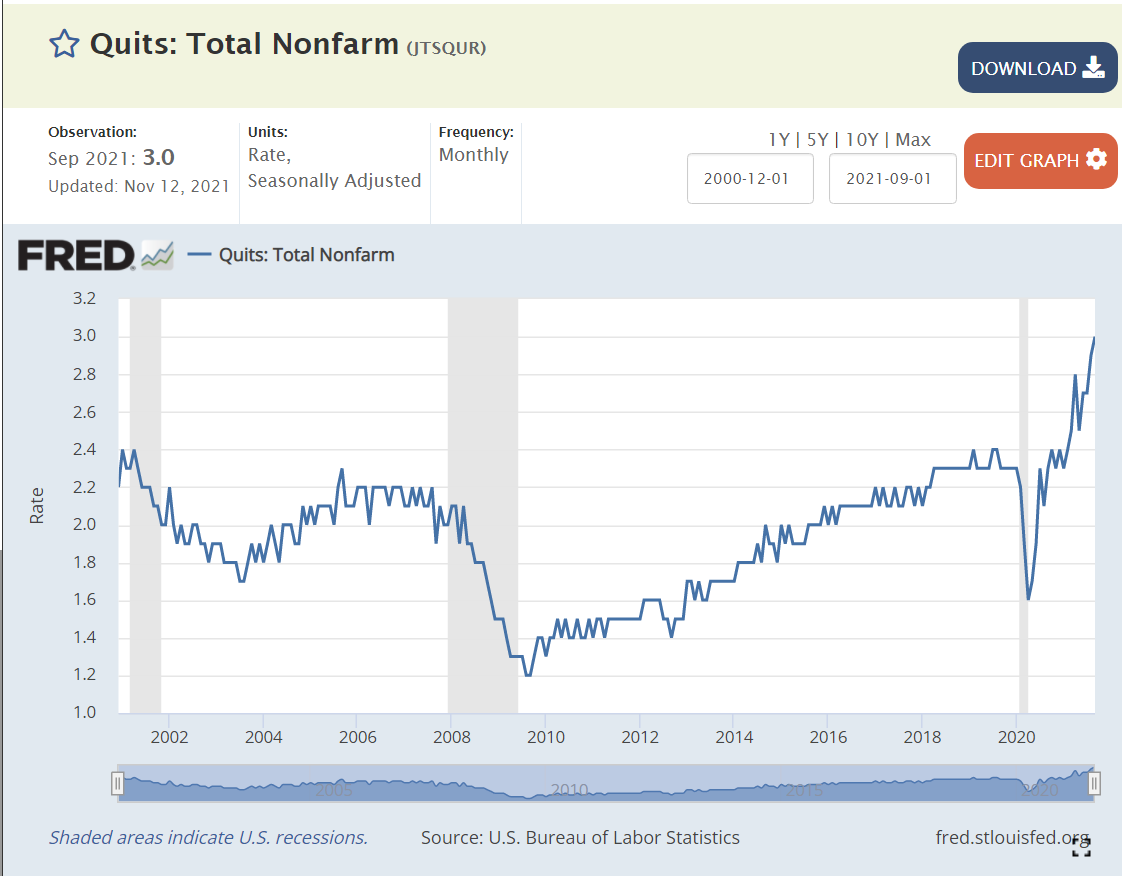
From 2000-2008, about 2% of employees voluntarily left their positions in any given month. The quit rate dropped to 1.5% in the aftermath of the “Great Recession” (2010-13). It very slowly recovered to 2.2% during 2016-18. It increased a little bit to 2.3% in 2019-2020. It rebounded to 2.3% in 2020, and has since increased to an unprecedented 3%. This reflects a labor market where 50% more employees are making a voluntary choice to leave their current employer, apparently confident that they can find an equal or better position.

Job Openings

Job openings averaged 4M from 2000-2014. Openings fell to 3M in 2010-12 after the “Great Recession”. Job openings then grew to 6M in 2017-18 and further to 7M in 2019-20. Job openings quickly returned to 7M early in the pandemic and then began their climb to the current 11M level. Again, these are unprecedented levels, twice as many open jobs as in any time from 2000-15.

Unemployed Persons Per Job Opening

The 2006-7 baseline was 1.5 unemployed persons per open position. The “Great Recession” peak was 6 to 1, an incredibly different labor market, where many older people “retired”; new college graduates went to graduate school, accepted lower positions or remained unemployed; and mid-career professionals accepted positions at 20% lower salary levels. It took 5 years to return to the typical 1.5/1 ratio. This ratio declined a little bit further to 1/1 during 2017-2020 in a tight labor market. The ratio very quickly returned to the historical 1.5 baseline during 2020. It is now at an unprecedented 0.8/1 level. Fewer unemployed people than jobs, not 1.5 to 1, but 0.75/1, half as many potential applicants. This is the first “employees” labor market since the 1960’s.

Home Values

The US Home Price Index was set to 100 in 2000. It increased to 180 during 2005-7. It dropped back to 140 in 2010-13, indicating that part of the rise before “the Great Recession” was a bubble. Prices climbed steadily from 140 to 210 (50% increase) from 2013 to 2020. Despite the pandemic, house prices have continued their climb, exceeding 260, another 25% increase in the last 2 years.

Mortgage Interest Rates
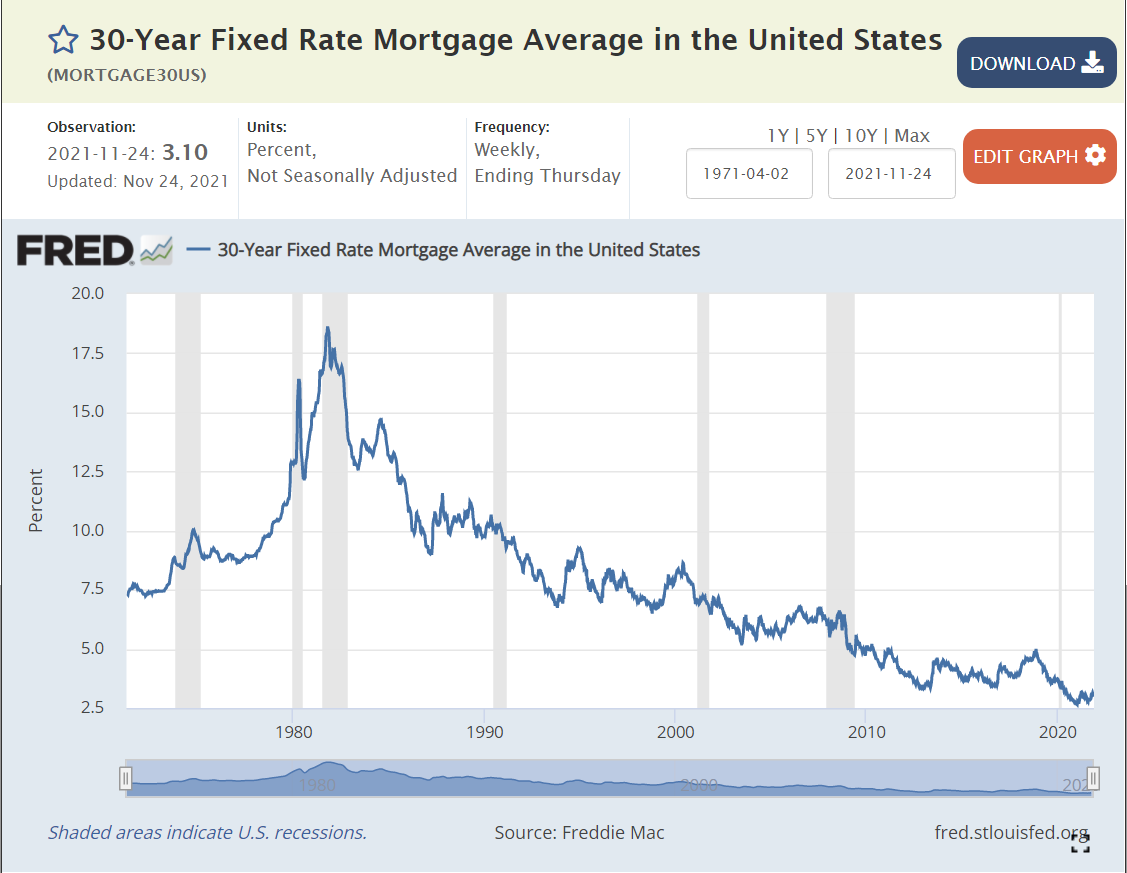
Mortgage interest rates averaged 8% during the 1990’s. They averaged 7% in the 2000’s. They declined even further to 4% during the 2010’s. They fell even further to 3% in 2020-21. The interest cost to finance a house is at an all-time low.

Stock Market
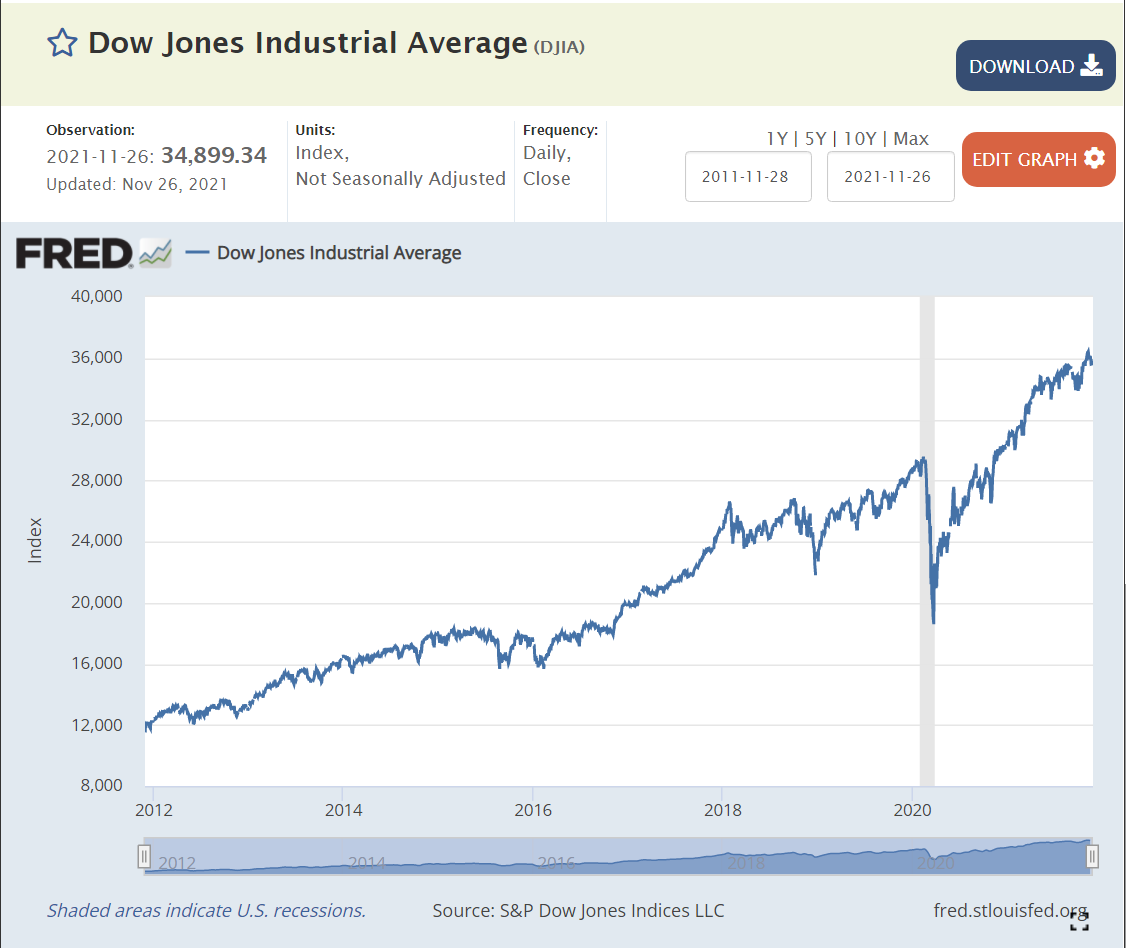
The US stock market averaged 16,000 points from 2014-16. It increased by 50% to 24,000 in 2018, and then climbed to 26,000 and 28,000 before the 2020 pandemic crash. Despite the real financial costs of the pandemic, the market quickly rebounded to 25,000 in the middle of 2020. It has since continued its climb to 36,000, 20% above the pre-pandemic level.

In 1992 James Carville claimed that “it’s the economy, stupid”.

https://en.wikipedia.org/wiki/It%27s_the_economy,_stupid

If so, voters should provide some support to president Biden’s results. Real income is up 2% annually, a record level. Reduction in number of unemployed is 6M in 1 year, another record. Unemployment rate is at 4.6%, below historical “full employment” level. Voluntary quit rate is 50% higher than history, indicating tremendous worker confidence. Nearly twice as many job openings as the historical level, providing great options for job seekers to find their “best” opportunities. Mortgage interest rates remain at historical lows, supporting home purchases. House values have grown by another 25%. The stock market is 20% higher.

This is all at a time when the pandemic unfortunately continues to claim lives and greatly disrupt life and the economy. Overall, the recovery is proceeding at a rate far faster what anyone thought was possible during 2020.

Good News: U.S. Air Travel Climbs.

YearAir-Miles10 Year % Change
196033
1970118258%
198021986%
199035964%
200053148%
20105555%
201975436%

• U.S. passenger-miles in air traffic 2007-2020 | Statista

U.S. Passenger-Miles | Bureau of Transportation Statistics (bts.gov)

Revenue Passenger Miles for U.S. Air Carrier Domestic and International, Scheduled Passenger Flights (RPM) | FRED | St. Louis Fed (stlouisfed.org)

BTS | Table 1-37: U.S. Passenger-Miles (umich.edu)

Since 1970, US air travel has grown by 4% annually, year after year after year.

Air travel in 2019 is more than 6 times as large as 1970 and more than 20 times as large as 1960 when the term “jet-setters” was coined.

Indy, Throw Me the Whip!

We moved to Indy in 1988 from Cleveland by way of Dallas. My wife was transferred to Indy by her employer and I was able to transfer with my employer. We visited for one weekend, noted the quietness and bought a house. We expected to stay for 3 years. We’ve stayed for 30 years.

Once we moved, we saw that Indy presented a “can do” atmosphere that was more like Dallas than like Cleveland. What does the population data say?

From 1970 to 2019, the Indy 9 county area grew from 1.2M to 2.0M people. The growth from 1970 to 1990 was negligible, a little more than 100K in 20 years. But each of the next 3 decades added 200,000 people, more than 10% growth each decade.

On a ranking of metro areas, Indy started in 29th place and has fallen 4 notches to 33rd place, so on that measure it has lost some ground.

Comparing cities across time is complicated, as the census bureau definitions change, but the data tells some stories. I restricted the comparison to the 64 cities that were “top 50” for at least one of the last 7 decades. 5 dropped out by 1970: Scranton, Youngstown, Syracuse, New Haven and Knoxville. 9 dropped out more recently: Dayton, Akron, Albany, Toledo, Rochester, Omaha, Bridgeport, Tucson and Honolulu. No big surprises. Tucson and Honolulu remain close to 50th place. 8 cities grew into the top 50: Virginia Beach/Norfolk, Tampa/St. Pete, Charlotte, Orlando, Raleigh, Austin, Riverside and Las Vegas.

For the US as a whole, 14 cities dropped 8 or more places, 6 dropped 4-7 places, 10 gained 4 or more places and 12 had small changes in rank (+/-3). By this measure across nearly 50 years, the median city dropped 4 places, the same as Indy, so it can claim an average growth rate during this time.

Looking at just the Midwest, Indy looks much better. 6 cities dropped out of the top 50. 6 dropped 8 or more places: Cleveland, Milwaukee, St. Louis, Kansas City, Cincinnati and Detroit. Minneapolis joins Indy at -4 near the top of this group. Columbus, OH nearly maintained its 31st place rating, slipping to 32nd. Chicago kept its 3rd place ranking.

Other “comparable” central U.S. cities include Buffalo (-26), Pittsburgh (-16), Louisville (-13), Memphis (-8) and Nashville (+11).

The bottom line is that Indy is holding its own at the national level and overperforming in the heartland.

List of metropolitan statistical areas – Wikipedia

From Naptown to Super City – Aaron M. Renn (aaronrenn.com)

Framing Politics With a Ruler

Peggy Noonan’s suggestion to use a 36 inch ruler to gauge right versus left in politics does help to explain the opposing views of tea partiers, Republicans and Democrats.  Noonan describes 0 inches as pure right and 36 inches as pure left (opposite of what you might expect).  She bemoans her perception that modern-day politicians negotiate between the 25 and 30 inch mark on the far left end of the ruler.  She asserts that tea partiers will try to move back to the 5 inch mark.

In politics, he who sets the framework usually wins the game.  Using American history since the agricultural 1770’s, urbanizing 1860’s, industrial 1920’s or depression 1930’s as a base, a case can be made that post-war politics and economics has been debated on the left end of the ruler, with a mixed economy government share of GDP at 20% and government spending/taxing share of GDP at 25-30%.  These shares of the economy double those of laissez-faire capitalism, the roaring twenties or the depression.  Noonan takes this long-run historical view of how the yardstick should be labeled.

Noonan is right in pointing out that politicians of both parties in a democratic system inherently seek to spend more money.  The rise in government spending in the Bush presidency after the unusual decline in government spending in the Clinton presidency (with Republican congress) is a modern reminder.  Tea partiers are right to have gut level concerns that government spending will continue to climb unchecked.  The trend in 2000-2008 was up.  Extraordinary banking and industry bail-out funds were piled on top of the stimulus spending for the Great Recession.  Health care and social security spending increases are expected in the next two decades.  Whether the various spending increases are justified or not, the trend is clearly up, without any clear countervailing force in Washington.

Those on the left might agree with the challenge to be faced, but they use a different scale to gauge left versus right, object to the accusation that they have driven up government spending, hold the Republicans responsible for inciting anger in the tea partiers and offer different long-run solutions.

If the scale is set between 100% individual, 0% government pure libertarianism versus 0% individual, 100% government pure socialism, the Democrats argue that the post-war game has all been played on the right (0-18 inch) side of the ruler.  Government share of GDP is 20%.  Government spending and taxes share of GDP is 30-35%, including all transfers.  This did not increase between 1960 and 2008.  The US tax burden at 27% of GDP is only 75% of the 36% average level for 30 developed countries.  Only Mexico, Turkey, Korea and Japan spend less than the US.  Total government spending in western European democracies is 40-55%.  Government spending did increase with the Vietnam War and Great Society policies, but was reduced by the Reagan revolution.  Government spending fell from 37.2% of GDP in 1992 to 32.6% in 2000. 

Democrats argue that their fiscal discipline was demonstrated in 1992 to 2000 when they balanced the federal budget and reduced the deficit, employing the “pay as you go” policy to force spending cuts to offset spending increases.  They point to Bush led Medicaid and defense spending increases as the cause of increased government by 2008.  They see the Bush tax cuts as redistribution to the wealthy and don’t see the overall tax-cut initiated economic growth claimed to increase net tax revenues.

Democrats argue that they have not purposely increased the long-run share of government in the economy.  They claim that the one-time investments/guarantees for the banking/auto industries were necessary for the whole economy, addressed issues that had grown for decades, will be partially recaptured and do not require continued funding.  Similarly, they pursued a moderate one-time Keynesian fiscal stimulus in response to a deep recession, just as was done by other governments of all parties in all countries for the last 60 years.  The stimulus spending lies between the 4.7% of GDP boost in 1982 and the 2.3% growth in 1992. Democrats argue that these actions are necessary and moderate and would have been undertaken by a responsible Republican successor to the Bush administration.

Democrats argue they are unfairly characterized as “big spenders” by the Republicans.  This simple accusation has stirred a populist response from “regular Americans”.  While Democrats have historically focused populist rage on big business and big banking, the Republicans and tea partiers have effectively used big government, Washington, elites, foreign countries and religions as targets, tying them to the Democratic Party.  Democrats argue that the monetarist, supply side, tax cut economic policies of the Republican Party since Reagan have been adopted for their populist simplicity and political effectiveness alone, further polarizing economic policy making.

Finally, Democrats have adopted part of the Republican play book in fundamentally looking to the private sector to drive the future economic growth required to support even the historic level of government spending.  The stimulus spending was partially focused on future industrial growth and infrastructure.  The banks and auto firms are returning to pure private ownership.  Small business lending and investment tax credits have become a focus.  Health care reform maintained private providers and insurers as the core of the system.  The costs of the war in Iran have been reduced.  A bipartisan group has been appointed to work on the Medicare/social security future.  Steps are being taken to promote exports.  A reduced public sector role for the mortgage industry has been proposed.  Obama and many Democrats have continued the pro-business approach used by Clinton.

On the other hand, Republicans can fairly point to steps taken by the Democrats that indicate a continued desire to “tax and spend”.  The stimulus bill benefited state government, construction and other Democratic interests disproportionately.  Health care reform achieved growth in government commitments without structural cost solutions.  Labor unions were given special treatment in the auto bail-out.  Fannie Mae and Freddie Mac’s roles were not touched in the banking reform.  The financial consumer protection agency smacks of unlimited and uninformed regulation.  The proposed increase in taxes for high earners is significant and is not coupled with structural spending reforms.  A second mini-stimulus has been approved and unemployment benefits have been extended to record lengths.

The current economic situation has raised the stakes for politics.  We should expect to see ongoing attempts to define the ruler and place the participants at marks that favor one group or another in the public eye.

Ch Ch Ch Changes

The Baby Boomers may have digested more workplace changes (1970-2010) than any prior generation, moving from an industrial to a post-industrial, services, or virtual world.  The post-Civil War generation saw the initial transition from an agricultural to an industrial society (1880-1920).  Their grandchildren saw the full flowering of the industrial world, with incredible advances in manufacturing, transportation and communications (1920-1960). 

Nearly every usual business practice or function in 1970 has been superseded or turned upside down in the last 4 decades.

The office world of 1970 looked much like 1920.  It was hierarchical, manual and rigid.  Secretaries assisted managers.  Typing, filing, shorthand and bookkeeping were essential skills.  Today, only a few senior execs or sales staff members have administrative or executive assistants.  Everyone else completes their own clerical functions as an integral part of work.  Paper ledger forms and 10-key adding machines have been replaced by Enterprise Resource Planning (ERP) systems in even the smallest firms.  QuickBooks offers capabilities that were unimaginable in 1970.

Mainframe computers automated high volume transaction and office tasks in large firms in 1970.  Computers have since expanded to touch every function, moving through minicomputer, PC, network and cloud phases.  Sophisticated applications exist today for every function and industry, including a dozen end-user tools such as spreadsheets, databases, word processing and collaboration/time/task management.

Communications has progressed from rotary phones, party lines and PBX systems to WiFi, VOIP systems, wireless phones and personal digital assistants.  Media has progressed from AM transistor radios through 8-track and VHS tapes to disks, digital downloads, massively multiplayer games and social media entities.

Companies today pursue core competencies, partnerships and virtual structures in contrast with the old vertically integrated ideal or financial portfolios of conglomerates.  Firms are financed through a broad range of instruments and investors throughout their lives rather than with simple stocks, bonds and preferred stocks.

Companies today compete globally and engage in partnerships with suppliers, customers and competitors.  They also compete with suppliers, customers and competitors, including small entrepreneurial start-ups.

Support functions are more important today.  The Personnel function has become Human Resources.  Marketing has assumed a strategically important role in product development and sales management.  Finance is a strategic partner in decisions.  Many functions are outsourced.

Product development is managed through a gates and phases process.

Operations functions have been totally transformed.  Quality has evolved from a technical necessity to an organizing principle.  Processes shape decisions.  Variability and waste are shunned.  The near-perfection of Six Sigma is pursued and achieved.  Firms benchmark and copy best practices.  Forecast based push systems have been replaced with JIT pull systems, reducing inventories to zero and lot sizes to units of one.  Mass production has been replaced by a network of focused factories, modular manufacturing and outsourcing.

Strategic planning has migrated from an infrequent fully integrated top-down approach to an iterative  process that massages top-down and bottom-up factors within a balanced scorecard composed of assets, operations, stakeholders and final goals. 

Suppliers are managed as long-term partners, instead of short-term contractors.  Staff members are treated as partners, even though company and staff initiated turnover is much higher.  Simplistic theory X and Y approaches (employees are good or bad) have evolved into situational leadership type approaches that match task/people dimensions to current needs. 

These generic changes have occurred seen in every industry and function, layered on top of the major technical and professional progress seen in each area. We are rapidly approaching a time when virtual organizations are a reality because they are more effective than forms suited to an industrial era.  Baby Boomers have experienced this whole cycle of change and are well situated to mange the final transitions.

Tale of Two Cities

In a recent speech at the Carmel Rotary Club, Indianapolis Star editor Dennis Ryerson warned the audience of the risk of a central city meltdown in Indianapolis as he had observed in Cleveland 20 years ago.  As someone who has lived in each region for more than 20 years, this prompted me to collect some historical statistics and speculate on the differential success of these two mid-sized Midwest areas.

In 1900, Indy was two-thirds the size of Cleveland, which at 654,000 people, was the nation’s seventh or eighth largest urban area by various definitions.  Indianapolis was in the 21st-25th range.

By 1930, Cleveland had grown by an astonishing 173%, adding 1.1 million people for a total of 1.8 million, reaching a peak national ranking of 6th to 8th.  Indianapolis was the turtle in this race, adding a mere 200,000 residents to grow by 50% to reach Cleveland’s 1900 650,000 population level, while maintaining a 21st-25th highest population ranking.

By 1960, Cleveland had added another one million residents (50%), reaching 2.7 million residents and maintaining a top 10 population ranking.  Indianapolis grew a little faster on a percentage basis, adding 400,000 residents to reach the 1.1 million population level.  Its national population rank slid to 26th as Sunbelt and west coast cities began to grow.

In the next five decades to 2009, Indianapolis continued its modest 1-1.5% annual growth rate, adding 750,000 residents to reach a population of 1.8M, while sliding to 34th place in the national metro population rankings.  Cleveland reached a peak population of 3M in 1970 before declining to 2.8M in 2009, good for a 26th place metro population ranking. 

In summary, Cleveland grew by 1 million people from 1900-1930 and from 1930-1960, but added ZERO population in the next 50 years!   Indianapolis added a quarter, half and three-quarters of a million people in those 3 periods.  What could possibly account for these divergent trends in cities located only 300 miles apart?

The locations are not very different.  Indy claims to be the “crossroads of America”, while Cleveland has said it is “the best location in the nation”.  Cleveland is on the New York to Chicago train line, the Great Lakes and interstates I-80, I-90 and I-77.  Indy boasts I-70, I-65, I-74 and I-69 interstate access.  Indy has leveraged its location and lower labor costs to become a greater distribution hub.  Cleveland has enjoyed a decade as a mini-hub for Continental, while Indy once served as a minor USAir hub.  Both cities have attracted rural residents from a 100 mile circle, but Cleveland’s area is only half as large due to Lake Erie.

Both cities had strong historic banking companies.  All of the Indy companies are gone.  Cleveland maintained National City Bank and KeyCorp as major banks through most of the period.

Cleveland has maintained a large Fortune 500 headquarters lead.  Firestone, Republic Steel, Uniroyal, Goodrich. TRW, Std Oil, White Motor, Eaton, Sherwin-Williams, Cleveland-Cliffs, Hanna Mining and Reliance Electric appeared in the 1960 list.  Cleveland had grown from 12 to 15 firms by 2009, adding Progressive Insurance, National City, KeyCorp, Parker-Hannifin, PolyOne, Lubrizol and Travel Centers of America.  Indy had 5 firms in 1960: RCA, Lilly, Curtis Publishing, Stokely Van Camp and Inland Containers.  It maintained only Lilly, WellPoint and Conseco in 2009.

On the professional sports scene, Cleveland has maintained football and baseball teams, while adding basketball, but dropping the second level hockey Barons.  Indy added the Colts and moved the Pacers from the ABA to the NBA.  Indy has successfully pursued an amateur sports strategy, attracting the Pan-Am games, the NCAA and many collegiate tournaments.

The cities share historical strengths in their art museums and orchestras, with Cleveland’s ranked higher.  Indy has added the Children’s Museum and Eiteljorg Museum, while Cleveland added the Rock n Roll Hall of Fame museum and lost the Salvador Dali museum.  Neither city has a major state university, with IUPUI and Cleveland State growing in parallel.  Cleveland has Case Western Reserve as a local research university.  Greater Cleveland has a much stronger community college system.  The Cleveland Playhouse and theatre groups offer more than Indy’s scene.  Cleveland’s Coventry/University Heights area is more vibrant than Indy’s Broad Ripple.  Cleveland adopted Michael Stanley while Indy embraced John Mellencamp.

Both cities focused on manufacturing for growth, especially automotive and metal forming manufacturing.  Cleveland had a greater emphasis on basic manufacturing in steel, rubber and plastics.  Indianapolis attracted a significant amount of investment from Japanese manufacturers.  Indianapolis’ health care industry has benefited from Lilly, Roche and IU, while Cleveland has leveraged CWRU University Hospitals and the Cleveland Clinic.

Net, net, Cleveland should have continued to grow slightly faster based on the factors above.  The drivers for Indianapolis’ positive differential growth include:

Better public relations regarding momentum.  Cleveland’s river fire and “mistake on the lake” moniker have hurt.  Indy was able to overcome the “naptown” label through continued positive growth and publicity.

Indianapolis and Indiana have maintained a low tax and low service environment conducive to business investment.

Indy has benefited from being the state capital and the only large city in Indiana, while Cleveland has battled Columbus and Cincinnati for state leadership.

Indianapolis has avoided major racial conflicts.  The 1966 Hough riots in Cleveland contrast with the calming Bobby Kennedy speech after Martin Luther King’s 1968 assassination.

Indianapolis public schools have not fallen as far as IPS.  Busing and white flight had a bigger negative impact in Cleveland where a more established Catholic school system option existed.

Downtown Indianapolis has recovered based upon major public and private investment in the Circle Center Mall, convention center and sports arenas.  Cleveland’s investment in the Brown’s stadium, Jacobs Field, Cavaliers arena, major office buildings and “the flats” has never reached the critical mass required for downtown growth.  Indianapolis’ downtown residential growth has been modest, but adequate.

Indianapolis pioneered the concept of uni-gov, merging the city into the county.  Cleveland has remained an island within Cuyahoga County and a small island within the metro area. 

Indianapolis civic leaders found a variety of ways to preserve and grow the central city and avoid having widespread areas of decay.  As Mr. Ryerson noted, this strategy will be more difficult to maintain as the surrounding counties grow at the expense of Marion County.  Both cities could benefit from some degree of regional government and taxing authority that aligns the interests of suburbs with the central city.

  Cleveland Indy  
  7 counties 9 counties  
       
1900          654         429 66%
1910          913         489 54%
1920       1,426         569 40%
1930       1,784         656 37%
1940       1,817         702 39%
1950       2,154         829 38%
1960       2,734       1,071 39%
1970       3,000       1,248 42%
1980       2,833       1,305 46%
1990       2,759       1,381 50%
2000       2,844       1,605 56%
2009       2,791       1,824 65%
       
1900-30       1,130         227  
  173% 53%  
       
1930-60          950         415  
  53% 63%  
       
1960-2009            57         753  
  2% 70%  

Dow 15,700

Dow 35,000 was a dream in the go-go 1990’s when the new economy had supposedly broken all of the old rules.  Dow 3,500 was a distinct fear in March, 2009 when stocks had fallen by more than half from their peak.  Dow 10,000 is the most visible reference point in the current stock market.

Every investor and business degree holder knows that stock values are fundamentally based on the expected risk-adjusted net present value of future after-tax cash flows.  They are also tempted by the “efficient markets hypothesis” that says that stock valuations incorporate all information about future returns and therefore set the present value in a rational manner.  On the other hand, they understand fluctuations, random walks, animal spirits and the history of under and over valued stock markets.

http://stockcharts.com/charts/historical/djia1900.html

http://www.investorsfriend.com/return_versus_gdp.htm

Individuals who believe that stocks return 7-8% on average in the long-run through 2-4% dividend yields and 4-6% price increases, must conclude that the stock market is inherently irrational.  It has been 30% undervalued or overvalued a majority of the last 100 years.  Overvalued 1922-31.  Undervalued 1932-54, except for 1936-37.  Undervalued 1974-86.  Overvalued 1996-2008. 

Stocks were overvalued by 137% in 1929 before tumbling to -67% undervalued in 1933.  Stocks reached an undervaluated low of -58% in 1942.  Stocks reached a new -50% undervaluation during the depths of the 1982 recession.  In 15 short years, by 1997, they reached a 57% overvaluation.  They rose to 115% overvalued in 2000, before retreating to a mere 38% overvaluation in 2003.  In 2008, stocks were 67% overvalued compared with the long-run trends.

Based on 100 years of history, the Dow Jones Industrial Average at the end of 2010 should be 9,000.  The expected value in 2020 is 15,700, providing a 5% annual valuation return and 2% dividend return.  Investors who bet against long-term average valuations do so at their own risk.

Year  Trend  Actual +/-
1910             50 62 24%
1911             53 60 14%
1912             55 60 9%
1913             58 60 4%
1914             61 58 -5%
1915             64 56 -12%
1916             67 80 19%
1917             70 80 14%
1918             74 70 -5%
1919             78 75 -3%
1920             82 100 23%
1921             86 70 -18%
1922             90 80 -11%
1923             94 90 -5%
1924             99 85 -14%
1925            104 100 -4%
1926            109 130 19%
1927            115 140 22%
1928            121 190 58%
1929            127 300 137%
1930            133 250 88%
1931            139 190 36%
1932            146 80 -45%
1933            154 50 -67%
1934            161 90 -44%
1935            170 90 -47%
1936            178 130 -27%
1937            187 175 -6%
1938            196 100 -49%
1939            206 130 -37%
1940            216 125 -42%
1941            227 125 -45%
1942            239 100 -58%
1943            250 125 -50%
1944            263 130 -51%
1945            276 160 -42%
1946            290 200 -31%
1947            304 170 -44%
1948            320 170 -47%
1949            336 175 -48%
1950            352 200 -43%
1951            370 250 -32%
1952            388 260 -33%
1953            408 260 -36%
1954            428 260 -39%
1955            450 380 -15%
1956            472 500 6%
1957            496 500 1%
1958            521 475 -9%
1959            547 525 -4%
1960            574 600 5%
1961            603 580 -4%
1962            633 700 11%
1963            664 550 -17%
1964            697 750 8%
1965            732 900 23%
1966            769 950 24%
1967            807 850 5%
1968            848 900 6%
1969            890 950 7%
1970            935 800 -14%
1971            981 850 -13%
1972         1,030 900 -13%
1973         1,082 1000 -8%
1974         1,136 850 -25%
1975         1,193 700 -41%
1976         1,252 850 -32%
1977         1,315 1000 -24%
1978         1,381 850 -38%
1979         1,450 850 -41%
1980         1,522 850 -44%
1981         1,614 950 -41%
1982         1,710 850 -50%
1983         1,813 1000 -45%
1984         1,922 1200 -38%
1985         2,037 1200 -41%
1986         2,159 1300 -40%
1987         2,289 1900 -17%
1988         2,426 1900 -22%
1989         2,572 2100 -18%
1990         2,726 2600 -5%
1991         2,890 2500 -13%
1992         3,063 3000 -2%
1993         3,247 3300 2%
1994         3,442 3700 8%
1995         3,648 3800 4%
1996         3,867 5000 29%
1997         4,099 6500 59%
1998         4,345 7800 80%
1999         4,606 9000 95%
2000         4,882 10500 115%
2001         5,175 10000 93%
2002         5,485 10000 82%
2003         5,815 8000 38%
2004         6,163 9500 54%
2005         6,533 10500 61%
2006         6,925 11000 59%
2007         7,341 12000 63%
2008         7,781 13000 67%
2009         8,248 7000 -15%
2010         8,743 10000 14%
2011         9,268    
2012         9,824    
2013       10,413    
2014       11,038    
2015       11,700    
2016       12,402    
2017       13,146    
2018       13,935    
2019       14,771    
2020       15,657    

2010 Graduates: Live a Great Life

Graduates, I encourage each of you to “Live a Great Life”.  This is your right, your choice and your destiny. 

We each live in three worlds: the world of commerce, the world of choice and the world of community.  I believe that “a great life” comes from balancing these three worlds.  In eighth grade, our industrial arts teacher, Mr. Laurie, told us that our first project would be a foot stool and that it would have three legs.  One student spoke up, “Mr. Laurie, I think it would be better with 4 legs”.  Mr. Laurie calmly responded, “Tom, I have found that 3 legs provide the proper balance for a successful footstool.  If you tried 4 legs, it would take you the whole semester to make them the same length and the final stool would be 3 inches tall”.  As I learned in this school, balancing the three legs of commerce, choice and community is essential to “living a great life”.

World of Commerce

The world of commerce is important as we emerge from the Great Recession.  Completing high school is a great accomplishment.  But it’s not the end of learning.  You will continue to build your problem solving and communications skills and you’ll pursue new degrees and certifications.  Lifelong learning is now required for everyone.

Our guidance counselor, Mr. McGinnis, urged us to be serious about our careers.  He said “choose something which interests you, build skills in that field and focus on one industry”.  In spite of the many options and uncertainties in life, pick that one path and treat it like it’s the only one. 

Securing employment is difficult today.  You can improve your odds by thinking about jobs from the employer’s point of view.  Employers want clear “yes” answers to three simple questions: “Can you do the job?  Are you self-motivated?  Are you manageable?”  Focus on these and you will always be an attractive job candidate.

Be confident about your economic future.  Don’t listen to the nightly news.  The sky is not falling.  The U.S. economy grows by 3% per year on average.  That doesn’t sound like much, but since the Diamond Alkali factory in Fairport closed 30 years ago, the US economy has grown by 160%, from $5 trillion to $13 trillion dollars.  There will be recessions, but you will succeed.

Education, career skills and positive attitudes will make you succeed in the world of commerce.  Always invest in yourself first.  Save the first 10% of every paycheck.  Invest it for your retirement.  When you are 53, you will thank me.

World of Choice

We also live in a “world of choice”.  In 1974, we were emerging from a “world of tradition” and sought a “world of choice” where we could “express ourselves”.  Our parents cautioned us to “be careful what you wish for”.  The number of choices and options today can be overwhelming.  You now have great responsibility for your own future. 

First, you must accept and love yourself as you are.   Believe that you were created just as you are for a purpose.  My classmate, Jim Kulma, shared a book with us in 1972. It was titled “I’m OK, You’re OK”.  It sold 15 million copies because its advice was very sound.

This is not an invitation to be self-centered.  We all need to become more self-aware.  Discover your talents and your non-talents.  Listen to others.  Seek feedback and advice. 

Because we have so many choices, engagement in life is critical.  Many adults, in their roles as workers, family and friends, choose to not fully engage in life.  They try to avoid responsibility for themselves and their choices because they are afraid of making mistakes.  Unfortunately, “there is no place to hide”.  Others will hold you accountable anyway.  Embrace responsibility and make it a habit. 

Engage in life; explore and experiment.  When you are older, you will not regret these adventures, but you might regret the things you missed.  Have the confidence to “take the road less traveled”.  As we learned playing “Milk League” baseball, “you can’t get a hit, if you don’t step up to the plate.”

View life as an exciting journey.  Don’t make it a death march in pursuit of a single goal, like career success.  Don’t think “If I only had a better job, a winning team, a better spouse, a bigger house or a full head of hair, things would be different”.  Joy comes from living life, not from dreaming about or even from reaching goals.

Accept that “life is not easy”.  Life remains a challenge.  Use the “in spite of” strategy.  In spite of the challenges, risks, hurts and pains, I will choose to do X.  If the challenges become too great, get help.  Family, friends and counselors are ready to help.  They all want you to succeed.

World of Community

We all need to earn a living and make wise choices.  But, to be happy, we must also live in the world of community.  We live in a world that glorifies material success and the individual.  However, history, science and common sense tell us that happiness does NOT come from wealth and introspection.  Happiness comes from relationships.  Every wisdom tradition, including psychology, has found that people are truly happy ONLY when they live for something outside of themselves.

In our everyday lives, family matters most.  Family life is difficult.  But, we were created to live with others.  We give and we get even more in return.  On my wife’s nightstand, there is a picture of two identical dogs sitting on a beach, much like the Fairport beach, at twilight, with the quote: “Love does not consist in gazing at each other, but in looking outward in the same direction”.  Invest in a high quality family life.  It will provide the greatest rewards.

Fun social groups matter.  Make time for bowling leagues, youth sports, church groups, boy scouts, girl scouts and playing cards with friends.  These low-cost activities create a high quality life.

Your local community matters.  There is great value in the familiarity, pride, loyalty and common interests of the local community.  Village residents already know this.  Your big city neighbors yearn to find this sense of place, security and belonging. 

Our national community and government also matter.  In a society with 300 million members, it is tempting to be a “free rider”.   We have found that democracy is the best form of government.  It allows the hopes and values of the people to be translated into laws to guide society.  Society needs your active involvement in the political process.  Our future depends upon it.

Finally, spiritual belief matters.  We all have a deep need to matter and to be significant.  This is fulfilled by connecting to something larger than ourselves.  We all ask the same questions: “what is the meaning of life?”, “where did the world come from?”, “why was I created?”, and “what happens in the long-run?”  These religious questions are part of our deepest nature.  Finding your relationship with eternity, mankind, truth and god is a vital part of your journey.

We live in these three worlds of commerce, choice and community.  Your generation inherits a world that is more complex, fast-paced and demanding than those of the past.  Some scholars wonder if we are “in over our heads”, with the demands of life exceeding our capabilities.  I believe that we are blessed to be able to lead even richer lives today.  I agree with the author Harold Kushner who says that God always provides each of us with the strength and capacity to make our journeys with confidence. 

On behalf of the “class of 1974” and the Fairport community, I wish each of you success on your journey.  I am confident that you are very well-prepared for the exciting worlds which lie ahead.

Indiana 2050

It will take some time for the official 2010 Indiana census to be complete.  The 2009 estimates and 1950-2000 census data can be used today to create a reasonably accurate picture of Indiana in 2050, 40 years from now.

Indiana grew by 24% from 1970 to 2009 and is likely to grow by 25% from 2009 to 2050.  The population will increase from 5.2 to 6.4 to 8.0 million residents.

In 1970, Indiana had only 4 counties with populations of 200,000 or more: Marion (Indy) at 794,000, Lake (Gary) with 546,000, Allen (Ft. Wayne) with 280,000 and St. Joseph (South Bend) with 245,000.  These four counties contained 1.9M people, or 36% of the 1970 population.  They grew to 2.0M in 2009 and an estimated 2.2M in 2050. 

By 2009, there were 6 counties above 200,000 populations, with Elkhart and Hamilton counties joining the list.  By 2050, it is likely that 10 counties will be above the 200,000 mark, adding Porter, Hendricks, Johnson and Tippecanoe counties to the list.

Between 2009 and 2050, Indiana is expected to grow by 1.6M people, or 25%.  Ten of the 92 counties will experience two-thirds of the growth across the next four decades.  Based on recent trends, Hamilton County will add 300,000 residents.  Suburban Hendricks and Johnson counties will grow by 100,000 residents (89%).  Marion and Allen counties will add 80,000 residents at 10-20% growth.  Tippecanoe, Hancock, Elkhart, Porter and Boone counties will each grow by 60-80,000 residents.

Five Indianapolis area counties will experience 70% or higher growth.  Hancock, Hamilton and Boone Counties will grow by 100%, with Johnson and Hendricks Counties close behind.  The nine counties in the Indianapolis area grew by 46%, from 1.25M to 1.8M people, in the last 40 years and are expected to grow by a further 43% in the next four decades, reaching a population of 2.6M.  This 790,000 person growth accounts for half of the state’s total growth from 2009 to 2050.  The Indianapolis area will grow from 28% to 33% of the total state population.

Eleven counties will change population ranks by three or more places.  Boone and Hancock Counties will climb 9-10 places.  Shelby, Clark and Hendricks Counties will rise 3-4 places.  Delaware, Wayne, Henry, Grant and Vanderburgh Counties will decline by 3-4 places.  Howard County may drop 7 places.

Indiana’s population will continue its 0.5% annual growth rate and reach 8 million by 2050.  Growth will be highly concentrated in a small number of urban counties.  The top ten counties, each with 200,000 or more people, will account for 50% of the state population.  The next 11 counties, each with 100,000 or more people, will account for another 19% of the state population.  These 21 counties will capture 80% of all growth,

averaging increases of 60,000 people.  The remaining 71 counties will experience growth of 4,000 people each on average.

       Pop   Pop   Est   2009-50     2009   2050   Chg 
SMSA County City  1970   2009   2050   Growth  Pct  Rank   Rank   Rank 
                     
Vincennes Knox Vincennes       42       38         38           –   0%       37 37       –  
Terre Haute Vigo Terre Haute      115     106       106           –   0%       17 19       (2)
South Bend Elkhart Goshen      127     201       273           72 36%        6 6       –  
South Bend Kosciusko Kosciusko       48       76       104           28 37%       19 20       (1)
South Bend LaPorte LaPorte      105     111       120             9 8%       15 16       (1)
South Bend Marshall Plymouth       35       47         59           12 26%       31 31       –  
South Bend St. Joseph South Bend      245     268       289           21 8%        5 5       –  
Richmond Henry Newcastle       53       48         48           –   0%       30 34       (4)
Richmond Wayne Richmond       79       68         68           –   0%       25 29       (4)
Muncie Delaware Muncie      129     115       115           –   0%       14 17       (3)
Louisville Clark Jeffersonville       76     108       148           40 37%       16 13        3
Louisville Floyd New Albany       56       74         94           20 27%       21 23       (2)
Lafayette Tippecanoe Lafayette      109     168       248           80 48%        8 8       –  
Kokomo Cass Logansport       40       39         39           –   0%       36 36       –  
Kokomo Grant Marion       84       69         69           –   0%       23 27       (4)
Kokomo Howard Kokomo       83       83         83           –   0%       18 25       (7)
Indianapolis Boone Lebanon       31       56       114           58 104%       27 18        9
Indianapolis Hamilton Noblesville       55     279       579         300 108%        4 2        2
Indianapolis Hancock Greenfield       35       68       144           76 112%       24 14      10
Indianapolis Hendricks Danville       54     141       261         120 85%       11 7        4
Indianapolis Johnson Franklin       61     142       242         100 70%       10 9        1
Indianapolis Madison Anderson      139     131       141           10 8%       13 15       (2)
Indianapolis Marion Indianapolis      794     891       971           80 9%        1 1       –  
Indianapolis Morgan Martinsville       44       71       101           30 42%       22 21        1
Indianapolis Shelby Shelbyville       38       45         61           16 36%       33 30        3
Ft. Wayne Allen Ft Wayne      280     354       434           80 23%        3 4       (1)
Ft. Wayne De Kalb Auburn       31       42         54           12 29%       34 32        2
Ft. Wayne Noble Albion       31       48         68           20 42%       29 28        1
Evansville Vanderburgh Evansville      169     175       189           14 8%        7 11       (4)
Evansville Warrick Booneville       28       59         84           25 42%       26 24        2
Columbus Bartholomew Columbus       57       76         96           20 26%       20 22       (2)
Columbus Jackson Brownstown       33       42         45             3 8%       35 35       –  
Cincinnati Dearborn Lawrenceburg       29       51         71           20 39%       28 26        2
Chicago Lake Gary      546     494       534           40 8%        2 3       (1)
Chicago Porter Valparaiso       87     164       232           68 41%        9 10       (1)
Bloomington Lawrence Bedford       38       46         50             4 8%       32 33       (1)
Bloomington Monroe Bloomington       85     131       171           40 31%       12 12       –  
  Subtotal 37 counties   4,091  5,125    6,543      1,418 12%      
                     
  All Others 55 counties   1,104  1,298    1,459         161 12%      
  (Pct of State)   21.3% 20.2% 18.2% 10.2%        
                     
  Indiana     5,195  6,423    8,002      1,579 25%      
        24% 25%          
                     
Indianapolis       1,251  1,824    2,614         790 43%      
(Pct of State)     24.1% 28.4% 32.7% 50.0%        

Infinite Progress

At the start of 2010, I put a positive spin on the nascent economic and psychological recovery with blogs on “The Sky Has Stopped Falling”, “Good Riddance to Utopian Views of 2000” and “Self-Improving Systems”.  Today, I want to promote the broader subject of “Infinite Progress”.

Economics has earned its label as “the dismal science”.  It has been serious, analytical, realistic, short-term and marginal.  Imitating calculus and physics, it has sought to optimize production functions and maximize results subject to multiple linear constraints.  Like other academic disciplines, economics has been shaped by the dominant culture.  Economics has progressed through the Physiocrats, Marxists and Marginalists who in turn proclaimed that land, labor and capital each held the key to economic value.  Even Paul Samuelson’s neoclassical synthesis focused on these three “factors of production”, while mentioning that there was some remaining role for “technology” and “entrepreneurship”.

The “law” of diminishing marginal returns emphasizes that in the short-run, with given technology, additional inputs eventually yield lower incremental results.  This is certainly true, but development and growth economists focusing on the international and business sectors have demonstrated that this fourth factor (technology/entrepreneurship) is the primary driver of progress.  In fact, rather than being subject to diminishing returns, knowledge is the one factor that is subject to increasing returns through time!

In spite of the slow recovery in the current economic cycle, I believe that we are only 50 years into the greatest productivity expansion in history.  Annual labor or multi-factor productivity growth of 2-4% has become commonplace.  Even in the recession, we experienced 6-8% productivity growth.  Productivity growth will accelerate in the coming years to a minimum of 5% annually, in spite of our various challenges (aging population, protectionism, extremism, political polarization, religious stagnation, terrorism, global warming, limited natural resources, multi-polar international powers).

In no particular order, knowledge and practice has expanded and will continue to expand in all of these fields:

  1. Trade.  Lessons were learned in the Great Depression.  Tariffs have continued to fall.  Multilateral treaties have stalled, but bilateral trade agreements are accelerating.  English is becoming the global language, followed by Mandarin Chinese and Spanish.  A majority of the global population produces at a near-subsistence level.  They will all generate modern western levels of output within 40 years, providing added value globally.
  2. Physics/Engineering.  Basic physics, mechanical and civil engineering continue to advance.  Modern materials, energy, devices and structures will advance and be refined in light of breakthrough understandings (supercollider).
  3. Chemistry.  “The Graduate” whispered “plastics” as the key to the 20th century.  Plastics has delivered, but has not exhausted its secrets.
  4. Biology.  Biotechnology and modern medicine is on the verge of major breakthroughs in individualized medicine, medical information, preventive medicine, devices, new drugs and nano-technology based solutions.  Mental health care is leveraging improved understanding of the mind, behavior and chemistry.
  5. Energy.  Delayed by politics and prices, energy exploration and solutions are emerging.  Wind, solar, nuclear, clean-coal, tidal and other answers are now real.  Break-through shale, gas and deep-sea extraction technologies are imminent.  Major investment in alternative transportation options is producing results.
  6. Natural Resources.  The food, fiber and natural resources sector continues its 200 year track record of innovation, with genetically modified organisms, drip irrigation, weather forecasting, satellite guided farming and fish markets adding value.
  7. Transportation. New highways, hiking, biking, high-speed trains, point to point aircraft, larger container ships and usage tolls suggesting continued progress.
  8. Electronics.  Songs, movies, video, instruments, observation, robots, entertainment, games, virtual reality, and the list goes on and on.
  9. Computer Power.  Moore’s Law. ‘Nuff said.
  10. Telecommunications.  Cell phones, internet, computer integration, GPS, much faster speeds.
  11. Integration.  Electronics, telecommunications, media, entertainment in one place, on demand.
  12. Community.  Tribes, cities, nations, world.  Clubs, games, blogs, social media, Face book, LinkedIn, Twitter, no limit.
  13. Specialization.  Professions, suppliers, outsourcing, matrix organizations, consultants, global suppliers, increasing economies of scale, niche markets
  14. Process Improvement.  Process, quality, cost of quality, value added, variability, bottleneck, ISO, TQM, benchmarking, process re-engineering, quantum leap, lean manufacturing, lean, six sigma, kaizen, self-improving systems.
  15. Computer Systems.  Automation, systematization, mainframes, minicomputers, personal computers, applications, man-machine, GUI, windows, mouse, ERP, cloud computing as a utility.
  16. Library Science.  Dewey decimal, multimedia, informatics, knowledge management, Wikipedia, Amazon.com, tripadvisor.com, Angieslist.
  17. Economics.  Markets, global trade, auctions, information, behavioral economics, EDI, e-commerce, capitalism embraced everywhere in one form or another.
  18. Finance.  Stocks, bonds, pork-bellies, futures, puts, calls, mutual funds, checkable deposits, insurance, hedges, securitized debt.
  19. Management/leadership.  Strategic planning.  Product innovation. Growth/margin. Core competencies.  Discipline of Market Leaders.  First or second. Operational excellence.  Situational leadership.  Theory X, Y, Z.  Motivators and de-motivators.  Covey’s 7 habits, urgent and important.  Meyers-Briggs, personality styles and Gallup talents.  Change management.  Engaged/disengaged.  Creativity and thinking hats.  Accountability/Oz Principle.  Good to Great, Both/And. 


Knowledge will continue to increase in every discipline.  Market pressures will ensure rapid adoption, expansion and innovation.  The work world in 2010 could not be seen in 1980.  The work world in 2040 will exhibit the same degree of discontinuous change from a much higher base.