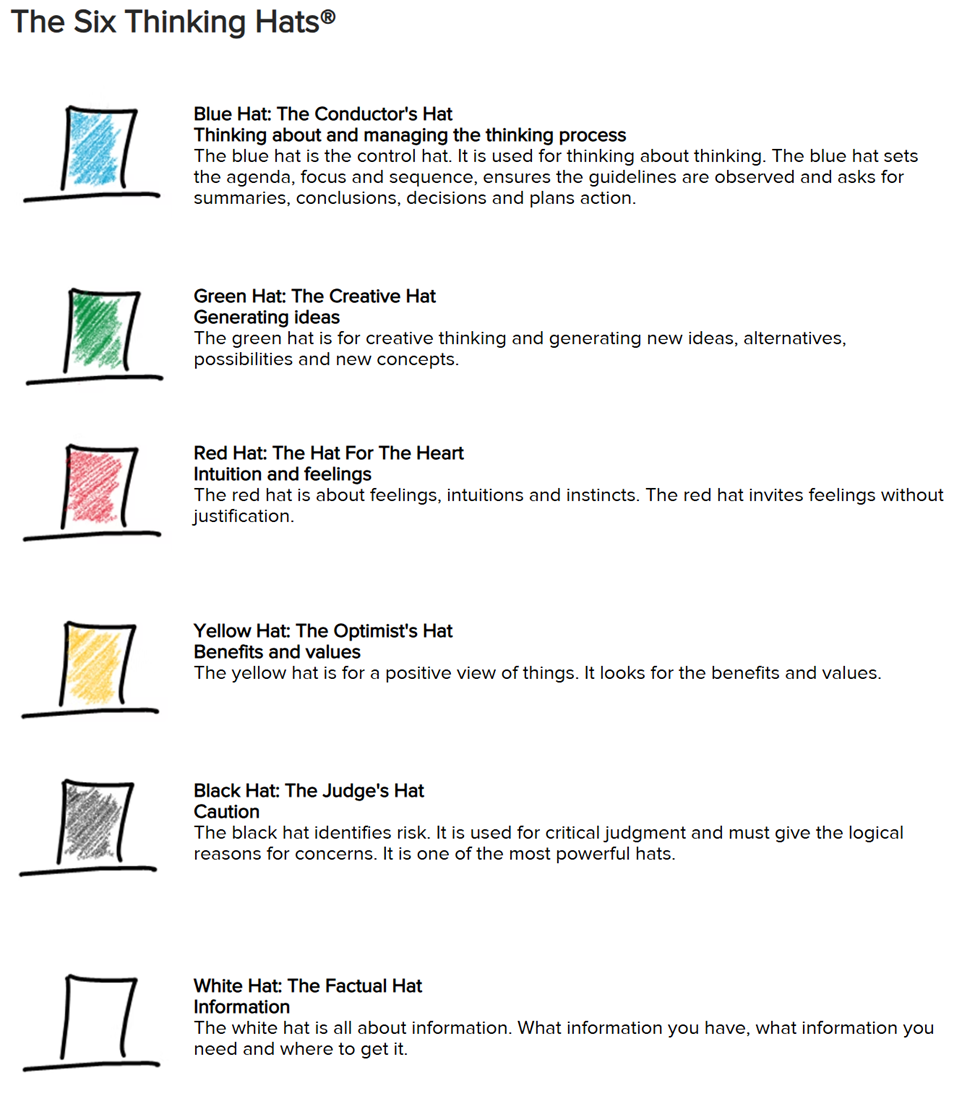
This 10-minute exercise, based on Edward de Bono’s Six Thinking Hats, is designed to teach adaptability by forcing participants to rapidly switch perspectives on a single problem, breaking them out of rigid “black-or-white” thinking.
The Exercise: “The 10-Minute Pivot”
Goal: Adapt to a sudden change in project scope.
Scenario: You are organizing an outdoor company team-building event. 24 hours before the event, the weather forecast changes from sunny to a severe thunderstorm.
Targeted Outcome: Move from panic/complaining to actionable solutions (adaptability).
Minute-by-Minute Breakdown
0-1 min: Blue Hat (Setup)
Goal: Define the problem.
Action: The facilitator states the problem: “The outdoor event is ruined. We have 10 minutes to adapt our plan to a completely indoor, last-minute alternative”.
1-2 min: White Hat (Facts)
Goal: What do we know?
Action: List facts only. “We have 50 people,” “The venue has a small conference room,” “We have budget already spent on food,” “The event is tomorrow”.
2-3 min: Red Hat (Feelings)
Goal: Vent and express emotions.
Action: “I feel stressed,” “I’m worried people will hate it,” “I’m frustrated”. Note: Only 1 minute, then move on.
3-4 min: Black Hat (Risks)
Goal: What are the pitfalls?
Action: “The conference room is too small,” “People might cancel,” “The activities are not tailored for indoors”.
4-5 min: Yellow Hat (Optimism)
Goal: What are the benefits/opportunities?
Action: “We save on tent rentals,” “It’s a chance to do more focused workshops,” “Team bonding might be more intimate”.
5-8 min: Green Hat (Creativity/Adaptability)
Goal: Brainstorm alternatives.
Action: “Virtual murder mystery?”, “Board game tournament in the lobby?”, “Hire an indoor cooking class instead?”.
8-10 min: Blue Hat (Decision & Action)
Goal: Select the best path.
Action: “Based on the ideas, we will move the food to the lobby, use the conference room for a trivia competition, and cancel the outdoor activities”.
Why this teaches Adaptability
Stops Ruts: It prevents participants from staying stuck in “Black Hat” (pessimism) or “Red Hat” (panic) mode.
Forced Perspective Shift: It forces individuals to think constructively even if they are naturally critical, or creatively if they are usually logical.
Encourages Teamwork: Everyone is “wearing” the same hat simultaneously, allowing for parallel thinking rather than arguing from different perspectives.
For a 15-minute adult group exercise on emotional self-control, the “Recognize, Relax, Reframe” (3-R) Workshop is an effective, structured approach. This activity focuses on building immediate awareness and practical regulation skills.
The “Recognize, Relax, Reframe” Workshop (15 Minutes)
This exercise uses the “Four Rs of Regulation” framework (Recognize, Relax, Reframe, Respond) to teach adults how to create space between a trigger and a reaction.
Activity: Ask participants to think of a minor recent frustration (e.g., a traffic delay or a late email).
Exercise: Use an Emotion Wheel or list of descriptors to help them label the specific emotion beyond just “angry” or “stressed”.
Goal: Identifying the exact sensation (e.g., “dismissed,” “overwhelmed,” or “impatient”) is the first step in self-management.
Phase 2: Somatic “Relax” Break (5 Minutes)
Activity: Lead the group through a 5-4-3-2-1 Grounding Technique or a brief deep breathing exercise.
Exercise: Participants identify where they feel the emotion in their body (e.g., tight shoulders or a clenched jaw) and visualize breathing “into” that tension to soften it.
Goal: To soothe the nervous system and prevent an emotional outburst.
Phase 3: Cognitive Reframe (4 Minutes)
Activity: Revisit the initial frustration from Phase 1.
Exercise: Use Cognitive Reappraisal to view the situation through a different lens.
Prompt: Ask: “What is one other possible explanation for this situation that isn’t personal?” (e.g., “The person who didn’t email back might be dealing with an emergency”).
Goal: To shift from an impulsive reaction to a values-based action.
Phase 4: Group Reflection (2 Minutes)
Discussion: Briefly share which “R” felt most challenging or most helpful.
Closing: Remind the group that self-control is a skill built through repetition, similar to a physical workout.
Before starting this exercise, pay attention to your breathing. Take a couple of breaths and just notice the pace and quality of your breaths. Then, go through the following steps:
5: Acknowledge FIVE things you SEE around you. Maybe it’s a bird, something on your desk, or the color of a particular piece of furniture. However big or small, state 5 things you see.
4: Acknowledge FOUR things you can TOUCH around you. This could be your hair, hands, the ground, grass, chair. Whatever it may be, list out 4 things you can touch.
3: Acknowledge THREE things you can HEAR. These should be external, do not focus on your thoughts. Maybe you can hear a car, the air conditioning, or a nature sound. Focus on things you can hear outside of your body.
2: Acknowledge TWO things you can SMELL. This one might be harder if you are not in a stimulating environment, if you cannot automatically sniff something out, walk nearby to find a scent. Maybe it’s the smell of paper, or a pillow, or something from nature outside.
1: Acknowledge ONE thing you can TASTE. What does the inside of your mouth taste like, gum, coffee, tea, whatever you had for lunch? If this one is difficult, name something you could taste around you, such as food that you see on the counter.
Taking these steps will not erase your anxiety or stress overnight, but it can be a very handy way of coping and significantly reducing the intensity of these experiences.
Cognitive reappraisal is a strategy for everyday living in which a person deliberately aims to modify their emotional response to experience by changing their thoughts. It involves evaluating an emotionally charged situation from a different perspective than what comes automatically to mind. Cognitive reappraisal is used to counter habitual—and often negative—interpretations of events that can lead to getting stuck in emotional turmoil or interfere with goal pursuits. Cognitive reappraisal reflects a core fact of psychological life—individuals can play a significant role in shaping their own emotional experience.
Cognitive reappraisal—generating a positive, even absurdly incongruous, reinterpretation of a negative event— often underlies benign humor. And in fact, researchers find that the use of benign humor—pointing out the bright side of adversities—is good at both down-regulating negative emotion and amplifying positive emotion. People may differ in their fluency in generating different appraisals of a situation, but it is a skill that can be deliberately cultivated, at first likely requiring considerable cognitive effort but, with practice, becoming more automatic.
Cognitive reappraisal is free, available at any time, and useful in many daily life situations that provoke an intense emotional reaction. However, researchers find that people use the strategy far less frequently than needed.
How can I apply cognitive reappraisal in my own life?
Life doesn’t always go the way we want. Experts identify several questions you can ask yourself to stimulate a positive reappraisal for negative situations.
• Are you engaging in some form of cognitive distortion, such as catastrophizing?
• What is the evidence supporting your automatic appraisal of the situation?
• Are any positive outcomes possible from the situation?
• Are you grateful for any aspect of the situation?
• In what ways are you better off than before the situation occurred?
• What did you learn from the experience?
What is an example of cognitive reappraisal?
Say you learn that a neighbor you loved while growing up has suddenly died. There are many possible responses. You could fully unleash your grief. Or you could distract yourself with work. Or you could choose to suppress your grief. Or you could acknowledge the loss but not get stuck in rumination or sadness about it by reframing the situation—by focusing on the wonderful life the person lived, the good they did in the world, and the many ways you benefitted from knowing the person.
Benefits of Cognitive Reappraisal
First and foremost, cognitive reappraisal actively modifies emotional responses to upsetting experiences to provide relief. As a strategy useful for emotional regulation, cognitive reappraisal has a double-barreled effect: It both lowers negative emotions such as sadness and anxiety and increases positive emotions associated with well-being. And because it alters activity patterns in emotion-processing circuits in the brain, over time it dampens excessive activation of brain centers such as the amygdala, which sends out emotional alarm signals in response to incoming information.
How does cognitive reappraisal improve problem-solving?
Strong emotions limit thinking processes essential for analyzing problems and generating possible solutions. Cognitive reappraisal restores access to rational thinking. For example, in a set of studies of students with intense math anxiety, those who were exposed to a reappraisal strategy during a math test performed more accurately and had less anxiety than fellow worriers who used their natural strategies to get through the same math problems. Brain imaging studies showed that among the students exposed to cognitive reappraisal, there was increased activity in brain regions linked to arithmetic performance.
How does cognitive reappraisal reduce negative emotions?
Cognitive reappraisal reduces negative emotions not by avoiding them or suppressing them but by deliberately bringing to mind and refocusing attention on aspects of a situation that stimulate positive emotions. In addition, by lowering emotional arousal, cognitive reappraisal restores access to rational thinking, which opens the door to problem solving difficulties and forward movement toward one’s goals, both sources of satisfaction.
A 10-minute “Emotion Wheel Check-In” is a highly effective, low-stakes group exercise to boost emotional awareness. Participants use an emotion wheel to identify, name, and briefly share their current feeling in a structured, non-judgmental circle, building emotional literacy and normalizing the expression of emotions within the team.
10-Minute Emotion Wheel Check-In Structure:
Preparation (1 min): Distribute an emotion wheel (like Plutchik’s) to participants or display it digitally.
Self-Reflection (2 min): Ask participants to silently scan the wheel, identify one emotion they are feeling right now, and think of a short explanation.
Group Sharing (6 min): Going around the circle, each person shares: “My name is [Name] and I am feeling [Emotion] because [Short Reason, optional]”.
Closing & Takeaways (1 min): Briefly discuss the diversity of emotions in the room and validate that all emotions are welcome.
Why this works:
Increases Emotional Vocabulary: Moves beyond simple “good” or “bad” to specific feelings.
Builds Empathy: Helps team members recognize emotional states in themselves and others.
Safe Space: Creates a quick, structured, and psychologically safe space for vulnerability.
Emotional Awareness – Identifying and understanding our emotions and their impact on our thoughts, behaviors, and others. Accurate Self-assessment – Clearly understanding personal strengths and limitations without self-criticism or inflated self-perception. Self-confidence – Firmly believing in one’s abilities, talents, and judgement. Self-respect – Properly regarding and caring for the dignity of one’s person and character. Authenticity – Acting in accordance with one’s true self, values and beliefs.
Self-Management
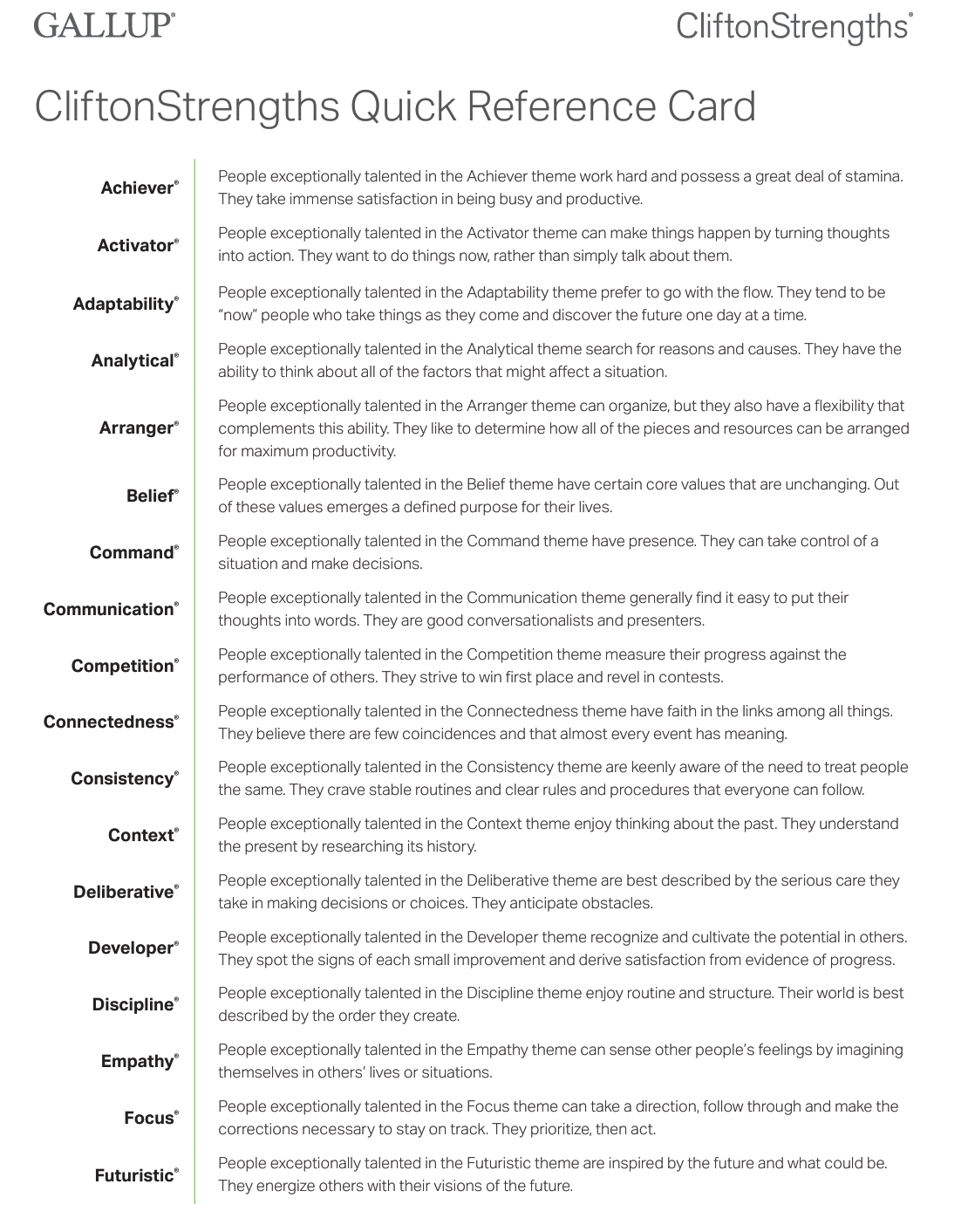
Emotional Self-control – Managing and regulating one’s emotional responses, preventing impulsive reactions. Adaptability – Flexibly and efficiently learning and applying that knowledge across situations. Achievement Motivation – Orientation towards success, mastery, and sense of purpose. Initiative – Recognizing needs, taking action, and pursuing outcomes without waiting for direction. Optimism – A mental attitude characterized by a positive outlook and expectations of favorable outcomes. Apologizing – Acknowledging errors and guilt, expressing regret, repenting, asking for forgiveness. Trustworthiness – Demonstrating credibility, reliability and intimacy buffered from self-interest. Resilience – Bouncing back from adversity with flexibility & strength, maintaining wellbeing despite challenges.
Social Awareness
Empathy – Understanding what other people feel, seeing their point of view, and imagining yourself in their place.
Organizational Awareness – Interpreting a group’s emotional state, relationship dynamics and power structures.
Service Orientation – Willingly anticipating, recognizing, and meeting others’ needs, before they are articulated.
Perspective Taking – Considering others’ thoughts, feelings, intentions, and motivations in a particular situation.
Cultural Awareness – Recognizing the different beliefs, values, and customs of someone based on their origins.
Relationship Management
Influence – Capacity to affect the character, development, or behavior of another person, group, or organization.
Conflict Management – Process by which disputes are resolved, negative results are minimized and positive results are prioritized.
Teamwork and Collaboration – Combined effort of a group of people working together towards a common goal or objective.
Inspirational Leadership – Inspiring and guiding people to get the job done, to bring out their best.
Change Management – Providing approaches, tools, and techniques to achieve a desired future state.
Collaboration Tools – Offering any technology or tool that can be used to help people to better work together.
Meeting Management – Organizing and facilitating meetings to ensure productivity and alignment.
Project Management – Planning, organizing, and executing tasks to create a tangible product, service, or deliverable.
Communications
Commonality – Finding and emphasizing common interests, perspectives and experiences.
Be Patient – Encouraging others to speak, not interrupting them.
Overall Awareness – Paying attention to non-verbal cues, overall message of speakers.
Recognize/Validate Others – Listening, remembering and using names, acknowledging others’ views and emotions.
Mirror Communications – Confirming listening by restating what you heard in your own words.
Speak Kindly – Using words that are neutral or supportive, not attacking others.
Understand – Asking questions, clarifying, seeking first to understand, not to reply.
Manage Praise – Giving and receiving praise for communications, actions, intentions and results, when appropriate.
Defend Properly – Defining boundaries, expressing views in “I” statements, not overreaching.
Solve the Problem – Focusing on issues, not people.
Electronic Communications – Effective email and social media communications.
Growth
Experiential Learning – Benefiting from the experience and natural results of participating in civil processes. Continuous Improvement – Maintaining newly developed skills and skill levels with support from civil colleagues. Embracing Feedback – Encouraging honest feedback provides opportunities for personal growth. New Perspectives – Gaining new approaches, viewpoints and paradigms from interacting with others. Higher Expectations – Improving goals and behaviors in response to the expectations/norms of others. Confidence – Using civil processes to address and resolve difficult situations builds personal and process confidence. Broadly Applying Skills – Trying, testing and using civility skills in all domains of life. Modelling Behaviors – Practicing civility skills helps to teach, influence and inspire others. Developing Others – Recognizing and nurturing potential in others through encouragement and honest feedback.
Problem-Solving
Analytical Tools – Critical thinking, decision making, game theory, finance, economics and operations management.
Creative Thinking – Thinking about a task or a problem in a new or different way, or generate new ideas.
Strategic Thinking – Intentionally and logically making organization level decisions with long-term impacts.
Organizational Design – Improving an organization’s effectiveness and performance.
Organizational Development – Structuring an organization to align with its strategic goals and objectives.
Systems Thinking – Cognitive skill and a way of understanding reality that emphasizes the whole rather than the sum of its parts.
Process Engineering – Approach to designing, analyzing, and optimizing steps to produce a consistent, repeatable outcome.
Public Administration – Coordination of government activities to ensure the effective delivery of services and the application of laws.
Healing the Heart of Democracy by Parker J. Palmer argues that democracy’s survival depends on cultivating “habits of the heart”—such as embracing togetherness, holding tension, and creating community—within our local lives. It calls for reclaiming civic life from polarization by nurturing courage, empathy, and personal agency to create a politics worthy of the human spirit. Google AI – April 8, 2026
Key concepts from the book include:
• The Heart as Democracy’s Center: Democracy starts in the human heart, where we must embrace questions about equity and generosity rather than succumbing to fear and dividing into “us vs. them”.
• Five Habits of the Heart: To restore democracy, Palmer proposes cultivating five habits in our daily lives (families, workplaces, neighborhoods):
1. We Are All in This Together: Understanding our interdependence.
2. Appreciation of “Otherness”: Valuing differences rather than fearing them.
3. Holding Tension in Life-Giving Ways: Using political conflict for creative, not destructive, purposes.
4. A Sense of Personal Voice and Agency: Believing in our capacity to make a difference.
5. A Capacity to Create Community: Working together to solve common problems.
• Reclaiming Politics: The book encourages breaking through political gridlock by focusing on personal responsibility, civil discourse, and shared values.
The book is a blend of personal reflection and political analysis, aiming to empower individuals to move beyond the “politics of rage” and build a more compassionate society.
1 Corinthians 13. If I speak in tongues of men or angels, but do not have love, I am only a resounding gong or a clanging symbol.
Civility as a purely abstract, technical, secular, efficient, professional, dry, thin concept cannot win in the modern world. Civility must spring from the hearts of men and women. The values, education, steps, content and behavior of Civility alone are simply not enough. What will attract and engage modern individuals into making Civility a passionate priority? Why will the Civility counter-revolution win?
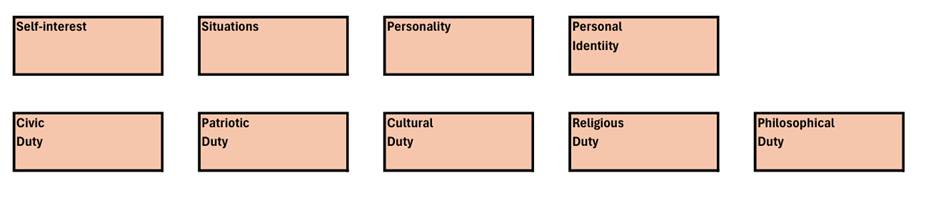
Humans are motivated by self-interest and specific situations but mainly by a passionate sense of duty.
Self-interest
In modern America, self-interest may be first!
Personal benefits
Practicing Civility provides 15 benefits, primarily improved communications and conflict resolution skills, better personal and professional relations and personal well-being.
Personal growth. Civility’s focus on self-awareness, self-management, social awareness, relationship management, communications, growth and problem-solving drives personal growth. It is a great fit for the implicit modern philosophy of self-expression and Maslow’s top-level goal of self-actualization.
3.Local environment. Civility values and behaviors can help individuals to make their local environments more productive, effective and Civil. One individual can use these tools to improve their local environment.
Benevolent self-interest. Civility has inherent spillover or externality effects. Individuals who invest in civility sometimes aim to influence others and local communities to become more Civil for the good of the community. Individuals feel good about promoting these changes.
Situation
Sometimes the situation alone calls for an obvious response. We have such a situation today. Our society is at risk, and we fear the consequences of a downward spiral. We have the tools, knowledge and agency to prevent this. We must respond.
Opportunity. Civility tools are widely accessible. The cognitive and behavioral sciences have grown tremendously in the last half century. Individuals learn and apply various Civility tools at all stages of their lives.
2. Consequence of Failure. Americans know about the “Decline and Fall of Rome”. They witnessed two world wars, a nuclear cold war and its end. They learned that Francis Fukayama’s proclamation of the end of history in 1992 was premature. Civilization is a precious thing. It faces many threats today. Combatting the possible failure of Western civilization is a worthwhile endeavor.
Generational Responsibility. “The Greatest Generation” has earned its rest. The “Baby Boomers” have dominated the last 75 years. We received “Western Civilization”, won the “cold war”, embraced individualism and expanded rights and freedoms. But we abandoned the cultural norms of civility. We have an opportunity to restore them in a better form with greater effectiveness without restricting individual freedoms.
4. Agency. We inhabit a “mass society” where global trade, banking systems, the United Nations, judges, lobbyists, politicians, the media, advertising, corporations, lawyers, banks, insurance companies, universities, computers, systems, processes and artificial intelligence seem to rule. Yet, we prize our individuality, independence, freedom, agency, identities and souls. Civility can be practiced and improved by everyone. No permission is required. We can teach others through our own actions and through education and changes to small communities like families, book clubs, prayer groups and work units. Small changes can have large impacts.
Duty
Civility rests upon 7 values. Human dignity, respect, acceptance and responsibility are broadly supported. Public spirit, intentionality and constructiveness attract less interest from some comprehensive value systems. People embrace, apply and grow such values when they feel a sense of duty, which can come from a variety of sources. Fortunately, Civility can be supported from any of 7 sources of duty.
Our society doesn’t require everyone to have the same religious or political beliefs. It doesn’t require everyone to actively practice Civility. It requires a “critical mass” of individuals who actively practice, improve themselves and promote Civility. We live in a time when we need to be very intentional about growing Civility.
Civic Duty – Many citizens deeply understand the benefits of living in a democratic society. They support Civility because they understand it is necessary. Civility enables constructive dialogue, supports self-governance, builds trust and social cohesion, promotes effective governance and manages conflicts peacefully.
Patriotic Duty – Americans are proud of their country’s history of establishing and maintaining a representative democracy as an example for the world. They practice civility to preserve democracy, uphold its founding principles, ensure social stability, and foster national unity and trust.
Cultural Duty – Individuals live in communities and follow the norms of those communities. The history of Civility sets expectations for continuing to act in a Civil manner. Even in highly individualistic communities, we accept that informal norms, expectations and manners are required to avoid stronger laws, administration and enforcement that would reduce our freedoms. Most individuals are proud of their cultural history and happy to comply. Conservatives naturally honor such history. Many American liberals are also quite proud of the achievements of our society.
Religious Duty – Many religions support at least some of the 7 Civility core values. Those who believe humans are created in God’s image emphasize human dignity, respect and acceptance. Many religious and ethical traditions teach the “Golden Rule”—to treat others as one wishes to be treated. This principle serves as a direct guide for civil behavior, encouraging empathy, courtesy, and kindness in all interactions. Many religions ask members to “love your neighbor”, and support the welfare of others, including strangers and those who are different. Religious texts and teachings often provide a moral framework that promotes virtues like patience, kindness, generosity, gentleness, self-control, and humility. Cultivating these virtues is considered part of a faithful life, which naturally leads to more civil interactions. A sense of humility, derived from the belief that only God can make the final judgment, encourages individuals to tolerate differing views and avoid a condescending attitude toward others.
Philosophical Duty – Philosophers have always addressed the core challenge of forming community and governing even though individuals have different views, needs and interests. Hence, they outline governance structures that work to bridge that gap, often overlapping with the values of Civility. Humanism, secular humanism and philosophies of personal growth and expression emphasize the importance of human dignity, the need to give and receive respect and the importance of accepting or celebrating differences. Many philosophies are compatible with the “golden rule” which emphasizes the mutual respect and forbearance required for a healthy society.
Personality. Individuals with a strong preference for “feeling” versus “thinking” behaviors naturally embrace the Civility values. This can be combined with either a “perceiving”/flexible or “judging”/inflexible approach to the world. Some individuals naturally prioritize responsibility/intentionality or positivity/constructiveness or public spiritedness/belonging.
7. Personal Identity. Many individuals today want to find, define, develop and refine their personal identities. They wish to consciously optimize their human potential. This includes being self-aware, managing themselves, being socially aware and managing relationships, the first 4 Civility behaviors. Individuals who build a secure personal identity can interact with others and accept their differences without feeling threatened or the need to resolve such differences. Individuals who have consciously made life choices and experienced personal growth understand that there are different options and views to be considered.
Practicing Civility will improve your health, effectiveness, sense of belonging, personal growth and leadership skills.
1. Conflict Reduction
Civility is founded on human dignity, respect and empathy. Differences are expected. Individuals seek to understand others. They focus on people, process, interactions and results, not just winning. They employ tools to find acceptable solutions. They refuse to personalize differences. This approach reduces the chance of differences or disagreements escalating to conflicts or crises. The habit of resolving or accepting differences creates an atmosphere that expects reasonable interactions and results.
2. Stress Reduction
Civility reduces the frequency and intensity of conflict. It minimizes the direct and indirect experience of personal attacks. Individuals are affirmed by each other, feeling respect and developing a stronger self-image. Others have higher morale, so they are less likely to fall “below the line” in their behaviors. Social norms guide positive behavior. Individuals expect that people, processes and results will be good, or at least acceptable. They learn to depersonalize interactions, reframe conversations to avoid righteous religious or political issues and build upon their positive experiences.
Positive experiences and expectations reduce stress, tension, fear, anger and anxiety. They encourage engagement and issue resolution. They reduce the risk of burnout.
3. Happiness
People in civil environments experience respect, acceptance, belonging, positivity, trust and good relationships. Civility leads to high achievement by developing communications, problem solving, relationship and influence skills. By applying the values of responsibility and intentionality, individuals improve their decision-making skills, especially those that require interaction, creativity and wisdom to manage complexity, uncertainty and differences. These experiences help people to become centered and composed.
The process emphasis of Civility supports personal growth. Individuals define goals, separate means and ends, welcome feedback, bridge differences and expect to change when they learn. Personal growth can cause anxiety at first, but extended experience provides a way to embrace change and expect positive personal and process results. Finally, Civility requires individuals to make choices about upholding values like human dignity, respect, responsibility, leadership and the public good. Individuals who define and strive to consistently live by moral values build justifiable self-assurance (#10).
4. Good Reputation
When you demonstrate communications, problem solving, interpersonal, personal and change management skills, others notice. When you apply the virtues of respect and acceptance, responsibility and intentionality, positivity and interaction, others notice. They notice your personal, work and civic realms. Your personal brand value grows. They trust, respect and like you. They expect you to work well with others and to keep your commitments. They provide professional and leadership opportunities because you are effective in the modern complex, team environment.
5. Influence
Those who practice respect, acceptance and interactive problem-solving prime others to consider their views. Self-confident, centered, composed, responsible, intentional people are seen as natural leaders. Individuals who have solid interpersonal and communications skills, especially active listening, encourage others to work with them. The experience of mutual respect and creative problem resolution in difficult situations leads others to prefer to work with their highly Civil colleagues.
6. Better Relationships
Civility makes building relationships a top priority. People, process and results. Civil people demonstrate empathy and self-regulation. They have good communications and interpersonal skills. They value respect and acceptance, responsibility and intentionality, positivity and interactions. Experiencing the give and take of shared decision-making or problem-solving benefits all parties.
7. Belonging
The Civility values of interaction/dialogue, mutual respect and public spiritedness combine to create and enhance communities. They create shared purposes, meanings, interests, history and the experience of managing difficult decisions. Belonging improves with this stronger sense of community.
The Civility values of human dignity, respect and acceptance together with empathetic behavior contribute to forming and sustaining a kind, compassionate community. Individuals are affirmed, feel safe and belong.
When Civility is actively thriving, the overall environment is Civil or harmonious. Morale, well-being and relationships improve. Belonging flourishes.
8. Included
The same forces that create belonging apply to inclusion. True belonging, based on acceptance and human dignity, is for everyone, despite whatever differences they may have. A “big tent” welcomes all. The underlying values also make individuals feel respected, valued and affirmed even when they are different or hold different views.
Interacting with mutual respect using modern behavioral science tools leads to understanding differences of interests, perspectives, goals, beliefs, preferences and values. Understanding helps to avoid conflicts. It allows us to disagree without being disagreeable. It encourages us to find creative, compromise solutions. It helps us to identify where we do have shared views. By truly accepting differences we include others.
9. Emotionally Composed
Civil people expect to encounter and manage differences. They willingly engage in group decision-making and problem-solving processes. They respect and empathize with others. They depersonalize crucial conversations. They identify common interests. They learn that they can discuss, trade, negotiate, advocate and influence civilly even when the stakes are high. They learn to accept and embrace compromise and avoid polarizing arguments about political and religious topics.
Civil people are supported by a civil environment of belonging and inclusion where others are mostly stable too. They practice the values of responsibility and intentionality. They know that they must make choices. They learn that some differences cannot be resolved and that they have personal growth opportunities. There is a virtuous cycle of self-control, with the experience of building greater confidence and reserves.
10. Satisfied
Anyone who has achieved 3 Happiness, built a 4 Good Reputation, become 5 Influential, created 6 Better Relationships and become 9 Emotionally Composed should be satisfied with life. If they are also succeeding in life and career based on developing and applying the key behavioral skills, they are further blessed. If they have been able to consistently follow their values, including public-spiritedness, they should be proud. If they have participated in group problem-solving and decision-making to shape their communities at any level, they know they have achieved something important.
11. Overcoming Selfishness
Three of the five key Civility behaviors apply: empathizing with others, building relationships and self-regulation. The individual is required to interact with others, so he or she might as well be good at it. Self-knowledge is required for interacting effectively with others. Radical selfishness is simply not an option.
Personal management and interpersonal skills help people to insightfully look inward and outward to balance both worlds.
Six of the Civility values apply: recognizing the human dignity of others, respecting others, accepting others, interacting with others, being constructive in spite of others and considering the common good with others.
Civility does not elevate “others” or communities above the individual, but it recognizes them as valid agents in life’s drama. They are worthy of serious, intentional, responsible consideration. Civil individuals happily move beyond a state of self-absorption to engage with life’s full possibilities.
12. Leveraging Human Dignity
Civility begins with the insight that we each share a common human dignity. We each have equal worth. This is an essential view of reality and human potential. It cannot be disputed. Civility values, behaviors and skills are derived from this base.
It means that we each have infinite worth and value. We have humanity in common and the “common good”, relationships and community truly matter. The views and interests of others matter and must be considered. Individuals have inalienable rights of protection from others, groups, governments and society. Minority interests should be considered and protected. Individuals must be treated as “ends”, never just as means to ends per Immanuel Kant. Groups and ideologies must never be more important than actual people. Civility processes protect these individual rights while respecting the need for groups, communities, governments and societies to make imperfect decisions for the common good.
13. Mutual Trust
When individuals practice the Civility values, they are signaling that they trust others. Displaying respect and acceptance indicates trust in another person. Investing in intentional, responsible, interactive and constructive actions says that an individual believes that the others are worthy of investment and implicitly trustworthy. Considering the common good or public interest also shows a belief that others should generally be trusted.
Trust is often given altruistically, at least at first. Modern game theory says this is the optimal first step in typical two player games. It is also offered with the expectation that it will be reciprocated. Trusters hope and expect that they will be trusted back.
Trusters also believe that they will indirectly benefit from nudging others into creating more effective teams, groups and communities. These groups are more effective due to collaboration and deliver better results. They reduce the costs and risks of making decisions. They create a positive environment of lower stress and conflict.
14. Mutually Constructive Behavior
Civility embraces positivity and a constructive approach to conflict management, negotiations, problem-solving, decision-making and politics. This value is supported ethically, tactically and strategically; NOT naively.
Responsibility and intentionality are adopted with the expectation that they will be at least partially reciprocated by others. Using a constructive approach to interactions helps to influence others to mirror this good behavior and engage positively.
Civility values an interactive and mutually respectful approach to the broad topic of problem-solving. Faith in interaction is based on the values of human dignity and respect. It is helped by empathetic behavior. It is greatly facilitated by positive and constructive attitudes, thoughts and actions. This is another area where a value (constructiveness) is first offered altruistically with the hope and expectation that it will be partially reciprocated.
Civiliteers hope that civil discourse will arise and become the norm. They hope that a positive environment will result in less stress and conflict. They expect better decision-making, especially when dealing with complex issues with real differences of views and interests. They believe that better decisions will arise from the recognition of differences, identification of the common good, creative solutions and constructive compromises that are “good enough”.
15. Moral Commitment
Civility promotes 7 values. It is an ethical system that is not dependent upon any specific philosophy, religion or political viewpoint. It is consistent with “classical liberalism” that was developed in the 1700’s in England, Europe and the United States.
It is a subset of a complete moral framework. It is fully adequate to support our day-to-day lives together at work, at play and in government. It attempts to balance the inherent conflicts between the self-aware individual and others and communities.
Individuals commit to this set of values because they believe they are in some sense “true”, morally right, adequate and necessary for society and politics. They hope that their imperfect application of these values will trigger others to make the same commitment. They understand that all humans are imperfect and that the serious pursuit of 9 values is much better than no pursuit at all. They adopt these values and invest in learning behavioral science skills and building habits because they want to do the right thing for future generations and ultimate values.
Moral values are the fundamental principles and beliefs that guide an individual’s behavior, helping them distinguish between right and wrong, good and evil. These values—such as honesty, fairness, and respect—act as a personal or societal compass that shapes character and influences decision-making, often requiring individuals to prioritize the collective good over personal gain. Google AI – April 8, 2026, for most text below.
Key aspects of moral values include:
• Guidance for Behavior: They act as an internal compass to dictate actions, choices, and interactions with others.
• Societal and Personal Origin: They can be derived from cultural norms, religious beliefs, or personal reflection, often absorbed through upbringing.
• Core Examples: Commonly held moral values include respect, compassion, responsibility, honesty, integrity, and fairness.
• Distinction from Ethics: While often used interchangeably, morals tend to be personal principles, whereas ethics are often rules prescribed by external sources (e.g., professional codes of conduct).
• Evolution: Moral values are not always fixed; they can change over time as societal norms evolve.
Essentially, moral values help people navigate complex social situations and ethical dilemmas, facilitating cooperative living within a community.
Society Requires Moral Values
Yes, a society requires a common set of moral values to maintain cohesion, stability, and trust. These shared values create a “consensus” that acts as a social glue, setting standard behaviors that guide individuals in treating each other with respect and fairness. Without this foundation, societies often face chaos, insecurity, and social division.
Key reasons for shared moral values include:
• Social Cohesion: They foster unity and prevent a community from falling apart.
• Order and Safety: A solid moral code provides a “safe track” for behavior, reducing the need for constant, forced enforcement of laws.
• Ethical Decision-Making: They provide a basis for distinguishing right from wrong, helping people make consistent choices in personal and professional lives.
• Cooperation: Shared values enable people to work together toward common goals, rather than merely surviving in small, fragmented groups.
While absolute conformity is not necessary, the general acceptance of a set of values—such as love, honesty, and fairness—is critical for the functioning of a modern, democratic society.
Liberal Democracy Requires a Set of Values (1)
Yes, liberal democracy requires a shared, foundational commitment to a core set of values, even while fostering a pluralistic society. These fundamental values, necessary for the system to function, include the rule of law, individual rights, equality, tolerance, and the legitimacy of democratic processes.
Key aspects of the requirement for shared values in liberal democracy:
• Core Principles: The system is rooted in principles of freedom, equality, and protection of rights.
• Essential Values: Key elements include the rule of law, separation of powers, and the protection of minority rights.
• Shared Beliefs: A commitment to democracy as both a governing system and a social arrangement are necessary.
• Tolerance as a Pillar: Tolerance for diverse opinions and lifestyles is a central value.
While liberal democracy allows for diverse opinions on many topics, a shared adherence to the rules of the game is essential for its stability.
Liberal Democracy Requires a Set of Values (2)
Liberal democracy does not require a uniform, comprehensive set of moral values, but it does necessitate a shared commitment to a core set of procedural, democratic values. This “overlapping consensus” includes mutual respect, tolerance, and commitment to the rule of law, allowing citizens with diverse moral or religious views to coexist peacefully.
Key aspects of shared values in a liberal democracy include:
• Procedural Norms: The focus is on shared agreement over the ground rules—such as tolerance, civic virtues, and non-violence—rather than a single moral code.
• Fundamental Principles: While pluralism is allowed, consensus exists around principles like legal equality, protection of individual rights, and freedom from coercion.
• The “Neutral” State: To remain neutral toward varying religious and moral views, liberal democracies focus on ensuring fairness for all rather than upholding a single traditional or religious morality.
• Constitutional Patriotism: Integration into liberal societies is increasingly tied to sharing constitutional and liberal-democratic values (like freedom and equality), as seen in European integration policies.
Therefore, the system thrives on moral diversity but faces instability if there is no shared commitment to the democratic process itself.
Communitarian Critique of Classical Liberal Values
Communitarians argue that classical liberal democracy overemphasizes individualism, atomistic freedom, and abstract rights, while neglecting the fundamental role of community, social responsibilities, and shared conceptions of the good life. They claim liberal democracy fails to recognize individuals are inherently embedded in, and shaped by, their communities.
Key values communitarians claim are missing from classical liberal democracy include:
• Shared Understandings of the Good: Communitarians argue that politics should not be neutral toward conceptions of a good life, but rather promote shared virtues, moral values, and community well-being.
• Social Responsibilities Over Individual Rights: They argue for a shift from a purely rights-based focus to one that emphasizes responsibilities to families, neighborhoods, and voluntary associations.
• Community Belonging and Identity: Communitarians believe that identity is formed through social context and that liberal democracy neglects the human need for strong communal bonds and collective identity.
• Common Good Over Individual Self-Interest: They believe the political order should foster public-spiritedness and focus on the common good rather than simply mediating between selfish interests.
• Social Cohesion and Stability: They contend that by focusing on individual autonomy, liberal democracy erodes the social bonds (such as in family or local communities) required for a stable society.
• Particularity Over Universality: Communitarians argue that political structures should reflect local traditions, histories, and cultural contexts, rather than relying on abstract, universal rights.
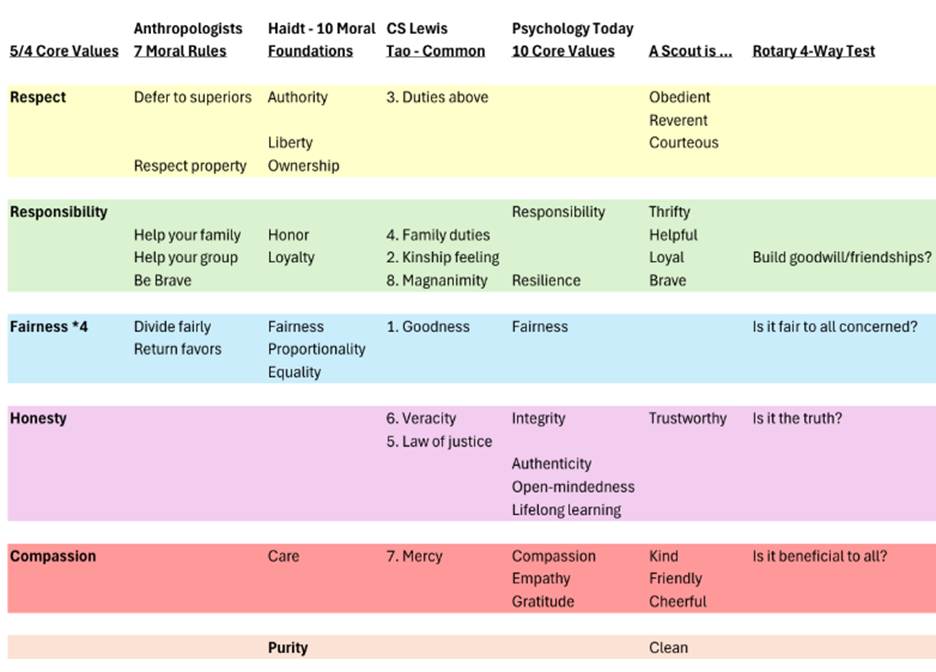
What Social Values Are Most Common? (Tom K. answer)
Respect, responsibility, fairness, honesty and compassion are the 5 most common social moral values.
Civility values are instrumental values, selected to be the smallest set that can effectively support the goal of delivering productive results through social discourse that recognizes differences and builds mutual respect. Respect and responsibility appear on the short list of common values above. Honesty is a component of Constructiveness. Human dignity is not in the top 5 values. It underlies acceptance, which is less common, and compassion which is common, especially today. Intentionality flows from responsibility but is defined as a distinct value. Public-spiritedness is partly supported by fairness listed above and human dignity, which is not.
Civility does not aim to replace any total moral, religious or political system. It aims to provide the skills, behaviors and habits that deliver Civil behavior and results in all domains of life. It seeks to become so widely accepted that it becomes a self-reinforcing norm, leveraging the virtuous cycle of social interaction.
Civility does not oppose other values that are proposed to make social interactions even better. Its “public-spiritedness” is a close cousin of the communitarians’ call (see above) for a more community-centered world, but Civility does not claim to know the right balance between the individual and the community.
Fairness, equity, equality and proportionality are not required, and their absence supports the essential nonpartisan stance of Civility
Purity is not required.
Constructiveness requires neutrality. Positivity is not required. Trust is a desired result of Civility rather than an underlying value.
Human rights are a step beyond human dignity.
Individualism, freedom, liberty and property ownership are not required and belong to political values.
Constructiveness requires some degree of creativity and hopefulness, but the values of idealism, utopianism, possibilities and righteousness are not needed.
Civility does not require, but hopes to produce the group values of cooperation, loyalty, belonging, honor and authority.
Civility’s combination of values often delivers but does not require moderation, avoidance, accommodation, restraint, indirect communication, subjectivity, tolerance, politeness and compromise.
Civility’s human dignity and respect do not require, but often deliver feelings, sensitivity, empathy, sympathy, care and forgiveness.
In similar fashion, it often delivers service, love, charity, mercy, selflessness and hospitality.
Based upon responsibility, constructiveness and intentionality, Civility requires rational thinking. It does not make rationality, common sense, transparency, practicality, objectivity, simplicity or curiosity a core value.
Our approach to Civility defines moral, religious, philosophical and political belief systems as support or motivation for embracing the Civility values and behaviors. It argues that Civility values and behaviors can be separated from other social values, behaviors and systems. It also allows Civility to be supported by personal, instrumental and secular factors without recourse to any overall moral system. This separation allows Civility to act as a neutral system that welcomes a wide variety of beliefs.
Civility does not reject the inclusion of values such as fairness, honesty, compassion, liberty, loyalty, community, empathy, love or service in any person or group’s definition of Civility. They are omitted to provide a smaller set of values that can be neutral on the political and religious dimensions.
The Civility values are strongly supported by the major world religions and secular humanism.