
Ex 8-1: Social Capital, Individualism versus Community
Civility is a set of behaviors used to build relationships and solve problems. Public-spiritedness is one of the 7 underlying values. Social awareness and relationship management are 2 of the 7 sets of behaviors.
Robert Putnam has documented the decline of “social capital” in the United States from 1960 into the current century. The growth of radical or hyper-individualism threatens to undermine the potential of Civility in some places.
Discussion questions:
- Have you experienced a reduction in social or community activities through time?
- Do your social activities meet your needs?
- Does social media provide valuable tools or solutions?
- What has replaced these social activities? Entertainment, work, childcare, travel, education, volunteering, parent care, housework?
- Do the differences between education levels surprise you?
https://en.wikipedia.org/wiki/Bowling_Alone
Bowling Alone: The Collapse and Revival of American Community is a 2000 nonfiction book by Robert D. Putnam. It was developed from his 1995 essay entitled “Bowling Alone: America’s Declining Social Capital” in the Journal of Democracy. Putnam surveys the decline of social capital in the United States since 1950. He has described the reduction in all the forms of in-person social intercourse upon which Americans used to found, educate, and enrich the fabric of their social lives. He argues that this undermines the active civic engagement which a strong democracy requires from its citizens.
Contents
Putnam discussed ways in which Americans disengaged from community involvement, including decreased voter turnout, attendance at public meetings, service on committees, and work with political parties. Putnam also cited Americans’ growing distrust in their government. Putnam accepted the possibility that this lack of trust could be attributed to “the long litany of political tragedies and scandals since the 1960s”, but believed that this explanation was limited when viewing it alongside other “trends in civic engagement of a wider sort”.
Putnam noted the aggregate loss in membership and number of volunteers in many existing civic organizations such as religious groups (Knights of Columbus, B’nai Brith, etc.), labor unions, parent–teacher associations, Federation of Women’s Clubs, League of Women Voters, military veterans’ organizations, volunteers with Boy Scouts and the Red Cross, and fraternal organizations (Lions Clubs, Benevolent and Protective Order of Elks, United States Junior Chamber, Freemasonry, Rotary, Kiwanis, etc.). Putnam used bowling as an example to illustrate this; although the number of people who bowled had increased in the last 20 years, the number of people who bowled in leagues had decreased. If people bowled alone, they did not participate in the social interaction and civic discussions that might occur in a league environment.
Putnam cites data from the General Social Survey that showed an aggregate decline in membership of traditional civic organizations, supporting his thesis that U.S. social capital had declined. He noted that some organizations had grown, such as the American Association of Retired Persons, the Sierra Club, and a plethora of mass-member activist groups. But he said that these groups did not tend to foster face-to-face interaction, and were the type where “the only act of membership consists in writing a check for dues or perhaps occasionally reading a newsletter.” He also drew a distinction between two different types of social capital: a “bonding” type (which occurs within a demographic group) and a “bridging” type (which unites people from different groups).
He then asked: “Why is US social capital eroding?” and discussed several possible causes. He believed that the “movement of women into the workforce” and other demographic changes affected the number of individuals engaging in civic associations. He also discussed the “re-potting hypothesis”—that people become less engaged when they frequently move towns—but found that Americans actually moved towns less frequently than in previous decades. He did suggest that suburbanization, economics and time pressures had some effect, though he noted that average working hours had shortened. He concluded the main cause was technology “individualizing” people’s leisure time via television and the Internet, suspecting that “virtual reality helmets” would carry this further in the future.
He estimated that the fall-off in civic engagement after 1965 was 10 percent due to pressure of work and double-career families, 10 percent to suburbanization, commuting, and urban sprawl, 25 percent to the expansion of electronic entertainment (especially television), and 50 percent to generational change (although he estimated that the effects of television and generational change overlapped by 10 to 15 percent). 15 to 20 percent remained unexplained.
Putnam suggested closer studies of which forms of associations could create the greatest social capital, and how various aspects of technology, changes in social equality, and public policy affect social capital. He closed by emphasizing the importance of discovering how the United States could reverse the trend of social capital decay.
Our Kids
Author Robert Putnam also wrote the award-winning Bowling Alone (1999) and The Upswing (2022) summarizing the mountains of social science research on American Community and related topics. The first book documented the large, steady and widespread decline in community participation in the second half of the 20th century. The second book extended the timeframe back to the 1850’s to document that community participation was very low in the post-Civil War era, but that institutional innovations plus social, economic and political changes aligned to promote greater community participation throughout the next 75 years, before declines began in the post-WW II era.
This book is also data-intensive and primarily focused on the role of “community” in driving divergent opportunities for lower socioeconomic status (SES) versus higher SES children. Five chapters focus on the American Dream, Families, Parenting, Schooling and Community before a final chapter on why we should care and what we might do. The author provides paired case studies of higher (top 1/3rd) and lower (bottom 1/3rd) SES families in his hometown of Port Clinton, Ohio (near Toledo), Bend, OR, Atlanta, Orange County, CA and Philadelphia to illustrate how the various factors interact and apply.
The author chooses to frame his story under the heading of upward mobility or equal opportunity because this is a very widely held American value with supporters in both political parties. His liberal/Democratic party bias shows in various places, but his mastery of the data, case studies and sequencing make this a powerful book describing how American communities, families, kids and neighborhoods were actually functioning in 2015 contrasted with those in 1955-75.
In summary, the reduction in community activities documented in Bowling Alone is mostly felt by the bottom half of the SES groups. Poor/poverty class, working class and middle-class families have been very negatively impacted by both lower absolute and relative economic opportunity and weaker community support, while professional, upper middle and wealthy class families have maintained economic and community resources to guide their children to positive outcomes. Upward mobility in the US has fallen as income and wealth inequality have increased, leading to greater divisions in society, lower trust, weaker institutions and polarized politics.
Putnam tries not to shout, but the clear implication is that American civilization, per se, is at risk! If one-third or one-half or two-thirds of Americans do not benefit widely from social institutions, choose to not participate in them, lose trust in their neighbors, fail to raise their children and turn to populist political candidates for solutions, The American Dream is at risk. The author does quietly note that the measurements of intergenerational mobility lag by 20 years, so what we are seeing today is somewhat based upon the social, economic, political and economic conditions of the late 1990s. The next two decades of community, institution and parent formation have already taken place and shaped childhood development.
“Sociologists”, like Dr Putnam, are often commingled with “socialists” and other leftwing political groups in the public mind; and the profession is clearly leftward leaning in universities today. However, the discipline also has an inherent rightwing slant. Sociologists devote their time to analyzing the roles of community, family, kin, religion, neighborhood, voluntary groups, institutions, unions, employers, political parties and other groups on human behavior. The focus is on the group as a counterweight to the purely individualist, commercial, scientific, rational, transactional, computing, materialist conceptions of human beings. Classical conservatives have often tried to “conserve” the delivered group history, traditions, culture, value, art and institutions (civilization) of the past against the various progressive, experimental, enlightened proposals of liberals. A successful civilization must have successful groups and institutions.
Google AI March 30, 2026
In his 2020 book The Upswing, Robert Putnam (along with co-author Shaylyn Romney Garrett) measures social capital through the lens of social connectedness and civic engagement.
The book tracks these measures over a 125-year period (roughly 1900 to today), showing an “inverted U-curve” or “I-We-I” arc where social capital rose steadily until the 1960s and has since steeply declined.
The specific measures and indicators used to track this trend include:
Civic & Organizational Life
Putnam uses data on formal and informal group participation to gauge how connected Americans are to their communities.
* Membership in organized groups: Participation in civic and community clubs, such as the Shriners, Knights of Columbus, and PTAs.
* Labor union density: The percentage of the workforce belonging to labor unions as a sign of economic and social solidarity.
* Religious participation: Rates of church attendance and membership in religious organizations.
* Voter turnout: Participation in elections as a measure of civic responsibility and investment in the “common good”.
Social & Family Connectivity
The book incorporates broader demographic trends that reflect social cohesion.
* Marriage and family patterns: Metrics such as the median age at first marriage, marriage rates, and the timing of motherhood (e.g., motherhood by ages 30 and 45).
* Social trust: Measures of “generalized social trust”—the degree to which citizens trust one another and institutions.
Cultural & Linguistic Shifts
An innovative part of Putnam’s analysis in The Upswing involves using the Google Books Ngram Viewer to track cultural shifts through language.
* “We” vs. “I” usage: Tracking the frequency of first-person plural pronouns (we, our, us) compared to first-person singular pronouns (I, me, my) in millions of digitized books to identify shifts from collectivism to individualism.
* Naming conventions: The use of uncommon or unique baby names as an indicator of a culture prioritizing individual identity over community conformity.
Complementary Metrics
While social capital is one of the four main pillars of the book, it is analyzed alongside three other synchronized metrics that follow the same historical arc:
* Economic inequality: The gap between the rich and poor.
* Political polarization: Levels of partisanship and cross-party collaboration.
* Cultural identity: The balance between “solidarity” and “individualism”.
August 22, 2024
Disconnected: The Growing Class Divide in American Civic Life
Findings from 2024 American Social Capital Survey
Daniel A. Cox, Sam Pressler
American social and civic life was once defined by diverse clubs, groups, and organizations. However, it has declined by every conceivable measure since the mid-20th century. Today’s Americans have fewer civic opportunities—that is, places, institutions, groups, programs, and activities in which they can experience community life. Americans participate in organized activities less often and join fewer community groups than they once did.
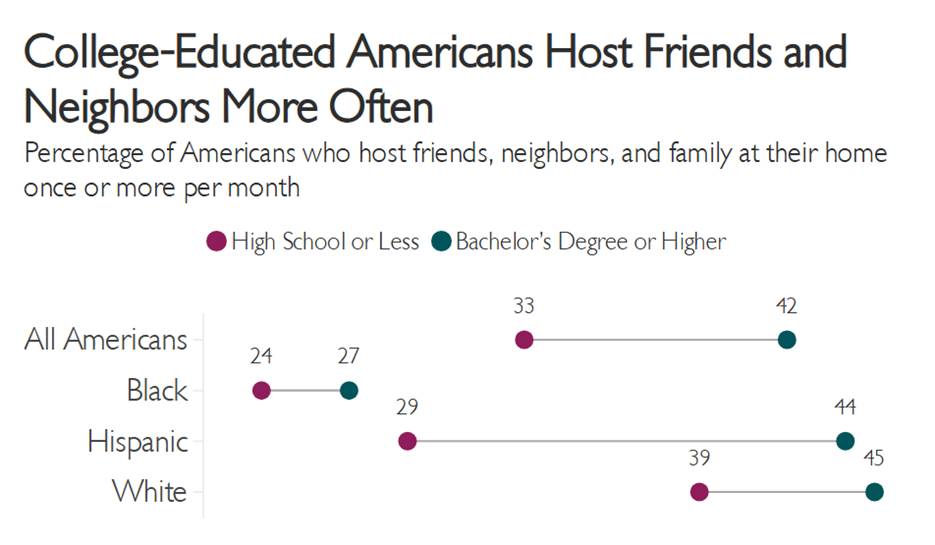
Relatedly, Americans have smaller social networks and fewer friends, and they spend less time with their friends, neighbors, and family members. This state of affairs has led Surgeon General Vivek Murthy to declare the United States is facing an “epidemic of loneliness and isolation.”
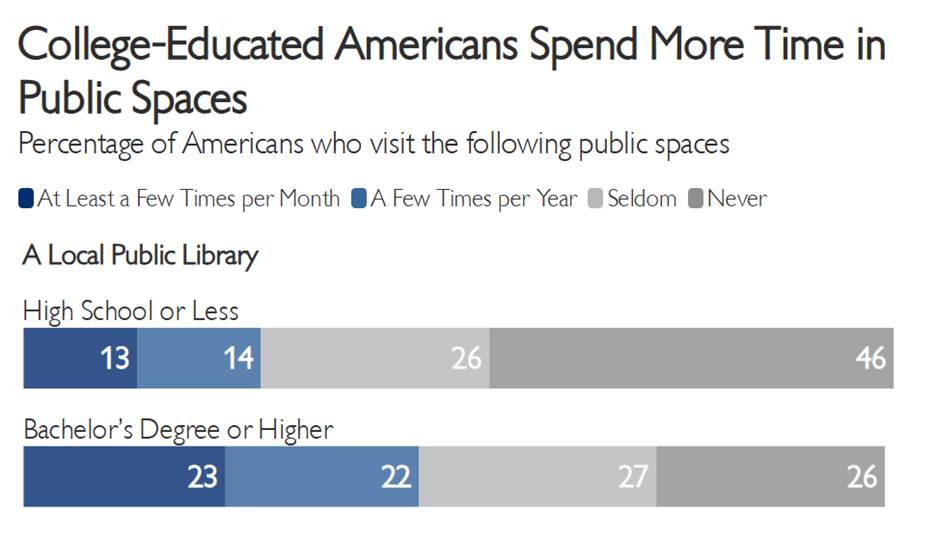
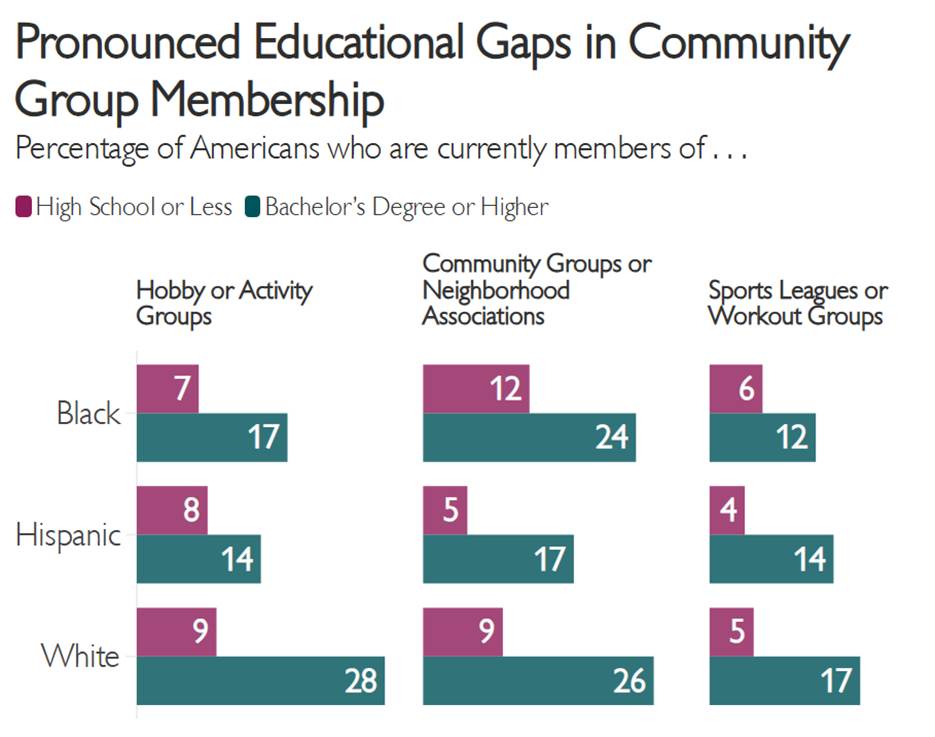
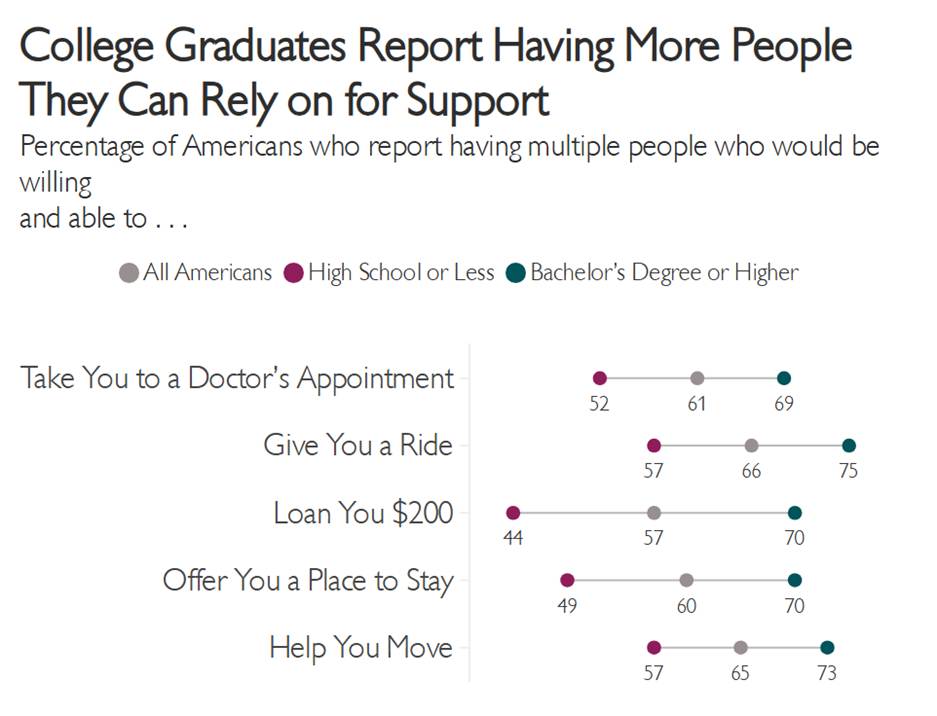
But America’s civic decline has not affected all groups equally. Americans with college degrees often reside in communities with abundant civic opportunities and thriving civic cultures. They participate in associational life at high rates and have robust social and friendship networks. In contrast, the relational lives of Americans without college degrees have contracted dramatically—compared to Americans with these degrees today and without them in the past. Two institutions that were formerly crucial sources of civic connectedness for less educated Americans, unions and churches, are now more likely to serve college graduates.
Other civic opportunities are becoming stratified along educational lines. Americans with a high school education or less are more likely to live in civic deserts, lacking commercial places (e.g., coffee shops) and public places (e.g., community centers, parks, and libraries) that are hubs of community connection. Partly as a result, these Americans are less likely to participate in associational life and more likely to be socially isolated. As Timothy P. Carney writes in Alienated America: Why Some Places Thrive While Others Collapse, associational life has apparently become “a high-end good” that most people can’t access.
Links
 Good News
[…] Social Capital: Individualism vs Community (8-1) – Good News […]