
Ex 8-2: Protecting Your Identity
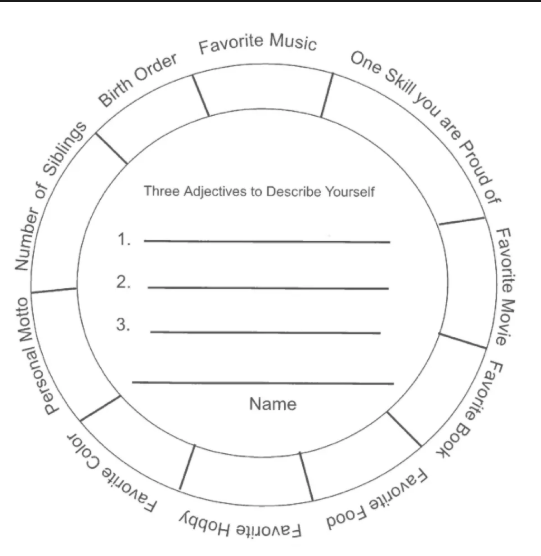
Step 1: Personal Identity Wheel (5 minutes)
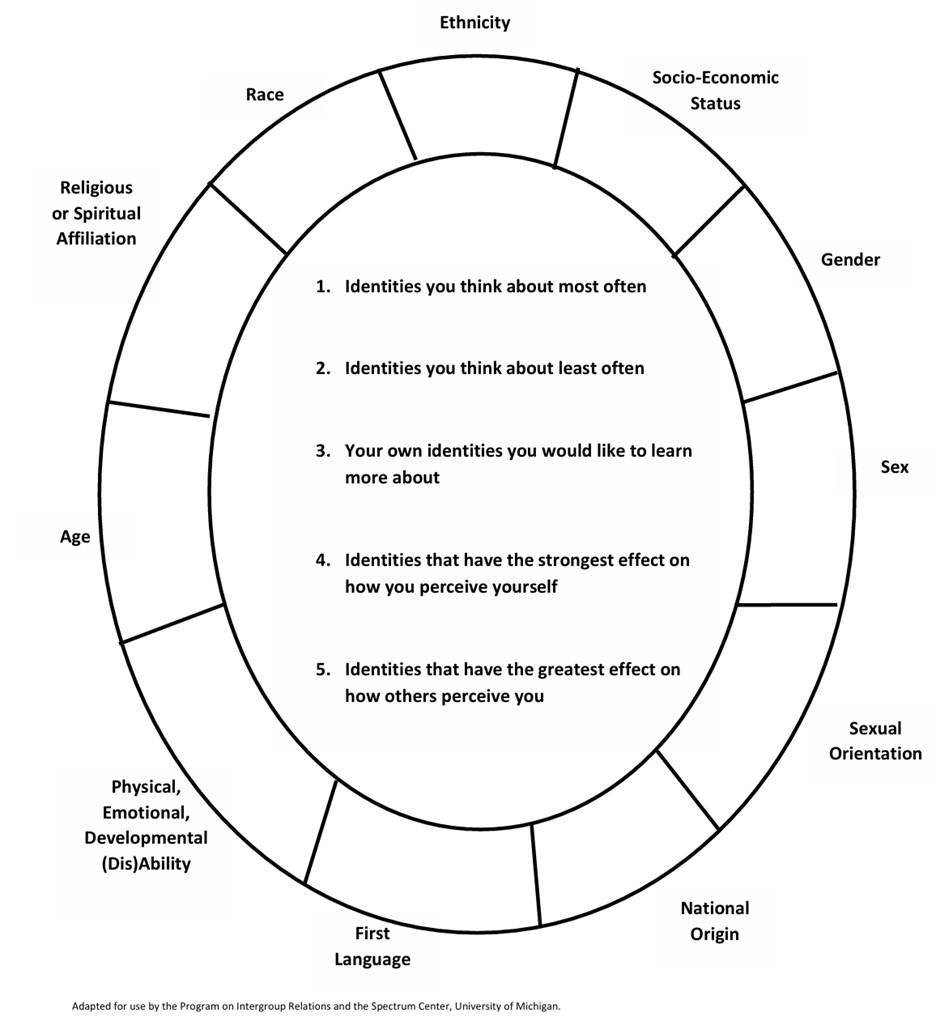
Step 2: Social Identity Wheel (5 minutes)
Step 3: Drawing Safety Activity (5 minutes)
Drawing Safety Activity
Get out a piece of paper and some drawing supplies. Set a five-minute timer and begin to think about a place or activity where you feel safe and relaxed. Start drawing that place (this triggers the visual cortex of the brain, an important part of memory).
It doesn’t matter if your drawing is pretty in any way. The whole purpose is to put focused imagination into creating perceived safety.
Continue thinking about and adding in any detail you can think of. At the end of the activity, check in with yourself. Notice the sensations in your body. What are you feeling?
One of the reasons this activity can be powerful is that it uses the visual cortex, the part of the brain that processes sight, to create safety.
Individuals are more sensitive to identity threats today due to a combination of intensified digital visibility, increased social polarization, and a growing psychological link between belonging and authenticity. Google AI, March 31, 2026
1. The Digital “Always-On” Reality
* Constant Comparison: Social media exposes individuals to curated, idealized versions of others’ lives. This “upward comparison” frequently triggers feelings of inadequacy, making people more protective and sensitive about how their own identity is perceived.
* Identity Sprawl: A modern digital identity spans hundreds of touchpoints, from personal credentials to social media profiles. This expanded “attack surface” means any perceived slight or data breach feels like a deeper, more personal violation than in the past.
* Digital Permanence: Unlike previous generations, today’s identity experiments and mistakes are preserved online. This lack of “narrative agency”—the ability to move on from past versions of oneself—heightens the stakes of any current threat to one’s reputation or identity.
2. Heightened Intergroup Polarization
* “Us vs. Them” Mindset: Modern sociopolitical environments often frame the “other side” as a direct threat to one’s way of life. When a “team” identity (political, social, or cultural) is threatened, individuals become more motivated to defend it aggressively to maintain their sense of belonging.
* Affective Polarization: Increased animosity between groups means that even neutral information can be perceived as an identity-threatening “attack” if it originates from an out-group. This leads to “boomerang effects,” where people react with increased hostility or resistance to preserve their internal sense of self.
3. Psychological Costs of Inauthenticity
* Authenticity as a Need: Modern identity is closely tied to the feeling of being one’s “authentic self”. Threats that make an individual feel they don’t “fit” or belong in a group (e.g., at work or online) directly impair this sense of authenticity.
* Psychological Stress: Research shows that “downplaying” or hiding parts of one’s identity to avoid threats leads to significant psychological stress and even physical health issues. Because the stakes for mental well-being are higher, sensitivity to these threats has naturally increased.
4. Evolution of Threats
* Sophistication of Impersonation: Technologies like AI and deepfakes allow for highly convincing impersonations, making identity theft feel more personal and invasive than traditional hacking.
* Loss of Trust: As trust becomes a “partisan commodity” and digital environments feel more hostile, individuals develop a state of hyper-vigilance to protect their identities from both social and technical exploitation.
BACKGROUND: Fukuyama’s Identity (2018)
The increased role of identity as the basis for politics, dignity, polarization, populism and loss of status makes identity a much more sensitive topic. Civility values and skills can help the individual and his relationships. However, the increased importance and sensitivity to threats makes practicing Civility more challenging.
‘1. The Politics of Dignity (excerpts …)
Twentieth century politics was largely a left (equality) versus right (freedom) battle. Politics today is more often based on identity. The left focuses more on protecting the group rights of marginal communities: blacks, immigrants, women, Hispanics, LGBTQ, refugees, and workers. The right focuses more on protecting the group rights of other traditional, rural, religious, national, racial and ethnic communities. The “classic liberal” emphasis on abstract, universal, individual human rights supported by both the center-left and the center-right has been overshadowed.
‘6. Expressive Individualism
Rousseau changed the game completely. The individual is now clearly first, ahead of society and the traditional God. The individual is inherently good, but often corrupted by society. The individual can find that good self by looking inward, deeply and with feeling. The individual has a moral obligation to find and express that good inner self. This autonomy applies in all dimensions. Creative powers become more important.
“The problem with this understanding of autonomy is that shared values serve the important function of making social life possible. If we do not agree on a minimum common culture, we cannot cooperate on shared tasks and will not regard the same institutions as legitimate; indeed, we will not even be able to communicate with each other absent a common language with mutually understood meanings”.
‘9. Invisible Man
It’s not “the economy, stupid” as claimed by James Carville. It’s my dignity. Relative status, qualitatively, matters to everyone. No one wants to be Ralph Ellison’s “invisible man”. The loss of status, like the loss on investments, has a strong negative emotional effect. This matters to the middle class and the working class. The loss of relative status is very painful. Immigration becomes a major issue because immigrants can be viewed as the cause of a loss in status/economic position.
’10. The Democratization of Dignity
“The affirmation of the inner identity depended, in the final analysis, on the truth of Rousseau’s assertion that human beings were fundamentally good; that their inner selves were sources of limitless potential.” “Ideas that ultimately trace back to Rousseau: that each of us has an inner self buried deep within; that it is unique and a source of creativity; that the self residing in each individual has an equal value to that of others; that the self is expressed not through reason but through feelings; and finally that this inner self is the basis of … human dignity”.
11. From Identity to Identities
Social movements in support of various “rights” exploded in the 1960’s: civil, feminist, sexual, environmental, disability, indigenous, immigrant and gender identity. They began as new waves in the expansion of individual rights within the “classic liberal” political model. In each case there were activists who promoted the importance of group rights as being even more important than equal individual rights. “Equal individual rights” was deemed an inadequate goal. Previously invisible and disrespected groups needed to be respected as groups specifically because of their differences. The “lived experiences” of exploited group members were to be relished even though the majority population might not be able to understand their experience and perspective.
Identity politics on the left has since led to identity politics on the right. Once groups decided that their rights, feelings, insights, and experiences were sacred and not subject to criticism from the outside, they adopted beliefs, norms and communications standards that can rightly be called “politically correct”. We are right because we know we are right.
 Good News
[…] Protecting Your Identity (8-2) – Good News […]