
Ex 8-3: DEI and Authority, Honor and Loyalty
A powerful way to explore this is through a “Values in Conflict” Scenario Analysis. This exercise puts people in a situation where they can’t satisfy both sets of values simultaneously, forcing them to prioritize and explain why.
The Exercise: The “New Policy” Dilemma
The Setup: (minutes 0-2)
Divide the group into small teams of 3-5 members. Present the following scenario:
Your organization has a long-standing, prestigious mentorship program where senior leaders hand-pick their successors. Historically, this has built incredible loyalty and a “family” atmosphere. However, the current leadership reflects only one demographic.
A new proposal suggests replacing this with an open, blind application process to encourage equity and diversity.
The Task: (minutes 3-11)
Each team must debate the following three tensions:
1. Equity vs. Authority: Does the “blind” process undermine the authority of senior leaders to choose who they trust to lead?
2. Inclusion vs. Loyalty: If a leader passes over a loyal, long-term protege to hire a more qualified outsider from an underrepresented group, have they betrayed group loyalty?
3. Diversity vs. Honor: Is the honor of the “old guard” and their legacy protected or insulted by changing the rules they lived by?
The Debrief: (minutes 12-15)
Bring everyone together to discuss:
* Which value felt the most “expensive” to give up?
* Can loyalty be redefined to include loyalty to a mission rather than just a person?
* How can authority be used to champion DEI rather than compete with it?
Moral Foundations Theory / The Righteous Mind
In 2013, Jonathan Haidt summarized a decade of research on what values make man tick. What moral intuitions are widely held across time and cultures? Which ones are consistent with evolutionary psychology? How do people think about moral values? The researchers identified and validated 5 values, which have been expanded and refined into 9. People are born with the ability to develop certain moral intuitions. They adopt them subconsciously from experience, family and culture. They hold them deeply and defend/rationalize them as needed. We can change our moral values, politics and religions, but we usually don’t.
(1) Care/Harm
Don’t harm others, take care of people, relieve suffering, empathize. Leads to the virtues of kindness, gentleness and nurturance.
(2) Fairness/Cheating/Equality
Treat people fairly. Reciprocal altruism. Impulse to impose rules that apply equally to all and avoid cheating. Intuitions about equal treatment and equal outcomes for individuals. Generates ideas of justice, rights and autonomy.
(3) Liberty/Oppression
Feelings of reactance and resentment people feel towards those who dominate them and restrict their liberty. Seek liberation from constraints and fight oppression. Motivation to assemble to oppose invalid authority. Promotes equal rights, individual freedom and freedom from oppression.
(4) Fairness/Cheating/Proportionality
Intuitions about individuals getting rewarded in proportion to their merit or contribution.
(5) Ownership
Intuition about possession rights in society, similar to territoriality, which reduce conflict.
(6) In-Group Loyalty/Betrayal
Instinct to affirm the value of groups you identify with, including family and country. Leads to the obligations of self-sacrifice, vigilance, patriotism and punishing betrayal of the group.
(7) Honor/Self-Worth
Basing one’s self-worth upon reputation, including family and kin reputation.
(8) Authority/Subversion
Stable social order based upon the obligations of hierarchical relationships, including obedience, respect and fulfilment of role-based duties. Prevent/oppose/punish subversion. Leads to the virtues of leadership, followership, deference to authority figures and respect for traditions.
(9) Purity/Sanctity/Degradation
Intuitions of physical and spiritual contamination and disgust elevate the value of purity in thought, word and deed. Leads to the virtues of self-discipline, self-improvement, naturalness and spirituality.
Acceptance and Inclusion Defined
Acceptance involves tolerating, respecting, and acknowledging differences. Acceptance is being open, tolerant, non-discriminating, nonjudgemental, understanding and minimizing prejudices. It is a habitual state of mind. The differences can be personal or group characteristics, beliefs, behaviors or identities.
Inclusion is acting on the value of acceptance. It includes being present, supporting others, choosing welcoming language and behaviors and preventing or reducing social exclusion.
Inclusion is primarily shown by intentionally creating positive social environments where all individuals are welcomed and feel a sense of belonging. Individuals are respected, heard, accommodated, and supported. They feel safe, trusted and free to be authentic. They are encouraged to participate, contribute and thrive.
Google AI Updated March 29, 2026
Christianity supports acceptance and inclusion through the core message of God’s love, urging believers to embrace all individuals—regardless of background—as being created in God’s image. Jesus demonstrated this by engaging with social outcasts, while teachings emphasize unity, grace, and treating others with unconditional love.
Biblical Foundations for Inclusion
• Imago Dei (Image of God): All humanity is created in God’s image, providing inherent dignity and worth to every person, which demands respect and inclusion.
• Jesus’ Example: Jesus consistently broke social barriers, welcoming sinners, tax collectors, and the marginalized (e.g., eating with them in Mark 2:15-17.
• Unity in Christ (Galatians 3:28): This verse declares that in Christ, there is no distinction between Jew or Greek, slave or free, male or female, promoting spiritual equality.
• Extravagant Grace: The gospel offers salvation to everyone, emphasizing that God’s love is inclusive and unconditional.
Practicing Acceptance
• Welcoming Others (Romans 15:7): Christians are called to accept one another just as Christ accepted them, fostering unity within the community.
• Social Justice: Scripture calls for justice and love for the vulnerable, demanding that believers oppose favoritism and actively include the marginalized.
• Community Care: Early Christians exemplified inclusion by sharing possessions to ensure everyone had what they needed.
Acceptance Tom K. continued …
Summary
The major world religions support acceptance and inclusion:
All individuals have human dignity, created by God, worthy of acceptance and inclusion.
Religion is practiced in communities where diverse individuals are brought together.
The strange, vulnerable, marginalized, foreigner, widows, prisoners, and outcasts are different and must be embraced.
Individuals are commanded to be compassionate, caring and loving to all.
The spiritual dimension of individuals in communities makes them equally worthy of acceptance.
Religious rituals emphasize the unity of individuals in community practice.
The universe is one and individuals should seek harmony with all of it despite the surface level diversity.
There are multiple, fluid paths to enlightenment or connecting with God, so diversity is natural.
Many religions specifically call out the value of diversity, differences, designs, races, other religions, non-religious sectors and viewpoints.
Some religions emphasize the inherent incompatibility of the individual with the whole, yet they are complementary despite the unbridgeable differences.
Religions note the path of personal growth and learning that is driven by interacting with diverse thoughts, experiences and individuals.
Respect Defined
Respect is an attitude or behavior of high regard, admiration or consideration toward a person, object, or entity.
We respect others, social roles, institutions, rules, laws and the boundaries of others.
Respect is shown through active listening, active engagement, conflict management, tolerance, maintaining safety, being courteous and considerate, honoring boundaries, intentionality, empathy, affirming and empowering others, equal treatment, trusting, justice and inclusion.
Human Dignity is a core Civility value. Respect is a recognition of that value through kindness, courtesy, and protecting rights.
Respect combined with the Civility value of Public-Spiritedness creates a need for social justice: protesting, correcting, and preventing actions that diminish human value.
Respect combined with the Civility values of Human Dignity and Intentionality requires us to proactively seek to understand and care for the needs, rights, and feelings of others.
Respect combined with the Civility values of Human Dignity and Acceptance requires us to acknowledge the value of all people, particularly those who face systemic disrespect.
Respect is supported by all major world religions.
Civility Supports Inclusion (Acceptance)
Summary
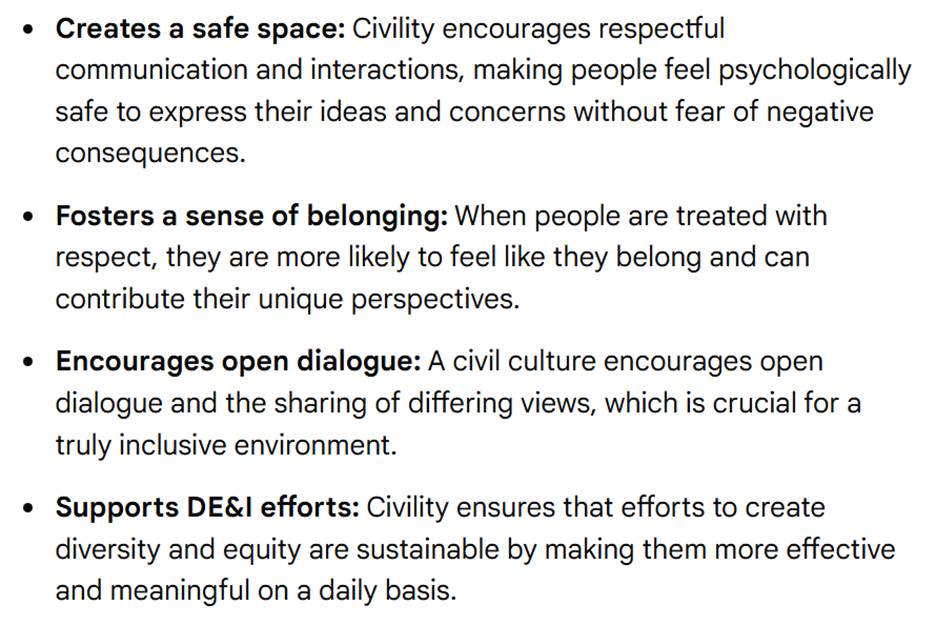
Diversity and inclusion are part of the key Civility value of acceptance. Each person has human dignity and should be respected and accepted by others in their individuality. Civility is based upon commonly held values and promotes personal development and responsibility for being a good person, interacting with others and considering community needs. Like DEI, it promotes a subset of values to make our lives together safer, more pleasant and more effective. It focuses on how we interact with each other constructively, despite our differences.
Civility’s nonpartisan stance takes no position on the stronger claims of DEI providers or their critics. Civility recommends that they both engage in meaningful dialogue to better understand where they can work together and where they must accept that they have different social, political and moral perspectives that cannot be reconciled today. Civility actively opposes the angry outbursts, attacks, emotional appeals, insults, blaming, bullying, shaming, disrespect, blind loyalty, ignorance, prejudging, stonewalling and demonization sometimes seen in these interactions.
 Good News
[…] DEI and Authority, Honor and Loyalty (8-3) – Good News […]