

https://www.sefiracreative.com/
Moral Shortcomings Are Noted Everywhere
Social conservatives have decried the decline of moral values since 1960.
Religious groups of all political views have done the same.
Robert Putnam has documented the loss of social capital in Bowling Alone, Our Kids, The Upswing and American Grace noting that morality, trust and institutions have declined at the same time.
Political scientists and pundits have noted the loss of civic virtue and wonder if a political system based on the “thin” virtues of “classical liberalism” can survive.
High schools, colleges and departments of education have begun to respond to the “crisis” but faced political challenges from both parties, educators and parents.
Corporations, universities, not for profits and military branches have attempted to define their core values as a way to build community, align resources and clarify direction. They note an absence of common values in their employees.
Personal growth advocates, even those emphasizing individual artistic expression, have increasingly noted that the community and spiritual dimensions of life are part of growth.
Big Disagreements
While social and political conservatives have pressed for moral reinforcements, both moderate and progressive liberals have pushed back on these efforts; wary of infringing on personal liberties and supporting community, cultural and institutional oppression. Economic conservatives and libertarians have not bemoaned the decline in community and shared values. Some “communitarian” philosophers and social scientists have begun to challenge the individualistic dogmas that have ruled universities since the Enlightenment. There is not a firm consensus that we need or can have on “shared values”. Many philosophers, theologians and social scientists are quite certain that this is a dead-end street.
Practically Speaking
A majority of citizens and leaders agree that the loss of a shared set of values is harming our country and society. We need to find some kind of solution. Promote religion. Educate students and adults. Conduct research. Create artistic vehicles for learning. Work together on teams. Join groups. Communicate better.
Let’s start by outlining the common moral values. We’ll ignore the experts. We’ll gloss over some inconsistencies. We won’t provide perfect definitions. We won’t outline an implementation strategy. We will provide a meaningful outline by combining the thoughts of some very different sources
Motivations
This is not a dead-end project. We live in “A Secular Age”. We’re not going to reach religious or political agreement on everything. Most people understand that we are forced to live together and that we have to “get along”. We have learned to be “tolerant” in most dimensions of life. We can learn to embrace a set of general moral principles that are self-evident. The principles cannot be proven or derived from core principles. They have to be “accepted”.
Individuals who learn these principles will do so for many reasons if they are presented well. They help the individual to live in a social world. Self-interest alone justifies developing these virtues, understanding and habits. These principles seem to be natural, widely seen across time, space and cultures. They may not be universal or “revealed” but they have proven their worth. Individuals are learning that extreme skepticism and subjectivity are inadequate. Every major worldview offers a set of moral principles like these. Individuals who strive to fulfill their potential understand that moral principles underlie “the good life”. These principles work together nicely in a logical, relatively succinct package.
Sources
Corporate “core values” experts trying to find the essences so they can be easily taught. Anthropologists looking for the most widely seen values. The evolutionary psychologist Jonathan Haidt. Mid-century philosopher and Christian apologist C.S. Lewis claiming that all major civilizations share key ethical principles. Psychology Today advising us on how to best guide our behavior. The Boy Scout Oath. The Rotary 4-Way test.
Summary
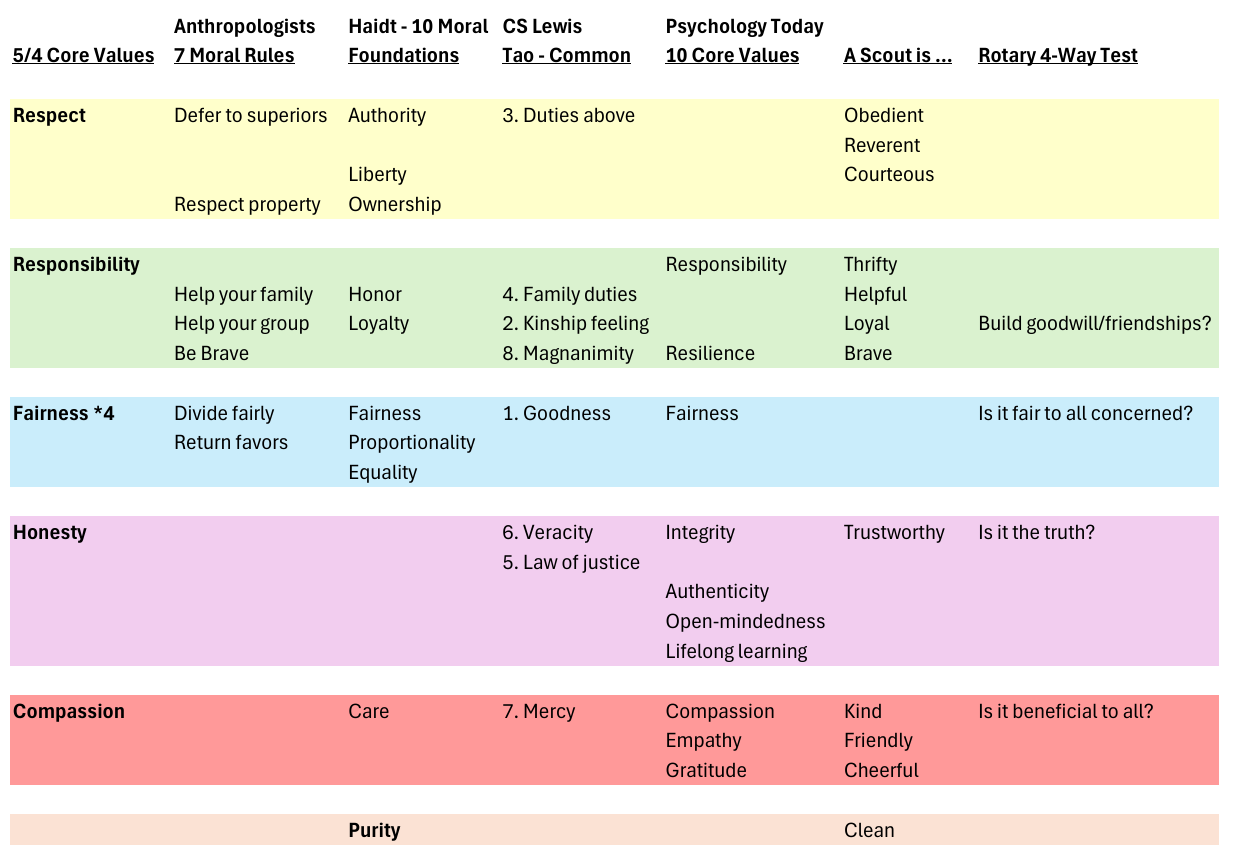
Descriptions
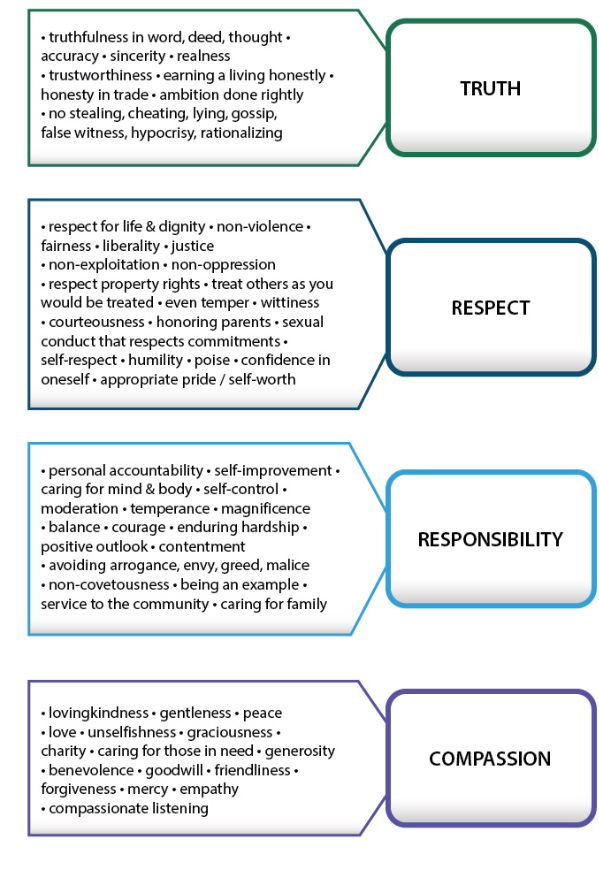
https://rootedindecency.com/blog/values/4-core-values-shared.html
4 self-evident clusters of Respect, Responsibility, Honesty and Compassion. We know what these are. We know they are good and useful. We know that it requires work for children to learn them and for us to put them into practice consistently and effectively.
Another author calls out Fairness as a fifth cluster.
https://docket.acc.com/harness-power-5-core-moral-values
A group of Oxford anthropologists has surveyed the vast literature on cultures and identified 7 universal principles that are almost always evident and never contradicted. They begin to add some second-level definitions to the 5 clusters.
Respect is shown both by “deferring to superiors” and “respecting property”. Responsibility is shown by “helping your family”, “helping your group” and “being brave”. Fairness is exhibited by “dividing fairly” and “returning favors”. This group didn’t see honesty and compassion as universal values.
Haidt’s “The Righteous Mind” introduced the world to a set of moral flavors that varied between traditional and modern (WEIRD) societies and between left and right politicians. His team has added some flavors that have some plausible origin in the development of men from hunter-gatherers through farming and cities. For Respect, Haidt agrees that property ownership rights matter and that respect for authority is critical to holding together communities. Without it, the free rider problem undermines groups. He also argues that “liberty” is the “flip side” of authority. Individuals inherently feel the need to defend their individuality against potentially oppressive authority.
Haidt emphasizes the importance of family, kinship, honor and loyalty in traditional societies. He argues that these values are just as valid as the modern care, fairness and equality trio. He provides 3 flavors of fairness, adding proportionality and equality to the basic idea. He also skips “honesty” and emphasizes “care” as the result of compassion. He adds “Purity” as a separate factor reflecting both biological and religious forms of cleanliness for early men.
https://en.wikipedia.org/wiki/The_Abolition_of_Man
In 1943, C.S. Lewis had experienced enough modern analytic philosophy, subjectivity and intellectual progress and fired back with “The Abolition of Man”. He argued that without an objective moral framework, Western civilization was doomed. The Nazi and communist threats mattered. But the breakdown of common culture, values and beliefs within democracy was an equal threat. Lewis argued that a roughly common moral framework and principles existed in every thriving culture. His “natural law” view was not widely embraced at the time.
Lewis’s 8 components of the Tao, or “the way” fit nicely into the 5 clusters. His “duties to parents, elders and ancestors” fits with Respect. He filled out Responsibility with family duties, kinship feelings and magnanimity which emphasized the bravery of making the right decisions. His “law of general beneficence” fills out Fairness. He outlines Veracity as critical to honesty and expands it with the “Law of Justice”. He fills the Compassion group with his Mercy.
https://www.psychologytoday.com/us/blog/beyond-school-walls/202305/10-core-values-to-guide-behavior
A recent Psychology Today article takes a more “personal growth” oriented view. The Respect drawer is empty, although “authenticity” could be seen as a form of self-respect. Dr. Koehler adds resilience to the Responsibility core value and includes Fairness. She adds 3 others to the Honesty cluster after Integrity. A growing individual needs to value authenticity, open-mindedness and lifelong learning. We start to see why there are differences at the second level, but I don’t think they are too great. The author embraces compassion, adding empathy and gratitude to this section.
https://www.scouting.org/about/faq/question10/
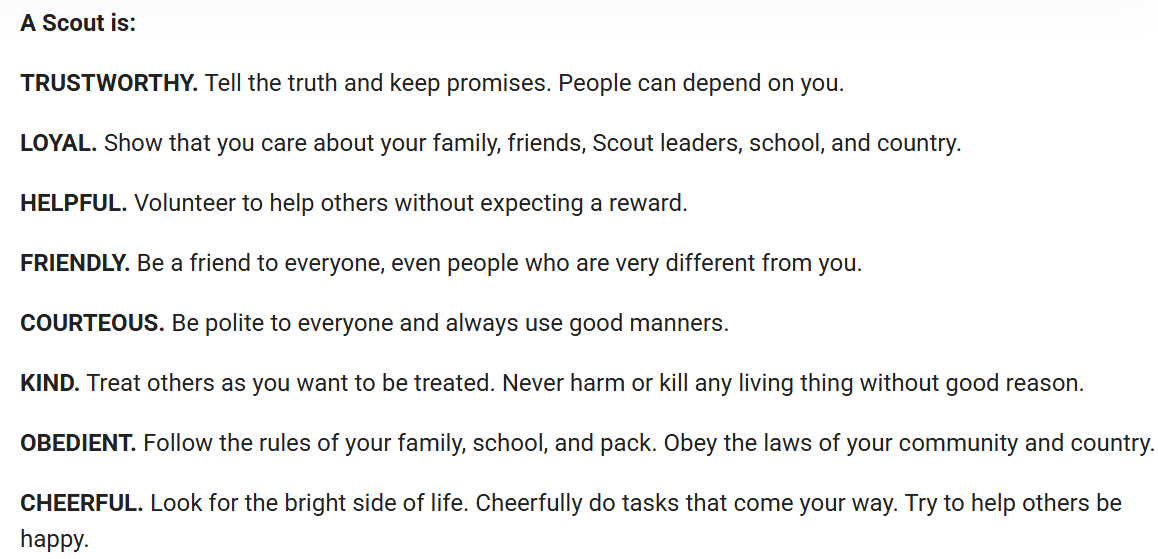

The Scout Oath was drafted in 1908. A Respectful scout is Obedient, reverent and Courteous. A Responsible scout is Thrifty, Helpful, Loyal and Brave. An Honest scout is Trustworthy. A Compassionate scout is Kind, Friendly and Cheerful. A scout is Clean.
https://my.rotary.org/en/guiding-principles

The Rotary 4-Way test was drafted in 1932. It fits into 4 of the 5 main categories.
Summary
We have a nice head start on outlining a set of common moral principles that could be used for education, civics, personal growth and community building. The core ideas fit with traditional and modern societies, secular and religious views, left and right politics. The key, as with our political system, is to agree to work within a framework of practical application. We cannot and will not resolve deeply felt religious, philosophical and political views. But we can agree on what it takes to work together and live good lives together.
 Good News
[…] We Have More in Common Than You Think Common Moral Values […]
[…] Common Moral Values We Have More in Common Than You Think Words for Who We Are in Common Morality (2020) Jonathan Sacks The Soul of America – Jon Meachem (2018) The Road to Character – 2015 […]
[…] The Road to Character – 2015 Moral Foundations Theory of Politics Common Moral Values Our Political Differences are NOT Going Away; And […]
[…] 6, 2025 tomkapostasyLeave a comment We Have More in Common Than You Think Common Moral Values Words for Who We Are in Common The Road to Character – 2015 Morality (2020) […]
[…] Common Moral Values […]
[…] Common Moral Values […]
[…] Common Moral Values – Good News […]
[…] Common Moral Values Morality (2020) Jonathan Sacks The Road to Character – 2015 The Soul of America – Jon Meachem (2018) […]
[…] Common Moral Values We Have More in Common Than You Think Civility: Nature versus Nurture Words for Who We Are in Common The 7 Civility Values are Supported by World Religions […]
[…] Common Moral Values […]