Inflation is dropping nicely but won’t reach 2% this year. Technical issues in calculation of housing costs which drives inflation a year later than reality. Government spending / budget deficit in a full-employment economy pushes inflation. Physical goods prices are declining. Services prices are stickier, with a smaller wage-price spiral effect. Global economy is weaker than the US, which is helping. Independent Federal Reserve is holding interest rates high longer than required, making up for its prior slow increase in interest rates.
Fiscal and monetary policy matter. Other industry level policies can greatly reduce inflation. The president and congress have not responded to my early 2022 advice!
November, 2022. Inflation fears are high. The data is positive, but mixed and not enduring enough to be confident that inflation is falling, not accelerating.
Corporations took advantage of supply chain disruptions and shortages to increase prices quite dramatically. Prices had been smooth for a decade. Firms increased them quickly. Prices have NOT continued to increase. They have dropped a bit, especially for goods.
I participate in our political, economic, social, and spiritual communities.
I respect the innate human dignity and rights of my neighbors.
I accept that we each think, feel, and act differently.
I work to improve my participation, compliance and civility skills and encourage others.
Candidate Pledge
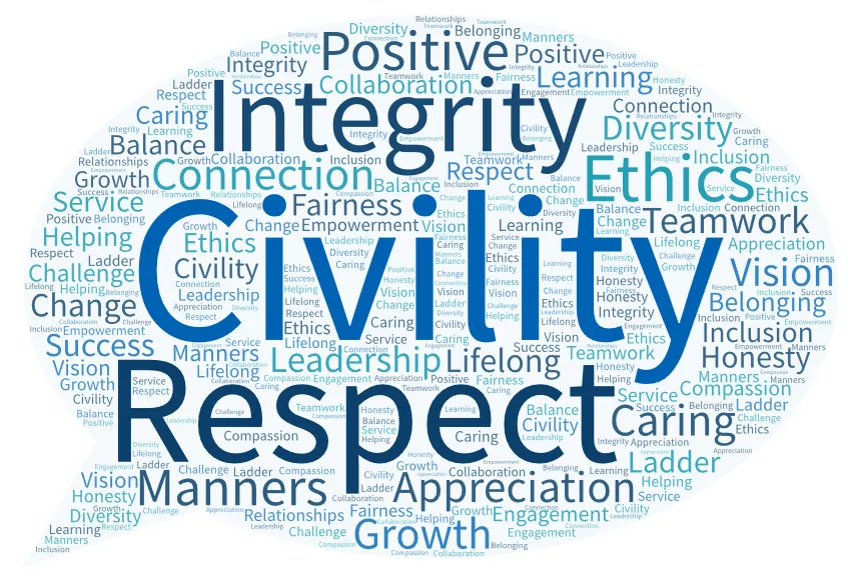
In Carmel, we seek to promote an environment of civility defined as the disposition to respect every human being we interact with as our moral equal and worthy of respect. Therefore, we encourage any candidate seeking public office and asking the citizens of Carmel for their vote, to agree to the following tenets of civility.
The Carmel Civility Project: Candidates Pledge
As a candidate for public office in Carmel, I hereby commit to the following five essential tenets of campaign conduct:
1. Civility and Respect: I will maintain a respectful demeanor towards everyone, regardless of our differences, and foster an environment of open-minded dialogue.
2. Integrity and Truthfulness: I promise to uphold truth and transparency in my campaign rhetoric and actions, swiftly correcting any mistakes should they arise.
3. Positive Focus: My campaign will highlight my vision and policies, eschewing negative attacks on my opponents’ character or record.
4. Informed Discourse: I pledge to inform citizens accurately about my platform and engage in constructive discussions to promote understanding and educated voting.
5. Democratic Process and Accountability: I vow to respect the democratic process, accept its outcomes, and encourage my supporters to engage in campaigns with integrity and decency in support of these principles.
By taking this pledge, I affirm a dedication to dignified campaigning not just out of respect for each resident of Carmel, but also in admiration for the institutions we cherish in our community.
I encourage us to always “look at the big picture”: across time, nations, industries, occupations, institutions and political views when considering the “state of the economy”.
Recent surveys indicate that many (partisan) Americans believe that the economy is in recession, the stock market is down, and unemployment is up (false). The US economy continues to lead the world out of the pandemic driven recession. I’ve documented the tremendous strength of the US economy in GDP growth, job creation, wage growth, profit growth and wealth creation. Today I’d like to focus on entrepreneurship and new firm creation, where the US once again leads the world.
The US economy led the world in creativity, technology, job growth and firm creation in the 1990’s as it recovered from the global economic challenges of the late post-war era. The deregulation and technology driven changes produced benefits into the “oughts”, the first decade of the new century. Unfortunately, the dynamic pace of new firm creation based on economic, trade, relocation and technological changes did not strongly continue in the first 20 years of 21st century. New firm creation lagged. Larger firms held onto jobs as they consolidated industries and protected their positions. Venture capital firms facilitated the most successful new companies to quickly expand market share and vanquish weaker competitors. Many Schumpeter disciples worried that the engines of “creative destruction” had lost their momentum and effectiveness.
The Great Recession of 2007-10 destroyed wealth, slowed economic growth, job creation and new firm starts. The Obama-Trump expansion was longer than expected by historical standards, but slower growing. Many critics and commentators concluded that the US had “lost its entrepreneurial spirit”.
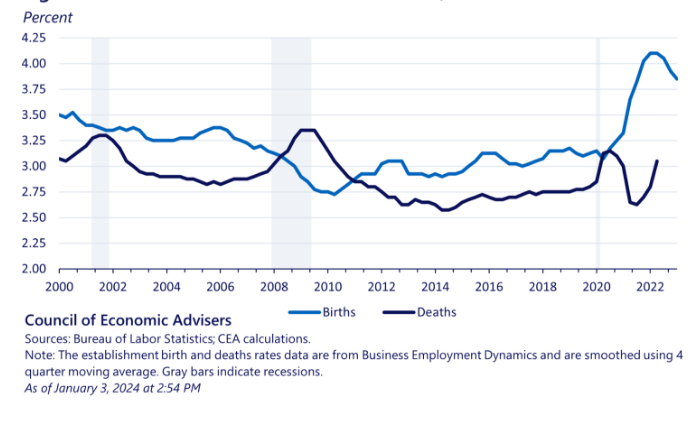
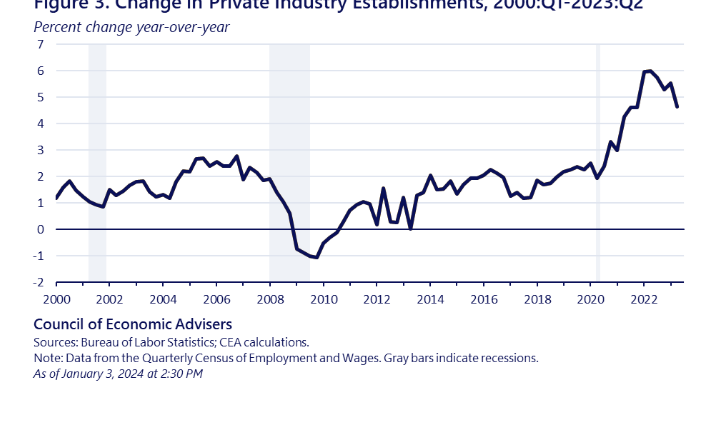
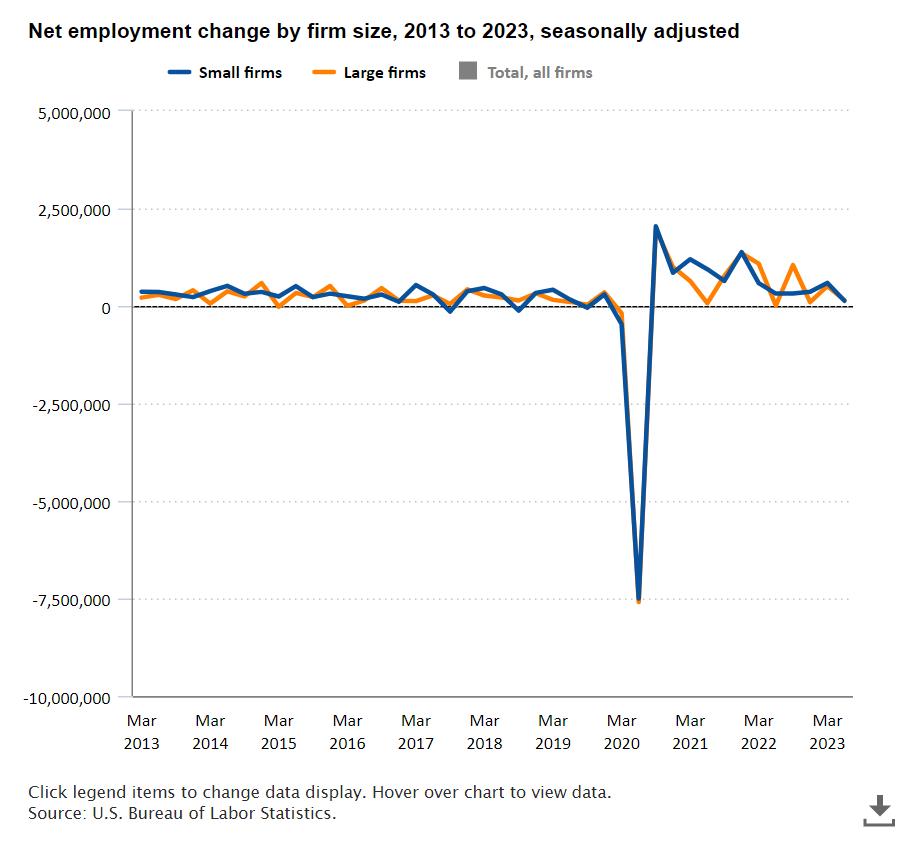
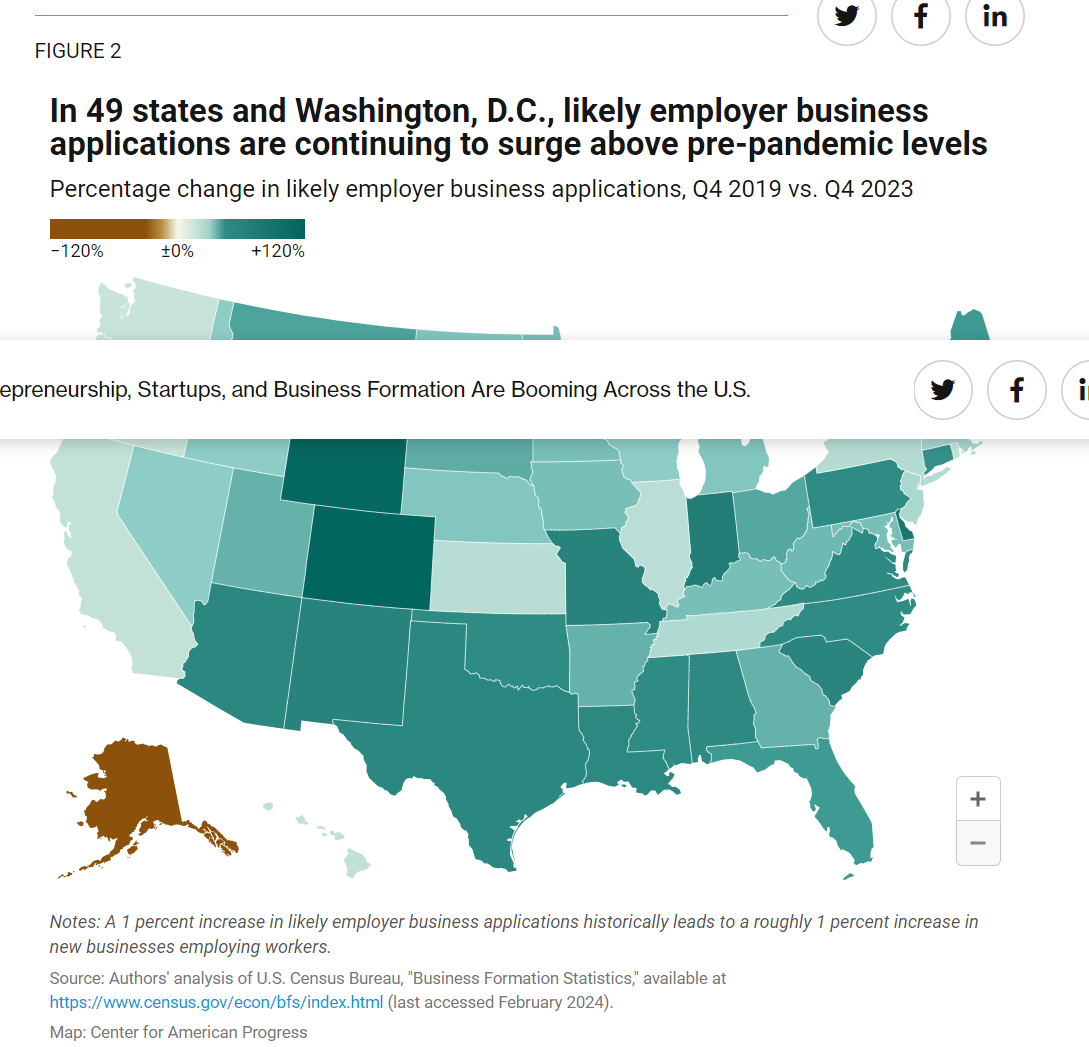
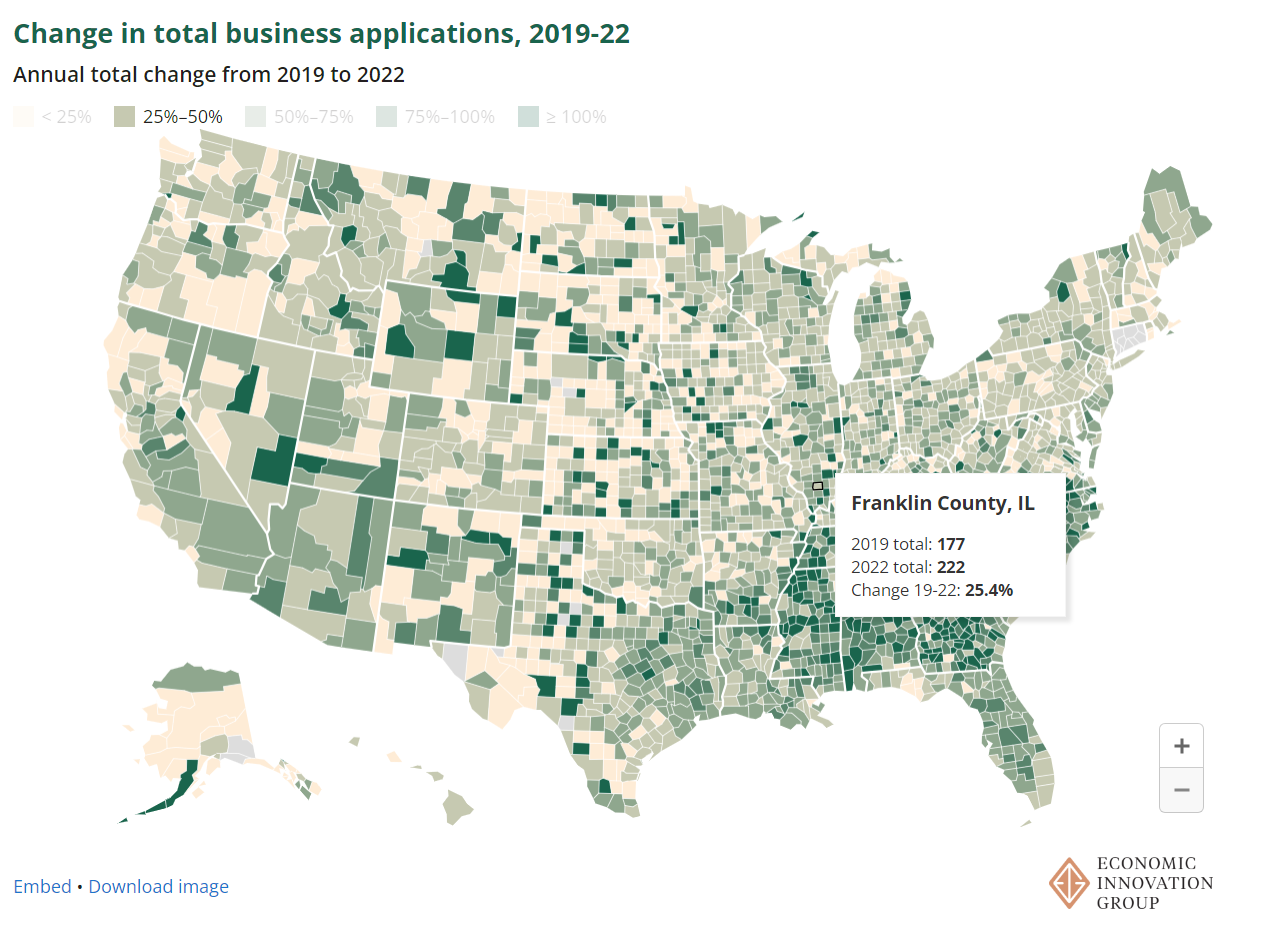
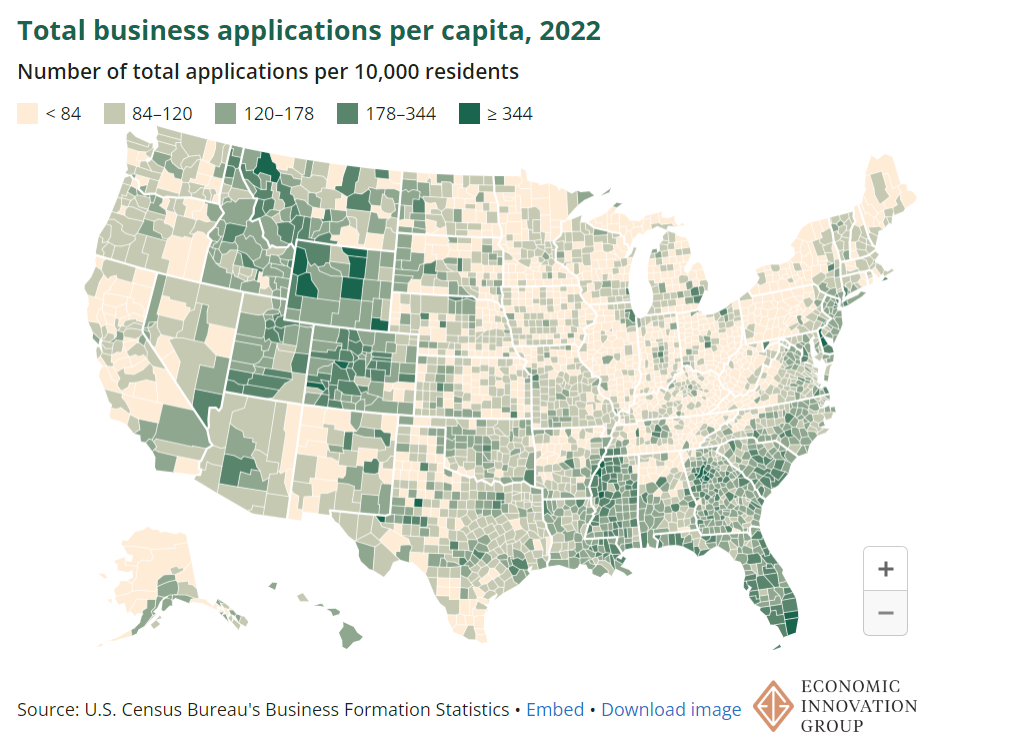
New firm creation since the pandemic has basically been 50% higher than before the pandemic.
This is an AMAZING and unexpected result for the US. During the pandemic, economic activity ground to a halt. Supply chains stopped functioning. People stayed home. 20 million jobs were lost. 1 million lives were lost in the US. Many firms closed. Global trade and military tensions increased. Trust in governments, corporations and other institutions was damaged. In 2020, there was no reason to believe that the pandemic would be medically controlled soon, or that economic growth would quickly rebound and resume its trend growth rate. But it did!
The IRS tracks new firm tax license applications. Most firms never really do business, but the ratio of initial applications to real firm creations has been stable through history. The Census Bureau has determined which subset of IRS license applications leads to real new firm creations. Both measures show the tremendous 50% increase between the pre-pandemic and post-pandemic eras.
As Wendy’s Clara spokeswoman exclaimed long ago, “show me the beef”. Did the increased rate of tax applications during 2021-22-23-24 result in new firm creation?
The initial surge in new businesses did NOT include the IT or manufacturing sectors which look ready to benefit from AI and government investment policies. Firm creation should continue at its record pace for the next 2-3 years.
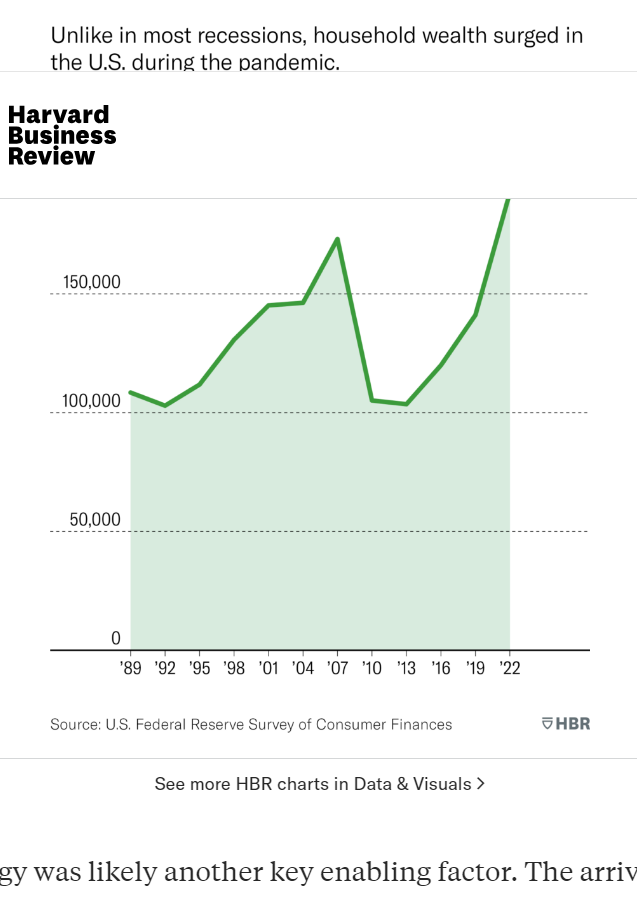
Why/how did this happen? US economy did not see wealth destruction during the pandemic as occurred in the Great Recession. Bipartisan government funding during the pandemic protected small businesses and individuals. The US labor market was strong before the pandemic and recovered very quickly to full employment with high quit rates, high job openings, low layoffs, wage growth, high labor force participation, and new immigrants included. There was no “credit crunch” destroying businesses. Venture capital firms were flush with capital, able to invest in the very best prospects. The US economy was mature as an “information age” economy, identifying opportunities. The virtual economy was mature, allowing individuals with minimal technical skills to easily create new businesses, market their services, and engage skilled resources. Individuals experienced being out of work and at home and determined that they could create new firms from home.
The Biden administration claims that its various public policies have leveraged the “natural” rebound.
Despite doomsayer predictions for the last 20 years, the USA remains the world’s largest economy. China’s population, productivity, property, politics, energy, trade, innovation and middle-income transition challenges have undercut past predictions of its inevitable world economic leadership.
One way to get a tangible sense of the USA’s economic size and dynamism is to compare individual states with other countries. Most of us have read articles highlighting the size of California, Texas, New York, Florida or Illinois as standalone economies. They would currently rank globally as economies numbered 9, 14, 16, 25 and 30, lining up with France, Spain, Saudia Arabia, Vietnam and Argentina in the pecking order. Their men’s soccer teams are ranked 2, 8, 53, 115 and 1 in the world. The US soccer team is ranked 11th and after its recent 5-1 pasting from 12th ranked Colombia it is sure to fall several places.
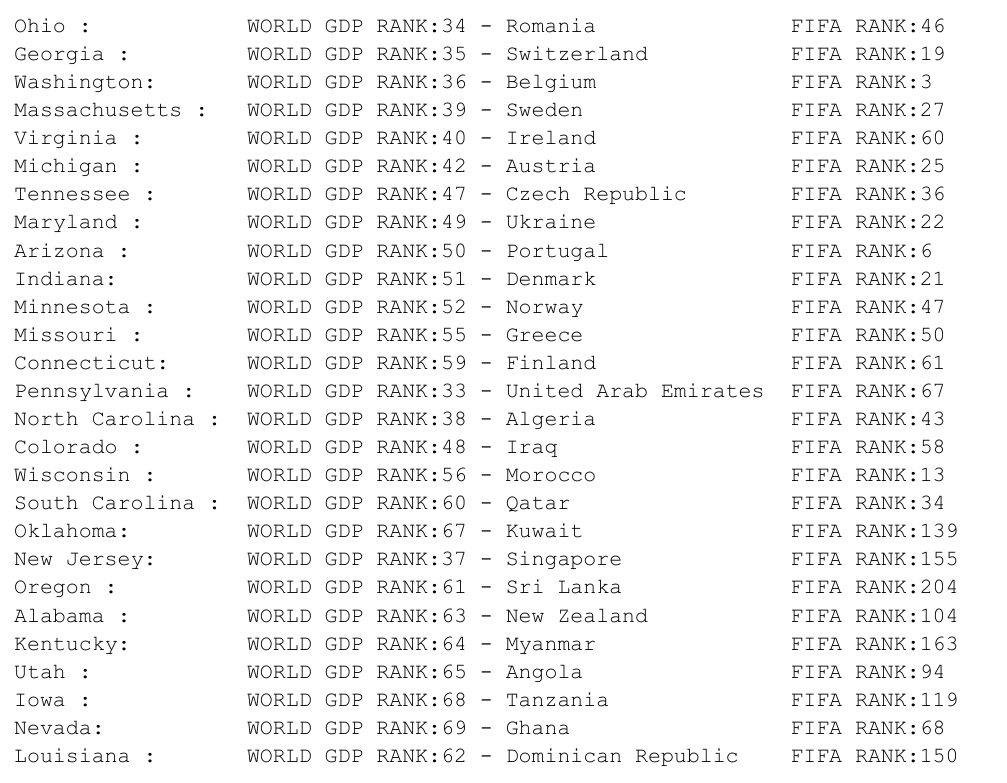
The real economic strength of the US is shown by the next 27 states. Collectively their GDP is as large as India. These 27 states match up one by one with the next 36 states in the global rankings. The 27 matched countries are each proud nations. There are surprises throughout this listing. UAE 33rd largest country? Romania 34th largest? Morocco 56th largest? Qatar 60th largest? Dominican Republic 62nd largest? New Zealand 63rd largest?
Even bigger surprises arise from the pairing of US states to their global equivalents. Raise your hand if you predicted that these US states are the economic equals of their global nation partners: Georgia and Switzerland, Massachusetts and Sweden, Virginia and Ireland, Maryland and Ukraine, Arizona and Portugal, Indiana and Denmark, Minnesota and Norway, Missouri and Greece, New Jersey and Singapore, Alabama and New Zealand.
The remaining 18 US states are not so large. Their combined GDP is about the same as our neighbor Canada, which ranks 15th overall by GDP, about the same size as Spain or Texas.
On the other hand, the US soccer team was ranked 11th globally. Three of the top 5 matching countries of Argentina, France and Spain deliver 1st, 2nd and 8th FIFA ratings. The middle 27 states matching nations provide another 8 world-class soccer teams in Belgium (3), Portugal (6), Morocco (13), Switzerland (19), Denmark (21), Ukraine (22), Austria (25) and Sweden (27).
The US is an economic colossus that continues to grow faster than the rest of the “developed countries” and maintains its global economic lead. We don’t normally think of Tennessee, Colorado, Michigan, Arizona, Indiana, Minnesota, Maryland and Missouri as global economic powerhouses, but they would EACH rank in the top 55 countries of the world as standalone economies.










 Good News