
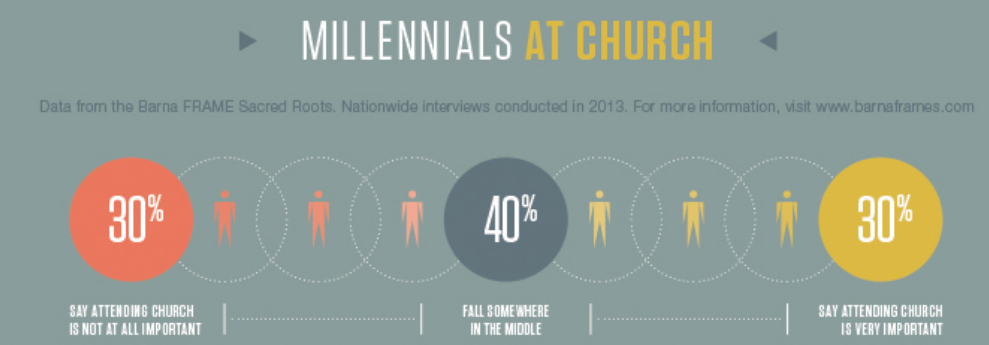
Overall, not that different from other generations. Optimistically, the glass is “half full”.

The motivated group looks like other church attenders. I connect with God at church. I feel a responsibility to participate at church. The church is an important part of our world.

The “not so interested” group doesn’t find God or relevance in churches. Perhaps, this points to an opportunity. Churches don’t reach out and grab this disengaged group. Again, it could be an opportunity for some.
Substantial majorities of Millennials who don’t go to church say they see Christians as judgmental (87%), hypocritical (85%), anti-homosexual (91%) and insensitive to others (70%). This is a strong rejection of the “Christians” they picture when answering a survey. Congregations or denominations which are seen as more “open” to others and differences might interest this group.

Even for all Millennials, churches are seen as out of step with modern authentic, tolerant and inclusive values.
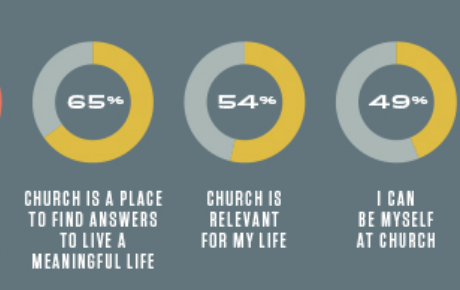
Despite perceived church shortcomings, most Millennials do see positive dimensions in churches.
Pew Research: Younger Millennials
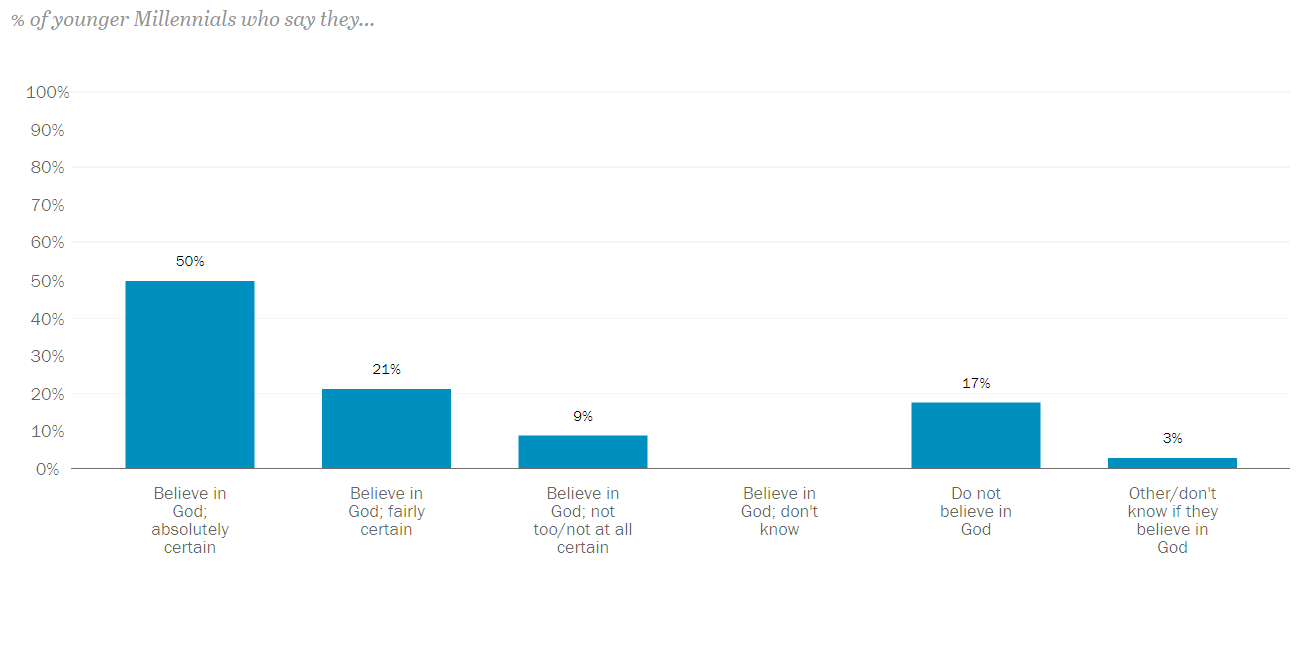
80% “yes” is a start.

Half experience spiritual well-being often. Half do not.
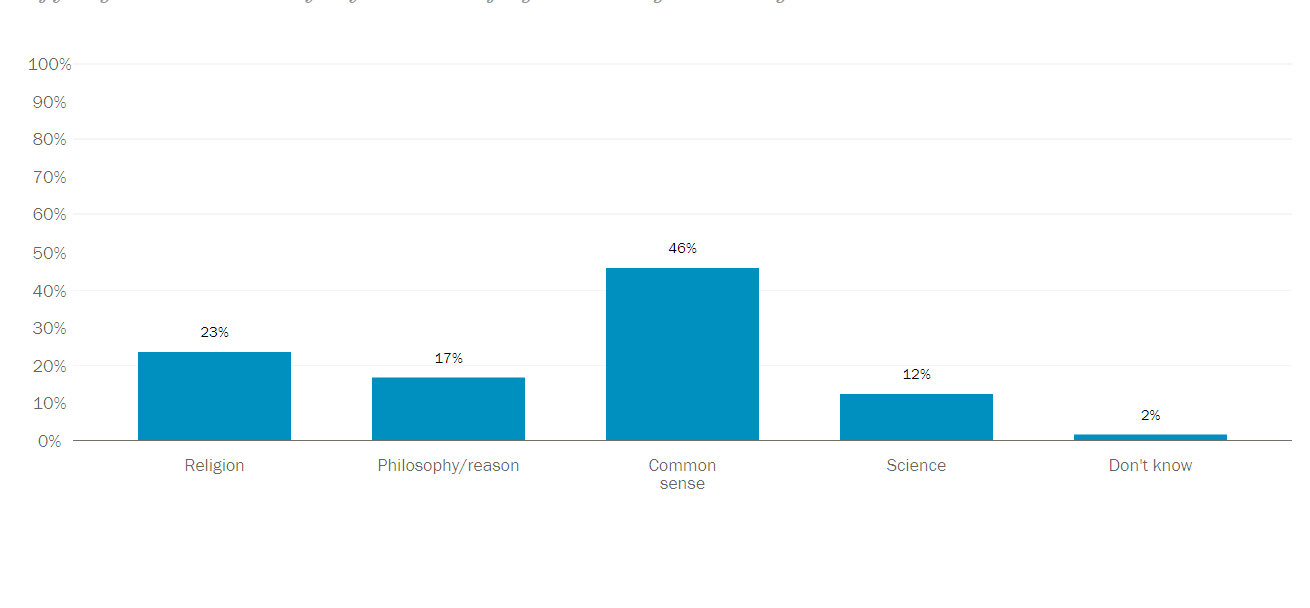
We live in “A Secular Age”. Millennials mostly don’t begin with religion.

A few take a fundamentalist view. One-third take a blended view of God’s special word. One-half are skeptical about any direct contact from God.
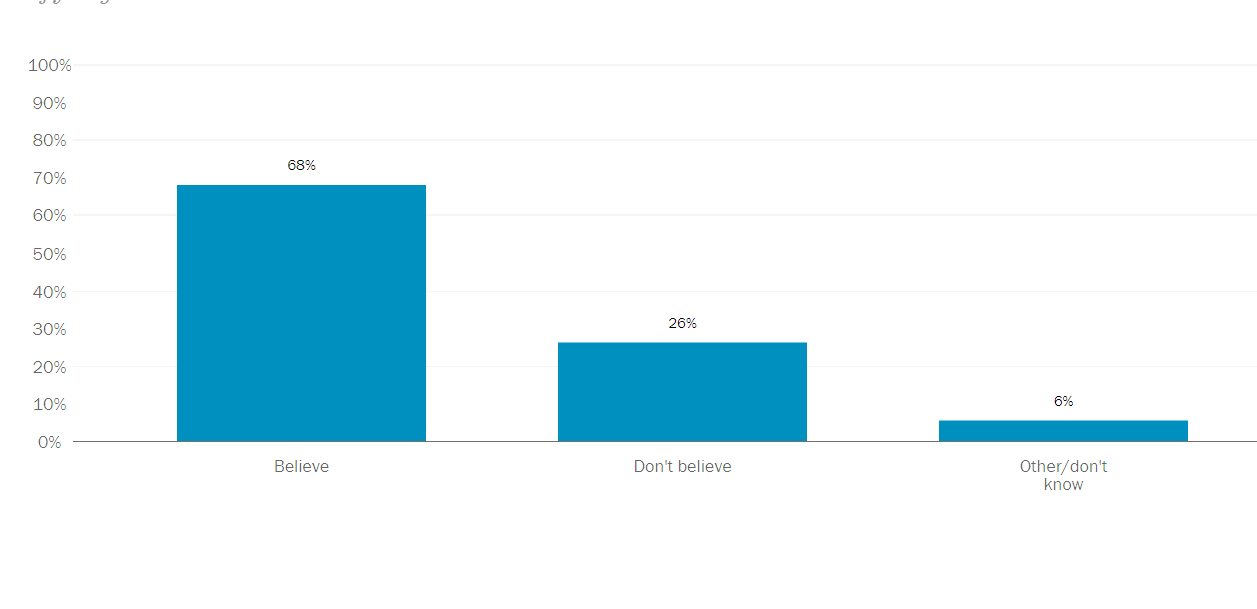
Two-thirds believe that “heaven” exists. :-(
My God is an Awesome God
Millennials want the church to offer what only the church can offer: to know and to love God. To learn about God, Christ and the holy spirit. To study the scriptures and the creeds. To love and be intimate with God, Christ and the holy spirit in order to transform their lives. To connect with the infinite universe, eternity and ultimate meaning.
They want practical sermons, programs and activities that apply this knowledge and relationship to guide their lives: moral decisions, self-improvement, relationships, consumer choices, financial choices, career/vocation, service.
Church Is a Place of Worship
It clearly looks, feels, sounds, surrounds and even smells sacred and appropriate for engaging with God. Initial impressions matter. Buffering matters. Appropriate technology is employed. The worship service, music and sermon link the congregation with God. Everyone can sense the sacred and holy presence.
Community is Real
Individuals know and trust each other. They worship, pray, learn, play and serve together. They care about the congregation as a whole and as individuals. They listen, share, interact, counsel, and advise one another. They respond to needs generously. They practice collective responsibility.
“Meaning” Matters
Ideas and activities must be relevant and most important. No time for distractions.
They must be material, worthwhile, substantial and impactful. My time is valuable.
They must be supported by logic and evidence. They must be compelling.
Millennials have lived in a world of progressive improvements, expanded consumer choices, increased affluence, scientific and technical change, computer and communications revolution, political polarization, created identities, infinite possibilities, reduced social safety nets and increased competition in a meritocratic world of widened results. Charles Taylor describes this as the “primacy of instrumental reason”. The demands of society force individuals to become highly skilled in the rational evaluation of means and ends, costs and benefits, risks and returns. They expect their religion to clearly deliver well-defined results, or it will be rejected. This is consistent with Paul Tillich’s view of religion as “matters of ultimate concern”.
“Authenticity” Matters
In a world of non-stop commercial marketing, branding, hidden persuaders, cookies, fake news, newspeak, click-bait, communities of interest, confirmation bias, distrust, media power, communications and advertising techniques, framing, strawmen, Overton windows, artificial intelligence, multitasking, narrow casting, micro markets, customized products and messages, enhancements, earworms, and virtual reality, Millennials fully appreciate the difference between reality and constructed reality.
For something as important as the meaning of life, ultimate reality, eternal salvation, mystical union, moral guidance, vocation, and true community they must have the “real thing”. They have very sensitive BS detectors. They demand authenticity in theology, creed, sermons, teaching, worship, programs, service and community. The pastors and congregation must “walk the talk”. They have no time for market-driven messages. They want “the real thing”, even if it is not perfectly comprehensible. They can manage some uncertainty, but no hypocrisy.
They have worked in organizations that have aligned mission, vision and values with strategy, tactics and reporting. They know that this can be done (well-enough). They want deep structures that persist, not shallow messages that quickly evaporate.
They value unity, integration and the whole. A complex system must work with its parts. They have seen this in action in many realms and expect no less from religion.
They value transparency, honesty and openness. In a competitive, commercial, secular culture, they wrestle with hucksters every hour. They need something they can fully trust in their religion.
Charles Taylor outlines the historical development of “authenticity” as a primary moral value in the book noted above.
The “Individual” Matters
Millennials value tolerance, respect, equal rights, and personal identity. They expect to be treated as fully equal humans in all dimensions. They have seen, experienced and achieved much. They have been given the opportunity to contribute meaningfully to organizations at young ages. They cannot tolerate irrational delays, politics, insider cliques and power, undue hierarchies, risk aversion, prejudices, waffling, consensus building, history worship, or tribal knowledge.
Charles Taylor devotes one-half of his book to the lopsided development of individualism versus the community or religious dimensions of life. This is the culture we inhabit and to engage Millennials, we must meet them where they live.
Summary
Religious belief, belonging and behavior have declined in the US for 50 years, especially reducing the attractiveness of the mainline Protestant denominations. The decline is mostly a generational decline, with newer generations much less attracted to religion. For mainline Protestant denominations to survive the 50% to 75% decline in membership, they must find ways to attract, engage and retain younger generations. The US remains an outlier for its high degree of religious engagement among economically advanced nations. The decline of mainline religions seems to have bottomed out, while the 1990’s growth of evangelical denominations appears to have been a temporary event. Younger adults still seek meaning in life, including connection to the universe, eternity and God. Their world is much different from the world in 1960, 1980 or 2000. Religious organizations must meet them where they live. Mainline Protestant churches are well positioned to maintain their core beliefs and connect with these demanding “seekers”.
https://www.resourceumc.org/en/content/how-to-attract-millennials-to-your-church
https://get.tithe.ly/blog/why-cool-church-is-no-longer-working-with-millennials-and-gen-z
https://www.reformedworship.org/blog/where-do-millennials-go-church
6 Reasons Why Millennials Aren’t Attracted to the Church
https://www.resourceumc.org/en/content/5-key-millennial-research-findings-churches-should-know
 Good News
[…] (USA) Membership Congregational Strategy: Let’s Join the Presbyterian Church Congregational Strategy: Millennials Congregational Strategy Congregational Strategy – 2 Morality (2020) […]