
Eight: The Conservative Advantage
By 2004, Haidt saw that his preliminary findings applied to national politics in the US. Democrats relied on just one or two of the moral foundations, or even zero, while Republicans appealed to all five in effective ways. He contrasts Bush, Sr and Bush, Jr, neither a naturally gifted politician, with cool and cerebral Dukakis, Gore and Kerry, who they handily defeated. The Bushes appealed to Republicans, independents and Democrats by using a variety of emotional pitches. Separately, Bill Clinton stands out as a naturally gifted politician and manipulator of emotions.
By 2011, Haidt and his associates had developed and perfected a variety of questionnaires and attracted 100,000 on-line respondents to make their results scientifically sound. Liberals greatly valued the Care and Fairness dimensions and disregarded the Loyalty, Authority and Sanctity dimensions. Moderates were like liberals in terms of their rank orderings but had much closer scores on the 5 attributes. Conservatives valued all 5 equally and Very Conservative individuals valued Authority, Sanctity and Loyalty above Care and Fairness.
Colleagues corroborated the findings based on religious sermon content, dog preferences and brainwaves! The author began to write articles for the general public to share his findings. Many of the responses were predictable. Liberals downplayed or rejected the 3 conservative foundations. Conservatives tentatively complimented an academic who “go it”. But many conservatives were as critical as the unhappy liberals. They questioned Haidt’s morals and lack of understanding of the differences between Democrats and Republicans. They emphasized that Democrats really don’t believe in fairness, just equality and rights. The respondents saw fairness as proportionality and earned rewards.
Haidt and his team reconsidered the 5 moral foundations and made two changes. First, they redefined “Fairness” to be based on the idea of proportionality of work/contibution and rewards. Haidt found evolutionary psychology support from Christopher Boehm’s research on humans and primates. While the original “reciprocal altruism” foundation basis does have support in human history, the development of larger communities with shared property 500,000 years ago required the development of people and norms with group concepts and different fairness behaviors. With more powerful tools/weapons and communications, groups were able to limit the direct power of alpha males and use gossip and communications to support a moderate hierarchical structure with a leader or leading group that commanded extra resources, power and respect, but not too much. This “goldilocks” scenario is considered by many anthropologists and evolutionary psychologists to be a key turning point in human history. Proportional fairness is more highly valued by conservatives but moderately valued by liberals.
Second, while considering this same turning point in human development, Haidt decided to add a sixth moral foundation: Liberty/oppression. In larger groups with an “authority” moral foundation required to support the leader, there is a need for a complementary value to oppose excessive use of authority. Individuals accept, follow and respect valid, legitimate authority, but they rebel against being abused. They can embrace hierarchy and disproportionate rewards to a point, but they are able to band together and oppose any abuse of power. Haidt shares anthropological details to make this plausible. This moral foundation is supported by both the left and the right. The left emphasizes relative equality of rewards and generic antiauthoritarianism. The right emphasizes the personal liberty side, “give me liberty or give me death”, “don’t tread on me”, don’t regulate me, don’t restrict my choices, guns, family or religion. A powerful moral foundation indeed.
Haidt returns for a third time to share John Stuart Mill’s vision of a just society. It is based on the enlightenment, individuals, rationality, utility and a theoretical contract between individuals and society. “The only purpose for which power can be rightfully exercised over any member of a civilized community, against his will, is to prevent harm to others”. This modern, progressive, Western view is based upon Care and Fairness alone.
He then shares sociologist Emile Durkheim’s view of how society works. It is organic, based on community, evolving to meet actual needs, incrementally changing, inherently conserving order and tradition, skeptical of change, based upon existing well-functioning institutions like the family and church. Durkheim argues that man needs to belong to a binding moral system comprised of institutions larger than the individual in order to have a sense of place, stability, order, belonging and meaning. Without this grounding, he is rootless, anxious, experiencing anomie, a lack of grounding. This world view prioritizes self-control over self-expression, duty over rights, and loyalty to one’s groups over concern for out-groups. Historically, Durkheimian societies have predominated. WEIRD societies have been the minority. Haidt encourages the reader to consider both conceptions to have legitimacy. He does not dwell on the possibility of a “both/and” blending of these views or ways to accommodate both at the individual, institution and society level, but consider these possibilities. The individual and the group both matter. Different individuals prioritize individual versus group needs differently and the 6 moral foundations. Given our seemingly intractable differences of opinion, how do we make society function?
Haidt shares more details about conservatives, liberals and libertarians, but the main point is most essential. Different people have different moral worldviews. They are not changing. No one worldview is clearly superior by any broadly accepted ethical standard. We are going to have to “agree to disagree” or as Rodney King said, “Can we all get along?” Can each side understand all six foundations and others who value them differently? Can liberals understand and appreciate Durkheim’s view of a group-based society? Can conservatives appreciate the “individual” and abstract principled, universal, secular insights of liberals, aside from liberty?
Nine: Why Are We So Groupish?
Individuals express both selfish and group-oriented thoughts and behaviors. Everyone knows this. We join and support teams and nations. We donate anonymously. We “do the right thing” when no one is looking at least some of the time (ring of Gyges theory be damned). We embrace religions and consider others. We volunteer. We participate in politics. Not always. Not everyone. But enough to say that this is a feature of humanity, not a bug or a flaw or a mistake. Haidt admits that he has pushed hard on the cynical view of humanity to demonstrate what individuals often do or do “on average”. Nonetheless, group thought, and behavior is part of our human make-up.
Haidt addresses this based on evolution. George Williams in 1955 and Richard Dawkins in 1976 made strong arguments against existing theories of “group selection” in nature and for humans. The differential positive survival of groups based upon group cohesion, solidarity and individual sacrifice is possible in evolutionary theory, but depends upon the group being able to control the individual member’s behavior so that he generally does what the group needs and does not “free ride”, avoiding the personal cost of a behavior that helps the group. Williams and Dawkins debunked many “group selection” examples, demonstrating that they were caused by individual selection or near-kin selection.
Haidt shares Darwin’s view which supports group selection in concept, especially with regard to morality! He provides four rather technical scenarios that support the idea that human group level selection has been a major factor in the development of morality.
The history of biology is that of transitions from one level of competition to a higher level of competition. Bacteria to mitochondria to cells to … animals to societies. 8 transitions in all of recorded time. In each case, the next higher level absorbed the prior lower level, making it secure and dependent upon the higher level, disabling the disruptive competition at the prior level. The development of queen bees and workers in a hive is an example. These more recent changes took place when a persistent, defensible resource was involved (nest and food). They also involved a need to feed infants and the need to defend against other groups of the same species. Human societies fit this model: caves, needy children and aggressive neighbors. Fixed location crops and city-states match this pattern. Group level competition by bands of humans makes sense.
Michael Tomasello argues that “it is inconceivable that you would ever see two chimpanzees carrying a log together”. Humans, on the other hand, have what is described as “shared intentionality”. We have some sense of what another person is seeing, feeling, doing and thinking. We have a mirror image capability. This allowed groups of 2-3 to cooperate and communicate effectively. Even before formal language, humans could use signals, expressions and actions to share ideas and confirm mutual understanding. This is a critical underpinning for moral thought and behavior. It allows groups to share expectations and norms, to consistently provide feedback on acceptable and unacceptable behavior.
Once a group has mutual understanding, empathy and communications it can define a culture and sustain that culture though time. The culture can evolve to further and cumulatively improve group level effectiveness. The culture can take advantage of biological evolution, teamwork, communications and innovations. Biological and cultural evolution can interact. Dairy herds, lactose tolerance, more food, more herds, cheese, more people. Abstract symbols and markings and language evolve. The components or vocabulary become richer and support faster and innovative growth. The sense of groupness increases as the communications skills and feedback loops improve. The group level matters even more. Group innovations such as shame and guilt develop. The authority, sanctity/cleanliness, liberty, fairness and loyalty moral foundations become more effective. Effective societies “self-domesticate”, restraining extreme individualism and promoting cooperation and support of the group.
Biologists argue about the speed of evolution. Haidt shares examples of rapid individual and group evolution in 10-30 generations. He argues that the migration of humans around the globe during a period of warming and cooling provided a challenging environment for humans that could have triggered very rapid evolutionary changes at the biological and cultural levels in the last 50,000 years.
Haidt concludes that we are 90% selfish chimp and 10% cooperative bee. Once again, this is assuming that the evolutionary framework is the “alpha and omega”, without any religious, spiritual or sacred dimension working in the universe.
Ten: The Hive Switch
Haidt asserts that humans have evolved to live at both the individual and group levels. In this chapter he describes this potential in more detail, emphasizing his 90/10 theory that we mostly live in the profane, individual, day to day world, but at times we “switch” to the group, sacred, infinite, eternal, religious level.
His favorite sociologist, Emile Durkheim, describes these two levels and emphasizes, in contrast to the individualist views expressed by other scientists, social scientists and philosophers from 1500-1900, that the social, group or religious level is an essential part of man’s nature. No man does or can live without a “thick” attachment to his culture, neighborhood, community and nation. Durkheim describes the lack of connection as the dreaded “anomie” or emptiness experienced by individuals who leave their community and emphasizes the “collective effervescence”, or energy felt by individuals in group settings.
Haidt opens the chapter describing a simple version of an “altered state of consciousness” created by the muscular bonding of military drills. He connects this with the rhythmic dancing to exhaustion reported in many primitive cultures by anthropologists. The individual is moved from being an individual, conscious agent to being a part of the collective, aligned, bonded, trusting, equal, outwardly focused group. He describes another half dozen ways in which individuals shift from a “me” to a “we” world view, in each case experiencing a different consciousness. Awe of nature, drugs, initiation ceremonies, sporting events, political rallies, religious ceremonies and meditation all produce this change in perspective.
Haidt outlines two biological channels that appear to be involved. The hormone oxytocin is associated with bonding, love and attention. Experimental psychology studies show that it improves feelings towards others in a group, not to broader humanity and that it does not create negative feelings for out-group members. The mirror neuron system allows humans to have the emotion of empathy. Seeing others, especially those we view favorably, perform an action triggers the same brain circuits as when the individual does the same action. Haidt describes this as “parochial altruism” or “parochial love”, the exact range of impact consistent with the development of group level bonding in an evolutionary mechanism.
The author reminds us of his earlier amazement at the scale of organization level cooperation seen in the modern world, especially in large corporations. Without inherent group level bonding and interaction capabilities, this would not be possible. He notes that modern organizations try to use “transformational” rather than merely “transactional” leadership styles to shift team members from a purely economic exchange to more of a partnership or group membership.
Haidt takes a quick tour through political groups which appear everywhere in human history. The nation state shows that group feelings can apply at a large scale. Manipulative leaders such as fascists can misuse groupness. He notes Robert Putnam’s research that shows the many ways in which “social capital” can be built and provide benefits in smaller scale political and social organizations.
Finally, the author relates his belief that human “happiness” does not come from the individual, self and soul alone as promoted by some religions and philosophies. Instead, he proposes that it comes primarily from positive relationships between the individual and others, groups and the sacred realm.
Eleven: Religion is a Team Sport
The chapter opens with a description of University of Virginia football traditions. Symbols, chants, songs, dances, traditions, rites, colors, colleagues, fraternities, sororities, ecstasy, collective effervescence, sanctity, sacred objects and locations. Yes, just like a religion, perhaps a Pentecostal religion! Sporting events and religions are “social facts”. They exist in almost all times and places.
After 9/11, many scientists, philosophers and journalists could no longer withhold their contempt for “organized religion”, especially any version of fundamentalist religion. The “New Atheists” documented why religion is almost all “bad” and an evolutionary mistake that could be overcome if everyone would follow their lead in eliminating it. Their model of human behavior is the familiar Platonic one where belief determines behavior. Haidt offered much evidence to question this simple model earlier in the book. He also presents a model of religious psychology where Beliefs, Actions and Belonging interact as equals.
“To an evolutionist, religious behaviors ‘stand out like peacocks in a sunlit glade'” according to D.C. Dennett. Evolution prunes away wasteful behaviors since they require the use of scarce energy. Yet, religion is everywhere. The New Atheists begin with the “hypersensitive agency detective device” that humans possess. We identify patterns. We assume an agent is behind any behavior, activity, shape, result, situation, effect, outcome, sight, sound, taste, image, memory, belief … Although philosophers argue about the existence of “cause and effect”, regular humans simply know that this is true. We assign causal agents in almost any situation as an instantaneous first hypothesis.
Once humans lived together in larger communities and used language, someone described agency in the form of God or spirits for all kinds of events: weather, wind, animal attacks, good harvests, bad fishing, attacking neighbors, etc. Other translations of human capabilities to serve the “God hypothesis” may have helped. Love of man to love of God. The idea that bodies and minds, souls, and God are different. In this analysis, religion was never a valuable tool at the individual or group level, merely a strange accident.
However, religions that did a better job of convincing people that they were correct, for whatever reason, would have continued through time and survived, attracted new groups while other less believable or effective religions would have passed away. This is a fine point, but a critical one. Selection is based on the ability of religious ideas, stories and leaders to survive and reproduce, irrespective of whether they provided any benefits to groups or individuals. In other words, appearances matter most in evaluating supernatural concepts. Religions are described by the “New Atheists” as viruses or parasites that promote themselves, even at high costs to their hosts.
Some anthropologists and evolutionary psychologists propose a similar evolutionary explanation for religion’s pervasive existence and influence. They argue that religions that made groups more cohesive and cooperative DID provide clear benefits at the group level, and possibly personal benefits too. As groups got bigger and adopted agriculture, making assets and a hierarchical structure more important, the need for cohesion increased and the opportunity for “more effective” concepts of God arose. Gods who can see everything. Gods who hate cheaters and oath breakers. Gods who administer collective punishment. Angry gods.
Haidt shares research on the survival of communes to support the idea that religions can greatly improve group solidarity. Religious communes survive 6 times as often as secular communes. Religious communes that required the most personal sacrifices from members did best. Personal sacrifices did not make a difference for secular communes. Haidt and some researchers argue that the “sacredness” of sacrifices, rituals, laws and practices allows them to become invisible, held at God’s level, unchallengeable and more effective.
Biologist David Sloan Wilson’s book “Darwin’s Cathedral” offers a theoretical framework combining Darwin’s idea of group level evolution to create morality and eliminate the “free rider” problem with Durkheim’s definition of religion as a “unified system of beliefs and practices that unites members into one single moral community”. Religion, as a social institution, arises and then evolves by delivering group level cohesion benefits. He refers to John Calvin’s strict Protestantism, medieval Judaism and Balinese rice farmers solving complex water management challenges as evidence for how this works. Haidt likens God to a maypole that serves the function of giving people a central figure to coordinate their lives as a community.
Robert Putnam and David Campbell in “American Grace” relate that individuals who “practice” a religion are significantly more generous than others, first to members of their religion and second to the larger community.
Haidt describes religions as “moral exoskeletons”. “If you live in a religious community, you are enmeshed in a set of norms, relationships and institutions that work primarily on the elephant to influence your behavior”. If you are not shaped by a religious community then you have to rely upon individual, rational decision-making, allowing the rider to try to guide the elephant, who has nonetheless picked up moral beliefs. Haidt is very skeptical that a society can be effective if it is comprised of individuals trying to “reason” their way through life rather than adopting some “religious” perspective that provides an agreed upon moral framework.
“Moral systems are interlocking sets of values, virtues, norms, practices, identities, institutions, technologies and evolved psychological mechanisms that work together to suppress or regulate self-interest and make cooperative societies possible”. This is a functionalist definition describing what morality does, not what it “ought to do”. Haidt suggests that utilitarianism, supplemented by the value of maintaining social order and cohesiveness, is a good philosophy (Ought) for making public policy decisions. Produce the greatest good for the greatest number, subject to the need to preserve the social order.
Twelve: Can’t We All Disagree More Constructively?
American politics has become more polarized in the last 50 years for the familiar reasons: Voting Rights Act of 1964 triggered alignment of conservative = Republican and liberal = Democratic parties. The Reagan Revolution consolidated varied “conservative” groups into one “conservative” umbrella allied in opposition to the “liberals”. The Gingrich Revolution further exaggerated these differences and staked out extreme positions and undercut compromise. These opposing parties have increasingly disregarded formerly shared norms on how “our democracy” works (2011 debt ceiling vote, Supreme Court nominations).
Haidt devoted a whole book to isolating six different dimensions of political, moral and religious beliefs, but returns to the simpler “left versus right” yardstick because it is most researched and provides solid insights. He adds libertarians to liberals and conservatives in some of his analysis. He notes that research shows that individuals pursue their moral/belief/worldview self-interest, not their economic self-interest in politics. Self-interest, but not naked self-interest.
Research documents that there is a genetic basis to political beliefs. Liberals tend to be less reactive to threats and more attracted to change and novelty. Conservatives are more attentive to threats of all kinds and value the familiar. Twins studies show that political views are about one-third predicted by genes, like many other personality traits. As individuals develop into young adults they adapt to their environments, where their initial preferences are reinforced or modified. Eventually they adopt a political/moral matrix world view and buy into a life narrative/story that makes sense for them. These life narratives are filled with moral content.
The grand narrative of liberalism is the heroic liberation narrative. “The arc of justice curves forward”. The world progresses from the darkness of oppression towards increasing fairness and equality. “Modern, liberal, democratic, capitalist (?), welfare societies” prevail. Authority, hierarchy, power and tradition are overcome. The grand narrative of conservatism is the heroic defense of the valued society. Reagan’s speeches illustrate this with a consistent pattern of outlining liberal threats and championing conservative responses to restore the just society. All of the moral foundations are employed. The organic and sacred roles of community, family, neighborhood, church and nation, are highlighted.
Haidt’s research shows that moderates and conservatives can generally imagine and understand, if not “appreciate”, the liberal narrative and priority moral dimensions. However, liberals, especially those who are “very liberal” struggle to even understand how loyalty, authority and sanctity belong in a moral worldview. The extreme rational, individualists struggle to see the community, group or religious dimension of life, morality and politics. “Morality binds and blinds”.
Haidt’s research shows that liberals fail to understand or appreciate the necessary role of “social capital” in building support for society, institutions and politics. He quote’s Putnam’s 1999 “Bowling Alone” which documents the huge decline in social activities in the US since the 1950’s and the impact on trust in others, institutions, politics and society. He does not “blame” liberals directly but points to the individualist bias of the modern world as a driving factor.
Haidt takes yet another pass at making “conservatism” accessible to his liberal colleagues in the academy, noting that much of his research is consistent with modern (1776+) conservative philosophy. Historian Jerry Muller argues that the original modern conservatives, David Hume and Edmund Burke, reason within the Enlightenment framework, attempting to outline political ideas, frameworks, concepts, institutions and structures that improve human happiness. They emphasize history, tradition, caution, moderation, community, institutions, beliefs, real people and skepticism. Muller contrasts this with “orthodoxy” which emphasizes a “transcendent moral order”.
Haidt argues that this worldview supports the value of “social capital” and “moral capital”. As outlined in the last two chapters, humans have the capacity to shift between the profane and sacred dimensions. Religions use this sacred, group, infinite, eternal dimension to bind people together in a solid group. This achievement of a deeply, intuitively shared worldview allows society to function more effectively, reducing the need for external laws and enforcement, building trust which simplifies daily life, reducing transaction costs, and offsetting pure self-interest.
Haidt contrasts the Chinese complementary framework of yin/yang or the pluralist (not relativist) philosophy of Isaiah Berlin with the monist (one) moral frameworks of pure utilitarianism or deontology (pure reason) or the Manichaean religious perspectives (good/evil). He is never so crass as to just say, “both the individual and the group matter”, but I believe that is the essence of his work. The WEIRD, academically liberal descendants of the rational, scientific, individual “enlightenment” believe that some form of fixed, final, perfect, just, fair, ideal philosophy and state is possible and will arrive. Orthodox religious believers and social conservatives idealize the community above the individual and perceive their own version of an ideal, well-run state arriving. The “silent majority” of Americans know that we need both the individual and community perspectives, the profane and the sacred, to have an effective community, nation and world [TK speaking].
Haidt proposes “Durkheimian utilitarianism” as the standard for public policy decisions. Create the most good for all people but preserve the core commitment to our shared community life. Promote the “little platoons” of life. He says that liberals are right to propose government as a necessary regulator and counterweight to the superorganism known as a multinational corporation. He says that libertarians are right to emphasize the benefits of the capitalist market system. He says that conservatives are right to emphasize the importance of preserving social and moral beliefs, laws, policies and institutions. He notes that liberals hate the idea of exclusion, so they prioritize, even sacralize, the defense of individual rights and the importance of shared humanity. This sometimes leads to policies that unintentionally undercut social structures (welfare and out-of-wedlock births).
Haidt does not dwell on solutions. He has a website, http://www.civilpolitics.org, with details. He discounts civility pledges or a miraculous insight that will change minds. He believes we are 90% individualistic chimp and 10% social bee. He believes that we “should” begin with honestly trying to empathize and understand the views of others. From his beliefs, actions, belonging model of religious psychology, he advises taking actions to interact with others.
Conclusion
Intuitions come first, strategic reasoning is second. The elephant leads, the rider acts as a press secretary.
There’s more to morality than harm and fairness. 6 flavors of morality at the cafe.
Morality binds and blinds. We are selfish and we are groupish. 90% chimp and 10% bee.
TK Commentary
We all have political, religious and moral worldviews that seem to be correct and obvious. We struggle to see why others don’t see the world as we do.
Yet, after 50,000 years of progressively more complex societies, politics and economics, we are stuck with each other now more than ever.
I’m not convinced that Haidt has “THE” 6 moral foundations identified and described or “explained” by evolution. But I think that he has clearly outlined our dual individual and group, moral, community, religious, sacred nature. And, it’s a good thing that we are inherently individuals and naturally community members. We live in a world that requires both at every level: family, neighborhood, community, profession, organization, state and world.
The author gently focuses on the excesses of the academic, new, far left without addressing the even more extreme postmodernist flavors common in the academy, media and progressive politics today. This an “orthodoxy” just as close-minded as the fundamentalist religious orthodoxy on the right, IMHO.
I believe that our politics is dominated by the extreme “orthodoxies” of religious fundamentalism, libertarian individualism and grievance/victim populism on the right and postmodernism, secular humanism, and identity grievance/victim populism on the left. Both extremes provide simple solutions to our complex modern challenges while demonizing the opposition to make us feel righteous.
During the challenges of the depression and WWII and in the post-war breather period, Americans largely set aside their political differences to support the nation first in 3 existential struggles (survival, fascism, communism). Racial, cultural and military events in the 1960’s conspired to set the stage for polarization. Some politicians have attempted to appeal to the “better angels of our nature”. Eisenhower and Kennedy, in their own ways. Reagan as an “above politics”, traditional, American, Teflon, city on the hill, idealist and communicator. Carter, Clinton and Obama as centrists. Bush, Sr and Bush, Jr. as less ideological Republicans. The political forces of extremism, simplicity and populism have been winning for 50 years. 😦
I believe that Haidt’s work provides the conceptual basis for some kind of new consensus that accepts that we are “stuck with each other”. The original US constitution took this same negative, but practical, view of reality. The US didn’t experience the religious and political wars as Europe did, so it is not so sensitive to the risk of such wars. We had the “Civil War”, but it has mostly receded from the public imagination as a force for compromise in modern politics. We are seeing the disfunction of solid red states and solid blue states. At some point, I predict that the “elites” in society will reassert control. These divisions are “bad for business”, threatening national security, undermining democracy, risking civil war, dividing neighbors, and damaging children and families.
 Good News
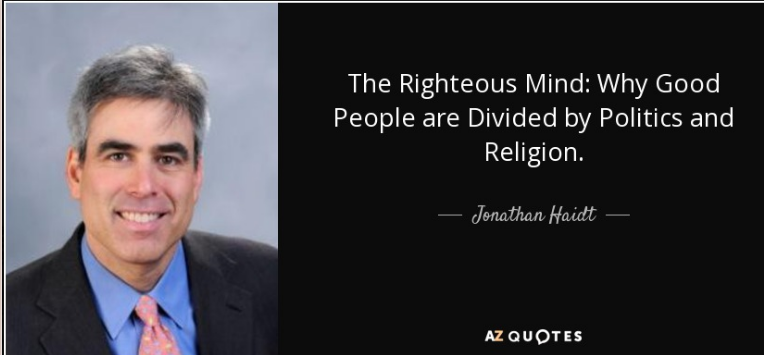
[…] Liberalism and Its Discontents – Francis Fukuyama 2022 Political commentator and social media entrepreneur Ezra Klein outlines the history of our two main political parties and their 1960-80 ideological realignment and polarization. He describes the role that social media has played in separating citizens from each other and the melding of our various identities into overly simplistic “red versus blue” categories. Why We’re Polarized 2020 Next, consider Johnathan Haidt’s book “The Righteous Mind”; subtitled “why good people are divided by politics and religion”. This 2012 book argues that there are 6 foundations for morality: care, fairness, loyalty, authority, sanctity and liberty/oppression. Like personality traits, individuals weigh them differently and rationalize accordingly. Politicians use this knowledge to divide or unify our communities. Moral Foundations Theory of Politics The Righteous Mind: Why Good People are Divided by Politics and Religion – 2012 (Part 1) The Righteous Mind – Part 2 […]
[…] Good News: God is NOT Dead In the US The World is Not Atomistic, Deterministic, Materialistic Modern American Religion Texts Only the Individual? Our Hamilton County: Diverse Religious Traditions Modern Curriculum for Citizens Peggy Lee: Is That All There Is? The Road to Character – 2015 Our American Community Moral Foundations Theory of Politics The Righteous Mind: Why Good People are Divided by Politics and Religion – 2012 (Part 1) The Righteous Mind – Part 2 […]
[…] The Righteous Mind: Why Good People are Divided by Politics and Religion – 2012 (Part 1) The Righteous Mind – Part 2 […]
[…] Righteous Mind: Why Good People are Divided by Politics and Religion – 2012 (Part 1) The Righteous Mind – Part 2 Moral Foundations Theory […]
[…] Righteous Mind: Why Good People are Divided by Politics and Religion – 2012 (Part 1) The Righteous Mind – Part 2 Moral Foundations Theory of Politics What’s The Root Cause of Our […]
[…] One Page: Liberalism and Its Discontents – Fukuyama (2022) Liberalism and Its Discontents – Francis Fukuyama 2022 The Righteous Mind: Why Good People are Divided by Politics and Religion – 2012 (Part 1) The Righteous Mind – Part 2 […]
[…] The Righteous Mind – Part 2 The Righteous Mind: Why Good People are Divided by Politics and Religion – 2012 (Part 1) Moral Foundations Theory of Politics […]
[…] Can’t We All Just Get Along? Moral Foundations Theory of Politics The Righteous Mind – Part 2 The Righteous Mind: Why Good People are Divided by Politics and Religion – 2012 […]
[…] Moral Foundations Theory of Politics The Righteous Mind – Part 2 The Righteous Mind: Why Good People are Divided by Politics and Religion – 2012 […]
[…] The Righteous Mind – Part 2 The Righteous Mind: Why Good People are Divided by Politics and Religion – 2012 […]
[…] The Righteous Mind – Part 2 – Good News […]
[…] Righteous Mind: Why Good People are Divided by Politics and Religion – 2012 (Part 1) The Righteous Mind – Part 2 Moral Intuitions, Personality and Politics … Oh My! Our Political Differences are […]
[…] Righteous Mind: Why Good People are Divided by Politics and Religion – 2012 (Part 1) The Righteous Mind – Part 2 Civil Personality Types Moral Intuitions, Personality and Politics … Oh My! Our […]