
US Spends 1% of Federal Budget on Aid, Not 25%

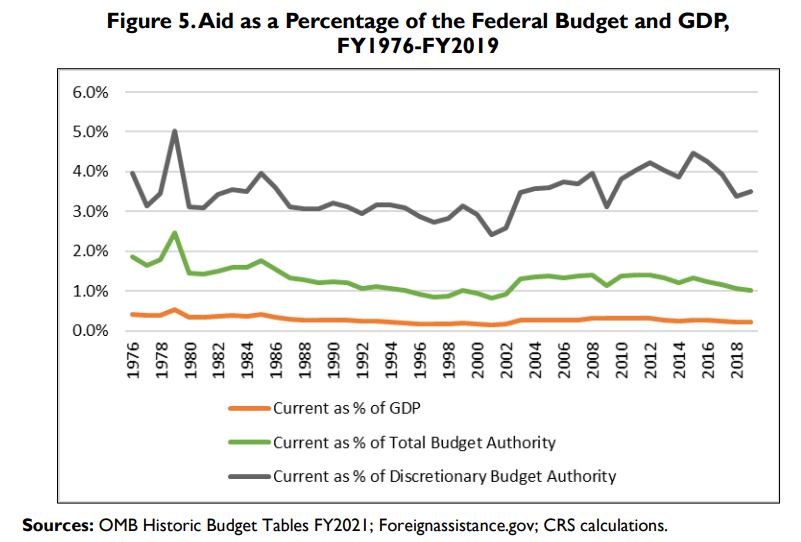
Aid is 1% of Budget, Down from 1.6% in 1980
Aid is 1% of Budget, Down from 1.4% in 2006
https://crsreports.congress.gov/product/pdf/R/R40213
Real $ Spending Increase Driven by Terrorism Threats with Bipartisan Support

https://crsreports.congress.gov/product/pdf/R/R40213
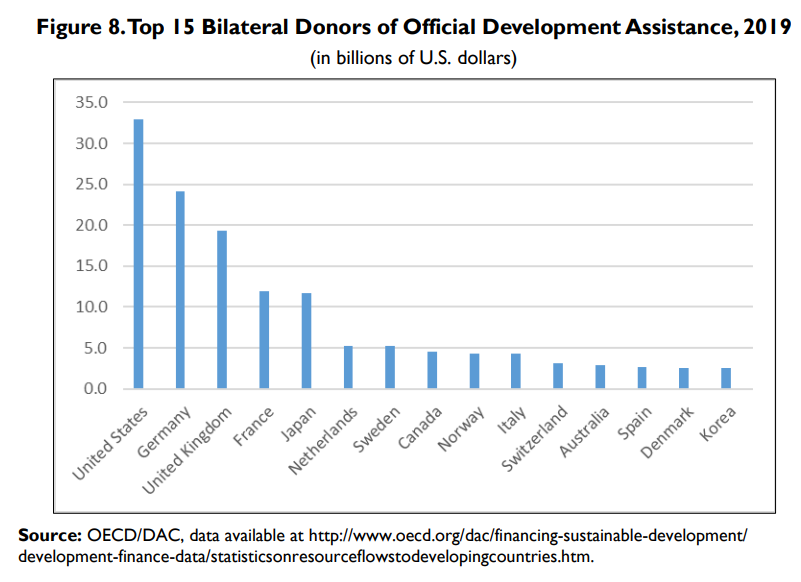
US Leads in Dollar Spending, Trails in $/Person
US Accounts for 23% of Global Aid
US 0.2% of GDP is Very Low for Developed Nation
https://crsreports.congress.gov/product/pdf/R/R40213

Where Does the Money Go?
41% to economic development and commercial interests
35% to military aid and national security
20% for humanitarian purposes
The congressional report splits up the $48B as
Peace/security 16B
Health, Ed $9B
Humanitarian $9B
Economic Growth $4B
Governance $3B
https://crsreports.congress.gov/product/pdf/R/R40213
Where Does the Money Go?

Africa 25%. Middle East 25%. Afghanistan $5B, Israel $3B, Jordan $2B, Egypt, Iraq, Ethiopia, Yemen, Colombia, Nigeria, Lebanon $1B each. Top 10 $16B, one-third of total.
Criticisms of Foreign Aid
Limited evidence that specific country investments provide political returns
Limited evidence of anti-terrorism campaign effectiveness (counterexamples)
Weak administrative structure and oversight at all levels
Direct evidence of individual country economic growth due to aid is limited
Some autocratic governments have benefitted from aid
Some aid is diverted to corrupt governments and individuals
Specific high priority countries have provided weak returns (Egypt, Pakistan, Afghanistan, Iraq)
Higher returns could be gained from investing in Western Hemisphere, Eastern Europe.
https://www.cfr.org/backgrounder/how-does-us-spend-its-foreign-aid
Benefits
Health measures, disease rates, lifespans. Global health. Economic development results globally and in individual countries. US trade benefits from developing trade lanes. Global education. Increased number of democracies, commitment to mixed capitalist economies. Lower cost of defense. Terrorism activities thwarted. Improved strength of US alliances. Improved flow through NGOs, multilateral organizations improves effectiveness. Dollar allocation provides US policy leverage.
https://www.cfr.org/backgrounder/how-does-us-spend-its-foreign-aid
https://www.concernusa.org/story/foreign-aid-myths-facts/
https://www.pbs.org/newshour/world/column-addressing-myths-surrounding-u-s-foreign-aid
 Good News
[…] News: Real $ US Exports are Up 180% since 1980. Good News: God is NOT Dead In the US Good News: US Foreign Aid Good News: The Ozone Hole is Healing Nicely Good News: US Pre-school Enrollment […]