
2.0% Inflation: Not in 2024

Last July, I predicted that inflation would be “near 2% by the middle of 2024”. That is not going to happen. Let’s look at the components to assess the last year and the likely future.

Year over year inflation rate peaked at 8.6% in 2nd quarter of 2022. It was more than cut in half at 4.0% a year later in the 2nd quarter of 2023. The last 2 quarters have been 3.25%. The “easy work” is complete. The “hard work” remains.

More volatile Food and Energy prices do not explain the continuing 3%+ inflation rate.
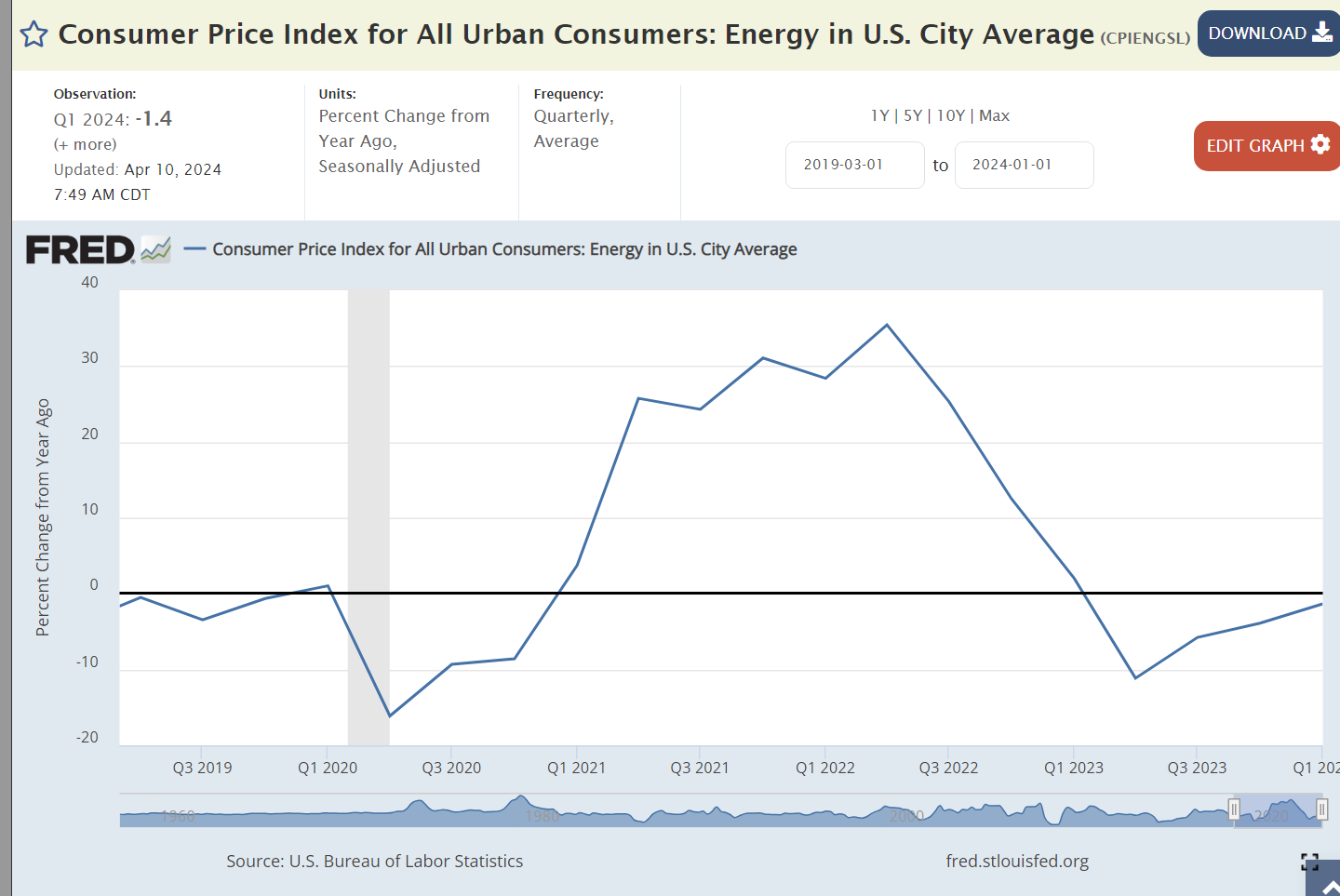
We have enjoyed energy price deflation for 3 quarters.
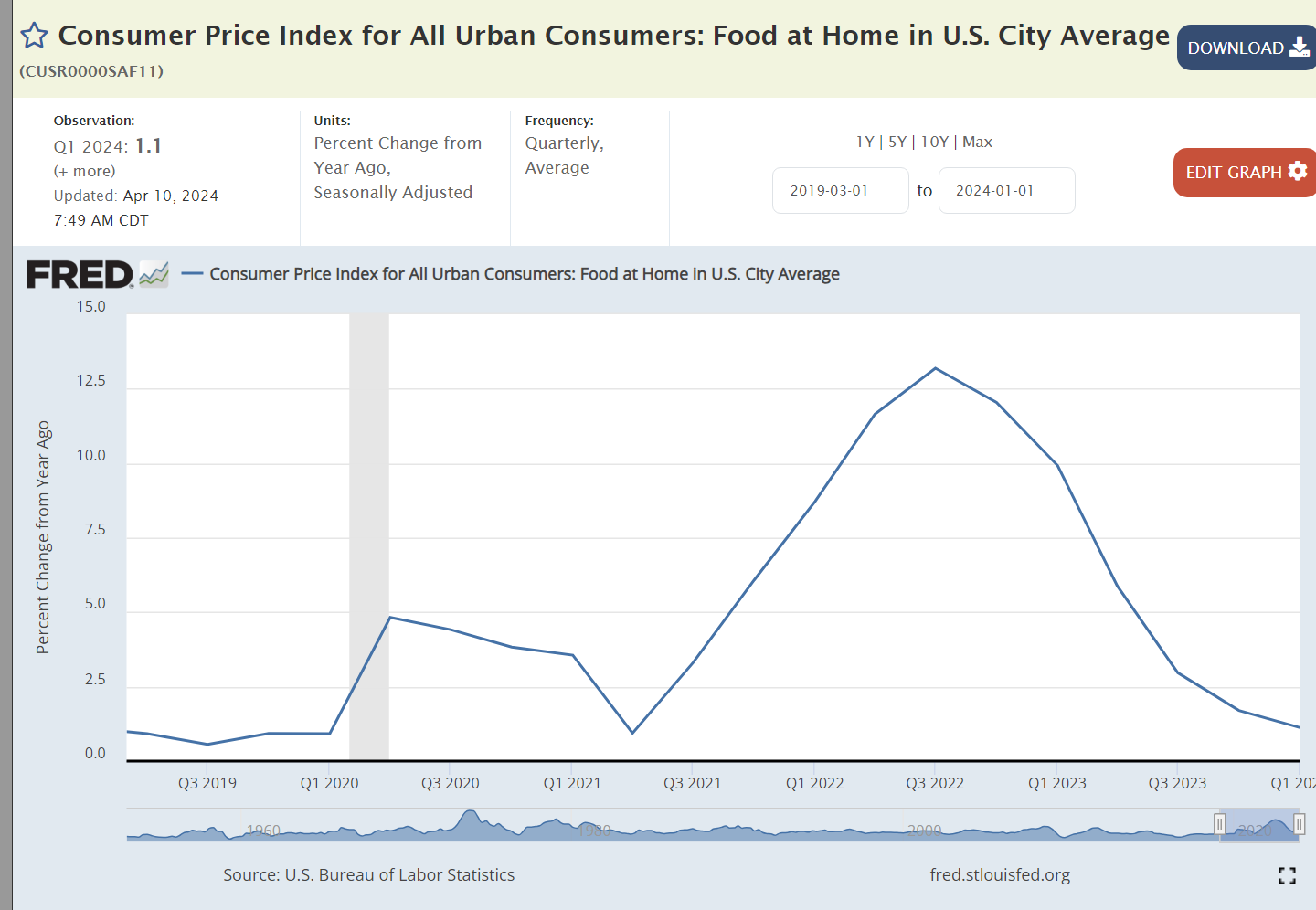
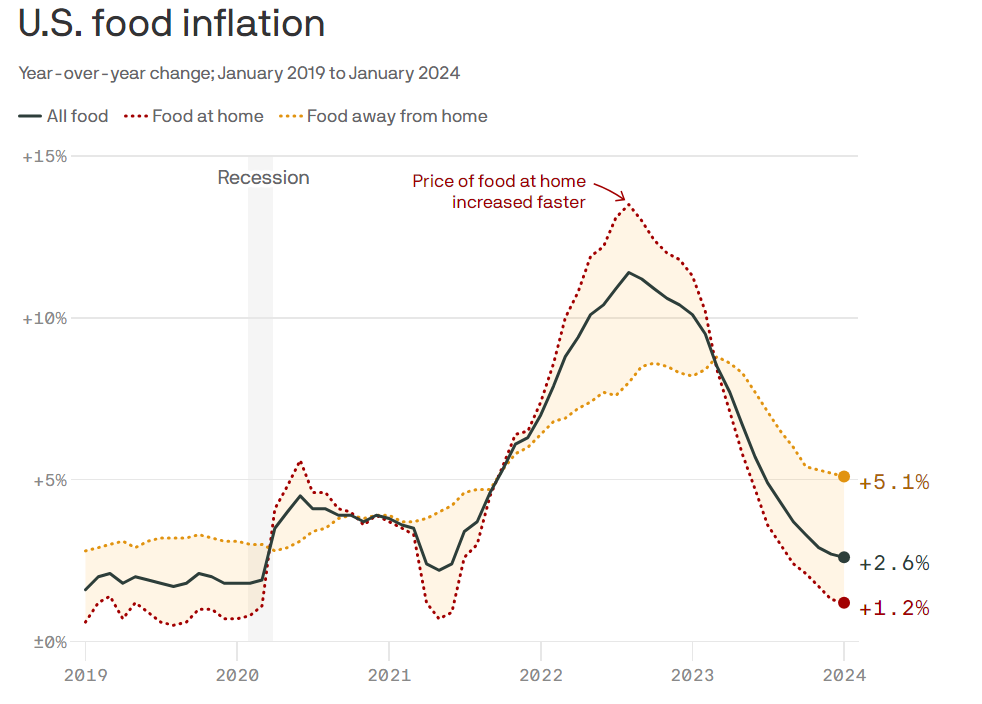
Food consumed at home prices have been nearly flat for the last 2 quarters after the 12-13% inflation during 2022.
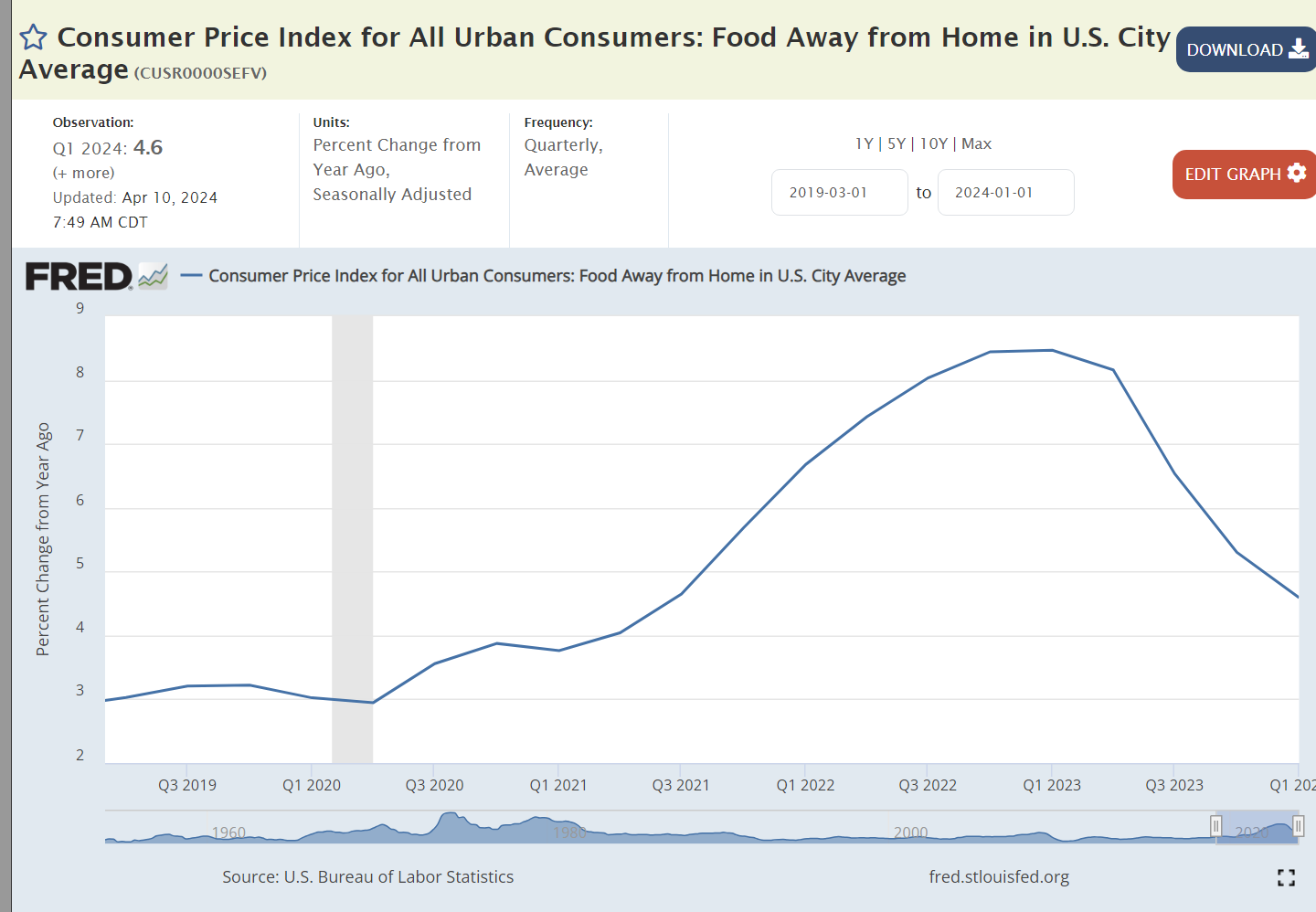
The price of food consumed away from home continues to rise at 4-5% annually. A tight labor market has increased staffing costs for restaurants. High food input costs taught them to better manage their menu prices. Many restaurants went out of business during the pandemic. Restaurants, large and small, lost money during the pandemic and are fighting hard to recover these losses. Following the lean pandemic years consumers have largely returned to their habits of eating out. This is a business sector where high aggregate demand driven by government deficit spending is creating inflation. It is not the “wage-price spiral” of the 1970’s in a manufacturing intensive economy but it is a similar situation in our retail-intensive economy.

We have enjoyed deflation in durable goods prices for 5 quarters as US and global manufacturers realigned their supply chains with more predictable demand patterns.

Nondurable goods inflation has been below the 2% benchmark for 4 quarters.

The broadly defined “services” sector at 5-6% inflation remains a stubborn problem area. It contains a number of sub-sectors with very different market conditions.

Medical care inflation above the overall inflation rate has been an issue for decades, but it has averaged just 1% for the last 5 quarters.

Transportation services prices have increased by 10% annually. This includes public and private transportation. Public sector transportation is attempting to recover from the pandemic driven decline in ridership. Private rail and truck carriers were disrupted by the pandemic as goods movements plummeted. The prospect of driverless trucks kept freight firms and drivers from returning. Transportation drivers are on the low end of wages. The overall increase in real wages at the low end of the labor market has made these physically demanding, away from home, jobs less attractive. This inflation is part long-term structural adjustment and part short-term recovery of freight flows in the economy. Transportation services is 5% of the CPI, material, but not large enough to drive the total.

The education and communications pair of service sectors has low inflation. Education is higher. Communications is lower.

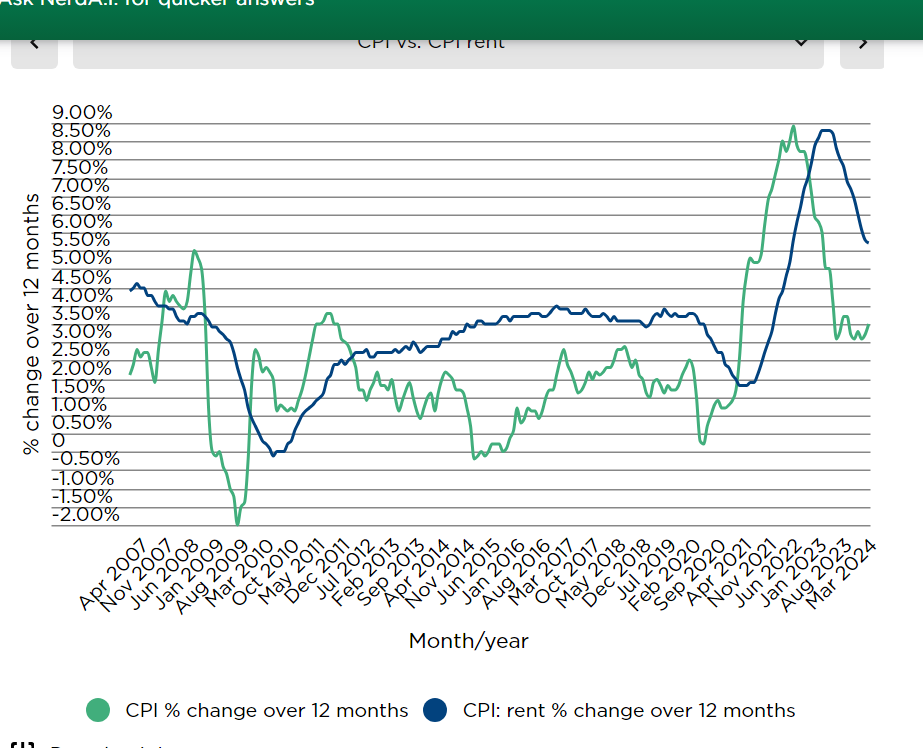
Housing is one-third of the total CPI. It is a very technical, wonky area. It combines a blend of actual rental charges and the estimated rental value of owned homes. Increases in home prices are smoothed out and their impact on the CPI tends to lag by 2-8 quarters. Housing inflation has fallen from 8% to 5%.

Housing sales prices have declined for 4 quarters. This will increasingly blend into the housing CPI, soon producing deflation rather than 4-5% inflation.
https://www.nerdwallet.com/article/finance/rental-market-trends

Market rent inflation remains in the 3-3.5% range based on the cumulative lack of US housing construction since the Great Recession of 2007-9. Combined with falling housing sales prices the combined housing CPI should decline to 2% by the fourth quarter of 2024.

Dreaded “cost-push” inflation is not a major factor for the US economy. A tight labor market has delivered 1% annual real wage increases for the last 5 quarters. This is a factor in inflation but not a driver or barrier to reaching 2% overall.

https://bipartisanpolicy.org/report/deficit-tracker

2024 looks like 2023, a very high budget deficit for a full-employment economy. In classical Keynesian economic terms, the aggregate demand pressure indicates continued 3% inflation.
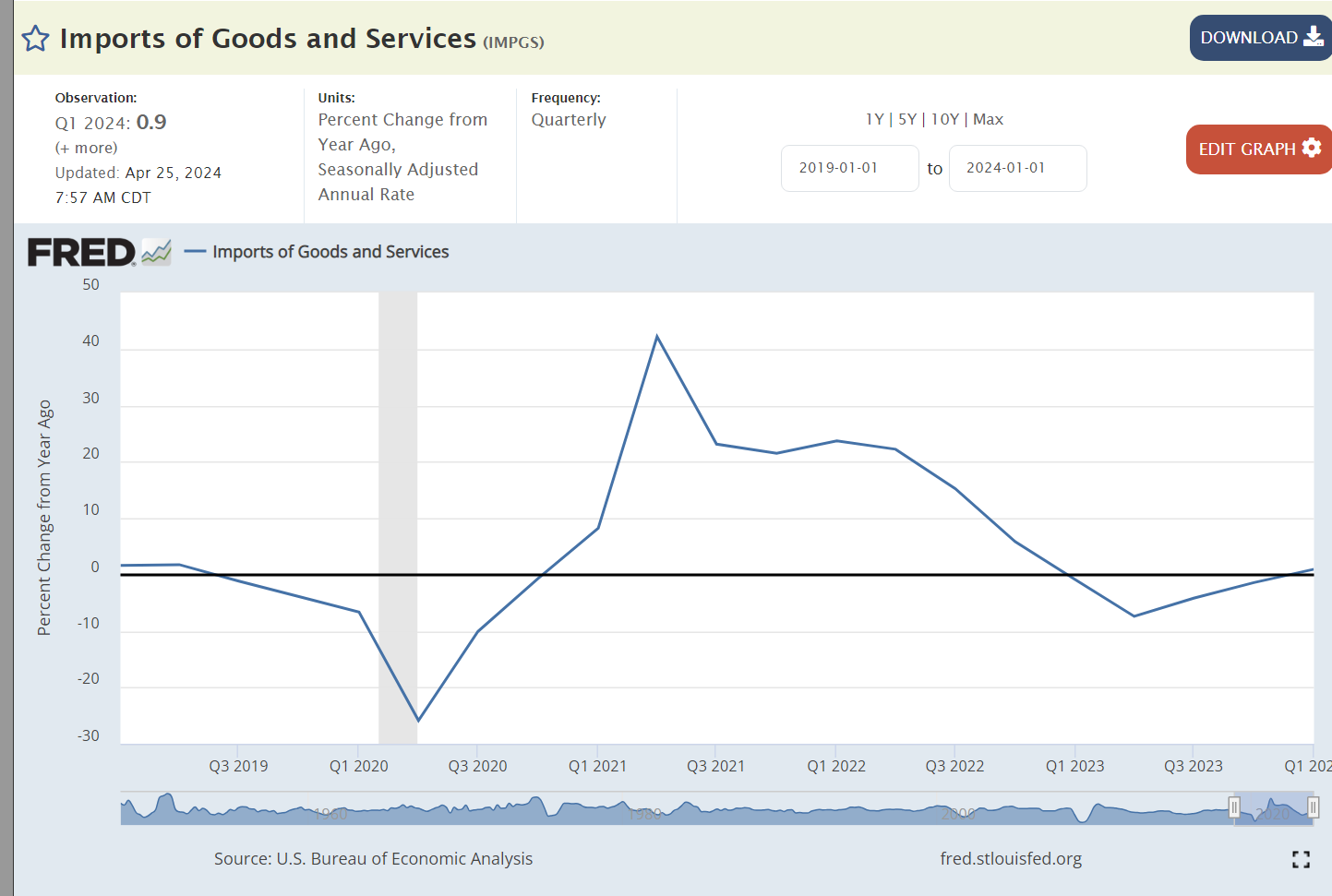
An overheated economy typically shows a strong increase in imports as demand reaches out globally. This is not the situation in the US this year.
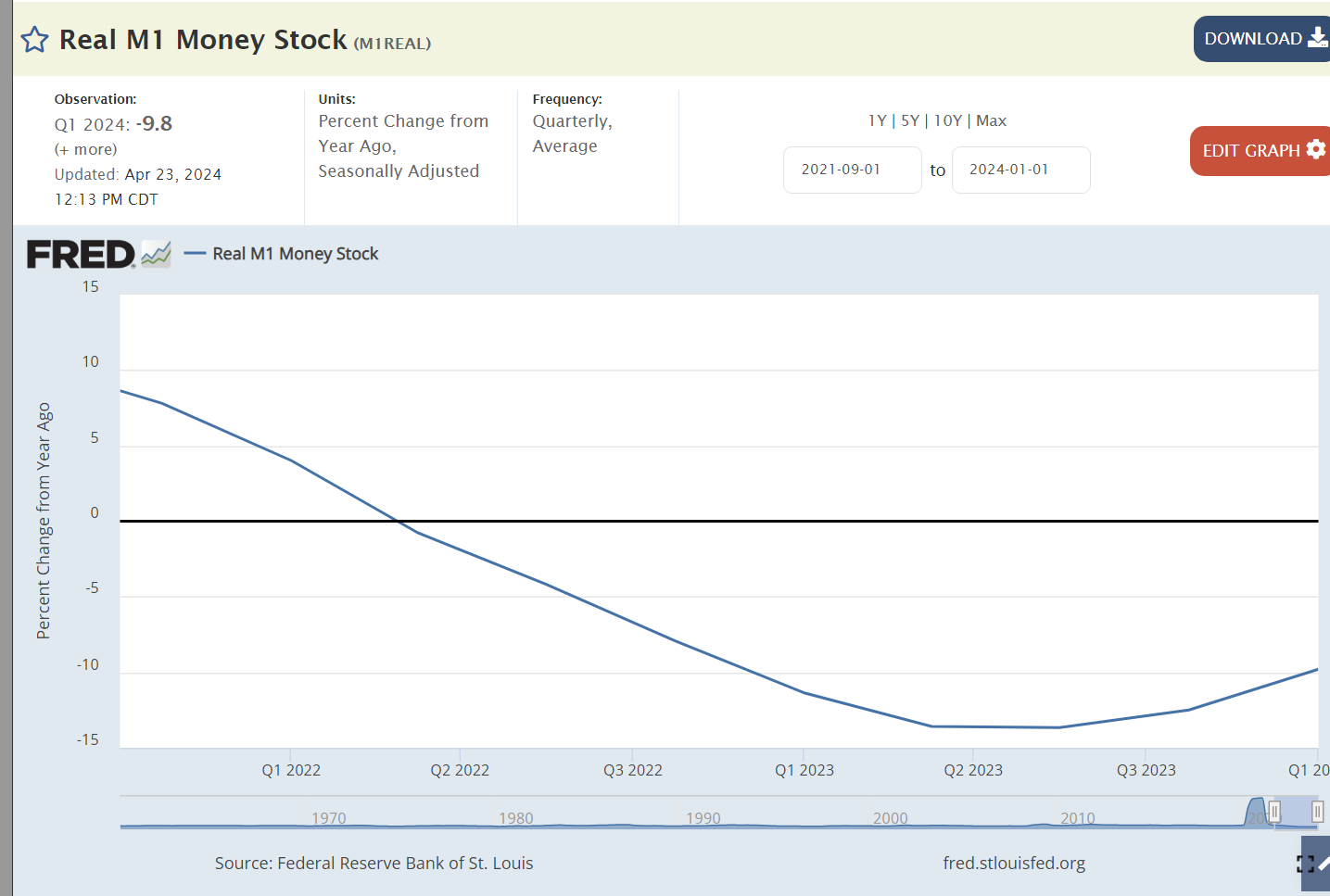
The money supply has a long-term impact on the economy, prices and inflation. The Federal Reserve Bank has been shrinking the “money supply” by 10% annually.
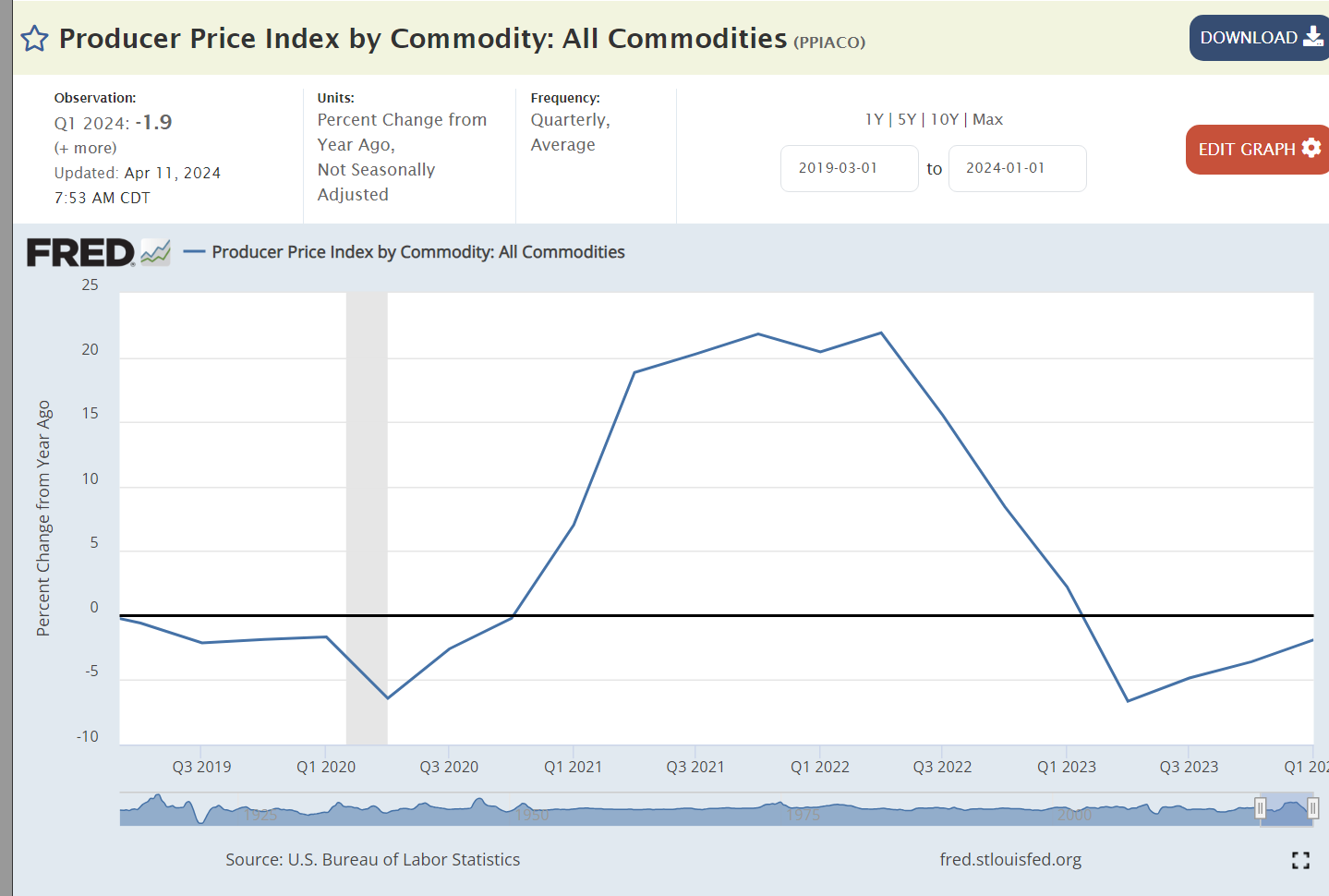
Commodities are the most volatile element of the global economy. Prices jumped by 20% with the unanticipated quick recovery from the pandemic. The last year has delivered commodities price deflation.

Changes in relative market power can drive inflation. Corporations increased profits by 50% in the first year of the pandemic. Profits have been relatively flat since then.

Summary

A dozen sectors point towards 2% inflation by year end. Energy, food at home, durable goods, nondurable goods, medical care, education/communication, housing prices, real wages, imports, money supply, commodity prices and profits.

Four sectors indicate concerns. Food away from home continues to drive high inflation.

https://www.axios.com/2024/02/13/cpi-food-inflation-dining-out
Public and private transportation services have not yet reached equilibrium. This pressure may continue for another 4 quarters but should not be a long-term inflation driver.
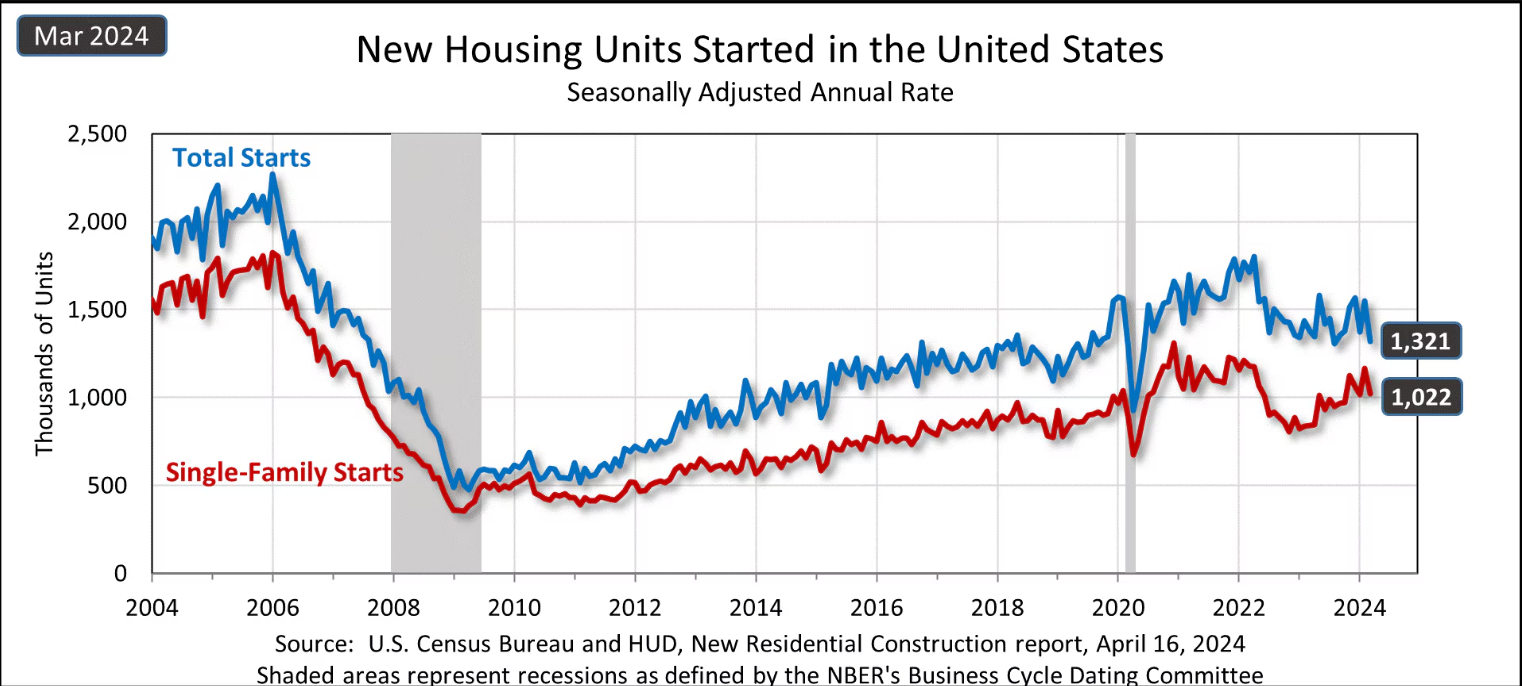
https://www.census.gov/construction/nrc/current/index.html

The “Great Recession” destroyed the construction industry. It has slowly recovered. Total construction has increased, perhaps not enough to bring housing supply into balance with demand 15 years later. Rental inflation at 3% is likely to continue.
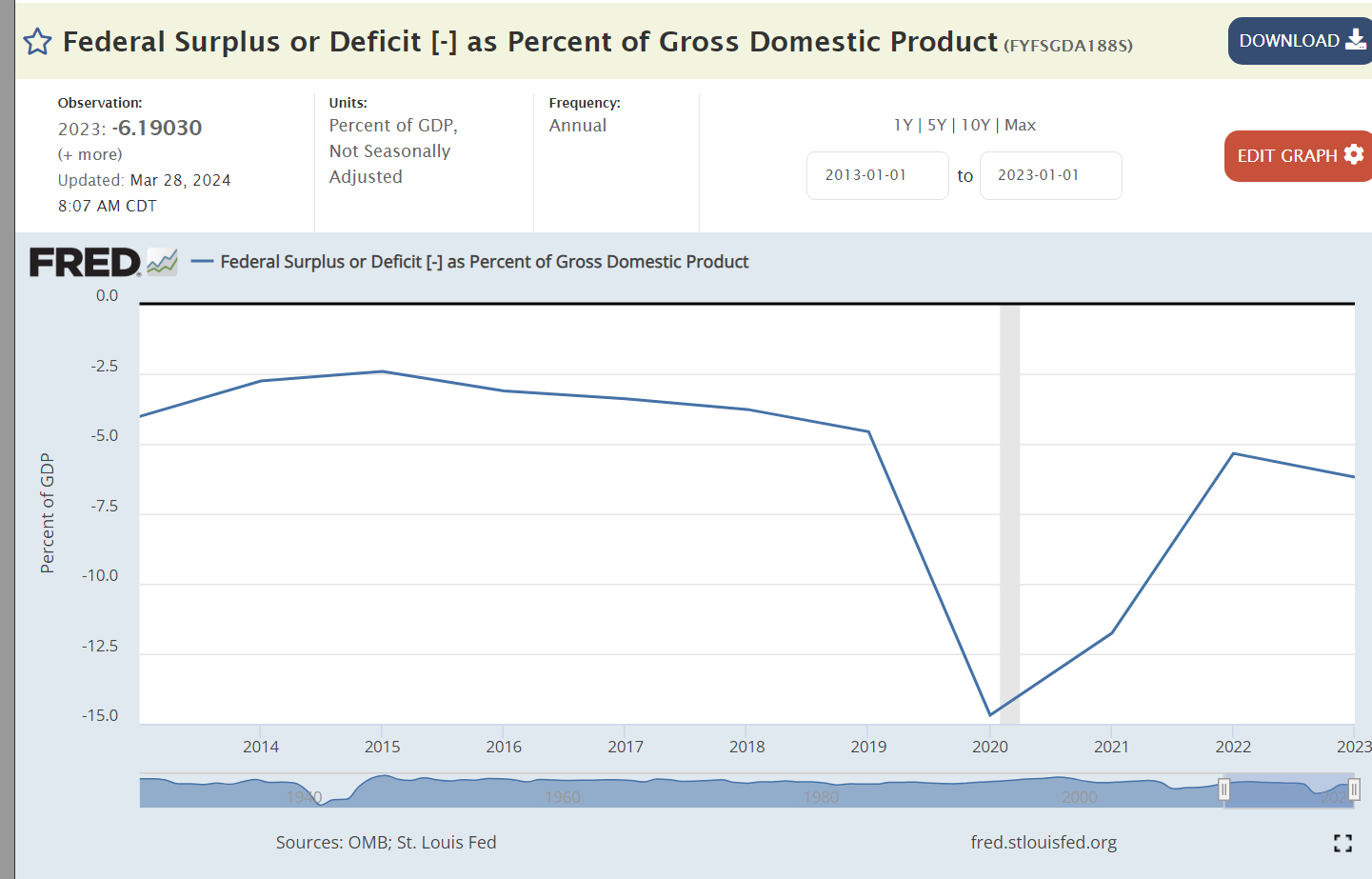
The federal budget deficit is the greatest concern. 6% of GDP is a huge deficit.

Net, net, I predict that the Urban Consumer CPI increase in the fourth quarter of 2024 versus the fourth quarter of 2023 will be 2.25%. The federal government spending deficit will directly and indirectly boost inflation.

Framing Politics With a Ruler

Peggy Noonan’s suggestion to use a 36 inch ruler to gauge right versus left in politics does help to explain the opposing views of tea partiers, Republicans and Democrats.  Noonan describes 0 inches as pure right and 36 inches as pure left (opposite of what you might expect).  She bemoans her perception that modern-day politicians negotiate between the 25 and 30 inch mark on the far left end of the ruler.  She asserts that tea partiers will try to move back to the 5 inch mark.

In politics, he who sets the framework usually wins the game.  Using American history since the agricultural 1770’s, urbanizing 1860’s, industrial 1920’s or depression 1930’s as a base, a case can be made that post-war politics and economics has been debated on the left end of the ruler, with a mixed economy government share of GDP at 20% and government spending/taxing share of GDP at 25-30%.  These shares of the economy double those of laissez-faire capitalism, the roaring twenties or the depression.  Noonan takes this long-run historical view of how the yardstick should be labeled.

Noonan is right in pointing out that politicians of both parties in a democratic system inherently seek to spend more money.  The rise in government spending in the Bush presidency after the unusual decline in government spending in the Clinton presidency (with Republican congress) is a modern reminder.  Tea partiers are right to have gut level concerns that government spending will continue to climb unchecked.  The trend in 2000-2008 was up.  Extraordinary banking and industry bail-out funds were piled on top of the stimulus spending for the Great Recession.  Health care and social security spending increases are expected in the next two decades.  Whether the various spending increases are justified or not, the trend is clearly up, without any clear countervailing force in Washington.

Those on the left might agree with the challenge to be faced, but they use a different scale to gauge left versus right, object to the accusation that they have driven up government spending, hold the Republicans responsible for inciting anger in the tea partiers and offer different long-run solutions.

If the scale is set between 100% individual, 0% government pure libertarianism versus 0% individual, 100% government pure socialism, the Democrats argue that the post-war game has all been played on the right (0-18 inch) side of the ruler.  Government share of GDP is 20%.  Government spending and taxes share of GDP is 30-35%, including all transfers.  This did not increase between 1960 and 2008.  The US tax burden at 27% of GDP is only 75% of the 36% average level for 30 developed countries.  Only Mexico, Turkey, Korea and Japan spend less than the US.  Total government spending in western European democracies is 40-55%.  Government spending did increase with the Vietnam War and Great Society policies, but was reduced by the Reagan revolution.  Government spending fell from 37.2% of GDP in 1992 to 32.6% in 2000. 

Democrats argue that their fiscal discipline was demonstrated in 1992 to 2000 when they balanced the federal budget and reduced the deficit, employing the “pay as you go” policy to force spending cuts to offset spending increases.  They point to Bush led Medicaid and defense spending increases as the cause of increased government by 2008.  They see the Bush tax cuts as redistribution to the wealthy and don’t see the overall tax-cut initiated economic growth claimed to increase net tax revenues.

Democrats argue that they have not purposely increased the long-run share of government in the economy.  They claim that the one-time investments/guarantees for the banking/auto industries were necessary for the whole economy, addressed issues that had grown for decades, will be partially recaptured and do not require continued funding.  Similarly, they pursued a moderate one-time Keynesian fiscal stimulus in response to a deep recession, just as was done by other governments of all parties in all countries for the last 60 years.  The stimulus spending lies between the 4.7% of GDP boost in 1982 and the 2.3% growth in 1992. Democrats argue that these actions are necessary and moderate and would have been undertaken by a responsible Republican successor to the Bush administration.

Democrats argue they are unfairly characterized as “big spenders” by the Republicans.  This simple accusation has stirred a populist response from “regular Americans”.  While Democrats have historically focused populist rage on big business and big banking, the Republicans and tea partiers have effectively used big government, Washington, elites, foreign countries and religions as targets, tying them to the Democratic Party.  Democrats argue that the monetarist, supply side, tax cut economic policies of the Republican Party since Reagan have been adopted for their populist simplicity and political effectiveness alone, further polarizing economic policy making.

Finally, Democrats have adopted part of the Republican play book in fundamentally looking to the private sector to drive the future economic growth required to support even the historic level of government spending.  The stimulus spending was partially focused on future industrial growth and infrastructure.  The banks and auto firms are returning to pure private ownership.  Small business lending and investment tax credits have become a focus.  Health care reform maintained private providers and insurers as the core of the system.  The costs of the war in Iran have been reduced.  A bipartisan group has been appointed to work on the Medicare/social security future.  Steps are being taken to promote exports.  A reduced public sector role for the mortgage industry has been proposed.  Obama and many Democrats have continued the pro-business approach used by Clinton.

On the other hand, Republicans can fairly point to steps taken by the Democrats that indicate a continued desire to “tax and spend”.  The stimulus bill benefited state government, construction and other Democratic interests disproportionately.  Health care reform achieved growth in government commitments without structural cost solutions.  Labor unions were given special treatment in the auto bail-out.  Fannie Mae and Freddie Mac’s roles were not touched in the banking reform.  The financial consumer protection agency smacks of unlimited and uninformed regulation.  The proposed increase in taxes for high earners is significant and is not coupled with structural spending reforms.  A second mini-stimulus has been approved and unemployment benefits have been extended to record lengths.

The current economic situation has raised the stakes for politics.  We should expect to see ongoing attempts to define the ruler and place the participants at marks that favor one group or another in the public eye.

Time for the Tea Party

Why It’s Time for the Tea Party (excerpt) – Peggy Noonan – WSJ -9/17/2010

I see two central reasons for the tea party’s rise. The first is the yardstick, and the second is the clock. First, the yardstick. Imagine that over at the 36-inch end you’ve got pure liberal thinking—more and larger government programs, a bigger government that costs more in the many ways that cost can be calculated. Over at the other end you’ve got conservative thinking—a government that is growing smaller and less demanding and is less expensive. You assume that when the two major parties are negotiating bills in Washington, they sort of lay down the yardstick and begin negotiations at the 18-inch line. Each party pulls in the direction it wants, and the dominant party moves the government a few inches in their direction.

But if you look at the past half century or so you have to think: How come even when Republicans are in charge, even when they’re dominant, government has always gotten larger and more expensive? It’s always grown! It’s as if something inexorable in our political reality—with those who think in liberal terms dominating the establishment, the media, the academy—has always tilted the starting point in negotiations away from 18 inches, and always toward liberalism, toward the 36-inch point.

Democrats on the Hill or in the White House try to pull it up to 30, Republicans try to pull it back to 25. A deal is struck at 28. Washington Republicans call it victory: “Hey, it coulda been 29!” But regular conservative-minded or Republican voters see yet another loss. They could live with 18. They’d like eight. Instead it’s 28.

For conservatives on the ground, it has often felt as if Democrats (and moderate Republicans) were always saying, “We should spend a trillion dollars,” and the Republican Party would respond, “No, too costly. How about $700 billion?” Conservatives on the ground are thinking, “How about nothing? How about we don’t spend more money but finally start cutting.”

What they want is representatives who’ll begin the negotiations at 18 inches and tug the final bill toward five inches. And they believe tea party candidates will do that..

Where Have All the Dollars Gone?

Economists enjoy the sense of security provided by the “National Income Accounts” where Gross Domestic Product, the value of all goods and services produced domestically, is always equal, by definition, to Consumption plus Investments plus Government plus Net Exports.  Reviewing the changes in the share of economic activity in the components of C+I+G+NX goes a long way towards explaining our current and future economic predicament.  The economy has changed dramatically since 1960. which will serve as a baseline for the post-war era.

During the bright days of Camelot, Consumption was 63%, Investment 15%, Government 21% and Net Exports +1%.  In 2008, Consumption was 70%, Investment 15%, Government 20% and Net Exports -5%.  In simplest terms, we are consuming 7% more thanks to the generosity of other exporting nations! 

Investment averages 16% of GDP: 11% business and 5% residential.  Business investment has reached peaks of 12-13% in 1978-85, 1998-2001 and 2007-08.  It experienced troughs of 9-10% in 1960-64, 1991-93, and 2003-04.  Business investment responds to tax and market opportunities, adding a pro-cyclical boost to the recovery.  Residential real estate follows its own pattern, reaching 5-6% peaks in 1962-64, 1972-73, 1977-79, and 2004-06, alternating with 3-4% troughs in 1966-67, 1975, 1981-82, 1990-93, and 2008.  The 3.3% share in 2008 is the lowest in the period, followed by an even lower share in 2009.  Residential real estate experienced an unprecedented 13 year run without a down cycle.  The over expansion in 2004-2006 means that the usual residential real estate recovery will be delayed for a few years.

Government consumption expenditures, excluding transfer payments, declined from 21% to 20% of GDP across the period.  Direct federal government, non-defense expenditures remained flat and immaterial at 2.5%.  National defense started at a high 10% in 1960 and remained at that level as late as 1968 before declining after the Vietnam conflict wound down.  The peace dividend allowed defense spending to fall to 6% for 1977-80.  Defense spending rose again in the waning years of the Cold War, reaching 7.4% in 1985-87, before sliding to as low as 3.8% from 1998-2001.  The terrorist response has triggered an increase to 5.1% of GDP by 2008.  Delivering the “Great Society” initiatives, state and local government spending grew from 9.5% in 1961-63 to 12.5% in 1974-76.  State and local government declined to 11% in 1983-85, remaining at 11.3% as late as 1998 before growing to 12.2% in 2002-03.  State and local government spending will act as a drag on the economy for at least 2 years.  Defense spending shows no clear trend.  Federal government spending on stimulus measures may be 3-5% of GDP in 2010.  The expected decline in stimulus spending will act as a drag on the economy in 2011.

Across 50 years the United States rejoined the world economy after the unusual post-war period of self-sufficiency and high global demand for U.S. goods.  Exports of services tripled from 1.3% to 3.9% of GDP in this period.  Exports of goods doubled from 4% to 8%, reaching 8.8% in 2008.  Total exports increased from 5% to 13% of GDP.  On the other hand, service imports doubled from 1.4% to 2.9%.  Goods imports increased five-fold, from 3% to 15% of GDP.  This 12% of GDP change has outpaced the growth in exports. 

A 2-3% trade deficit was experienced from 1984-88.  The competitive response reduced the deficit to an average of 1% for the next decade.  The deficit rapidly grew to 4% in 2000 and a high of 5.7% in 2005-06.  As pundits have noted, no nation has ever been able to run a 5% trade deficit for decades.  The unique situation of the US as the world’s currency and safest investment home, plus the growth of China’s economy and its willingness to finance the trade deficit has allowed this to continue.  In the long-run, the US dollar will fall relative to China’s currency and trade will rebalance.  There is no way to predict the timing of this change.  For a decade, the U.S. has consumed 5% more than it produced.  Consumption will fall.

Consumption is the 800 pound gorilla of GDP accounting.  Its rise from 63% to 70% of GDP is the counterbalance to the trade deficit.  Durable goods production held its own, maintaining 9% of GDP through 2003, before falling to 7.6% as the auto recession began in 2008.  Non-durable goods production dropped from 25% to 16% of GDP by 1995 and maintaining that level through 2008.  The 9% decline in non-durable goods production has been replaced by an increase in services from 30% to 47% of the economy. 

The service share was 30% as recently as 1969, so this 17% switch occurred in just 40 years.  The service share reached 45% in 2001 and has inched up slowly since then, reflecting the “jobless recovery” of the 2000’s.  Durable goods production will recover from its low level as autos and equipment age.  The trend in non-durable goods moving to import sources is likely to continue.  Without changes in the health care industry, this part of services is likely to keep growing: a short-term benefit for jobs and GDP.

Government budget, trade and savings deficits need to be repaid.  The retiring Baby Boomers need to be replaced in the labor force at high productivity rates.  Some form of improved health care market, incentives or rationing is required to limit the growth of this sector.  The U.S. has significant economic challenges to be faced.  The transition from Keynesian fiscal stimulus and easy money to a sustainable course is a necessary first step.  U.S. economic productivity, competitiveness and innovation have not been undermined by the Great Recession.  The business cycle provides a natural boost to recovery from inventory replenishment, capital spending and durable goods demand as we are already seeing.  Let’s hope that the president can have a real meeting of the minds with Congress and begin to address the long-term structural challenges faced by the country that go far beyond the 2010 and 2012 elections.