
2.0% Inflation: Not in 2024

Last July, I predicted that inflation would be “near 2% by the middle of 2024”. That is not going to happen. Let’s look at the components to assess the last year and the likely future.

Year over year inflation rate peaked at 8.6% in 2nd quarter of 2022. It was more than cut in half at 4.0% a year later in the 2nd quarter of 2023. The last 2 quarters have been 3.25%. The “easy work” is complete. The “hard work” remains.

More volatile Food and Energy prices do not explain the continuing 3%+ inflation rate.
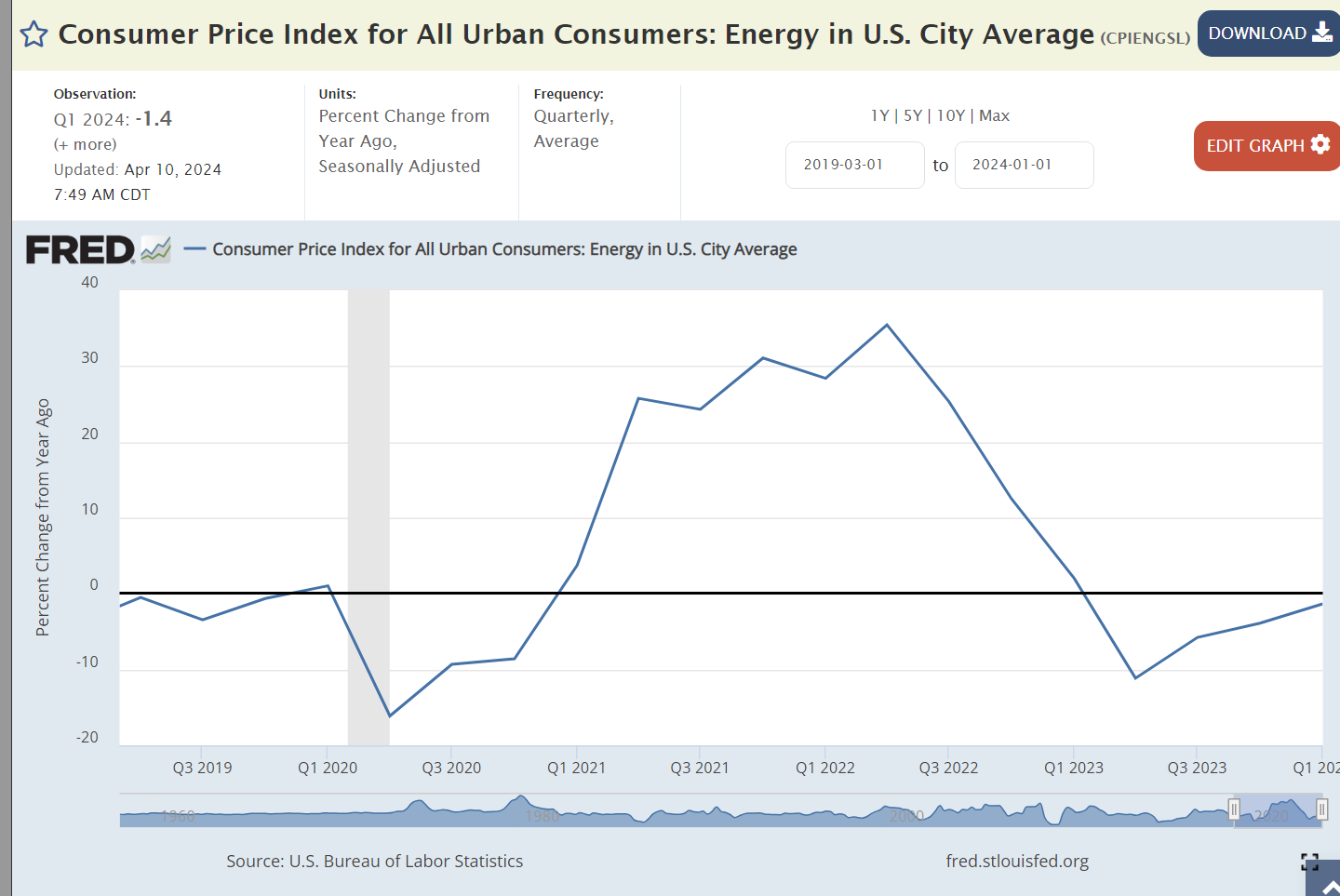
We have enjoyed energy price deflation for 3 quarters.
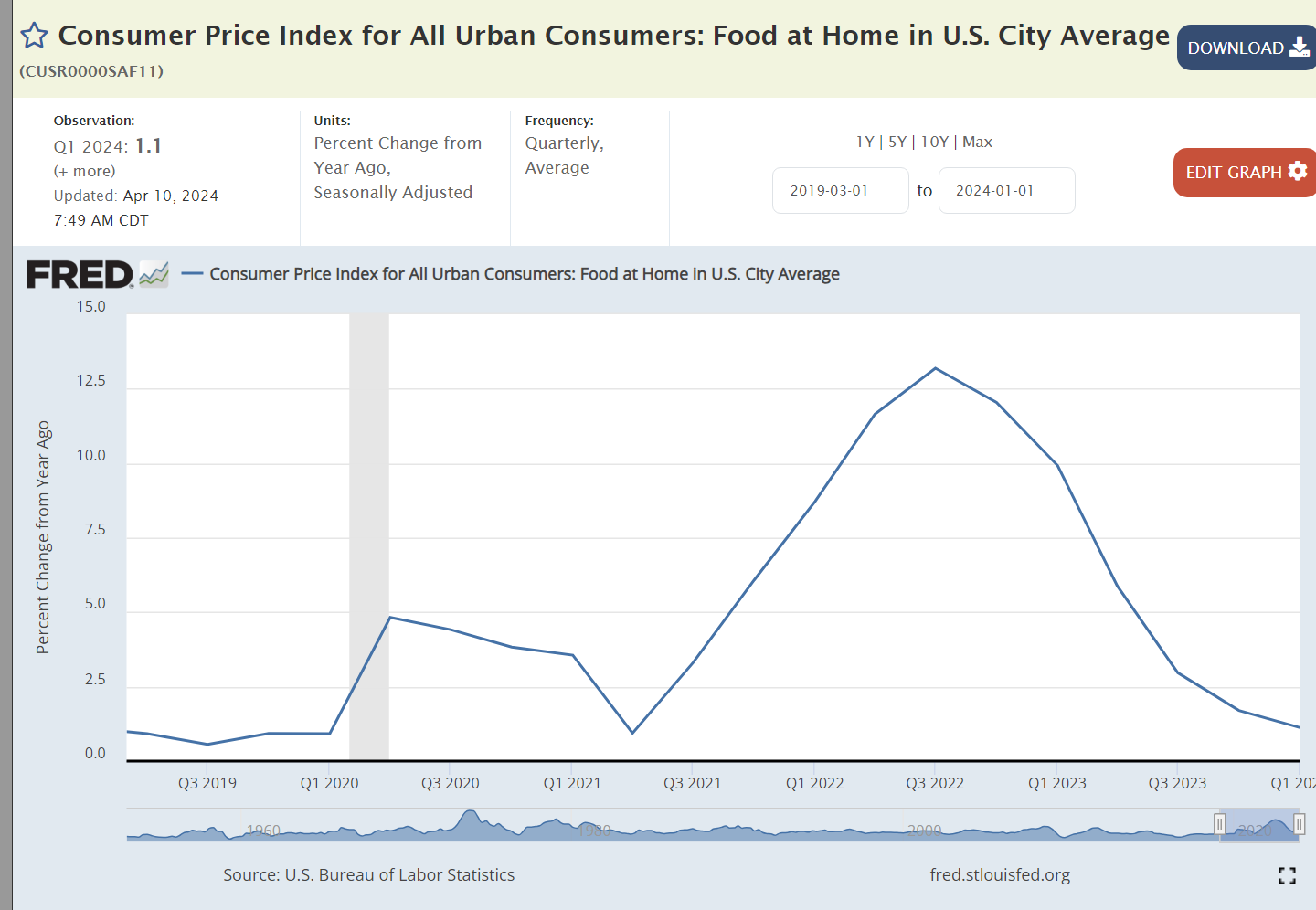
Food consumed at home prices have been nearly flat for the last 2 quarters after the 12-13% inflation during 2022.
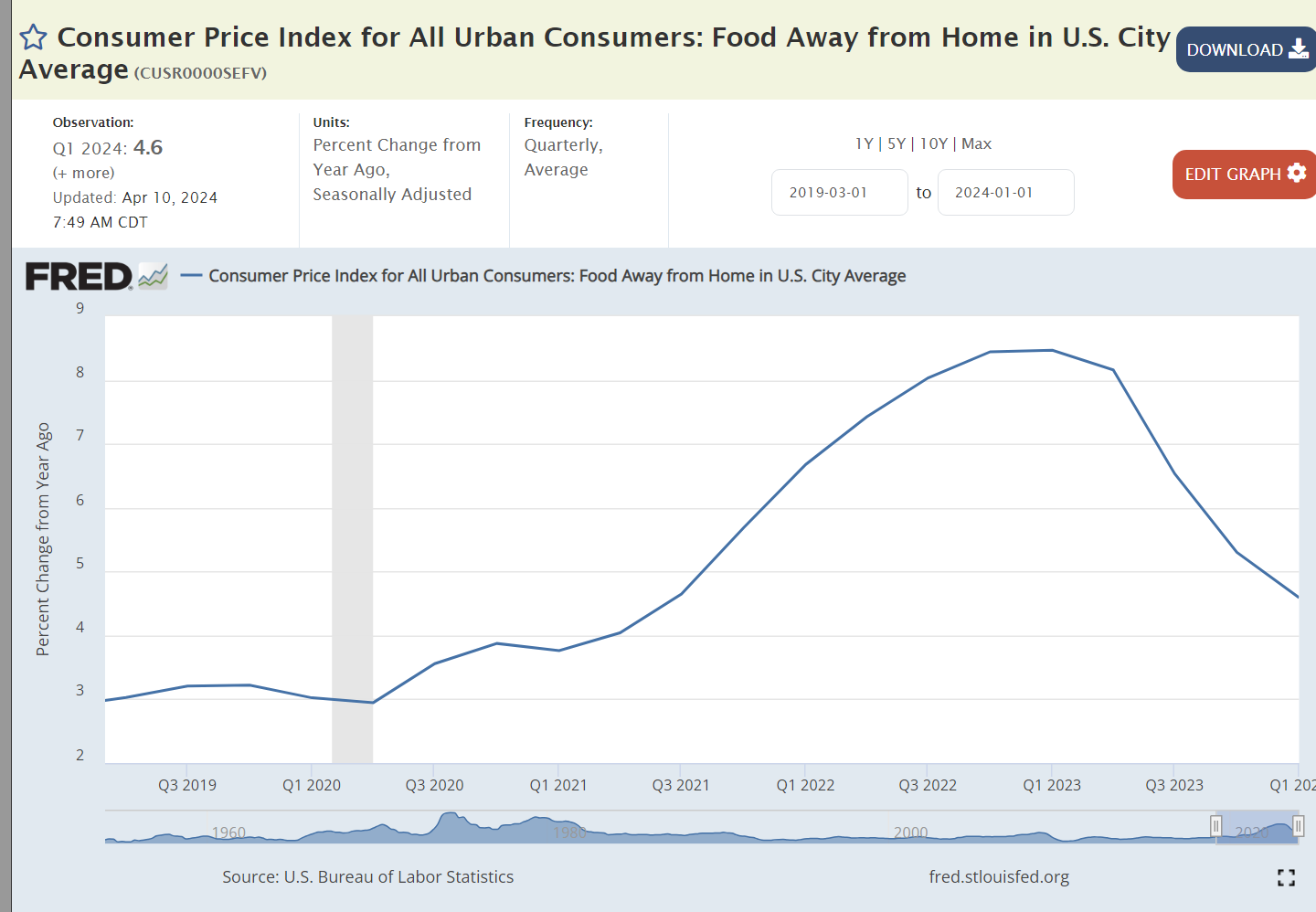
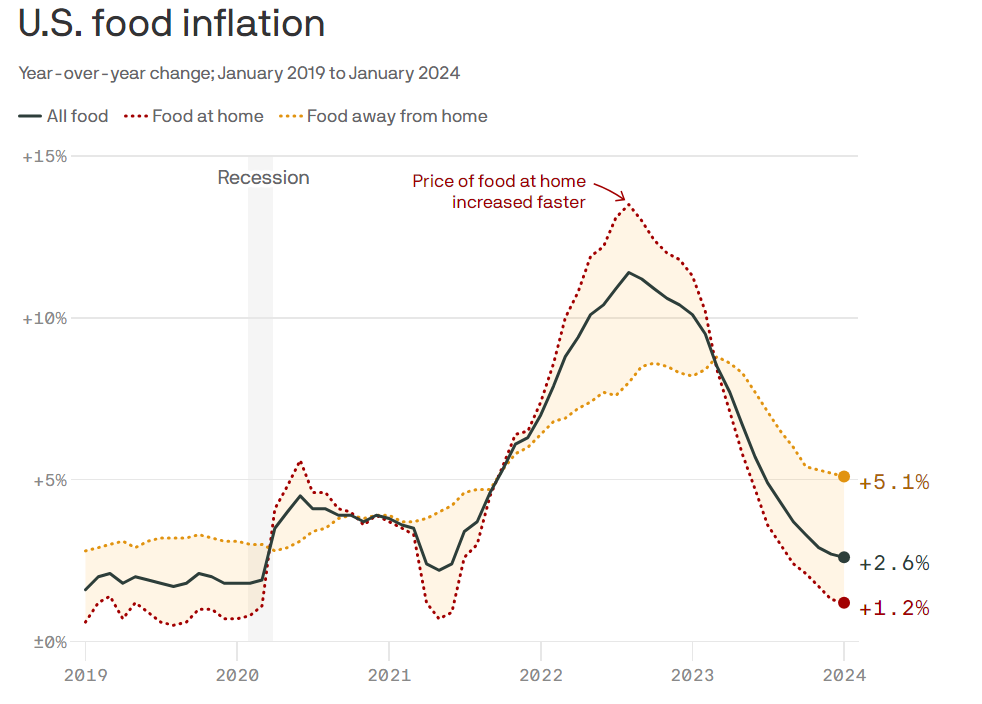
The price of food consumed away from home continues to rise at 4-5% annually. A tight labor market has increased staffing costs for restaurants. High food input costs taught them to better manage their menu prices. Many restaurants went out of business during the pandemic. Restaurants, large and small, lost money during the pandemic and are fighting hard to recover these losses. Following the lean pandemic years consumers have largely returned to their habits of eating out. This is a business sector where high aggregate demand driven by government deficit spending is creating inflation. It is not the “wage-price spiral” of the 1970’s in a manufacturing intensive economy but it is a similar situation in our retail-intensive economy.

We have enjoyed deflation in durable goods prices for 5 quarters as US and global manufacturers realigned their supply chains with more predictable demand patterns.

Nondurable goods inflation has been below the 2% benchmark for 4 quarters.

The broadly defined “services” sector at 5-6% inflation remains a stubborn problem area. It contains a number of sub-sectors with very different market conditions.

Medical care inflation above the overall inflation rate has been an issue for decades, but it has averaged just 1% for the last 5 quarters.

Transportation services prices have increased by 10% annually. This includes public and private transportation. Public sector transportation is attempting to recover from the pandemic driven decline in ridership. Private rail and truck carriers were disrupted by the pandemic as goods movements plummeted. The prospect of driverless trucks kept freight firms and drivers from returning. Transportation drivers are on the low end of wages. The overall increase in real wages at the low end of the labor market has made these physically demanding, away from home, jobs less attractive. This inflation is part long-term structural adjustment and part short-term recovery of freight flows in the economy. Transportation services is 5% of the CPI, material, but not large enough to drive the total.

The education and communications pair of service sectors has low inflation. Education is higher. Communications is lower.

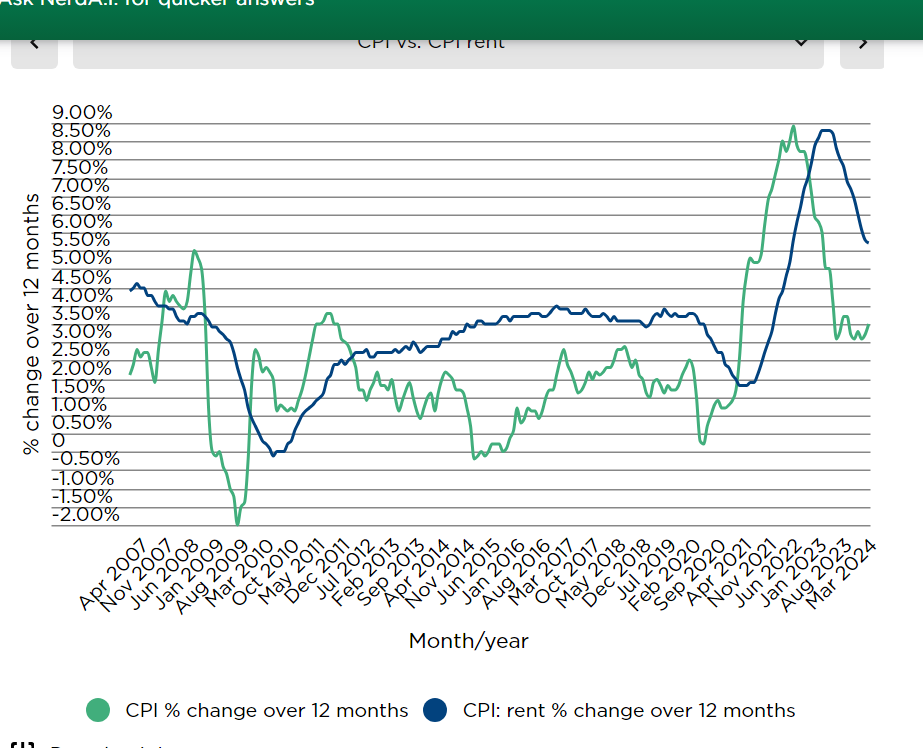
Housing is one-third of the total CPI. It is a very technical, wonky area. It combines a blend of actual rental charges and the estimated rental value of owned homes. Increases in home prices are smoothed out and their impact on the CPI tends to lag by 2-8 quarters. Housing inflation has fallen from 8% to 5%.

Housing sales prices have declined for 4 quarters. This will increasingly blend into the housing CPI, soon producing deflation rather than 4-5% inflation.
https://www.nerdwallet.com/article/finance/rental-market-trends

Market rent inflation remains in the 3-3.5% range based on the cumulative lack of US housing construction since the Great Recession of 2007-9. Combined with falling housing sales prices the combined housing CPI should decline to 2% by the fourth quarter of 2024.

Dreaded “cost-push” inflation is not a major factor for the US economy. A tight labor market has delivered 1% annual real wage increases for the last 5 quarters. This is a factor in inflation but not a driver or barrier to reaching 2% overall.

https://bipartisanpolicy.org/report/deficit-tracker

2024 looks like 2023, a very high budget deficit for a full-employment economy. In classical Keynesian economic terms, the aggregate demand pressure indicates continued 3% inflation.
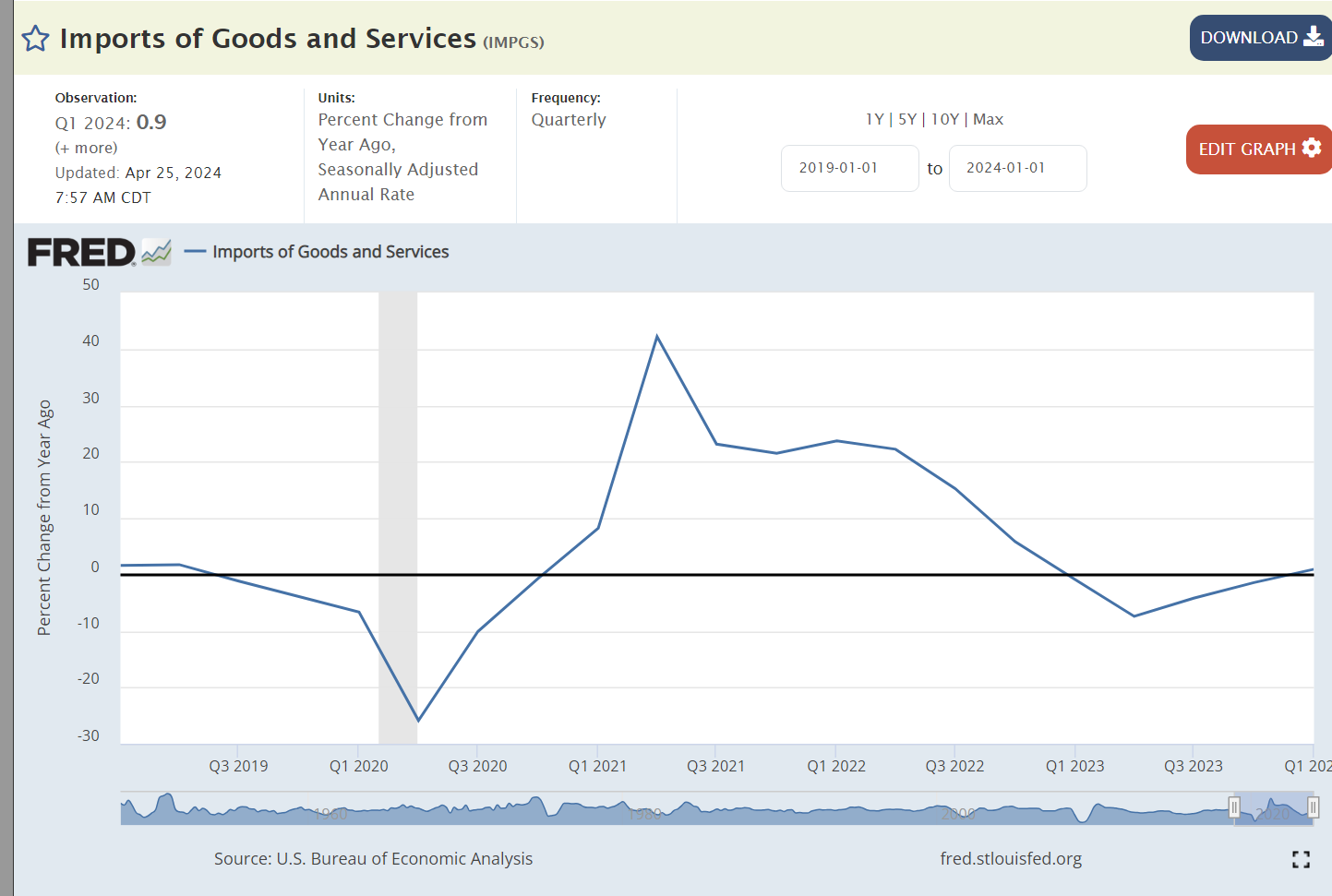
An overheated economy typically shows a strong increase in imports as demand reaches out globally. This is not the situation in the US this year.
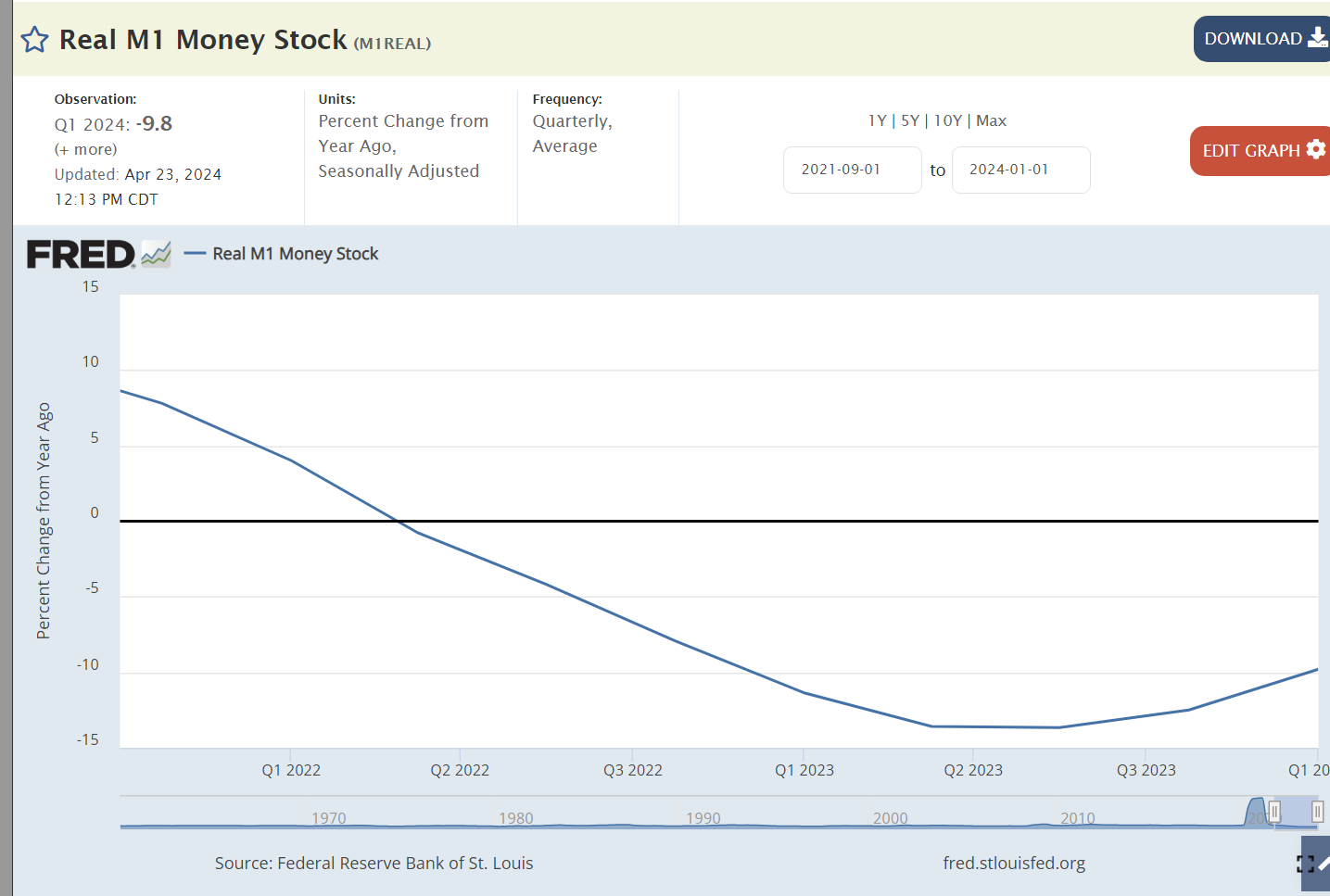
The money supply has a long-term impact on the economy, prices and inflation. The Federal Reserve Bank has been shrinking the “money supply” by 10% annually.
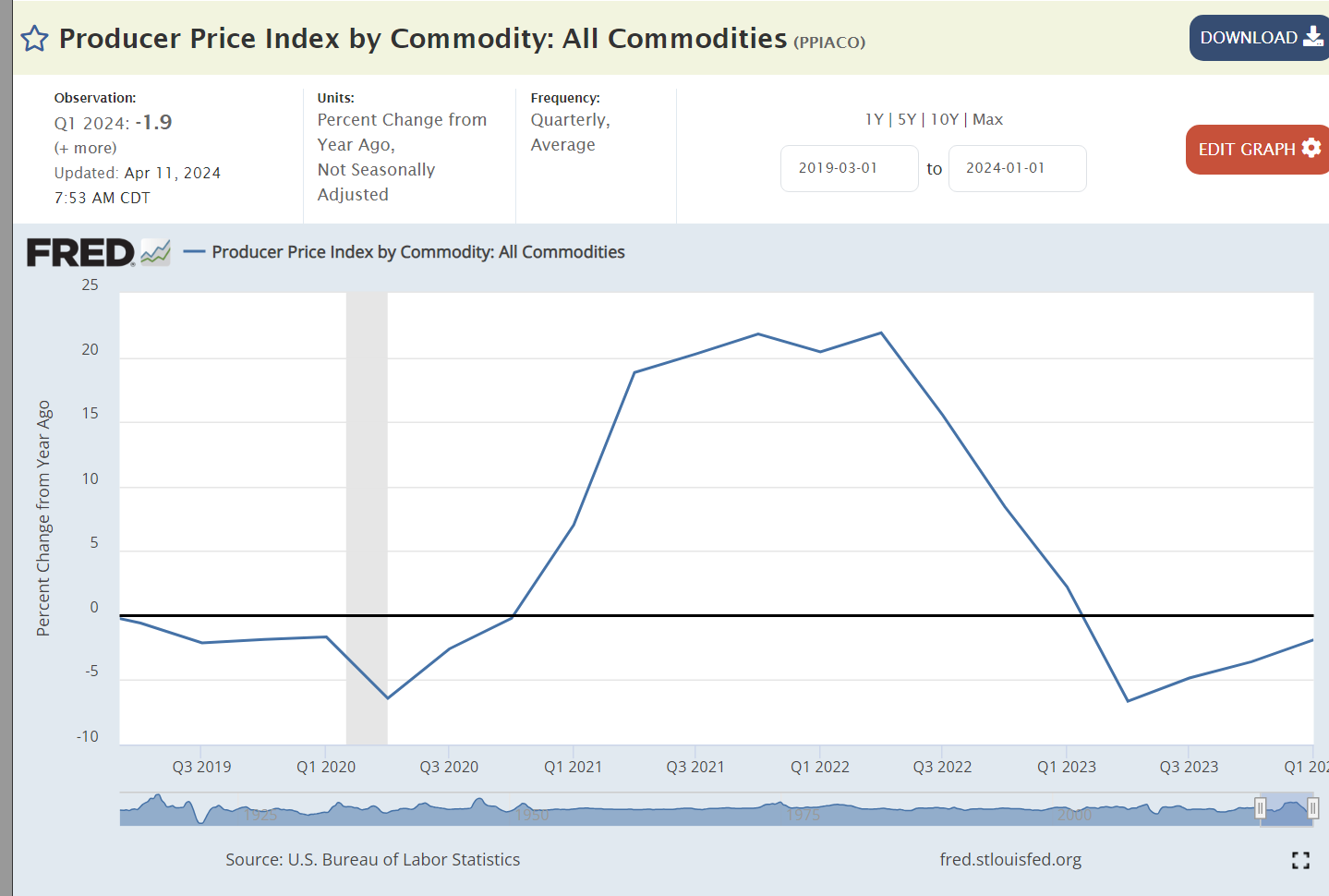
Commodities are the most volatile element of the global economy. Prices jumped by 20% with the unanticipated quick recovery from the pandemic. The last year has delivered commodities price deflation.

Changes in relative market power can drive inflation. Corporations increased profits by 50% in the first year of the pandemic. Profits have been relatively flat since then.

Summary

A dozen sectors point towards 2% inflation by year end. Energy, food at home, durable goods, nondurable goods, medical care, education/communication, housing prices, real wages, imports, money supply, commodity prices and profits.

Four sectors indicate concerns. Food away from home continues to drive high inflation.

https://www.axios.com/2024/02/13/cpi-food-inflation-dining-out
Public and private transportation services have not yet reached equilibrium. This pressure may continue for another 4 quarters but should not be a long-term inflation driver.
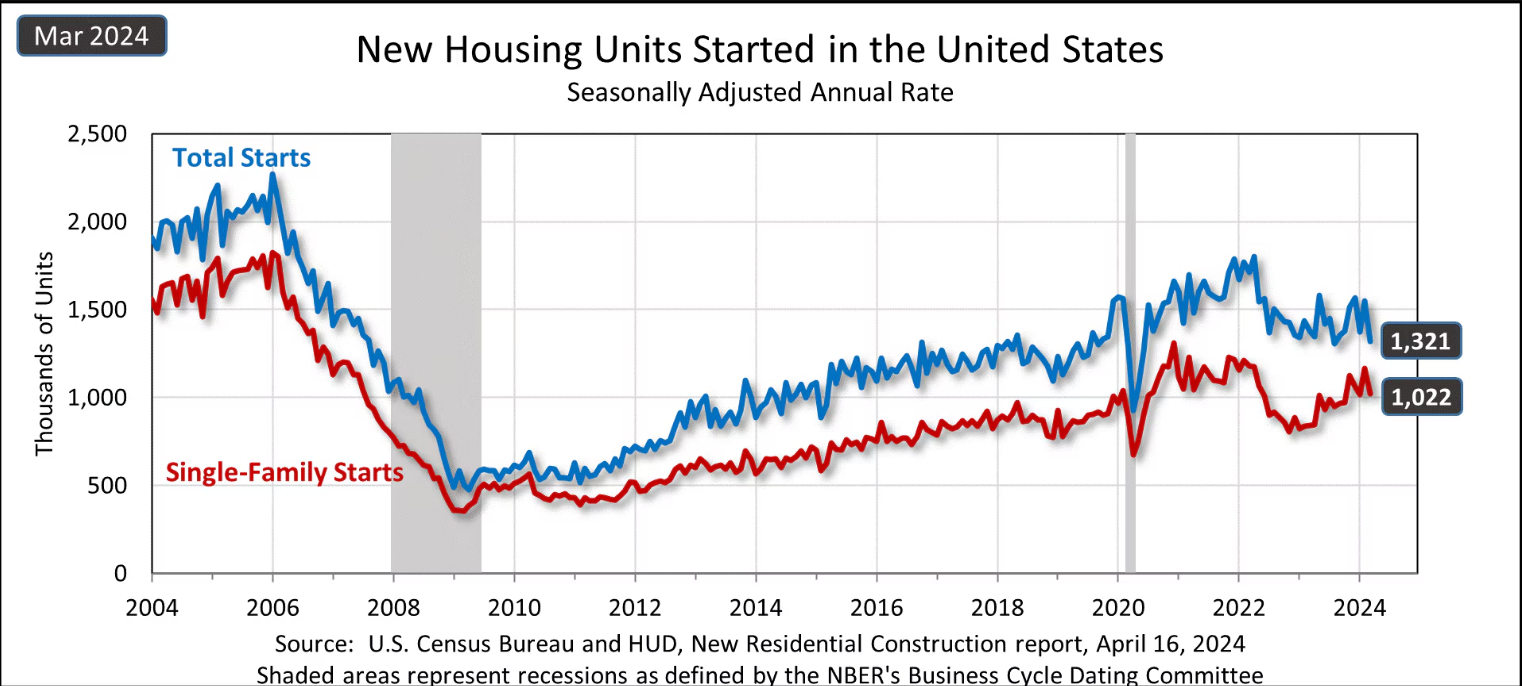
https://www.census.gov/construction/nrc/current/index.html

The “Great Recession” destroyed the construction industry. It has slowly recovered. Total construction has increased, perhaps not enough to bring housing supply into balance with demand 15 years later. Rental inflation at 3% is likely to continue.
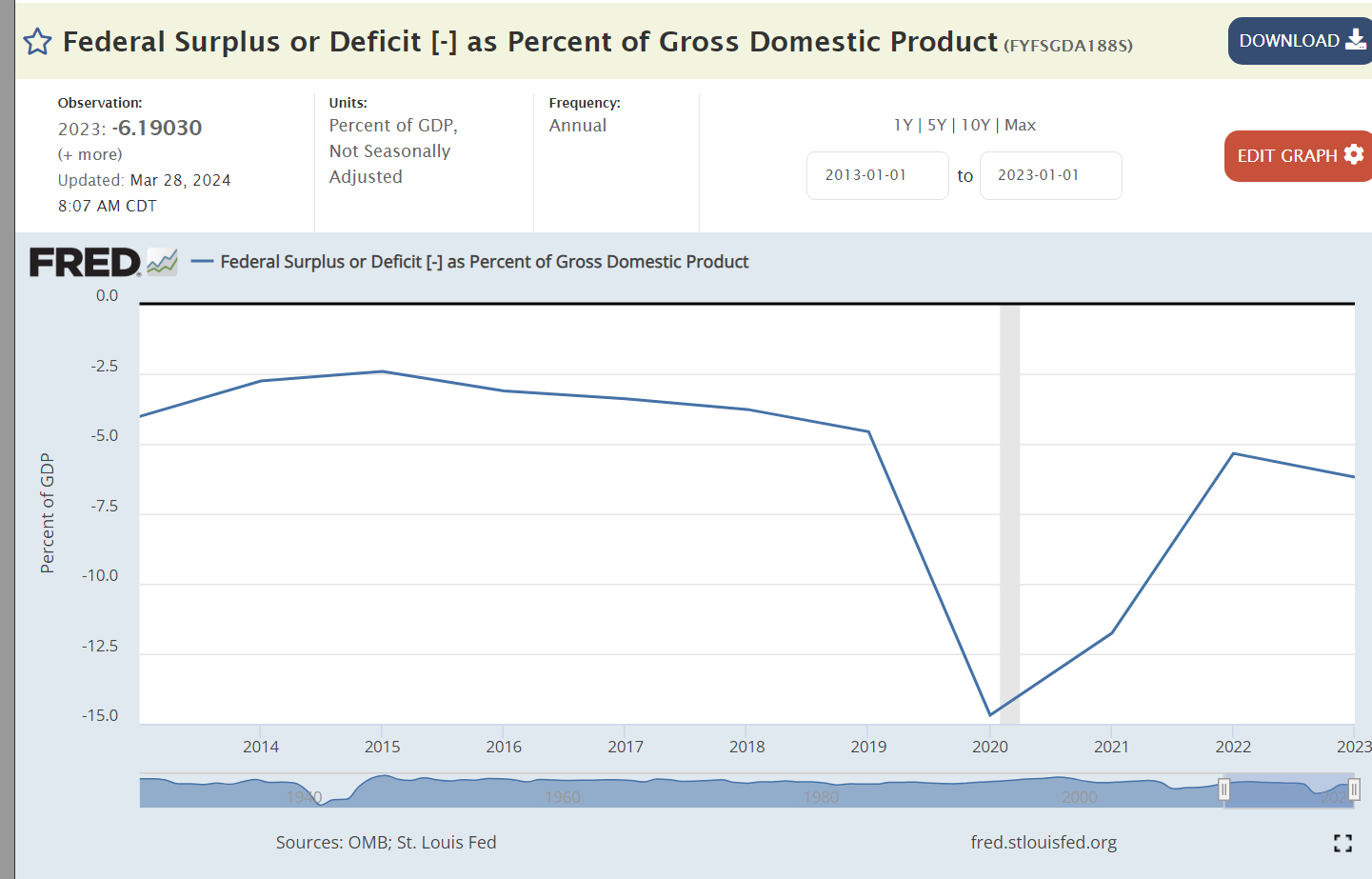
The federal budget deficit is the greatest concern. 6% of GDP is a huge deficit.

Net, net, I predict that the Urban Consumer CPI increase in the fourth quarter of 2024 versus the fourth quarter of 2023 will be 2.25%. The federal government spending deficit will directly and indirectly boost inflation.

Economic(s) Progress?

Adam Smith started a conversation in 1776 about the economic and moral benefits of the “invisible hand” in the marketplace – making society better off, in spite of there being no coordinated plan.  Karl Marx argued that the unstoppable workings of history would inevitably lead to a socialist utopia.  In 1976, the sociologist Daniel Bell wrote of the “Cultural Contradictions of Capitalism”, whereby the underlying Protestant Work Ethic is corroded because of the hedonistic consumerism in a capitalist society.  Marx was wrong.  Bell was wrong about the end of capitalism, even if his critique of an aimless society still stings.  Where do we stand today on Smith’s breakthrough claims regarding the moral and economic superiority of the “free market”?

Support for the most simplified view of markets being truly perfect reached its peak following the Reagan/Thatcher years when the totalitarian communist alternative collapsed and the Atlantic version of a mixed economy demonstrated significant ongoing advantages compared with the Nordic version with greater state involvement.  Events of the last two decades – rise of China/emerging markets and fall of US/UK from the Great Recession – have undercut the plausibility of an extreme market solution being the best,  only or final answer.

It is obvious in hindsight that the business cycle has not been tamed, that financial markets are inherently unstable and subject to “animal spirits”, that markets are not perfect and that greed will continue to drive many market participants.  In spite of the positive societal benefits of financial innovations such as options, mutual funds, checkable deposits, portfolios and securitized assets, the broad financial sector seems to be an ongoing source of the greatest failures in capitalism.  The formal definition of “perfect market theory” has not reduced volatility, but it has led to a finance sector where every possible trick is used to generate “wealth”: Ponzi schemes, the carrying trade in foreign investing, borrowing short and lending long, off-balance sheet vehicles, hedge funds and extreme leverage to name a few.

A visible part of the general business sector appears to be equally enamored of finding every possible way to create financial wealth beyond “the old fashioned way, we earn it”.  Mergers and acquisitions continue because they can reduce competition, leverage overvalued stock prices and employ low-cost borrowing, even though on average they do not provide a net return to stockholders.  Corporations manage reported earnings, producing smooth growth for quarters until the next recession provides an opportunity to report losses due to extraordinary items and business conditions.  Executive pay increases as a share of revenues, as stockholders find themselves unable to solve “the agency problem”.  Corporations promote legal and public relations executives to the highest levels because the opportunities to create incremental wealth through influencing public policy are greater than investing in new products or markets.

On the other hand, it remains clear that capitalism remains a tremendous value creating mechanism for society, with productivity growth, innovation and personal incomes rising at strong rates without any long-term end in sight.  The system’s incentives do focus resources on innovation and dynamic value creation.  In spite of John Kenneth Galbraith’s old claims in “The Affluent Society”, there appears to be no limit to the demand for personal consumption at any income levels in society.  The recent work “Richistan” notes that individuals with $5M of annual income feel they would be secure if they only earned 50% more!

In a fundamental way, we’ve come back to the basic framework and issues of economics raised in the post-war period.  What is the right role for government in a mixed economy? 

We have learned some things in the last 50 years and the consensus view is more to the right than it was in 1950 or 1970.  The dynamic long-run wealth creating role of capitalism is better appreciated, including its role as a poverty and inequality reducing strategy.  Most agree that monetary policy matters, expectations about government behavior matter and “fine tuning” is only a theory.  Market competitors are the best anti-monopoly force, so regulation should be light and focus on anti-competitive actions rather than narrowly defined market shares.  Ongoing growth of real incomes in the bottom third of society can offset rising dollar inequality.  John Rawls’ philosophical justification for some income redistribution resonates for many moderates and liberals, but Robert Nozik’s emphasis on “fair rules” alone provides conservatives with a deeply felt alternative view.  Government actors are as subject to self-interest as consumers and capitalists, especially with regard to being “captured” by those they aim to regulate.  Countervailing forces such as labor unions are blunt instruments, which may not even benefit the groups they aim to support.

Many economists would like to see the public policy debates return to the post-war topics, with the two political parties sliding from left to right within the informed framework of current economic knowledge.  Capitalism provides great value as Adam Smith demonstrated.  There are inherent risks due to relying on self-interest (as Smith also noted).  There is a role for government in counterbalancing the business cycle, maintaining fair markets, managing the self-interest of government actors and ensuring public support for capitalism in spite of the unequal distribution of benefits.  The political parties exist to find a “happy medium” on these issues.

The current political climate does not readily support this possibility.  The Republican Party has become increasingly consistent, philosophical, libertarian and monetarist in its views.  Its leaders increasingly define a single economic viewpoint: minimal government, no taxes, minimal economic regulations, rules based monetarism, minimal anti-competitive policy or enforcement, zero income redistribution, etc.  While each of these views has philosophical and substantive research support, the combination of doctrinaire views leaves no room for a sliding scale in public policy, for the only preferred solution is “zero”. 

The Democratic Party has not lost its preference for “redistributing the pie” versus “growing the pie”.  It has not helped its union supporters to evolve into a German or Japanese style alternative way.  It has championed continued protection of its public sector employee supporters from accountability or competition.  It has reached the goal of universal social welfare coverage for health care.  In spite of some tactical moves to the center on economic issues (welfare reform, the means of health care reform, international trade), the Democratic Party continues to emphasize those policy areas that increase the role of the state versus the individual, rather than identifying ways to better leverage the value creating potential of markets.

It seems that it will take more than President Obama’s slogans of “hope and change” to get our political parties and politicians to focus on the potential for increased economic growth and pragmatically justified economic roles for the government.  Perhaps, we need another “political economist” to develop a breakthrough theory of the political sector as insightful and valuable as Smith’s view of the market.

Infinite Progress

At the start of 2010, I put a positive spin on the nascent economic and psychological recovery with blogs on “The Sky Has Stopped Falling”, “Good Riddance to Utopian Views of 2000” and “Self-Improving Systems”.  Today, I want to promote the broader subject of “Infinite Progress”.

Economics has earned its label as “the dismal science”.  It has been serious, analytical, realistic, short-term and marginal.  Imitating calculus and physics, it has sought to optimize production functions and maximize results subject to multiple linear constraints.  Like other academic disciplines, economics has been shaped by the dominant culture.  Economics has progressed through the Physiocrats, Marxists and Marginalists who in turn proclaimed that land, labor and capital each held the key to economic value.  Even Paul Samuelson’s neoclassical synthesis focused on these three “factors of production”, while mentioning that there was some remaining role for “technology” and “entrepreneurship”.

The “law” of diminishing marginal returns emphasizes that in the short-run, with given technology, additional inputs eventually yield lower incremental results.  This is certainly true, but development and growth economists focusing on the international and business sectors have demonstrated that this fourth factor (technology/entrepreneurship) is the primary driver of progress.  In fact, rather than being subject to diminishing returns, knowledge is the one factor that is subject to increasing returns through time!

In spite of the slow recovery in the current economic cycle, I believe that we are only 50 years into the greatest productivity expansion in history.  Annual labor or multi-factor productivity growth of 2-4% has become commonplace.  Even in the recession, we experienced 6-8% productivity growth.  Productivity growth will accelerate in the coming years to a minimum of 5% annually, in spite of our various challenges (aging population, protectionism, extremism, political polarization, religious stagnation, terrorism, global warming, limited natural resources, multi-polar international powers).

In no particular order, knowledge and practice has expanded and will continue to expand in all of these fields:

  1. Trade.  Lessons were learned in the Great Depression.  Tariffs have continued to fall.  Multilateral treaties have stalled, but bilateral trade agreements are accelerating.  English is becoming the global language, followed by Mandarin Chinese and Spanish.  A majority of the global population produces at a near-subsistence level.  They will all generate modern western levels of output within 40 years, providing added value globally.
  2. Physics/Engineering.  Basic physics, mechanical and civil engineering continue to advance.  Modern materials, energy, devices and structures will advance and be refined in light of breakthrough understandings (supercollider).
  3. Chemistry.  “The Graduate” whispered “plastics” as the key to the 20th century.  Plastics has delivered, but has not exhausted its secrets.
  4. Biology.  Biotechnology and modern medicine is on the verge of major breakthroughs in individualized medicine, medical information, preventive medicine, devices, new drugs and nano-technology based solutions.  Mental health care is leveraging improved understanding of the mind, behavior and chemistry.
  5. Energy.  Delayed by politics and prices, energy exploration and solutions are emerging.  Wind, solar, nuclear, clean-coal, tidal and other answers are now real.  Break-through shale, gas and deep-sea extraction technologies are imminent.  Major investment in alternative transportation options is producing results.
  6. Natural Resources.  The food, fiber and natural resources sector continues its 200 year track record of innovation, with genetically modified organisms, drip irrigation, weather forecasting, satellite guided farming and fish markets adding value.
  7. Transportation. New highways, hiking, biking, high-speed trains, point to point aircraft, larger container ships and usage tolls suggesting continued progress.
  8. Electronics.  Songs, movies, video, instruments, observation, robots, entertainment, games, virtual reality, and the list goes on and on.
  9. Computer Power.  Moore’s Law. ‘Nuff said.
  10. Telecommunications.  Cell phones, internet, computer integration, GPS, much faster speeds.
  11. Integration.  Electronics, telecommunications, media, entertainment in one place, on demand.
  12. Community.  Tribes, cities, nations, world.  Clubs, games, blogs, social media, Face book, LinkedIn, Twitter, no limit.
  13. Specialization.  Professions, suppliers, outsourcing, matrix organizations, consultants, global suppliers, increasing economies of scale, niche markets
  14. Process Improvement.  Process, quality, cost of quality, value added, variability, bottleneck, ISO, TQM, benchmarking, process re-engineering, quantum leap, lean manufacturing, lean, six sigma, kaizen, self-improving systems.
  15. Computer Systems.  Automation, systematization, mainframes, minicomputers, personal computers, applications, man-machine, GUI, windows, mouse, ERP, cloud computing as a utility.
  16. Library Science.  Dewey decimal, multimedia, informatics, knowledge management, Wikipedia, Amazon.com, tripadvisor.com, Angieslist.
  17. Economics.  Markets, global trade, auctions, information, behavioral economics, EDI, e-commerce, capitalism embraced everywhere in one form or another.
  18. Finance.  Stocks, bonds, pork-bellies, futures, puts, calls, mutual funds, checkable deposits, insurance, hedges, securitized debt.
  19. Management/leadership.  Strategic planning.  Product innovation. Growth/margin. Core competencies.  Discipline of Market Leaders.  First or second. Operational excellence.  Situational leadership.  Theory X, Y, Z.  Motivators and de-motivators.  Covey’s 7 habits, urgent and important.  Meyers-Briggs, personality styles and Gallup talents.  Change management.  Engaged/disengaged.  Creativity and thinking hats.  Accountability/Oz Principle.  Good to Great, Both/And. 


Knowledge will continue to increase in every discipline.  Market pressures will ensure rapid adoption, expansion and innovation.  The work world in 2010 could not be seen in 1980.  The work world in 2040 will exhibit the same degree of discontinuous change from a much higher base.

Good Riddance to Utopian Views of 2000

Much of the anxiety being expressed in the political arena today stems from the discovery that the turn of the millennium consensus views of steady assured progress were exaggerated, or just plain wrong.  The events of the last decade have shown that simple, deterministic conclusions are usually wrong.  This is not the first time that western society has had its “progressive” bubble burst.  Even the recent triple play natural disasters (hurricane, tsunami and earthquake) have a parallel in the Lisbon earthquake of 1755, which lead Voltaire to attack the belief that man was living in “the best of all possible worlds”.

In 2000, we thought that representative government would prevail as an increasing number of countries became functional democracies and established democratic traditions.  Cuba was the special exception.  Even China was seen as a potential convert.  Progress was being made in Eastern Europe, Asia, Africa and Latin America.   We now see that China’s leaders intend to maintain power, that progress in Russia and Eastern Europe is fragile and that a new Bolivarian revolution justifies dictatorships.

In 2000, the division of state and religious spheres was clear and settled in Europe, allowing a variety of religions to work within a set of rules.  The Pope spoke out for radical changes to society, but had limited impact.  Some progress in conflict areas lead to hope for progress, as nations from Turkey to Indonesia to Ireland found solutions.  The “consensus” was an illusion.  Islam, Christianity and other religions are not content to work within the context a secular humanist state.  We now see that “true believers” do not fit within the tidy scheme.

In 2000, a decade after the fall of the “iron curtain”, the U.S. stood tall as the only superpower, even after cashing in the peace dividend.  The US, Europe and the UN began to make significant progress in handling the remaining “trouble spots”, in areas that seemed unfamiliar and insignificant.  We now see that Brazil, Russia, India and China would like to join the US, Europe and Japan in a multi-polar world.  The shifting alliances of earlier centuries are the model of our future.

In 2000, after dodging the ironic Y2K threat, the world saw an unlimited future of technological progress.  The older physics, chemistry and energy based economy continued to grow at a healthy pace.  Agricultural and biological innovations promised to feed the world and heal the sick.  Information technology continued to evolve through the internet, telecommunications and knowledge management.  Even the environment was improving, as 30 years of focus on clean air, clean water and eliminating toxic waste had a cumulative positive impact.  We’re still making progress, but concerns about energy and water shortages, Frankenfoods, genetic manipulation and climate change become greater with time, as no simple “solutions” have appeared.

In 2000, international economic progress was in full-stride.  Individual, regional and global trade agreements increased trade and cross-country investment.  International financial crises were managed and outlier countries were guided through an agreed upon recovery plan.  European economic integration continued to deliver benefits with each new step.  Today, we struggle to find common ground for major trade deals.  A variety of crisis recovery models seem valid.  Further European economic integration is possible, but the benefits are not so certain.  International sensitivity to trade, labor, environmental, property rights and investment differences is growing.

In 2000, a mixed capitalist economic model dominated.  There were two flavors, traditional European and Atlantic, but these were differences in style and degree, not in fundamental substance.  Success stories in all areas of the world indicated that this model could and would be replicated.  Today, there are several varieties of state capitalism (Russia, China, France, Japan, and Venezuela) that offer alternatives.

Finally, in 2000, there was a widespread belief that we had moved into a new economic model where the rough edges of capitalism had been tamed.  The business cycle could be managed through independent monetary policy (and a touch of fiscal policy).  Productivity, inflation and unemployment goals could all be attained.  Financial guidelines like price-earnings ratios had been superseded by a “new economy”.  And, risk and volatility had been tamed through portfolio theory, hedging and new financial instruments.

The world is not in worse condition today than it was a decade ago.  Only by moving past the unrealistically utopian views of the turn of the century can we make progress in addressing the challenges we face.