How Hamilton County, Indiana Grows

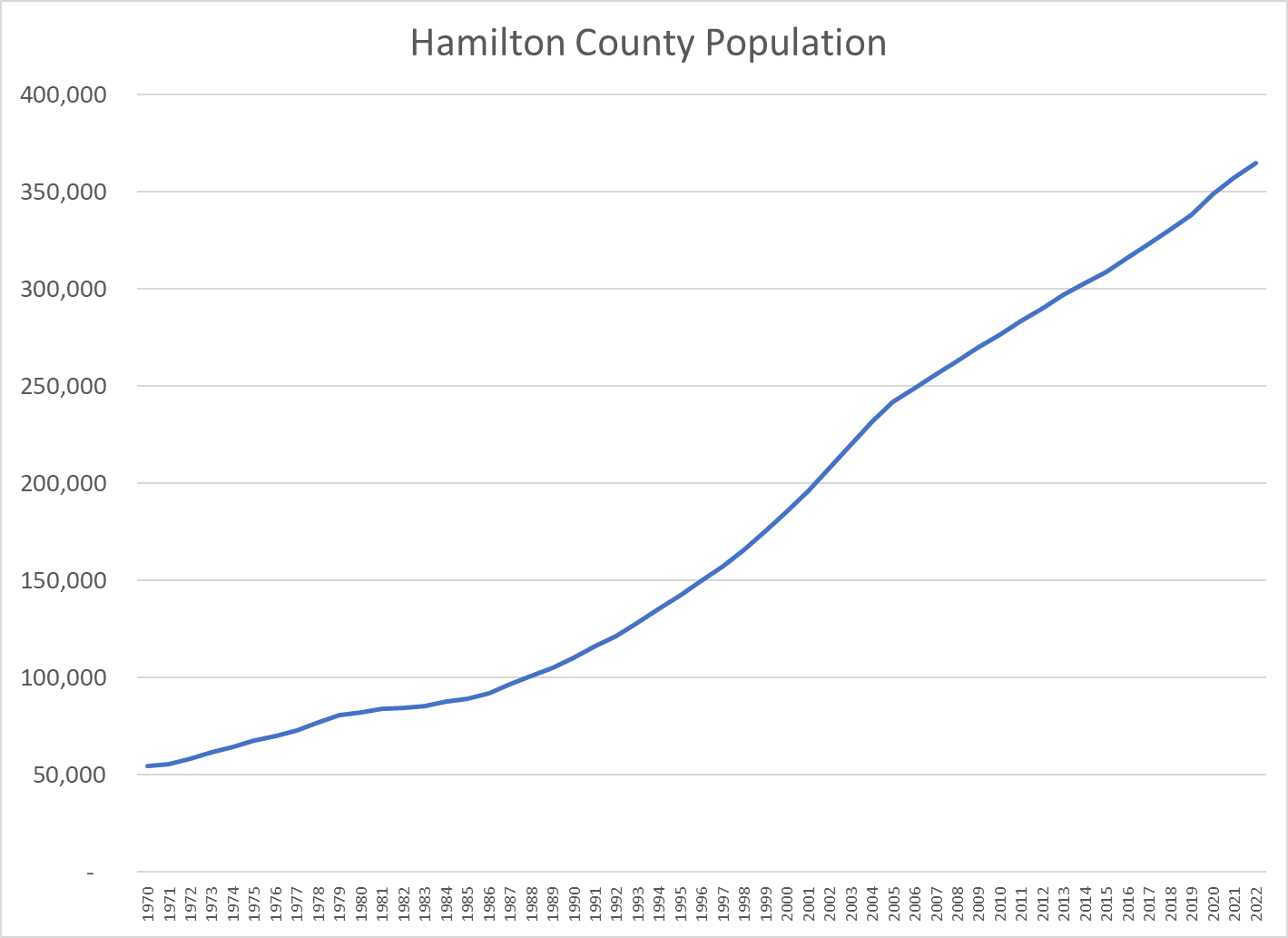
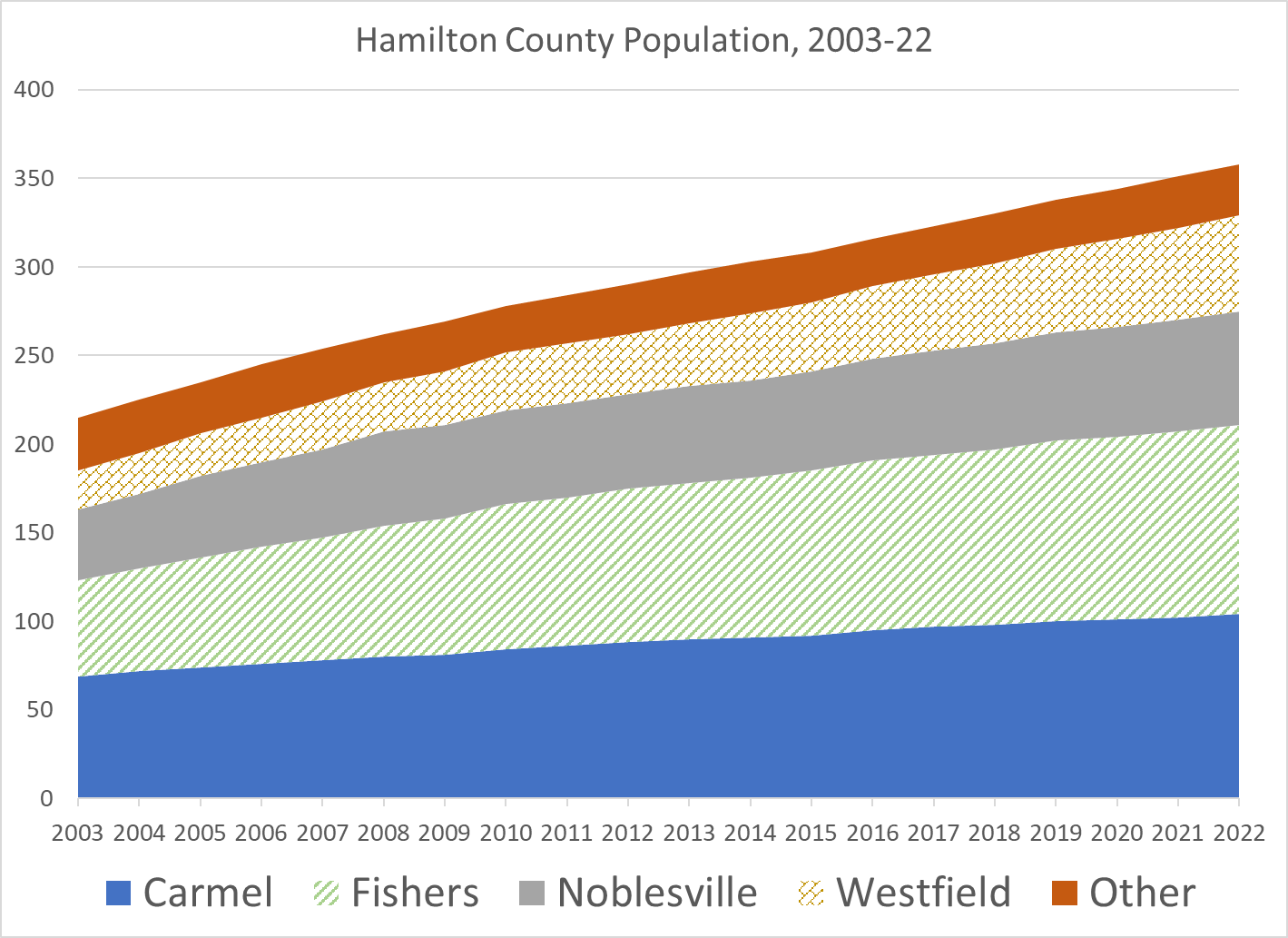
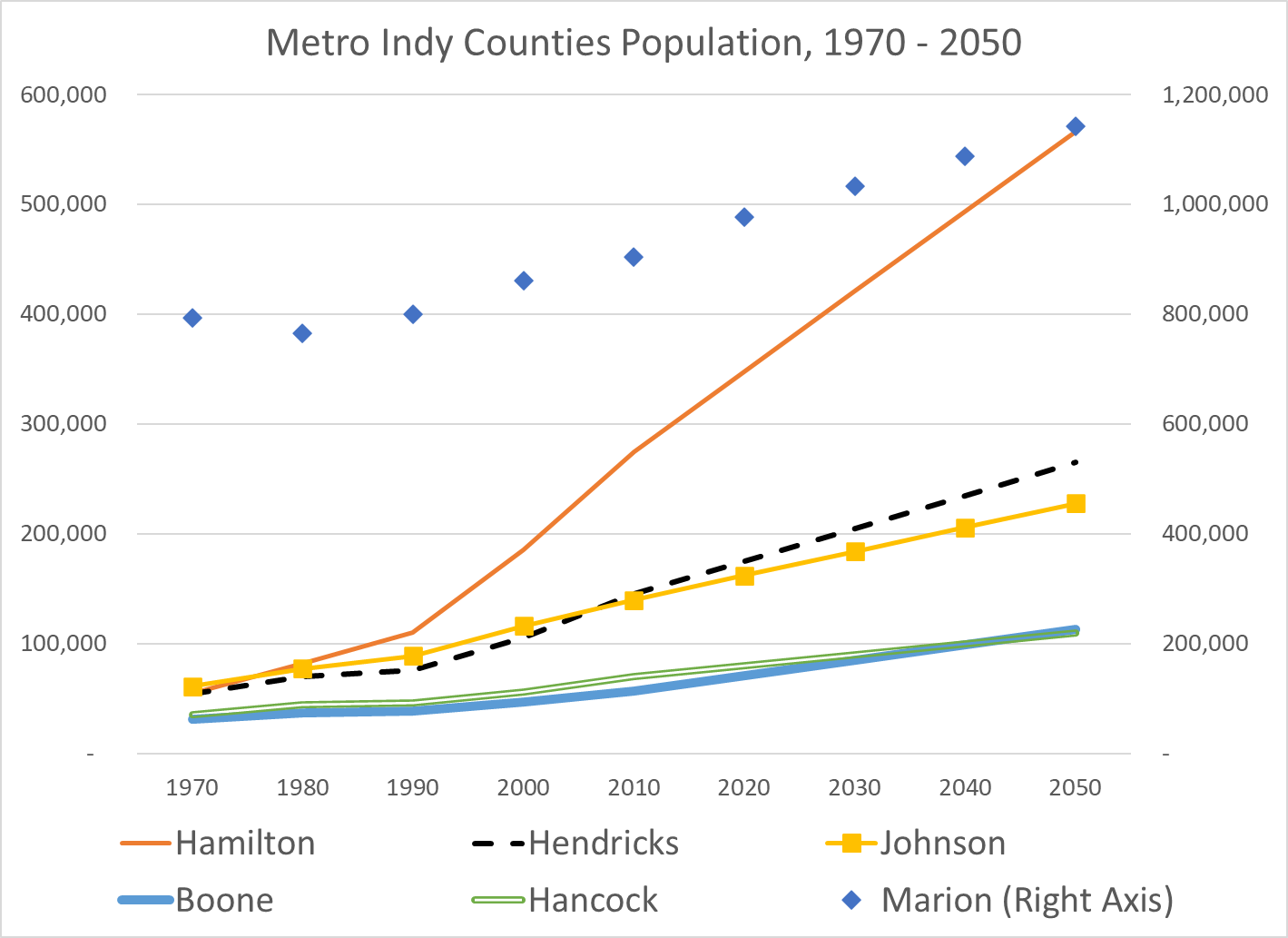
Hamilton County, Indiana is north of Marion County and Indianapolis. It has grown seven-fold since 1970, from 54,000 to more than 365,000 people. It now ranks in the top 7% as the 209th largest county of the 3,142 in the US. It is the fourth largest of Indiana’s 92 counties, trailing Marion (Indianapolis), Chicago’s suburban Lake County and Allen County (Ft. Wayne) which it will surpass for third place in 2029.

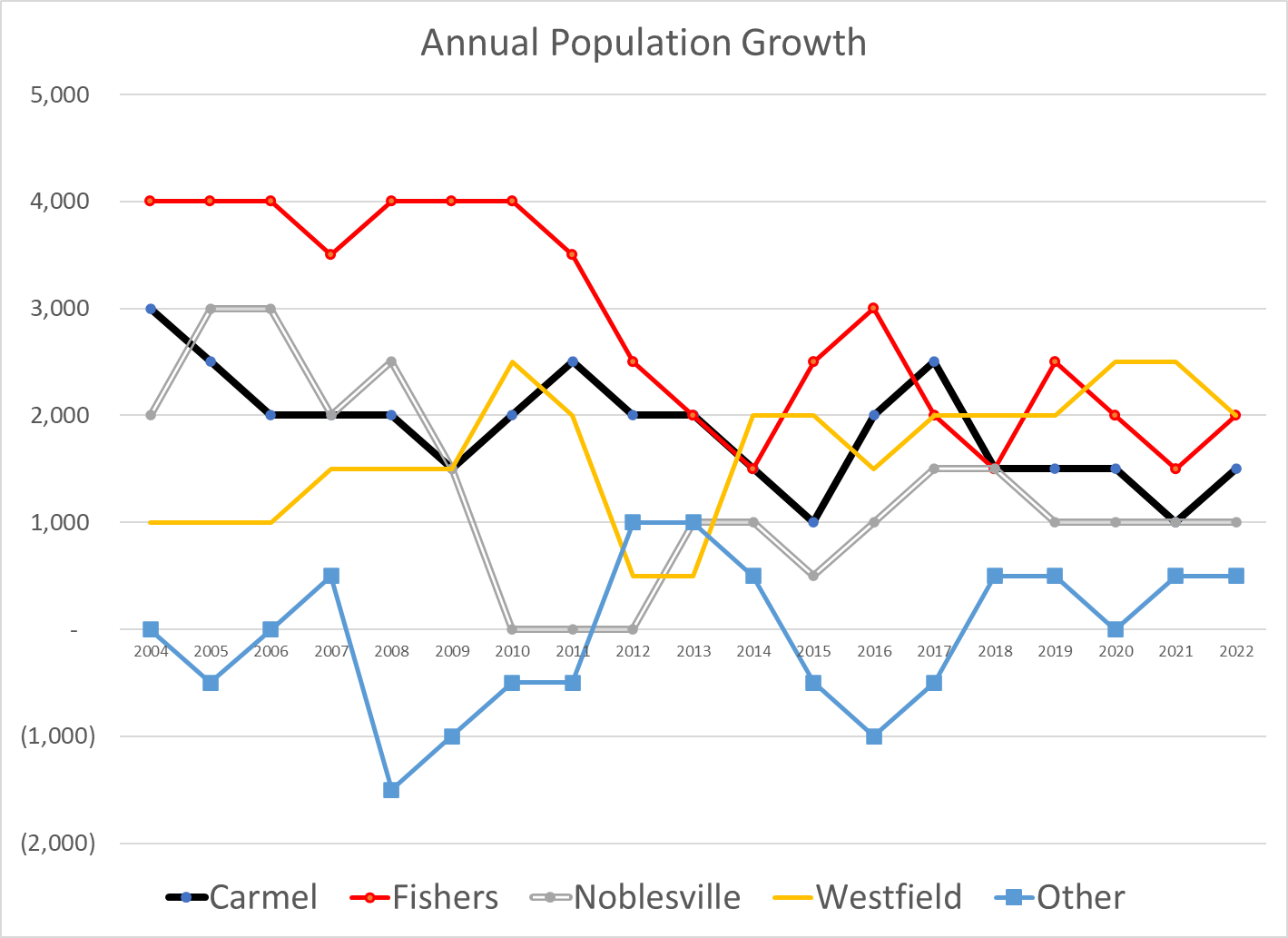
The county has averaged a 7,800 person annual increase since 1990 and has maintained a 7,500-person annual increase in the last decade.

Growth reached a peak of 12,000 per year prior to the Great Recession, dropped back to 7,000 per year and has slowly grown to 8,000 per year.

As a growing suburban area, the county has benefitted from a younger population with relatively more births and less deaths. This demographic advantage has decreased through time.

On average, this natural increase advantage has provided 2,000 additional people each year for the last two decades. The net in-migration level was over 8,000 before the Great Recession, dropped in half to 4,000 before recovering to about 6,000 people per year.

The US Census Bureau’s American Community Survey (ACS) attempts to measure the annual migration flows between all 3,142 counties! It’s survey techniques generally require a 3-5 year sampling period to have statistical reliability. The US Census Data and the Indiana Vital Statistics Data (Births and Deaths) show an implicit net in-migration to Hamilton County from 2011-20 of 4,575 annually. The ACS reports just 3,124. The actual increase is 144% of the surveyed increase.

https://www.census.gov/topics/population/migration/guidance/county-to-county-migration-flows.html

https://www.stats.indiana.edu/vitals/

https://wonder.cdc.gov/controller/datarequest/D158

Cross-County Migration

Hamilton County’s population ranged from 283-346,000 between 2011-20, for an average of 314,000. Inbound migration averaged 23,600 per year or 7.6% of the population. Outbound migration averaged 20,400 per year or 6.6% of the population. On average, the county’s population turns over every 15 years. The net in-migration in the ACS survey was 3,100, a little more than two-thirds of the implicit 4,600 net in-migration per year. I compared the 2011-2015 and 2016-2020 data and found that they were generally consistent. I believe that the proportions reported are generally accurate.

International In-Migration

ACS reports an annual average of 1,800 international immigrants. This is 59% of the net 3,100 figure; quite material. On an annual basis, this is just 0.6% of the county population, but for a decade it is 6%. 61% of Hamilton County’s international immigrants report Asia as their home continent.

Total US Migration

Net in-migration to Hamilton County from the US is a positive 1,300 per year in the ACS survey, perhaps 1,900 including the 1.46X factor. Net domestic net in-migration is two-thirds the size of international net in-migration; 0.4% annually or 4% per decade.

48 States Aside from Indiana and Illinois

Net in-migration to Hamilton County from the other 91 counties in Indiana plus Illinois averages 3,004 per year, essentially equal to all of the total net in-migration. Net in-migration to Hamilton County from the other 48 states is a negative 1,700 per year, roughly one-half of the positive overall net in-migration figure. Hamilton County receives minor positive inflows from the adjacent states of Ohio, Michigan and Kentucky. It sends 1,000 residents to Texas each year and receives just 400 in return. Texas accounts for one-third of Hamilton County’s net out-migration aside from Indiana and Illinois. Hamilton County exports 1,200 residents annually to Florida but an equal 1,200 return each year.

Chicago, Illinois

In the last decade 1,500 people annually moved to Hamilton County from Illinois (Chicago) and just 700 returned the favor. Hamilton County received a net 800 residents from Illinois each year in the past decade. This is one-fourth of the net in-migration to Hamilton County. Many Hamilton County college graduates make Illinois their first professional home, so the flow of experienced professionals from Chicago to Hamilton County is probably more than 1,500 per year.

Marion County, Indiana (Indianapolis)

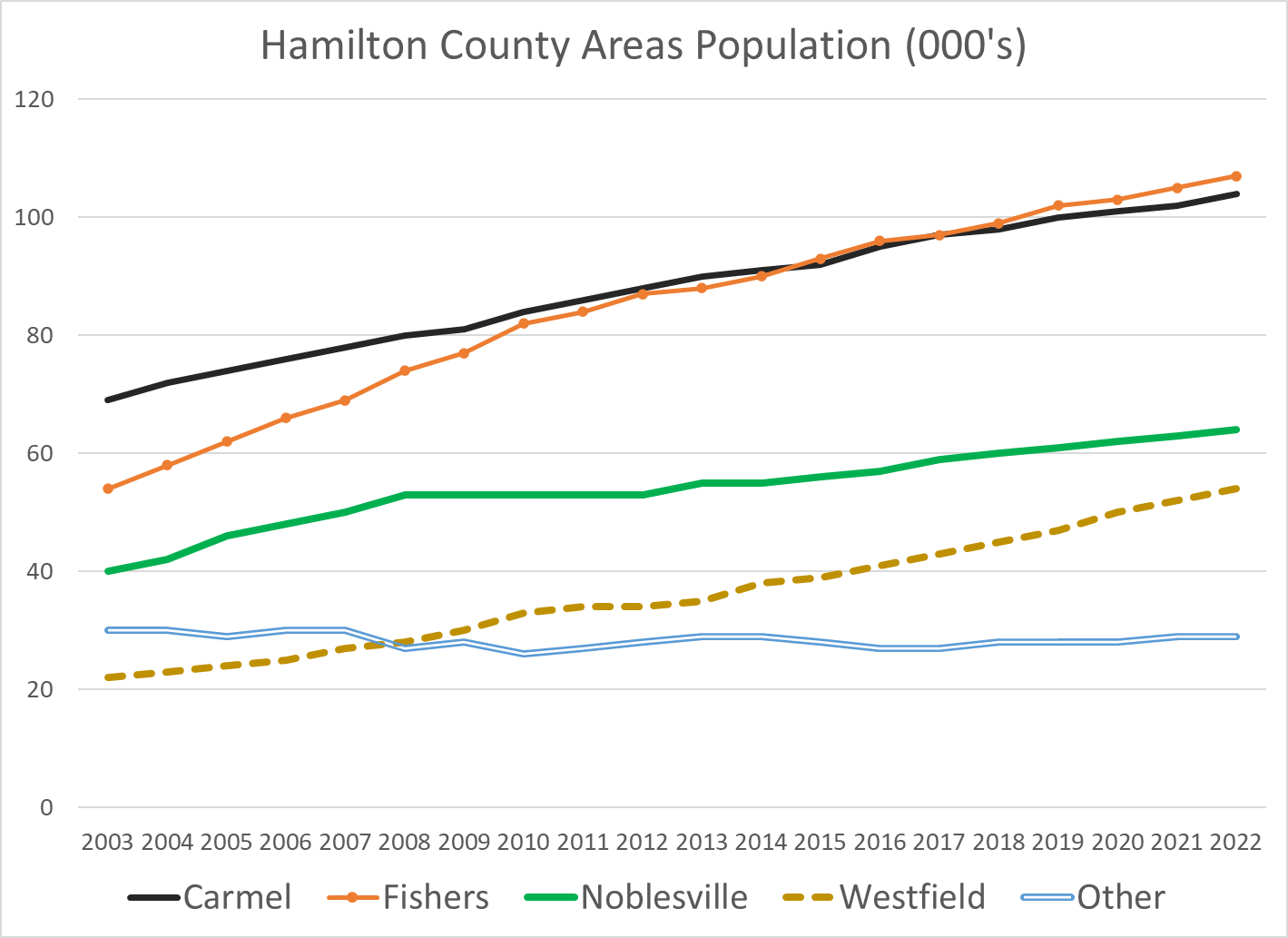
Hamilton County’s Carmel, Fishers, Westfield and Noblesville claim that they are “edge cities” somewhat independent of Indianapolis. In the last decade a net 3,300 migrants from Marion County chose to make Hamilton County their home each year, accounting for more than ALL of the ACS survey’s 3,100 annual increase. Marion County has nearly 1 million people and continues to grow slowly despite this 0.3% annual leakage to Hamilton County.

College Students

Hamilton County school graduates have very high college attendance rates. Hamilton County exports 2,600 students each year to IU, Purdue and Ball State and receives 1,000 back, for a net out-migration of 1,600 per year, about one-half of the net in-migration figure.

Indiana

Hamilton County has a minor net in-migration from sparsely populated Boone County to its west (300/year). It’s net in-migration with the 8 nearby counties, including Boone, is a 500 loss. Hamilton County is an attractive suburban destination, but net net it loses 500 residents annually to nearby counties other than Marion.

Setting aside Marion County and the 3 university counties, Hamilton County attracts 500 new residents annually from the other 87 Indiana counties.

Summary

Hamilton County enjoys a 2,000-person annual natural population increase due to its relatively young age profile. Half of its 6,000-person annual net in-migration is driven by international immigrants attracted to its schools, amenities, services and culture. Most of its remaining growth is driven by nearby Marion County residents who are seeking the same results. Hamilton County is attracting residents from Chicago as retirees, commuting residents or transplants. Hamilton County loses about 2,000 college students each year who migrate into a national labor market. This is an opportunity for further population growth. It also shows that the net 3,100 growth per year figure understates the attractiveness of this county to all potential migrants.

10 Most Likely Democratic Presidential Nominees

Kindly set Joe Biden aside. As of today, he is clearly most likely to be nominated.

Four others show up on the pundits’ “most likely” lists but will probably not be nominated. New Orleans’ mayor Mitch Landrieu is a career politician from a red state. Kamala Harris has not taken advantage of her VP post. Elizabeth Warren and Alexandria Ocasio-Cortez are too far left.

Like Joe Biden, Bernie Sanders, Michael Bloomberg and Jim Webb may have aged out of contention.

Robert Kennedy, Jr and John bel Edwards are too far right.

Sherrod Brown, Marianne Williamson, Phil Murphy and Tammy Baldwin are too far left.

Terry McAuliffe, Beto O’Rourke and Stacy Abrams have incurred political losses that require them to re-establish their bona fides.

Seven candidates floated “trial balloons” in 2016 or 2020 but failed to gain traction. They each need to define a “compelling reason” to return to the national spotlight. Michael Bennet and Jay Hickenlooper in Colorado. Martin O’Malley, Tom Steyer and Deval Patrick on the east coast. Jay Inslee on the west coast. Julian Castro in Texas.

Four candidates are branded with the liberal “red L” of Chicago or New York. Rahm Emmanuel and JB Pritzker. Kirstin Gillenbrand (perhaps unfairly) and Bill de Blasio. Tom Steyer and Michael Bloomberg are handicapped again.

I don’t see the national case for Gina Raimondo, Andrew Yang or Andy Bashear.

Mark Kelly, Josh Shapiro, Jared Polis and Wes Moore are relative newcomers to the national stage.

I present 4 “sleepers” who don’t have consensus national media support.

Virginia senator Mark Warner.

https://en.wikipedia.org/wiki/Mark_Warner

Virginia senator Tim Kaine.

https://en.wikipedia.org/wiki/Tim_Kaine

New Hampshire senator Maggie Hassan.

https://en.wikipedia.org/wiki/Maggie_Hassan

Georgia senator Raphael Warnock

https://en.wikipedia.org/wiki/Raphael_Warnock

I agree with 6 of the consensus “most likely” candidates.

New Jersey Senator Cory Booker.

https://en.wikipedia.org/wiki/Cory_Booker

Indiana mayor Pete Buttigieg.

https://en.wikipedia.org/wiki/Pete_Buttigieg

North Carolina governor Roy Cooper.

https://en.wikipedia.org/wiki/Roy_Cooper

Minnesota Senator Amy Klobuchar.

https://en.wikipedia.org/wiki/Amy_Klobuchar

California governor Gavin Newsom.

https://en.wikipedia.org/wiki/Gavin_Newsom

Michigan governor Gretchen Whitmer.

https://en.wikipedia.org/wiki/Gretchen_Whitmer

Summary

Booker, Buttigieg, Cooper, Klobuchar, Newsom and Whitmer are attractive presidential primary candidates for Democratic voters. Warner, Kaine, Hassan and Warnock could also become realistic candidates.

McAuliffe, O’Rourke, Abrams, Bennet, Hickenlooper, O’Malley, Steyer, Patrick, Inslee and Castro have political assets that could be appeal on the national primary stage.

Breaking away from the pack is difficult today. Ironically, the larger-than-life dimensions of Trump and Biden may prepare the way for competitive future primaries between relatively equal candidates.

Good News: Real Mortage Rates Are 2%

Real mortage interest rates can be calculated as the difference between nominal mortage interest rates and the 10-year Treasury Bond interest rate. Although nominal interest rates have ranged from 3% to 16%, the real, after expected inflation, interest rates are remarkably consistent, averaging just 1.7% and ranging between 1.3% and 2.1% in 70% of the last 52 years. The peak real rate was 3.0% in 1982 following the unexpectedly high and remaining high nominal rates of the prior 4 years.

Banks, mortgage-backed securities investors and mortgage borrowers all take risks when they complete mortgage transactions. Lenders are betting that their present and future borrowing interest rates are and will be low enough to fund their mortgages at a profit. Each lender locks in funding commitments for a reasonable share of the loan life and counts on the consistency of interest rates over the business cycle to fund the remaining portion. Lenders that experience a mismatch put their stockholders’ equity at risk and face bankruptcy. Investors in mortgage-backed securities are subject to valuation change risks throughout the period in which they are invested. Most such investors hold diversified portfolios of mortgages (region, amount, riskiness, urban vs suburban vs rural) and non-mortgage assets to ensure that any investment decision will not be too damaging.

Fixed-rate mortgage borrowers are betting that inflation will not fall too much lower than the expected inflation rates when they borrowed. If so, they will be paying back the mortgage in higher real value dollars than expected. If inflation and mortgage rates drop by more than 2%, most borrowers will seek to refinance their mortgages at the new, lower market rates, paying another round of closing costs for this privilege. Fixed rate borrowers are also hoping that inflation will be higher than the expected inflation rates at the time they borrowed, allowing them to pay back their debt with cheaper real dollars. Mortgage originators do not generally have the legal right to “call” the debt and require a change in the rates and terms as many commercial lenders and bond issuers do.

The “good news” is that the US mortgage market is very efficient and the real interest rate premium for borrowing to own a home is just 2% more than what the US government pays for borrowing. Borrowers face interest rate change risks, especially being caught with a high interest rate mortgage when inflation rates fall if they are unable to refinance.

The market has been tested through 7 business cycles and held up very well. The “Great Recession” exposed excessive risk taking by mortgage originators and funders. They lost money and many went out of business. Riskier mortgages are rarely issued today, and government regulations provide some added protection against any future overreach.

For higher income households that itemize deduction on their federal tax returns, the nominal interest rate paid is a tax-deductible offset to earned income. These individuals typically pay 22%, 24% or 34% marginal tax rates. A 5% nominal tax rate can provide a 1%, 1.25% or 1.65% reduction in the effective interest rate, thereby making the 2% real mortgage rate less than 1%. Higher income households can benefit greatly from this tax benefit.

https://fred.stlouisfed.org/series/MORTGAGE30US

https://fred.stlouisfed.org/series/RIFLGFCY10NA

Mostly Good News Since the 2008 Great Recession

https://content.time.com/time/specials/2007/article/0,28804,1733748_1733756_1735278,00.html

Real, after inflation, Gross Domestic Product is up by one-third, despite the pandemic. That’s 2% annually, despite the Great Recession and the pandemic. The US economy is very solid.

A 21% increase in per capita income during this time. Quite solid and constant growth.

Inflation averaged a bit less than 2% before the pandemic, spiked to 8%, and has since declined to 4%. Experts disagree on whether it will return to 2% soon.

Gas prices are the most obvious component of inflation. They are largely driven by global supply and demand. Prices today are the same as in 2011-14, despite the general inflation increase of more than 20% since then.

Despite the pandemic, US unemployment is at a 50 year low!

Job seekers today encounter 3 times as many job openings.

Core age labor force participation has snapped back after the pandemic.

Investment values have doubled.

The number of millionaires and billionaires in the US has continued to increase.

Personal savings rates rose from 6% to 9% before the pandemic, shot up and fell back down to just 4% recently.

Housing values have doubled since the Great Recession.

Mortgage rates averaged 4% after the Great Recession, dropped to 3% and then increased to 6%+ as the Federal Reserve raised interest rates.

US exports have nearly doubled in 14 years.

Despite the Trump tariffs, which Biden has maintained, imports have also nearly doubled.

Despite historically slower growth rates, higher budget deficits and looser monetary policies, the US dollar is more highly valued today than in 2008.

Foreign countries still see the US as a positive ally, despite their concerns during the Trump era.

Obama returned the budget deficit to a “reasonable” 3% by 2016. Trump expanded it to 5% and then 15% as the pandemic struck. Biden drove some recovery to 5% by 2022, but has not driven further reductions.

US coal production is in a long-term decline.

Natural gas production has nearly doubled in 14 years.

Net farm income has been significantly above the base for 6 of the last 14 years, despite lavish Trump farm subsidies.

Manufacturing employment has continued to rise slowly in the last 14 years against the headwinds of international competition.

It’s difficult to put the pandemic in perspective, but here we see a 2-year reduction in expected lifespans. Opioid deaths and so-called “deaths of despair”, alcohol, drugs, suicide, also play a role.

Birth rates continue to drift lower as seen in all regions of the world.

The number of retirees has increased by more than 50%.

Retiree incomes are up by one-third, matching inflation.

Prospective retirees have doubled their cumulative savings.

The abortion rate has continued to fall in the last 30 years.

Church attendance has dropped from 40% to 30%.

Summary

The US economy recovered slowly after the Great Recession and then very quickly after the pandemic. Real, after inflation, output and per capita output increased. The labor market became very tight. Asset prices (investments and housing) rose for intrinsic and monetary reasons. The US remained a competitive international producer. The federal budget deficit was better at the end of the Obama period but worse for Trump and Biden. The pandemic reduced life expectancy and households had fewer children. Successful retirements grew and will grow. Social trends continue, uninterrupted by political positioning and policies.

Perceptions of the country and the economy are increasingly shaped by partisan political party views. Nonetheless, the US economy continues to grow and thrive.

Winning the Trifecta: Increased Single Party Control of Governors and State Legislatures

https://www.americasbestracing.net/gambling/2021-beginners-bet-the-week-the-trifecta

For most of the 20th century, states outside of the “Solid South” had a competitive two-party system and mixed party results for the three bodies of government. In President Obama’s first midterm election in 2010, Republicans added ten new state trifectas, managing all 3 elected branches of government. Democrats have fought back, increasing their count of trifectas in the last 5 years. Political analysts assert that this increased clustering of results at the state level is due to the increased polarization of the electorate and the “nationalization” of political issues at the state level. Proponents of a federalist delegation of powers to the state level hope that this will result in greater experimentation in state policy results and tests of the effectiveness of those partisan policies.

State level trifectas allow political parties to implement policies that they prefer, without regard to the opinions of the opposition. They also allow ruling parties to pass laws that signal their support for their constituents’ political preferences. They can deliver on their election promises. Many of these laws address partisan or “wedge” issues: abortion, gun control, marijuana, unions, wages, health care, education, the environment and infrastructure.

https://fivethirtyeight.com/videos/whats-the-deal-with-political-trifectas/

https://www.opb.org/article/2022/11/11/control-of-congress-matters-state-governors-power/

https://www.route-fifty.com/management/2022/12/democratic-control-trifectas-state-legislatures-2023-massachusetts-maryland-michigan-minnesota/381376/

https://www.washingtonpost.com/politics/2022/12/08/democrat-state-government-trifecta-americans/

https://www.washingtonpost.com/outlook/2021/05/12/2010-elections-politics-effects/

State legislatures also increasingly focus on the election process, voting access and drawing legislative districts to partisan advantage.

Redistricting is Shaped by Trifecta Governments

https://www.pewresearch.org/short-reads/2021/03/04/with-fewer-state-governments-divided-by-party-than-in-years-past-gop-has-edge-in-redistricting/

https://www.brennancenter.org/our-work/research-reports/who-controlled-redistricting-every-state

https://projects.fivethirtyeight.com/redistricting-2022-maps/

And … the 2020 redistricting is not yet complete for 6 states.

https://abcnews.go.com/Politics/redistricting-6-states-affect-controls-congress/story?id=101011397

Trifectas by State and Party in 2023

https://www.270towin.com/content/state-government-trifectas

22 Republican and 17 Democratic trifectas in 2023.

https://www.ncsl.org/about-state-legislatures/state-partisan-composition

Republicans lead in the counts.

https://ballotpedia.org/State_government_trifectas

https://www.washingtonpost.com/politics/2022/12/08/democrat-state-government-trifecta-americans/

Democrats have a small advantage in the number of people represented by trifecta governments.

2022 Election Helped Democrats

The 2022 election was better than expected for Democrats. They were especially pleased to achieve trifecta status in Maryland, Massachusetts, Michigan and Minnesota (what are the M odds?).

https://fivethirtyeight.com/videos/whats-the-deal-with-political-trifectas/

https://www.opb.org/article/2022/11/11/control-of-congress-matters-state-governors-power/

https://www.route-fifty.com/management/2022/12/democratic-control-trifectas-state-legislatures-2023-massachusetts-maryland-michigan-minnesota/381376/

Historical Trends in Trifectas by Party

https://www.washingtonpost.com/politics/2022/12/08/democrat-state-government-trifecta-americans/

https://ballotpedia.org/State_government_trifectas

With fewer state governments divided by party than in years past, GOP has edge in redistricting

During the 1970’s and 1980’s, Democrats held 15 trifectas, mostly in the South, while Republicans held a little more than 5. In the 1994 midterm election during Bill Clinton’s first term, Republicans won handily at the national, state and local levels. Democrats lost 10 trifectas which they would not recover until 2008. Republicans added a dozen trifectas and led the Democrats by 16-8 for most of the next decade.

https://library.cqpress.com/cqalmanac/document.php?id=cqal94-1102765

In George Bush, Sr.’s second mid-term election in 2006, Democrats recovered most of their losses at the state level, gaining a 15-10 lead in trifectas.

https://www.washingtonpost.com/wp-dyn/content/article/2006/11/08/AR2006110800589.html

Republican Gains in 2010 Were Historic

The Republican gains during Obama’s first midterm election in 2010 were historic, creating a 23-11 Republican lead in trifectas and setting patterns of state control that have largely continued since. Analysts pointed to the economy, health care, the tea party, immigration, race, scandals and Republican election investments at the state level.

https://www.politico.com/story/2010/11/democrats-losses-ran-wide-deep-045160

https://en.wikipedia.org/wiki/2010_United_States_elections

https://www.washingtonpost.com/outlook/2021/05/12/2010-elections-politics-effects/

https://www.npr.org/2016/03/04/469052020/the-democratic-party-got-crushed-during-the-obama-presidency-heres-why

Ballotopedia provides year by year trifecta data which allows us to show how the Republican party has built and maintained its dominance in the last 25 years and how the Democratic party has shown signs of strength in the last 5 years.

Republican State Trifectas Maintained Since Year …

1995- Utah, Idaho, North Dakota and South Dakota

1999- Nebraska and Florida (except 2010)

2003-5 – South Carolina, Georgia and Texas (9 cumulative)

2009 – Arizona (except 2023)

2011-12 – Alabama, Indiana, Ohio, Oklahoma, Tennessee, Wyoming and Mississippi (17)

2015-19 – Arkansas, Iowa, Missouri and West Virginia (21)

2021 – Montana and New Hampshire (23)

Democratic State Trifectas Maintained Since Year …

2003 – Illinois (except 4 years)

2007-9 – Oregon and Delaware

2011-3 – California, Connecticut, Hawaii and Rhode Island (7 cumulative)

2018-19 – New Jersey, Washington, Colorado, Maine, New Mexico and New York (13)

2023 – Maryland, Massachusetts, Michigan and Minnesota (17)

https://ballotpedia.org/State_government_trifectas

The Republicans got started earlier and were more effective at “locking down” states, but the left versus right political alignment in the country has allowed Democrats to partially “catch up” recently.

The two parties have a similar number of states at risk of losing their trifecta status. Montana, New Hampshire and Arizona for the Republicans (3). Maryland, Massachusetts, Michigan and Minnesota for the Democrats (4). Based on history and trends, Democrats (2) hope to see Nevada and Vermont join their trifecta team. Republicans (5) have even more candidates in Kansas, Louisiana, Kentucky, Wisconsin and North Carolina.

Summary

39 of 50 state governments are controlled by a single party. This pattern is likely to continue. States are using this power to shape election rules and ensured continued local political party control and are making policy choices that make the differences between red and blue states more distinct.

Do You Believe in Magic? “No Labels” Proposes a Centrist Third Party

Joe Lieberman is back in the news again (remember him? or not?).

https://en.wikipedia.org/wiki/Joe_Lieberman

A “centrist” organization he supports is actively working to be on the presidential ballot in all 50 states in 2024. “No Labels” has defined “centrist” political positions. It says that Democrats and Republicans have abandoned the center. It considers the Democrats and Joe Biden as extremists. It also considers the Republicans and Donald Trump as extremists and claims that it will withdraw its candidates if polling indicates that it will lead to a Trump election in 2024. It has not chosen presidential and vice-presidential candidates. Rumored candidates include Joe Manchin, Jon Huntsman, Kyrsten Sinema, Larry Hagan and Mark Cuban.

https://en.wikipedia.org/wiki/No_Labels

The political parties ARE polarized.

Trump and Biden are considered unattractive candidates by many due to their age and baggage. 60% of Americans hope that Trump will not run again and 70% hope that Biden will not run again. Yet, they appear to lead their parties for the nomination. One might think that now is the best time for a 3rd party candidate.

The Democrats, centrists and political analysts are all coming out against the “No Labels” third party. The congressional “problem solvers caucus” is opposed. “No Labels” co-founder Bill Galston has removed his support. The “Third Way” has blasted the movement. The “Lincoln Project” is opposed. Democrats see this as a way to elect Trump.

https://www.thirdway.org/memo/the-no-labels-third-party-bid-a-plan-that-will-re-elect-trump

They argue that 3rd party candidates in the US have always failed to actually win any states since Wallace’s 1968 run. Even Ross Perot won no states. They mostly attract voters away from the incumbent party as in 68, 80, 92, 00 and 16.

Analysts (and Democrats) emphasize that true centrist, independents are less than 10% of the electorate. While self-identified “independents” are now more than 30% or the electorate, most strongly lean towards one party or the other. So-called moderates are 20-25% of the voting population. “No labels” has outlined an electoral college map in which a centrist candidate could be elected. Critics consider it wildly optimistic, with a centrist candidate winning Hawaii, Maryland, Massachusetts and Utah.

Democrats perceive this as a threat and are actively trying to undermine “No Labels” party registration.

538 argues that Democrats and Republicans are very comfortable with Biden and Trump as their candidates for 2024. Left and right leaning “independents” have similar views.

David Brooks welcomed “No Labels” in the NYTimes and then reversed his view.

https://www.sltrib.com/opinion/commentary/2022/09/03/david-brooks-is-america-ready/

The rest of the “mainstream media” has taken the same position.

https://nymag.com/intelligencer/2023/05/the-fallacy-behind-no-labels-independent-unity-ticket.html

https://www.latimes.com/opinion/story/2023-05-29/third-party-no-labels-2024-election-joe-biden-donald-trump

https://abcnews.go.com/Politics/unity-ticket-2024-presidential-race-democrats-objecting-3rd/story?id=99773854

https://www.cnn.com/2023/07/17/politics/third-parties-elections-what-matters/index.html

https://www.forbes.com/sites/saradorn/2023/07/18/what-to-know-about-no-labels-shadowy-political-group-raises-alarms-over-a-spoiler-2024-presidential-candidate/?sh=5c79a5a83c29

https://www.usnews.com/news/the-report/articles/2023-07-21/how-a-third-party-presidential-candidate-could-push-trump-to-victory

https://www.npr.org/2023/07/22/1189362839/no-labels-americans-elect-third-party

Summary

The US has run a two-party system for hundreds of years. Polarization has increased. The two parties have adopted divergent policy positions. Nonetheless, there is not a clear path for a newly formed centrist party to consolidate disaffected Democrats, Republicans and moderates to win a presidential election. It may require some sort of discontinuity (another coup attempt) to prompt Americans to consider a revolutionary party with a radically nonpartisan bent to revise our political structure, supporting the existing “checks and balances” structure, making elections fairer, reducing the influence of funding sources, helping political parties to force candidates to the center, and inserting filtering mechanisms to prevent extremist politicians.

Good News: Labor Force Participation Recovers from the Pandemic

https://chicago.suntimes.com/2022/6/10/23162642/best-photos-of-the-week-chicago

Overall labor force participation rate dropped by 1.5% in the pandemic and has recovered by 1%, still 0.5% below the recent history. However, the prime age category and several market segments no meet or exceed their pre-pandemic levels. Many details to consider.

Hispanic participation is now 1% higher than the 2018-19 average before the pandemic.

The Asian participation rate is up 1%.

The Black participation rate is up 0.5%.

The White participation rate dropped by 1.5% and has recovered by half: 0.75% better but 0.75% below history.

The Women’s participation rate has essentially recovered to the 2018-19 average but is a half point lower than the peak levels seen just before the pandemic.

The male participation rate dropped by 1.5% but has only recovered by 0.5%, a major 1% below pre-pandemic times. Part of this is due to the long-term downward trend. Part of this is a “mix variance” driven by the very high number of “baby boomers” moving into normal retirement age or retiring early.

https://www.richmondfed.org/publications/research/econ_focus/2021/q1/district_digest

Black men are back to their pre-pandemic participation rate.

Black women are more active labor force participants.

Hispanic men remain 1% below their pre-pandemic labor force participation rate.

Latino women have recovered to their historically high 61% participation ratio.

The White male participation rate dropped by 2% and has not recovered. Again, part is due to the long-run downward trend. Part is the aging of baby boomers into retirement. The remainder appears to be a response to the pandemic experience. “I’m not working unless you make it worth my while.”

White women remain a little below their 2018-19 average and three-quarters of a point behind their pre-pandemic peak level.

Teenage work participation has increased by 1.5% as entry level wages have risen.

College grad age participation rate has mostly recovered but remains 1% below the pre-pandemic high.

The retirement age workforce reduced its participation rate by 1.5% and has stayed there after a brief pseudo-recovery.

https://www.whitehouse.gov/cea/written-materials/2023/04/17/the-labor-supply-rebound-from-the-pandemic/

The prime age work force is now above even the elevated pre-pandemic level and a full one percent above the 2018-19 average. This is very good news, reflecting a strong economy an labor market.

Prime aged men have returned to the workforce.

Prime aged women are the “rock stars”, increasing their participation by 2% from 2019.

Brookings has combined all of the race and age data. Major declines for white men in all 3 age groups and for white women aged 65+. Major improvements for prime age white, black and other women and for prime age black men.

Non- high school graduates have added 1% to their labor force participation as real wages have increased.

High school graduate participation dropped by three points before recovering by two points.

Individuals with some post-high school education, but not a bachelor’s degree, are in the middle range of US educational attainment. Their labor force participation rate had declined by almost 3 points in the 6 years before the pandemic, dropped by another 2 points during the pandemic and has not “recovered”.

Labor force participation by bachelor’s degree holders was stable before the pandemic, then dropped by 2 points and has since recovered by a little more than 1 point, remaining about one-half point below the prior average.

Individuals with a high school degree or higher have displayed drops of 10 points in labor force participation across the last 30 years. Most of this change is due to the “mix variance” of lower participation by an increasingly older and retired population, but some reflects other causes.

https://www.census.gov/library/stories/2021/06/why-did-labor-force-participation-rate-decline-when-economy-was-good.html

Foreign born members of the US labor force have fully “returned to work” after the pandemic.

https://www.whitehouse.gov/cea/written-materials/2023/04/17/the-labor-supply-rebound-from-the-pandemic/

This participation growth improvement has taken place as the foreign-born population has increased to its trend growth rate.

https://www.ers.usda.gov/topics/rural-economy-population/employment-education/rural-employment-and-unemployment/

https://www.ers.usda.gov/data-products/chart-gallery/gallery/chart-detail/?chartId=103862

In general, rural labor markets have grown more slowly in the last 15 years and shown greater reductions in labor force participation. Some of the increased labor force participation in the last 2 years may reflect a recovery from these declines.

https://www.bostonfed.org/publications/new-england-economic-conditions/2023/april.aspx

Most states show a similar pattern of labor force participation in the years before the pandemic, declining by 2-4% and afterwards recovering to their pre-pandemic level. California’s recovery has been slower. The New England states had an unusual increase in labor force participation before the pandemic and have not seen a major recovery after the pandemic.

Summary

Several sources decry the decline in the number of workers and the labor force participation rate, noting that it holds back the economic recovery and taints the 3.5% unemployment rate.

https://www.forbes.com/sites/qai/2023/01/25/unemployment-is-low-but-so-is-the-labor-force-participation-rate—whats-going-on-in-the-us-labor-market/?sh=72f0035b244e

https://www.gspublishing.com/content/research/en/reports/2021/11/12/4f72d573-c573-4c4b-8812-1d32ce3b973e.html

https://www.uschamber.com/workforce/understanding-americas-labor-shortage

Other sources point to the long-term downward trends in participation as the biggest factor, mostly driven by an aging workforce and recent higher than normal retirement rates. Pre-pandemic forecasts showed a one-half point decline in participation, matching the actual 2023 data. Detailed analysis shows that the age adjusted participation rate is a little higher. The core group, aged 25-54 population, also shows labor force participation recovery to relatively high pre-pandemic levels. So … there are demographic, racial, education, birth country, rural/urban, location and state differences in participation. There are opportunities for higher participation in a strong economy and labor market. However, the recovery from the pandemic is complete, reflecting this strong economy and labor market.

https://www.whitehouse.gov/cea/written-materials/2023/04/17/the-labor-supply-rebound-from-the-pandemic/

https://www.axios.com/2023/06/02/jobs-report-workers-prime-age-labor-force-participation

https://www.atlantafed.org/chcs/labor-force-participation-dynamics

One Page: Liberalism and Its Discontents – Fukuyama (2022)

Fukuyama defends “classical liberalism” as a political structure. Not US “liberals” or UK “liberal democrats” or neo-liberals. It was born in the 18th century, child of the enlightenment and religious wars, emphasizing the individual over the group, the equality of individuals, the human species rather than any subset, and practical political structures that provide reasonable results. Individual rights, rationality, human dignity, the rule of law, institutions, compromise and tolerance. Typically connected with objectivity, the scientific method and free trade versions of capitalism. The mixed economic and political systems that he celebrated in 1992 as the “end of history” when fascism and communism were defeated.

“Classical liberalism” is threatened from the right and the left. First, from the right with Reagan/Thatcher neoliberalism which elevates economic property rights as a super-value, undercutting other political and social values. Second, from populist, authoritarian leaders who are actively “illiberal”, campaigning against “free trade”, international bodies, immigration, elites and various “others”, discounting the value of institutions and the “rule of law”. Third, from the left as the progressive, new, radical left has adopted the postmodernist views that elevate “power” as the central political value/insight and claim that powerful elites always control society unless they are opposed by “marginalized” groups to lead a revolution against the dominant groups.

Fukuyama criticizes neoliberalism for being too extreme, opposing the role of government even where it is needed per elite opinion: some regulations, public investments, income redistribution, fiscal and monetary policy, international trade and development, public utilities, environmental externalities, etc. He challenges the notion that property rights are significantly more important than other “rights”. He agrees that the intellectual foundations for “classical liberalism” tend to result in a “thin” basis for morality and community, but argues that neoliberalism makes this even worse, ignoring the moral and community dimensions. He recommends that voters and politicians focus on improving the “quality” of necessary government services.

“Classical liberalism” was developed within a Christian religious and moral worldview, which provided the required moral and community dimension for their 18th century societies. However, Luther’s Protestant Reformation was radically individualistic, downplaying the church as an institution and elevating the individual’s reading of the Bible and personal relationship with God. Philosophers like Rousseau further elevated the role of the individual and criticized the potentially corrosive role of society. Philosophers like Kant developed frameworks that were independent of history and culture, using reason alone to develop morality. Fukuyama notes that a full-fledged individualistic society really grew after WWII, in the shadow of Darwin, Freud and Marx. He notes that John Rawls’ 1971 “Theory of Justice” provides an overly abstract approach to morality and politics, further eliminating the role of “community”. Fukuyama doesn’t have a simple solution to the individualistic imbalance in society.

Fukuyama invests two chapters outlining the development of the post-modernist philosophical and political worldview. 19th century philosophers like Nietzche declared that “God is dead” and that objectivity is dead. They tried to find a “subjective” basis for philosophy, rejecting the core tenants of “classical liberalism” and prior objective, idealistic models. Objectivity, causation and the scientific method were shaky foundations. Dynamic, organic, artistic, natural, revolutionary, evolving worldviews were proposed. After WWII this coalesced into the post-modernist approach. Post-modernism provided a new home for those who supported communism. The elites and power structure oppress the marginalized communities because “they can”. The intellectuals have the role of ensuring that the oppressed understand their abused role and work to overthrow the repressors. The parallel with Marxism is strong. Fukuyama admits that “power” is really important and that powerful people and institutions have used and sometimes abused their power. Yet, he points to the progress of “classical liberal” societies in providing economic success, making life better for poor and minority communities, expanding individual rights, providing a framework for progress, a forum for participation and safeguards against extreme policies or leaders, etc. Philosophically, he cannot support the singular emphasis on power or the subjective worldview. He claims that the “burden of proof” for overthrowing the “classical liberal” model remains on the critics.

Fukuyama leaves us with 10 principles: quality of government, inequality matters, federalism can help, freedom of speech is critical, privacy matters, the scientific method and rational problem-solving work, individual rights have a solid intellectual and historical basis, while group rights do not, the individual and group/morality both matter, civic participation matters and moderation is a virtue.

Good News: Franchising Opportunities

Today, 3,400 US franchisors support 800,000 franchisees with 9 million employees grossing $1.7 trillion of annual sales and 3% of US GDP.

https://www.franchisedirect.com/information/is-your-franchise-fit-for-the-us

Rationale

Franchising provides an opportunity for qualified individuals to own a business and earn equity-like rewards, without outstanding industry expertise, with lower business failure risk, requiring relatively modest equity investments and the opportunity for advantageous bank and small business loans.

Franchising provides the owner of a product or service concept with the opportunity to expand using “other people’s money”. It facilitates geographic and international expansion leveraging locally knowledgeable managers/investors. It allows differentiated products, services and systems to be replicated quickly and consistently. It provides legal agreements that ensure that the franchisor’s brand is enhanced and not damaged by the franchisee’s operations. It provides a system that strongly aligns the interests of local managers/owners with those of the central business.

History

Franchising has experienced several “boom and bust” periods, fraudulent deals and changing relations between franchisors and franchisees through time. Initial growth began in the 1850-1920 period together with the growth of the manufacturing and transportation industries. Automobiles, farm equipment, sewing machines, service stations, auto parts, pharmacies, soft drinks and train stop/car hop restaurants lead the way originally using the product franchising model. The depression interrupted the growth of franchising. Automobile dealers, service stations and soft drink distributors accounted for 80% of franchising before the depression.

Franchising accelerated again after WWII with fast-food restaurants leading the way, accompanied by a diverse set of laundry, hotel, rental car, real estate and convenience stores. These businesses were often still tied to products or patented equipment. However, McDonalds (1955) offered the first business format franchises which provided greater opportunities in a growing, travelling society.

Business format franchising “includes not only the product, service, and trademark, but the entire business format itself: a marketing strategy and plan, operating manuals and standards, quality control, and a continuing process of assistance and guidance.”

With rapid growth came accounting fraud by franchisors, one-sided contracts, overlapping deals, pyramid schemes and conflicts between franchisors and franchisees. The Energy Crisis of the 1970’s bankrupted a large share of service stations. State and federal regulations enacted in the 1970’s ensured that standard disclosure agreements were used, allowing potential franchise owners to work with their lawyers to ensure that they understood the deals they were making.

https://www.tasanet.com/Knowledge-Center/Articles/ArtMID/477/ArticleID/1251790/Where-It-All-Began-The-Evolution-of-Franchising

https://www.entrepreneur.com/franchises/entrepreneur-franchising-the-big-bang/66000

https://en.wikipedia.org/wiki/Franchising

Growth

Data on the franchising industry is not standardized. Two industry associations and the US Census Bureau provide somewhat inconsistent data. Nonetheless, the growth of franchising after the “bust” in the 1970’s is amazing. The number of establishments has grown from 375,000 (1973) to 420,000 (1988) to 530,000 (1990) to 775,000 (2021). Total employment has grown more slowly, from 7 million (1988) to almost 10 million (2017). Sales has grown much faster from $160 billion (1975) to $350 billion (1980) to $530 billion (1985) to $1 trillion (2004) to $1.3 trillion (2007) to $1.5 trillion (2012) to $1.7 trillion (2017).

https://www.latimes.com/archives/la-xpm-1990-09-27-fi-1859-story.html

https://www.entrepreneur.com/franchises/entrepreneur-franchising-the-big-bang/66000

https://www.census.gov/library/stories/2021/12/franchising-is-more-than-just-fast-food.html

Varied Opportunities

https://www.census.gov/library/stories/2021/12/franchising-is-more-than-just-fast-food.html

Leading sectors by annual earnings include senior care ($155K), real estate ($153K), personal services ($126K), business services ($122K) and pet services ($119K).

https://www.entrepreneur.com/franchises/the-highest-earning-franchise-categories-according-to/417572

Entrepreneur Magazine has been publishing its “Franchising 500” rankings since 1980.

https://www.entrepreneur.com/franchises/directory/franchise500-ranking

The fast-food restaurant industry remains the “killer app” for franchising.

https://www.statista.com/statistics/190330/employees-of-us-franchise-establishments-by-business-line-since-2007/

Franchisee Demographics

Strategic Emphasis in 2023

Sustainable resources; operations and marketing.

Nearer international and local supply chain sourcing.

Simpler operations and automation. Resilient, recession-proof.

Multiple brand retail locations.

Technology, digital operations.

Marketing/social media capabilities.

Home delivery services.

Personalized products and customer service.

Generation and minority group niche marketing and growth.

Fitness, health, and wellness services.

Home improvement services.

Food and restaurants recover.

Increasing role for multi-unit franchisees.

https://www.forbes.com/sites/forbesfinancecouncil/2023/01/04/franchising-trends-to-be-on-the-lookout-for-in-2023/?sh=969cf8949e91

https://www.franchising.com/guides/current_trends_in_franchising.html

https://www.linkedin.com/pulse/6-franchise-trends-watch-2023-teri-barber/

https://topfranchise.com/articles/trends-in-franchising-for-2023/

https://blog.gitnux.com/franchise-trends/