The decline in Civility is intertwined with other changes in society. We’ll share the 6 root causes. Fortunately, the recovery of Civility can help to address each of the 6 root causes of decline. Radical individualism, human nature, skepticism, our secular age, imperfect myths and insecurity.
There has been a groundswell of interest in addressing the loss of Civility in modern society. Members of both parties, young and old, rural, urban and suburban have begun to engage on this important topic. Civility is treating others with respect, especially when you disagree. It is a mental attitude, a habit, a character trait, a set of actions. Civility is a key to effective life in community, especially for participating in a democratic government.
Yet, I will argue that the loss of Civility is a symptom of much larger challenges rather than a root cause.
Our current challenging social and political situation is driven by the root causes of individualism, skepticism secularism, inadequate myths, human nature and insecurity. In a word: negativity. Civility embraces constructiveness, intentionality and public-spiritedness as clearly “positive” values. It is also based upon the “positive” values of human dignity, respect and acceptance. Is it reasonable to be so positive in a time of negativity driven by politicians, the media and our fellow citizens? The answer is “yes”. We have chosen to emphasize our challenges rather than our accomplishments. Those who pursue Civility need to be aware of the reality of modern progress, conditions in all areas of life and realistic opportunities for change.
Overall Good News
Improvements in all areas of life since the 1976 bicentennial are amazing!
Civility is a social norm and a set of behaviors based upon a set of shared values. We address public morality, the 7 Civility values and their broad support from different belief systems.
Morality
Thought leaders increasingly embrace the need for some kind of commonly held public morality to replace the historical background of Christianity and Western civilization.
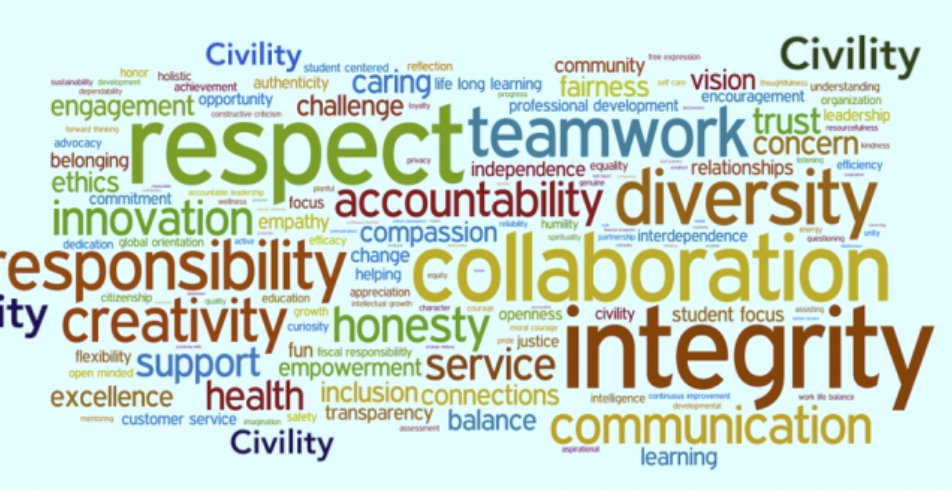
Respect, responsibility, honesty, compassion and fairness comprise one set of values to consider.
Rabbi Sacks provides historical context of the ideas that have led to an “I” focused culture, outlines the symptoms of a weakened “We” culture, and provides some insights as to what can be done. He combines a politically and economically moderate view with a conservative social perspective.
“We will have to rebuild families and communities and voluntary organizations. We will come to depend more on networks of kinship and friendship. And we will rapidly discover that their very existence depends on what we give as well as what we take, on our willingness to shoulder duties, responsibilities, and commitments as well as claiming freedoms and rights.”
Teddy Roosevelt: “The first duty of an American citizen, then, is that he shall work in politics; his second duty is that he shall do that work in a practical manner; and his third is that it shall be done in accord with the highest principles of honor and justice.” The citizen should be like his “man in the arena”, fully engaged in important matters.
Brooks offers 15 solutions. Live for holiness. Fight selfishness. Use your heroic capacity to struggle against external and internal challenges. Humility is the first virtue. Pride is the central vice. Struggle against sin and for virtue. Purposely build character skills, habits, experiences and preferences. Focus on the long-term, permanent attributes of life. Seek help in building character. Recognize the U-shaped pattern of falling, evaluating, feeling and accepting grace and recovering. Quiet the self enough to listen and defeat weaknesses and temptations. Aim for a practical wisdom built upon experience and history rather than a perfect ideology, theology or philosophy. Organize work around a “vocation” and do your best. Define leadership as finding “a just balance between competing values and competing goals”. Embrace the path of becoming better in your vocation and better as a person. That is the opportunity we are given.
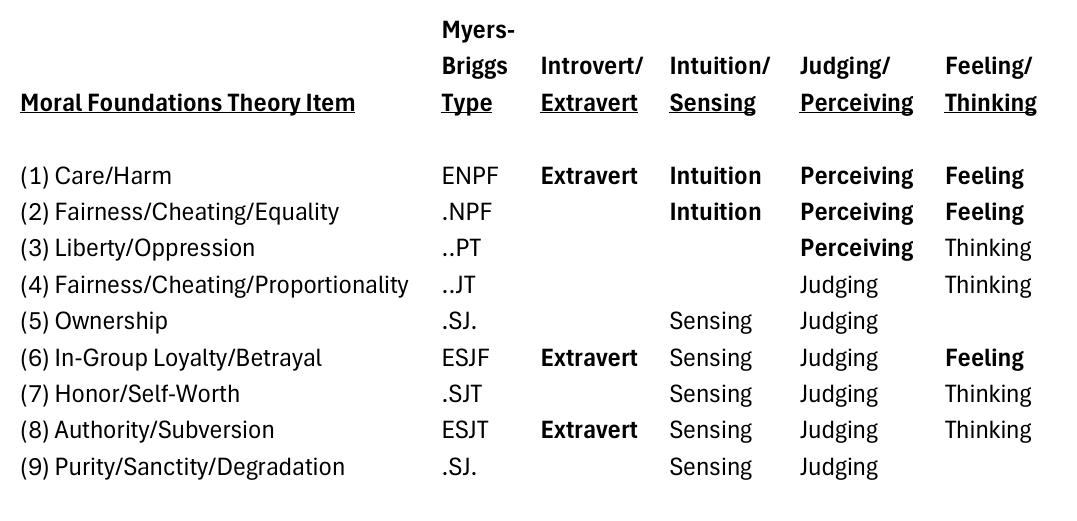
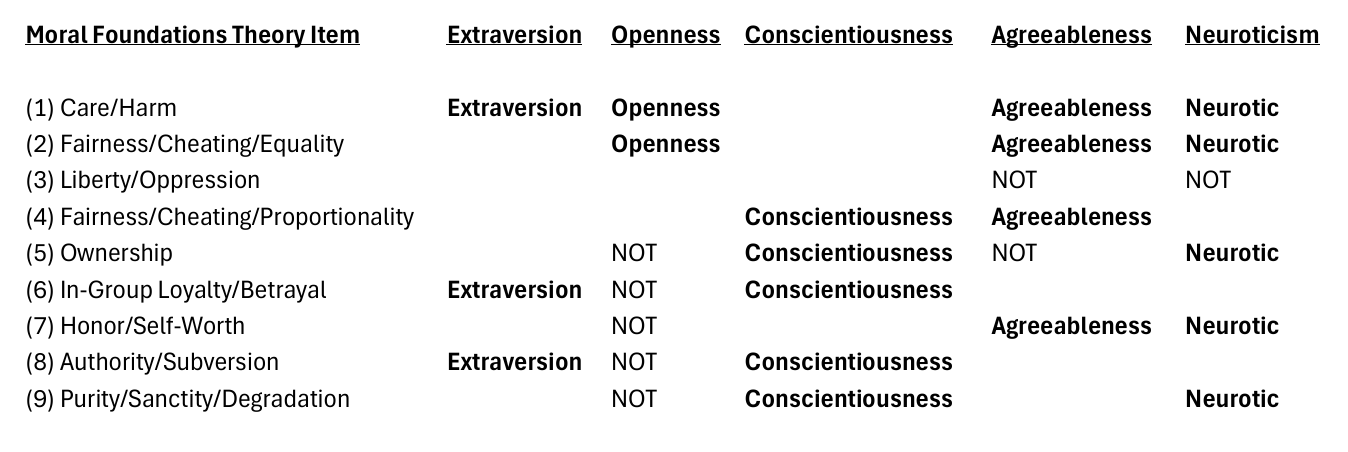
Jonathan Haidt and his colleagues have developed a set of 9 intuitive moral values that are consistent with evolutionary psychology insights. Amateur psychologists appreciate the Myers-Briggs model while professionals promote the “Big 5” personality traits. Google AI allows us to relatively quickly check our intuitive sense of how the moral values connect with the personality traits.
Professor Haidt’s work emphasizes that moral values are part of our internal makeup based upon evolution, especially recent evolution into a social and cultural species. His team promotes the “rider and elephant” model that asserts that we acquire and reflect deep-seated moral, political and religious views in an intuitive fashion. We only use our rider/rational character to defend/explain our choices from time to time. This was developed independently of Daniel Kahneman’s system 1, system 2 “thinking fast and slow model”. We mostly think fast/intuitively but are able to think slow/rationally as required. The “Moral Foundations Theory” team says that we are 90% selfish chimp and 10% cooperative bee. We are now a hybrid species.
Dr. Haidt is an intuitive, experiential liberal whose academic/scientific work forced him to re-examine his moral beliefs and biases, and those of the left-leaning social sciences. His team documented that there are traditional moral values widely held throughout history and across cultures that do not comply with the dominant WEIRD model of western, educated, industrial, rich and democratic. They took the usual modern experimental psychologist steps and defined 5 moral values. They later expanded their model to 9 values, breaking fairing/no cheating into equality and proportionality and adding liberty/oppression, ownership and honor.
Their team was widely criticized from the left for challenging/undermining the prevailing views of modern moral values (stage-based development, ala Jean-Jacques Rousseau and Lawrence Kohlberg) and opposing the “conventional wisdom” of inevitable moral and cultural progress towards a liberal ideal. At an early stage, they determined that liberal individuals and politicians had a limited moral palate of just care/harm and fairness while conservative individuals and politicians appreciated care/harm and fairness and many traditional moral values. Circa 2013 they tried to convince Democrats that they were playing politics “with one arm tied behind their backs”. The team must have thought “in for a dime, in for a dollar” when they later added ownership and honor to the traditional values of loyalty, authority and purity as valid, universal, historical moral intuitions.
I will take a first pass at how moral intuitions relate to personality traits and then to political views.
Introversion versus extraversion has a limited connection with moral intuitions or politics. Both parties and philosophies attract introverts and extroverts.
Abstract, intellectual individuals emphasize care/harm and fairness/equality as their main moral virtues. Haidt and others criticize this dominant academy view as “thin morality”, inadequate for the real world of community and politics. More concrete/specific/sensing/experiential/practical people tend to also support the conservative values of ownership, loyalty, honor, authority and purity.
Open-minded “perceiving” individuals support care, equality and liberty. Their “judging” counterparts support the 5 clearly conservative values listed above and proportionality as important principles for equity.
High “feeling” individuals tend to adopt the care and equality moral possibilities. They also tend to support the more conservative value of group loyalty. High “thinking” individuals like the structure provided by proportionality, authority and honor. They also tend to be more sensitive to liberty/oppression.
The “Big 5” personality value of “openness” to new experiences is considered the most important predictor of political views by political scientists and psychologists. High openness drives moral intuitions of care and equality. Low openness leads to a preference for ownership, loyalty, honor, authority and purity.
Conscientiousness is affiliated with the conservative values of ownership, loyalty, authority and purity. Proportionality is more neutral for politics, but clearly connected here.
Agreeableness does not align with the other factors. Friendly, high feeling individuals predictably support care and equality. But they also support conservative leaning proportionality and honor. Non-agreeable individuals are more sensitive to oppression, a relatively neutral value. Non-agreeable individuals are more interested in the conservative value of property ownership.
Neuroticism is an equal opportunity offender. Tightly wound, sensitive individuals tend to support the liberal core of care and equality. They are also attracted to the “conservative” values of ownership, honor and purity.
Summary
There is a clear left-right, liberal-conservative divide in some moral intuitions and personalities. There are statistical trends and tendencies. But real individuals are more complicated. Modern individuals are more likely to consider themselves independents with a portfolio of liberal and conservative views on specific topics. Many personality dimensions are unrelated to political views. Humans have different personalities, moral intuitions and political views. There is no clear “right and wrong” view. We are stuck with each other.
I encourage all partisans to deeply consider this result. Politicians are incentivized to win. They look for the “least common denominator”, the most effective words to assemble and maintain a voting coalition. In the modern world of politically and religiously low-engagement citizens, this is a rational and winning approach. Polarization and win/lose positioning are also logical means to election and re-election.
I think that we inherently hold different moral intuitions and political views based upon our personalities and life experiences. We are stuck with each other. We need to invest in Civility to make our political systems work. We need to embrace compromise and “good enough” political results.
In 2013, Jonathan Haidt summarized a decade of research on what values make man tick. What moral intuitions are widely held across time and cultures? Which ones are consistent with evolutionary psychology? How do people think about moral values? The researchers identified and validated 5 values, which have been expanded and refined into 9. People are born with the ability to develop certain moral intuitions. They adopt them subconsciously from experience, family and culture. They hold them deeply and defend/rationalize them as needed. We can change our moral values, politics and religions, but we usually don’t.
(1) Care/Harm
Don’t harm others, take care of people, relieve suffering, empathize. Leads to the virtues of kindness, gentleness and nurturance.
(2) Fairness/Cheating/Equality
Treat people fairly. Reciprocal altruism. Impulse to impose rules that apply equally to all and avoid cheating. Intuitions about equal treatment and equal outcomes for individuals. Generates ideas of justice, rights and autonomy.
(3) Liberty/Oppression
Feelings of reactance and resentment people feel towards those who dominate them and restrict their liberty. Seek liberation from constraints and fight oppression. Motivation to assemble to oppose invalid authority. Promotes equal rights, individual freedom and freedom from oppression.
(4) Fairness/Cheating/Proportionality
Intuitions about individuals getting rewarded in proportion to their merit or contribution.
(5) Ownership
Intuition about possession rights in society, similar to territoriality, which reduce conflict.
(6) In-Group Loyalty/Betrayal
Instinct to affirm the value of groups you identify with, including family and country. Leads to the obligations of self-sacrifice, vigilance, patriotism and punishing betrayal of the group.
(7) Honor/Self-Worth
Basing one’s self-worth upon reputation, including family and kin reputation.
(8) Authority/Subversion
Stable social order based upon the obligations of hierarchical relationships, including obedience, respect and fulfilment of role-based duties. Prevent/oppose/punish subversion. Leads to the virtues of leadership, followership, deference to authority figures and respect for traditions.
(9) Purity/Sanctity/Degradation
Intuitions of physical and spiritual contamination and disgust elevate the value of purity in thought, word and deed. Leads to the virtues of self-discipline, self-improvement, naturalness and spirituality.
Criticisms of the Liberal Values Approach
Liberals are attracted to the first 3 of the 9 values, while conservatives find all 9 to be appealing, including the traditional ones that liberals tend to avoid. This provides conservative politicians with the advantage of having 9 moral flavors to attract and inspire followers, while liberals make do with just 3.
Contrary to the self-image of most liberals, holding just 3 values can make us (me) intolerant, limited, uninformed, less caring/empathetic, disrespectful, proud, faithful, rigid, narrow, critical, uncivil, elitist, divisive, polarizing, righteous, close-minded, controlling, unsophisticated, Manichean, and unscientific!
Haidt and others criticize liberals for taking a simplistic “march of progress” view of history. C.S. Lewis called this “chronological snobbery” and “the spirit of the age” in comparison with universal views. Martin Luther King, Jr.’s quote “The arc of the moral universe is long, but it bends toward justice” fits into this determinist historical view. Hegel provided a philosophical basis for historical progress. World War I ended the naive view of unstoppable progress in all dimensions of life. The critics don’t discount the relative importance of the first 3 values but reject the elimination of the other 6.
Critics argue that liberals have applied “Occam’s Razor” to trim the list of important, experienced, valuable virtues to just 3 in order to make a political philosophy appear scientific. This is inconsistent with the historical liberal support for pluralism; the recognition of multiple, irreducible values needed for political, religious, economic and community life.
They argue that the short-list elevates the individual while removing any sense of community from the core values of man. They consider this nonsense. The history of philosophy, religion and social science focuses on the critical relationships between the individual and the community, universe, nature, church, city/polity, family/kin group, the many, and the whole.
They say that the strong liberal view is overly rational, elevating formal, scientific, instrumental logic above other forms of logic, feelings, intuitions, group logic, experience, habit, creativity, development, insight, values or spirit.
They say that the liberal view is overly formal, legalistic, individual rights based, administrative, measured, enforced, guaranteed, state based, centralized, bureaucratic, literal, detailed, and inflexible. It is based upon exact fulfilment of idealistic principles without regard to the realities of people or life. It falls into the trap of “the perfect is the enemy of the good” voiced by Voltaire. This approach mirrors that of the Pharisees in the New Testament. It attempts to formally implement utopian goals.
Critics say that care, equality and liberty are collectively very inadequate bases to support a social, political or spiritual philosophy. Too individual, ideal, abstract and emotional. Not balanced with community, spirit, and practicalities.
Critics argue that this approach undermines the essence of the liberal democratic model which recognizes that political differences of all kinds are inherent and offers a structure that limits the risks of worst cases while promoting the development of large majority support for compromise positions.
They say that elevating 3 values and discounting the inherent validity of other values leads to polarization. Caring is good. Trade-offs, qualifications, clarifications, competing values are bad. Equality of opportunity and results is good. Self-interest, group interest, access and preparation costs, excellence, risk-taking, creativity, perseverance, natural abilities, teaching, technology, self-discipline, and diet are bad. Liberty is good. Community, responsibility, duty, honor, hierarchy, wealth, power, feedback, and rewards are bad. There is an inherent limit to raising up any one or few values to be the “creme de la creme”. It doesn’t work. In reality, we are stuck with a messy, indeterminate set of values. Historically, liberals were more comfortable with complexity, change, and emerging perspectives; a reforming, organic, and evolving world.
Critics note that liberals have historically promoted a subjective world view, with individuals happily pursuing different newly created views. They have emphasized tolerance and welcomed paradoxes. They have embraced the arts. They have promoted F. Scott Fitzgerald’s view that “The test of a first-rate intelligence is the ability to hold two opposed ideas in the mind at the same time, and still retain the ability to function“. The recent liberal perspective is much more fixed.
Critics charge liberals with elitism for believing that their set of values is “obviously” superior to others. They argue that their discounting of others’ values is disrespectful. They say that it ignores their inherent value as worthy individuals.
Rebuttal
Conservatives are creating a “strawman” opponent. Some liberals DO believe that the first 3 values are most important and sufficient for supporting our social, political, spiritual and economic worlds. Very few hold this extreme position.
“Liberal versus conservative” is a simplifying intellectual construct. Liberal leaning individuals show great diversity in their beliefs. Individuals increasingly hold a portfolio of left, right and center views. Different interest groups within the liberal family emphasize different values.
“Liberals” do not live in ivory towers. They are engaged in their communities with individuals of varying political views. They are practical. They agree that good is better than perfect.
Tolerance and respect for individual views is a strongly held liberal value.
Politicians, volunteers, donors and thought leaders tend to be more divisive but they are a small share of “liberals”.
Recent survey research confirms significant differences from left to right in making explicit choices, but lab experiments and observational studies show that liberals also respond to situations based on all potential values.
Both conservatives and liberals tend to overexaggerate the depth of support for values or positions held by their opponents. The true differences in moral intuitions and values are not so extreme.
Politicians, strategists and communicators have learned from Haidt’s work. They better understand that humans are motivated in a variety of ways and seek to offer all 9 flavors.
Perception is Reality
Clever politicians live in the world of framing, soundbites, community building, targeted messages, fake news, impressions, smears, reinforcement, enemies, actions drive beliefs, brand is everything, share of mind, emotions, exaggerations, polarization, lies, click-bait, etc.
The so-called “liberal” positions described above do not have to be real, substantial, significant, constant, priorities, enduring, deeply held, common, important, material, central, core, logical, widely held, or consistent. They only have to be plausible or believable. Modern communicators have very few personal filters. Most listeners employ few critical thinking skills. They consume political news and commentary as entertainment and personal validation.
Hence, the views of the most extreme, true-believing, progressive, new left, far left, green, environmental, globalist, utopian, socialist, pro-labor, postmodernist, dada, creative, anti-privilege, defund the police, community activist, radical, intellectual, legalistic, disadvantaged, oppressed citizen, immigrant, politician, intellectual, influencer or local neighbor can be used to portray liberals as extremists, radicals, and severe threats to the American way of life.
Few of us write or act with an eye or ear cocked towards avoiding caricature. In the modern world we all need to become much more disciplined: individually, in our local politics and in holding state and national politicians to a new gold standard of support by the broad American public.
(1) Care/Harm
Surveys indicate that liberals and conservatives equally support this critical value. Because conservatives trade-off Care with other values in their policies, decisions and communications, some liberals accuse them of being cold, heartless or unfeeling. They reject this characterization and question the wisdom and character of their accusers, creating another cycle of polarization. In parallel, some liberals hold Care for the weak, poor, widowed, immigrants, imprisoned, disabled, or unlucky as the supreme value which does not allow for trade-offs to be made. Practical, balanced conservatives reject this utopian, idealistic approach and view it as proof of liberal extremism.
(2) Fairness/Cheating/Equality
Haidt and his team were required to separate 2 Equality from 4 Proportionality as they learned that different people defined fairness in quite different ways. The moral intuition that “cheating is wrong and basic fairness is right” prompts a variety of beliefs. Even when defined as “equality” it covers equal opportunity, equal treatment, equal rights, roughly equal outcomes and equal outcomes. Conservatives have “middling” support for 2 equality. Liberals show very strong support for “equality” of all kinds, broadly applied, often in its strongest form. The response to a violation can be so strong that it looks like (9) Purity/Sanctity/Degradation. Conservatives who don’t have this strong experience can see liberals as over-reacting, thin-skinned, woke, virtue signaling, overly protective, or bleeding hearts. Some liberals who watch conservatives dismiss differences, treatments and systems as relatively unimportant cannot understand why they don’t see the deep violation of human dignity as intolerable on all levels and not subject to context, materiality or trade-offs. This difference of relative weighting, intensity and perspective is difficult to bridge but both sides could start with recognizing it as differences rather than an ultimate “right versus wrong”.
(3) Liberty/Oppression
American liberals and conservatives both rank this as very important. They apply it to different situations. Liberals worry about powerful businesses, multinationals, banks, individuals, churches, courts, militaries, systems, processes and traditional institutions. Conservatives worry about the government, criminals, immigrants, foreigners, militaries and non-traditional institutions.
(4) Fairness/Cheating/Proportionality
Liberals give this a “middle” priority. They value logic and reason. Some support our meritocratic economic and social systems. Conservatives give this a much higher value. They worry about being cheated by governments, bosses, suppliers, welfare beneficiaries, immigrants, tenured faculty, free riders, criminals, storekeepers, retailers, foreign governments, international agencies, and self-dealing charities. (9) Purity/Sanctity/Degradation feelings arise as individuals monitor and prevent attempts to violate this deep sense of fairness. In a mirror image to (2) Fairness/Cheating/Equality, some liberals criticize conservatives for overreacting to remote, infrequent, low impact or nonexistent threats. They encourage others to make rational economic decisions to reduce but not eliminate such actions. Conservatives see this as a non-tradable value and wonder why liberals can be flexible on a truly essential human right – to not be violated.
(5) Ownership
This recently added moral intuition clearly resonates with the conservative values of fairness/proportionality, authority, and liberty/oppression. “What’s mine is mine and what’s yours is yours” is obvious. Conservative support for property rights has a long history. Liberals have weaker support for Ownership as a core intuition or value. They worry about powerful actors oppressing the weak by depriving them of property directly or indirectly [(2) Equality and (3) Oppression]. Some liberals argue that property is an agreed upon legal necessity subject to community definition and control. This view is unintelligible to many conservatives as we saw in the Obama “you didn’t build this” debate about the relative source of value/rights of property ownership between government infrastructure and business owners. Many conservatives today take the opposing view that “taxation is theft” because property ownership is seen as the supreme human right or value in society, befuddling their liberal neighbors. Liberals can benefit from gaining an intuitive sense of ownership as deeply felt and influential. Conservatives can benefit from seeing the government/economic systems perspective as being valuable just like the cultural/social norms perspective.
(6) In-Group Loyalty/Betrayal
Conservatives appreciate this value. Liberals give it weak support or oppose it as being contrary to the individual and a possible tool of oppression by powerful institutions like churches, political parties, fraternities and governments. Conservatives value community and individuals. All communities require forces to bind members. This infringes on perfect individual freedom but is unavoidable. Liberals remain concerned about the long history of powerful institutions doing “whatever it takes” to assume and maintain power, including taking away member’s rights. Liberals want to always emphasize the need for individual choice in making decisions to join, support and follow an organization. As conservatives worry about (4) being cheated in many dimensions of life, liberals worry about losing their individual rights and voice when they join any organization. This is a gut level, nagging concern. Yet, liberals do form strong group attachments to institutions, universities, sports teams, neighborhoods, professions, civic organizations, political parties, interest groups and churches in the lived world. Once again, greater self-awareness combined with better observation and understanding of “others” could reduce the perceived gap about what is important.
(7) Honor/Self-Worth
Another recently added moral intuition. Conservative honor is based on duty, hierarchy, and group integrity; Liberal honor is based on compassion, rights, and individual fairness. Conservatives highly value loyalty to the group and respect for authority, which are core components of traditional, collectivist “honor”. Liberal honor is less about group loyalty and more about universal human rights and compassion.
Liberals develop feelings of self-worth largely through individual achievement rather than their status as part of a family, profession, role, nation or group. Conservatives value communities more highly so see honor in the group, role or self as more important.
(8) Authority/Subversion
Conservatives greatly value a stable social order and the tools needed to build and maintain it. Liberals tend to fear oppression from powerful collective organizations, so minimize this value. This value is closest to the “essence” of liberal versus conservative views as measured by political scientists. Liberals seek new experiences while conservatives avoid unnecessary risks. Liberals could benefit from distinguishing (3) Liberty/Oppression from this value. Conservatives argue that social organizations, institutions and norms are required for any society. Proper authority must be respected to make this work. Liberals support authority for some organizations such as the government, so should be able to see the proper role of authority elsewhere.
(9) Purity/Sanctity/Degradation
Conservatives support this value, considering it obvious and universal. Liberals tend to consider it relatively unimportant. They often see conservative concerns about sex and sexual differences, racial interaction, criminals, religious beliefs and practices, flags, patriotism, foreign languages and “others” as overreactions to weak or nonexistent risks. Liberals have their own sacred items/threats such as children, abuse, animals, pollution, organic foods, fascism, locally handcrafted goods, mass transit, prejudice, microaggressions, and personal identities. Conservatives see the lack of liberal support for traditional social norms and institutions as a lack of human decency; an extreme point of view. Some liberals criticize the deeply felt support for these institutions, their leaders and symbols as being unfounded. Conservatives feel the sting of disrespect.
Summary
Humans have sets of moral intuitions that are deeply felt and often unconscious. There is a “liberal versus conservative”, “modern versus traditional” dimension that groups together sets of values. There is a long history of Western societies adopting more liberal values and fewer conservative values but there is no evidence that conservative values will disappear someday as society becomes more informed, intelligent, urban, secular, cosmopolitan, scientific and rational. Anyone who invests time studying all of these values will see that they are heartfelt, prewired intuitions. Some humans will hold each of them and consider them important.
Liberals and conservatives can both benefit from studying these values and recognizing their intrinsic validity. Individuals choose and/or hold different sets of values. They prioritize or weigh them differently. Most people acquire values informally by living life, not through explicit political, religious or philosophical choices. They have and defend their values. We will continue to hold different values. We can be civil. We can use our political system to manage these differences. Liberals, who claim to take the broader perspective and seek to find new solutions for problems, are obligated to invest in self-awareness and better understanding how others think about the world and what they can do to help everyone understand and connect.
Civility is a set of behaviors that recognize differences and build respect. Civility is demonstrated through self-awareness, self-management, social awareness, relationship management, communications, growth and problem solving.
Civility is driven by the RICH RAP values of responsibility, intentionality, constructiveness, human dignity, respect, acceptance and public-spiritedness.
These values are essential components of the major world religions, including Christianity.
Responsibility
Responsibility for one’s choices and actions is central to Christianity.
To God: have faith, obey, repent and account for your life.
To Self: grow spiritually, resist sin, develop self-control and seek salvation.
To Others: Show love, serve, choose wisely and build relationships.
To Family: Provide for all needs.
Accountability: Be responsible for thoughts, actions and results. Listen and repent.
Action: Faith must be applied.
Stewardship: Use God-given time, talents and treasures for God’s purposes.
Reflection of Christ: Become more Christ-like through a life of holiness, love and service.
Christianity roots respect in human dignity. It is viewed as a command rather than an earned privilege, focusing on humility, love, and treating others better than oneself.
Image of God: showing respect to others honors God.
Commanded love: proper respect to everyone, including opponents, authorities, and believers.
Humility and selflessness: outdo one another in showing honor.
Value of dignity: respect is based only on intrinsic value given by God, not by social status, merit or agreement.
Reflection of Christ: Jesus showed compassion to the outcasts, the vulnerable, the weak and chose common men and women as disciples to build His church.
Christianity says that all people are created in God’s image, loved unconditionally, and invited into community regardless of background. Jesus exemplified this by engaging with marginalized groups and individuals, and Scripture emphasizes complete equality through spiritual unity.
Radical inclusion by Jesus: breaking social norms to engage outcasts, sinners and the “unclean”.
Theological equality: all are equal in Christ (Galatians 3:28).
Commandment to Love: Love your neighbor as yourself (Matthew 22:39); all of your neighbors.
Welcome the Stranger: the Old Testament repeatedly preaches that foreigners and the marginalized must be treated the same as the native born.
Community of Grace: all individuals are accepted into the community of faith and grace.
Christianity requires members to act with love, justice, and integrity in civic life. Serving the community, promoting good laws, and engaging in public discourse reflect God’s love and desire for the common good.
Love God, Love Neighbor: The great commandment requires service to society.
Identity in Christ: A child of God, redeemed by and connected with Christ, belongs to the community and as a “new” person willingly serves it.
Salt and Light: Called to be a positive influence through and for the community.
Morality: Actions are right or wrong. Individuals can/must do “right”.
Civic Engagement: Voting, holding office, debating and advocating are civic responsibilities.
Common Good: Building relations with others to work for the common good is required.
Positive Witness: Contribute so that others will see the value of “following Jesus”.
We live in a place and time where Civility has declined as a habit or social norm. It is necessary for our social, economic and political communities, IMHO. We need to rebuild Civility as a habit, norm and ideal. We can do this for practical reasons.
Or we might embrace Civility because it is a logical consequence of our religious beliefs.
Christianity is a positive force in the lives of 2 billion people. It is clearly consistent with and supports the 7 Civility values.
“Render unto Caesar the things that are Caesar’s, and to God the things that are God’s” is recorded in 3 of the gospels. Christians are warned that they must distinguish between the material and spiritual, the personal and the community, the practical and the ideal. Some have read this line to encourage Christians to withdraw from practical and civic life in favor of a private, ascetic, withdrawn spiritual life.
Most Christian theologians emphasize the duality of Christ as “fully man, fully God”. Unlike many religions, Christianity embraces the material, natural side of man as being created by God. Genesis records that God concluded his creation and man were “very good”, despite the fall and imperfections. This perspective encourages us to go “all in” as individuals, spouses, parents, stewards, fishers, builders, carpenters, teachers, servants, prophets, nurses, and participants in community.
We promote Civility as a set of behaviors, values, habits, norms and expectations; NOT as a replacement for religion, but as a secular framework for managing community in a world of 8 billion people.
I personally believe that there are common moral values that God has revealed to men in various places, ways and times.
I don’t see a groundswell of support for this view or for Christianity alone, so I promote the secular alternative of Civility as a “least common denominator” way for our “kingdom of man” to function effectively on behalf of the 8 billion children of God.

 Good News