Modern History: Business & Economics

1602 – Dutch East India Company, limited liability corporation, global trade

https://en.wikipedia.org/wiki/Dutch_East_India_Company

1776 – The Wealth of Nations from markets, specialization and trade

https://en.wikipedia.org/wiki/Adam_Smith

1817 – Comparative advantage drives international trade

https://en.wikipedia.org/wiki/David_Ricardo

1865 – Gilded age economic expansion and inequality in the US, laissez faire

https://en.wikipedia.org/wiki/Gilded_Age

1867 – Trade unions legalized in the United Kingdom

https://en.wikipedia.org/wiki/Trade_unions_in_the_United_Kingdom

1910 – Scientific management, Frederick Taylor, Taylor method

https://en.wikipedia.org/wiki/Scientific_management

1911 – Breakup of the Standard Oil Company – anti-monopoly power

https://en.wikipedia.org/wiki/Standard_Oil_Company

https://en.wikipedia.org/wiki/The_History_of_the_Standard_Oil_Company

https://en.wikipedia.org/wiki/Standard_Oil_Co._of_New_Jersey_v._United_States

1913 – Federal Reserve Bank created

https://en.wikipedia.org/wiki/Federal_Reserve_Act

1913 – Industrial assembly line- Ford

https://en.wikipedia.org/wiki/Assembly_line

1929 – Great Depression

https://en.wikipedia.org/wiki/Business_cycle

https://en.wikipedia.org/wiki/Great_Depression

1933 – Securities and Exchange Commission regulates financial markets

https://en.wikipedia.org/wiki/Securities_Act_of_1933

1936 – Modern macroeconomics is outlined

https://en.wikipedia.org/wiki/John_Maynard_Keynes

1939 – Silicon Valley begins with Hewlett-Packard, product and financing innovation

https://en.wikipedia.org/wiki/Hewlett-Packard

https://en.wikipedia.org/wiki/Silicon_Valley

1942 – Creative Destruction is an essential part of effective capitalism.

https://en.wikipedia.org/wiki/Joseph_Schumpeter

1947 – Military industrial sector, defense complex created

https://en.wikipedia.org/wiki/Military_production_during_World_War_II

https://en.wikipedia.org/wiki/Military%E2%80%93industrial_complex

https://en.wikipedia.org/wiki/Military_budget_of_the_United_States

1948 – Japanese companies start modern manufacturing based upon statistical insights.

https://en.wikipedia.org/wiki/Toyota_Production_System

1950 – The study of “sequence of events” leads to modern project management.

https://en.wikipedia.org/wiki/Critical_path_method

https://en.wikipedia.org/wiki/Timeline_of_project_management

1952 – Henry Markowitz formalizes modern portfolio theory.

https://en.wikipedia.org/wiki/Modern_portfolio_theory

1955 – Destination theme park travel begins – Walt Disney

https://en.wikipedia.org/wiki/Disneyland

https://en.wikipedia.org/wiki/Disney_Experiences

1955 – Enclosed Shopping Mall

https://en.wikipedia.org/wiki/Shopping_center

https://en.wikipedia.org/wiki/Shopping_mall

1956 – Intermodal shipping container and freight transport

https://en.wikipedia.org/wiki/Intermodal_freight_transport

1958 – General purpose credit cards

https://en.wikipedia.org/wiki/Credit_card

1958 – A meritocratic work environment was dominating, and critics objected.

https://en.wikipedia.org/wiki/The_Rise_of_the_Meritocracy

1962 – Product and process standardization, franchising take off

https://en.wikipedia.org/wiki/History_of_McDonald%27s

1962 – Discount retailing, big box stores, category killers arise.

https://en.wikipedia.org/wiki/History_of_Walmart

1968 – For profit health care.

https://en.wikipedia.org/wiki/HCA_Healthcare

1970 – Income inequality begins to grow again in the US

https://en.wikipedia.org/wiki/Income_inequality_in_the_United_States

1971 – Discount air travel, standardized routes and aircraft

https://en.wikipedia.org/wiki/History_of_Southwest_Airlines

1973 – How much is a financial option worth?

https://en.wikipedia.org/wiki/Black%E2%80%93Scholes_model

1973 – Reliable express delivery is founded.

https://en.wikipedia.org/wiki/FedEx

1974 – Tax-advantaged individual retirement accounts

https://en.wikipedia.org/wiki/Individual_retirement_account

1975 – Index funds and mutual funds simplify and lower transaction costs of investing.

https://en.wikipedia.org/wiki/The_Vanguard_Group

1978 – Executive stock options provide high levels of tax-advantaged compensation.

https://en.wikipedia.org/wiki/Employee_stock_option

1979 – Monetary policy can stop inflation, at a cost.

https://en.wikipedia.org/wiki/Paul_Volcker

1980 – Junk bonds provide financing for riskier companies and tools for investors.

https://en.wikipedia.org/wiki/High-yield_debt

1980 – Michael Porter clarifies the effective use of business strategy to compete in markets.

https://en.wikipedia.org/wiki/Competitive_advantage

1984 – Eli Goldratt offers a “theory of constraints” as a way to understand and manage complex systems effectively, leading to true “lean manufacturing” and “lean operations”.

https://en.wikipedia.org/wiki/Theory_of_constraints

1994 – On-line retailing, everything is in stock, and available soon.

https://en.wikipedia.org/wiki/History_of_Amazon

2007 – Great Recession highlights the ongoing risks of financial deregulation.

https://en.wikipedia.org/wiki/Great_Recession

Summary

Process standardization. Financial innovation. Highly focused strategies. New business forms. Markets and international trade deliver desired products, lower prices and competition. A role for government regulation remains. The macroeconomy can be managed to reduce the impact of business cycles and shocks.

Good News: The Business Cycle is Done

https://www.yourobserver.com/news/2023/dec/01/construction-begins-legacy-trail-overpasses/

From 1945 through 1985 the US economy regularly accelerated its growth, reached a peak, fell back and then recovered. Businesses, economists, politicians and the public expected that this 3-5 year business cycle would continue forever.

Looking back, it seems like the business cycle was broken by 1985. All of the subsequent downturns have been prompted by extraneous, outside of the system, shocks. In 1990 a second global oil shortage shock.

https://en.wikipedia.org/wiki/Early_1990s_recession_in_the_United_States

In 2000-2001, a stock market bubble popped.

https://en.wikipedia.org/wiki/Early_2000s_recession#:~:text=A%20combination%20of%20the%20Dot,Inverted%20yields%20in%20early%202001.

In 2007, a mortgage lending bubble popped.

https://en.wikipedia.org/wiki/Great_Recession

In 2020, a pandemic driven recession, followed by a very unexpected rapid recovery.

https://en.wikipedia.org/wiki/COVID-19_recession

40 years without a classic business cycle recession is long enough to claim victory.

How could this happen? The independent Federal Reserve Bank has maintained a neutral monetary policy. We have not “shot ourselves in the foot” and we have implemented reasonable policies to offset external shocks. The federal government budget deficit has generally returned towards zero following depression periods. Automatic stabilizers and congressional action have addressed recessionary periods with enough stimulus to stop economic decline and restart recovery.

More importantly, the structure of the US economy has changed. The share of high fixed cost manufacturing has declined as “services” has increased as a share of the total economy. The share of international trade (imports and exports) less directly connected to the domestic economy alone, has increased. The power of labor (unionized or not) has fallen, allowing firms to reduce hours and real wages during a downturn. In most recent times, firms better recognize the cost of attracting and developing highly skilled labor in a complex production world, so they retain key staff even during downturns. Vertical integration has been reduced, allowing firms to respond to minor demand changes more effectively. Based upon the quality revolution, major firms have reset their capacity utilization targets to 80% rather than 95%, providing firms with greater flexibility in managing variable demand and not reaching the point where internal costs increase and the need to increase prices occurs.

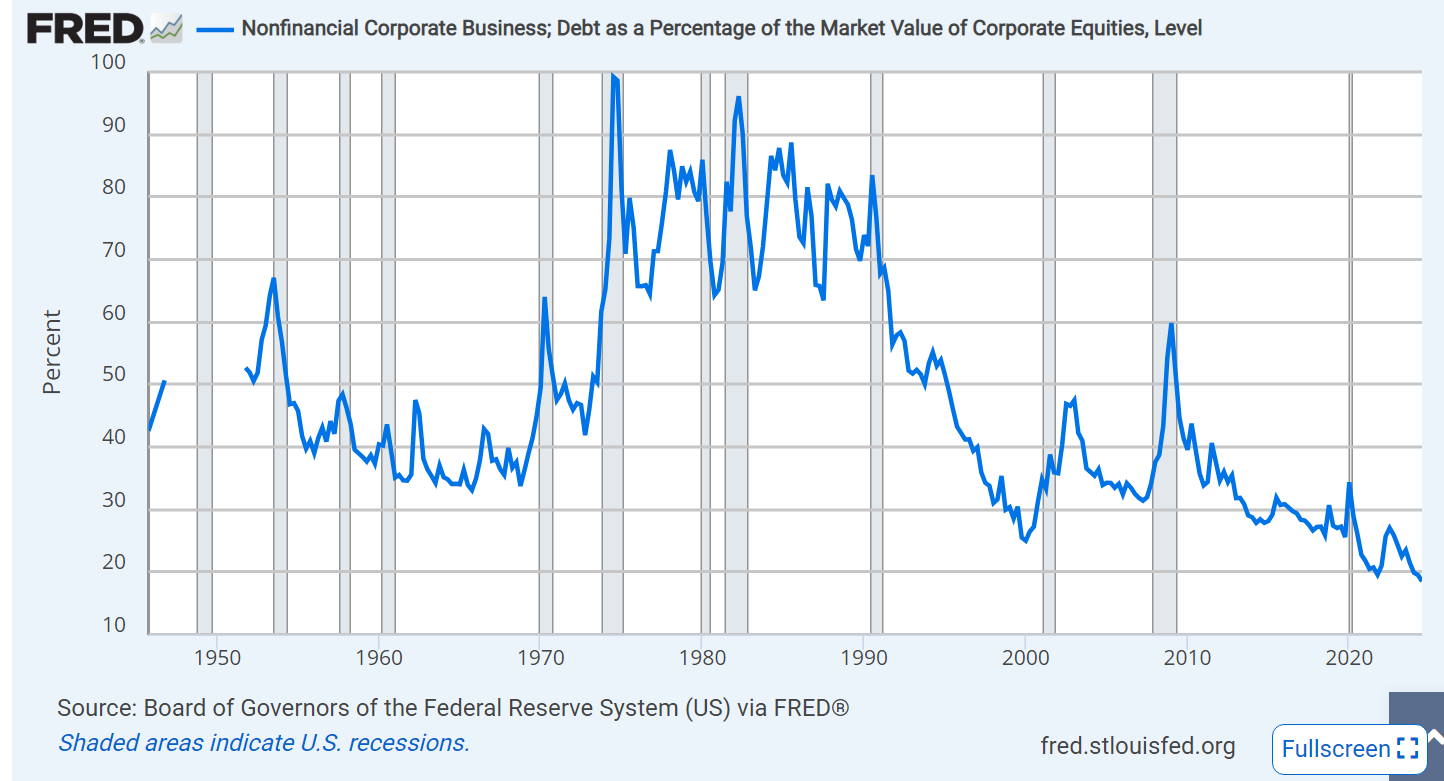
Financial leverage has also decreased. US firms have access to deep bond markets so are they able to incur only necessary levels of indebtedness.

Even with a much greater level of imported goods, retailers hold lower levels of inventory, allowing them to not overreact to changes in demand. Firms have more effective supply chain management processes.

The unemployment rate also shows this structural change. When it was pushed below 5% in the 1960’s, inflation increased and was not permanently checked for 20 years. By 2000 the economy was able to expand and keep unemployment below 5% for extended periods of time without triggering “cost-push” inflation. Unemployment still increases during an economic downturn, but low unemployment does not seem to trigger a recession.

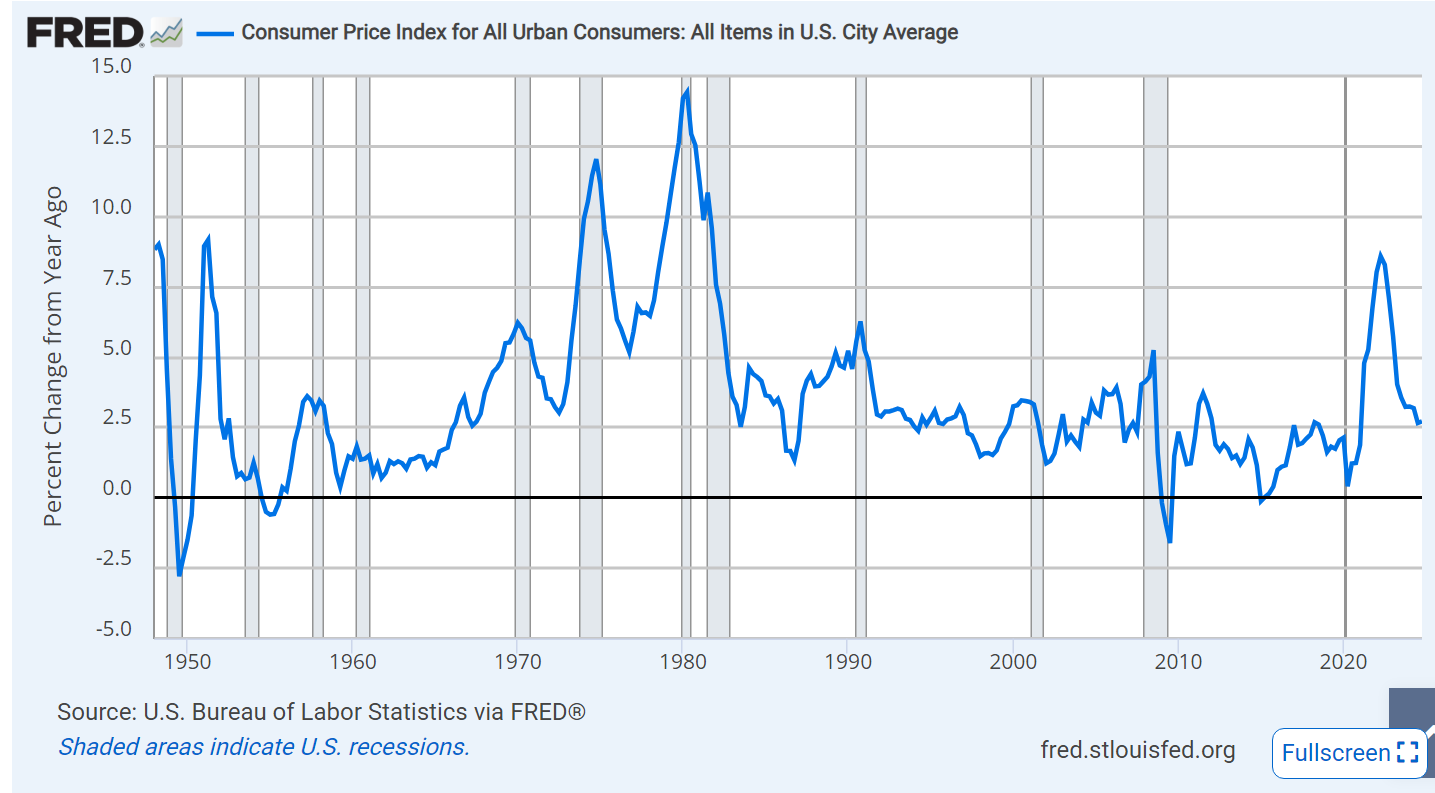
From the 1950’s through the 1980’s inflation tended to increase as the economy overheated before a reduction in credit availability would slow the overall economy. Aside from the Covid pandemic shortages, we no longer see major inflation increases.

Impact

The business cycle caused firms to underinvest because the best available forecast was always that the boom period would be interrupted in 1-5 years. Sales, margins and profits could not be assumed to increase forever.

The business cycle caused firms to follow a stop-start pattern for capital investment projects, process improvement, research & development, new product introduction, new markets, new channels and mergers & acquisitions. Seeing a downturn, firms would cancel existing initiatives, even at a significant cost, in order to conserve cash and signal to stakeholders that management was actively managing the business. Projects would slowly resume after it was clear that the business cycle recovery was under way 2 years later.

For individuals, the “last hired, first fired” cycle applied. Firms froze open position hiring. They released interns and summer workers. They prohibited overtime. They cancel contracts with temporary labor firms. Less experienced workers and minority groups suffered. Labor intensive industries, especially construction, were hard hit. Smaller firms closed. The hiring cycle would resume 2 years later.

Historically, stock market values also followed the pattern of the business cycle closely. Stock market declines were seen as an “early warning” indicator by forecasters. Since stock market values are theoretically determined by a risk-adjusted discount rate, the reduction of business cycle variability allows investors to use a lower interest/discount rate and value future earnings at a higher net present value.

Summary

The business cycle appears to be gone. The modern economy does not have the same high fixed costs it once had. Firms are able to increase their sales, profits and capacities in tandem without greatly overshooting the mark. Our national institutions help to keep growth at a sustainable level. Workers, firms, investors and society all benefit from this great advance, even if it is not publicly celebrated.

Congregational Strategy – 2

A complement to Treacy and Wiersema’s 3-way “operations excellence, product innovation and customer intimacy” approach to strategy is Richard Schonberger’s “universal customer needs” approach: QSFVIP. Brand value is added when an organization consistently delivers value to a target market.

Quality

Are the Bible, theology, creed and messages from the pulpit and programs generally consistent?

Are they expressed in ways that clearly communicate the essential beliefs, moral values, church operations and expectations of members?

Would members and visitors agree that “what you see is what you get”?

Are the programs and services offered consistent with the stated beliefs?

Are the congregation’s local branding, mission, vision, values and communications aligned with denominational statements?

Do the congregation’s members “walk the talk”, putting their faith into practice?

Does the congregation address “difficult” or “controversial” topics consistent with its stated beliefs?

Are the sermons and programs relevant to today’s highest priority needs?

Are the sermons and programs relevant to all groups of members and prospective members?

Do the sermons and programs address thinking, feeling and action dimensions of human experience?

Does the organization have an effective quality review and improvement process for sermons and programs?

Speed

Do church services, programs and operations respect the time of participants?

Are church programs effectively scheduled in advance, shared virtually, and recorded or summarized quickly?

Are emerging congregational needs addressed quickly?

Are visitors engaged quickly and effectively?

Are new members engaged quickly and effectively?

Are missing or low participation members engaged quickly and effectively?

Are prayer requests met immediately?

Does the church respond to individual care, prayer and financial needs quickly?

Flexibility

Does the congregation understand the current priority needs of major member groups?

Does the congregation offer worship services and programs that meet the needs of various major member groups?

Does the congregation effectively adjust long-term and annual planning to meet changing community needs?

Does the congregation take advantage of ecumenical and secular input and resources?

Does the congregation welcome and value conflicting opinions, doubting Thomases, and devil’s advocates in its deliberations?

Has the congregation considered controversial issues and evolved some of its views upon further consideration?

Does the congregation consider new scientific results?

Value

Does the congregation prioritize its program investments to only deliver those with the highest benefits?

Has the congregation identified its “target audience” and refined services and programs to match?

Have the very highest priority spiritual needs of members and prospective members been defined and programs adjusted?

Has the church evaluated its competitors for the time and treasure of members and prospective members and focused its programs and services to meet only the spiritual and unmet needs?

Are the target market, brand and products of the congregation clearly aligned?

Do the brand characteristics and communications closely align with the beliefs and programs of the congregation?

Do members and prospective members receive what they expect based on congregational creed and marketing in programs and services?

Does the church address both earthly and eternal needs?

Do the congregation’s programs and experiences effectively transform members to devote their lives to God?

Does the church offer clear apologetics that actively address non-Christian answers?

Does the church operate effectively within ”A Secular Age” whose default assumptions are “God is dead”, no supernatural dimension, materialism, subjectivity, relativity, skepticism, radical Nietzschean individualism, created identity, existentialism, Rousseau’s naturally good man and modern capitalism?

Does the church have a low barrier to engagement?

Information/Transaction Costs/Risks

Does the church have clear requirements for membership? Attendance, participation, baptism, belief, contributions, behavior, feedback, penance, confession, obedience, loyalty, prayer, dress, time, activities, personal growth, improvement.

Does the church reject “cheap grace” and make clear the expected commitments?

Is it easy to donate?

Does a single website provide easy access to all program options?

Does the church have clear channels for requests and communications?

Does the church provide clear moral standards and enforce them for members?

Does the church provide programs that address financial and life choice risks?

Does the church provide resources to members in need?

Personal Relations

Are members engaged in small groups?

Are members personally connected with at least one staff member?

Do visitors and prospective members feel that the church welcomes them?

Do the staff, deacons and Stephens’ ministry identify and meet members’ needs?

Are members engaged in recurring activities like greeting and ushering?

Do children interact with caring adults?

Do members believe that the pastoral staff would do “anything” for them?

Good News: Average US Car is 12 Years Old

The average age of all US cars and light trucks in operation exceeded 12 years for the first time in 2021.

https://news.ihsmarkit.com/prviewer/release_only/id/4759502/

Typical vehicle age increased by one-quarter, from 9.6 to 12.1 years since 2002.

Typical vehicle age increased by more than one-half from 7.8 years in 1990.

Typical vehicle age more than doubled from just 5.3 years in 1969.

The rate of increase has remained relatively constant, with improved highways, driving, designs, quality and maintenance allowing the average age to increase by 1 year every 7-8 years.

Data

summary table, page 60.

page 10, 1969

page 54, 1977. 1 of several somewhat different figures.

page 26, 1983.

page 104, 1990

page 78, 1995.

Articles

https://www.usatoday.com/story/money/cars/2021/06/14/used-cars-suvs-trucks-used-car-prices/7638769002/

https://www.autodealertodaymagazine.com/366056/average-age-of-vehicles-on-the-road-increases

https://www.iseecars.com/longest-lasting-cars-study

Good News: Labor Productivity from 1970 to 2020, A Personal Perspective

Nonfarm Business Sector: Real Output Per Hour of All Persons (OPHNFB) | FRED | St. Louis Fed (stlouisfed.org)

I formally retired this Spring at age 65. I started working in 1966 at age 10 as a newspaper delivery boy. I’d like to reflect on the big changes in the economy during these 5 decades.

The US Bureau of Labor Statistics tracks the real output per hour in the nonfarm business sector, or “labor productivity”. The media reports this number as it has “real” and “political” importance. The average annual improvement has been 1.9%. That is a 95% increase in 50 years, nearly a doubling, on an arithmetic basis. However, productivity compounds geometrically, just like compound interest, so the 2020 worker is actually 159% more productive. Or, the 1970 worker was 39% as effective as the 2020 worker!!! The 2020 worker delivered 5 units of output for every 2 units of output in 1970!!! Expressed in these terms, it’s clear to see this is a really important measure.

The annual productivity increase has ranged from -1.6% (1974, when I finished high school) to 4.5% (1992). 3 times below 0% and 3 times above 4%. The measured productivity growth increases and decreases through time. From 1970-76, labor productivity grew by 2.4% annually, a very good result. This was the end of the post WWII boom period. Japanese and European competition, oil cartels, sleepy consolidated industries, environmental laws and stagflation disrupted this progress. The next 13 years (1977-89) were a time of transition (disco). Labor productivity grew by just 1.4% per year, despite the early positive effects of the computer revolution. 1% per year lower doesn’t look like much, but it means that output in 1989 was 13% less than it would have been if the country had maintained it’s early 1970’s productivity improvements. The impact of the “Reagan Revolution” in freeing American capitalism from regulations and taxation was not clear during his presidency. The next 8 years (1990-97) showed some improvement, to 1.7% annually, but not a true revolution that either Bush or Clinton could celebrate. The next 13 years (1998-2010) were the golden years for improved labor productivity, averaging 2.9% annually, DOUBLE the improvements from 1977-89. The later Clinton years and the whole George W Bush presidency witnessed these results. The next 6 years (2011-16) reflected the slow recovery from the Great Recession with labor productivity growing by just 0.7% annually, half of the poor 1977-89 time frame. Productivity growth started to recover in the last 4 years, averaging 1.7%.

Economists tend to focus on the role of “capital” in driving labor productivity. In essence, if workers have more or better machines and computers, they will produce more per hour. In very rough terms, about one-half of labor productivity improvements come from better tools.

How Capital Deepening Affects Labor Productivity (stlouisfed.org)

The economists who try to measure the output part of labor productivity (real GDP) try to be consistent and conservative. That means that they understate real GDP. They don’t include the value of reduced pollution. They try to adjust for the improved quality of goods and services, but count only the obvious benefits. In a world dominated by services, this is a major gap. They make no attempt to estimate the benefits of less time spent buying goods and services. They make no estimate of the value of shorter delivery times. They are unable to account for the benefits of transparent and deep markets for goods and services.

Finally, they do not account for the value of product variety, broader consumer choices and customized goods. The fact that modern products more exactly fit consumer needs adds no value to GDP. By the 1990’s firms understood the universal customer value framework (QSFVIP) outlined by Deming, Juran, Shingo, Schonberger and others.

Amazon.com: Building a Chain of Customers eBook: Schonberger, Richard J.: Books

Firms understood Marshall Field’s dictum to “give the lady what she wants” and pursued it with a vengeance in order to gain market share, fight imports and improve margins. Based on my experience, firms devoted at least as much time to delivering upon these “soft”, qualitative, unmeasured productivity factors throughout the last 50 years. Hence, true productivity growth may have been twice as high as officially reported.

What changed in 50 years?

Secretaries and administrative assistants disappeared. Managers and professionals learned to do their own “paperwork”.

Clerks disappeared. Fewer transactions. Lower transaction costs. Standardized transactions. Automated transactions. No data entry operators.

All processes were subject to measurements like Ford’s assembly line.

More “analysts” working to improve all functions. Not just chemistry and engineering specialists. Financial analysts, marketing analysts, pricing analysts, logistics specialists, forecasters, inventory specialists, brand managers, compensation analysts, trainers, quality specialists, process engineers, systems engineers, professional purchasing analysts, etc.

Documentation revolution. Policies and procedures. Standardization. Say what you do.

Quality/process/TQM/lean 6 sigma revolution. Every activity can be defined and improved. Do what you say. Improve.

Process management via Goldratt’s theory defined in “The Goal”.

Import substitution due to lower transport, finance and transaction costs.

Outsourcing and specialization. Finance, accounting, HR, engineering, IT, facilities, marketing, advertising, logistics, distribution, legal, labor, manufacturing, design, project management, testing, returns, maintenance, leasing, equipment rental, etc. Stick to your core functions.

Flatter organizations. Fewer middle management layers.

New product introduction as a well-defined process that can be improved and outsourced.

Business viewed as a portfolio of products and channels and markets.

Competitive banking. Competitive equity markets. Venture capitalists. Bankruptcy processes. Leveraged buyouts. Asset based financing. Leases. Portfolio theory. International funds flows.

Reduced barriers to international trade. Tariffs. Regulations. Lower shipping costs due to containerization. Rule of law reducing costs like letters of credit. Fax machines. Reduced foreign travel costs. Japanese supplier partner concepts.

Improved suppliers. Supplier partnerships. Supplier measures. Contracts. Supplier improvement plans. Less bidding, negotiations or transactions.

Capital allocation/investment within firms. Basic ROI/NPV education. Portfolio of products. New products, new channels, new brands, process improvements, supplier improvements. Improved supplier opportunities. Acquisition value. Improved project management and risk management.

Jack Welch view: be number 1 or 2 or else. Walmart or niche service positioning, not JC Penney or Sears or Kmart. Firms dedicated their products to what customers would willingly buy.

Benchmarking to world class standards. Belief that reaching this performance level is possible and required.

Computerization of all processes. Transactions. Planning. Scheduling. Forecasting. Controls. Budgets.

Immediate communications. Supplier transactions. Product development. Project management. Inventory management.

Digital replacement of analog publishing.

Role of network effects. Clear standards.

Internal planning and scheduling tools.

Improved current and futures markets for all commodities and business inputs.

Reduced costs for transportation, agriculture, manufacturing, minerals and standardized inputs.

Reduced construction costs through design, standardization, sourcing, project management tools.

Greatly improved hiring frameworks and tools (fill the bucket). Management development training. Employee evaluation and feedback tools.

Social support for necessary “downsizing” at larger firms during economic downturns.

Basic productivity improvements from Microsoft Office tools: spreadsheets, word processing, publishing, web publishing, forms, database structure, queries, reporting, projects, etc.

Internal planning, analysis and control tools. Activity based costing. Balanced scorecard.

Much of the productivity improvements of the last 50 years have been due to improvements in “administration”. The lean 6 sigma quality revolution points to continued improvements in the future, perhaps with a lesser measured impact.

Breakthrough improvements in chemistry, biotechnology, physics, nanotechnology, DNA, plastics, materials, communications and energy may be required to drive productivity improvements in the next 50 years.

I’m an optimist. Science delivers opportunities. Profit oriented firms in competitive market find and apply these opportunities. Output per labor hour will be 150% higher again in 2070 (5/2 X). That means that workers in 2070 will be more than 6 times as productive as those in 1970!

Organizational Structure

If you deeply believe in the primacy of the process paradigm, work to overhaul your organization’s structure.

Following the input-processing-output structure, oranizations should be organized to maximize cross-functional results. Five direct reports to the president.  Perhaps a sixth direct report managing the functional specialist areas of design engineering, marketing, sales, process engineering, HR, finance, accounting, operations, quality, customer service, purchasing, IT, etc as support functions.

1. Organizational strategy (I, P and O): planning, analysis and control.  Finance/accounting, quality and strategy folks build the superstructre of long-term strategic plans, business unit reporting, value added, How does the overall system work effectively?

2. Supply chain management (I).  Purchasing, scheduling, materials control, distribution, logistics team adopts a strategic view incorporating the needs of product development, engineering design, manufacturing, purchasing, marketing, sales, and operations.

3. Customer Management (O).  Sales, marketing, customer service and technical service in every market.

4. Product management (P).  Product managers supported by marketing and engineering.

5. Operations (P).  Manufacturing, distribution, reverse logistics, HR, IT, quality, process engineering, transacrion accounting.

Note that each of these 5 areas requires cross-functional experience and understanding.  We are 236 years past Adam Smith’s writings about functional  specialization and 175 years past David Ricardo’s deep insights regarding comparative advantage.  Darwin posited the process paradigm for natural events 150 years ago.  Dr. Deming promoted this view 60 years ago for manufacturing.  

 http://en.wikipedia.org/wiki/The_Two_Cultures

CP Snow outlined the different worldviews of scientists and humanities majors in 1959, but he could have been describing the different worldviews of all professions.  Breaking through to see the bigger or contrasting picture is the most important insight.

http://www.peacecorps.gov/wws/educators/lessonplans/lesson.cfm?lpid=295

The Blind Men and the Elephant story provides the same insight.  A single perspective is inherently limited and flawed.  A comprehensive view is beter.


Lean Six Sigma Resources

Out of the Crisis, W. Edwards Deming, 1982

Chapters 1-2, 6-9, 11 and 16 provide a good introduction to the science of variability and quality.  The author’s unique personality makes this a memorable work, even though some content is repeated and some of the author’s personal views must be ignored or discounted.


The Goal, Eli Goldratt and Jeff Cox, 1984

This 300 page novel illustrates how a sequence of variable events operates and how it can be managed effectively.


The Toyota Way, Jeffrey K. Liker, 2004

Chapters 1-4, 7-20 describe the power, principles and components of the Toyota Way.


The Six Sigma Way, Peter S. Pande, Robert P. Neuman and Roland R. Cavanaugh, 2000

Chapters 1-5 provide an executive overview of Six Sigma and why a firm might invest in this approach to operations excellence.  Chapters 6-11 outline a common approach to staffing and organization.  Chapters 12-18 provide a high level overview of the major tools and processes used in Six Sigma.


The Six Sigma Handbook, Thomas Pyzdek and Paul Keller, 3rd ed., 2010

Chapters 1-4 outline the management of a Six Sigma organization and projects.  Chapters 5-12 provide a comprehensive explanation of Six Sigma tools and techniques.  A modest amount of technical statistics is included.  Often used as a textbook for Six Sigma black belt courses.


Lean Six Sigma Pocket Toolbox, George, Rowlands, Price and Maxey, 2005

Quick reference guide to 100 commonly used tools.  Best used by individuals with lean six sigma training and experience or significant statistics background.

Lean Six Sigma Components

Lean Six Sigma (LSS) is a term which describes a complementary set of tools and insights used to improve business processes.  It is based upon the statistical understanding of variation and the sequence of steps in a process.  It provides a comprehensive approach to setting business goals, improving processes and delivering results.  It builds upon the modern quality movement and the Japanese manufacturing emphasis on process flows.  It includes ISO 9000 standards for quality assurance within an overall management system.  It takes a long-term view of processes, investing in measurements, staff skills, feedback systems and the pursuit of near perfect goals reflecting customer needs.  The insights and tools originated in manufacturing firms, but are successfully applied to many business processes, functions and industries.

A mature Lean Six Sigma (LSS) implementation commonly has six distinct components: a comprehensive quality management system, operations measures and goals integrated into an overall planning and control system, a supplier management program, a supply chain management system which integrates suppliers, internal processes and customer processes, process improvement projects and a product development process.

The comprehensive quality management system is designed to meet the ISO 9000 standards.  At all levels and functions, processes are defined, measured and improved.  The “Plan, Do, Check, Act” improvement cycle is used.  “Say what you do, do what you say, be able to tell the difference” forms the basis for decentralized continuous improvement.  Quality control, quality assurance and quality cost programs are implemented.  Senior and functional managers understand and support the role of quality, measurement and improvement.  Front-line employees learn quality concepts and tools and begin to apply them effectively.

Standalone quality management systems have a history of becoming technical functional silos or disappearing due to lack of support.  Successful LSS initiatives proactively define company level operations measures to meet perceived customer needs.  These measures are integrated into some version of a balanced scorecard that includes financial, customer, operations and asset measures.  Operations measures cover the customer goals of quality, speed, flexibility, value, information and personal service (QSFVIP).  The limitations of purely financial measurement systems are overcome.  Process improvement projects are prioritized together with other capital investments and strategic initiatives.

Organizations soon discover that they are constrained by the limitations of their suppliers and undertake supplier management programs.  They translate their customer goals into supplier goals.  Formal supplier qualification, scorecard and preferred supplier programs are implemented.  Supplier management coordination is centralized.  Individual supplier goals and improvement programs are defined.  Overall company goals and improvement programs are defined.  The quality supplier management program is enhanced.  Organizations adopt the supplier perspective as a complement to the product and financial perspective.  The supplier base is consolidated.  Supplier assets and risks become strategic management factors.

Purchasing, sourcing, freight, distribution and customer service functions are aligned, combined and upgraded within a formal supply chain management process.  Internal processes are revised to more directly and effectively meet core and exceptional customer needs for products and services.  Organization level delivery goals are defined for product availability, on-time shipping and recovery.  Future goals are defined and investments are made to reach these goals.  Internal capacity and cycle times are elevated in importance.  Customer requirements are translated into supplier requirements.  Lead-time, capacity, on-time shipping and minimum order quantity improvements are requested of suppliers.  Forecasting and MRP systems are modified to deliver what they can.  Investments are made in creating “just-in-time” supply systems.

Process improvement projects are formalized.  Quality, industrial engineering, purchasing, accounting, IT and project management professionals learn Lean Six Sigma skills and work with functional staff to define process improvement opportunities.  Projects are divided into continuous process improvement, Kaizen quick-fixes and total process re-engineering projects.  Typically, physical processes are addressed first, followed by transaction and support processes. 

Finally, product development is formalized as a well-defined and consistent process.  Standard development stages, approval gates and documents are defined.   Cross-functional teams, roles and participation are emphasized.  Business justifications support business requirements which are translated into technical requirements.  The clear project scope allows for a project task plan and timeline to be defined.  Templates, forms and guidelines are used to systematize the collection, review and sharing of key information.   The statistical principles of variability and queuing theory are used to effectively manage various functional resources in the portfolio of active development projects.

In summary, Lean Six Sigma takes a probability and statistics approach to managing and improving repetitive tasks and sequences of events.   It does not diminish the importance or value of the individual tasks which are often the province of functional experts.  It does not discount the importance of staff management, but highlights the limits of motivational approaches.  It does not ignore the need to handle exceptions or the value of exceeding customer expectations, but emphasizes the value of consistently meeting negotiated customer requirements.   It does not dispute the need to set and achieve short-term financial goals, but focuses on long-term improvements to meet escalating customer expectations.  It does not challenge the value of improving individual operations steps, but notes that only final product delivery earns customer value.

 Lean Six Sigma directly challenges the common sense view that the whole is the sum of the parts.  It emphasizes processes that span suppliers, all internal functions and customers.  The process view (including quality and customer perspectives) often differs from the functional, financial or product views.  Effective managers learn to integrate these perspectives to make superior business decisions.

Lean Six Sigma Benefits

A Lean Six Sigma (LSS) approach to operations management delivers many benefits:

  1. A comprehensive operations management system, processes and staff aligned with organizational priorities through a balanced scorecard.
  2. Engaged staff who understand what actions deliver customer satisfaction and increase long-term profits.
  3. An improved root cause oriented decision-making process that includes all functional perspectives.
  4. A system which naturally identifies potential process improvement projects.
  5. Improved supplier loyalty and willingness to invest in customer success.
  6. Satisfied customers, sales growth, pricing power and a more effective sales force.
  7. Less fire fighting.  Exceptions are managed effectively with less negative impact.
  8. Increased ROI from the existing ISO 9000 infrastructure.
  9. Finished goods defects below 1%.  Defect rates cut in half.
  10. Total cost of quality cut in half, especially scrap, waste and rework.
  11. Individual process quality levels are measured so that risks are understood and managed.
  12. Customer expectations are made explicit, holding operations accountable for delivery and limiting the power of individual staff or customers to lobby for exceptional (unprofitable) results.
  13. Delivery cycle times are reduced by 33-80%, with clear understanding of process capabilities to avoid overpromising.
  14. Consistent on-time delivery improves from 98% to near 100%.
  15. In-stock product availability increases from 95-97% to 99%.
  16. Peak period delivery capacity doubles.
  17. Real conversion cost per unit improves by 2-3% per year.
  18. Product costing better reflects the real cost of low volume products.
  19. Buying and selling transaction costs are reduced by 50%.
  20. Risks are reduced through process definition, staff engagement, cross-training and supplier experience.
  21. A constructive culture is built which engages staff in continuous improvement towards near perfection goals in quality, delivery time, capacity, cost, product variety, transaction costs, risk management and customer engagement.

Lean Six Sigma Insights

The operations best practices collectively termed Lean Six Sigma (LSS) fill several textbooks and form the basis for a professional certification.  They were developed by academics and industry practitioners across 80 years.  Looking back, the key results proceed logically from just two statistical insights!  First, repeated activities have variable results which can be described by a probability distribution.  The variability is inherent in the process and will continue until the process is fundamentally changed.  Second, the completion of a sequence of steps with variable time results can be described by a probability distribution derived from queuing theory.   Variability of the individual steps will accumulate, leading to bottlenecks and longer completion times than might be expected.

There are two core ideas.  Activities have variable results.  Sequences of activities have variable results with significant delays.  Both insights rely upon probability theory, which is based upon the repeated trials of random events.  Probability theory looks at the outcomes of the whole process.  It predicts average results and the dispersal of results.  As such, it describes the forest rather than the trees.  It predicts patterns of outcomes, not single events.  It treats variability and central tendency as equally important.

Six Sigma promotes the pursuit of near perfect quality.  The impact of variability on defects and quality is described in the work of Dr. Deming and Dr. Juran.  Lean is shorthand for Lean Manufacturing, which emphasizes the flow of product through a sequence of steps.  The impact of variability upon a sequence of dependent events is described in the works of Shigeo Shingo (Toyota Production System) and Dr. Goldratt.  In the last 30 years these breakthrough ideas have been applied, refined and extended by many others. 

The insights below are briefly summarized together with their major practical implications.  This approach allows the reader to quickly gain a sense of the range of topics addressed and their potential impact.  The power of these two statistical insights in the hands of an experienced operations team will hopefully become apparent. 

Quality, total quality management, zero defects, process re-engineering and ISO 9000 programs each played a role in developing the content of Lean Six Sigma.  These programs had mixed degrees of success due to their innovative nature, misunderstandings by businesses and practitioners, change management hurdles and conflict with the dominant short-term financial paradigm.  Lean Six Sigma has built upon their successes and modified the tools and applications to better fit within the real business environment.  Organizations which have reached a critical mass of Lean Six Sigma skills, processes and skilled staff have gained momentum, leveraging this effective approach to operations excellence.

  1. Process steps can universally be modeled as inputs, processing and outputs.  Processing has inherent variability.  This variability applies equally to machine and human processing.  Variability is everywhere and can be described by simple statistics.  Defects are inherent in all variable processing steps.
  2. Since variability is inherent in every process step, the responsibility for variable outputs lies primarily with the managers and engineers who designed the system.  Staff members are responsible for working within their capacity.  Supervisors are responsible for selecting, motivating and disciplining staff.  Process design is the largest driver of output and defects!
  3. Process results can be measured in a simple fashion and graphed versus time.  Controlled processes can be determined statistically and the range of normal variability defined.  Outlier events can be distinguished from inherent process variability.  Outlier events should each be investigated.  Non-outliers should be ignored.  Reaction to random variability only increases variability and reduces average results!
  4. Line employees can measure results, understand variability, determine and reduce sources of process variability.  Together with management they can analyze results and greatly improve processes.  Employee training and engagement is critical.
  5. Since defects arise from variability, zero variability should be the goal of each process step.  Continuous improvement through many small steps is used to eliminate variability (close to zero).  Failsafe processes and radical simplification are highly valued.  Process step operators are best positioned to self-inspect the results of their work and prevent any defects from moving downstream.  Production lines should stop when a process step is broken.  Final inspection is the least cost-effective defect reduction program.
  6. Supplier quality is critical.
  7. Although Dr. Deming preached against the tolerance of any level of variability or defects, the controlled process measurement systems lead to self-correcting and self-improving systems.  A goal is set, like zero defects.  The result of the process is measured.  The set of defects is examined, grouped and rank ordered.  Solutions to reduce the leading cause are identified, implemented and confirmed to cause improvement.  The cycle is repeated.  This patient, incremental process can achieve heroic results with enough repetitions.  The conflict with the financial paradigm’s law of diminishing marginal returns is apparent.
  8. Once released from the short-term assumptions of the financial paradigm, engineers found that progress towards perfection was possible with defect rates cut in half repeatedly.  One defect per hundred dropped to 1/200, 1/400, 1/800, 1/1,600, 1/3,200, etc.  As with the half-life of a radioactive material, there is no end.  The limit is zero, which is approached but never reached.
  9. More importantly, practitioners found that all metrics can be defined in terms of defect rates and addressed the same way.  Zero variability, cycle time, capacity limits, set-up time, work-in-process inventory, response time, travel distance, non-value added steps, unique parts, unique events, etc. can all be pursued this way.  In practical terms this may be the single most important idea.  Cumulative progress through simple actions towards perfection is valuable.
  10. This experience lead engineers to challenge and reject accounting orthodoxy.  Local optimums are not global optimums.  Fully allocated cost is a misleading fiction.  Efficiency and utilization ratios matter in the long-run but not in the short-run.  Eliminating waste is always a good step.  Staff and engineers can use this simple rule to guide improvement steps.  Budgets and financial measures provide disincentives for progress.  Financial measures are misunderstood by staff (and engineers).  In the long-run, enabling staff and engineers to make processes better may generate the greatest total value.  In practice, engineers and cost accountants have made peace, coordinating their standards and measurements and ensuring that budget variance explanations are made within the context of overall results.
  11. The cost of quality is often underestimated by a factor of 2-5.  Accounting for all prevention, detection and mitigation costs confirms this range.  Initial defect prevention, identification and correction is highly valued.
  12. The cost of customer dissatisfaction from defective products is “unknown and unknowable”.   The same value applies to out of stock products.  Businesses rarely apply infinite value to customer dissatisfaction, but the point is well taken and a non-zero estimate is used.
  13. Freed from the mysteries of standard cost accounting, diminishing marginal returns, efficiencies and utilization measures, operations staff sought to make customer demands more certain.  They discovered that all customer demands fit within a framework of quality (product and process), speed, flexibility (capacity and exceptions), value (price, features and benefits), information (transaction cost, risk management) and personal relations.  Operations staff soon discovered that customer demands are unlimited.  Customers want zero defects, perfect tracking and assurance, immediate delivery as needed (not as ordered), infinite capacity, payment to use the product, total customization, zero transaction cost, fully buffered risk and family level intimacy!!  Operations staff members have used this insight to guide their long-term improvement efforts and to negotiate service level agreements with the sales staff to limit the demands for a given year and avoid the need for exception processing beyond this greatest common denominator!
  14. The operations approach to measurements fits well within the balanced scorecard framework of complementary financial, customer, operations and asset measures.
  15. ISO 9000 evolved to define a set of standards which ensure the effectiveness of a comprehensive quality management system.  ISO 9000 is built upon the simple self-improving system of “say what you do, do what you say and be able to tell the difference”.  As such, ISO 9000 leaders and auditors place heavy emphasis on the ability of the system to be audited for the existence of well-defined processes, the consistent measurement of results,  the review of variances and development of corrective actions and improvements.  This overlapping superstructure has sometimes been opposed by staff, operating managers, engineers and senior management who do not see the systematic value in being able to assess and prove compliance.  Wise internal ISO 9000 leaders have reduced the administrative burden and simplified processes to deliver “good enough” assurances of process compliance.


  1. Shingo, Toyota and Goldratt looked deeply at the apparently simple idea that a process is composed of a sequence of dependent events.  One step cannot be completed until the prior step is complete.  The first result is that variation (delays) accumulates.  Randomly shorter and longer times do not naturally offset each other.  Later steps pay for the delays of earlier steps.  Waves of delayed product sweep through the system, interspersed with periods of no product.  More steps, options and variability combine to make average total process cycle time several multiples of the theoretical average time!
  2. As with Dr. Deming’s focus on the “willing worker” who is unfairly expected to pay attention and work harder to avoid variability and defects, Shingo and Goldratt note that harder working and more responsive employees can play only a very small role in offsetting this accumulated variability.  These results are not based upon Theory X or Theory Y assumptions about the nature of employees.   They rely solely upon the science of variation.  The process is the 90% answer!
  3. Both statistical insights indicate that management should focus on the process rather than individual events or behavior.  The whole is more than the sum of the parts.  The forest is more than the sum of the trees.  Improved efficiency in one step might not help total output at all.  Improved cycle time at one step might not lead to shorter overall completion time.  Labor efficiency or utilization may not help short-term results.  Short-term machine utilization is irrelevant.  Releasing work may delay the whole process.  A perfectly balanced production line is inherently inefficient.  No forecast is accurate enough to optimize production scheduling.
  4. The scientific management, factory automation and IT approaches to optimizing a single step are called into question.   Single step improvements may not benefit end results.  If they require large processing batches, they probably hinder overall results!  The flow of product from step to step, across functional borders, may be the most important opportunity for improvement.  These improvements can be made locally with little or no capital investment!
  5. Simple, visual measures and signals can best guide the flow of parts and product from station to station.  Complex planning and control systems to track product and forecast completion are costly and ineffective!
  6. The probability of a final defect rises to certainty as error rates exceed 1% and the number of steps exceeds 50.  A two percent defect rate across 30 steps has a 46% total defect rate!  Individual process error rates must be reduced.  The number of steps must be reduced.  Processes must be combined into fewer steps.  Modular product design is indicated.
  7. Work-in-process (WIP) inventory can be used to buffer variability between work steps.  It is less effective at buffering than is generally presumed.  In practical terms, WIP serves to hide the variability of individual process steps.  Hence there is no pressure for improvement.  The counterintuitive approach is to reduce inventory by 20% and monitor the process step variability to see if product can flow through.  If not, invest in steps to reduce the variability.  If so, reduce the inventory by 20% again.  Repeat!  Zero WIP is the goal.  In practical terms, one hour or one load or one container of WIP is common.
  8. Large batches inherently increase the lumpiness of flow between workstations, increase total production time and result in inefficiencies due to delays.  As with WIP, the recommended approach is to reduce batch sizes until “unit of one” processing is achieved.  In practical terms this can be one container, one pallet, one shift or one unit.
  9. Smaller batch sizes also play a role in reducing lead-times to recover from out of stock conditions.  They play a role in maximizing required production during a capacity constrained situation.  As such, effective organizations systematically invest in ways to reduce batch sizes for individual production steps and finished goods orders.
  10. The fixed costs of an operation usually determine the minimum order quantity.  In manufacturing this is driven by the set-up times.  Manufacturers have found that set-up times can be reduced by 80-95% or more!  The historic role of large batches and volume discounts is greatly diminished.
  11. The accumulation of process step variability indicates that downstream capacity must be significantly greater than beginning capacity.
  12. Systems to control the release of product at the beginning of a production process or between any two adjacent steps can improve the overall capacity of the system by reducing the investment of time and materials in product that is not immediately required!
  13. Due to set-up costs, unique parts and learning curve effects, high volume products are typically costed too high while low volume products are costed too low.  Efforts to reduce set-up, training and purchasing fixed costs reduce these differences.
  14. Although world-class operators reduce lot sizes, WIP, lead-times, defects and step variability to surprising levels, few have been able to design a wide variety of products and process flows with true “unit of one” processing, zero WIP, 0.1% defects and one hour cycle times for random orders.  Hence, many operators develop focused factories to continuously produce small batches of related A volume products, classic assembly lines with cellular manufacturing designs, travel distances and shared work teams for B volume products and flexible low automation job shops for C volume products.  Customers cooperate to keep focused factories at 100% capacity.  They pre-notify parts requests for B volume products.  They accept longer lead-times and higher costs for C volume products that cannot flow within the focused factory or cellular manufacturing lines.
  15. The production of finished goods for safety stock when there is demand for finished goods not in stock is inherently counterproductive.  Current demand product should be the first priority at all times.
  16. Since finished goods demand cannot be adequately forecast, organizations should invest in reducing their total production time so that they can produce to order with a very short cycle time.  This approach is called a pull, just-in-time or build to order system in contrast with a push system that builds stock to meet forecast demand.  Production cycle time, even when multiple factories are involved, should be reduced from weeks to days to hours.
  17. Since raw materials cannot be stocked for all possible finished goods demand patterns, suppliers should also reduce their cycle times to hours so that all components have an infinite effective supply!
  18. In practice, manufacturers maintain finished goods buffers for immediate sale.  They reduce production cycle times to days.  They hold inventory buffers between plants even if they are able to minimize them within a factory.  Manufacturers hold a few days or weeks of component supplies.  They partner with suppliers and trade-off other factors to achieve historic usage quantity (2x) parts supply cycle times of less than one week.
  19. Firms have also learned that improvement efforts must be differentiated among continuous process improvement steps done locally with minimum capital investment, Kaizen events that quickly change a contiguous set of steps with minimum capital investment, IT resources or adjacent impact and process re-engineering which requires time, capital, IT and other functional resources. 
  20. Firms have developed a number of process evaluation methods to identify improvement opportunities.  Process results are benchmarked against world-class results in related and unrelated industries.  As noted in step 9, processes are compared against the ideal of zero cycle time, travel distance, non-value added activities, etc. 


The so-called quality revolution became a business operations revolution.  Like the probability based revolutions in quantum physics, chemistry, mathematics, ecology, evolution, meteorology, marketing research, target marketing, network communications, game theory, portfolio theory and options valuation, the discipline of operations management has been revolutionized as well.  Variability is inherent in process steps.  Variability is magnified across steps in a process.  Customers have infinite and infinitely variable demands.  The sales team lobbies for customers.  Product managers seek infinite product variety.  Finance requires predictable short-term financial results.  Suppliers want predictable demands.  Operations managers have embraced the Lean Six Sigma program and actively invested in training, staffing and projects to create the assets needed to anticipate, meet and manage these inherently competing demands. 


The net benefits of a comprehensive Lean Six Sigma program are substantial.  The staffing and project implementation costs are modest and well-defined.  The benefits, steps and risks are documented in this series of Lean Six Sigma articles. 


The received wisdom in strategic planning indicates that firms should pursue operations excellence, product innovation or customer intimacy.  The Lean Six Sigma approach directly delivers operations excellence, supports systematic product innovation and meets current levels of customer needs.  World-class firms in a wide variety of industries have proven the value of this business strategy.