Causes of the Decline in Civility #2

In April, I summarized everything “I knew” about the causes of the decline in civility. Things have not improved in 4 months. I will try again.

Google AI says:

There’s a widespread belief that civility in the U.S. is declining, and several factors are frequently cited as contributing to this trend: 

Social media and the internet: Many Americans point to social media and the internet as primary drivers of eroding civility. The rapid spread of information, and the anonymity afforded by online interactions, can contribute to disrespectful behavior, according to Agility PR Solutions.

  • Media in general: The broader media landscape, encompassing traditional and online news sources, is also often blamed for contributing to incivility.
  • Public officials and political leaders: The behavior of public officials and political leaders is seen by many as influencing the overall level of civility in society. Incivility among elites can potentially trickle down and impact how citizens interact with one another.
  • Political polarization and partisan divides: The increasing polarization of political views and the tendency to demonize opposing viewpoints can foster an environment where civility is eroded. Focusing on judgment over curiosity in discourse can be particularly harmful.
  • Changes in societal values: Some suggest that a shift in values, emphasizing individualism and authentic self-expression over social conventions, may contribute to a decline in traditional politeness norms.
  • Weakening social norms and lack of education: A lack of emphasis on teaching and upholding civility, both within families and educational institutions, might contribute to its decline. 

Tom’s 6 Root Causes:

  1. Radical individualism

2. Human nature

3. Skepticism

4. Imperfect myths

5. Our secular age

6. Insecurity

Social media and the internet

2. Human nature is imperfect and selfish. Given anonymity, many individuals take advantage of that power to criticize others. Individuals seeking affirmation re-orient their lives to garner external praise, using all possible means. They seek groups and media to reinforce their views rather than promote true personal growth, which can be painful. Media organizations have an incentive to reinforce these behaviors in order to monetize them.

https://en.wikipedia.org/wiki/Ring_of_Gyges

The Media’s Role in Increased Polarization: Google AI Summary

In the mid-20th century (approximately 1930s-1980s), a combination of factors encouraged media outlets, particularly newspapers and broadcast media, to adopt more centrist positions:

  • Professionalization of Journalism: The rise of journalism schools and the increasing emphasis on journalistic professionalism fostered a belief in objectivity and impartiality, according to In These Times. This meant a conscious effort to present news without overt partisan bias. The City University of New York notes that newspapers became gradually less partisan over this period, a trend that continued after the 1910s and through 1980.
  • The Fairness Doctrine: Enforced by the Federal Communications Commission (FCC) from 1949 to 1987, the Fairness Doctrine mandated that broadcast networks devote time to contrasting views on issues of public importance. Britannica adds that this required stations to provide adequate opportunities for opposing perspectives, particularly in news and public affairs programming, although it didn’t necessitate balance within individual programs. This forced broadcasters to consider a broader range of viewpoints than they might have otherwise.
  • Shifting Advertising Landscape and Commercial Interests: As the cost of publishing newspapers increased, they became less reliant on party subsidies and more dependent on advertising revenue, particularly from department stores and other retailers. These advertisers often preferred a less partisan approach to reach a wider audience, contributing to a move towards centrism in news coverage, according to the Center for Journalism Ethics.

Media Concentration: While media ownership consolidated during this period, particularly after World War II, the drive for broader audiences to attract advertisers also played a role in the push for more middle-of-the-road content, according to The Business History Conference

TK: We have returned to the more normal situation with highly partisan news media and opinion sources. Combined with the internet, individuals can tailor their media consumption.

Public officials and political leaders

Political polarization and partisan divides

From 1870-1970, America was largely run by a Republican, WASP, New England, Middle Atlantic and Midwest elite. They were very confident that their views were correct: religiously, socially, politically and economically. FDR was considered “a traitor to his class”. There were populist and reformer challenges, but the leaders knew they should and would lead (Bush, Sr.). The cultural revolution of the 1960’s, the Civil Rights Act of 1964, the Vietnam War, Watergate and the economic and population explosion of the Sunbelt upended the two parties. Republicans became conservative and Democrats became liberal. In a two-party system, this resulted in a simplistic “left versus right”, “red versus blue” framing and polarization.

The challenges of minority groups, women’s rights, environmental rights, human rights, international relations, individual rights, multiculturalism, immigrants, abortion rights, gay rights, crime, secularism, atheism, students’ rights, popular music, sexual freedom, international trade, foreign languages, new religions, urbanization, radical wealth, and pleasure on demand created a social and cultural polarization that eventually became much more important than the traditional (Marxist) class/economics division. Goldwater, Agnew, Nixon and Reagan saw the opportunities for political advantage. Democrats, guided by 4 mostly winning economic decades of FDR, Truman, JFK, LBJ and Carter, were slow to adjust to this reframing of political dimensions. Even Clinton, who successfully triangulated an economic “third way”, did not fully recognize this critical shift.

Weakening social norms and lack of education

5. our secular age and 4 imperfect myths. Secularization theory asserts that as societies become more advanced economically, scientifically and educationally they will naturally become less religious and more secular. The evidence does not support this theory at the society level. Societies become less or more “religious” at quite different rates. However, as societies become wealthier, they do have influential intellectuals who conclude that science, philosophy, art, creativity, economics, business, trade, politics and culture can advance more effectively without religion. This creates our “secular age”, where religious belief is merely one option among many that are socially acceptable.

This questioning, criticism, and destruction of the received Christian and Western Civilization values came late to the US. The 1950’s and first half of the 1960’s were a period of cultural conservatism and increased religious belief and participation. The US experienced very radical change in all dimensions from 1965-1970. Social norms were disrupted or destroyed for many.

In a world of “anything goes”, individuals choose their religion. They choose which religious, cultural and political beliefs to hold. They are not philosophers or scientists, so their beliefs are often polyglot, amalgams, pluralistic, hodge podge, syncretized, and logically inconsistent. They are often “least common denominator” views asking little from the individual. Hence, the weakening of social norms leads to a wide variety of informal social beliefs.

The 1950’s, following WWII, naturally reinforced an “America is best” history in schools. History classes, western civilization and American civics were very important. These subjects lost favor in the 1970’s and forward. Schools struggled to clearly define and teach the core lessons of the American and Western experience. Social responsibilities and civility lost ground.

Changes in societal values

For me, this is the most important category.

Classic Liberal Individualism/Democrats

Classical liberals emphasize the individual above the community or society. They value logic above tradition. They emphasize individual social rights. Utilitarianism, the greatest good for the greatest number, is always nearby. Systems and structures are most important to ensuring a fair society without oppression by the powerful. John Rawls’ “A Theory of Justice” is important. It philosophically justifies a “fair” redistribution of resources. This group is deeply suspicious of the power of the wealthy to rule society. It is willing to have weaker overall results in order to minimize the chance of dominance by the ruling class or elites. Hence, the emphasis is on structures and legal rights. Not on responsibilities, opportunities, communities, or society, per se. This group values tolerance highly and is sometimes unwilling to impose its views on others. Critics argue that political structures and legal rights are not enough to support a real society. By this logic, Democrats as classical liberals simply don’t satisfy the human need for transcendence. They only offer “good enough”.

They offer only a “thin” philosophy that may be adequate for the political dimension but does not address other human claims. Professor Haidt calls this a historically unusual WEIRD view – Western, educated, industrialized, rich and democratic. He notes that liberals typically emphasize just care and fairness as moral, political, and religious values.

Conservatives/Republicans

Modern Republicans support individual freedom in some cultural dimensions, but mostly economically. Republicans embrace the radical individualism of libertarians within their coalition. But mostly, they embrace the “free market” as a philosophical ally of their emphasis on personal liberty of commerce and the rights of property.

President Trump does not align with this tradition. He does not adopt their philosophical principles. He believes in “instrumental” negotiations, power, leverage and deals.

There is a risk that the Republican emphasis on “free markets” will result in the misapplication of economic principles to politics, ethics, commerce and society.

Daniel Bell argued in 1976 that free market extremism is inherently inconsistent with conservative cultural beliefs.

Michael Sandel offers case studies that show how “market thinking” expands into other areas where it is philosophically less relevant but still popular.

Charles Taylor argues that the “instrumental reasoning” of economics, business and science threatens to obliterate all other thinking approaches.

Catholic Church

The Roman Catholic Church has a long history of supporting the preservation of historical powers or national leaders. It also has a history of criticizing the emerging secular options, Protestants, scientists and secularists for replacing God with some other human constructed principles. It developed liberation theology and currently advocates for democratic socialism.

Extremism

2. Human nature is simplistic. It does not support complicated win/win positions. 6. Insecurity. Fear leads to simplistic and highly righteous positions from left and right.

The Therapeutic Society

Constructively, modern upper middle-class society embraces secularism, stages of growth, individual growth, individual expression, self-actualization, creativity, possibilities, personal growth, arts, authenticity, depth psychology, psychoanalysis, myth, possibilities, Maslow, Montessori, Freud, Jung, Spock, Carnegie, Rogers, Rousseau, etc. The individual has unlimited potential and is encouraged to seek this potential. Philip Rieff cogently argues that man requires a connection to the transcendent to provide meaning. He says that modern secular society provides substitutes (therapists, self-help, self-expression) that simply don’t work.

https://www.thegospelcoalition.org/themelios/article/a-theological-sickness-unto-death-philip-rieff-prophetic-analysis/

The Culture of Narcissism

Christopher Lasch says that we have lost our connection with reality. Our soul requires validation. It seeks it but does not find it. This is a very convincing description of our current situation. Google AI summary follows:

Christopher Lasch’s The Culture of Narcissism (1979) argues that American society in the latter half of the 20th century was undergoing a shift from a character emphasizing individualism and contribution, to a more self-absorbed, narcissistic personality. This shift, he argued, was driven by a complex interplay of social, economic, and psychological factors

Key arguments and characteristics of the culture of narcissism

  • Reliance on external validation: The narcissistic individual, according to Lasch, craves admiration and approval from others to fuel their self-esteem, according to EBSCO. This dependence on external validation can lead to insecurity and a fear of not measuring up.
  • Emphasis on image and superficiality: Lasch observed a cultural preoccupation with appearances, image, and a focus on fleeting trends and celebrity, often prioritizing presentation over substance and achievement. The media plays a role in fostering this, according to Lasch, by promoting unrealistic images and fostering a desire for fame and celebrity.
  • Erosion of Traditional Authority Structures: Lasch argued that the decline of institutions like the family and community, coupled with the rising influence of external agencies and expert advice, weakened traditional sources of authority and guidance. This can leave individuals feeling disconnected and reliant on external sources for personal and societal guidance.
  • Impact of Consumer Culture: Consumerism plays a role in shaping narcissistic tendencies by creating an emphasis on instant gratification, personal desires, and the construction of identity through consumption, undermining community and social responsibility. Advertising, Lasch suggested, encourages insatiable appetites for both goods and personal fulfillment, ultimately leading to feelings of emptiness and dissatisfaction.
  • Decline of Political Engagement: The focus on personal fulfillment, according to Lasch, resulted in a neglect of broader social and political issues, leading to feelings of powerlessness and alienation. 

Impact and significance

The Culture of Narcissism became a bestseller and has had a lasting impact on American cultural criticism, according to SuperSummary. While some found his analysis insightful, highlighting the psychological impact of consumerism and social changes, others criticized his pessimism or disagreed with his interpretation of social trends. Some critics found his use of Freudian psychoanalysis outdated and viewed his arguments as potentially promoting patriarchal values. Despite the varied reception, Lasch’s work continues to be a point of discussion and reflection on American culture. 

Counterfactuals: Civility Should be Much Better Today

Many of the developments of the last 50, 100 or 500 years would lead one to predict that “civility” would be much better today than 50 years ago.

Measured IQ’s have improved by 10+ points.

Workers are 4-5 times more productive than they were in the WWII era.

Americans nearly all live in metropolitan areas where they interact with other races, ethnicities, classes, nationalities, religions and political views.

People make more choices and experience natural consequences of their decisions. Modern markets and society push individuals to interact in all dimensions of life.

More Americans work in large enterprises where they are required to interact with “others” effectively.

Human rights have been adopted for all. Nationalities, races, religions, genders, sexual preferences and abilities are protected and celebrated.

Regional, national and global trade, travel, sports teams and media are available to all.

Ecumenical religious groups thrive. Christian denominations work with each other and “world religions” in ways unimaginable in 1929.

“Tolerance” is elevated as an important cultural and moral value by liberals, Democrats, cultural elites, and business leaders.

Personality profiles, talents, multiple intelligences, gender differences, emotional intelligences, team building, toxic personalities, autism spectrum and other insights highlight the important differences between people and the need for those who wish to succeed to understand them and adapt appropriately.

The percentage of Americans who have completed a college degree has increased from 5% to 40% since WWII. The educational experience, social expectations and interactions all promote civility, seriously considered responses to life and people.

The data is sparse, but it looks like 15% of Americans today visit mental health professionals each year to deal with the challenges of life, up from 3-5% in the WWII era. Neighbors, elders, medical professionals, educators and religious leaders have always helped.

The information required to make decisions is easily available.

European nations (and Japan) were able to move past the horrors of the two world wars and establish tolerance for neighboring states as essential principles of modern democracies.

Global institutions were built from the experiences of the Great Depression and WWII. Other nations have rights, responsibilities and things to offer the world.

The colonial, imperial models were discredited along with fascism, Marxism and totalitarianism. The tolerant, “middle way” Western model of mixed capitalist economies, democracies and international trade and cooperation were validated in the 1992 “end of history” per Francis Fukuyama.

Artists and events have destroyed the notion that cultural, social, religious, political, and business leaders are somehow superior and worthy of unquestioning loyalty to single groups, institutions, parties or leaders. We are now all deeply and inherently skeptical.

These historical, social, economic, political, family, educational, and cultural forces say things should be getting better; much better. The forces against civility must be very strong. This points towards “human nature” as the most important factor.

Summary

The media is commercially incentivized to tear us apart. We are obligated to make wise choices for our media consumption. Political parties prefer to have simple, extreme contrasts. We can reject these nonproductive views. Political parties are often captured by their extreme supporters. We need to participate.

The choice of media sources for news and opinion is critical. We have an obligation to help our fellow citizens see that it is in their own best interest to separate news from opinion, to critically evaluate all messages, to value feedback and to seek personal growth.

Politics is a mess. “The inmates are running the asylum”. Individual politicians optimize their own results. Polarization. Communications. Brands. Techniques. Fundraising. Gerrymandering. We have to re-establish a level playing field, increase political participation, hold officials accountable, set character screens, etc.

Our culture is a mess. It is truly bipolar. Purely secular, scientific, utilitarian, classical liberal on one side. Fundamentalist religious and cultural certainty on the other side. Either/or. Win/lose. Political polarization has infected the culture. In a scientific, secular age we all demand certainty. Unfortunately, scientists, philosophers, political and religious leaders cannot deliver “certainty”. They can only provide useful tools, frameworks, paradigms, myths, stories, histories, prophets, songs, art, insights, components, and limits.

We deeply fear total relativism and pure subjectivity. This pushes us to “certainty” extremisms.

“Anything goes” in 1934 shocks the world. Cole Porter, Indiana legend.

https://www.youtube.com/watch?v=r7NJ9ylAhos&list=RDr7NJ9ylAhos&start_radio=1

“is that all there is my friend, then let’s keep dancing”.

Things fall apart; the center cannot hold. A fear in all cultures. The great 1958 modern African novel.

https://en.wikipedia.org/wiki/Things_Fall_Apart

https://www.poetryfoundation.org/poems/43290/the-second-coming

The 1970 “scientist priests all think” critique.

Soren Kierkegaard founded existentialism in 1843 by positing the “leap of faith”. Certainty, in classical logical terms, was impossible. The big questions could not be reduced to pure logic.

https://en.wikipedia.org/wiki/Leap_of_faith

In Exodus 3:14 God tells Moses: “I am who I am”. Eternity, infinity, wisdom, pure light, spirit, truth, insight, goodness, righteousness, greatness, sovereignty, combination, sets, groups, ideal types, templates, harmony, forms, abstraction. We struggle to digest this, of course.

Civility is only possible when individuals are secure in their perceived existential situation.

80 Years of Global Economic Success

President Trump continues to peddle false stories of American economic failure. I’ve written 20 articles debunking these false assertions.

I’d like to focus today on US and global economic growth since 1945 guided by the new economic order of win/win free trade installed by the Bretton Woods conference.

https://en.wikipedia.org/wiki/Bretton_Woods_Conference

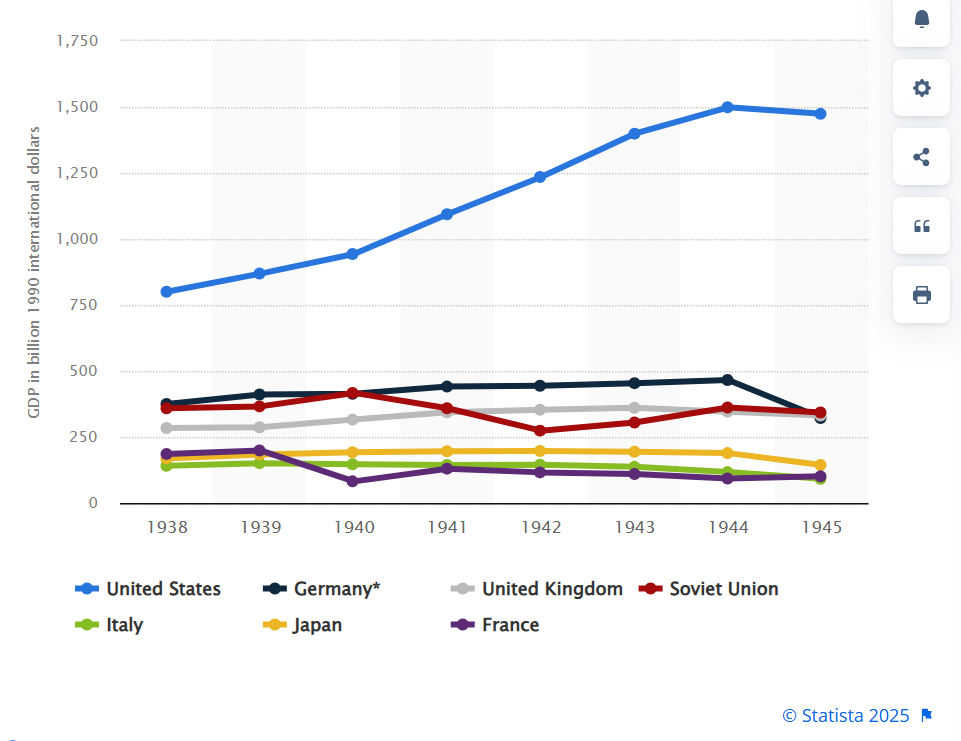
The US economy has grown 11-fold since then in real economic terms. The US economy, which won the war, was just 9% as large as it is today! This is a little less than 3-fold population growth combined with 4-fold per capita production/income growth.

Visually, it is clear that US economic growth has been steady across these 80 years, only interrupted by a few severe recessions.

The US had already doubled its GDP between 1938 and 1945. So, the US economic growth was 22-fold from 1938 to 2025. Other leading countries showed flat total output in the war era.

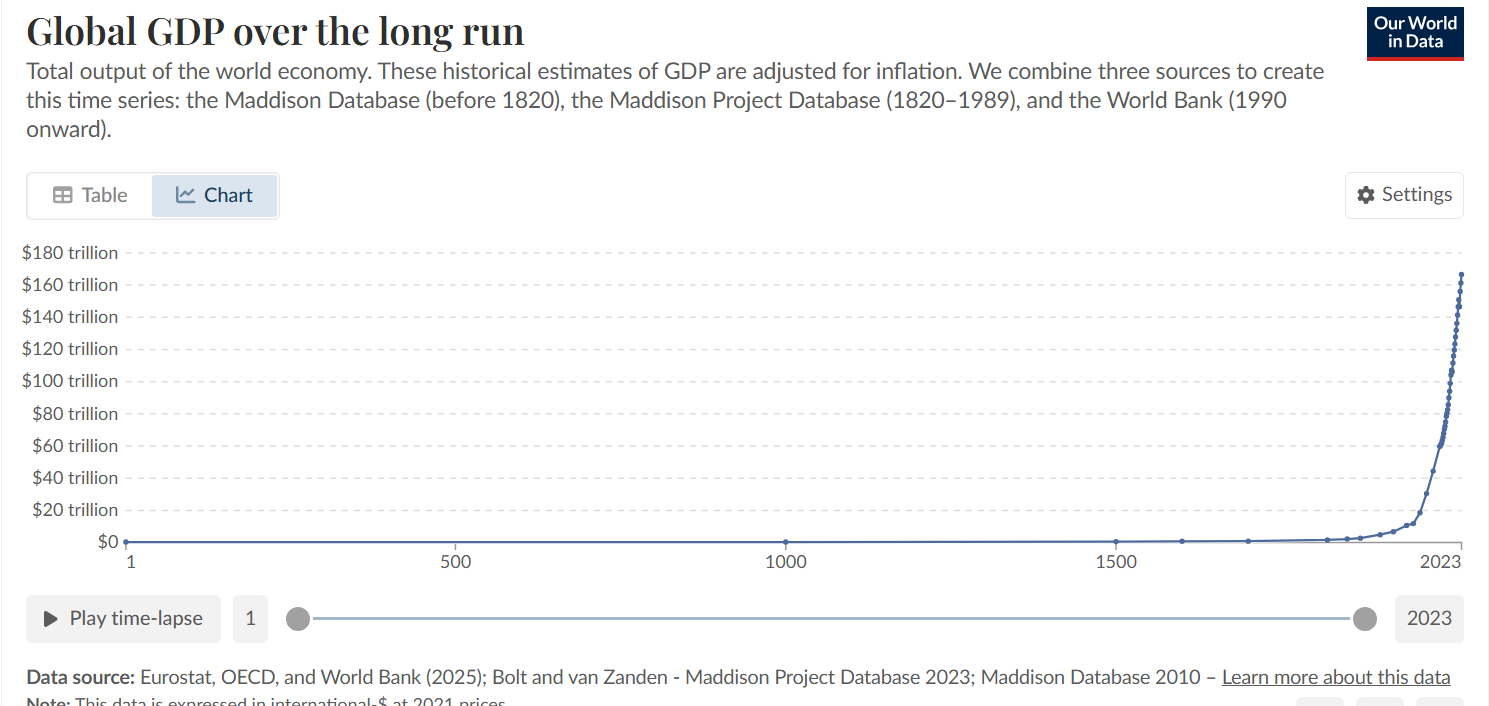
https://ourworldindata.org/grapher/global-gdp-over-the-long-run

Global GDP growth essentially started in 1820. 80 year periods until 1940 yielded 3X economic growth. 11X or 22X was a “whole new ball game”.

Another data source confirms the 15X post war real economic growth.

https://en.wikipedia.org/wiki/List_of_countries_by_largest_historical_GDP

Country level data confirms the global growth pattern.

Russia 8x

UK 8x

China 300x

India 150x

France 8x

Germany 9x

Italy 9x

Japan 21x

Canada 12x

https://en.wikipedia.org/wiki/Angus_Maddison_statistics_of_the_ten_largest_economies_by_GDP_(PPP)

This chart shows that the US reached its apex as a share of global GDP right after WWII. I think that president Trump mistakenly believes that the US could have maintained its 28% global market share forever. In more realistic terms, the US reached 19% of global GDP in 1913 and properly maintained that share in 2008.

Summary

The post-WW II global institutions drove 11-fold growth for the US and 15-fold growth for the world. The historical benchmark in 3x. The US experienced an extra doubling of its economy from 1938-1945. The mercantilist views of 1880-1920 simply cannot compete with the post-war free trade regime.

The Trade War is Just Another Distraction

The “orange one” does not “hold all of the cards”. He is critically threatened by his foreign handlers and the US justice system. He was not elected to promote a trade war. No one expected a trade war. He merely “shadow boxed” during his first term on trade. He has made the “trade war” his first priority because it is a “sure win” politically, in the short-run. He first bluffed exaggerated 50% and 100% tariffs, and the media duly reported these crazy claims that anchor or outline the story. He now claims HUGE victories with 15% tariffs. The self-described GOAT negotiator thereby proves his standing. He claims victory. He uses this temporary bump in support to take over the government.

Citizens need to recognize that this is clearly not a “win” for the country. Import tariffs are simply taxes. They get split between the foreign exporter, the importer and the retail customer. At 15%, the typical payment split is 25%, 25% and 50%. Exporters still want to sell goods and maintain market share. They have fixed costs. They have profits. They can reduce prices in the short-term. Importers still want to sell goods and maintain market share. They can limit price increases in the short-term. Most markets are “sticky”. Brands, supply chains, habits, marketing and convenience matter. Import costs are half to three-quarters of retail prices. The consumer price increase is 5-8%. Some consumers switch to lower priced options, some don’t. The “next best” low price option for an imported good is probably another imported good. The “Trump tariffs” distort markets. They don’t deliver a “victory” for American consumers, producers, labor, finance or government. They merely “gum up the works”.

The “orange one” understands leverage, populism and persuasion. He really doesn’t understand markets, as demonstrated by his dozens of business failures. A 15% import tariff will cause pain for foreign exporters, US importers and consumers. It’s not large enough to cause a domestic firm to invest in expanded capacity. They will use all of their existing capacity and even cut prices a little to win market share. Manufacturing investments require 20-30-40 year timeframes to be viable. They require confidence in government policies on trade, regulations, antitrust, labor, environment, intellectual property, lobbying, property taxes, inventory taxes, corporate income taxes, international taxes, international finance, transportation, supply chains, labor costs, etc. Trump’s policies strongly work against such investments.

US industries don’t import goods to save just 10%. They import goods because the total cost of imports is at least 20% lower and trending in the right direction. Importing always has extra costs for transportation, communications, delays, coordination, property risks, quality control, product development, supplier management, flexibility, tariff risks on both ends, legal risks, capital controls, financial transactions, inventory, obsolescence, etc. There is a “step function” involved here. US firms from 1970-2000 only relinquished their domestic manufacturing because when they completely ignored all fixed costs and only looked at short-term variable costs, they had to outsource production. There will be no overall manufacturing renaissance. There will be some very low labor cost manufacturing that returns to the states. That is, only where labor costs are a small percentage of the total production cost. Hence the “job creation” impact will be tiny, impossible to measure.

So … if they won’t build new factories, what will be the leading responses of domestic importers? They will find ways to import/reroute goods from lowest tariff countries. They will find ways to reclassify goods and avoid tariffs. They will lobby for exemptions. They will import only key components and do “final assembly” locally in highly automated factories. They will hold imported goods in a Free Trade Zone. They will split physical products from services and intellectual property to minimize tariffs. They will lobby for domestic government subsidies. They will offer “service hour models” to customers as in aircraft engines and never sell the physical goods and incur the tariffs.

Will the import tariffs reduce the federal budget deficit? Yes. The US imports 15% of GDP. Tariffs will be applied to about half of the imports. Imports will be reduced and replaced by domestic production, a little. 15% of 5% is about 0.75% of GDP. The federal budget deficit is 6.5% and climbing. This will help a little. Consumers will pay for half of this as in a sales tax.

What are the secondary impacts of the tariffs? Domestic firms will invest management time and money in managing the system instead of developing better goods and services. Lower import competition often leads to higher prices overall. Domestic producers experience higher input costs and attempt to pass them along to consumers. Foreign countries will increase their tariff and non-tariff barriers to US exporters. The US loses its moral advantage as a promoter of “free trade”. The US loses opportunities to reduce trade barriers through global and regional “free trade” agreements. The US loses the opportunity to drive global labor and environmental standards. The US loses the opportunity to expand free trade in services, the industries of the future. The US’s “unfair advantage” as the manager of the US dollar as the global currency will be challenged. The US’s soft power in language, arts, education, language, culture, and global leadership will be questioned. The US’s role as a stalwart ally will be undermined, leading to merely costlier and unreliable transactional relations with former allies. Foreign citizens will choose to not consume US goods and services. The US will have to pay directly for its global military bases. The US will have to pay for allies’ support on the “war on terror”. The US will have to pay for all global initiatives. The US will have to directly control “rogue states”. The indirect costs are HUGE and unappreciated.

Why did the US pursue the post WW II new world order? Ending imperialism and colonies. Forming the United Nations and trying to use it to manage some conflicts. Principles of political self-determination and human rights. Global bodies for better health. Investments in Germany, Italy, Japan and Europe instead of reparations. International Monetary Foundation and World Bank to support developing nations and manage currencies. GATT and WTO to promote lower trade barriers and multilateral deals. NATO and other alliances rather than colonies and protectorates. The win/lose approach of the 1800’s, WWI and WWII had failed. The world was ready to try a win/win approach. The US, with its history of isolationism, exceptionalism and national independence, chose to not pursue “world dominance”. The post- WWII institutions were not perfect, but they demonstrated that they were much better than those that had governed international relations for the prior 500 years.

Again, put everything in perspective. The US imports 15% of GDP. 15% import tariffs on half of goods. Consumers adjust and substitute domestic and lower total price imports. US consumers pay a 1% sales tax on imported goods. US military and influence costs rise by much more than 1% of GDP. Consumers pay higher prices. The US has less global influence. Where is the win? Marginal manufacturing plants and jobs are not returning to the US, no matter what the “orange one” says unless they are subsidized by the local, state or national government.

This is just another “con” by the “orange one”. We want to believe that American jobs have been unfairly stolen by government subsidized factories and low-cost labor without environmental protections in foreign countries. There is a grain of truth in each claim. Foreign governments do subsidize export firms. They try to maintain low currency values to support exports. They accept low total labor costs and environmental damages. Every country tries to be globally competitive.

No “magic wand” exists to force or entice everyone into embracing win/win institutions or deals naively. There is always an incentive to be a “free rider”, taking advantage of the global deals and quietly not really complying, just like some oil producers in OPEC. There is always an advantage for a single country with enough power to “hold out” or bluff or play “chicken” to extract a better deal for that country than for the others. This is the real world of bargaining, negotiations and deal-making. No system, philosophy, institutions, social pressure, or trump card easily delivers win/win results without overcoming the win/lose incentives of the game’s players.

There was a time when “Republicans” were supposedly the party of realism, pragmatism, common sense, business, efficiency, logic, finance, trade, capitalism, science, industry, proof, objectivity, best practices, and elite opinion. “Democrats” allegedly appealed to emotions, wishes, utopias, fairness, justice, perspectives, hopes, possibilities, oppression, victimhood, persuasion, popular opinion, populism, and ideals. The post-WWII institutions were supported on a bipartisan basis for more than 50 years. In 1992, President Clinton and the Democratic party embraced the “third way”, fully supporting these policies, capitalism and limited government, despite criticisms from the progressive, new, far left. The post – WWII system of international institutions has been criticized as “globalism” and “neo-liberalism” by the left wing of the Democratic party.

The post-WWII institutions were not perfect for Democrats, Republicans, the USA or the global community. But they worked incredibly well. Real global GDP has increased by 40 times since 1945, from $2.5 trillion to $100 trillion!!!!! That is 4.72% real growth compounded year after year after year for 80 years, coming out of a world war, encompassing a cold war, the Vietnam War, the Korean War, a global pandemic, the collapse of birth rates, business cycles, financial panics, energy crises, Middle East wars, and terrorism.

The US real GDP increased by more than 11X in the same period, growing by 3.1% annually.

https://fred.stlouisfed.org/series/GDPC1

A comparable 80-year period before the Great Depression shows just 4-fold global real GDP growth, not 40-fold. Of course, much of this difference is due to differences other than the post-WWII institutions. This was a time of 1.75% annual growth rather than the modern 4.72%. The 3% annual difference compounded across 80 years delivers 10 times greater growth. This is not a marginal advantage. This is an UNBELIEVABLE advantage. This is difficult to communicate. Small percentage differences across a lifetime.

Summary

The “bottom line” is that the “orange one” only believes in “win/lose” and rejects any form of “win/win”. The post-WWII institutions are win/win, so they must be rejected. Capitalism, alliances, partnerships, joint ventures, corporations, modern supplier relations, families, communities, nations, treaties, fraternities, sororities, ecosystems, clubs, cooperatives, unions, study partners, mentors/mentees, credit unions, mutual insurance companies, social enterprises, not-for-profits, churches, service organizations and many others are win/win. The “win/lose” framework supports the “orange one’s” desired position as a great leader needed to save the people.

Free trade has provided truly amazing benefits for the US and the world. The post-WWII cooperative institutions have reduced wars and conflicts. The “Trump tariffs” will slow global economic growth. They will not provide any material benefits for the US.

The US has enough economic, social, political and military power to force country by country “deals” that appear to benefit the US, when considered in a short-term win/lose framework. These deals will harm the US and the global economy.

From 1945-2000 “free trade” was Republican economic orthodoxy. “Free trade” benefitted US multi-national corporations which had the ability to take advantage of global markets. The US economy and labor markets were flexible enough to manage the changes. Capitalism was supported as the best economic system versus communism, fascism, socialism, protectionism, imperialism, colonialism or mercantilism. US financial institutions were well positioned to facilitate trade. US universities were ready to educate the world. Imported goods and immigrant labor drove lower US wages.

Trump is appealing to his populist base to oppose the “others” of immigrants, non-whites, non-fundamentalist Christians, criminals, thieves, rapists, sweat shops, subsidized factories, polluters, underpaid workers, etc. “We should produce everything we need in America. We have the factory capacity, finances and skills to do so.” He appeals to nationalism while ignoring the critical principle of comparative advantage. Countries export only what they are very best at growing, producing or serving. They do not produce everything themselves just like states, firms and individuals that are not fully self-sufficient.

Modern History: Math (and Physics)

1543 – The Sun is the center of the universe, sort of, not the earth.

https://en.wikipedia.org/wiki/Nicolaus_Copernicus

1611 – The Sun is the center of the universe, sort of, and I have scientific, observational proof.

https://en.wikipedia.org/wiki/Galileo_Galilei

1637 – The world can be described mathematically, in 3 clear dimensions. We can convert geometry into algebra. We can “know” everything. And in my spare time I will revolutionize philosophy too.

https://en.wikipedia.org/wiki/Ren%C3%A9_Descartes

1654 – We can use algebra to fully describe uncertain, probable events. In my spare time, I will contribute to mathematics, physics, chemistry, theology and the scientific method.

https://en.wikipedia.org/wiki/Blaise_Pascal

1673 – The world can be understood. Calculus, philosophy, politics, law, library science, music, biology. Newton was greater. Leibniz gets second billing then and now.

https://en.wikipedia.org/wiki/Gottfried_Wilhelm_Leibniz

1687 – The world can be understood. Calculus, physics, astronomy, theology, optics, scientific method, alchemy. The reduction of physical forces to a simple equation is the highlight of all science. His legacy is largely misunderstood. He remained religious. He was a mystic and an alchemist. Describing events mathematically did not “explain” them. Aristotle’s emphasis on “final” causes still mattered.

https://en.wikipedia.org/wiki/Isaac_Newton

1734 – The world is dynamic and complex. Yet, we can still describe it mathematically. Let’s describe sets of differential equations. Defining several fields of mathematics. Showing how math can be applied to physics. Perhaps the greatest mathematician of all time.

https://en.wikipedia.org/wiki/Leonhard_Euler

1821 – Carl Gauss competes for the greatest mathematician of all time. Algebra, geometry, connections between subfields, many challenges solved, analysis, topology, non-Euclidean geometry, astronomy, calendars, advances in probability theory, maps, magnetism, optics and mechanics.

https://en.wikipedia.org/wiki/Carl_Friedrich_Gauss

1830 – The earth is not fixed. It evolves through long time as shown in the geological record.

https://en.wikipedia.org/wiki/Charles_Lyell

1847 – We can formalize Aristotelian logic in algebra as ones and zeros. Look out computers.

https://en.wikipedia.org/wiki/Boolean_algebra

1854 – Geometry is an analytical discipline. It is not limited to the simple Greek solids of Euclid. It can be applied to a variety of “spaces”. OMG!

https://en.wikipedia.org/wiki/Riemannian_geometry

1862 – Electricity and magnetism can be described by a set of equations, more complex, but similar to those of Newton describing gravity. We barely understand these phenomena, but the equations can predict how they function. Math and physics.

https://en.wikipedia.org/wiki/A_Dynamical_Theory_of_the_Electromagnetic_Field

https://en.wikipedia.org/wiki/James_Clerk_Maxwell

1895 – We can describe an abstract mathematics called “set theory” which describes how individual components relate to the whole. This approach can describe all formal logic. It can potentially serve as the basis for all of mathematics. It begins to fully address the idea of infinity.

https://en.wikipedia.org/wiki/Set_theory

1895 – The world is mainly comprised of waves of various lengths. Some wave lengths can be used to “see” within physical objects. We’ll call them X-rays.

https://en.wikipedia.org/wiki/X-ray

1911 – The atom is much more complicated than we thought. It has a center of protons and neutrons. It has multiple shells of probabilistically present tiny electrons. Atomic particles “disappear” as radioactive decay based on probabilities.

https://en.wikipedia.org/wiki/Ernest_Rutherford

1915 – Everything you thought you knew about the world is false! The speed of light is fixed. There is no physical background space “ether”. Speed of light is a rare constant. Energy and matter are interchangeable. Time and space interact. Time is relative. Space is warped by matter (gravity). In essence, several dimensions of reality cluster, pull, interact, interrelate together in mathematically describable ways. Everything is very connected. I worked the rest of my life to combine the laws of physics, but they did not comply.

https://en.wikipedia.org/wiki/Albert_Einstein

1925 – We’ve digested all of the new theories and experimental results. Everything in the universe is unavoidably probabilistic. Light is wave and particle. Space is relative. Electrons are probably in SPDF circuits. Particles are probably there! Measurements impact reality. Schrodinger’s cat can be dead or live. Spooky action at a distance. We can never really know “for sure”. This is before the exploration of sub-atomic particles which raises many more very difficult questions.

https://en.wikipedia.org/wiki/Quantum_mechanics

1927 – The universe was created from a single point in time. Confirmed in 1965.

https://en.wikipedia.org/wiki/Big_Bang

https://en.wikipedia.org/wiki/Cosmic_background_radiation

1928 – Many decisions can be analyzed as games and optimal strategies defined.

https://en.wikipedia.org/wiki/Game_theory

1931 – We cannot reduce any “robust” mathematics to simple formal logic or set theory. Infinity and other non-reductionist components stand in the way.

https://en.wikipedia.org/wiki/G%C3%B6del%27s_incompleteness_theorems

1942 – Power from atomic decay is possible.

https://en.wikipedia.org/wiki/Nuclear_power

1947 – A general solution strategy is available to solve optimization problems subject to multiple constraints.

https://en.wikipedia.org/wiki/Linear_programming

1960 – We live in a special place. Several physics constants are needed to allow life to exist and evolve. This set of constants is very unlikely.

https://en.wikipedia.org/wiki/Fine-tuned_universe

1968 – Systems are everywhere. They obey certain laws.

https://en.wikipedia.org/wiki/Systems_theory

1975 – There are fractional dimensions everywhere!

https://en.wikipedia.org/wiki/Benoit_Mandelbrot

Summary

Our universe has a well-defined structure. Observer perspective really matters. Mathematical equations are amazingly powerful. There is no simple deterministic universe. It is probabilistic “turtles all the way down”. Perspective is relative. New mathematical perspectives are impossible to predict and difficult to comprehend.

Modern History: International

1803 – Napoleonic Wars embroil the European continent.

https://en.wikipedia.org/wiki/Napoleonic_Wars

1814 – Spanish American wars of independence.

https://en.wikipedia.org/wiki/Spanish_American_wars_of_independence

1839 – Opium Wars between China and European powers

https://en.wikipedia.org/wiki/Opium_Wars

1848 – European popular revolutions due to clashes of old and new, rich and poor.

https://en.wikipedia.org/wiki/Revolutions_of_1848

1861 – Nationalism drives unification of Italy and Germany.

https://en.wikipedia.org/wiki/Unification_of_Italy

https://en.wikipedia.org/wiki/Unification_of_Germany

1868 – Meiji Restoration in Japan

https://en.wikipedia.org/wiki/Meiji_Restoration

1885 – European colonization of Africa

https://en.wikipedia.org/wiki/Colonisation_of_Africa

1898 – Spanish – American War

https://en.wikipedia.org/wiki/Spanish%E2%80%93American_War

1904 – Russo – Japanese War

https://en.wikipedia.org/wiki/Russo-Japanese_War

1914 – World War I

https://en.wikipedia.org/wiki/World_War_I

1917 – Russian Revolution

https://en.wikipedia.org/wiki/Russian_Revolution

1920 – League of Nations

https://en.wikipedia.org/wiki/League_of_Nations

1933 – Nazi Germany

https://en.wikipedia.org/wiki/Nazi_Germany

1933 – Holocaust, Victims of Nazi Germany

https://en.wikipedia.org/wiki/Victims_of_Nazi_Germany

1939 – World War II

https://en.wikipedia.org/wiki/World_War_II

1945 – Atomic Bombings

https://en.wikipedia.org/wiki/Atomic_bombings_of_Hiroshima_and_Nagasaki

1945 – United Nations

https://en.wikipedia.org/wiki/History_of_the_United_Nations

1944 – Bretton Woods Agreement – global monetary and trade policy

https://en.wikipedia.org/wiki/Bretton_Woods_Conference

1947 – Cold War

https://en.wikipedia.org/wiki/Cold_War

1947 – Indian Independence Movement

https://en.wikipedia.org/wiki/Indian_independence_movement

1948 – Marshall Plan

https://en.wikipedia.org/wiki/Marshall_Plan

1948 – State of Israel

https://en.wikipedia.org/wiki/History_of_Israel_(1948%E2%80%93present)

1949 – NATO

https://en.wikipedia.org/wiki/History_of_NATO

1949 – People’s Republic of China

https://en.wikipedia.org/wiki/Proclamation_of_the_People%27s_Republic_of_China

1951 – European Union

https://en.wikipedia.org/wiki/History_of_the_European_Union

1954 – Japanese Economic Miracle

https://en.wikipedia.org/wiki/Japanese_economic_miracle

1962 – Cuban Missile Crisis

https://en.wikipedia.org/wiki/Cuban_Missile_Crisis

1973 – Energy Crisis

https://en.wikipedia.org/wiki/1973_oil_crisis

1975 – Vietnam War Ends

https://en.wikipedia.org/wiki/Vietnam_War

1979 – US and China normalize relations

https://en.wikipedia.org/wiki/China%E2%80%93United_States_relations#Normalization

1979 – Iranian Revolution

https://en.wikipedia.org/wiki/Iranian_Revolution

1985 – Asian Four Tigers Economic Growth

https://en.wikipedia.org/wiki/Four_Asian_Tigers

1989 – End of Cold War, Fall of the Berlin Wall

https://en.wikipedia.org/wiki/Cold_War_(1985%E2%80%931991)

https://en.wikipedia.org/wiki/Fall_of_the_Berlin_Wall

1990 – End of South African Apartheid

https://en.wikipedia.org/wiki/Negotiations_to_end_apartheid_in_South_Africa

2001 – September 11 Attacks

https://en.wikipedia.org/wiki/September_11_attacks

2001 – China joins WTO, economic growth accelerates, poverty reduced

https://en.wikipedia.org/wiki/Economic_history_of_China_(1949%E2%80%93present)

https://en.wikipedia.org/wiki/Poverty_reduction

2004 – Enlargement of the European Union

https://en.wikipedia.org/wiki/Enlargement_of_the_European_Union

2014 – Russian Invasion of Ukraine

https://en.wikipedia.org/wiki/Russian_invasion_of_Ukraine

Summary

Colonization and de-colonization. Opening of Asia. World Wars. Nuclear threats. International integration. Economic progress. Bipolar, superpower, multipolar world.

Modern History: Philosophy and Politics

1597 – Nature, data, experiments, inductive reasoning and skepticism are good methods to find truth.

https://en.wikipedia.org/wiki/Francis_Bacon

1637 – Radical doubt. No final ends. Just me. I think, therefore I am. How much can I logically derive from a few irrefutable “first principles”?

https://en.wikipedia.org/wiki/Ren%C3%A9_Descartes

1648 – We cannot settle religious conflicts by war. We’ll let princes choose for their subjects.

https://en.wikipedia.org/wiki/Peace_of_Westphalia

1689 – The individual exists as a free self to be created. A “social contract” to form a government must respect the individual.

https://en.wikipedia.org/wiki/John_Locke

1755 – The individual is born good, subjective and feeling. Society may threaten the individual.

https://en.wikipedia.org/wiki/Jean-Jacques_Rousseau

1781 – There is a reasonable moral structure like the “golden rule”. Reason is powerful but limited.

https://en.wikipedia.org/wiki/Immanuel_Kant

1783 – Self-government with limited power is possible and potentially effective.

https://en.wikipedia.org/wiki/American_Revolution

1789 – “The people” can overthrow the ancient regime. Governing is a bigger challenge. The “nation” and ideals (liberty, equality, fraternity) are very, very powerful tools.

https://en.wikipedia.org/wiki/French_Revolution

https://en.wikipedia.org/wiki/Anti-clericalism

1790 – The accumulation of wisdom in society’s institutions and history should not be ignored. We should wisely and cautiously conserve these assets.

https://en.wikipedia.org/wiki/Edmund_Burke

1800 – I am not a machine. Nature, feelings, imagination, creativity, art, supernatural, history, exotic, mysterious, unique, heroism, passion, intuition, chivalry, myth.

https://en.wikipedia.org/wiki/Romanticism

1807 – History is a separate world force. Thesis, antithesis and synthesis drive the world forward.

https://en.wikipedia.org/wiki/Georg_Wilhelm_Friedrich_Hegel

1843 – The modern individual living his daily life faces big existential challenges that cannot be resolved with certainty.

https://en.wikipedia.org/wiki/S%C3%B8ren_Kierkegaard

1848 – Production techniques drive economic power relations. Revolution of the working class will necessarily occur, resulting in an ideal society.

https://en.wikipedia.org/wiki/Karl_Marx

1848 – Utilitarian emphasis on pain and pleasure. Liberty as the supreme value. Yet, government actions to reach valuable ends, including redistribution, are also needed.

https://en.wikipedia.org/wiki/John_Stuart_Mill

1850 – The strong are “naturally” entitled to protect their assets against the claims of the weak.

https://en.wikipedia.org/wiki/Social_Darwinism

1878- Practical results matter. Abstract philosophical systems cannot be evaluated in other ways.

https://en.wikipedia.org/wiki/Pragmatism

1883 – God is dead. Christianity is a “slave religion”. A few can be the supermen, embracing their powers.

https://en.wikipedia.org/wiki/Friedrich_Nietzsche

1890 – Governments, institutions and rational structures can address the challenges of modern civilization.

https://en.wikipedia.org/wiki/Progressive_Era

1890 – “The people” have high expectations that their “will” will be followed.

https://en.wikipedia.org/wiki/Populism_in_the_United_States

https://en.wikipedia.org/wiki/Populism

1906 – Government regulation is needed in some situations to overcome the shortcomings of “laissez faire” capitalism.

https://en.wikipedia.org/wiki/The_Jungle

1913 – All of mathematics can be reduced to formal symbolic logic. Everything is logically consistent. All of science and politics and philosophy might also be so structured.

https://en.wikipedia.org/wiki/Principia_Mathematica

1915 – The nation is most important. Centralized power is necessary to fulfill the nation’s goals.

https://en.wikipedia.org/wiki/Fascism

1920 – Women have the same political rights as men. Perhaps similar social status.

https://en.wikipedia.org/wiki/Women%27s_suffrage

1933 – The government is ultimately responsible for the economic welfare of its people.

https://en.wikipedia.org/wiki/New_Deal

1935 – The government is responsible for insuring its citizens against poverty and disability.

https://en.wikipedia.org/wiki/Social_Security_(United_States)

1943 – Man freely exists in a universe lacking predetermined meaning. Man can define his own meaning.

https://en.wikipedia.org/wiki/Jean-Paul_Sartre

1948 – All humans are “born free and equal in dignity and rights” regardless of “nationality, place of residence, sex, national or ethnic origin, colour, religion, language, or any other status”.

https://en.wikipedia.org/wiki/Universal_Declaration_of_Human_Rights

1961 – Power is the ultimate guide to understanding the world. The powerful exploit others. Opposing this exploitation is the duty of those who understand.

https://en.wikipedia.org/wiki/Post-structuralism

1962 – Science is not inherently rational. Major paradigms are determined by groups of scientists.

https://en.wikipedia.org/wiki/The_Structure_of_Scientific_Revolutions

1963 – Socially determined roles for women prevent true happiness.

https://en.wikipedia.org/wiki/The_Feminine_Mystique

1964 – The federal government actively prohibits racial, national and sex discrimination.

https://en.wikipedia.org/wiki/Civil_Rights_Act_of_1964

1970 – The environment is recognized as a collective asset worthy of conservation.

https://en.wikipedia.org/wiki/Earth_Day

1971 – “A Theory of Justice” justifies government actions to limit unfair results. Classical liberals cheer.

https://en.wikipedia.org/wiki/John_Rawls

1974 – Only a minimal government libertarian state is justified. Touche!

https://en.wikipedia.org/wiki/Robert_Nozick

1974 – A US president was forced out of office for his criminal activities. The transfer of power worked. Confidence in government and institutions was shaken.

https://en.wikipedia.org/wiki/Impeachment_process_against_Richard_Nixon

1980 – A pro-market, socially conservative political party was elected by reframing the terms of the debate away from economic security and inequality.

https://en.wikipedia.org/wiki/Ronald_Reagan

2017 – The Republican Party increasingly appealed to a coalition of economic winners, social conservatives, libertarians and populists, embracing a transactional, common-sense patriotic nationalism.

https://en.wikipedia.org/wiki/Donald_Trump

Summary

“Practical men who believe themselves to be quite exempt from any intellectual influence, are usually the slaves of some defunct economist. Madmen in authority, who hear voices in the air, are distilling their frenzy from some academic scribbler of a few years back” – John Maynard Keynes

Bacon and Descartes provided early alternatives to the prevailing integrated religious worldview. Locke and others outlined the individual based “social contract” theory that provided a basis for the American and French revolutions. The American model continued to inspire while the French model both inspired and frightened. The rational Enlightenment view led to utilitarianism, pragmatism and progressivism plus the reactions of Romanticism, Marx and Nietzsche. Conservative reactions of Burke, Social Darwinism and Fascism also occurred. “Big government” was adopted as a potential positive force by the left as well. Individual rights were increasingly recognized in theory and practice. Post-war existentialism and postmodernism replaced discredited Marxism on the left. The Reagan/Thatcher revolution re-established pro-market and traditional social conservatism as a dominant force. Trump capitalized on the populist themes and media tools of the skeptical post-Watergate era.

Science versus religion. Church and state. Individual and community. Rich and poor. Liberty versus justice. Liberal versus conservative. Populists and elites. State and international politics. What should we do? Who should decide? What is the best structure? How do we protect minority rights? Protect the goose that lays the golden eggs.

The U.S. and Western system of government regulated capitalism, relatively free trade and democratically elected limited government dominated the second half of the twentieth century. In 1992 Francis Fukuyama proclaimed, “The End of History”. This “Western consensus” view is increasingly challenged today.

‘Many forms of Government have been tried and will be tried in this world of sin and woe. No one pretends that democracy is perfect or all-wise. Indeed, it has been said that democracy is the worst form of Government except for all those other forms that have been tried from time to time.…’ – Winston Churchill

Palantir/Alexander Karp Speak

https://en.wikipedia.org/wiki/Palantir_Technologies

Palantir was founded in 2003. It has 4,000 employees and $3B of revenues using technology to make the military more effective. It is valued at more than $300B, the 30th most valuable company in the world! Yes, 100X revenues (not 8X or 25X) and $75M per employee (not $3M-10M). The founder, Alexander Karp, has written a book about what’s wrong with the US and what to do about it, in his spare time. The book jacket says he earned his doctorate in “social theory” from Goethe University in Frankfurt.

The 218-page book is rambling, with an extra 66 note pages. The bottom line is that everyone should be like the author, a hard charging owner engineer, focused on technical results AND deeply interested in the social, political and economic success of the nation. Hence, it crosses political boundaries!!!! A majority of the book castigates “the left”. About a quarter criticizes the shallow market right. However, the author raises great questions about what is required for success by the US that should not be discounted by either side of the political spectrum, IMO.

On specific policy questions, the author wants freedom for his firm to grow and succeed. Define some guardrails for AI. Don’t worry about personal freedom versus facial recognition. Invest in science. Prioritize science and technology. Honor leaders and leadership. Support the founder and ownership culture. Value science above finance and consulting. Adopt hard power, hawkish, deterrence foreign policies. Prioritize economic growth. Embrace best business practices. Validate rational trade-offs.

Crush “The Left”, It is Destroying Civilization

Karp claims that the “vampire squid” left is:

  1. Anti-nation, post-nation, completely, irrevocably, unapologetically.
  2. Without ideals, goals or ends.
  3. Skeptical, opposing any beliefs, deconstructing all.
  4. Opposing any national, community or political identity!
  5. Uninterested in defining “the good life”.
  6. Opposing the use of technology in support of the goals of the state or society.
  7. Opposing the legitimization of the state via economic growth.
  8. Uninterested in using the capabilities of technology for key industries.
  9. Promoting neutral, rudderless values in the nation’s elites.
  10. Prioritizing “woke” AI controls.
  11. Restricting free speech.
  12. Complacent about international threats.
  13. Seduced by the lure of global peace, values and organizations.
  14. Overly idealistic, unable to consider pragmatic trade-offs.
  15. Unwilling to hold allies accountable.
  16. Enamored with the role of trade alone in preventing national disputes.
  17. Lost in the controlling ideology of “the oppressor vs. oppressed”.
  18. Bereft of core values.
  19. Vindictive, punishing opponents.
  20. Unwisely emphasizing the pure moral character and actions of public office holders.
  21. Ignorant of the role of culture in managing society.
  22. Prioritizing individual rights at the expense of community.
  23. Anti-Western culture and civilization.
  24. Anti-community, of any kind.
  25. Anti-shared, objective values or morality, especially by society’s elites.
  26. Universalist, idealist, cosmopolitan opposed to practical and local values.
  27. Anti-religious.
  28. Unworried that the “separation of church and state” undermines belief.
  29. Promoting tolerance and pluralism in order to undermine any objective truth.
  30. Highlighting legal compliance and individual rights at the expense of “the good” and true justice.
  31. Defining a realm of acceptable “liberal” values and prohibiting other values.
  32. Opposing any benefits from historical civilizations.
  33. Mostly interested in reviewing the oppressive roles of colonial empires.
  34. Uninterested in objective physical or moral truths.
  35. Uninterested in problem solving.
  36. Certain of its moral superiority versus political and class opponents.
  37. Opposed to conventional, objective, scientific knowledge.
  38. OK with a “thin” moral world of market efficiency and legal freedoms.
  39. Mostly interested in “performative discourse” instead of critical thinking.
  40. Committed to a martyr’s idealism in political performance.
  41. Opposed to recognizing the key role of great leaders.
  42. Uninterested in the moral dimension of life.
  43. Actively opposed to the moral and practical advances of Western Civilization.
  44. Ambivalent regarding any objective notion of objective truth or beauty.
  45. Opposed to the “great man” concept of history, replacing it with social pressures alone.
  46. Committed to the self-evident progress of man through science, alone.

The extreme claims are mostly self-refuted by any neutral reader. Karp inappropriately commingles postmodernism, classical liberalism, liberal institutions, interest groups, the Democratic Party and its supporters. It is unclear whether he is an advocate employing the strawman technique or really doesn’t understand the differences between the many groups in the leftist coalition. He generally defines the most extreme, exaggerated, indefensible examples for criticism. He ignores the differences between philosophers and real people. He does quite a bit of name calling. He portrays his opponents as simpletons, unaware of tradeoffs. He generalizes leftists as pure feeling, intuitive beings rather than mixed constructive thinkers. He fails to recognize any of Jonathan Haidt’s morality flavors as being essentially important to left and right.

The Right is Not Blameless

  1. The market pays finance/consulting folks more than engineers.
  2. In the end, idealism is more important than pragmatism!
  3. The neoliberal philosophy that elevates the market above religion is clearly wrong.
  4. The pure market, pragmatic philosophy undermines any ultimate ends.
  5. The commercial world is uninterested in “the good life”.
  6. Criticism of “the state” undermines its valid role and what technology can do.
  7. The state must be perceived as legitimate. An extreme distribution of wealth and income must be addressed in the political process.
  8. A meritocratic, secular world alone cannot generate consensus values.
  9. Growing international trade alone is not enough to avoid conflicts.
  10. A commercial society does not require its managerial elites to engage in the political process.
  11. The “productization” of life, the rise of instrumental logic, places humanity at risk and threatens any sense of cultural community or values.
  12. The default hierarchical structure of large bureaucratic organizations is inherently less efficient and effective in the long run.
  13. The most valuable, effective employees require freedom from rules and obedience.
  14. Key government roles are valuable and should be compensated accordingly.
  15. Inclusivity is required for firm effectiveness.
  16. Firms are artificial entities. Like citizens, they should be obligated to support the nation.

Real Problems/Challenges/Opportunities

  1. As a nation, we don’t have generally agreed upon priorities, values, and ideals.
  2. Since we don’t have priorities, we don’t effectively apply our rich resources as a nation.
  3. We don’t have a consensus that other values trump market values.
  4. We don’t appreciate the critical role of the nation. We have lost our patriotism.
  5. We don’t have a dream, story, history, myth, image of a great nation. Without some constructive narrative we won’t have a civilization.
  6. Lacking a national identity, we are rootless, anxious, listless, worried, adrift.
  7. Nationalism is replaced by globalism or secularism as an organizing structure.
  8. In post-Vietnam, Watergate, 1960’s world, skepticism is the default world view, undercutting the development, acquisition, promotion or application of any serious moral, social, cultural, religious or political belief.
  9. Skepticism is a self-reinforcing worldview. The lack of “belief” undermines interpersonal trust, institutions, community, politics and patriotism.
  10. Skepticism undermines belief in objective moral, physical and aesthetic truths. A relativist, subjective philosophy elevates tolerance, social distance, safety, and conflict avoidance as leading social values.
  11. The neo-liberal market philosophy has resulted in economic efficiency, market values and instrumental logic quietly dominating moral, social, cultural, religious and political views for many. Results matter but can be overdone.
  12. Criticism of government roles and performance has undermined the core expectation and demand that government deliver results, respond to citizens and operate effectively and efficiently. Government and science are not enemies. Government and industry are not enemies.
  13. We observe the positive results that can be delivered by entrepreneurial, founder, owner, responsible organizations but have not found solid ways to ensure that this approach impacts all industries, especially the government sector. Results matter but can be overdone.
  14. The neoliberal “free market” political philosophy of Milton Friedman justifies corporations to ignore the nation or community as a valid stakeholder. It encourages corporations to treat all decisions as opportunities to maximize economic returns, undermining other valid political, social and moral responsibilities. Results matter but can be overdone.
  15. Effective organizations relentlessly focus on final results, structuring their plans, systems, and resources with reinforcing feedback loops and expectations. Less effective organizations and industries waste resources. Global or local market competition, anti-trust regulation, tax structures, industrial policy, education, effectiveness audits, best practices sharing, outsourcing, benchmarking, etc. can be used to improve. Results matter but can be overdone.
  16. All industries contribute to a healthy economy and society. None should be allowed to be ineffective.
  17. Lacking a national culture, mass media, effective political parties, or shared religious views, the socialization of students and young adults is critical. Education matters. In a meritocracy, the role of suburban high schools and leading universities is essential.
  18. Solid and exceptional talents and leadership matter to organizations and nations. Our political systems mostly fail to use these capabilities. We apply idealistic “oughts” to our political processes rather than reasonable incentives for participation and results.
  19. We apply unrealistic ideals to political candidates instead of evaluating their effectiveness. This attracts “talking heads” and repels effective candidates. We should judge politicians as we judge other professionals, managers and leaders. Politics and governing are messy businesses, like sales, purchasing, negotiations, mergers and acquisitions in business. We need to set proper expectations and ignore how the sausage is made.
  20. Cultural and social expectations matter. They should not be set by politicians. Historically, social, economic, intellectual and leadership elites informally shaped, refined and enforced these commonly held views. In our radically individualistic culture, we have not found an effective replacement for the old approaches.
  21. In national and international politics, we need to evaluate both hard and soft power approaches. We need to consider ideals and pragmatic factors. Trade-offs are often required.
  22. Leadership matters. In a complex world, firm and political leaders require great skills to be effective.

Karp’s Solutions

  1. A stronger central government to make better choices.
  2. Industrial policies and government funding.
  3. Overhaul political incentive systems to get better candidates.
  4. Revise laws to align corporations with national priorities.
  5. Provide incentives to better use the founder/ownership model for firms.
  6. Fund scientific research.
  7. Defeat the “far left” views and policies of “progressive”, new left, postmodernist Democrats.
  8. Elevate the nation as the primary social/community vehicle for society.
  9. Promote the Teddy Roosevelt “man in the arena” view of society, politics, institutions and leadership.
  10. Promote the Teddy Roosevelt “speak softly and carry a big stick” view of international relations. Increase hard power, especially for technological areas.
  11. Use the resources of science, technology, IT and business to improve society.

Summary

Karp argues that “the technological republic” can address the problems he has identified. His primary solutions are technocratic ones. I think that the “neutral” problems he has identified are important. I don’t think his “solutions” really fix them. The solutions are mainly focused on using firms and talents like his in supporting the government’s military capabilities.

Greater nationalism is one approach to the core problems, but strong nationalism has a mixed history and may not be a widely supported solution in the modern or postmodern world. Individualism is too strong. Religious and political views are diverse. Racial, ethnic, regional and class groups are diverse.

The Worst Dealer, Ever!

The Wrong Bottom Line

Trump focuses only on win/lose. If the US earns $1 trillion from trade and the rest of the world (ROW) earns $1.2 trillion, he sees this as a $200 billion loss. The ROW is winning, taking advantage of the USA and its unenlightened deal makers. If the US earns $500 billion from trade and the ROW earns only $400 billion then we are winning by $100 billion. Trump sees the second scenario as far superior to the first. Relative winnings (win/lose) are the bottom line rather than actual winnings (win/win). This is a fundamental flaw.

The Wrong Measure

Trump only sees costs; he doesn’t consider benefits. Net benefits, benefits minus costs is the right measure.

The Wrong Timeframe

Trump only looks at the short-run. He ignores the long-run. He believes that he can always renegotiate any situation.

International Relations is Complicated

Trump only sees dollar signs. The trade balance can be measured. It is positive or negative. The cost of defense can be measured. Either we pay or others pay. We trade goods and services. Defense/security benefits matter. We care about immigration, crime, taxes, personal security, climate, health, economic development, investments, rule of law, intellectual property, labor, the environment, etc. Other countries care about all of these dimensions. We must too.

International Relations is Irrational

Citizens have an irrational commitment to their nations. They are willing to die for them. Nations have sovereignty. Each has certain minimal rights. Politicians respond to these irrational beliefs. Ignoring this reality is irrational, even though it is very frustrating.

Alliances are Cheaper than Empires

The US learned from European, Japanese and American experiences. Empires are very costly to establish and maintain. Nations can be enticed into becoming reliable allies at a fraction of the cost. They are rationally willing to evaluate costs and benefits, risks and rewards, short-term and long-term, labor and capital, sovereignty and influence, security and opportunity. Trump is right to negotiate, but wrong to discount this basic approach.

Global Agencies are Cheaper than Individual Deals

The US has greatly benefited from the post-1945 system of global governance, finance, economic development, health and trade. Global deals designed by the global leaders provide a framework for low-cost transactions. Trump believes that the strongest nations can extract even more net value through individual deals. Too many countries. Too much complexity to negotiate all of these topics effectively.

Single Deal or Repeated Deals?

Trump comes from the real estate world where each deal is “one off”. International relations and trade are repeated deals. The optimal strategy is different when the “tit for tat” strategy can be used. Firms and nations will punish any bully, even at a significant cost to themselves. The strongest players must consider the weaker players’ strategies. When firms or nations find that they cannot trust someone the total costs go up significantly.

Playing Chicken

There are many strategies in the game of chicken. The strongest player does not automatically win. Bluffing matters. Posturing matters. Resources matter. The ability to endure losses and pain matter. Allies matter. Insurance matters. Flexible resources matter. Capacity matters. Creativity matters. Credibility matters. Non-negotiable factors matter. Trump seems to confuse simple economic might with certain winning.

Comparative Advantage

Trump does not understand David Ricardo’s theory of comparative advantage from 200 years ago. You can be better than someone else in everything, at least in theory. You cannot have a comparative advantage in every production process. Between any two individuals, firms, states or nations, there will be differences in relative productivity. This is the basis for trade and specialization. The U.S. cannot be better in every industry. We can be relatively better in many industries, but not in all. As our incomes and standard of living increase, we will be relatively less competitive in those activities that can use lower cost labor. This is an unavoidable fact. We can choose to subsidize low skilled manufacturing employment, but we are fighting against very strong market forces.

Dealmaking Strategy

Trump focuses on simple short-term one-time win/lose. The best negotiators know that the greatest value comes from “growing the pie” in the long-run (win/win). They don’t assume a fixed-sum game. They cooperate to grow the pie, perhaps at the expense of suppliers, competitors, labor, investors or customers. They exploit comparative advantages to lower overall costs, lower risks and increase benefits. They share or signal their relative priorities. They fulfill their commitments. They create incentives for sustained cooperation. They cooperate to build market power. They manage customer expectations. They under promise and over deliver. They manage the government. They build shared cultural expectations and priorities. They build personal relationships. They manage large risks. They manage and coordinate supply chains. Modern business is complex. The real winners understand and deal accordingly.

Summary

Trump’s dealmaking approach fails on every critical dimension. It is a losing approach for almost all firms and for all countries. His supporters need to understand that he cannot win with his approach and force him to change. His opponents need to highlight these failures. The United States has too much at risk from Trump’s losing strategies.

Civility Crisis or Civilization Crisis?

https://www.britannica.com/topic/The-Fall-of-the-Roman-Empire

There has been a groundswell of interest in addressing the loss of civility in modern society. Members of both parties, young and old, rural, urban and suburban have begun to engage on this important topic. Civility is treating others with respect, especially when you disagree. It is a mental attitude, a habit, a character trait, a set of actions. Civility is a key to effective life in community, especially for participating in a democratic government.

Yet, I will argue that the loss of civility is a symptom of much larger challenges rather than a root cause. We need to examine and address these challenges and their causes. Other symptoms of a civilization crisis include political polarization, declining trust, weakened institutions, less social capital, deep skepticism, increased pessimism about the future, anxiety, social isolation, lack of common morality, greater income inequality, personal insecurity, diminished global institutions, and a “secular age’ where religious belief is tentative, in tension with scientism, commercialism, postmodernism, pragmatism, libertarianism, materialism, progress, individualism and the classic liberal political state.

I have summarized the root causes as:

Radical Individualism

Human Nature

Skepticism

Imperfect Myths

Our Secular Age

Insecurity

Radical Individualism and Community

We have unintentionally become a society of individualists, failing to adequately invest in community. We prioritize individual rights, commercial rights, gun rights, abortion rights, property rights, human rights, individual choice, self-actualization, creative development and raise tolerance to a mega-virtue. We need to re-establish the balance between individuals and the community.

Poisonous Politics

With the fall of the Berlin Wall in 1992, Francis Fukuyama’s bold claim that we were seeing “the end of history” seemed plausible, even likely. Liberal democracy, mixed capitalist economies and deepening global trade looked like sure winners. Historic options had been completely discredited. People are not so easily satisfied. Politicians are more creative than expected. They have redefined, repackaged, reorganized and recommunicated. They have convinced us to merge our religious and political identities. We have “retreated to our corners”, embracing polarized politics because the other guy is most certainly awful.

Fukuyama says that pure liberal democracy depends upon a cultural, community, philosophical base to hold it together. We coasted on the tails of Western civilization and Christianity, but that common source is gone. We have become so concerned with defining and defending our identities that politics has become a matter of “ultimate concern”! Klein documents how we have moved into this mess and provides some practical solutions. Haidt outlines our built-in religious/political mental patterns and how politicians use them to craft seductive policies, parties and messages.

We have paths out of this polarized dead-end.

Religion

The breakdown of the “Christian consensus” undermines the certainty of religious belief, making any denomination, including “none of the above” simply one choice among many. Humans need answers to big challenges like:

  1. Facing death.
  2. Finding a purpose beyond self.
  3. Being affirmed.
  4. Living as a social being in community.

Our present solutions are imperfect. We have not developed a context or framework for living comfortably and confidently in “A Secular Age”. We have confronted big challenges before and have succeeded.

Morality

Scholars, intellectuals, historians, political scientists, philosophers and theologians mostly reject the idea of creating a common morality to hold together society, especially our political culture and processes. I say that we have no choice but to try. We have done this in our public schools for a century. We can define a common moral core just like the Boy Scouts and Rotary have done.

Insecurity

The loss of a solid religious base combined with a high rate of technological changes and a meritocratic economic system create deeply felt insecurity. We must create a context where “everyman” can rest, survive and thrive.

Solutions

We have many problems. We need many solutions. Some can be addressed through grass roots efforts to simply change the way we see the world and how we interact with each other. Some will require difficult political changes.

Summary

We have reached a point in US history and Western Civilization where individualism has overreached and eclipsed community, religion and morality. We see this everywhere. We need to recognize our difficult situation and build upon our historical strengths. We have made tremendous progress in all dimensions during the last 500 years around the world. We know how to get along even when we disagree. We need to refine and invest in those structures. We understand human nature much better today than we did in 1500, 1750 or 2000. We know we can’t create a “Tower of Babel” but we can create useful structures to manage our political and religious differences while offering everyone a good life.

We Always Have a Choice

The American two-party system has been captured by political extremists. Political parties no longer play their historical function of vetting candidates for broad acceptance, electability and support of party platforms. Parties are dominated by highly motivated extremists as staffers and volunteers. In the post-Gingrich era clever politicians use wedge issues and polarized positions to attract supporters. A majority of states are dominated by single parties and have gerrymandered 80% of the districts to be solidly single party. Majority party politicians are sure to win the general election, so they only worry about competitors from the wings. Special interest groups and large dollar donors support the extreme views in each party. Modern social media tends to reinforce the views of extremists, effectively connecting voters with simplistic answers.

National level politicians devote all of their time to winning elections and being re-elected. Few are interested in the hard work of crafting compromises or finding innovative solutions to the nation’s problems. Voters are frustrated by the lack of progress and responsiveness. They join the anti-Washington chorus. Politicians respond with empty rhetoric.

One solution is to “throw the bums out”. Require all candidates to demonstrate basic levels of character. Require them to actively look for solutions that meet the needs of a solid majority of citizens. Reward those who pursue middle solutions and who avoid the easy populist solutions and rhetoric.

In general elections, if your party’s candidate does not meet these basic requirements, cast a write-in ballot. Vote for Ronald Reagan if you cannot support an extremist Republican. Vote for Barrack Obama if you cannot support an extremist Democrat.

The US political system does not provide 5-7 real choices in general elections. We don’t have Green, socialist, regional, separatist, religious, racial, ethnic, libertarian or liberal democratic options. The Democratic party is split between center-left (moderate) and progressive wings. The Republican party was once split between center-right (moderate) and extremist wings. It is now all extremist, no RINOs allowed. The extremists found a true champion in Goldwater and lost. They recovered with Reagan 40. They tolerated Bush 41 and 43. They embraced Sarah Palin and then Trump 45 and 47.

Moderate, Main Street, Wall Street, philosophical conservatives have no political party home today. Moderate Democrats have little in common with the New Left, the progressive left, environmentalists, postmodernists, socialists, social Democrats.

The TRUE moral majority, real America is in the center. We are conservative, individualistic, practical, American, skeptical, historical, community loving, institution supporting, trusting, classic liberals. We ALSO believe in the liberal American ideals of human rights, liberty, social justice, equal rights, equal opportunity, and international solutions. We are multicultural, multi-ethnic, multi-racial and multi-religious. We intuitively respect diverse religious and political views. Not because we think that others are “right”, but because we accept different individual views as possibly valid. We think there is an objective physical and moral reality but are not confident that we alone possess the truth.

This is the “American genius”. We lean left or right. We think that we are right. But, we accept that our good neighbors have different views. We work together to find solutions for all, solutions that are accepted by a solid majority, not just what a political party can force through.

This requires us to vote against our own side on the simple “left to right” spectrum when candidates fail to meet the basic standards of character or promoting the common good.