Are You Better Off? Yes, Today, November, 2021.

Ronald Reagan skewered Jimmy Carter with this taunt in the 1980 presidential debate. Joe Biden’s approval rating is falling quickly in recent months. US voters need to assess the true state of the US economy under Biden’s leadership after 2 years of a global pandemic, last seen in 1918.

Real Disposable Personal Income Per Capita

Real, inflation adjusted income per person continues to rise. In 2000, average income was just $33,000 per year. It rises quite significantly to $38,000 in booming 2007-10. It remains at this level through 2013. This is a 15% increase over 13 years, a little better than 1% per year. The economy adds another $6,000 in the next 7 years before the pandemic. That’s growth twice as fast, 2% per year during this boom time. Real income has grown another $2,000 to $47,000 in the last 2 years, 2% annually, after the pandemic. Very good news.

Employed Persons

US employment was typically 130M from 2000-2012. Great growth occurred from 2012 to 2020, reaching an unprecedented 152M. The pandemic dropped employment to 130M, an incredible 22M lower. Employment quickly rebounded about half-way to 142M during 2020. It has grown by another 6M in the last year. The employment growth from 2010-20 averaged 2M per year. The 2021 record is a very strong performance, reflecting a healthy economy that has robustly adapted to the challenges of a pandemic environment.

Unemployment Rate

Unemployment averaged about 5% during the first decade of the century, a generally good result compared with 20th century history. It doubled to 10% during the “Great Recession” and then slowly declined to 5% by 2015 and then even further, exceeding economists’ expectations, to 3% in 2018-2020. The pandemic rocketed it up to 15%, but it quickly recovered to 7%. It has since declined to less than 5%, which has historically been the typical definition of “full employment”.

Job Quits

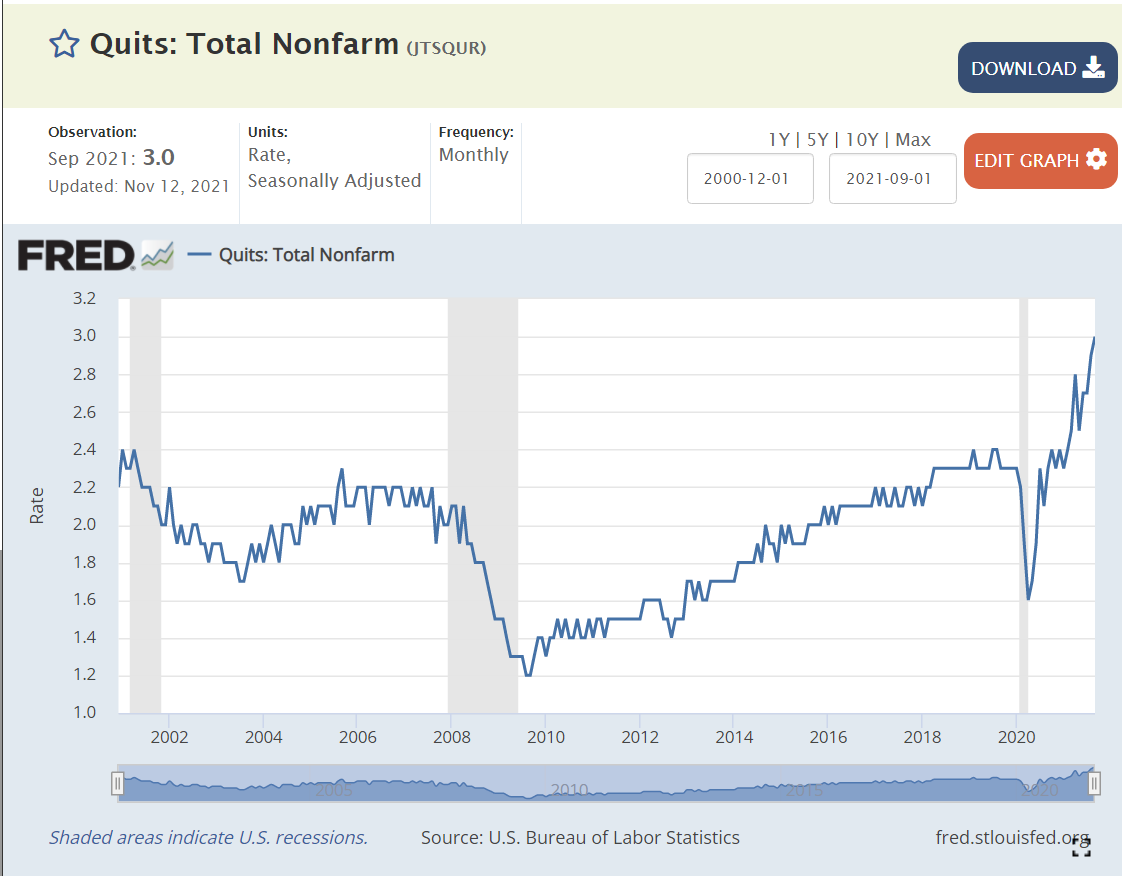
From 2000-2008, about 2% of employees voluntarily left their positions in any given month. The quit rate dropped to 1.5% in the aftermath of the “Great Recession” (2010-13). It very slowly recovered to 2.2% during 2016-18. It increased a little bit to 2.3% in 2019-2020. It rebounded to 2.3% in 2020, and has since increased to an unprecedented 3%. This reflects a labor market where 50% more employees are making a voluntary choice to leave their current employer, apparently confident that they can find an equal or better position.

Job Openings

Job openings averaged 4M from 2000-2014. Openings fell to 3M in 2010-12 after the “Great Recession”. Job openings then grew to 6M in 2017-18 and further to 7M in 2019-20. Job openings quickly returned to 7M early in the pandemic and then began their climb to the current 11M level. Again, these are unprecedented levels, twice as many open jobs as in any time from 2000-15.

Unemployed Persons Per Job Opening

The 2006-7 baseline was 1.5 unemployed persons per open position. The “Great Recession” peak was 6 to 1, an incredibly different labor market, where many older people “retired”; new college graduates went to graduate school, accepted lower positions or remained unemployed; and mid-career professionals accepted positions at 20% lower salary levels. It took 5 years to return to the typical 1.5/1 ratio. This ratio declined a little bit further to 1/1 during 2017-2020 in a tight labor market. The ratio very quickly returned to the historical 1.5 baseline during 2020. It is now at an unprecedented 0.8/1 level. Fewer unemployed people than jobs, not 1.5 to 1, but 0.75/1, half as many potential applicants. This is the first “employees” labor market since the 1960’s.

Home Values

The US Home Price Index was set to 100 in 2000. It increased to 180 during 2005-7. It dropped back to 140 in 2010-13, indicating that part of the rise before “the Great Recession” was a bubble. Prices climbed steadily from 140 to 210 (50% increase) from 2013 to 2020. Despite the pandemic, house prices have continued their climb, exceeding 260, another 25% increase in the last 2 years.

Mortgage Interest Rates

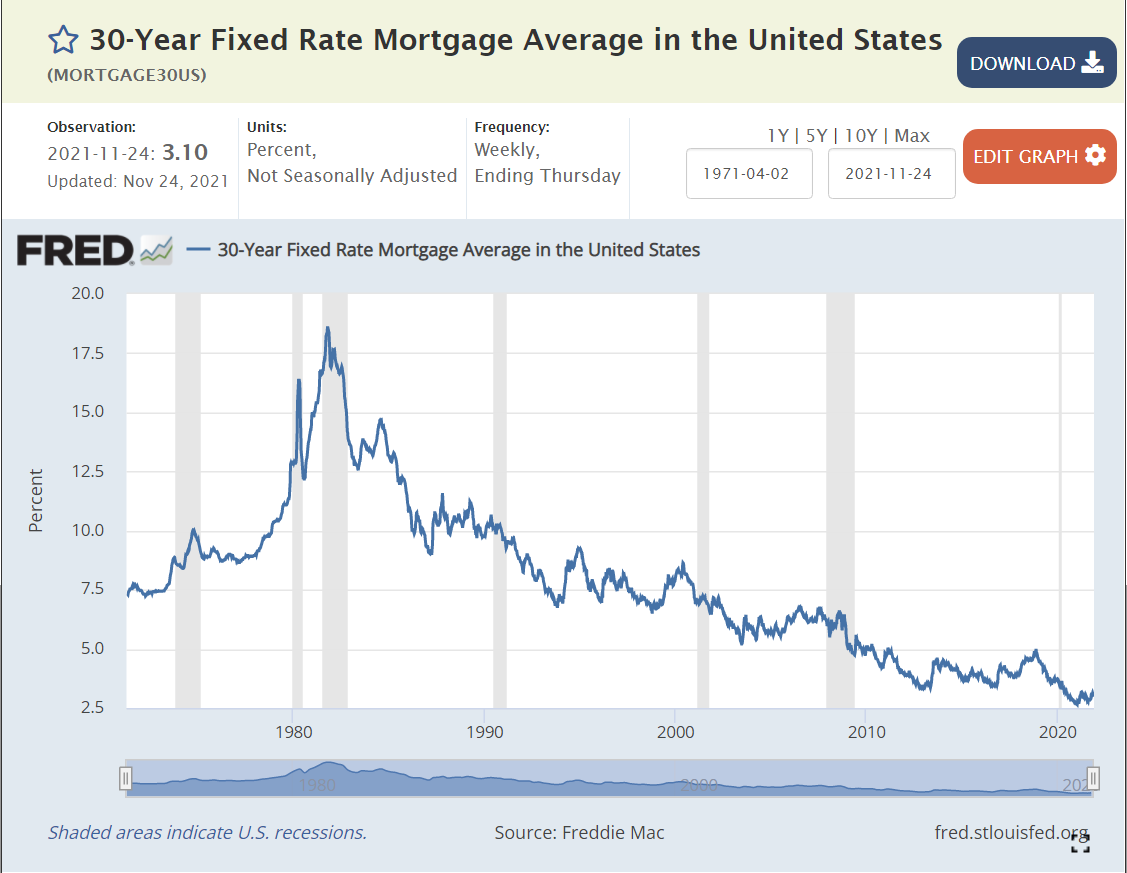
Mortgage interest rates averaged 8% during the 1990’s. They averaged 7% in the 2000’s. They declined even further to 4% during the 2010’s. They fell even further to 3% in 2020-21. The interest cost to finance a house is at an all-time low.

Stock Market

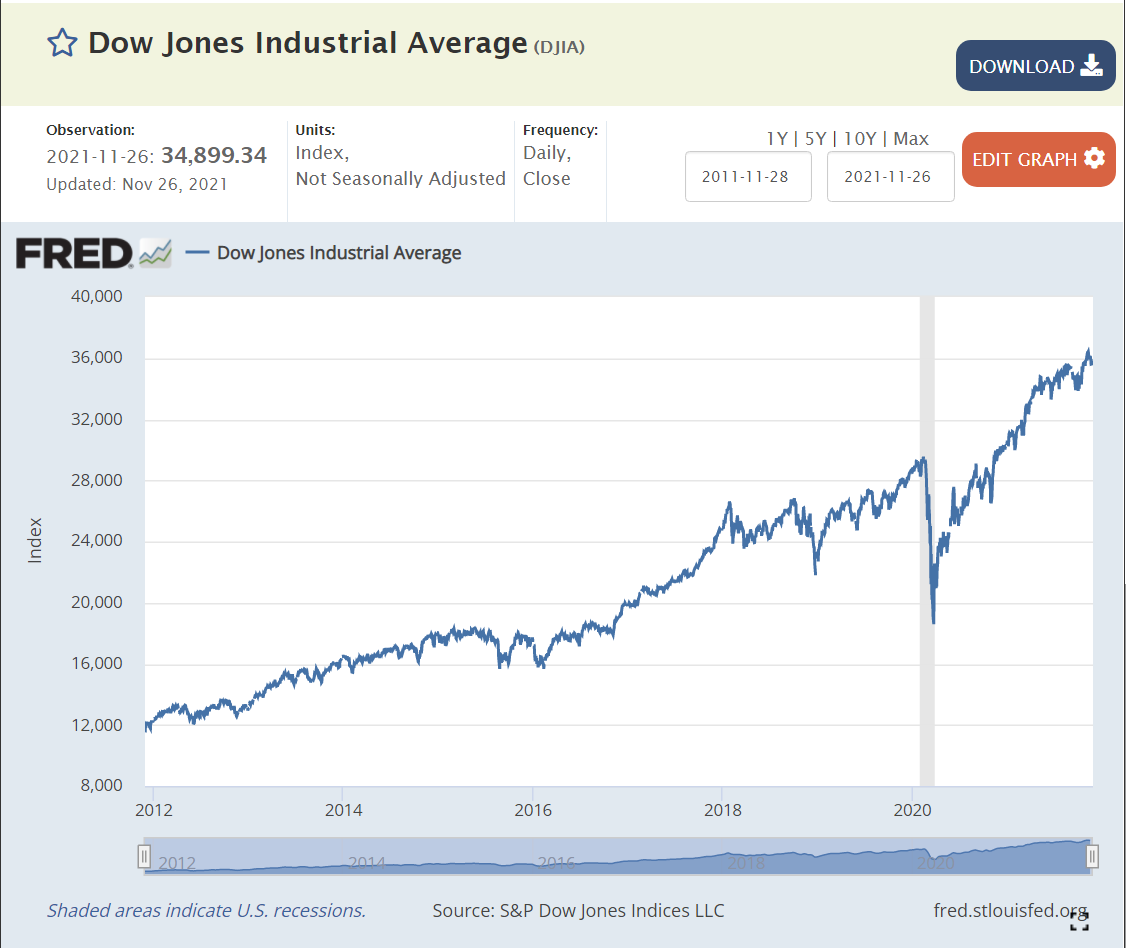
The US stock market averaged 16,000 points from 2014-16. It increased by 50% to 24,000 in 2018, and then climbed to 26,000 and 28,000 before the 2020 pandemic crash. Despite the real financial costs of the pandemic, the market quickly rebounded to 25,000 in the middle of 2020. It has since continued its climb to 36,000, 20% above the pre-pandemic level.

In 1992 James Carville claimed that “it’s the economy, stupid”.

https://en.wikipedia.org/wiki/It%27s_the_economy,_stupid

If so, voters should provide some support to president Biden’s results. Real income is up 2% annually, a record level. Reduction in number of unemployed is 6M in 1 year, another record. Unemployment rate is at 4.6%, below historical “full employment” level. Voluntary quit rate is 50% higher than history, indicating tremendous worker confidence. Nearly twice as many job openings as the historical level, providing great options for job seekers to find their “best” opportunities. Mortgage interest rates remain at historical lows, supporting home purchases. House values have grown by another 25%. The stock market is 20% higher.

This is all at a time when the pandemic unfortunately continues to claim lives and greatly disrupt life and the economy. Overall, the recovery is proceeding at a rate far faster what anyone thought was possible during 2020.

Good News: More Women in Political Leadership Roles

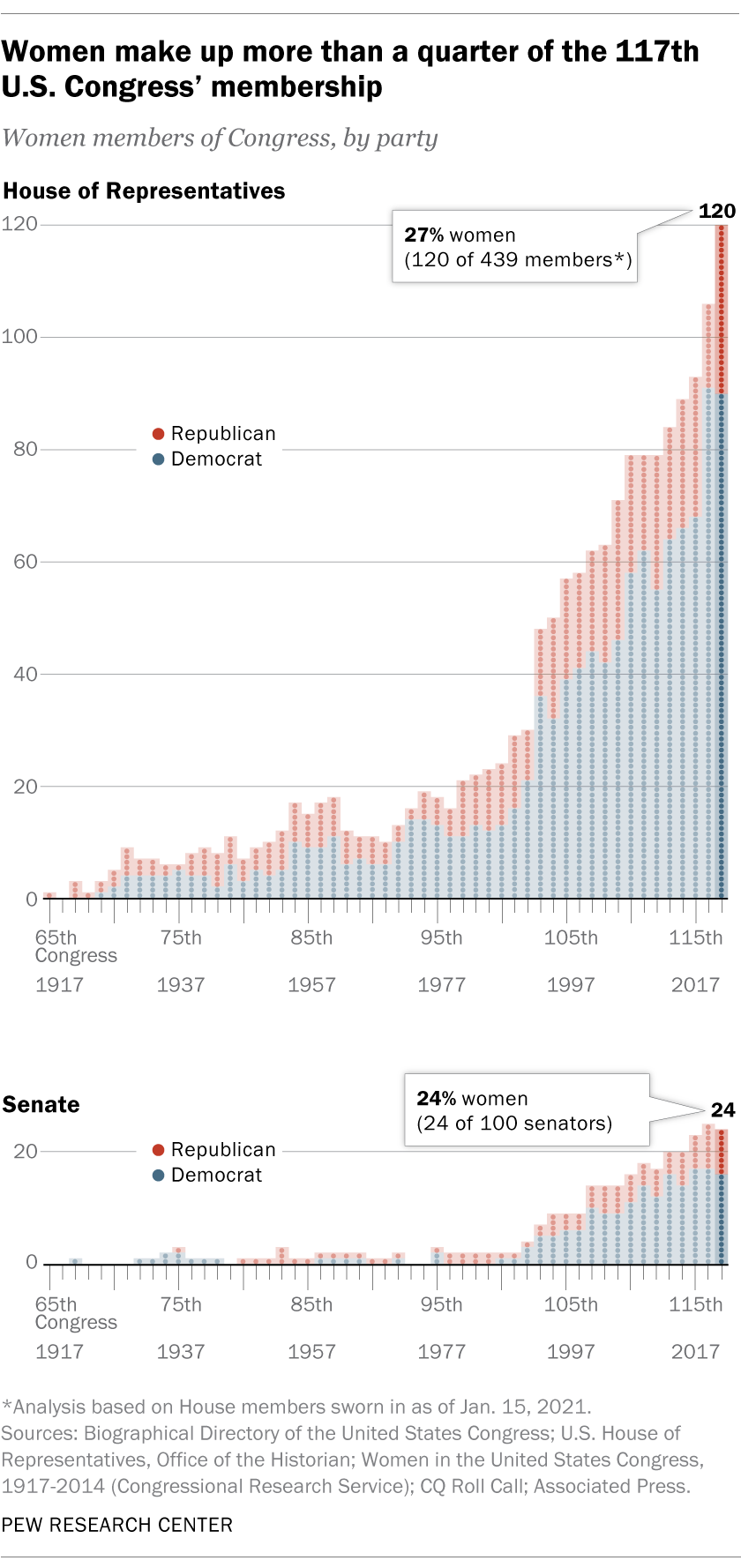
A record number of women are serving in the 117th Congress | Pew Research Center

27% in the House and 24% in the Senate.. Consistent increases, especially since the large increase in 1992. Democrats have more than twice as many women representatives, at 38% versus 14% for Republicans.

Details on congressional data.

Women in Congress | US House of Representatives: History, Art & Archives

History of Women in the U.S. Congress | CAWP (rutgers.edu)

Women now hold 36% of state and federal judgeships.

Statistics | National Association of Women Judges (nawj.org)

Women hold 31% of the seats in state legislatures. This number was flat at 25% from 2009 through 2018 before increasing to 29% in 2019. Two-thirds of these reps were Democrats. States that lean Democratic have significantly more women representatives. Only one state, Nevada, has a majority of female legislators.

Women in State Legislatures 2021 | CAWP (rutgers.edu)

Women hold just 18% of governorships. Here, Democrats and Republicans have performed equally well.

History of Women Governors | CAWP (rutgers.edu)

The Pew Research Organization tracks several other measures of female participation in leadership positions. Biden’s cabinet has a record 48% female proportion. 7% of Fortune 500 CEOs are women. 27% of corporate board seats are now held by women. 31% of college presidencies are held by women.

The Data on Women Leaders | Pew Research Center

In general, the growth in participation by women in these public and private leadership positions has been relatively consistent for the last 25 years. Additional progress appears highly likely during the next 25 years.

Politico takes a more negative view of progress, highlighting the continuing inequality, weak progress in some states and stalled progress by some measures. It provides helpful state level data.

Why state legislatures are still very white — and very male (politico.com)

The U.S. Senate: Unrepresentative

The United States was founded as an aspirational representative democracy. No taxation without representation. One man, one vote. Yet, the Senate was created at the 1787 Constitutional Convention to equally represent the states in the federation, not to equally represent the citizens. This was a compromise between the small states and the large states.

How the Great Compromise and the Electoral College Affects Politics Today – HISTORY

The Unconstitutional Implications of the Two-Senator-Per-State Rule — Northwestern Undergraduate Law Journal (thenulj.org)

Distortions

Recent critics focus on the extent of the distortions favoring the citizens of small versus large population states.

California’s 39M residents have the same representation as Wyoming, Vermont, Alaska and North Dakota who each have three-quarters of one million residents. This is a larger than 50 to 1 advantage for these four states. The California-Wyoming ratio is 68X, meaning that California citizens have just 1.5% as much power as Wyoming citizens.

A majority of states comprised of the 26 with the lowest populations represent 18% of the population. In theory, they could combine to outvote the other 24 states with 82% of the population. States with 57M people have more power than states with 269M citizens. The “lucky duckies” in the small population states, on average, get more than 5 times as much power as those in the large population states.

Distorted democracy: Change the Constitution or the states to fix it (usatoday.com)

The 9 most populous states contain more than one-half of the US population, but get only 18% of the Senators. The other 41 states with less than half of the people get 82% of the Senators. The filibuster rules that allow 40% of Senators to block Senate action give 41 Senators representing 11% of the country a potential veto. The two-thirds requirement for constitutional amendments and treaties gives this power to 34 Senators representing 5% of the population.

Abolish the Senate (bestdemocracy.org)

The 50/50 Democratic/Republican split in the Senate shows Democrats representing 185M residents versus 143M for Republicans. Democrats represent 40M more people with the same number of Senators. They represent 29% more citizens each. If California (D) and Texas (R) are removed from the calculation, Democrats have 30M extra voters to represent for the same number of Senators.

Demographers estimate that the disproportionate influence of small states will increase further in the next 20 years. In 2040, the 15 largest states will have 30% of the Senators (power) and 70% of the population, while the 35 states with 30% of the population will have 70% of the power.

‘The Senate is broken’: system empowers white conservatives, threatening US democracy | US Senate | The Guardian

Who Benefits from the Small State Advantage?

Republicans tend to be more popular in small states. In the 30 least populous states, Republicans have 35 Senators versus 25 for the Democrats, a 10 seat advantage. In the 20 most populous states, Republicans have 16 Senators versus 24 for the Democrats, an 8 seat disadvantage (2018).

Small states are getting a much bigger say in who gets on the court | CNN Politics

Most statisticians estimate the Republican advantage in the Senate to be the equivalent of 3%.

The Senate is a much bigger problem than the Electoral College – Vox

In 1950-1960, the impact of small states was more evenly split between Republicans and Democrats. The benefit to Republicans grew through time.

‘The Senate is broken’: system empowers white conservatives, threatening US democracy | US Senate | The Guardian

The Senate Has Always Favored Smaller States. It Just Didn’t Help Republicans Until Now. | FiveThirtyEight

Historically, small population states (mostly rural) have taken advantage of their relative power advantage to gain proportionately more federal spending, military bases and employment (earmarks, committee chair advantages). They have looked out for the interests of their citizens with distinctive federal policies for agriculture, natural resources/oil, highways versus mass transit, gun control/gun rights, criminal justice views, etc.

Lower population states have lower levels of immigration, fewer non-English speaking residents, higher per capita health care spending, higher % households with student debt, lower poverty rates and higher % of home owners.

the-senate-is-an-irredeemable-institution.pdf (filesforprogress.org)

Various calculations indicate that minorities lose representation and power versus Whites. Non college grad whites +12% extra representation. Non college grad blacks -20%. Non college grad Hispanics -30%.

the-senate-is-an-irredeemable-institution.pdf (filesforprogress.org)

As Blacks make up 11% of the 26 least populated states, but 15% of the 24 most populated states, they are 25% underrepresented.

Distorted democracy: Change the Constitution or the states to fix it (usatoday.com)

One author estimates that Whites get 0.35 Senators per 1M population, while Blacks get 0.26/1M and Hispanics just 0.19/1M.

‘The Senate is broken’: system empowers white conservatives, threatening US democracy | US Senate | The Guardian

Another author says that rural residents get 37% extra say, Whites get 13% extra compared to the average voter while non-Whites get 22% less for a total 35% minority voter penalty.

The 2021 Senate Will be Unrepresentative | by Michael Ettlinger | Medium

Why is This Such a Hot Issue?

The Republican advantage is material and is likely to continue.

The country’s political parties are more clearly aligned on a single conservative-liberal dimension, making parties and voters more polarized and reducing the opportunity for compromises based on other dimensions.

Starting with Newt Gingrich, the Republican Party discovered the power of 100% party discipline in both the House and Senate, making trade-offs, compromises, deals and log rolling less likely.

While rural/urban differences have always existed in the US (Federalists vs Democratic Republicans, North/South, Farm populists), the alignment of cultural and economic interests with the 2 parties now reinforces these differences.

The electoral college includes a vote for each Senator, so distortions are reflected to a lesser, but material, extent in presidential contests. US Supreme Court nominees require Senate confirmation.

The White/minority power difference.

With a divided population, the legitimacy of government is threatened.

Not a Problem (Opposing Views)

US Congress has stood the test of time with its “checks and balances”, including the purposeful compromise between large and small population states.

In the long-run, the advantages to one political party have faded.

The Pareto Principle (80/20) rule applies to many calculations like these. The forecast 30% of people with 70% of votes is less distorted than 80/20.

The US was formed as a federation of states with equal rights, like the sovereignty rights of nation states.

Voters do get “equal representation” in the House.

Geography and property are valid dimensions of political power, with a right to be represented.

There are many dimensions to political power. Urban areas are over represented in the economy, universities, media and culture. This gives rural areas/citizens an opportunity to be heard.

Constitutional Amendment?

Article 5 states that “no state, without its consent, shall be deprived of its equal suffrage in the Senate”. Hence, some would argue that no amendment can change these voting rules. Perhaps unanimous consent of the original 13 states would be sufficient. If a regular amendment was possible, it would require the support of two-thirds of the Senators and three-fourths of the states. Realistically, any amendment would require the potential support of 40 states, with only 10 left behind. This would require support from a majority of Republican states and all Democratic states. A Constitutional Convention with all options on the table may be required to change the basic 2 Senators per state rule.

The Senate is a much bigger problem than the Electoral College – Vox

Potential Solutions

Replace House and Senate with a unicameral legislature.

Abolish the Senate (bestdemocracy.org)

Allow states with some high ratio of the smallest or average state to divide into 2 or 3 or more states. “Encourage”/incentivize states with less than 1% of national population to merge with another state. Start with California and Texas.

The United States Senate was explicitly designed to be undemocratic. (milforddailynews.com)

Assign a “bonus” Senator to states with a population greater than 3 times the average population.

Redraw the whole state map to reflect natural economic areas with population differences of no more than 5 to 1.

Assign Senators based on 1 per state plus 1 per population with 110 total Senate seats.

The Unconstitutional Implications of the Two-Senator-Per-State Rule — Northwestern Undergraduate Law Journal (thenulj.org)

Change Senate election rules to have both Senators from a state be elected in the same election. Allow 2 candidates per party. If 1st place winner does not win at least 52.5% of votes, choose second Senator from party with second highest vote total.

U.S. Senate has fewest split delegations since direct elections began | Pew Research Center

Add District of Columbia and Puerto Rico as states. Consider Guam, American Samoa, Northern Marianas and US Virgin Islands.

Finally, some “political” solutions.

Provide economic development assistance grants for 10 smallest states to increase their population, especially their urban population.

Target economic policies/incentives to small, rural states to support the Democratic party.

Examining America’s Farm Subsidy Problem | Cato Institute

Provide incentives for 400,000 Democrats to move from California to Wyoming (125K), Montana (61K), Alaska (45K), North Dakota (36K) and South Dakota (132K) to narrowly win elections in 5 small states!!

US Infant Mortality Rate: It’s Complicated

The good news is that infant mortality rates (deaths/1,000 live births in 1st year) declined by 80% between 1950 and 2000, from 35 to just 7 and have declined an additional 14% to a little less than 6 by 2018.

• United States: infant mortality rate 1935-2020 | Statista

Infant Mortality Rate for the United States (SPDYNIMRTINUSA) | FRED | St. Louis Fed (stlouisfed.org)

The main CDC page highlights the 5 main causes of death, the significant state differences (higher rates in the south central states, Ohio and WV, and differences by race. Black infant mortality rates (IMR) remain more than twice as high as non-Hispanic Whites. Asians have lower rates than Whites. Hispanic White infant mortality rates are “close” to the White rates.

Infant Mortality | Maternal and Infant Health | Reproductive Health | CDC

The Petersen-KFF website provides clear summaries of the main dimensions of this public health area. About 2/3rds of deaths occur in the first month and are termed neonatal. The remainder in the first year of life are termed postnatal. Both neonatal and postnatal death rates have declined in the last 20 years.

Petersen provides more details on state level death rates, showing that the Great Lakes states have high rates similar to the southern states (7), while much of the country has much lower rates (5).

Births for mothers under 20 show death rates almost twice as high as those in their twenties and thirties.

Ten factors account for two-thirds of deaths, lead by congenital defects and early delivery/low birth weight which account for one-third.

The US mortality rate (5.8) is 75% higher than other countries with similar income levels (3.5). The world-class results in Japan and Finland come in at 2. Details in the way the US reports its figures may account for one-third of the difference versus comparable countries. While the US rate has declined from 7 to 5.8 in the last 20 years, the comparable group reduced its rate from 4.6 to 3.3. Various sources propose that socioeconomic inequality, racial differences and health care system differences account for the US’s poor performance.

What do we know about infant mortality in the U.S. and comparable countries? – Peterson-KFF Health System Tracker

Health status – Infant mortality rates – OECD Data

The racial disparities in infant mortality rates are addressed in various ways.

The very different rates by state seem to show that differing health care policies matter greatly.

Regional variation in Black infant mortality: The contribution of contextual factors (plos.org)

Socioeconomic and racial differences at the county level can be clearly seen in Indiana.

Infant mortality in Indiana | County Health Rankings & Roadmaps

The US Health & Human Services website highlights black-white differences in birth weights, SIDS occurrence, early births/low birth rates and causes of death.

Infant Mortality and African Americans – The Office of Minority Health (hhs.gov)

The statistical analyses to disentangle socioeconomic status and race are very complicated. Most show that socioeconomic status accounts for half of differences, but not nearly 100%. This study found that maternal education, maternal marital status and maternal age “explained” much of the racial differences. Of course, the authors then point to poverty and income differences as underlying factors.

Racial and Ethnic Infant Mortality Gaps and the Role of Socio-Economic Status (nih.gov)

Several more recent studies point to systematic racism working through a large number of lifetime events which impact the mother’s health as the primary cause of racial differences in infant mortality rates.

Exploring African Americans’ High Maternal and Infant Death Rates – Center for American Progress

Eliminating Racial Disparities in Maternal and Infant Mortality – Center for American Progress

One study of Florida births indicated that having a black doctor reduced deaths by 40% for black infant births. White infant mortality was not effected by the race of the doctor.

Black newborns 3 times more likely to die when looked after by White doctors – CNN

In summary, great progress has been made since WW II and continues to be made in the US. However, the reduction in death rates has slowed down. The US death rates are much higher than in other higher income nations and death rates in Europe and Japan have declined faster than in the US. US state death rates range widely, from 4 to 8. Black death rates are twice as high as white death rates.

There remains room for significant progress. World class 2 deaths per 1,000 versus 4.7 for American whites, 11 for American blacks, 4.2 for Californians, 4.6 for New Yorkers, 6.1 for Illinoisans and Floridians, 7.2 for Buckeyes, Hoosiers and Georgians, more than 8 for Mississippians and Arkansans.

Free Trade

Historically, for more than 200 years, economists, conservatives, industrialists and western countries have supported free trade, based upon the theories of Smith and Ricardo. Free trade creates more valuable goods and services. Free trade provides opportunities. Free trade forces domestic firms to become more competitive. The losers from free trade can have their losses mitigated through enlightened government policies. Leftists and labor unions have opposed free trade because governments have not always provided those “enlightened” policies to offset the negative effects on workers and because far leftists cannot support any positive results from capitalism.

3 typical pro trade arguments.

Benefits of free trade – Economics Help

Why is free trade good? | The Economist

Why Free Trade? | IFT (ifreetrade.org)

Conservatives in the west have generally supported free trade for these last two centuries. Western firms and their beneficial owners were positioned to benefit (on average) from free trade. Part of this was the justification for imperialism and economic extraction from “less developed countries”, but most advocates saw the local, corporate and global benefits of trade. Republican support of free trade has been consistent in the post WW II era. Most Republican policy wonks agree with their Democratic colleagues that the great depression was deepened and prolonged by anti-trade legislation in the US and elsewhere.

The Benefits of Free Trade: Addressing Key Myths | Mercatus Center

7 Reasons to Support Free Trade – Foundation for Economic Education (fee.org)

The Benefits of International Trade | U.S. Chamber of Commerce (uschamber.com)

Economists of mainstream political views tend to support “free trade” as a government policy which can provide benefits for countries and the global economy.

Is free trade always the answer? | Business | The Guardian

Economists Actually Agree on This: The Wisdom of Free Trade – The New York Times (nytimes.com)

A Super-Majority of Economists Agree: Trade Barriers Should Go | Cato at Liberty Blog

Center for Economic Research and Forecasting | Economists Do Agree on Something! (clucerf.org)

4 Politically Controversial Issues Where All Economists Agree – The Atlantic

The free trade position has been opposed in the last 200 years by many. Leftists and less developed countries see this as gloss to justify exploitation. Marxists oppose capitalism. Labor sees the negative impact on domestic wages. Environmentalists see trade as a way to export pollution. Anti-globalization advocates see trade as a way to provide power to multinational corporations, so oppose it. Supporters of “less developed countries” argue that pure free trade unfairly prevents firms from developing. Incumbent firms argue that competitors have “unfair” advantages, including government support, that must be offset.

Why do economists support Free Trade? | Jobs Back (JobsBack.com)

Free Trade Is Killing American Manufacturing | IndustryWeek

Free trade in economic theories | Exploring Economics (exploring-economics.org)

Economists on the Run – Foreign Policy

The Folly of Free Trade (hbr.org)

While the “science” and “interests” of free trade may be clear, the “politics” is less clear. In a simple, win/lose, Manichean view, evil foreigners attempt to defeat good domestic firms and their employees. Populist politicians of both left and right views are tempted to tap this voting block.

Here’s why everyone is arguing about free trade (cnbc.com)

Failing at Free Trade: Why Economists Haven’t Won the Debate (dtnpf.com)

Finally, 2 articles that consider both sides.

Free Trade Agreement Pros and Cons (thebalance.com)

4 Reasons Free Trade Has Become A Contentious Political And Economic Issue (forbes.com)

As with many modern public policy issues, there is a professionally supported position (pro, with some limits or compensations). However, the gap between the relatively complex analysis (comparative advantage, history, statistics) required to support these conclusions and votes is wide and used by politicians to frame and tell stories in their best interest, not the interest of the nation or its citizens.

It’s the Economy, Stupid

James Carville once tried to greatly simplify American politics. I’m going to take a longer term view, back to the 1940’s, using the Gallup Poll’s “Most Important Problem” surveys. He’s only partly right, IMHO.

For 1948-83, I’ll use the top problem from each year to greatly simplify the analysis.

In the Cold War period (1948-62), the economy was most important 3/14 years (20%). International affairs, aid, war, peace, nuclear attacks, etc. held the top spot for 10/14 years (70%). Race was the leading issue in 1956 (tied).

Terrorism and Economy Seen as Top Problems Facing Country Today, but Neither Dominates (gallup.com)

From 1963-72, Vietnam, War and Peace dominated in 7/11 years (63%). Race was the biggest issue in 2 years (18%). Crime/violence first became a leading issue in 1968. Ethics, morality and families also first became a top issue in 1968.

Through the transitional 11 years of 1973-83 (Nixon, Ford, Carter, early Reagan), the economy scored 22 of the 23 votes. The “environment” in 1974 was the sole outlier. Foreign affairs scored zero after its 25 year reign. Inflation was the largest economic issue, as “stagflation”, supply chain disruptions, gas shortages and oil prices pinched.

Inflation placed in 2 of the next 4 years as an issue, but was a relatively unimportant factor thereafter, registering in just 7 of the next 32 years (23%).

Paul Volcker’s Noble War on Inflation (yahoo.com)

In these first 35 years, the economy and international affairs were each half of the high visibility topics. Domestic affairs were a minor focus, aside from the issue of race, racism and race relations. The counterculture of the 1960’s and the reaction against it would have a greater impact later.

For the next 36 years, I’ll use a hybrid measure for important problems. Issues which were either in the “top 4” for the year or which claimed the attention of at least 10% of the respondents are recorded as important.

In this timeframe, economic issues wax and wane in importance, but overall they account for 42% of all topics. Economic topics at the end of senior Bush/Clinton were 70% of all responses. They declined in Clinton times to 40% and eventually just 20%. Economic worries increased to 40% in early junior Bush times, but declined to just 20% by the end of his tenure. Obama presided over the Great Recession, with 70% of economic topics ascendant, slowly declining to 30%. Trump inherited a healthy economy, with only 15% of those surveyed considering it a top issue.

Record-Low 12% Cite Economic Issues as Top U.S. Problem (gallup.com)

In the late Reagan period (1984-88), the economy remains the primary focus with 2/3rds of the votes (14/22). The budget deficit/government spending becomes a priority, recognized in each of the 5 years as a highly important issue. Federal government budget deficits exceeded 3% of GDP for the first time since WWII in the Reagan presidency and remained at this level for a decade until a Clinton/congressional compromise returned it briefly to break-even.

Federal Surplus or Deficit [-] as Percent of Gross Domestic Product (FYFSGDA188S) | FRED | St. Louis Fed (stlouisfed.org)

International issues remained visible in Reagan times, with 5/22 votes (23%). With the end of the “Cold War” we have a dozen years with no priority international issues.

The first “emerging” domestic issue in the Reagan years was “drugs”. It was a priority for 3 of those 5 years (15%) and 6 of the next 12 years (10%). Democrats, some then and many now, claim that this was a veiled racist signal. Republicans, as in Prohibition, pointed to the direct negative impact on individuals and the collateral damage to others. Americans, in general, believed that “drugs” were a significant social problem for many decades, increasing with the more recent “opioid crisis”.

In U.S., 65% Say Drug Problem ‘Extremely’ or ‘Very Serious’ (gallup.com)

The Bush Sr years showed 50% attention (8/16) to economic issues: jobs, budget and overall. Drugs remained a major focus in 1989-92. Poverty became a material issue at this time, scoring a top rating in all 4 years and in 5 of the next 8 Clinton years. This generally Democratic favorable issue expired in the 90’s after “welfare reform” without major policy implications.

Government Ranks as Top U.S. Problem for Third Year (gallup.com)

Table 2.1.2012–Attitudes toward the most important problem facing the country, United States, 1984-2012 (albany.edu)

During Clinton times, economic issues were just one-third of the total (14/45). Foreign policy issues were non-existent. This created a vacuum for policy wonks and spinners to guide the public. Republicans clearly won this battle. The “war on drugs” continued, with moderate Democrats supporting additional measures. The “war on crime” was a top issue in 7/8 Clinton years. Again, Democrats pointed to veiled racism, while Republicans leveraged the statistics.

No Single Problem Dominates Americans’ Concerns Today (gallup.com)

The “culture wars” began in earnest, with “ethics, morality and family values” becoming a priority issue in 4 of the 8 Clinton years, highlighted by his impeachment on moral issues.

Secondary education quality became a national political issue. The 1983 study of “A Nation at Risk” highlighted the shortcomings of the decentralized US public education system. Although Republicans sought to eliminate the national Department of Education, they effectively criticized the American public education “system” as inadequate, captured by unions and in need of a competitive challenge through vouchers. President Clinton could not dodge the challenge and made improving the education system a priority. President W Bush followed in his footsteps.

Clinton presided over the consolidation of American superpower status, the expansion of Republican promoted free trade, balanced budgets and the embrace of the capitalist market system (The third way). This was not seen as a Democratic win or compromise, but an opportunity to focus on domestic policy issues, by wise Republican strategists at the national level.

Clinton also attempted to deliver some form of national health care. He failed. But, this was a top policy issue in 4 of his 8 years. It continued to be an issue in the W Bush years, even though no solution was proffered. The basic criticism of “national government” (think Spiro Agnew) re-emerged in the Clinton years, earning priority status in 2 of his 8 years in office.

Public Trust in Government: 1958-2021 | Pew Research Center

9/11 changed the world. In W Bush years, the economy ranked a top priority in one-third of minds (12/32). Terrorism and war in the Middle East was of the same magnitude (12/32). Crime, ethics, education and government became less important. Health care remained a priority (3/32) even though no “solution” was found.

Terrorism and Economy Seen as Top Problems Facing Country Today, but Neither Dominates (gallup.com)

In the Obama years, economic issues were rightfully the priority, earning two-thirds of the votes (19/30). The Republican driven “culture” issues were not as highly visible in this period. Health care was a priority issue, and continued to be so through the Trump years as Republicans fought to reverse this legislation.

Economy, Healthcare Top “Most Important Problem” List (gallup.com)

The legitimacy/illegitimacy of the national government began as a criticism of the Clinton years. This faded in the W Bush years, but came roaring back for 8/8 of the Obama years. Once again, Democrats pointed to racism, while Republicans increasingly criticized the basic validity of national government decisions that restricted individual choice.

Public Trust in Government: 1958-2021 | Pew Research Center

Record High Name Government as Most Important Problem (gallup.com)

Government Ranks as Top U.S. Problem for Third Year (gallup.com)

Trump inherited a solid economy and a world with fewer major active conflicts. Economic and foreign policy issues were not a priority. Traditional Republican “culture wars” issues were also less important to the public. Trump was able to raise immigration and trade to the status of important subjects. Health care remained an issue for 1 year with the failed attempt to unseat Obamacare and 1 year of Covid. Race became a priority issue for 4/4 Trump years. “Unifying the country” earned a top 4 spot in the last 2 years. Criticism of “the government” continued as a top 4 issue in all 4 years of the Trump presidency.

Heightened Racial Concern a Clear Legacy of Floyd’s Death (gallup.com)

More Americans Cite COVID-19 as Most Important U.S. Problem (gallup.com)

Across 70 years, the economy accounts for 44% of the votes. International affairs account for one-sixth of the votes. Domestic policy issues account for 40% of the total. Republicans were more effective at framing public thoughts, guiding their preferred domestic policy issues to be 25% of the total.

Most Important Problems: By Presidency and Category

48-6263-7273-8384-8889-9293-0001-0809-1617-2084-20
Cold WVietTransReagBushClintWObamaTrump
Inflation822329
Jobs352438123
Budget523122
Economy3112456825
SUB3022148141219168
Intl/Aid511
Viet/War570
ME/War4711
Terror55
SUB1070500120017
Crime1718
Guns11
Culture1415
Drugs3339
Educn516
Immigrn13
SUB020332040232
Poverty459
Health1432212
Race12145
Environ11
Unifying22
SUB12105933828
Govt218417
Total141123221645323015160

Good News: High School Graduation Rates

There is significant politics and complex statistics in this subject area, but the basic outcomes are clear cut and positive.

High school graduation rates in the US increased throughout much of the 20th century. 1910: 10%. 1930: 30%. 1950: 60%. 1960: 70%. 1970: peak 75%. Then, graduation rates held steady or declined for the next 30 years! Various explanations are offered: increased graduation requirements, less effective educators, social challenges, mix of students.

Could the Common Core State Standards affect high school graduation rates? by Kelly Griffith and Victor Sensenig – AJE Forum

U.S. High School Graduation Rate Hits All-Time High | Data Mine | US News

Graduation rates fluctuated between 72-74% from 1980-2008, before starting a period of positive improvements into the mid 80% range.

Government Fail: Public Education – Capital Research Center

The gold standard is the data from the National Center for Educational Statistics (NCES). We have 5 different measures. The first 3 provide 1977-2017 comparisons.

Annual dropout events have declined from 7% to 5%. They reached a minimum of less than 4% in 2007 before increasing. White dropouts declined from 6% to 4%. Black dropouts declined from 10% to 5%. Hispanic dropouts declined from 10% to 6%.

The dropout status of 16-24 year-olds collectively declined from 14% to 6% overall. Whites dropped from 12% to 5%. Blacks declined from 20% to 6%. Hispanics fell from 33% to 10%.

The percentage of 18-24 year olds who had completed high school (or GED) increased from 84% to 93%. Whites rose from 87-95%. Blacks rocketed from 74-94%. Hispanics rocketed from 59-88%.

The “adjusted graduation rate” measures on-time graduation. From 2010 to 2016 it shows overall improvement from 79% to 85%.

The “freshman graduation rate” measures on-time attainment of a regular diploma. It shows improvement from 71% in 1995-98 to 82% in 2012.

Trends in High School Dropout and Completion Rates in the United States: 2019

The media has pursued the relatively straightforward dropout rate data, covering the significant improvements in all groups from 2000 to 2015.

U.S. High School Dropout Rates Fall, Especially Among Latinos | FiveThirtyEight

High School Dropout Rates – Child Trends

Why the U.S. high school dropout rate has fallen so dramatically – CSMonitor.com

At the international comparison level, the US has improved from 18th of 21 OECD (advanced) economies in 2006 with a 75% graduation rate versus 81% average to 9th of 35 in 2018 with an 86% graduation rate versus the 81% average.

EDUCATION AT A GLANCE: International Comparison Places the United States Near the Bottom in High School Graduation Rates and College Graduates | Alliance For Excellent Education (all4ed.org)

Students – Secondary graduation rate – OECD Data

From Sputnik to “A Nation at Risk” to “No Child Left Behind”, the US has become relatively more effective at setting goals, measuring progress and adjusting educational strategies and tactics. Some groups essentially act as gadflies, pressuring politicians, educators, administrators and boards to improve.

Home – The Hechinger Report

11 Facts About High School Dropout Rates | DoSomething.org

These policy groups have become effective at identifying groups that are not meeting the goals and offering recommendations for improvements. For example, they were able to identify a relatively small number of schools that accounted for a majority of non-graduates (Pareto principle). The pejorative term “drop out factories” was applied to schools with graduation rates below 60%. A tail of low performing schools remains (for various reasons), but many low performing schools were closed or greatly improved in the last 25 years.

What is a “drop out factory” and is it still an issue in today’s educational space? (stemscopes.com)

The leading group is termed “America’s Promise”. It has focused efforts on reaching a 90% graduation rate for every state, school and subgroup by 2020. Through the latest report from 2018, that goal has not been achieved, but solid progress has been documented. Graduation rates reached 85%, with 14 straight years of improvement. Between 2011-18 Black grad rates improved from 67-79%. Hispanic grad rates improved from 71-81%. Low income grad rates improved from 70-80%. Individual state scores demonstrated that even higher rates were pragmatically possible for all groups. In 2017, 2 states reached the 90% level. In 2018, 7 states met the target. They were from all corners of the country: Iowa, Texas, Alabama, New Jersey, Kentucky, Tennessee and West Virginia. This group noted that 7% of students in 11% of high schools accounted for 28% of non-grads. It also noted that 10 states account for 56% on non-grads. It outlined specific recommendations for continued improvement.

The post 1999, “No Child Left Behind” progress is questioned by some sources. They claim that increased accountability has lead educators and administrators to simply work the system by changing graduation requirements or fudging tests. Statistical reviews of state performance discounts the effect of these alleged activities.

U.S. High School Dropout Rate [2021]: Statistics & Trends (educationdata.org)

Are America’s rising high school graduation rates real—or just an accountability-fueled mirage? (brookings.edu)

Two measures of educational performance (NAEP and PISA) focus on elementary and middle school results so they cannot be used to confirm or dispute the high school graduation improvements.

College admissions of a greater percentage of high school grads supports the positive results.

College remediation requirements remain high, but no clear increasing trend has been documented.

SAT scores have not significantly changed during the last 40 years (math up and reading down).

Average SAT Scores Over Time: 1972 – 2020 (prepscholar.com)

The number of students taking the SAT has remained relatively constant.

SAT – Wikipedia

US high school graduation rates improved from 10% to 70% between 1910 and 1970. They remained the same for 30 years as requirements were increased to meet the obvious challenges of a more competitive world (Sputnik, Japan, Asia, EU). Graduation rates have increased consistently for the last 20 years, mainly through improvements at the lowest performing schools. These improvements have slowed in the last decade, but progress continues to be made.

Good News: U.S. Charitable Giving

U.S. charitable giving to GDP ratio is 1.44%. Canada is second at 0.77%. UK is third at .54%. Italy at 0.3% is representative of Europe. U.S. giving is 5 times as high as other developed countries. (Table 27). U.S. private overseas aid is $44B. UK is second at $5B. (Table 25).

U.S. Generosity (philanthropyroundtable.org)

The World Giving Index has consistently rated the U.S. as the most generous country of 125 reviewed. Across 2010-19, US is 3rd highest percentage of those surveyed reporting they had “helped a stranger in the last year” at 72% compared with 48% global average. US was 5th highest with 42% reporting they had volunteered time for a charity in the past year versus 20% global average. US was 11th highest in percent reporting monetary donations in the last year (61%), versus global average of 30%.

WGI_2019_REPORT_2712A_WEB_101019.pdf (cafamerica.org)

In general, total US charitable giving has grown on a per capita or percent of GDP basis for more than 50 years. There is a clear “step up” in giving in the late 1990’s. Real (inflation adjusted) per capita giving has nearly doubled from representative $600 in 1970’s to $1,100 in 2000’s. (table 1). The US nonprofit sector reflects that growth, even though program fees are a much larger share of revenues, rising from less than 2% of GDP in the 1930’s-50’s to 3% in the 1970’s to more than 5% by the 2010’s. (table 6).

U.S. Generosity (philanthropyroundtable.org)

The US nonprofit sector now has 1.5M organizations and employs 10% of the US workforce. (table 5).

U.S. Generosity (philanthropyroundtable.org)

The Nonprofit Sector in Brief 2019 | National Center for Charitable Statistics (urban.org)

These sources also report that roughly one-fourth of Americans volunteer each year, donating 136 hours of work. (graph 8).

U.S. Generosity (philanthropyroundtable.org)

The Nonprofit Sector in Brief 2019 | National Center for Charitable Statistics (urban.org)

Total US charitable donations as a share of disposable income ratio has averaged roughly 2% across the last 40 years. Charitable giving as a percent of GDP averaged 1.7% in the 80’s and early 90’s, before increasing to 2.1% in the “oughts” and teens.

The most widely reported figure shows total real (inflation adjusted) US charitable giving since 1979. This has increased together with real US GDP. Representative years and amounts: 1982 ($150B), 1992 ($194), 2002 ($317), 2012 ($355) and 2019 ($450B).

FUNDRAISING INSIGHTS FROM THE GIVING USA 2020 REPORT – AskRIGHT

Giving by individuals has fallen from 80% to 70% of the total. Bequests have increased from 7-8%. Foundation giving has more than doubled as a share of the total, from 7 to 16%. Hence, the real individual giving numbers are solid and rising, but their growth rate has slowed through time. 1982 ($130B), 1992 ($160), 2002 ($250), 2012 ($250), 2019 ($310).

FUNDRAISING INSIGHTS FROM THE GIVING USA 2020 REPORT – AskRIGHT

While the total and individual charitable donation amounts have increased, the percentage of individuals donating has declined significantly. Years, percentages and average donation. 2002: 67%, $2,000. 2008: 65%, $2,300. 2012: 59%, $2,400. 2016: 53%, $2,500. Various authors speculate that the decline is caused by increasing inequality, lower confidence in institutions and changes in tax deduction laws.

Fewer Americans are giving money to charity but total donations are at record levels anyway – Lilly Family School of Philanthropy (iupui.edu)

In the early 2010’s there was a significant decrease in charitable giving percentages by non-itemizers (10%) and a much smaller decrease by itemizers (5%).

Leadership 18 Applauds New Legislation Aimed at Halting Decline in the Number of Americans Who Give to Charity | Business Wire

There are various reports that break down giving rates by state, city, religion, politics, region, marital status, generation and income. Perhaps most important is that the decrease in the giving percent from 67% to 53% means that the percentage giving zero, and dragging down the average, has increased from 33% to 47% of the population, from one-third to nearly one-half.

More than 90% of individuals with income above $125K donate to charity. 77% of those with incomes of $50-125K donate. This drops off to 58% at the $25-50K range and 37% under $25K (graph 11).

U.S. Generosity (philanthropyroundtable.org)

As a percentage of disposable income, individuals below $50K donate 1.5%, those at $50-200K donate 1.75% and those above $200K donate 2-3-4%.

Massive charitable donations by the rich and famous are making the same big splash as always (phys.org)

Many predicted that 2020 would be a reduced year for giving due to the pandemic or post-election concerns.

Presidential Elections and Charitable Giving: What Does the Data Tell Us? | CCS Fundraising

Percentage of Americans Donating to Charity at New Low (gallup.com)

One source indicates that actual 2020 giving increased by 5%, with 1% more people making donations. This report also indicated that 23% of affluent donors increased their contributions to local projects and increased their unrestricted contributions.

One way wealthy people changed their charitable giving during the pandemic – MarketWatch

Another source indicates that 2020 donations were up by 11% and the number of donors was up by 7%. They reported a 15% increase in small donations (<$250), an 8% increase in medium-sized donations and a 10% increase in large donation ($1,000+).

Fundraising Effectiveness Project: Giving Increases Significantly in 2020, Even as Donor Retention Rates Shrink | Association of Fundraising Professionals (afpglobal.org)

The US has a solid track record of individual charity. Donations have risen in real terms through time. Americans support nonprofits through cash and time donations. The decline in the percentage of individuals making donations is a concern. The “one-time” tax deduction for non-itemizing filers may help to spur increased contribution habits.

Charitable Giving Statistics & Facts for 2021 | Balancing Everything

Indiana Coronavirus May 14

Indiana Coronavirus update. Daily cases are a little (-10%) lower. Last 3 weeks averaged 1,032 versus 1,144 in prior 3 weeks. This is up a little from the March average of 800 but way down from the Nov-Jan peak average of 4,700. Daily deaths have dropped even faster, from 75 at the peak to 11 in March to 7 in April/May.

The death rate is now less than 1%, compared with 2% last Fall and 1.6% during the peak infection period (improved treatment and age profile).

Indiana vaccination rate has lagged, after a positive early start, with 31% fully vaccinated. This is 39th best state. Median state is 36% vaccinated. 4 adjacent states are 35-37% vaccinated. Indiana’s vaccination rate (74%) for seniors (65+) is slightly better than the national average (72%).

National vaccines per day increased to 2M by the end of Feb and 3M by the end of Mar, peaking in early April. Daily vaccine rate declined to 2.6M at the end of April and continues to fall. Indiana follows the same pattern with 35,000 per day at the end of Feb, 42,000 at the end of March and April, but just 30,000 in mid-May.

At the county level in metro Indianapolis, the vaccine rates vary widely. Central Marion County is at 28% fully vaccinated. 4 counties are at 30-33% (Morgan, Johnson, Shelby and Madison). 4 others are at 40-41% (Boone, Hendricks, Hancock and Hamilton)

. https://www.npr.org/…/how-is-the-covid-19-vaccination…

https://www.coronavirus.in.gov/vaccine/2680.htm

https://covid.cdc.gov/covid-data-tracker/…https://www.coronavirus.in.gov/2393.htm

Indiana: How Much Political Power?

Indiana is the 17th largest U.S. state ranked by population, with 6.7 million residents.

Indiana’s GDP is the 18th largest. Its GDP per capita is only 32nd.

List of states and territories of the United States by GDP – Wikipedia

Indiana has 11 electoral college votes, tied for 13th most of all states. Indiana did not lose an electoral college vote in the latest census, although 3 neighboring states did. With 538 total votes, the average state has almost 11 votes, so Indiana is average by this measure. From 1872-1926, Indiana had 15 electoral votes. From 1932-40 it had 14. From 1944-88 it had 13. From 1984-2000 it had 12, so the trend is clearly downward.

Indiana Presidential Election Voting History (270towin.com)

Indiana has not been a “swing” state with disproportionate clout in our lifetime.

Party affiliation by state – Religion in America: U.S. Religious Data, Demographics and Statistics | Pew Research Center (pewforum.org)

Indiana can claim its fair share of U.S. presidents. 1 out of 46, with the 23rd president, Benjamin Harrison (1889-93). Indiana can partly claim Harrison’s grandfather William Henry Harrison who briefly served as the 9th president and who served as governor of the Indiana Territory from 1801-12, although he was not born there. Indiana also claims to be Lincoln’s boyhood home (1816-30).

Indiana also has its fair share of losing presidential candidates with Wendell Wilkie (1940) and Socialist Party stalwart Eugene Debs (1900-20).

Indiana Presidents: Learn About the 3 Hoosiers Who Became President (visitindiana.com)

Indiana truly stands out at the VP level, with 4 serving in this office: Charles Fairbanks (1905-9), Thomas Marshall (1913-21), Dan Quayle (1989-93) and Mike Pence (2017-21). It has provided 12 VP candidates.

Witnessing History: Hoosiers for President (indianahistory.org)

At the Supreme Court, Indiana claims more than its fair share of the 120 justices with 4: Willis Van Devanter (1911), Sherman Minter (1949), current Chief Justice John Roberts (2005) and recently appointed Amy Coney Barrett (2021).

A quick look at U.S. Supreme Court Justices from Indiana « Capitol & Washington (capitolandwashington.com)

Since WWII there have been 35 individuals serving in the top political appointment office, the White House Chief of Staff. Ron Klain currently holds that role, as the only Hoosier to do so.

White House Chief of Staff – Wikipedia

Historically and recently, Indiana has shown above average political influence at the national level in the U.S.