Covey’s “7 Habits” and Civility

The 7 Habits of Highly Effective People – Leader In Me

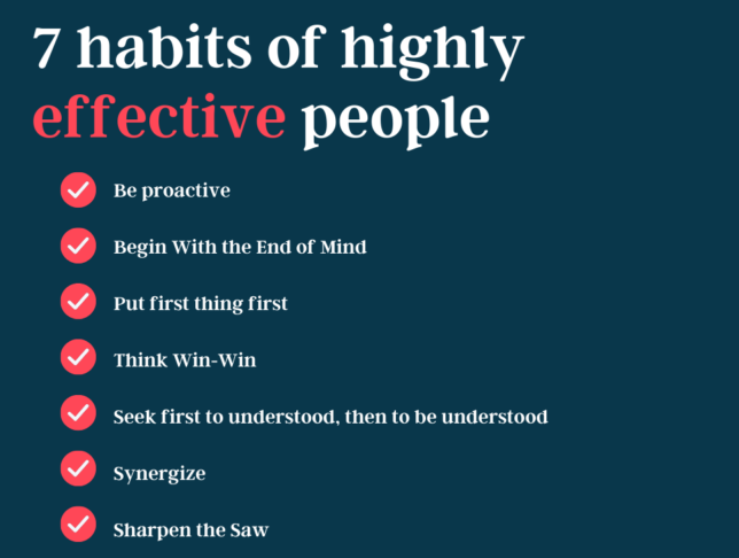
Stephen Covey’s 1989 book invented the personal development industry for modern employers and employees. It has sold more than 20 million copies and helped millions of people become “more effective”.

I’ll connect the “7 habits” to the very independently derived 7 values and 7 skills/behaviors of Civility.

The 7 Habits of Highly Effective People – Wikipedia

Civility is Really About 7 Behaviors – Good News

Civility Resources (5): Action – Good News

7 Civility Values – Good News

Civility Resources (4): Values – Good News

Covey’s book is principle centered, focused on character development and the importance of managing perceptions.

Civility is “principle centered”, based on the 7 nonpartisan values of human dignity, respect, acceptance, responsibility, constructiveness, intentionality and public spiritedness.

Civility is based upon 7 skills/behaviors of self-awareness, self-management, social awareness, relationship management, communications, growth and problem-solving that also acknowledge the importance of a lifetime of personal development. The 6th behavior outlines how the practice of Civility leads to personal growth.

Civility emphasizes the crucial role of identifying, understanding and shaping personal perspectives, insights and world views. The 4 values of respect, acceptance, responsibility and public spiritedness require the individual to work on refining their world views. Similarly, the self-awareness and social awareness behaviors emphasize the need to clearly define and sometimes challenge real views as part of social discourse or civil dialogue.

1. Be Proactive (Google AI)

Stephen Covey’s Habit 1: “Be Proactive” relates to civility by placing the responsibility for respectful behavior on the individual rather than on external circumstances or other people’s actions. Being proactive means choosing to respond with values—such as kindness and respect—rather than reacting based on feelings, which fosters a more civil, constructive, and collaborative environment.

Choice of Response vs. Reaction: Covey argues that between a stimulus (e.g., someone being rude) and the response, there is a space to choose. Proactive individuals use this space to choose a civil, value-based response, rather than blindly reacting with anger or sarcasm, which would diminish civility.

Owning One’s Behavior: Proactive people do not blame their behavior on others or their environment (“he makes me so mad”). Instead, they act with accountability, knowing that their own conduct is a result of their own decisions.

Focus on the Circle of Influence: Proactive people focus on what they can control—their own attitude, language, and behavior. They understand that while they cannot control another person’s rudeness, they can control their own polite response, which can often improve the situation.

Proactive Language: Proactive people use language that implies choice, such as “I can,” “I will,” or “I choose”. This language is inherently more empowering and respectful than the reactive language of blame (“He makes me…”, “I have to…”).

Acting with Intention: Proactive individuals create a climate of respect, rather than waiting for others to do so. They take the initiative to communicate clearly, apologize for mistakes, and behave with kindness, which acts as a proactive driver of civility in professional and personal relationships.

By taking ownership of their behavior, proactive individuals stop blaming “out there” for their issues, thereby reducing conflict and increasing respectful interaction.

TK Summary: Strong overlap with Civility values of responsibility and intentionality, overlap with respect and constructiveness. Strong overlap with Civility behavior self-management, overlap with communication, self-awareness and social awareness. Civility is not about politeness, surface level choices, weakness or moderation. It focuses on making great choices and deeply owning those choices.

2. Begin With the End in Mind (Google AI)

Stephen Covey‘s second habit, Begin with the End in Mind, relates to civility by framing daily interactions as steps toward a long-term legacy of character and relationship quality. Instead of reacting to immediate frustrations, this principle encourages individuals to act according to their core values and the “end” they want to achieve in their personal and professional lives. 

In the context of civility, this habit manifests in several ways:

Relationship Preservation as the “End”: In conflict resolution, beginning with the end in mind means visualizing a successful outcome where the relationship is preserved or strengthened, rather than just “winning” an argument.

The Eulogy Exercise: Covey famously asks people to visualize their own funeral and consider what they want friends, family, and colleagues to say about their character. If you want to be remembered as kind, respectful, and fair, you must practice those civil behaviors in the present to make that “end” a reality.

Principle-Centered Living: By centering one’s life on unchanging principles like trust and honesty, an individual can maintain civil behavior even in the face of adversity, rather than being swayed by temporary emotions or external circumstances.

Intentional Communication: This habit encourages visualizing the desired atmosphere of a conversation or meeting before it begins. This mental “first creation” allows for more deliberate, empathetic, and respectful communication.

Living by Design, Not Default: Without a clear vision of who you want to be, you may fall into reactive, uncivil patterns dictated by pre-existing habits or others’ behaviors. Intentionally choosing your “end” goal empowers you to respond with civility by design.

TK Summary: The Civility values of respect and intentionality stand out, followed by human dignity and responsibility. The Civility behaviors of relationship management and self-management are essential here, also using self-awareness and problem-solving to create this habit.

3. Put First Things First (Google AI)

Stephen Covey’s “Put First Things First” habit relates to civility by prioritizing long-term relationship building, respect, and ethical behavior over reactive, urgent, but unimportant demands. It emphasizes investing time in people and principles, ensuring that how we treat others remains a top priority rather than an afterthought sacrificed for immediate, urgent tasks.

Key connections include:

Prioritizing Relationships: By focusing on Quadrant II (important but not urgent) activities, such as relationship building and proactive communication, people cultivate a respectful and supportive environment, rather than treating interactions as interruptions.

Proactive Self-Management: It requires managing oneself to live according to values, which prevents rushing, stress-induced rudeness, and, instead, fosters a calm, thoughtful approach to interactions.

Valuing People Over Tasks: It emphasizes that people and their well-being are paramount, ensuring that interacting with others is treated as a priority rather than a “low-priority” task compared to other work.

Preventing Ethical Crises: By acting on principles before they become urgent problems, individuals are more likely to behave with integrity and maintain professional civility.

TK Summary: Here, Covey focuses on the Civility values of human dignity and acceptance, supported by respect. He emphasizes the Civility behaviors of relationship management and self-management, supported by communications and personal growth.

4. Think Win-Win (Google AI)

Stephen Covey’s “Think Win-Win” habit (Habit 4) is directly related to civility by serving as a character-based code for interaction that requires mutual respect, emotional maturity, and the balance of courage and consideration. It builds a culture of trust and collaboration, replacing competitive “win-lose” mentalities with cooperative, respectful, and mutually beneficial relationships.

Key relationships between “Think Win-Win” and civility include:

Mutual Respect and Consideration: Win-win requires valuing other people’s needs as much as your own, which is the foundation of respectful communication.

Emotional Maturity: It requires the “courage” to express your own needs and the “consideration” to listen to others, forming the basis of mature, civil dialogue.

Abundance Mentality: It assumes there is enough for everyone, promoting a cooperative mindset over scarcity-driven competition, fostering generosity rather than selfishness.

Trust Building: By aiming for solutions where everyone feels satisfied, this habit builds long-term trust, which is the cornerstone of civil interaction.

Think Win-Win isn’t simply about being “nice”; it is a framework for ensuring that interactions are respectful, fair, and beneficial for all stakeholders.

TK Summary: The Civility value of true respect is first, augmented by acceptance, responsibility, intentionality and public-spiritedness. Self-management is the primary Civility behavior, accompanied by social awareness, relationship management, communications and problem-solving.

5. Seek First to Understand, Then Be Understood (Google AI)

Stephen Covey’s habit of “Seek First to Understand, Then to Be Understood” (Habit 5) is foundational to civility because it replaces judgmental listening with empathic listening, cultivating respect and validation in interactions. By prioritizing understanding over simply being right, it promotes patience, reduces conflict, and fosters deeper human connections.

Promotes Empathy & Respect: Instead of listening to respond or judge, this habit encourages listening with the intent to truly understand another person’s perspective and emotions.

Suspends Judgment: It fosters a mindset of pausing and suspending judgment, which is essential for treating others with dignity.

Builds Trust Through Validation: When others feel heard and understood, it gives them “psychological air,” encouraging a safe, collaborative environment rather than a combative one.

Combats Dehumanization: It forces one to see the person behind an argument or avatar, preventing the rush to judgment often found in poor, uncivil discourse.

Balance of Courage and Consideration: This habit teaches that true influence is built by combining kindness (seeking to understand) with courage (being understood), facilitating Win/Win outcomes.

TK Summary: Covey highlights the first 3 Civility values of human dignity, respect and acceptance. “Others” really, really matter. He then elevates the Civility behaviors of self-management and communications (active listening), complemented by social awareness and relationship management.

6. Synergize (Google AI)

Stephen Covey’s habit of Synergize (Habit 6) relates to Civility by fostering creative cooperation through valuing differences, empathetic listening, and seeking “third alternatives” (Win/Win) rather than conflict. It transforms respectful, polite communication into synergistic collaboration, treating diverse viewpoints as assets, not threats.

Key connections between synergy and civility include:

Valuing Differences: Synergy goes beyond mere tolerance (politeness) to truly valuing mental, emotional, and psychological differences, which is the foundation of a civil, inclusive society.

Empathetic Communication: Synergizing requires seeking first to understand others, creating a safe, respectful environment where individuals feel valued.

Moving Beyond Defensiveness: It replaces defensive, protective, or legalistic communication with open and honest dialogue.

Co-creation of Solutions: It actively seeks a “third way” that is better than either party’s original idea, promoting partnership rather than win-lose confrontations.

TK Summary: The Civility values of respect and acceptance are critical supports for synergy: a belief in interactive teamwork. The Civility behaviors of modern “best practices” communications and problem solving are required for synergy to deliver the goods.

7. Sharpen the Saw (Google AI)

Stephen Covey‘s 7th Habit, Sharpen the Saw, relates to civility by focusing on the social and emotional renewal required to interact with others respectfully and effectively. This habit emphasizes that a depleted or “dull” individual is more likely to be reactive, impatient, and ineffective in their relationships.

The relationship between “Sharpening the Saw” and civility manifests in several key ways:

Emotional Regulation and Reduced Reactivity

Preventing Burnout: Without regular renewal, emotions become “raw” and the spirit becomes insensitive.

Interpersonal Resilience: Leaders who prioritize physical and emotional self-care are less reactive and better prepared to handle interpersonal challenges with composure.

The “Private Victory”: Covey argues that personal renewal (the private victory) must precede successful public interactions (the public victory). Civility is difficult to maintain when one is operating from a state of exhaustion or stress. 

Social and Emotional Renewal

Empathetic Connection: Sharpening the “social saw” involves cultivating empathy and emotional intelligence, which are foundational to civil behavior.

Building the “Emotional Bank Account”: This habit encourages making “deposits” into others’ emotional bank accounts through courtesy, kindness, and honesty.

Interdependent Habits: Habit 7 makes Habits 4, 5, and 6 (Think Win-Win, Seek First to Understand, and Synergize) possible. These habits represent the core of civil and cooperative social interaction.

Principled Character Development

Alignment with Values: Renewal in the spiritual dimension involves committing to a value system that often includes integrity, kindness, and human dignity.

Civic Responsibility: By focusing on self-improvement, individuals increase their capacity to contribute positively to their community and maintain a “minimal model of a civic citizen”.

TK Summary: Covey calls out the Civility value of human dignity as essential to living a great life, followed by the importance of respect for others. This habit matches up directly with the Civility behavior of personal growth and notes the importance of self-management and social awareness in living a sustainable good life in the modern world.

Summary

Many of us lived through the “malaise” of the 1970’s and 1980’s as the US tried to digest the cultural revolution of the 1960’s, the political disappointments of Vietnam and Watergate, and the global economic revolution of the 1970’s and 1980’s. The US was no longer invincible. It was threatened on all sides. Covey’s book was a clarion call to refocus on “character”. Yet, it was not about a soft, countercultural “greening of America” or a naive return to 1950’s cultural certainties. It was about the tools required for individuals to survive and thrive in a complex, global, secular world. It was not a politically partisan approach.

His “7 habits” have stood the test of time. The crosswalk with Civility is very dense. He is focused on the individual looking for habits of successful personal development. Civility is focused on the minimal values and behaviors required to maintain Civil discourse at all levels of an interdependent society.

He strongly agrees that human dignity, respect and acceptance are required for every individual. Responsibility and intentionality are very important. Constructiveness and public-spiritedness matter.

Self-management, relationship management and effective communication skills are essential. Moderate self-awareness and social awareness are needed for success. Personal growth and problem-solving skills are also required.

We collectively have an obligation to define, teach and build Civility skills/behaviors and values for the benefit of our fellow citizens and society. The overlap with Stephen Covey’s highly successful “7 habits” tells me we’re on the right path.

The Ethics of Authenticity / The Malaise of Modernity (1991) – Charles Taylor – Good News
We’re MUCH Better Off in 2026 – Good News

The 8 Older Men and Civility

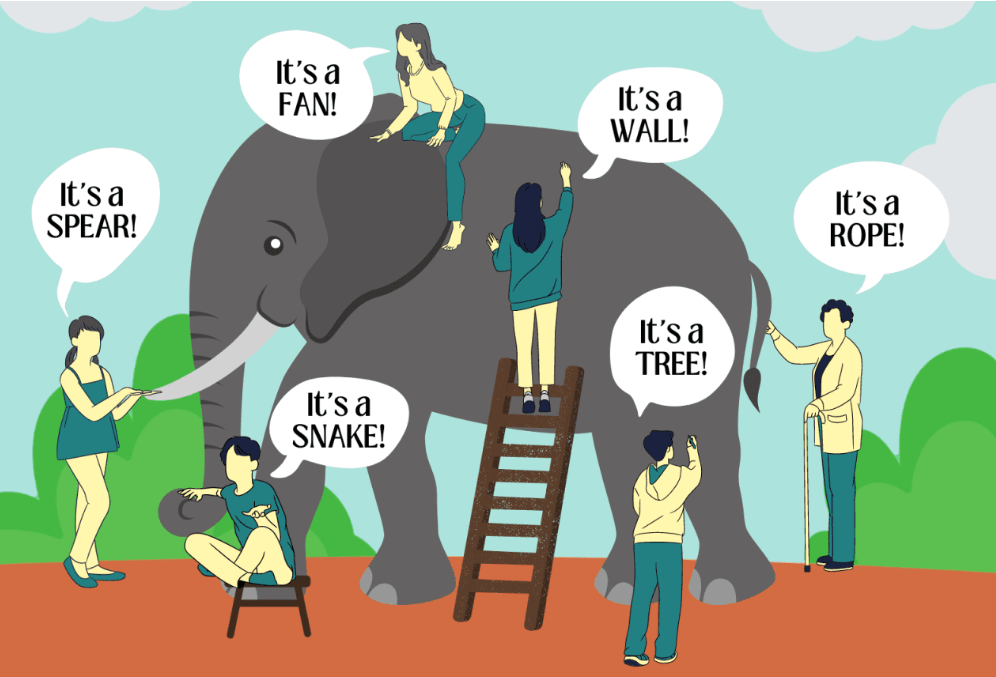
The blind men and the elephant: Is perception reality?

In recent times, eight older men lived in an Indiana community. Each was successfully retired and quite confident. Their neighbors loved the older men and encouraged their breakfast group meetings. Since the older men were no longer actively engaged at work, they had to imagine how things really operated. They listened carefully to stories about the active world of business, government, politics, health care, science, and leadership told to them by others.

The men were curious about many of the stories they heard, but they were most curious about Civility as a super solution to social challenges. They were told that Civility could fix politics, solve tough problems, promote personal growth, reinsert facts and logic into debate, revive trust, social relationships and institutions, and restore the balance between individuals and community. 

They remembered Indiana as a very special place with great leaders. They recognized Birch and Evan Bayh, VP’s Quayle and Pence, representatives Lee Hamilton and Julia Carson, Indianapolis mayors Hudnut, Goldsmith, Petersen, Ballard and Hogsett, mayor and senator Lugar, but especially Governor Mitch Daniels.  They knew that Daniels had been effective for Indiana, America and Purdue.  Did Daniels believe in this Civility miracle solution?

The older men argued day and night about Civility. “Civility must be too simple,” claimed the first man. He had heard stories that it ignores real differences and big solutions.

“No, you must be wrong,” argued the second man. “Civility is complicated, combining values and habits in search of perfection.  That is why people struggle to follow it.”

“You’re wrong! Civility seeks compromise, the middle ground and the golden mean.  It combines the best that participants can offer,” said the third man.

“Please,” said the fourth man. “You are all mistaken. Civility grandly guarantees that it can solve all problems and conflicts! You know how people exaggerate.”

“How can you be so naïve,” exclaimed the fifth man.  “Civility simply rationalizes weak, overly sensitive behaviors that avoid conflict and deny human nature.”

“Civility ignores passion and the emotions,” cried the sixth man.  “It eliminates feelings, values, and intuitions by emphasizing cold rationality alone.”

“I am sure that Civility is a leftist plot,” said the seventh man. “That would explain why it emphasizes the importance and legitimacy of government.”

“On the contrary,” declared the eighth man. “Civility is a Republican scheme to return to the 1950’s with its mindless emphasis on a single culture, morality, character and values.”

Finally, the neighbors grew tired of all the arguments, and arranged for the curious men to visit the home office of Mr. Daniels to learn the truth about Civility.

When the men reached the home a half-hour ahead of schedule, they were greeted by an old friend who managed the governor’s visitors. Their friend led them to a waiting room where they watched a 10-minute video on Civility. The retired men quickly began to argue.

The first man stood up and exclaimed. “Civility is just common sense, nothing special.”

The second man misquoted the video. “Civility claims that all people can get along and all problems can be solved,” he announced.

The third man disagreed. “I was right,” he decided. “Civility is a tool of the powerful to maintain the status quo.”

The fourth man criticized Civility’s idealism. “What we have here,” he said, “is a sort of cult, invoking magical practices to reach utopian ends.”

The fifth man responded, “Civility is hopelessly weak because it asserts that strong emotions, interpersonal relations, sensitivity and hospitality can mend all fences.”

The sixth man stated, “Civility is very powerful.  It allows groups and individuals to acquire and use power for their own ends, while dismissing the needs and desires of others.”

The seventh man considered the actors in the presentation. “Civility elevates individuals and personal growth above church and community, so it must favor Democrats,” he said.

The eighth man was shocked. “Why, Civility is nothing more than a way for the powerful to reassert social control through norms, taboos and shunning,” he scoffed.

The governor’s aide led his friends to the kitchen. “Sit here and rest,” he said. “I will bring you something to drink.”

While they waited, the eight men talked about Civility.

“Civility is just politeness, rules and etiquette.  It is a surface level approach,” said the first man. “Surely we can finally agree on that.”

“Just politeness? Civility aims to transform men, institutions and society” answered the second man.

“Transformation?  Civility focuses just on process, promotes elite values and prevents real arguments and solutions” insisted the third man.

“It’s impossible for everyone to develop such powerful skills that effectively bridge real human differences,” said the fourth man.

“Civility merely assumes that better skills, processes and values can manage differences, conflicts and human nature through the forces of goodwill,” noted the fifth man.

“Civility provides a socially approved way for individuals to emphasize form over substance.  They can perform in a civil manner without really addressing the needs of others,” cautioned the sixth man.

“Socialist subjectivity and radical tolerance. There’s no doubt,” said the seventh man.

“Don’t you see?” pleaded the eighth man. “Civility is intended to keep us occupied and distracted by small issues and away from the larger issues of systematic injustice.  Someone is using Civility to trick us.”

Their argument continued and their shouts grew louder and louder.

“Too simple!” “Too complex!” “Too moderate!” “Too extreme!” “Too soft!” “Too hard!” “Too liberal!” “Too conservative!”

“Stop shouting!” called a very angry voice.

It was Purdue President emeritus Daniels, disturbed by the noisy argument.

“How can each of you be so certain you are right?” asked the former governor.

The eight men considered the question. And then, knowing the budget director to be a very wise man, they decided to say nothing at all.

“Civility combines values, skills and behaviors to solve problems and build relations,” said Mr. Daniels. “Each of you exaggerates the importance of only one part. Perhaps if you put the parts together, you will see the truth. Now, let me finish my morning in peace.”

When their friend returned with drinks, the eight men rested quietly, thinking about their leader’s advice.

“He is right,” said the first man. “To learn the truth, we must put all the parts together. Let’s discuss this on the journey home.”

The first man found his seat on the senior bus. The second man found his seat, and so on until all eight men were ready to travel together.

References (and apologies …)

Peace Corps – The Blind Men and the Elephant

Civility is Nonpartisan – Good News

Civility is Not Simple or Easy – Good News

Opposition to Civility is Unconvincing – Good News

Opposition to Civility is Unconvincing (2) – Good News

Civility is for Everyone! – Good News

Civility: Can’t We All Just Get Along? – Good News

Civility Resources (3): Politics

Marshall Ramsey | Stuff from Marshall Ramsey’s brain.

Overview

The decline in social Civility appears in our politics MAGNIFIED. The same factors are at work, but political actors have not just lost some Civility skills, many have rejected and opposed Civility. We’ll address the role of differences and commonality, polarization, limits of classical liberalism and current conditions.

Political, Religious and Philosophical Differences

We have evolved 6-9 “political” constructs. They are natural. Different people, personalities, political groups and cultures emphasize some more than others. There is a difference between traditional and modern/postmodern cultures. Conservatives and liberals see the world differently.

Moral Foundations Theory of Politics – Good News

The Righteous Mind: Why Good People are Divided by Politics and Religion – 2012 (Part 1) – Good News

The Righteous Mind – Part 2 – Good News

Are those who see the world differently from me Evil? Wrong? Unworthy? Shunned? Ignorant? Clueless? Selfish? Childish? Possessed? Confused? Stunted? Misguided? Immoral? Greedy? Irrational? Emotional? Small-minded? Provincial? Utopian? Idealistic? Shortsighted? Prejudiced? Reactive? Limited? Deluded? Suckers? Hubristic? Elitist?

Civility: Can’t We All Just Get Along? – Good News

Our Political Differences are NOT Going Away; And That’s OK – Good News

Moral Intuitions, Personality and Politics … Oh My! – Good News

We Have More in Common Than You Think – Good News

Words for Who We Are in Common – Good News

Polarization

We have become more and more polarized; partly by choice and partly by accident. Improved social Civility can help to fix this.

Causes of Increased Political Polarization – Good News

One Page: Why We’re Polarized – Klein (2020) – Good News

Why We’re Polarized 2020 – Good News

The New American Right, Daniel Bell, 1955 – Good News

Classical Liberalism Needs a Moral Basis

One Page: Liberalism and Its Discontents – Fukuyama (2022) – Good News

Liberalism and Its Discontents – Francis Fukuyama 2022 – Good News

Fukuyama: Identity (2018) – Good News

Recent Politics

Framing What Matters Most in America: 2023 – Good News

Politics Ain’t Beanbag: Diagnosing the 2024 Presidential Election – Good News

Serve the American People – Good News

It Gets Even Worse – Good News

Who Will Defend Democracy? – Good News

Civility Resources (1): Context of Good News

Optimism – Global Wellness Institute

Overview

Our current challenging social and political situation is driven by the root causes of individualism, skepticism secularism, inadequate myths, human nature and insecurity. In a word: negativity. Civility embraces constructiveness, intentionality and public-spiritedness as clearly “positive” values. It is also based upon the “positive” values of human dignity, respect and acceptance. Is it reasonable to be so positive in a time of negativity driven by politicians, the media and our fellow citizens? The answer is “yes”. We have chosen to emphasize our challenges rather than our accomplishments. Those who pursue Civility need to be aware of the reality of modern progress, conditions in all areas of life and realistic opportunities for change.

Overall Good News

Improvements in all areas of life since the 1976 bicentennial are amazing!

We’re MUCH Better Off in 2026 – Good News

100 improvements in all areas.

Index of 100 Good News Posts – Good News

A safer world.

Modern History: International – Good News

Unimaginable communications and computer tools.

Modern History: Communications and Computers – Good News

Social progress and social choices.

Modern History: Society and Religion – Good News

32 Fiction Works Set in the 1950’s – Good News

Philosophy and politics. We have succeeded many times.

Modern History: Philosophy and Politics – Good News

WW II, the Fifties and early Sixties: 24 Great Biographies – Good News

American Presidents – 36 Great Biographies – Good News

Science and Technology

Modern History: Communications and Computers – Good News

Human Progress: Accumulate and Innovate – Good News

Modern History: Math (and Physics) – Good News

Modern History: Biology and Life – Good News

Modern History: Technology – Good News

Good News: 100 Recent Technical Innovations for You! – Good News

Business and Economics

Modern History: Business & Economics – Good News

80 Years of Global Economic Success – Good News

The US Economy Leads the World – Good News

The US Economy is Already Great: No Tariffs Required – Good News

Good News: The Business Cycle is Done – Good News

Management Effectiveness Has More Than Doubled in the Last 50 Years!!!! – Good News

Mostly Good News Since the 2008 Great Recession – Good News

Civility Resources (4): Values

Overview

Civility is a social norm and a set of behaviors based upon a set of shared values. We address public morality, the 7 Civility values and their broad support from different belief systems.

Morality

Thought leaders increasingly embrace the need for some kind of commonly held public morality to replace the historical background of Christianity and Western civilization.

Respect, responsibility, honesty, compassion and fairness comprise one set of values to consider.

Common Moral Values – Good News

Rabbi Sacks provides historical context of the ideas that have led to an “I” focused culture, outlines the symptoms of a weakened “We” culture, and provides some insights as to what can be done. He combines a politically and economically moderate view with a conservative social perspective.

“We will have to rebuild families and communities and voluntary organizations. We will come to depend more on networks of kinship and friendship. And we will rapidly discover that their very existence depends on what we give as well as what we take, on our willingness to shoulder duties, responsibilities, and commitments as well as claiming freedoms and rights.”

Morality (2020) Jonathan Sacks – Good News

Teddy Roosevelt: “The first duty of an American citizen, then, is that he shall work in politics; his second duty is that he shall do that work in a practical manner; and his third is that it shall be done in accord with the highest principles of honor and justice.” The citizen should be like his “man in the arena”, fully engaged in important matters.

The Soul of America – Jon Meachem (2018) – Good News

Brooks offers 15 solutions. Live for holiness. Fight selfishness. Use your heroic capacity to struggle against external and internal challenges. Humility is the first virtue. Pride is the central vice. Struggle against sin and for virtue. Purposely build character skills, habits, experiences and preferences. Focus on the long-term, permanent attributes of life. Seek help in building character. Recognize the U-shaped pattern of falling, evaluating, feeling and accepting grace and recovering. Quiet the self enough to listen and defeat weaknesses and temptations. Aim for a practical wisdom built upon experience and history rather than a perfect ideology, theology or philosophy. Organize work around a “vocation” and do your best. Define leadership as finding “a just balance between competing values and competing goals”. Embrace the path of becoming better in your vocation and better as a person. That is the opportunity we are given.

The Road to Character – 2015 – Good News

Using the classical Greek values today.

All Things Shining: A Secular Age Solution? – Good News

The 7 Civility Values

7 Civility Values – Good News

Civility Playlists – 300 Songs – Good News

The 7 Civility Values are Supported by World Religions – Good News

Christianity Supports the 7 Civility Values – Good News

Stephen Covey’s “7 Habits” support the 7 values and the 7 skills/behaviors.

Covey’s “7 Habits” and Civility – Good News

Individual Civility Values

Human Dignity is a Universal Value – Good News

Respect is a Universal Value Supporting Civility – Good News

Responsibility is a Universal Value That Supports Civility – Good News

Intentionality is a Universal Value That Drives Civility – Good News

Constructiveness is a Widely Supported Value and Basis for Civility – Good News

Public-Spiritedness is a Universally Accepted Civility Value – Good News

Acceptance: A Little More Complicated

Acceptance is a Universal Value Supporting Civility – Good News

Civility and DEI – Good News

Addressing the “Threat” of Immigration – Good News

How Liberal Values Drive Conservative Populism – Good News

Civility Resources (5): Action

Overview

Civility is based on values, but the practice of Civility is about behavior and habits that can be learned and improved. Inspiration connects the Civility values with the Civility behaviors. Civility is a social norm subject to the laws of virtuous and vicious cycles. The widespread re-adoption of Civility as a social norm faces many challenges.

Behaviors/Habits

Civility is a set of behaviors that recognizes differences and builds mutual respect.

  1. Self-awareness
  2. Self-management
  3. Social awareness
  4. Relationship management
  5. Communications
  6. Growth
  7. Problem-solving

Civility is Really About 7 Behaviors – Good News

We now understand how humans behave. We are imperfect and amazing. We have the ability to balance the individual and the other, the individual and the community, the individual and spirit/God.

Civility is based upon the human dignity of each individual. The modern “cognitive science” approach embraces this insight. It offers tools to make our lives more effective, meaningful and satisfying. Civil individuals should invest time to master these subjects.

Civility: Cognitive Science to the Rescue – Good News

Cultures exist because individuals need to be combined into communities. Without cultural norms, expectations, education, rewards, penalties and taboos there wouldn’t be any culture, community or civilization.  This requires society – and its leaders and influencers – to clearly define select important aspirational values AND to define what is TABOO, poison, shunned, beyond the pale, unacceptable, and rejected by all.

Civility Taboos – Good News

Cultural Norm/Virtuous Cycle

Civility is a set of behaviors based upon a set of values. It is adopted and grown by individuals based upon their conscious and unconscious experiences. The practice of Civility tends to promote Civility in others. Unchecked incivility tends to destroy Civility. 

Civility as a Dynamic System – Good News

Inspiration

Civility offers direct and indirect benefits to individuals. In the end, it is both a practical and a moral choice. We live in a “secular age” where the received religious views can be challenged by well-meaning people. My belief is that our “classical liberal” democracy requires the support of a Civility subset of values. I also believe that our secular society requires this same subset of values to facilitate the interactions and transactions of modern life. I believe that almost all individuals can justify Civility values, behaviors and skill development on a practical basis alone. I hope that the 15 benefits described below will help everyone to make the right choice.

Civility: What’s In It for Me? – Good News

15 inspiring reasons to embrace Civility for ourselves and others.

Inspiring Civility – Good News

The “heart” is the source of our best thoughts, feelings and actions, including acting Civilly in daily life which builds the skills, influence and expectations to require Civility in our political world.

Healing the Heart of Democracy – Good News

Some personality types are more passionate about Civility, but all are welcome.

Civil Personality Types – Good News

We must have hopes, ideals and dreams.

Dream the Impossible Dream – Good News

Challenges

Civility encompasses values and behaviors, a dynamic process and personal growth. It offers a process solution to our common differences and potential conflicts. It has many component parts that change through time for each person. The core components can be learned and applied by everyone. The basics are easy. Practicing and perfecting Civility values and skills is the good work of a lifetime, worthy of our human dignity.

Civility is Not Simple or Easy – Good News

Civility is supported by left and right in America’s political history. Modern techniques for most effective group interactions and negotiations are neutral. The values that support Civility are neutral. Civility takes no stand on modern political issues. The latest attempt to define the “righteous” bases for politics provides no dimension opposed to civility. Civility can be used as a bipartisan base for our democracy and our day-to-day interactions.

Civility is Nonpartisan – Good News

Civility is not politeness, utopian, weak, emotional, partisan, righteous or apologetic. It can be used by the most serious, radical individuals to refine their own skills, engage with others and attempt to find common ground and understanding. It seeks to find solutions and to build relations. It seeks to undermine polarization. It does not prevent leftists or rightists from highlighting systematic injustices or threats to individual rights and liberties in our economic, political and social worlds.

Opposition to Civility is Unconvincing – Good News

The populist wing of the Republican party sounds like the far-left wing of the Democratic party. Civility is a tool of the other guys, unfair, biased, inadequate, ineffective, unreliable, soft, emotional and too slow. The Civility approach doesn’t support the simple polarizing approach of modern politics. It emphasizes facts, logic, values clarification, optimal means, compromises, discovery, short and long run trade-offs, all of the tools of the modern negotiator’s kitbag. It accepts that profound differences may remain in our political, economic and social realms. 

Opposition to Civility is Unconvincing (2) – Good News

Civility is easy to caricature and dismiss. Simplistic “straw man” versions are easy to attack. It is a moderate and moderating approach, so some might call it conservative. It values interactions, feedback, process, learning and growth, so some might label it liberal.

Civility is for Everyone! – Good News

Civility does require personal work and interactions. We have a much better understanding of the components of Civility today. It offers a scalable solution to our many problems. It can be developed one step at a time. It can be used in all arenas of life. It can be taught to everyone. We can re-establish Civility as a social norm. Like other social norms, there is a virtuous cycle/network effect that leverages our progress. Modern social science classes provide very effective tools and classes to build our skills. Civility has personal benefits, especially a sense of personal agency. It has benefits for the institutions of modern life that can invest and promote it. Civility is a personal choice that cannot be prevented by groups that oppose it. Civility is a “no brainer”. We have the opportunity to re-establish it for the benefit of all.

Restoring Civility: Overcoming Obstacles – Good News

Many Civility behaviors are strongly natural. Some are not.

Civility: Nature versus Nurture – Good News

Civility Resources (6): Solutions

Overview

Civility is a popular subject to talk about and bemoaning the loss of Civility has become a national pastime. But the trick is to “do something about it”. We have personal, political, strategic, educational, policy and structural solutions to consider.

Politics

Once citizens see that they are treated like victims and encouraged to adopt a victim position by politicians, they can “turn the table” and demand to be treated as powerful voters given real answers.

Don’t Be a Political Victim (Left) – Good News

Don’t Be a Political Victim (Right) – Good News

Civilization and daily life are guided by unspoken norms and beliefs. We have experienced significant changes in the past century that undermined the consensus view and now requires individuals to consciously consider a greater share of their daily lives. We have not reached a new consensus and may not do so anytime soon. As we work through these differences we need to reinvest in Civility skills, habits and understanding. Civility helps us individually, in groups and as a society to interact effectively despite our differences. We don’t need perfection or infinite improvement, but we need to invest in Civility and use its power as a self-reinforcing system or virtuous cycle to guide us into the future.

The Power of Civility – Good News

In order to solve our political problems, we need to face and solve the 6 underlying root causes. They are interconnected. They can be addressed mostly outside of the political process. This is cause for great hope and optimism.

Facing Our Political Situation: How Do You Solve a Problem Like Maria? – Good News

Education

We live in a complex, interdependent world and must make many choices.  We need a greatly enhanced educational program.

Modern Curriculum for Citizens – Good News

Policies

Many Americans today cry out for “respect”. They see a social, economic and political system that does not work for them. A political party that really understands this situation would take strong action, IMHO. Some thoughts …

R-E-S-P-E-C-T – Good News

I’ve outlined other policy steps below that might convince the two-thirds of the electorate that are working and middle class that they are the priority.

R-E-S-P-E-C-T-2 – Good News

This 2017 bestseller was applauded by the WSJ, The Economist, Harvard sociologist Robert Putnam, JD Vance (as a complement to Hillbilly Elegy) and Barrack Obama. It tells the story of Janesville, Wisconsin as a General Motors assembly plant with 3,000 workers was permanently closed in the turmoil of the Great Recession. It focuses on the impact on real people and the community’s response. The author concludes that neither the liberal response of job training nor the conservative response of economic redevelopment incentives was adequate to meet the community’s needs. What could work?

The Janesville Plan: Economic Opportunity for All – Good News

Wealthy individuals and families have great wealth to protect. As a nation and society, we have an obligation to eliminate this concern from being a primary role in our political decisions. We can set reasonable limits on the maximum contributions required from prosperous individuals in our society. 

The Paradox of Great Wealth in a Democracy – Good News

Structures

Draft citizen and candidate Civility pledges to consider.

A Civility Pledge – Good News

Civility Pledges – Good News

The people and leaders can choose to create new structures that provide pressure on politicians to act with Civility.

Taking Back Our Government: Candidate Appraisal Boards (CAB) – Good News

Promoting the General Good: A Council of Advisors, Elders, Guardians or Wisdom – Good News

Voters don’t have to accept non-Civil candidates.

We Always Have a Choice – Good News

Talk with others.

The 8 Older Men and Civility – Good News

Healing the Heart of Democracy

Review

I’m summarizing the 2024 update of the 2011 original. The author’s views largely coincide with the modern Civility project. He starts with the political/democracy view of life and works backwards into how people should live their lives in all realms. He promotes an aspirational view of what we can and should do. He is widely read and incorporates a variety of materials, mostly academic, into the book. As a sociologist he stays at the middle level of detail, not becoming too abstract and philosophical. Dr. Palmer is a very solid writer, communicating his views clearly and incorporating appropriate support and stories. His Quaker religious background is evident throughout. His “new left” leanings provide examples, language and context that can challenge the moderate or conservative reader.

He directly addresses our real challenges. We’re stuck with each other. Individualism without community is a dead end. The media, consumerism, political scapegoats, populism and fascism are real threats. Our democratic political structures provide us with tools, not solutions. These structures are resilient, the issues are evergreen. We never fully settle our differences, and that is OK. The fear of the “other” is innate. The scientific expert view of life is inadequate and ultimately unsatisfying. We need effective myths to shape our worldviews, but they cannot be fixed and reductionistic like our science or business approaches. The key dimensions of life are best addressed with a tension of yes and probably not; individual and community, liberty and law, material and spirit, inward and outward, selfish and altruistic, principles and applications, etc. We live by habits. There are 5 habits relevant to democracy that require significant work to adopt. The ground or basis of life, truth, decisions and knowledge is “heart”, our intuitive ability to combine thought, feeling, skepticism, history, community and myth into decisions. It is an organic, holistic Quaker insight consistent with secular listening, focusing, psychology, philosophy, meditation, logic, systems, and social sciences. The author and publisher offer 40 video clips and a study guide for those who would like to share and explore this work with others.

Intro to 2024 Edition

We are in crisis in the Trump era. The 2001 “war on terrorism” response of demonizing other countries, growing the military and restricting civil liberties was only the beginning of our troubles. These challenges reinforce the need to invest in local, experiential, real conversations to build our Civility skills. Some groups are “beyond the pale”: violent, anti-factual, or racist. The loss of trust is an existential threat to our democracy. We cannot engage everyone; we only need a supermajority two-thirds to restore our system. “Habits of the heart” are built upon local interactions. Grassroots efforts to build these habits have spontaneously started in many places. Racial prejudice remains an issue. Progress in improving the human soul is slow, but worthwhile.

Politics of the Brokenhearted

People, like the author, who have heartfelt views of ideal human and political behavior, are often disappointed, even “brokenhearted”, when their deepest desires, insights and beliefs are unfulfilled. Today, our deepest political, philosophical, spiritual, religious, ethical, aesthetic, social views are often rejected by people and leaders. Despite many supporting factors, we fail to make political, religious, global and moral progress. This is the human condition. President Lincoln faced these challenges and was depressed. He overcame the disappointments to describe and take a constructive path forward. Storytelling is therapeutic. The “heart” is a critical concept: core of the self, where all ways of knowing converge. Despite the darkness we follow the light.

Humans are imperfect. Democracy is always at risk. The “heart”, our deepest ability to comprehend, can transform suffering into community, conflict into creative energy and tension into the common good. Dr. Palmer argues that the unavoidable contrasts/conflicts in life can lead to progress.

I. Democracy’s Ecosystem

Diverse races, ethnicities, classes and perspectives are foundational. We struggle with diversity, change and raggedyness. We seek to tame it in business, farming and politics. We need to consider efficiency and effectiveness. Diversity is inherent and good in nature. We are wired to fear the other, the stranger and diversity. Yet, we know intellectually that diversity provides us with tremendous benefits in marriage, trade, creativity, art, beauty, and religion. The tension between contrasting views, principles, measurements, frameworks, insights, beliefs, experiences, histories, etc. is not naturally or easily embraced, even though it is needed for personal growth. Individuals who choose to experience and wrestle with tension and heartbreak can become stronger, able to better manage future experiences. This persistence and earned personal growth do not “solve” the tension, conflict or pain, but it provides a greater ability to encounter it again and again. It is the only [partial] solution. Listening, empathy, exploration, dialogue, accountability, and problem-solving methods all matter.

Civility prioritizes the improvement of individuals. It does not demonize Washington, DC, big money, intolerance, passions, ignorance, or the 2-party system. These challenges are eternal. Human nature is eternal. We can make choices to improve our personal and political results.

“Heart” is a larger way of knowing. Mind, intellect, rationality, emotion, imagination and intuition are combined. This complex “heart” is what make us human. It aligns with religion, culture, community and the humanities as fundamentally organic, complex, spiritual and irreducible. Less complex views such as wealth, consumption, money, fear or progress are inadequate to the human condition. “Why do we suffer?” is a critical question that can only be answered by the heart. The question can be used by politicians to mislead people.

Deep thinking individuals like Quaker John Woolman can see solutions. They may involve holding the tension between conflicting people, interests or ideas for generations.

Politics of the heart rejects divisiveness, toxicity, passivity, powerlessness and commercialism.

Social movements leverage the “powers of the heart”.

II. Confessions of an Accidental Citizen

Personal advancement can be seen as more important than the common good. The responsibilities of citizenship are not really taught to children and youths, even those in professional class suburbs.

“Citizenship is a way of being in the world rooted in knowledge that I am a member of a vast community of human and nonhuman beings that I depend upon for essentials I could never provide for myself”. The community and the greater good matter, really matter, matter first! Yet the public good is unclear and disputed.

Hence, the political structure that provides long-term stability is elevated to become more important than the individual political decisions, no matter how heartfelt!!! This is an amazing result.

Democracy, political institutions and the heart can easily be misused by individuals or political leaders.

Rules and structure matter. Hope matters. Voluntary associations matter. Individualism can destroy community. Individualism has virtues.

Chutzpah says that I really matter. Humility says that I must know that I don’t know it all. We need both.

Five habits of the heart:

  1. We are all in this together. We are interdependent.
  2. We must appreciate the “other”. We prefer people of our own tribes who look, feel and think like us. We can recognize the great value to be had from interacting with “others”.
  3. We must learn to hold contrasting ideas, values, preferences and experiences in tension. We don’t choose one over the other. We accept that they have pieces of the truth that cannot be reduced to one or the other. We are imperfect and broken humans who do not expect to have perfect knowledge.
  4. We must define and express our personal views.
  5. We must create community.

The Civility revolution takes place at the grassroots level.

III. The Heart of Politics

Palmer focuses on Terry Tempest Williams’ concept of living democracy.

“The human heart is the first home of democracy. It is where we embrace our questions. Can we be equitable? Can we be generous? Can we listen with our whole beings, not just our minds, and offer our attention rather than our opinions? And do we have enough resolve in our hearts to act courageously, relentlessly, without giving up – ever – trusting our fellow citizens to join with us in our determined pursuit of a living democracy?”

After 9/11, we showed as a nation that we have lost the ability to have civil debates about important topics. This was and remains very frustrating for most citizens.

Palmer says that we individually and collectively have the power in our hearts to address this shortcoming. He notes that these words challenge us about our own capacity for openness, honesty, trust and persistence. It’s not enough to lament politicians or the situation. The key is taking steps to make things better.

This insight does not support a simple romanticism. The heart can support the best or worst of mankind.

While Palmer’s politics are consistently from the left and criticize the rise of the far right in American politics, he is clear that the challenges of human life are faced by everyone. Generosity and self-interest. Listening and fear of hearing. Trusting and fearing. The aspirational challenge of values and moral character is inherent in human nature. It is easy to criticize others for their lapses while ignoring our own shortcomings.

Palmer dismisses claims that the strategy, resources and techniques of politics are most important by describing how emotional appeals to “family, faith and patriotism” are so effective.

He argues that heartfelt struggles generate our social ills. Fear drives consumerism. Arrogance requires more of everything. A spiritual emptiness drives false consumer solutions. Yet, Americans are also the most generous people on earth.

While feelings provide opportunities to manipulate people, the appeal of pure reason is similarly ineffective. Palmer describes Alan Greenspan’s 2008 “shocked disbelief” that individuals could be so greedy that the efficient banking markets could be destroyed. He criticizes our education and business culture for using reason alone to make decisions.

Palmer reiterates that “heart” is an integral way of knowing that combines thinking, feeling, experience, intuition and judgement. He illustrates it with a story of a USDA administrator facing pressure from his boss to comply with his politics, finally deciding to follow his “farmer’s heart” and recognize that “I report to the land”. The staffer used all of his experience, acknowledging the tensions of the different interests and perspectives before making a choice. The choice may be overruled but it helped to move larger conversations forward.

Palmer outlines “the power of heartbreak”. We all experience disappointments, large and small. We respond differently. Most of us are crushed, withdraw, weep, deny, delay and build defenses against future experiences by becoming stoic, less at risk, less emotional, etc. Yet others find ways (by necessity, insight, character, grace or luck) to digest the situation, experience it, learn and become stronger and more engaged. These experiences can make us stronger and more flexible rather than weaker and brittle. He’s arguing at two levels. In our personal day to day lives, and in our civic, political lives. If we can build the experiences, power, insight and strength in our personal lives we can apply this everywhere. Our heartbreak at the recent loss of Civility in our country can help us to work for change.

“Despite our sharp disagreements on the nature of the American dream, many of us on the left, on the right, and in the center have at least this much in common: a shared experience of heartbreak about the condition of our culture, our society and our body politic.”

“But a heart that has been consistently exercised through constant engagement with suffering is more likely to break open instead of apart. Such a heart has learned how to flex to hold tension in a way that expands its capacity for both suffering and joy.”

“But one day you emerge and discover, to your surprise that because of your devastating loss, your heart feels more grateful, alive and loving.”

“We must restore the wholeness of our civic community … hearts are the source of what Lincoln called ‘our bonds of affection”, that sense of unity among strangers that allows us to do what democracy demands of its citizens: engage collectively and creatively with issues of great moment, even – and especially – in times of intense conflict.”

Palmer acknowledges that we cannot be conflict free. He notes that conflict can drive creativity and resolve critical questions.

Palmer identifies our “inner emptiness, the absence of a strong sense of personal identity” as the most important cause of our situation. He proposes that we should look inward to our “hearts” rather than outward to prepackaged solutions. He describes the many negative impacts of consumerism on undermining the development of a personal identity. He describes how “scapegoating” by politicians and the media plays an especially virulent role in destroying personal identity by making people dependent on others for solutions and filling the victim role.

He comments: “Of course, many Americans find it not only possible but actually pleasant to live among strangers and take a pass at scapegoating. Put simply, these are the grown-ups who left the adolescent mindset behind and learned to take responsibility for their own inner struggles for meaning instead of seeking someone to blame.”

“Democracy needs and, at its best, breeds people who have minds of their own … The healthy self finds an identity that allows it to feel at home in its own skin and in the company of others, even (and sometimes especially) ‘alien’ others”.

IV. The Loom of Democracy

Palmer reiterates that we face conflicting views in our politics which create tensions. He argues that our political system, like a loom, can constructively hold this tension and produce constructive results, a cloth that is strong and new. “holding the tension of our political disagreements to keep us talking with each other and giving us chance after chance to reweave the fabric of our common life.” He highlights unavoidable tensions like freedom and discipline, and liberty and law. These inherently contrasting principles call for both/and rather than either/or solutions that take time to create and continue to evolve.

“The heart has the capacity to turn tension towards constructive ends, but there is nothing automatic about it.” It is more likely to succeed with successful practice. Prior failures may prevent future success. “Is it an experienced heart, a reflective heart, a heart made supple by inner exercise and responsive engagement with life? Or is it a heart grown brittle from being wounded, unattended and unhealed, sheltered and withdrawn, a heart more prone to shattering in the face of yet another demand?”

In addition to experiencing and growing from heartbreak, the author recommends “mindfulness, meditation or prayer, reading great literature … spending time in solitude … talking with a counselor or spiritual guide.”

Palmer argues that the American political system is designed to address “divergent” problems by maintaining engagement and commitment and driving creativity. He argues that forced solutions and final solutions destroy the community and the system. “In American-style democracy, the incessant conflicts of political life are meant to be contained within a dialectic of give-and-take, generating and even necessitating collaboration and inventiveness.”

The system allows topics to be addressed for long periods of time. No decision is final.

Palmer notes that “fight or flight” is hardwired in us but does not help to resolve divergent political decisions. He argues that the progress of civilization has been in inventing tools to overcome this either/or response: language, art, religion, education and democracy. [These inventions do] “not propose to bring life’s tensions to an end … [but] offers us a process for using them creatively, providing … structures that promise to turn the energy of tension towards constructive ends.” He notes that extreme individualism works against these tools that help us to work together in communities and associations of all sizes.

V. Life in the Company of Strangers

Palmer begins the chapter with a story about a taxi driver, illustrating the trade-off between the risks of interacting with the stranger, the “other” and the benefits of learning about people and the world.

He outlines a 3-level social world of private, public and political. We increasingly retreat to the private life. We are mostly isolated from the high-level political life, dominated by professionals. We have the opportunity to live in the “messy” middle public level where we can practice our interactions with others with conflicting values, interests and ideals.

Palmer argues that the skills, relationships, confidence and groups we form in the middle are the essence of democracy, like the “voluntary associations” emphasized by deTocqueville in the early 1800’s. The public life acts as a buffer zone between the private and the political, holding the political level accountable (ideally).

The geography of the public level is emphasized through the examples of a public house, other “great good” places for interaction, well-designed urban areas and events. Robert Putnam’s Bowling Alone analysis of various places where we can interact or form community comes to mind.

Public organizations and places are where we can act with “dignity, independence, and vision”. We meet on common ground, accept the stranger, enrich our experience, express ourselves, identify concerns, debate, negotiate, identify needs, assist, generate ideas, share resources, protect and empower people. He emphasizes that these are possibilities rather than a set of utopias.

Palmer notes that public spaces and organizations are eliminated in authoritarian political systems. They act as a defense against the improper growth of centralized power.

Palmer notes that we make choices to interact, join and participate every day. Increasing these interactions at work, school, church, organizations and neighborhoods can change ourselves and the world around us. Small actions like potluck suppers, block parties, community gardens, porch sitting and holiday gatherings can have a large impact.

He ends the chapter with a description of Wendell Berry’s fictional small Kentucky town of Port William.

“Port William is a small farming community whose residents are not strangers to each other in the way city people are. Still, they remain strangers to each other in the way all of us are, no matter how well we may think we know each other: within each of us there is an endless, inarticulate play of shadow and light that makes us riddles to each other because we are riddles to ourselves. And yet all of the characters in this fictional world are integral and valued parts of what Berry calls ‘the Port Williams membership’. …This sense of membership is the ultimate gift of the public life … our sense that we belong to one another”.

VI. Classrooms and Congregations

Classrooms and congregations can provide great opportunities for us to participate in the public level of community and dialogue.

“Educational institutions have at least as much impact, and arguably more, on our basic assumptions about what is real, possible, and meaningful … we get images of ourselves … and images of the world”.

Without violating separation of church and state, Palmer argues that fundamental questions are unavoidable and should be addressed. “the nature of a ‘good life'”. [Rabbi Hillel asked:] “If I am not for myself, who is for me? If I am only for myself, what am I? If not now, when?”

“An education that pretends to explore only the outer world is disingenuous and incomplete. A good education is intentional and thoughtful about helping students find an inner orientation toward what is ‘out there’ that will be life-giving for them in the world … Do I have gifts? … does my life have purpose? … whom and what can I trust? … how can I rise above my fears? … how do I deal with suffering? … how can I maintain hope?”

Inner-life questions are embedded in all subjects, not just literature and the arts. They must be inserted. Courses should connect normal content with context and application.

Education should be more experiential encouraging students to experience the give-and-take of the public level. Students can engage within school and in the community. Teachers should be facilitators rather than scientific experts. The humanities courses must be preserved and enriched.

Congregations can also provide opportunities for public level engagement. Church governance participation. Church program leadership and participation. Peer counseling. Small group interaction. Potluck suppers! The use of consensus as the standard for decisions rather than majority rule.

Elevate “hospitality” to become a duty. “When a believer fails to offer hospitality to a stranger, the spiritual journey comes to a sudden halt … Becoming people who offer hospitality to strangers requires us to open our hearts time and again to the tension created by our fear of ‘the other'”.

VII. Safe Space for Deep Democracy

“The spaces in which our hearts are formed are not always made of bricks and mortar – they are also created by images, ideas, and ideals … the wellspring of all notional space is the human heart … if our hearts are large and supple enough to hold the tensions of those questions in a life-giving way, they produce ideas and ideals that feed a living democracy”.

We cannot let the media define our reality and spaces. “if we are to be citizens of a democracy, we must spend time in conceptual spaces defined by personal experience”.

Solitude, compartments, inner voice. “We also need safe spaces for small gatherings of ‘the company of strangers,’ spaces where citizens can come together to explore the challenge of living heartfelt lives in the neighborhood, in the workplace, and in the larger world.”

Circle of trust meetings, small groups, professional organization meetings, rocking and talking groups, Camp Obama, power of storytelling.

VIII. The Unwritten History of the Heart

“name, claim, and examine the myths that animate our personal or collective lives, myths that give voice to deep movements of the heart … a myth is an effort to tell truths that cannot be told with mere facts or known by the senses and mind alone, truths that take form only in the integrative place called the heart.”

“Myths do more than name truths that lie deeper than mere facts … they also name aspirations that might be achieved … when we openly acknowledge this gap between aspiration and reality and are willing to live to it honestly, a myth can encourage us to bring what we are a bit closer to what we seek to be.”

[America’s myth is found in the “Declaration, the Constituion, the Pledge of Allegiance, or our national anthem.” It is easily accessible and easily perverted into a simplistic, fully achieved status.

Many Americans believe in the full achievement of the American ideals. Palmer disagrees regarding military power, economic growth, opportunity and the melting pot. “Taken together, myths like these have been foundations of national pride, and we have taken their truth for granted … if we want to reclaim our democracy, we need to do the challenging heart-work of examining our myths, seeing how far they are from the reality of our national life, then reclaiming their embedded visions and doing the hard work necessary to bring reality closer to them.”

Palmer argues that reclaiming democracy can be done through the stages of past movements for social change. “Movements of social transformation are sparked by people who are isolated, marginalized, and oppressed but who do not fall into despair.”

The four stages are initial actions of courage, communities of congruence, going public and seeing signs of success.

It is necessary to act with hope in the tragic gap between today and tomorrow. It can be done by holding ourselves to the standard of faithfulness rather than the standard of effectiveness. The great movements take a long time.

Evaluation

Center-left or new-left bias is only sometimes acknowledged.

Racial and economic conflict are taken for granted.

There is a “small is beautiful” preference.

Myths, religion, spirituality are emphasized as essential.

Practical solutions are offered.

Utopian solutions are discounted but there remains an organic bias.

The 5 habits emphasize community, tolerance/tension, individual expression/agency and respect for the “other”. These are consistent with the 7 Civility values but the centrality of respect for the “other” inserts a value that is not universally shared. Jonathan Haidt emphasizes the validity of cultures that are more inward looking.

Dr. Palmer’s insights align with my 6 root causes (individualism, imperfect myths, secular age, insecurity/fear, human nature/greed) except he does not highlight excessive skepticisim.

His solutions are very aspirational. Are they possible for everyone or just a few?

Is the “heart” a valid construct? How does it work? Is this the “inner voice” of one religious perspective?

Is the growth of the heart through repeated heartbreak a valid, useful or widespread concept? I think we can all understand that this happens for some people at some times. It is a blessing and an inspiration. Can we base our life’s journey on this approach?

I think that Dr. Palmer provides a consistent evaluation of our current situation and reasonable steps forward. His study guide and video clips provide tools for groups to evaluate his ideas and promote the growth of Civility.

Buckeye Rustbelt

Introduction

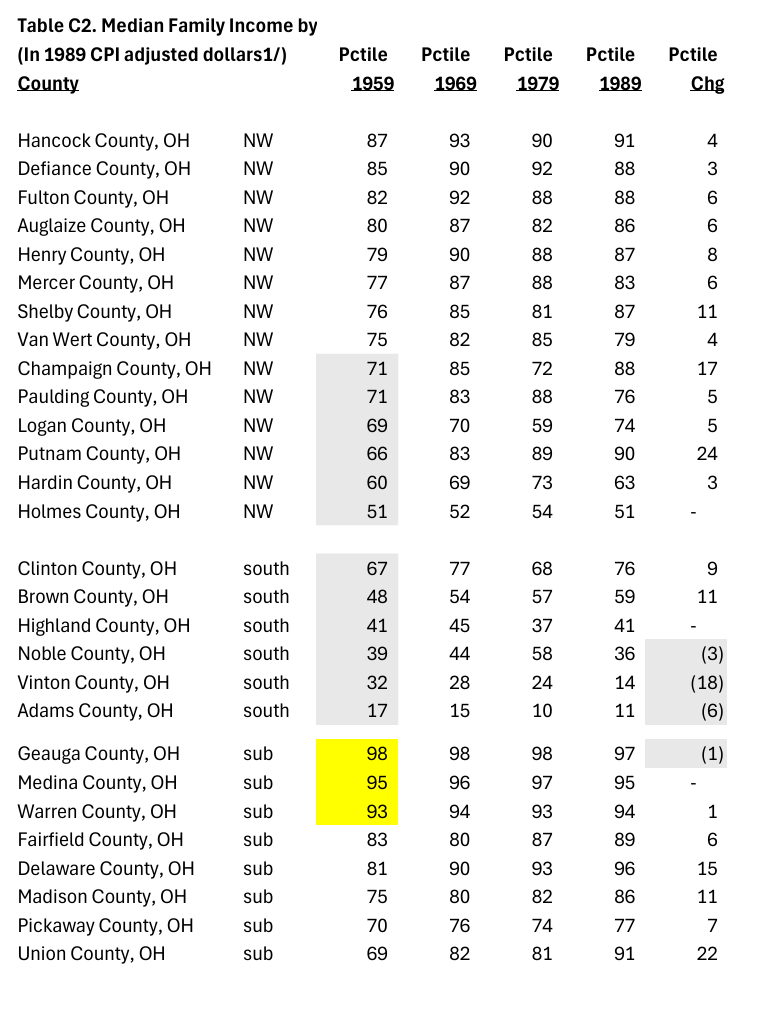
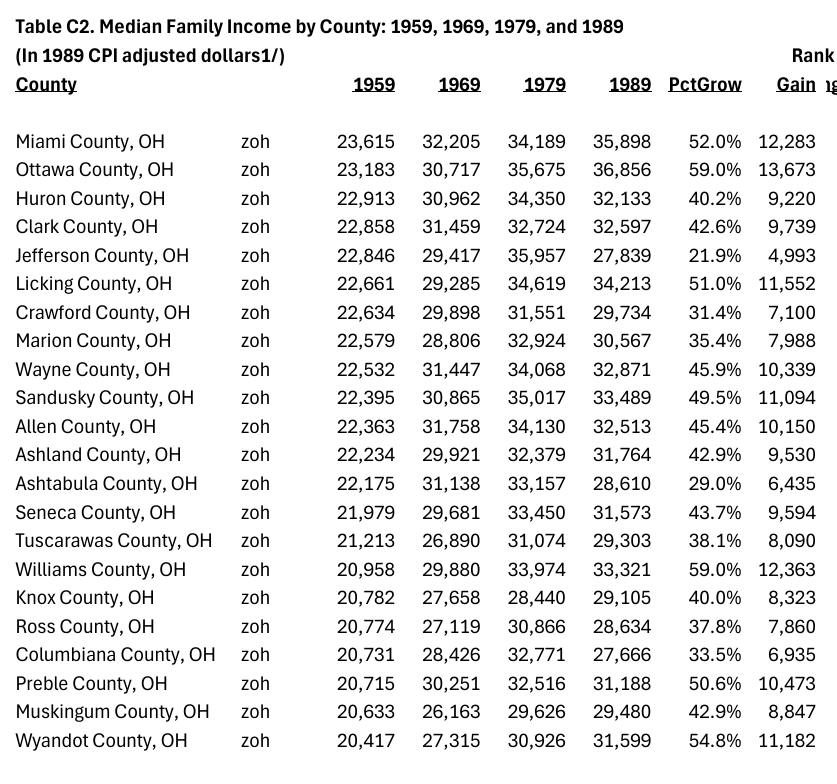
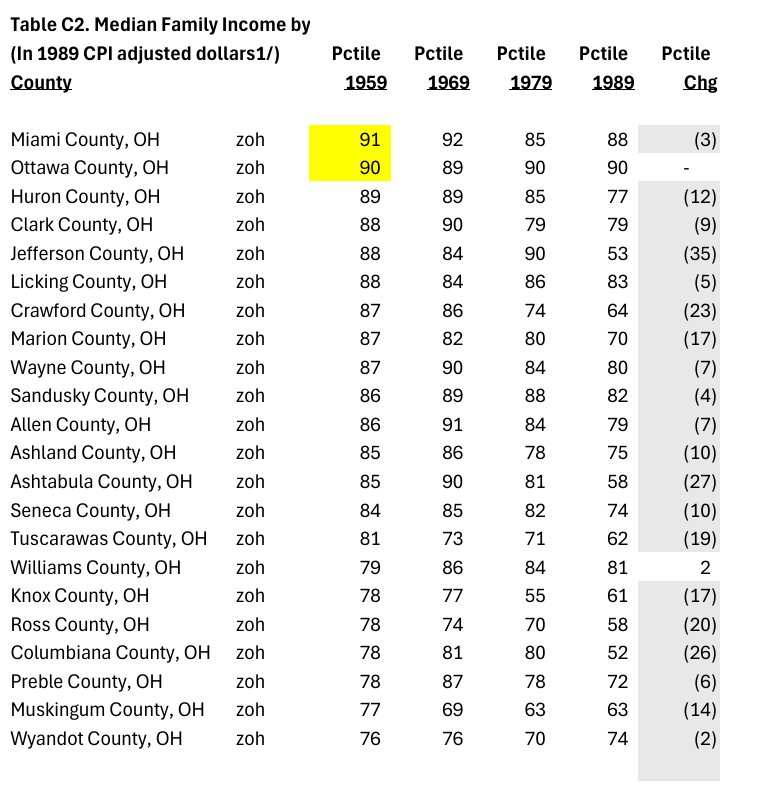
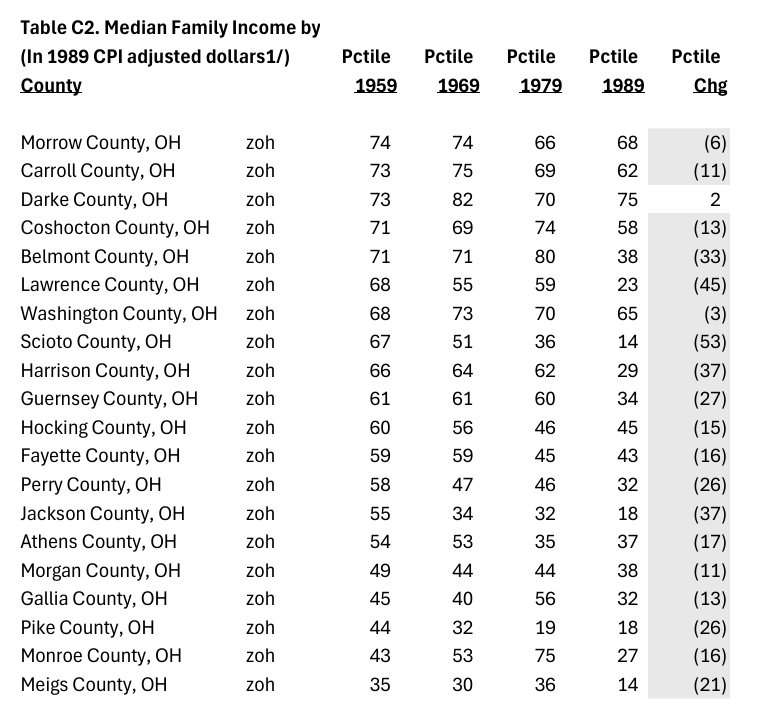
I was born in northeast Ohio in 1956, left for Dallas from 1984-87, returned and then moved to Indianapolis in 1988. I pulled the data on median family incomes to try to explain the impact of the shutdown of factories between 1960 and 1990 on the Ohio economy at the county level.

88 Ohio Counties

Context and Analysis

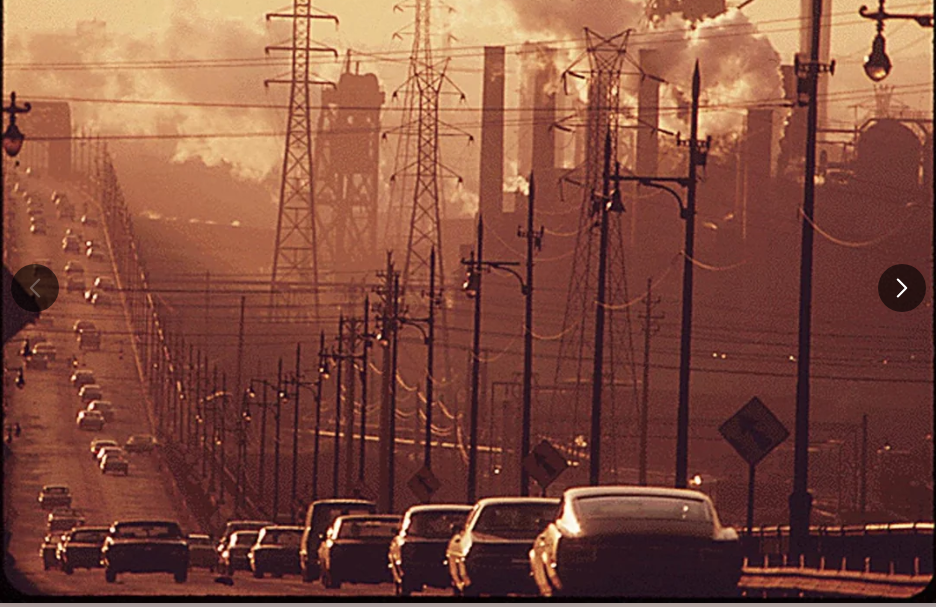
I was born in “the best location in the nation” according to the Cleveland Electric Illuminating Company (CEI). Cleveland was the source of the oil-based energy revolution and home of John D. Rockefeller. It was a major steel-making hub ideally situated to combine coal, iron ore and limestone. It had translated this advantage into providing metal machining services for all industries. The Cleveland metro area had been in the top 10 by population nationally and home to great sports teams. It was an innovator in paints, chemicals, electricity, science and broadcasting. It was home to a Federal Reserve Bank, a “Big 8” accounting firm and many Fortune 500 headquarters. It was a distribution hub within 500 miles of a large share of the US population and GDP. Its cultural assets were world class. It was situated on the Lake Shore rail line between New York City and Chicago. It was served by many interstate highways, 2 airports, the Great Lakes and the St. Lawrence Seaway. It leaned Republican but had strong Democratic cities. It was a powerful state, deemed the “mother of presidents” with 8 serving the nation. I attended McKinley ES and Harding HS. Cleveland leaned towards New England culturally as descendants of the Connecticut New Western Reserve for Revolutionary War soldiers.

Cleveland’s manufacturing prowess was repurposed during WWII to support the “arsenal of democracy”. It expanded in the post-war boom period to support the US and European recoveries. Unfortunately, Cleveland firms, owners and banks generally missed the transition to value added services and modern manufacturing between 1960 and 1990. The same story played out throughout the Midwest. The very best manufacturing firms improved their processes, developed new products and outsourced routine production in order to survive.

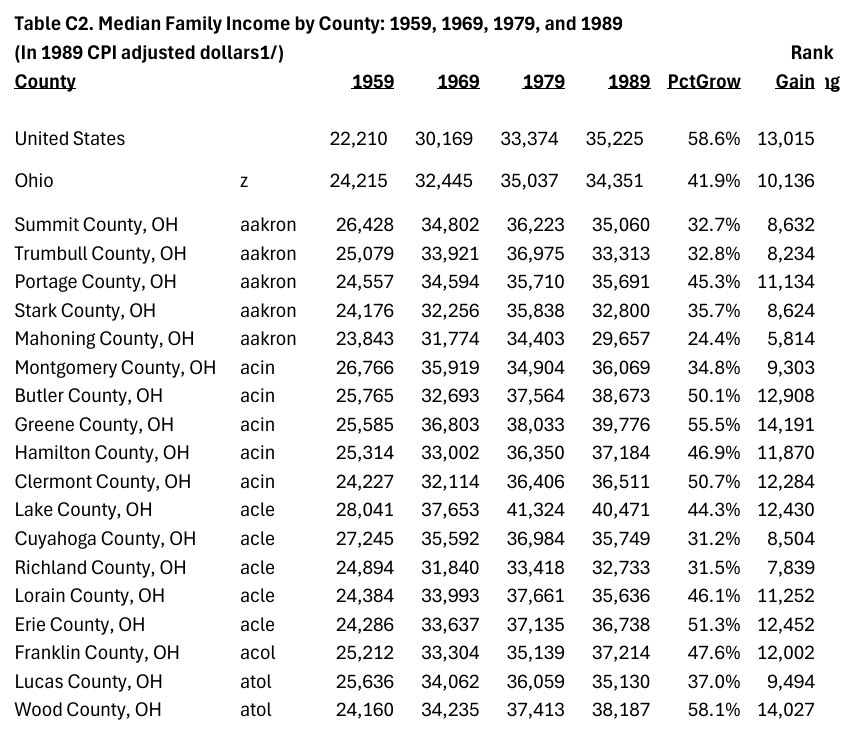
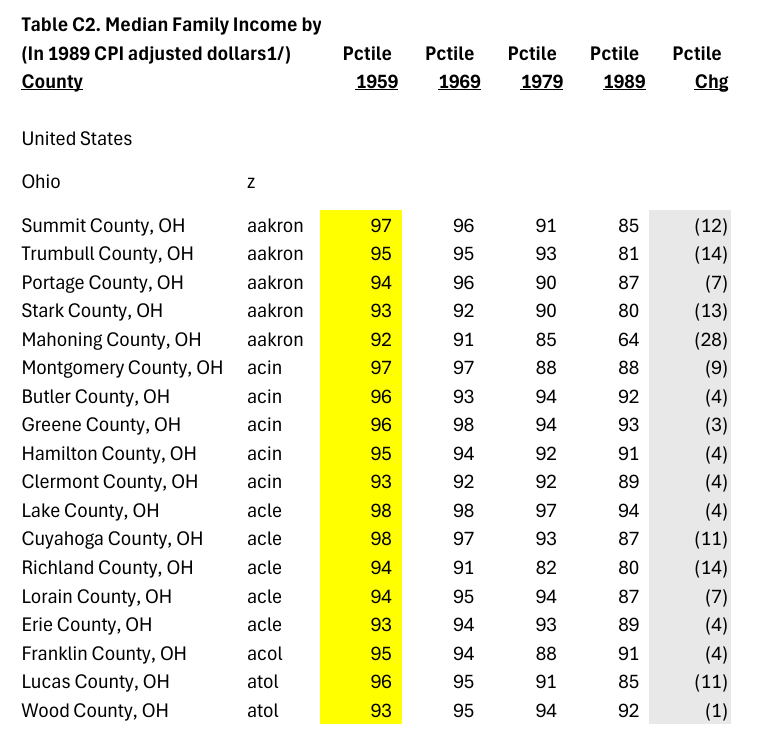
Ohio incomes were 10% above the national average in 1959 but below the average by 1989. The state was loaded with 18 large manufacturing counties that provided world class output and incomes above the 90th percentile for the 3,100 American counties. Cleveland, Akron/Canton/Youngstown, Columbus and Cincinnati/Dayton were global manufacturing leaders in 1959.

Real incomes grew by 59% between 1959 and 1989 for the nation as a whole. Ohio incomes grew by just 42% as the manufacturing economy faced global competition. The 18 major manufacturing counties grew by the same $11,000 as the state, 10% less than the national $13,000. These proud counties fell from the 95th to the 86th percentile of incomes in these 3 decades.

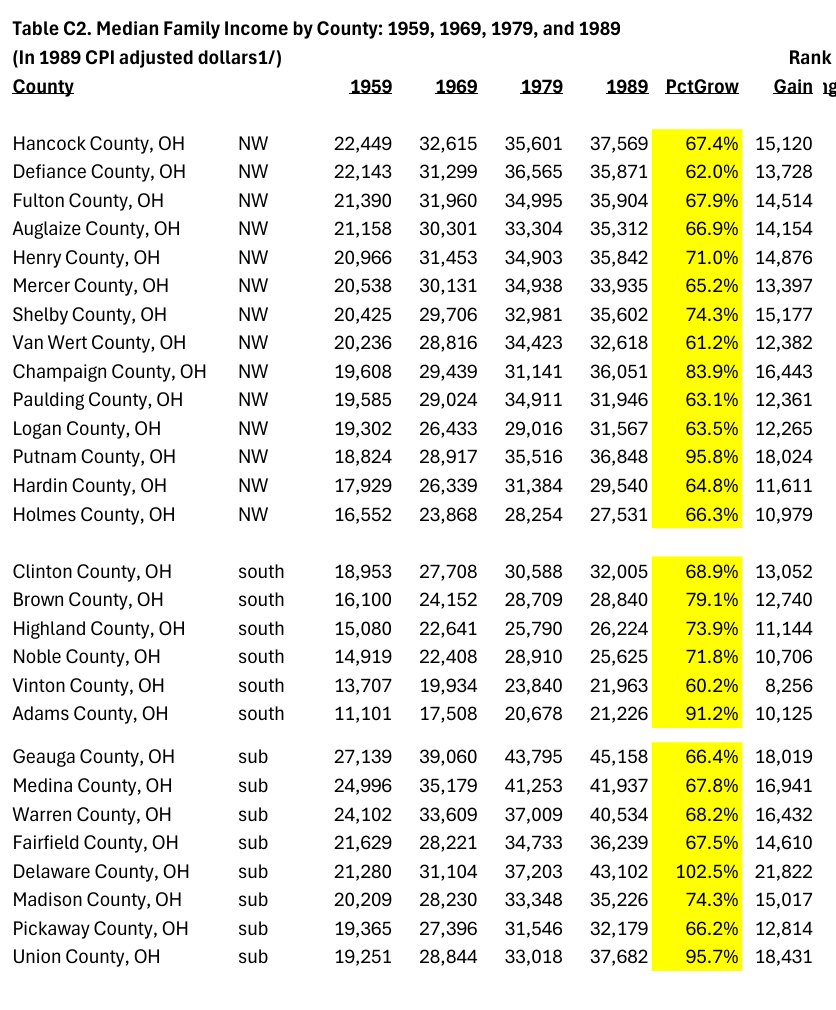
Ohio had some offsetting growth during this period. 14 northwestern counties were able to leverage their globally competitive agricultural assets to boost incomes by 70%, raising their percentile level from 74% to 81%. 6 very low-income southern counties experienced 74% income growth as they maintained their 40th percentile income level. 8 suburban counties booked 76% income growth, moving from 83rd to 91st percentile incomes.

The remaining 42 countries celebrated $9,000 worth of improved income compared with the national average of $13,000. They declined from the 72nd to the 56th income percentile.

Overall, proud Ohio could only claim 23 income percentile gains amongst its 88 counties across these 3 decades (1/4th). 15 in the rich Maumee River valley farmlands and 6 in suburban counties.

Summary

Ohio did not keep up with the global competition from 1959 to 1989. It managed to retain a disproportionate 25 Fortune 500 firms and their benefits to the local economy. Schumpeter’s theory of competitive destruction applies here. Prior success is a possible base for future success (industry and talent clusters) but not a guarantee. Ohio has experienced falling real incomes in both its metro and rural counties in the subsequent decades leading to a populist political environment.

Cross-references

Restoring Civility: Overcoming Obstacles

https://www.hoover.org/research/restoring-civility-hostile-world

Basic Steps

Individuals who believe in Civility as a solution to what ails us as a society should take the basic steps of learning more about the Civility movement and then joining with one of the many grass-roots groups to share the content of Civility, especially the 7 values and 7 behaviors, with others. This is classic membership and communications work. There are many personal and community benefits from practicing and promoting Civility.

Help others to understand the solid content of modern Civility and remove the misunderstandings that Civility is politeness, utopian, weak, emotional, partisan, righteous and apologetic. There is much work required to refine and promote the true Civility brand.

Improve your personal Civility skills.

Review and commit to the underlying values that support Civility.

Apply your skills and insights in a single environment or community. Civility combines thinking, feeling and doing to create improved habits. Civility applies in family, social, political, educational and business environments. Your example can be contagious.

Recognize that Civility is a social norm. Social norms are reinforced by society. We have lost some of this social norm but can rebuild it by changing the insights, skills and behavior of a relatively small number of individuals, especially influential people, like my readers. Civility is not utopian. Its supporters don’t believe that we can change human nature. But we do see the viral, social networking, virtuous cycle nature of growing Civility as a practice and expectation throughout our society. We don’t need everyone to participate or each of us to be excellent in order to win; re-establishing a self-reinforcing set of norms. We just need to reach critical mass.

Research and share the amazing power that Civility has to address 6 of our social ills: radical individualism, weak aspects of human nature, skepticism, imperfect myths, our secular age and insecurity.

Politics

Don’t despair about politics. We have experienced polarized politics about important issues throughout history. The Civility movement aims to be nonpartisan, so it hesitates to offer specific structural “solutions” to our political challenges. It seeks to improve the Civility skills and values of all citizens, respecting the human dignity of every person, becoming more intentional and constructive and holding politicians accountable. We believe that this accountability for citizens and political leaders is the most important factor in reforming our political activities. It is directly actionable

Invite political actors and parties to adopt Civility as the core of their work. Many today don’t practice Civility. They blame “the other guy”. It will take time to make this happen, but we will re-establish this basic standard for representing our communities.

Civility is Not Trivial

We define Civility as primarily a set of behaviors, a set of habits. Habits are not easy to create. They are not easy to maintain. They are not easy to improve. Civility calls for specific habits in self-awareness, self-management, social awareness, relationship management, communications, growth and problem solving! Yes, it looks like a master’s degree in counseling, family therapy, psychology or organizational development! Effective communications, relations and problem solving are critical skills for modern life. They can be learned as children, youths, young adults and mature adults. They apply in all spheres of life.

Civility is modestly complex, integrating 7 values and 7 sets of behaviors. It integrates thinking, feeling and doing. It is an applied skill with theoretical supports. It requires practice and feedback to build and improve habits. It must be practiced in social settings, which may not be supportive. It requires an investment of time, attention, vulnerability, emotions and discipline. Civility, per se, is not required to perform basic life functions, so it can be ignored to some degree today. Like other moral systems, Civility is aspirational. There is no end to the possible improvements in our skills or the application of the values. Hence, it is sometimes frustrating. We prefer to have “achievement” type goals which can be completed just once.

Civility requires a big commitment. As noted in the first two articles, it provides great personal and community benefits. The 7 Civility values are supported by the major world religions, most cultures and professions. Civility insights and behaviors are applied throughout life. Not everyone will invest deeply in Civility. Those who choose to invest will be repaid multiple times.

Radical Individualism

As noted in the “Power of Civility” article, Civility provides a required community counterbalance to individualism. As Jonathan Haidt describes it, we’re 90% selfish chimps and 10% cooperative bees. Civility requires us to balance this dual nature. It embraces public-spiritedness as a core value, requiring us to look at the social dimensions of our thoughts, relations and decisions. This balance is not easy to decide or maintain. Different political, religious, philosophical and cultural systems take different positions.

Civility encourages us to become comfortable with considering, advocating and living these choices while respecting the different choices of others. In this sense, Civility is a “classical liberal” approach to managing our individual roles within society. We start with the individual and believe that our processes, norms and institutions will protect our individual rights as we resolve differences.

We are individualists who fear the infringement of our liberties and liberties by any powerful organizations. We don’t want a secular or religious culture that strongly limits our freedoms of thought, speech, religion, assembly, protection or property. Civility provides a set of tools that protects these rights while also considering the competing claims of communities at all levels.

We note that our individualistic society allows individuals to withdraw to their own choices and provision of goods and services with limited social interactions. We think that this allows individuals to ignore their responsibilities to the community. We live in an interdependent world. The “rugged individualist” cannot survive in the modern world. Civility asks each person to consider the community dimension of their behavior, speech and politics. Civility argues that individual rights and community responsibilities can coexist for everyone – with a wide variety of beliefs.

Civility does not guarantee success. It is a tool that can help the individual and the community.

Human Nature

Civility’s ability to bring out the best in human nature is described in the “Power of Civility” article.

Civility accepts that we can be selfish, exaggerate our own views, diminish the views of others and rationalize actions and non-actions to our own benefit.

We have a limited attention span. We struggle to truly multi-task. We let our subconscious do much of the work. We don’t challenge or articulate our political, religious, philosophical and cultural views. We have world views. We act relatively consistently. We defend/rationalize our views as needed. In general, we don’t use our slow and rational faculties. We tend to be self-righteous about our views.

We are morally imperfect. Even with practice, experience and social pressure, we still do what we know we shouldn’t do AND don’t do what we know we should. We reject feedback and social pressure even when it is in our own interest.

We hold different political and religious views. We have different interests, talents and personalities. Living together and reaching agreement is difficult, even with the best of intentions and Civility habits.

Civility accepts our shortcomings and offers a program to do the best we can with what we’ve got.

Insecurity

“The Power of Civility” article outlines how Civility can help us to improve security in a world that feels more insecure each day.

Humans crave security at the base level of Maslow’s hierarchy of needs. Security is based upon perceived threats and risks. In a complex, urban, technological, global, secular, meritocratic world we’re insecure more often. We react by trying to build security. We seek certainty through our beliefs and groups. We avoid risks. We avoid “others”. We prejudge. We feel like victims. We buy security.

Civility requires a degree of openness, trust and interaction that is difficult when we feel insecure.

Individuals are encouraged to practice and build Civility skills in safe environments before flexing them in more difficult places.

Experience applying Civility skills can help us to better understand the size, likelihood and impact of risks and to understand our power to manage those situations effectively. An experienced negotiator, communicator, leader, volunteer, seller, and consumer is well-positioned to thrive and minimize significant threats.

Imperfect Myths/Our Secular Age

Civility is required because we live in society and we no longer live in a world where the religious, social, economic and political are merged into Christendom or even in a world where Christian moral values, imperfectly applied, prevail as social norms. We live in a “classical liberal” political system based upon individual rights and freedoms. It was created 250 years ago when a common Christian moral system prevailed. It is based upon the assumption that individuals have a core set of moral values in common.

Civility is based upon the core values of human dignity, respect, acceptance, responsibility, constructiveness, intentionality and public-spiritedness. These values are adequate to support all of the desired Civility behaviors. Some proponents of the “classical liberal” political system argue that it must not incorporate a subset of moral values because there is no way to evaluate these values without starting with a full-blown moral system. These groups have argued with the modern communitarians and been unable to find common ground. We advocate the 7 Civility values on a pragmatic basis. They are required to drive the Civility behaviors. We need the Civility behaviors to live together.

I don’t think many citizens will reject these values because they are somehow inconsistent with the theory of our political system.

Summary

The grass-roots efforts to restore Civility have accelerated in the last 2 decades. Politicians and journalists have leveraged modern media and social media to appeal to the lower angels of human nature in order to monetize attention. In a world without a dominant religion, political philosophy or culture, we have a clear need for help in addressing our major social and political system challenges.

Civility does require personal work and interactions. We have a much better understanding of the components of Civility today. It offers a scalable solution to our many problems. It can be developed one step at a time. It can be used in all arenas of life. It can be taught to everyone. We can re-establish Civility as a social norm. Like other social norms, there is a virtuous cycle/network effect that leverages our progress. Modern social science classes provide very effective tools and classes to build our skills. Civility has personal benefits, especially a sense of personal agency. It has benefits for the institutions of modern life that can invest and promote it. Civility is a personal choice that cannot be prevented by groups that oppose it. Civility is a “no brainer”. We have the opportunity to re-establish it for the benefit of all.