Civility is a set of behaviors based upon a set of values. It is adopted and grown by individuals based upon their conscious and unconscious experiences. The practice of Civility tends to promote Civility in others. Unchecked incivility tends to destroy Civility. The practice of Civility depends upon a communications, interaction and problem-solving process. The social commitment to Civility depends upon the rate and intensity of practice and the frequency and impact of responses to incivility. Civility is a social value that is partly conscious and partly unconscious.
Chaos Theory
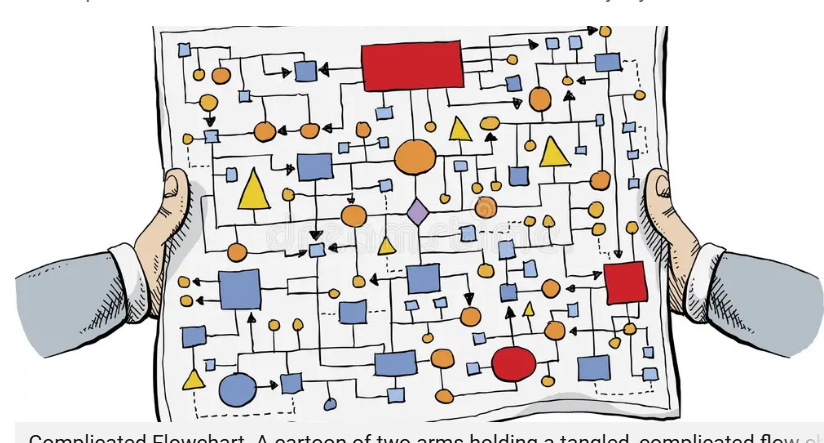
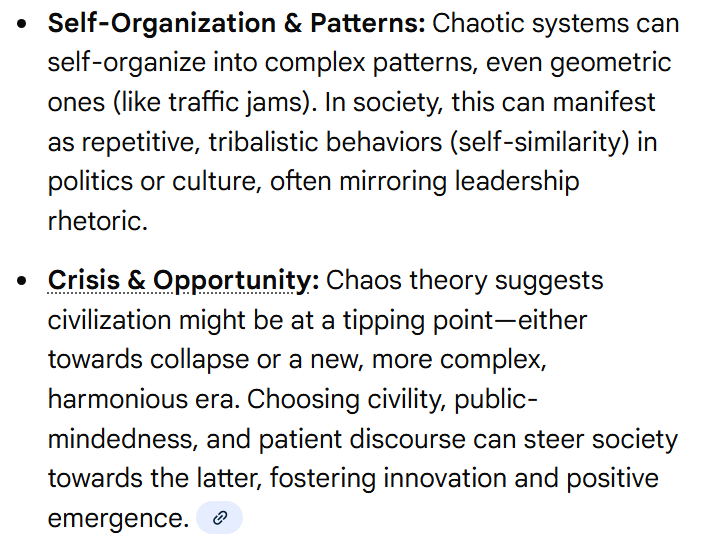
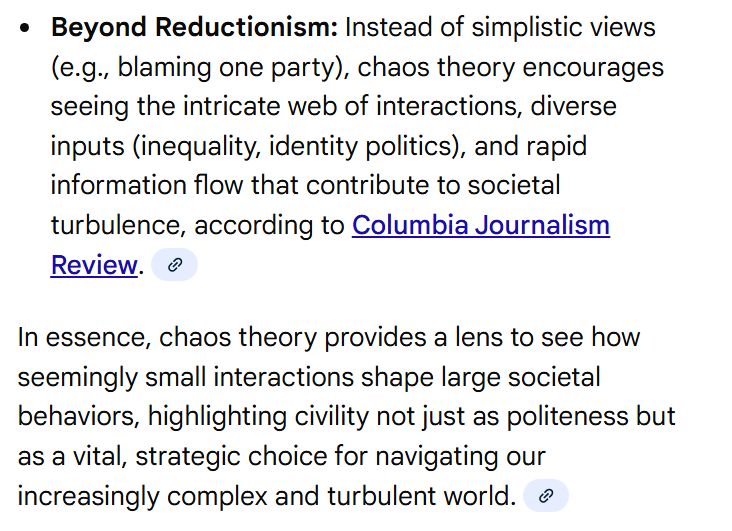
OK!!! Once we start to investigate dynamic systems, the words and concepts get abstract and “questionable” pretty quickly. Complex systems are unstable. Small changes can cause large impacts. I share this because I think that Civility is a social system subject to this kind of dynamic, nonlinear change.
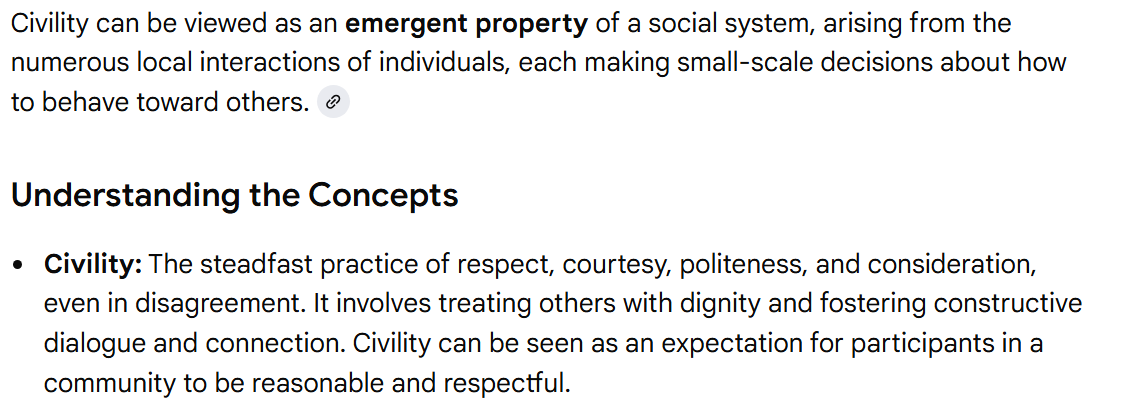
Emergent Systems
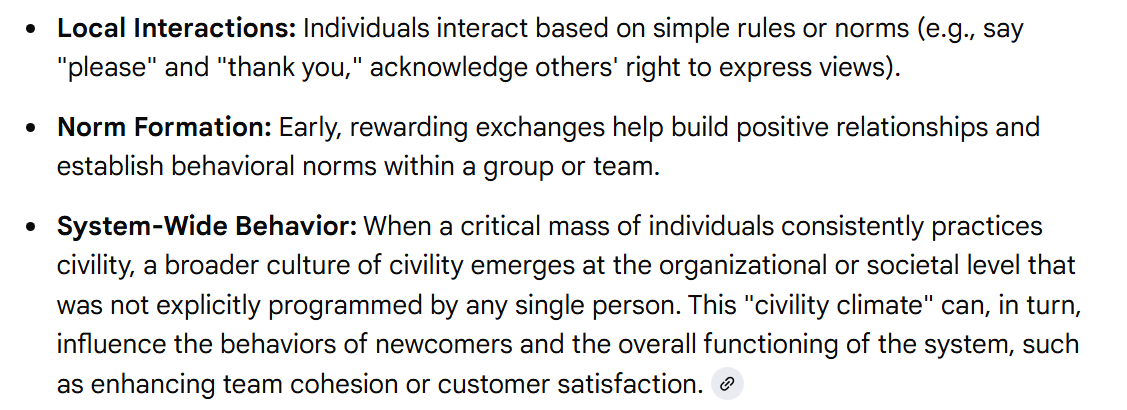
OK!!! Civility is an emergent property of people interacting. Simple, positive interactions promote more positive interactions. AI is trying to describe the idea of virtuous cycles and vicious cycles on a knife’s edge. Civility is a fragile concept and practice.
Managing Incivility
We have mixed advice. Some uncivil behaviors are so toxic they must be opposed. Yet, limiting free speech is against the core beliefs of Civility.
Civility, like other cultural norms, does not disappear quickly, it persists.
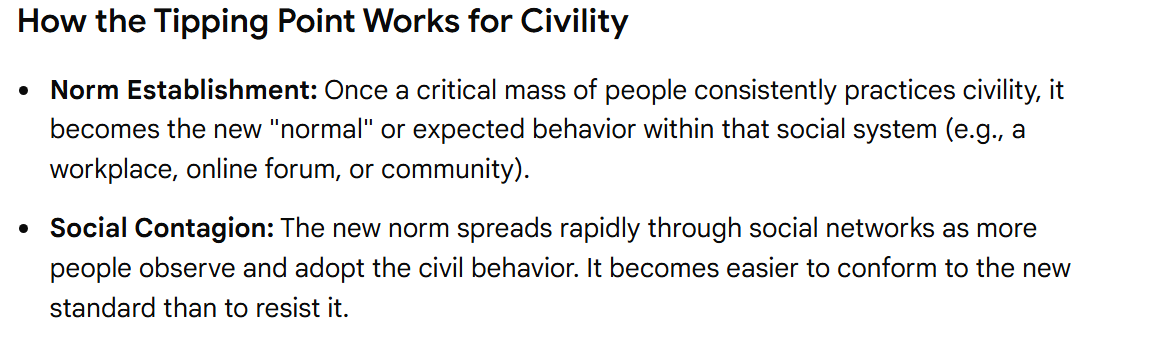
Tipping Point
Civility is positioned to survive. There are many individuals and groups with the incentive and capability to defend and promote Civility.
Summary
Overall, I am optimistic about the survival and progress of Civility today, December 15, 2025.
POST SCRIPT
In the process of using Google AI today, I am now EXTREMELY CONCERNED THAT THE SINGULARITY IS ABOUT TO OCCUR SOON. The responses to my complex questions are at least an order of magnitude more insightful than they were just a few days ago!
Civility has operated for a few hundred years without a brand manager. It has acquired several unfortunate associations through the years. It is commonly seen as just surface level politeness and etiquette, a magic wand problem solver, an impractical emotional approach or an apologist for passivity, power, the status quo, righteousness, the right or the left. Properly defined, Civility is not an easily discounted simplistic answer to our cultural challenges.
Civility Is …
Civility is a set of behaviors that recognizes differences and builds mutual respect: self-awareness, self-management, social awareness, relationship management, communications, growth and problem solving.
It is based on 7 nonpartisan values: human dignity, respect, acceptance, responsibility, intentionality, constructiveness and public-spiritedness.
Inherently Complex
Civility is primarily a set of habits, skills or behaviors that are used to interact with others. There are 7 groups and many specific behaviors in applied Civility. These behaviors are learned, applied, improved and based upon modern behavioral science.
There are also 7 values, principles or virtues that lie beneath the behaviors. They are nonpartisan, commonly held ideas consistent with many political, religious and philosophical systems.
These values have been identified through time as being necessary for effective interactions. They are not derived from any specific religious, political or philosophical system. No one value is the basis for the system, although “human dignity” seems to have the greatest power in driving behaviors and inspiring commitment to Civility. Descriptions of individual behaviors are shaped by the values. There are clear expectations of good behaviors and contrasting taboos.
Civility requires a commitment to engage with others in order to effectively communicate and resolve differences. As such, extraverts have a natural advantage in practicing Civility. Fortunately, the modern behavioral sciences provide training and experiences to help introverts to be “fully effective” even if it requires greater effort.
Civility embraces thinking, feeling and doing. The values and behaviors require all 3 dimensions of life.
The behaviors are inherently practical, applied and specific. The values are more abstract, intellectual and philosophical.
Embracing and applying Civility requires practical and abstract thinking, feeling and doing.
Civility emphasizes “perceiving” in its human dignity, respect, acceptance, constructiveness and public-spiritedness values. It emphasizes “judging” in its responsibility and intentionality values.
Civility focuses inward with self-awareness and self-management skills. It focuses outward for communications, social awareness and relationship management. It balances the needs and importance of the individual with those of the community.
The Whole Process
The Civility model focuses on the process of personal interactions to solve problems and manage relationships. It assumes repeated interactions that encourage participants to invest in relationships and seek long-term results. The process is expected to be iterative, encouraging participation and engagement. Results are not predetermined. Goals are clarified. Positions are shared. Solutions are proposed. Feedback and responses are welcomed. Choices are negotiated. Civility assumes a dynamic process is employed.
Civility skills and values are held by all individuals. They acquire these views throughout life. They apply these conscious and unconscious approaches in all areas of life, formal and informal. Civility norms and expectations are different in different groups and settings. Civil behavior encourages civil behavior. Uncivil behavior is sometimes shunned, encouraged or accepted. A virtuous cycle or a vicious cycle can occur.
Civility values and skills are learned and perfected through application, usage and feedback.
Nonpartisan
Civility is actively nonpartisan. Its proponents accept the results of “Moral Foundations Theory” that there are 6-9 deeply held human views that underly political (and some religious) beliefs. Individuals and political groups disagree about which are most important. Civility is not positioned to resolve these differences. It is designed to help well-meaning individuals understand each other, find common ground and negotiate results that also support relationships and the process. Civility offers a process that allows individuals and groups to maintain their views and still work effectively with others.
Civility attempts to avoid its own “righteousness”. It offers a tested process to facilitate certain interactions. It does not claim to have final religious, political or philosophical answers. It does not claim that its values, behaviors and processes will always produce good results or resolve conflicts. It acknowledges that our understanding of values and ability to implement them through behaviors is imperfect. It recognizes that “best practices” in any of the social sciences evolve through time. Civility attempts to make explicit its values, beliefs and understandings and promote them in clear, transparent ways.
Human dignity, respect and acceptance require a mature perspective. They are not easy to deeply understand, practice or master. They focus on the essence of individuals in a social environment.
Responsibility, intentionality and constructiveness are also “stretch” values. They also require us to consider the required relationship between the individual and others. It is not simple. Our obligation to others requires perspective and some broader moral framework. Building a commitment to these values requires feedback, support, experience and moral perseverance.
Public-spiritedness also requires a balance between the individual and the environment. Aside from a few saints, humans are not capable of living solely for others. They must balance these needs, wants and desires. Civility does not define how much “public spiritedness” is enough. It requires each individual to consider this difficult topic.
Summary
Civility encompasses values and behaviors, a dynamic process and personal growth. It offers a process solution to our common differences and potential conflicts. It has many component parts that change through time for each person. The core components can be learned and applied by everyone. The basics are easy. Practicing and perfecting Civility values and skills is the good work of a lifetime, worthy of our human dignity.
Civility is a set of behaviors that recognizes differences and builds mutual respect: self-awareness, self-management, social awareness, relationship management, communications, growth and problem solving.
It is based on 7 nonpartisan values: human dignity, respect, acceptance, responsibility, intentionality, constructiveness and public-spiritedness.
Civility is required for a representative democracy to thrive. Citizens must practice and embrace these habitual behaviors. Social norms must press individuals to adopt these beliefs and improve their behaviors, despite the call of opposing forces.
Civility has declined in the United States of America since the 1960’s cultural revolution and the 1980’s Reagan revolution. Individualism has ascended [perhaps too far]. Religion and culture have lost influence. Many today are working to rekindle Civility as a core set of values and behaviors necessary for a society of free individuals to succeed.
In broad terms, I have identified 6 threats to our society. I’d like to outline how Civility can be used to address these challenges. Civility alone cannot save our society, but it has the ability to prevent us from spiraling down in a vicious cycle. Civility has the ability to trigger a virtuous cycle. It is a catalyzing and leveraging force.
Radical individualism dispenses with community, society, religion, morality and philosophy. ONLY the individual now matters. Many of us have unintentionally adopted this faulty worldview: in whole or in part.
Civility begins with the claim that every person possesses INFINITE human dignity.
This is an individualistic start. But it is paired with the logical complements of respect and acceptance. If I have infinite human dignity, then all others must also have infinite human dignity. They MUST be respected. They MUST be accepted. They are not perfect, faultless, better or good. But they have the same potential for good and excellence that I enjoy.
This insight requires me to try to be self-aware, to manage myself, to be aware of others and to responsibly and intentionally manage my relationships with others. “I’m OK, You’re OK”.
Civility calls on us to be positive and constructive, not as a weak Pollyanna view but as individuals who are hopeful, who seek to find the greatest possible results.
Civility embraces public-spiritedness. It acknowledges that we live in community at all times and are responsible to consider our community obligations. We are not called to blindly accept community views, norms or decisions. But we always consider our civic and community duties and responsibilities.
Humans are never satisfied with what they have. We compare themselves to others and come up short. Our logical reasoning is imperfect. We focus on losses, the short-term, concrete items and anchors.
Civility accepts our weaknesses. It encourages us to look outwards to our neighbors to really evaluate ourselves. It promotes the “rough and tumble” of interpersonal engagement in informal and formal life. Civility guides us to be self-aware and self-managing. Civility recognizes that personal growth is an ongoing process. We cannot simply digest best practices intellectually; we must experience them.
Skepticism
Healthy scientific skepticism is fine. Unfortunately, we have often come to reject everyone and every fixed idea. Political polarization has undermined any sense of the “common good” or objective reality.
Civility embraces positivity and constructiveness. We should always pursue and consider positive opportunities.
Responsibility and intentionality require us to step above the situation and assess it objectively. We cannot take the shortcut of simplistic naive kneejerk skepticism.
Civility embraces modern behavioral and cognitive science. It uses rational modern decision-making tools. We have much stronger insights into true human nature. It is imperfect but we are better positioned to purposely lead great lives.
Despite the intellectual attraction of skepticism, America has prospered economically for 250 years. It has demonstrated that a democratic republic can succeed. The US has overcome two world wars, the Great Depression, the Vietnam War, the cultural revolution of the 1960’s, the Cold War, the Great Recession, the Covid pandemic and populism.
Religion has not died. Utilitarianism is barely remembered. Atheism is mostly rejected. Simplistic philosophies are inadequate. Scientific progress marches forward. Pure scientific rationalism loses support as a philosophy of life. Nietzsche and existentialism forced men to face the prospect of meaninglessness and we have survived. Self-awareness and social awareness help us to understand the complexity, contradictions, inconsistencies and mysteries of real life.
Imperfect Myths
Modern worldviews generally fail to replace the peace and answers of the ideals of Christendom. Civility offers a set of values and behaviors that support the practical operation of modern life with its greatly enhanced diversity.
Civility supports the 4 deep challenges of: facing death, finding a purpose beyond self, being affirmed and living as a social being in community. The commitment to human dignity, respect and acceptance help with the need to be affirmed. I’m OK, You’re OK. Civility promotes the social, interactive, growing, dynamic person. It offers a safe environment where individuals can pursue religious perspectives. It emphasizes the role that the “other” can play in personal growth.
Civility does NOT replace any of the religious, historical, cultural and national myths that have addressed human needs in the past. Civility is a set of values and behaviors that allows for constructive interactions in all areas and levels of society despite our differences. It does not choose sides in religious, political and philosophical debates. It is a necessary, but insufficient basis for modern life.
Our Secular Age
Civility accepts that we cannot easily find final deterministic solutions to the great questions of life. We have experienced 600 years of modernity without finding rational, objective, scientific, secular answers. Civility provides a social platform that supports religious belief. It supports debate on difficult subjects. It focuses on how we can live together, accept and overcome our real differences.
Our Secular Age is one in which the biggest questions – about God, man and meaning – don’t have consensus answers. No single denomination or ecumenical group holds a dominant worldview. Atheists, agnostics and “none of the above’s” are a large and fast-growing group, especially among younger age cohorts.
The loss of certainty creates existential angst for citizens. Civility responds with “human dignity” as a core belief that elevates individuals and the human condition to something of importance, a matter of ultimate concern for all. Civility offers “acceptance” as a central value, acknowledging that different backgrounds, experiences and beliefs are to be expected and welcomed. Civility encourages a positive, constructive approach to our lack of consensus on political, religious and philosophical topics. Civility promotes the virtues of responsibility, respect and initiative as tools for the required interactions with others – on topics large and small.
Finally, Civility focuses on behaviors, habits and norms of practical interaction as being most effective in living actual lives in a Secular Age. The Protestant Reformation triggered centuries of religious conflict. The principles of Civility were used to heal this divide and can apply to our differences today.
Insecurity
Modern man is surrounded by uncertainty as he is forced to make more decisions in more areas with more choices than ever before. Most of us try to ignore the surrounding forces and live our lives day to day as best as we can. We implicitly adopt some kind of philosophy of life. We stay busy. We pursue goals. We consider the changes in our worlds. But the underlying tensions make life difficult. Economic and personal striving are a cultural norm. Polarized politics is hard to avoid. It’s difficult to relax, center and fully engage in life. We treasure peace and certainty. We’re still looking for answers that work well in a world filled with options and choices.
Civility’s focus on human dignity, respect and acceptance of each person and others serves to build a strong sense of self-worth. The self-awareness and self-management skills reinforce this central validation of each person.
The values of responsibility, intentionality and constructiveness reinforce the solid self with positive real-world experience and reinforcement. The social awareness, communications and relationship management skills operationalize this good intent.
Collectively, the Civility values and behaviors provide personal assets to be successful in a challenging world. They address the need for frequent interactions with “others”. They provide confidence that individuals have the capabilities and experience to thrive in difficult situations because they have managed them before.
Summary
Civilization and daily life are guided by unspoken norms and beliefs. We have experienced significant changes in the past century that undermined the consensus view and now requires individuals to consciously consider a greater share of their daily lives. We have not reached a new consensus and may not do so anytime soon. As we work through these differences we need to reinvest in Civility skills, habits and understanding. Civility helps us individually, in groups and as a society to interact effectively despite our differences. We don’t need perfection or infinite improvement, but we need to invest in Civility and use its power as a self-reinforcing system or virtuous cycle to guide us into the future.
Civility is a set of behaviors that recognizes differences and builds mutual respect.
Self-awareness
Self-management
Social awareness
Relationship management
Communications
Growth
Problem-solving
Self-Awareness
Emotional Awareness – Identifying and understanding our emotions and their impact on our thoughts, behaviors, and others. Accurate Self-assessment – Clearly understanding personal strengths and limitations without self-criticism or inflated self-perception. Self-confidence – Firmly believing in one’s abilities, talents, and judgement. Self-respect – Properly regarding and caring for the dignity of one’s person and character. Authenticity – Acting in accordance with one’s true self, values and beliefs.
Self-Management
Emotional Self-control – Managing and regulating one’s emotional responses, preventing impulsive reactions. Adaptability – Flexibly and efficiently learning and applying that knowledge across situations. Achievement Motivation – Orientation towards success, mastery, and sense of purpose. Initiative – Recognizing needs, taking action, and pursuing outcomes without waiting for direction. Optimism – A mental attitude characterized by a positive outlook and expectations of favorable outcomes. Apologizing – Acknowledging errors and guilt, expressing regret, repenting, asking for forgiveness. Trustworthiness – Demonstrating credibility, reliability and intimacy buffered from self-interest. Resilience – Bouncing back from adversity with flexibility & strength, maintaining wellbeing despite challenges.
Social Awareness
Empathy – Understanding what other people feel, seeing their point of view, and imagining yourself in their place.
Organizational Awareness – Interpreting a group’s emotional state, relationship dynamics and power structures.
Service Orientation – Willingly anticipating, recognizing, and meeting others’ needs, before they are articulated.
Perspective Taking – Considering others’ thoughts, feelings, intentions, and motivations in a particular situation.
Cultural Awareness – Recognizing the different beliefs, values, and customs of someone based on their origins.
Relationship Management
Influence – Capacity to affect the character, development, or behavior of another person, group, or organization.
Conflict Management – Process by which disputes are resolved, negative results are minimized and positive results are prioritized.
Teamwork and Collaboration – Combined effort of a group of people working together towards a common goal or objective.
Inspirational Leadership – Inspiring and guiding people to get the job done, to bring out their best.
Change Management – Providing approaches, tools, and techniques to achieve a desired future state.
Collaboration Tools – Offering any technology or tool that can be used to help people to better work together.
Meeting Management – Organizing and facilitating meetings to ensure productivity and alignment.
Project Management – Planning, organizing, and executing tasks to create a tangible product, service, or deliverable.
Communications
Commonality – Finding and emphasizing common interests, perspectives and experiences.
Be Patient – Encouraging others to speak, not interrupting them.
Overall Awareness – Paying attention to non-verbal cues, overall message of speakers.
Recognize/Validate Others – Listening, remembering and using names, acknowledging others’ views and emotions.
Mirror Communications – Confirming listening by restating what you heard in your own words.
Speak Kindly – Using words that are neutral or supportive, not attacking others.
Understand – Asking questions, clarifying, seeking first to understand, not to reply.
Manage Praise – Giving and receiving praise for communications, actions, intentions and results, when appropriate.
Defend Properly – Defining boundaries, expressing views in “I” statements, not overreaching.
Solve the Problem – Focusing on issues, not people.
Electronic Communications – Effective email and social media communications.
Growth
Experiential Learning – Benefiting from the experience and natural results of participating in civil processes. Continuous Improvement – Maintaining newly developed skills and skill levels with support from civil colleagues. Embracing Feedback – Encouraging honest feedback provides opportunities for personal growth. New Perspectives – Gaining new approaches, viewpoints and paradigms from interacting with others. Higher Expectations – Improving goals and behaviors in response to the expectations/norms of others. Confidence – Using civil processes to address and resolve difficult situations builds personal and process confidence. Broadly Applying Skills – Trying, testing and using civility skills in all domains of life. Modelling Behaviors – Practicing civility skills helps to teach, influence and inspire others. Developing Others – Recognizing and nurturing potential in others through encouragement and honest feedback.
Problem-Solving
Analytical Tools – Critical thinking, decision making, game theory, finance, economics and operations management.
Creative Thinking – Thinking about a task or a problem in a new or different way, or generate new ideas.
Strategic Thinking – Intentionally and logically making organization level decisions with long-term impacts.
Organizational Design – Improving an organization’s effectiveness and performance.
Organizational Development – Structuring an organization to align with its strategic goals and objectives.
Systems Thinking – Cognitive skill and a way of understanding reality that emphasizes the whole rather than the sum of its parts.
Process Engineering – Approach to designing, analyzing, and optimizing steps to produce a consistent, repeatable outcome.
Public Administration – Coordination of government activities to ensure the effective delivery of services and the application of laws.
Summary
We have lost our commitment to civility in our interactions with each other in the last 50 years. On the other hand, we understand exactly how and why we should act civilly. We can learn about acting civilly within all of our institutions, setting aside our political differences. The behavioral sciences have clearly described the practice of civility. We now have the ability to learn and sharpen our civility skills. We must implement this training for our children and our fellow citizens.
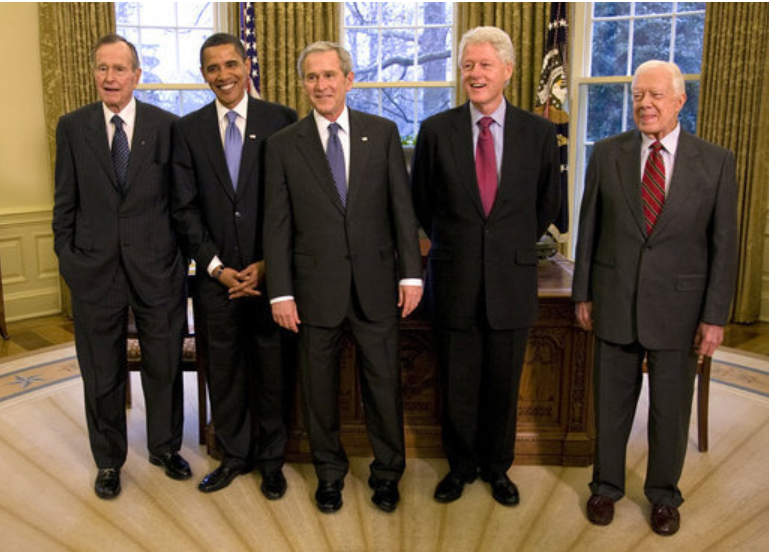
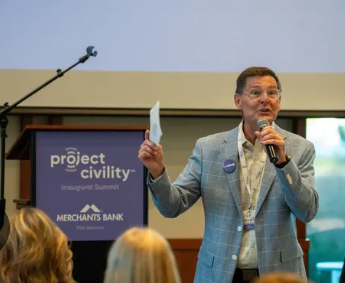
Former Indiana governor and Purdue University president Mitch Daniels provides us with a model of civility in his public life, as we have seen from many American political leaders.
Google AI offers this interesting summary. The “world” is predisposed to see “civility” as a “soft” subject. Proponents of civility must work to overcome this preconception while leveraging the insights, commitment and support of those who “naturally” know that civility is needed for all.
Google AI Answer
The personality types most passionate about civility, politeness, and social harmony tend to be those with strong Extroverted Feeling (Fe) or Introverted Feeling (Fi) functions, which guide them to prioritize others’ emotions, social order, and strong moral values.
Key types that embody this passion include:
ESFJ (Consul/The Most Polite): Considered the most polite personality type, ESFJs highly value good manners, tradition, and maintaining social balance and harmony. They are warm, welcoming, and deeply care about the emotional well-being of those around them, actively working to create harmonious situations and avoiding conflict.
ISFJ (Defender/The Nurturer): ISFJs are driven by a strong sense of duty, integrity, and honesty, conducting themselves with the utmost decency. They value cooperation and consensus, and are often very sensitive to other people’s feelings, finding it frustrating when people engage in needless debate.
ENFJ (Protagonist/The Giver): Known for their optimism and ethical nature, ENFJs are highly aware of the needs of others and are naturally polite. They are motivated by helping people and communities meet their potential and strive to make a positive impact, often acting as “moral guidance”.
INFJ (Advocate): Thanks to their ability to intuit others’ emotions, INFJs are usually very polite and sensitive, with a strong focus on fairness and justice. They are often moved by social problems affecting society and work to address the suffering of others by focusing on authenticity and personal growth.
INFP (Mediator): As compassionate and caring types, INFPs are sensitive to the feelings of others and careful with their wording. They have a strong internal moral compass and are typically nonjudgmental when approaching someone in need, focusing on emotional comfort and inspiration.
In contrast, other types might prioritize efficiency, logic, or directness over social pleasantries, which can sometimes come across as less “civil” in the traditional sense, though they are not necessarily impolite deliberately.
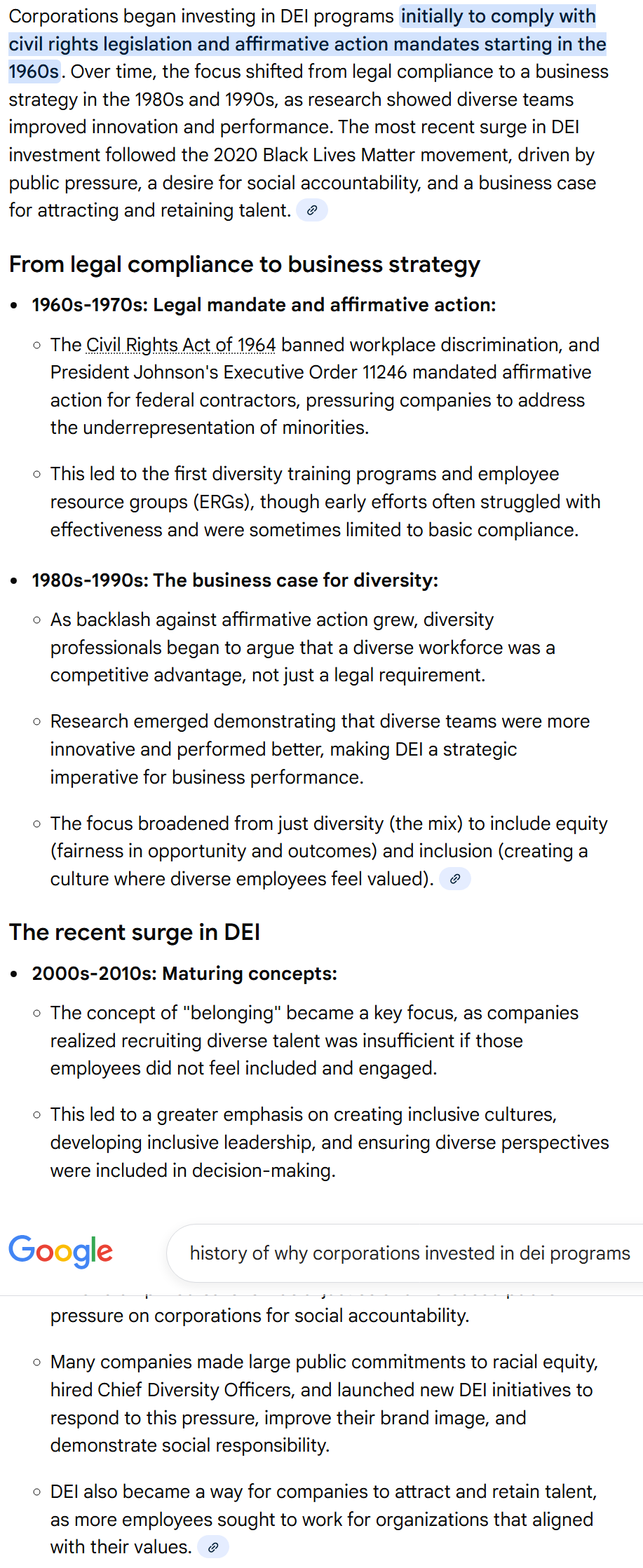
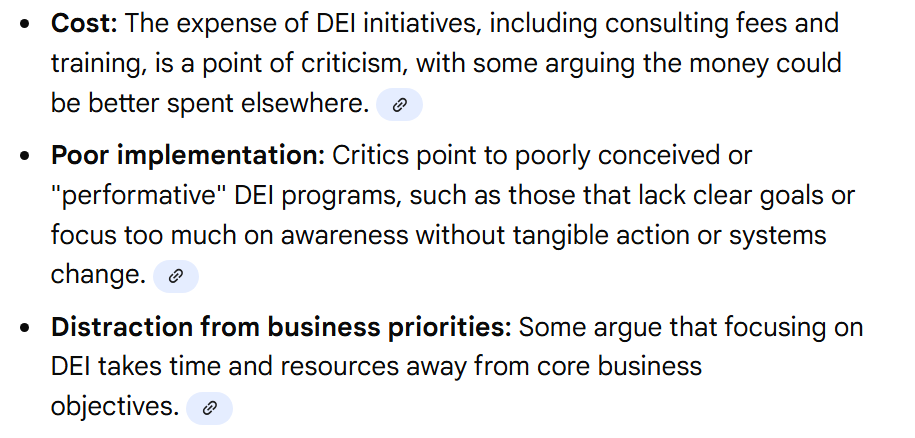
The common criticisms are not overly persuasive. The real issue is that this became part of the “culture wars”. Corporations didn’t invest in DEI because they suddenly became “woke”, they did so because DEI was beneficial for recruiting, retention and marketing. We live in a diverse world. Commercial enterprises recognized this and adjusted their activities accordingly.
Affirmative action is a step beyond “equal opportunity”. It says that our society systematically discriminates against minority groups and individuals and that we should take steps to offset this. This is a political issue that “Civility” chooses to not address in order to be actively nonpartisan.
Also missing above is the claim by postmodernists, professors, influencers, politicians and many progressives that society is inherently unfair, dominated by incumbent powerful forces, requiring revolutionary insight and reaction to overcome their power. Critics say that DEI is used as a political tool. Many disagree with the critics. “Civility” does not take a stance on this dispute. It is “above our paygrade”.
Definitions of Diversity
The presence of differences within a group, which can include race, gender, ethnicity, age, sexual orientation, religion, physical ability, and other aspects of social identity.
Embracing the differences everyone brings to the table, while acknowledging the benefit of the multiple perspectives, ideas, and solutions provided when individuals with different backgrounds, identities, and views collaborate and are heard.
The presence and participation of individuals with varying backgrounds and perspectives, including those who have been traditionally underrepresented.
Embracing the differences everyone brings to the table, whether those are someone’s race, age, ethnicity, religion, gender, sexual orientation, physical ability or other aspects of social identity.
Diversity ensures that a variety of perspectives are represented, whether they come from different races, genders, ages, sexual orientations, or cultural backgrounds.
Creating an environment where every individual feels respected, supported, and has a strong sense of belonging.
Encouraging all people to express their ideas and perspectives freely.
Creating an environment where people of all backgrounds can thrive and contribute to their fullest potential.
A sense of belonging in an environment where all feel welcomed, accepted, and respected.
Respecting everyone’s voice and creating a culture in which people from all backgrounds feel encouraged to express their ideas and perspectives.
Civility Supports Inclusion (Acceptance)
Diversity and inclusion fit into the Civility value labelled “accepting” or “acceptance”. They are clear priority components of Civility.
Definitions of Equity
Providing fair and just treatment to all individuals, regardless of their differences.
Ensuring everyone has the resources and opportunities needed to succeed, rather than giving everyone the exact same thing.
Treating everyone fairly and providing opportunities for everyone to succeed, considering their traits, including resources, support, and potential accommodations to help those with disabilities thrive in the workplace.
Equal access to opportunities and fair, just, and impartial treatment.
Treating everyone fairly and providing equal opportunities.
Civility Supports Equity (Partially)
Equity is not exactly one of the 8 core values of Civility. Civility is based upon human dignity, respect for each other, responsibility, public-spiritedness, acceptance, intentionality, interactivity and constructiveness. Equity is a form of the value “fairness”. According to Jonathan Haidt, fairness is a widely held political value, but it is described in different ways by different people and considered much more important by liberals than by conservatives. “Civility” is not opposed to “equity”, but “equity” is not essential for the practice of “Civility”.
The highly influential human resources professional society SHRM removed “equity” from their historical support of DEI programming. Many opposed this change, arguing that equity is an essential component of DEI.
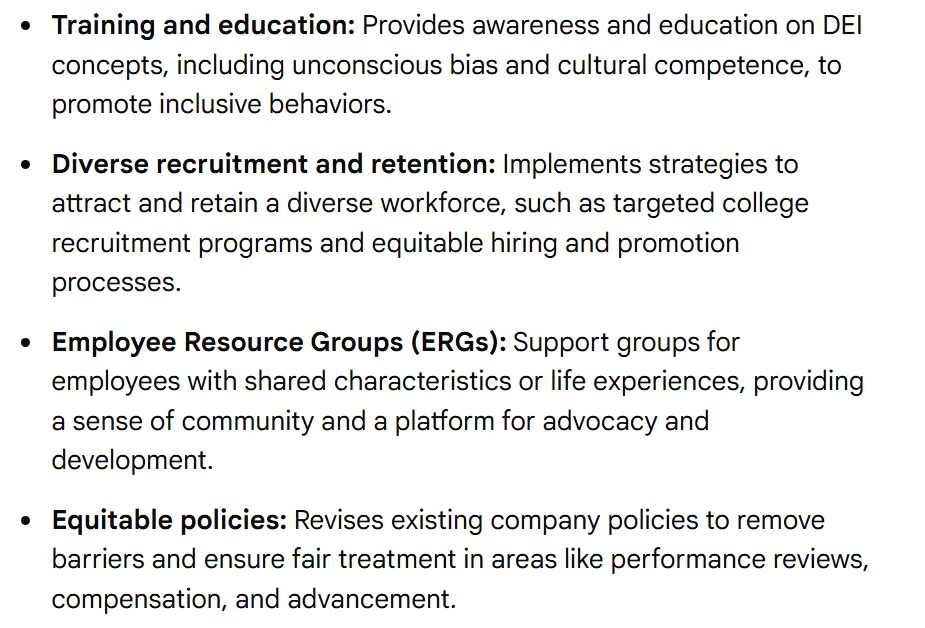
“Typical” DEI programs lean left. Civility, per se, does not support the more partisan views. “Unconscious bias” may be important, but it is not a civility value, behavior or skill. Civility does not take a stance on activist “equitable” HR processes. Every person has human dignity and is worthy of respect, check. Extra investment in mentorship and sponsorship of “underrepresented” employees is also optional from a Civility perspective.
Corporate Human Resources Professionals Generally Lean Left and Strongly Support DEI
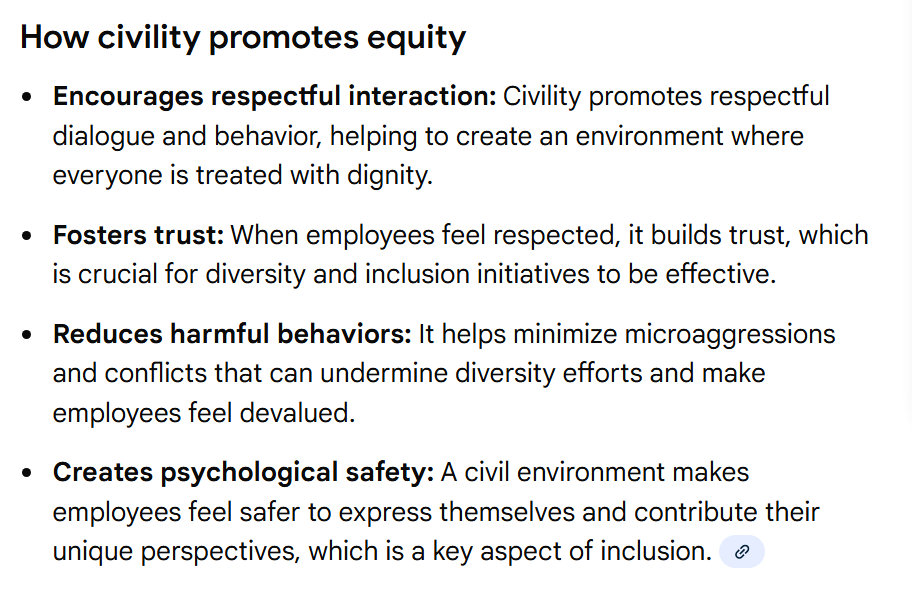
Diversity and inclusion are part of the key Civility value of acceptance. Each person has human dignity and should be respected and accepted by others in their individuality. Civility is based upon commonly held values and promotes personal development and responsibility for being a good person, interacting with others and considering community needs. Like DEI, it promotes a subset of values to make our lives together safer, more pleasant and more effective. It focuses on how we interact with each other constructively, despite our differences.
Civility’s nonpartisan stance takes no position on the stronger claims of DEI providers or their critics. Civility recommends that they both engage in meaningful dialogue to better understand where they can work together and where they must accept that they have different social, political and moral perspectives that cannot be reconciled today. Civility actively opposes the angry outbursts, attacks, emotional appeals, insults, blaming, bullying, shaming, disrespect, blind loyalty, ignorance, prejudging, stonewalling and demonization sometimes seen in these interactions.



























 Good News