Modern Curriculum for Citizens

https://www.heraldtribune.com/story/opinion/columns/your-voice/2023/04/23/new-college-of-florida-needs-a-new-direction-to-become-a-top-school/70131713007/

Modern Curriculum for Citizens

Citizens today face a large, complex, dynamic environment with the requirement to make good personal, social, political, economic, and moral choices.  Citizens and society are impacted by the quality of these choices.

The American public must invest in our students and citizens to offer an educational curriculum that covers all the relevant topics with enough depth and applicability to make them lifetime tools.  Modern science has much to offer.  Advanced nations and economies have developed institutions and cultures that effectively perform the key functions of successful societies.  At the same time, the rapid technological changes, increased complexity, and huge scale of our world pose challenges.  The tension between secular and religious worldviews and across various political views is high and our skills at resolving these tensions or integrating individuals and communities have lagged behind the challenges.

A modern curriculum outlines the dimensions, structures, and challenges of our shared lives in all dimensions.  It highlights the successes that have been achieved in history and the failures.  It offers the various cultural, religious, social, political, and economic worldviews that have guided humans.  It critically assesses their strengths and weaknesses, contributions, and relevance today.

It raises the critical questions that are faced today.  It helps students understand how institutions, culture and politics all shape our world.  It outlines political and religious worldviews.  It encourages students to assume personal responsibility for their lives and participate in shaping our society at all levels.  The curriculum focuses on the role of the individual and the role of the community in each dimension of life.  An effective society requires voluntary engagement from its citizens.  This curriculum motivates individuals to participate and succeed.

These courses cover a great deal of material at a high level and provide time for an applications perspective.  They are courses for the citizen, not for those who expect to major in the relevant disciplines.

Ideally, the nation would adopt a single broad “model curriculum” outline and delegate the details of setting course content and standards to the states or regional educational accreditation agencies.

This proposal has 8 courses for high school students and 9 courses for university students.  It includes capstone courses on “My Future” and “Our Future” to integrate the courses in a meaningful way.  The university courses are designed to encourage states to offer them to all citizens at a nominal tuition rate through their state universities and community colleges.

101 American History

Full year course at the high school level.  Less biography and dates.  More about the major transformations of typical American life as the nation grew in size, expanded across the continent, invested in trade and infrastructure, transformed the land for changing waves of agriculture, adopted new technologies, embraced economic change, wrestled with manufacturing and urbanization, addressed racial, religious, ethnic and class differences, developed political parties, institutions and state versus federal roles, the role of communities and not-for-profits, the impact of religious diversity, economic theories of history, business cycles and panics, US expansion, conflicts, wars, empire, growing global role.  Major political parties and issues through time.  The role of communications technologies.  The expanded role of government.  The development of new institutions.  The expansion of individual rights and roles for women.  Government regulations.  Limits on laissez faire capitalism.  Taxation.  The self-sufficient man and the rugged individualist.  Immigrants.  Native Americans.  Relations with Mexico and Latin America.  Isolationism.  Globalism and trade.  The scale, social and economic nature of the country in 1800, 1850, 1900, 1950 and today. 

The US has a dynamic history of success in adapting its culture and institutions to meet the needs of the day.  It has a history of extending individual rights to more individuals and groups through time, despite opposition from some citizens.  Students can understand how existing beliefs, habits, laws, and institutions interact with technological, military, trade, economic, social, political, and religious innovations.  Change is slower than some desire.  Change is opposed on principle and because it has costs to some groups and individuals.  Some changes are reversed because they don’t work in practice, or they have unintended consequences.  The US has been relatively effective at maintaining individual rights and implementing changes on a decentralized basis.  This context is essential for understanding current issues and political differences.

Theories of history.  Evolution.  Adaptation.  Economic determinism.  Regional differences. Western civilization.  Land, labor, and capital.  Economic, social, and political power.  Cultural power.  Shining city on a hill.  Manifest destiny.  American exceptionalism.

102 Society / Sociology

The individual and the group, community, society.  Fundamental tensions.  Haidt and evolutionary psychology.  Empathy, language, trust, loyalty, free rider, game theory.  One on one.  Small groups. Groups of 150.  Hunter-gatherers.  Agriculture. Cities.  Leaders.  Power.  Religion.  Anthropological perspective.  Modern historical perspective.  Political theory perspective.  Contract theory. 

Roles of society.  Maslow’s hierarchy of needs.  Safety, protection.  Economic transactions.  Religion, explanation, myths, eternity.  Belonging.  Status.  Leadership.  Followership.  Law.  Compliance.  Entertainment.  Education.  Health.  Respect.  Property.  Children.  Deviants.

Interactions of power, status, wealth, and salvation/eternity.

Social capital.  Trust.  Institutions: family, neighborhoods, religious, professional, industrial, labor, intellectual, educational, economic, political, social services, libraries, ethnic.  Innovations through time.

Role of technological and economic change on social and political institutions.

Change, migration, stress, war, disruption, rootlessness, divorce, unemployment, bankruptcy, anomie.

Economic basis of power through history.  Labor theory of value.  Marx.  Existentialism.  Post-modernism.  Groups.  Class, gender, race, religion, ethnicity, nationality as potential victim groups.  Role of “others”.  Criminals and mental health. 

Functions of large organizations.  Political.  Economic.  Military.  Role of leadership.  Innovations through time.   Attraction, retention, and engagement. 

Special roles: opinion leaders, market influencers, pop culture examples, fashion influencers, media influencers, intellectual influencers, journalism and media influencers, social media influencers, literature, movie, and tv works, teachers, parents, ministers, and coaches.

Power of social norms and influence.  Desire for belonging and social acceptance.

High, medium, and low commitment communities.

Rise of nationalism.  Rise of global and supra-national groups.

How groups and communities are different from the sum of their parts.

Man is made to reside in community.

103 Economics

70% Microeconomics, 20% Macroeconomics, 10% International Economics.

Labor markets.  Product markets.  Competitive markets.  Rationale for government oversight.

Reinforce the American History overview.  Provide framework for Personal Finance, Business/Organizational Behavior and Globalization.  Outline one key model before Critical Thinking and Applied Decision Making.  Provide background for Political Thought and Shaping Our Future.

104 Civics / American Government

Historical and philosophical context for the US constitution.  Articles of Confederation.  Bill of Rights.  Checks and balances.  Rights of Englishmen.  Jefferson’s small farmer.  Hamilton’s trader.  The Federalist papers.  Federal and state roles through time.  US within European interests.  Supreme Court role defined.  Increasing role of government in the 19th and 20th centuries.  US and advanced economies.  Washington setting presidential roles.  Political parties.  Jefferson-Jackson support for farmers and small businesses.  Pre-civil war politics.  Civil war.  Reconstruction.  Post-reconstruction.  Isolationism.  Laissez-faire capitalism.  Political machines.  Progressivism.  Farmer-labor populism.  Nativist populism.  Socialism and radical unionism not.  Supreme Court as a conservative limit on progressive laws.  Local government reforms.  Income taxes.  Prohibition and its reversal.  New England and Middle Atlantic rule.  Midwest gains influence.  Democratic party in the South.  Southern Democrat political power in Congress.  Food safety regulation.  Regulating trusts and monopolies.  The Depression.  FDR and Democrats gain.  Reagan and the neoliberal revolution.

Political parties.  House and Senate.  Supreme Court.  Electoral College.  Legislation and budgets/funding.  Role of constitution versus congressional rules.  Presidential veto.  Line-item veto.  Independent agencies.  OMB.  Federal Reserve Bank.  International treaties.  United Nations.  Election funding.  Gerrymandering.  Lobbyists.  Military ruled by government.  DOJ.  FBI.  Rule of law.  Separation of church and state.  Filibuster.  Speaker of the House.  Majority leader of the Senate.  Voting rights, rules, and restrictions.  Presidential versus parliamentary system.  Two-party versus multi-party systems.  Simple versus ranked choice voting systems.  Third parties.  Direct election of Senators.  Direct election of presidential candidates.  Political parties as a moderating influence.  Sunset laws.  Zero-based budgeting.  Legislation versus appropriation.  Debt ceiling constraint.  Role of earmarks.  Economics of politics: public choice theory.  Role of politicians.  Representative or delegate.  Role of parties to simplify voting.  Role of character.  Recalls.  Citizen initiatives.  Role of political ideology.  Special interest groups.

105 Psychology

Standard introductory course.  Link back to evolutionary psychology in the society/sociology course.  Make clear that the simplified utilitarian model assumed by economists (maximize pleasure, minimize pain) is inadequate.  Address psychological views of religion, behavior, experience, and motivation.  Describe the overlap of social psychology with sociology and organizational behavior.  Describe the history of intelligence testing as a basis for critical thinking and multiple intelligences.  Clearly define personality profiles and talents so that these results can be used in the capstone course.  Describe the basic risk-averse nature of people that drives the risk/reward basis of financial markets.  Provide a basic outline of how experimental psychology performs experiments.  Outline the background for the fundamental challenge of organizations to align the interests of individuals and the organization. 

106 Personal Finance

Economic specialization.  Profession.  Industry.  Human capital.  Education.  Talents.  Multiple intelligences.  Income and wealth.  Retirement.  Saving.  Investing.  Risks.  Insurance.  Rent versus own.  Investing in education.  Accounting model of assets, liabilities, net equity, revenues, and expenses.  Risk versus reward.   Banks.  Checking and savings accounts.  Tax sheltered investments.  Capital gains taxes.  Strategies for saving.  Financial advisors.  Insurance agents.  Real estate choices.  Financial tracking tools.  Grocery shopping.  Clothes shopping.   Appliance shopping.  Medical services and insurance plans.  Personal services.  Home/construction services.  Car shopping.  Car buying versus leasing.  Just 15% more.  Buying status.  Using financial leverage.  Cost of borrowing: paycheck loans, credit cards, pawn shops.  Student loans and payment options.  The millionaire next door.  Negotiating employment.  Franchises.  Owning a business.  Side-gigs. 

107 Critical Thinking

General process and factors.  Individual or team.  Diverse sources, perspectives, models, contributors.  Inductive and deductive logic approaches.  Analogies.  Open-mindedness, active listening.  Identify and evaluate assumptions. Evaluate relevance and weight of evidence.  Evaluate data.  Is the goal proof, optimization, meets standards, or ranking?  Adequate research.  Meta-analysis of the decision process.  Likely errors. Lessons learned.  Devil’s advocate. Expert review.

Tools.  6 thinking hats.  Brainstorming.  Flowcharts.  Tables and graphs.  Descriptive statistics.  Hypothesis testing.  Formal logic.  Scientific method.  Math proof types.  Pattern identification.  Probabilities.  Expected value.  Legal logic.  Best practices.  Industry or discipline specific models.  Simulations.  Troubleshooting.  The rational financial decision-making model.

Pitfalls.  Probabilities, infinity, compounding, orders of magnitude, paradoxes.  Logical fallacies.  Portfolio effect; sum greater than parts.  Correlation and causation.  “Either/or” or “both/and” situation?  Is versus ought factors.  Objective and subjective factors.  Outliers.  Black swans.  Individual biases.  Thinking fast and slow.  Jump to conclusion.  Confirmation bias.  Anchoring.  Politics.  Personality.  Talents.  Experience.  False patterns.  Attribution error.  Abstract or applied.  Analog or digital.  Sales, marketing, legal and communications tricks.  Source biases.  We don’t get fooled again!

108 Shaping My Future

My personality, talents, and values.

Education, profession, industry.

Prioritizing and balancing competing claims.  Time and task management skills.

My advisors, mentors, coaches, and counselors.  Thanks for the feedback. 

My dating and relationship goals, limits, options, tactics, hopes, tools, beliefs, opportunities, advisors, and dreams.  Total commitment. 

My community and service preferences.

My religious explorations and commitments. 

Living a good life.  Building character and virtues.

Bucket list.  On my death bed.  Eulogy virtues. 

Rights and responsibilities.  Victimhood.  Choices. Investing in me. 

Setting goals.  Delivering results. 

301 World History, Cultures and Governments

Standard year-long high school or college textbook.  Some grounding in pre-historic development of humans.  Tools, iron, agriculture, leaders, religion.  Links to anthropology reinforcing the parallel development of similar social answers to universal questions.  Notion of “civilization”.  The individual and the community.  Free rider problem.  Role of language.  Central issues of cohesiveness within a society, power, and external threats.  Role of changing technologies.  Role of religion and institutions.  Role of military power.  Role of trade.  Role of changing economic assets.  Role of changing political and philosophical ideas.  Community and individual oriented societies.  Conflicts between traditional and modern views.  Nationalism, regionalism, and globalism.  Empires.  Maintaining power.  Prevalence of war and violence.  Individual rights, human rights, community rights.  The appeals of Marxism, capitalism, religion, democracy, and populism.  The tension between self-interest and larger groups at the individual, local government, organization, and nation-state level.  Religion, race, ethnicity, class, and ideals as ways to make a society cohere.

302 Applied Decision-Making

Rational financial calculation.  Cost/benefit analysis.  Strategic planning process.  Risk versus reward.  Managing a portfolio of investments or projects.  Task/project management.  Critical path.  Time management:  Getting Things Done (Allen).  Decision flow charts.  Process perspective.  Urgent versus important (Covey).  Expected value.  Financial modeling, sensitivity analysis, what if.  Simulations.  Scenario analysis.  Worst case scenario.  Committed versus flexible resources, undo.  Inquiry versus advocacy framework.  6 thinking hats (de Bono).  Brainstorming techniques.  Mission, vision, values framework.  Pareto analysis, prioritization.  Root cause analysis, 5 why’s.  Mind mapping, visualization (Buzan).  Cause and effect diagrams.  Force field analysis.  Expert Delphi groups.  T-account, “pros and cons”.  Game theory.  Mini-max.  Stable or unstable.  Data scrubbing.  Rule out some options to simplify.  Personal risk of recommendation.

Behavioral economics.  How we really decide.  Thinking, fast and slow (Kahneman).  Biases.  Satisficing versus optimizing (Simon).  Habits.  Heuristics.  Rules of thumb.  Fewer options.  First option.  Anchoring.  Framing.  Managing uncertainty.  Overconfidence.  Loss-aversion.  Mental buckets.  Nudges.  Limited information.  To a hammer every problem looks like a nail.  Follow the herd.  Social acceptance.  Confirmation bias. 

303 Business / Organizational Behavior

Standard introductory course.  Firms, capitalism, productivity, competition.  Government, industrial policy, trade policy, taxes, regulations, property, infrastructure, education, contracts, courts.  Ethics, stakeholders, social responsibility.  Comparative advantage, competitive strategy, international business, outsourcing.  Business forms, joint ventures, growth, corporations, business life cycle, creative destruction, entrepreneurs.  Returns to factors of production.  Strategy, leadership, management, specialized labor.  Departments, divisions, structures, matrix, project management, teams, agency.  Operations, quality, processes, planning.  HR, recruiting, engagement, motivation, retention, compensation, innovation, unions.  Customer wants and needs, marketing, products, product life cycle, services.  Distribution channels, physical distribution, logistics, suppliers.  Social media, e-business, IT, ERP, CRM, WMS, etc.  Accounting, planning, analysis and control systems, financing.

304 Political Thought

Standard university course often labelled “Western Political Theory”, covering both the historical and topical aspects of political, philosophical, theological, economic, and sociological views of how government level politics functions.  Greek and Roman experience, city-states, Cicero, Socrates, Plato, and Aristotle.  Christian views:  Augustine, Aquinas, Luther, and Calvin.  Pragmatism: Machiavelli, realpolitik, Nietzsche, Bismark, Kissinger.  The Individualistic Enlightenment: contract theory, Hobbes, Locke, Kant, Montesquieu, Rousseau, separation of powers, Jefferson, de Tocqueville.  Classical liberalism, utilitarianism, economics, Bentham, Mill, Smith, Spencer.  The organic state, nationalism, Hegel, Marx, Lenin, Gramsci, totalitarianism, fascism, Orwell, Arendt.  Modern liberalism, progressivism, socialism, welfare state, FDR, Dewey, Popper, Rawls.  Romanticism, historicism, utopianism, environmentalism, greens, spiritualism, art.  Conservatism, Burke, Hayek, Friedman, Rand, Nozick, Reagan, Thatcher, “neo-liberalism”.   Post-modernism, post-structuralism, existentialists, Foucault, Marcuse, new left.

Topics.  Politics, economics, culture, philosophy, and religion all shape society and compete for influence.  Integrated cultures focused on the community have strongly dominated through time.  The individualistic upheaval of the reformation, enlightenment and scientific revolution impacted political, philosophical, religious, economic, and social views.  Haidt’s 6 flavors of morality and politics remain in competition today.  Role of economic resources, systems, and theories upon politics.  Impact of religion on politics.  Separation of church and state.  Religion, community, and politics in a secular age (Taylor).  Expansion of individual and human rights.  Populism, anti-elite views in a meritocracy.  Attraction of authority figures.  Power.  The classic liberal state’s rights, Rousseau’s view of human potential and the success of mixed capitalist economies creates a very individual oriented world for politics with high expectations for respect, fulfilment, results, and identity affirmation.  Communitarian critiques of a “flat” classic liberal government model.  The scale of society and international complexity has grown, undercutting personal connections, social capital, and trust.  Rational, scientific, technical methods deliver results, but have limits for humans, politics, political structures, and organizations.  Evolution of Christian denominations, fundamentalism, and social conservativism.  Conspiracy theories.  Filtering institutions, experts, and parties in a complex world.  Centralized versus decentralized political structures.  Individuals seek a wide variety of results from political systems: identity, ideology, justice, rights, respect, opportunity, freedom, interests, wealth, status.  Citizenship duties.  International relations, trade, empires, global organizations, peace, and war.  Institutional characteristics that make governments succeed.  The End of History (Fukuyama)?  

This is a very challenging outline for “everyman”.  Yet, most thinkers’ key contributions can be summarized in a paragraph or two.  This course prepares the student for the “Religion in a Secular Age”, “Moral Lives” and “Living Our Future” courses.  Politics, philosophy, and religion overlap.  They are essential for modern citizens to understand our society and make choices.

305 Interpersonal and Communication Skills

The volume, diversity, complexity, and impact of interpersonal communications have continued to grow.  We use these skills at work, in teams, transacting, playing, influencing, negotiating, buying, selling, searching, researching, and building networks and brands.

Social psychology, talents, personalities, groups, forming, storming, norming and performing, trust, social capital. Haidt’s 6 moral flavors, free riders, game theory, exit, voice, loyalty.

Communications model, signal, noise, carrier, feedback, shared language, filtering, perceptions, framework, listening, process, nonverbals, framing.  Messages to inform, persuade, align, motivate, sell, organize, criticize, entertain.  6 thinking hats.  Attention, focus, understanding, confirmation, pauses.  Stimulus, gap, response.  Cognitive behavioral therapy.  Responsible, in control, engaged, not a victim.

Persuasion, influencing, negotiating, leading, managing, preconceptions, crucial conversations, shared goals, resources, languages, prejudices, thinking fast and slow, rider and elephant, get what you negotiate, everyone is selling, power as an asset, personality, gender, and culture differences.

Sales and marketing, universal customer wants, brands, products, win/win, features and benefits, lifestyle, identity, price, belonging, social aspects, trust, expectations, long-run, techniques, closing, disarming, overcoming objections, styles, human wants, status, power, winning, achieving, affiliation.  We won’t get fooled again.

Mass media, internet, social media, targeting, biases, economic models, personal information, cookies, search tools, trails, pausing, sites visited, demographics, click bait, different media, influencers, belonging, shared interests, identity, feelings, logic, digital assistant, effective search techniques and evaluating results.

306 Religion in a Secular Age

Religious history, anthropology, evolutionary psychology, sociology.  Integrated society, religion, economics, and politics.  Religious beliefs, drivers, varieties of religious experience, goals, benefits, purposes.  The individual and the community, nature, and God.  Thinking, feeling, and doing aspects of religion.

Scientific developments: Copernicus, Galileo, Newton, scientific method, geology, Darwin, Einstein, and quantum physics.  Church responses, new denominations, feelings, logic, liberal Protestantism, social gospel, spirit, born again, fundamentalism.

Social, political and philosophical developments:  Luther, individual religious choice, challenges to church, state and society, individual rights and political influence, classic liberal political model separates church and state, church shortcomings, religious wars, problem of evil, best of all worlds, historical criticism, Pascal’s wager, secular humanism, deism, growth of universities, Kierkegaard’s leap of faith, Nietzsche’s end of God, Marx’s opiate of the masses, Freud’s unconscious wish fulfilment, pragmatism, nationalism, world wars, welfare state, the secular age (Taylor).

Relations between science and religion.  Conflict, independence, dialogue, integration.  Only religion.  Only science.  Faith in God.  Faith in Science.  Material world.  Spiritual world.  Basis for truth.  Philosophy of science, scientific method, assumptions, simplicity, beauty, math, laws, research methods, logical limits, is/ought gap, models, paradigms, humans.  Theology, literal, principles, laws, rules, reforming, prophets, causes, moral focus, creation, nature, power, ends, methods, logic, holy scripture, priests, practices, sin, salvation, God.

Topics: big bang, creation, physics parameters, cosmology, sources of life, planets with life, quantum physics, attempts to unify physics, probability everywhere, wave/particle duality, complexity, dark matter and energy, miracles, supernatural, active God, challenges to Darwin’s evolution, intelligent design, intelligibility of nature, ecology and processes, genetics, human genome, mind, consciousness, neuroscience.

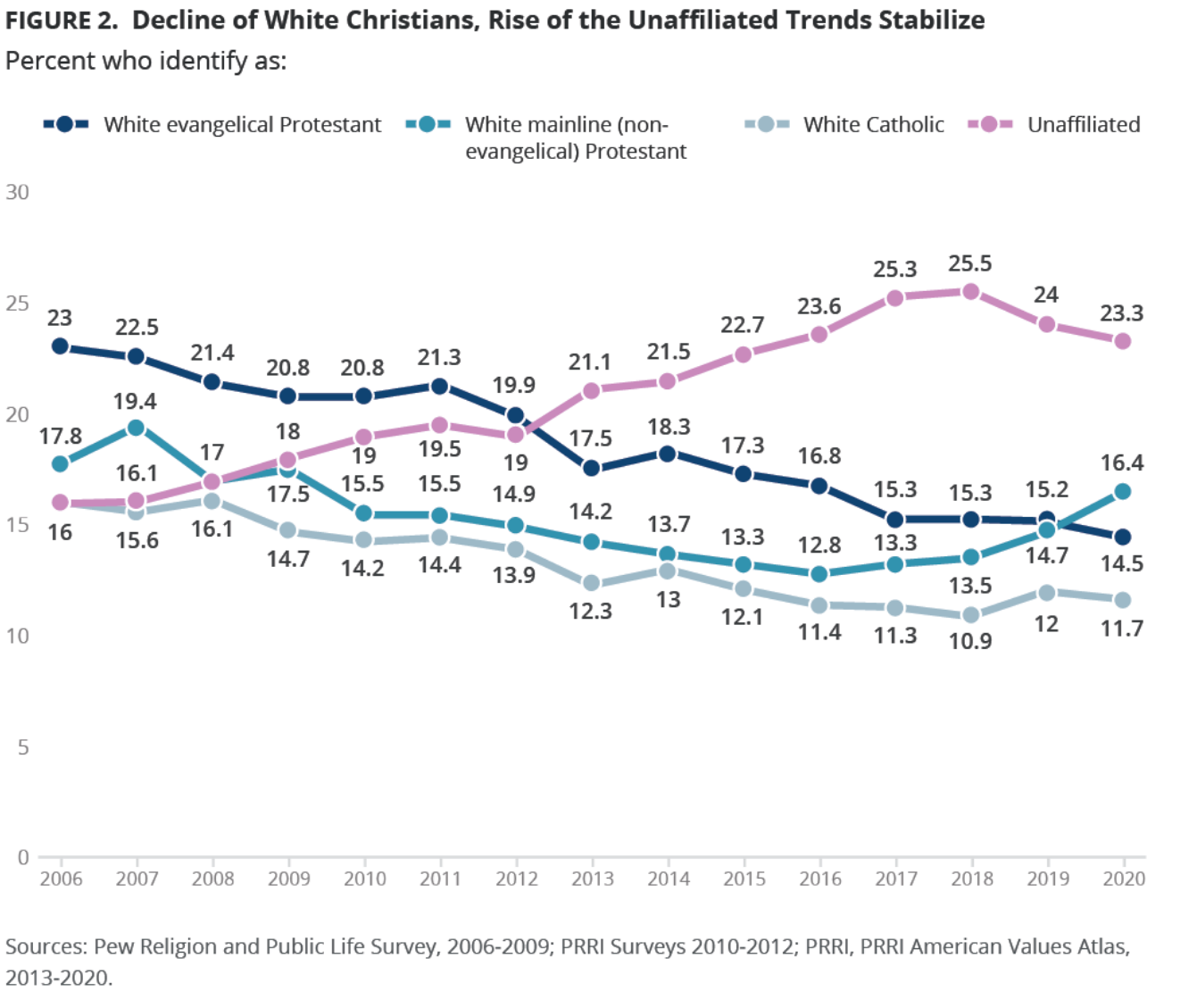
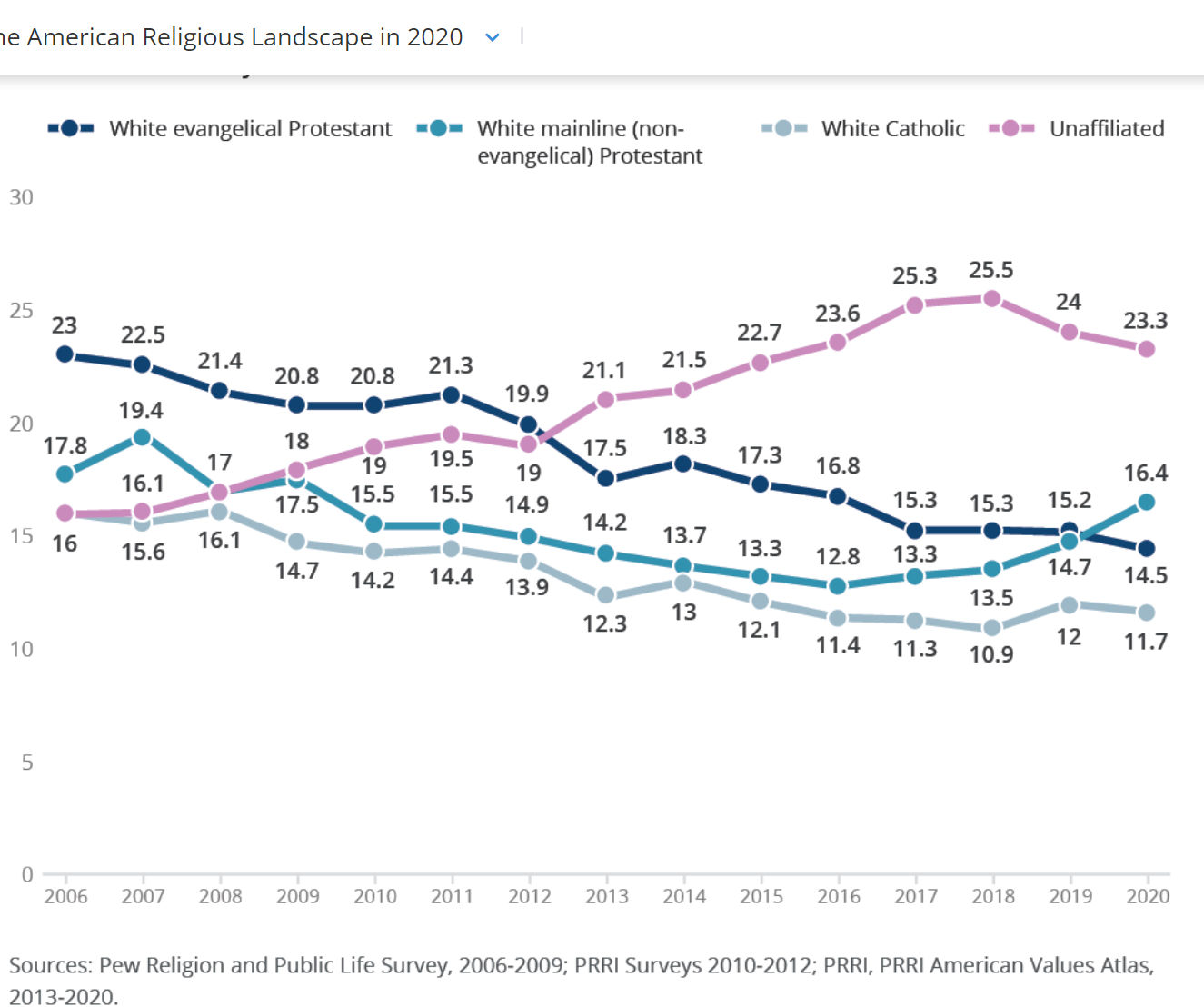
In a secular age.  Classic liberal political state leaves religion, morality, and community to individual and organizational choice.  Capitalist economy promotes worldly individualism, merit, and commercialism.  Reduced religious belief and participation.  Reduced trust and social capital.  Less social pressure for religious participation or moral judgments.  Default philosophy is now individualistic, Rousseau style” man is good” and journey of self-actualization.  Secular humanist, agnostic, naturalistic, atheistic, ecumenical and world religion options all exist.  Individual choice of religion is not required.  Individualist spirituality outside of organized religion is an option.  Religion can be a limited liability membership among others.  Religious choices are independent of other life choices and experiences.  Religious mentors are less common.  Individuals buffered from death, accidents, disease, hunger, crime, exploitation, heavy work, and family demands can live an “adequate” life without considering religious questions.

For most of human history, religion was deeply integrated into each civilization’s world view and daily life.  This began to change in Europe after 1500.  By 1900, the educated classes could consider both religious and secular options.  By 1950, the religious age was over, replaced by the secular age, where most individuals assumed away the spiritual dimension and viewed the world through a scientific, materialistic, deterministic, and commercial lens.  From practical, scientific, and philosophical perspectives this capitulation is quite suspect.

307 Globalization

Components of international economics, economic development, and “global issues” college courses.

Globalization: defined.  Economic, political, cultural, and environmental dimensions.

Goals: Economic, Happiness, Fairness, Justice, Human Rights, Equal Rights, Respect, Economic Equality, Opportunity, Liberty, Poverty, Exploitation, Security and Power.

History of ideas, institutions, policies, actions, and results for all 4 dimensions.

Economic markets, capitalism, welfare economics, government regulation, taxation, mixed economies.

International economics: absolute advantage, comparative advantage, intra-industry trade, relative resources, economies of scale, first mover advantage, regional clusters, industrial policy, rationales for trade protection, trade policies, industry transitions, middle income challenge, drivers of economic market power, barriers to entry, dynamic competitive advantage, patents, regulations, licenses, relationships, resource ownership.

Land, natural resources, commodities, energy, agriculture, resource curse.

Labor, human capital, education, migration, population supply, participation, aging, immigration, health, disease.

Capital, assets, equipment, manufacturing, processes, systems, logistics, products, brands, key assets, suppliers, distribution channels.

Technology, agriculture, science, computer, communications, artificial intelligence.

Management, organizational structures, legal structures, contracts, stakeholder relations, partners, ventures, outsourcing, crossholdings, innovation, change management, key worker appeal, entrepreneurship, risk-taking.

Financial capital, access, operating leverage, financial leverage, industry assets for lending, credit systems, insurance, leasing, legal protections, early-stage equity capital, industry variability.

Development economics: comparative advantage, industrial policy, economic institutions, taxation, regulation, financial markets, education, infrastructure, property rights, labor force participation, trade policy, labor markets, product markets, public health, fiscal policy, monetary policy, exchange rate and capital controls policy.

Political systems: nation-state, republics, democracy, individual rights, centralized power, decision-making, elections, rule of law, human rights, courts, bankruptcy.

Corruption, property rights, crime, terrorism, bureaucracies, political machines, organized crime, political spoils, good government, professional government staff, checks and balances, independent judiciary, military controlled.

Trade agreements, treaties, regional groups, trade alliances, military alliances, colonies, empires, shared currencies, travel, immigration, Bretton Woods, GATT, IMF, World Bank, UN, international law, UN agencies, NGO’s, development banks, international relations.

Policies: institutions, trade, industry, economic development, international organizations, human rights, fiscal, monetary, exchange, welfare state.

Culture: history, religion, ethnicities, language, traditions, food, institutions, ethics, trust, social capital, family structures, centralized government, individual rights, communities, education, property ownership, unions, guilds, not-for-profit organizations, clubs, entertainment, elderly, nature, arts, intellectuals, transportation, communication, media, interpersonal space, literature, myths, norms, land ownership, main industries, travel, trade, multicultural experience.  Changes, pressures, ideas, convergence, replacement from globalization.

Environmental:  resources, limits, population growth, food security, ag technology, sustainable agriculture, extraction, transportation and production, waste, pollution, water access, common resources, recycling, energy sources, chemical risks, global warming, species habitat and preservation, desertification, invasive species, labor safety, monocrops, biological diversity.

Human impact of accelerated globalization: the world is flat, abstract ideas, digital services, money, technology, markets, speed, compressed space, media volume, simultaneous communications, always on, standardization, processes, tools, language, business, production, units of measure, brands, connectedness, networks, transactions, global considerations, global markets, global sources, mobility, migration, remittances, travel, mixed global and local culture, traditional versus secular, multicultural experiences, risks, contagion, business, pandemics, war, technology, AI, climate, experts, terror, identity threatened, productive role, imposter syndrome, meritocracy, rat race, trust, social capital, change, professional insecurity, irrelevance, respect, humanness.

The “Establishment View” is that capitalism, relatively free trade, infrastructure focused development and representative democracy combine to provide an environment that drives economic growth for most countries and promotes the other goals as well.  Statistics from 1945-2020 generally support this claim.

Critics disparage this view and label it “neo-liberalism”.  The critics have become increasingly vocal and influential since 1992 when Francis Fukuyama proclaimed the victory of the establishment view and the “end of history”.

Communists criticize the capitalist base and promote the value of a single party and government ideally directing the economics, politics, culture, and environment for the common good.

Postmodernists view “neo-liberalism” as just the latest charade by the powerful to exploit the people and focus on highlighting the disenfranchised minorities.  Human rights, equality and diversity are elevated as the path to success.

While many examples of post-war economic, political, and cultural development progress can be highlighted and global growth and poverty reduction cannot be disputed, critics can still point to the inequality of results around the world.  Latin America, much of Asia, the Middle East and Africa have not benefited significantly from the overall gains.  Income and wealth inequality within nations has increased.  The “system” does not automatically serve everyone, and political leaders have not generally developed policies to better “share the wealth”.

Many traditional leftists accept the capitalist system, but struggle with the government’s inability to offset its growing powers and capture of disproportionate profits and power.  Globalization increases both the scale and “winner takes all” tendencies while reducing governments’ power to properly regulate.

Greens note the damage and risks posed by capitalist systems is expanded through international trade.  The damage is real and difficult to govern away.  They highlight the interconnectedness of natural systems and the threats posed by actors that view nature as merely a resource.  Romantic greens emphasize the inherent value of nature.  Scientific greens emphasize the detailed risks of chemicals and complex systems.

Citizens also note the “winner takes all” nature of larger economic systems.  The “global elites” who manage corporations and governments clearly win.  The meritocratic technical and managerial elite (STEM) also win.  Large corporations, their employees and owners also win.  Regular citizens will be relatively poorer and unprotected.  They see that governments have struggled to devise policies to meaningfully help those who are harmed by changes.

Citizens also see the cultural impact of accelerated globalization.  The world becomes a large, complex, uncontrollable, technical, digital, economic machine.  Individuals are cogs in the machine.  They lose their humanity.  Political and cultural leaders have not yet offered policies or solutions which truly address this threat.

Neo-liberal globalization tends to emphasize only individual and economic values.  This threatens traditional values and cultures.  Meritocracy and commercialism combine to lure citizens into a rat race.  They lose identity, community, family, balance and meaning.  Traditionalists, religious people, artists, communitarians, and sensitive people all oppose this threat.

Globalization is a major issue for our world.  Capitalist democracies and free trade have driven real progress for 75 years.  However, the progress has been uneven, and the cultural challenges have not been addressed.  Citizens have a responsibility to understand these complex issues and pressure political leaders for reasonable policies to take advantage of the opportunities of globalization while offsetting the side effects.

Globalization is a critical topic for all citizens because we live in a global world with large shares of international trade.  It is a hotly contested local topic.  Citizens need to understand the potential benefits, costs and risks of international trade policies.

308 Moral Lives

Morality, ethics, virtues, and values defined, principles, characteristics, and goals.  The essence is the relationship of the self to others.

History and current context: secular, individual, therapeutic, multicultural, meritocracy, neo-liberal, polarized (Sacks).

Many social roles, rights, duties, and responsibilities.

Society requires morality.  Individuals benefit from defining moral views and behavior.

Inherent challenges: multiple interests, priorities, application, complexity, situation dependent, conflicts, uncertainty, not derived from science, structure cannot be fully rationalized, absolute commitment.

Human nature: person, more than material, dignity, mind, consciousness, free will, nature vs. nurture, language, meaning, communication, community, religious dimension, growing, imperfect, honest, good, sinful, desires, selfish, partial control, intuitive, feeling, self-aware, analog and spiritual, abstract and concrete.  Every person thinks (knows) that they are “right” in their moral views.  Haidt’s “elephant and rider” analogy.  Moral life and material life.

Tensions of morality with the other dimensions of life.

Sources of morality: culture, history, art, science, religion, philosophy, and politics.

Science, evolutionary psychology, Haidt’s 6 moral foundations.

Philosophical insights: intent and results, duties, objective or subjective, relative or absolute, moral, immoral, skeptical, power, human rights, intuition, feeling, theology.

Ethical schools.  Stoicism, hedonism, skepticism, Plato, Aristotle, Augustine, Aquinas, scholasticism, natural law, utilitarianism, Kant, social contract, classic liberalism, pragmatism, Nietzsche, existentialism, intuitionist, Rousseau, romanticism, secular humanism, communitarian, virtue ethics.

Moral reasoning, errors, limits, decisions, truth, and knowledge.

Modern political schools, moral philosophies, and claims.  Classic liberal, conservatism, communism, socialism, labor, green, Christian Democrat, libertarianism, nationalism, populism, Christian nationalism, social conservatism, new left, postmodernism.

Religious ethics: God centered, universe and community before the individual, person as a moral agent, good versus evil, choices have consequences, alignment with reality, natural law, belief, sacred/holy, moral lives, human dignity, love, nonmaterialist/spiritual dimension exists, role of revelation, authority, tradition, holy works, all activities matter, commitments, covenants, commandments, orderly, absolute features, judging, forgiving.  Thinking, feeling, and doing as religious dimensions. 

Virtues ethics.  Aristotle.  Sample virtues and vices.  Modern virtues ethics (MacIntyre).  Risk of making a single virtue supreme.  Virtues to address our current situation.  Brooks’ “resume versus eulogy” virtues.

Personal ethics: adopt, DIY, or blended.  Degrees of engagement and general approaches.  Golden rule, golden mean, pay it forward, common core Tao (CS Lewis), love God and neighbor.  Moral journey: resources, organizations, practices, insights, feedback, advisors.  Interacting across differences.

Applied ethics, 4 of many topics: economic justice/equality, discrimination/equal rights, human sexuality, feminist views.

Community ethics: shaped by many sources.  Politicized today.  Role of personal identity.  Multiple cultures.  Urban/suburban/rural.  Class.  Race.  Religion.  Immigrants.  Is a common core possible? 

Not an “ethics” course for philosophy majors.  Society requires some form of shared ethical beliefs to function.  Our individualistic society and political system don’t provide answers.  Secular and religious perspectives for modern citizens.

309 Shaping Our Future

We collectively own our future.  Political, economic, social, and religious institutions are shaped by men and women. 

We live in a collective society.  Note the key role of institutions and social norms, laws, and politics.  Much greater specialization and trade.  Producing and consuming.  Benefits of living in society.  Myth of the self-made man.  Costs and risks of living in society.  Newborn individuals do not get to choose.

Responsibilities of citizenship:  voting, informed, producing, following laws and regulations, paying taxes, service, and loyalty.

Goals of government and politics:  safety, security, protect property, life, liberty, pursuit of happiness, human rights, opportunities, justice, moral laws, promote the common good, economic well-being, economic security, manage public goods, public investments, business and banking infrastructure, rights of speech, press and religion, protect minority interests, mutual insurance, avoid catastrophes, and international relations.

Six clusters of priority issues (Pew/Gallup):  Economy, inflation, jobs.  Budget, government, health care funding, social security, energy.  War, international relations, aid, terrorism, immigration.  Morality, crime, gun rights, abortion limits, education results and rights.  Education quality and access, poverty, hunger, labor, race, environment, gun control, climate change, abortion rights, human rights.  Campaign financing, election rules, rule of law, trust, polarization.

Context since WWII.  Economy.  Labor force participation.  Income and wealth inequality.  Median quality of life, after transfers, product quality, choices, and public goods.  Federal government share of economy and employment.  Budget deficits.  Business cycles.  Poverty.  Health care quality and costs.  Economic opportunities.  Social capital and trust.  Religious participation.  Crime rates.  Military costs, wars, and threats.  International trade, imports, and exports.  Technological change.  Education results.  Race, religion, ethnicity, sex, gender, disability access.  Environment.  Voting, political processes, polarization.  Global alliances, democracy, and capitalist countries.  Mostly “good news”.

The triumph of Western representative democracy and the mixed capitalist economy.  Fukuyama’s 1992 claim of the “end of history”.  Communism, fascism, totalitarianism.  The elements and benefits of a classic liberal political system.  Criticisms from neo-liberals, social conservatives, communitarians, progressive liberals.  The elements and benefits of a classic liberal economic system.  Criticisms from neo-liberals, labor, greens, mainstream Democrats, progressive liberals.  Churchill – “democracy is the worst form of government – except for all the others that have been tried”. 

Political system today.  Two parties equally matched.  Low voter participation.  Minority of motivated voters can rule.  Polarized parties.  Extreme policies, positioning, and platforms.  “Winner takes all” mentality.  Cooperation is not rewarded.  High fundraising costs to compete.  Gerrymandering.  Sorting of rural versus urban.  Polarized media options.  Special interests veto power.  Problem solving is not rewarded.  Perceived single left versus right political dimension.  Importance of political identity/team.  No limits to political tactics.  The “Rule of law” is threatened. 

Voters.  Party, character, policies, wedge issues, messages, ideology, special interests, transactions, protest.  Incentives to participate.  Limits: priorities, free rider, doesn’t matter, information costs.

Politicians.  Public choice theory, work for self-interest, respond to incentives.  Emotions, communications, simple issues, teams and brands, gerrymandering, voting rules, extreme positions, terminology, framing, blaming, attacks, straw man positions, own facts, stories, no costs or tradeoffs required, Overton window shifts, identity, exaggeration, end of universe, fear of low probability events, what people want to hear.  Great salespeople use messaging to connect buyers and sellers.

Parties.  Win elections, define issues, coordinate brand and messaging, field candidates, raise funds, allocate funds, choose candidates, build and maintain coalitions, set priorities, influence officials to support the party, define boundaries, craft legislation, manage special interests, define districts, maintain unity, manage conflicts between candidates or party wings.  Parties are weaker today due to better communications technologies, direct fundraising and “direct democracy” laws. 

Political subgroups.  Conservative, socialist, labor, green, mainline Democrat, libertarian, nationalist, populist, social conservative, Main Street Republican, business Republican, neo-liberal, progressive Democrat.  A higher share identifies as “independent” today, but a higher percentage lean left or right.  Subgroups vary in their priorities and policies for economic, traditional social, business, government, international, social justice, and environment dimensions. They vary in their participation, moral bases, and willingness to compromise.

The Civil Rights Act of 1964 realigned parties on a left versus right axis and Ronald Reagan consolidated the varieties of “conservatives” solidly into the Republican Party.  The Democrats also adapted.  Various attempts to summarize the essence of “left versus right”: sensitivity to risk/loss, nature of man good or fallen, realism versus idealism, tradition versus progress, authority versus independence, liberty versus state, proven versus progressive, local versus global, religious versus secular, Haidt’s 6 moral foundations.  Many individuals and subgroups do not align cleanly on this single dimension.  They oppose the simplistic, polarizing approach and argue that it works to prevent progress and gives undue power to extreme positions. 

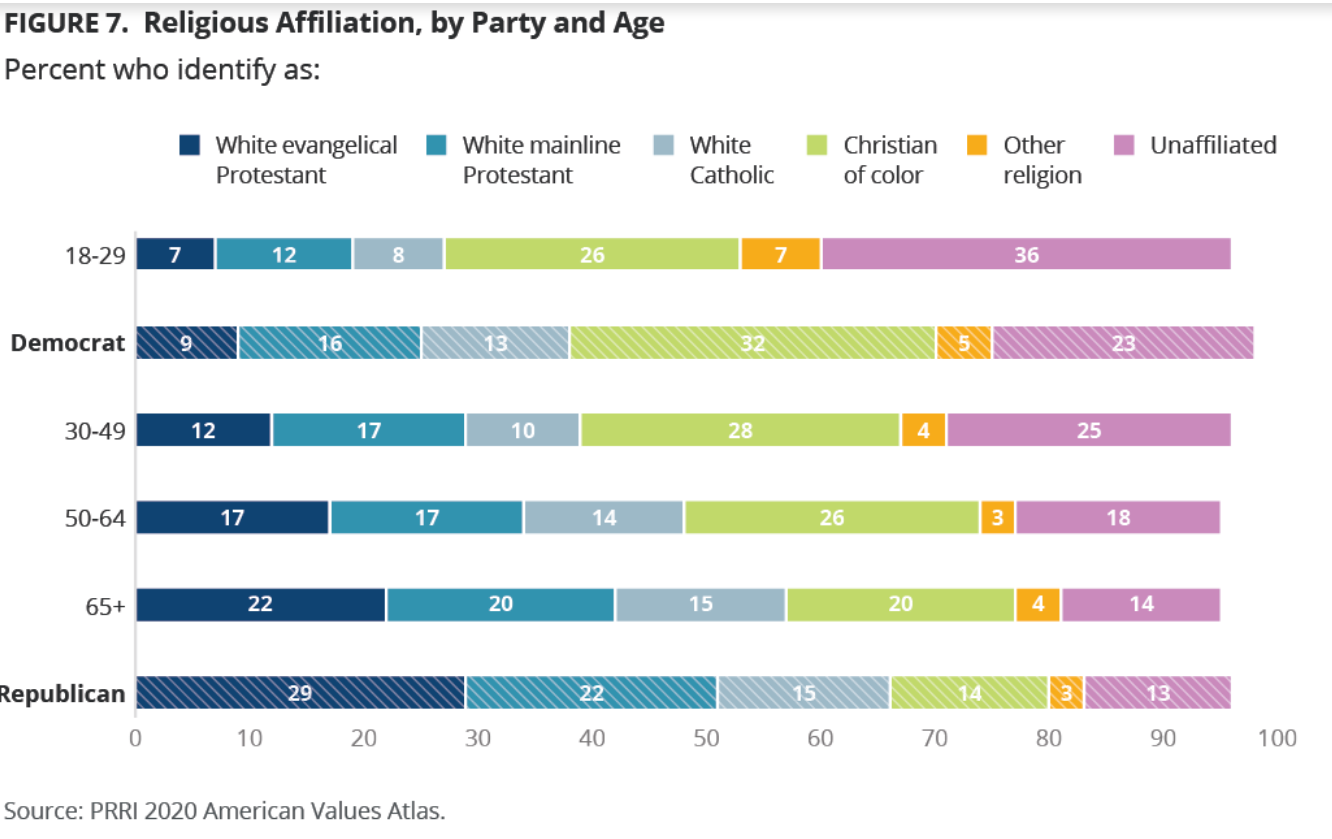
Changes in political subgroups since WWII.  Southern Democrats migrated to Republican Party.  Moderate Republicans migrated to Democratic Party.  Labor, working class whites migrated to Republican Party.  Mainstream white Democrats a smaller share of Democrats.  Minorities a larger share of Democrats.  Progressives a larger share of Democrats.  International relations less important, but still Republican hawks and Democratic doves.  Social conservatives a larger share of Republicans.  Urban Democrats and rural Republicans are clustered.  Big business Republicans a smaller share of the party.  Democrats focused on the coasts and just 500 of 3,000 counties.  Republicans fill the middle and the Sunbelt.  Libertarians mostly support the Republican Party.  The young lean towards Democrats, but Republicans benefit from aging.  The Republican Party’s average income and education advantages have fallen.  Democrats once believed that demographic benefits of more minorities, urbanization, immigrants, and education would ensure a new “permanent majority”, but offsetting changes among working- and middle-class whites as well as minority voters challenge this projection.  Urban clustering, partisan gerrymandering and the constitutional rules for the Senate and electoral college provide Republicans with a 3-5% structural advantage in national politics.

Possible solutions for polarization and loss of political power by the center.  Public funding of elections, nonpartisan district drawing, political parties retain one-third of primary delegates, council of elders, ranked choice voting, new centrist party, Democrats move to center, Republican party splits and moderate Republicans attract moderate Democrats, centrist organization with approval power over candidates, compromise legislation to take wedge issues out of the mix, media legislation to separate news and opinion functions, larger Supreme Court with term/age limits and some non-political appointments, agreement among billionaires and major corporations to not fund extreme candidates, non-extremist rating by a nonpartisan group like League of Women Voters, congressional agreement to delegate more issues to the states, Congress in session 14 days on, 14 days off, return of earmarks for use in persuasion of swing representatives, fundraising limits for special interest groups, Bill of Responsibilities for citizens and representatives.

Populism.  Long history in the U.S.  Anti-banking, anti-city, anti-elites.  Farmer-labor party.  Unions within Democratic Party.  Disconnect between politicians, journalists, and intellectuals and the average person’s lived experience.  Democracy promises that “the people” will be represented.  Some political issues are abstract and remote.  Some political options contrast “lived experience” with ideas and ideals.  Economic changes, threats and disruptions can drive populism.  Social, residential, religious, and cultural changes can drive increased populist demands for solutions.  A larger, global, more complex economy undercuts security.  A meritocratic economy with greater spread of economic returns coupled with a weak “safety net” drives anxiety.  An economically focused society undercuts the non-economic tools used to ensure that all citizens feel respected and needed.  Both parties teach their children that they can achieve whatever they seek.  Working class social capital and trust are weak (Putnam).

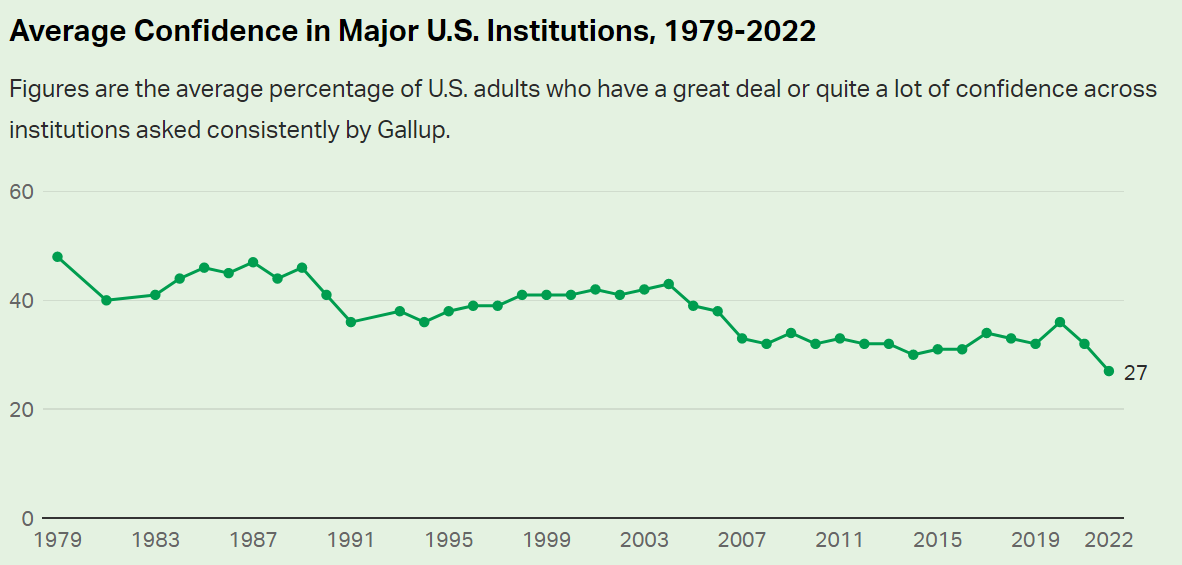
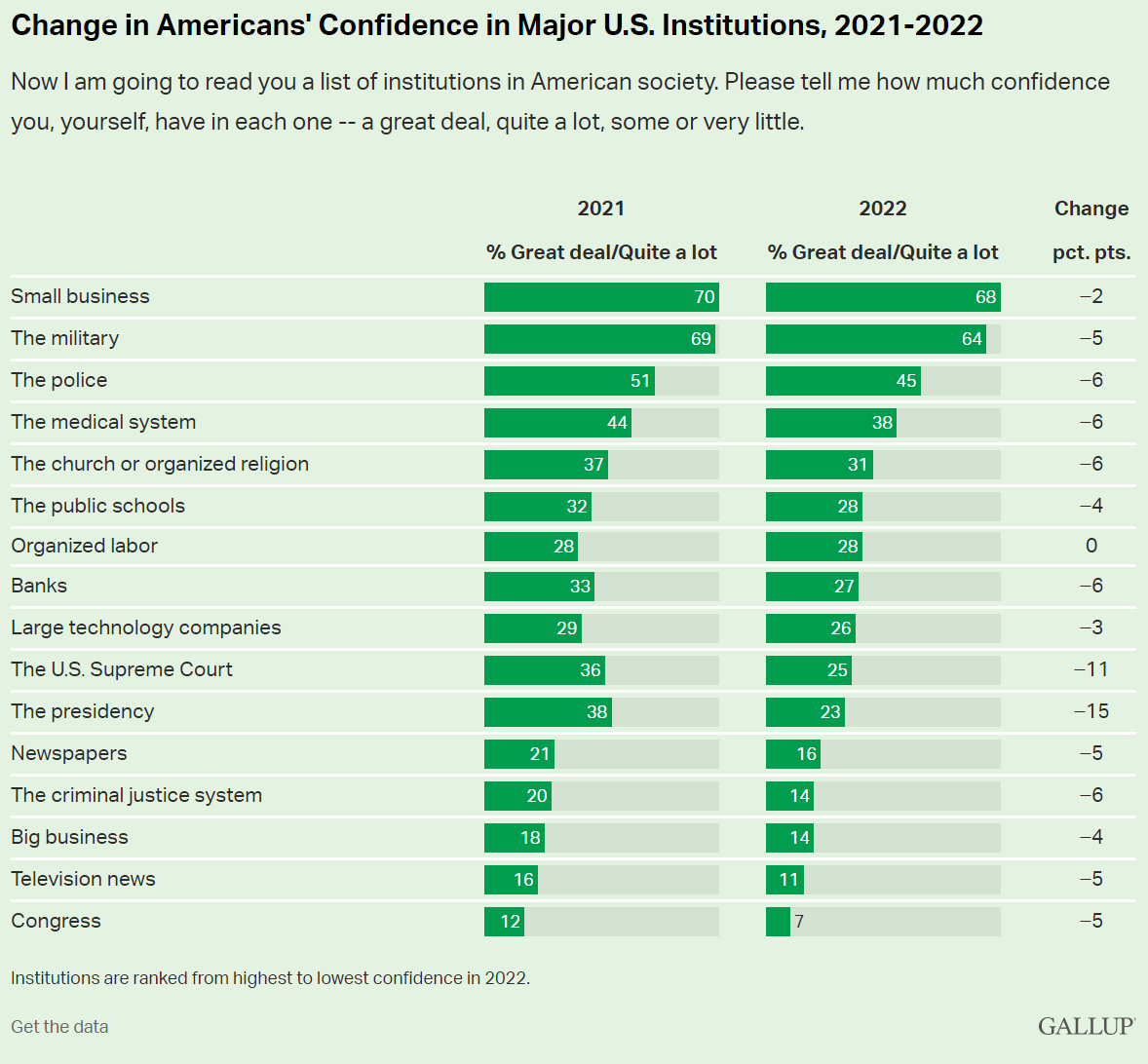
Challenges.  Citizens/voters are imperfect, treat democracy as another consumer good rather than a duty, are suspicious of “others”, have unlimited wants and focus on most recent rewards.  Our political system requires tolerance, respect, trust, and compromise, but intolerance has grown.  The lag between decisions and results makes political feedback imperfect.  The rewards and incentives for compromise are weak.  Our political system leaves morality, values and community to individuals and organizations, yet relies upon some degree of shared commitment.  The decline in social capital, trust, and trust in institutions, especially among the working class, undermines the commitment of citizens to the system. 

Many political choices are inherently values based and contentious.  Political choices often involve limited resources and require trade-offs.  Capitalist systems drive consolidation of income and wealth.  The income and wealth in the US are so high at the top that the incentive to preserve them through politics is very high.  The ad revenue and click based media system reinforce extremist tendencies in politics.  The single left-right, red-blue team basis for politics overlaps with many dimensions of personal identity and is self-reinforcing.

Hope for the future.  The U.S. economy continues to grow, providing jobs, wages, choices, goods and services, tax revenues, low unemployment, and a weakened business cycle.  Growth buffers political conflicts and demands.  Resources address the budget deficit and allow for the investments to offset the side-effects of globalization, improve job security, offer respect to all workers and cap inequality. 

The U.S. has an encouraging history of political leadership and social progress (Meachem), innovations in social institutions and progress in science and management science, allowing organizations to better meet their needs.  The U.S. has world leading organizations that innovate to meet changing and conflicting needs.  There are thousands of great leaders in U.S. organizations.  States, government agencies, the military, universities, and large not-for-profits demonstrate winning ways for politics and program delivery.  Some states have adopted “good government” initiatives and found ways to cooperate in addressing the pandemic.  More and more countries around the world are successfully adopting the classic liberal model of representative democracy plus mixed capitalist economies, lending credibility to their overall effectiveness despite their shortcomings.

The very top economic elite have an incentive to make our political model function and maintain credibility and support despite contradictory incentives to maximize their share of income.  The US, Europe and China collectively have an incentive to define a new world order that preserves the benefits globalization, prevents war, and addresses global challenges like climate change.  The professional and managerial class in the U.S. has a strong incentive to maintain a system in which they thrive, even if they must give up some income, embrace compromises and oppose their chosen political party from time to time.

Our political system has built-in “checks and balances” and protections for self-preservation.  The failures of polarization may drive some political parties, first at the state level, to change their approaches.  Interparty conflicts may disrupt the simplistic liberal versus conservative axis and encourage individual policy voting once again.  One party or the other may lose so much from its extreme postures that it will be forced to move towards the center.

If national politics remains severely partisan and dysfunctional, a nonpartisan movement may push to restrict the scope of national politics.  Our federal system is built to delegate topics to the states.  Technocratic organizations like the OMB and Federal Reserve Board have demonstrated basic competence.  Other functions could be moved outside of direct politics.  The U.S. has a strong religion, not-for-profit and volunteer sector that could grow, especially given the number of retired people.

Generational politics is growing.  The elderly want to protect their retirement benefits and home values.  Young adults are struggling with housing costs, student loans, health costs, social security funding, budget deficits and climate change.  The cycle of new generations might produce individuals with greater interest in compromise and results.  An aging population might provide more voters with a wiser long-term perspective.  Overall, these generations could change the way we look at politics.

The newer generations might provide a greater sense of community versus individualism.  American pride might be tapped to rise above partisan differences and re-establish a government that works for the people.  A modern religious revival could promote key values, trust and community required for better politics.  The suburban professional class’s secular values could become standard for the nation, re-establishing the shared community values needed as a basis for aspirational politics.  Objective news is already available if citizens would choose it.  “Good news” sources that provide expert, historic and cross-national perspective are also available to guide well-meaning voters with open minds.  Multicultural examples of success are available in several U.S. states and provide a model for how the historically dominant culture can thrive alongside others as it loses its political advantage.

One Page: Liberalism and Its Discontents – Fukuyama (2022)

Fukuyama defends “classical liberalism” as a political structure. Not US “liberals” or UK “liberal democrats” or neo-liberals. It was born in the 18th century, child of the enlightenment and religious wars, emphasizing the individual over the group, the equality of individuals, the human species rather than any subset, and practical political structures that provide reasonable results. Individual rights, rationality, human dignity, the rule of law, institutions, compromise and tolerance. Typically connected with objectivity, the scientific method and free trade versions of capitalism. The mixed economic and political systems that he celebrated in 1992 as the “end of history” when fascism and communism were defeated.

“Classical liberalism” is threatened from the right and the left. First, from the right with Reagan/Thatcher neoliberalism which elevates economic property rights as a super-value, undercutting other political and social values. Second, from populist, authoritarian leaders who are actively “illiberal”, campaigning against “free trade”, international bodies, immigration, elites and various “others”, discounting the value of institutions and the “rule of law”. Third, from the left as the progressive, new, radical left has adopted the postmodernist views that elevate “power” as the central political value/insight and claim that powerful elites always control society unless they are opposed by “marginalized” groups to lead a revolution against the dominant groups.

Fukuyama criticizes neoliberalism for being too extreme, opposing the role of government even where it is needed per elite opinion: some regulations, public investments, income redistribution, fiscal and monetary policy, international trade and development, public utilities, environmental externalities, etc. He challenges the notion that property rights are significantly more important than other “rights”. He agrees that the intellectual foundations for “classical liberalism” tend to result in a “thin” basis for morality and community, but argues that neoliberalism makes this even worse, ignoring the moral and community dimensions. He recommends that voters and politicians focus on improving the “quality” of necessary government services.

“Classical liberalism” was developed within a Christian religious and moral worldview, which provided the required moral and community dimension for their 18th century societies. However, Luther’s Protestant Reformation was radically individualistic, downplaying the church as an institution and elevating the individual’s reading of the Bible and personal relationship with God. Philosophers like Rousseau further elevated the role of the individual and criticized the potentially corrosive role of society. Philosophers like Kant developed frameworks that were independent of history and culture, using reason alone to develop morality. Fukuyama notes that a full-fledged individualistic society really grew after WWII, in the shadow of Darwin, Freud and Marx. He notes that John Rawls’ 1971 “Theory of Justice” provides an overly abstract approach to morality and politics, further eliminating the role of “community”. Fukuyama doesn’t have a simple solution to the individualistic imbalance in society.

Fukuyama invests two chapters outlining the development of the post-modernist philosophical and political worldview. 19th century philosophers like Nietzche declared that “God is dead” and that objectivity is dead. They tried to find a “subjective” basis for philosophy, rejecting the core tenants of “classical liberalism” and prior objective, idealistic models. Objectivity, causation and the scientific method were shaky foundations. Dynamic, organic, artistic, natural, revolutionary, evolving worldviews were proposed. After WWII this coalesced into the post-modernist approach. Post-modernism provided a new home for those who supported communism. The elites and power structure oppress the marginalized communities because “they can”. The intellectuals have the role of ensuring that the oppressed understand their abused role and work to overthrow the repressors. The parallel with Marxism is strong. Fukuyama admits that “power” is really important and that powerful people and institutions have used and sometimes abused their power. Yet, he points to the progress of “classical liberal” societies in providing economic success, making life better for poor and minority communities, expanding individual rights, providing a framework for progress, a forum for participation and safeguards against extreme policies or leaders, etc. Philosophically, he cannot support the singular emphasis on power or the subjective worldview. He claims that the “burden of proof” for overthrowing the “classical liberal” model remains on the critics.

Fukuyama leaves us with 10 principles: quality of government, inequality matters, federalism can help, freedom of speech is critical, privacy matters, the scientific method and rational problem-solving work, individual rights have a solid intellectual and historical basis, while group rights do not, the individual and group/morality both matter, civic participation matters and moderation is a virtue.

The Righteous Mind – Part 2

Eight: The Conservative Advantage

By 2004, Haidt saw that his preliminary findings applied to national politics in the US. Democrats relied on just one or two of the moral foundations, or even zero, while Republicans appealed to all five in effective ways. He contrasts Bush, Sr and Bush, Jr, neither a naturally gifted politician, with cool and cerebral Dukakis, Gore and Kerry, who they handily defeated. The Bushes appealed to Republicans, independents and Democrats by using a variety of emotional pitches. Separately, Bill Clinton stands out as a naturally gifted politician and manipulator of emotions.

By 2011, Haidt and his associates had developed and perfected a variety of questionnaires and attracted 100,000 on-line respondents to make their results scientifically sound. Liberals greatly valued the Care and Fairness dimensions and disregarded the Loyalty, Authority and Sanctity dimensions. Moderates were like liberals in terms of their rank orderings but had much closer scores on the 5 attributes. Conservatives valued all 5 equally and Very Conservative individuals valued Authority, Sanctity and Loyalty above Care and Fairness.

Colleagues corroborated the findings based on religious sermon content, dog preferences and brainwaves! The author began to write articles for the general public to share his findings. Many of the responses were predictable. Liberals downplayed or rejected the 3 conservative foundations. Conservatives tentatively complimented an academic who “go it”. But many conservatives were as critical as the unhappy liberals. They questioned Haidt’s morals and lack of understanding of the differences between Democrats and Republicans. They emphasized that Democrats really don’t believe in fairness, just equality and rights. The respondents saw fairness as proportionality and earned rewards.

Haidt and his team reconsidered the 5 moral foundations and made two changes. First, they redefined “Fairness” to be based on the idea of proportionality of work/contibution and rewards. Haidt found evolutionary psychology support from Christopher Boehm’s research on humans and primates. While the original “reciprocal altruism” foundation basis does have support in human history, the development of larger communities with shared property 500,000 years ago required the development of people and norms with group concepts and different fairness behaviors. With more powerful tools/weapons and communications, groups were able to limit the direct power of alpha males and use gossip and communications to support a moderate hierarchical structure with a leader or leading group that commanded extra resources, power and respect, but not too much. This “goldilocks” scenario is considered by many anthropologists and evolutionary psychologists to be a key turning point in human history. Proportional fairness is more highly valued by conservatives but moderately valued by liberals.

Second, while considering this same turning point in human development, Haidt decided to add a sixth moral foundation: Liberty/oppression. In larger groups with an “authority” moral foundation required to support the leader, there is a need for a complementary value to oppose excessive use of authority. Individuals accept, follow and respect valid, legitimate authority, but they rebel against being abused. They can embrace hierarchy and disproportionate rewards to a point, but they are able to band together and oppose any abuse of power. Haidt shares anthropological details to make this plausible. This moral foundation is supported by both the left and the right. The left emphasizes relative equality of rewards and generic antiauthoritarianism. The right emphasizes the personal liberty side, “give me liberty or give me death”, “don’t tread on me”, don’t regulate me, don’t restrict my choices, guns, family or religion. A powerful moral foundation indeed.

Haidt returns for a third time to share John Stuart Mill’s vision of a just society. It is based on the enlightenment, individuals, rationality, utility and a theoretical contract between individuals and society. “The only purpose for which power can be rightfully exercised over any member of a civilized community, against his will, is to prevent harm to others”. This modern, progressive, Western view is based upon Care and Fairness alone.

He then shares sociologist Emile Durkheim’s view of how society works. It is organic, based on community, evolving to meet actual needs, incrementally changing, inherently conserving order and tradition, skeptical of change, based upon existing well-functioning institutions like the family and church. Durkheim argues that man needs to belong to a binding moral system comprised of institutions larger than the individual in order to have a sense of place, stability, order, belonging and meaning. Without this grounding, he is rootless, anxious, experiencing anomie, a lack of grounding. This world view prioritizes self-control over self-expression, duty over rights, and loyalty to one’s groups over concern for out-groups. Historically, Durkheimian societies have predominated. WEIRD societies have been the minority. Haidt encourages the reader to consider both conceptions to have legitimacy. He does not dwell on the possibility of a “both/and” blending of these views or ways to accommodate both at the individual, institution and society level, but consider these possibilities. The individual and the group both matter. Different individuals prioritize individual versus group needs differently and the 6 moral foundations. Given our seemingly intractable differences of opinion, how do we make society function?

Haidt shares more details about conservatives, liberals and libertarians, but the main point is most essential. Different people have different moral worldviews. They are not changing. No one worldview is clearly superior by any broadly accepted ethical standard. We are going to have to “agree to disagree” or as Rodney King said, “Can we all get along?” Can each side understand all six foundations and others who value them differently? Can liberals understand and appreciate Durkheim’s view of a group-based society? Can conservatives appreciate the “individual” and abstract principled, universal, secular insights of liberals, aside from liberty?

Nine: Why Are We So Groupish?

Individuals express both selfish and group-oriented thoughts and behaviors. Everyone knows this. We join and support teams and nations. We donate anonymously. We “do the right thing” when no one is looking at least some of the time (ring of Gyges theory be damned). We embrace religions and consider others. We volunteer. We participate in politics. Not always. Not everyone. But enough to say that this is a feature of humanity, not a bug or a flaw or a mistake. Haidt admits that he has pushed hard on the cynical view of humanity to demonstrate what individuals often do or do “on average”. Nonetheless, group thought, and behavior is part of our human make-up.

Haidt addresses this based on evolution. George Williams in 1955 and Richard Dawkins in 1976 made strong arguments against existing theories of “group selection” in nature and for humans. The differential positive survival of groups based upon group cohesion, solidarity and individual sacrifice is possible in evolutionary theory, but depends upon the group being able to control the individual member’s behavior so that he generally does what the group needs and does not “free ride”, avoiding the personal cost of a behavior that helps the group. Williams and Dawkins debunked many “group selection” examples, demonstrating that they were caused by individual selection or near-kin selection.

Haidt shares Darwin’s view which supports group selection in concept, especially with regard to morality! He provides four rather technical scenarios that support the idea that human group level selection has been a major factor in the development of morality.

The history of biology is that of transitions from one level of competition to a higher level of competition. Bacteria to mitochondria to cells to … animals to societies. 8 transitions in all of recorded time. In each case, the next higher level absorbed the prior lower level, making it secure and dependent upon the higher level, disabling the disruptive competition at the prior level. The development of queen bees and workers in a hive is an example. These more recent changes took place when a persistent, defensible resource was involved (nest and food). They also involved a need to feed infants and the need to defend against other groups of the same species. Human societies fit this model: caves, needy children and aggressive neighbors. Fixed location crops and city-states match this pattern. Group level competition by bands of humans makes sense.

Michael Tomasello argues that “it is inconceivable that you would ever see two chimpanzees carrying a log together”. Humans, on the other hand, have what is described as “shared intentionality”. We have some sense of what another person is seeing, feeling, doing and thinking. We have a mirror image capability. This allowed groups of 2-3 to cooperate and communicate effectively. Even before formal language, humans could use signals, expressions and actions to share ideas and confirm mutual understanding. This is a critical underpinning for moral thought and behavior. It allows groups to share expectations and norms, to consistently provide feedback on acceptable and unacceptable behavior.

Once a group has mutual understanding, empathy and communications it can define a culture and sustain that culture though time. The culture can evolve to further and cumulatively improve group level effectiveness. The culture can take advantage of biological evolution, teamwork, communications and innovations. Biological and cultural evolution can interact. Dairy herds, lactose tolerance, more food, more herds, cheese, more people. Abstract symbols and markings and language evolve. The components or vocabulary become richer and support faster and innovative growth. The sense of groupness increases as the communications skills and feedback loops improve. The group level matters even more. Group innovations such as shame and guilt develop. The authority, sanctity/cleanliness, liberty, fairness and loyalty moral foundations become more effective. Effective societies “self-domesticate”, restraining extreme individualism and promoting cooperation and support of the group.

Biologists argue about the speed of evolution. Haidt shares examples of rapid individual and group evolution in 10-30 generations. He argues that the migration of humans around the globe during a period of warming and cooling provided a challenging environment for humans that could have triggered very rapid evolutionary changes at the biological and cultural levels in the last 50,000 years.

Haidt concludes that we are 90% selfish chimp and 10% cooperative bee. Once again, this is assuming that the evolutionary framework is the “alpha and omega”, without any religious, spiritual or sacred dimension working in the universe.

Ten: The Hive Switch

Haidt asserts that humans have evolved to live at both the individual and group levels. In this chapter he describes this potential in more detail, emphasizing his 90/10 theory that we mostly live in the profane, individual, day to day world, but at times we “switch” to the group, sacred, infinite, eternal, religious level.

His favorite sociologist, Emile Durkheim, describes these two levels and emphasizes, in contrast to the individualist views expressed by other scientists, social scientists and philosophers from 1500-1900, that the social, group or religious level is an essential part of man’s nature. No man does or can live without a “thick” attachment to his culture, neighborhood, community and nation. Durkheim describes the lack of connection as the dreaded “anomie” or emptiness experienced by individuals who leave their community and emphasizes the “collective effervescence”, or energy felt by individuals in group settings.

Haidt opens the chapter describing a simple version of an “altered state of consciousness” created by the muscular bonding of military drills. He connects this with the rhythmic dancing to exhaustion reported in many primitive cultures by anthropologists. The individual is moved from being an individual, conscious agent to being a part of the collective, aligned, bonded, trusting, equal, outwardly focused group. He describes another half dozen ways in which individuals shift from a “me” to a “we” world view, in each case experiencing a different consciousness. Awe of nature, drugs, initiation ceremonies, sporting events, political rallies, religious ceremonies and meditation all produce this change in perspective.

Haidt outlines two biological channels that appear to be involved. The hormone oxytocin is associated with bonding, love and attention. Experimental psychology studies show that it improves feelings towards others in a group, not to broader humanity and that it does not create negative feelings for out-group members. The mirror neuron system allows humans to have the emotion of empathy. Seeing others, especially those we view favorably, perform an action triggers the same brain circuits as when the individual does the same action. Haidt describes this as “parochial altruism” or “parochial love”, the exact range of impact consistent with the development of group level bonding in an evolutionary mechanism.

The author reminds us of his earlier amazement at the scale of organization level cooperation seen in the modern world, especially in large corporations. Without inherent group level bonding and interaction capabilities, this would not be possible. He notes that modern organizations try to use “transformational” rather than merely “transactional” leadership styles to shift team members from a purely economic exchange to more of a partnership or group membership.

Haidt takes a quick tour through political groups which appear everywhere in human history. The nation state shows that group feelings can apply at a large scale. Manipulative leaders such as fascists can misuse groupness. He notes Robert Putnam’s research that shows the many ways in which “social capital” can be built and provide benefits in smaller scale political and social organizations.

Finally, the author relates his belief that human “happiness” does not come from the individual, self and soul alone as promoted by some religions and philosophies. Instead, he proposes that it comes primarily from positive relationships between the individual and others, groups and the sacred realm.

Eleven: Religion is a Team Sport

The chapter opens with a description of University of Virginia football traditions. Symbols, chants, songs, dances, traditions, rites, colors, colleagues, fraternities, sororities, ecstasy, collective effervescence, sanctity, sacred objects and locations. Yes, just like a religion, perhaps a Pentecostal religion! Sporting events and religions are “social facts”. They exist in almost all times and places.

After 9/11, many scientists, philosophers and journalists could no longer withhold their contempt for “organized religion”, especially any version of fundamentalist religion. The “New Atheists” documented why religion is almost all “bad” and an evolutionary mistake that could be overcome if everyone would follow their lead in eliminating it. Their model of human behavior is the familiar Platonic one where belief determines behavior. Haidt offered much evidence to question this simple model earlier in the book. He also presents a model of religious psychology where Beliefs, Actions and Belonging interact as equals.

“To an evolutionist, religious behaviors ‘stand out like peacocks in a sunlit glade'” according to D.C. Dennett. Evolution prunes away wasteful behaviors since they require the use of scarce energy. Yet, religion is everywhere. The New Atheists begin with the “hypersensitive agency detective device” that humans possess. We identify patterns. We assume an agent is behind any behavior, activity, shape, result, situation, effect, outcome, sight, sound, taste, image, memory, belief … Although philosophers argue about the existence of “cause and effect”, regular humans simply know that this is true. We assign causal agents in almost any situation as an instantaneous first hypothesis.

Once humans lived together in larger communities and used language, someone described agency in the form of God or spirits for all kinds of events: weather, wind, animal attacks, good harvests, bad fishing, attacking neighbors, etc. Other translations of human capabilities to serve the “God hypothesis” may have helped. Love of man to love of God. The idea that bodies and minds, souls, and God are different. In this analysis, religion was never a valuable tool at the individual or group level, merely a strange accident.

However, religions that did a better job of convincing people that they were correct, for whatever reason, would have continued through time and survived, attracted new groups while other less believable or effective religions would have passed away. This is a fine point, but a critical one. Selection is based on the ability of religious ideas, stories and leaders to survive and reproduce, irrespective of whether they provided any benefits to groups or individuals. In other words, appearances matter most in evaluating supernatural concepts. Religions are described by the “New Atheists” as viruses or parasites that promote themselves, even at high costs to their hosts.

Some anthropologists and evolutionary psychologists propose a similar evolutionary explanation for religion’s pervasive existence and influence. They argue that religions that made groups more cohesive and cooperative DID provide clear benefits at the group level, and possibly personal benefits too. As groups got bigger and adopted agriculture, making assets and a hierarchical structure more important, the need for cohesion increased and the opportunity for “more effective” concepts of God arose. Gods who can see everything. Gods who hate cheaters and oath breakers. Gods who administer collective punishment. Angry gods.

Haidt shares research on the survival of communes to support the idea that religions can greatly improve group solidarity. Religious communes survive 6 times as often as secular communes. Religious communes that required the most personal sacrifices from members did best. Personal sacrifices did not make a difference for secular communes. Haidt and some researchers argue that the “sacredness” of sacrifices, rituals, laws and practices allows them to become invisible, held at God’s level, unchallengeable and more effective.

Biologist David Sloan Wilson’s book “Darwin’s Cathedral” offers a theoretical framework combining Darwin’s idea of group level evolution to create morality and eliminate the “free rider” problem with Durkheim’s definition of religion as a “unified system of beliefs and practices that unites members into one single moral community”. Religion, as a social institution, arises and then evolves by delivering group level cohesion benefits. He refers to John Calvin’s strict Protestantism, medieval Judaism and Balinese rice farmers solving complex water management challenges as evidence for how this works. Haidt likens God to a maypole that serves the function of giving people a central figure to coordinate their lives as a community.

Robert Putnam and David Campbell in “American Grace” relate that individuals who “practice” a religion are significantly more generous than others, first to members of their religion and second to the larger community.

Haidt describes religions as “moral exoskeletons”. “If you live in a religious community, you are enmeshed in a set of norms, relationships and institutions that work primarily on the elephant to influence your behavior”. If you are not shaped by a religious community then you have to rely upon individual, rational decision-making, allowing the rider to try to guide the elephant, who has nonetheless picked up moral beliefs. Haidt is very skeptical that a society can be effective if it is comprised of individuals trying to “reason” their way through life rather than adopting some “religious” perspective that provides an agreed upon moral framework.

“Moral systems are interlocking sets of values, virtues, norms, practices, identities, institutions, technologies and evolved psychological mechanisms that work together to suppress or regulate self-interest and make cooperative societies possible”. This is a functionalist definition describing what morality does, not what it “ought to do”. Haidt suggests that utilitarianism, supplemented by the value of maintaining social order and cohesiveness, is a good philosophy (Ought) for making public policy decisions. Produce the greatest good for the greatest number, subject to the need to preserve the social order.

Twelve: Can’t We All Disagree More Constructively?

American politics has become more polarized in the last 50 years for the familiar reasons: Voting Rights Act of 1964 triggered alignment of conservative = Republican and liberal = Democratic parties. The Reagan Revolution consolidated varied “conservative” groups into one “conservative” umbrella allied in opposition to the “liberals”. The Gingrich Revolution further exaggerated these differences and staked out extreme positions and undercut compromise. These opposing parties have increasingly disregarded formerly shared norms on how “our democracy” works (2011 debt ceiling vote, Supreme Court nominations).

Haidt devoted a whole book to isolating six different dimensions of political, moral and religious beliefs, but returns to the simpler “left versus right” yardstick because it is most researched and provides solid insights. He adds libertarians to liberals and conservatives in some of his analysis. He notes that research shows that individuals pursue their moral/belief/worldview self-interest, not their economic self-interest in politics. Self-interest, but not naked self-interest.

Research documents that there is a genetic basis to political beliefs. Liberals tend to be less reactive to threats and more attracted to change and novelty. Conservatives are more attentive to threats of all kinds and value the familiar. Twins studies show that political views are about one-third predicted by genes, like many other personality traits. As individuals develop into young adults they adapt to their environments, where their initial preferences are reinforced or modified. Eventually they adopt a political/moral matrix world view and buy into a life narrative/story that makes sense for them. These life narratives are filled with moral content.
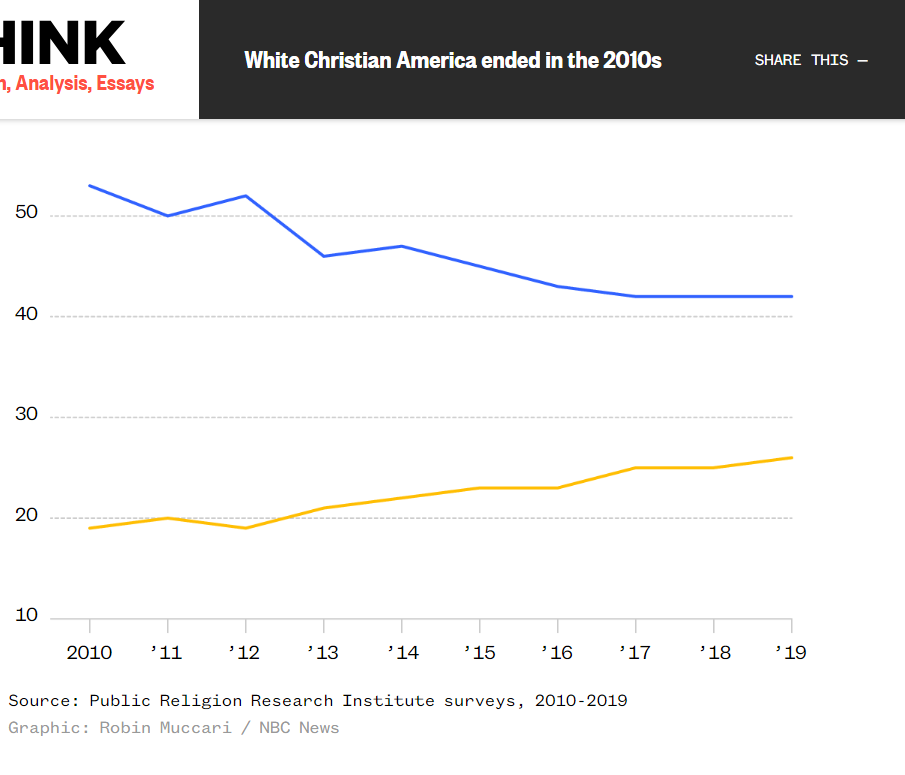
The grand narrative of liberalism is the heroic liberation narrative. “The arc of justice curves forward”. The world progresses from the darkness of oppression towards increasing fairness and equality. “Modern, liberal, democratic, capitalist (?), welfare societies” prevail. Authority, hierarchy, power and tradition are overcome. The grand narrative of conservatism is the heroic defense of the valued society. Reagan’s speeches illustrate this with a consistent pattern of outlining liberal threats and championing conservative responses to restore the just society. All of the moral foundations are employed. The organic and sacred roles of community, family, neighborhood, church and nation, are highlighted.

Haidt’s research shows that moderates and conservatives can generally imagine and understand, if not “appreciate”, the liberal narrative and priority moral dimensions. However, liberals, especially those who are “very liberal” struggle to even understand how loyalty, authority and sanctity belong in a moral worldview. The extreme rational, individualists struggle to see the community, group or religious dimension of life, morality and politics. “Morality binds and blinds”.

Haidt’s research shows that liberals fail to understand or appreciate the necessary role of “social capital” in building support for society, institutions and politics. He quote’s Putnam’s 1999 “Bowling Alone” which documents the huge decline in social activities in the US since the 1950’s and the impact on trust in others, institutions, politics and society. He does not “blame” liberals directly but points to the individualist bias of the modern world as a driving factor.

Haidt takes yet another pass at making “conservatism” accessible to his liberal colleagues in the academy, noting that much of his research is consistent with modern (1776+) conservative philosophy. Historian Jerry Muller argues that the original modern conservatives, David Hume and Edmund Burke, reason within the Enlightenment framework, attempting to outline political ideas, frameworks, concepts, institutions and structures that improve human happiness. They emphasize history, tradition, caution, moderation, community, institutions, beliefs, real people and skepticism. Muller contrasts this with “orthodoxy” which emphasizes a “transcendent moral order”.

Haidt argues that this worldview supports the value of “social capital” and “moral capital”. As outlined in the last two chapters, humans have the capacity to shift between the profane and sacred dimensions. Religions use this sacred, group, infinite, eternal dimension to bind people together in a solid group. This achievement of a deeply, intuitively shared worldview allows society to function more effectively, reducing the need for external laws and enforcement, building trust which simplifies daily life, reducing transaction costs, and offsetting pure self-interest.

Haidt contrasts the Chinese complementary framework of yin/yang or the pluralist (not relativist) philosophy of Isaiah Berlin with the monist (one) moral frameworks of pure utilitarianism or deontology (pure reason) or the Manichaean religious perspectives (good/evil). He is never so crass as to just say, “both the individual and the group matter”, but I believe that is the essence of his work. The WEIRD, academically liberal descendants of the rational, scientific, individual “enlightenment” believe that some form of fixed, final, perfect, just, fair, ideal philosophy and state is possible and will arrive. Orthodox religious believers and social conservatives idealize the community above the individual and perceive their own version of an ideal, well-run state arriving. The “silent majority” of Americans know that we need both the individual and community perspectives, the profane and the sacred, to have an effective community, nation and world [TK speaking].

Haidt proposes “Durkheimian utilitarianism” as the standard for public policy decisions. Create the most good for all people but preserve the core commitment to our shared community life. Promote the “little platoons” of life. He says that liberals are right to propose government as a necessary regulator and counterweight to the superorganism known as a multinational corporation. He says that libertarians are right to emphasize the benefits of the capitalist market system. He says that conservatives are right to emphasize the importance of preserving social and moral beliefs, laws, policies and institutions. He notes that liberals hate the idea of exclusion, so they prioritize, even sacralize, the defense of individual rights and the importance of shared humanity. This sometimes leads to policies that unintentionally undercut social structures (welfare and out-of-wedlock births).

Haidt does not dwell on solutions. He has a website, http://www.civilpolitics.org, with details. He discounts civility pledges or a miraculous insight that will change minds. He believes we are 90% individualistic chimp and 10% social bee. He believes that we “should” begin with honestly trying to empathize and understand the views of others. From his beliefs, actions, belonging model of religious psychology, he advises taking actions to interact with others.

Conclusion

Intuitions come first, strategic reasoning is second. The elephant leads, the rider acts as a press secretary.

There’s more to morality than harm and fairness. 6 flavors of morality at the cafe.

Morality binds and blinds. We are selfish and we are groupish. 90% chimp and 10% bee.

TK Commentary

We all have political, religious and moral worldviews that seem to be correct and obvious. We struggle to see why others don’t see the world as we do.

Yet, after 50,000 years of progressively more complex societies, politics and economics, we are stuck with each other now more than ever.

I’m not convinced that Haidt has “THE” 6 moral foundations identified and described or “explained” by evolution. But I think that he has clearly outlined our dual individual and group, moral, community, religious, sacred nature. And, it’s a good thing that we are inherently individuals and naturally community members. We live in a world that requires both at every level: family, neighborhood, community, profession, organization, state and world.

The author gently focuses on the excesses of the academic, new, far left without addressing the even more extreme postmodernist flavors common in the academy, media and progressive politics today. This an “orthodoxy” just as close-minded as the fundamentalist religious orthodoxy on the right, IMHO.

I believe that our politics is dominated by the extreme “orthodoxies” of religious fundamentalism, libertarian individualism and grievance/victim populism on the right and postmodernism, secular humanism, and identity grievance/victim populism on the left. Both extremes provide simple solutions to our complex modern challenges while demonizing the opposition to make us feel righteous.

During the challenges of the depression and WWII and in the post-war breather period, Americans largely set aside their political differences to support the nation first in 3 existential struggles (survival, fascism, communism). Racial, cultural and military events in the 1960’s conspired to set the stage for polarization. Some politicians have attempted to appeal to the “better angels of our nature”. Eisenhower and Kennedy, in their own ways. Reagan as an “above politics”, traditional, American, Teflon, city on the hill, idealist and communicator. Carter, Clinton and Obama as centrists. Bush, Sr and Bush, Jr. as less ideological Republicans. The political forces of extremism, simplicity and populism have been winning for 50 years. 😦

I believe that Haidt’s work provides the conceptual basis for some kind of new consensus that accepts that we are “stuck with each other”. The original US constitution took this same negative, but practical, view of reality. The US didn’t experience the religious and political wars as Europe did, so it is not so sensitive to the risk of such wars. We had the “Civil War”, but it has mostly receded from the public imagination as a force for compromise in modern politics. We are seeing the disfunction of solid red states and solid blue states. At some point, I predict that the “elites” in society will reassert control. These divisions are “bad for business”, threatening national security, undermining democracy, risking civil war, dividing neighbors, and damaging children and families.

The Righteous Mind: Why Good People are Divided by Politics and Religion – 2012 (Part 1)

Evolutionary psychologist Jonathan Haidt wants the general reader to understand how man’s evolution has shaped his psychology, especially as it applies to “politics and religion”. He and his colleagues have considered a wide variety of theories from evolutionary psychology. He has concluded that real world men and women first have intuitive views of politics and use their “rational” skills to justify their views and avoid changing. Second, he identifies a half dozen evolutionary behaviors and thought patterns that underly most political beliefs. Third, he shares research that shows that liberals generally only emphasize 2-3 of these viewpoints while conservatives apply all 6. Fourth, he argues that humans are 90% solitary individuals and 10% collective or community animals who naturally live at both the profane and sacred levels. Fifth, he argues that religious belief has co-evolved in the last 10,000 years with the domestication of animals, increased value of assets and development of larger groups in civilization who threatened each other.

Many religious people struggle to even consider a book that uses “evolution” to outline politics and religion. Haidt does not take a determinist approach, nor does he disregard a sacred basis for religion. Many progressives, especially those who believe that only fairness and equality are proper bases for political views and who discount religion, also struggle with this book which provides a “broader” picture. I encourage readers to set aside their political views, even though Haidt shares many studies that say we are very poor at doing so, because I think that his insights into people using intuition and rationalizing, overall, are objectively true. I also think that understanding the 6 underlying thought patterns supporting our deeply held political beliefs can help to reduce our polarization and make us more accepting of the beliefs of other people [Are those who think differently from me really EVIL?].

Finally, I think that his analysis of the individual and community and the role of religious belief is applicable today as we struggle to accommodate a variety of political and religious views. I think that it is possible that we could get a consensus among 80% of Americans that we “need” some degree of community to balance a purely individualistic perspective and that religious belief is a valid worldview that is not going to disappear in the next century, so we ought to recognize, at a public policy level, that religious belief and organizations have played and can play a very constructive role in American life, with the encouragement from all, even as we preserve the “separation of church and state”, freedom of belief and a commitment to the ideals of America’s founders regarding individual rights and equality. The genius of the American political system, in my view, is that it allows us to define pragmatically effective institutions and norms, while allowing individuals to hold diametrically opposed views about politics, religion and philosophy. We can “agree to disagree” about many things while working together to make a great life for ourselves and our descendants.

Introduction: The Wisdom of Rodney King (1992)

Rodney King was nearly beaten to death by 4 LA police officers. Despite a videotape of the attack, the officers were not convicted of a crime. LA erupted in riots. King then said “please, we can get along here. We can all get along. I mean, we’re all stuck here for a while. Let’s try to work it out.” We all hold “righteous” beliefs about right and wrong, politics and religion. We’re right and the other guy is wrong.

One: Where Does Morality Come From?

Haidt provides the reader with a quick history of how psychology has treated morality as a “special way of thinking”. In the “nature versus nurture” debate, psychologists generally chose nurture. From Rousseau through Piaget, Kohlberg and Turiel, psychologists found that a “stages of growth” model effectively described the progress of moral thinking in children. The detailed research focused on perceptions of harm and fairness. The research confirmed that children universally progressed through stages of understanding leading to an “adult” level view of harm, fairness, justice and moral behavior. As Rousseau described the world in 1750, humans are born with a “blank slate” mind and easily develop language, thought and morality. In this view, society and its institutions, including parents, teachers and religion, mostly interfere with the “natural” development of children. The “conventional wisdom” through 1990 supported this worldview. Haidt deems this a “rationalist” worldview because in it all children can develop moral views rationally, through their basic interactions with the world, without need for cultural education or innate capabilities beyond general reasoning.

Haidt studied philosophy, politics, anthropology and psychology before starting to work on his doctoral thesis. Like many students in the seventies, eighties and nineties, he found the mainly behaviorist psychology of the time to simply be too “neat and tidy”, objective, simplistic, static, deterministic, dry, rational, logical, machine-like, inhuman. Input-processing-output. Homo economicus. Stimulus-response. No gap, no consideration. No social context. No biological or evolutionary basis. Certainly no religion.

Richard Shweder challenged the consensus view of how people conceive of morality in 1987. He started from an anthropological perspective. Successful cultures all find a way to balance the needs of the individual and the community. Most choose to emphasize the needs of the community. Only a few, mainly modern Western ones, strongly prioritize the needs of the individual. The modern West had doubled down on the individualistic view in the 18th and 19th centuries with the growth of Protestant religious sects, science, capitalism and new individual based political systems. In the 20th century, the extreme “social” views of fascism and communism were rejected, reinforcing the individualist perspective. Shweder saw that the progress of modern psychology was based solely on the individualistic perspective. His research showed that moral views differed by culture and that both harm/fairness and social conventions matter.

Haidt’s dissertation research pushed this a little further along. He emphasized moral stories that could trigger reactions of disgust or disrespect. He found that the US and Brazil, urban and rural, upper- and lower-class people had quite different moral views. There was no single moral conclusion.

Haidt also found that individuals were strongly predisposed to justify their moral views, no matter how normal or unusual they appeared to the interviewer. We all need to believe and feel that our moral views are “righteous”, no matter where they came from. He quotes David Hume (Rousseau’s contemporary) that “reason is and ought only to be the slave of the passions and can never pretend to any other office than to serve and obey them”.

Morality includes factors from both individual and social community perspectives. Individualistic and abstract fairness, harm and justice are not enough. Social taboos, food prohibitions, sexual taboos, hierarchy, loyalty and family ties also matter.

Moral views in traditional, social based communities are generally quite similar. They are very different from individualistic societies.

Haidt is working hard to be an objective scientist, describing how moral views exist, not how they “ought to be”. Social centered communities have quite different views. These “traditional” views continue to be held by some, even in modern, individualistic societies.

Haidt rejects the psychological mainstream view. Individuals do not simply “figure it out” rationally. They are shaped by logic/reason, social influences and innate thought patterns.

Two: The Intuitive Dog and Its Rational Tail (Tale)

How do people really address moral decisions? Philosophers tend to emphasize individual rationalism, even though Plato’s discussion, Q&A, social model was the beginning of modern philosophy. They emphasize reasoning (the head) and mostly or totally ignore emotion (the heart). While philosophers were aware of Hume’s view of reason as a slave to the passions, they ignored this possibility. As noted in chapter one, psychologists followed the “rationalists” until 1990, when some challenges arose.

Frans de Waal documented that chimpanzees possessed most of the building blocks human use to build communities and moral systems: feelings of sympathy, fear, anger and affection. Feelings might matter more.

Antonio Damasio documented a type of brain damage in humans that reduced their emotional skills to near zero. This caused them to lose their ability to make rational decisions about daily choices. Without a gut level, intuitive sense, they were overwhelmed by the complexity of making common daily rational decisions. Emotions are part of decision making.

Edward O. Wilson proposed in his 1975 book Sociobiology that natural selection influenced human behavior. He argued that there is in some sense a human nature that rationality and social pressures cannot simply ignore. The response from the “rational” psychology community and many others holding Rousseau’s “blank slate” view of the mind as a necessary underpinning for their political views was extremely negative, making the idea “untouchable” for more than a decade. A number of researchers quietly picked up Wilson’s approach and renamed it evolutionary psychology. New research defined hypotheses that could be scientifically tested.

In 1987 Howard Margolis, a public policy professor published Patterns, Thinking and Cognition. He demonstrated that there is a clear difference between the quick, intuitive cognition of pattern matching (seeing-that) and the slower, conscious, more complex and formally rational logic used to reason or justify (reasoning-why). Both are forms of cognition, but they use different parts of the brain.

Haidt developed experiments to help distinguish between the roles of the head and the heart, reason and emotions. He first found that individuals can make moral decisions just as well when being stressed by other demands on their thinking (a heavy load). Moral judgements seemed to match Margolis’ intuitive, pattern matching, quick, subconscious form of cognition. He next found that in a wide variety of cases, initial moral judgments could not be changed even with the strongest forms of logic, evidence and persuasion. Participants stuck with their initial choices. They defended themselves with good and bad reasons. When their bad logic was challenged, they doubled down with new reasons or just claimed that they didn’t need to justify their choices.

In his 2006 book The Happiness Hypothesis, Haidt consolidated this thinking into the analogy of an elephant (automatic processes, including emotion, intuition, and all forms of “seeing-that” and a rider of the elephant (controlled processes, including reasoning-why). In behavioral economist Daniel Kahneman’s 2011 work Thinking, Fast and Slow, he calls them simply system 1 and system 2. The rider can see into the future, learn new skills, master new technologies, consider complex situations and justify or rationalize choices. For most moral decisions, individuals react intuitively and rationalize their gut feelings. Hence, a simple model has the individual interacting with the environment, the elephant/heart/emotions/intuition making moral judgements and the rider justifying the choices.

Haidt argues that few moral decisions involve rational choices, and few decisions are revised by individual reconsideration. On the other hand, he notes that man is a social animal who wants to be held in high esteem by his peers and looks to them for feedback on a variety of topics including moral decisions. Hence, Haidt’s model of moral decision making adds a feedback loop from society to the individual. This is about social pressure that can persuade an individual to reconsider the basis for a moral decision and potentially provide a different intuition that replaces the old one.

On the one hand, individuals make subconscious, intuitive moral decisions rapidly without the benefit of “logical” thought and tend to “stick to their guns”. On the other hand, individuals are capable of logical introspection and they can be influenced by others and they can consider new or competing models, insights, perspectives, paradigms, etc. Individuals tend to have “their minds made up” on moral issues (politics and religion), but there is some ability to consider the views of others and to reconsider moral insights.

Three: Elephants Rule

Intuitions come first, strategic reasoning second. The social intuitionist model is summarized in just 6 words.

Hypnotized subjects instructed to feel a flash of disgust by a word evaluated stories containing the word more negatively. Even a story with no moral violation triggered such a response in 30% of subjects and they tried to rationalize their initially stated feelings.

Brains evaluate instantly and constantly. The founder of experimental psychology, Wilhelm Wundt, in 1890 described affective primacy. Individuals feel small positive or negative flashes of emotion with most perceptions and impressions. Feelings are associated with perception. Although the feelings may be weak and fleeting, they are triggered hundreds or thousands of times a day. In 1980, Robert Zajonc demonstrated that we attach mini feelings even to neutral objects like made-up words, Japanese characters and shapes. We are built to respond emotionally to the world.

Social and political judgements are particularly intuitive. Research shows that the positive or negative connotations of words effect our ability to interpret the positive or negative nature of a second, following word. The pair “love-cancer” requires extra mental energy and time to evaluate the emotional nature of “cancer”. Negative prejudices have also been shown to impact our reactions to succeeding pictures, stories or events. Liberal and conservative biases have been demonstrated using these techniques. Other research shows that research participants make several intuitive judgements of photos in a very short period of time. Subjects’ evaluations of “competence” allowed them to predict 2/3rds of political elections.

Our bodies guide our judgments. We use “affect as information”. Positive or negative feelings generated by smells or objects change perceptions. Subjects who wash their hands evaluate stories with higher moral intensity. Immorality makes people feel dirty. The link between the body and morality flows in both directions.

Psychopaths reason but don’t feel. Their lack of social feeling leaves them without a moral compass. Their “logical” brain merely pursues self-interest, treating others as objects. Feelings matter for moral judgments.

Babies feel but don’t reason. Six-month-old infants have innate understanding of basic physical movements and will respond to anomalies by staring longer. In a similar fashion, such infants understand “niceness” and respond differently to nice and “not nice” puppets. Even before they have reasoning abilities, babies have some ability to reason morally.

Affective reactions are in the right place at the right time in the brain. Damasio’s studies of brain damaged patients without emotions have been followed by related studies on “normal” individuals. Stories that involved direct personal harm triggered negative reactions, while those with only impersonal conflict situations triggered much less of a response. Other games, experiences and situations have been presented and subjects’ brains measured. Emotional areas are triggered by such personally impactful experiences leading to greater degrees of moral evaluations as predicted.

Elephants are sometimes open to reason. The intuition does not always “win”. The rational mind is always tempted to defend the intuitive response. If given time to consider, it is more likely to look at a variety of factors and may become more independent of the elephant’s initial reaction. The “rider” is also attentive to social pressures, reactions, influences and arguments and will consider the thoughts, stories and reasons of others that it considers socially influential.

Four: Vote for Me (Here’s Why)

Haidt begins the chapter with another trip to philosopher land. He presents Plato’s story about Glaucon who claims that people are virtuous only because they fear the consequences of being caught. The legal/criminal consequences; but especially the social consequences that will interfere with their social standing and ability to work within the community as a trusted member. Glaucon describes the mythical gold ring of Gyges, which allows an individual to be invisible at will. He claims that anyone possessing such a ring would do as he pleases, without regard to any notion of morality. Haidt believes that Glaucon is right, and that Plato and subsequent philosophers have been caught up in a delusion that rational thinking is and can be the basis for outstanding morality.

Haidt says that humans are the world champion of cooperation beyond kinship. We work effectively in formal and informal systems of accountability, defined as the “explicit expectation that one will be called upon to justify one’s beliefs, feelings or actions to others”. In later chapters Haidt digs into the evolutionary basis for this remarkable social ability, supported by natural capabilities. Haidt cites researcher Phil Tetlock who sees the world as Haidt does, describing how we act like intuitive politicians striving to maintain appealing moral identities. In simplest terms, we could not work in large, non-kinship based, organizations without having the common ability to interact on a basis of trust, including feedback loops that build such skills and reinforce the incentive to build trust. Tetlock’s research shows that when experimental subjects know that they will have to explain their decisions, they think more systematically and self-critically, avoiding the many “sloppy thinking” errors typically found in experimental psychology settings. When socially required, humans can focus, self-evaluate and justify adequately their reasoning. He argues that conscious reasoning is carried out largely for the purpose of persuasion, not finding truth.

Researcher Mark Leary developed experiments that demonstrated that all individuals, even those who claim that they ignore the opinions of others, see and respond to negative feedback from others, even anonymous others. Leary says that at a nonconscious and pre-attentive level we continuously scan the social environment for any negative feedback.

Haidt uses the presidential press secretary to illustrate our tendency and ability to justify any previously expressed conclusion. Research in 1960 by Peter Wason defined the idea of “confirmation bias”. When asked to brainstorm or defend a position we can easily generate many new related ideas. We prefer to generate confirming ideas and evidence while neglecting contrary evidence. Researcher David Perkins demonstrated that higher IQ individuals generated more arguments to support their views, but not more contrary hypotheses or evidence.

Haidt summarizes the United Kingdom’s Parliament scandal of 2009, when it was revealed that nearly all members, given an opportunity to be reimbursed for nearly any expense, made claims at this scale for years and were surprised by the public’s very negative response to their egregious behavior. Humans can easily rationalize their opinions and behavior, even convincing themselves of its righteousness. Psychologists have emphasized the role of “plausible deniability” in shaping immoral or borderline immoral decisions and actions. Dan Ariely’s more recent experiments show that nearly all people with secrecy and plausible deniability will cheat, not greatly, but somewhat. Ouch.

Social psychologist Tom Gilovich studies the cognitive mechanisms of “strange beliefs”. He finds that such individuals employ a double standard. When an individual wants to believe something, a small amount of roughly plausible evidence will suffice. When opposing evidence is presented, any possible reason to discount the evidence is considered conclusive. Psychologists have deep evidence of our ability and propensity to pursue “motivate reasoning”. People can see what they want to see, given just a little ambiguity. Hence, they can discount scientific studies and mainstream media and political opponents.

Political scientists, following economists, once believed that people voted, volunteered and donated out of individual self-interest. Most political scientists today would at least say that people are also motivated by their groups’ best interests. People belong to various groups with various degrees of attachment. They participate for both their own self-interest and their groups’ interest. Haidt claims that the group dimension is very dominant.

Haidt directly attacks the “rationalist delusion” that the ability to reason well about ethical issues causes good behavior. No surprise, he has research studies that demonstrate that elite moral philosophers behave no differently from other people. He also cites Hugo Mercier and Dan Sperber who summarized the research on motivated reasoning and reasoning biases/errors stating, “skilled arguments … are not after the truth but after arguments supporting their views”. Haidt claims that no teaching method has been developed to overcome the confirmation bias since it is so strong. [TK doubts this based on personal experience]

The author then reclaims his scientific authority and allegiance to reason. “We must be wary of any individual’s ability to reason”. Most individual people, 80%, 90%, 95% or more remain trapped, most of the time, in non-self-aware decision making about moral situations. However, social processes (science, structured decision making, projects, political systems?) can be structured to overcome the individual biases. This requires a structure, individual buy-in, communications, techniques, trust, leadership, participation, etc. Most individuals, even highly educated, intelligent, experienced ones tend to make moral, religious and political decisions without challenging their intuitions. Yet, individuals can be self-reflective and social systems can improve outcomes.

Five: Beyond WEIRD Morality

Most psychology research is based on individuals who are Western, educated, industrialized, rich and democratic (WEIRD). How could it possibly represent universal, scientific truths?

Worldviews matter. Moral worldviews matter. Richard Shweder’s 1991 publication spanned anthropology and psychology, termed cultural psychology. He and his colleagues said that the two fields are intertwined. You can’t study mind alone, because it is situated within a culture. You can’t study culture alone, because many of its views, myths and beliefs are generated from the common views of minds.

Shweder described 3 different varieties of fully functioning moral worldviews: the ethics of autonomy (individual), community and divinity (infinite, beyond). All of anthropology supports the view that different moral worldviews exist. Haidt asks that we defer discussions of which are “best” or “right” until later after we have learned about them, appreciated them and learned about methods to not simply defend our worldview and criticize all others.

[Yes, Haidt is an unusual academic. He shares his own liberal leaning political views. In the end, he believes that learning and cooperation can help us all to get along. But he relies on scientific evidence from anthropology, biology, psychology, political science, behavioral economics, philosophy, social psychology and sociology, even when it does not support his political leanings or academic theories. Hence, he is criticized both as a “closet conservative” and as a “secular utopian”]

The ethic of autonomy is our world, especially the upper middle class professional world epitomized in Haidt’s U Penn Ivy League students. They strongly believe in the classic liberal worldview expressed by John Stuart Mill in 1859: “the only purpose for which power can be rightfully exercised over any member of a civilized community, against his will, is to prevent harm to others”. This is the modern mainstream Western, English and American worldview. The world is comprised of individuals first and foremost. Individuals have inalienable rights. Political and moral systems must protect these rights. Life, liberty and the pursuit of happiness. First, do no harm. Contract theory of politics. Individual rights. Human rights. Freedom and liberty. Libertarianism. Utilitarianism focused on the best summarized results treating each individual as equally valuable.

The ethic of community begins with the community, relationships, structures, institutions and roles first. The whole is greater than the sum of the individuals and distinctively different. Haidt points to Asia for examples. He could have pointed to pre-Enlightenment, pre-Reformation, pre-Renaissance Europe. In this world, people are first and foremost members of larger entities such as families, teams, armies, companies, tribes and nations. People have an obligation to the groups. Moral concepts of duty, hierarchy, respect, reputation and patriotism matter greatly.

The ethic of divinity envisions people as temporary, immaterial components of a comprehensive divine whole. The whole world is infused with the divine spirit. Individuals are also divine objects with a divine purpose. There is a hierarchy of most divine and least divine or degraded things. Disgust at despicable, dirty things is natural. The body is a temple when alive and even after death. Moral concepts of sanctity and sin, purity and pollution, elevation and degradation are employed. Again, Europe before 1500 qualifies as following this ethic. See Charles Taylor’s 2018 A Secular Age. My grandmother from rural Hungary, near Ukraine, brought this worldview with her to America in 1903 and still followed it when she died in a small Ohio village in 1966.

Haidt relates his personal story. A New York Jew, descendant of Russian grandparents, garment industry workers, Haidt inhaled the liberal air, FDR’s semi-divine status and the undergraduate Yale University atmosphere. Stops at the Universities of Pennsylvania and Chicago reinforced the “conventional political consensus”. Democrats were right/correct. Republicans were wrong/right/evil/fooled/deluded/impaired. Haidt was attracted to philosophy, psychology, biology, anthropology, etc. He was a free thinker. Good academic, trying to find a multidisciplinary perspective that would provide new, better scientific insights.

Shweder’s work was a breakthrough for Haidt, psychology, cultural psychology and evolutionary psychology. His work provided a paradigm shift, first described by Thomas Kuhn in The Structure of Scientific Revolutions in 1962. Science moves forward incrementally and smoothly until … it doesn’t. For Haidt, mid-way through writing his dissertation after finishing his field research, it provided a framework for his provocative moral stories that were viewed so differently by different nations, classes and regions. His “best” stories were either those of disrespect that violated the ethics of community or those of disgust or carnality which violated the ethics of divinity.

Even is a modern WEIRD society, some individuals did not conform to the prevailing individualistic/autonomous norms. They were greatly offended by violations of community and divinity-based norms and taboos. Cultures and individuals have multiple moral worldviews innately!!!!

Haidt provides more details about his 1993 research in India, where the ethics of community and divinity prevail. He was able to appreciate how these systems create an internally consistent society that meets most social needs. He sees how these ethics do not mesh well with the ethic of autonomy, but learns to see the value, beauty, worth, history, results, flexibility, hope, ideals and reality of India at that time. He returns to the US and can appreciate the views of social conservatives. He is released from partisan anger.

Six: Taste Buds of the Righteous Mind

Haidt provides an analogy between taste buds for enjoying food and evolutionarily derived “moral modules” that are used to construct real world moral cultures, beliefs, intuitions, responses and language. He returns to the history of philosophy through modern rationalist psychology once again. He notes that rationalist philosophers since the “Englightenment” have sought to derive a moral philosophy that can be reduced to a single principle, model or framework. He notes that Jeremy Bentham and Immanuel Kant were great systematizers and poor empathizers, which allowed them to propose these kinds of systems and attract followers.

He recalled that the Enlightenment has been characterized as a war between Reason and ignorant Religion, with Reason winning. He returned to David Hume’s philosophy which rejected a reductionist approach and embraced a pluralist approach, even quoting the same analogy between taste and moral philosophy. He describes utilitarianism as the “arithmetic” of pain and pleasure and Kant’s version of the Golden Rule as the “logic” of noncontradiction. He rejects both as too simple to scientifically describe how real-world moral thinking takes place.

Haidt seeks to develop a Moral Foundations Theory comprised of “moral modules” that are consistent with the main findings of evolutionary psychology and the variety of moral cultures and thinking described by anthropologists. He warns the reader 3 times that it is very easy to find a plausible evolutionary basis for nearly any observed behavior but believes that he and his partner Craig Joseph were able to identify robust rationales for 5 clusters of morality.

His model starts with the original adaptive challenge and triggers, notes current triggers of intuitive, emotional reactions, notes the primary linked emotion and the relevant virtues for 5 flavors of morality.

The first flavor is care/harm focused on the care and protection of children. A child’s suffering triggers a compassionate response which we call caring or kindness. Today baby seals or cartoon pictures might trigger the same response!

Sensitivity to fairness/cheating derives from the need to develop two person partnerships. (Anger, gratitude, guilt)

Sensitivity to loyalty/betrayal is needed for the formation of larger social groups. (group pride, rage at traitors)

Sensitivity to authority/subversion is needed to manage hierarchical relationships without constant battling. (Respect, fear)

Sensitivity to sanctity/degradation is required to avoid contaminants. (Disgust)

Haidt ends the chapter saying that “theories are cheap”.

Seven: The Moral Foundations of Politics

In this chapter, Haidt digs deeper into the proposed 5 moral foundations of politics. He wants us to agree that these “modules” drive many currently important political/moral beliefs and that they make sense in terms of key evolution developments for humans. He is also working hard to help his tribe, the liberals, truly appreciate that these are ALL legitimate moral principles held by billions around the world and how the mainstream Western liberal emphasis on just the individual and rationality, summarized in John Stuart Mill’s 1859 maxim about very limited rightful political restraints on individuals, is an outlier historically and cross-culturally. [He’s still dodging the question of whether this path of philosophy is in some sense right or better than the others].

He begins with another stab at homo economicus, the utilitarian version of man who simply maximizes personal pleasures versus pains. [We could have long discussions about the details, power and uses of the philosophy at the individual and community levels, but for now his focus is on real moral behavior and his point well taken, IMHO]. Haidt shares five paired research questions that demonstrate our inherent, innate, intuitive, subconscious, primal, unlearned, universal, easily triggered reaction to violations of moral rules or taboos on the 5 posited moral dimensions. Stick a needle into a child’s arm. Receive a stolen TV. Criticize the US on Al-Jazeera. Slap dad in the face. Attend a play of naked, grunting actors. Most of us react negatively to the stories even if intellectually we see “no real harm”.

Haidt circles back to the definition of “innateness”, emphasizing that a pre-1970 strict definition of “exactly so in every culture” is not supported by scientists today. Instead, they describe humans as 50/50 “nature versus nurture”, prewired and flexible versus hardwired, starting with some abilities but adding to them and refining them through experience. For example, we are prewired to quickly react with “fight or flight” when seeing a snake, but some people have much stronger reactions than others and this response can also be triggered by a “squiggly line”. This is critical because he is arguing that the “moral modules” are each innate, ready to be used and fine-tuned by all humans.

Humans give birth to children who require 3-5-7 years of care to be able to survive. Woman and men who innately were predisposed to respond to infant signals of need were best positioned to shepherd these needy animals into early childhood survival. Psychology’s “attachment theory” says that the “serve and return” interaction of moms and children is required for development. Cute kids, dolls, cartoons and stuffed animals all trigger the loving, protective response. Liberals emphasize the “caring” dimension, applying it to disenfranchised groups of all kinds. Conservatives “care” for more closely related sets of kin, neighbors, co-religionists, racial and ethnic allies, fellow patriots, etc.

Humans evolved to function in hunter-gatherer societies and then in fixed agricultural societies. This required an ability to judge the real cooperation of others. Robert Trivers’ 1971 theory of “reciprocal altruism” agrees with much game theory research that shows that a “tit for tat” strategy of interacting with others is optimal. Individuals who took a step away from simple self-interest were able to cooperate effectively without being “suckered” by others. A genetically common group with this insight could radically outperform its strictly individualist peers. They felt “pleasure, liking and friendship when people show signs they can reciprocate … [and] .. anger, contempt and even disgust when people try to cheat us or take advantage of us.” Liberals emphasize ideal, abstract “fairness” while conservatives emphasize proportional “fairness”. Equal results versus equal opportunity and proportionate rewards for performance.

As groups further increased in size, humans required additional signals to evaluate who was “pulling their fair share” versus being a “free rider”. Individuals that actively bought into a group identity and willingly displayed this commitment were able to form larger, more tightly knit communities. On an evolution basis, they would have succeeded far more often than the pure individualists or groups with just better “one on one” bonds. Haidt points to Muzarif Herif’s 1954 research that documented the “tribal” nature of 12-year-old boys, as we still see in scout packs today. Boys want to be part of a team, to be leaders, to compete, to stake out territory, to adopt names, flags, songs and secrets. Just like irrational sports team allegiances. In a world of tribal warfare, groups that bonded together would have survived better. Identifying (loving) teammates and (hating) traitors was essential. Conservatives naturally employ this dimension. Liberals apply it to more universal groups: humanity, union brothers, seekers, the enlightened, academics, the disenfranchised, the working class.

As groups increased in size even further and necessarily became more hierarchical, individuals who could effectively navigate the two-way required dominance/submission relations became more valuable. Respecting “legitimate” authority and willingly delivering signs of respect, dominance and submission became highly valuable at the community level. We’re moving from bands of 10-20-50 to groups of 50-100-150 to communities of 250-1,000-10,000. Adam Smith outlined the advantages of specialization in larger societies in 1776, but they also applied 10-20-50-100,000 years ago. Haidt notes that “pecking order” signs are common in nature. He also emphasizes that agreement on roles reduces constant fighting between individuals and that high-ranking individuals typically take on the role of maintaining order and justice for the community. Haidt notes that this power can be abused, but it is not inherently abusive. Conservatives love this one. “Anything that is construed as an act of obedience, disobedience, respect, disrespect, submission, or rebellion, with regard to authorities perceived to be legitimate” triggers a response. Today, anything that subverts traditions, institutions or values is suspect from the right. Liberals generally struggle with the importance of this dimension.

The fifth proposed basis of morality is more fundamental. Humans are omnivores. We migrate. We eat new foods. We interact with new people. We need to know what is safe or not. The negative reactions to filth, excrement, disease, sores, pus, smells, blood, mixtures, darkness, caves, the unknown, the other, is probably one of the oldest moral foundations. It is found in most cultures and religions. “Cleanliness is next to godliness”. Dietary restrictions. God is high and the devil is low. God’s temple. Human body as a temple. Chastity. Not polluted. Unclean. Sacred and profane. Body and soul. Haidt summarizes this as the sanctity/degradation foundation. The human body/soul is more than a piece of meat. Sexual intercourse is more than animal husbandry. Sex with a relative is repulsive. Some individuals are “untouchable”. Sacred places, objects, saints, symbols, words, books, images, limits, smells, roles, and relics are … sacred. Blasphemy is “beyond the pale”, unimaginable, dead serious, unforgiveable, ruthless, diabolical. This is not just a Manichaean dualist “good versus evil” abstraction. It becomes a definition of the eternal, the infinite, the all-powerful, the best, moral excellence against its evil opposite.

Humans have intuitions about moral issues that were developed to make an increasingly complex society succeed. They are about the individual and the group, the individual and death from disease, and God. These accessible “moral modules” can be applied to current events. Wise politicians understand the strength of these modules and seek to use them to attract political support.

The Road to Character – 2015

“This was first conceived as a book about cognition and decision making … it became a book about morality and the inner life”.

0. Introduction: Adam II and the “Eulogy Virtues”

Contrast the Adam I “resume virtues”: job market, external success, career, ambition, building, creating, producing, discovering, status, victory, how things work, venture forth, utilitarian logic and success with the Adam II “eulogy virtues”: kind, brave, honest, faithful, relationships, moral, serene, right and wrong, love, sacrifice, truth, soul, why things exist, return to roots, charity and redemption.

We all live these two selves, but there is an inherent tension between their competing claims.

Adam II logic is inverted: give to receive, surrender to gain, conquer desire to get what you crave, failure leads to the success of humility and learning, forget to fulfill yourself, confront your weaknesses, not just leverage your strengths. [Nietzsche’s “weak religion” claims echo here]

American culture today prioritizes the “resume virtues”. School and career competition. Product marketing. Fast and shallow communications. Self-promotion, elevator speech, LinkedIn. [These are not new criticisms. See Daniel Bell’s 1976 “The Cultural Contradictions of Capitalism”.] The emphasis and power of the “transactional” virtues have grown since 1945 or 1976 to make the modern world almost unrecognizable from earlier times.

Brooks describes this imbalance producing merely a “shrewd animal”, capable of playing one game, with a vague anxiety about lack of meaning, boredom, missing love and unattached to any moral purpose making life worthwhile. Inner consistency, confidence and integrity are missing. Without developed morals, the achievements of Adam I are undercut.

Brooks promises to deliver an “older moral ecology” for modern times by sharing biographical essays. This is the “broken timber” tradition, emphasizing human weakness, brokenness, sin, moral drama and development. He admits that no simple outline or list of principles is adequate. Moral development requires an individual journey, experiences, feelings, intuitions, awareness, a community, principles, choices, feedback, small steps and habits. Each person’s journey is different.

Those who are further along on the moral journey have certain characteristics: inner cohesion, calmness, ability to face adversity, persistency, consistency, dependability, reservedness, reticence, humility, kindness, cheerfulness, restraint, respect, temperance, balance, dignity, centeredness, service, comfort, quiet action, receptivity, reflection, support and depth. These are the classical moral virtues. They are less common, but no less important today.

1. The Shift

The central fallacy of Adam I life is that accomplishments and the pursuit of happiness will produce deep satisfaction. The Adam II view is that desires are infinite, fleeting and an inadequate basis for a meaningful life. The ultimate joys are moral joys pursued by living a moral life, in spite of our flawed nature. Brooks argues that our culture since WW II has lost the experience, language, norms and habits to encourage most people to pursue the moral life rather than just the surface-level materialistic life.

V-J Day celebrated the end of the war, the second “war to end all wars”. News coverage highlighted the views of politicians, celebrities and regular people. The tone was one of self-effacement and humility. This is it. What can you say? Thank God it’s over. We won because our men are brave and many other things. I hope we are more grateful than proud. Joy, yes. But solemnity and self-doubt too.

Brooks inserts the disclaimer “in so many ways, life is better now than it was then”. Racism, sexism, anti-Semitism, conformity, limited cultural options, cold culture, hierarchy, rigid parental roles, etc. His vignettes and text highlight the benefits of “the moral journey” without claiming that any formula, church, culture or person were perfect. His deepest point is that humans are flawed (sinful), but in spite of that nature, they can lead a morally worthy journey. He is concerned that today we don’t emphasize this dimension of life, reducing opportunities for individuals and society as a whole.

The “greatest generation” displayed humility. Even most of the celebrities shared these characteristics. Bragging was considered gauche or “out of place” by every class. People were more grounded, skeptical, balanced and aware that everyone has challenges and demons to face. The “hardness” of life in the generation after the “roaring twenties” had impacted habits and culture. Cabinet members served; they didn’t write memoirs.

The “Big Me” view of life, focused on child development started immediately after the war with self-help, get ahead and parenting books all aiming to apply the “humanistic” psychology that contrasted with Freud’s much darker view of humans and humanity. Rock and roll and the “swinging sixties” receive more press, but they were part of an overall change in popular culture rooted in an individual oriented psychology that gave less emphasis to the non-individual dimensions. Human nature did not change. People did not become more evil. But their focus started with the individual and often simply stayed there.

Brooks cites data showing that individuals today consider themselves more important, display more narcissistic traits and pursue fame more often. Popular culture reinforces the parenting and schooling changes. “You are special. Trust yourself. Follow your passion. Don’t accept limits. Chart your own course. You are so great”. Part of this was a reaction to the “conformity” of “mass society” in the 1950’s. But the reaction swung to an extreme rather than finding a new and better balance.

Brooks outlines why the Adam II, eulogy virtues path of a moral journey is “better”. Self-effacing people are aesthetically pleasing. That is, Brooks simply likes this style. Self-promoters are fragile and jarring. Humility is intellectually impressive. It takes great effort, insight and discipline to offset our natural tendency to embrace ignorance. Humility leads to wisdom, not merely knowledge. The path of wide-awake “trial and error” supported by a community develops insights and confidence. Wise people have learned to see things from multiple perspectives and broader perspectives, to know their own limits, to integrate pieces, to reach tentative conclusions, to deal with issues, accepting that others may make better choices in the future. Humility has a direct moral value, avoiding pride and hubris.

Wise, humble, moral individuals approach life as a journey. They start with the same broken human nature and grab-bag of talents and weaknesses. They experience highs and lows. But they learn from the lows as they are open to learning, feedback, looking inside, restarting and taking small steps forward in hope of improving. This self-awareness allows them to not become distraught by their repeated brokenness, but to embrace the human condition, the opportunity for grace, help from others and always another opportunity. This apparently “negative” or “pessimistic” view of life leads to a tempered optimism, a confidence that these small steps are the essence of a good human life and that despite the backsliding, the journey is good. They also accept that the demand for moral perfection remains but cannot be fulfilled. In spite of this, they move ahead graciously and positively.

Brooks emphasizes the complementary side of the semi-sweet, bittersweet, self-disciplined path he has outlined. Austerity and hardship play a role, but love and pleasure are required too. The experience of nature, people, love and art are required to be humble, wise and human. There is a balance again. Devotion to a cause, service and mystical wonder are essential ingredients of the journey. This journey has an “everyman” quality, encouraging individuals of all classes, professions and backgrounds to join in and support each other.

The author reiterates that “human nature” has not changed in the last 3 generations, but our culture has moved to an “individualistic” extreme that encourages parents, children and adults to focus on the “success” dimension of life above the “moral” dimension. We are losing the habits, language, examples, understanding and beliefs needed to maintain the “moral” dimension as an important part of our civilization.

2. The Summoned Self: Frances Perkins

Brooks uses the life of Frances Perkins, FDR’s multiple-term Secretary of Labor, to develop the ideas of a moral journey, a calling or vocation and the tension between different aspects of a person’s self and their environment. In thumbnail terms, Perkins was one of the first liberal, feminist pioneers, advocating for women’s, children’s and worker’s rights. She reflected her stern and religious New England upbringing and the special guidance of Mount Holyoke at the turn of the nineteenth century.

Perkins’ “calling” arrived when she experienced the horrific Triangle Shirtwaist Factory fire in 1911, when she was 31. Dozens of eighth through tenth floor workers died from a fire where the exits had been blocked. New York City reacted with mourning, outrage and shame. Working conditions had been highlighted by a strike two years earlier, but management had prevailed, and society had ignored the ladies’ plight. Prior to this time Perkins had worked in her field of social service in a conventional manner, but now knew that she would truly have to devote her life to improving working conditions, even at personal cost to herself in terms of time, methods, dress and relations.

Brooks describes today’s commencement calls to individuals to “follow their passion, to trust their feelings, to reflect and find their purpose in life”. Their best role is to be found by looking inward. It is to be shaped in Adam I terms: what is my purpose? what do I want? What do I value? Inventory my talents. Set some goals and metrics of progress. Map a strategy and go. Apply your self-determination achieve self-fulfillment.

In prior times, highly talented, driven and aware individuals like Perkins approached these questions from the opposite side: what does life want from me? Servants don’t create their lives; they are summoned by life to meet the needs of their time and place.

Brooks highlights Victor Frankl’s 1942 experience in Nazi concentration camps where he was positioned with “no choice”, but was able to identify his one remaining choice, to focus on the gap between stimulus and response, to decide what response could be made in the worst environment. Frankl could choose to not surrender, to focus on the wishes of others, to serve, to educate, to preach, to work out a means of survival. Most people try to avoid suffering. Frankl embraced it and survived. Lived experience and the condition of society can (and should) play a role in determining one’s vocation, not just personal reflections.

The author describes a vocation as a “calling” versus a job or a career. Some are called by God, indignation, nature, literature, or a personal experience. The vocation chooses the individual. A vocation is not chosen on a utilitarian basis to maximize happiness. The person becomes an instrument of the cause, religion, movement, industry, tradition or profession. They are part of something larger than themselves that applies across time. Such a vocation is serious, but not burdensome. The rewards of professionalism, craftsmanship and service are fulfilling even if conventional success is not assured or achieved.

Perkins’ background was nineteenth century New England Yankee. Dead serious, parsimonious, earnest, brutally honest, focused, reticent, self-reliant, egalitarian, and emotionally tough. Yet the social conservatism was combined with communal compassion, local government action and a faith in education. There was a balance, or sorts. Mount Holyoke existed to help teenagers become adults by shaping their moral character, identifying weaknesses, building discipline skills, wrestling with religious obligations, connecting themselves with life, identifying opportunities to serve, tempering idealism, pursuing heroic causes with humble steps. Perkins selected a I Corinthians verse for her class motto: “Therefore my beloved brethren, be ye steadfast, unmovable, always abounding in the work of the Lord”.

Perkins “career” included roles as a teacher, social worker, manager, lobbyist, leader and public policy analyst and influencer. She served in New York State commission roles before becoming Secretary of Labor. Her views were shaped at Hull House in Chicago which directly involved women with the local poor and immigrants, offering a wide variety of services in a cooperative environment. Staff were taught to serve God and the cause rather than individuals, so that they would retain their motivation.

Perkins was effective in promoting her causes, using her knowledge and passion to sway legislators, owners and journalists. She embedded herself into every needed political environment to become influential, going where ladies had not gone before, playing real politics, compromising as required, even dressing to look older and appeal to the “maternal instincts” of her audience. While Perkins’ career looks like a linear success, her personal life was difficult and cold, at best. Her husband and daughter suffered from mental illness. She managed them and kept this separate from her public life. She retired to live in a dorm and teach at Cornell.

Perkins believed in reticence. She kept her private life private. She did not feel a need to use her inner feelings, passions and desires as tools for public policy. They belonged in private. Brooks notes that Perkins had her weaknesses. She was not best at emotions, intimacy, public relations, introspection or softness. As a woman in a man’s world, especially the epitome of labor relations, she was “all business”. On the other hand, Perkins’ “all business” approach was successful and she was humble about her style, pioneering status and results. Anyone else with the same opportunities would have done the same things, she said.

Perkins was an astute observer of people, managing FDR and writing a biography about him. She appreciated FDR’s adopted style of humility and interactions with people. She saw that his incremental, probing, seeking, improvising, balancing decision-making style was successful, even if it was difficult for his colleagues, opponents and the world. She noted that he crafted policy as an instrument of the process, not as an engineer himself.

Brooks summarizes her great political results in defining, supporting and delivering the New Deal. He contrasts her insignificance as a Mount Holyoke student, shaped by a system that chipped away at her weaknesses of laziness and glibness to then pursue idealistic goals as a servant of mankind. She set aside her own image and family to pursue this calling. She met each new challenge and steadfastly pursued objectives. She combined activism with reticent traditionalism, hesitancy and puritanical sensibility. How unlikely a career path. But, not so unlikely as a calling for a young lady enrolled at Mount Holyoke in 1900.

3. Self-Conquest: Dwight Eisenhower

Dwight Eisenhower is another leader of the FDR era, born in 1890 and raised on the frontier prairie around Abilene, KS. Brooks uses Eisenhower’s life to illustrate self-conquest and moderation.

Ike’s father David had limited career success, was quiet, somber, solitary and difficult. He married Ida Stover and raised 5 boys, each remarkably successful. Ida was born in the Shenandoah Valley of Virginia in 1862, lost both parents of her large family by age 11, and worked as a cook for a family as a teen. She moved away, finished high school, joined a westbound caravan and settled in Kansas. She studied music in college, married David Eisenhower and joined the River Brethren church, which believed in plain dress, temperance and pacifism (!). While Ida adopted the strict faith of her church, she maintained her warm, joyful, optimistic, vibrant, gregarious personality and belief that each person must make their own faith choices.

The boys were raised in this economically marginal, but psychologically mixed home. No drinking, card playing or dancing. Plenty of Bible study and verses. A focus on thrift, self-discipline, chores, manual labor, temperance, self-restraint, self-wariness and natural risks. The prairie was an unforgiving atmosphere that emphasized prudence, hard work and endurance.

“Sin” remained an important enemy in the Eisenhower home. Ida and Dwight were both schooled in Bible verses and skilled at applying them to real world situations. The need to “conquer sin and your soul” was obvious. Developing character was a central part of life. Brooks shares that we don’t speak of “sin” today, even though human nature has not changed, and we still experience a dual nature of being selfish, deceiving and self-deceived while also showing God’s image and seeking transcendence and virtue. The darkest Puritanical obsession with sin lies in our historical past. The Victorian commingling of “sin” and pleasure is mostly gone. The use of “sin” as a catch-all term to ensure that no one has fun is less common. The use of “sin” as a tool for strict parenting, irrespective of moral development, is also fading away. So, we are left with the downside of human nature, but no vocabulary to describe it.

Brooks argues that the moral concept of sin cannot be ignored because it is so central. Despite the materialistic scribblings of some scientists and philosophers, life cannot be reduced to atoms and forces. People make moral decisions. Bad choices are not simply errors or mistakes. They are choices made within competing moral forces and shortcomings. Sin is a social term. Our decisions impact others. Their expectations impact us. We recognize the universality of sin in our neighbors and seek help and forgiveness. Sin is real. Individuals “know” right from wrong. We still do the wrong thing. We don’t want to be hard-hearted, cruel or ignore situations, but we do. Our talents drive complementary shortcomings from exaggeration or pride. Sin is large and small, mostly small. The habit of avoiding small sins helps to avoid large sins. Small sins lead to large sins. We face moral choices every day. Moral character is built upon the control of our partially sinful nature.

Ida Eisenhower lived a “both/and” life. She was funny and warm-hearted but demanded compliance with her rules. She required work and offered freedom. She demanded that her family cultivate the habit of small, constant self-repression. Etiquette, attending church, deference, respect, plain food, avoiding luxury, keeping the Sabbath. Practice the small outward disciplines to build character. Work hard. She also used love as a character-building tool. Love of children, country, the poor, giving and neighbors. Strict and kind. Disciplined and loving. Sin and forgiveness.

Dwight always had a temper. Ida helped him learn to control it. At West Point he excelled at demerits. Although he mostly controlled his temper, Ike’s colleagues and subordinates learned to read his face, watch his neck arteries bulge, observe his moods, and avoid him on brown suit days. Ike was aware of his challenges. As a staff officer, he adapted to his superior. He focused on the details and processes to produce results. He identified and studied the habits of his most effective colleagues. He guided disagreements and complaints into the trash or his diary. He bought into the military’s hierarchical culture and accepted that his best place was where the military assigned him. Ike was happy to assume a persona as a staff leader, general or president. He used the persona to his advantage.

Ike was slow to fully blossom. He entered full service after WW I, behind thousands with higher ranks and experience. He remained a lieutenant colonel for two decades. His brothers gained early career success. Yet, Eisenhower continued to serve his country and develop his craft, earning honors and attention for the performance of his duties and his school record. He was attached to Generals Connor and MacArthur for a decade, mastering politics, management and leadership. When his time arrived, he delivered. He was able to bridge between competing factions and earn the respect required to make critical decisions and win support. Ike kept the focus on the team, praising victories and embracing defeats closely.

Ike was not a saint, a visionary, a creative thinker, a brilliant strategist, a leader of human rights or a warm human being. He was comfortable with himself. He was comfortable with his second self, the persona required to achieve his objectives. Brooks notes that this inauthenticity is often criticized today. Being true to oneself is seen as a supreme value. Ike put this in perspective.

Brooks praises Ike’s moderation. Once again, we have a flavor of both/and rather than either/or. Moderation is not compromise, average or equanimity. It is the ability to identify conflicting perspectives or dimensions and use the best of them to make practical decisions. Conflict is inevitable. A fully harmonious person does not exist. A single coherent philosophy cannot guide all choices. Various political goals are incompatible. In politics, philosophy and personality things don’t fit together neatly. Passion and self-control. Faith and doubt. Security and risk. License and liberty. Equality and achievement. Order and liberty. Individual and community. The key is to recognize that clean solutions do not always exist. Good solutions require balance, long-term and short-term, practical and ideal considerations, action and calm. Like FDR, Ike saw that incremental decisions may be the best choice.

The “moderate” instinctively considers options, accepts compromises, considers goals and values, incorporates multiple perspectives, separates means from ends. He or she is wary of simple solutions, single truths, zealotry, and unbridled passion.

Brooks does not say this, but this is the historical basis for “conservatism” from Edmund Burke forward. The accumulated wisdom of history, tradition and society is a valuable counterweight to the latest progressive insight, breakthrough or revolution. The conservative is wary of risk, especially the biggest risks. This approach reduces those risks.

4. Struggle: Dorothy Day

https://en.wikipedia.org/wiki/Dorothy_Day

Dorothy Day is less well known than the others featured in this book and perhaps the most difficult to summarize, categorize, explain or relate to. Born in 1897, she was a radical Catholic social worker. Her life was shaped by a seeker’s need to know, to connect, to understand, to matter. She delivered results for millions of people and inspired millions more. She challenged orthodoxy and promoted versions of the Catholic faith and social practices. She is a feminist hero. She is recognized as a “servant of God” by the Catholic Church and may become a saint someday. I’m guessing that Brooks included her to provide a left leaning example in his pantheon of heroes, to explore conversion and suffering as virtues.

After a challenging first 30 years of life, Day joined the Catholic Church because she saw the practical and ideal effects it had on poor immigrant workers in the city. She was rebounding from a series of disappointments but had discovered romantic love and experienced childbirth and motherhood. She needed a new and better answer to her striving for truth, beauty, justice and meaning. Initially, she was drawn mostly to the orderliness of the religion, but she saw that its doctrine of radically true equality of individuals could be the basis for real, transformational service.

She built upon her previous radical politics and journalistic experience to found a newspaper advocating for workers. This evolved into a newspaper that served the working people, soup kitchens, food pantries, group housing and political activism. Brooks notes that she wanted to demonstrate the ideal of true human service to others, partly to address human needs, but also to set a radical example to challenge individuals to read and reflect upon the church’s teachings.

Throughout her life, Dorothy Day was a seeker, a feeler, a maximizer, a searcher, a dramatist, unbounded, fearless, driven, experimental, focused and testing. She wanted to know truth, beauty and justice. She burned with a passion for this wisdom. She deeply felt the virtue of unity and the pain of separation. She looked for new perspectives and understood that there are many layers of depth in our journey. She lived day to day, but honored history and eternity. In the end, she knew that she could not fully achieve this kind of mastery or certainty as a human but was grateful for her life and her religious experience.

In her youth and young adulthood, she actively sought but did not find. She began writing at a young age. She was a voracious reader from a young age of philosophers and “deep” novelists. She learned about the conflicts between the spirit and the flesh at a young age and explored this tension into her thirties. She explored alternative lifestyles, living arrangements, work, drinking, drugs and sex. She was attracted to radical politics, especially addressing injustice. Brooks interprets this as her heart was in the right place, but without a proper structure there was no ability to connect with the infinite, the eternal, the transformational until she was a practicing member of the Catholic Church.

Day was “wound so tight” that she never experienced the deep serenity which many other saints have been claimed to find. She pursued service and community and practice, but retained a doubt if she was “good enough”. Was her action pure or prideful? How could one know? She served the community, but did she do enough for her family? She chose to remain celibate after losing her partner and father of her daughter due to irreconcilable religious and political differences. This human longing was never refilled. She innovated, served, lectured, lead others, wrote, lobbied and impacted millions, but was this enough? Was it the best course? She lived in community with the poor and colleagues but still felt alone.

Day embraced suffering. She was hard on herself. She accepted small windows of relief. But she was relentless. What else can I do? Brooks outlines the potential good of this kind of radical suffering. Suffering can help the seeker to find a new dimension, a deeper reality that leads to a better world. Suffering is a natural byproduct of an honest complete search for holiness, divinity and the perfect life. Suffering connects us with others who need help and who share our universal experience. Suffering allows an individual to “hit bottom” as in a “12 step program” and surrender to a higher power. Suffering can help us to empathize with others as they actually live their lives, different from our experience. Suffering jolts us away from our everyday, surface, bourgeoise, Adam I life. Suffering ensures that we understand that we are not in control, we are not self-sufficient. Suffering exposes layers and dimensions that we had tried to hide. Suffering teaches gratitude. We gain perspective on the “highs and lows” of life. Suffering can connect us to history, providence and God. Suffering can lead individuals to their vocation or calling, or at least scare them away from false gods. Individuals can respond to deep suffering with magnanimous responses of community service.

In the end, Day found enough to satisfy her longings. Her experience was “good enough”, adequate, but still not perfect. She continued on her journey, adapting, improving, adjusting and praying. She embraced order, routine, service, communion, motherhood, community, prayer, writing, reading, discipline, practices, and much progress that was made for the poor, the community and the world. She was gracious and thankful for her life’s experiences. That was enough.

5. Self-Mastery: George Marshall

The memory of General George Marshall is fading from public consciousness with time. As an Army general, he led the overhaul of training and prioritization of senior officers to prepare the US military for WW II. He served as Army deputy and chief of staff for FDR, advising the president, managing relations with Congress and the press and preparing for the D-Day invasion. After the war he served as ambassador to China, Secretary of State, Secretary of Defense and leader of the “Marshall Plan” to rebuild Europe.

https://en.wikipedia.org/wiki/George_C._Marshall

Other American leaders considered him the very best in a time filled with heroes. Towering intellect, unnatural genius, integrity, selfless devotion to duty, beyond all influences, telling the truth, immensity of integrity, terrific influence and power, no politics involved, trying to win the war the best way.

Marshall was born in 1890 and raised in a small Pennsylvania coal town. His father was a successful small businessman who risked everything on a real estate venture and lost. Marshall experienced childhood poverty in a proud family distantly related to Supreme Court Justice John Marshall. George was an unengaged elementary school student but “buckled down” in high school when he heard his brother say he did not want George to follow him to the Virginia Military Institute (VMI) and embarrass the family.

Marshall enrolled at VMI and found the school’s history, tradition and military culture to be a good fit. VMI had produced many Civil War generals and considered itself like West Point despite the Confederacy’s unfortunate outcome. VMI was part of an older military tradition that intended to shape the character of young men bound for future public leadership. It combined ” a chivalric devotion to service and courtesy, a stoic commitment to emotional self-control, and a classic devotion to honor”. It believed that leaders were made, not born. VMI taught reverence for the heroes of the past as a way to define, form and motivate self-discipline and build character. Marshall blossomed at VMI where he “excelled at drilling, neatness, organization, precision, self-control and leadership”. He graduated without a single demerit and was the unquestioned leader of his class.

Brooks emphasizes that this training to be a “great leader” does not fit with today’s “find yourself” and “express yourself” model of personal development. Leaders are public servants. They should strive to be magnanimous, to rise above the passions of mere mortals. Holding power, they will be subject to the risks of abusing that power, exaggerating their own weaknesses and strengths. They will need to rely upon their own good judgment as they are subject to the pressures of politics. Hence, they must develop a core sense of “right and wrong” and habits that allow them to work alone as necessary, seeking advice but not relying upon coalitions. They must develop complete self-control to attract and wield power and influence, for others and upon themselves.

This style highlights the role of institutions, society and traditions versus the individual self. The self is weak and subject to influence and emotions. A stoic self-reliance is needed. This is built from the outside in by practicing self-control in the small things of life; drill, decorum, etiquette, language, erect posture, shiny shoes. By building and applying the habit of self-control to daily routine, the leader is able to apply it in the great decisions, where it really matters.

Like Eisenhower, Marshall was caught in the after WW I period with more experienced officers holding the higher-ranking positions, preventing his promotion for two decades. Marshall did serve in WW I as a logistics officer and caught the attention of General Pershing who moved him to his general staff office. Marshall served mainly as a staff officer, managing things like ordnance, logistics and training. He excelled in these roles but only won his promotion to general at age 58.

Marshall applied and exemplified the military virtues. As an aide to others, he subordinated his views to theirs, applying extra energy to ensure that their wills and orders were delivered. He was loyal to the military as an institution. It came before him and would follow him. He was honored to participate in the institution, gaining from it and contributing a bit. Brooks highlights the role that professions and institutions can have in counterbalancing self-centered individualism. Through participation an individual is shaped and molded to think like the group, to serve, to mirror the culture and ethics of the group. The connection between an individual and the group is more than transactional. It is more like a solemn commitment to support, learn, serve and honor the wisdom of the collective whole and those who had served before. In return, the group connects the individual to a meaningful something that is larger, and which lives on. Some might call this a conservative viewpoint while others would describe it as a balancing force.

Marshall’s picture could appear in the encyclopedia under the entry for soldier or general. He looked and acted the part. Stoic, reliable, dead serious, private, attentive to details, focused on victory, impatient with politics or frivolity. He was a reserved person with few close friends. Personable but not garrulous. Devoted to duty and his two wives, but not interested in “club life”, he filled key roles because of his talents, trustworthiness and history of delivering results. He was a natural leader, a revered leader, but not an inspirational leader in today’s terms of public speaking, charisma and emotional impact.

Despite his slow academic start, Marshall learned to apply himself academically. He developed an outstanding memory for details. He learned to connect mission, vision and values with strategy, tactics and logistical details in the most complex situations. He was an innovator, willing to overhaul procedures to make them more effective. He was willing to set aside emotions and potential consequences and “speak truth to power” as required. He refused to ask FDR for the D-Day leadership role because he honored the president’s role in making such a decision based upon all factors, including personal and political ones.

Marshall was not perfect. He could be cold, rigid and aloof. His distaste for the frivolous part of politics and journalists sometimes leaked through. He didn’t have a large group of friends or allies. In the end, he was a “magnanimous” leader as VMI sought to create. He pursued a leadership role in a public institution where it was best for him to be “above the fray”. Society needed someone to lead, advise and deliver reliably, without second guessing their motives. Society needed some individuals to look and act like “heroes”, hiding the doubts and shortcomings of the leader and society. This leader was made of marble, qualitatively different from others but committed to his nation. This leader earned great honors because he was worthy of them based on achievement and character. In the post-sixties, post-Watergate, post-Clinton era we struggle to truly “look up” to any leaders. We prefer irreverence.

Marshall died just shy of his 80th birthday. He ensured that there was no big ceremony, no grand eulogies, just a soldier’s honorable burial.

6. Dignity: A. Philip Randolph and Bayard Rustin

https://en.wikipedia.org/wiki/A._Philip_Randolph

https://en.wikipedia.org/wiki/Bayard_Rustin

Brooks next chooses two civil rights leaders who are not as well-known as Martin Luther King, Jr., but who had the same level of impact on the African American community and the US between 1940 and 1970. “Dignity” is an ironic title for this chapter. There is clearly great dignity in the cause of civil rights, the dignity displayed by these two leaders and the dignity mastered by civil rights action participants. I am a man. We are men. We belong. We are morally strong. We have God and history supporting us. However, Brooks’ main message, in my reading, is not about simple human dignity. Rather, it is that the greatest achievement of the post-war, modern “liberal”, secular, individual rights world view, real civil rights, was achieved by self-doubting radical conservatives.

Randolph was born in 1899 in Jacksonville and moved to New York City in 1912 after completing high school. Rustin was born in 1912, raised and educated in Ohio and Pennsylvania before moving to New York City in 1937. Both were deeply influenced by the African Methodist Episcopal (AME) church and the norms of the emerging Black middle class. Both were good students with strong interests in the humanities. Both mastered the precise speaking skills and manners required for Blacks to hope to advance in a still racist world.

Randolph pursued “dignity” as a goal. He was taught that he could and should “transcend” his social environment. Son of a minister, he was a student of the Bible and familiar with the roles of ancient and modern heroes. He adopted a formal, polite, dignified approach to life, emphasizing self-control, self-mastery, renunciation and self-discipline. He accepted being poor and considered luxury as a temptation or even a moral failing. He understood that he would need to be a moral leader in all of his work, eliminating any signs of corruption or self-dealing in order to attract followers and participants in his political, union and civil rights efforts.

Like Marshall, he looked at the big picture and saw a need for public leaders who would be “different” from regular people, held to a higher standard, relied upon as solid and ethical, aware of their own potential faults but self-aware and self-correcting. He would need to be “public-spirited”, working to identify a common core of beliefs, policies and actions that met the public’s needs and were effective, even if they weren’t his own exact beliefs.

Randolph started as a radical leftist, promoting Marx and the Russian Revolution. He became more pragmatic in his work and as a married man and Harlem socialite. He worked as a union organizer, earning some victories. He worked with the Pullman Car porters for a dozen years, attracting union members and union recognition, followed by a breakthrough contract in 1935, giving him a high national profile.

With the build-up to WW II, the country needed more war production but failed to employ the Black workforce in large numbers. Randolph was able to persuade FDR to issue an executive order prohibiting discrimination in war factory production. Randolph used the threat of a “march on Washington” to achieve this goal. FDR blinked, perhaps reconsidering his statement that “You can’t bring a hundred thousand negroes to Washington, somebody might get killed”. Other civil rights leaders urged Randolph to use the threat of a march to push for greater victories, but he chose to not push any harder at that time. Randolph used his public standing, charisma and moral integrity to promote civil rights in the 1940’s.

Randolph adopted Gandhi’s nonviolent resistance model in the late 1940’s, opposed by many other civil rights leaders who subscribed to the “arc of justice” view that education, prosperity, communication and modernity would slowly persuade Americans to drop their prejudices and advantages and offer equal opportunities and equal rights to all. Brooks emphasizes the “ironic” nature of nonviolent resistance. It is designed to use weakness to build leverage against the powerful oppressor by forcing him to act and expose his worst side and thin excuses. It requires extreme self-discipline to embrace the suffering required for effectiveness. It is rooted in the biblical prophecy tradition, calling upon higher principles, demanding justice, forcing confrontation rather than simply hoping for good-will and time to prevail. It embraces a religious view of broken man, requiring strong forces to move him out of his sinful thoughts and habits.

Rustin was shaped by the AME church and the Quakers. A scholar, poet, speaker and athlete, Rustin had many talents and many interests. He began as an organizer in a Christian pacifist organization. Linking religion and politics, Rustin tried to combine a path to inner virtue with a strategy for social change. Rustin became a speaker and organizer for the civil rights movement, risking his life in various civil disobedience acts. He chose to go to jail for his pacifist beliefs rather than do service as a conscientious objector during the war. Even within prison he promoted desegregation. Following his 3-year prison term, Rustin resumed his civil rights activism.

Rustin accepted his gay self during college and found some support from his tolerant family and a Harlem subculture, but America at that time did not tolerate this personal option. Despite Rustin’s attempt to fill the role of a morally solid, dignified, respected leader, he was tempted by promiscuity. This caused him and his organizations problems leading him to back out of any public leadership role in 1953. He remained engaged as a civil rights leader, training, organizing and promoting activities, events and other leaders.

In 1962 Randolph and Rustin revived the idea of a massive “march on Washington” as a way to pressure president Kennedy to act rather than just study or discuss civil rights legislation. The more progressive and traditional civil rights leaders initially opposed this escalation, concerned about the risks and the potential reduction of their political influence. The Birmingham marches and police responses raised the temperature and convinced most to support the “march on Washington”. Randolph and Rustin organized and led the march. King served as the headliner. It attracted attention and served as a “tipping point” for civil rights.

Brooks emphasizes the active nature of the civil rights movement based upon a “crooked timber” view of man. This was not a more radical “Black Panthers” approach, but it was radical nonetheless. The participants were willing to invest their lives into a cause, an institution, greater than themselves, on behalf of their ancestors and descendants. The leaders understood that extreme action was required. They understood that their own actions were subject to the same human weaknesses. Action required leadership. Leaders quarreled and indulged their own weaknesses. Yet, these leaders prevailed.

7. Love: George Eliot/Mary Anne Evans

https://en.wikipedia.org/wiki/George_Eliot

Mary Anne Evans was born in a small central England community in 1819, as the Victorian age was digesting “cracks in the faith”. Her father was a carpenter and middle-class land agent/manager. Her mother struggled with severe medical challenges and died when Mary Anne was 16. Mary Anne and her siblings attended boarding schools. She received a superior education for a young woman of her time but was required to return home and become the female head of household when her mother died. Biographers contrast this extremely intelligent and well-educated young woman with an emotionally deprived young woman.

Evans began her fiction writing career at age 37 and was soon world famous. She adopted the pen name George Eliot to shield her personal life from public attention and to ensure that she would not be pigeonholed as merely a woman writer. Silas Marner, Adam Bede, Middlemarch and her other works are considered classics of Victorian, British, Western and World literature.

She is considered one of the first to truly describe the inner self. (Freud’s influential writing began a quarter century later in 1890). D. H. Lawrence wrote “It was really George Eliot who started it all. It was she who started putting the real action inside”. She is considered a master of “realism”, describing local worlds, characters and times as they fully exist. Her work is prior to “depth psychology” or purposely making characters represent or illustrate abstract philosophical, psychological, scientific, artistic or political viewpoints. She introduces women as deeply real characters, on par with men, emphasizing their real-world interactions, not just romantic fantasies. Her novels are written bottom-up, inside-out, organically or holistically, connecting the pieces as in real life, allowing readers to see multiple levels and perspectives. She is considered a perceptive and empathetic author, highlighting the real character development of ordinary people. Her work is noted for its excellent plots, descriptions, dialogue and character development, especially moral development.

In 1840, when Evans came of age, the Enlightenment, Protestant Reformation, Counterreformation, Scientific Revolution, Colonialism and Deism were old news. The Industrial Revolution and rapid urbanization were causing problems in Europe and the United States. The philosophy of Locke, Hobbes, Voltaire, Hume, Diderot and Kant was widely understood by intellectuals. Hegel was seen as a leading new voice. John Stuart Mill was consolidating the Utilitarian perspective. Fichte, Schiller, Feuerbach, Kierkegaard, Emerson, James and Spencer were attracting attention. While the Victorian Age was socially conservative, this was a pivotal period in intellectual history with increasing challenges to the “received Christian tradition”.

As an intellectually precocious youth and young adult, Mary Anne digested the newer views in the context of her “lived experience”. At 21, she encountered Charles Hennell’s early “historical Jesus” work and agreed that there was little evidence to support the claimed miracles. She befriended Charles Bray who proposed a combination of a watchmaker God/Deism and Social Gospel activism based on deeply understanding the rules God provided. She translated Feuerbach’s “The Essence of Christianity” from German. Feuerbach proposed that the essence of Christian morality could be preserved through love. Love was the highest power and truth, capable of triggering transcendence. Her husband, George Lewes, was freethinking and romantic. He was knowledgeable about French and German life and writers. He was witty and effervescent in a British society that valued dour self-importance.

Brooks outlines Eliot’s journey of character development. She began as a very needy individual, intellectually advanced but emotionally handicapped. She sought love, acceptance and affirmation, but did not find them. She smothered her brother, father and a series of men, but failed to win their affection. Biographers say that her neediness and plain appearance were equally damaging in not reaching her goals. At age 23, she informed her father that she could no longer practice a religion which she did not believe in. This led to a dramatic separation and reconciliation. Evans began to learn that intellectual principles must be applied, weighed, compared and balanced with other human, familial and social considerations. Brooks notes that her intellectually driven need to pursue “the truth” helped her to apply the same principles to herself, seeing that she was selfish and narcissistic.

Mary Anne applied her intellectual talents as a writer and editor with some success. She pursued men and failed to win them. She developed intellectually and emotionally through her twenties. She was romantically attracted to the young philosopher Herbert Spencer, but this did not work out. Evans was disappointed at age 32, but was incrementally developing her worldview, self-confidence, dignity and agency.

Mary Anne met George Lewes in 1851 at age 32, and they agreed to “marry” in 1854. Lewes brought much baggage. He had been married to a woman for 11 years who had a long running affair with another man and children. Lewes adopted the children and never divorced his wife. Mary Anne and Lewes moved to the Netherlands, Germany and other continental countries to escape the inevitable rejection from British Victorian society.

Brooks describes Evans’ relationship with Lewes as based upon “intellectual love”. Evans continued to seek someone who would affirm, support, accept, embrace, value, engage, understand, and love her. Brooks asserts that she found this. They shared a world of ideas, the pursuit of moral and intellectual truth, common acquaintances, intellectual experiences and a vocation.

Brooks views “love”, however derived, as an even larger force than mere agency and sees it applied in Evans’ life with Lewes and her remarkable literary career. Love is described as reorienting the soul, losing control, falling, irrational, surrendering, vulnerable, naked, weak, broken, fused, affirmed, growing, giving, receiving, poetic, losing mind, magical, submissive, embracing, local, specific, narrowing, transcendent, awakening, enlarging, energetic, softening, serving, amazing and caring. Whew! He claims that Evans and Lewes were transformed and ennobled by their mutual claims and commitments to each other. Evans viewed marriage as a spiritual rather than a legal connection and observed the conventional dimensions of married life with her new husband.

Evans and Lewes continued to learn on their European journeys. She started writing fiction at age 37. Her works were quickly well received. She had leveraged her inherent talents of observation and empathy with her position as a “marginal” person in society, carefully watching her interactions with others skeptical of her status as a member of society. Eliot never achieved a self-confident state. She wrestled with anxiety and depression. Writing was a struggle. She had to feel the experience of her characters in order to translate them into words.

In the end, Eliot was a radical, innovative, breakthrough author much at home with the intellectual developments of her time. Yet she was a traditionalist honoring the ways and values of her time and her father. She was a realist about life, most famous for describing the reasons for unsuccessful marriages. In her writing and her philosophy, she adopted no grand schemes. Her successful characters worked within their own limits, trades and neighborhoods. They lived incremental, practical, cautious lives, reflecting who they were. They were humble, tolerant, sympathetic and decent. They grew practically and morally by making small decisions. They were honest men and women pursuing their lives within a social fabric.

Like many coming 19th century philosophers and novelists, Eliot points to day-to-day life as the answer or meaning of life in a disenchanted world. Local experience. Practical institutions like marriage. Small decisions of self-control, duty, sacrifice and service. Daily work in a vocation. Tolerance and acceptance of neighbors. Embracing the ugly, stupid and inconsistent people in life as they are. Cherishing all possible hopes.

Brooks summarizes Eliot as a “both/and” inspiration. “Tolerant and accepting, but also rigorous, earnest, and demanding. She loved but she also judged”. I think Brooks chose to highlight Evans/Eliot because she considered the intellectual forces rejecting Christianity, agreed with the detailed criticisms, but remained focused on the need for a society based upon broken human nature and practical possibilities within a set of familiar local experiences and institutions.

8. Ordered Love: St. Augustine of Hippo

Brooks attempts to condense Augustine’s life, journey, conversion, theology and impact into 16 short pages! He focuses on the contrast between an upwardly mobile rationalist and skilled rhetorician and the passionate tugs of his own heart and his mother.

https://en.wikipedia.org/wiki/Augustine_of_Hippo

Brooks highlights irony, contrast, tensions, complements, duality, evolution and journeys throughout this book as he seeks to illustrate, teach, inculcate and build character. Augustine’s conversion story is familiar to many who have read it in church, Western Civilization, political theory, theology or psychology classes. He was one of the first authors in the western tradition to look deeply inward. He was already knowledgeable about several religions and highly skilled as a teacher of rhetoric before his conversion to Christianity. He was a seeker, a searcher, ambitious, advancing, proving, learning, and enjoying. He was successful, but he felt a void, a gap, something missing.

Looking inward, he found brokenness, crooked timber, original sin, a self which was unmanageable and inconsistent. He knew what was right, but he did otherwise. Repeatedly, passionately, with self-awareness. His self-awareness and emotional depth made this contradiction a big problem. He tried to ignore it, but once he was aware of this gap it continued to grow. He tried to delay confronting it, but as a “seeker of truth”, he had to consider its meaning.

He also found that the void in his core pointed towards the infinite, the eternal, to God. He was unable to find the “answers” in himself, in his daily activities and success, even in his seeking. The base of life had to be in God, not in his self.

Augustine contrasted the shortcomings of the dualistic, good and evil, Manicheans with the Christians who also had idealistic principles, but who focused more on the individual person or soul, who worshipped this “son of man” and “son of God”. The Christian faith both pointed towards the awesome God and to the individual man, made in the image of God. As part of the Judeo-Christian tradition, this religion emphasized personal responsibility and wrestled with man on earth and man in spirit. It provided a richer tapestry for faith.

Augustine focused on the concept of Grace, the forgiveness of sins and embrace of man by God solely due to God’s choice, not earned by man. This would later play a key role in Luther’s thinking. For Augustine it provided a way to undercut the deeply felt desire of a seeker of wisdom, truth, control and pleasure to manage his own life. The individual by himself was unable to make true progress in life. Without a framework, order, principle, crutch, lever or basis, he was condemned to flail, to dig his hole deeper with every action. With this intuitively felt God, expressed in the historical story of Jesus on earth, an individual could start with a reliable context of meaning and spirit. Most importantly, it meant giving up control of the journey, method, way or approach.

The individual needed to surrender to the graciously given Love of God, the embrace of God, the acceptance from God in order to turn away from selfishness. The goals, passions, methods, and failures of the self could be replaced by a simpler way. The failures of achievement could be replaced with responsive service. The individual was not then made perfect, but the gnawing disappointment and anxiety of striving could be calmed. The balance between the ineffective self and the most effective God could slowly but consistently improve.

Some of this path is closely tied to Augustinian Christianity. Brooks argues that the broader journey and components are more universally applicable. Connecting with a philosophy or community that is broader than yourself. Managing selfishness. Wrestling with pride. Honestly observing human behavior. Honestly looking at your own psychology, habits, tensions, motivations and shortcomings. Considering the full effects of your behavior, habits, goals, passions, and priorities. There are no “easy” solutions. The journey remains a journey with suffering, hope, happiness and thanksgiving.

Brooks emphasizes the paradoxical nature of Augustine’s journey. Seeking builds skills, talents, knowledge, experience and desires. Roadblocks inevitably fill the path. Progress is made in some places but not in others. The pain of unfulfilled progress drives courageous self-assessment. Augustine uses his best skills to find a “compromise” solution. “Make me chaste, but not yet”. Like Rene Descartes, Augustine searches for what he “cannot doubt”. He identifies his own imperfection and the mysterious call of God. He wrestles with these maxims and everything else he “knows”. He seeks help. His friend, God or the spirit point him to a Bible passage. This verse helps Augustine to more clearly see the human predicament. His personal striving is inadequate, no matter how hard he tries to find an answer. The solution is to “let go and let God”, to accept grace, to listen, and to hush. This diminishing of the human mind allows the self to be connected with God and then confidently embrace a path chosen by God. This path does not lead to earthly achievement but does provide a way for life today and for eternity.

The meek shall inherit the earth. Paradox is an appropriate response to man’s condition.

9. Self-Examination: Samuel Johnson

Samuel Johnson was born in 1709 in a small England town to undistinguished parents. At age 37 he contracted to write an English dictionary, which he completed in 8 years, defining 42,000 words and documenting 116,000 appropriate quotations. He wrote scientific and legal texts for others. He wrote a book of 52 biographies. He created the purported words of speakers in parliament for two years based upon an informer’s summary. He wrote thousands of essays on diverse subjects. He was a leading figure in British letters, a noted conversationalist and friend to dozens in all classes.

Johnson suffered from early medical issues that made him partially blind, deaf and lame. From an early age he recognized that his handicaps constrained him and made others interact with him in various ways. He chose to actively engage in the battle to live his life. Johnson had diverse interests and a short attention span. He learned from his solid primary and secondary classical educations. He took advantage of his father’s books and read widely. He was basically self-taught. He attended Oxford for one year without learning much due to his attitude and the more conventional approach to learning which it required. He did show glimpses of outstanding work and learned that he could function at the highest level.

Johnson left the university after one year. He tried teaching but failed. He continued to learn on his own. He married a woman 20 years his senior. He started a school which failed. His health deteriorated further, developing behavioral tics and fighting depression. He continued to engage with life and people and devour his food and live “hand to mouth”. At 28 he departed for London and supported himself as a freelance writer on the edge of poverty.

His career and life began to blossom when he started crafting his imagined versions of parliamentary speeches at age 29. Johnson built upon his talents. He leaned into his problems and “managed” his suffering. He interacted and engaged broadly even though others mostly rejected him. He developed his craft of reading, discussing, observing and writing. He remained a generalist at a time when specialists were starting to prevail. He was pragmatic, skeptical and determined. He was a social person despite his rejection by most. He decided to be proud and to leverage his pride as a way to combat his feelings of envy. He had an outstanding memory for details and an ability to link memories to context. He was comfortable with details and particulars, aware of general theories but more comfortable drawing smaller lessons. He chose to see the world as a moral place and was motivated to engage and make the world better. He saw the world as it was and was intellectually honest about himself, his acquaintances and men in general.

Johnson had great gifts and major handicaps. He was motivated to engage and improve despite the many headwinds he faced in his first 30 years of life. He was temperamentally a fighter. He was persistent and displayed grit or what the Finns call sisu. He had the ability to digest mountains of material, observe people and synthesize any situation into a summary that included the essence of the situation and some broader implications, including moral implications. He could clearly express his thoughts, integrating his broad learning into his expression. He benefitted from his interactions with people of all walks of life and some of the greatest thinkers of his time.

In addition to suffering, pride and envy, he emphasized charity and mercy in his writings. He disdained pity for handicapped individuals and sufferers, but he empathized with the human condition and believed that individuals were worthy of care and support. As an essayist, he addressed “despair, pride, hunger for novelty, boredom, gluttony, guilt and vanity”. In his breadth of important topics addressed, he compares with Shakespeare.

Brooks argues that Johnson was able to assemble a consistent view of man and morality even though he naturally remained interested in so many different topics and was skeptical of general theories and philosophies. He was a keen observer of himself and others. He was self-critical. He created and tested his ideas about life and morality. He became fearless in addressing difficult situations. He knew his own experience interacting with a difficult world and many different people. He was able to combine this breadth and depth into a practical set of mini generalizations. He was noted for his many insightful maxims about human behavior. Based on his struggles he gradually grew more confident in his ability to manage any situation.

Once again, Brooks encourages the reader to walk away impressed by the subject’s conflicting (dual) attributes. Johnson’s insights were driven by his suffering and his capacity for sympathy. He could see deeply, and he could express what he saw. He combined thinking and feeling. He moved between details and generalizations. He quotes a biographer saying that Johnson was “a mass of contradictions: lazy and energetic, aggressive and tender, melancholic and humorous, commonsensical and irrational, comforted yet tormented by religion”.

10. The Big Me

Brooks contrasts quarterbacks Johnny Unitas and Broadway Joe Namath in 1969 to illustrate the commonly held view that “the revolution” in American culture took place after the “swinging sixties” replaced the self-effacing Greatest Generation with the narcissistic Baby Boomers. Brooks argues that the loss of “moral realism” as the predominant worldview began after WW II when society simply couldn’t handle a future of “dead serious” compliance with strict rules of behavior after 16 years of economic and existential challenges.

Brooks defines “moral realism” as emphasizing “how little we can know, how hard it is to know ourselves, and how hard we have to work on the long road to virtue” … “limited view of our individual powers of reason … suspicious of abstract thinking and pride … limitations in our individual natures”.

He considers romanticism to be the main alternative. Romantics trust the self and distrust the conventions of the world rather than vice versa. Man is inherently good, distorted by social pressures. The individual needs to find himself and develop that self. Nature, the individual, sincerity and identity matter most.

A flurry of positive thinking, self-help, parenting and positive psychology works were embraced after WW II. Be positive, nice, kind, especially to yourself. Break free from the constraints. Carl Rogers urged people to be “positive, forward moving, constructive, realistic and trustworthy”. Pursue self-actualization. “Self-love, self-praise, and self-acceptance are the paths to happiness”. This singularly positive, idealistic and individualistic perspective has shaped schools, curriculums and human resources training. Brooks accepts that this countercultural movement helped to unlock large groups of constrained people (women, minorities, the poor) from socially imposed limitations on life, morality, career and vocation..

Brooks argues that these changes have gone too far. A simplistic romanticism has been turbocharged by faster and more frequent communications, options to personalize each individual’s media consumption and a social media environment that promotes “brand me”. An increasingly meritocratic work world has also pushed individuals to devote more time, talent and effort into competition for apparently limited rewards of money, power, goods and status. Work success has replaced vocation, profession or craft. Work has pushed aside the competing eulogy virtues of Adam II. A tendency to frame all decisions in utilitarian, cost-benefit frameworks has devalued the whole idea of character, sin, ethics, virtues, vices, love, poetry, God, idealism, grace, wisdom and a moral journey. Busyness, status based social invitations and social media status fill the remaining time as a pseudo road to character.

As in his earlier “Bobos in Paradise”, Brooks levies his sharpest criticism upon the upper middle class professional parents who “ought to know better”. Their children are more materialistic. They have unreasonable expectations. Their time is carefully organized by helicopter parents to deliver additional success status to the parents, undercutting the true unconditional love of good parents. Surveys show that we have fewer friends and less intimacy, that we show less empathy. The frequency of use of character terms has declined drastically. Individuals rarely frame decisions in moral terms. Since they rely upon their inner feelings rather than some received or constructed moral framework, they are moral relativists and choose to not judge the character or character journeys of others. A downward spiral continues.

Brooks asks those who believe in moral realism and the overreach of simplistic romanticism to push back. He is not perfectly clear in this final chapter, but the rest of the book emphasizes the notion of pairs of values held in tension. A moral world view is not just positive and idealistic or negative and skeptical. It is a method to consider these conflicting perspectives. We have lost the skills, experience, language and frameworks to consider moral choices and to purposely develop character as a meaningful way of life.

Brooks offers 15 solutions. Live for holiness. Fight selfishness. Use your heroic capacity to struggle against external and internal challenges. Humility is the first virtue. Pride is the central vice. Struggle against sin and for virtue. Purposely build character skills, habits, experiences and preferences. Focus on the long-term, permanent attributes of life. Seek help in building character. Recognize the U-shaped pattern of falling, evaluating, feeling and accepting grace and recovering. Quiet the self enough to listen and defeat weaknesses and temptations. Aim for a practical wisdom built upon experience and history rather than a perfect ideology, theology or philosophy. Organize work around a “vocation” and do your best. Define leadership as finding “a just balance between competing values and competing goals”. Embrace the path of becoming better in your vocation and better as a person. That is the opportunity we are given.

Liberalism and Its Discontents – Francis Fukuyama 2022

US politics are very polarized. Left and Democrat are nearly synonymous. Right and Republican are nearly synonymous. Professor Fukuyama sees an even greater threat from the challenges of the “New Left” and the “Hard Right” to the core principles of the “classical liberal” political system of the United States.

The book is a defense of “classical liberalism”. Limited government power. Legal institutions protect individual rights.

Not US center-left political liberals or EU center-right political liberals.

Classical liberalism is under attack from right – nationalist, cultural, authoritarian and from the left – postmodern theory, inequality, identity politics, group rights.

Classical liberalism born of history, 1700-1800, rationalism, science of enlightenment, anti-conservative aristocracy, church, tradition, favored groups. Partial solution to the post-Reformation religious wars. Dominant world view 1945-1990 as communism and fascism lost war of ideas. But, also opposed by romantic movement 1800’s, nationalism late 1800’s, communism 1900, fundamentalist religion, etc.

Inherently a practical solution to a world with unavoidable diversity of opinion and interests: religious, ethnic, state, culture, race, gender, class, etc. Privileges individual over community. Privileges institutions (law, military) over individual political actors. Privileges pragmatism over theoretical cleanliness. Privileges conflict avoidance above utopian justice. Privileges incremental change to revolution. Privileges all individuals’ rights versus just the most valuable individuals’ rights.

In a more diverse, global world, “classical liberalism” remains a solid choice for organizing society. The burden for promoting change lies with the critics.

1. What Is Classical Liberalism?

A. Individualist. Claims and rights of individual get priority over claims of any group.

B. Egalitarian. All individuals have an equal legal and moral standing in society. This contrasts with systems and philosophies where groups are more important. Nations, monarchies, aristocracies, oligarchies, autocracies, religion, class, race, etc.

C. Universalist. Humanity as a species is first. Specific historical forms, institutions, groups, leaders, cultures, etc. are secondary.

D. Meliorist. Social and political institutions and arrangements are imperfect, subject to improvement or decay. Liberalism is inherently pragmatic, accepting that no system or policy will meet the needs or reflect the values of all citizens. Compromise and tolerance are required to govern a state with unreconcilable differences. Liberalism sought to end the “wars of religion” where opposing sides were certain they were right and willing to fight. Liberalism accepts the need for a “strong state” to militarily offset the powers of “strong men” or “strong groups”, echoing Thomas Hobbes.

Individuals have rights because they are human. These rights are more important than social, political, economic and cultural institutions. Freedom of speech, association, belief and politics. Right to own private property and transact by choice. The right to vote and influence political decisions were added through time. Starting with these principles, governments are freely formed by individuals (contract theory) in order to protect individuals and preserve these rights.

Critically, “liberalism” is based on ideas, rational philosophical ideas, rather than history, tradition or power, per se. It is not only based on ideas, but also on history and experience. The “rational” dimension of “liberalism” can cause proponents and defenders to take positions that are considered “extreme” by others.

Contrast “liberalism” with “democracy” which is “rule by the people”. Democracies provide voting rights to most citizens and limit the power of strong groups to restrict the vote of the people. Not all liberal states are democracies. Democracy has expanded greatly during the 20th century. “Liberalism” provides an infrastructure that supports democracies and buffers attacks on them.

The emphasis on individual rights in “liberalism” causes an emphasis on laws and the rule of law, independent of the exercise of direct political power. The history of powerful rulers disregarding any inconvenient “rights” made the early proponents and adopters of “liberalism” champions of this “checks and balances” approach to governance. Again, critics of “liberalism” point out that highlighting just legal rights can lead to unbalanced political systems and societies that downplay other values and interests.

“Liberalism” claims to be a moral system. It honors human dignity, autonomy and choice. Individual choice is supported in most areas of life, constrained only by legal and regulatory limits agreed upon by political representatives. This right to choose applies to all people.

Economic benefits stem from property rights, freedom to transaction, legal institutions and the “rule of law”. Individuals invest in potentially profitable opportunities because they are confident that they will be able to capture and maintain most of the benefits from successful ventures. Historically, this has delivered strong economic growth with positive spillover benefits. Some critics question the use of economic measures such as GDP and growth as proxies for society, but the “order of magnitude” growth levels under “liberal” economic systems clearly provide enough benefits to allow society to prosper and redistribute as desired. Liberals also tend to support “free trade” policies for the movement of goods, services, finances and people because these voluntary trades result in net added benefits to both sides.

“Liberalism” is strongly associated with the “enlightenment” and the “scientific revolution”, relying upon logic and evidence to make objective decisions. It is also linked with the “scientific method”, noting that the free marketplace of ideas is effective in evaluating competing claims and drawing conclusions, even if those conclusions are only formally probablistic, rather than certain.

Liberalism emphasizes tolerance and compromise as virtues in order to defuse strongly held differences of opinion. Hence, it is inherently in conflict with any religious or political view or system that believes that it holds the only “truth” and that this “truth” must be consistently reflected in political, regulatory, judicial and social decisions. This tolerance for differences aligns liberalism with ecumenical religious groups and “relativist” ethical philosophies. It also aligns liberalism with a more dovish foreign policy approach recognizing the “rights” of all states and the global community as valid. Because of its tolerance for diverse religious views, liberal secular states are sometimes seen as opposing religion or supporting atheist or agnostic religious positions.

Historically, liberal states have resorted to war to protect what they saw as essential national interests.

Liberal states focus on the philosophical principles that shape nation-states (freedoms, rights, liberties) rather than religious, ethnic or cultural dimensions (blood and soil).

Equal rights for all people was slow to develop in liberal states, even when the principles were enshrined in declarations, constitutions and bills of rights. On the other hand, the ideals of equality played a role in expanding equality through time.

Historically, the new “liberal” systems were supported by groups opposed to the existing, “conservative” powers: monarchy, state churches, aristicracy, landed gentry. Capitalists, property holders, traders, urbanites and professionals supported “liberal” systems which provided them with greater economic, political and social rights than the received systems. Through time, the more ancient powers lost influence and the new “middle class” accumulated power and influence in the “liberal” system.

“Liberals” celebrated the defeat of fascism and Nazism after WWII and the defeat of Soviet communism in 1990. Fukuyama’s 1992 book “The End of History and the Last Man” documented this achievement. The widespread adoption of basic liberal principles and “mixed capitalist” states was a clear economic success and no clear competitor remained in 1992.

Left- and right-wing political groups emphasize different parts of autonomy or free choice in the “liberal” state. Conservatives and neoliberals (Reagan, Thatcher, free marketers) emphasize free economic choices and a corresponding limit to government economic roles. Democrats, leftists and progressives emphasize personal social autonomy. Libertarians emphasize all freedoms and oppose large government roles of any kind.

2. From Liberalism to Neoliberalism

The post-WWII “good times” rolled for 3 decades, but the growth of government activities, slower economic growth, stagflation, international crises and growing political opposition to the “status quo” lead to a reaction against the general economic and political consensus that a “mixed economy” was “good enough”. Reagan and Thatcher won solid election victories with clear messages of “less government”.

This pro-business, anti-government philosophy became known as neoliberalism and was broadly adopted in many western countries, with left-leaning parties adapting with more pro-business policies and less government activism (Clinton).

Fukuyama points to inefficient, ineffective and overreaching government as drivers of this major change in political views. He notes that reduced regulations, outsourcing, divestiture and lower taxes did lead to more competitive industries and economies leading to increased growth and employment.

He also paints neoliberalism as an extreme view, discounting any role for government and unduly emphasizing just the economic dimension of public policy. He doesn’t see a close tie between “classical liberal” political states and neoliberal political philosophy and tactics. Like most “liberals” and economists, he sees various roles for the government in a modern state due to inherent “market failures”. Basic consumer and environmental regulations, military and public safety, anti-trust, financial market regulation, public goods (education, infrastructure), regulated natural monopolies, limits to inequality. He suggests that public policy should focus on the effectiveness of government services first and the share of government services second, without and demonization of government or lionizing of “free enterprise”. He notes that the share of government services provided is a political choice made within a “liberal” system that could be very low (20%) or very high (80%).

Fukuyama outlines the basic economic argument for “free trade” (opportunity to make both parties and societies better off) and notes that this is of little succor to those who lose from free trade (workers, businesses, localities), especially when policies and programs to help them recover are non-existent, underfunded or ineffective.

He observes that the political failures to ensure efficient governments, effective politics (vetocracy), limits to inequality, proper financial regulation and balanced trade have driven opposition to government, politicians and political parties on the left and the right from critics on the left and the right!

3. The Selfish Individual

The author sees neoliberalism and its libertarian cousin as distortions of “liberalism”, focusing solely on an extreme view of individual economic results alone.

Property rights matter, but no more than other rights of choice. Property rights are supported by government institutions, so the quality of government matters. The original distribution of property is an important factor which cannot be “assumed away”. There is no reason to prioritize financial rights or physical property rights over intangible property rights or other things which humans value. Economic efficiency and growth are valuable, but tradeoffs exist with other socially valuable goals: peace, security, opportunity, expression, speech, association, equality, fairness, solidarity, growth, etc.

Consumption is not the highest priority. Production matters, not supply-side economics, but human connection to producing. Pride of authorship.

Anti-trust regulation is required to offset monopoly power. Political action is needed to offset regulatory capture.

Libertarian approved theory of “spontaneous order” has little historical or theoretical support. Markets, common law and social Darwinism are not simply “facts”.

The state also has a role in international trade policy, industrial policy, R&D, defense, public goods airports, etc. Not either/or.

The economics discipline’s reliance on selfish utility maximizing agents is not supported by casual observation or behavioral economics. People use crutches to make decisions. They work from habit. They are OK with “good enough”. Individuals value social goods like friends, status, respect, pride, safety and power. They consider “fairness” and other principles. Choices are influenced by social norms.

People play various roles in groups. The simple rational model of principal-agent is inadequate to explain behavior. People follow leaders, norms and procedures. They discriminate based upon prejudices even when it is economically irrational. People belong to many groups which influence their behavior: nation, class, religion, family, neighborhood, profession, gender, gender preference, age, marital status, civic, artistic, political, social, athletics, etc. The materialist, determinist, rationalist, objective, calculating model of human behavior is clearly inadequate.

4. The Sovereign Self

The individual, good inner self evolves to become a self-worshipping god.

When the “liberal” model first evolved, a Christian (or at least deist) religious framework existed in most societies which provided a moral basis for politics and society. Freedom of choice was made within a largely fixed moral framework for most citizens. Through time, the individual grew relative to the community and individuals were then positioned to choose their own moral framework. This positioned individual autonomy to be the supreme virtue, above all others.

Autonomy evolved from individual choice to group choice and rights. This resulted in questions about the underlying basis of “liberalism”: individual versus group, universal human rights or differences, and the requirement of tolerance.

Martin Luther’s focus on “salvation by grace alone” focused on the individual, especially the internal individual’s thoughts in contrast with the mediation of salvation through the authority of the church and priests and the works of man. Jean-Jacques Rousseau’s vision of uncivilized man as inherently good further focused attention on the individual, since it was possible to shape this blank slate which could be perfected, in contrast with the doctrine of “original sin”. Immanuel Kant used reason to define the limits of reason and to develop a rational basis for morality, essentially the golden rule, optionally expressed in the maxim that man should always be an “end”, but never just a “means”. Again, the individual was highlighted and separated from religion. In this context, the ability of each man to reason and make choices was elevated as a supreme virtue, potentially above morality itself.

Fukuyama indicates that the basis for extreme individualism was available from the start, but only in the 20th century, after two world wars, Darwin, Freud, Marx and Hitler, was this variety able to blossom. He stresses the growth of the self-help movement as a key accompaniment to the philosophical, political and academic evolution. Therapists replaced priests and ministers as the guides for personal growth.

The author focuses on the philosophy of John Rawls in his 1971 “Theory of Justice”. Rawls provides a theoretical framework of choosing society’s rules in a “veil of ignorance”, where each individual does not know what his or her abilities, talents, wealth and opportunities will be. Rawls argues that a “rational man” in this situation would set rules that would protect him from the worst-case circumstances, even if that required transfers of resources and limits to opportunity and overall output. This matches the rational “mini-max” principle developed in post-WWII game theory. This provided American political liberals with a justification for their preference to reduce inequalities of income and wealth through government redistribution.

Fukuyama argues that Rawls goes “too far” in removing any moral basis from society. This “moral” choice is made almost mechanically on the basis of thought alone. The political influence of real individuals is ignored. “Justice” is defined without reference to “the good”. Rawls says that the human subject is separate from his attributes (wealth, status, character, genes) which are assigned arbitrarily. Hence, all property belongs to the state and can be redistributed as required.

Robert Nozick’s 1975 book “Anarchy, State and Utopia” challenges this view, arguing that individual rights cannot so easily be acquired by the state based upon a philosopher’s story. Resurgent libertarians argue that the individual owns all property before the state has any rights. Philosophers since that time have been busy contrasting the “individualist” and “communitarian” views of ethics ever since. Even left-leaning philosophers like Michael Sandel criticize this “thin moral world” of choices without communities, traditions or other moral values. Fukuyama says that this most modern view of ethics compared with historical ethics is parallel to the evolution of liberalism to neoliberalism. A valid principle has been elevated to an absolute standing and lost its rationale and practical effectiveness.

Fukuyama claims that Rawls’ provides a philosophical basis for moral choice that is solely individual, independent of society. He notes that many commentators on “liberal” political systems see a requirement for some level of shared moral belief, including tolerance and public-spiritedness. The growth of the self-help movement, personal growth and self-actualization in the postwar era provided practical experience of the self, detached from religious and social norms. Rawls’ philosophy said that is “fine”. Existentialist philosophy evolved into postmodernism and complemented Rawls’ political and ethical philosophy. Fukuyama argues that these views undercut the social basis required for a liberal political system and that individuals lured into believing that total personal autonomy is possible will be dismayed when they learn this is not so and thereby reject historical individual based political views and pursue group-based views (next chapter).

5. Liberalism Turns on Itself

In the next two chapters the author outlines how modern “new left” thinkers have created a political theory that is quite opposed to “classical liberalism”, especially as outlined by John Rawls. “Critical theories” and postmodern philosophy reject any strong individualistic philosophy that does not give strong weight to groups, communities and society. Ironically, in this debate, classic conservatives and “new left” progressives are aligned, raising up the group as a critical basis for ethics, morality and a just political state.

Fukuyama focuses on the nature of the individual self in Rawls’ philosophy compared with that of others who propose “critical theories”. While most citizens don’t really want to dig this deep, Fukuyama and other philosophically minded academics, critics and political leaders consider this essential. In the Rawls model, and in other “classic liberal” models, the focus is on the rational individual facing a world of choices. From this existential situation, the need and desire for certain rights and freedoms to support these choices by the “choosing being” are developed and a consistent political and ethical model is developed. As with the ultra-skeptical Rene Descartes, the mathematical Newton and the medieval philosopher of science Occam, “less is presumed to be more” in “classical liberal” philosophies. If a few assumptions and observations about individuals are sufficient to create a robust and effective model, why make reference to groups or specific moral goods, especially after many philosophers wrestled with the distinction between facts and values, is and ought, descriptive and evaluative claims and concluded that these two groups of ideas simply don’t exist in ways that they can be combined and evaluated. In practical politics, liberals of all stripes are ready to insert and advocate for their “progressive” values, including the importance of groups and specific moral values. But this is missing from the philosophical model.

Philosophers have long seen individual identity as a crucial aspect of being a person, especially as a choice making agent. Without self-awareness and a personal identity, how can one make choices? For “liberals” the choosing agent makes choices which build that identity, preferences and moral framework to guide choices. Per Rousseau, the individual starts with a “blank slate” and constructs this identity. The individual is first; the environment, including family, groups and society is secondary.

For “critical theorists”, some group characteristics that are imposed upon the individual (race, ethnicity, gender, gender preference, culture) are much more fundamental. The individual may begin with a “blank slate”, but society forces its perceptions and values regarding these group characteristics upon the individual no matter how hard he or she may try to choose for him- or herself. The critical role of society, the group, the system, the power structure is unavoidable.

To the common man, even a very interested “John Q Public”, this seems to be “much ado about nothing”, senseless quarreling over “nature versus nurture” or “which came first, the chicken or the egg?”. But for philosophers, academics, theorists and advocates, getting to the “root cause” is precisely the most important topic.

“Identity politics” is aligned with the view that an individual’s identity based on these key groups is essential. Those with power in any society use that power to create ideologies, structures and norms that define these group identities in ways that benefit the elites of that society. Hence, individuals in the non-preferred categories are unwittingly deprived of their rightful power and marginalized. Individuals shaped and governed by society’s messages, institutions, laws, thoughts and actions must be re-educated to understand the “real” situation and combat their exploitation. This sounds very much like the Marxist view of western society before communism was discredited by the real-world actions and results of the Soviet Union. The marginalized groups replace the marginalized workers, both needing to be enlightened by the few who have “true insight”.

From the 1960’s “New Left” forward, proponents of “critical theories” and “identity politics” have rejected “classic liberalism” as being an ideology of the powerful classes designed to maintain power and exploit the “masses”. The progressive left rejects individualism alone as a valid basis for any meaningful political philosophy. It observes little progress on reducing inequality or helping individuals to develop their true identities free from socially imposed masks. Unconstrained capitalism is linked to “classical liberalism” and found guilty of supporting the elites and oppressing the marginalized groups. The divide between the center-left and far-left is very deep.

In 1964 Herbert Marcuse outlined the basics of this transition from Marxist to “new left” political thought in “One Dimensional Man”. So-called liberal democracies did not promote equality or autonomy. The elites captured the corporations and legislatures and controlled society to maintain political, economic and social control by the elites. Charles Reich’s 1971 The Greening of America provided a more digestible best-seller with a similar message. “Free speech” was deemed a tool of the powerful and questioned. The “working class” was determined to be coopted in a consumer society where Vance Packard’s “hidden persuaders” forced them to consume ever more, work ever more and envy others. Individuals didn’t really choose; they only had the illusion of choice.

The New Left questioned the individualistic “contract theory” underlying “classic liberalism’s” political model, highlighting examples of slavery, worker and marriage contracts that were clearly imposed rather than negotiated. They argued that the exploitation of society by capitalists, dominance of neoliberal ideology and capture of regulatory agencies were inevitable. They outlined the long history of colonialism, imperialism, destruction of natives and presumption of a superior “western civilization” as evidence that the powerful groups would always do whatever is required to maintain control. They documented the ways in which political “checks and balances” provided the ruling elites with additional levers of power. They concluded that “classical liberalism” was intellectually and historically bankrupt.

Fukuyama presents some counterevidence to oppose these claims. Liberalism does not exclude groups, morals, society or other values. Real-world liberal political systems incorporate these values. An extreme form of liberal philosophy (Rawls) is just a straw-man, not representative of how actual liberal political systems work. Liberal states have made social progress through time, voluntarily investing more individuals and groups with greater rights. Economic progress is obvious. Liberal states invest heavily in social welfare programs. Liberal political states make it possible for progressives, liberals, conservatives and hard right groups to all have voice and political influence. International trade and economic growth make possible individual choices, health, art, safety, security and self-actualization. The individual focus of the liberal state frees individuals from the constraints of traditional family, kin and religious bonds. Meritocracy is consistent with a wide range of human development and actualization ideals. Migration continues to flow from states with limited individual rights to those with liberal rights, the rule of law and economic advantages. Liberal states support multicultural societies. The worst “sins” of “western civilization” and liberal states, including colonialism, are receding into history. Eastern European, East Asian and other states have successfully adopted the liberal state model. “Checks and balances” result in sustainable political changes and prevent authoritarian rule.

6. The Critique of Rationality

“Classical liberalism” is also closely associated with a rational approach to determining truth. Historically, logically and currently it uses and supports the “scientific method”. An objective reality exists and can be discovered by observation. Theories begin with self-evident assumptions and are fleshed out using logic. Theories are evaluated by the testing of predictions. Theories build credence as they develop more testable hypotheses which are validated or not invalidated. Humans can understand this objective reality and use science and technology to control nature. Scientists keep facts and values separated. Scientific conclusions (theories) are inherently probabilistic, but relative confidence can be determined and agreed upon. Techniques to verify propositions are agreed upon by professional scientists. Evidence is more highly regarded than individual assertions. Testing is defined so that it can be repeated and verified. Progress accumulates, although changes in scientific theories do occur. Science, like the courts, journalism and the military, is led by professionals who are largely independent of political power.

“Critical theory” proponents treat science and rational discourse as another social institution subject to control by the powerful elite.

In 1882 Friedrich Nietzche proclaimed “God is dead”. The decline in religious belief and influence in western Europe, especially in elite circles, allowed this to be stated and analyzed. Nietzche was saying that society had substitutes for the concept of God as a way to explain the world and manage suffering, so God was no longer necessary. He saw that Christian morality underpinned western society and politics and that the loss of this framework was a radical and threatening change. In such a world without shared morality, the only virtue or value was power. Nietzche outlined the contrasting lives of those living by the Christian “slave morality” and those of a noble superman who sees himself as the measure of all things. He concluded that “there are no facts, only interpretations”. Nietzsche did not convince many of his views then or now, but he opened the door to considering such different viewpoints. No morality. Only power. No objectivity.

Nietzche was a precursor to the philosophical approaches that lead to postmodernism. Nietzsche’s professional training was in philology, the study of a language’s grammar, history and literary tradition. His contemporary, Ferdinand Saussure, was a pioneer in the development of linguistics as the science of language. He separated words from a direct link to reality. For him, the human process of speaking is dynamic and the meaning of words are shaped by the speaker, disrupting the naive view that words simply signify things. The act of speaking also shapes the worldview of the speaker, making language a subjective entity.

Saussare’s subjective approach to language and meaning lead a series of French intellectuals including Jacques Derrida in the 1960’s and 1970’s to develop an extension of this view. The claimed that the external world is actually created by the words that we use to describe it. Other philosophers had considered what was “really real” previously and some had proposed that reality is really a subjective creation of the mind rather than an objective, material fact but this approach had limited impact outside of philosophy. As philosophers focused on language as a primary topic during the twentieth century, this idea became more attractive and, in some sense, “plausible”. The next step was to link language back to the power structures which determine language. Now, we have the power structure determining language which determines thought which creates reality. With this “structure”, a critic could “deconstruct” the underlying meaning of any important writings and show how the power structure guided the writer to reinforce the beliefs and interests of the power structure. Many doctoral dissertations could be written to show that all of “the western canon” was comprised of individuals unwittingly working for the power structure.

Michel Foucault expanded from this criticism of the true meaning of written language to a broader attack on all modes of thinking done within the framework of language guided by the “powers that be”. A subject like cross-cultural studies was inherently defective due to assumptions shared by the ruling western culture. The liberal idea that all individuals share an underlying moral core was rejected by Foucalt and the postmodernists. Instead, the shared lived experience of group identity is considered most important and differs from person to person. A privileged white American male simply cannot understand the experience of a marginalized non-white non-American female. The group experience is most important. The combination of various dimensions results in the concept of intersectionality which defines the most relevant group in even finer terms. By denying the ruling group member’s ability to understand the experience of the minority group member, this approach undercuts any authority of the ruling group member.

Fukuyama says that some of these insights about the role of language, subjectivity, tools of power, self-deception, alignment of interests, hidden biases, unconscious prejudices, etc. are valid in some historical situations. However, he does not agree with the philosophical or political conclusions that have been drawn. He notes that the deconstructionists and postmodernists have written in ways to make their theories difficult to describe or evaluate. He asserts that the extremely broad use of power as the driver of all activity is inherently flawed, asking if Foucalt’s analysis is also driven by the power structure. He notes that this framework can be used effectively for political purposes, to fence off criticism from others with differing views and to force others to consider societal or systematic components of social challenges instead of focusing on individual moral choices.

The author concludes the chapter by noting that modern identity politics can be a tactic used to help left-leaning partisans increase the sharing of equal rights, opportunities and outcomes for all members of less-privileged groups within the framework of the liberal state model. Or identity politics can be a threat to the liberal model, denying universal modes of comprehension and experiencing reality and promoting groups as the primary political actors. He notes that the hard right often takes this same point of view, denying the authority of science or elites, creating its own language, denying free speech, challenging facts and elevating racial and national groups above the rule of law and universal rights of individuals.

8. Are There Alternatives?

The author summarizes some of the major criticisms of liberal states from the right and the left. He acknowledges that liberal states are imperfect at delivering these desired outcomes, even when they might be broadly accepted by the citizenry. He does not really address the true strength of this criticism. He has three responses. Better results could be delivered within the existing system through more effective political strategies and improved rules. The far left and far right usually don’t offer structural solutions that are better conceptually or practically. The solutions that are offered are typically offensive to the liberal state’s individual protecting principles and a majority of the citizens’ political opinions.

Social conservatives say that the liberal state offers no moral core beyond a soft nationalism, universal human rights, rationality, tolerance, respect for the rule of law, deliberation and compromise. The state “allows” morality and allegiance to groups but does not promote them. Hence, society has weak communities, low trust, diluted morality, limited responsibility and the absence of any overarching purpose. The bureaucratic state tends to overreach, prioritizing secular over religious views and empowering judicial and administrative actors to intrude on individuals. Unchecked market capitalism undermines family, community and tradition. The emphasis on individual rights undermines the efforts of groups to maintain ethnic, religious or other group cohesiveness.

Progressives focus on the lack of progress on addressing equal rights, opportunities and results for the broad population, but especially marginalized groups.

10. Principles for a Liberal Society

A. The quality of government matters, as does trust and support.

B. Inequality of opportunity, rights and outcomes matters.

C. Federalism is an important tool for controversial, non-critical issues.

D. Freedom of speech is a core value that supports other freedoms.

E. Privacy is a core right requiring protection.

F. The scientific method and rational problem solving matter.

G. Individual rights are fundamental. Group rights are problematic.

H. Human autonomy/independent choice is not a trump card. Groups, ethics, morality, nation matter too.

I. The liberal state rests upon the commitment and participation of its citizens.

J. Moderation is a virtue.

Trust in the DOJ and the FBI

Republican Trust in the DOJ Has Improved Significantly Since 2015

https://www.pewresearch.org/politics/2018/07/24/growing-partisan-differences-in-views-of-the-fbi-stark-divide-over-ice/
https://www.pewresearch.org/politics/2019/10/01/public-expresses-favorable-views-of-a-number-of-federal-agencies/
https://www.pewresearch.org/politics/2020/04/09/public-holds-broadly-favorable-views-of-many-federal-agencies-including-cdc-and-hhs/

Trust in the Department of Justice (DOJ), overall, has been relatively flat. Republican support has increased while Democratic support has dropped.

Historically, Republicans Strongly Supported the FBI

https://fivethirtyeight.com/features/why-democrats-and-republicans-did-a-sudden-180-on-the-fbi/
https://www.pewresearch.org/politics/2018/07/24/growing-partisan-differences-in-views-of-the-fbi-stark-divide-over-ice/

Historically, Republicans have been conservative, supporting the police, military, FBI, defense, “law and order”, criminal justice and “black and white” law enforcement. While the DOJ and some other federal agencies have been staffed by left-leaning coastal elites, the FBI has been staffed by more conservative leaning individuals.

https://www.politico.com/story/2016/11/fbi-donald-trump-base-230755

Overall Support for the FBI has Remained High, but has Become Polarized

https://www.pewresearch.org/politics/2018/07/24/growing-partisan-differences-in-views-of-the-fbi-stark-divide-over-ice/
https://news.gallup.com/poll/257489/fbi-positive-job-ratings-steady-among-americans.aspx
https://www.pewresearch.org/politics/2019/10/01/public-expresses-favorable-views-of-a-number-of-federal-agencies/

Different survey questions produced different results, but the FBI is one of the most respected federal agencies.

Trump’s 2018 Attacks on the FBI Drastically Reduced Republican Support for the FBI (see above and below)

https://www.pbs.org/newshour/politics/fbi-support-is-eroding-but-most-americans-still-back-bureau-poll-says

The Republican versus Democratic split widened.

https://www.vox.com/latest-news/2018/2/3/16968372/trump-fbi-republican-poll-confidence

https://www.huffpost.com/entry/republican-confidence-in-the-fbi-has-dropped-since-2015_n_5a721bbbe4b09a544b5616a7

https://ssri.psu.edu/news/mccourtney-institute-mood-nation-poll-examines-public-trust-fbi

Republican’s Response to Trump’s Claims Were Severe

https://democracy.psu.edu/poll-report-archive/poll-report-republicans-no-longer-trust-the-fbi/
https://www.huffpost.com/entry/republican-confidence-in-the-fbi-has-dropped-since-2015_n_5a721bbbe4b09a544b5616a7

https://www.politico.com/story/2018/02/03/conservatives-fbi-trump-republicans-389076

Republicans Were Much Less Supportive of the FBI in 2019 versus the Democrats

https://www.pewresearch.org/politics/2019/10/01/public-expresses-favorable-views-of-a-number-of-federal-agencies/
https://news.gallup.com/poll/257489/fbi-positive-job-ratings-steady-among-americans.aspx

Context: Americans’ Belief in or Trust of Institutions Has Been Declining for Decades

https://news.gallup.com/poll/192581/americans-confidence-institutions-stays-low.aspx

Huge 10% drop in the middle of George W Bush’s presidency. 5 institutions with 10% or greater drops in support.

https://news.gallup.com/poll/352316/americans-confidence-major-institutions-dips.aspx

Widespread further decline in support of “institutions” during the pandemic.

https://news.gallup.com/poll/394283/confidence-institutions-down-average-new-low.aspx

The broad decline continues in 2022. Can it continue?

I’m Very, Very, Very Scared

538 has a similar article but refuses to link directly. Worth your time to query and copy.

“What Happens When Americans Don’t Trust Institutions?”

If only one-quarter of Americans trust in its basic institutions, how can we have democracy and capitalism and “western civilization”? If “everything is broken”, then we need a dictator or a revolution. Really? Really? Really?

I have to blame the 16 year-old me for some of this. In 1972, we were all opposed to “the man”, “the organization man”, “the establishment”, etc. We were children of the hard-won victory of democracy and capitalism against fascism and imperialism and communism. We believed in progress, science, growth and possibilities. We were skeptical about the Vietnam war, the military, McNamara and his whiz kids, General Curtis LeMay, big corporations, compromises, limitations, bureaucracy, bigness (small is beautiful), population growth, technology, etc. Many of us deeply believed in a romantic idealism or utopianism, making stodgy historical institutions so irrelevant.

Fast forward 50 years and I (we) possess a fundamentally conservative view, embracing the need/value of institutions and channeling our inner Edmund Burke to emphasize the value of the accumulated wisdom of society.

https://en.wikipedia.org/wiki/Edmund_Burke

So, the overall decline in trust of American institutions is a real challenge. The decline in trust in the FBI is clearly (IMHO) a Trump driven result. This, too, is a real challenge to our democracy. Do we (I) really believe that the leadership and staff of the FBI have abandoned their democratic principles which we have lived and supported for almost 250 years? I don’t think so. But the decline in trust/belief in all institutions combined with the increasingly politically polarized view of individual institutions makes this a reasonable view for many of our fellow citizens. We have much, much work to do in order to preserve our institutions, government and society.

Good News: God is NOT Dead In the US

Nietzsche Declared It In 1882: 7 Generations Ago

https://philosophybreak.com/articles/god-is-dead-nietzsche-famous-statement-explained/

Time Magazine Taunted 1966: 3 Generations Ago

80-90% Believe in God or a “Higher Power”

https://www.pewtrusts.org/en/trust/archive/fall-2018/when-you-say-you-believe-in-god-what-do-you-mean

56% believe in God as described in the Bible. Another 23% have a less literal belief in God. Of the 20% who answer “no”, fully one-half believe in some kind of higher power or spiritual force. Only 10%, in 2017, fully rejected any supreme being/force/concept.

Time Says 90% Believe in God

https://time.com/4283975/god-belief-religion-americans/

Gallup Poll Reinforces 80-90% Belief

https://news.gallup.com/poll/268205/americans-believe-god.aspx

US Belief In God Is Twice as High as In Europe

56% in US believe in Biblical God versus 27% in Europe.

https://www.pewtrusts.org/en/trust/archive/fall-2018/when-you-say-you-believe-in-god-what-do-you-mean

U.S. adults are more religious than Western Europeans

Belief in God Forecast to Grow Globally

The Future of World Religions: Population Growth Projections, 2010-2050

However: Non-Religion Affiliated Folks Grew

https://www.christianitytoday.com/news/2019/march/evangelical-nones-mainline-us-general-social-survey-gss.html

From 7% to 22% by this measure!

PRRI summarizes their data and Pew data to assert that the unaffiliated population grew from 16% to 25% but has recently fallen back to 23%.

Other analysts conclude that the “nones” account for up to 30% of the population.

https://www.deseret.com/faith/2022/4/14/23022509/god-is-not-dead-religion-data-politics-faith-in-america

https://www.nbcnews.com/think/opinion/2010s-spelled-end-white-christian-america-ncna1106936

This survey shows the “unaffiliated” category increases from 20% to 26%.

Fewer Young Adults Belong to Churches

Religious Believers Maintain Same Activities

https://www.deseret.com/faith/2022/4/14/23022509/god-is-not-dead-religion-data-politics-faith-in-america

Mainstream Protestants Fell, Bottomed, Recovered

https://www.christianitytoday.com/news/2019/march/evangelical-nones-mainline-us-general-social-survey-gss.html

From 28% to 12%, or from 18% to 13%.

Evangelicals Grew, Then Declined

https://www.christianitytoday.com/news/2019/march/evangelical-nones-mainline-us-general-social-survey-gss.html

About Three-in-Ten U.S. Adults Are Now Religiously Unaffiliated

Based on a “born again” definition, evangelicals have declined by 6%.

https://www.cnn.com/2021/07/10/opinions/american-evangelicals-protestantism-butler-bass/index.html

Evangelicals Increasingly Overlap With Republican Party Identification

https://www.christianitytoday.com/news/2019/march/evangelical-nones-mainline-us-general-social-survey-gss.html

https://www.sltrib.com/opinion/commentary/2021/10/27/ryan-burge-why/

Summary

US citizens belief in God remains strong, between 80-90%. Church affiliation has declined to 70%. Mainline (liberal-centrist) Protestant believers have declined dramatically, but recently stabilized. Evangelical Protestant believers increased in the 1980’s and 1990’s, but have declined somewhat since then. Catholic membership has remained roughly constant, with Hispanics replacing Whites.

The decline in Whites as a percentage of the US population, combined with the increase in non/other believers has lead to headlines proclaiming the end of a majority White Christian America. This is true statistically, with politicians attempting to take advantage of the situation.

https://www.nbcnews.com/think/opinion/2010s-spelled-end-white-christian-america-ncna1106936

The World is Not Atomistic, Deterministic, Materialistic

Blinded By “Science”

History of Atomism, Determinism, Materialism

Democritus in 300 BCE outlined a view of the world that has strongly shaped perceptions of reality to this day. All physical things can be reduced to smaller particles (atoms) that are irreducible. Everything can be “explained” by these particles.

https://plato.stanford.edu/entries/atomism-ancient/

The progress of science since 1500 has been shaped by a principle, called Occam’s Razor, which asserts that a simpler explanation is better than a more complex explanation. This is an untestable assertion, let alone a “law”, but the general progress of “science” and the “scientific method” since that time has reinforced this bias toward simple, rational, linear, logical explanations.

https://www.britannica.com/topic/Occams-razor

The progress of modern science was accelerated by Rene Descarte’s 3-dimensional right-angle coordinate system of space. It led to the belief that all space was composed of a substance called “the ether”. Physics experiments showed that this “materialist” view of space was inaccurate.

https://www.encyclopedia.com/reference/encyclopedias-almanacs-transcripts-and-maps/ether-physics-and-astronomy

However, the progress of science reinforced the atomist, determinist, materialist concept of the universe through the end of the 19th century (1800-1899).

https://plato.stanford.edu/entries/atomism-modern/

Early Modern Physics was Not Atomistic, Deterministic, Materialistic.

Newton defined concepts and equations for gravity and calculus. These were true breakthroughs, but perhaps misinterpreted as purely mechanical breakthroughs.

https://www.goodreads.com/quotes/168406-nature-and-nature-s-laws-lay-hid-in-night-god-said

To this day, we can describe gravity, but we have no idea how it works through space and time and matter. Gravity does not reinforce atomistic concepts, it challenges them with the notion of force at a distance, affecting those atoms.

https://science.howstuffworks.com/environmental/earth/geophysics/question232.htm

The next major progress in physics was in describing “waves”, as they flowed between atoms. Curvilinear, not linear. Waves have a role to play in mechanics, but they are more important in electromagnetic waves.

The equivalence of electricity and magnetism was one of the first true innovative discoveries in modern physics. Counterintuitive. Not atomistic. Not easy to understand. Not understood by most.

Click to access CHAP03.PDF

The role of heat or thermodynamics in physics and chemistry was one that allowed atomistic views to continue into the 20th century. With a plausible description of probablistic Brownian motion, the atomistic view remained ascendant through 1900.

Click to access CHAP03.PDF

Research into the “nature” of the atom eventually revealed that atoms were comprised of “particles”: protons, neutrons and electrons. However, the tiny electrons did not stand still. They rotated about the core of protons and neutrons. They also rotated at specific fixed distances away from the center of electrons. Or, they “tended” to appear at these 4 distances (SPDF) away from the center, based on a very complicated probability function. Atomistic, deterministic, materialistic concepts did not apply. This did not destroy the atomistic world view, I know not why.

Modern Physics Rejects Atomism, Determinism, Materialism: Einstein

Einstein showed that time is “relative” to other factors in the universe (gravity/speed). The simple world view of “fixed” time is wrong.

https://www.sciencealert.com/watch-the-famous-twin-paradox-of-special-relativity-explained

Einstein’s theory also asserted that space is curved, rather than linear as always assumed previously. No simple “billiard ball” universe.

https://en.wikipedia.org/wiki/Curved_space

Einstein did not like the new “quantum theory” of the universe that was described in his time. The inherently probabilistic nature did not resonate with him, even though the physics community adopted it.

https://www.livescience.com/65697-einstein-letters-quantum-physics.html

Einstein was a “determinist” at heart and devoted his later life to finding a way to reconcile the very different “forces” of gravity, electro-magnetism and atomic forces. He failed to find a simple, deterministic explanation of the universe.

https://www.aps.org/publications/apsnews/200512/history.cfm

Modern Physics Rejects Atomism, Determinism, Materialism

The universe appears to have a history and a future, it is not static.

https://www.space.com/25126-big-bang-theory.html

Light is a wave. No, it is a particle. No, it is both.

https://www.thoughtco.com/wave-particle-duality-2699037

All of reality is based on probability. Quantum theory of physics says that particles are connected/entangled at a distance. We don’t know which reality is real until we observe it.

https://www.discovermagazine.com/the-sciences/schroedingers-cat-experiment-and-the-conundrum-that-rules-modern-physics

How Bell’s Theorem Proved ‘Spooky Action at a Distance’ Is Real

If we try to observe nature more closely, we effect nature. Hence, we can never, ever, really know the world.

https://scienceexchange.caltech.edu/topics/quantum-science-explained/uncertainty-principle

The very best modern physics theory that attempts to integrate gravity, electromagnetic forces and atoms is “string theory”. It has no experimental evidence, only logic to support it. A world of “many dimensions” is far removed from an atomistic world.

Other Modern Applications of Probability or Non-Determinist Logic

Darwin’s theory of natural selection is based upon probabilistic events. Sexual reproduction. Genetic changes. Population results.

True Darwinism Is All About Chance

Mathematicians attempted to “systematize” their discipline at the end of the 19th century. Bertrand Russell was the leader.

https://en.wikipedia.org/wiki/Principia_Mathematica

Unfortunately for those who longed for a solid, formal structure, Kurt Goedel proved in 1931 that any logical system worthy of the name of mathematics could not be proven from a finite set of obvious first assumptions. Mathematicians, physicists and other scientists had long looked at classical logic and geometry as a model for their work. Goedel showed that this was impossible. Again, the world should have digested the implications of this HUGE change, but due to the complexity of the arguments it was, and has been, largely ignored.

https://www.britannica.com/topic/Godels-first-incompleteness-theorem

Modern portfolio theory, the basis of our financial system, is based upon system level probabilities.

https://en.wikipedia.org/wiki/Modern_portfolio_theory

Political theorists have determined that no voting system can fully represent the preferences of the voters.

https://www.investopedia.com/terms/a/arrows-impossibility-theorem.asp

All modern scientists conduct experiments trading off alpha and beta risks. The hypothesis may be right, but stats say it is wrong. The hypothesis may be wrong. but the stats say it is right. This is an unavoidable conflict. No deterministic system can solve this.

https://www.investopedia.com/terms/a/alpha-risk.asp

Determinist Philosophy

The scientific community, in reality, works based on existing paradigms, and changes its views slowly based upon new evidence and new paradigms.

https://www.theguardian.com/science/2012/aug/19/thomas-kuhn-structure-scientific-revolutions

Human consciousness remains a challenge to the deterministic world view.

The practical use of machine learning / artificial intelligence does not use pure logic. It searches for probabilistic patterns.

https://mitsloan.mit.edu/ideas-made-to-matter/machine-learning-explained

Summary

Atomism, determinism, materialism is an attractive view of our universe. However, we have much evidence to reject this world view. Our world is based on multiple levels of reality and probability. Most of it is “logical” and consistent, but it cannot be simply reduced to a mechanistic base.