Social conservatives have decried the decline of moral values since 1960.
Religious groups of all political views have done the same.
Robert Putnam has documented the loss of social capital in Bowling Alone, Our Kids, The Upswing and American Grace noting that morality, trust and institutions have declined at the same time.
Political scientists and pundits have noted the loss of civic virtue and wonder if a political system based on the “thin” virtues of “classical liberalism” can survive.
High schools, colleges and departments of education have begun to respond to the “crisis” but faced political challenges from both parties, educators and parents.
Corporations, universities, not for profits and military branches have attempted to define their core values as a way to build community, align resources and clarify direction. They note an absence of common values in their employees.
Personal growth advocates, even those emphasizing individual artistic expression, have increasingly noted that the community and spiritual dimensions of life are part of growth.
Big Disagreements
While social and political conservatives have pressed for moral reinforcements, both moderate and progressive liberals have pushed back on these efforts; wary of infringing on personal liberties and supporting community, cultural and institutional oppression. Economic conservatives and libertarians have not bemoaned the decline in community and shared values. Some “communitarian” philosophers and social scientists have begun to challenge the individualistic dogmas that have ruled universities since the Enlightenment. There is not a firm consensus that we need or can have on “shared values”. Many philosophers, theologians and social scientists are quite certain that this is a dead-end street.
Practically Speaking
A majority of citizens and leaders agree that the loss of a shared set of values is harming our country and society. We need to find some kind of solution. Promote religion. Educate students and adults. Conduct research. Create artistic vehicles for learning. Work together on teams. Join groups. Communicate better.
Let’s start by outlining the common moral values. We’ll ignore the experts. We’ll gloss over some inconsistencies. We won’t provide perfect definitions. We won’t outline an implementation strategy. We will provide a meaningful outline by combining the thoughts of some very different sources
Motivations
This is not a dead-end project. We live in “A Secular Age”. We’re not going to reach religious or political agreement on everything. Most people understand that we are forced to live together and that we have to “get along”. We have learned to be “tolerant” in most dimensions of life. We can learn to embrace a set of general moral principles that are self-evident. The principles cannot be proven or derived from core principles. They have to be “accepted”.
Individuals who learn these principles will do so for many reasons if they are presented well. They help the individual to live in a social world. Self-interest alone justifies developing these virtues, understanding and habits. These principles seem to be natural, widely seen across time, space and cultures. They may not be universal or “revealed” but they have proven their worth. Individuals are learning that extreme skepticism and subjectivity are inadequate. Every major worldview offers a set of moral principles like these. Individuals who strive to fulfill their potential understand that moral principles underlie “the good life”. These principles work together nicely in a logical, relatively succinct package.
Sources
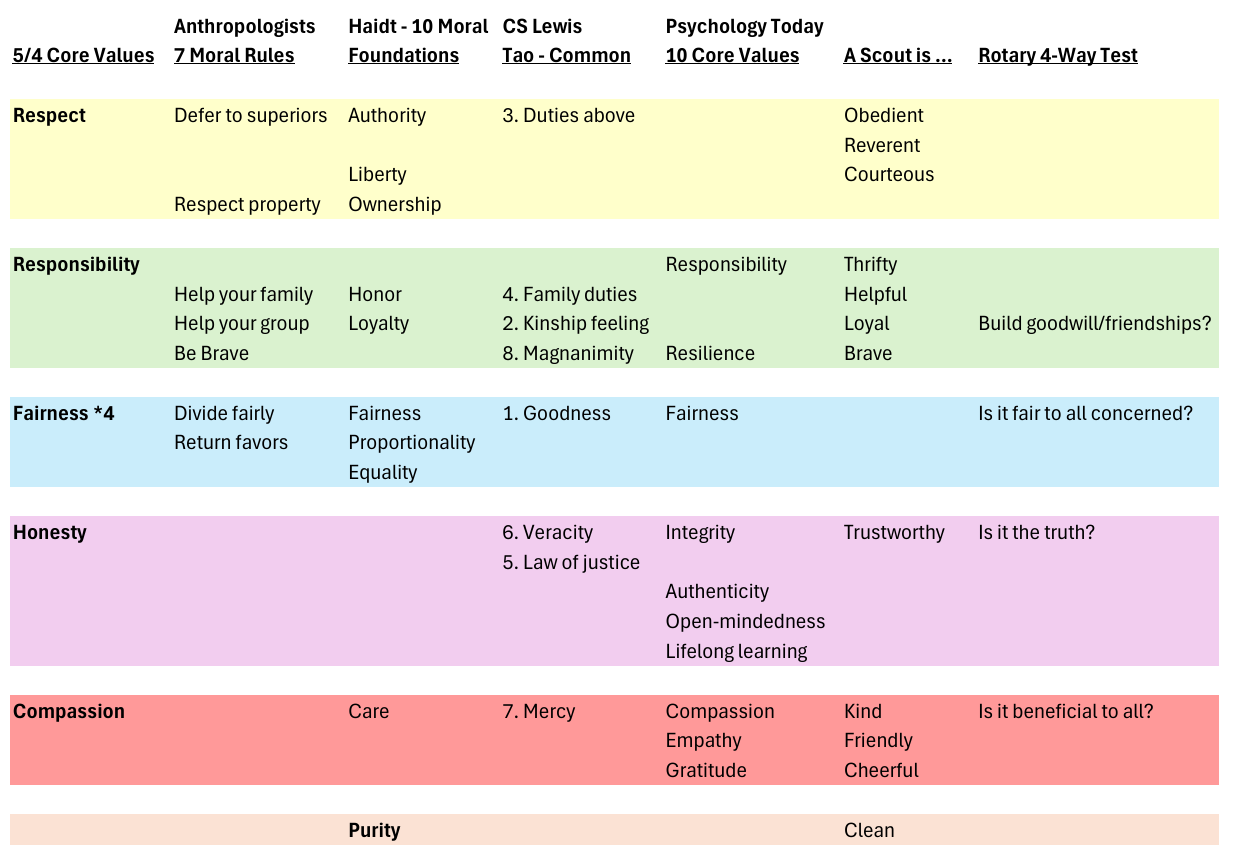
Corporate “core values” experts trying to find the essences so they can be easily taught. Anthropologists looking for the most widely seen values. The evolutionary psychologist Jonathan Haidt. Mid-century philosopher and Christian apologist C.S. Lewis claiming that all major civilizations share key ethical principles. Psychology Today advising us on how to best guide our behavior. The Boy Scout Oath. The Rotary 4-Way test.
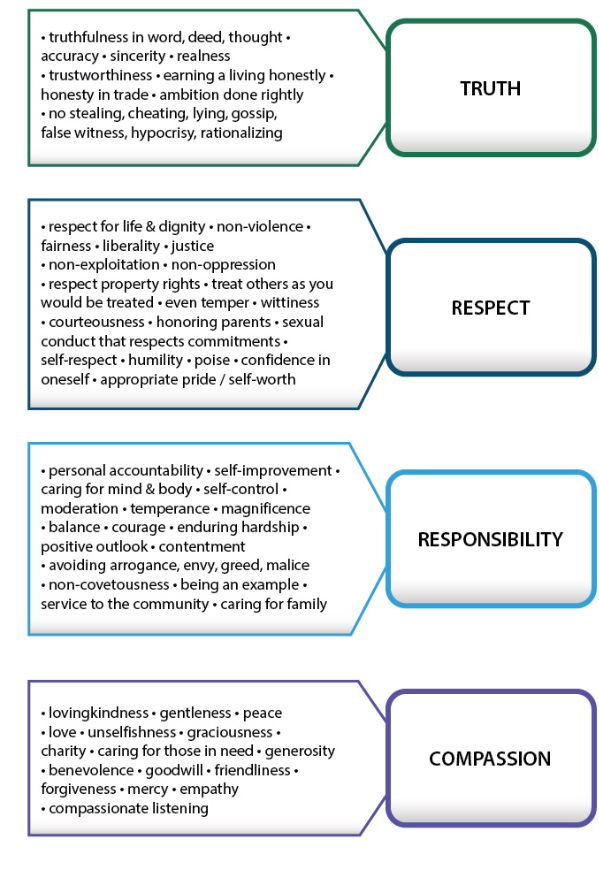
4 self-evident clusters of Respect, Responsibility, Honesty and Compassion. We know what these are. We know they are good and useful. We know that it requires work for children to learn them and for us to put them into practice consistently and effectively.
Another author calls out Fairness as a fifth cluster.
A group of Oxford anthropologists has surveyed the vast literature on cultures and identified 7 universal principles that are almost always evident and never contradicted. They begin to add some second-level definitions to the 5 clusters.
Respect is shown both by “deferring to superiors” and “respecting property”. Responsibility is shown by “helping your family”, “helping your group” and “being brave”. Fairness is exhibited by “dividing fairly” and “returning favors”. This group didn’t see honesty and compassion as universal values.
Haidt’s “The Righteous Mind” introduced the world to a set of moral flavors that varied between traditional and modern (WEIRD) societies and between left and right politicians. His team has added some flavors that have some plausible origin in the development of men from hunter-gatherers through farming and cities. For Respect, Haidt agrees that property ownership rights matter and that respect for authority is critical to holding together communities. Without it, the free rider problem undermines groups. He also argues that “liberty” is the “flip side” of authority. Individuals inherently feel the need to defend their individuality against potentially oppressive authority.
Haidt emphasizes the importance of family, kinship, honor and loyalty in traditional societies. He argues that these values are just as valid as the modern care, fairness and equality trio. He provides 3 flavors of fairness, adding proportionality and equality to the basic idea. He also skips “honesty” and emphasizes “care” as the result of compassion. He adds “Purity” as a separate factor reflecting both biological and religious forms of cleanliness for early men.
In 1943, C.S. Lewis had experienced enough modern analytic philosophy, subjectivity and intellectual progress and fired back with “The Abolition of Man”. He argued that without an objective moral framework, Western civilization was doomed. The Nazi and communist threats mattered. But the breakdown of common culture, values and beliefs within democracy was an equal threat. Lewis argued that a roughly common moral framework and principles existed in every thriving culture. His “natural law” view was not widely embraced at the time.
Lewis’s 8 components of the Tao, or “the way” fit nicely into the 5 clusters. His “duties to parents, elders and ancestors” fits with Respect. He filled out Responsibility with family duties, kinship feelings and magnanimity which emphasized the bravery of making the right decisions. His “law of general beneficence” fills out Fairness. He outlines Veracity as critical to honesty and expands it with the “Law of Justice”. He fills the Compassion group with his Mercy.
A recent Psychology Today article takes a more “personal growth” oriented view. The Respect drawer is empty, although “authenticity” could be seen as a form of self-respect. Dr. Koehler adds resilience to the Responsibility core value and includes Fairness. She adds 3 others to the Honesty cluster after Integrity. A growing individual needs to value authenticity, open-mindedness and lifelong learning. We start to see why there are differences at the second level, but I don’t think they are too great. The author embraces compassion, adding empathy and gratitude to this section.
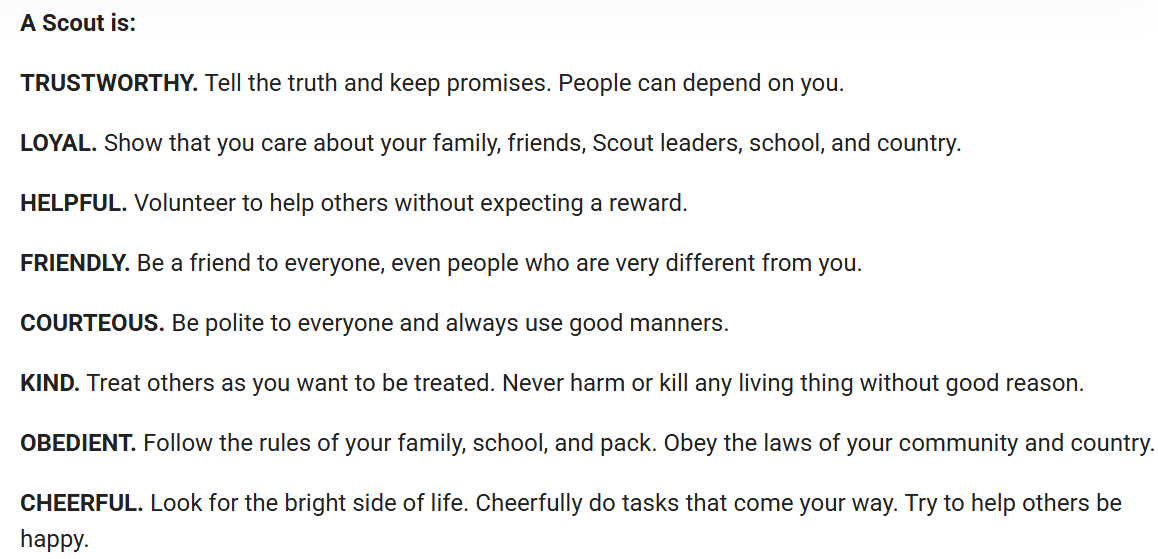
The Scout Oath was drafted in 1908. A Respectful scout is Obedient, reverent and Courteous. A Responsible scout is Thrifty, Helpful, Loyal and Brave. An Honest scout is Trustworthy. A Compassionate scout is Kind, Friendly and Cheerful. A scout is Clean.
The Rotary 4-Way test was drafted in 1932. It fits into 4 of the 5 main categories.
Summary
We have a nice head start on outlining a set of common moral principles that could be used for education, civics, personal growth and community building. The core ideas fit with traditional and modern societies, secular and religious views, left and right politics. The key, as with our political system, is to agree to work within a framework of practical application. We cannot and will not resolve deeply felt religious, philosophical and political views. But we can agree on what it takes to work together and live good lives together.
Especially in these challenging times we have to be idealistic and believe in possibilities.
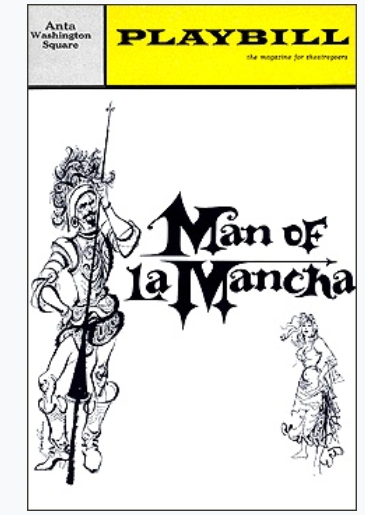
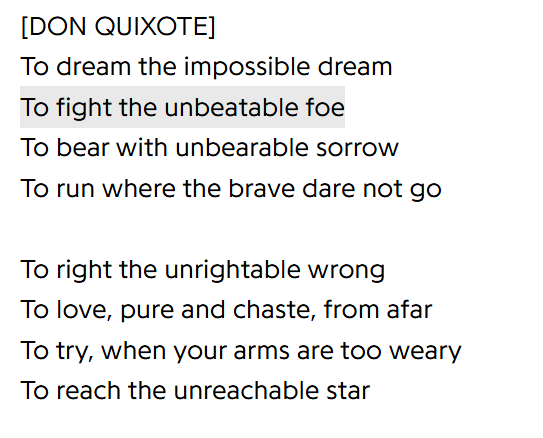
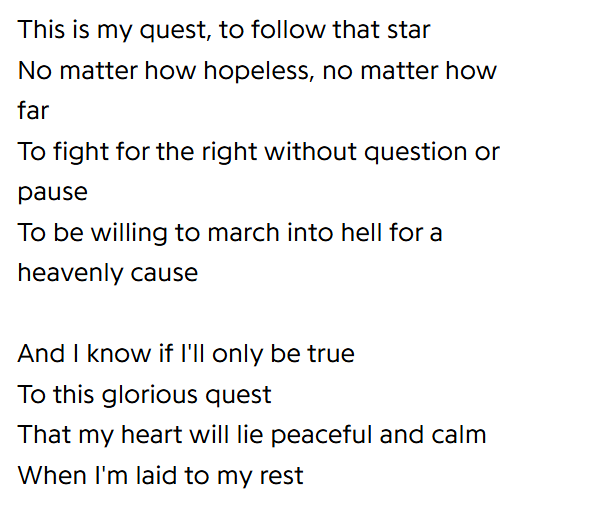
Jim Nabors’ rendition of “The Impossible Dream” on the 1965 Gomer Pyle, USMC show is a great place to start. We’ve become too practical, skeptical, secular and cool to consider this or any similar view on life, derived from the classic 1615 novel Don Quixote. Enjoy!
Jonathan Haidt’s “moral foundations” appear to be deeply rooted in human evolution. Democrats mostly embrace care, fairness and equality. Republicans emphasize the broader menu of loyalty, authority, purity, proportionality, honor, liberty, and ownership. Policy differences are unavoidable.
2. Citizens have differing interests/views in all 4 broad domains of international relations, economics, politics and culture.
3. The basic left/liberal/progressive versus right/conservative/traditional divide has endured for 2 centuries.
4. Social scientists agree that some form of the psychological dimension of “openness” is an important driver of left versus right political views. Individuals who are more intuitive (N)/abstract/open on the second Meyers-Briggs dimension tend to take liberal views. Those with more concrete/specific/applied views tend to be conservatives. Similarly, those who are more Judging rather than Perceiving on the 4th dimension tend to be conservatives, seeing the world in an orderly, structured manner. Meyers-Briggs (T)hinkers tend to be conservative, and (F)eelers tend to be liberal, but this is a weaker statistical link.
5. Philosophers and social scientists have worked intently for 2 centuries to find a “scientific”, objective, rational, modern view of how politics “ought” to be. Classical liberals, including Immanuel Kant and John Rawls, have proposed neutral, allegedly “value free” systems, but they have not been widely adopted.
6. Religious supporters have watched for a new “great awakening” or signs of the “end times” without success.
7. The progressive era of 1880-1920 overturned some of the political machines of the time and replaced them with scientific management style city managers and opposing political forces. “Good government” folks have since proposed and implemented city managers, commissions, outsourcing, sunset laws, zero based budgeting, process improvements and referendums but this has not removed politics from governing.
8. Philosophers have considered and combined pre-Socratic, Socratic, Neo-Platonian, Aristotelian, Augustinian, Aquinian, scholastic and modern views. They have discounted many views but not reached any true consensus on the important questions. We remain at a stalemate about the critical questions of the individual vs. community, objective vs. subjective reality, ideal/essential vs. existential/empirical world, natural and/or supernatural world, and a logical/designed vs. random/evolving world.
9. Philosophers and social scientists mostly agree that values, morality and character are inherently subjective. Some religious oriented people, philosophers and social scientists agree that a subset of core values is widely seen and shared, but this view has not gathered followers in the last half-century.
10. Classical liberals argue that the US system of democracy and representative government with “checks and balances” is fully adequate to guide society in making solid public choices. This group argues that the citizens can embrace the underlying required pluralistic political values without having to make further choices about broader cultural values. Conservatives and a growing number of moderates and liberals today complain that this approach offers a morality that is too “thin” to support a culture or a political system in the long run.
11. Perceived scarcity is not going to disappear soon, even with continued economic growth and 70 years’ worth of such predictions. Everyone remains interested in getting their fair share of the growing pie.
12. Class interests have not been destroyed. If anything, the life experiences between the top 1%, 10%, 20% and the middle 60% or the bottom 20% have diverged even further apart in the last 75 years. Although we don’t discuss “class” as an organizing principle for politics in the US, it has grown to become more important.
13. Social scientists have a much better understanding of “human nature”. We are imperfect. We have personality preferences. We can flex and learn but only so much. Nature and nurture. Tremendous potential. Education and experience are insufficient to create “perfect” citizens who can easily overcome our inherent political differences.
Despite the great progress of Western Civilization, we do not have and are very unlikely to find a single solution to our political differences. As individuals we have deeply experienced, considered and felt views of how our community should best operate. They are mutually inconsistent. We can work together to resolve some differences and agree to compromise on others. The apparently valid and opposing views don’t have an obvious resolution. I recommend that we constructively work together to find reasonable, decent compromise solutions and at the same time accept our inability to find an ideal solution without allowing that to discourage us.
We have lost control of our political system and confidence in our institutions. I offer some root cause reasons for this situation in a series of posts. Sixth and final post in the series.
In 1943, Abraham Maslow outlined a theory of human motivation that argued that some factors are so important that they must be “satisfied” in order for individuals to pursue other human needs. “Safety and security” was the second layer, just above meeting physiological needs. When I review my first five attempts to get at the “root cause” of our challenging current situation and my remaining list of important factors, I conclude that insecurity may be THE root cause. If we are truly insecure, we will do “whatever it takes” to find security.
Let’s start at the highest level. Following the “progress” of the last 500 years, we are now expected to make important and consequential choices for ourselves in all areas of life: religion, politics, career, retirement, investing, insurance, health, recreation, leisure, marriage, parenting, sexuality, personal finance, consumption, travel, experiences, education, goals, personal expression, arts, branding, friends, community, communications, entertainment, media, social networks, privacy, tolerance, philosophy, clothing, transportation, food, hobbies, housing, banking, OMG! Today, we also have many more options within each category. We have better information and tools, but conflicting priority perspectives and uncertainty about how to find shortcuts. In total, we’re overwhelmed with no solution in sight [maybe AI]. This ongoing situation undercuts any basis for feeling deep security.
Science
Think of science as an expanding sphere or globe. The more we know, the more there is to add to our knowledge. By 1800, we had reached the limit of any man or woman “knowing everything”.
This does not trouble most people directly. Scientific advances since 1800 are estimated to have doubled every 15 years. That’s 15 more doublings or 32,768 times more knowledge since we first reached the limits of human understanding! Implicitly, this must trouble most people greatly. We are overwhelmed by a complex world that we cannot comprehend.
So … science provides us with better understanding and tools. It provides structure and some certainty. It also provides unexpected uncertainty. Modern science bears little resemblance to Newtonian classical mechanics. It is all probability, complexity, and unavoidable uncertainty. About one-third of high school students complete a basic physics course. Perhaps 5% of Americans complete a single college physics course. We tend to think of the world in simple, materialist terms, but scientists since Einstein’s 1910 results do not support this world view. We want certainty, but scientists no longer provide it.
War, pandemics, plague, nuclear war, food shortages, water pollution, air pollution, food processing contamination, cancer, thalidomide, vaccines, hexavalent chromium, sarin gas, fluoride, extinctions, global warming, sea level rise, climate extremes, solar flares, electrical outages, runaway thermonuclear reactions, ozone layer thinning, acid rain, global government agencies, multinational corporations, non-governmental organizations. So many threats, highlighted by the media and various interest groups. Great uncertainty for all.
Economic Life
Economic scale grows. Specialization increases. Everyone must engage with the system. We all become cogs in the machine. We are dehumanized.
Economic stability is weak. Greater economic competition and change. International competition. Loss of large company support for employees. Increased technological changes and disruptions. Administrative, engineering, process and legal changes. Regulatory changes.
Corporate competition. Mergers & acquisitions. Outsourcing. Work automation and obsolescence. Job insecurity.
Weakened effective safety net from government.
Meritocracy focuses the minds of parents, children and adults on careers only. We worry.
Consolidation of income and wealth leading to further power consolidation through economic, social and political channels.
Increased financial leverage through availability of credit. More individuals have high fixed payment requirements and the risk of bankruptcy in hard times.
Capitalism continues to offer diverse goods and services to meet every need and desire. The commercial mindset pervades society.
Technological innovation offers an unlimited supply of new goods and services.
Personal Life
We have generally embraced Rousseau’s perspective on life. Each individual is born with infinite potential. Our job is to help each child achieve their potential and destiny, leveraging their talents. They have the capacity to “be, all that you can be”. Unfortunately, the individual needs to be validated by someone. They don’t have direct access to a transcendent religion or philosophy or community. Hence, they have to reach out to “society” for validation. They create a personal brand. They gain clicks. It is never enough. They are insecure.
Philosophy
We live in a secular age where all belief is insecure.
We have a great diversity of theological and experiential religious perspectives. This helps some and undermines faith for many others.
Western society has considered “progress” as a substitute for religion for 4 centuries. The economic, political, scientific, and communications advances provide a background for the belief that there is a “pattern” to history and it is inevitably heading in the right direction. The backlash in the 20th century has been strong based upon the world wars, Great Depression and the horrors of totalitarianism and technology.
We experienced some return to faith in progress in the post – WW II period and at the end of the Cold War. However, “the end of history” marked by the permanent victory of democracy, capitalism and globalism was very short-lived.
Politics
Our political parties are fluid. The civil rights act of 1964 shattered the Democratic party. The Vietnam War, riots, the counterculture and Kent State shootings reoriented the parties. By 1981 Reagan consolidated conservatives of national, Main Street, Wall Street, philosophy. libertarianism, religious, cultural, and international flavors to form a new enduring majority to replace the previous FDR majority. By 1994 Newt Gingrich installed an oppositional view against President Clinton. The polarization of politics grew from there. A black and white, right versus wrong, good versus evil view grew upon the singular yardstick of left versus right, conservative versus liberal. The mass media splintered into politicized pundits. Politicians embraced a world where perception is reality. The ends soon justified the means. A simple “red versus blue” perspective was promoted and adopted. Civility, trust, consensus, reason, fairness, tradition, and the American way declined. The 2008 mortgage debt meltdown created the populist “tea party”. The Republican party absorbed this populist group and revised its policies, accelerating towards populist and nationalist views with candidate Trump in 2016. Some citizens find security in their political party, but a vast majority decry the polarized situation.
Culture
The majority of cultures through time and around the world have been “traditional”. European civilization since 1700 is the outlier, deemed WEIRD by Johnathan Haidt. Western, educated, industrialized, rich and democratic. Traditional cultures emphasize group-oriented loyalty, authority and sanctity more than the individual-oriented care and fairness factors.
During the 18th, 19th and first half of the 20th centuries, the common Christian cultural background allowed European and American societies to explore and embrace this individualistic dimension without abandoning the group-oriented values, traditions or Christianity. After WWII and especially after the countercultural 1960’s, the loose consensus on culture has been shattered. Many historical norms have been challenged or overturned in the areas of marriage, sexuality, gender, race, parenting, government authority, male authority, church authority, institutional authority, music, art, drugs, religious belief, history, tolerance, human rights, life, relativism, subjectivism and objective morality. The cultural changes were broad, deep and disorienting. They have been celebrated, accepted or opposed. Culture, religion and politics have become aligned in a secular versus religious, liberal versus conservative, traditional versus modern/postmodern way.
We have multiple cultures based on this major split, but also based upon age, social/professional class, and geography (rural/urban/suburban) (coastal, Midwest, Sunbelt). Some people find security in their smaller culture. Many are disoriented by the multiple options and the conflicts between the cultures. Modern media capabilities allow us to live in isolated ways or to engage in fighting to promote our culture and oppose other cultures.
The changes since WWII have reduced our participation in communities of all types while increasing our focus on the individual. Many people no longer have the support of meaningful community ties.
Modern man is surrounded by uncertainty as he is forced to make more decisions in more areas with more choices than ever before. Most of us try to ignore the surrounding forces and live our lives day to day as best as we can. We implicitly adopt some kind of philosophy of life. We stay busy. We pursue goals. We consider the changes in our worlds. But the underlying tensions make life difficult. Economic and personal striving are a cultural norm. Polarized politics is hard to avoid. It’s difficult to relax, center and fully engage in life. We treasurer peace and certainty. We’re still looking for answers that work well in a world filled with options and choices.
We have lost control of our political system and confidence in our institutions. I offer some root cause reasons for this situation in a series of posts. Fifth post in the series.
The modern world has largely solved the problems of science and economics. Our political and religious solutions compete to solve 4 big remaining human challenges.
Facing death.
Finding a purpose beyond self.
Being affirmed.
Living as a social being in community.
Secular Humanism / Personal Growth
Be stoic, heroic, transcend through your worldly life. C-
Link to humanity, universe, reach for excellence, find personal purpose. C
Focus on this first, find support, promote yourself, find supporters. C-
Link up with peers, communities of interest, demographic groups, limited liability. C
Populism / Common Man / Common Sense
Ignore, stay busy, be stoic, accept, find a church, avoid it. C
Focus on day to day, local experience, controllable, be good, craftsmanship. C+
All are equal, victim, local commonality, work support, politics, reinforcing groups. B+
Neighborhood, work, sports groups. Church and political groups. B
Authoritarianism / Nationalism / Traditionalism
Ignore, stay busy, link to greater cause(s), embrace religion. B
Link identity to nation, politics, church, culture, class, history. A-
Reinforcing groups, against “others”, merge identity with group. B+
Deepen ties to family, neighborhood, church, class, region, sports. B
Libertarianism / Free Market
Stoicism, heroism, results, engaged, avoid. C
Elevate self, hero, superman, freedom, liberty, choice principles. B
Glorify God, love neighbor, golden rule, laws, spirit. A
Created in God’s image, child of God, baptism, congregational support. B+
Local congregation ties, ministries, activities, catholic church, ecumenicism. B
Summary
No major “solution” fully solves all of these 4 main challenges. The “science versus religion” split is deep. Some individuals combine multiple views to create a better solution. In “A Secular Age” individuals have to make choices about what to believe. They have to sort through conflicting views and information. They have to define and prioritize their goals. Without a dominant or obvious social choice, they have to determine how they will make such philosophical, political and religious choices, even if it is to not make a choice. We have an opportunity to reform our public schools and other institutions to help us make these choices and to embrace our neighbors who make different choices.
We have lost control of our political system and confidence in our institutions. I offer some root cause reasons for this situation in a series of posts. Fourth post in the series.
Classic liberal state, individual rights, liberty, freedom, fairness, justice
No era of human history has been perfect but “Western civilization” experienced net cumulative progress in its self-understanding, capabilities, confidence, positivity, justice and use of effective institutions for several centuries.
History Undermining Total Confidence in Any Single, Simple Cultural, Religious or Political Worldview
Natural disasters, plagues, wars, evil and oppression.
Religious conflicts, denominations, global religions, secular humanism, Deism, institutional failures.
Promise and obvious experienced shortcomings of utopian solutions such as socialism, communism, fascism, globalism, romanticism, environmentalism, and eugenics.
Rise of the modern nation state as an effective context for community, government, commerce, loyalty and security, followed by its totalitarian abuse, demonization of others and splintering into smaller geographic, religious and ethnic states.
The amazing, sustained progress of science and technology to “solve” all problems, followed by the realization that it cannot solve moral, political and social problems and that it creates many new ethical, commercial, and political challenges.
The sustained global economic progress driven by urbanization, industrialization, finance, administration, capitalism, government regulation and trade raising living standards, offering opportunity, improving health and reducing poverty, without reaching a clear consensus on how to capture the benefits of economic progress without being overwhelmed by the exploitative, unequal, monopolistic, political capture, environmental and cultural downsides.
The shock of the Great Depression and the 2 world wars to the popular, business and elite confidence that economic, social, global, military, political, educational, scientific and cultural progress was inevitable. The global successes of the post-war era and the collapse of the Soviet Union provided a very brief renewal in faith in progress and “the end of history”.
Philosophy worked very hard to keep up with the progress of science but has ultimately failed. Most of philosophy has been absorbed by science and social science. It provided some support for modern religion, science, arts and politics in the early modern period. It also offered deep skepticism about religion, objectivity, causality, and language. It didn’t solve “nature versus nurture”. It didn’t resolve idealism, essentialism, rationalism versus empiricism, pragmatism, existentialism. It provided us with several flavors of individualism, including Rousseau’s positive view of man outside of society. It served up Hegel’s historical/dynamic view, Marx’s insights and nonsense, Nietzsche’s replacement of God with Superman and the final retreat to logical positivism, materialism and postmodernism.
The expansion of individual rights has been a signature strength of the last 500 years. The true essential equality of individuals is broadly embraced. Race, gender, ethnicity, religion, class, social status, wealth, property, profession, sexuality, customs, appearance, and education are generally respected. Yet, we humans discriminate and prejudge upon such categories. Efforts by idealistic and minority groups to offset such shortcomings are hotly contested.
Major Options Today
Religious belief. The default secular worldview limits this approach to understanding the world and making important choices. Fundamentalist right to progressive left.
Personal growth. Design your life and your children’s lives to “be all that you can be”. You will have to look outside for validation of your progress. You may not find guidance by looking inward. You may find that you need community and links to eternity and the universe.
Libertarianism. Free market capitalism. Anti-government. Liberty. Freedom. Ayn Rand, Milton Friedman, Friedrich Hayek, and Ludwig von Mises developed a positive version of this worldview. It is embraced by a large share of the Republican party today. It is fundamentally anti-community and anti-religion. It elevates a single dimension of philosophy and morality above all others: economic liberty.
Populism. The “little guy” is exploited by “the elites”. A victim perspective. Farmers, peasants, factory workers, and small business owners take this perspective. In our individualistic, opportunistic, competitive, meritocratic, commercial, secular world all people need to justify their progress. We all “know” that we are “above average”, like the inhabitants of Garrison Keillor’s Lake Wobegon. If we don’t reach our goals, someone or something else must be to blame.
Authoritarianism. The world is too complex. We need a “great leader”.
Postmodernism. The powerful use every possible tool to oppress others. All minority groups are victims of the “ruling class”. Most modern philosophies, institutions and language are tools. Enlightened professors in the humanities and social sciences are waiting to lead the next revolution.
The Center Remains Missing
The Republican party has moved far right, embracing libertarianism, free markets, cultural conservatism and populism. The Democratic party and other cultural elites have been tempted by postmodernism, expected demographic trends and special interest groups. They have failed to provide a compelling mainstream alternative to the Republican party since Reagan and Gingrich. Socialists like Bernie Sanders, Elizabeth Warren and Alexandria Ocasio-Cortez win headlines. Democrats have consistently lost the framing battle, competing on shifting terms favorable to Republicans. They have failed to find a positive core message like opportunity, progress, pluralism, balance, rule of law, will of the people, decency, justice, reasonable fairness, shared winnings, sustained growth, win/win, security, or mutual interests.
I would also argue that a simple proposal to maintain the benefits of our historical political systems could be compelling and adequate for a supermajority of citizens and voters.
I return to Jonathan Haidt’s work on the moral foundations of politics and religion. The BIG change in human history is from a broad portfolio of factors in most historical and global societies to the WEIRD perspectives supported in part of the Western world: care, fairness and equality alone. “Liberals” now mostly ignore loyalty, authority, purity, proportionality, liberty, honor and ownership while “conservatives” wisely appeal to all of these moral flavors.
Western civilization has embraced rationality, science, and individualism. It has gone too far, forgetting about community and eternity/universality. Skepticism has grown as we have learned that no single, simple perspective is adequate to explain our world. There is now a risk that we reject all structured knowledge. There is also a risk that we embrace intuitive world views and leave rationality and criticism behind. The Republican party has managed to keep the various flavors of conservatism aligned in a far-right view. Democrats are unable to offer a compelling alternative to the general public.
The United States maintained a strong religious worldview among its people and its elites for generations longer than Europe. The U.S. saw a surge in religious belief, membership and participation as the baby boomers left behind WWII and the Great Depression and formed new families. The supermajority consensus allowed the country to be nominally secular but effectively Christian. Most individuals did not have to make religious choices. They followed their parents’ choices and adjusted their degree of engagement.
The mid-century counterculture, birth control, liberal theology, higher education experience, arts, music, jazz, women’s rights, war protests, civil rights, abortion rights, sexual revolution, films, globalization, rejection of authority, individual expression, riots, child rearing beliefs, therapeutic psychology, personal growth, commercialism, advertising, drugs, divorce laws, urbanization, anonymity, health, medicine, drive-ins, car access, mass media, common experiences, etc. provided and validated many new options for most life decisions, including religious beliefs and activities.
As Charles Taylor documented in his “A Secular Age”, the possibility of non-belief became possible, then plausible and then the default option among some highly educated people. The “none of the above” option spread throughout society. Religious belief became one choice among many. Each succeeding generation, allowed to choose, became less religious.
Societies, cultures and civilizations work best when citizens hold common beliefs unconsciously. When the default worldview is shared, “life is good”. Religious and philosophical beliefs matter greatly, even if most people don’t consciously address them. The breakdown of a shared worldview triggers several actions. Many “double down” on the historical choices, validating, refining, formalizing, justifying and supporting them. Others search for alternatives. Some look to modify their beliefs to preserve the past and address the new challenges or situation. Others simply “check out”.
We’re living in one of those transition periods. These responses to changes in religion and philosophy play out in all other areas of life: careers, family, interests, leisure, education, arts, community, volunteering, trust, confidence, interactions, dialogue, civics, politics, dress, socialization, health, communications, sports, games, participation, risk-taking, creativity, exploration, myths, history, commitments, lifestyles, experimentation, conformity, skepticism, certainty, ethnicity, nationalism, patriotism, language, the list continues.
Everything becomes fluid and relative or fixed, static and fundamental. Some embrace change and possibilities. Others fight, fight, fight. “Things fall apart, the center cannot hold”. Ouch.
As much as we praise the individual and individual choice as the best expression of human experience, most people are not made for so many choices.
In the US this challenge is exacerbated by the availability of new options for religious belief. Many non-Christian options are available in my community. Is this an opportunity or a threat?
Humans have a strong preference for certainty. “Cognitive consistency” is essential. We look for evidence to confirm our beliefs and ignore conflicting evidence. Radical skepticism and serious relativism are quite unwelcome. We “know we are right”. Yet, we need to be validated by our neighbors and our peers. We need to live our lives based upon our habits. We simply can’t be pursuing the “5 why’s” technique every minute. We have lives to lead. As Jonathan Haidt says, the elephant leads, the rider occasionally influences the elephant.
Daniel Kahneman has the same insight. Our conscious mind simply cannot address everything “logically”. It must use shortcuts, habits and heuristics. It can only rationally address a very small portion of life.
We don’t know what to believe, if we’re honest with ourselves. Kierkegaard’s “leap of faith” still applies but does not satisfy. Skepticism and subjectivism have undermined us. The “rational” Enlightenment and the advances of science have reinforced the expectation of certainty. A perfectly materialistic worldview is deemed possible and promoted by some. The philosophers rejected any supernatural belief, pursued positive, analytical philosophy, saw it was a dead-end, pursued existentialism, saw it was a dead-end, considered postmodernism, saw it was a dead-end.
The scientists continue to move ahead with their highly effective techniques. The philosophers of science and the “science and religion” experts have undermined any proof of materialism or scientism. Science cannot replace religion. They overlap. They work in different dimensions. Oh boy!
Scientists, mathematicians and philosophers have “proved” that we cannot have a deterministic description of the world supported by facts and logic. Ouch! Probability, mystery, uncertainty, perspectives, paradigms, infinities, dimensions, indeterminacy, descriptions, measures, fractal dimensions, imaginary numbers, duality, quantum uncertainty, and artificial intelligence.
We are grasping for a new form of certainty. It has not arrived. [Waiting for Godot?] Red and blue politics are trying to fill the gap, quite poorly. We’re looking for a religious, cultural or artistic break-through. Science alone is clearly inadequate.
We’re looking for a “both/and” solution. Yin/Yang. A toroidal field that supports nuclear fusion. Bittersweet. Sweet and sour. Some new version of Hegel’s thesis, antithesis, synthesis, repeat process. Some version of Hofstadter’s eternal golden braid. Practical/analog and mystical/eternal at the same time.
A double helix that provides a new 3-dimensional structure. A bootstrapping theory that creates life from chemicals. A mechanical or other “explanation” of consciousness.
This ultimate exhaustion of alternatives may lead us back to Christianity!
We have lost control of our political system and confidence in our institutions. I offer some root cause reasons for this situation in this series of posts.
Republicans have driven economic individual extremism, and Democrats have driven social individual extremism. We are unable to balance the individual with the community, morality, culture or religion.
After WWII our leaders worried greatly about the extinguishment of the individual by our culture, religion, businesses, government and universities. These large organizations were so large, effective and results-oriented that they could not encourage or allow individual freedom. They would necessarily enforce social conformity, even in a capitalist democracy. The 20th century’s totalitarian societies, George Orwell’s 1984 and Aldous Huxley’s Brave New World greatly disturbed thought leaders. Liberals and conservatives worried about different aspects, but the core concern was universal. Consider The Organization Man, The Man in the Grey Flannel Suit, The Hidden Persuaders, The Road to Serfdom, Atlas Shrugged and The Lonely Crowd. Very surprisingly, the “individual” was unleashed in the next half century and became God.
Mick Jagger struggled with the conflict between competing powers. He embraced the tension and moved ahead. Freddie Mercury simply declared victory. Complete victory.
The individual alone as God is not a solid base for our society or any society.
We are polarized because we all “know” that we are right. We don’t have solid experience working with others in community or government to resolve differences. We don’t reach our goals, and then we look to blame someone else or claim victim status. We lock into media sources that reinforce our views. We only connect with individuals just like ourselves. We pursue only individual goals and are frustrated they are not affirmed. We emphasize consumer and producer goals and complain about “the rat race”. We don’t participate in civic life, complain that politics is ineffective and look for someone to solve our problems. We are not experienced managing complex situations, so we look for simple answers to complex questions about politics and the meaning of life.
I believe that our society has adopted a radically individualist perspective without being aware that “it” has made these choices and transmitted its choices though our culture. Historically, conservatives have been the main promoters of the “community” complement to individualism, but I don’t see any possibility for our current conservative party to effectively fulfill this role in its populist, nationalist, xenophobic, capitalist, commercialist, elitist, authoritarian, transactional state. Liberals have not been exceptionally strong promoters of “community” or community organizations other than the central state historically, but I will argue that 6 core liberal objectives require strong communities and community organizations for success. I have broached this subject in 3 other recent articles.
Strong economic agents often have the ability to misuse their economic resources in all dimensions. They can shape political, governmental, judicial and administrative choices. They can use their power to obtain greater than market returns/rates from labor, suppliers, competitors, lenders, investors, partners, universities, not for profits, professional, managerial and executive staff, nations, non-governmental organizations, immigrants, children, minorities, women, disabled and other low power groups. Strong players can treat other agents purely as means and ignore their humanity. Strong players can shape products, product markets, delivery channels, advertising, marketing and communications to take advantage of human weaknesses in making economic decisions. Radical liberals argue that these abuses are inherent and extreme. Most liberals point to the evidence of historical abuses to support their concerns about concentrated power and advocate for controls, laws, checks and balances, counterweights, information, regulation, expectations, legal opportunities, etc.
Community plays a major role in politics through political parties, unions, community organizations, interest groups, industry associations, professional organizations, government employee organizations, journalist associations, media associations, universities, teachers’ organizations, PTO’s, legal associations, social services organizations, community foundations, churches, civic organizations, social organizations, veterans’ organizations, etc. Individuals who have experience as members, volunteers, funders, leaders and beneficiaries of organizations are likelier to participate in other organizations and believe that organizations make a difference in the political process at all levels.
Community organizations and select industries also play a crucial role in shaping the implicit political, economic, social and moral beliefs of our society. Capitalism, free markets, democracy, liberty, progress, America, opportunity, God, federalism, government, regulation, rule of law, entrepreneurship, free trade, unions, populism, presidential power; the list of concepts and their proper roles is long. Education, university education, churches and religion, mainstream media, other media, entertainment industry, arts, music, professions, industries, youth and college organizations, political communications, etc. The list of influencers is long. Groups, organizations and community matter.
Most importantly, community experience shapes our beliefs regarding the relationship between the individual and the community. We currently emphasize the economic, social, personal development and political rights of individuals. We de-emphasize the rights of communities and organizations and the responsibilities of individuals who “belong” to these organizations. We emphasize individual choice, tolerance, rights and “limited liability” commitments.
The modern right has embraced the “pure” capitalist system as the primary defender of all individual rights, liberties and freedoms. Natural “laissez faire”. Social Darwinism. Anti-communism. Anti-totalitarianism. Anti-government. Anti-regulation. Anti-centralization. Entrepreneurship. Road to Serfdom. Job creators. Greed is good. Wealth is good. Lives of the rich and famous. Horatio Alger. These stories, ideologies, politics, myths, principles, policies, science, and beliefs are centrally important to individuals adopting a view of the role, risks and control of economic power.
Liberals tend to point towards the universal, abstract dimension. The nation. Global humanity. The rational view points towards the highest level as the most effective way to outline or solve problems. The national community is suspect because of fascist risks. Perhaps a proper national community could be used to support liberal views. Lincoln, FDR and Kennedy embraced the nation. The global community may be useful for religious or abstract politics, but it is seen as highly important by only a very small slice of our citizens.
Communities of interest are more important. These organizations shape both political activity and the underlying views of the people.
(2) Abuse of Political or Cultural Power
“Liberals” have mostly discounted the risks of state power, even after the many examples of totalitarian atrocities on the left and right. Yet philosophically this concern was at the heart of “classical liberalism”, which created the relatively low power American national government (even on the second try). The power of the state, the military, the draft board, the DOJ, the FBI, the police, the courts, the national guard and the imperial president were major concerns for liberals in the 1960’s. The power of “the state” to monitor the activities of ordinary citizens was also an issue in the 1960’s and 1970’s as the actions of the CIA and Nixon’s government were revealed. In the second Trump administration many liberals are once again wisely worried about centralized political power.
The use of community organizations in politics is critical as noted above.
Liberals are generally much more concerned about the role that culture can play in indoctrinating individuals to support and comply with a single view of citizenship, politics, religion, culture, law and life. The 1950’s (!) and 1960’s cultural revolution or counterculture was largely about protecting the individual from the forces of conformity to the nation, big business, commercial society, small towns, and religion.
Following Rousseau, liberals believe that individuals have great potential for personal growth and creativity. This expression of individual potential holds a mystical, infinite, divine quality. Forces that constrain this journey should be opposed. Those who support the use of human possibilities must be supported.
I think this is a critical point to reconsider. Government, religion and cultural institutions do have the power to overreach in favor of the views of the powerful actors in society. They can support pure capitalism, nationalism, populism, elitism, religious conformity, commercialism, pragmatism, materialism, etc. They can also support the liberal world view: balance, true individual rights, justice, opportunity, equality, peace, diversity, global community, progress, improvement, human rights. Community, organizations and institutions are tools. They can be used by any political, moral, economic, pragmatic, interest or social group to advance their interests.
As noted in the prior section, organizations are essential to the political process. There is a risk that political and cultural organizations will align to support conservative political views, even the most extreme, fundamentalist, literalist, constraining, oppressive, unequal, static, wasteful, impersonal ones that liberals oppose.
Undermining the role of “community”, of local organizations, of communities of interest, does not help to oppose the ongoing march of conservatives towards a highly structured system that supports the rule by the successful over the rest. The existence of a wide variety of healthy organizations is essential to provide a counterbalance against a single worldview becoming dominant and oppressive.
Historically, philosophical conservatives were MOST concerned about society, the nation, God, tradition, community, family, race, history, avoiding disaster, etc. They wanted to preserve the positive aspects of the inherited society. The individualist, rationalist views of the “Enlightenment” were not embraced. … Until it became clear that the kings, church, nobility, and landed aristocracy were going to be replaced by the new elites of capitalism, trade, ownership, law, university, and denominations. Then, the conservatives “changed horses” to the new winners in modern society. The individualistic strain of economic life in capitalism became supreme. The true “community” dimension of religion, local community, guild, union, charity, service, parish, precinct, tradition, protection, festivals, saints, colleagues, heroes, handicrafts, debt forgiveness, tithes, noblesse oblige, leadership, extended family, common law, music, art, food, dress, language, etc. became much less important. Daniel Bell argued that the “cultural contradictions of capitalism” made it impossible for any society based on pure capitalism to survive or thrive.
There is an inherent conflict between social and economic conservatism. The first elevates community. The second elevates the individual. Ronald Reagan was able to combine both strands into a single loosely defined worldview. He argued that traditional American social values are consistent with “free market” economics. Republicans through Trump have managed to maintain the same conglomeration of incompatible views.
Republicans have managed to win the political wars. Democrats have managed to win the culture wars. The Republican cultural counteroffensive is alive today. Anti-trans rights. Public choice education. Anti-mainstream media. Anti-elite. Anti-university. White nationalism. So-called Christian nationalism.
Cultural values are transmitted through communities, organizations, government, laws, businesses, work experience, political experience, family, friends, and colleagues. Democrats would be wise to invest resources in developing and communicating community supporting world views.
Liberals worry about the ability of conservatives to use “human nature” to manipulate citizens. Consider Jonathan Haidt’s moral foundations theory. Humans inherently respond to moral, political and religious calls based on loyalty, authority, purity, honor and ownership. Liberals highlight care, fairness, and equality and some degree of liberty and proportionality. They believe that Western civilization has moved beyond the other 5 values and that politicians who appeal to citizens on these dimensions are merely hucksters. They worry about the framing of issues, groupthink, victimhood, low education, low information, selfish citizens.
Liberals worry about a “least common denominator” world view, and its use by politicians. Fundamentalist, legalistic, fixed religion. Simple slogans. Survival. No change. Polarization. Unthinking either/or. Local/provincial. Commercial. Conventional. Bourgeoisie. Selfish. Self-interested. Unquestioning. Following. Cheering. Uncritical. Short-term. Blindly following “experts” or leaders. Blindly individualistic. Elevating history and personal experience. Family, clan and tribe. They believe that every individual is capable of personal growth and seeing a broader, more abstract perspective of life. Rousseau once again. Infinite possibilities for all. Individuals who do not pursue the great possibilities of life are seen as living a false consciousness. This is most explicit in Marxism and postmodernism but part of mainstream liberal thought.
Liberals tend to embrace the abstract, idealistic views of Plato, Descartes, Locke, Rousseau, Spinoza, Hegel, Marx and Kant. They believe that a single well-defined worldview must be right. They struggle with the messy applied views of Aristotle, Jesus, Hume and Dewey. Normal humans are nearly all on the applied, analog, pragmatic, complex, unfinished, uncertain end of the spectrum.
In all of these areas, culture is transmitted through community. A very small share of people study, or even sample philosophy, theology, sociology, economics or political science. Fewer yet study literature, history, art or the humanities.
“Cultural conservatives” have highlighted the importance of community organizations in transmitting culture. Now, they want to politicize previously neutral or secular institutions. Public schools, libraries, judges, FBI, DOJ, BMV, sheriffs, public health, emergency preparedness and response, private schools, election boards and officials. Moderates and liberals must evaluate and respond to these initiatives. How do we preserve important institutions as truly neutral? What political effort is needed for those that must be politicized?
Until Trump-times, liberals did not need to worry about the basic structure of the American government. The rule of law. Political norms. Objectivity. Facts. Logic. Conscience. Character. Historical traditions. Bipartisan American foreign policy. Voting rights. Civil rights. Freedom of the press. Freedom of religion. Checks and balances. Pride of the Senate. Independent judiciary. Protected federal workers. Nonpartisan military. Independent agencies like Federal Reserve Board. American commitment to allies. American commitment to treaties. In a flash, Trump has used the skepticism of Descartes, Hume, Nietzsche, the existentialists and postmodernists to propose a truly radical world of only “might makes right” without any constraints. Hegel to the infinite power. A portion of the electorate and one party and that party’s leadership and key supporters have embraced this worldview, perhaps without understanding everything that it implies.
We have important cultural beliefs to consider. Strong, dynamic, engaged, tense, battle tested, creative, robust, forward-thinking groups of citizens are needed to formulate alternative views and oppose these challenges to the progress of modernity, Western civilization and classical liberalism.
(3) A Broken Political System
Our government does not deliver its core services. Government is not efficient or effective compared with private sector firms and industries. Government fails to reflect the will of the people, even when it is strong and clear. The political system has been captured by politicians who have structured the rules to highlight politicians’ re-election and power. The political system has been captured by influential interest groups. Political competition is based on communications rather that content. The political system does not encourage or reward participation by the people. Political parties seek their own best interests rather than the nation’s best interests. The political system strongly favors the status quo. The political system strongly favors the interests of the powerful, wealthy and well organized versus the popular will. Strong forces are able to shape administrative implementation of laws.
Our two-party system is broken. Our media system is broken. Trust in the government at all levels and in all functions has been systematically undermined as a deliberate strategy by one political party.
Community institutions are required to overcome this situation. Political parties, interest groups, churches, community organizations, social welfare organizations, not for profits, professional organizations, industry organizations, states, counties, metro areas, global organizations, environmental organizations, patriotic organizations, veterans’ organizations, civil rights organizations, lifestyle organizations, local charities and United Ways, children’s organizations, youth organizations, fraternities, sororities, civic organizations …
Western civilization improved the opportunities and results for its citizens and the whole world from 1500 through 1914. The world wars, fascism, communism, totalitarianism and the great depression undermined public and intellectual confidence in “progress”. The post-WWII era recovered confidence in slow, sustained global progress based on the “western consensus” of mixed-market capitalism, democracy and international trade. The 9/11 terrorist attacks, the market failure based great recession, the rise of China’s state-oriented system, political polarization, mixed lessons from a global pandemic, rogue Russia, Iran and North Korea, global warming/climate change threats, and BREXIT withdrawal from the European dream have once again undermined our sense of progress. We face challenges, big challenges. Is our political system up to the challenge?
Historically, America has responded to global or conceptual challenges with revised political structures. We seem to be stuck in a trap. Only community organizations that aim to recover the principle of the government reflecting the general will of the people can lead the way. As Americans, we believe in manifest destiny and American exceptionalism. We can do whatever it takes to succeed. That is our history and our calling.
(4) Loss of Human Dignity
Our culture today focuses on personal growth, development, creativity and possibilities. Yet all individuals have an intense need to be validated for both their performance and their selves. Our society provides many ways to support the results of personal growth but only a few that embrace the individual directly.
A market economy requires us to fill the role of economic man as a specialized producer, employee, investor, property owner, trader and consumer. The economic value of the role is recognized. Only for those in the “creative class” is the individual even partially seen as a human being rather than merely “human capital”. Consistent compliance with the various economic roles is required, so they tend to “crowd out” other ways of thinking.
The market determines the “value” of all things in purely economic terms. The meritocracy funnels us into the highest “value added” activities which don’t often match our talents, personalities or interests. We set aside those other dimensions of ourselves. We start to view all choices as economic choices, pushing aside personal, social, political or spiritual factors.
We practice instrumental rationality in our decision making in business, science and law. We seek of optimize means for given ends. We balance costs and benefits, risks and rewards, short-term and long-term. This habitual way of thinking is reinforced through our “personal productivity” tools. We optimize our writing, data, reports, calendars, projects, processes, teams and schedules. We adopt this optimizing efficiency and effectiveness perspective. We become more like our computers and machines.
We face challenges of scale. Huge bureaucracies in business, government, and nonprofit organizations. They are large and process driven. Most have systematized, automated and optimized their “user interfaces” to the point where connecting with another human is nearly impossible. Some organizations do invest in making “self-service” easier, but the net effect is that we become “cogs in the machine” in order to transact our required daily activities. This is not new, but the pervasiveness, complexity and lack of options accumulates.
Organizations struggle to make individual choices with individual customers, employees, partners or suppliers. In general, a standard process is more effective, less risky and approved by the legal department. A decision-tree outlines all possibilities. Front-line employees, even highly paid professionals, are less empowered to make “business decisions” based upon all factors. This undercuts both the former decision makers and their partners.
Our meritocratic culture highlights the best, the winners, the exceptional, the superb, the most creative or unusual, the leaders, those who have overcome adversity. The focus is mainly on the end results of the few, rather than the common human experience of all. The demands of the meritocracy cause all human activities to be evaluated for resume and career building. No time for the person, the spirit, community, friends, art, health or fun.
We measure everything. What gets measured gets done. Helpful human measures are rare.
Our culture provides very weak philosophical answers. A secular age. Pure materialism. Skepticism, agnosticism, atheism. Pure subjectivism and radical tolerance. Utilitarian, calculating measures of pleasure and pain. Mainly scientific, instrumental, transactional psychologies. Anxiety revealing existentialism and postmodernism. Universities and public intellectuals that have undermined religion.
Our politics has devolved into simple red versus blue tribe allegiances, discouraging efforts at innovation, finding common ground, understanding, empathizing, communicating, or cooperating. Many feel their identities as men or women, whites or blacks, rich or poor as being imposed upon them rather than being chosen.
That’s pretty depressing. Fortunately, we humans are tough. We find some community and validation at home, school, work and other organizations. We use our tools. We squeeze in “real life”. We “check out” from the structures. Overall, we don’t get as much affirmation as we desire, especially in a word focused on personal growth.
There are solutions to address our situation. Legislation and social pressures for human, labor, consumer and patient rights. Traditional and experiential education on community, decision making, spirituality, consumer economics, personal finance, team building, leadership, multiple intelligences, talents, wisdom, creativity, goal setting, planning, leadership, boundaries. A more complex, structured, incentive slanted world requires individuals to understand their situation and what they can do to survive and thrive.
These are classic “liberal” priorities. Protected and well-educated individuals are best positioned to combat the intrusion of external forces that impinge on their humanity. Improved forms of community are needed to support a political party that is focused on the needs of all individuals. New forms of community education and experience are required for the “lifelong learning” needed to build so many competencies, frameworks, tools, insights and wisdom.
I believe that most demographic, class, philosophy and interest groups within the conservative tent have these same experiences with modern life. They hope for a return to an earlier age when the existing institutions were better prepared to help with this most important dimension of human life. I think most really understand that there is no “going back” to the 1950’s exactly as it was. We need to upgrade our institutions and communities to make life better. This is an area where creative bipartisan efforts can deliver great value.
(5) A Feeling of Weakened Security and Opportunity
The classical liberal emphasis on human rights, from the “bill of rights” through the recognition of minority rights in the last century is at risk. The “rule of law”, independent judiciary, political norms, civil service, career service, military, agencies, property and other structural components of our political system are at risk in a society that has lost the memory of the wars against fascism and communism. Modern “liberals” allowed “conservatives” to ensure that schools, civic clubs, youth organizations and editorialists would reinforce this critical component. Today, we need a “coalition of the willing” from both parties to protect these guardians of our security.
Post-Reagan America grudgingly accepts a government funded patchwork social safety net. Since 1981, the economy has become more dynamic, specialized, competitive and international. Employees have lost their informal “rights” to lifelong employment, fixed benefit pensions, stakeholder influence, seniority, respect for tribal knowledge, camaraderie, etc. Firms, factories, offices, roles and contracts “come and go”. Firms outsource, import and contract as required. Americans approved the “Reagan Revolution” two generations ago. The social safety net has not been adjusted to match the reality of employment insecurity today. Community organizations that once provided important parts of the “safety net” now play a much smaller part. All employees feel insecure. George W. Bush opened the door for both parties to embrace conservative means to liberal ends with the outline of “compassionate conservatism”. Liberals might find this compromise solution more effective than the current political stalemate that creates a widening gap between personal insecurity and social solutions.
Overall, our economy continues to provide opportunities for employment and ownership. Political parties argue about equal opportunity for different groups, changes in opportunities and the right degree of opportunities.
Our culture offers mixed messages about opportunity. We highlight those who succeed from all backgrounds. We celebrate innovation, creativity, output and entrepreneurship. We support change management as a required part of a dynamic economy. We celebrate American exceptionalism and the growth of opportunity, liberty, and prosperity. We tell our children that they can become anything that they want to be. We have been a confident society.
The politics of equal opportunity has highlighted the real challenges for those who possess less economic, family, neighborhood, education, language, confidence, communications or cultural assets in a competitive world. Slower economic growth for the bottom and middle thirds of the economy for 50 years has dented confidence. Polarized politics makes the economy and other national contexts more negative when the other party is in power. The replacement of a religious culture with a secular culture makes the economy the dominant or only factor in assessing the future. There is a “victimhood” strand within our culture that disconnects many fellow citizens when they experience difficult times. Our media driven world highlights the negative, simple and exceptional stories, overshadowing the long-term progress that continues to be made in most areas of life. The post-1960’s, Vietnam, Watergate mind is ironic and skeptical. We find it difficult to “believe” in progress, institutions or trust. The increased scale of society leads some individuals to doubt that they have any agency whatsoever. Some individuals find cultural, political and business support for “diversity” a threat to their personal opportunities.
Liberal leaders enjoy taking the critic’s role. In this case, we need to define, promote, communicate, implement and sustain a renewed confidence in our society, politics, economy and personal lives. Liberals need to be advocates and promoters. The message has to be based on reality and believable. We have strengths in our society and can develop new ones. This core socialization function is naturally provided through universities, opinion leaders, media, schools, civic organizations, churches, youth organizations, neighborhoods and local governments.
(6) Destroying the Great Vampire Squid of Unbridled Capitalism
The power and influence of a truly “laissez faire” capitalist system is the root cause of the 5 liberal issues above. (1) Unconstrained economic agents use and abuse their power. Competitive markets are strong forces. Large firms are stronger, smarter, more creative and enduring. (2) The individualist, commercial “free enterprise” system inherently undermines “community” as a force to conserve culture. (3) Economic interests tend to capture the political system and eventually undermine its basic operations. (4) The mature technological economic system undermines our humanity. (5) The fully empowered economic system threatens human rights, security and opportunity.
The root cause of these problems is that a pure market system, unconstrained by law, politics, regulators, religion, culture, history, options, unions, cooperatives grows too strong. There is no limit to corporate size and rewards but the incentives for growth remain. There is no limit to market share without anti-trust laws and enforcement. There are no limits to opportunities from political capture without spending and lobbying regulations. There are no limits to judicial and election manipulation. There are no limits to supplier, labor and customer squeezes. There are no feedback mechanisms to constrain the beast once it has overcome political and cultural/social limits.
There are even more negative consequences that we see today.
The economic system becomes so dominant that it simply excludes all competitors. We see a “race to the bottom” of countries, states and municipalities lining up to incentivize powerful firms to do business by cutting taxes and regulations, reducing labor and environmental burdens and offering subsidies. Employees lose union rights and then even basic employee rights as they become reclassified as contractors. Firms squeeze suppliers down to marginal cost pricing. They collect fees for the “right” to do business with them.
The large scale integrated economic system becomes so dominant that alternatives are eliminated. Everyone must use the banking system. Small scale firms must use the main economic system for supplies, services, logistics, and distribution. Only a small number of suppliers remain for each product or service. Individuals find it difficult to disconnect from the grid.
The system also comes to dominate the culture philosophically. Individualism and commercialism undermine institutions and community. Instrumental, scientific, objective cost-benefit reasoning comes to dominate thinking and become the default way of seeing the world. Utilitarianism, libertarianism, materialism, pragmatism, existentialism and atheism become attractive philosophies. Philosophical conservativism is replaced by winning.
The threat of losing in a meritocratic system with weak safety nets and the need for public affirmation of winners leads to lives devoted to economic success and the exclusion of all else.
Extreme views like “social Darwinism” return. Greed is good. A “winners are good, losers are bad and deserve to lose” view becomes socially acceptable. “Every man for himself” is considered wisdom. All relations become transactional. The pursuit of self-interest is honored. “The end justifies the means” is accepted as valid in all spheres of life. The “great man” theory of history and leadership is adopted. All relations are considered win/lose, even when win/win options are obvious. “Might makes right” is seen as self-evident in all arenas.
In 1992 Francis Fukuyama confidently proclaimed the “end of history” and the permanent victory of Western capitalism and democracy. In the last 30 years Western capitalism has continued to grow, manage technical revolutions and dominate the global economy while other nations have also grown significantly, driving the greatest reduction of poverty in human history. We have not seen the “end of history”. The powerful economic system systematically undermines those who confront it and usually wins. The results for society are mixed, unacceptable and unstable.
I don’t believe that the powerful interests of unchecked capitalism can be overcome by political tactics or specific reforms alone. I think that they can only be offset when a majority of Americans understand, in some fashion, the threat which this radical ideology and extreme, revolutionary political force poses to our nation and society. It requires a credible political alternative. It requires a groundswell of support for rule by the people interpreted as a solid majority of 60%. It requires idealistic liberals to embrace this centrist bias for the good of society.
We live in the greatest economic society in history. We have the ability to grow, trade, solve global problems and provide greater economic opportunities for all and a more effective safety net without reducing the incentives that drive the economic machine.
To reach these goals, we need to gain broad consensus on the need for balance in our politics. We have 6 political camps in the US: far left, center-left, center, center-right, far right and undecided. We can turn this into dozens by looking at economic, cultural, military, international and philosophical dimensions. We’re not going to get 60% to the left or to the right in the US, even by its relatively conservative political standards compared with other developed countries. We are stuck with each other. We are blessed to live in the first country that embraced the “classical liberal” political system with its “checks and balances” approach. This is an inherently cautious, socially and economically conservative system, but it allows for change when it must occur.
We are at one of those times in history. We must find another “New Deal” that preserves the economic goose that lays the golden eggs, while taming the goose so that she does not become the golden goddess. To do this, we need leadership. We need conversations and interaction. We need trust. We need “liberals” to embrace community and culture as important and valid shapers of public opinion. We need to agree on a revised political system. We need to support community institutions that shape, reinforce and reward cultural beliefs. Laws and education are not enough. Real people learn by experience, examples, stories, friends, neighbors and community leaders who they trust. There is no great leader, communications, tagline, brand, flag, music, framing, research, program or legal shortcut.
Summary
I think that radical individualism is the curse of our time. “A pox on both your houses”. Liberals have over promoted social individualism while conservatives have over promoted economic individualism. Unbridled capitalism is the root cause of many of our society’s challenges. I encourage liberals to overcome their historical suspicion of “community” as merely an agent of the Church, priests, kings, lords, landlords, capitalists and merchants. The “classic liberal” political model only supports a “thin” set of moral values promoting the state, separation of church and state and tolerance. That is not enough to offset the power of wealth in the modern capitalist economic system. The financial stakes are much too high in a $27 Trillion economy with 20 million millionaires. Large financial interests will always win and expand to infinity … unless we have some kind of broader agreed upon framework. I believe we can embrace such a framework only if we leverage communities to send, consider and support such a message.
Historically, liberals have welcomed change, considered new ideas, experimented, innovated, broken idols, destroyed sacred cows, valued reason and confidently believed in a better future. Finding a way to make “community” a central part of our politics, economics and society is a new opportunity to apply those values.









 Good News